SPRINT EXECUTION Bachan Anand  [email_address] http://agile.conscires.com/ Slides prepared by Indu Menon, Neeta Singh and Vanessa Brown
Agenda Overview of Agile and Scrum Scrum Overview Sprint Execution Q&A Please dial in to (218) 895-4640  PIN: 3289145 http://agile.conscires.com/
Overview of Agile and Scrum Please dial in to (218) 895-4640  PIN: 3289145 http://agile.conscires.com/
Overview of Agile and Scrum Agile Manifesto Agile is a set of values: Individuals and interactions over processes and tools Working software (Products) over comprehensive documentation Customer collaboration over contract negotiation Responding to change over following a plan Please dial in to (218) 895-4640  PIN: 3289145 http://agile.conscires.com/
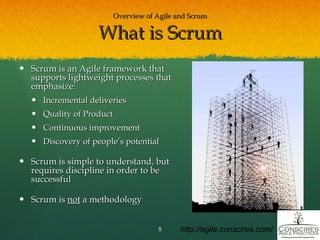
Overview of Agile and Scrum What is Scrum Scrum is an Agile framework that supports lightweight processes that emphasize: Incremental deliveries Quality of Product Continuous improvement Discovery of people’s potential Scrum is simple to understand, but requires discipline in order to be successful Scrum is  not  a methodology http://agile.conscires.com/
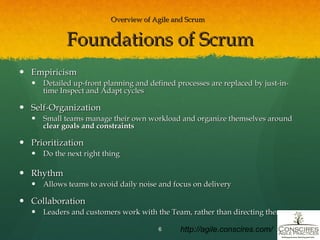
Overview of Agile and Scrum   Foundations of Scrum Empiricism  Detailed up-front planning and defined processes are replaced by just-in-time Inspect and Adapt cycles Self-Organization Small teams manage their own workload and organize themselves around  clear goals and constraints Prioritization Do the next right thing Rhythm Allows teams to avoid daily noise and focus on delivery Collaboration Leaders and customers work with the Team, rather than directing them http://agile.conscires.com/
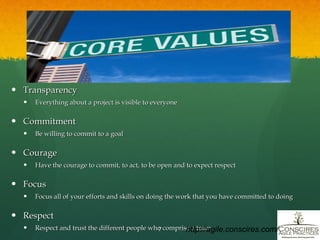
Transparency Everything about a project is visible to everyone Commitment Be willing to commit to a goal Courage Have the courage to commit, to act, to be open and to expect respect Focus Focus all of your efforts and skills on doing the work that you have committed to doing Respect Respect and trust the different people who comprise a team http://agile.conscires.com/
Scrum Overview
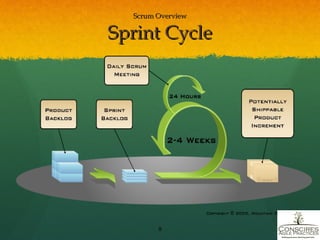
Scrum Overview Sprint Cycle
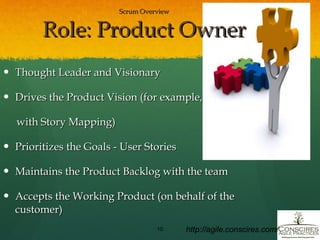
Scrum Overview Role: Product Owner Thought Leader and Visionary Drives the Product Vision (for example, with Story Mapping) Prioritizes the Goals - User Stories  Maintains the Product Backlog with the team Accepts the Working Product (on behalf of the customer) http://agile.conscires.com/
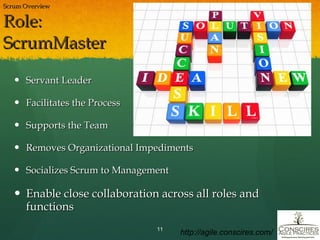
Scrum Overview Role: ScrumMaster Servant Leader Facilitates the Process Supports the Team Removes Organizational Impediments Socializes Scrum to Management Enable close collaboration across all roles and functions http://agile.conscires.com/
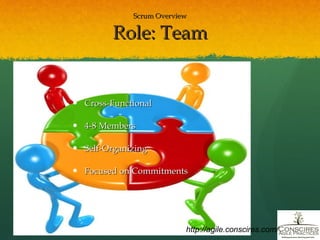
Scrum Overview Role: Team Cross-Functional  4-8 Members Self-Organizing Focused on Commitments http://agile.conscires.com/
Sprint Execution
Sprints Basic unit of development in the  Scrum  development methodology Scrum projects make progress in a series of  “sprints” last between one week and one month http://agile.conscires.com/
Sprints Continued Are a "time-boxed" (i.e. restricted to a specific duration) effort of a constant length. A constant duration leads to a better rhythm Product is designed, coded, and tested during the sprint http://agile.conscires.com/
Timeboxing …why? helps the team and organization in focusing on clear goals. to cause movement and to set an expectation that we will limit the time and energy spent in any one direction guide line in how we break work down into tasks or execution.  to avoid gold platting or excessive polishing of an item or thing. http://agile.conscires.com/
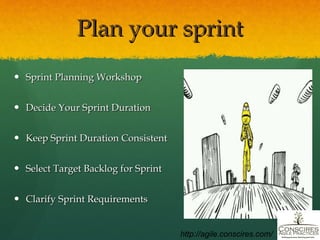
Plan your sprint Sprint Planning Workshop Decide Your Sprint Duration Keep Sprint Duration Consistent Select Target Backlog for Sprint Clarify Sprint Requirements  http://agile.conscires.com/
Sprint Planning Team selects items from the product backlog they can commit to completing Sprint backlog is created Tasks are identified and each is estimated (1-16 hours) Collaboratively, not done alone by the ScrumMaster High-level design is considered http://agile.conscires.com/
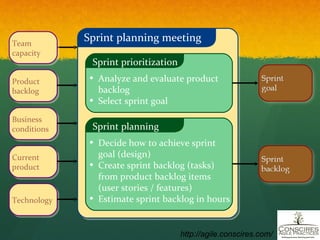
Sprint planning meeting Business conditions Team capacity Product backlog Technology Current product http://agile.conscires.com/ Sprint prioritization Analyze and evaluate product backlog Select sprint goal Sprint planning Decide how to achieve sprint goal (design) Create sprint backlog (tasks) from product backlog items (user stories / features) Estimate sprint backlog in hours
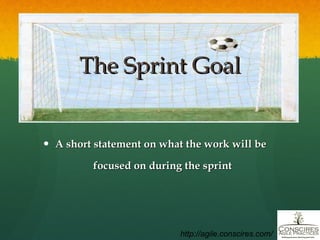
The Sprint Goal A short statement on what the work will be  focused on during the sprint http://agile.conscires.com/
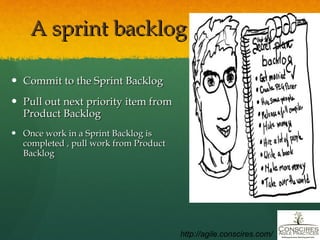
A sprint backlog Commit to the Sprint Backlog  Pull out next priority item from Product Backlog  Once work in a Sprint Backlog is completed , pull work from Product Backlog http://agile.conscires.com/
Managing the Sprint Backlog Individuals sign up for work of their own choosing Work is never assigned Estimated work remaining is updated daily Any team member can add, delete or change the sprint backlog Work for the sprint emerges If work is unclear, define a sprint backlog item with a larger amount of time and break it down later Update work remaining as more becomes known http://agile.conscires.com/
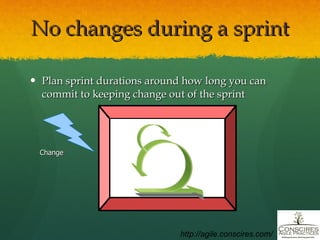
No changes during a sprint Plan sprint durations around how long you can commit to keeping change out of the sprint Change http://agile.conscires.com/
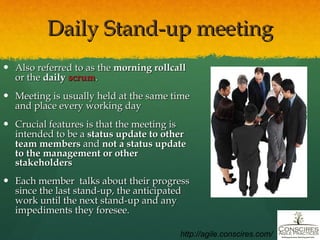
Daily Stand-up meeting Also referred to as the  morning rollcall  or the  daily  scrum . Meeting is usually held at the same time and place every working day Crucial features is that the meeting is intended to be a  status update to other team members  and  not a status update to the management or other stakeholders Each member  talks about their progress since the last stand-up, the anticipated work until the next stand-up and any impediments they foresee. http://agile.conscires.com/
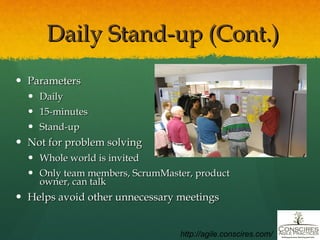
Daily Stand-up (Cont.) Parameters Daily 15-minutes  Stand-up Not for problem solving Whole world is invited Only team members, ScrumMaster, product owner, can talk Helps avoid other unnecessary meetings http://agile.conscires.com/
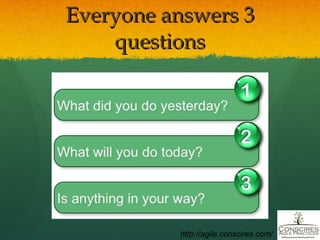
Everyone answers 3 questions http://agile.conscires.com/
What is This Meeting For? Tasks Synchronize the various team members Identify required help and common areas of work Impediments Raise new impediments Pair impediments with people Ensure past impediments are being taken care of To identify technical issues http://agile.conscires.com/
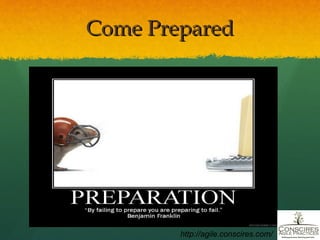
Come Prepared http://agile.conscires.com/
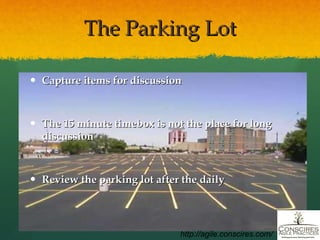
The Parking Lot Capture items for discussion The 15 minute timebox is  not  the place for long discussion Review the parking lot after the daily http://agile.conscires.com/
The Impediments List “ Anything that prevents a team member from performing work as efficiently as possible” - from Victor Szalvay’s article  “Glossary of Scrum Terms”   Rule of thumb : at least one impediment a day How do we generate impediments? Understand what an impediment is and make sure the team understands as well Ask "why are there no impediments today?" Hanging notes from the ceiling to entice the team If all else fails…beg   http://agile.conscires.com/
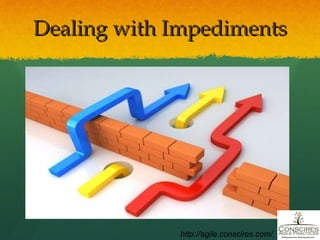
Dealing with Impediments http://agile.conscires.com/
Bad Smells of Daily Scrum Storytelling Reporting to the SM Accounting for time rather then goals Invisible (electronic) task board Not raising impediments Not handling impediments Not helping each other Low Energy Who goes first? Cell phones on. Laptops open. People “checked out.” http://agile.conscires.com/
Loss of Rhythm - Symptoms Daily Scrums are skipped or meeting times vary  Sprint durations are inconsistent or change arbitrarily mid-sprint  Sprint planning is inconsistent or drifts  Sprint planning meetings are skipped  http://agile.conscires.com/
Promote Rhythm Sustainable pace Leads to focus Be consistent  Reference:  http://www.scrumalliance.org/articles/34 http://agile.conscires.com/
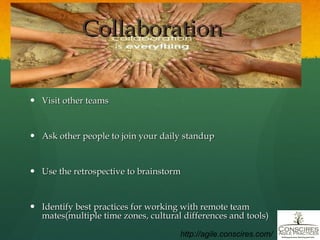
Collaboration Visit other teams Ask other people to join your daily standup Use the retrospective to brainstorm Identify best practices for working with remote team mates(multiple time zones, cultural differences and tools) http://agile.conscires.com/
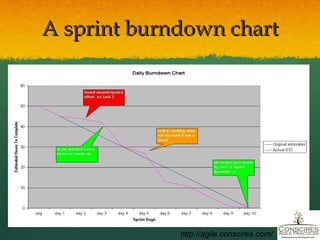
Monitor Sprints Burndown and Burn Rate Report Taskboard Mid-Sprint checkpoint. Reference: http://developagile.com/post/760163969/monitoring-a-sprint-in-the-agile-scrum-world http://agile.conscires.com/
A sprint burndown chart http://agile.conscires.com/
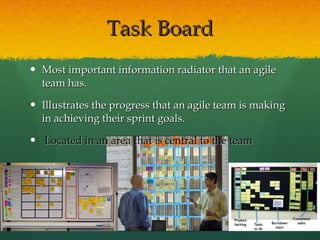
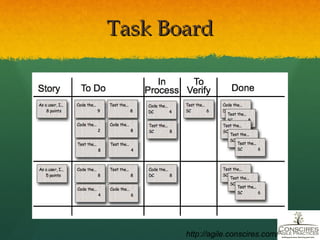
Task Board Most important information radiator that an agile team has.  Illustrates the progress that an agile team is making in achieving their sprint goals. Located in an area that is central to the team
Task Board http://agile.conscires.com/
The Sprint Review Team presents what it accomplished during the sprint Typically takes the form of a demo of new features or underlying architecture Sprint Retrospective Informal 2-hour prep time rule No slides Whole team participates Invite the world http://agile.conscires.com/
How do you  learn Scrum – By Doing? Apply few practices at a time Understand the values and foundations Inspect and Adapt Experience the Joy of Doing Scrum http://agile.conscires.com/
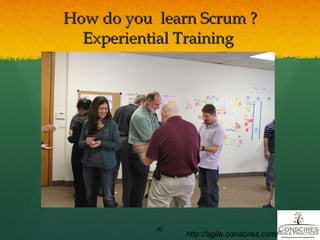
How do you  learn Scrum ? Experiential Training  http://agile.conscires.com/
Pay-it-forward / Donation only trainings 1 day Agile & Scrum Training Denver/Boulder, CO  - July 30 th Irvine , CA - August 12 th San Francisco, CA -Aug 26 th Atlanta, GA - Aug 26 th Boston, MA - Sep 30 th San Diego , CA – Sep 30 th   Las Vegas, NV – Oct 7 th   Seattle, WA - Oct 21 st http://agile.conscires.com/
User groups /Communities ALN – Agile Leadership Network Scrum Alliance – Scrum User Groups Online User Groups Scrum Alliance http://agile.conscires.com/
User groups /Communities APLN – Agile Project Leadership Network Scrum Alliance – Scrum User Groups Online User Groups Scrum Alliance http://agile.conscires.com/
Scrum Certifications  http://agile.conscires.com/
Q & A http://agile.conscires.com/
Donation only 1 day Trainings Denver – July 30 th   http://agile.conscires.com/scrum-1-day-training-denver-03/ Irvine - August 12 th   http://agile.conscires.com/1-day-agile-scrum-training-irvine-05/ Seattle – October 21 st   http://agile.conscires.com/agile-scrum-training-seattle-03/ San Francisco – Aug 26 th   Atlanta – Aug 26 th   San Diego Sep 30 th   Boston – Sep 30 th   http://agile.conscires.com/1-day-agile-scrum-training-boston-04/ http://agile.conscires.com/
Thank you ! More Resources at http://agile.conscires.com/suggested-reading-list-and-resources/ Contact Info Bachan Anand [email_address] 949-232-8900 http://www.linkedin.com/in/bachan http://agile.conscires.com/

Sprint Execution - Stand-up, Taskboard etc

  • 1.
    SPRINT EXECUTION BachanAnand [email_address] http://agile.conscires.com/ Slides prepared by Indu Menon, Neeta Singh and Vanessa Brown
  • 2.
    Agenda Overview ofAgile and Scrum Scrum Overview Sprint Execution Q&A Please dial in to (218) 895-4640 PIN: 3289145 http://agile.conscires.com/
  • 3.
    Overview of Agileand Scrum Please dial in to (218) 895-4640 PIN: 3289145 http://agile.conscires.com/
  • 4.
    Overview of Agileand Scrum Agile Manifesto Agile is a set of values: Individuals and interactions over processes and tools Working software (Products) over comprehensive documentation Customer collaboration over contract negotiation Responding to change over following a plan Please dial in to (218) 895-4640 PIN: 3289145 http://agile.conscires.com/
  • 5.
    Overview of Agileand Scrum What is Scrum Scrum is an Agile framework that supports lightweight processes that emphasize: Incremental deliveries Quality of Product Continuous improvement Discovery of people’s potential Scrum is simple to understand, but requires discipline in order to be successful Scrum is not a methodology http://agile.conscires.com/
  • 6.
    Overview of Agileand Scrum Foundations of Scrum Empiricism Detailed up-front planning and defined processes are replaced by just-in-time Inspect and Adapt cycles Self-Organization Small teams manage their own workload and organize themselves around clear goals and constraints Prioritization Do the next right thing Rhythm Allows teams to avoid daily noise and focus on delivery Collaboration Leaders and customers work with the Team, rather than directing them http://agile.conscires.com/
  • 7.
    Transparency Everything abouta project is visible to everyone Commitment Be willing to commit to a goal Courage Have the courage to commit, to act, to be open and to expect respect Focus Focus all of your efforts and skills on doing the work that you have committed to doing Respect Respect and trust the different people who comprise a team http://agile.conscires.com/
  • 8.
  • 9.
  • 10.
    Scrum Overview Role:Product Owner Thought Leader and Visionary Drives the Product Vision (for example, with Story Mapping) Prioritizes the Goals - User Stories Maintains the Product Backlog with the team Accepts the Working Product (on behalf of the customer) http://agile.conscires.com/
  • 11.
    Scrum Overview Role:ScrumMaster Servant Leader Facilitates the Process Supports the Team Removes Organizational Impediments Socializes Scrum to Management Enable close collaboration across all roles and functions http://agile.conscires.com/
  • 12.
    Scrum Overview Role:Team Cross-Functional 4-8 Members Self-Organizing Focused on Commitments http://agile.conscires.com/
  • 13.
  • 14.
    Sprints Basic unitof development in the Scrum development methodology Scrum projects make progress in a series of “sprints” last between one week and one month http://agile.conscires.com/
  • 15.
    Sprints Continued Area "time-boxed" (i.e. restricted to a specific duration) effort of a constant length. A constant duration leads to a better rhythm Product is designed, coded, and tested during the sprint http://agile.conscires.com/
  • 16.
    Timeboxing …why? helpsthe team and organization in focusing on clear goals. to cause movement and to set an expectation that we will limit the time and energy spent in any one direction guide line in how we break work down into tasks or execution. to avoid gold platting or excessive polishing of an item or thing. http://agile.conscires.com/
  • 17.
    Plan your sprintSprint Planning Workshop Decide Your Sprint Duration Keep Sprint Duration Consistent Select Target Backlog for Sprint Clarify Sprint Requirements http://agile.conscires.com/
  • 18.
    Sprint Planning Teamselects items from the product backlog they can commit to completing Sprint backlog is created Tasks are identified and each is estimated (1-16 hours) Collaboratively, not done alone by the ScrumMaster High-level design is considered http://agile.conscires.com/
  • 19.
    Sprint planning meetingBusiness conditions Team capacity Product backlog Technology Current product http://agile.conscires.com/ Sprint prioritization Analyze and evaluate product backlog Select sprint goal Sprint planning Decide how to achieve sprint goal (design) Create sprint backlog (tasks) from product backlog items (user stories / features) Estimate sprint backlog in hours
  • 20.
    The Sprint GoalA short statement on what the work will be focused on during the sprint http://agile.conscires.com/
  • 21.
    A sprint backlogCommit to the Sprint Backlog Pull out next priority item from Product Backlog Once work in a Sprint Backlog is completed , pull work from Product Backlog http://agile.conscires.com/
  • 22.
    Managing the SprintBacklog Individuals sign up for work of their own choosing Work is never assigned Estimated work remaining is updated daily Any team member can add, delete or change the sprint backlog Work for the sprint emerges If work is unclear, define a sprint backlog item with a larger amount of time and break it down later Update work remaining as more becomes known http://agile.conscires.com/
  • 23.
    No changes duringa sprint Plan sprint durations around how long you can commit to keeping change out of the sprint Change http://agile.conscires.com/
  • 24.
    Daily Stand-up meetingAlso referred to as the morning rollcall or the daily scrum . Meeting is usually held at the same time and place every working day Crucial features is that the meeting is intended to be a status update to other team members and not a status update to the management or other stakeholders Each member talks about their progress since the last stand-up, the anticipated work until the next stand-up and any impediments they foresee. http://agile.conscires.com/
  • 25.
    Daily Stand-up (Cont.)Parameters Daily 15-minutes Stand-up Not for problem solving Whole world is invited Only team members, ScrumMaster, product owner, can talk Helps avoid other unnecessary meetings http://agile.conscires.com/
  • 26.
    Everyone answers 3questions http://agile.conscires.com/
  • 27.
    What is ThisMeeting For? Tasks Synchronize the various team members Identify required help and common areas of work Impediments Raise new impediments Pair impediments with people Ensure past impediments are being taken care of To identify technical issues http://agile.conscires.com/
  • 28.
  • 29.
    The Parking LotCapture items for discussion The 15 minute timebox is not the place for long discussion Review the parking lot after the daily http://agile.conscires.com/
  • 30.
    The Impediments List“ Anything that prevents a team member from performing work as efficiently as possible” - from Victor Szalvay’s article “Glossary of Scrum Terms” Rule of thumb : at least one impediment a day How do we generate impediments? Understand what an impediment is and make sure the team understands as well Ask "why are there no impediments today?" Hanging notes from the ceiling to entice the team If all else fails…beg  http://agile.conscires.com/
  • 31.
    Dealing with Impedimentshttp://agile.conscires.com/
  • 32.
    Bad Smells ofDaily Scrum Storytelling Reporting to the SM Accounting for time rather then goals Invisible (electronic) task board Not raising impediments Not handling impediments Not helping each other Low Energy Who goes first? Cell phones on. Laptops open. People “checked out.” http://agile.conscires.com/
  • 33.
    Loss of Rhythm- Symptoms Daily Scrums are skipped or meeting times vary Sprint durations are inconsistent or change arbitrarily mid-sprint Sprint planning is inconsistent or drifts Sprint planning meetings are skipped http://agile.conscires.com/
  • 34.
    Promote Rhythm Sustainablepace Leads to focus Be consistent Reference: http://www.scrumalliance.org/articles/34 http://agile.conscires.com/
  • 35.
    Collaboration Visit otherteams Ask other people to join your daily standup Use the retrospective to brainstorm Identify best practices for working with remote team mates(multiple time zones, cultural differences and tools) http://agile.conscires.com/
  • 36.
    Monitor Sprints Burndownand Burn Rate Report Taskboard Mid-Sprint checkpoint. Reference: http://developagile.com/post/760163969/monitoring-a-sprint-in-the-agile-scrum-world http://agile.conscires.com/
  • 37.
    A sprint burndownchart http://agile.conscires.com/
  • 38.
    Task Board Mostimportant information radiator that an agile team has. Illustrates the progress that an agile team is making in achieving their sprint goals. Located in an area that is central to the team
  • 39.
  • 40.
    The Sprint ReviewTeam presents what it accomplished during the sprint Typically takes the form of a demo of new features or underlying architecture Sprint Retrospective Informal 2-hour prep time rule No slides Whole team participates Invite the world http://agile.conscires.com/
  • 41.
    How do you learn Scrum – By Doing? Apply few practices at a time Understand the values and foundations Inspect and Adapt Experience the Joy of Doing Scrum http://agile.conscires.com/
  • 42.
    How do you learn Scrum ? Experiential Training http://agile.conscires.com/
  • 43.
    Pay-it-forward / Donationonly trainings 1 day Agile & Scrum Training Denver/Boulder, CO - July 30 th Irvine , CA - August 12 th San Francisco, CA -Aug 26 th Atlanta, GA - Aug 26 th Boston, MA - Sep 30 th San Diego , CA – Sep 30 th Las Vegas, NV – Oct 7 th Seattle, WA - Oct 21 st http://agile.conscires.com/
  • 44.
    User groups /CommunitiesALN – Agile Leadership Network Scrum Alliance – Scrum User Groups Online User Groups Scrum Alliance http://agile.conscires.com/
  • 45.
    User groups /CommunitiesAPLN – Agile Project Leadership Network Scrum Alliance – Scrum User Groups Online User Groups Scrum Alliance http://agile.conscires.com/
  • 46.
    User groups /CommunitiesAPLN – Agile Project Leadership Network Scrum Alliance – Scrum User Groups Online User Groups Scrum Alliance http://agile.conscires.com/
  • 47.
    Scrum Certifications http://agile.conscires.com/
  • 48.
    Q & Ahttp://agile.conscires.com/
  • 49.
    Donation only 1day Trainings Denver – July 30 th http://agile.conscires.com/scrum-1-day-training-denver-03/ Irvine - August 12 th http://agile.conscires.com/1-day-agile-scrum-training-irvine-05/ Seattle – October 21 st http://agile.conscires.com/agile-scrum-training-seattle-03/ San Francisco – Aug 26 th Atlanta – Aug 26 th San Diego Sep 30 th Boston – Sep 30 th http://agile.conscires.com/1-day-agile-scrum-training-boston-04/ http://agile.conscires.com/
  • 50.
    Thank you !More Resources at http://agile.conscires.com/suggested-reading-list-and-resources/ Contact Info Bachan Anand [email_address] 949-232-8900 http://www.linkedin.com/in/bachan http://agile.conscires.com/

Editor's Notes

  • #8 Doing Scrum mechanics without these values misses the point. These values are not unique to Scrum, but the Scrum Framework is built on top of these values.
  • #10 Sprints are TimeBoxed 1 to 2 weeks Typical duration is 2–4 weeks or a calendar month at most A constant duration leads to a better rhythm
  • #13 Cross-Functional = Dev, QA, Bus Analyst, UI Designer, Architect
  • #32 What" needs to be done "Who" is going to do it "When" they will communicate progress back