EVOLUTION OF SOFTWARE
ARCHITECTURE!
CLOUD NATIVE MICROSERVICE.
VIQUAR MOHAMMED KHAN
2
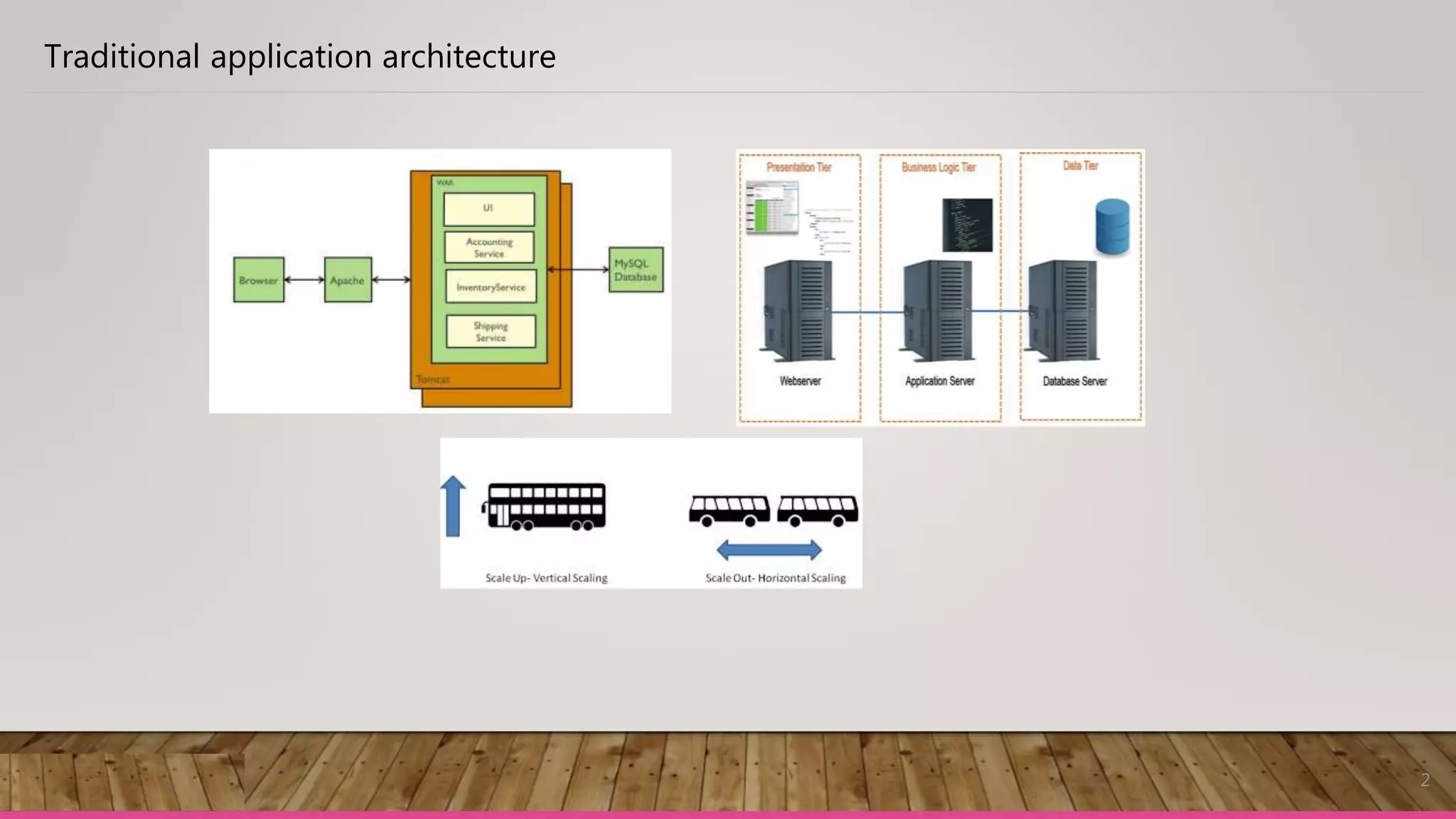
Traditional application architecture
3
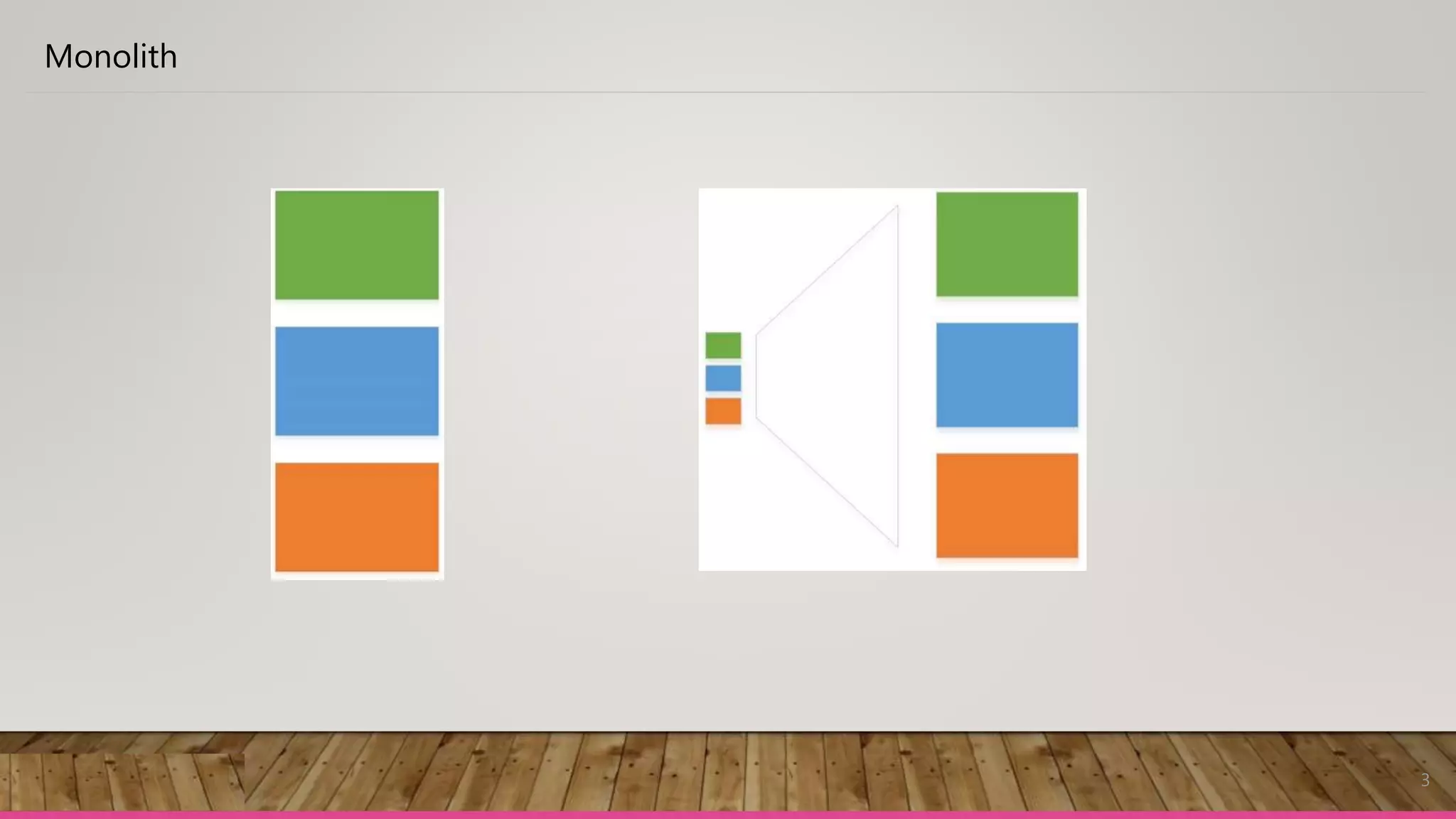
Monolith
4
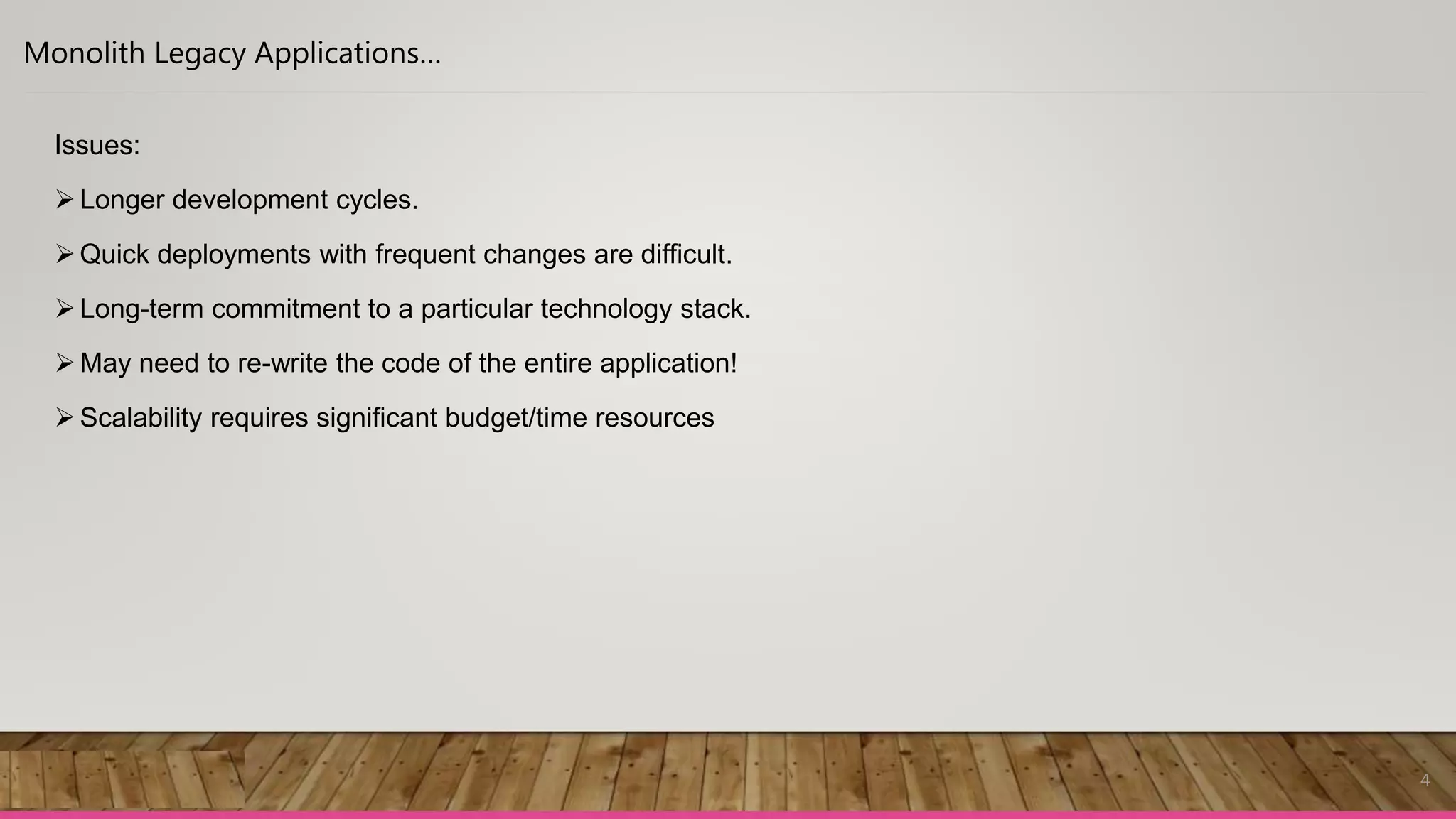
Monolith Legacy Applications…
Issues:
Longer development cycles.
Quick deployments with frequent changes are difficult.
Long-term commitment to a particular technology stack.
May need to re-write the code of the entire application!
Scalability requires significant budget/time resources
5
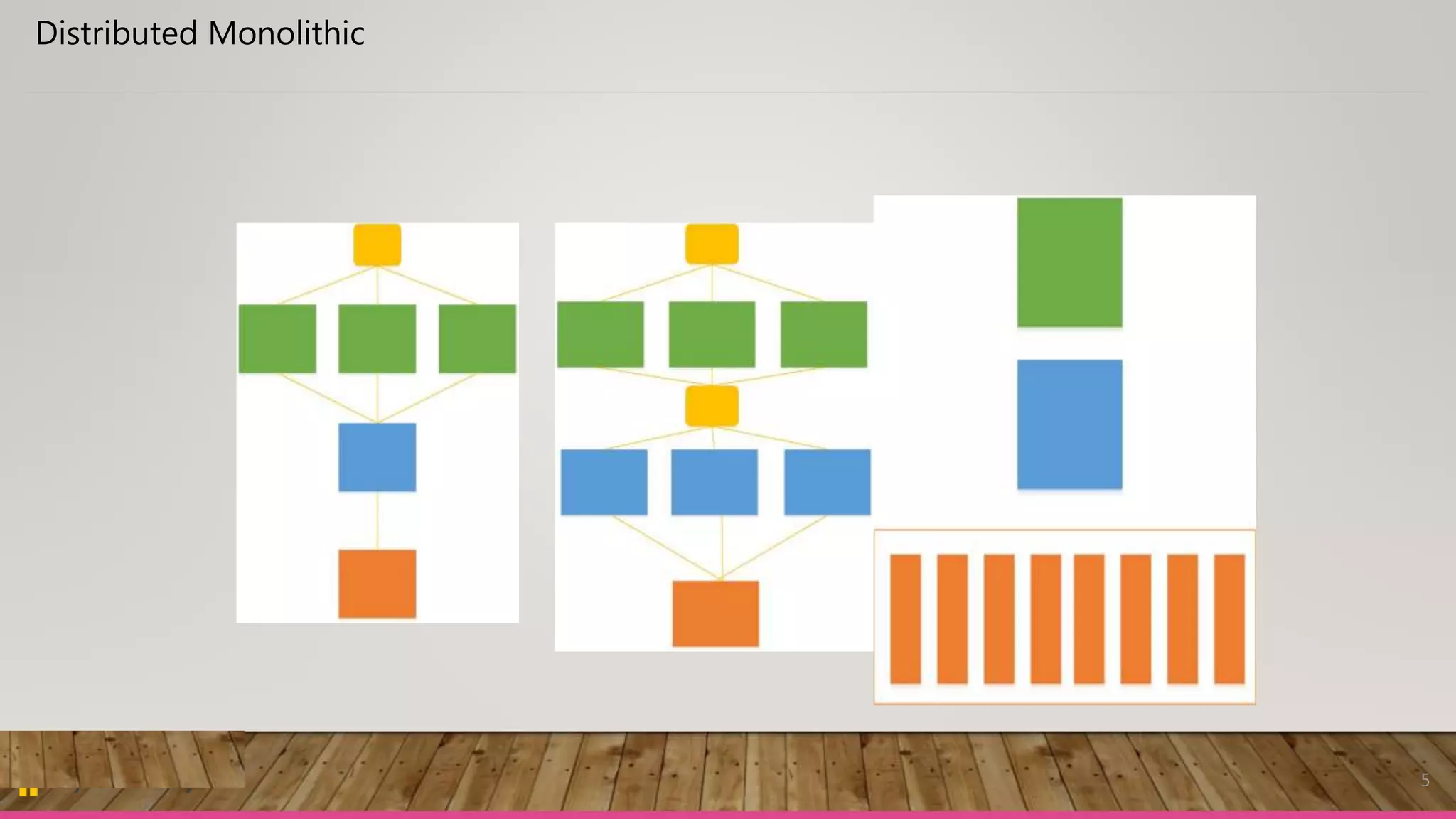
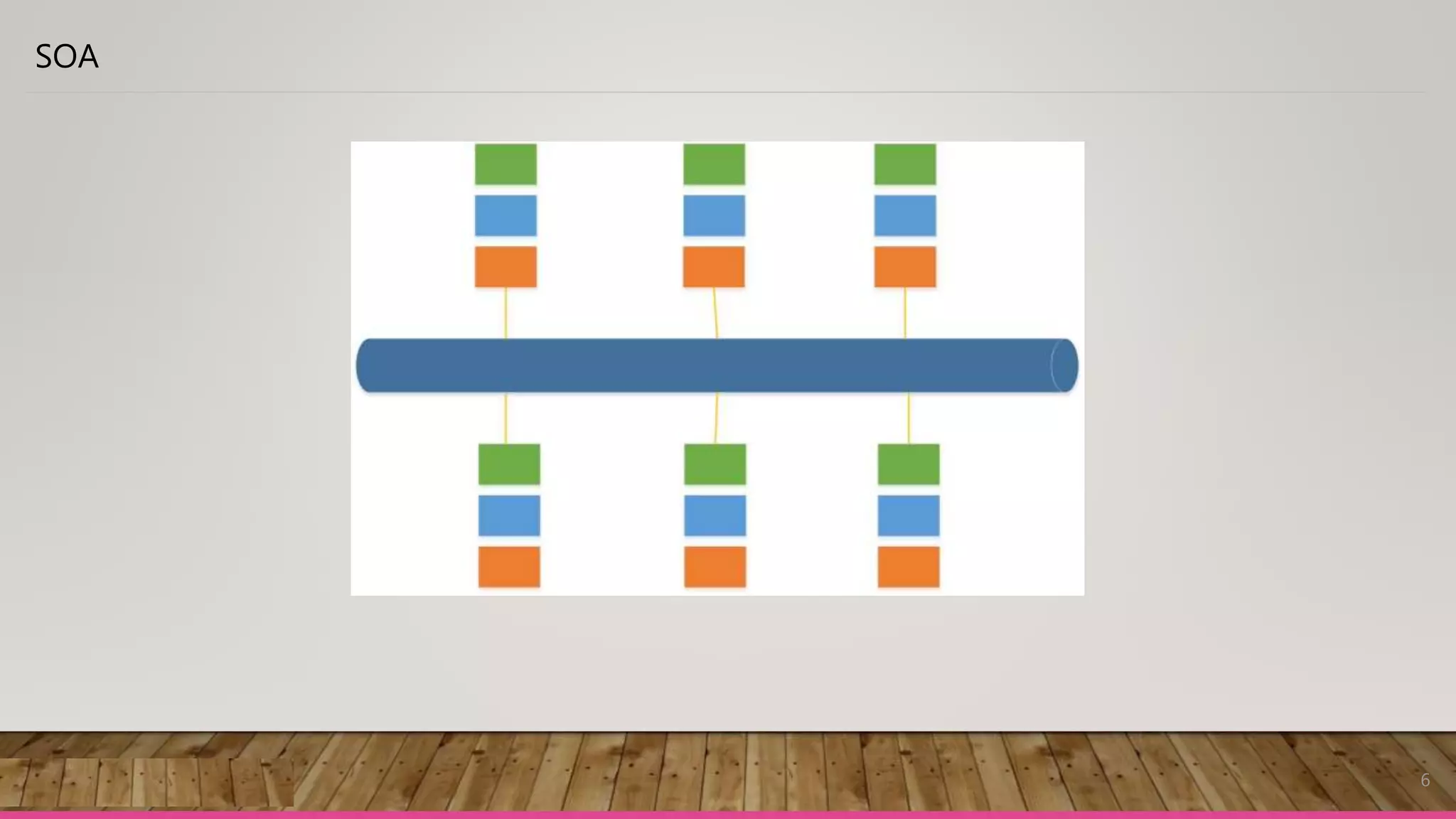
Distributed Monolithic
6
SOA
7
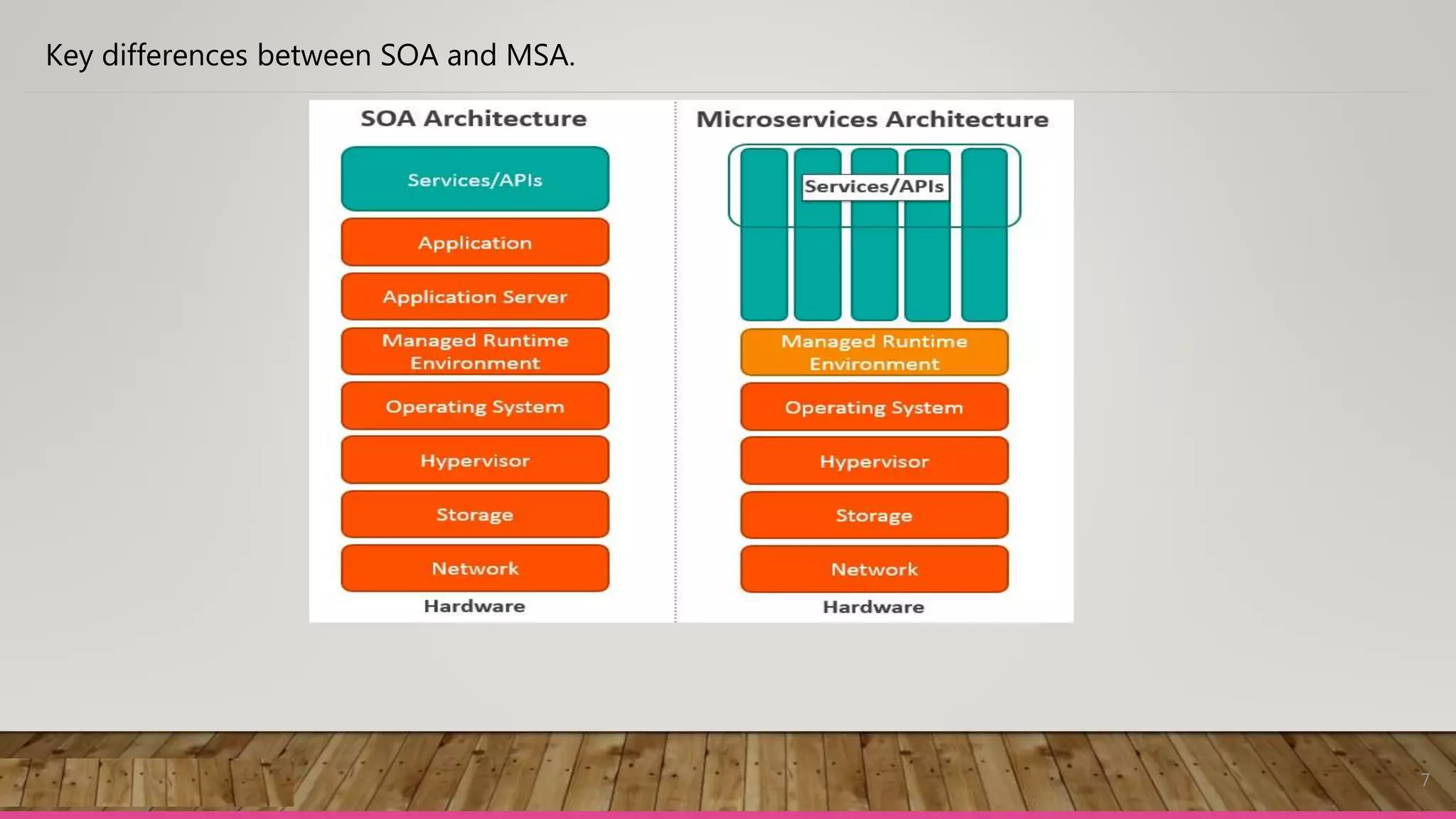
Key differences between SOA and MSA.
8
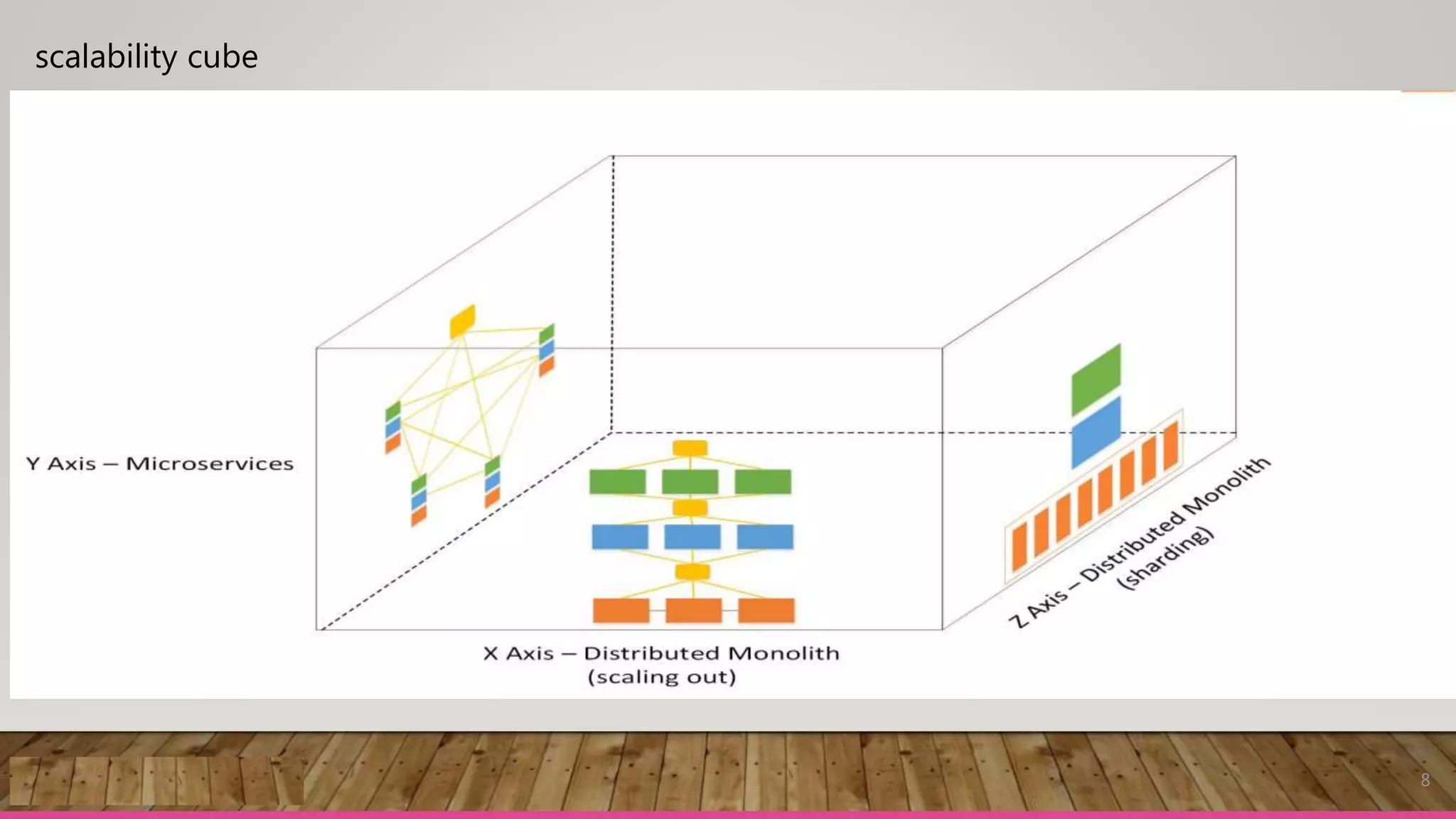
scalability cube
9
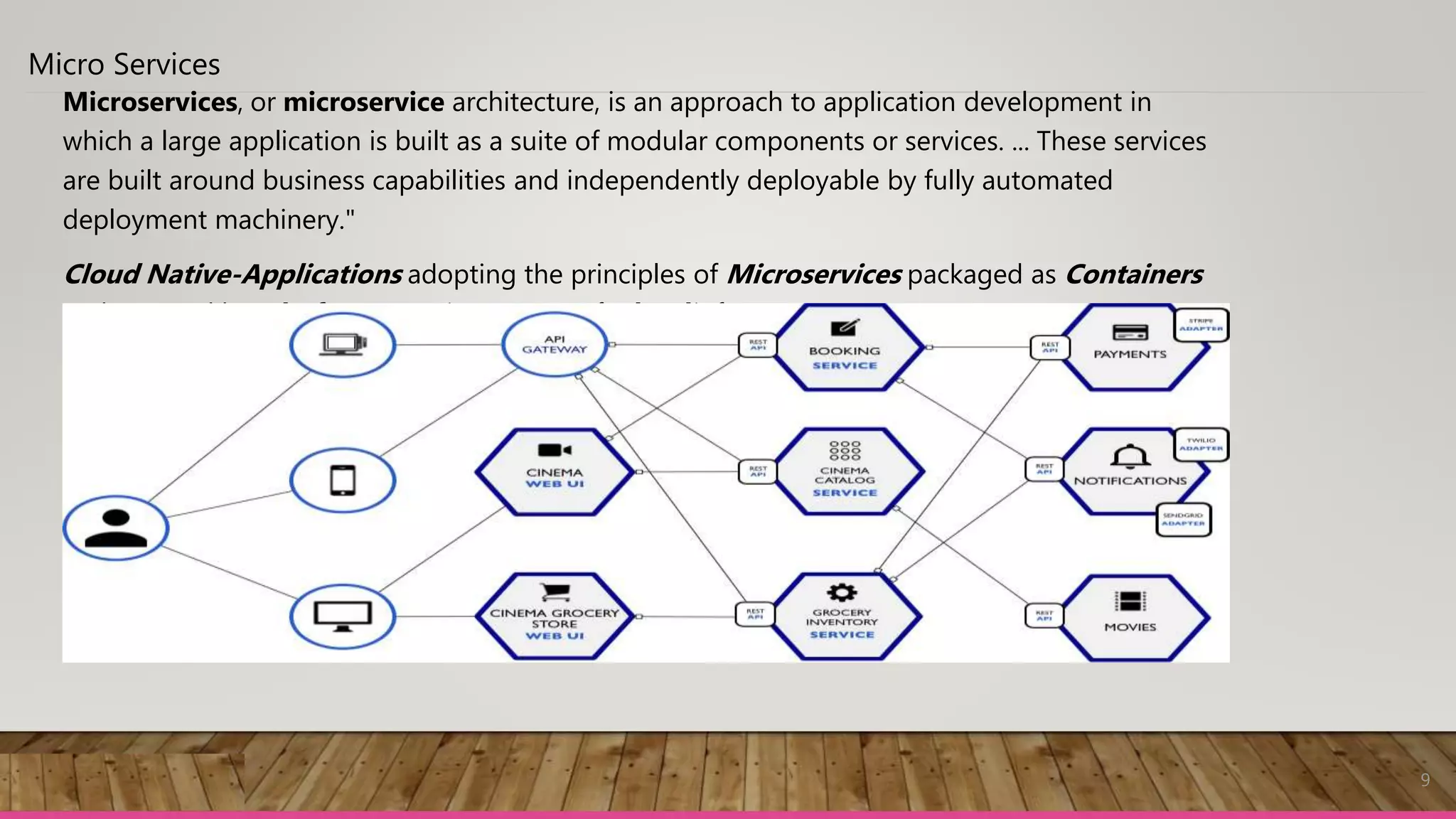
Micro Services
Microservices, or microservice architecture, is an approach to application development in
which a large application is built as a suite of modular components or services. ... These services
are built around business capabilities and independently deployable by fully automated
deployment machinery."
Cloud Native-Applications adopting the principles of Microservices packaged as Containers
orchestrated by Platforms running on top of Cloud infrastructure.
10
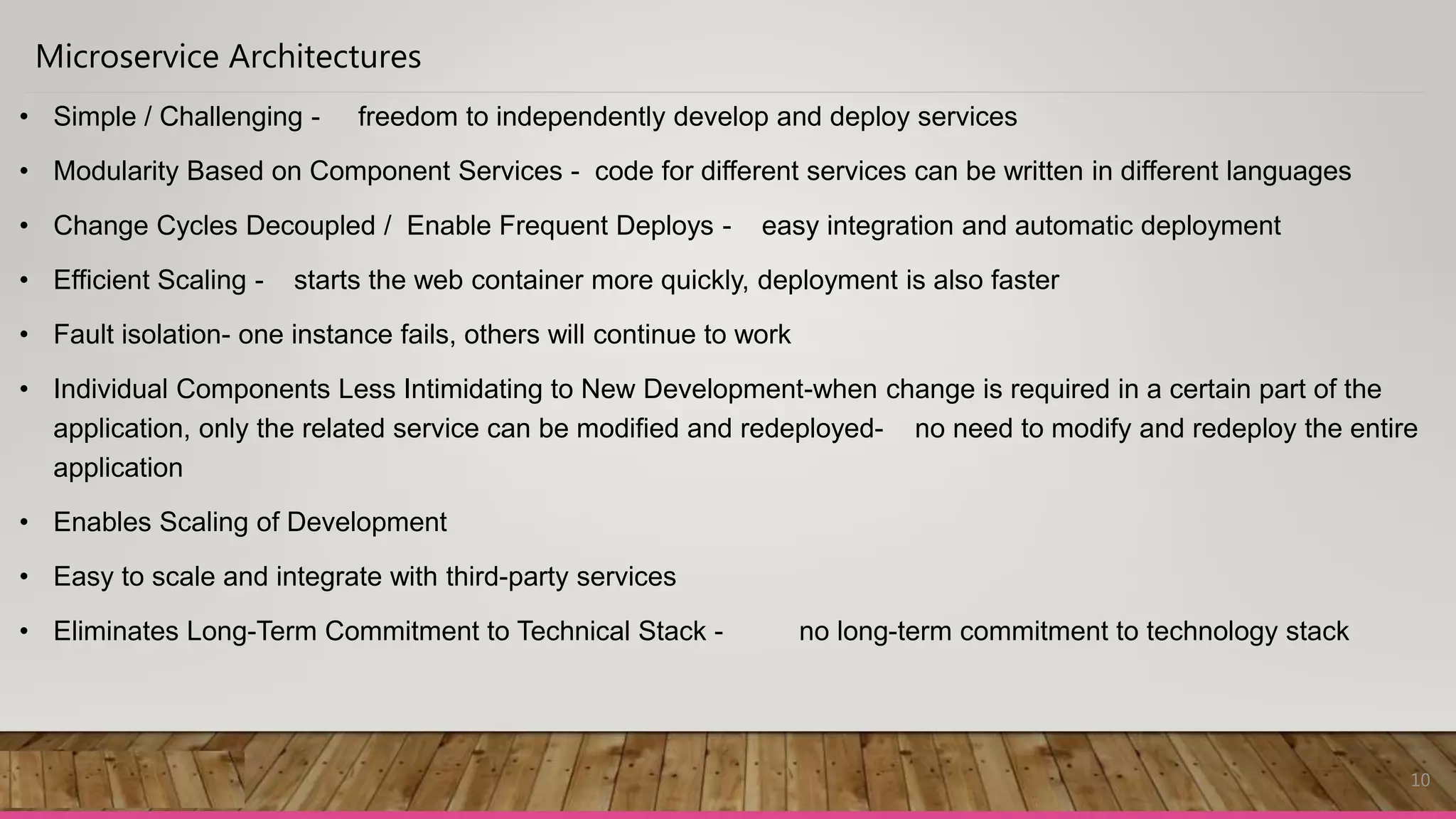
Microservice Architectures
• Simple / Challenging - freedom to independently develop and deploy services
• Modularity Based on Component Services - code for different services can be written in different languages
• Change Cycles Decoupled / Enable Frequent Deploys - easy integration and automatic deployment
• Efficient Scaling - starts the web container more quickly, deployment is also faster
• Fault isolation- one instance fails, others will continue to work
• Individual Components Less Intimidating to New Development-when change is required in a certain part of the
application, only the related service can be modified and redeployed- no need to modify and redeploy the entire
application
• Enables Scaling of Development
• Easy to scale and integrate with third-party services
• Eliminates Long-Term Commitment to Technical Stack - no long-term commitment to technology stack
11
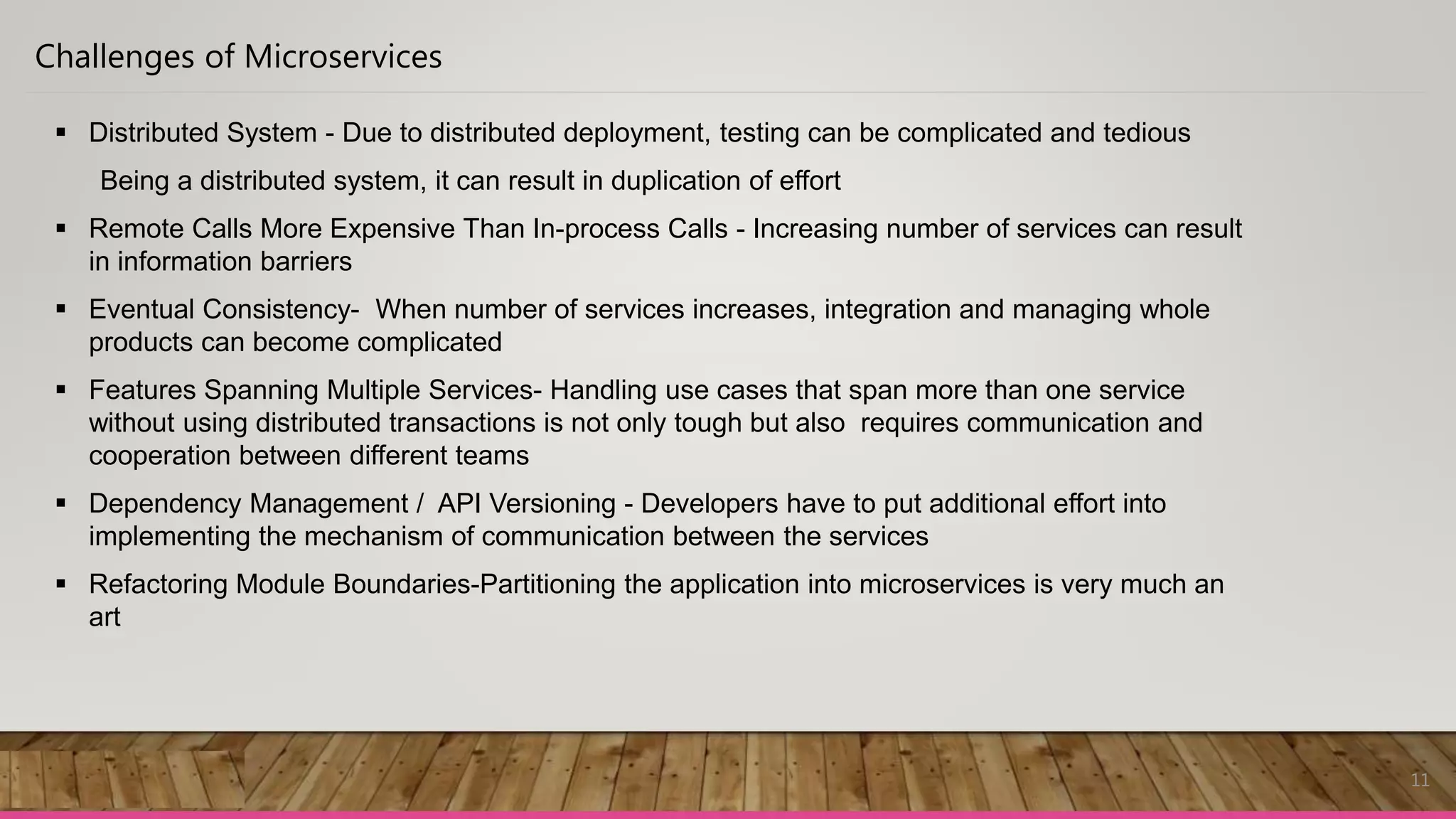
Challenges of Microservices
 Distributed System - Due to distributed deployment, testing can be complicated and tedious
Being a distributed system, it can result in duplication of effort
 Remote Calls More Expensive Than In-process Calls - Increasing number of services can result
in information barriers
 Eventual Consistency- When number of services increases, integration and managing whole
products can become complicated
 Features Spanning Multiple Services- Handling use cases that span more than one service
without using distributed transactions is not only tough but also requires communication and
cooperation between different teams
 Dependency Management / API Versioning - Developers have to put additional effort into
implementing the mechanism of communication between the services
 Refactoring Module Boundaries-Partitioning the application into microservices is very much an
art
12
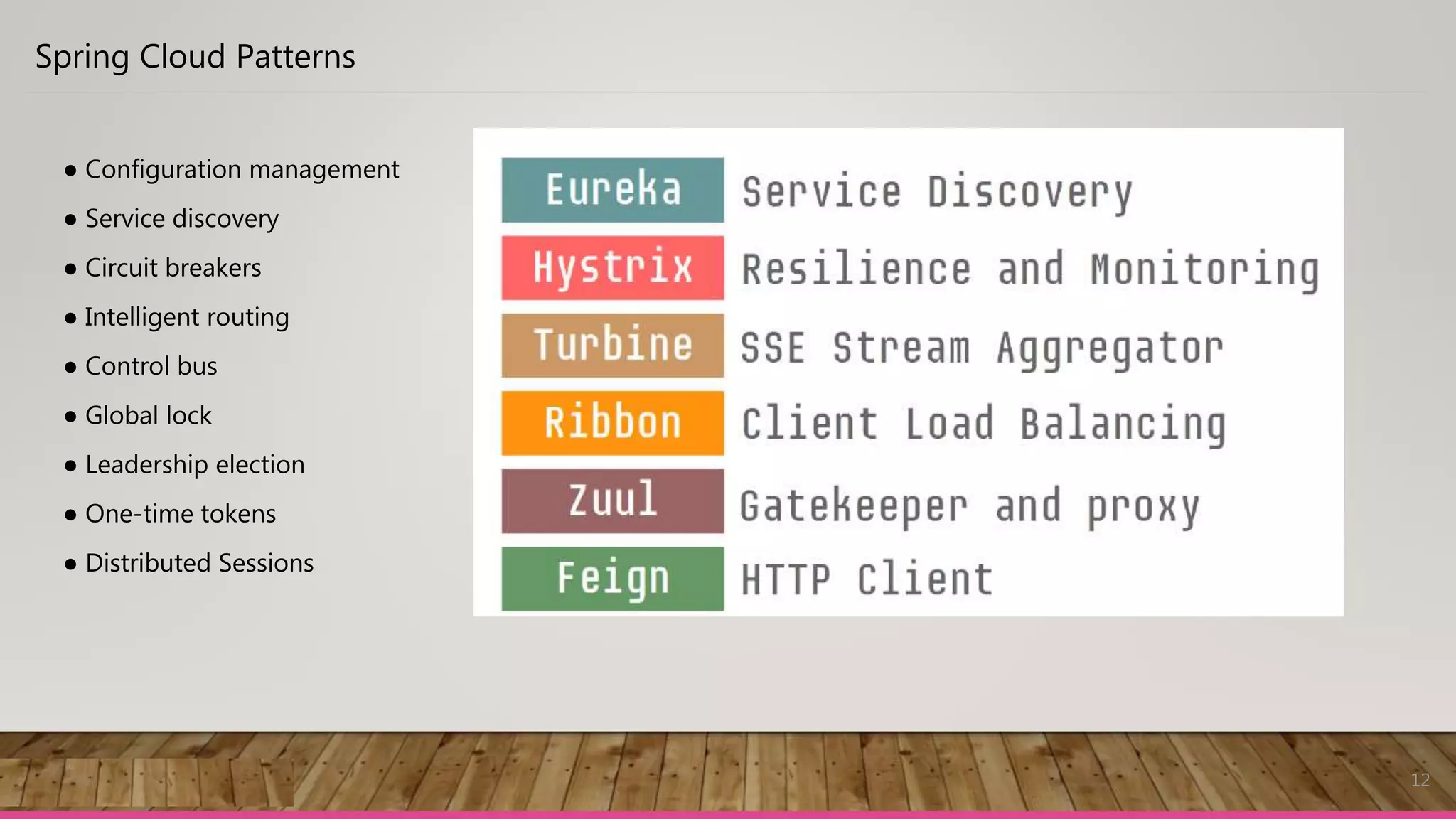
Spring Cloud Patterns
● Configuration management
● Service discovery
● Circuit breakers
● Intelligent routing
● Control bus
● Global lock
● Leadership election
● One-time tokens
● Distributed Sessions
13
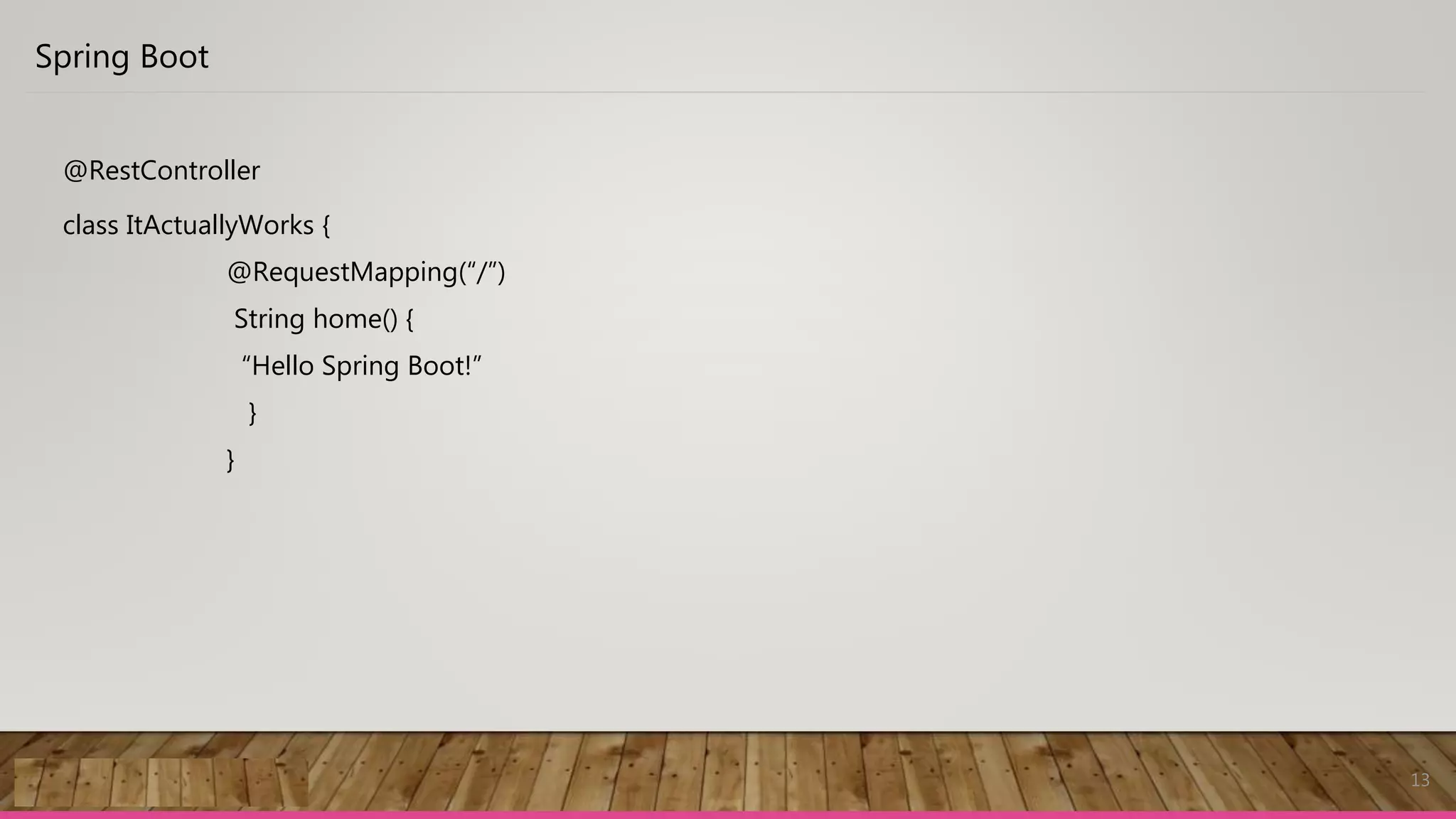
Spring Boot
@RestController
class ItActuallyWorks {
@RequestMapping(“/”)
String home() {
“Hello Spring Boot!”
}
}
14
Annotation-driven
@SpringBootApplication
@EnableCircuitBreaker
@EnableDiscoveryClient
public class App extends RepositoryRestMvcConfiguration {
@Override
protected void configure(RepositoryRestConfiguration config) {
config.exposeIdsFor(Customer.class);
}
public static void main(String[] args) {
SpringApplication.run(CustomerApp.class, args);
}
}
15
Service Discovery: Eureka Server
@SpringBootApplication
@EnableEurekaServer
public class Application {
public static void main(String[] args) {
SpringApplication.run(Application.class, args);
}
}
16
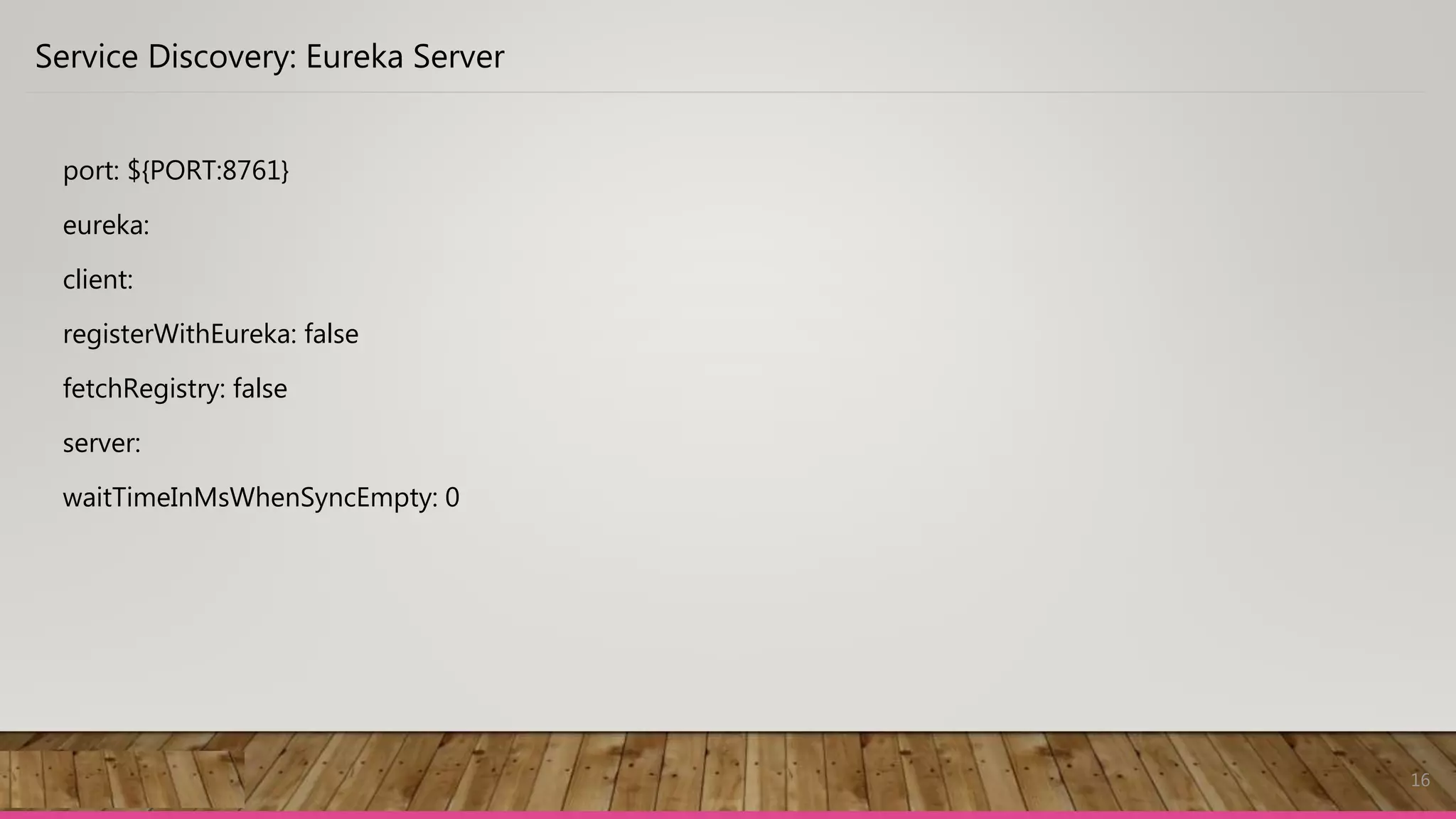
Service Discovery: Eureka Server
port: ${PORT:8761}
eureka:
client:
registerWithEureka: false
fetchRegistry: false
server:
waitTimeInMsWhenSyncEmpty: 0
17
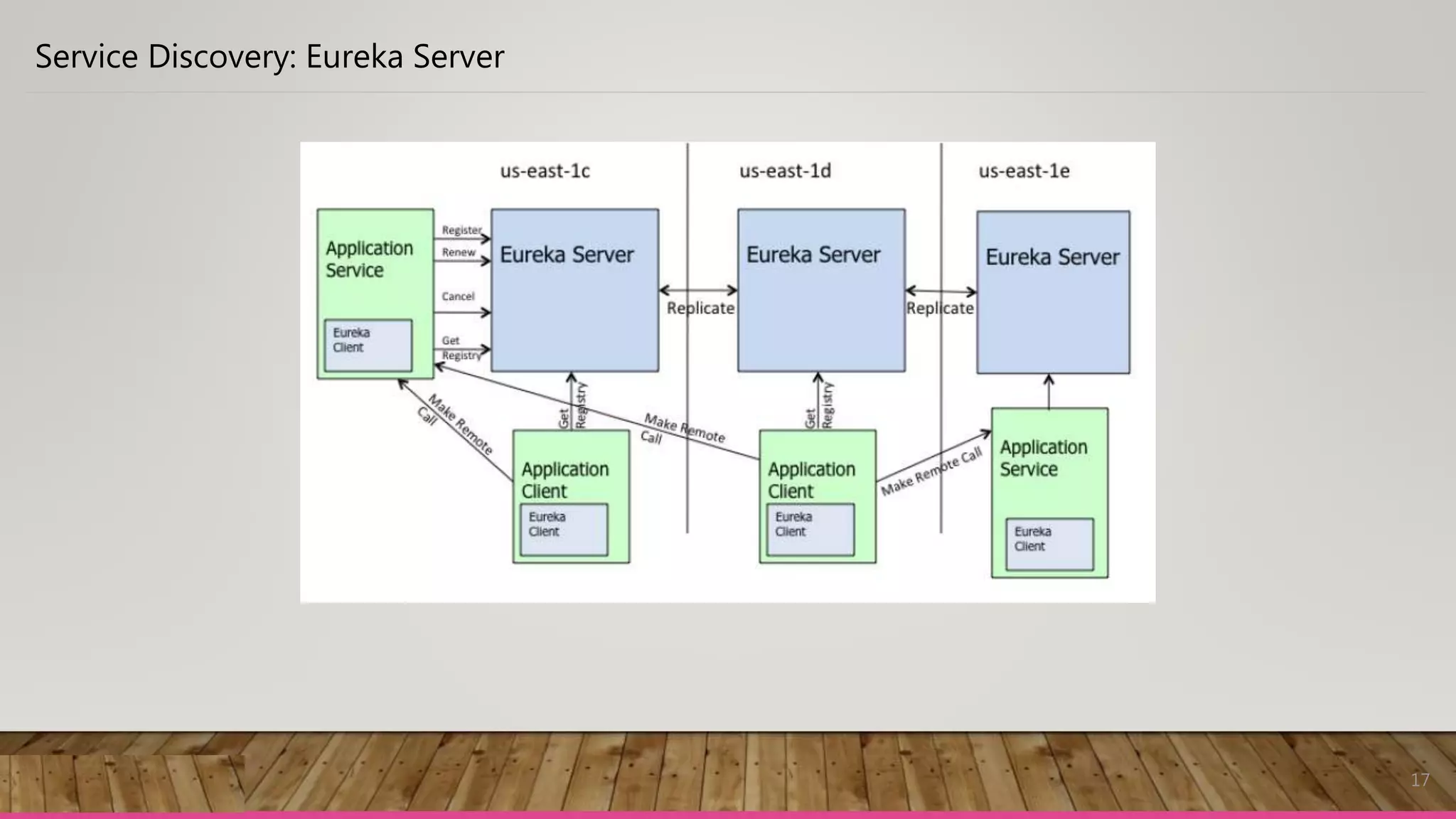
Service Discovery: Eureka Server
18
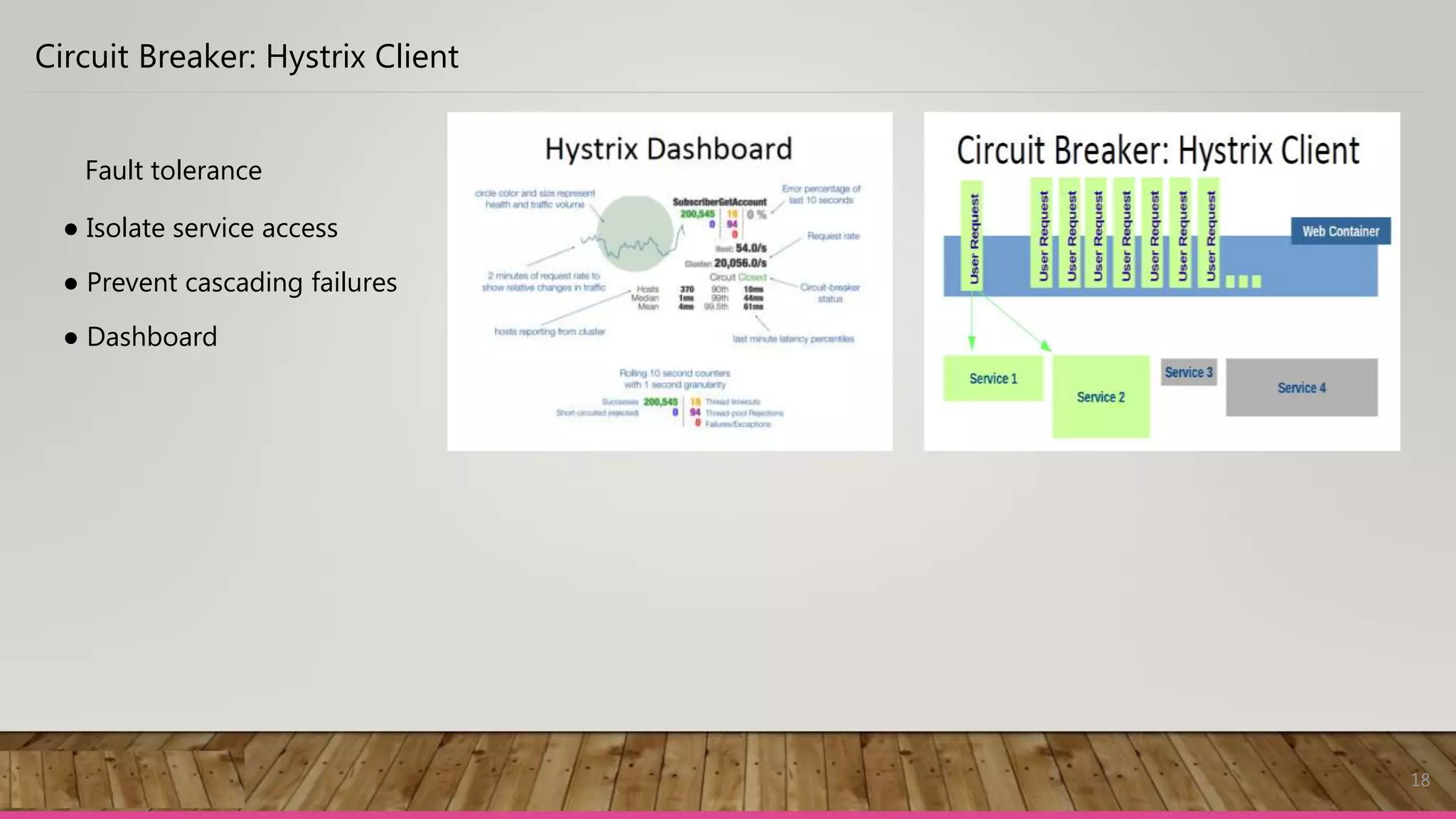
Circuit Breaker: Hystrix Client
Fault tolerance
● Isolate service access
● Prevent cascading failures
● Dashboard
19
Circuit Breaker: Hystrix Client
@SpringBootApplication
@EnableCircuitBreaker
public class Application {
public static void main(String[] args) {
new pringApplicationBuilder(Application.class).web(true).run(args);
}
}
20
Service Discovery: Eureka Server
src/main/resources/bootstrap.yml
spring:
application:
name: my-service
21
Config Server
@Configuration
@EnableAutoConfiguration
@EnableDiscoveryClient
@EnableConfigServer
public class ConfigServerApplication {
public static void main(String[] args) {
SpringApplication.run(ConfigServerApplication.class,args);
}
}
22
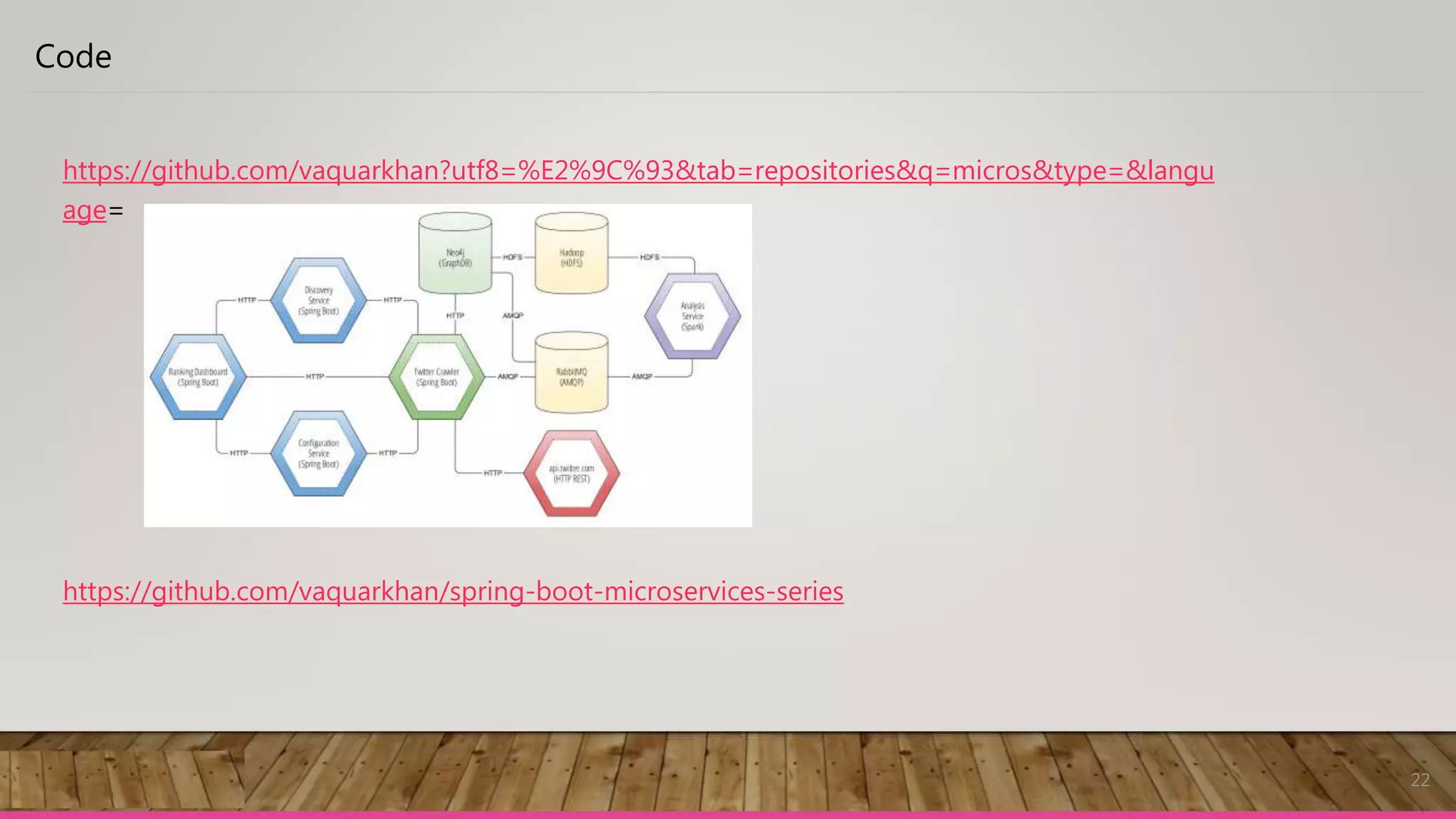
Code
https://github.com/vaquarkhan?utf8=%E2%9C%93&tab=repositories&q=micros&type=&langu
age=
https://github.com/vaquarkhan/spring-boot-microservices-series
23
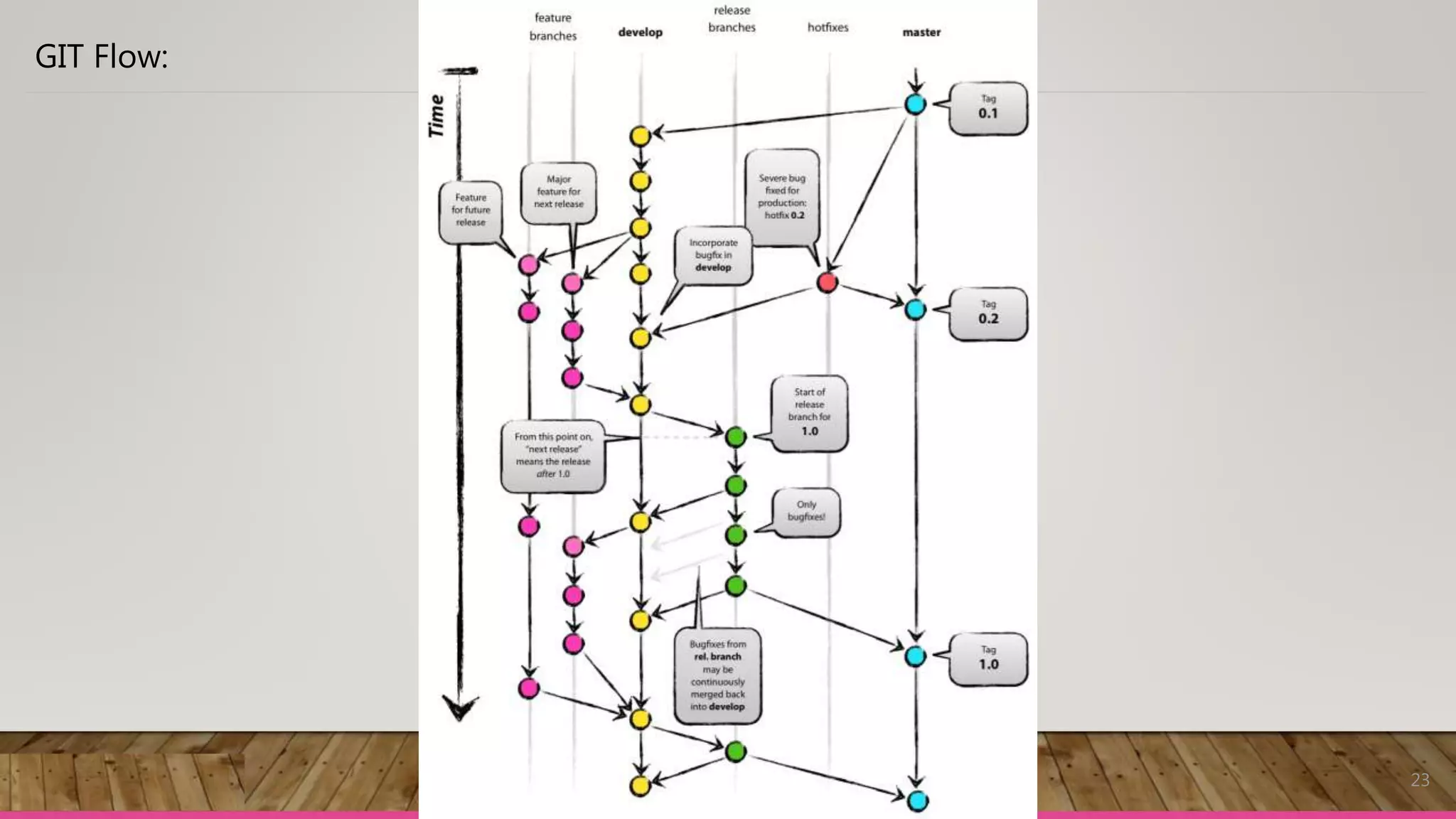
GIT Flow:
24
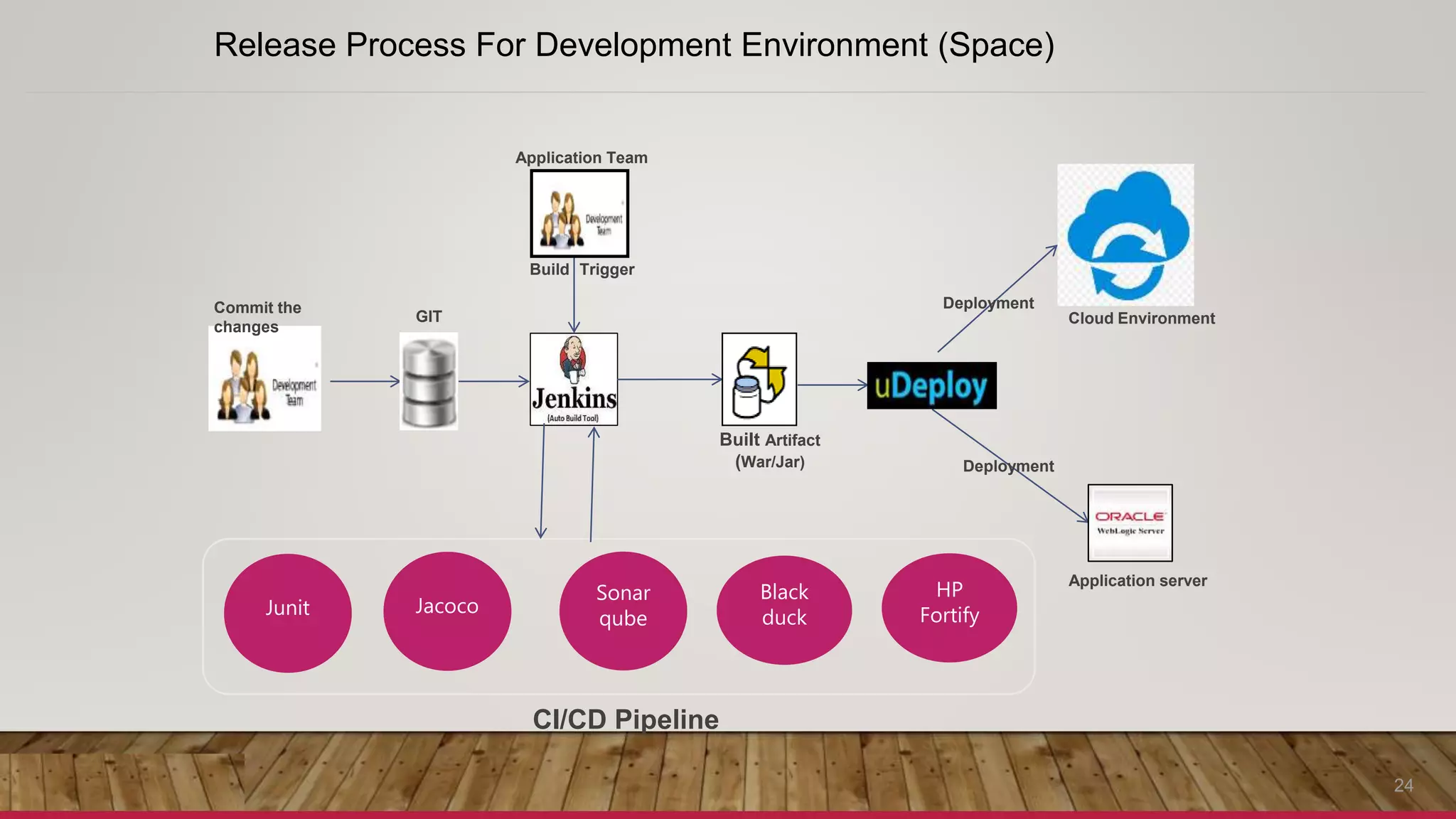
Release Process For Development Environment (Space)
Build Trigger
GIT
Built Artifact
(War/Jar)
Application server
Deployment
Commit the
changes
Application Team
Cloud Environment
Deployment
Junit Jacoco
Sonar
qube
HP
Fortify
Black
duck
CI/CD Pipeline
25
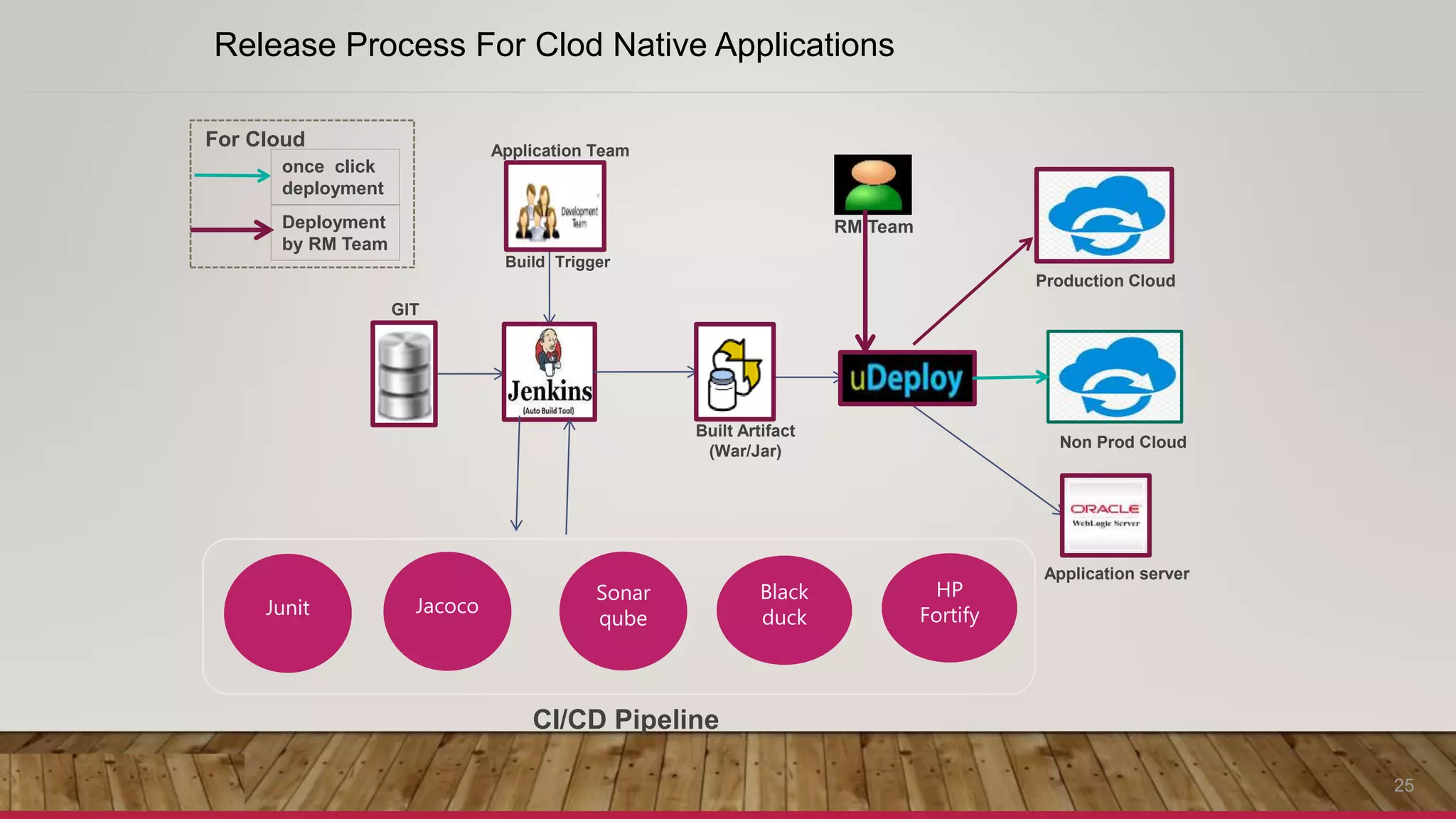
Release Process For Clod Native Applications
Junit Jacoco
Sonar
qube
HP
Fortify
Black
duck
Build Trigger
GIT
Built Artifact
(War/Jar)
Application server
Application Team
Production Cloud
CI/CD Pipeline
Non Prod Cloud
RM Team
once click
deployment
Deployment
by RM Team
For Cloud
26
27
Questions?
28
Resources
● http://projects.spring.io/spring-cloud/
● http://martinfowler.com
● http://techblog.netflix.com

Cloud native-microservices

Editor's Notes

  • #5 Monolithic pros–inheritance ,abstraction , don’t repeat yourself , sharing common code ------------------------------------------------------------------------------------------------------- Monolithic cons -the code base grows with it, which can overload your IDE, impossible to refactor , feelings with code , not agile , no polyglot  development , single point of failure (If any single application function or component fails, then the entire application goes down) , not easy to upgrade horizontal scaling. Each copy of the application in various servers will utilize the same amount of underlying resources, which is often not an efficient way to design. Every release required complete application testing
  • #6 Skip - Integrated applications. Applications can share resources. A single instance of functionality can be reused. Common user interfaces Bottom-up approach N-tier: Deployment costs are low. Database switching costs are low. Business migration coasts are low. Communication performance suffers Maintenance costs are high. ----------------------------------------------------------------------------------------------------------- Scaling - horizontal scaling. Each copy of the application in various servers will utilize the same amount of underlying resources, which is often not an efficient way to design Scale monolithic Developers must create multiple instance of the same functionality (service). Proprietary (user) interfaces.
  • #11 Microservice Best practice: 1) Design monolithic first and think in bounded context 2) Twelve factor app 3) Small 2 Pizza team 4) Create a Separate Data Store for Each Microservice - You end up with the situation where if one team updates a database structure, other services that also use that structure have to be changed too. 5) Keep Code at a Similar Level of Maturity( -create new code instead of fixing old code to introduce bug 6) Do a Separate Build for Each Microservice- This sometimes leads to the situation where various microservices pull in a similar set of files, but at different revision levels. 7) shouldn't couple the services -Prefer choreography over orchestration 8 )Skip the Don’t Repeat Yourself (DRY) principle and don't share code between Microservices 9) Nothing share architecture -DB , binary dependency , code etc 11) Automated environment- continuous delivery ,new relic ,Splunk –don’t think microservice without it 12) Contract document -Swagger 13) Microservices versioning best practices 14) Implement a Self-Registration and Discovery Mechanism 15) Prefer Polyglot Over Single Stack 16) focus on business capabilities of apps. ------------------------------------------------------------------ independence of services simplicity of adding new features. fault tolerance. implicit interfaces. operational overhead requires devops skills operational complexity. dev teams can deliver updates independently and roll out new releases more frequently while keeping the rest of the system available and stable. orchestration is a tightly couple approach for integrating microservices. In orchestration we rely on the central system to control and call various microservices to complete a task. In choreography each microservices works like a state machine and reacts based on the input from other parts. microservices are application architecture style where independent, self contained programs with a single purpose each can communicate with each other over a network. typically these microservices are able to be deployed independently because they have separation of responsibilities via a well defined specification with significant backward compatibility to avoid sudden dependency breakage.
  • #12 ajay