SESSION – 11 & 12
By → Anuj Kumar Singh
Introduction to Spring AOP (Aspect Oriented Programming)
Spring AOP enables Aspect-Oriented Programming in spring
applications. In AOP, aspects enable the modularization of concerns
such as transaction management, logging or security that cut across
multiple types and objects (often termed crosscutting concerns).
AOP provides the way to dynamically add the cross-cutting concern
before, after or around the actual logic using simple pluggable
configurations. It makes easy to maintain code in the present and future
as well. You can add/remove concerns without recompiling complete
source code simply by changing configuration files (if you are applying
aspects suing XML configuration).
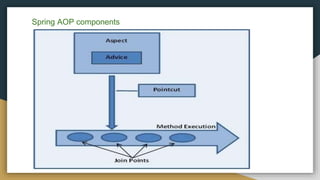
What is advice, joinpoint and pointcut
1. An important term in AOP is advice. It is the action taken by an
aspect at a particular join-point.
2. Joinpoint is a point of execution of the program, such as the
execution of a method or the handling of an exception. In Spring
AOP, a joinpoint always represents a method execution.
3. Pointcut is a predicate or expression that matches join points.
4. Advice is associated with a pointcut expression and runs at any join
point matched by the pointcut.
5. Spring uses the AspectJ pointcut expression language by default.
Spring AOP components
Types of AOP advices
There are five types of advice in spring AOP.
1. Before advice: Advice that executes before a join point, but which
does not have the ability to prevent execution flow proceeding to
the join point (unless it throws an exception).
2. After returning advice: Advice to be executed after a join point
completes normally: for example, if a method returns without
throwing an exception.
3. After throwing advice: Advice to be executed if a method exits by
throwing an exception.
4. After advice: Advice to be executed regardless of the means by
which a join point exits (normal or exceptional return).
5. Around advice: Advice that surrounds a join point such as a method
invocation. This is the most powerful kind of advice. Around advice
can perform custom behavior before and after the method
invocation. It is also responsible for choosing whether to proceed to
the join point or to shortcut the advised method execution by
returning its own return value or throwing an exception.
Spring framework  AOP

Spring framework AOP

  • 1.
    SESSION – 11& 12 By → Anuj Kumar Singh
  • 2.
    Introduction to SpringAOP (Aspect Oriented Programming) Spring AOP enables Aspect-Oriented Programming in spring applications. In AOP, aspects enable the modularization of concerns such as transaction management, logging or security that cut across multiple types and objects (often termed crosscutting concerns). AOP provides the way to dynamically add the cross-cutting concern before, after or around the actual logic using simple pluggable configurations. It makes easy to maintain code in the present and future as well. You can add/remove concerns without recompiling complete source code simply by changing configuration files (if you are applying aspects suing XML configuration).
  • 3.
    What is advice,joinpoint and pointcut 1. An important term in AOP is advice. It is the action taken by an aspect at a particular join-point. 2. Joinpoint is a point of execution of the program, such as the execution of a method or the handling of an exception. In Spring AOP, a joinpoint always represents a method execution. 3. Pointcut is a predicate or expression that matches join points. 4. Advice is associated with a pointcut expression and runs at any join point matched by the pointcut. 5. Spring uses the AspectJ pointcut expression language by default.
  • 4.
  • 5.
    Types of AOPadvices There are five types of advice in spring AOP. 1. Before advice: Advice that executes before a join point, but which does not have the ability to prevent execution flow proceeding to the join point (unless it throws an exception). 2. After returning advice: Advice to be executed after a join point completes normally: for example, if a method returns without throwing an exception. 3. After throwing advice: Advice to be executed if a method exits by throwing an exception.
  • 6.
    4. After advice:Advice to be executed regardless of the means by which a join point exits (normal or exceptional return). 5. Around advice: Advice that surrounds a join point such as a method invocation. This is the most powerful kind of advice. Around advice can perform custom behavior before and after the method invocation. It is also responsible for choosing whether to proceed to the join point or to shortcut the advised method execution by returning its own return value or throwing an exception.