SESSION – 1
By→ Anuj Kumar Singh
Java Server Pages
1. JSP technology is used to create web application just like Servlet
technology.
2. It can be thought of as an extension to Servlet because it provides more
functionality than servlet such as expression language, JSTL, etc.
3. A JSP page consists of HTML tags and JSP tags. The JSP pages are
easier to maintain than Servlet because we can separate designing and
development.
4. It provides some additional features such as Expression Language,
Custom Tags, etc.
Advantages of JSP over Servlet
1. Extension to Servlet
We can use all the features of the Servlet in JSP and we can use
implicit objects, predefined tags, expression language and Custom
tags in JSP, that makes JSP development easy.
2. Easy to maintain
We can easily separate our business logic with presentation logic.
3. Fast Development: No need to recompile and redeploy
If JSP page is modified, we don't need to recompile and redeploy the
project.
4. Less code than Servlet
In JSP, we can use many tags such as action tags, JSTL, custom
tags, etc. that reduces the code. Moreover, we can use EL, implicit
objects, etc.
JSP Lifecycle
The JSP pages follow these phases:
1. Translation of JSP Page
2. Compilation of JSP Page
3. Classloading (the classloader loads class file)
4. Instantiation (Object of the Generated Servlet is created).
5. Initialization ( the container invokes jspInit() method).
6. Request processing ( the container invokes _jspService() method).
7. Destroy ( the container invokes jspDestroy() method).
jspInit(), _jspService() and jspDestroy() are the life cycle methods of JSP.
The JSP API
The JSP API consists of two packages:
1. javax.servlet.jsp
2. javax.servlet.jsp.tagext
javax.servlet.jsp package
The javax.servlet.jsp package has two interfaces and classes.
The two interfaces are as follows:
1. JspPage
2. HttpJspPage
The classes are as follows:
1. JspWriter
2. PageContext
3. JspFactory
4. JspEngineInfo
5. JspException
6. JspError
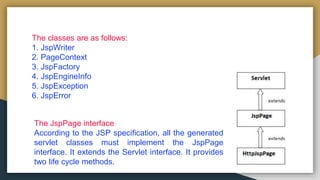
The JspPage interface
According to the JSP specification, all the generated
servlet classes must implement the JspPage
interface. It extends the Servlet interface. It provides
two life cycle methods.
Methods of JspPage interface
1. public void jspInit(): It invoke only at once during the life cycle
of the JSP when JSP page is requested firstly. It is used to
perform initialization. It is same as the init() of Servlet interface.
2. public void destroy(): It is invoked only once during the life cycle
of jsp before the JSP page is destroyed. It is used to perform
some cleanup operations.
The HttpJspPage interface
It extends the JspPage interface.
public void _jspService(): It is invoked each time when request
for the JSP page comes to the container. It is used to process
the request. The underscore _ signifies that you cannot override
this method.
Jsp   session 1

Jsp session 1

  • 1.
    SESSION – 1 By→Anuj Kumar Singh
  • 2.
    Java Server Pages 1.JSP technology is used to create web application just like Servlet technology. 2. It can be thought of as an extension to Servlet because it provides more functionality than servlet such as expression language, JSTL, etc. 3. A JSP page consists of HTML tags and JSP tags. The JSP pages are easier to maintain than Servlet because we can separate designing and development. 4. It provides some additional features such as Expression Language, Custom Tags, etc.
  • 3.
    Advantages of JSPover Servlet 1. Extension to Servlet We can use all the features of the Servlet in JSP and we can use implicit objects, predefined tags, expression language and Custom tags in JSP, that makes JSP development easy. 2. Easy to maintain We can easily separate our business logic with presentation logic. 3. Fast Development: No need to recompile and redeploy If JSP page is modified, we don't need to recompile and redeploy the project. 4. Less code than Servlet In JSP, we can use many tags such as action tags, JSTL, custom tags, etc. that reduces the code. Moreover, we can use EL, implicit objects, etc.
  • 4.
    JSP Lifecycle The JSPpages follow these phases: 1. Translation of JSP Page 2. Compilation of JSP Page 3. Classloading (the classloader loads class file) 4. Instantiation (Object of the Generated Servlet is created). 5. Initialization ( the container invokes jspInit() method). 6. Request processing ( the container invokes _jspService() method). 7. Destroy ( the container invokes jspDestroy() method). jspInit(), _jspService() and jspDestroy() are the life cycle methods of JSP.
  • 6.
    The JSP API TheJSP API consists of two packages: 1. javax.servlet.jsp 2. javax.servlet.jsp.tagext javax.servlet.jsp package The javax.servlet.jsp package has two interfaces and classes. The two interfaces are as follows: 1. JspPage 2. HttpJspPage
  • 7.
    The classes areas follows: 1. JspWriter 2. PageContext 3. JspFactory 4. JspEngineInfo 5. JspException 6. JspError The JspPage interface According to the JSP specification, all the generated servlet classes must implement the JspPage interface. It extends the Servlet interface. It provides two life cycle methods.
  • 8.
    Methods of JspPageinterface 1. public void jspInit(): It invoke only at once during the life cycle of the JSP when JSP page is requested firstly. It is used to perform initialization. It is same as the init() of Servlet interface. 2. public void destroy(): It is invoked only once during the life cycle of jsp before the JSP page is destroyed. It is used to perform some cleanup operations. The HttpJspPage interface It extends the JspPage interface. public void _jspService(): It is invoked each time when request for the JSP page comes to the container. It is used to process the request. The underscore _ signifies that you cannot override this method.