







Spring AOP
ASPECT ORIENTED PROGRAMMING
Spring AOP - Introduction

Aspect – Unit of Modularity

Entails breaking down program logic into distinct parts called so-
called concerns. The functions that span multiple points of an
application are called cross-cutting concerns

Cross-cutting concerns are conceptually separate from the
application's business logic.
AOP in Business

Logging

Transaction Management – Declarative

Caching

Security
AOP Terminologies

Aspect

Advice

Join Point

Pointcut

Introduction

Target Object

Weaving
AOP Advice

This is the actual action to be taken either before or after
the method execution.

This is actual piece of code that is invoked during program
execution by Spring AOP framework.
Types of Advices

Before - Run advice before the a method execution.

After - Run advice after the a method execution regardless
of its outcome.

After Returning - Run advice after the a method execution
only if method completes successfully.

After throwing - Run advice after the a method execution
only if method exits by throwing an exception.

Around- Run advice before and after the advised method
is invoked.
Advices - Examples

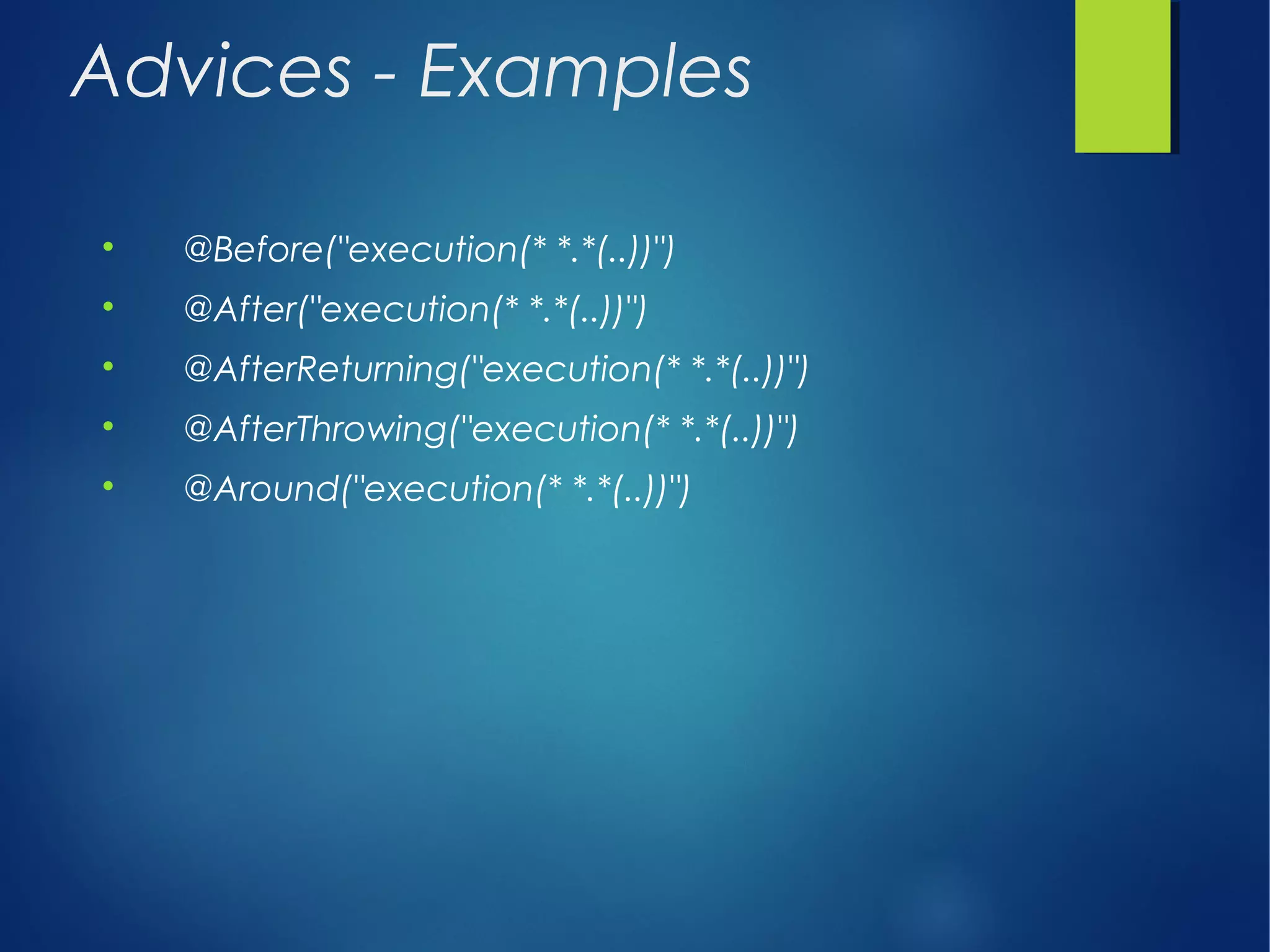
@Before("execution(* *.*(..))")

@After("execution(* *.*(..))")

@AfterReturning("execution(* *.*(..))")

@AfterThrowing("execution(* *.*(..))")

@Around("execution(* *.*(..))")
Aspects Implementation

XML Schema Based

Annotaion Based
Join Point

An Advice is applied to different program execution points,
which are called join points.

An Advice to take the correct action, it often requires
detailed information about join points.
Accessing Join Point
Information

Kind

Method signature

Argument values

Target Object

Proxy Object
AspectJ Precedence

More than one Aspect classes – need Precedence

How to implement?

Ordered Interface

Order Annotation
Point Cut Expressions

It is a powerful expression language that can match
various kinds of join points.

Indicate which method should be intercept, by method
name or regular expression pattern.

expression(<method scope> <return type> <fully qualified
class name>.*(parametes))
Continue..,

method scope: Advice will be applied to all the methods
having this scope. For e.g., public, private, etc. Please note
that Spring AOP only supports advising public methods.

return type: Advice will be applied to all the methods
having this return type.
Continue..,

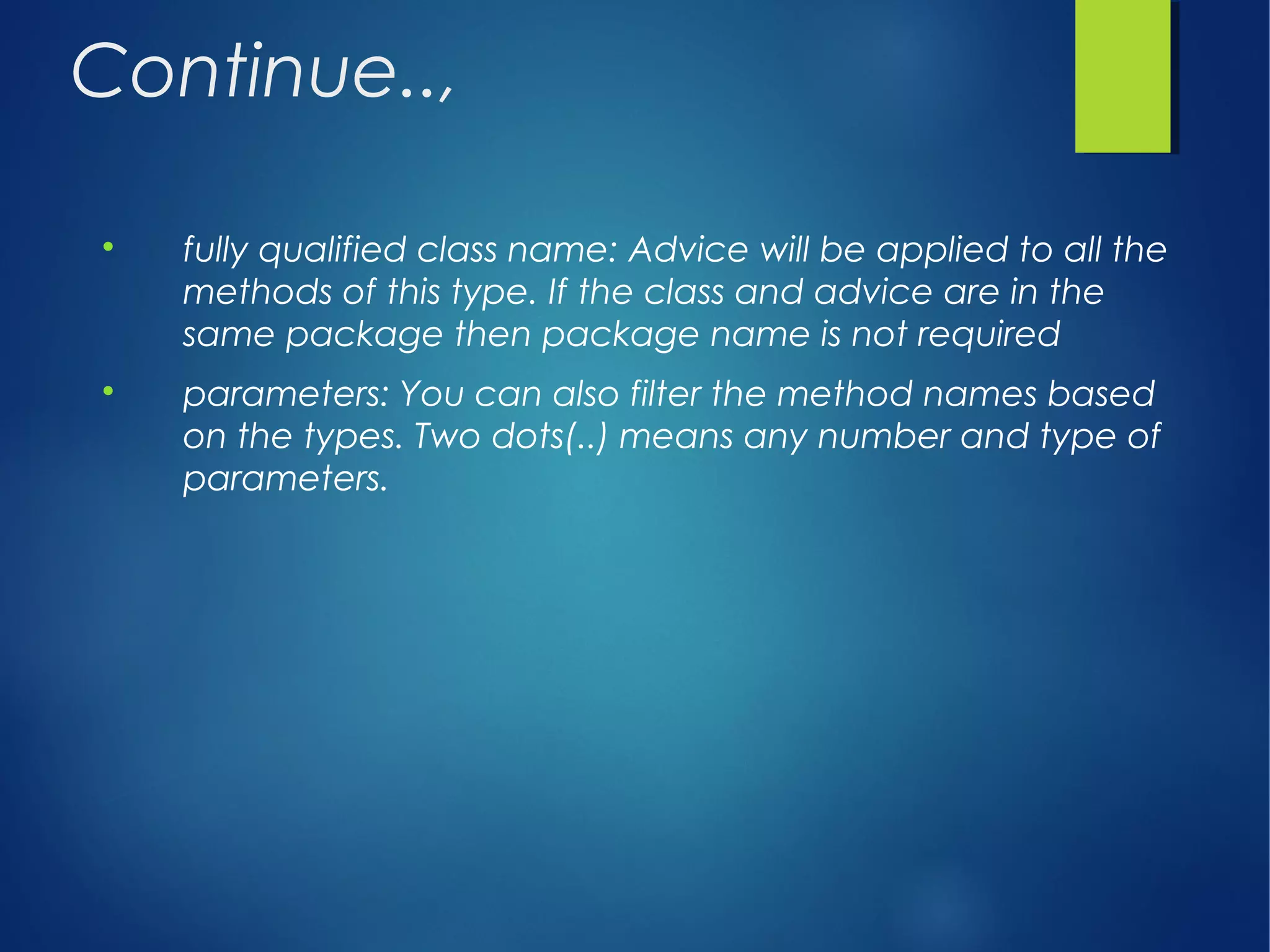
fully qualified class name: Advice will be applied to all the
methods of this type. If the class and advice are in the
same package then package name is not required

parameters: You can also filter the method names based
on the types. Two dots(..) means any number and type of
parameters.
Pointcut Examples

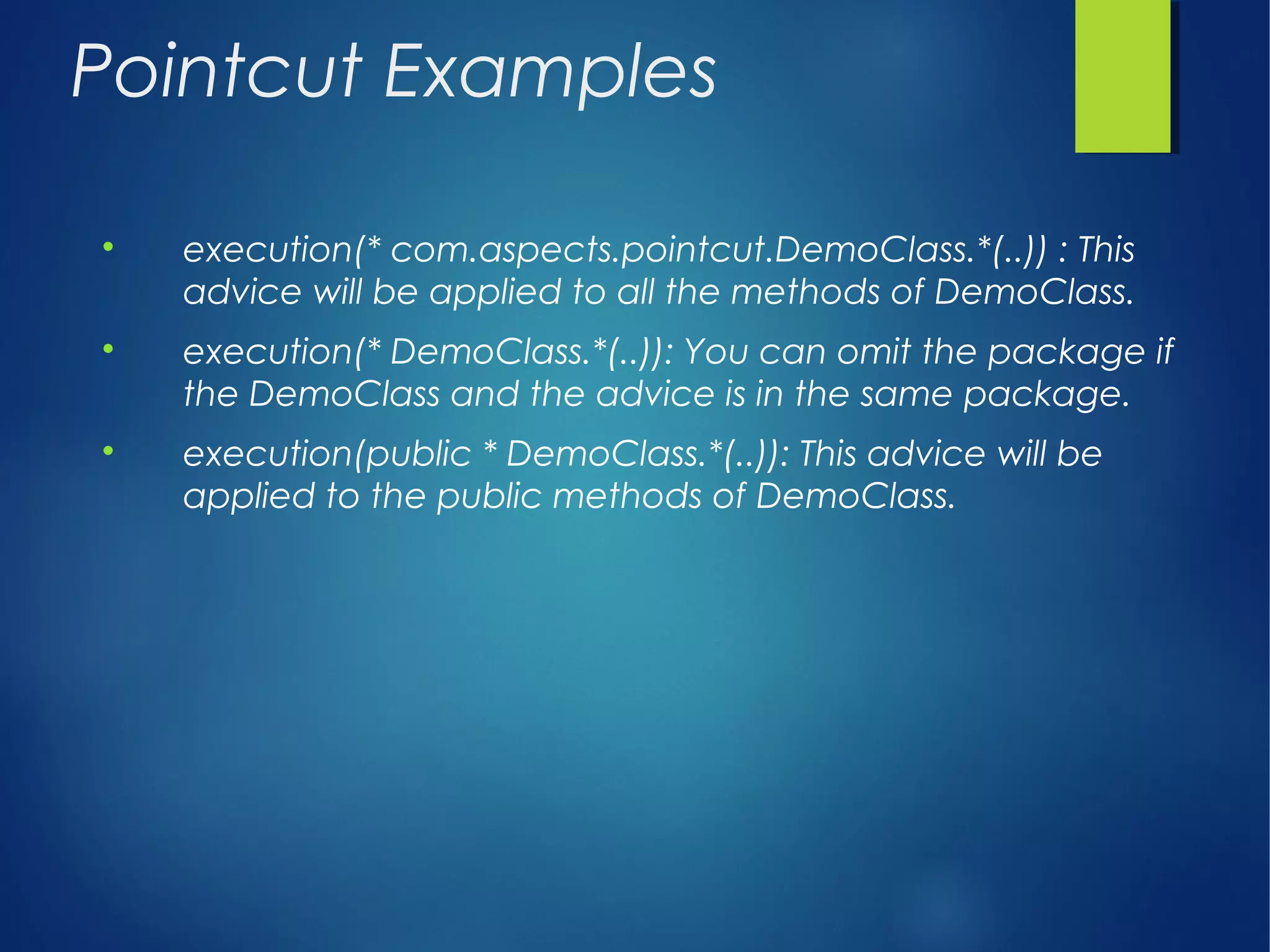
execution(* com.aspects.pointcut.DemoClass.*(..)) : This
advice will be applied to all the methods of DemoClass.

execution(* DemoClass.*(..)): You can omit the package if
the DemoClass and the advice is in the same package.

execution(public * DemoClass.*(..)): This advice will be
applied to the public methods of DemoClass.
Pointcut Examples

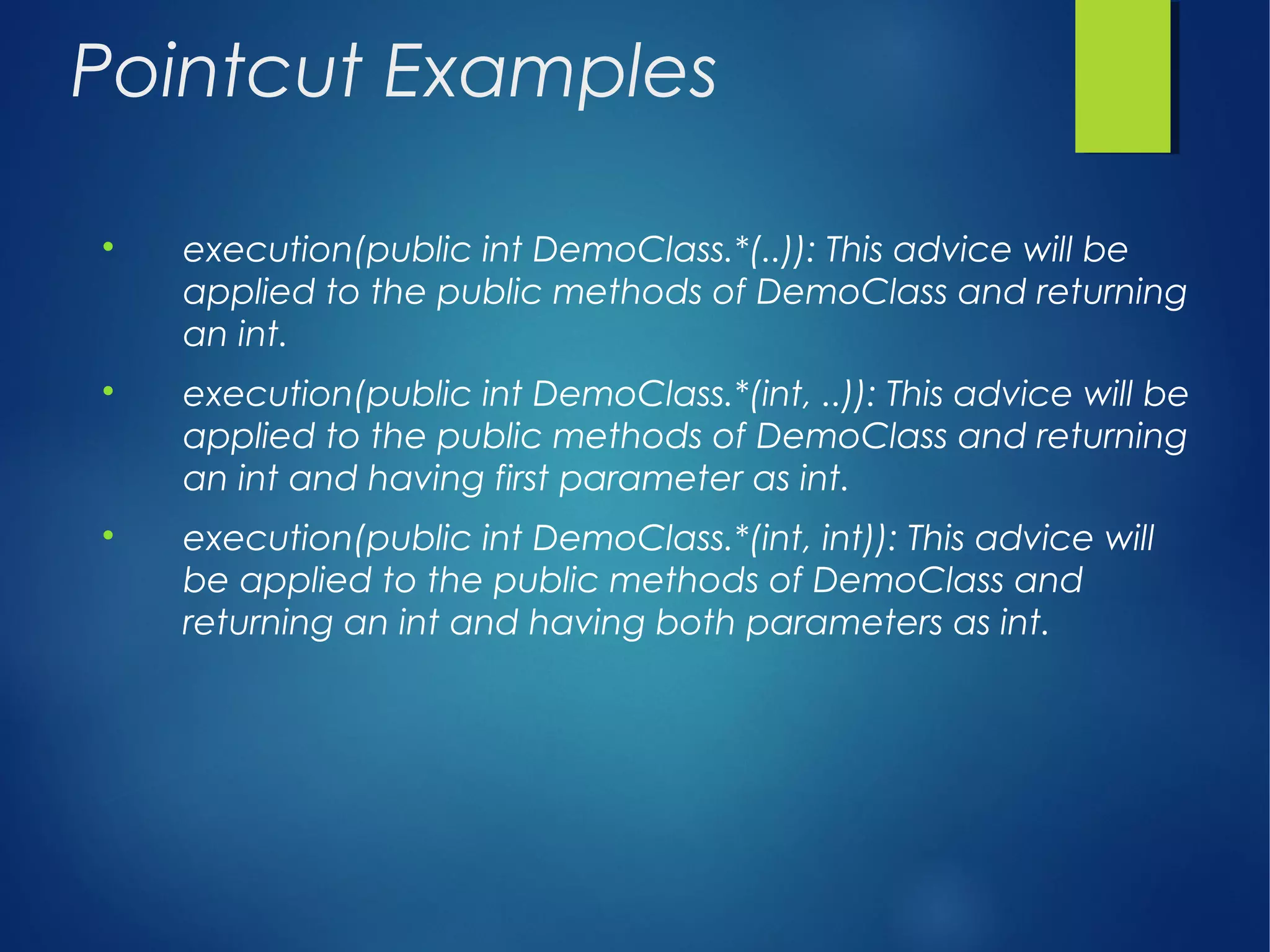
execution(public int DemoClass.*(..)): This advice will be
applied to the public methods of DemoClass and returning
an int.

execution(public int DemoClass.*(int, ..)): This advice will be
applied to the public methods of DemoClass and returning
an int and having first parameter as int.

execution(public int DemoClass.*(int, int)): This advice will
be applied to the public methods of DemoClass and
returning an int and having both parameters as int.
Reusing Pointcut Expression
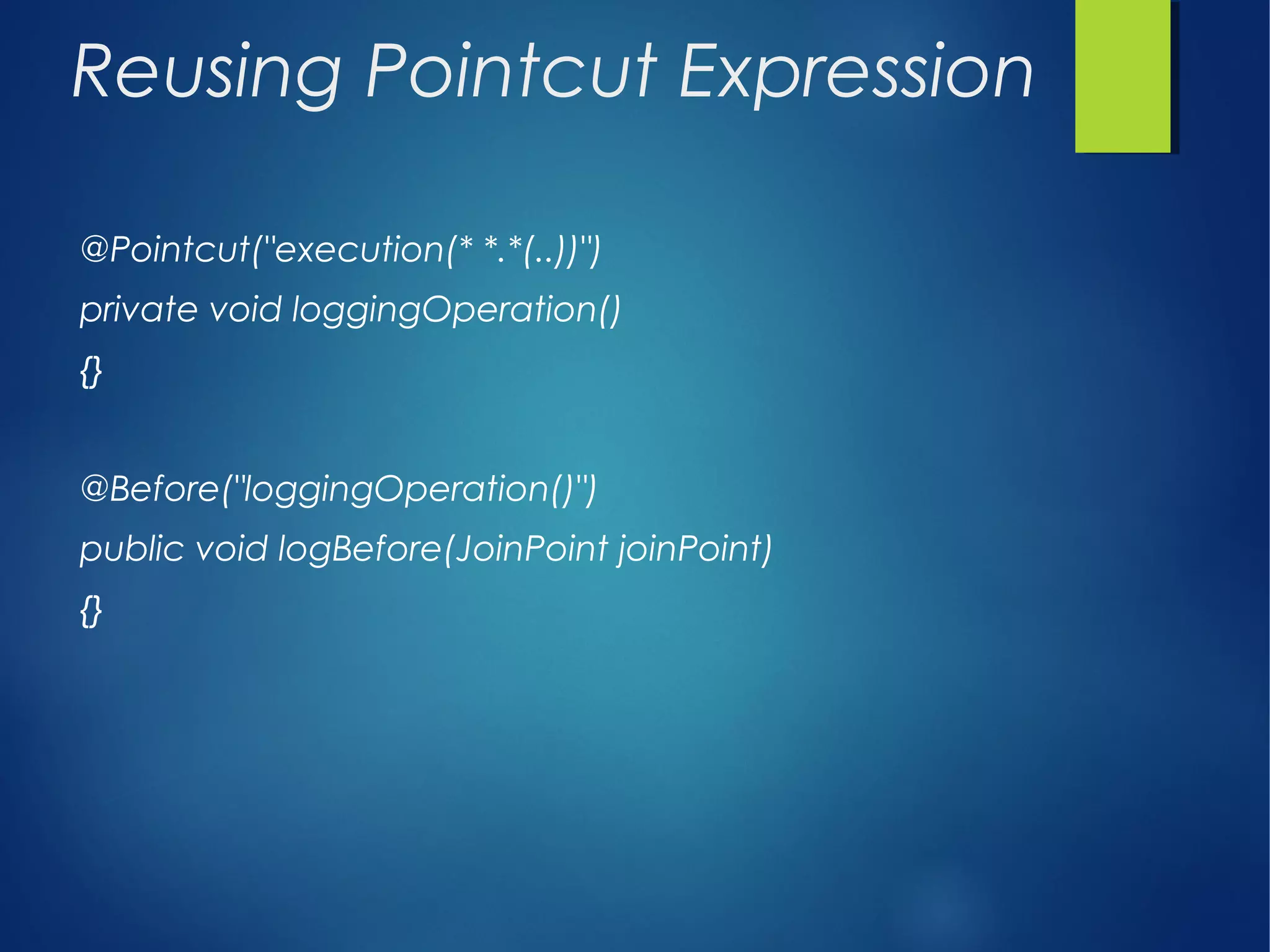
@Pointcut("execution(* *.*(..))")
private void loggingOperation()
{}
@Before("loggingOperation()")
public void logBefore(JoinPoint joinPoint)
{}
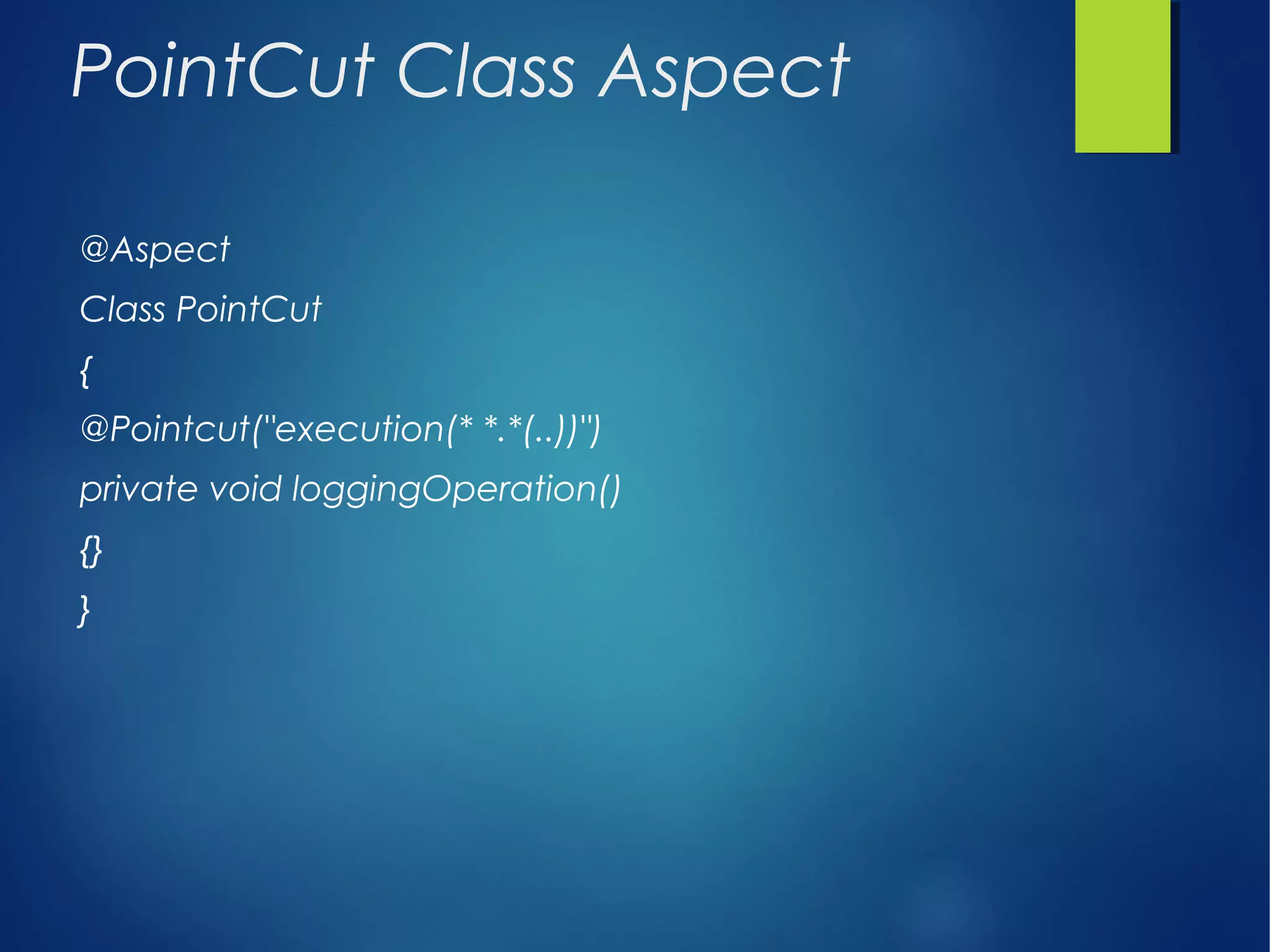
PointCut Class Aspect
@Aspect
Class PointCut
{
@Pointcut("execution(* *.*(..))")
private void loggingOperation()
{}
}
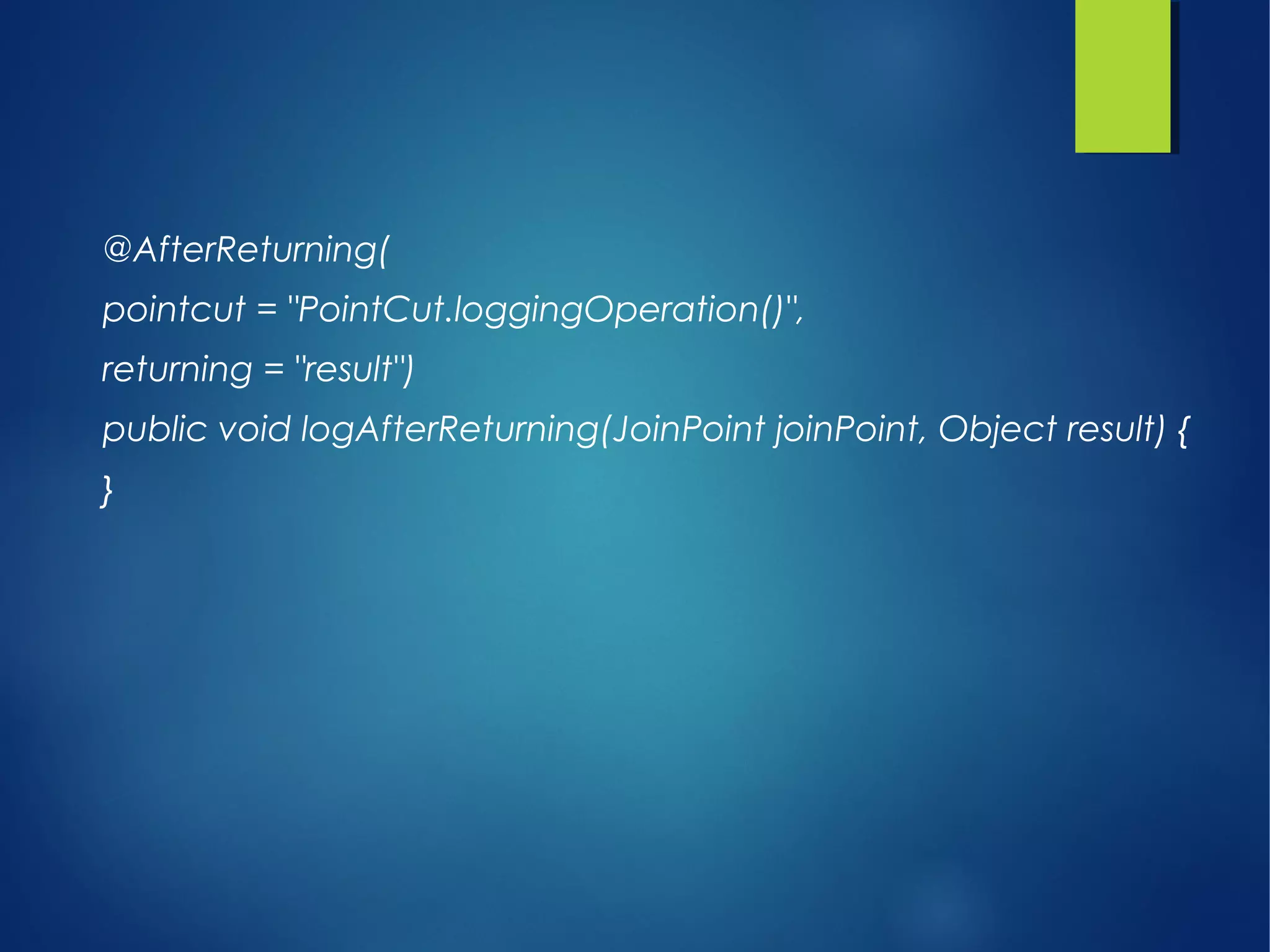
@AfterReturning(
pointcut = "PointCut.loggingOperation()",
returning = "result")
public void logAfterReturning(JoinPoint joinPoint, Object result) {
}
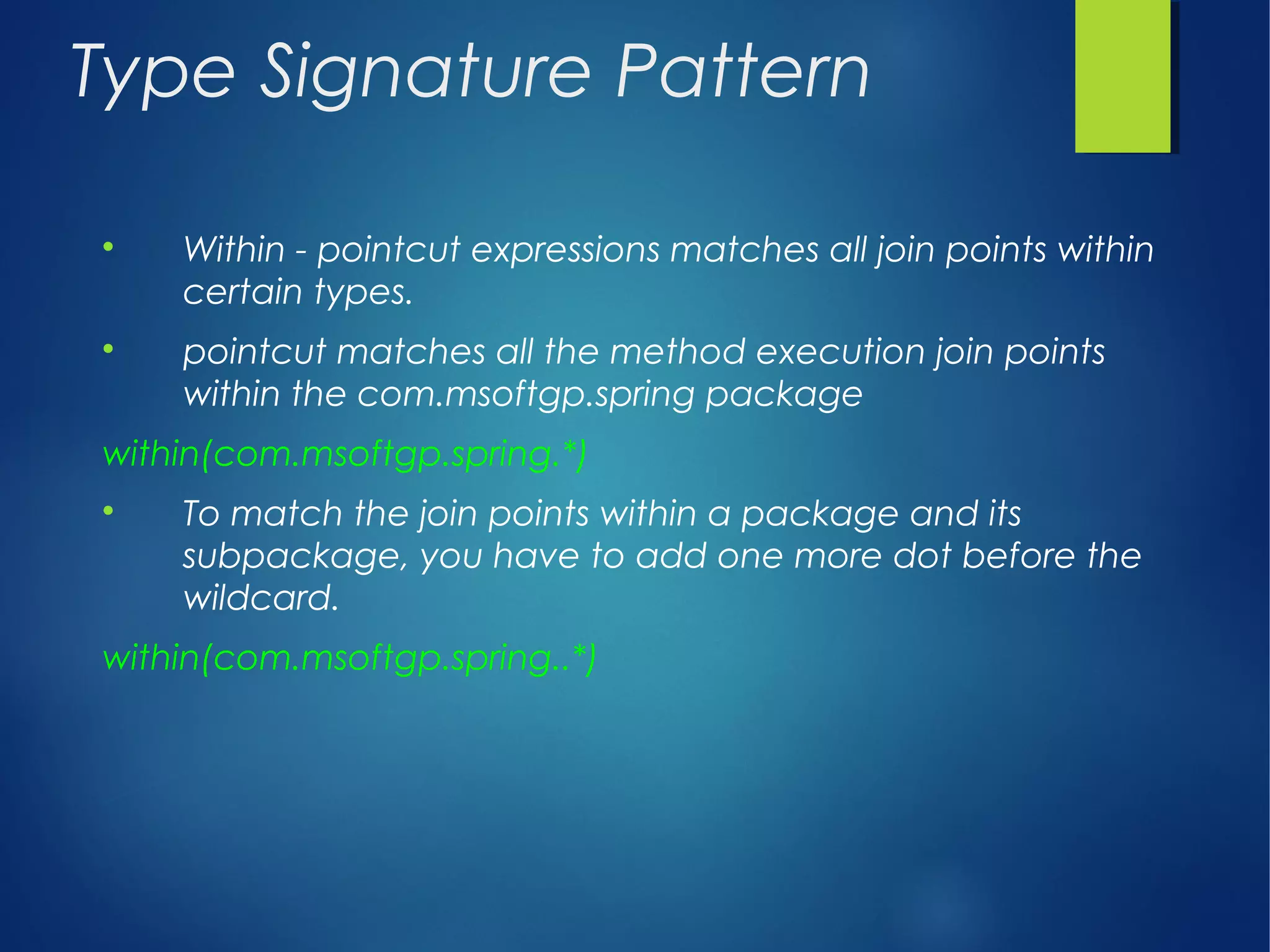
Type Signature Pattern

Within - pointcut expressions matches all join points within
certain types.

pointcut matches all the method execution join points
within the com.msoftgp.spring package
within(com.msoftgp.spring.*)

To match the join points within a package and its
subpackage, you have to add one more dot before the
wildcard.
within(com.msoftgp.spring..*)

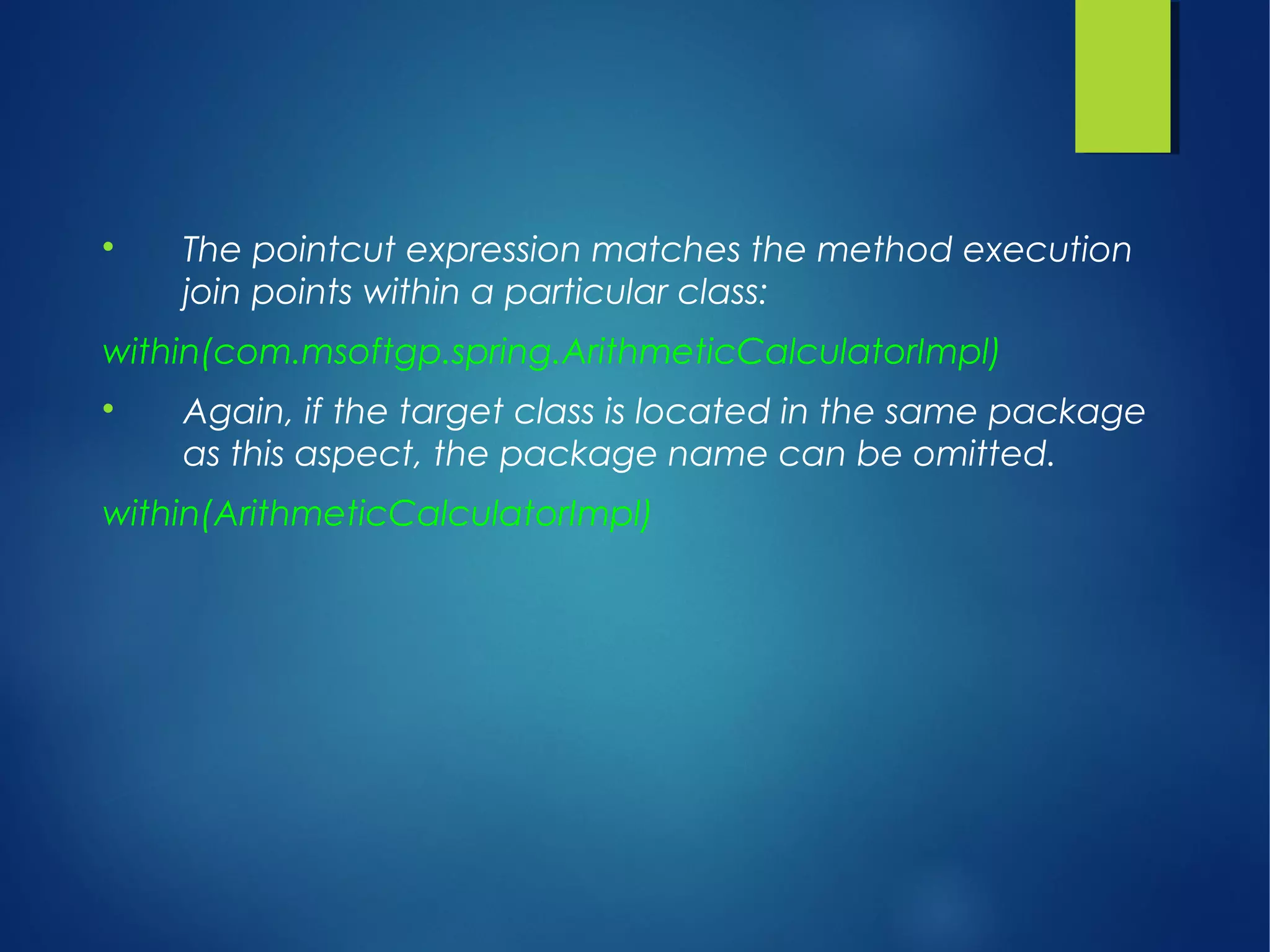
The pointcut expression matches the method execution
join points within a particular class:
within(com.msoftgp.spring.ArithmeticCalculatorImpl)

Again, if the target class is located in the same package
as this aspect, the package name can be omitted.
within(ArithmeticCalculatorImpl)

You can match the method execution join points within all
classes that implement the ArithmeticCalculator interface
by adding a plus symbol.
within(ArithmeticCalculator+)
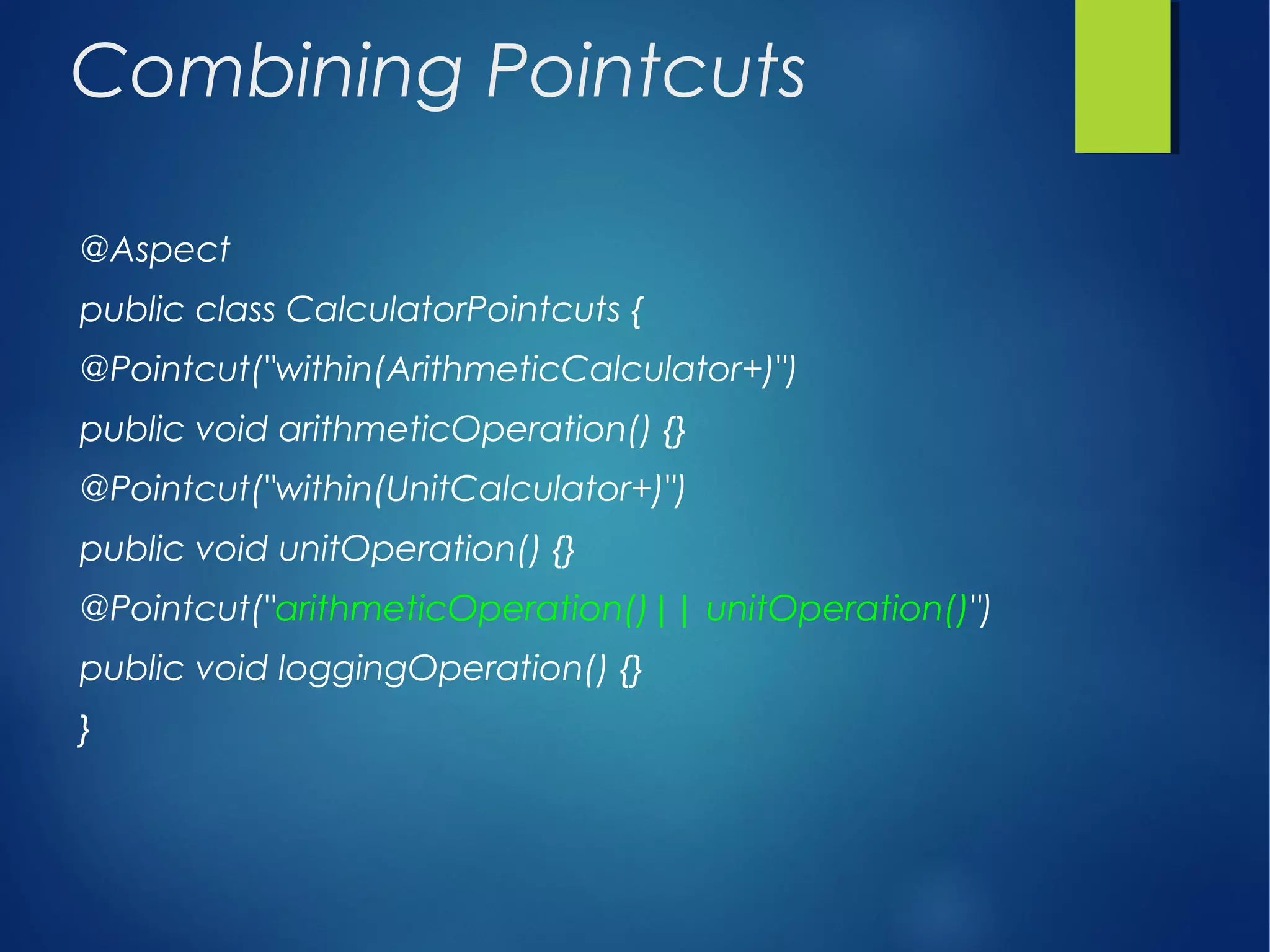
Combining Pointcuts
@Aspect
public class CalculatorPointcuts {
@Pointcut("within(ArithmeticCalculator+)")
public void arithmeticOperation() {}
@Pointcut("within(UnitCalculator+)")
public void unitOperation() {}
@Pointcut("arithmeticOperation()|| unitOperation()")
public void loggingOperation() {}
}
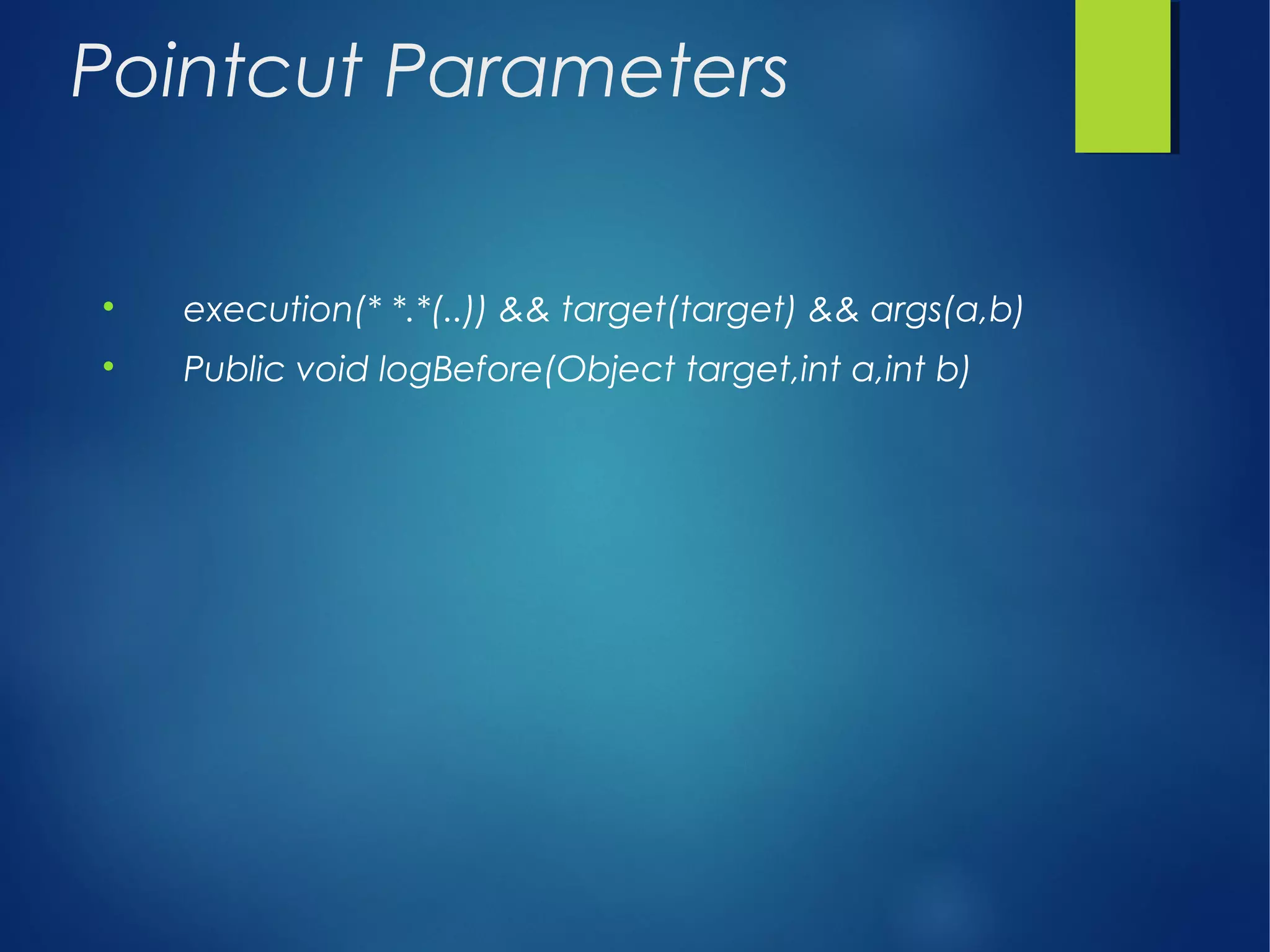
Pointcut Parameters

execution(* *.*(..)) && target(target) && args(a,b)

Public void logBefore(Object target,int a,int b)
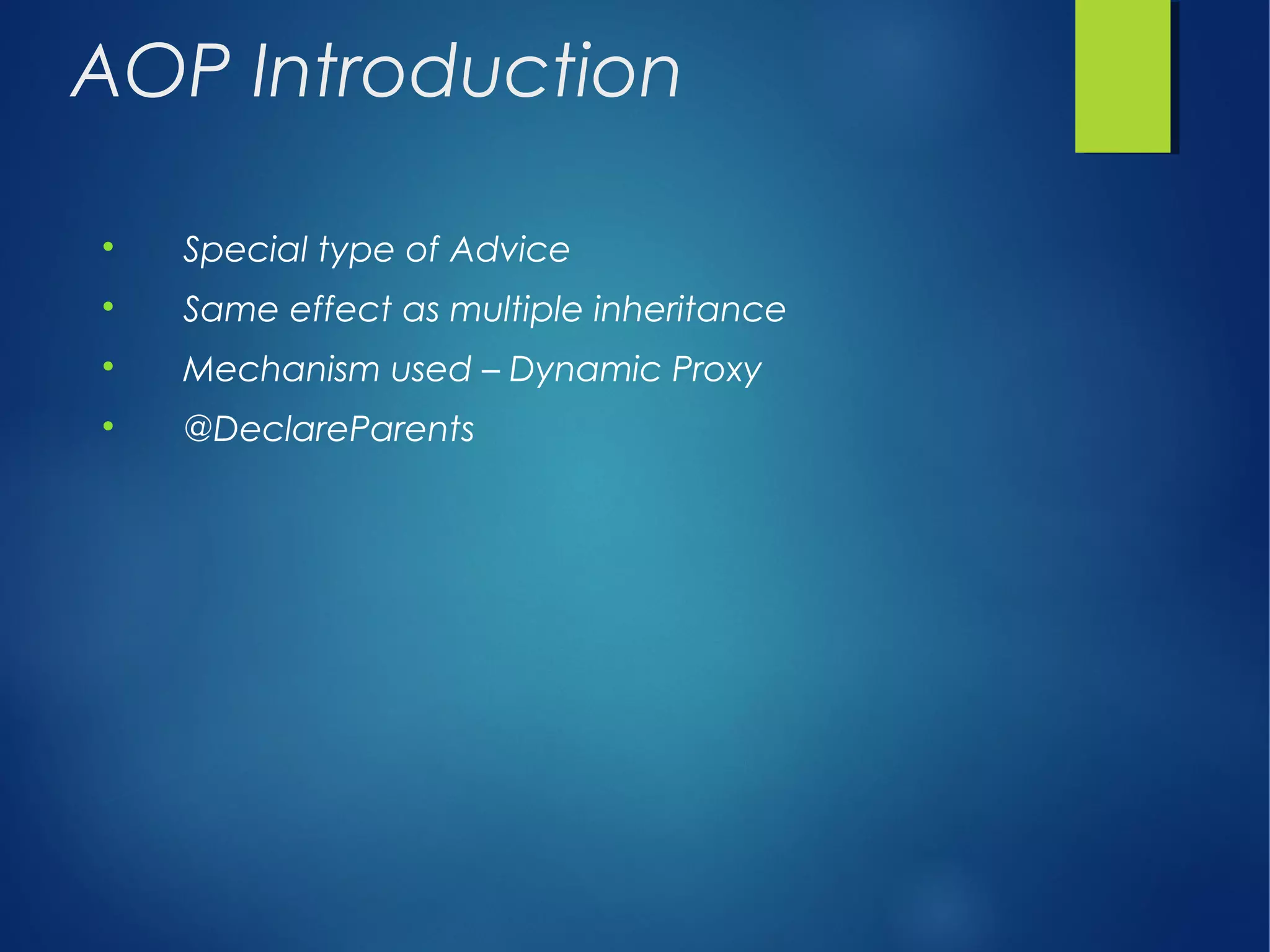
AOP Introduction

Special type of Advice

Same effect as multiple inheritance

Mechanism used – Dynamic Proxy

@DeclareParents
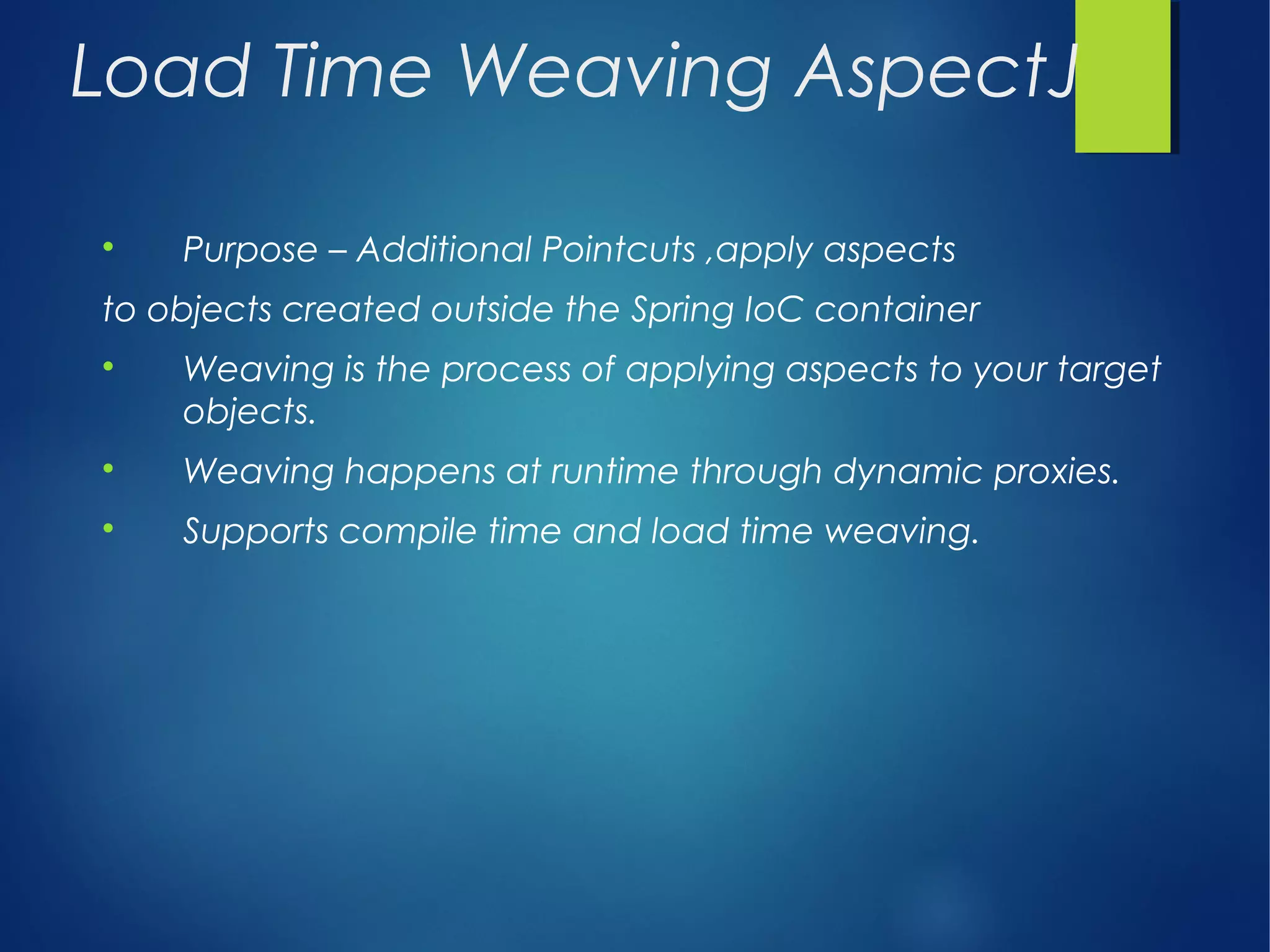
Load Time Weaving AspectJ

Purpose – Additional Pointcuts ,apply aspects
to objects created outside the Spring IoC container

Weaving is the process of applying aspects to your target
objects.

Weaving happens at runtime through dynamic proxies.

Supports compile time and load time weaving.
Types of AspectJ Weaving

Complie time weaving

Load time weaving

By AspectJ Weaver

Spring Load time Weaver

Application Used : Caching
Configuring AspectJ Aspects in
Spring

Factory-method is aspectof()
Injecting Spring Beans into
Domain Beans

Wiring Spring objects and Domain Objects

Injection of Spring beans is a cross cutting concern

Annotate the Domain class with @Configurable
THANK YOU

Spring AOP

  • 1.
  • 2.
    Spring AOP -Introduction  Aspect – Unit of Modularity  Entails breaking down program logic into distinct parts called so- called concerns. The functions that span multiple points of an application are called cross-cutting concerns  Cross-cutting concerns are conceptually separate from the application's business logic.
  • 3.
    AOP in Business  Logging  TransactionManagement – Declarative  Caching  Security
  • 4.
  • 5.
    AOP Advice  This isthe actual action to be taken either before or after the method execution.  This is actual piece of code that is invoked during program execution by Spring AOP framework.
  • 6.
    Types of Advices  Before- Run advice before the a method execution.  After - Run advice after the a method execution regardless of its outcome.  After Returning - Run advice after the a method execution only if method completes successfully.  After throwing - Run advice after the a method execution only if method exits by throwing an exception.  Around- Run advice before and after the advised method is invoked.
  • 7.
    Advices - Examples  @Before("execution(**.*(..))")  @After("execution(* *.*(..))")  @AfterReturning("execution(* *.*(..))")  @AfterThrowing("execution(* *.*(..))")  @Around("execution(* *.*(..))")
  • 8.
    Aspects Implementation  XML SchemaBased  Annotaion Based
  • 9.
    Join Point  An Adviceis applied to different program execution points, which are called join points.  An Advice to take the correct action, it often requires detailed information about join points.
  • 10.
    Accessing Join Point Information  Kind  Methodsignature  Argument values  Target Object  Proxy Object
  • 11.
    AspectJ Precedence  More thanone Aspect classes – need Precedence  How to implement?  Ordered Interface  Order Annotation
  • 12.
    Point Cut Expressions  Itis a powerful expression language that can match various kinds of join points.  Indicate which method should be intercept, by method name or regular expression pattern.  expression(<method scope> <return type> <fully qualified class name>.*(parametes))
  • 13.
    Continue..,  method scope: Advicewill be applied to all the methods having this scope. For e.g., public, private, etc. Please note that Spring AOP only supports advising public methods.  return type: Advice will be applied to all the methods having this return type.
  • 14.
    Continue..,  fully qualified classname: Advice will be applied to all the methods of this type. If the class and advice are in the same package then package name is not required  parameters: You can also filter the method names based on the types. Two dots(..) means any number and type of parameters.
  • 15.
    Pointcut Examples  execution(* com.aspects.pointcut.DemoClass.*(..)): This advice will be applied to all the methods of DemoClass.  execution(* DemoClass.*(..)): You can omit the package if the DemoClass and the advice is in the same package.  execution(public * DemoClass.*(..)): This advice will be applied to the public methods of DemoClass.
  • 16.
    Pointcut Examples  execution(public intDemoClass.*(..)): This advice will be applied to the public methods of DemoClass and returning an int.  execution(public int DemoClass.*(int, ..)): This advice will be applied to the public methods of DemoClass and returning an int and having first parameter as int.  execution(public int DemoClass.*(int, int)): This advice will be applied to the public methods of DemoClass and returning an int and having both parameters as int.
  • 17.
    Reusing Pointcut Expression @Pointcut("execution(**.*(..))") private void loggingOperation() {} @Before("loggingOperation()") public void logBefore(JoinPoint joinPoint) {}
  • 18.
    PointCut Class Aspect @Aspect ClassPointCut { @Pointcut("execution(* *.*(..))") private void loggingOperation() {} }
  • 19.
    @AfterReturning( pointcut = "PointCut.loggingOperation()", returning= "result") public void logAfterReturning(JoinPoint joinPoint, Object result) { }
  • 20.
    Type Signature Pattern  Within- pointcut expressions matches all join points within certain types.  pointcut matches all the method execution join points within the com.msoftgp.spring package within(com.msoftgp.spring.*)  To match the join points within a package and its subpackage, you have to add one more dot before the wildcard. within(com.msoftgp.spring..*)
  • 21.
     The pointcut expressionmatches the method execution join points within a particular class: within(com.msoftgp.spring.ArithmeticCalculatorImpl)  Again, if the target class is located in the same package as this aspect, the package name can be omitted. within(ArithmeticCalculatorImpl)
  • 22.
     You can matchthe method execution join points within all classes that implement the ArithmeticCalculator interface by adding a plus symbol. within(ArithmeticCalculator+)
  • 23.
    Combining Pointcuts @Aspect public classCalculatorPointcuts { @Pointcut("within(ArithmeticCalculator+)") public void arithmeticOperation() {} @Pointcut("within(UnitCalculator+)") public void unitOperation() {} @Pointcut("arithmeticOperation()|| unitOperation()") public void loggingOperation() {} }
  • 24.
    Pointcut Parameters  execution(* *.*(..))&& target(target) && args(a,b)  Public void logBefore(Object target,int a,int b)
  • 25.
    AOP Introduction  Special typeof Advice  Same effect as multiple inheritance  Mechanism used – Dynamic Proxy  @DeclareParents
  • 26.
    Load Time WeavingAspectJ  Purpose – Additional Pointcuts ,apply aspects to objects created outside the Spring IoC container  Weaving is the process of applying aspects to your target objects.  Weaving happens at runtime through dynamic proxies.  Supports compile time and load time weaving.
  • 27.
    Types of AspectJWeaving  Complie time weaving  Load time weaving  By AspectJ Weaver  Spring Load time Weaver  Application Used : Caching
  • 28.
    Configuring AspectJ Aspectsin Spring  Factory-method is aspectof()
  • 29.
    Injecting Spring Beansinto Domain Beans  Wiring Spring objects and Domain Objects  Injection of Spring beans is a cross cutting concern  Annotate the Domain class with @Configurable
  • 30.