Spring Batch 2.0 Overview Guido Schmutz Technology Manager [email_address] Zurich, 18.3.2009
Introduction Guido Schmutz Working for Trivadis for more than 12 years Co-Author of different books Consultant, Trainer, Software Architect for Java, Oracle, SOA and EDA Member of Trivadis Architecture Board Trivadis Technology Manager More than 20 years of software development experience Contact: guido.schmutz@trivadis.com
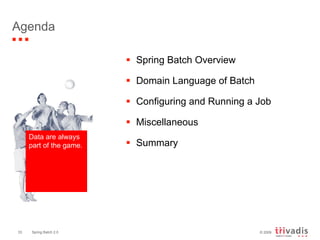
Agenda Spring Batch Overview Domain Language of Batch Configuring and Running a Job Miscellaneous Summary Data are always part of the game.
Spring Batch Introduction Spring Batch is the first java based framework for batch processing a lightweight, comprehensive batch framework  builds upon the productivity, POJO-based development approach, known from the Spring Framework current GA release is 1.1.4.RELEASE Spring Batch 2.0 will be released in the next couple of months Presentation is based on 2.0.0-RC1
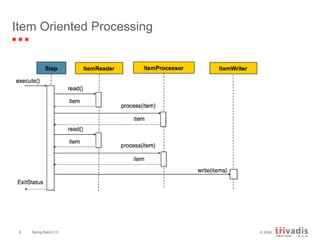
Batch Processing What is a Batch Application? Batch applications need to process  high volume  business critical  transactional  data A typical batch program generally  reads  a large number of records from a database, file, or queue processes  the data in some fashion, and  then  writes  back data in a modified form
Item Oriented Processing
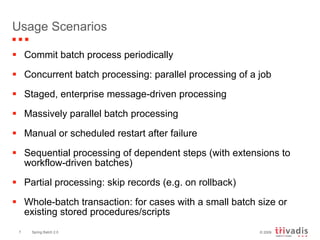
Usage Scenarios Commit batch process periodically Concurrent batch processing: parallel processing of a job Staged, enterprise message-driven processing Massively parallel batch processing Manual or scheduled restart after failure Sequential processing of dependent steps (with extensions to workflow-driven batches) Partial processing: skip records (e.g. on rollback) Whole-batch transaction: for cases with a small batch size or existing stored procedures/scripts
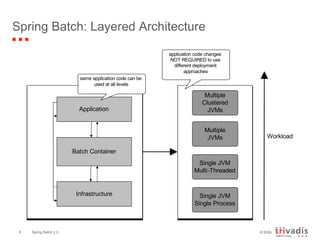
Spring Batch: Layered Architecture
Agenda Spring Batch Overview Domain Language of Batch Configuring and Running a Job Miscellaneous Summary Data are always part of the game.
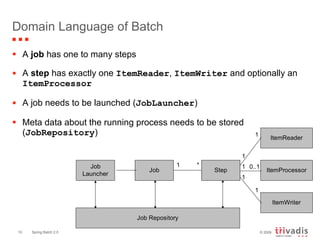
Domain Language of Batch A  job  has one to many steps A  step  has exactly one  ItemReader ,  ItemWriter   and optionally an  ItemProcessor A job needs to be launched ( JobLauncher ) Meta data about the running process needs to be stored ( JobRepository )
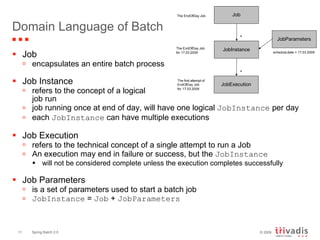
Domain Language of Batch Job  encapsulates an entire batch process  Job Instance refers to the concept of a logical  job run job running once at end of day, will have one logical  JobInstance  per day  each  JobInstance  can have multiple executions  Job Execution refers to the technical concept of a single attempt to run a Job An execution may end in failure or success, but the  JobInstance   will not be considered complete unless the execution completes successfully Job Parameters is a set of parameters used to start a batch job  JobInstance  =  Job  +  JobParameters
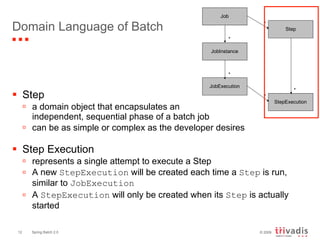
Domain Language of Batch Step a domain object that encapsulates an  independent, sequential phase of a batch job can be as simple or complex as the developer desires Step Execution represents a single attempt to execute a Step  A new  StepExecution  will be created each time a  Step  is run, similar to  JobExecution   A  StepExecution  will only be created when its  Step  is actually started
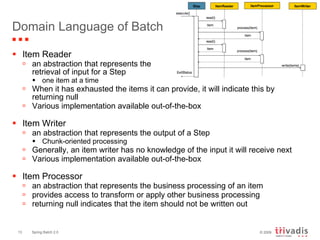
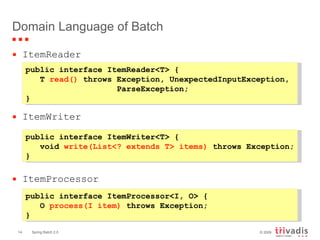
Domain Language of Batch Item Reader an abstraction that represents the  retrieval of input for a Step one item at a time When it has exhausted the items it can provide, it will indicate this by returning null Various implementation available out-of-the-box Item Writer an abstraction that represents the output of a Step Chunk-oriented processing Generally, an item writer has no knowledge of the input it will receive next Various implementation available out-of-the-box Item Processor an abstraction that represents the business processing of an item  provides access to transform or apply other business processing returning null indicates that the item should not be written out
Domain Language of Batch ItemReader ItemWriter ItemProcessor public interface ItemReader<T> {  T  read()  throws Exception, UnexpectedInputException,    ParseException;  }  public interface ItemWriter<T> { void  write(List<? extends T> items)  throws Exception; }  public interface ItemProcessor<I, O> {  O  process(I item)  throws Exception;  }
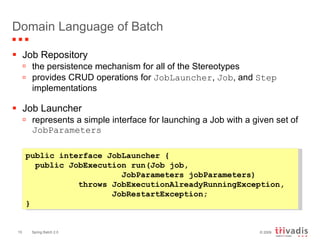
Domain Language of Batch Job Repository the persistence mechanism for all of the Stereotypes provides CRUD operations for  JobLauncher ,  Job , and  Step  implementations  Job Launcher represents a simple interface for launching a Job with a given set of  JobParameters   public interface JobLauncher {  public JobExecution run(Job job,  JobParameters jobParameters)    throws JobExecutionAlreadyRunningException,  JobRestartException;  }
Agenda Spring Batch Overview Domain Language of Batch Configuring and Running a Job Miscellaneous Summary Data are always part of the game.
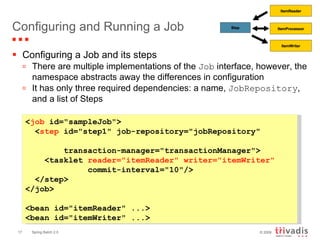
Configuring and Running a Job Configuring a Job and its steps There are multiple implementations of the  Job  interface, however, the namespace abstracts away the differences in configuration It has only three required dependencies: a name,  JobRepository , and a list of Steps  < job  id=&quot;sampleJob&quot;>  < step  id=&quot;step1&quot; job-repository=&quot;jobRepository&quot;  transaction-manager=&quot;transactionManager&quot;>  <tasklet  reader=&quot;itemReader&quot; writer=&quot;itemWriter&quot;     commit-interval=&quot;10&quot;/>  </step>  </job> <bean id=&quot;itemReader&quot; ...> <bean id=&quot;itemWriter&quot; ...>
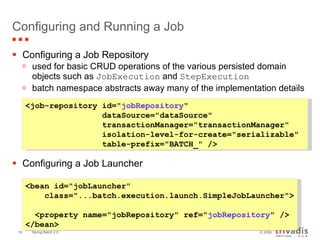
Configuring and Running a Job Configuring a Job Repository used for basic CRUD operations of the various persisted domain objects such as  JobExecution  and  StepExecution batch namespace abstracts away many of the implementation details Configuring a Job Launcher <job-repository id=&quot; jobRepository &quot;    dataSource=&quot;dataSource&quot;    transactionManager=&quot;transactionManager&quot;    isolation-level-for-create=&quot;serializable&quot;    table-prefix=&quot;BATCH_&quot; />   <bean id=&quot;jobLauncher&quot;    class=&quot;...batch.execution.launch.SimpleJobLauncher&quot;>    <property name=&quot;jobRepository&quot; ref=&quot; jobRepository &quot; /> </bean>
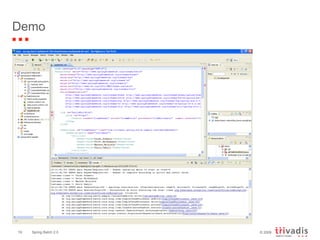
Demo
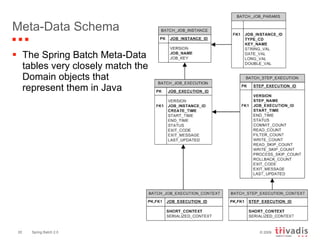
Meta-Data Schema The Spring Batch Meta-Data tables very closely match the Domain objects that represent them in Java
Agenda Spring Batch Overview Domain Language of Batch Configuring and Running a Job Miscellaneous Summary Data are always part of the game.
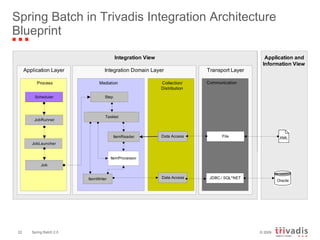
Spring Batch in Trivadis Integration Architecture Blueprint
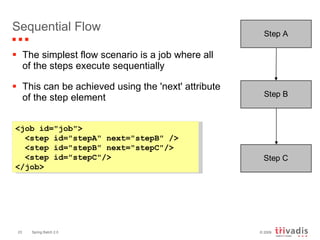
Sequential Flow The simplest flow scenario is a job where all of the steps execute sequentially This can be achieved using the 'next' attribute of the step element <job id=&quot;job&quot;> <step id=&quot;stepA&quot; next=&quot;stepB&quot; /> <step id=&quot;stepB&quot; next=&quot;stepC&quot;/> <step id=&quot;stepC&quot;/> </job>
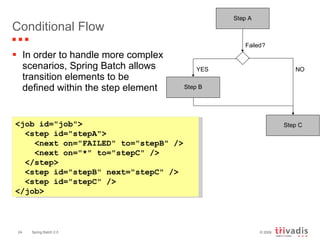
Conditional Flow In order to handle more complex scenarios, Spring Batch allows transition elements to be defined within the step element  <job id=&quot;job&quot;> <step id=&quot;stepA&quot;> <next on=&quot;FAILED&quot; to=&quot;stepB&quot; /> <next on=&quot;*&quot; to=&quot;stepC&quot; /> </step> <step id=&quot;stepB&quot; next=&quot;stepC&quot; /> <step id=&quot;stepC&quot; /> </job>
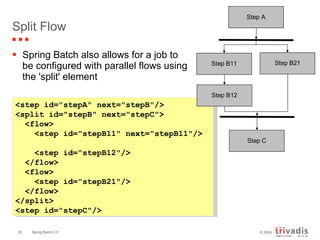
Split Flow Spring Batch also allows for a job to be configured with parallel flows using the 'split' element  <step id=&quot;stepA&quot; next=&quot;stepB&quot;/>   <split id=&quot;stepB&quot; next=&quot;stepC&quot;>  <flow>  <step id=&quot;stepB11&quot; next=&quot;stepB11&quot;/>  <step id=&quot;stepB12&quot;/>  </flow> <flow>  <step id=&quot;stepB21&quot;/>  </flow>  </split>  <step id=&quot;stepC&quot;/>
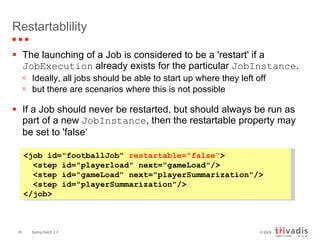
Restartablility The launching of a Job is considered to be a 'restart' if a  JobExecution  already exists for the particular  JobInstance . Ideally, all jobs should be able to start up where they left off but there are scenarios where this is not possible If a Job should never be restarted, but should always be run as part of a new  JobInstance , then the restartable property may be set to 'false‘ <job id=&quot;footballJob&quot;  restartable=&quot;false&quot; >    <step id=&quot;playerload&quot; next=&quot;gameLoad&quot;/>  <step id=&quot;gameLoad&quot; next=&quot;playerSummarization&quot;/> <step id=&quot;playerSummarization&quot;/> </job>
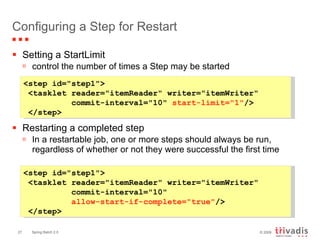
Configuring a Step for Restart Setting a StartLimit control the number of times a Step may be started Restarting a completed step In a restartable job, one or more steps should always be run, regardless of whether or not they were successful the first time  <step id=&quot;step1&quot;> <tasklet reader=&quot;itemReader&quot; writer=&quot;itemWriter&quot;    commit-interval=&quot;10&quot;    allow-start-if-complete=&quot;true&quot; />  </step>   <step id=&quot;step1&quot;> <tasklet reader=&quot;itemReader&quot; writer=&quot;itemWriter&quot;    commit-interval=&quot;10&quot;  start-limit=&quot;1&quot; /> </step>
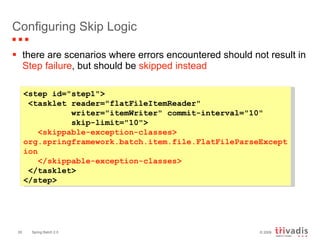
Configuring Skip Logic there are scenarios where errors encountered should not result in  Step failure , but should be  skipped instead <step id=&quot;step1&quot;> <tasklet reader=&quot;flatFileItemReader&quot;    writer=&quot;itemWriter&quot; commit-interval=&quot;10&quot;    skip-limit=&quot;10&quot;> <skippable-exception-classes> org.springframework.batch.item.file.FlatFileParseException </skippable-exception-classes>  </tasklet>  </step>
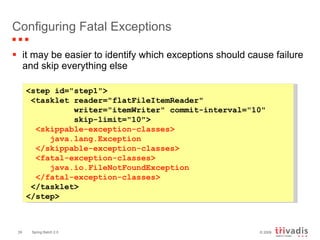
Configuring Fatal Exceptions it may be easier to identify which exceptions should cause failure and skip everything else  <step id=&quot;step1&quot;> <tasklet reader=&quot;flatFileItemReader&quot;  writer=&quot;itemWriter&quot; commit-interval=&quot;10&quot;  skip-limit=&quot;10&quot;> <skippable-exception-classes> java.lang.Exception  </skippable-exception-classes>  <fatal-exception-classes>  java.io.FileNotFoundException  </fatal-exception-classes> </tasklet> </step>
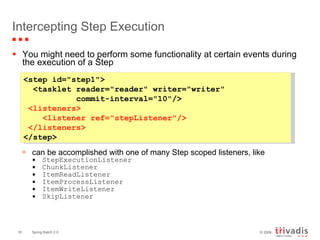
Intercepting Step Execution You might need to perform some functionality at certain events during the execution of a Step can be accomplished with one of many Step scoped listeners, like StepExecutionListener ChunkListener ItemReadListener ItemProcessListener ItemWriteListener SkipListener   <step id=&quot;step1&quot;> <tasklet reader=&quot;reader&quot; writer=&quot;writer&quot;    commit-interval=&quot;10&quot;/>  <listeners>   <listener ref=&quot;stepListener&quot;/>  </listeners> </step>
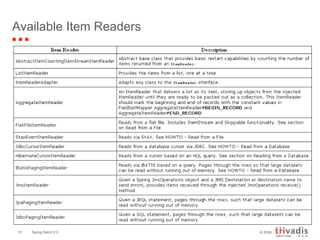
Available Item Readers
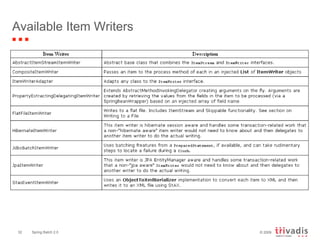
Available Item Writers
Agenda Spring Batch Overview Domain Language of Batch Configuring and Running a Job Miscellaneous Summary Data are always part of the game.
Summary Lack of a standard enterprise batch architecture is resulting in higher costs associated with the quality and delivery of solutions. Spring Batch provides a highly scalable, easy-to-use, customizable, industry-accepted batch framework collaboratively developed by Accenture and SpringSource Spring patterns and practices have been leveraged allowing developers to focus on business logic, while enterprise architects can customize and extend architecture concerns
Thank you! ? www.trivadis.com

Spring Batch 2.0

  • 1.
    Spring Batch 2.0Overview Guido Schmutz Technology Manager [email_address] Zurich, 18.3.2009
  • 2.
    Introduction Guido SchmutzWorking for Trivadis for more than 12 years Co-Author of different books Consultant, Trainer, Software Architect for Java, Oracle, SOA and EDA Member of Trivadis Architecture Board Trivadis Technology Manager More than 20 years of software development experience Contact: guido.schmutz@trivadis.com
  • 3.
    Agenda Spring BatchOverview Domain Language of Batch Configuring and Running a Job Miscellaneous Summary Data are always part of the game.
  • 4.
    Spring Batch IntroductionSpring Batch is the first java based framework for batch processing a lightweight, comprehensive batch framework builds upon the productivity, POJO-based development approach, known from the Spring Framework current GA release is 1.1.4.RELEASE Spring Batch 2.0 will be released in the next couple of months Presentation is based on 2.0.0-RC1
  • 5.
    Batch Processing Whatis a Batch Application? Batch applications need to process high volume business critical transactional data A typical batch program generally reads a large number of records from a database, file, or queue processes the data in some fashion, and then writes back data in a modified form
  • 6.
  • 7.
    Usage Scenarios Commitbatch process periodically Concurrent batch processing: parallel processing of a job Staged, enterprise message-driven processing Massively parallel batch processing Manual or scheduled restart after failure Sequential processing of dependent steps (with extensions to workflow-driven batches) Partial processing: skip records (e.g. on rollback) Whole-batch transaction: for cases with a small batch size or existing stored procedures/scripts
  • 8.
  • 9.
    Agenda Spring BatchOverview Domain Language of Batch Configuring and Running a Job Miscellaneous Summary Data are always part of the game.
  • 10.
    Domain Language ofBatch A job has one to many steps A step has exactly one ItemReader , ItemWriter and optionally an ItemProcessor A job needs to be launched ( JobLauncher ) Meta data about the running process needs to be stored ( JobRepository )
  • 11.
    Domain Language ofBatch Job encapsulates an entire batch process Job Instance refers to the concept of a logical job run job running once at end of day, will have one logical JobInstance per day each JobInstance can have multiple executions Job Execution refers to the technical concept of a single attempt to run a Job An execution may end in failure or success, but the JobInstance will not be considered complete unless the execution completes successfully Job Parameters is a set of parameters used to start a batch job JobInstance = Job + JobParameters
  • 12.
    Domain Language ofBatch Step a domain object that encapsulates an independent, sequential phase of a batch job can be as simple or complex as the developer desires Step Execution represents a single attempt to execute a Step A new StepExecution will be created each time a Step is run, similar to JobExecution A StepExecution will only be created when its Step is actually started
  • 13.
    Domain Language ofBatch Item Reader an abstraction that represents the retrieval of input for a Step one item at a time When it has exhausted the items it can provide, it will indicate this by returning null Various implementation available out-of-the-box Item Writer an abstraction that represents the output of a Step Chunk-oriented processing Generally, an item writer has no knowledge of the input it will receive next Various implementation available out-of-the-box Item Processor an abstraction that represents the business processing of an item provides access to transform or apply other business processing returning null indicates that the item should not be written out
  • 14.
    Domain Language ofBatch ItemReader ItemWriter ItemProcessor public interface ItemReader<T> { T read() throws Exception, UnexpectedInputException, ParseException; } public interface ItemWriter<T> { void write(List<? extends T> items) throws Exception; } public interface ItemProcessor<I, O> { O process(I item) throws Exception; }
  • 15.
    Domain Language ofBatch Job Repository the persistence mechanism for all of the Stereotypes provides CRUD operations for JobLauncher , Job , and Step implementations Job Launcher represents a simple interface for launching a Job with a given set of JobParameters public interface JobLauncher { public JobExecution run(Job job, JobParameters jobParameters) throws JobExecutionAlreadyRunningException, JobRestartException; }
  • 16.
    Agenda Spring BatchOverview Domain Language of Batch Configuring and Running a Job Miscellaneous Summary Data are always part of the game.
  • 17.
    Configuring and Runninga Job Configuring a Job and its steps There are multiple implementations of the Job interface, however, the namespace abstracts away the differences in configuration It has only three required dependencies: a name, JobRepository , and a list of Steps < job id=&quot;sampleJob&quot;> < step id=&quot;step1&quot; job-repository=&quot;jobRepository&quot; transaction-manager=&quot;transactionManager&quot;> <tasklet reader=&quot;itemReader&quot; writer=&quot;itemWriter&quot; commit-interval=&quot;10&quot;/> </step> </job> <bean id=&quot;itemReader&quot; ...> <bean id=&quot;itemWriter&quot; ...>
  • 18.
    Configuring and Runninga Job Configuring a Job Repository used for basic CRUD operations of the various persisted domain objects such as JobExecution and StepExecution batch namespace abstracts away many of the implementation details Configuring a Job Launcher <job-repository id=&quot; jobRepository &quot; dataSource=&quot;dataSource&quot; transactionManager=&quot;transactionManager&quot; isolation-level-for-create=&quot;serializable&quot; table-prefix=&quot;BATCH_&quot; /> <bean id=&quot;jobLauncher&quot; class=&quot;...batch.execution.launch.SimpleJobLauncher&quot;> <property name=&quot;jobRepository&quot; ref=&quot; jobRepository &quot; /> </bean>
  • 19.
  • 20.
    Meta-Data Schema TheSpring Batch Meta-Data tables very closely match the Domain objects that represent them in Java
  • 21.
    Agenda Spring BatchOverview Domain Language of Batch Configuring and Running a Job Miscellaneous Summary Data are always part of the game.
  • 22.
    Spring Batch inTrivadis Integration Architecture Blueprint
  • 23.
    Sequential Flow Thesimplest flow scenario is a job where all of the steps execute sequentially This can be achieved using the 'next' attribute of the step element <job id=&quot;job&quot;> <step id=&quot;stepA&quot; next=&quot;stepB&quot; /> <step id=&quot;stepB&quot; next=&quot;stepC&quot;/> <step id=&quot;stepC&quot;/> </job>
  • 24.
    Conditional Flow Inorder to handle more complex scenarios, Spring Batch allows transition elements to be defined within the step element <job id=&quot;job&quot;> <step id=&quot;stepA&quot;> <next on=&quot;FAILED&quot; to=&quot;stepB&quot; /> <next on=&quot;*&quot; to=&quot;stepC&quot; /> </step> <step id=&quot;stepB&quot; next=&quot;stepC&quot; /> <step id=&quot;stepC&quot; /> </job>
  • 25.
    Split Flow SpringBatch also allows for a job to be configured with parallel flows using the 'split' element <step id=&quot;stepA&quot; next=&quot;stepB&quot;/> <split id=&quot;stepB&quot; next=&quot;stepC&quot;> <flow> <step id=&quot;stepB11&quot; next=&quot;stepB11&quot;/> <step id=&quot;stepB12&quot;/> </flow> <flow> <step id=&quot;stepB21&quot;/> </flow> </split> <step id=&quot;stepC&quot;/>
  • 26.
    Restartablility The launchingof a Job is considered to be a 'restart' if a JobExecution already exists for the particular JobInstance . Ideally, all jobs should be able to start up where they left off but there are scenarios where this is not possible If a Job should never be restarted, but should always be run as part of a new JobInstance , then the restartable property may be set to 'false‘ <job id=&quot;footballJob&quot; restartable=&quot;false&quot; > <step id=&quot;playerload&quot; next=&quot;gameLoad&quot;/> <step id=&quot;gameLoad&quot; next=&quot;playerSummarization&quot;/> <step id=&quot;playerSummarization&quot;/> </job>
  • 27.
    Configuring a Stepfor Restart Setting a StartLimit control the number of times a Step may be started Restarting a completed step In a restartable job, one or more steps should always be run, regardless of whether or not they were successful the first time <step id=&quot;step1&quot;> <tasklet reader=&quot;itemReader&quot; writer=&quot;itemWriter&quot; commit-interval=&quot;10&quot; allow-start-if-complete=&quot;true&quot; /> </step> <step id=&quot;step1&quot;> <tasklet reader=&quot;itemReader&quot; writer=&quot;itemWriter&quot; commit-interval=&quot;10&quot; start-limit=&quot;1&quot; /> </step>
  • 28.
    Configuring Skip Logicthere are scenarios where errors encountered should not result in Step failure , but should be skipped instead <step id=&quot;step1&quot;> <tasklet reader=&quot;flatFileItemReader&quot; writer=&quot;itemWriter&quot; commit-interval=&quot;10&quot; skip-limit=&quot;10&quot;> <skippable-exception-classes> org.springframework.batch.item.file.FlatFileParseException </skippable-exception-classes> </tasklet> </step>
  • 29.
    Configuring Fatal Exceptionsit may be easier to identify which exceptions should cause failure and skip everything else <step id=&quot;step1&quot;> <tasklet reader=&quot;flatFileItemReader&quot; writer=&quot;itemWriter&quot; commit-interval=&quot;10&quot; skip-limit=&quot;10&quot;> <skippable-exception-classes> java.lang.Exception </skippable-exception-classes> <fatal-exception-classes> java.io.FileNotFoundException </fatal-exception-classes> </tasklet> </step>
  • 30.
    Intercepting Step ExecutionYou might need to perform some functionality at certain events during the execution of a Step can be accomplished with one of many Step scoped listeners, like StepExecutionListener ChunkListener ItemReadListener ItemProcessListener ItemWriteListener SkipListener <step id=&quot;step1&quot;> <tasklet reader=&quot;reader&quot; writer=&quot;writer&quot; commit-interval=&quot;10&quot;/> <listeners> <listener ref=&quot;stepListener&quot;/> </listeners> </step>
  • 31.
  • 32.
  • 33.
    Agenda Spring BatchOverview Domain Language of Batch Configuring and Running a Job Miscellaneous Summary Data are always part of the game.
  • 34.
    Summary Lack ofa standard enterprise batch architecture is resulting in higher costs associated with the quality and delivery of solutions. Spring Batch provides a highly scalable, easy-to-use, customizable, industry-accepted batch framework collaboratively developed by Accenture and SpringSource Spring patterns and practices have been leveraged allowing developers to focus on business logic, while enterprise architects can customize and extend architecture concerns
  • 35.
    Thank you! ?www.trivadis.com