
Nov 2014
Author: Kumar
Spring Batch
 Introduction
 Objective ,Scenarios & Features
 Spring Batch domain detail
 Major Types
 Code Samples
1
2
 Why another framework….?
 Batch jobs are part of most IT projects and
currently no commercial or open source
framework provides a robust, enterprise-scale
solution/framework
 The lack of a standard architecture has led many
projects to create their own custom architecture
 SpringBatch is output of combined effort of
Accenture and Spring Source which provide a
highly scalable, easy-to-use, customizable, Batch
architecture framework.
3
 What is a batch?
– Start and end
– Read from input – write to output
– Datasets too large to read and process all items
at once
– Optimize by committing periodically: chunk
 What is SpringBatch?
– Spring batch is defined as the processing of data
without
human interaction of interruption.
– It help to utilize the Maximum CPU time.
4
 Introduction
 Objective ,Scenarios & Features
 Spring Batch domain detail
 Major Types
 Code Samples
5
 Provide a highly scalable, easy-to-use, customizable, industry-accepted Batch
architecture framework
 Can be used in various cases…..
– Generation of statement
– ETL processing(moving the data from one data source to
another)
– Scientific analysis like weather forecasting
– Big data or data intelligence.
 Clear separation of concerns – application developer concentrates on business
logic.
 Commit batch process periodically
 Manual or scheduled restart after failure.
 Web based administration interface (Spring Batch Admin)
 supports multithreaded processing, parallel processing for single
JVM, remote chunking & remote partitioning for multiple jvm
6
 parallel processing of a jobs.
 Partial processing: skip records (e.g., on rollback)
 Sequential processing of dependent steps
 message-driven processing
 Whole-batch transaction for simple data models or small batch size
 Start,restart & skip capabilities
 Job control language for monitoring and operations: start, stop, suspend, cancel
 Based on spring framework
 Declarative I/O:- spring batch provides many functionalities related to I/O like writing mails, writing
to DB,Writing into flat/csv/xml file etc
 Transaction mgt.:-rollback,transaction boundary etc
7
 Introduction
 Objective ,Scenarios & Features
 Spring Batch domain details
 Major Types
 Code Samples
8
 A Job is a process which should run from start to
finish without interruption.
 A job can be completed in various independent
steps.
 Within the step individual data are processing
over and over again is called an item.
 In order to complete the job we need to process
millions of items, since we can’t process all these
items at a time so we divide it into small groups
called chunks.
 If you are not processing any chunk over and over
in case of initializing some task then you may go
for a single tasklets.
9
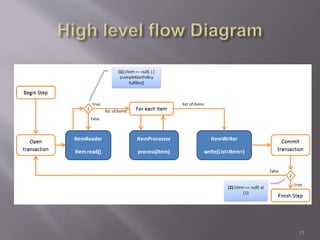
 The entire process of batch is completed in three major
steps.READ-PROCESS-WRITE.
 The class responsible to read,write & process is called
Item Reader, Item Writer & Item Processor respectively .
 On a particular event you can trigger any particular
task,this can be done Listeners.
 The status of job is kept in a repository called
JobRepository. Two ways to maintain a JobRepository.
First is using memory or map based second one
Database based or JDBC based.
 Each job updates the jobRepository their current status.
If something went wrong then spring batch restart that
job for that particular chunk where it left off.
10
 We need to launch the configured jobs.this task
can be done by a simple interface called
JobLauncher .
 To locate a job we can take the help of
JobLocator .
 the number of items that are aggregated and
written by the item writer in a single commit
can be decided by Commit Interval .
 Maximum number of erroneous record can be
set by Skip Limit <tasklet> <chunk reader="reader" writer="writer" commit-interval="3" skip-limit="2">
…………</chunk>…………..</ tasklet>
11
12
13
 Introduction
 Objective ,Scenarios & Features
 Spring Batch domain details
 Major Types
 Code Samples
14
15
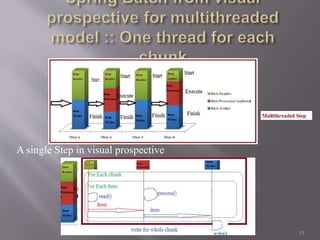
A single Step in visual prospective
16
17
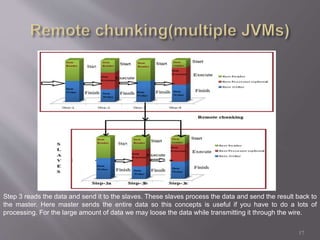
Step 3 reads the data and send it to the slaves. These slaves process the data and send the result back to
the master. Here master sends the entire data so this concepts is useful if you have to do a lots of
processing. For the large amount of data we may loose the data while transmitting it through the wire.
18
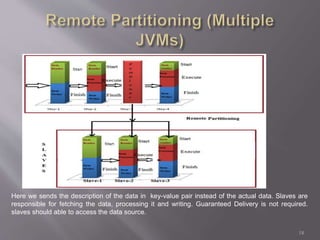
Here we sends the description of the data in key-value pair instead of the actual data. Slaves are
responsible for fetching the data, processing it and writing. Guaranteed Delivery is not required.
slaves should able to access the data source.
 Introduction
 Objective ,Scenarios & Features
 Spring Batch domain details
 Major Types
 Code Samples
19
1. Hello world example using tasklet
2. Example using Spring batch annotation
3. Example using Reader, Processor & writer
4. Example using Listeners
5. Example using Multi resource Reader
6. Example for Partitioning
7. Unit Testing example using spring batch
8. Spring batch Integration with Quartz example
9. Example using Command line Job Runner
10. Start, skip and restart example
20
 Spring Batch Home page:
http://static.springframework.org/spring-batch/
 Spring Batch Source Code:
https://springframework.svn.sourceforge.net/svnroot
/springframework/spring-batch/trunk/
 Forum:
http://forum.springframework.org/forumdisplay.php
?f=41
 Mailing List:
http://lists.interface21.com/listmanager/listinfo/spri
ng-batch-announce
 Issue Tracking (Jira)
http://opensource.atlassian.com/projects/spring/bro
wse/BATCH
21
 http://projects.spring.io/
 http://spring.io/
 http://www.theserverside.com/
 https://jcp.org/en/jsr/detail?id=352
 http://docs.spring.io/spring-
batch/reference/html/
22
23
Q & A

Spring batch

  • 1.
  • 2.
     Introduction  Objective,Scenarios & Features  Spring Batch domain detail  Major Types  Code Samples 1
  • 3.
  • 4.
     Why anotherframework….?  Batch jobs are part of most IT projects and currently no commercial or open source framework provides a robust, enterprise-scale solution/framework  The lack of a standard architecture has led many projects to create their own custom architecture  SpringBatch is output of combined effort of Accenture and Spring Source which provide a highly scalable, easy-to-use, customizable, Batch architecture framework. 3
  • 5.
     What isa batch? – Start and end – Read from input – write to output – Datasets too large to read and process all items at once – Optimize by committing periodically: chunk  What is SpringBatch? – Spring batch is defined as the processing of data without human interaction of interruption. – It help to utilize the Maximum CPU time. 4
  • 6.
     Introduction  Objective,Scenarios & Features  Spring Batch domain detail  Major Types  Code Samples 5
  • 7.
     Provide ahighly scalable, easy-to-use, customizable, industry-accepted Batch architecture framework  Can be used in various cases….. – Generation of statement – ETL processing(moving the data from one data source to another) – Scientific analysis like weather forecasting – Big data or data intelligence.  Clear separation of concerns – application developer concentrates on business logic.  Commit batch process periodically  Manual or scheduled restart after failure.  Web based administration interface (Spring Batch Admin)  supports multithreaded processing, parallel processing for single JVM, remote chunking & remote partitioning for multiple jvm 6
  • 8.
     parallel processingof a jobs.  Partial processing: skip records (e.g., on rollback)  Sequential processing of dependent steps  message-driven processing  Whole-batch transaction for simple data models or small batch size  Start,restart & skip capabilities  Job control language for monitoring and operations: start, stop, suspend, cancel  Based on spring framework  Declarative I/O:- spring batch provides many functionalities related to I/O like writing mails, writing to DB,Writing into flat/csv/xml file etc  Transaction mgt.:-rollback,transaction boundary etc 7
  • 9.
     Introduction  Objective,Scenarios & Features  Spring Batch domain details  Major Types  Code Samples 8
  • 10.
     A Jobis a process which should run from start to finish without interruption.  A job can be completed in various independent steps.  Within the step individual data are processing over and over again is called an item.  In order to complete the job we need to process millions of items, since we can’t process all these items at a time so we divide it into small groups called chunks.  If you are not processing any chunk over and over in case of initializing some task then you may go for a single tasklets. 9
  • 11.
     The entireprocess of batch is completed in three major steps.READ-PROCESS-WRITE.  The class responsible to read,write & process is called Item Reader, Item Writer & Item Processor respectively .  On a particular event you can trigger any particular task,this can be done Listeners.  The status of job is kept in a repository called JobRepository. Two ways to maintain a JobRepository. First is using memory or map based second one Database based or JDBC based.  Each job updates the jobRepository their current status. If something went wrong then spring batch restart that job for that particular chunk where it left off. 10
  • 12.
     We needto launch the configured jobs.this task can be done by a simple interface called JobLauncher .  To locate a job we can take the help of JobLocator .  the number of items that are aggregated and written by the item writer in a single commit can be decided by Commit Interval .  Maximum number of erroneous record can be set by Skip Limit <tasklet> <chunk reader="reader" writer="writer" commit-interval="3" skip-limit="2"> …………</chunk>…………..</ tasklet> 11
  • 13.
  • 14.
  • 15.
     Introduction  Objective,Scenarios & Features  Spring Batch domain details  Major Types  Code Samples 14
  • 16.
    15 A single Stepin visual prospective
  • 17.
  • 18.
    17 Step 3 readsthe data and send it to the slaves. These slaves process the data and send the result back to the master. Here master sends the entire data so this concepts is useful if you have to do a lots of processing. For the large amount of data we may loose the data while transmitting it through the wire.
  • 19.
    18 Here we sendsthe description of the data in key-value pair instead of the actual data. Slaves are responsible for fetching the data, processing it and writing. Guaranteed Delivery is not required. slaves should able to access the data source.
  • 20.
     Introduction  Objective,Scenarios & Features  Spring Batch domain details  Major Types  Code Samples 19
  • 21.
    1. Hello worldexample using tasklet 2. Example using Spring batch annotation 3. Example using Reader, Processor & writer 4. Example using Listeners 5. Example using Multi resource Reader 6. Example for Partitioning 7. Unit Testing example using spring batch 8. Spring batch Integration with Quartz example 9. Example using Command line Job Runner 10. Start, skip and restart example 20
  • 22.
     Spring BatchHome page: http://static.springframework.org/spring-batch/  Spring Batch Source Code: https://springframework.svn.sourceforge.net/svnroot /springframework/spring-batch/trunk/  Forum: http://forum.springframework.org/forumdisplay.php ?f=41  Mailing List: http://lists.interface21.com/listmanager/listinfo/spri ng-batch-announce  Issue Tracking (Jira) http://opensource.atlassian.com/projects/spring/bro wse/BATCH 21
  • 23.
     http://projects.spring.io/  http://spring.io/ http://www.theserverside.com/  https://jcp.org/en/jsr/detail?id=352  http://docs.spring.io/spring- batch/reference/html/ 22
  • 24.