Copyright © 2012, Oracle and/or its affiliates. All rights reserved.1
Copyright © 2012, Oracle and/or its affiliates. All rights reserved.2
Batch Applications for the
Java Platform
Sivakumar Thyagarajan
Oracle India
sivakumar.thyagarajan@oracle.com
Copyright © 2012, Oracle and/or its affiliates. All rights reserved.3
The following is intended to outline our general product direction. It is intended
for information purposes only, and may not be incorporated into any contract.
It is not a commitment to deliver any material, code, or functionality, and should
not be relied upon in making purchasing decisions. The development, release,
and timing of any features or functionality described for Oracle’s products
remains at the sole discretion of Oracle.
Copyright © 2012, Oracle and/or its affiliates. All rights reserved.4
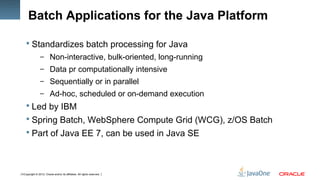
Batch Applications for the Java Platform
 Standardizes batch processing for Java
– Non-interactive, bulk-oriented, long-running
– Data pr computationally intensive
– Sequentially or in parallel
– Ad-hoc, scheduled or on-demand execution
 Led by IBM
 Spring Batch, WebSphere Compute Grid (WCG), z/OS Batch
 Part of Java EE 7, can be used in Java SE
Copyright © 2012, Oracle and/or its affiliates. All rights reserved.5
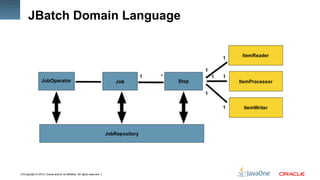
JBatch Domain Language
Copyright © 2012, Oracle and/or its affiliates. All rights reserved.6
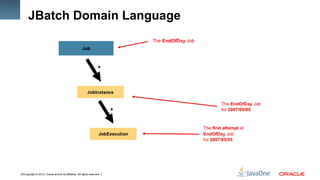
JBatch Domain Language
Copyright © 2012, Oracle and/or its affiliates. All rights reserved.7
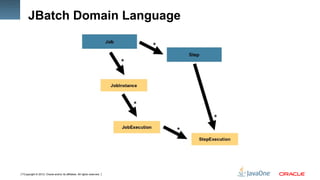
JBatch Domain Language
Copyright © 2012, Oracle and/or its affiliates. All rights reserved.8
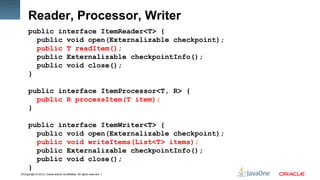
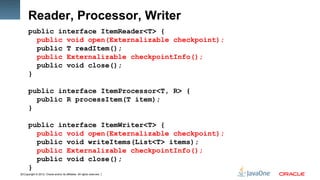
Reader, Processor, Writer
public interface ItemReader<T> {
public void open(Externalizable checkpoint);
public T readItem();
public Externalizable checkpointInfo();
public void close();
}
public interface ItemProcessor<T, R> {
public R processItem(T item);
}
public interface ItemWriter<T> {
public void open(Externalizable checkpoint);
public void writeItems(List<T> items);
public Externalizable checkpointInfo();
public void close();
}
Copyright © 2012, Oracle and/or its affiliates. All rights reserved.9
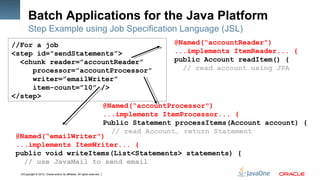
//For a job
<step id=”sendStatements”>
<chunk reader=”accountReader”
processor=”accountProcessor”
writer=”emailWriter”
item-count=”10” />
</step>
Batch Applications for the Java Platform
Step Example using Job Specification Language (JSL)
@Named(“accountReader")
...implements ItemReader... {
public Account readItem() {
// read account using JPA
@Named(“accountProcessor")
...implements ItemProcessor... {
Public Statement processItems(Account account) {
// read Account, return Statement
@Named(“emailWriter")
...implements ItemWriter... {
public void writeItems(List<Statements> statements) {
// use JavaMail to send email
Copyright © 2012, Oracle and/or its affiliates. All rights reserved.10
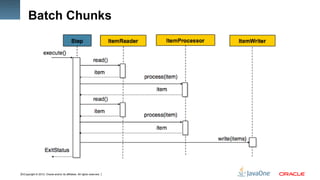
Batch Chunks
Copyright © 2012, Oracle and/or its affiliates. All rights reserved.11
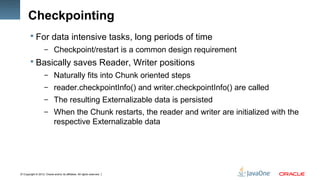
Checkpointing
 For data intensive tasks, long periods of time
– Checkpoint/restart is a common design requirement
 Basically saves Reader, Writer positions
– Naturally fits into Chunk oriented steps
– reader.checkpointInfo() and writer.checkpointInfo() are called
– The resulting Externalizable data is persisted
– When the Chunk restarts, the reader and writer are initialized with the
respective Externalizable data
Copyright © 2012, Oracle and/or its affiliates. All rights reserved.12
Reader, Processor, Writer
public interface ItemReader<T> {
public void open(Externalizable checkpoint);
public T readItem();
public Externalizable checkpointInfo();
public void close();
}
public interface ItemProcessor<T, R> {
public R processItem(T item);
}
public interface ItemWriter<T> {
public void open(Externalizable checkpoint);
public void writeItems(List<T> items);
public Externalizable checkpointInfo();
public void close();
}
Copyright © 2012, Oracle and/or its affiliates. All rights reserved.13
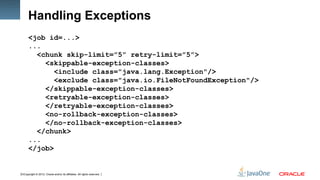
Handling Exceptions
<job id=...>
...
<chunk skip-limit=”5” retry-limit=”5”>
<skippable-exception-classes>
<include class="java.lang.Exception"/>
<exclude class="java.io.FileNotFoundException"/>
</skippable-exception-classes>
<retryable-exception-classes>
</retryable-exception-classes>
<no-rollback-exception-classes>
</no-rollback-exception-classes>
</chunk>
...
</job>
Copyright © 2012, Oracle and/or its affiliates. All rights reserved.14
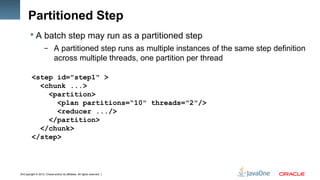
Partitioned Step
 A batch step may run as a partitioned step
– A partitioned step runs as multiple instances of the same step definition
across multiple threads, one partition per thread
<step id="step1" >
<chunk ...>
<partition>
<plan partitions=“10" threads="2"/>
<reducer .../>
</partition>
</chunk>
</step>
Copyright © 2012, Oracle and/or its affiliates. All rights reserved.15
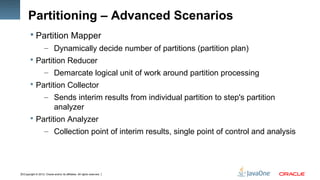
Partitioning – Advanced Scenarios
 Partition Mapper
– Dynamically decide number of partitions (partition plan)
 Partition Reducer
– Demarcate logical unit of work around partition processing
 Partition Collector
– Sends interim results from individual partition to step's partition
analyzer
 Partition Analyzer
– Collection point of interim results, single point of control and analysis
Copyright © 2012, Oracle and/or its affiliates. All rights reserved.16
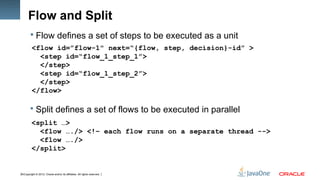
Flow and Split
 Flow defines a set of steps to be executed as a unit
<flow id=”flow-1" next=“{flow, step, decision}-id” >
<step id=“flow_1_step_1”>
</step>
<step id=“flow_1_step_2”>
</step>
</flow>
 Split defines a set of flows to be executed in parallel
<split …>
<flow …./> <!– each flow runs on a separate thread -->
<flow …./>
</split>
Copyright © 2012, Oracle and/or its affiliates. All rights reserved.17
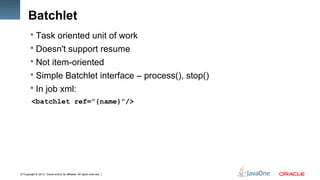
Batchlet
 Task oriented unit of work
 Doesn't support resume
 Not item-oriented
 Simple Batchlet interface – process(), stop()
 In job xml:
<batchlet ref=”{name}”/>
Copyright © 2012, Oracle and/or its affiliates. All rights reserved.18
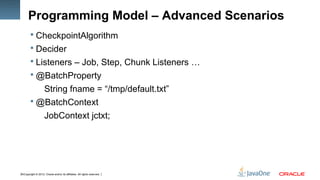
Programming Model – Advanced Scenarios
 CheckpointAlgorithm
 Decider
 Listeners – Job, Step, Chunk Listeners …
 @BatchProperty
String fname = “/tmp/default.txt”
 @BatchContext
JobContext jctxt;
Copyright © 2012, Oracle and/or its affiliates. All rights reserved.19
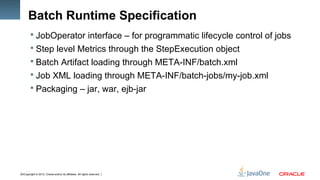
Batch Runtime Specification
 JobOperator interface – for programmatic lifecycle control of jobs
 Step level Metrics through the StepExecution object
 Batch Artifact loading through META-INF/batch.xml
 Job XML loading through META-INF/batch-jobs/my-job.xml
 Packaging – jar, war, ejb-jar
Copyright © 2012, Oracle and/or its affiliates. All rights reserved.20
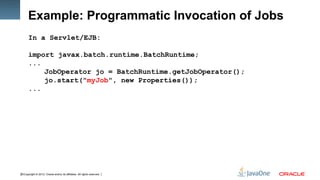
Example: Programmatic Invocation of Jobs
In a Servlet/EJB:
import javax.batch.runtime.BatchRuntime;
...
JobOperator jo = BatchRuntime.getJobOperator();
jo.start("myJob", new Properties());
...
Copyright © 2012, Oracle and/or its affiliates. All rights reserved.21
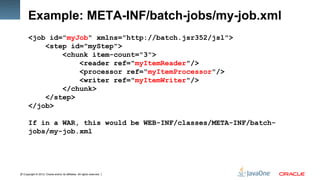
Example: META-INF/batch-jobs/my-job.xml
<job id="myJob" xmlns="http://batch.jsr352/jsl">
<step id="myStep">
<chunk item-count="3">
<reader ref="myItemReader"/>
<processor ref="myItemProcessor"/>
<writer ref="myItemWriter"/>
</chunk>
</step>
</job>
If in a WAR, this would be WEB-INF/classes/META-INF/batch-
jobs/my-job.xml
Copyright © 2012, Oracle and/or its affiliates. All rights reserved.22
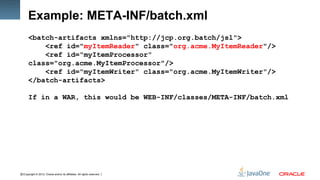
Example: META-INF/batch.xml
<batch-artifacts xmlns="http://jcp.org.batch/jsl">
<ref id="myItemReader" class="org.acme.MyItemReader"/>
<ref id="myItemProcessor"
class="org.acme.MyItemProcessor"/>
<ref id="myItemWriter" class="org.acme.MyItemWriter"/>
</batch-artifacts>
If in a WAR, this would be WEB-INF/classes/META-INF/batch.xml
Copyright © 2012, Oracle and/or its affiliates. All rights reserved.23
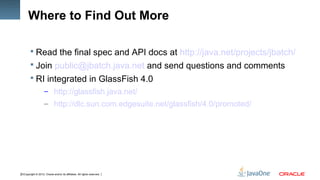
Where to Find Out More
 Read the final spec and API docs at http://java.net/projects/jbatch/
 Join public@jbatch.java.net and send questions and comments
 RI integrated in GlassFish 4.0
– http://glassfish.java.net/
– http://dlc.sun.com.edgesuite.net/glassfish/4.0/promoted/
Copyright © 2012, Oracle and/or its affiliates. All rights reserved.24
Graphic Section Divider
Copyright © 2012, Oracle and/or its affiliates. All rights reserved.25

Batch Applications for the Java Platform

  • 1.
    Copyright © 2012,Oracle and/or its affiliates. All rights reserved.1
  • 2.
    Copyright © 2012,Oracle and/or its affiliates. All rights reserved.2 Batch Applications for the Java Platform Sivakumar Thyagarajan Oracle India sivakumar.thyagarajan@oracle.com
  • 3.
    Copyright © 2012,Oracle and/or its affiliates. All rights reserved.3 The following is intended to outline our general product direction. It is intended for information purposes only, and may not be incorporated into any contract. It is not a commitment to deliver any material, code, or functionality, and should not be relied upon in making purchasing decisions. The development, release, and timing of any features or functionality described for Oracle’s products remains at the sole discretion of Oracle.
  • 4.
    Copyright © 2012,Oracle and/or its affiliates. All rights reserved.4 Batch Applications for the Java Platform  Standardizes batch processing for Java – Non-interactive, bulk-oriented, long-running – Data pr computationally intensive – Sequentially or in parallel – Ad-hoc, scheduled or on-demand execution  Led by IBM  Spring Batch, WebSphere Compute Grid (WCG), z/OS Batch  Part of Java EE 7, can be used in Java SE
  • 5.
    Copyright © 2012,Oracle and/or its affiliates. All rights reserved.5 JBatch Domain Language
  • 6.
    Copyright © 2012,Oracle and/or its affiliates. All rights reserved.6 JBatch Domain Language
  • 7.
    Copyright © 2012,Oracle and/or its affiliates. All rights reserved.7 JBatch Domain Language
  • 8.
    Copyright © 2012,Oracle and/or its affiliates. All rights reserved.8 Reader, Processor, Writer public interface ItemReader<T> { public void open(Externalizable checkpoint); public T readItem(); public Externalizable checkpointInfo(); public void close(); } public interface ItemProcessor<T, R> { public R processItem(T item); } public interface ItemWriter<T> { public void open(Externalizable checkpoint); public void writeItems(List<T> items); public Externalizable checkpointInfo(); public void close(); }
  • 9.
    Copyright © 2012,Oracle and/or its affiliates. All rights reserved.9 //For a job <step id=”sendStatements”> <chunk reader=”accountReader” processor=”accountProcessor” writer=”emailWriter” item-count=”10” /> </step> Batch Applications for the Java Platform Step Example using Job Specification Language (JSL) @Named(“accountReader") ...implements ItemReader... { public Account readItem() { // read account using JPA @Named(“accountProcessor") ...implements ItemProcessor... { Public Statement processItems(Account account) { // read Account, return Statement @Named(“emailWriter") ...implements ItemWriter... { public void writeItems(List<Statements> statements) { // use JavaMail to send email
  • 10.
    Copyright © 2012,Oracle and/or its affiliates. All rights reserved.10 Batch Chunks
  • 11.
    Copyright © 2012,Oracle and/or its affiliates. All rights reserved.11 Checkpointing  For data intensive tasks, long periods of time – Checkpoint/restart is a common design requirement  Basically saves Reader, Writer positions – Naturally fits into Chunk oriented steps – reader.checkpointInfo() and writer.checkpointInfo() are called – The resulting Externalizable data is persisted – When the Chunk restarts, the reader and writer are initialized with the respective Externalizable data
  • 12.
    Copyright © 2012,Oracle and/or its affiliates. All rights reserved.12 Reader, Processor, Writer public interface ItemReader<T> { public void open(Externalizable checkpoint); public T readItem(); public Externalizable checkpointInfo(); public void close(); } public interface ItemProcessor<T, R> { public R processItem(T item); } public interface ItemWriter<T> { public void open(Externalizable checkpoint); public void writeItems(List<T> items); public Externalizable checkpointInfo(); public void close(); }
  • 13.
    Copyright © 2012,Oracle and/or its affiliates. All rights reserved.13 Handling Exceptions <job id=...> ... <chunk skip-limit=”5” retry-limit=”5”> <skippable-exception-classes> <include class="java.lang.Exception"/> <exclude class="java.io.FileNotFoundException"/> </skippable-exception-classes> <retryable-exception-classes> </retryable-exception-classes> <no-rollback-exception-classes> </no-rollback-exception-classes> </chunk> ... </job>
  • 14.
    Copyright © 2012,Oracle and/or its affiliates. All rights reserved.14 Partitioned Step  A batch step may run as a partitioned step – A partitioned step runs as multiple instances of the same step definition across multiple threads, one partition per thread <step id="step1" > <chunk ...> <partition> <plan partitions=“10" threads="2"/> <reducer .../> </partition> </chunk> </step>
  • 15.
    Copyright © 2012,Oracle and/or its affiliates. All rights reserved.15 Partitioning – Advanced Scenarios  Partition Mapper – Dynamically decide number of partitions (partition plan)  Partition Reducer – Demarcate logical unit of work around partition processing  Partition Collector – Sends interim results from individual partition to step's partition analyzer  Partition Analyzer – Collection point of interim results, single point of control and analysis
  • 16.
    Copyright © 2012,Oracle and/or its affiliates. All rights reserved.16 Flow and Split  Flow defines a set of steps to be executed as a unit <flow id=”flow-1" next=“{flow, step, decision}-id” > <step id=“flow_1_step_1”> </step> <step id=“flow_1_step_2”> </step> </flow>  Split defines a set of flows to be executed in parallel <split …> <flow …./> <!– each flow runs on a separate thread --> <flow …./> </split>
  • 17.
    Copyright © 2012,Oracle and/or its affiliates. All rights reserved.17 Batchlet  Task oriented unit of work  Doesn't support resume  Not item-oriented  Simple Batchlet interface – process(), stop()  In job xml: <batchlet ref=”{name}”/>
  • 18.
    Copyright © 2012,Oracle and/or its affiliates. All rights reserved.18 Programming Model – Advanced Scenarios  CheckpointAlgorithm  Decider  Listeners – Job, Step, Chunk Listeners …  @BatchProperty String fname = “/tmp/default.txt”  @BatchContext JobContext jctxt;
  • 19.
    Copyright © 2012,Oracle and/or its affiliates. All rights reserved.19 Batch Runtime Specification  JobOperator interface – for programmatic lifecycle control of jobs  Step level Metrics through the StepExecution object  Batch Artifact loading through META-INF/batch.xml  Job XML loading through META-INF/batch-jobs/my-job.xml  Packaging – jar, war, ejb-jar
  • 20.
    Copyright © 2012,Oracle and/or its affiliates. All rights reserved.20 Example: Programmatic Invocation of Jobs In a Servlet/EJB: import javax.batch.runtime.BatchRuntime; ... JobOperator jo = BatchRuntime.getJobOperator(); jo.start("myJob", new Properties()); ...
  • 21.
    Copyright © 2012,Oracle and/or its affiliates. All rights reserved.21 Example: META-INF/batch-jobs/my-job.xml <job id="myJob" xmlns="http://batch.jsr352/jsl"> <step id="myStep"> <chunk item-count="3"> <reader ref="myItemReader"/> <processor ref="myItemProcessor"/> <writer ref="myItemWriter"/> </chunk> </step> </job> If in a WAR, this would be WEB-INF/classes/META-INF/batch- jobs/my-job.xml
  • 22.
    Copyright © 2012,Oracle and/or its affiliates. All rights reserved.22 Example: META-INF/batch.xml <batch-artifacts xmlns="http://jcp.org.batch/jsl"> <ref id="myItemReader" class="org.acme.MyItemReader"/> <ref id="myItemProcessor" class="org.acme.MyItemProcessor"/> <ref id="myItemWriter" class="org.acme.MyItemWriter"/> </batch-artifacts> If in a WAR, this would be WEB-INF/classes/META-INF/batch.xml
  • 23.
    Copyright © 2012,Oracle and/or its affiliates. All rights reserved.23 Where to Find Out More  Read the final spec and API docs at http://java.net/projects/jbatch/  Join public@jbatch.java.net and send questions and comments  RI integrated in GlassFish 4.0 – http://glassfish.java.net/ – http://dlc.sun.com.edgesuite.net/glassfish/4.0/promoted/
  • 24.
    Copyright © 2012,Oracle and/or its affiliates. All rights reserved.24 Graphic Section Divider
  • 25.
    Copyright © 2012,Oracle and/or its affiliates. All rights reserved.25