The Nature and Measurement of
Marketing Productivity in Consumer
Durables Industries:
A Firm Level Analysis


           Spring 2012: Group
                       2
                 Huy Dang
               Oanh Nguyen
               Jeffrey Gritton
                 Liman Ha
   Marketing Productivity emerged in the early 80s
    as a major concern of American business
   The purpose of this article is to develop a
    managerially relevant concept of marketing
    productivity, its operational measurement, and a
    procedure for establishing environment specific
    benchmarks to compare with various business
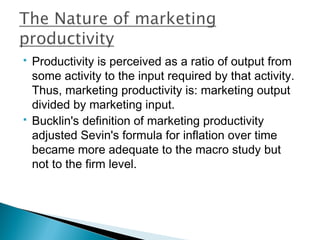
   Productivity is perceived as a ratio of output from
    some activity to the input required by that activity.
    Thus, marketing productivity is: marketing output
    divided by marketing input.
   Bucklin's definition of marketing productivity
    adjusted Sevin's formula for inflation over time
    became more adequate to the macro study but
    not to the firm level.
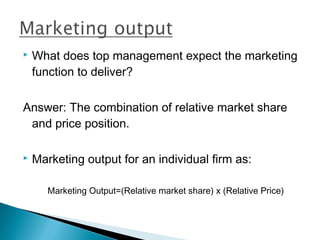
   What does top management expect the marketing
    function to deliver?

Answer: The combination of relative market share
 and price position.

   Marketing output for an individual firm as:

       Marketing Output=(Relative market share) x (Relative Price)
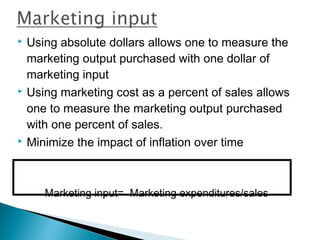
 Using absolute dollars allows one to measure the
  marketing output purchased with one dollar of
  marketing input
 Using marketing cost as a percent of sales allows

  one to measure the marketing output purchased
  with one percent of sales.
 Minimize the impact of inflation over time


     Marketing input= Marketing expenditures/sales
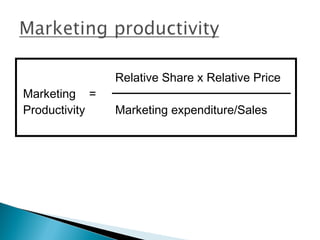
Relative Share x Relative Price
Marketing =
Productivity   Marketing expenditure/Sales
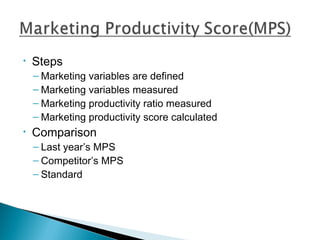
•   Steps
    – Marketing variables are defined
    – Marketing variables measured
    – Marketing productivity ratio measured
    – Marketing productivity score calculated
•   Comparison
    – Last year’s MPS
    – Competitor’s MPS
    – Standard
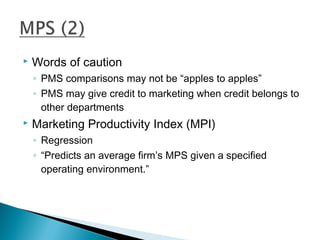
   Words of caution
    ◦ PMS comparisons may not be “apples to apples”
    ◦ PMS may give credit to marketing when credit belongs to
      other departments
   Marketing Productivity Index (MPI)
    ◦ Regression
    ◦ “Predicts an average firm’s MPS given a specified
      operating environment.”
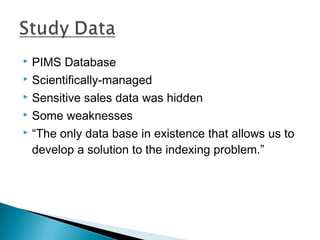
 PIMS Database
 Scientifically-managed

 Sensitive sales data was hidden

 Some weaknesses

 “The only data base in existence that allows us to

  develop a solution to the indexing problem.”
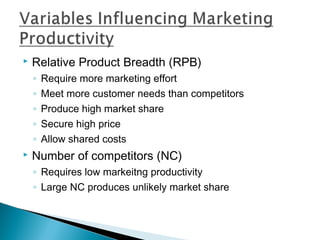
   Relative Product Breadth (RPB)
    ◦   Require more marketing effort
    ◦   Meet more customer needs than competitors
    ◦   Produce high market share
    ◦   Secure high price
    ◦   Allow shared costs
   Number of competitors (NC)
    ◦ Requires low markeitng productivity
    ◦ Large NC produces unlikely market share
   Relative Customer Size Range (RCSR)
    ◦ High RCSR requires more marketing effort
    ◦ Allows firm to obtain relatively high market share
    ◦ Allows firm to change differential price
   Served Market Growth (SMG)
    ◦ High SMG requires more marketing effort
    ◦ Concerned more with building capacity than stimulating
      demand
   Number of Immediate Customers (NIC)
    ◦ High NIC requires low levels of marketing productivity
    ◦ Higher costs to serve large numbers of customers
    ◦ Serving large NIC does not necessarily correlate to large
      market share
   Purchase Amount Immediate Customers
    ◦ Requires relatively high level of marketing productivity
    ◦ Suggests few customers, less frequent purchases and
      indirect distribution
   Purchase amount Immediate Customers (PAIC)
    ◦ Requires high level of marketing productivity
    ◦ Suggests few customers, less frequent purchases and
      indirect distribution
   Frequency of Product Changes (FPC)
    ◦ Associated with low level of marketing productivity
    ◦ Costly when introduced to the market
   Customization
    ◦ Associated with high marketing productivity
    ◦ Limited number of customers
 Focused on businesses that dealt in consumer
  durables
 Limited number of firms due to capacity limitation

 135 firms total

 Variables within 0.10 were retained in the model
   1)R²=0.43
   2) R² for each split half remain above 0.40 level;
    Auxiliary services did not meet 0.10; NC,RCSR, and
    FPC missed the 0.10 criteria in one of the split
    halves but were included in the other.
   3)All of the hypothesized relationships are reflected
    in the overall durables market except two. Custom
    production in durable goods does not lead to a high
    level of MP;
   4) Durable goods industries characterized by
    frequent product changes tend to have a higher
    level of marketing productivity than do industries
    with less frequent change.
 5)Replication of the process with 206 consumer
  nondurables firms in PIMS data base that were
  not constrained by capacity. The split half analysis
  produced results similar to those obtained for the
  durable industries model.
 6) In total, this replication in a different industry

  strongly supports the overall structure of the
  model developed for the durables industries.
 Expenditure data only exist only as a percent of
  sales in the PMS database
 Absolute expenditures would have been useful in

  allowing more confidence in the comparison of
  firms with large share differentials.
 Management should explicitly define marketing
  performance objectives in terms of relative price
  and relative share.
 If all the major firms in the market are similar on

  the firm specific variables (RPB,RPQ, CSR and
  NIC), no adjustments need to be made.
 If the firm is substantially above or below the level

  of key competitors, an analysis should be
  conducted .
 Causes of variations can be:
 1) 1 or more uncontrollable variables not

  discovered in the study.
 2) Short term competitive strategies such as

  buying market share.
 3) Particularly effective or ineffective uses of

  marketing expenditures.
   1. What is marketing productivity?
    ◦ What problems do we face in measuring productivity?
    ◦ How can we avoid them?
 2. What are the drawbacks/limitations of the
  Hawkins et al.’s (1987) marketing productivity
  index?
 3. Can we apply the index to measure productivity

  in other industries?

Spring 2012 group 2 marketing productivity

  • 1.
    The Nature andMeasurement of Marketing Productivity in Consumer Durables Industries: A Firm Level Analysis Spring 2012: Group 2 Huy Dang Oanh Nguyen Jeffrey Gritton Liman Ha
  • 2.
    Marketing Productivity emerged in the early 80s as a major concern of American business  The purpose of this article is to develop a managerially relevant concept of marketing productivity, its operational measurement, and a procedure for establishing environment specific benchmarks to compare with various business
  • 3.
    Productivity is perceived as a ratio of output from some activity to the input required by that activity. Thus, marketing productivity is: marketing output divided by marketing input.  Bucklin's definition of marketing productivity adjusted Sevin's formula for inflation over time became more adequate to the macro study but not to the firm level.
  • 4.
    What does top management expect the marketing function to deliver? Answer: The combination of relative market share and price position.  Marketing output for an individual firm as: Marketing Output=(Relative market share) x (Relative Price)
  • 5.
     Using absolutedollars allows one to measure the marketing output purchased with one dollar of marketing input  Using marketing cost as a percent of sales allows one to measure the marketing output purchased with one percent of sales.  Minimize the impact of inflation over time Marketing input= Marketing expenditures/sales
  • 6.
    Relative Share xRelative Price Marketing = Productivity Marketing expenditure/Sales
  • 7.
    Steps – Marketing variables are defined – Marketing variables measured – Marketing productivity ratio measured – Marketing productivity score calculated • Comparison – Last year’s MPS – Competitor’s MPS – Standard
  • 8.
    Words of caution ◦ PMS comparisons may not be “apples to apples” ◦ PMS may give credit to marketing when credit belongs to other departments  Marketing Productivity Index (MPI) ◦ Regression ◦ “Predicts an average firm’s MPS given a specified operating environment.”
  • 9.
     PIMS Database Scientifically-managed  Sensitive sales data was hidden  Some weaknesses  “The only data base in existence that allows us to develop a solution to the indexing problem.”
  • 10.
    Relative Product Breadth (RPB) ◦ Require more marketing effort ◦ Meet more customer needs than competitors ◦ Produce high market share ◦ Secure high price ◦ Allow shared costs  Number of competitors (NC) ◦ Requires low markeitng productivity ◦ Large NC produces unlikely market share
  • 11.
    Relative Customer Size Range (RCSR) ◦ High RCSR requires more marketing effort ◦ Allows firm to obtain relatively high market share ◦ Allows firm to change differential price  Served Market Growth (SMG) ◦ High SMG requires more marketing effort ◦ Concerned more with building capacity than stimulating demand
  • 12.
    Number of Immediate Customers (NIC) ◦ High NIC requires low levels of marketing productivity ◦ Higher costs to serve large numbers of customers ◦ Serving large NIC does not necessarily correlate to large market share  Purchase Amount Immediate Customers ◦ Requires relatively high level of marketing productivity ◦ Suggests few customers, less frequent purchases and indirect distribution
  • 13.
    Purchase amount Immediate Customers (PAIC) ◦ Requires high level of marketing productivity ◦ Suggests few customers, less frequent purchases and indirect distribution  Frequency of Product Changes (FPC) ◦ Associated with low level of marketing productivity ◦ Costly when introduced to the market  Customization ◦ Associated with high marketing productivity ◦ Limited number of customers
  • 14.
     Focused onbusinesses that dealt in consumer durables  Limited number of firms due to capacity limitation  135 firms total  Variables within 0.10 were retained in the model
  • 15.
    1)R²=0.43  2) R² for each split half remain above 0.40 level; Auxiliary services did not meet 0.10; NC,RCSR, and FPC missed the 0.10 criteria in one of the split halves but were included in the other.  3)All of the hypothesized relationships are reflected in the overall durables market except two. Custom production in durable goods does not lead to a high level of MP;  4) Durable goods industries characterized by frequent product changes tend to have a higher level of marketing productivity than do industries with less frequent change.
  • 16.
     5)Replication ofthe process with 206 consumer nondurables firms in PIMS data base that were not constrained by capacity. The split half analysis produced results similar to those obtained for the durable industries model.  6) In total, this replication in a different industry strongly supports the overall structure of the model developed for the durables industries.
  • 17.
     Expenditure dataonly exist only as a percent of sales in the PMS database  Absolute expenditures would have been useful in allowing more confidence in the comparison of firms with large share differentials.
  • 18.
     Management shouldexplicitly define marketing performance objectives in terms of relative price and relative share.  If all the major firms in the market are similar on the firm specific variables (RPB,RPQ, CSR and NIC), no adjustments need to be made.  If the firm is substantially above or below the level of key competitors, an analysis should be conducted .
  • 19.
     Causes ofvariations can be:  1) 1 or more uncontrollable variables not discovered in the study.  2) Short term competitive strategies such as buying market share.  3) Particularly effective or ineffective uses of marketing expenditures.
  • 20.
    1. What is marketing productivity? ◦ What problems do we face in measuring productivity? ◦ How can we avoid them?  2. What are the drawbacks/limitations of the Hawkins et al.’s (1987) marketing productivity index?  3. Can we apply the index to measure productivity in other industries?