Advertising Objectives
• DAGMAR
• Brand objective
• Consumer attitudes
• Market structure
• IMC Tools
Prepared by
- Nikshit Solanki
- Minoli Shah
- Prem Korde
- Sopandeo Naikwar
- Suraj Singh
An Advertising Objective is
 “An Advertising objective is a specific communication task, to be
accomplished among a defined audience to a given degree in a given period
of time”.
Advertising Objective
• Increasing Sales and Profits
• Encourage Trial and Usage
• Reminder Advertising
• Follow-Up
Advertising
New
Customers
Immediate
Sales
Change
attitude
Change
attitude
Future
sales
Advertising Goal
DAGMAR
Defining Advertising Goals for Measured Advertising Results
 DAGMAR is a marketing approach used to measure the results of an advertising campaign.
 DAGMAR is an approach to advertising planning and a precise method for selecting and
quantifying goals and for using those goals to measure performance.
 DAGMAR is aimed at setting advertising goals / planning's and not marketing goals.
 The DAGMAR suggests a precise method for selecting and quantifying advertising goals.
 It proposes that advertisers should collect feedback measures to determine if their
advertising met those goals.
 Results. The approach involves setting specific, measurable objectives for a campaign to
determine if specific objectives were met.
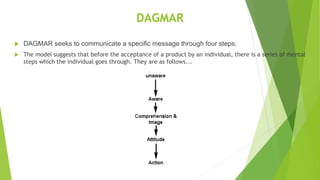
 DAGMAR seeks to communicate a specific message through four steps:
DAGMAR
 DAGMAR seeks to communicate a specific message through four steps:
 The model suggests that before the acceptance of a product by an individual, there is a series of mental
steps which the individual goes through. They are as follows...
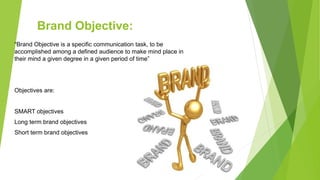
Brand Objective:
“Brand Objective is a specific communication task, to be
accomplished among a defined audience to make mind place in
their mind a given degree in a given period of time”
Objectives are:
SMART objectives
Long term brand objectives
Short term brand objectives
Consumer Attitude
 Consumer behavior/attitude and advertising are closely related because the main goal of
advertising involves using the behavior of potential buyers.
 The art of advertising is to use visual images and convincing copy to give consumers a
sense of longing or need for products or services. This also ties in with the study of
marketing, the means by which advertising is delivered to consumers through networking,
advertisements, and other means of communication.
 Advertising refers to ways in which marketers, retailers, and other professionals
communicate with potential consumers or prospects. It usually involves the use of paid
printed media communications, television spots, or Internet radio ads.
Consumer buying process :-
Effects of Advertising
Increased Awareness
Advertising and promotion offer a news function to consumers. Viewers of ads learn
about new products and services available to them, much like they learn about events in
the news. This information function has a neutral role. It provides facts without approval or
disapproval from consumers. Customer behavior at this stage encompasses expressions
of curiosity.
Analysis of Features
Consumers have a rational response to advertising when they look at the features of a
product or service. This response focuses on a logical listing of all the functional aspects
of the offering. This is an intellectual response, rather than an emotional one.
Evaluation of Benefits
When customers weigh benefits, they become emotionally involved with advertising and
promotion. Consumers identify ways the product or service can make them happier,
improve their lives or give them pleasure. This part of the consumer response is irrational
and can lead to impulse buying and competition to obtain the product.
The interconnected characteristics of a market, such as the number and
relative strength of buyers and sellers and degree of collusion among
them, level and forms of competition, extent of product differentiation,
and ease of entry into and exit from the market is called as Market
Structure.
Determinants of Market Structure
 Freedom of Entry & Exit
Nature of the Product
 Control over Supply Output
 Control over Price
 Barriers to Entry
Types Of Market Structure
 -Perfect competition: the efficient market where goods are produced using the most efficient
techniques and the least amount of factors. This market is considered to be unrealistic but it is
nevertheless of special interest for hypothetical and theoretical reasons.
 -Monopoly: it represents the opposite of perfect competition. This market is composed of a sole
seller who will therefore have full power to set prices.
 -Oligopoly: in this case, products are offered by a series of firms. However, the number of sellers
is not large enough to guarantee perfect competition prices. These markets are usually studied by
analyzing duopolies, since these are easier to model and the main conclusions can be
extrapolated to oligopolies.
 -Monopolistic competition: this market is formed by a high number of firms which produce a
similar good that can be seen as unique due to differentiation, that will allow prices to be held up
higher than marginal costs. In other words, each producer will be considered as a monopoly
thanks to differentiation, but the whole market s considered as competitive because the degree of
differentiation is not enough to undermine the possibility of substitution effects.
IMC Tool Mix
Integrated Marketing Communication Tools
Integrated Marketing Communication tools refer to integrating various marketing tools such as advertising, online
marketing, public relation activities, direct marketing, sales campaigns to promote brands so that similar message
reaches a wider audience. Products and services are promoted by effectively integrating various brand
communication tools.
Integrated marketing communication effectively integrates all modes of brand communication and uses them
simultaneously to promote various products and services among customers effectively and eventually yield higher
revenues for the organization.
Various IMC Tools:
Advertising
Sales Promotion
Direct Marketing
Personal Selling
PR Activites
Case Study…
Cereal Maker Change objectives and slash Budget –
without Much Success.
Q1) How smart move was for Post Cereal to slash prices in a competitive markets?
Ans) As already known in the market as one of the top companies for cereals, In order to compete with
Post Cereal,Kelloggs and General Mills reduces majorly on their Advertising & Promotional spendings.
This was an advantage for Post Cereal as they started climbing faster than the grocery price index almost
every year. Hence this majorly helped in regaining their customers back.
Q2) Wasn’t it Counter intuitive to decrease advertising and promotional spending specially when there was
a fall in sales?
Ans) Post Cereal took the risk of having such huge cuts in order to build a name brand more price
competitive with store brands. Which had gained a 7% gain in market share in 7 years.
It considered these cuts as a “RETURN TO RATIONAL MARKETING”
Q3) What do you conclude with this strategy?
Imc presentation   advertising objectives

Imc presentation advertising objectives

  • 1.
    Advertising Objectives • DAGMAR •Brand objective • Consumer attitudes • Market structure • IMC Tools Prepared by - Nikshit Solanki - Minoli Shah - Prem Korde - Sopandeo Naikwar - Suraj Singh
  • 2.
    An Advertising Objectiveis  “An Advertising objective is a specific communication task, to be accomplished among a defined audience to a given degree in a given period of time”. Advertising Objective • Increasing Sales and Profits • Encourage Trial and Usage • Reminder Advertising • Follow-Up
  • 3.
  • 4.
    DAGMAR Defining Advertising Goalsfor Measured Advertising Results  DAGMAR is a marketing approach used to measure the results of an advertising campaign.  DAGMAR is an approach to advertising planning and a precise method for selecting and quantifying goals and for using those goals to measure performance.  DAGMAR is aimed at setting advertising goals / planning's and not marketing goals.  The DAGMAR suggests a precise method for selecting and quantifying advertising goals.  It proposes that advertisers should collect feedback measures to determine if their advertising met those goals.  Results. The approach involves setting specific, measurable objectives for a campaign to determine if specific objectives were met.  DAGMAR seeks to communicate a specific message through four steps:
  • 5.
    DAGMAR  DAGMAR seeksto communicate a specific message through four steps:  The model suggests that before the acceptance of a product by an individual, there is a series of mental steps which the individual goes through. They are as follows...
  • 6.
    Brand Objective: “Brand Objectiveis a specific communication task, to be accomplished among a defined audience to make mind place in their mind a given degree in a given period of time” Objectives are: SMART objectives Long term brand objectives Short term brand objectives
  • 7.
    Consumer Attitude  Consumerbehavior/attitude and advertising are closely related because the main goal of advertising involves using the behavior of potential buyers.  The art of advertising is to use visual images and convincing copy to give consumers a sense of longing or need for products or services. This also ties in with the study of marketing, the means by which advertising is delivered to consumers through networking, advertisements, and other means of communication.  Advertising refers to ways in which marketers, retailers, and other professionals communicate with potential consumers or prospects. It usually involves the use of paid printed media communications, television spots, or Internet radio ads.
  • 8.
  • 9.
    Effects of Advertising IncreasedAwareness Advertising and promotion offer a news function to consumers. Viewers of ads learn about new products and services available to them, much like they learn about events in the news. This information function has a neutral role. It provides facts without approval or disapproval from consumers. Customer behavior at this stage encompasses expressions of curiosity. Analysis of Features Consumers have a rational response to advertising when they look at the features of a product or service. This response focuses on a logical listing of all the functional aspects of the offering. This is an intellectual response, rather than an emotional one. Evaluation of Benefits When customers weigh benefits, they become emotionally involved with advertising and promotion. Consumers identify ways the product or service can make them happier, improve their lives or give them pleasure. This part of the consumer response is irrational and can lead to impulse buying and competition to obtain the product.
  • 10.
    The interconnected characteristicsof a market, such as the number and relative strength of buyers and sellers and degree of collusion among them, level and forms of competition, extent of product differentiation, and ease of entry into and exit from the market is called as Market Structure.
  • 11.
    Determinants of MarketStructure  Freedom of Entry & Exit Nature of the Product  Control over Supply Output  Control over Price  Barriers to Entry
  • 12.
    Types Of MarketStructure  -Perfect competition: the efficient market where goods are produced using the most efficient techniques and the least amount of factors. This market is considered to be unrealistic but it is nevertheless of special interest for hypothetical and theoretical reasons.  -Monopoly: it represents the opposite of perfect competition. This market is composed of a sole seller who will therefore have full power to set prices.  -Oligopoly: in this case, products are offered by a series of firms. However, the number of sellers is not large enough to guarantee perfect competition prices. These markets are usually studied by analyzing duopolies, since these are easier to model and the main conclusions can be extrapolated to oligopolies.  -Monopolistic competition: this market is formed by a high number of firms which produce a similar good that can be seen as unique due to differentiation, that will allow prices to be held up higher than marginal costs. In other words, each producer will be considered as a monopoly thanks to differentiation, but the whole market s considered as competitive because the degree of differentiation is not enough to undermine the possibility of substitution effects.
  • 13.
    IMC Tool Mix IntegratedMarketing Communication Tools Integrated Marketing Communication tools refer to integrating various marketing tools such as advertising, online marketing, public relation activities, direct marketing, sales campaigns to promote brands so that similar message reaches a wider audience. Products and services are promoted by effectively integrating various brand communication tools. Integrated marketing communication effectively integrates all modes of brand communication and uses them simultaneously to promote various products and services among customers effectively and eventually yield higher revenues for the organization. Various IMC Tools: Advertising Sales Promotion Direct Marketing Personal Selling PR Activites
  • 14.
    Case Study… Cereal MakerChange objectives and slash Budget – without Much Success. Q1) How smart move was for Post Cereal to slash prices in a competitive markets? Ans) As already known in the market as one of the top companies for cereals, In order to compete with Post Cereal,Kelloggs and General Mills reduces majorly on their Advertising & Promotional spendings. This was an advantage for Post Cereal as they started climbing faster than the grocery price index almost every year. Hence this majorly helped in regaining their customers back. Q2) Wasn’t it Counter intuitive to decrease advertising and promotional spending specially when there was a fall in sales? Ans) Post Cereal took the risk of having such huge cuts in order to build a name brand more price competitive with store brands. Which had gained a 7% gain in market share in 7 years. It considered these cuts as a “RETURN TO RATIONAL MARKETING”
  • 15.
    Q3) What doyou conclude with this strategy?