Presented by:
Ms. Deepali Mhatre
CHAPTER-I
INTRODUCTION TO MARKETING
 Definition:
 Marketing is the management process responsible for
identifying, anticipating and satisfying consumers’
requirements profitably.
 Definition by Boone and Kurtz:
 Marketing is the process of planning and undertaking
the conception, pricing, promotion & distribution of
goods and services to create and maintain
relationships that will satisfy individual and
organizational objectives.
 Introduction:
 Marketing is the process used to determine what products or services
may be of interest to customers, and the strategy to use in sales,
communications and business development. It generates the strategy
that underlies sales techniques, business communication, and business
developments. It is an integrated process through which companies
build strong customer relationships and create value for their customers
and for themselves.
 Marketing is used to identify the customer, satisfy the customer, and
keep the customer. With the customer as the focus of its activities,
marketing management is one of the major components of business
management. Marketing evolved to meet the stasis in developing new
markets caused by mature markets and overcapacities in the last 2-3
centuries.[ The adoption of marketing strategies requires businesses to
shift their focus from production to the perceived needs and wants of
their customers as the means of staying profitable.
 The term marketing concept holds that achieving organizational goals
depends on knowing the needs and wants of target markets and
delivering the desired satisfactions. It proposes that in order to satisfy
its organizational objectives, an organization should anticipate the
needs and wants of consumers and satisfy these more effectively than
competitors. Marketing includes all activities for transferring goods from
producer to consumers. Its main aim is to sell and satisfy the
consumers. Today, market’s king is consumer. So, marketing provides
you good technique to handle customers. Marketing’s best technique is
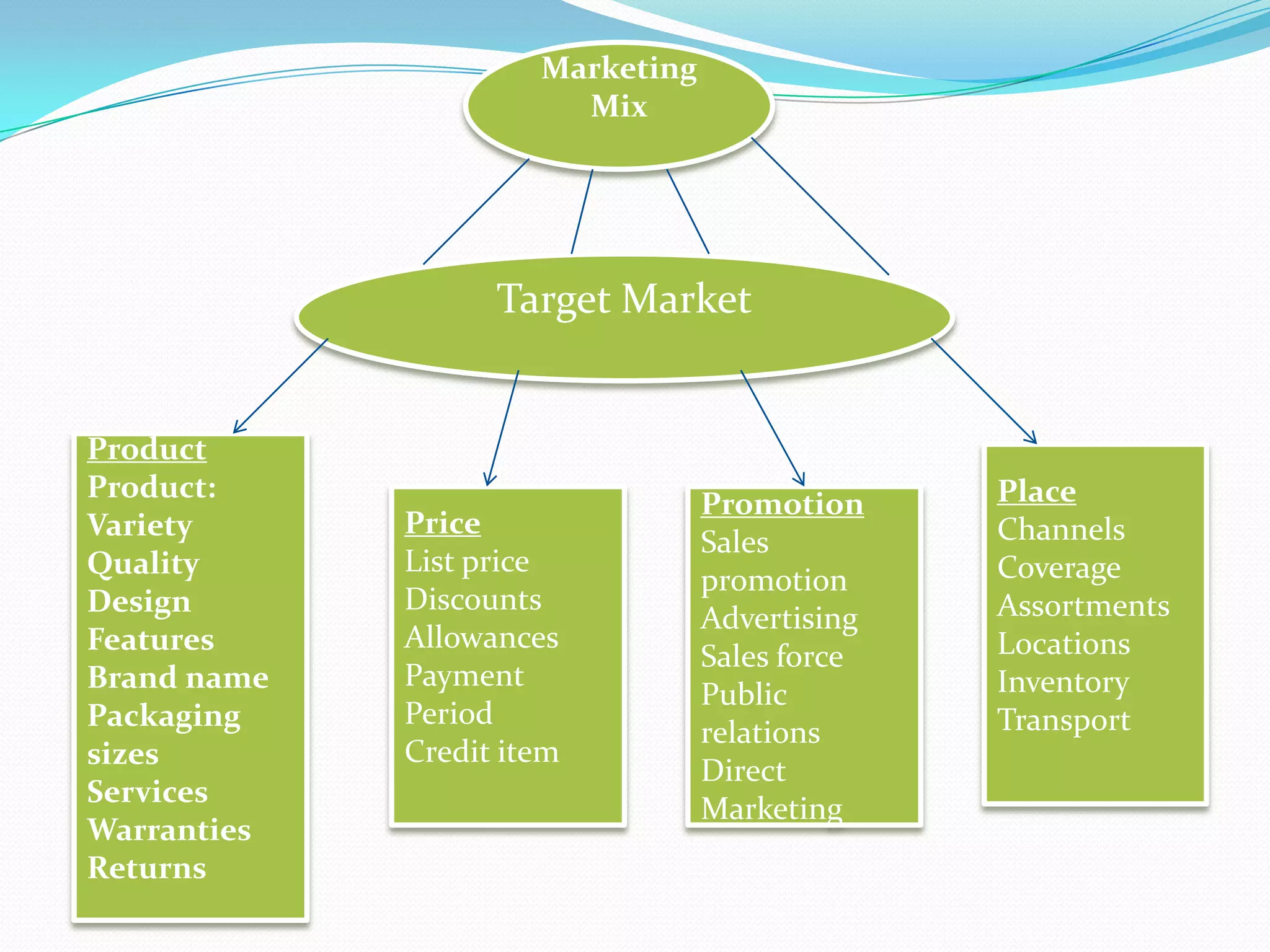
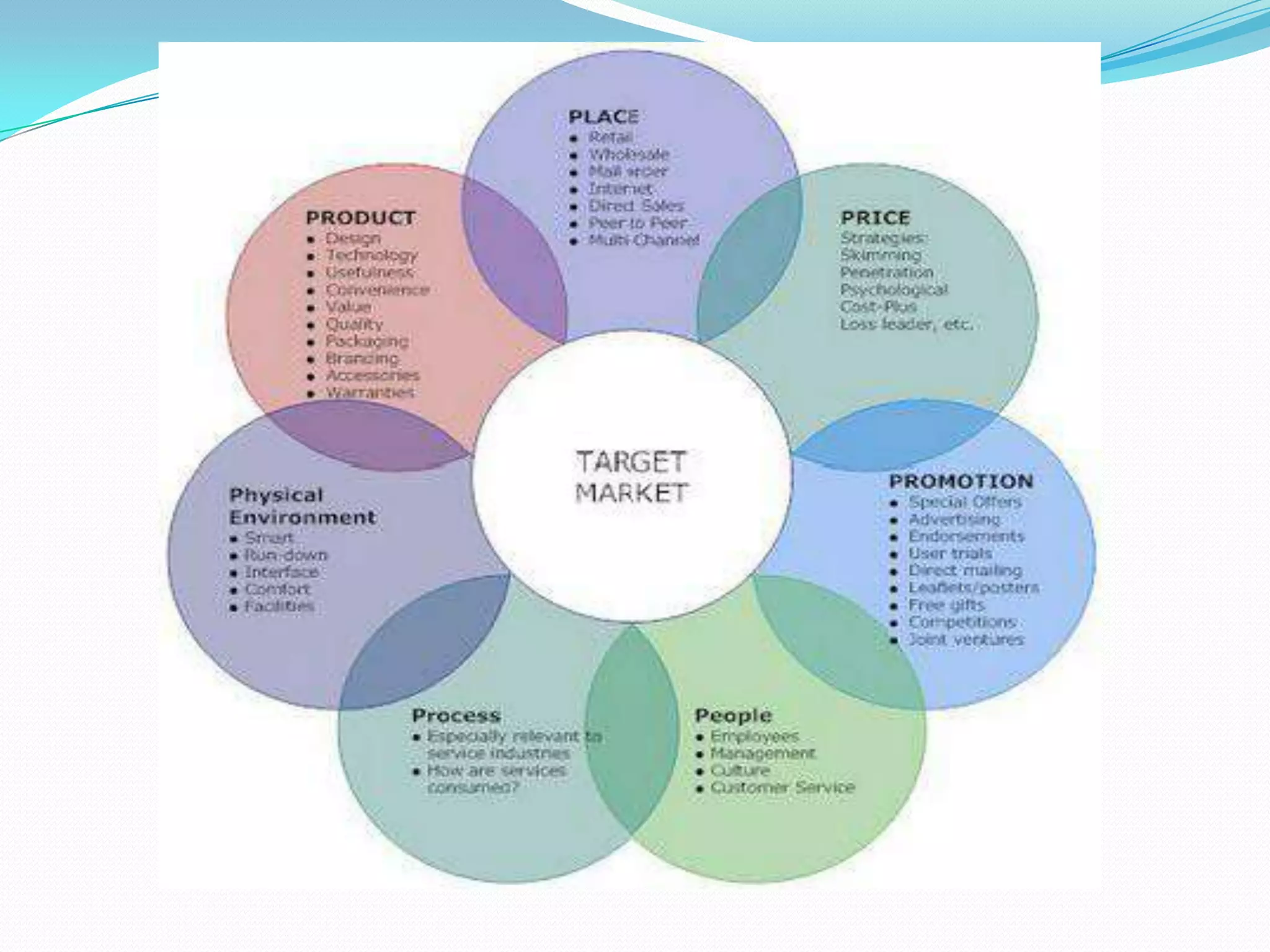
marketing mix. Marketing mix has four P
 1. Product which is made by producer must be made quality
basis.
2. Price is fixed by market but marketer should take low
price than market for increasing of sale.
3. Promotion is done by advertising; it must be used at proper
time for target audience.
4. Placement is relating to distribution activities, marketer
should reach by proper channel of distribution.
Marketing Research:
 Marketing research involves conducting research to support
marketing activities, and the statistical interpretation of data
into information. This information is then used by managers to
plan marketing activities, gauge the nature of a firm's marketing
environment and attain information from suppliers. Marketing
researchers use statistical methods such as quantitative research,
qualitative research, hypothesis tests, Chi-squared tests, linear
regression, correlations, frequency distributions, Poisson
distributions, binomial distributions, etc. to interpret their
findings and convert data into information. The marketing
research process spans a number of stages, including the
definition of a problem, development of a research plan,
collection and interpretation of data and disseminating
information formally in the form of a report. The task of
marketing research is to provide management with relevant,
accurate, reliable, valid, and current information.
Evolution of Marketing:
 An orientation, in the marketing context, related to a perception or
attitude a firm holds towards its product or service, essentially
concerning consumers and end-users. Throughout history, marketing
has changed considerably in conjunction with consumer tastes.
 Earlier approaches
 The marketing orientation evolved from earlier orientations, namely,
the production orientation, the product orientation and the selling
orientation
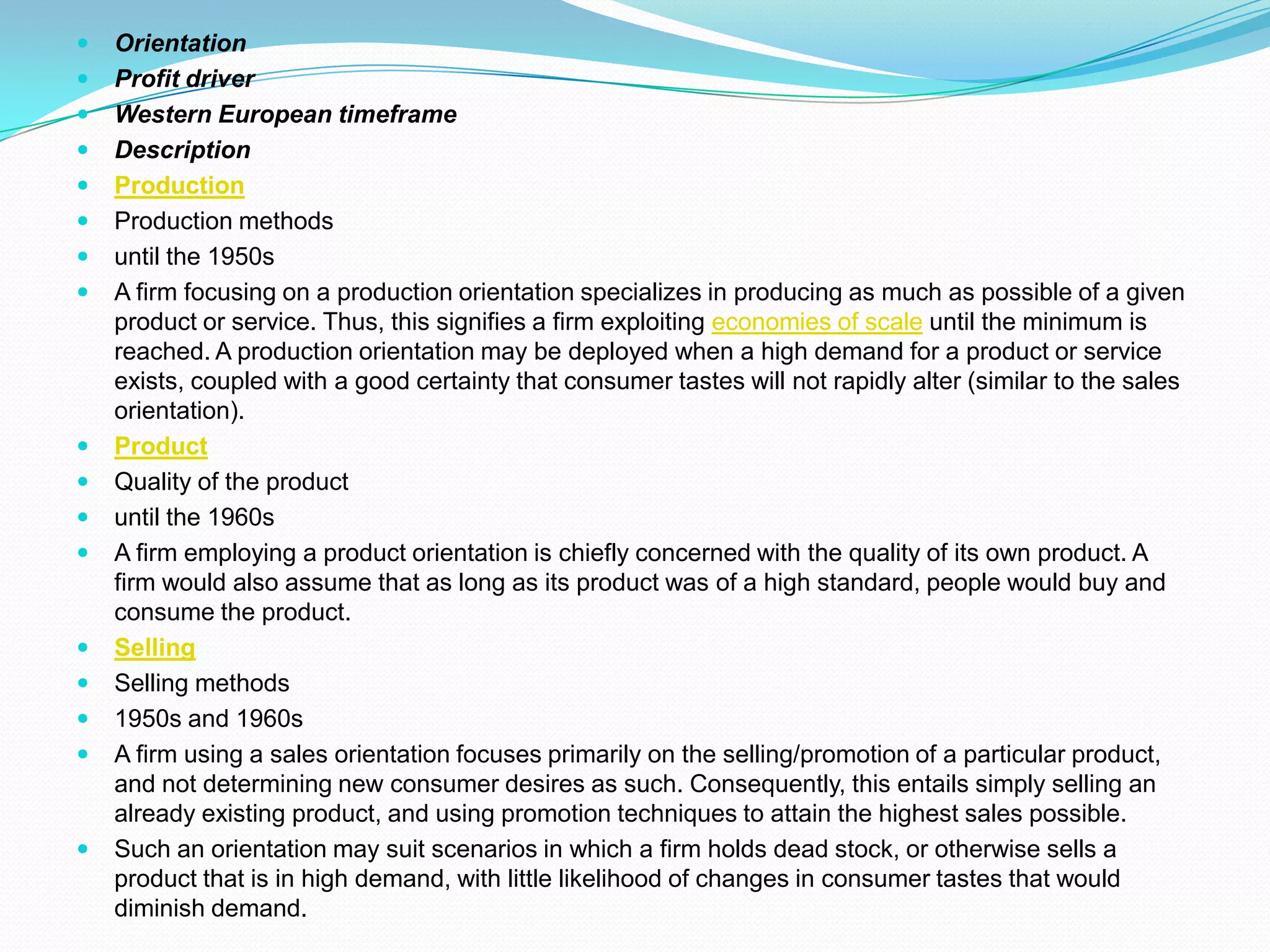
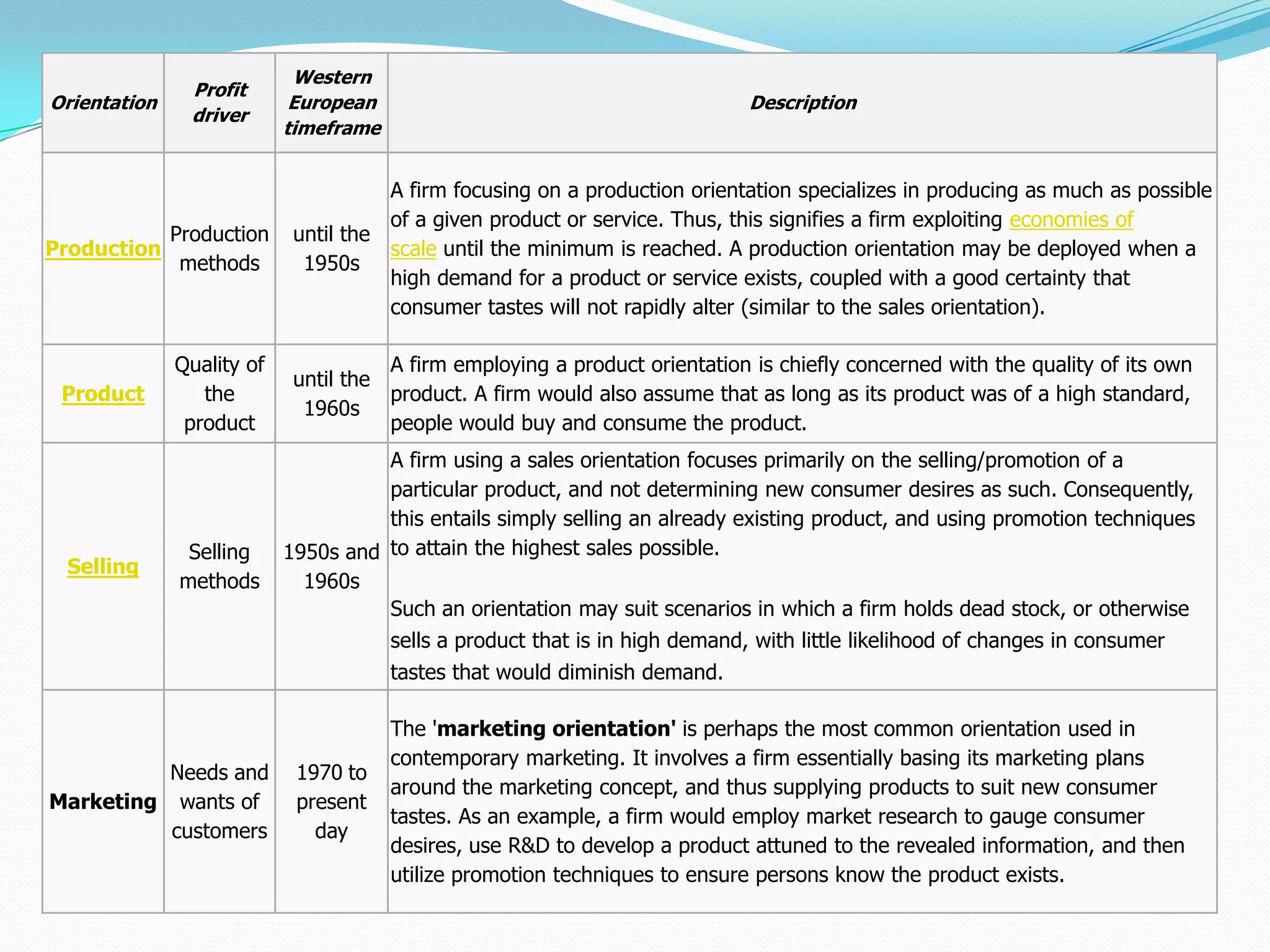
 Orientation
 Profit driver
 Western European timeframe
 Description
 Production
 Production methods
 until the 1950s
 A firm focusing on a production orientation specializes in producing as much as possible of a given
product or service. Thus, this signifies a firm exploiting economies of scale until the minimum is
reached. A production orientation may be deployed when a high demand for a product or service
exists, coupled with a good certainty that consumer tastes will not rapidly alter (similar to the sales
orientation).
 Product
 Quality of the product
 until the 1960s
 A firm employing a product orientation is chiefly concerned with the quality of its own product. A
firm would also assume that as long as its product was of a high standard, people would buy and
consume the product.
 Selling
 Selling methods
 1950s and 1960s
 A firm using a sales orientation focuses primarily on the selling/promotion of a particular product,
and not determining new consumer desires as such. Consequently, this entails simply selling an
already existing product, and using promotion techniques to attain the highest sales possible.
 Such an orientation may suit scenarios in which a firm holds dead stock, or otherwise sells a
product that is in high demand, with little likelihood of changes in consumer tastes that would
diminish demand.
 Marketing
 Needs and wants of customers
 1970 to present day
 The 'marketing orientation' is perhaps the most common
orientation used in contemporary marketing. It involves a firm
essentially basing its marketing plans around the marketing concept,
and thus supplying products to suit new consumer tastes. As an
example, a firm would employ market research to gauge consumer
desires, use R&D to develop a product attuned to the revealed
information, and then utilize promotion techniques to ensure persons
know the product exists.
Marketing
Mix
Target Market
Product
Product:
Variety
Quality
Design
Features
Brand name
Packaging
sizes
Services
Warranties
Returns
Price
List price
Discounts
Allowances
Payment
Period
Credit item
Promotion
Sales
promotion
Advertising
Sales force
Public
relations
Direct
Marketing
Place
Channels
Coverage
Assortments
Locations
Inventory
Transport
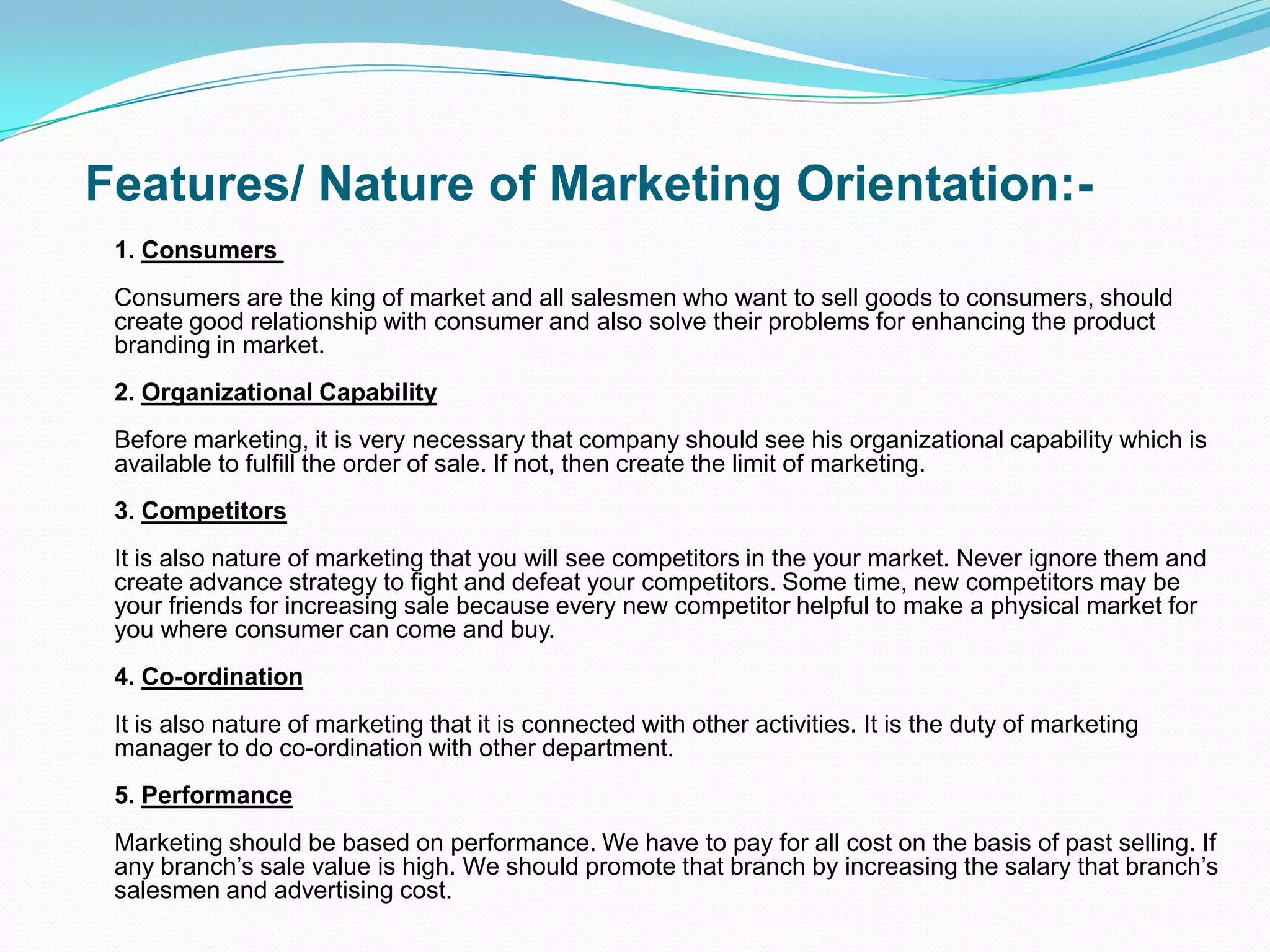
Features/ Nature of Marketing Orientation:-
1. Consumers
Consumers are the king of market and all salesmen who want to sell goods to consumers, should
create good relationship with consumer and also solve their problems for enhancing the product
branding in market.
2. Organizational Capability
Before marketing, it is very necessary that company should see his organizational capability which is
available to fulfill the order of sale. If not, then create the limit of marketing.
3. Competitors
It is also nature of marketing that you will see competitors in the your market. Never ignore them and
create advance strategy to fight and defeat your competitors. Some time, new competitors may be
your friends for increasing sale because every new competitor helpful to make a physical market for
you where consumer can come and buy.
4. Co-ordination
It is also nature of marketing that it is connected with other activities. It is the duty of marketing
manager to do co-ordination with other department.
5. Performance
Marketing should be based on performance. We have to pay for all cost on the basis of past selling. If
any branch’s sale value is high. We should promote that branch by increasing the salary that branch’s
salesmen and advertising cost.
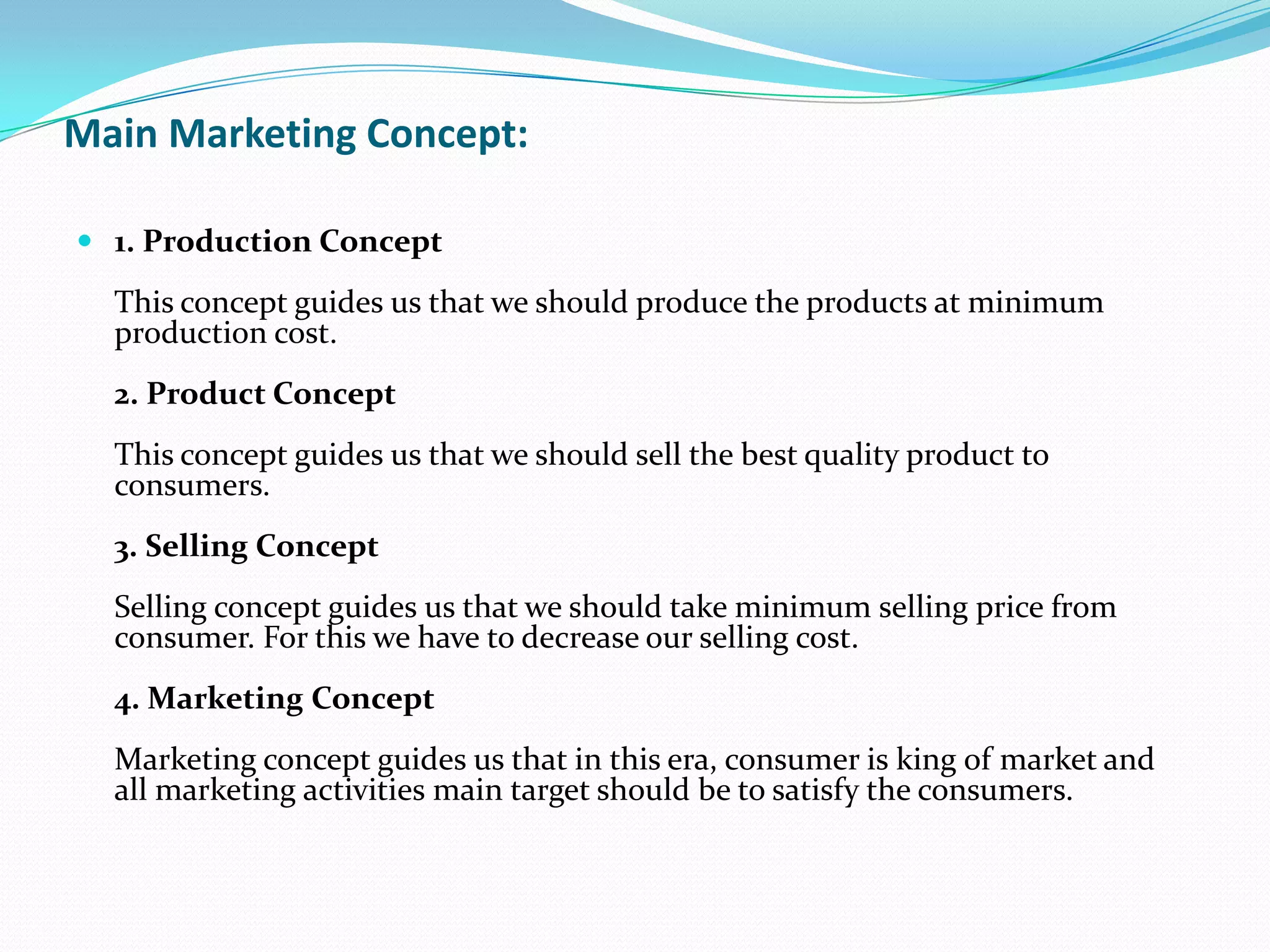
Main Marketing Concept:
 1. Production Concept
This concept guides us that we should produce the products at minimum
production cost.
2. Product Concept
This concept guides us that we should sell the best quality product to
consumers.
3. Selling Concept
Selling concept guides us that we should take minimum selling price from
consumer. For this we have to decrease our selling cost.
4. Marketing Concept
Marketing concept guides us that in this era, consumer is king of market and
all marketing activities main target should be to satisfy the consumers.
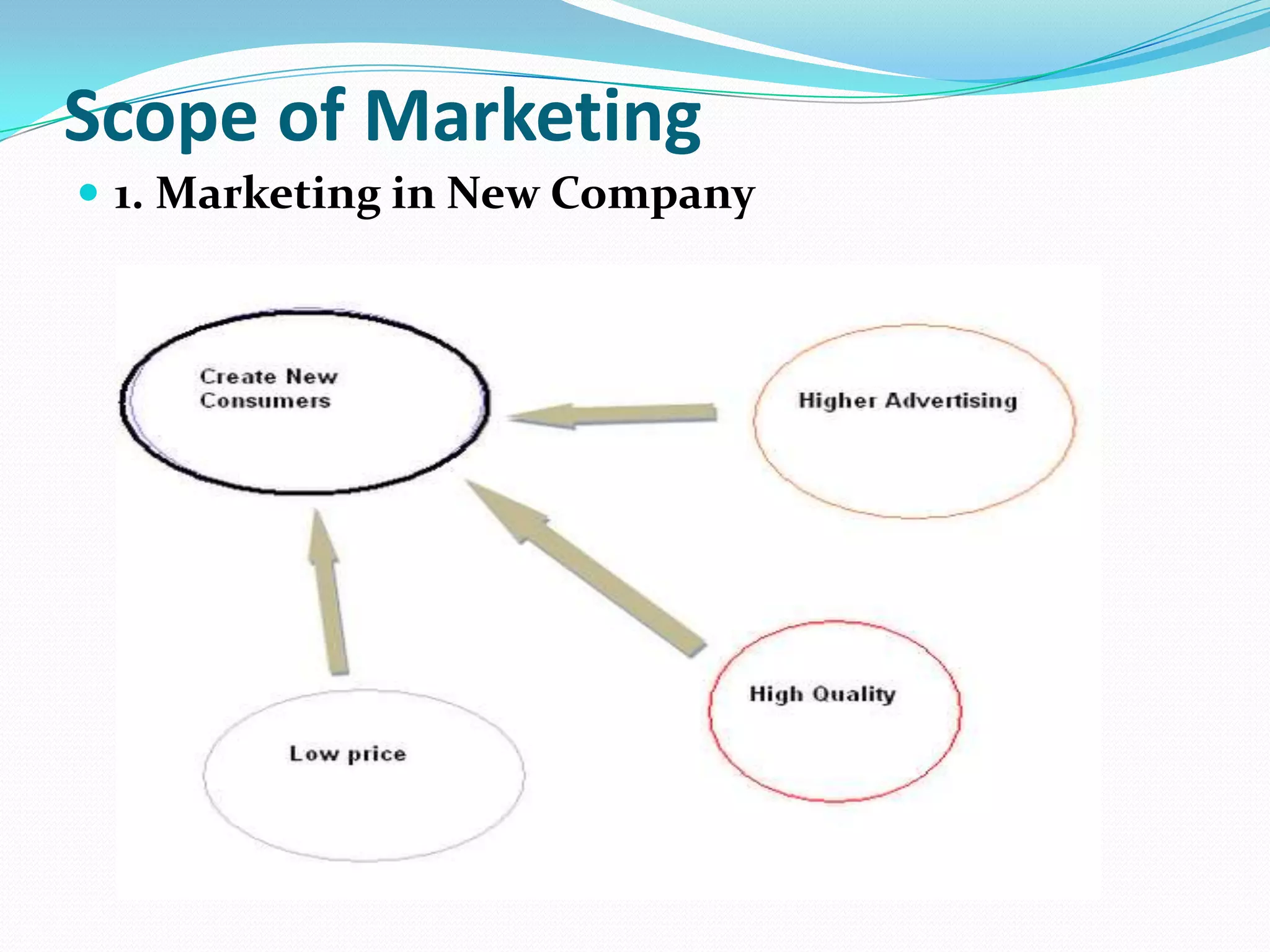
Scope of Marketing
 1. Marketing in New Company
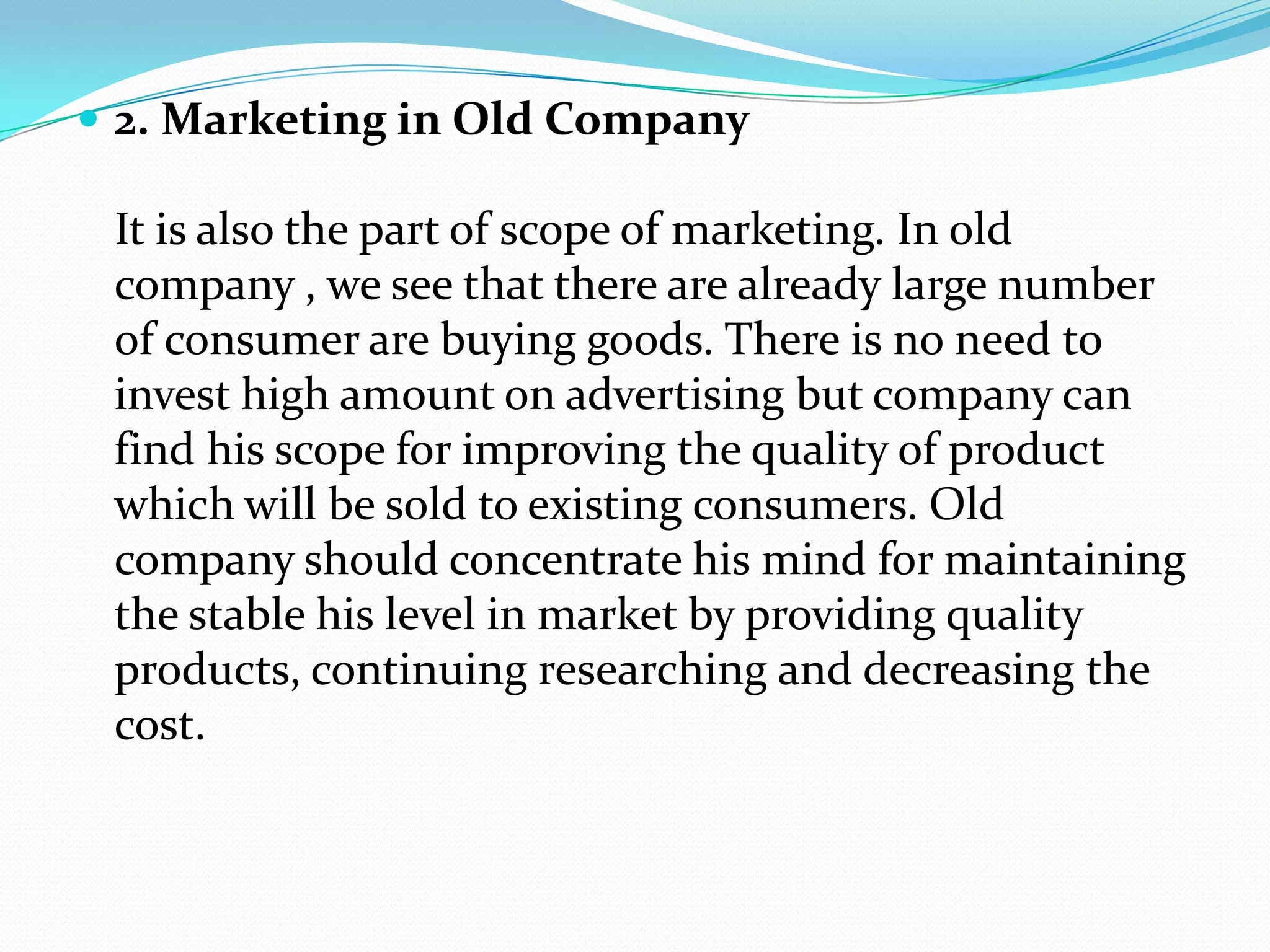
 2. Marketing in Old Company
It is also the part of scope of marketing. In old
company , we see that there are already large number
of consumer are buying goods. There is no need to
invest high amount on advertising but company can
find his scope for improving the quality of product
which will be sold to existing consumers. Old
company should concentrate his mind for maintaining
the stable his level in market by providing quality
products, continuing researching and decreasing the
cost.
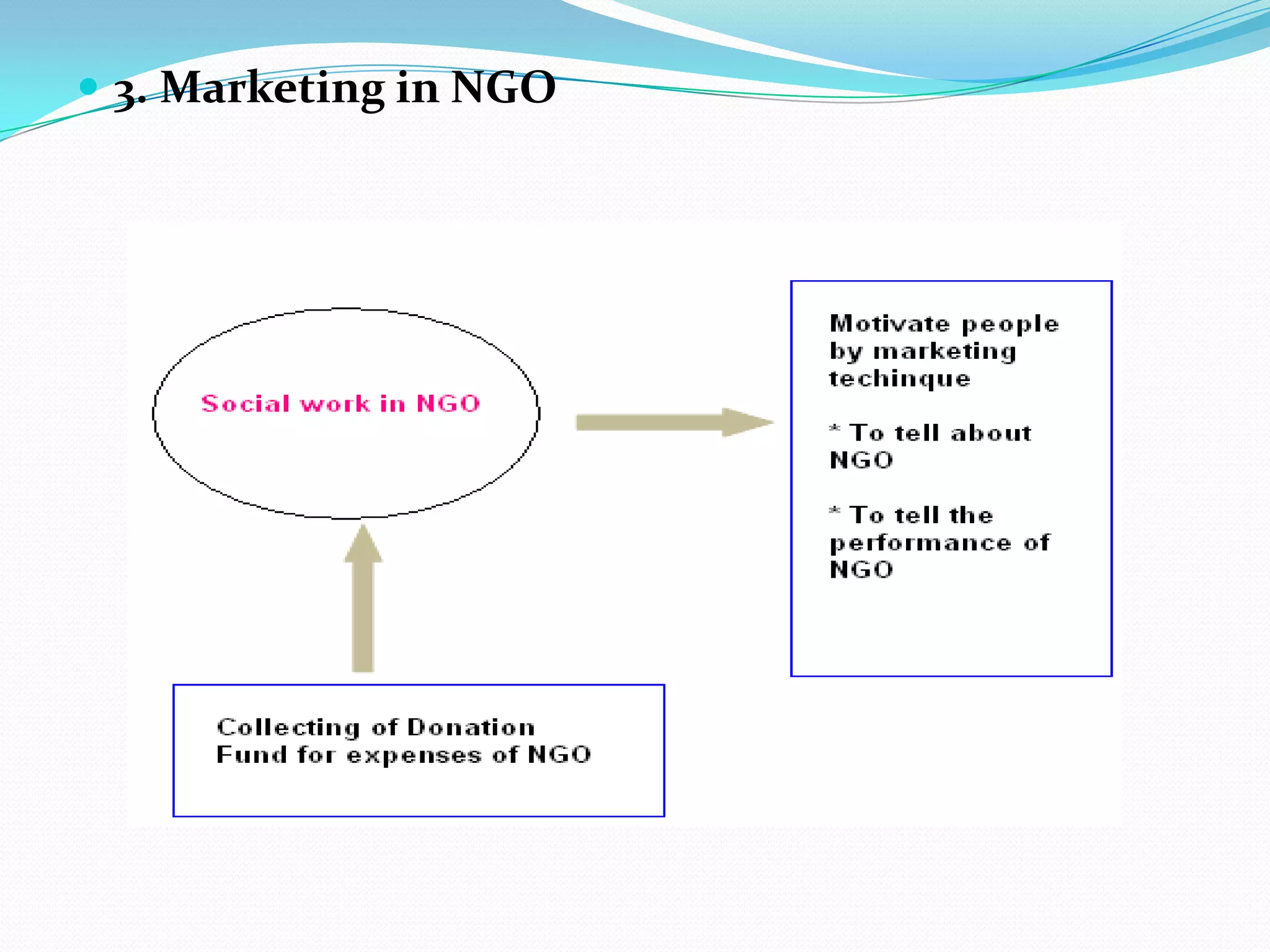
 3. Marketing in NGO
Orientation
Profit
driver
Western
European
timeframe
Description
Production
Production
methods
until the
1950s
A firm focusing on a production orientation specializes in producing as much as possible
of a given product or service. Thus, this signifies a firm exploiting economies of
scale until the minimum is reached. A production orientation may be deployed when a
high demand for a product or service exists, coupled with a good certainty that
consumer tastes will not rapidly alter (similar to the sales orientation).
Product
Quality of
the
product
until the
1960s
A firm employing a product orientation is chiefly concerned with the quality of its own
product. A firm would also assume that as long as its product was of a high standard,
people would buy and consume the product.
Selling
Selling
methods
1950s and
1960s
A firm using a sales orientation focuses primarily on the selling/promotion of a
particular product, and not determining new consumer desires as such. Consequently,
this entails simply selling an already existing product, and using promotion techniques
to attain the highest sales possible.
Such an orientation may suit scenarios in which a firm holds dead stock, or otherwise
sells a product that is in high demand, with little likelihood of changes in consumer
tastes that would diminish demand.
Marketing
Needs and
wants of
customers
1970 to
present
day
The 'marketing orientation' is perhaps the most common orientation used in
contemporary marketing. It involves a firm essentially basing its marketing plans
around the marketing concept, and thus supplying products to suit new consumer
tastes. As an example, a firm would employ market research to gauge consumer
desires, use R&D to develop a product attuned to the revealed information, and then
utilize promotion techniques to ensure persons know the product exists.

Introduction to marketing

  • 1.
  • 2.
    CHAPTER-I INTRODUCTION TO MARKETING Definition:  Marketing is the management process responsible for identifying, anticipating and satisfying consumers’ requirements profitably.  Definition by Boone and Kurtz:  Marketing is the process of planning and undertaking the conception, pricing, promotion & distribution of goods and services to create and maintain relationships that will satisfy individual and organizational objectives.
  • 3.
     Introduction:  Marketingis the process used to determine what products or services may be of interest to customers, and the strategy to use in sales, communications and business development. It generates the strategy that underlies sales techniques, business communication, and business developments. It is an integrated process through which companies build strong customer relationships and create value for their customers and for themselves.  Marketing is used to identify the customer, satisfy the customer, and keep the customer. With the customer as the focus of its activities, marketing management is one of the major components of business management. Marketing evolved to meet the stasis in developing new markets caused by mature markets and overcapacities in the last 2-3 centuries.[ The adoption of marketing strategies requires businesses to shift their focus from production to the perceived needs and wants of their customers as the means of staying profitable.  The term marketing concept holds that achieving organizational goals depends on knowing the needs and wants of target markets and delivering the desired satisfactions. It proposes that in order to satisfy its organizational objectives, an organization should anticipate the needs and wants of consumers and satisfy these more effectively than competitors. Marketing includes all activities for transferring goods from producer to consumers. Its main aim is to sell and satisfy the consumers. Today, market’s king is consumer. So, marketing provides you good technique to handle customers. Marketing’s best technique is marketing mix. Marketing mix has four P
  • 4.
     1. Productwhich is made by producer must be made quality basis. 2. Price is fixed by market but marketer should take low price than market for increasing of sale. 3. Promotion is done by advertising; it must be used at proper time for target audience. 4. Placement is relating to distribution activities, marketer should reach by proper channel of distribution.
  • 5.
    Marketing Research:  Marketingresearch involves conducting research to support marketing activities, and the statistical interpretation of data into information. This information is then used by managers to plan marketing activities, gauge the nature of a firm's marketing environment and attain information from suppliers. Marketing researchers use statistical methods such as quantitative research, qualitative research, hypothesis tests, Chi-squared tests, linear regression, correlations, frequency distributions, Poisson distributions, binomial distributions, etc. to interpret their findings and convert data into information. The marketing research process spans a number of stages, including the definition of a problem, development of a research plan, collection and interpretation of data and disseminating information formally in the form of a report. The task of marketing research is to provide management with relevant, accurate, reliable, valid, and current information.
  • 6.
    Evolution of Marketing: An orientation, in the marketing context, related to a perception or attitude a firm holds towards its product or service, essentially concerning consumers and end-users. Throughout history, marketing has changed considerably in conjunction with consumer tastes.  Earlier approaches  The marketing orientation evolved from earlier orientations, namely, the production orientation, the product orientation and the selling orientation
  • 7.
     Orientation  Profitdriver  Western European timeframe  Description  Production  Production methods  until the 1950s  A firm focusing on a production orientation specializes in producing as much as possible of a given product or service. Thus, this signifies a firm exploiting economies of scale until the minimum is reached. A production orientation may be deployed when a high demand for a product or service exists, coupled with a good certainty that consumer tastes will not rapidly alter (similar to the sales orientation).  Product  Quality of the product  until the 1960s  A firm employing a product orientation is chiefly concerned with the quality of its own product. A firm would also assume that as long as its product was of a high standard, people would buy and consume the product.  Selling  Selling methods  1950s and 1960s  A firm using a sales orientation focuses primarily on the selling/promotion of a particular product, and not determining new consumer desires as such. Consequently, this entails simply selling an already existing product, and using promotion techniques to attain the highest sales possible.  Such an orientation may suit scenarios in which a firm holds dead stock, or otherwise sells a product that is in high demand, with little likelihood of changes in consumer tastes that would diminish demand.
  • 8.
     Marketing  Needsand wants of customers  1970 to present day  The 'marketing orientation' is perhaps the most common orientation used in contemporary marketing. It involves a firm essentially basing its marketing plans around the marketing concept, and thus supplying products to suit new consumer tastes. As an example, a firm would employ market research to gauge consumer desires, use R&D to develop a product attuned to the revealed information, and then utilize promotion techniques to ensure persons know the product exists.
  • 9.
    Marketing Mix Target Market Product Product: Variety Quality Design Features Brand name Packaging sizes Services Warranties Returns Price Listprice Discounts Allowances Payment Period Credit item Promotion Sales promotion Advertising Sales force Public relations Direct Marketing Place Channels Coverage Assortments Locations Inventory Transport
  • 10.
    Features/ Nature ofMarketing Orientation:- 1. Consumers Consumers are the king of market and all salesmen who want to sell goods to consumers, should create good relationship with consumer and also solve their problems for enhancing the product branding in market. 2. Organizational Capability Before marketing, it is very necessary that company should see his organizational capability which is available to fulfill the order of sale. If not, then create the limit of marketing. 3. Competitors It is also nature of marketing that you will see competitors in the your market. Never ignore them and create advance strategy to fight and defeat your competitors. Some time, new competitors may be your friends for increasing sale because every new competitor helpful to make a physical market for you where consumer can come and buy. 4. Co-ordination It is also nature of marketing that it is connected with other activities. It is the duty of marketing manager to do co-ordination with other department. 5. Performance Marketing should be based on performance. We have to pay for all cost on the basis of past selling. If any branch’s sale value is high. We should promote that branch by increasing the salary that branch’s salesmen and advertising cost.
  • 11.
    Main Marketing Concept: 1. Production Concept This concept guides us that we should produce the products at minimum production cost. 2. Product Concept This concept guides us that we should sell the best quality product to consumers. 3. Selling Concept Selling concept guides us that we should take minimum selling price from consumer. For this we have to decrease our selling cost. 4. Marketing Concept Marketing concept guides us that in this era, consumer is king of market and all marketing activities main target should be to satisfy the consumers.
  • 12.
    Scope of Marketing 1. Marketing in New Company
  • 13.
     2. Marketingin Old Company It is also the part of scope of marketing. In old company , we see that there are already large number of consumer are buying goods. There is no need to invest high amount on advertising but company can find his scope for improving the quality of product which will be sold to existing consumers. Old company should concentrate his mind for maintaining the stable his level in market by providing quality products, continuing researching and decreasing the cost.
  • 14.
  • 19.
    Orientation Profit driver Western European timeframe Description Production Production methods until the 1950s A firmfocusing on a production orientation specializes in producing as much as possible of a given product or service. Thus, this signifies a firm exploiting economies of scale until the minimum is reached. A production orientation may be deployed when a high demand for a product or service exists, coupled with a good certainty that consumer tastes will not rapidly alter (similar to the sales orientation). Product Quality of the product until the 1960s A firm employing a product orientation is chiefly concerned with the quality of its own product. A firm would also assume that as long as its product was of a high standard, people would buy and consume the product. Selling Selling methods 1950s and 1960s A firm using a sales orientation focuses primarily on the selling/promotion of a particular product, and not determining new consumer desires as such. Consequently, this entails simply selling an already existing product, and using promotion techniques to attain the highest sales possible. Such an orientation may suit scenarios in which a firm holds dead stock, or otherwise sells a product that is in high demand, with little likelihood of changes in consumer tastes that would diminish demand. Marketing Needs and wants of customers 1970 to present day The 'marketing orientation' is perhaps the most common orientation used in contemporary marketing. It involves a firm essentially basing its marketing plans around the marketing concept, and thus supplying products to suit new consumer tastes. As an example, a firm would employ market research to gauge consumer desires, use R&D to develop a product attuned to the revealed information, and then utilize promotion techniques to ensure persons know the product exists.