
ORGANIC FERTILIZERS;
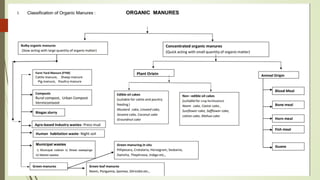
CLASSIFICATION OF ORGANIC
FERTILIZERS;
BULKY ORGANIC MANURES
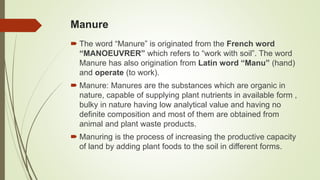
Manure
 The word “Manure” is originated from the French word
“MANOEUVRER” which refers to “work with soil”. The word
Manure has also origination from Latin word “Manu” (hand)
and operate (to work).
 Manure: Manures are the substances which are organic in
nature, capable of supplying plant nutrients in available form ,
bulky in nature having low analytical value and having no
definite composition and most of them are obtained from
animal and plant waste products.
 Manuring is the process of increasing the productive capacity
of land by adding plant foods to the soil in different forms.
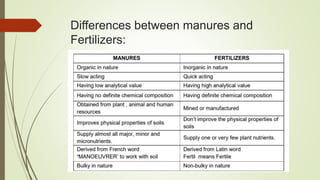
Differences between manures and
Fertilizers:
Identification of different
organic manures and
applying procedure
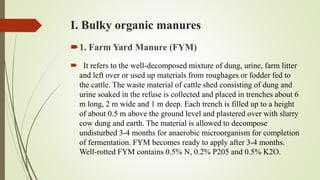
I. Bulky organic manures
1. Farm Yard Manure (FYM)
 It refers to the well-decomposed mixture of dung, urine, farm litter
and left over or used up materials from roughages or fodder fed to
the cattle. The waste material of cattle shed consisting of dung and
urine soaked in the refuse is collected and placed in trenches about 6
m long, 2 m wide and 1 m deep. Each trench is filled up to a height
of about 0.5 m above the ground level and plastered over with slurry
cow dung and earth. The material is allowed to decompose
undisturbed 3-4 months for anaerobic microorganism for completion
of fermentation. FYM becomes ready to apply after 3-4 months.
Well-rotted FYM contains 0.5% N, 0.2% P205 and 0.5% K2O.
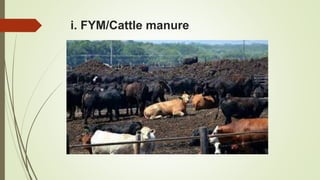
i. FYM/Cattle manure
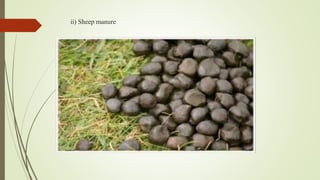
ii) Sheep manure
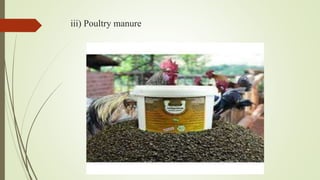
iii) Poultry manure
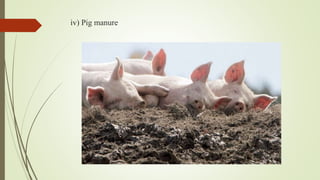
iv) Pig manure
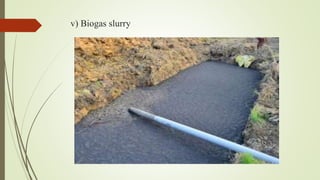
v) Biogas slurry
Compost:
Large quantities of waste material are available as
vegetable refuse, farm litter, such as weeds, stubble,
sugarcane trash, Sewage sludge and animal waste in
houses and in areas like human and industrial refuse;
therefore, excreta can be converted into useful compost
manure by conserving and subjecting these to a controlled
process of anaerobic decomposition. Compost is used in
the same way as FYM and is good for application to all
soils and all crops.
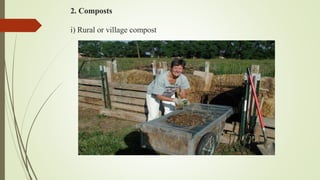
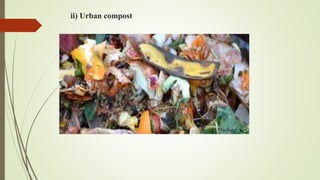
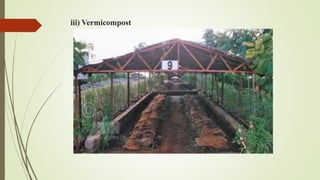
2. Composts
i) Rural or village compost
ii) Urban compost
iii) Vermicompost
Green Manuring:
 It is a practice of ploughing or turning into the soil undercomposed green plant tissues for the
purpose of improving physical structure as well as fertility of the soil. From the time immemorial
the turning in a green crop for improvement of the conditions of the soil has been a popular
farming practice. Green Manuring, wherever feasible, is the principal supplementary means of
adding organic matter to the soil. It consists of the growing of quick growing crop and ploughing it
under to incorporate it into the soil. The green manure crop supplies organic matter as well as
additional nitrogen, particularly if it is a legume crop, which has the ability to fix nitrogen from the
air with the help of its root-nodule bacteria. A leguminous crop producing 25 tones of green matter
per hectare will add about 60 to 90 kg of nitrogen when ploughed under. This amount would equal
an application of 3 to 10 tones of FYM on the basis of organic matter and its nitrogen contribution.
The green manure crops also exercise a protective action against erosion and leaching. The most
commonly used green manuring crops are: Sunhemp (Crotalaria juncea), Dhaincha (Sesbania
aculeata), Cluster bean (Cyamopsis tetragonoloba), Senji (Melilotus parviflora), Cowpea (Vigna
catjang, Vigna sinensis), Berseem (Trifolium alexandrium).
3. Green manures
i) Green manuring in-situ
ii) Green leaf manure
Continue..
 Green manure crops
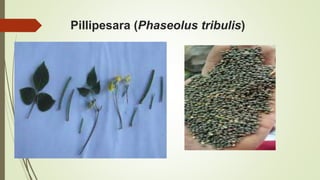
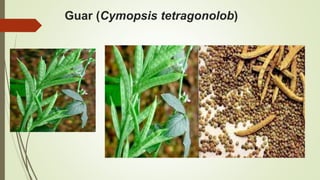
 This is most common green manure crops grown under this
system are sunnhemp(Crotalaria juncea) ,daincha (Sesabani
aaculeata), Pillipesera (Phaseolus trilobus) and guar
(Cyamopsis tetragonoloba)
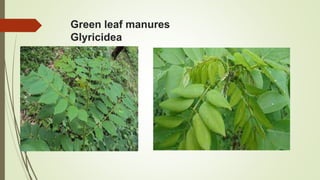
 Green leaf manures
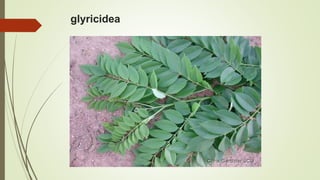
 Green leaf manuring refers to turning into the soil green leaves
and tender twigs collected from shrubs and trees grown on
bunds,waste lands and nearby forest areas. The common
shrubs and trees used are Glyricidia, Sesbania speciosa
,Karanj(Pongamia pinnata) etc.,
Green manures
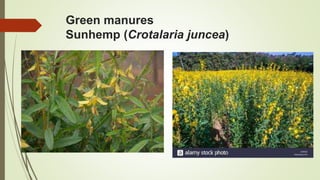
Sunhemp (Crotalaria juncea)
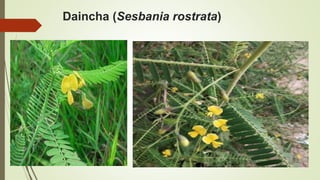
Daincha (Sesbania rostrata)
Pillipesara (Phaseolus tribulis)
Guar (Cymopsis tetragonolob)
Green leaf manures
Glyricidea
glyricidea
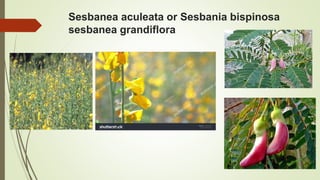
Sesbanea aculeata or Sesbania bispinosa
sesbanea grandiflora
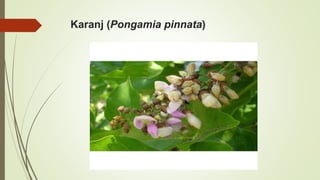
Karanj (Pongamia pinnata)
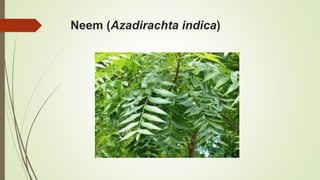
Neem (Azadirachta indica)
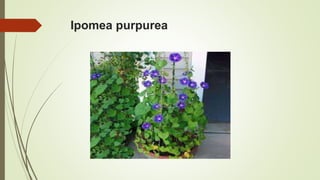
Ipomea purpurea
Waste:
Industrial waste: Among the industrial by products, spent
wash from ditilisers and molasses and pressmud from
sugar industry have good manurial value. It is important to
use only well decomposed pressmud at 10 tones/ha.
Addition of pressmud improves the soil fertility and
enhances the activity of microbes. Coir waste is the by-
product from coir industry and can be used as manure after
proper decomposition.
Continue..
 Municipal and Sewage waste: It also forms an important
component of organic waste. In India, the total municipal refuse is
about 12 mt/annum containing about 0.5% N, 0.3% P2O5 and 0.3%
K2O. Sewage sludge is available to an extent of 4 million tones per
annum containing 3% N, 2% P and 0.3% K (Bharadwaj and Gaur,
1985). Sewage sludge particularly from industrialized cities is
contaminated with heavy metals and these pose hazards to plants,
animals and human beings. Separation of the toxic waste at the
source will minimize the concentration of such elements in the
sludge.
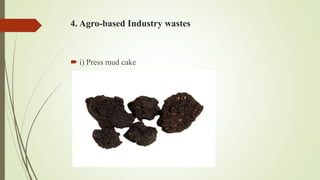
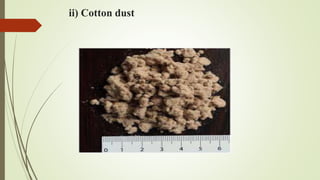
4. Agro-based Industry wastes
 i) Press mud cake
ii) Cotton dust
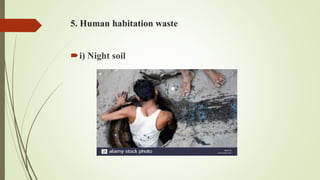
5. Human habitation waste
i) Night soil
6) Municipal wastes
i)Municipal rubbish
ii) Street sweepings
iii) Market wastes
Concentrated Organic Manure:
Concentrated organic manures are those materials that are
organic in nature and contain higher percentage of
essential plant nutrients such as nitrogen, phosphorous and
potash, as compared to bulky organic manures. These
concentrated manures are made from raw materials of
animal or plant origin. The concentrated organic manures
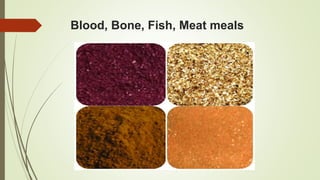
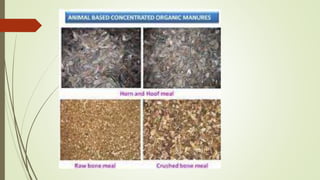
commonly used are oilcakes, blood meal, fishmeal, meat
meal and horn and hoof meal.
Concentrated organic manures
Animal originated
 Bone meal
 Fish meal
 Horn meal
 Blood meal
 Meat meal
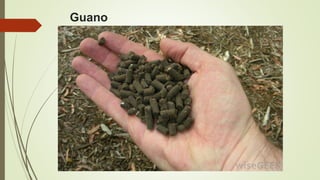
 Guano
Blood, Bone, Fish, Meat meals
Guano
Plant originated
Oil cakes
i) Edible oil cakes: Suitable for cattle and poultry feeding
and also as a manure /fertilizer but not economical Eg.
Groundnut, Gingelly cakes etc,
ii) Non –Edible oil cakes: Suitable for crop fertilization.
Eg. Castor cake, neem cake etc.,
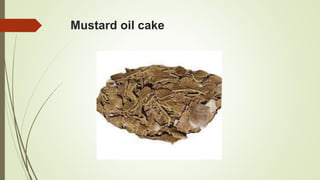
Mustard oil cake
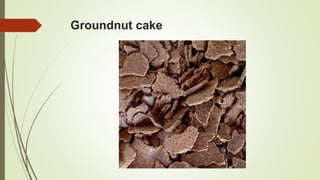
Groundnut cake
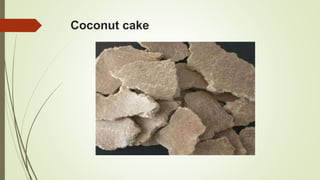
Coconut cake
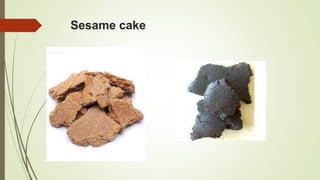
Sesame cake
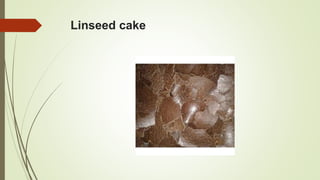
Linseed cake
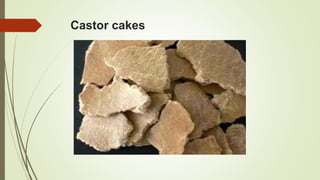
Castor cakes
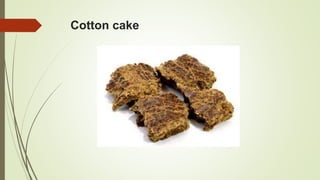
Cotton cake
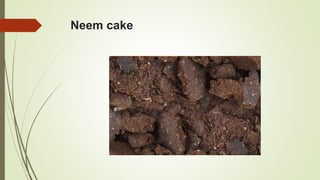
Neem cake
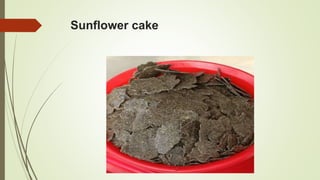
Sunflower cake
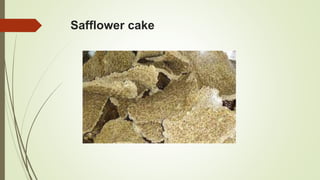
Safflower cake
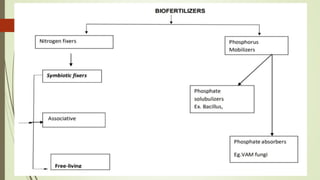
Bio fertilizers
 It has been observed that there is decline in crop yield due to
continuous apply of inorganic fertilizers. Therefore, increasing need
is being felt to integrate nutrient supply with organic sources to
restore the health of soil. Bio-fertilizer offers an economically
attractive and ecologically sound means of reducing external inputs
and improving the quality and quantity of internal sources. Bio-
fertilizer is microorganism's culture capable of fixing atmospheric
nitrogen when suitable crops are inoculated with them. The main
inputs are microorganisms, which are capable of mobilizing
nutritive elements from non-usable form to usable form through
biological process. These are less expensive, eco-friendly and
sustainable. The beneficial microorganisms in the soil that are
greater significance to horticultural situations are biological nitrogen
fixers, phosphate solubilizers and mycorrhizal fungi.
The Biofertilizers containing biological nitrogen fixing organism are of
utmost important in agriculture in view of the following advantages:
 They help in establishment and growth of crop plants and trees.
 They enhance biomass production and grain yields by 10-20%.
 They are useful in sustainable agriculture.
 They are suitable organic farming.
 They play an important role in Agroforestry / silvipastoral
systems.
THANK YOU

ORGANIC FERTILIZERS .pptx

  • 1.
    ORGANIC FERTILIZERS; CLASSIFICATION OFORGANIC FERTILIZERS; BULKY ORGANIC MANURES
  • 2.
    Manure  The word“Manure” is originated from the French word “MANOEUVRER” which refers to “work with soil”. The word Manure has also origination from Latin word “Manu” (hand) and operate (to work).  Manure: Manures are the substances which are organic in nature, capable of supplying plant nutrients in available form , bulky in nature having low analytical value and having no definite composition and most of them are obtained from animal and plant waste products.  Manuring is the process of increasing the productive capacity of land by adding plant foods to the soil in different forms.
  • 3.
  • 4.
    Identification of different organicmanures and applying procedure
  • 6.
    I. Bulky organicmanures 1. Farm Yard Manure (FYM)  It refers to the well-decomposed mixture of dung, urine, farm litter and left over or used up materials from roughages or fodder fed to the cattle. The waste material of cattle shed consisting of dung and urine soaked in the refuse is collected and placed in trenches about 6 m long, 2 m wide and 1 m deep. Each trench is filled up to a height of about 0.5 m above the ground level and plastered over with slurry cow dung and earth. The material is allowed to decompose undisturbed 3-4 months for anaerobic microorganism for completion of fermentation. FYM becomes ready to apply after 3-4 months. Well-rotted FYM contains 0.5% N, 0.2% P205 and 0.5% K2O.
  • 7.
  • 8.
  • 9.
  • 10.
  • 11.
  • 12.
    Compost: Large quantities ofwaste material are available as vegetable refuse, farm litter, such as weeds, stubble, sugarcane trash, Sewage sludge and animal waste in houses and in areas like human and industrial refuse; therefore, excreta can be converted into useful compost manure by conserving and subjecting these to a controlled process of anaerobic decomposition. Compost is used in the same way as FYM and is good for application to all soils and all crops.
  • 13.
    2. Composts i) Ruralor village compost
  • 14.
  • 15.
  • 16.
    Green Manuring:  Itis a practice of ploughing or turning into the soil undercomposed green plant tissues for the purpose of improving physical structure as well as fertility of the soil. From the time immemorial the turning in a green crop for improvement of the conditions of the soil has been a popular farming practice. Green Manuring, wherever feasible, is the principal supplementary means of adding organic matter to the soil. It consists of the growing of quick growing crop and ploughing it under to incorporate it into the soil. The green manure crop supplies organic matter as well as additional nitrogen, particularly if it is a legume crop, which has the ability to fix nitrogen from the air with the help of its root-nodule bacteria. A leguminous crop producing 25 tones of green matter per hectare will add about 60 to 90 kg of nitrogen when ploughed under. This amount would equal an application of 3 to 10 tones of FYM on the basis of organic matter and its nitrogen contribution. The green manure crops also exercise a protective action against erosion and leaching. The most commonly used green manuring crops are: Sunhemp (Crotalaria juncea), Dhaincha (Sesbania aculeata), Cluster bean (Cyamopsis tetragonoloba), Senji (Melilotus parviflora), Cowpea (Vigna catjang, Vigna sinensis), Berseem (Trifolium alexandrium).
  • 17.
    3. Green manures i)Green manuring in-situ ii) Green leaf manure
  • 18.
    Continue..  Green manurecrops  This is most common green manure crops grown under this system are sunnhemp(Crotalaria juncea) ,daincha (Sesabani aaculeata), Pillipesera (Phaseolus trilobus) and guar (Cyamopsis tetragonoloba)  Green leaf manures  Green leaf manuring refers to turning into the soil green leaves and tender twigs collected from shrubs and trees grown on bunds,waste lands and nearby forest areas. The common shrubs and trees used are Glyricidia, Sesbania speciosa ,Karanj(Pongamia pinnata) etc.,
  • 19.
  • 20.
  • 21.
  • 22.
  • 23.
  • 24.
  • 25.
    Sesbanea aculeata orSesbania bispinosa sesbanea grandiflora
  • 26.
  • 27.
  • 28.
  • 29.
    Waste: Industrial waste: Amongthe industrial by products, spent wash from ditilisers and molasses and pressmud from sugar industry have good manurial value. It is important to use only well decomposed pressmud at 10 tones/ha. Addition of pressmud improves the soil fertility and enhances the activity of microbes. Coir waste is the by- product from coir industry and can be used as manure after proper decomposition.
  • 30.
    Continue..  Municipal andSewage waste: It also forms an important component of organic waste. In India, the total municipal refuse is about 12 mt/annum containing about 0.5% N, 0.3% P2O5 and 0.3% K2O. Sewage sludge is available to an extent of 4 million tones per annum containing 3% N, 2% P and 0.3% K (Bharadwaj and Gaur, 1985). Sewage sludge particularly from industrialized cities is contaminated with heavy metals and these pose hazards to plants, animals and human beings. Separation of the toxic waste at the source will minimize the concentration of such elements in the sludge.
  • 31.
    4. Agro-based Industrywastes  i) Press mud cake
  • 32.
  • 33.
    5. Human habitationwaste i) Night soil
  • 34.
    6) Municipal wastes i)Municipalrubbish ii) Street sweepings iii) Market wastes
  • 35.
    Concentrated Organic Manure: Concentratedorganic manures are those materials that are organic in nature and contain higher percentage of essential plant nutrients such as nitrogen, phosphorous and potash, as compared to bulky organic manures. These concentrated manures are made from raw materials of animal or plant origin. The concentrated organic manures commonly used are oilcakes, blood meal, fishmeal, meat meal and horn and hoof meal.
  • 36.
    Concentrated organic manures Animaloriginated  Bone meal  Fish meal  Horn meal  Blood meal  Meat meal  Guano
  • 37.
  • 39.
  • 40.
    Plant originated Oil cakes i)Edible oil cakes: Suitable for cattle and poultry feeding and also as a manure /fertilizer but not economical Eg. Groundnut, Gingelly cakes etc, ii) Non –Edible oil cakes: Suitable for crop fertilization. Eg. Castor cake, neem cake etc.,
  • 41.
  • 42.
  • 43.
  • 44.
  • 45.
  • 46.
  • 47.
  • 48.
  • 49.
  • 50.
  • 51.
    Bio fertilizers  Ithas been observed that there is decline in crop yield due to continuous apply of inorganic fertilizers. Therefore, increasing need is being felt to integrate nutrient supply with organic sources to restore the health of soil. Bio-fertilizer offers an economically attractive and ecologically sound means of reducing external inputs and improving the quality and quantity of internal sources. Bio- fertilizer is microorganism's culture capable of fixing atmospheric nitrogen when suitable crops are inoculated with them. The main inputs are microorganisms, which are capable of mobilizing nutritive elements from non-usable form to usable form through biological process. These are less expensive, eco-friendly and sustainable. The beneficial microorganisms in the soil that are greater significance to horticultural situations are biological nitrogen fixers, phosphate solubilizers and mycorrhizal fungi.
  • 52.
    The Biofertilizers containingbiological nitrogen fixing organism are of utmost important in agriculture in view of the following advantages:  They help in establishment and growth of crop plants and trees.  They enhance biomass production and grain yields by 10-20%.  They are useful in sustainable agriculture.  They are suitable organic farming.  They play an important role in Agroforestry / silvipastoral systems.
  • 55.