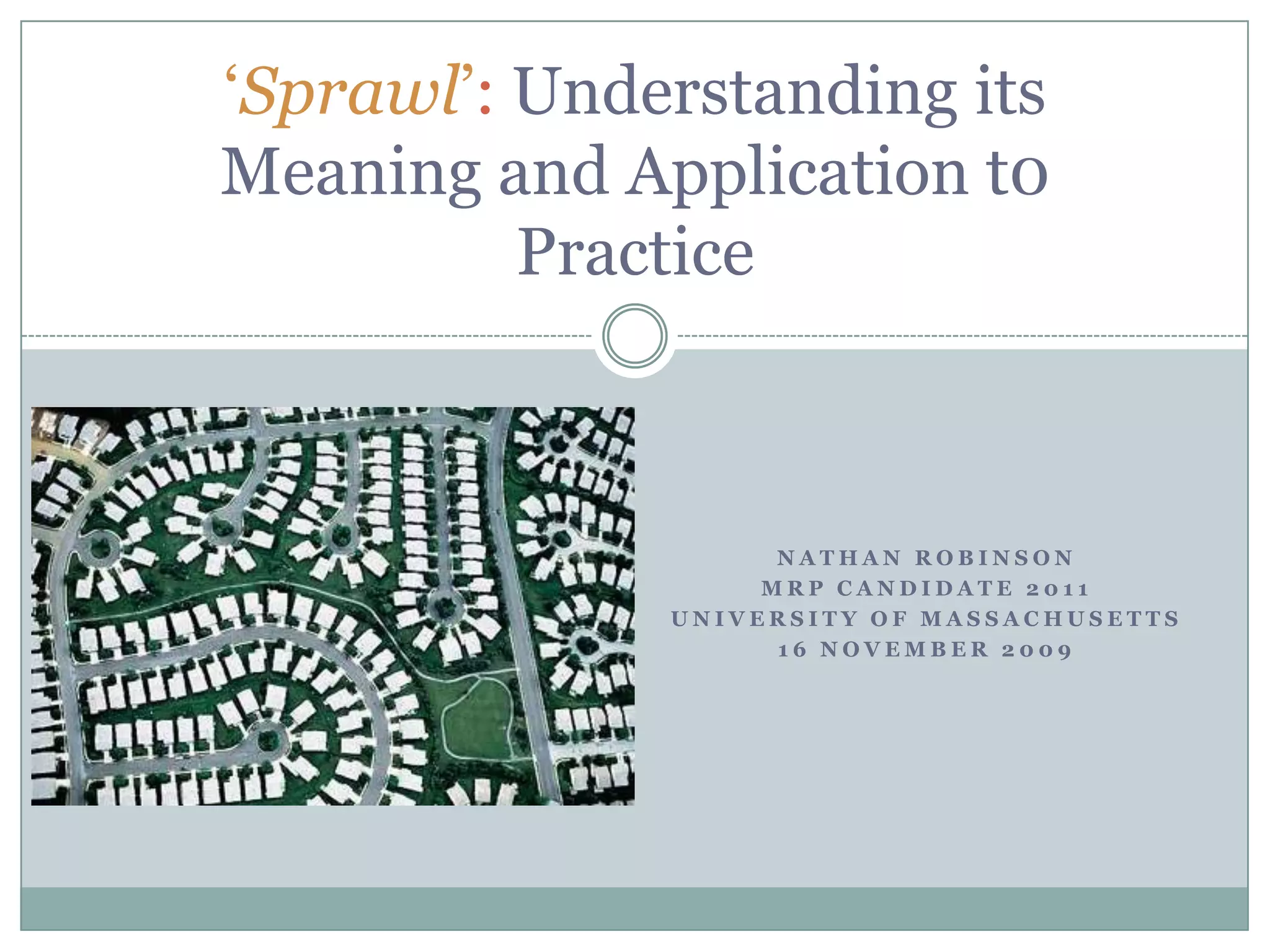
Nathan RobinsonMRP Candidate 2011University of Massachusetts16 November 2009‘Sprawl’: Understanding its Meaning and Application t0 Practice
Presentation OverviewWhy Should We CareOrigins of ‘Sprawl’Confounding Perspectives and Definitions‘Sprawl’DefinedConcluding Remarks
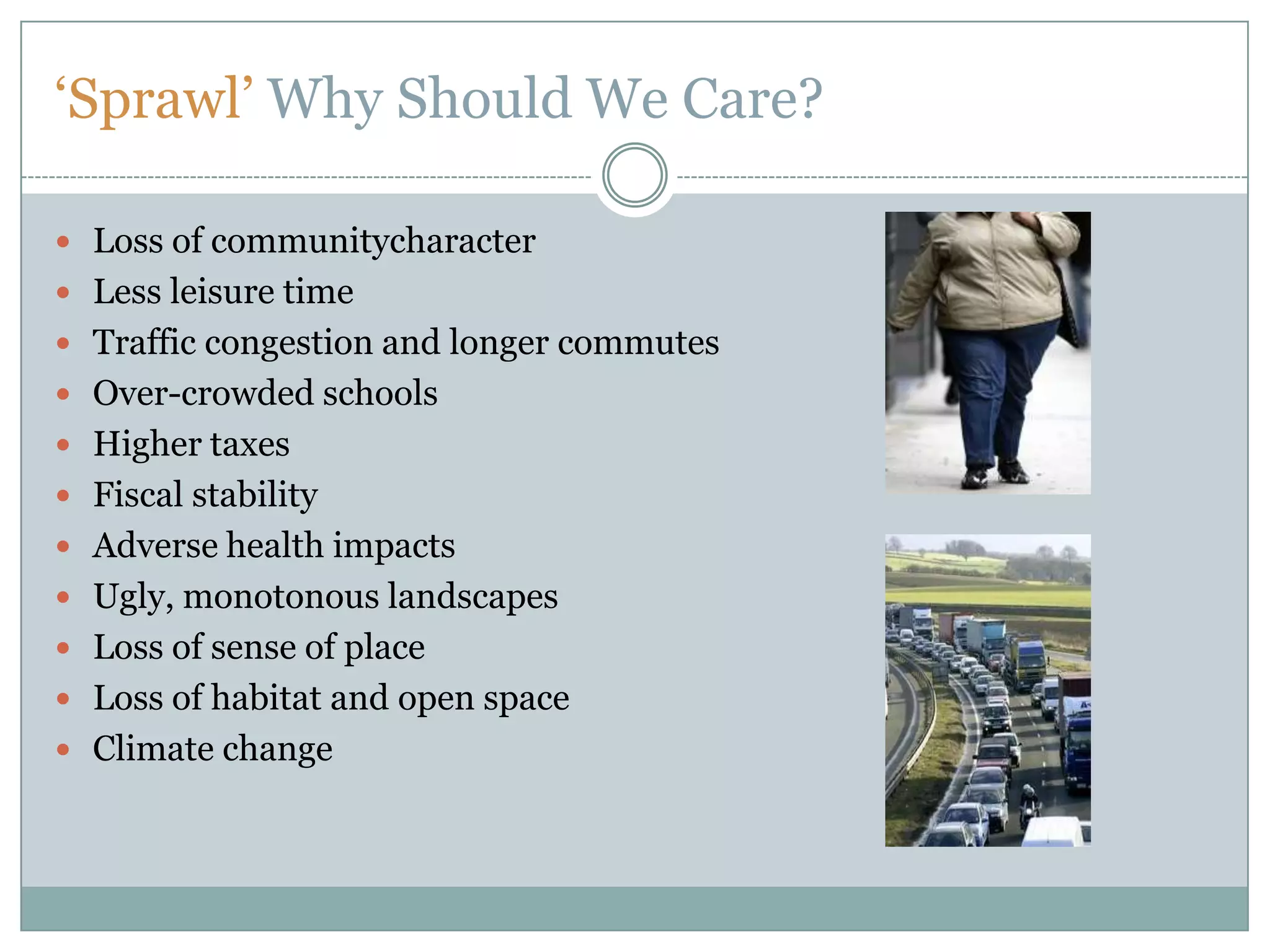
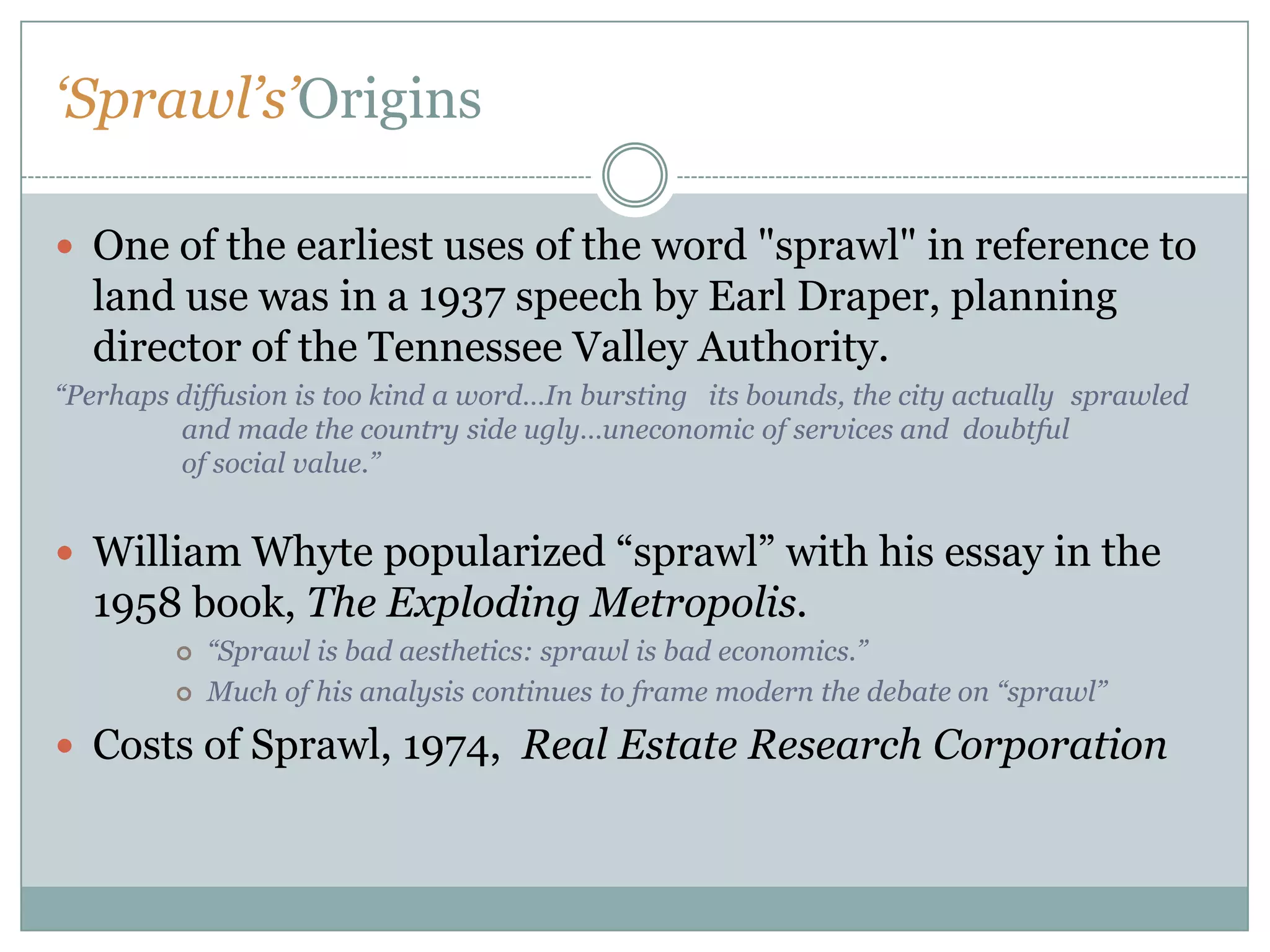
‘Sprawl’ Why Should We Care?Loss of communitycharacterLess leisure timeTraffic congestion and longer commutesOver-crowded schoolsHigher taxesFiscal stabilityAdverse health impactsUgly, monotonous landscapesLoss of sense of placeLoss of habitat and open spaceClimate change
‘Sprawl’s’OriginsOne of the earliest uses of the word "sprawl" in reference to land use was in a 1937 speech by Earl Draper, planning director of the Tennessee Valley Authority. “Perhaps diffusion is too kind a word…In bursting   its bounds, the city actually 	sprawled 	and made the country side ugly…uneconomic of services and  doubtful 	of social value.”William Whyte popularized “sprawl” with his essay in the 1958 book, The Exploding Metropolis. “Sprawl is bad aesthetics: sprawl is bad economics.”Much of his analysis continues to frame modern the debate on “sprawl”Costs of Sprawl, 1974,  Real Estate Research Corporation
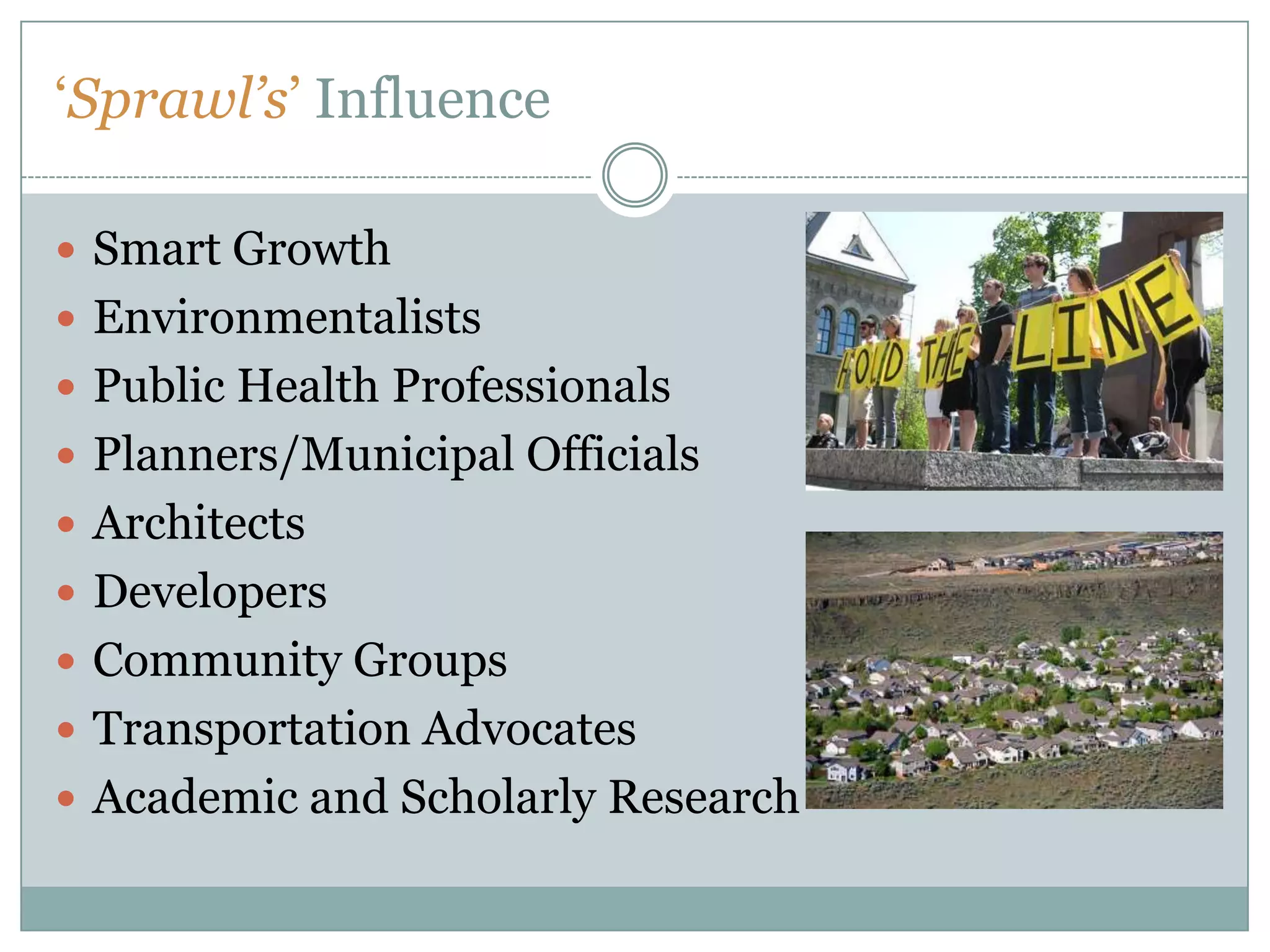
‘Sprawl’s’ InfluenceSmart GrowthEnvironmentalistsPublic Health ProfessionalsPlanners/Municipal OfficialsArchitectsDevelopersCommunity GroupsTransportation AdvocatesAcademic and Scholarly Research
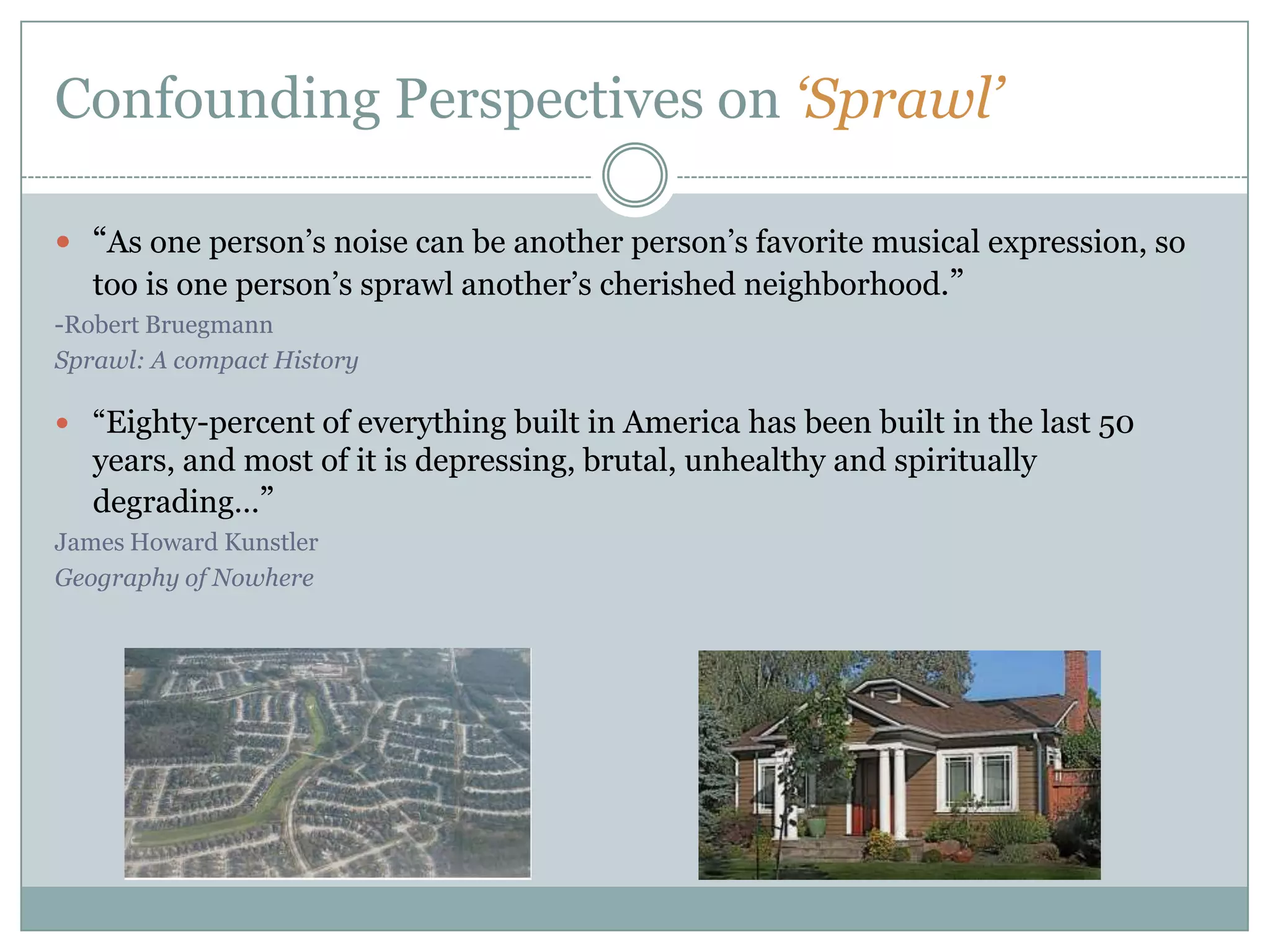
Confounding Perspectives on ‘Sprawl’“As one person’s noise can be another person’s favorite musical expression, so too is one person’s sprawl another’s cherished neighborhood.” -Robert BruegmannSprawl: A compact History“Eighty-percent of everything built in America has been built in the last 50 years, and most of it is depressing, brutal, unhealthy and spiritually degrading…”James Howard KunstlerGeography of Nowhere
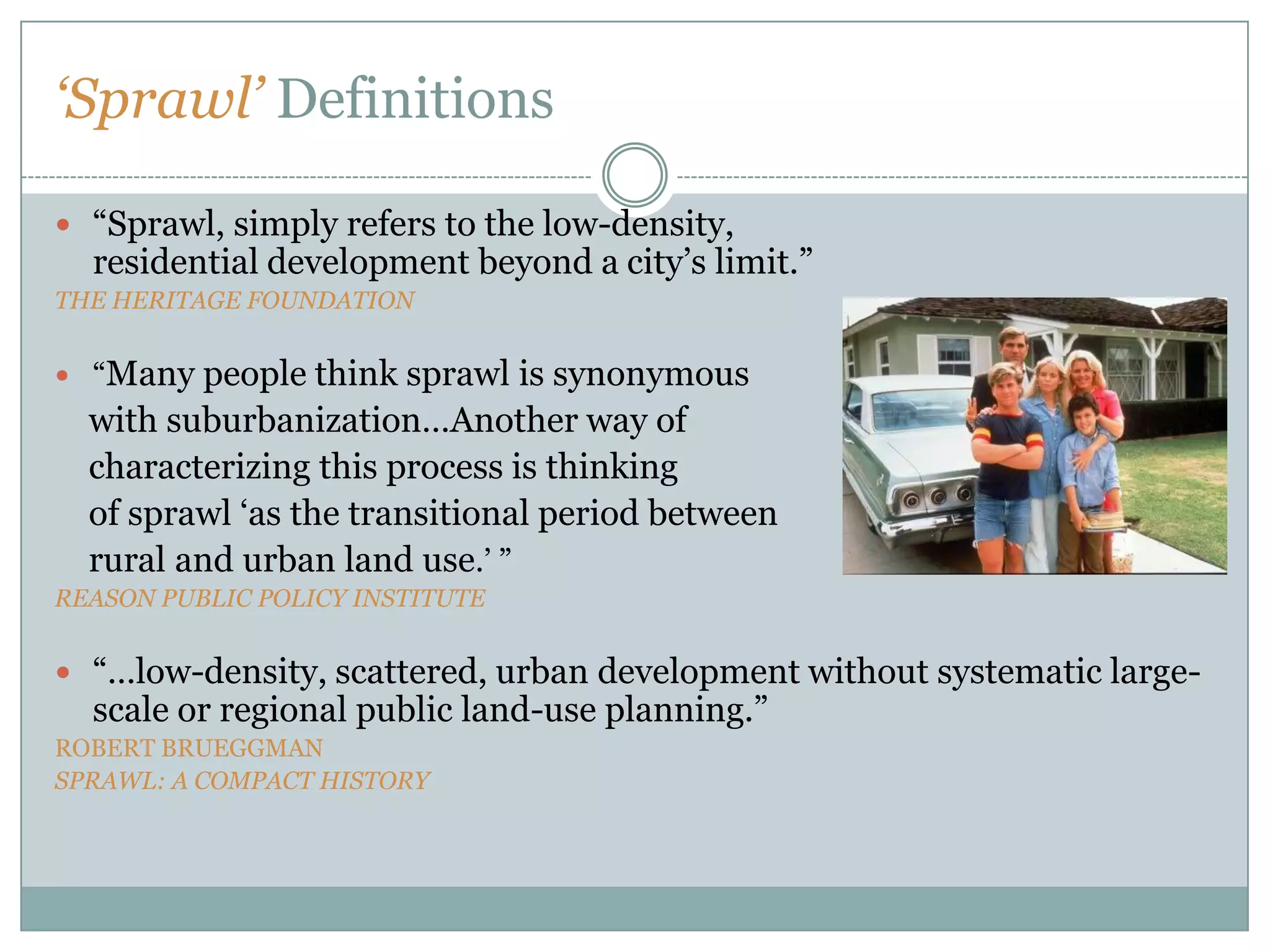
‘Sprawl’ Definitions “Sprawl, simply refers to the low-density,                                        residential development beyond a city’s limit.”THE HERITAGE FOUNDATION“Many people think sprawl is synonymous     with suburbanization…Another way of     characterizing this process is thinking     of sprawl ‘as the transitional period between     rural and urban land use.’ ”REASON PUBLIC POLICY INSTITUTE“…low-density, scattered, urban development without systematic large-scale or regional public land-use planning.”ROBERT BRUEGGMANSPRAWL: A COMPACT HISTORY
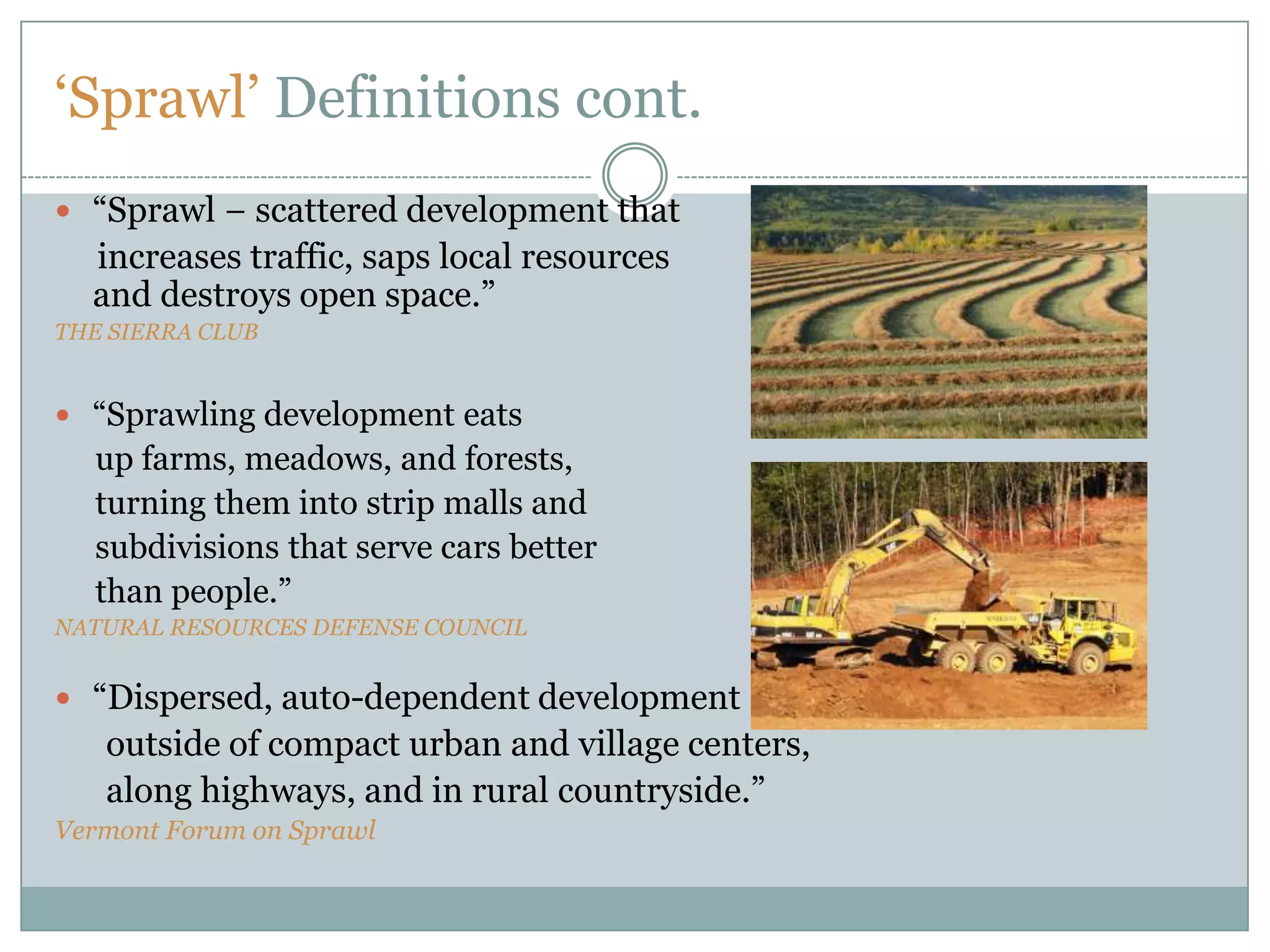
‘Sprawl’ Definitions cont.“Sprawl − scattered development that     increases traffic, saps local resources                                                                         and destroys open space.”THE SIERRA CLUB“Sprawling development eats      up farms, meadows, and forests,      turning them into strip malls and      subdivisions that serve cars better      than people.”NATURAL RESOURCES DEFENSE COUNCIL“Dispersed, auto-dependent development       outside of compact urban and village centers,      along highways, and in rural countryside.”Vermont Forum on Sprawl
Sprawl≠ SuburbPropensity to equate sprawl with suburbs as a means for validation  Suburbs not confined to the United StatesHistorically, suburbs were reserved for the wealthy and something the common man aspired to. Over half the population lives in suburbsLewis Mumford, early critic of sprawl, spoke highly of traditional, planned, inner ring suburbs.
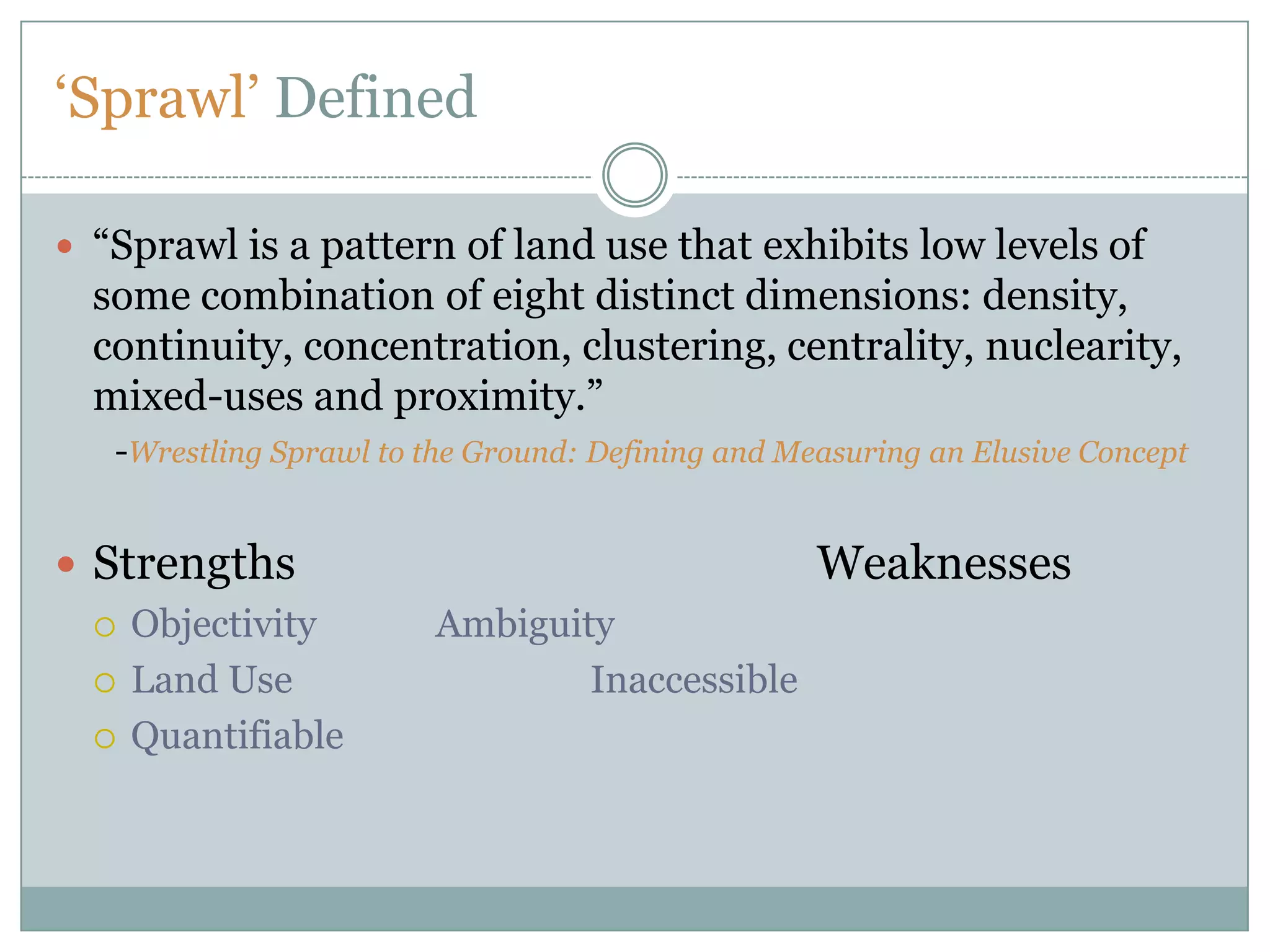
‘Sprawl’ Defined“Sprawl is a pattern of land use that exhibits low levels of some combination of eight distinct dimensions: density, continuity, concentration, clustering, centrality, nuclearity, mixed-uses and proximity.” 	-Wrestling Sprawl to the Ground: Defining and Measuring an Elusive ConceptStrengths					WeaknessesObjectivity	AmbiguityLand Use	 		   InaccessibleQuantifiable
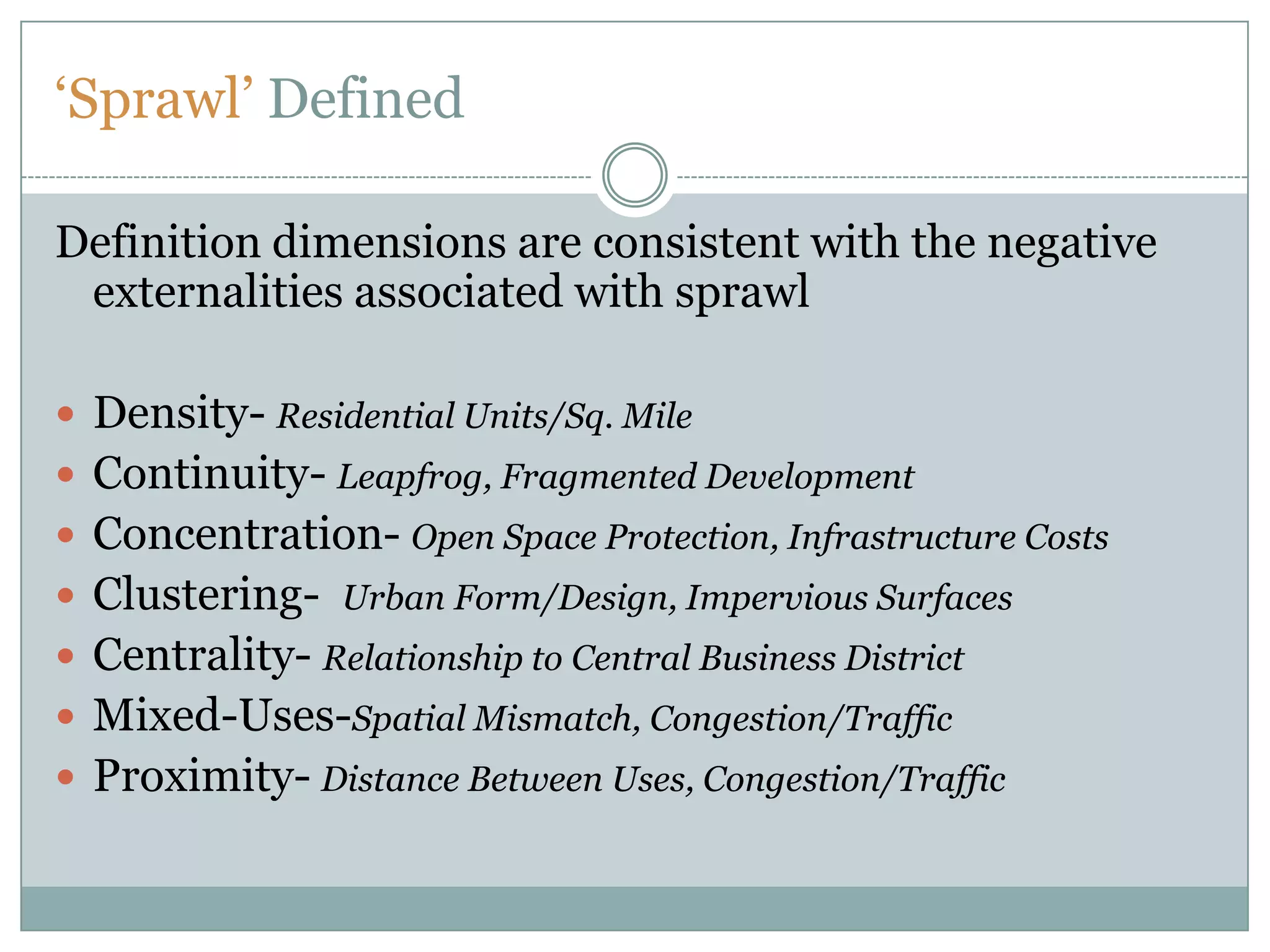
‘Sprawl’ DefinedDefinition dimensions are consistent with the negative externalities associated with sprawlDensity- Residential Units/Sq. MileContinuity- Leapfrog, Fragmented DevelopmentConcentration- Open Space Protection, Infrastructure CostsClustering-  Urban Form/Design, Impervious SurfacesCentrality- Relationship to Central Business District Mixed-Uses-Spatial Mismatch, Congestion/TrafficProximity- Distance Between Uses, Congestion/Traffic
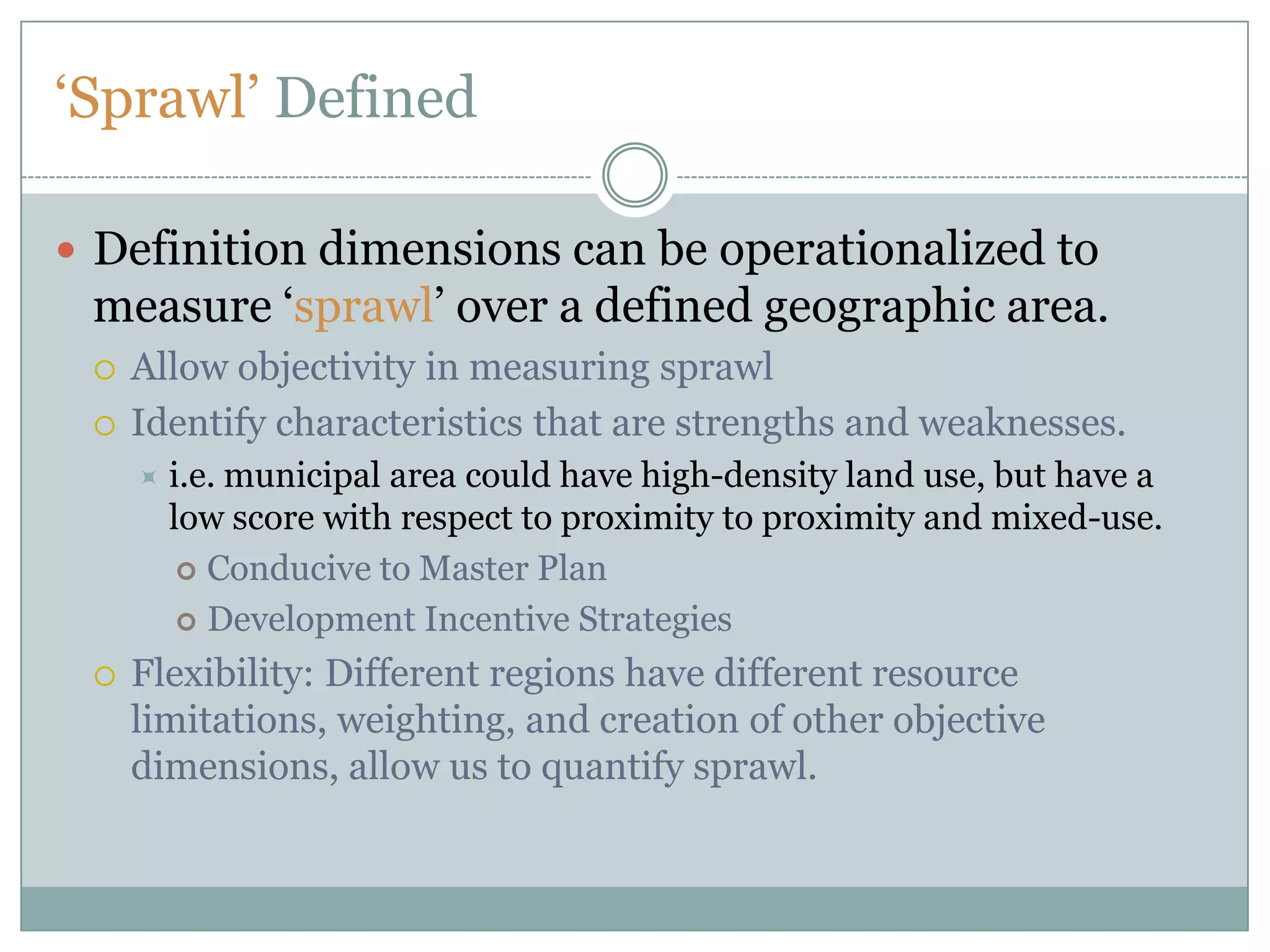
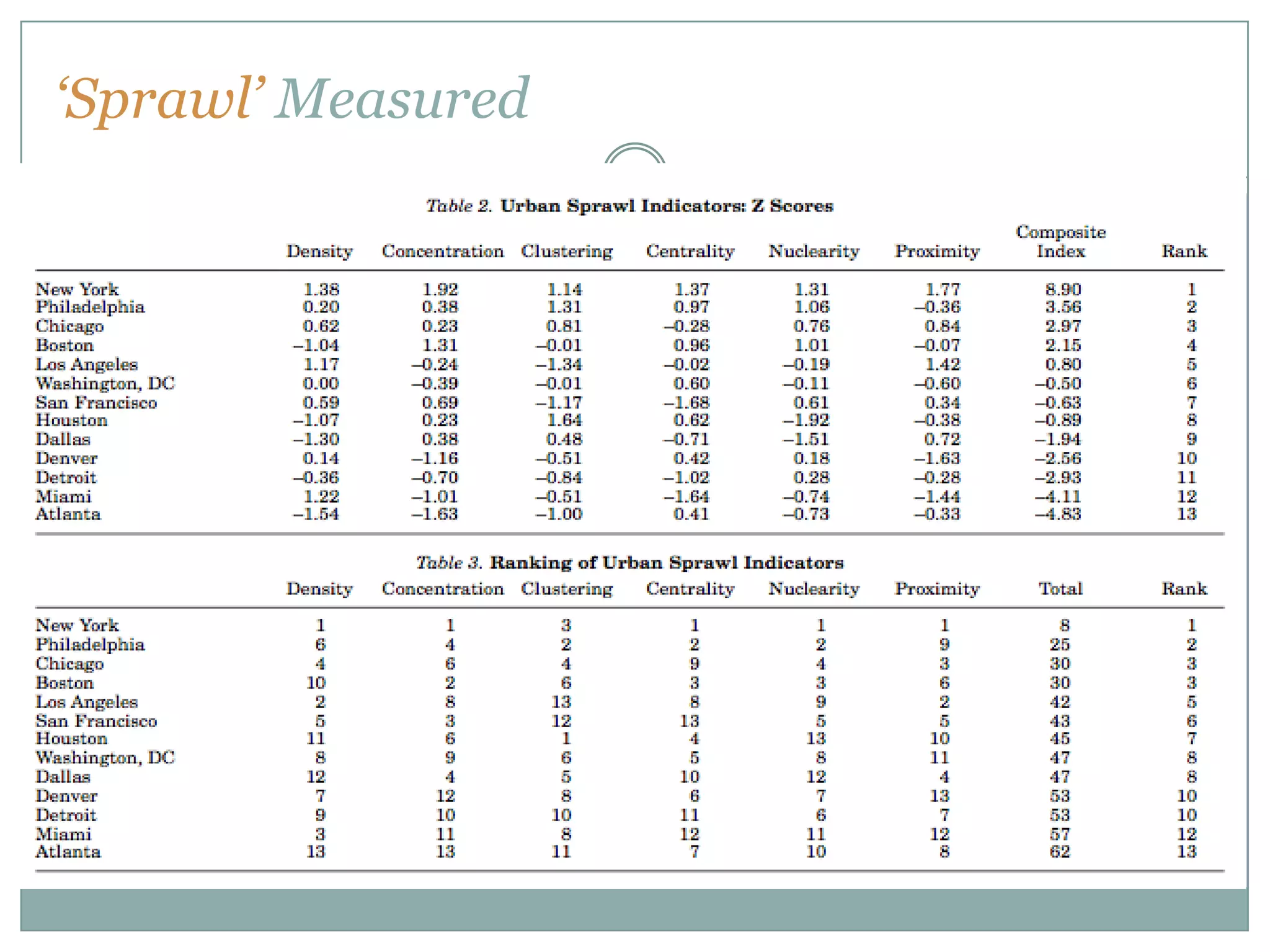
‘Sprawl’ DefinedDefinition dimensions can be operationalized to measure ‘sprawl’ over a defined geographic area. Allow objectivity in measuring sprawlIdentify characteristics that are strengths and weaknesses. i.e. municipal area could have high-density land use, but have a low score with respect to proximity to proximity and mixed-use.Conducive to Master PlanDevelopment Incentive StrategiesFlexibility: Different regions have different resource limitations, weighting, and creation of other objective dimensions, allow us to quantify sprawl.
‘Sprawl’ Measured
Conclusion‘Sprawl’ is a very controversial word that has been influential in shaping the debate on development and growth management.Subjectivity has its benefits and costs‘Sprawl’ is not all low-density residential developmentAs planners we can use objective definitions to operationalize land use characteristics to help us make rationale and informed land use decisions.The definition presented today is merely an example of an attempt to quantify ‘sprawl.’ Communities and regions will have different resource constraints, and therefore different  definitions. Important to have consistency within regions.

Sprawl: Understanding its Meaning and Application to Practice

  • 1.
    Nathan RobinsonMRP Candidate2011University of Massachusetts16 November 2009‘Sprawl’: Understanding its Meaning and Application t0 Practice
  • 2.
    Presentation OverviewWhy ShouldWe CareOrigins of ‘Sprawl’Confounding Perspectives and Definitions‘Sprawl’DefinedConcluding Remarks
  • 3.
    ‘Sprawl’ Why ShouldWe Care?Loss of communitycharacterLess leisure timeTraffic congestion and longer commutesOver-crowded schoolsHigher taxesFiscal stabilityAdverse health impactsUgly, monotonous landscapesLoss of sense of placeLoss of habitat and open spaceClimate change
  • 4.
    ‘Sprawl’s’OriginsOne of theearliest uses of the word "sprawl" in reference to land use was in a 1937 speech by Earl Draper, planning director of the Tennessee Valley Authority. “Perhaps diffusion is too kind a word…In bursting its bounds, the city actually sprawled and made the country side ugly…uneconomic of services and doubtful of social value.”William Whyte popularized “sprawl” with his essay in the 1958 book, The Exploding Metropolis. “Sprawl is bad aesthetics: sprawl is bad economics.”Much of his analysis continues to frame modern the debate on “sprawl”Costs of Sprawl, 1974, Real Estate Research Corporation
  • 5.
    ‘Sprawl’s’ InfluenceSmart GrowthEnvironmentalistsPublicHealth ProfessionalsPlanners/Municipal OfficialsArchitectsDevelopersCommunity GroupsTransportation AdvocatesAcademic and Scholarly Research
  • 6.
    Confounding Perspectives on‘Sprawl’“As one person’s noise can be another person’s favorite musical expression, so too is one person’s sprawl another’s cherished neighborhood.” -Robert BruegmannSprawl: A compact History“Eighty-percent of everything built in America has been built in the last 50 years, and most of it is depressing, brutal, unhealthy and spiritually degrading…”James Howard KunstlerGeography of Nowhere
  • 7.
    ‘Sprawl’ Definitions “Sprawl,simply refers to the low-density, residential development beyond a city’s limit.”THE HERITAGE FOUNDATION“Many people think sprawl is synonymous with suburbanization…Another way of characterizing this process is thinking of sprawl ‘as the transitional period between rural and urban land use.’ ”REASON PUBLIC POLICY INSTITUTE“…low-density, scattered, urban development without systematic large-scale or regional public land-use planning.”ROBERT BRUEGGMANSPRAWL: A COMPACT HISTORY
  • 8.
    ‘Sprawl’ Definitions cont.“Sprawl− scattered development that increases traffic, saps local resources and destroys open space.”THE SIERRA CLUB“Sprawling development eats up farms, meadows, and forests, turning them into strip malls and subdivisions that serve cars better than people.”NATURAL RESOURCES DEFENSE COUNCIL“Dispersed, auto-dependent development outside of compact urban and village centers, along highways, and in rural countryside.”Vermont Forum on Sprawl
  • 9.
    Sprawl≠ SuburbPropensity toequate sprawl with suburbs as a means for validation Suburbs not confined to the United StatesHistorically, suburbs were reserved for the wealthy and something the common man aspired to. Over half the population lives in suburbsLewis Mumford, early critic of sprawl, spoke highly of traditional, planned, inner ring suburbs.
  • 10.
    ‘Sprawl’ Defined“Sprawl isa pattern of land use that exhibits low levels of some combination of eight distinct dimensions: density, continuity, concentration, clustering, centrality, nuclearity, mixed-uses and proximity.” -Wrestling Sprawl to the Ground: Defining and Measuring an Elusive ConceptStrengths WeaknessesObjectivity AmbiguityLand Use InaccessibleQuantifiable
  • 11.
    ‘Sprawl’ DefinedDefinition dimensionsare consistent with the negative externalities associated with sprawlDensity- Residential Units/Sq. MileContinuity- Leapfrog, Fragmented DevelopmentConcentration- Open Space Protection, Infrastructure CostsClustering- Urban Form/Design, Impervious SurfacesCentrality- Relationship to Central Business District Mixed-Uses-Spatial Mismatch, Congestion/TrafficProximity- Distance Between Uses, Congestion/Traffic
  • 12.
    ‘Sprawl’ DefinedDefinition dimensionscan be operationalized to measure ‘sprawl’ over a defined geographic area. Allow objectivity in measuring sprawlIdentify characteristics that are strengths and weaknesses. i.e. municipal area could have high-density land use, but have a low score with respect to proximity to proximity and mixed-use.Conducive to Master PlanDevelopment Incentive StrategiesFlexibility: Different regions have different resource limitations, weighting, and creation of other objective dimensions, allow us to quantify sprawl.
  • 13.
  • 14.
    Conclusion‘Sprawl’ is avery controversial word that has been influential in shaping the debate on development and growth management.Subjectivity has its benefits and costs‘Sprawl’ is not all low-density residential developmentAs planners we can use objective definitions to operationalize land use characteristics to help us make rationale and informed land use decisions.The definition presented today is merely an example of an attempt to quantify ‘sprawl.’ Communities and regions will have different resource constraints, and therefore different definitions. Important to have consistency within regions.

Editor's Notes

  • #5 William Whyte’s essay, Urban Sprawl, epitomizes the issue, and even in the 1950’s much of his commentary regarding sprawl still rings true today. “The problem is how to achieve an economically high-density in developed areas, and at the same time more amenable surroundings for the people in them.”
  • #6 The sierra club, natural resource defense council, and the conservation law foundation, preimminent national and regional organizations have all alligned in the fight against sprawl.
  • #7 Read the two Definitions: One from the Natural Resources Defense Council, the Other From the Reason FoundationSprawl, simply refers to the low-density, residential development beyond a city’s limitMany people think sprawl is synonymous with suburbanization…Another way of characterizing this process is thinking of sprawl as the transitional period between rural and urban land useSprawling Development eats up farms, meadows, and forests, turning them into strip malls and subdivisions that serve cars better than people.” NRDCSprawl-scattered development that increases development, sap local resources and destroys open space. Sierra Club.
  • #11 I would to this definition that development is characterized by a Temporal element that is characterized by a very quick turn-around time.Objective: The definition does not include value judgments or subjective criteria like aesthetics or “quality of life.”LUC: Deals only land use characteristics, does not include causes of sprawl, (cheap land) or effects of sprawl, “congestion” or loss of open space in the criteriaQuantifiable: As we will see later, the eight distinct dimensions can be operationalized, to be measured. Density: Is a measure of residential housing units/square mile, reflects the built environment, Continuity: Used to measure the “leapfrog effect,” is development being fragmented, which could lead to loss of continuous open space and another negative externality of sprawl such as more driving?Concentration: Refers to how densely development is distrubuted over a measurable area. Areas with high concentration how lower levels of dispersal and thus less sprawl. Clustering: the form of development within a Grid, related to impervious surfaces, water filtration and health, etc. Centrality: Distance from Central business districtNuclearity: Poly nuclear, versus NuclearMixed-Use:
  • #14 New York, Philadelphia, ChicagoAtlanta, Miami, Detroit had the lowest scores.