SPOTTING &
ADDRESSING
EMPLOYEE BURNOUT
01.30.20
Agenda • Welcome & introductions
• Burnout research
• Preventing burnout
• Addressing burnout
• Q&A
Our Background
Julianne Tillmann, Ph.D.
Director of Research,
Limeade Institute, Limeade
Sarah Stevens, SHRM-CP
Sr. Manager,
People Team, Limeade
3
Christine Bilheimer
Sr. Strategic Account Executive,
Customer Success Team, Limeade
BURNOUT –
AN “OCCUPATIONAL
PHENOMENON”
4(WHO, 2019 https://www.Who.Int/mental_health/evidence/burn-out/en/)
Workplace stress caused additional
expenditures of anywhere from
$125 - $190 BILLION
PER YEAR
5%-8%
Representing
Goh, Pfeffer & Zenios, 2015
High demands at work was responsible for
$48 BILLION
IN SPENDING
OF NATIONAL
HEALTH CARE SPENDING
5
Burnout results in low productivity and high turnover, especially
turnover of your most talented employees.
THE TRUE COST TO BUSINESS
CAN BE FAR GREATER…
6
BURNOUT
STORY
7
Burnout Research
What it is and how to get ahead of it
8
Defining Burnout
A response to prolonged exposure to emotional, physical and interpersonal stressors
Characterized by the feelings of:
Maslach,Schaufeli,& Leiter, 2001
EXHAUSTION
I’m so tired
I feel depleted
CYNICISM
I’m so fed up,
I just don’t care
anymore
INEFFICACY
I’m not making
a difference
9
From on Fire… to
Burned Out
• You have to be on fire in order to
burn out
• You have to care, be “all in”, and
be engaged in order to burnout
BURNOUT HAPPENS WHEN YOU HAVE HIGH
ENGAGEMENT BUT LOW WELL-BEING
Phases of Burnout
11LimeadeInstitute, 2019
What’s The Difference?
DISENGAGEMENT
I am past the point
of caring or I have never cared
at all
This is just a job
BURNOUT
I have cared so deeply, for so
long, without a break from the
stress that I have become
depleted and cynical
I have given everything
to this job
ENGAGEMENT
I am energized by and
connected to this job, so much
so that I get purpose from it
This is way more than
a job
12
Most companies think of burnout
as a PERSONAL issue, when it is
really an ORGANIZATIONAL one…
ORGANIZATIONS have a responsibility
to help their employees PREVENT
burnout and ALLEVIATE burnout
13
Maslach,Schaufeli,& Leiter, 2001; Mayo Clinic,2019 14
Overload – workload and time
pressure
Lack of support from managers
Lack of feedback
Lack of participation in decision making
Lack of fairness and equity
Role conflict and ambiguity; job or
organizational changes
Valuesdisconnect and Broken
psychological contract
Demands outside of work
Common Causes of Burnout
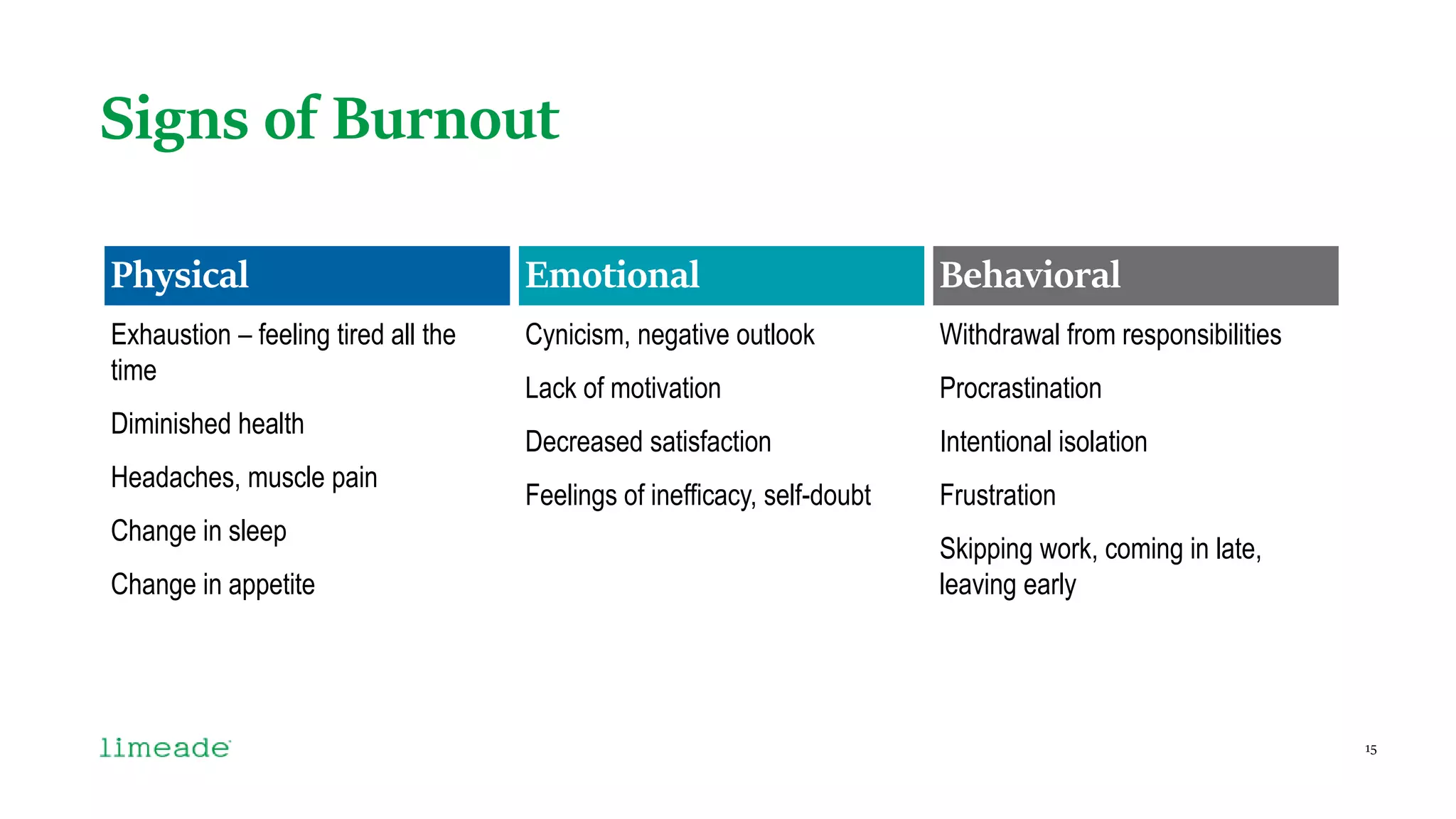
Signs of Burnout
Physical Emotional Behavioral
Exhaustion – feeling tired all the
time
Diminished health
Headaches, muscle pain
Change in sleep
Change in appetite
Cynicism, negative outlook
Lack of motivation
Decreased satisfaction
Feelings of inefficacy, self-doubt
Withdrawal from responsibilities
Procrastination
Intentional isolation
Frustration
Skipping work, coming in late,
leaving early
15
16
Burnout Leads to:
ORGANIZATIONAL IMPACTS
• Reduced organizational commitment
• Absenteeism
• Intention to leave
• Actual turnover
PERSONAL IMPACTS
• Lower productivity
• Stress-related health issues
• Increased substance abuse
• Anxiety, depression
and decreases in self-esteem
Maslach,Schaufeli,& Leiter, 2001; Burke & Greenglass,2001
Burnout is Contagious
Greater personal conflict at work
Increased work disruption
“Spillover” into people’s life outside of
work
17
Maslach,Schaufeli,& Leiter, 2001; Burke & Greenglass,2001
Burned out employees were more than
2x
as likely to have tried to convince another
colleague to leave the job with them (31%
vs 12%)
2020 Employee Care Report(inpress)
PREVENTING &
ADDRESSING BURNOUT
18
19
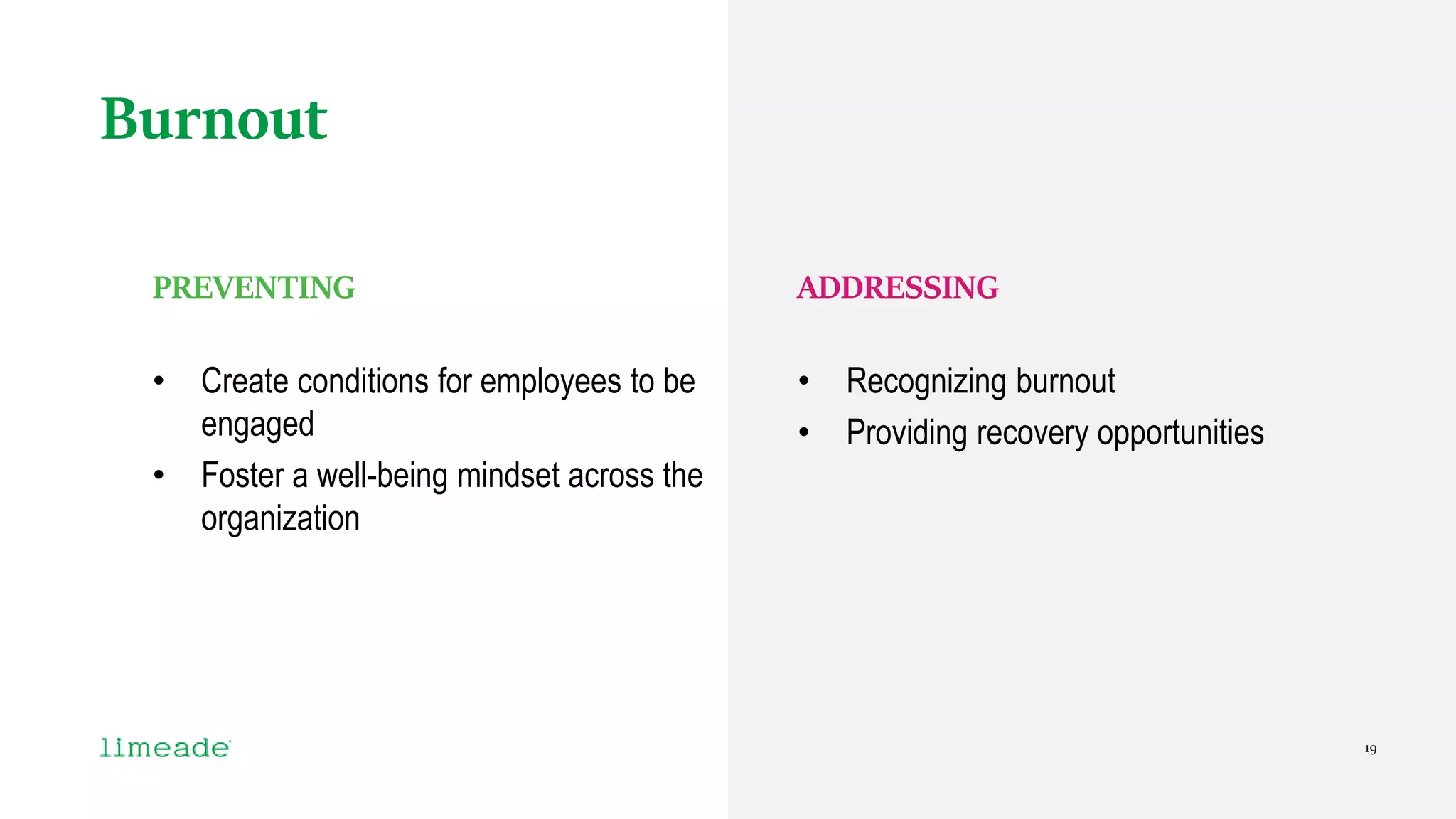
Burnout
ADDRESSING
• Recognizing burnout
• Providing recovery opportunities
PREVENTING
• Create conditions for employees to be
engaged
• Foster a well-being mindset across the
organization
LimeadeInstitute, 2018 20
Liking one’s work and being energized
by it
Respected and supported by colleagues
and manager
Being challenged,learning and using
one’s strengths
Being able to focus and manage work
stress
Having a life outside of work
Being valued, included and treated fairly
Making a difference and having a
purpose
Caring, supportive organization
Creating Conditions for Engagement
21
Fostering a Well-Being Mindset
• Empower employees to build in recovery
moments
• Help employees find and keep their purpose
• Give employees permission to set emotional
and physical boundaries with their work (and
have managers lead by example)
• Help employees understand how they think
about stress individually and as a team
• Help employees find their “sweet spot” of
stress
• Encourage and enable managers to have
meaningful check-ins with employees
Recognizing Burnout
EXHAUSTION CYNICISM INEFFICACY
PHYSICAL
SIGNS
EMOTIONAL
SIGNS
BEHAVIORAL
SIGNS
Recovery
Detachment Relaxation
23
Mastery
Hahn, Binnewies, Sonnentag, & Mojza, 2011; Sawhney, Jennings, Britt, & Sliter, 2018; Sonnentag & Fritz, 2007; Sonnentag et al., 2010; Sonnentag, Venz, & Casper, 2017
Social Connections
Recovery - processes and activities that replenish key resources
Key Takeaways
Preventing burnoutThe role of the
organization
Addressing
burnout
Thank you!
25

Spotting and Addressing Employee Burnout

  • 1.
  • 2.
    Agenda • Welcome& introductions • Burnout research • Preventing burnout • Addressing burnout • Q&A
  • 3.
    Our Background Julianne Tillmann,Ph.D. Director of Research, Limeade Institute, Limeade Sarah Stevens, SHRM-CP Sr. Manager, People Team, Limeade 3 Christine Bilheimer Sr. Strategic Account Executive, Customer Success Team, Limeade
  • 4.
    BURNOUT – AN “OCCUPATIONAL PHENOMENON” 4(WHO,2019 https://www.Who.Int/mental_health/evidence/burn-out/en/)
  • 5.
    Workplace stress causedadditional expenditures of anywhere from $125 - $190 BILLION PER YEAR 5%-8% Representing Goh, Pfeffer & Zenios, 2015 High demands at work was responsible for $48 BILLION IN SPENDING OF NATIONAL HEALTH CARE SPENDING 5
  • 6.
    Burnout results inlow productivity and high turnover, especially turnover of your most talented employees. THE TRUE COST TO BUSINESS CAN BE FAR GREATER… 6
  • 7.
  • 8.
    Burnout Research What itis and how to get ahead of it 8
  • 9.
    Defining Burnout A responseto prolonged exposure to emotional, physical and interpersonal stressors Characterized by the feelings of: Maslach,Schaufeli,& Leiter, 2001 EXHAUSTION I’m so tired I feel depleted CYNICISM I’m so fed up, I just don’t care anymore INEFFICACY I’m not making a difference 9
  • 10.
    From on Fire…to Burned Out • You have to be on fire in order to burn out • You have to care, be “all in”, and be engaged in order to burnout BURNOUT HAPPENS WHEN YOU HAVE HIGH ENGAGEMENT BUT LOW WELL-BEING
  • 11.
  • 12.
    What’s The Difference? DISENGAGEMENT Iam past the point of caring or I have never cared at all This is just a job BURNOUT I have cared so deeply, for so long, without a break from the stress that I have become depleted and cynical I have given everything to this job ENGAGEMENT I am energized by and connected to this job, so much so that I get purpose from it This is way more than a job 12
  • 13.
    Most companies thinkof burnout as a PERSONAL issue, when it is really an ORGANIZATIONAL one… ORGANIZATIONS have a responsibility to help their employees PREVENT burnout and ALLEVIATE burnout 13
  • 14.
    Maslach,Schaufeli,& Leiter, 2001;Mayo Clinic,2019 14 Overload – workload and time pressure Lack of support from managers Lack of feedback Lack of participation in decision making Lack of fairness and equity Role conflict and ambiguity; job or organizational changes Valuesdisconnect and Broken psychological contract Demands outside of work Common Causes of Burnout
  • 15.
    Signs of Burnout PhysicalEmotional Behavioral Exhaustion – feeling tired all the time Diminished health Headaches, muscle pain Change in sleep Change in appetite Cynicism, negative outlook Lack of motivation Decreased satisfaction Feelings of inefficacy, self-doubt Withdrawal from responsibilities Procrastination Intentional isolation Frustration Skipping work, coming in late, leaving early 15
  • 16.
    16 Burnout Leads to: ORGANIZATIONALIMPACTS • Reduced organizational commitment • Absenteeism • Intention to leave • Actual turnover PERSONAL IMPACTS • Lower productivity • Stress-related health issues • Increased substance abuse • Anxiety, depression and decreases in self-esteem Maslach,Schaufeli,& Leiter, 2001; Burke & Greenglass,2001
  • 17.
    Burnout is Contagious Greaterpersonal conflict at work Increased work disruption “Spillover” into people’s life outside of work 17 Maslach,Schaufeli,& Leiter, 2001; Burke & Greenglass,2001 Burned out employees were more than 2x as likely to have tried to convince another colleague to leave the job with them (31% vs 12%) 2020 Employee Care Report(inpress)
  • 18.
  • 19.
    19 Burnout ADDRESSING • Recognizing burnout •Providing recovery opportunities PREVENTING • Create conditions for employees to be engaged • Foster a well-being mindset across the organization
  • 20.
    LimeadeInstitute, 2018 20 Likingone’s work and being energized by it Respected and supported by colleagues and manager Being challenged,learning and using one’s strengths Being able to focus and manage work stress Having a life outside of work Being valued, included and treated fairly Making a difference and having a purpose Caring, supportive organization Creating Conditions for Engagement
  • 21.
    21 Fostering a Well-BeingMindset • Empower employees to build in recovery moments • Help employees find and keep their purpose • Give employees permission to set emotional and physical boundaries with their work (and have managers lead by example) • Help employees understand how they think about stress individually and as a team • Help employees find their “sweet spot” of stress • Encourage and enable managers to have meaningful check-ins with employees
  • 22.
    Recognizing Burnout EXHAUSTION CYNICISMINEFFICACY PHYSICAL SIGNS EMOTIONAL SIGNS BEHAVIORAL SIGNS
  • 23.
    Recovery Detachment Relaxation 23 Mastery Hahn, Binnewies,Sonnentag, & Mojza, 2011; Sawhney, Jennings, Britt, & Sliter, 2018; Sonnentag & Fritz, 2007; Sonnentag et al., 2010; Sonnentag, Venz, & Casper, 2017 Social Connections Recovery - processes and activities that replenish key resources
  • 24.
    Key Takeaways Preventing burnoutTherole of the organization Addressing burnout
  • 25.