Creating a Caring
Culture
to attract and retain talent
Agenda 1. Shifting workplaces
2. The importance of care
3. Creating a caring workplace
2
Our Background
Laura Hamill, Ph.D.
Chief People Officer &
Chief Science Officer, Limeade
Julianne Tillmann, Ph.D.
Director of Research,
Limeade Institute, Limeade
3
4
You are lucky to have a job.
In my day, we just came to work
and did our jobs.
Darn snowflakes!
This is about business, not your
feelings.
You get a paycheck every two weeks,
that’s how I show I care.
The history of work
and our assumptions about
what work is supposed to be
are primary reasons
it feels taboo.
Assumptions About Work
Colquitt,2017 6
Contractual
Monitoring and surveillance
Feedback isprimarily negative
Keeping score
Money motivates
Adversarial
But This Was
When…
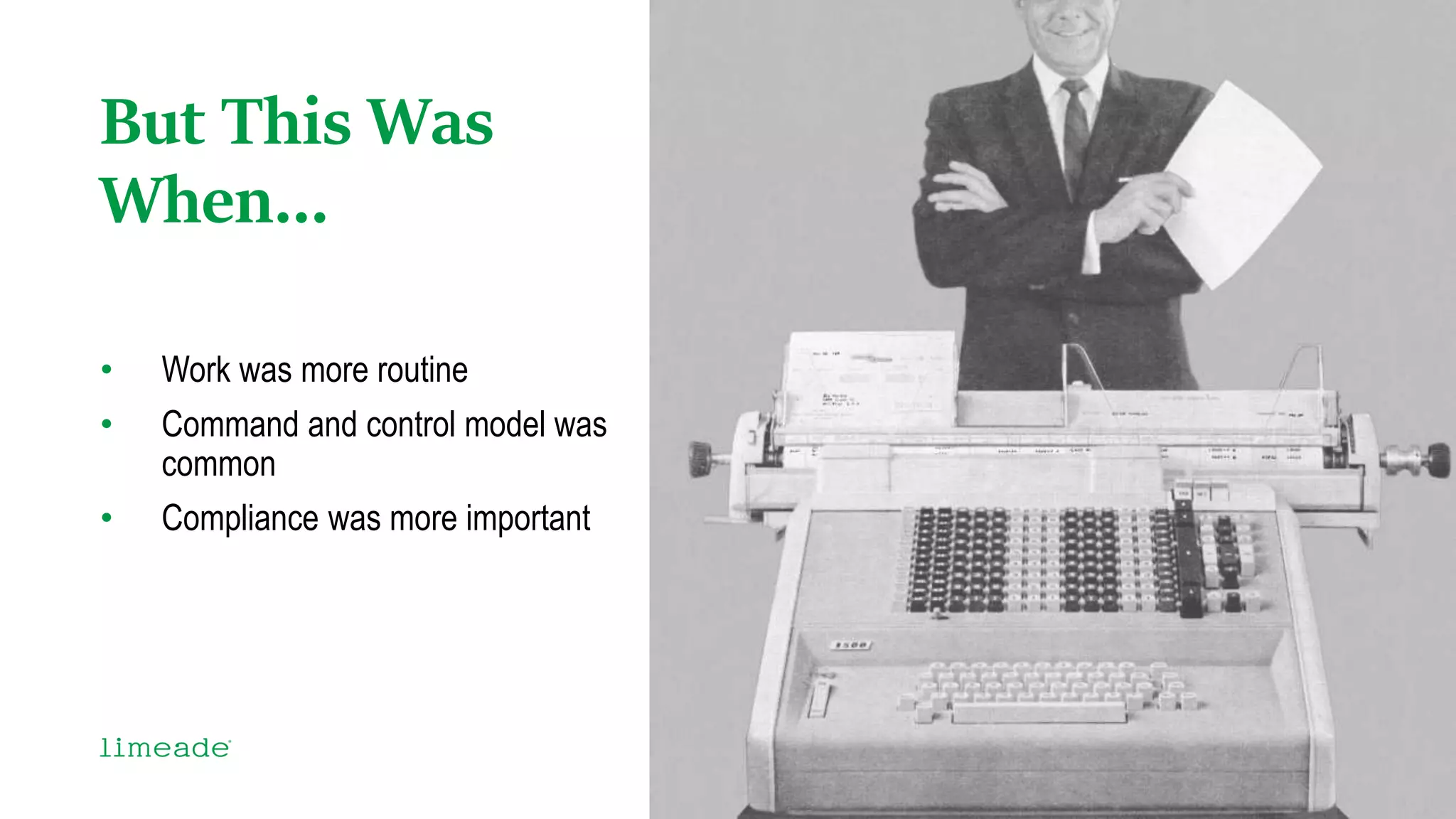
• Work was more routine
• Command and control model was
common
• Compliance was more important
To what extent does your organization buy
into these traditional assumptions about
work?
• 5 = To a very great extent
• 4 = To a great extent
• 3 = To a moderate extent
• 2 = To a small extent
• 1 = Not at all
THE DEMANDS HAVE
CHANGED
UNDERSTANDING HAS
EVOLVED
SOLVING FOR THE
WORKFORCE OF
YESTERDAY WON’T
WORK
So, why now?
CARE
10
Importance
of Care
11
12
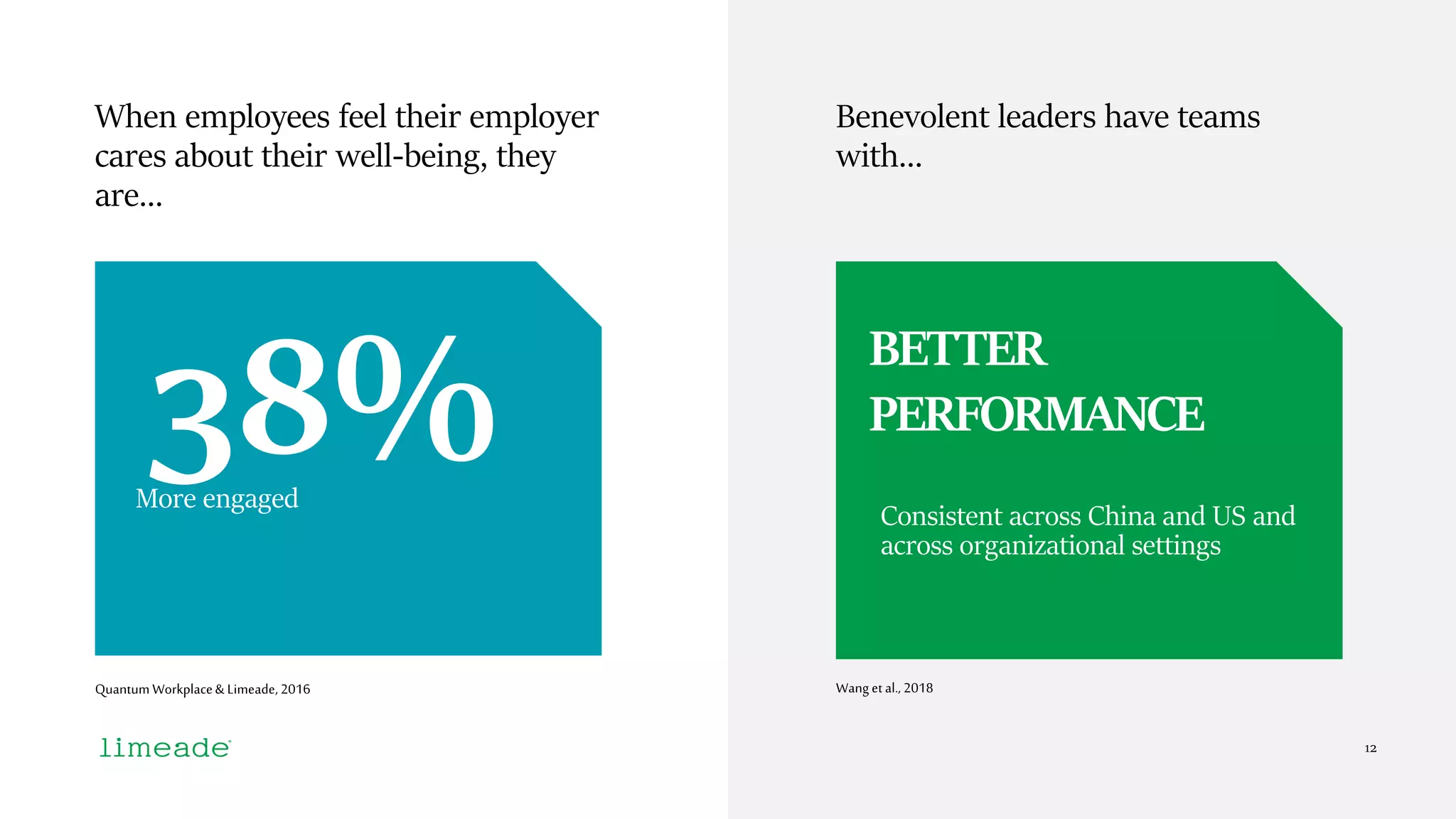
When employees feel their employer
cares about their well-being, they
are…
38%More engaged
Quantum Workplace& Limeade, 2016
Benevolent leaders have teams
with…
BETTER
PERFORMANCE
Consistent across China and US and
across organizational settings
Wang et al., 2018
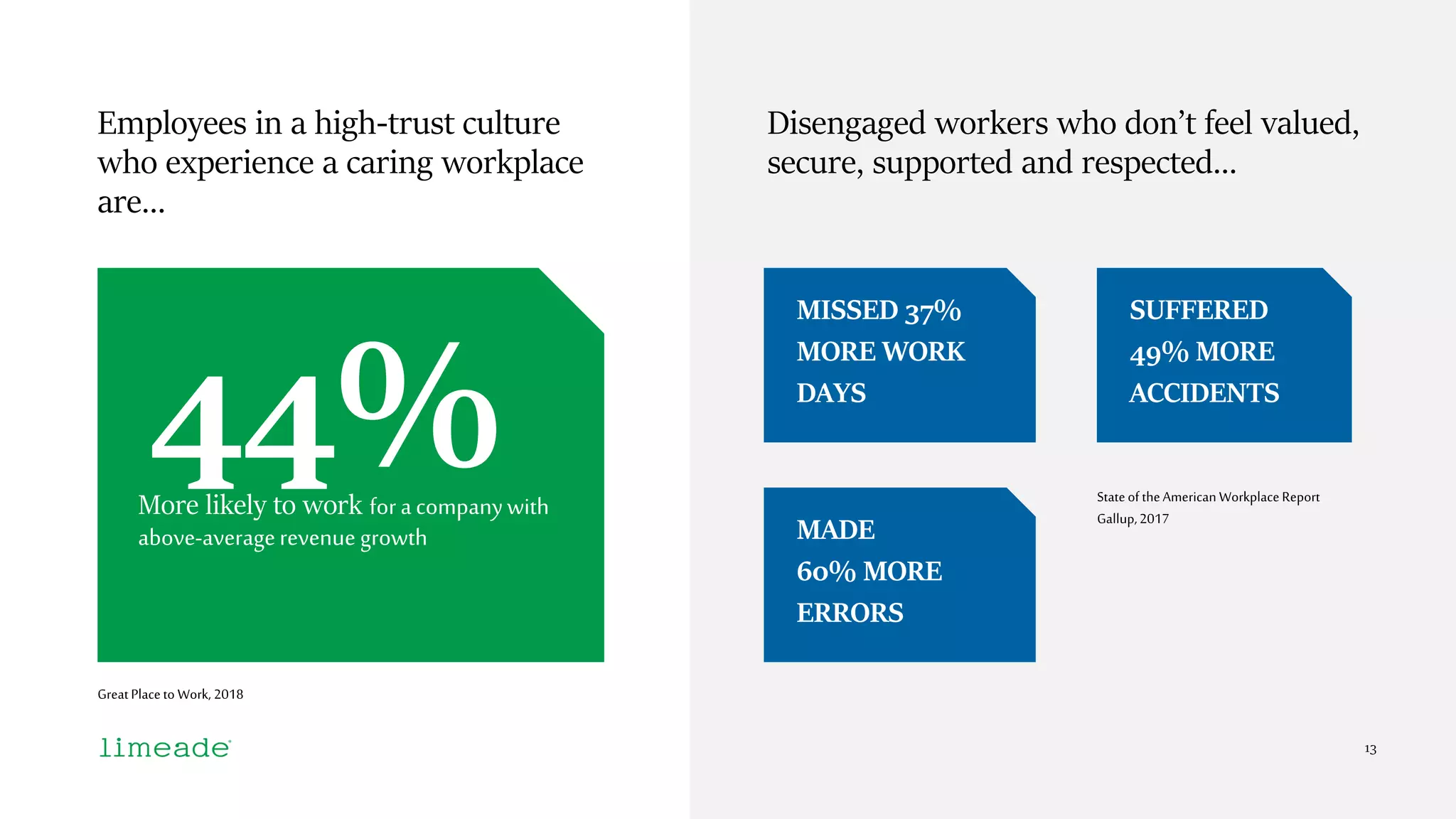
Disengaged workers who don’t feel valued,
secure, supported and respected…
Stateof theAmerican WorkplaceReport
Gallup,2017
MISSED 37%
MORE WORK
DAYS
SUFFERED
49% MORE
ACCIDENTS
MADE
60% MORE
ERRORS
13
Employees in a high-trust culture
who experience a caring workplace
are…
44%More likely to work foracompanywith
above-averagerevenue growth
GreatPlaceto Work, 2018
Careisrelated towell-being,
engagement and inclusion.
52%
75%
94%
43%
72%
94%
14%
72%
95%
0%
20%
40%
60%
80%
100%
%Favorable Well-being
Engagement
Inclusion
Org Does NOT Care Neutral Org Care Org DOES Care
LimeadeInstitute,2019 14
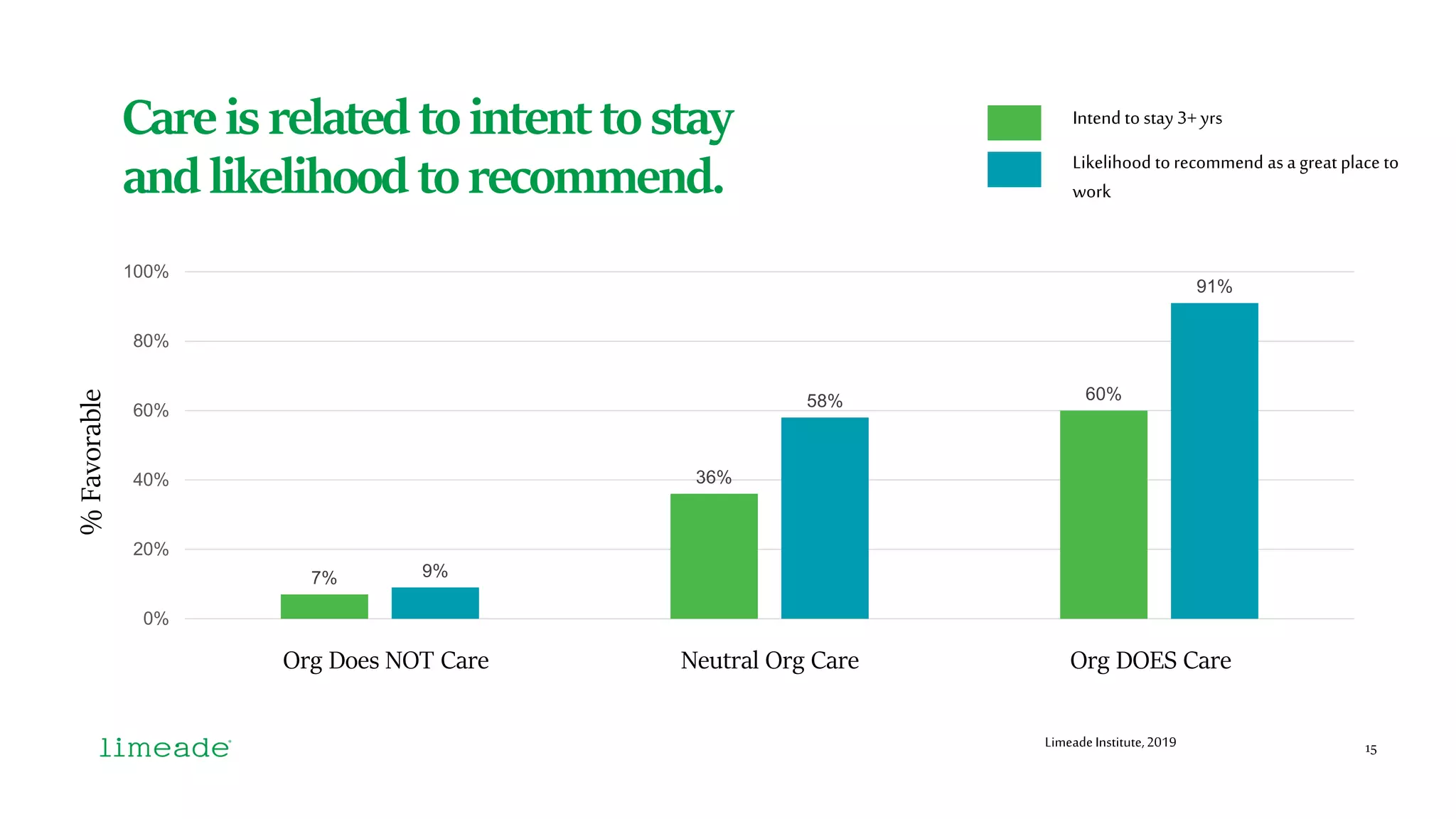
Careisrelated tointent tostay
and likelihood torecommend.
LimeadeInstitute,2019
7%
36%
60%
9%
58%
91%
0%
20%
40%
60%
80%
100%
Intend to stay 3+ yrs
Likelihood torecommend as a great place to
work
%Favorable
Org Does NOT Care Neutral Org Care Org DOES Care
15
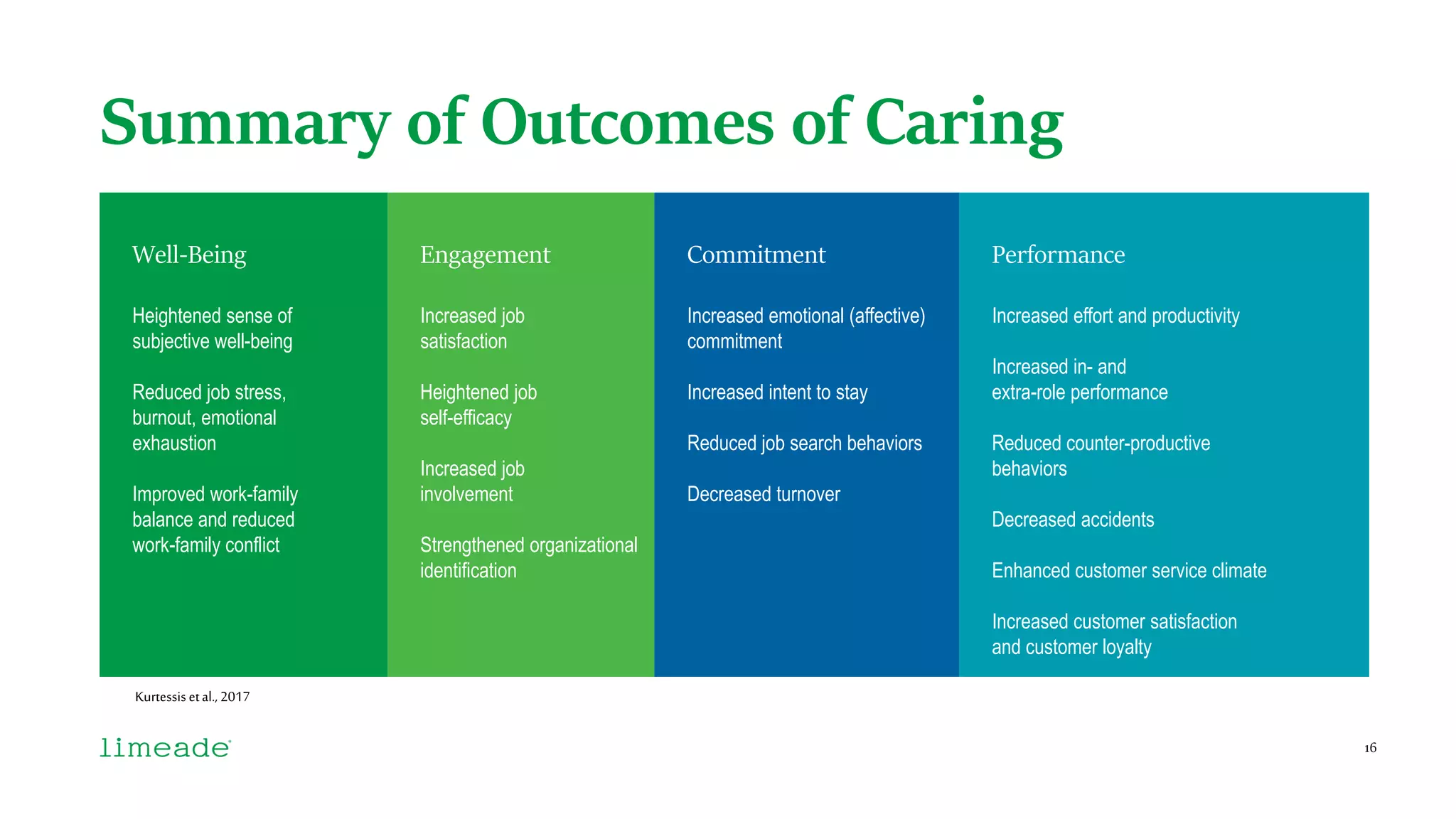
Summary of Outcomes of Caring
Kurtessis etal., 2017
16
Well-Being
Heightened sense of
subjective well-being
Reduced job stress,
burnout, emotional
exhaustion
Improved work-family
balance and reduced
work-family conflict
Engagement
Increased job
satisfaction
Heightened job
self-efficacy
Increased job
involvement
Strengthened organizational
identification
Commitment
Increased emotional (affective)
commitment
Increased intent to stay
Reduced job search behaviors
Decreased turnover
Performance
Increased effort and productivity
Increased in- and
extra-role performance
Reduced counter-productive
behaviors
Decreased accidents
Enhanced customer service climate
Increased customer satisfaction
and customer loyalty
Creating a Caring
Workplace
17
ELEMENTS
OF CARE
18
o Treating employees with
respect
o Basic behavior
standards and
expectations
o Fair policies
o Internal
communications
o Manager and employee
relations
o Doing what we say we
will
o Autonomy
o Enriching work
o Engagement
o Job design
o Safety measures
o Sexual harassment
prevention
o Fair pay
o Health insurance
o Benefits
Ss SAFETY
+ SECURITY Dr DIGNITY
+ RESPECT Ft FAIRNESS
+ TRUST Mw MEANINGFUL
WORK
Elements of Care – Level 1 19
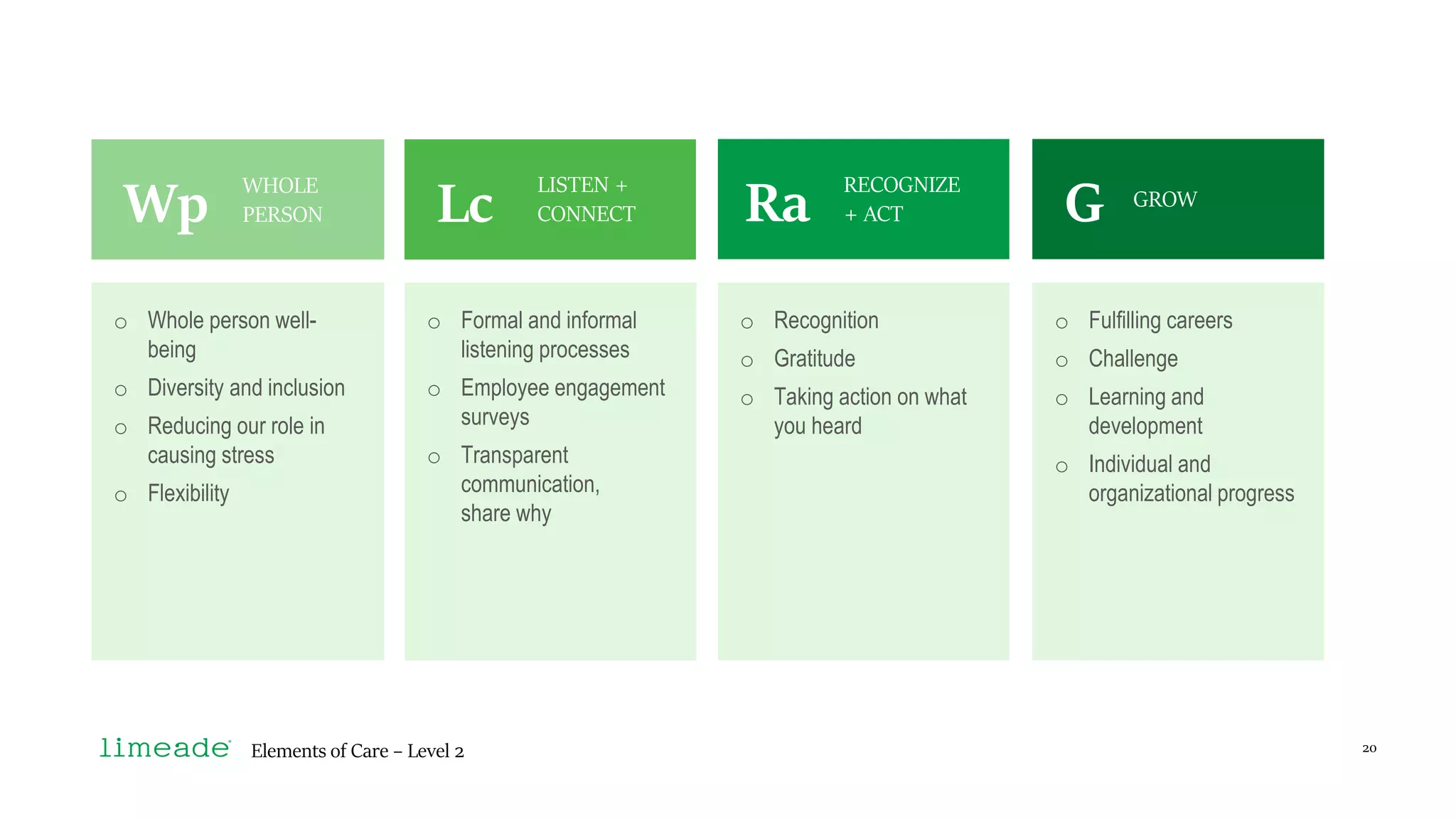
o Whole person well-
being
o Diversity and inclusion
o Reducing our role in
causing stress
o Flexibility
o Formal and informal
listening processes
o Employee engagement
surveys
o Transparent
communication,
share why
o Recognition
o Gratitude
o Taking action on what
you heard
o Fulfilling careers
o Challenge
o Learning and
development
o Individual and
organizational progress
Wp Lc Ra GWHOLE
PERSON
LISTEN +
CONNECT
RECOGNIZE
+ ACT
GROW
Elements of Care – Level 2 20
o Personal purpose
o Organizational purpose
o Inspiring leadership
o Extending care outside of
the organization
o Corporate social
responsibility
o Philanthropy
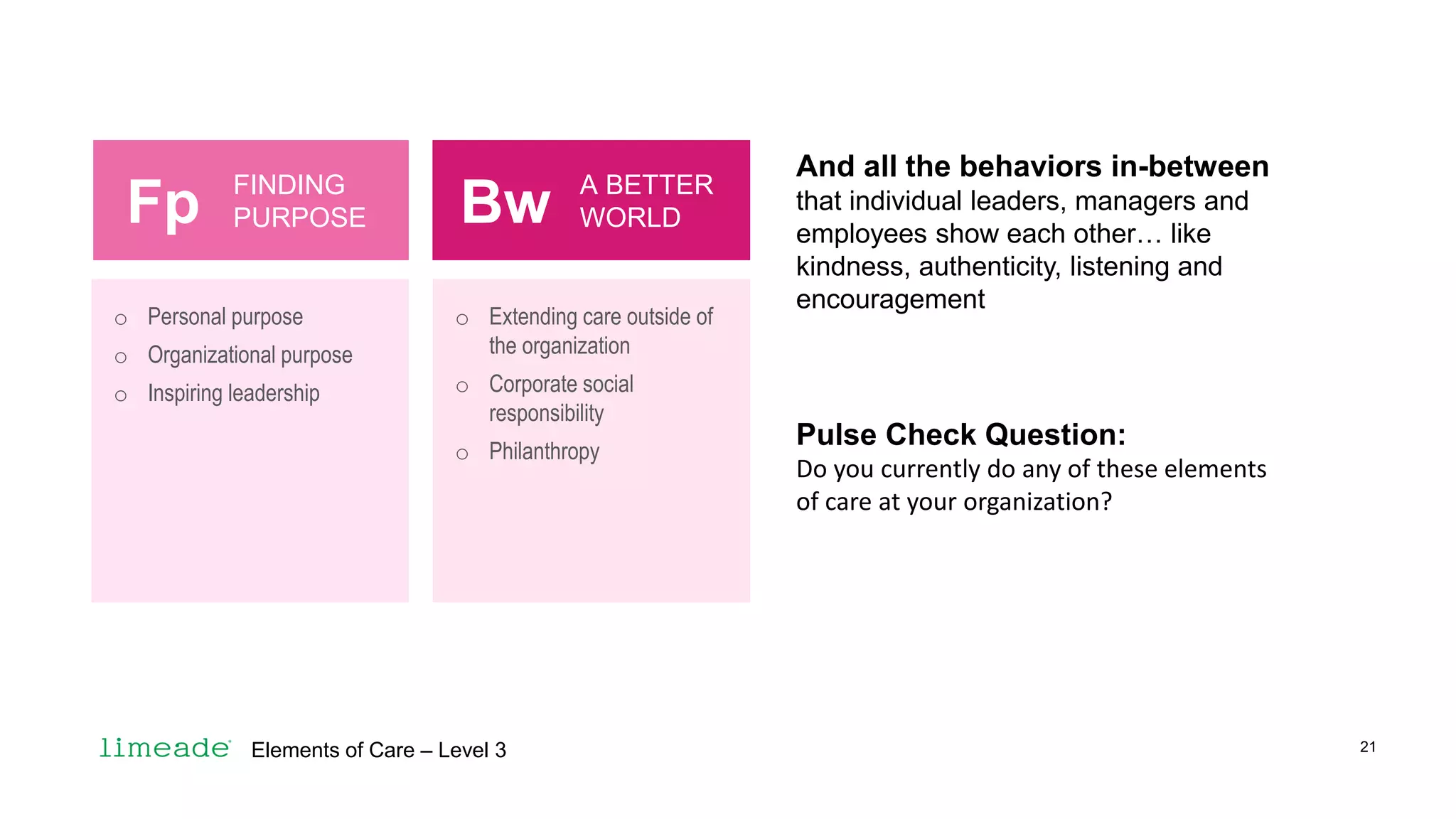
And all the behaviors in-between
that individual leaders, managers and
employees show each other… like
kindness, authenticity, listening and
encouragement
Fp BwFINDING
PURPOSE
A BETTER
WORLD
Elements of Care – Level 3 21
Pulse Check Question:
Do you currently do any of these elements
of care at your organization?
Takeaways
Challenge assumptions
about work
Caring is good for employees
AND for the organization
22
Organizations can show
care in many ways
Our challenge to you…
Create an employee experience where
every employee knows their company
cares.
23
Thank you!
24

Creating a Caring Culture to Attract and Retain Talent -12/2/2019

  • 1.
    Creating a Caring Culture toattract and retain talent
  • 2.
    Agenda 1. Shiftingworkplaces 2. The importance of care 3. Creating a caring workplace 2
  • 3.
    Our Background Laura Hamill,Ph.D. Chief People Officer & Chief Science Officer, Limeade Julianne Tillmann, Ph.D. Director of Research, Limeade Institute, Limeade 3
  • 4.
    4 You are luckyto have a job. In my day, we just came to work and did our jobs. Darn snowflakes! This is about business, not your feelings. You get a paycheck every two weeks, that’s how I show I care.
  • 5.
    The history ofwork and our assumptions about what work is supposed to be are primary reasons it feels taboo.
  • 6.
    Assumptions About Work Colquitt,20176 Contractual Monitoring and surveillance Feedback isprimarily negative Keeping score Money motivates Adversarial
  • 7.
    But This Was When… •Work was more routine • Command and control model was common • Compliance was more important
  • 8.
    To what extentdoes your organization buy into these traditional assumptions about work? • 5 = To a very great extent • 4 = To a great extent • 3 = To a moderate extent • 2 = To a small extent • 1 = Not at all
  • 9.
    THE DEMANDS HAVE CHANGED UNDERSTANDINGHAS EVOLVED SOLVING FOR THE WORKFORCE OF YESTERDAY WON’T WORK So, why now?
  • 10.
  • 11.
  • 12.
    12 When employees feeltheir employer cares about their well-being, they are… 38%More engaged Quantum Workplace& Limeade, 2016 Benevolent leaders have teams with… BETTER PERFORMANCE Consistent across China and US and across organizational settings Wang et al., 2018
  • 13.
    Disengaged workers whodon’t feel valued, secure, supported and respected… Stateof theAmerican WorkplaceReport Gallup,2017 MISSED 37% MORE WORK DAYS SUFFERED 49% MORE ACCIDENTS MADE 60% MORE ERRORS 13 Employees in a high-trust culture who experience a caring workplace are… 44%More likely to work foracompanywith above-averagerevenue growth GreatPlaceto Work, 2018
  • 14.
    Careisrelated towell-being, engagement andinclusion. 52% 75% 94% 43% 72% 94% 14% 72% 95% 0% 20% 40% 60% 80% 100% %Favorable Well-being Engagement Inclusion Org Does NOT Care Neutral Org Care Org DOES Care LimeadeInstitute,2019 14
  • 15.
    Careisrelated tointent tostay andlikelihood torecommend. LimeadeInstitute,2019 7% 36% 60% 9% 58% 91% 0% 20% 40% 60% 80% 100% Intend to stay 3+ yrs Likelihood torecommend as a great place to work %Favorable Org Does NOT Care Neutral Org Care Org DOES Care 15
  • 16.
    Summary of Outcomesof Caring Kurtessis etal., 2017 16 Well-Being Heightened sense of subjective well-being Reduced job stress, burnout, emotional exhaustion Improved work-family balance and reduced work-family conflict Engagement Increased job satisfaction Heightened job self-efficacy Increased job involvement Strengthened organizational identification Commitment Increased emotional (affective) commitment Increased intent to stay Reduced job search behaviors Decreased turnover Performance Increased effort and productivity Increased in- and extra-role performance Reduced counter-productive behaviors Decreased accidents Enhanced customer service climate Increased customer satisfaction and customer loyalty
  • 17.
  • 18.
  • 19.
    o Treating employeeswith respect o Basic behavior standards and expectations o Fair policies o Internal communications o Manager and employee relations o Doing what we say we will o Autonomy o Enriching work o Engagement o Job design o Safety measures o Sexual harassment prevention o Fair pay o Health insurance o Benefits Ss SAFETY + SECURITY Dr DIGNITY + RESPECT Ft FAIRNESS + TRUST Mw MEANINGFUL WORK Elements of Care – Level 1 19
  • 20.
    o Whole personwell- being o Diversity and inclusion o Reducing our role in causing stress o Flexibility o Formal and informal listening processes o Employee engagement surveys o Transparent communication, share why o Recognition o Gratitude o Taking action on what you heard o Fulfilling careers o Challenge o Learning and development o Individual and organizational progress Wp Lc Ra GWHOLE PERSON LISTEN + CONNECT RECOGNIZE + ACT GROW Elements of Care – Level 2 20
  • 21.
    o Personal purpose oOrganizational purpose o Inspiring leadership o Extending care outside of the organization o Corporate social responsibility o Philanthropy And all the behaviors in-between that individual leaders, managers and employees show each other… like kindness, authenticity, listening and encouragement Fp BwFINDING PURPOSE A BETTER WORLD Elements of Care – Level 3 21 Pulse Check Question: Do you currently do any of these elements of care at your organization?
  • 22.
    Takeaways Challenge assumptions about work Caringis good for employees AND for the organization 22 Organizations can show care in many ways
  • 23.
    Our challenge toyou… Create an employee experience where every employee knows their company cares. 23
  • 24.

Editor's Notes

  • #2 Laura
  • #3 Julia
  • #4 Laura then Julia
  • #5 Laura
  • #6 Laura Many of us in our own experiences as human beings, as employees know that care matters Many of us also know it is better for our businesses if we care But it is primarily History of work Assumptions about what work is supposed to be That make us feel like care is taboo
  • #7 Laura The way work has been done in the past (and is still experienced in many places) has been based on a number of assumptions: What are some of those assumptions? That there’s a contract between me the employee and you the employer That we are here to screw each other over, so the relationship is adversarial Because of that, I need to watch you closely And take corrective action when you make a mistake Because what matters is what your score is, and we are all keeping score And the main way I’m going to show you that I value you is through money
  • #8 Laura But what are all those assumptions based on? A very outdated view of what work is These assumptions influenced how we designed work and the psychological contract between the employee and the employer Routine work Work was mostly controlled by men Staying within the lines, following rules was the most important thing
  • #10 Laura Why now? Demands have changed Work requires more creativity and innovation Whole new industries in technology, like AI and data science Our friends at DELOITTE: 80% of all companies rate their business “highly complex” or “complex” for employees. outsourcing, independent contractors, gig workers, and crowdsourcing The workforce itself has shifted Almost 50% of the workforce will be millennial in 2020—that’s next year! And millennials stay less time in organizations—43% leave within the first two years I am not a millennial basher or a big believer that millennials are so different from everyone else But I do think they tend to have more courage to walk away from bad work—they don’t put up with the stuff my generation put up with So there are real indications for how we attract and retain talent—you know, the war for talent we always talk about All stuff you hear at every HR conference, right? Our understanding has evolved We have more science and evidence that well-being and inclusion and engagement and culture all matter We know that the employee experience is directly related to the customer experience We have a burning platform Push it even further: If your organization is stuck in the past, in traditional ways of thinking about work, your business will not succeed Tell a little story, talking to a CHRO We have to rethink what it is like for our employees to work here Need to attract all new talent, we need cutting edge researchers and data scientists Competing with google and amazon for talent We have to radically change our culture That’s so exciting, so how are you going to do that? We are going to focus on our compensation package I almost laughed, but then realized she was serious
  • #11 Laura You are already doing things that put the employee at the center: Engagement, Inclusion, Communication, Culture, Well-Being, Trust But are you doing these things together in a way that shows employees you care
  • #12 Julia takes over As Laura mentioned, the idea of organizational care has been around for more than 50 years. Over the years, there is been growing evidence for why care matters. In this next section, I will provide a brief overview of that research. We will not go into too much detail but hopefully enough to show that caring for employees is not just good for employees, but it is also good for business.
  • #13 Julia Benevolence – kind and fair authoritarianism and benevolence Benevolence-dominant paternalistic leadership refers to leaders' sole dependence on the use of benevolence without their strong assertion of authority whereas authoritarianism-dominant paternalistic leadership is based mainly on authoritarianism itself classical paternalistic leadership, which best fits early observations of paternalistic leaders, refers to the salient combination of both leadership components.
  • #14 Julia
  • #15 Julia
  • #16 Julia
  • #17 Julia Hopefully, you’ve bought into this. Let’s talk about how you can make this come to life in your organization.
  • #18 Laura takes over Laura Passive vs. Active Just caring is not enough. You need to be actively delivering it through different channels. It’s easy to say you care, but it is hard to show that you care. Saying you care and not doing it is harmful…intent vs. impact. So let’s talk more about creating an EX where your employees know you care I often hear a lot of good intentions from c-suite Large organizations Lack of leader visibility/connection Gets lost in translation You have to take concerted efforts to show it
  • #19 Laura We’ll go through each of these elements and provide examples of how organizations Talk about how we’ve pulled these elements together As Lauren mentioned, I run the research team and as part of our work we review existing research and conduct our own, primary research. The way we approached the concept of care was through research. This might look like the periodic table to you, that’s intentional. It’s about the different elements that you can combine in different ways to show you care.. When we talk about passive vs. active care, How does an organization operationalize care? Like a hierarchy of care, not exhaustive At most basic level, keeping your employees safe Treating them with respect Treating them fairly Building trust Next level Valuing them as whole people Listening to them, taking action on what they say Helping them grow Highest level Connecting with purpose Creating authentic cultures Extending to outside of your organization, caring about the world Some might even call these Care stairs Oh shoot, where are the ping pong tables, where are the juice bars, where are margarita Fridays? where is pet insurance? These surface level perqs can be fun, but what matters to much more are these more meaningful (and way more difficult to provide) aspects of work
  • #20 Laura describes the levels, Julia gives examples Safety and security are the basics an organization needs to have in place to not only attract and keep employees but to protect its reputation. - Pay inequity is increasingly becoming a reputational risk for organizations. In a recent survey by Aptitude Research (2019), 80% of employees said that they expect greater transparency and better communication form their employer. Job fulfillment and satisfaction are important components of how employees experience work. In a recent survey by SHRM, 40% of employees rated job fulfillment/satisfaction as the most important component of a work environment (SHRM Omnibus Survey, June 2019). Enriching work: like using a variety of skills, identifying with the tasks in your job, feeling a sense of autonomy and ownership in your work
  • #21 Laura describes the levels, Julia gives examples Flexibility – According to a 2018 SHRM survey, nearly half of all US workers regularly encounter conflicts between work and family obligations (SHRM 2018 Employee Benefits Survey). Yet, only 27% of organizations offer paid family leave of some kind. How important progress is When you are moving fast and when you have high expectations Don’t take the time to reflect on where you have been Recent research has really shown how important it is to show you are making progress And that actually knowing that you are making progress is more important than actually reaching you goal
  • #22 Laura describes the levels, Julia gives examples Organizational purpose – this often gets missed. According to a 2019 Oxford Economics report, only half of employees claim to understand the vision and goals of their organization. (Oxford Economics, "Return on Culture: Providing the connection between culture and profit report," 2019). Purpose Authentic and consistent norms of caring internally And then extend that outside of the org Now I don’t want to forget all of the behavior in between I see organizations over-relying on this and not focusing on all of the things we have covered so far But individual behavior matters when we care about people we build trust Trust is important because it makes us feel safe. Managers and leaders play a key role in determining the employee experience— harsh and stressful or pleasant and enjoyable— we’re especially sensitive to signs of trustworthiness in our leaders. We prefer leaders and managers who are warm to those who project tough characteristics. So its both individual behavior (esp of leaders and managers) and the systematic approach organizations take that help build a caring organization
  • #23 Laura So I hope you leave here with 3 takeaways We need to challenge traditional assumptions and create new norms of behavior in organizations Perhaps some of you have thought that the concept of care was at odds with being data driven, at odds with focusing on the bottom line I hope that you see that there are so many good reasons to care about your employees it’s better for people and better for your business And finally, There are lots of ways your org can show it cares, we all have work to do
  • #24 Laura Our challenge to you Don’t create an employee experience that is about efficiency or streamlining Not even one that’s cool, millennial focused Especially Not one that is less bad or one that makes HR ”suck” less—that’s real, I’ve heard multiple HR leaders “aspire” to this Click EX where every emp knows your comp cares PAUSE SLOW