Guidelines For ADR Reporting
Submitted by- Soham Chakrabarti.
Reg. No.- PGD/2021/3487
M. Pharm (Pharmacology)
Email- drxsohamchakrabarti@gmail.com
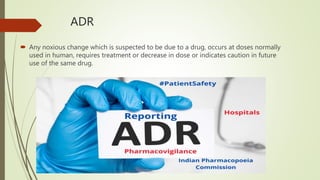
ADR
 Any noxious change which is suspected to be due to a drug, occurs at doses normally
used in human, requires treatment or decrease in dose or indicates caution in future
use of the same drug.
Adverse Event (AE)
 Adverse Event (AE): Any untoward medical occurrence that may present
during treatment with a pharmaceutical product but which does not
necessarily have a causal relationship with this treatment.
 Therefore, an adverse drug reaction is an adverse event with a causal link
to a drug.
Classification of ADRs
 Depending upon…
 Onset of event: Acute(<60 mins), Sub-acute(1-24 hrs.), Latent(>2 days)
 Type of reaction: Type A (Augmented), B (Bizarre), C (Chemical),D
(Delayed), E (Exit),
 Severity: Minor, Moderate, Severe, Lethal ADRs
 Others: Side effects, Secondary effects, Toxic effects, Intolerance,
Idiosyncrasy, Drug allergy, Photosensitivity, Drug Dependence, Drug
Withdrawal Reactions, Teratogenicity, Mutagenicity, Carcinogenicity, Drug
induced disease (Iatrogenic)
Type A (Augmented) reaction
 Reactions which can be predicted from the known pharmacology
of the drug
 Dose dependent
 Can be alleviated by a dose reduction
 E.g.
Anticoagulants Bleeding
Beta blockers Bradycardia
Nitrates Headache
Prazosin Postural hypotension
Type B (Bizarre) reaction
 Cannot be predicted from the pharmacology of the drug
 Not dose dependent
 Host dependent factors important in predisposition
 E.g.
Penicillin Anaphylaxis
Anticonvulsant Hypersensitivity
Type C (Chemical) reaction
 Biological characteristics can be predicted from the chemical
structure of the drug/metabolite
 E.g.
 Paracetamol Hepatotoxicity
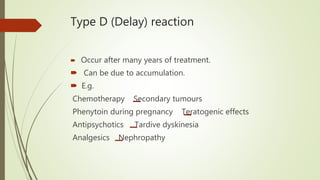
Type D (Delay) reaction
 Occur after many years of treatment.
 Can be due to accumulation.
 E.g.
Chemotherapy Secondary tumours
Phenytoin during pregnancy Teratogenic effects
Antipsychotics Tardive dyskinesia
Analgesics Nephropathy
Type E (Exit) reaction
 Occur on withdrawal especially when drug is stopped abruptly
 E. g.
Phenytoin withdrawal Seizures,
Steroid withdrawal Adrenocortical insufficiency.
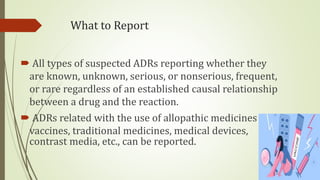
What to Report
 All types of suspected ADRs reporting whether they
are known, unknown, serious, or nonserious, frequent,
or rare regardless of an established causal relationship
between a drug and the reaction.
 ADRs related with the use of allopathic medicines
vaccines, traditional medicines, medical devices,
contrast media, etc., can be reported.
Where to Report
 All healthcare professionals (clinicians, dentists, pharmacists, nurses) and
patient/consumers can report ADRs to NCC or AMCs. The pharmaceutical
companies can also send individual case safety reports for their product
to NCC.
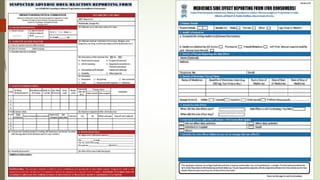
 Duly filled Suspected Adverse Drug Reaction Reporting Form can be
send to the nearest Adverse Drug Reaction Monitoring Centre (AMC)
or directly to the National Coordination Centre (NCC).
 Or can directly mail this filled form to pvpi@ipcindia.net or
pvpi.ipcindia@gmail.com
 A list of nationwide AMCs is available at: http://www.ipc.gov.in,
http://www.ipc.gov.in/PvPI/pv_home.html
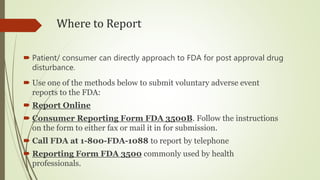
Where to Report
 Patient/ consumer can directly approach to FDA for post approval drug
disturbance.
 Use one of the methods below to submit voluntary adverse event
reports to the FDA:
 Report Online
 Consumer Reporting Form FDA 3500B. Follow the instructions
on the form to either fax or mail it in for submission.
 Call FDA at 1-800-FDA-1088 to report by telephone
 Reporting Form FDA 3500 commonly used by health
professionals.
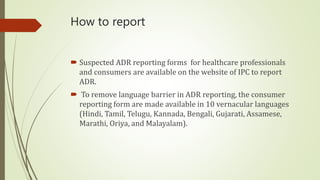
How to report
 Suspected ADR reporting forms for healthcare professionals
and consumers are available on the website of IPC to report
ADR.
 To remove language barrier in ADR reporting, the consumer
reporting form are made available in 10 vernacular languages
(Hindi, Tamil, Telugu, Kannada, Bengali, Gujarati, Assamese,
Marathi, Oriya, and Malayalam).
Post reporting work
 A reporter can send filled ADR reporting form directly to NCC or
their nearest AMC. In case of AMC, these reports are confirmed
by healthcare professionals and entered into Vigiflow and sent
to NCC for further assessment. These reports are then finally
reviewed at NCC and committed to WHO-Uppsala Monitoring
Centre. The obtained information is entered in the drug safety
database, analyzed, and assessed by the experts to identify new
signals.
 The submitted ADR report does not have any legal implication
on the reporters. The patients’ identity are held in strict
confidence and protected to the fullest extent.
 Therefore, healthcare providers are encouraged to report ADRs
for better understanding of the risk associated with the use of
medicines and to safeguard the health of patients.
LIST OF DRUGS PROHIBITED FOR MANUFACTURE AND SALE THROUGH
GAZETTE NOTIFICATIONS UNDER SECTION 26A OF DRUGS & COSMETICS
ACT 1940 BY THE MINISTRY OF HEALTH AND FAMILY WELFARE WITH THEIR
PRESENT STATUS AS ON 22.11.2021.
 Fixed dose combinations of Corticosteroids with any other
drug [excluding Fixed Dose Combination of Tamsulosin HCl
0.4mg (as film coated modified release tablet) + Deflazacort
30mg in hard gelatin capsule] for internal use except for
preparations meant for meter dose inhalers and dry powder
inhalers. (7/4/21)
 Hydrochlorothiazide + Ramipril +Losartan Potassium(11/1/19)
Guidelines For ADR Reporting.pptx

Guidelines For ADR Reporting.pptx

  • 1.
    Guidelines For ADRReporting Submitted by- Soham Chakrabarti. Reg. No.- PGD/2021/3487 M. Pharm (Pharmacology) Email- drxsohamchakrabarti@gmail.com
  • 2.
    ADR  Any noxiouschange which is suspected to be due to a drug, occurs at doses normally used in human, requires treatment or decrease in dose or indicates caution in future use of the same drug.
  • 3.
    Adverse Event (AE) Adverse Event (AE): Any untoward medical occurrence that may present during treatment with a pharmaceutical product but which does not necessarily have a causal relationship with this treatment.  Therefore, an adverse drug reaction is an adverse event with a causal link to a drug.
  • 4.
    Classification of ADRs Depending upon…  Onset of event: Acute(<60 mins), Sub-acute(1-24 hrs.), Latent(>2 days)  Type of reaction: Type A (Augmented), B (Bizarre), C (Chemical),D (Delayed), E (Exit),  Severity: Minor, Moderate, Severe, Lethal ADRs  Others: Side effects, Secondary effects, Toxic effects, Intolerance, Idiosyncrasy, Drug allergy, Photosensitivity, Drug Dependence, Drug Withdrawal Reactions, Teratogenicity, Mutagenicity, Carcinogenicity, Drug induced disease (Iatrogenic)
  • 5.
    Type A (Augmented)reaction  Reactions which can be predicted from the known pharmacology of the drug  Dose dependent  Can be alleviated by a dose reduction  E.g. Anticoagulants Bleeding Beta blockers Bradycardia Nitrates Headache Prazosin Postural hypotension
  • 6.
    Type B (Bizarre)reaction  Cannot be predicted from the pharmacology of the drug  Not dose dependent  Host dependent factors important in predisposition  E.g. Penicillin Anaphylaxis Anticonvulsant Hypersensitivity
  • 7.
    Type C (Chemical)reaction  Biological characteristics can be predicted from the chemical structure of the drug/metabolite  E.g.  Paracetamol Hepatotoxicity
  • 8.
    Type D (Delay)reaction  Occur after many years of treatment.  Can be due to accumulation.  E.g. Chemotherapy Secondary tumours Phenytoin during pregnancy Teratogenic effects Antipsychotics Tardive dyskinesia Analgesics Nephropathy
  • 9.
    Type E (Exit)reaction  Occur on withdrawal especially when drug is stopped abruptly  E. g. Phenytoin withdrawal Seizures, Steroid withdrawal Adrenocortical insufficiency.
  • 10.
    What to Report All types of suspected ADRs reporting whether they are known, unknown, serious, or nonserious, frequent, or rare regardless of an established causal relationship between a drug and the reaction.  ADRs related with the use of allopathic medicines vaccines, traditional medicines, medical devices, contrast media, etc., can be reported.
  • 11.
    Where to Report All healthcare professionals (clinicians, dentists, pharmacists, nurses) and patient/consumers can report ADRs to NCC or AMCs. The pharmaceutical companies can also send individual case safety reports for their product to NCC.  Duly filled Suspected Adverse Drug Reaction Reporting Form can be send to the nearest Adverse Drug Reaction Monitoring Centre (AMC) or directly to the National Coordination Centre (NCC).  Or can directly mail this filled form to pvpi@ipcindia.net or pvpi.ipcindia@gmail.com  A list of nationwide AMCs is available at: http://www.ipc.gov.in, http://www.ipc.gov.in/PvPI/pv_home.html
  • 12.
    Where to Report Patient/ consumer can directly approach to FDA for post approval drug disturbance.  Use one of the methods below to submit voluntary adverse event reports to the FDA:  Report Online  Consumer Reporting Form FDA 3500B. Follow the instructions on the form to either fax or mail it in for submission.  Call FDA at 1-800-FDA-1088 to report by telephone  Reporting Form FDA 3500 commonly used by health professionals.
  • 13.
    How to report Suspected ADR reporting forms for healthcare professionals and consumers are available on the website of IPC to report ADR.  To remove language barrier in ADR reporting, the consumer reporting form are made available in 10 vernacular languages (Hindi, Tamil, Telugu, Kannada, Bengali, Gujarati, Assamese, Marathi, Oriya, and Malayalam).
  • 15.
    Post reporting work A reporter can send filled ADR reporting form directly to NCC or their nearest AMC. In case of AMC, these reports are confirmed by healthcare professionals and entered into Vigiflow and sent to NCC for further assessment. These reports are then finally reviewed at NCC and committed to WHO-Uppsala Monitoring Centre. The obtained information is entered in the drug safety database, analyzed, and assessed by the experts to identify new signals.  The submitted ADR report does not have any legal implication on the reporters. The patients’ identity are held in strict confidence and protected to the fullest extent.  Therefore, healthcare providers are encouraged to report ADRs for better understanding of the risk associated with the use of medicines and to safeguard the health of patients.
  • 16.
    LIST OF DRUGSPROHIBITED FOR MANUFACTURE AND SALE THROUGH GAZETTE NOTIFICATIONS UNDER SECTION 26A OF DRUGS & COSMETICS ACT 1940 BY THE MINISTRY OF HEALTH AND FAMILY WELFARE WITH THEIR PRESENT STATUS AS ON 22.11.2021.  Fixed dose combinations of Corticosteroids with any other drug [excluding Fixed Dose Combination of Tamsulosin HCl 0.4mg (as film coated modified release tablet) + Deflazacort 30mg in hard gelatin capsule] for internal use except for preparations meant for meter dose inhalers and dry powder inhalers. (7/4/21)  Hydrochlorothiazide + Ramipril +Losartan Potassium(11/1/19)