Copyright © 2015 Splunk Inc.
Why Threat Data is Cool
2
About Me
2
Brian Fennimore – Manager of Security
Operations at Virtustream
– Now EMC
– Now Dell
14 years of experience in IT and Security
6 year Splunk user
My favorite Splunk T Shirt
– “See your world. Maybe wish you hadn’t.”
3
About Virtustream
3
Enterprise-class cloud software and services provider
Strong focus in delivering on security, compliance,
performance and efficiency requirements
Service catalog includes SAP, ERP, CRM, complex
mission-critical enterprise applications
Multiple industries serviced including Enterprise, Service
Provider, Government, Financial Services, Healthcare
4
How Virtustream Uses Splunk
- “Source of truth” for centrally indexing log / event data
- Single pane of glass for tracking metrics, KPIs (MTTR, e.g.)
- Automation of compliance reporting – internal and regulatory
- Security – service and internal, including enrichment via threat data
5
Threat Data
Information that identifies a threat in a specific and usable manner
• E.g. IP address | Malicious URL | etc…
• Sometimes called “Threat Intelligence” “Threat Feeds”
• Tons of sources (free and pay)
• Quality > Quantity
– Both can be handy
– Prevention > Detection (do both | AND detect the preventions)
• Make your own
– Honeypots | Log inspection | etc…
• Where does it fit in?
6
Prime Directive
All/Most of our efforts should associate to something here
Understand, manage and reduce risk
Common
Focus
Volatile
Plentiful
Institutional
Risk = 𝑓 𝑣𝑢𝑙𝑛𝑒𝑟𝑎𝑏𝑖𝑙𝑖𝑡𝑦, 𝑡ℎ𝑟𝑒𝑎𝑡, 𝑖𝑚𝑝𝑎𝑐𝑡
Quantify the Qualitative
7
Risk = f(V,T,I)
• Vulnerability
– Find ‘em - Track ‘em – Fix ‘em – fast – No more small vulnerabilities. Just
vulnerabilities.
• Threat
– Actors, conditions, friendly people (mistakes)
• Impact
– Confidentiality – Keep those secrets secret
– Integrity – Is that thing really that thing? Non-repudiation
– Availability – uptime | quality uptime
FURTHER READING: http://krebsonsecurity.com/2015/04/whats-your-security-maturity-level/
8
How is threat data cool?
• What do I do with all this data?
– IP Address
– DNS Name
– File Hash
• High quality (block it, redirect it, auto-mitigate)
• Low quality (Alert, warrants further investigation)
• Better to prevent vs. detect. But always detect.
9
Threat Data Consumption
We have the data, now what?
• IP Address
– Block it (firewall policy/API, Null Route, other…tons of ways to
block/drop an IP)
– Alert (You have Splunk, yes? | You have flows, yes?)
• DNS Name
– Control your local resolvers
– Block it - BlackHole DNS http://www.malwaredomains.com/bhdns.html
– Alert – BIND has some pretty cool logging available
• File Hash
– Vuln Scanner? HIPS? Forensics tools? Some custom scripting?
10
The File Hash
• Not too invasive
• Frequent enough to be useful
• Is there a decent list somewhere? NSRL, VirusTotal, many others.
• White list | Black list | Gray list
FURTHER READING: http://www.nsrl.nist.gov/ National Software Reference Library
11
Enter Ziften
• Splunk>Live! Philadelphia (July 2015)
– See? Lots of great things happen at these gatherings
• Lightweight agent (less than 1MB)
• Grabs processes/daemons
• Grabs associated files and network traffic
• Lovely Splunk TA
• Sends meta-data to central location
– Ziften Agent -> Ziften Server -> Splunk
 OR
– Ziften Agent -> Splunk
12
OTX Detection x IP address x Binary
FURTHER READING: https://www.alienvault.com/open-threat-exchange
13
Network Connecting Binary x Port
14
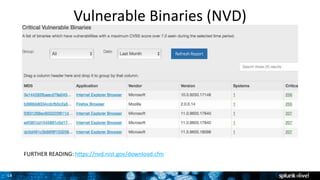
Vulnerable Binaries (NVD)
FURTHER READING: https://nvd.nist.gov/download.cfm
15
Ziften > Splunk
sourcetype=ziften* hoursago=1 | fillnull
imagefilemd5,imagefilepath | table imagefilemd5,imagefilepath
16
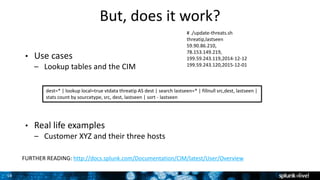
But, does it work?
• Use cases
– Lookup tables and the CIM
• Real life examples
– Customer XYZ and their three hosts
dest=* | lookup local=true vtdata threatip AS dest | search lastseen=* | fillnull src,dest, lastseen |
stats count by sourcetype, src, dest, lastseen | sort - lastseen
# ./update-threats.sh
threatip,lastseen
59.90.86.210,
78.153.149.219,
199.59.243.119,2014-12-12
199.59.243.120,2015-12-01
FURTHER READING: http://docs.splunk.com/Documentation/CIM/latest/User/Overview
17
What’s next
• Information sharing across a trusted community
• Spirit of CISA with benevolent ends
• More options for Threat Data Consumption
FURTHER READING: https://www.congress.gov/bill/114th-congress/senate-bill/754/text
18
Threat data is really cool
Information that identifies a threat in a specific and usable manner
What is the return?
– Direct reduction of risk
– Greater visibility and from a different angle (new perspective)
“See your world. Maybe wish you hadn’t.”
The bad guys are already seeing it anyway.
Thank You

SplunkLive! Customer Presentation – Virtustream

  • 1.
    Copyright © 2015Splunk Inc. Why Threat Data is Cool
  • 2.
    2 About Me 2 Brian Fennimore– Manager of Security Operations at Virtustream – Now EMC – Now Dell 14 years of experience in IT and Security 6 year Splunk user My favorite Splunk T Shirt – “See your world. Maybe wish you hadn’t.”
  • 3.
    3 About Virtustream 3 Enterprise-class cloudsoftware and services provider Strong focus in delivering on security, compliance, performance and efficiency requirements Service catalog includes SAP, ERP, CRM, complex mission-critical enterprise applications Multiple industries serviced including Enterprise, Service Provider, Government, Financial Services, Healthcare
  • 4.
    4 How Virtustream UsesSplunk - “Source of truth” for centrally indexing log / event data - Single pane of glass for tracking metrics, KPIs (MTTR, e.g.) - Automation of compliance reporting – internal and regulatory - Security – service and internal, including enrichment via threat data
  • 5.
    5 Threat Data Information thatidentifies a threat in a specific and usable manner • E.g. IP address | Malicious URL | etc… • Sometimes called “Threat Intelligence” “Threat Feeds” • Tons of sources (free and pay) • Quality > Quantity – Both can be handy – Prevention > Detection (do both | AND detect the preventions) • Make your own – Honeypots | Log inspection | etc… • Where does it fit in?
  • 6.
    6 Prime Directive All/Most ofour efforts should associate to something here Understand, manage and reduce risk Common Focus Volatile Plentiful Institutional Risk = 𝑓 𝑣𝑢𝑙𝑛𝑒𝑟𝑎𝑏𝑖𝑙𝑖𝑡𝑦, 𝑡ℎ𝑟𝑒𝑎𝑡, 𝑖𝑚𝑝𝑎𝑐𝑡 Quantify the Qualitative
  • 7.
    7 Risk = f(V,T,I) •Vulnerability – Find ‘em - Track ‘em – Fix ‘em – fast – No more small vulnerabilities. Just vulnerabilities. • Threat – Actors, conditions, friendly people (mistakes) • Impact – Confidentiality – Keep those secrets secret – Integrity – Is that thing really that thing? Non-repudiation – Availability – uptime | quality uptime FURTHER READING: http://krebsonsecurity.com/2015/04/whats-your-security-maturity-level/
  • 8.
    8 How is threatdata cool? • What do I do with all this data? – IP Address – DNS Name – File Hash • High quality (block it, redirect it, auto-mitigate) • Low quality (Alert, warrants further investigation) • Better to prevent vs. detect. But always detect.
  • 9.
    9 Threat Data Consumption Wehave the data, now what? • IP Address – Block it (firewall policy/API, Null Route, other…tons of ways to block/drop an IP) – Alert (You have Splunk, yes? | You have flows, yes?) • DNS Name – Control your local resolvers – Block it - BlackHole DNS http://www.malwaredomains.com/bhdns.html – Alert – BIND has some pretty cool logging available • File Hash – Vuln Scanner? HIPS? Forensics tools? Some custom scripting?
  • 10.
    10 The File Hash •Not too invasive • Frequent enough to be useful • Is there a decent list somewhere? NSRL, VirusTotal, many others. • White list | Black list | Gray list FURTHER READING: http://www.nsrl.nist.gov/ National Software Reference Library
  • 11.
    11 Enter Ziften • Splunk>Live!Philadelphia (July 2015) – See? Lots of great things happen at these gatherings • Lightweight agent (less than 1MB) • Grabs processes/daemons • Grabs associated files and network traffic • Lovely Splunk TA • Sends meta-data to central location – Ziften Agent -> Ziften Server -> Splunk  OR – Ziften Agent -> Splunk
  • 12.
    12 OTX Detection xIP address x Binary FURTHER READING: https://www.alienvault.com/open-threat-exchange
  • 13.
  • 14.
    14 Vulnerable Binaries (NVD) FURTHERREADING: https://nvd.nist.gov/download.cfm
  • 15.
    15 Ziften > Splunk sourcetype=ziften*hoursago=1 | fillnull imagefilemd5,imagefilepath | table imagefilemd5,imagefilepath
  • 16.
    16 But, does itwork? • Use cases – Lookup tables and the CIM • Real life examples – Customer XYZ and their three hosts dest=* | lookup local=true vtdata threatip AS dest | search lastseen=* | fillnull src,dest, lastseen | stats count by sourcetype, src, dest, lastseen | sort - lastseen # ./update-threats.sh threatip,lastseen 59.90.86.210, 78.153.149.219, 199.59.243.119,2014-12-12 199.59.243.120,2015-12-01 FURTHER READING: http://docs.splunk.com/Documentation/CIM/latest/User/Overview
  • 17.
    17 What’s next • Informationsharing across a trusted community • Spirit of CISA with benevolent ends • More options for Threat Data Consumption FURTHER READING: https://www.congress.gov/bill/114th-congress/senate-bill/754/text
  • 18.
    18 Threat data isreally cool Information that identifies a threat in a specific and usable manner What is the return? – Direct reduction of risk – Greater visibility and from a different angle (new perspective) “See your world. Maybe wish you hadn’t.” The bad guys are already seeing it anyway.
  • 19.