Presenter : Dr Mohd. Altaf Tantray
Guide: Dr Sandeep Kour
Tim J. Dylina,DDS J Prosthet Dent2001;86:539-45.
 INTRODUCTION
 DEFINITION
 TYPES
 FUNCTIONS
 SPLINT CHARACTERISTICS
 SPLINT FABRICATION
 Practitioners appreciate a practical approach to all
aspects of treatment; splint therapy is no
exception.
 Splint
 breaks muscular engrams
 Relaxes masticatory muscles
 Brings condyle to centric relation
 Splint therapy:
 Splint therapy may be defined as the art and
science of establishing neuromuscular harmony in
the masticatory system and creating a mechanical
disadvantage for parafunctional forces with
removable appliances
 Splint
 Defined as a removable appliance used to break
neuromuscular engrams to create neuromuscular
harmony in masticatory system.
 All splints are classified as
 Permissive or
 Nonpermissive
 Permissive splint
 It allows the teeth to move on the splint
unimpeded, which in turn allows the condylar
head and disk to function anatomically.
 Boero RP. The physiology of splint therapy: a
literature review. Angle Orthod 1989;59:165-80.
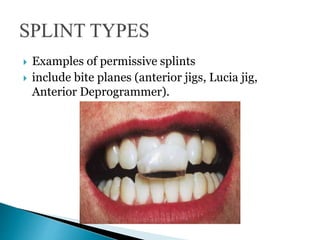
 Examples of permissive splints
 include bite planes (anterior jigs, Lucia jig,
Anterior Deprogrammer).
 stabilization splints (flat plane, Tanner, superior
repositioning, and centricrelation [CR])
 Nonpermissive
 A nonpermissive splint has a ramp or
“indentations” that position the mandible
inferiorly and anteriorly and secure it there.
 An example of a nonpermissive splint is
 A repositioning splint (anterior repositioning
appliance [ARA])
 Soft splints and
 hydrostatic splints (Aquilizer; Jumar Corp, Carefree,
Ariz.) are
 pseudo-permissive splints,
 as their functions are extremely different than those of the
permissives
 To seat condyles in CR
 Relax muscles
 To provide diagnostic information
 Mitigate pdl proprioception
 Reduce cellular hypoxia
 Protecting teeth and associated structures from
bruxism
 The characteristics of a successful splint should
 stability;
 balance in CR;
 immediate posterior disclusion;
 a “skating rink” surface;
 equal intensity stops on all teeth;
 smooth transitions in lateral, protrusive,
 and extended lateral excursions (crossover);
 Comfort during wear; and
 reasonable esthetics.
 Patient compliance
 Depends upon
 Specific diagnosis of TMD
 Thorough understanding of anatomy and relation
of condyle – disc –fossa relation.
 Muscle in co-ordination is determined by
 muscle palpation,
 joint loading,
 range-of-motion measurements,
 painful facial muscles,
 headaches,
 limited ranges of motion,
 frequent joint inflammation, and
 occlusal interferences to CR;
 infrequent clicking on jaw movement also may be
present
 Bite plane therapy or permissive splint therapy in Phase I (reversible treatment)
 with appropriate Phase II therapy (additive or subtractive occlusal therapy,
 restorative dentistry,
 orthodontics,
 Maxillofacial surgery, and segmental alveolar surgery)
 to restorebalance from/to the CR position
 Advanced muscle and disc inco-ordination
 jaw locking
 painful joint noises
 Increases in pain with splint therapy
 Pain on loading with bimanual manipulation
 irreversible cases but may be managed to a pain-
free state with
 appropriate medications,
 Splint therapy, and
 Phase II therapy
 It should
 Provide equal intensity of contact on all teeth.
 Provides immediate posterior disclusion by the anterior
teeth and condylar guidance.
 Be as frictionless as possible for neuromuscular
harmony and subsequent healing
 The splint must allow the condyle to achieve the
CR position.
 the splint must be continually monitored and
adjusted.
 Relief of symptoms changes occlusal contacts on
splint.
 A suggested protocol would include adjustments
at
 24 hours,
 54 hours,
 7 days,
 2 weeks, and
 1 month after seating
Holmgren K, Sheikholeslam A, Riise C. Effect of a full-arch maxillary
occlusal splint on parafunctional activity during sleep in patients with
nocturnal bruxism and signs and symptoms of craniomandibular disorders.
J Prosthet Dent 1993;69:293-7.
 After 3 months with no changes on the splint, a
comfortable musculature, and no pain on loading,
the patient is ready for evaluation of phase II
therapy
 unload the joint,
 prevent bruxism, or
 “heal” the patient
 Splint produces neuromuscular harmony in masticatory
system.
 Dental practitioners have a responsibility to understand and
 provide this treatment,
 monitor the condition, and
 refer the patient to another practitioner if necessary
 Manns A, Miralles R, Palazzi C. EMG, bite force, and elongation of the
masseter muscle under isometric voluntary contractions and variations of
vertical dimension. J Prosthet Dent 1979;42:674-82.
 McKee JR. Comparing condylar position repeatability for standardized
versus nonstandardized methods of achieving centric relation. J Prosthet
Dent 1997;77:280-4.
 Holmgren K, Sheikholeslam A, Riise C. Effect of a full-arch maxillary
occlusal splint on parafunctional activity during sleep in patients with
nocturnal bruxism and signs and symptoms of craniomandibular disorders.
J Prosthet Dent 1993;69:293-7.

Splint therapy for tmj disc displacement

  • 2.
    Presenter : DrMohd. Altaf Tantray Guide: Dr Sandeep Kour
  • 3.
    Tim J. Dylina,DDSJ Prosthet Dent2001;86:539-45.
  • 4.
     INTRODUCTION  DEFINITION TYPES  FUNCTIONS  SPLINT CHARACTERISTICS  SPLINT FABRICATION
  • 5.
     Practitioners appreciatea practical approach to all aspects of treatment; splint therapy is no exception.  Splint  breaks muscular engrams  Relaxes masticatory muscles  Brings condyle to centric relation
  • 6.
     Splint therapy: Splint therapy may be defined as the art and science of establishing neuromuscular harmony in the masticatory system and creating a mechanical disadvantage for parafunctional forces with removable appliances
  • 7.
     Splint  Definedas a removable appliance used to break neuromuscular engrams to create neuromuscular harmony in masticatory system.
  • 8.
     All splintsare classified as  Permissive or  Nonpermissive
  • 9.
     Permissive splint It allows the teeth to move on the splint unimpeded, which in turn allows the condylar head and disk to function anatomically.  Boero RP. The physiology of splint therapy: a literature review. Angle Orthod 1989;59:165-80.
  • 10.
     Examples ofpermissive splints  include bite planes (anterior jigs, Lucia jig, Anterior Deprogrammer).
  • 11.
     stabilization splints(flat plane, Tanner, superior repositioning, and centricrelation [CR])
  • 12.
     Nonpermissive  Anonpermissive splint has a ramp or “indentations” that position the mandible inferiorly and anteriorly and secure it there.
  • 13.
     An exampleof a nonpermissive splint is  A repositioning splint (anterior repositioning appliance [ARA])
  • 14.
     Soft splintsand  hydrostatic splints (Aquilizer; Jumar Corp, Carefree, Ariz.) are  pseudo-permissive splints,  as their functions are extremely different than those of the permissives
  • 15.
     To seatcondyles in CR  Relax muscles  To provide diagnostic information
  • 16.
     Mitigate pdlproprioception  Reduce cellular hypoxia  Protecting teeth and associated structures from bruxism
  • 17.
     The characteristicsof a successful splint should  stability;  balance in CR;
  • 18.
     immediate posteriordisclusion;  a “skating rink” surface;  equal intensity stops on all teeth;
  • 19.
     smooth transitionsin lateral, protrusive,  and extended lateral excursions (crossover);  Comfort during wear; and
  • 20.
     reasonable esthetics. reasonable esthetics.  Patient compliance
  • 21.
     Depends upon Specific diagnosis of TMD  Thorough understanding of anatomy and relation of condyle – disc –fossa relation.
  • 22.
     Muscle inco-ordination is determined by  muscle palpation,  joint loading,  range-of-motion measurements,
  • 23.
     painful facialmuscles,  headaches,  limited ranges of motion,  frequent joint inflammation, and  occlusal interferences to CR;  infrequent clicking on jaw movement also may be present
  • 24.
     Bite planetherapy or permissive splint therapy in Phase I (reversible treatment)  with appropriate Phase II therapy (additive or subtractive occlusal therapy,  restorative dentistry,  orthodontics,  Maxillofacial surgery, and segmental alveolar surgery)  to restorebalance from/to the CR position
  • 25.
     Advanced muscleand disc inco-ordination  jaw locking  painful joint noises  Increases in pain with splint therapy  Pain on loading with bimanual manipulation
  • 26.
     irreversible casesbut may be managed to a pain- free state with  appropriate medications,  Splint therapy, and  Phase II therapy
  • 27.
     It should Provide equal intensity of contact on all teeth.  Provides immediate posterior disclusion by the anterior teeth and condylar guidance.  Be as frictionless as possible for neuromuscular harmony and subsequent healing  The splint must allow the condyle to achieve the CR position.
  • 28.
     the splintmust be continually monitored and adjusted.  Relief of symptoms changes occlusal contacts on splint.
  • 29.
     A suggestedprotocol would include adjustments at  24 hours,  54 hours,  7 days,  2 weeks, and  1 month after seating Holmgren K, Sheikholeslam A, Riise C. Effect of a full-arch maxillary occlusal splint on parafunctional activity during sleep in patients with nocturnal bruxism and signs and symptoms of craniomandibular disorders. J Prosthet Dent 1993;69:293-7.
  • 30.
     After 3months with no changes on the splint, a comfortable musculature, and no pain on loading, the patient is ready for evaluation of phase II therapy
  • 32.
     unload thejoint,  prevent bruxism, or  “heal” the patient
  • 33.
     Splint producesneuromuscular harmony in masticatory system.  Dental practitioners have a responsibility to understand and  provide this treatment,  monitor the condition, and  refer the patient to another practitioner if necessary
  • 34.
     Manns A,Miralles R, Palazzi C. EMG, bite force, and elongation of the masseter muscle under isometric voluntary contractions and variations of vertical dimension. J Prosthet Dent 1979;42:674-82.  McKee JR. Comparing condylar position repeatability for standardized versus nonstandardized methods of achieving centric relation. J Prosthet Dent 1997;77:280-4.  Holmgren K, Sheikholeslam A, Riise C. Effect of a full-arch maxillary occlusal splint on parafunctional activity during sleep in patients with nocturnal bruxism and signs and symptoms of craniomandibular disorders. J Prosthet Dent 1993;69:293-7.