CURRENT TRENDS INTEMPOROMANDIBULAR DISORDER
MANAGEMENT: A PROSTHODONTIST’S PERSPECTIVE
PRESENTED BY:
DR. ARYA JAIN
PG first year
JOURNAL CLUB
PRESENTATION
2.
TITLE- Current trendsin temporomandibular disorder
management: A prosthodontist’s perspective
• Authors- Hazra R, Srivastava A, Kumar D, Khattak A.
• Journal name- Journal of Dentistry Defense Section
• Year- December 2022
• Volume-16
• Issue-2
• Page no- 146-150
• Indexing : medknow 2
3.
3
INTRODUCTION
• Temporomandibular joint(TMJ) disorders occur when the muscles of
mastication and the TMJ fail to work in coordination with each other.
• Temporomandibular disorders (TMDs) are one of the most frequently
occurring nonodontogenic related chronic orofacial pain conditions.
‑
4.
4
• Epidemiologic studiesreport that approximately 75% of the population
have at least one sign of TMJ dysfunction and approximately 33% have at
least one TMD symptom.
• Women are affected four times more than the men.
• Signs and symptoms of TMD usually increase in frequency and severity
from the second through the fourth decade of life.
5.
5
TEMPOROMANDIBULAR JOINT
• TheTMJ is the most unique joint in the whole body as one joint may influence
the function of the other joint.
• It is a synovial joint of condylar variety.
• It is a part of the stomatognathic system that comprises several internal and
external structures.
6.
6
• Because themandible is fused in the
midline, one joint cannot be moved
without moving the other.
• The two joints can differ in their
properties and even a problem in one
joint can have the symptoms expressed
in the other.
7.
7
TEMPOROMANDIBULAR DISORDERS
• Accordingto the American Academy of
Orofacial Pain, TMD is defined as “a
collective term embracing a number of
clinical problems that involve the
masticatory musculature, TMJ and
associated structures or both.”
8.
8
• TMD shouldbe considered in the differential diagnosis of headache and
orofacial pain in the absence of specific attributable organic cause.
• Dental practitioners should consider TMJ disorders as a possible cause in the
diagnosis of orofacial pain including headaches, shoulder and neck pain,
vertigo and associated pain, blurring of vision, disorders of hearing, nausea,
vomiting, and disturbances in concentration, in the absence of any specific,
attributable, or organic cause.
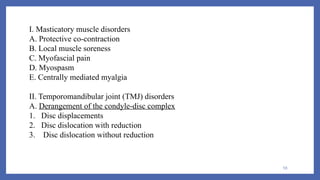
10
I. Masticatory muscledisorders
A. Protective co-contraction
B. Local muscle soreness
C. Myofascial pain
D. Myospasm
E. Centrally mediated myalgia
II. Temporomandibular joint (TMJ) disorders
A. Derangement of the condyle-disc complex
1. Disc displacements
2. Disc dislocation with reduction
3. Disc dislocation without reduction
11.
11
B. Structural incompatibilityof the articular surfaces
1. Deviation in form
a. Disc
b. Condyle
c. Fossa
2. Adhesions
a. Disc to condyle
b. Disc to fossa
3. Subluxation (hypermobility)
4. Spontaneous dislocation
12.
12
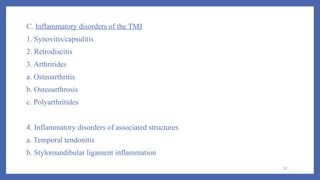
C. Inflammatory disordersof the TMJ
1. Synovitis/capsulitis
2. Retrodiscitis
3. Arthritides
a. Osteoarthritis
b. Osteoarthrosis
c. Polyarthritides
4. Inflammatory disorders of associated structures
a. Temporal tendonitis
b. Stylomandibular ligament inflammation
13.
13
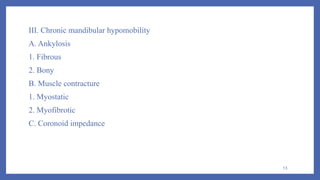
III. Chronic mandibularhypomobility
A. Ankylosis
1. Fibrous
2. Bony
B. Muscle contracture
1. Myostatic
2. Myofibrotic
C. Coronoid impedance
14.
14
IV. Growth disorders
A.Congenital and developmental bone disorders
1. Agenesis
2. Hypoplasia
3. Hyperplasia
4. Neoplasia
B. Congenital and developmental muscle disorders
1. Hypotrophy
2. Hypertrophy
3. Neoplasia
15.
15
SIGNS AND SYMPTOMS
•It is characterized by the signs such as tenderness and stiffness of the joint and the
muscles, increasing dull pain on mouth opening, reduced and deviated mouth opening,
referred pain to the angle of mandible and muscles of the neck.
• Otologic symptoms such as fullness of the ear and tinnitus, cervical pain and head ache
are also commonly associated with TMDs.
16.
16
ETIOLOGY
• The etiologyof TMD has not been fully understood; in general, it is considered
multifactorial.
• There are numerous factors that can contribute to TMD, namely the predisposing factors.
• There are factors that cause onset of TMD, called as initiating factors.
• The factors that interfere with the healing or enhance the progression of TMD called as
perpetuating factors.
17.
17
KEYS IN MAKINGDIFFERENTIAL
DIAGNOSIS
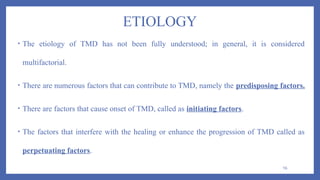
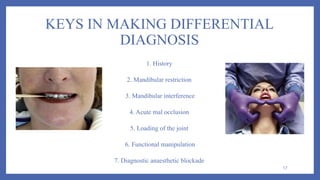
1. History
2. Mandibular restriction
3. Mandibular interference
4. Acute mal occlusion
5. Loading of the joint
6. Functional manipulation
7. Diagnostic anaesthetic blockade
18.
18
MANAGEMENT
Treatment methods generallyare of two types:
• Definitive treatment refers to modalities that are directed toward managing or
eliminating the etiologic factors that have created the disorder.
• Supportive therapy refers to treatment methods that are directed toward reducing
patient symptoms.
19.
19
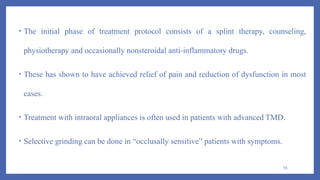
• The initialphase of treatment protocol consists of a splint therapy, counseling,
physiotherapy and occasionally nonsteroidal anti-inflammatory drugs.
• These has shown to have achieved relief of pain and reduction of dysfunction in most
cases.
• Treatment with intraoral appliances is often used in patients with advanced TMD.
• Selective grinding can be done in “occlusally sensitive” patients with symptoms.
20.
20
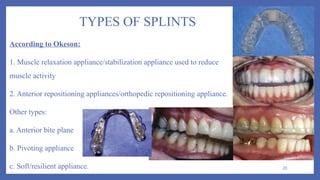
TYPES OF SPLINTS
Accordingto Okeson:
1. Muscle relaxation appliance/stabilization appliance used to reduce
muscle activity
2. Anterior repositioning appliances/orthopedic repositioning appliance.
Other types:
a. Anterior bite plane
b. Pivoting appliance
c. Soft/resilient appliance.
21.
21
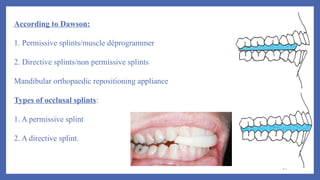
According to Dawson:
1.Permissive splints/muscle déprogrammer
2. Directive splints/non permissive splints
Mandibular orthopaedic repositioning appliance
Types of occlusal splints:
1. A permissive splint
2. A directive splint.
22.
22
INDICATIONS FOR USEOF SPLINTS
• Improving neuromuscular coordination
• Treatment of myogenic pain
• Improving function of the TMJ
• Treatment of pain arising from the joints
• Increasing the vertical dimension
• Securing a definite mandibular position
23.
23
• Altering thepattern of mandibular movement
• Testing the planned occlusal scheme in centric and eccentric positions
• Splinting of loose teeth
• Distributing the load in bruxism
• Clarifying occlusal etiological factors while making a differential diagnosis.
24.
24
DISCUSSION
• In general,literature shows that TMD patients are usually benefitted with oral splints.
• The most recent meta analytic review concludes that stabilization splint therapy may
‑
be beneficial for reducing pain severity at rest and on palpation and depression when
compared to no treatment.
• Effects of non occluding splints on TMJ pain and clicking have been observed.
25.
25
• The conservativenature of splints and its success rate are reasons for their extensive
use.
• Splints may reduce sleep bruxism. Currently, splints are considered to act through
nonspecific mechanisms probably involving behavior modifying properties.
• Despite the nearly universal prescription of oral splints in the treatment of TMJ
disorders or bruxism, the quality of the evidence supporting the mechanisms of action
suggested for their presumed efficacy is still questionable.
26.
26
• Although theprospect for curing TMJ disorders and/or bruxism, or trying to
eliminate their unknown cause, remains an unrealistic expectation, it still can
be argued that improving the patient’s perception of well being, quality of
‑
life, and psychological status or changing harmful habits through the
judicious application of a noninvasive and cost efficient management
‑
strategy (such as the use of stabilizing splints), may represent an acceptable
alternative.
27.
27
• Oral appliancesmay favor reorganization of muscle fiber recruitment
patterns and a shift in the area of maximum joint loading and are the most
effective mode of deprogramming.
• Prosthodontists should be aware of the temporary effects of the appliances,
which are not miraculous devices that position the mandibles ideally but are
instead responsible for transient shifts in joint and muscle loading.
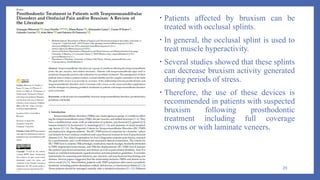
29
• Patients affectedby bruxism can be
treated with occlusal splints.
• In general, the occlusal splint is used to
treat muscle hyperactivity.
• Several studies showed that these splints
can decrease bruxism activity generated
during periods of stress.
• Therefore, the use of these devices is
recommended in patients with suspected
bruxism following prosthodontic
treatment including full coverage
crowns or with laminate veneers.
30.
30
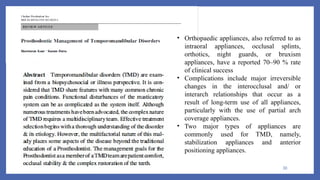
• Orthopaedic appliances,also referred to as
intraoral appliances, occlusal splints,
orthotics, night guards, or bruxism
appliances, have a reported 70–90 % rate
of clinical success
• Complications include major irreversible
changes in the interocclusal and/ or
interarch relationships that occur as a
result of long-term use of all appliances,
particularly with the use of partial arch
coverage appliances.
• Two major types of appliances are
commonly used for TMD, namely,
stabilization appliances and anterior
positioning appliances.
31.
31
CRITICAL ANALYSIS
STRONG POINTS
•Clear, clinically oriented
discussion
• Emphasis on conservative
therapies
WEAK POINTS
• Lack detailed explanation about
the splints
• Limited depth in diagnostic criteria
• Minimal coverage of emerging
modalities
32.
32
CONCLUSION
• Management ofTMD may be simple or may require a multidisciplinary
approach.
• Occlusion is one of the factors contributing to TMDs.
• Hence, dentists, physicians, psychologists, and physical therapists work together
to cope with such condition afflicting the patients.
• Prosthodontists’ play a major role as it is imperative that a healthy asymptomatic
TMJ is a mandatory requisite to start any rehabilitation procedure.
33.
33
SUMMARY
• It iscritical to identify the cause of orofacial pain and proper differential
diagnosis and keep in mind that oral splints do not cure, but they may contribute
to the patient’s well being just like crutches, which are useful as a nonspecific
‑
“healing aid” during a patient’s orthopedic rehabilitation phase, but which are
not regarded as a primary or definitive treatment modality until the primary
cause is identified and treated.
#5 A synovial joint is a joint where two bones meet and are enclosed within a joint capsule filled with synovial fluid, which lubricates the joint and reduces friction during movement.
#16 Factors that increase the risk of tmd
Occlusal factors
Parafunction
Deep pain input
Emotional stress
trauma
#17 The history is always helpful in distinguishing joint
from muscle disorders.
Joint disorder -usually occurs at 25 to 30 mm and hard end feel
Muscle disorder – mouth opening will be 8-10 mm and soft end feel
an acute malocclusion is a sudden alteration of the occlusal condition secondary to a disorder.
A bilateral manipulation technique will load the joints and help
determine whether pain is from an intracapsular or an extracapsular source.
#20 1 patient reports with a TMD that relates to muscle hyperactivity such as bruxism, a stabilization appliance should be considered.
2 The anterior positioning appliance is used primarily to treat disc displacements and disc dislocations with reduction. The anterior positioning appliance causes the mandible to assume a more forward position, temporarily creating a more favorable condyledisc relationship
3 anterior bite plane for acute malooclusion
4 Posterior bite planes have been advocated in cases of severe loss of vertical dimension or when there is a need to make major changes in anterior positioning of the mandible
5 pivoting appliance – unloading of joints
6 soft/resilient -protective
#21 to move the mandible to a position that aligns the condyle with the displaced disk.