Daniela Martínez
Rivera
Medicine Student
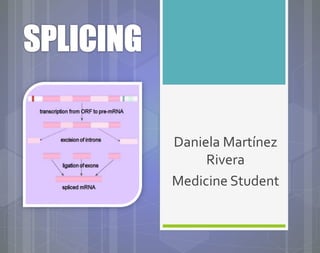
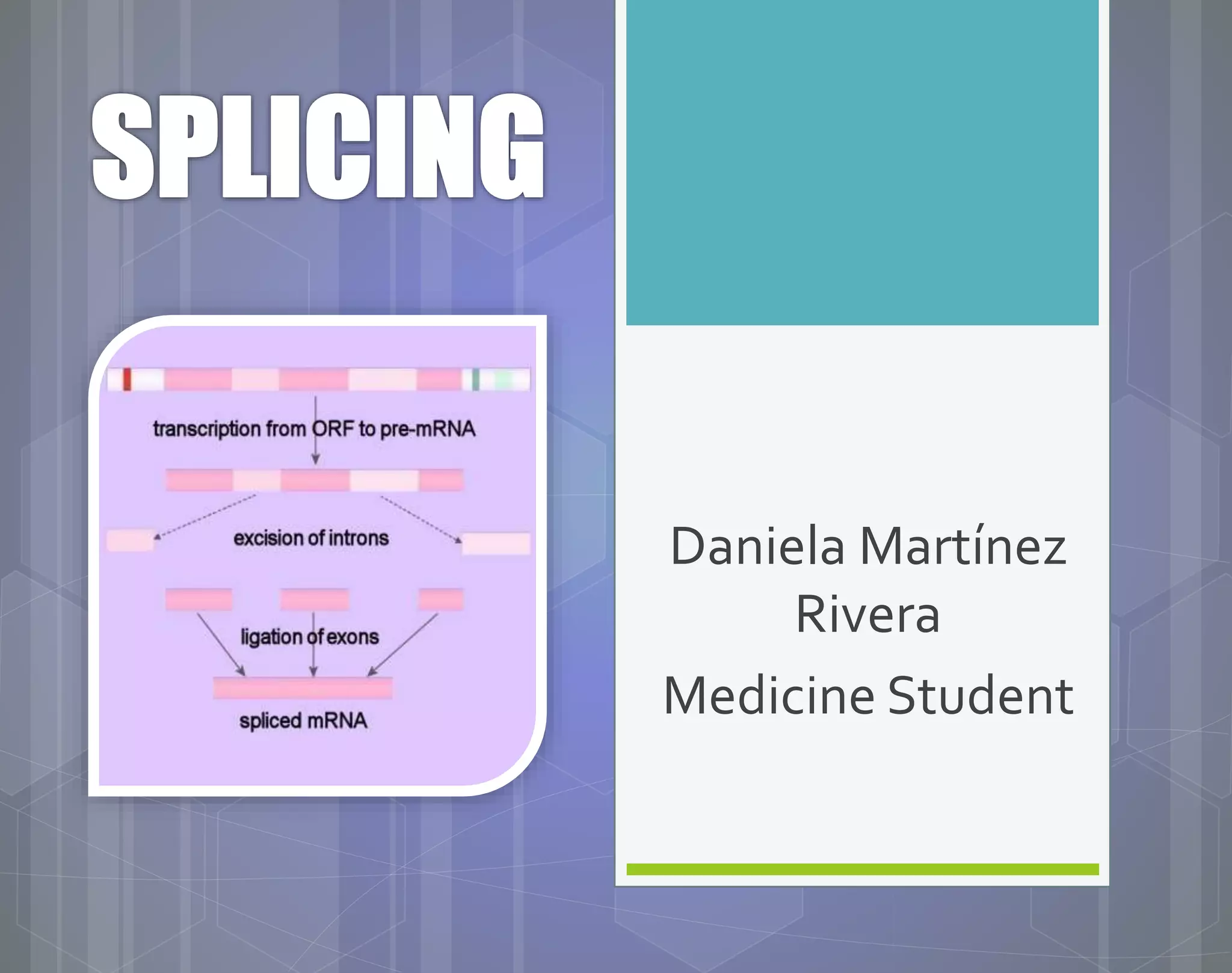
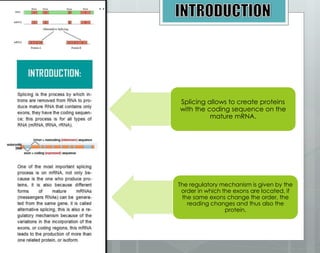
Splicing allows to create proteins
with the coding sequence on the
mature mRNA.
The regulatory mechanism is given by the
order in which the exons are located, if
the same exons change the order, the
reading changes and thus also the
protein.
Most cancer
transcriptomes are
bloated by widespread
intron retention. Kocarnik
, JM. (2015, August 17).
Most cancer transcriptomes are
bloated by widespread intron
retention
Abnormal RNA splicing is
a common characteristic
of most cancers because
helps with the initiation
and metastasis.
Most cancer transcriptomes are
bloated by widespread intron
retention
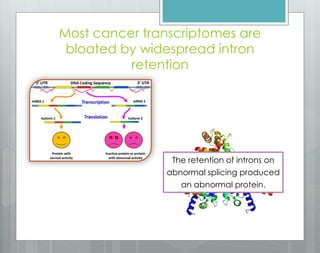
The retention of introns on
abnormal splicing produced
an abnormal protein.
Most cancer transcriptomes are
bloated by widespread intron
retention
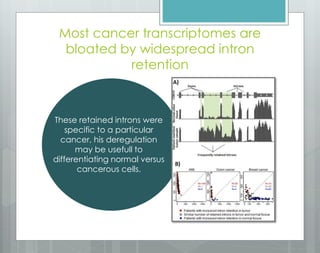
These retained introns were
specific to a particular
cancer, his deregulation
may be usefull to
differentiating normal versus
cancerous cells.
Most cancer transcriptomes are
bloated by widespread intron
retention
Student’s observation:
I think the splicing process regarding a
global issue such as the cancer is, will have
a great impact , the deepening
knowledge will help the development of
new therapies targeting tumor cells and
also to the prevention of cancer as a
disease and his expression.
'Decoding' gene
regulation. Medical
University of Vienna .
(2015, June 11).
'Decoding' gene regulation
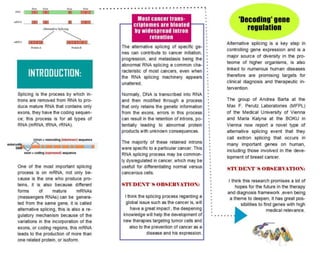
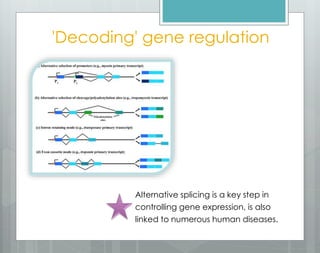
Alternative splicing is a key step in
controlling gene expression, is also
linked to numerous human diseases.
'Decoding' gene regulation
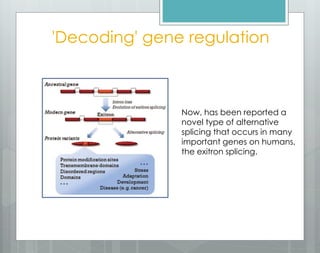
Now, has been reported a
novel type of alternative
splicing that occurs in many
important genes on humans,
the exitron splicing.
'Decoding' gene regulation
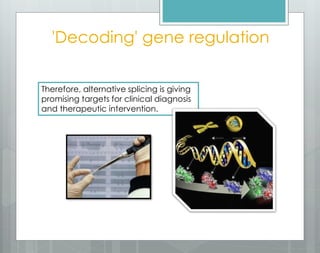
Therefore, alternative splicing is giving
promising targets for clinical diagnosis
and therapeutic intervention.
'Decoding' gene regulation
Student’s observation:
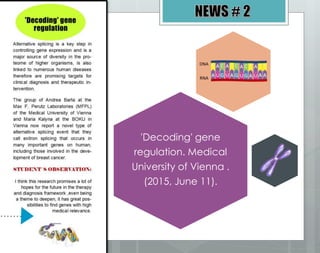
I think this research promises a lot of hopes for
the future in the therapy and diagnosis
framework ,even being a theme to deepen, it
has great possibilities to find genes with high
medical relevance.
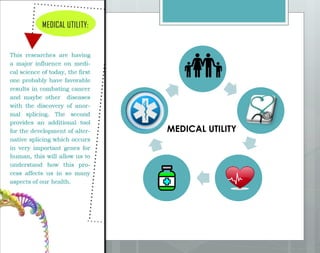
MEDICAL UTILITY
Medical Utility
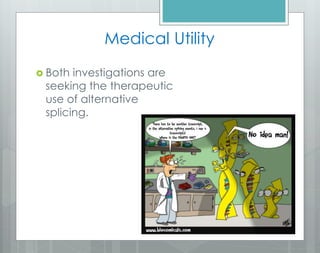
 Both investigations are
seeking the therapeutic
use of alternative
splicing.
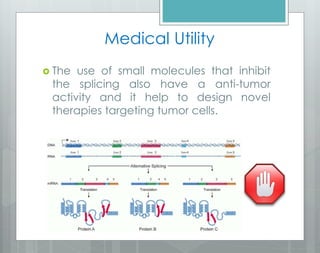
 The use of small molecules that inhibit
the splicing also have a anti-tumor
activity and it help to design novel
therapies targeting tumor cells.
Medical Utility
 Control of gene expression with the
alternative splicing not only helps the
therapeutic treatment , also to the
prevention of diseases.
Medical Utility
Bibliography
 Medical University of Vienna . (2015, June 11).
'Decoding' gene regulation. ScienceDaily. Retrieved
August 25, 2015 from
http://www.sciencedaily.com/releases/2015/06/150
611081526.htm
 Kocarnik , JM. (2015, August 17). Most cancer
transcriptomes are bloated by widespread intron
retention. Fred Hutch. Retrieved August 27, 2015
from
http://www.fredhutch.org/en/news/spotlight/import
s/most-cancer-transcriptomes-are-bloated-by-
widespread-intron-rete.html
 Martinez Sánchez, Lina Maria. Biologia
molecular.8.ed.Medellin: UPB. Fac.Medicina.
Splicing / Molecular Biology

Splicing / Molecular Biology

  • 1.
  • 4.
    Splicing allows tocreate proteins with the coding sequence on the mature mRNA. The regulatory mechanism is given by the order in which the exons are located, if the same exons change the order, the reading changes and thus also the protein.
  • 5.
    Most cancer transcriptomes are bloatedby widespread intron retention. Kocarnik , JM. (2015, August 17).
  • 6.
    Most cancer transcriptomesare bloated by widespread intron retention Abnormal RNA splicing is a common characteristic of most cancers because helps with the initiation and metastasis.
  • 7.
    Most cancer transcriptomesare bloated by widespread intron retention The retention of introns on abnormal splicing produced an abnormal protein.
  • 8.
    Most cancer transcriptomesare bloated by widespread intron retention These retained introns were specific to a particular cancer, his deregulation may be usefull to differentiating normal versus cancerous cells.
  • 9.
    Most cancer transcriptomesare bloated by widespread intron retention Student’s observation: I think the splicing process regarding a global issue such as the cancer is, will have a great impact , the deepening knowledge will help the development of new therapies targeting tumor cells and also to the prevention of cancer as a disease and his expression.
  • 10.
  • 11.
    'Decoding' gene regulation Alternativesplicing is a key step in controlling gene expression, is also linked to numerous human diseases.
  • 12.
    'Decoding' gene regulation Now,has been reported a novel type of alternative splicing that occurs in many important genes on humans, the exitron splicing.
  • 13.
    'Decoding' gene regulation Therefore,alternative splicing is giving promising targets for clinical diagnosis and therapeutic intervention.
  • 14.
    'Decoding' gene regulation Student’sobservation: I think this research promises a lot of hopes for the future in the therapy and diagnosis framework ,even being a theme to deepen, it has great possibilities to find genes with high medical relevance.
  • 15.
  • 16.
    Medical Utility  Bothinvestigations are seeking the therapeutic use of alternative splicing.
  • 17.
     The useof small molecules that inhibit the splicing also have a anti-tumor activity and it help to design novel therapies targeting tumor cells. Medical Utility
  • 18.
     Control ofgene expression with the alternative splicing not only helps the therapeutic treatment , also to the prevention of diseases. Medical Utility
  • 19.
    Bibliography  Medical Universityof Vienna . (2015, June 11). 'Decoding' gene regulation. ScienceDaily. Retrieved August 25, 2015 from http://www.sciencedaily.com/releases/2015/06/150 611081526.htm  Kocarnik , JM. (2015, August 17). Most cancer transcriptomes are bloated by widespread intron retention. Fred Hutch. Retrieved August 27, 2015 from http://www.fredhutch.org/en/news/spotlight/import s/most-cancer-transcriptomes-are-bloated-by- widespread-intron-rete.html  Martinez Sánchez, Lina Maria. Biologia molecular.8.ed.Medellin: UPB. Fac.Medicina.