QUALITY ASSURANCE IN
EDUCATION THROUGH
VOLUNTARY
ACCREDITATION
QUALITY ASSURANCE IN
EDUCATION THROUGH
VOLUNTARY
ACCREDITATION
According to British Higher Education Council:
According to former CHED Executive Director:
“Quality” is the central mystery in all the
variants of meaning and nuance of which the
word is capable.”
“Quality” is not perfection, it is improving
your previous best and showing that you are at
the leading edge in most aspects.
What do I need to
learn?
What do I need to
learn?
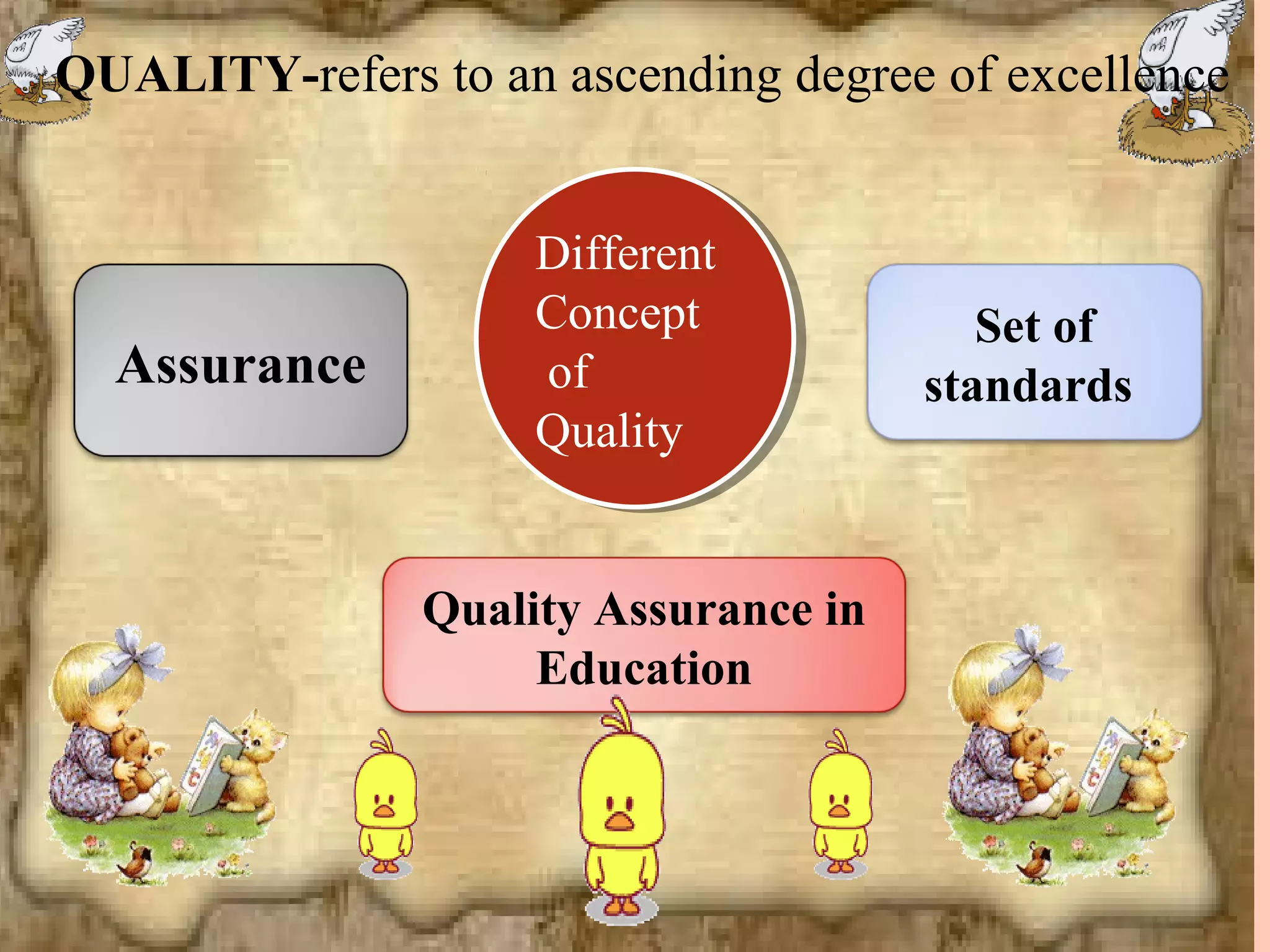
QUALITY-refers to an ascending degree of excellence
Different
Concept
of
Quality
Different
Concept
of
Quality
Set of
standardsAssurance
Quality Assurance in
Education
LEGALBASIS OF VOLUNTARY ACCREDATATION IN
THE PHILIPPINES
LEGALBASIS OF VOLUNTARY ACCREDATATION IN
THE PHILIPPINES
EDUCATION ACT OF 1982
CREATION OF THE
COMMISSION ON HIGHER
EDUCATION(CHED) IN 1994
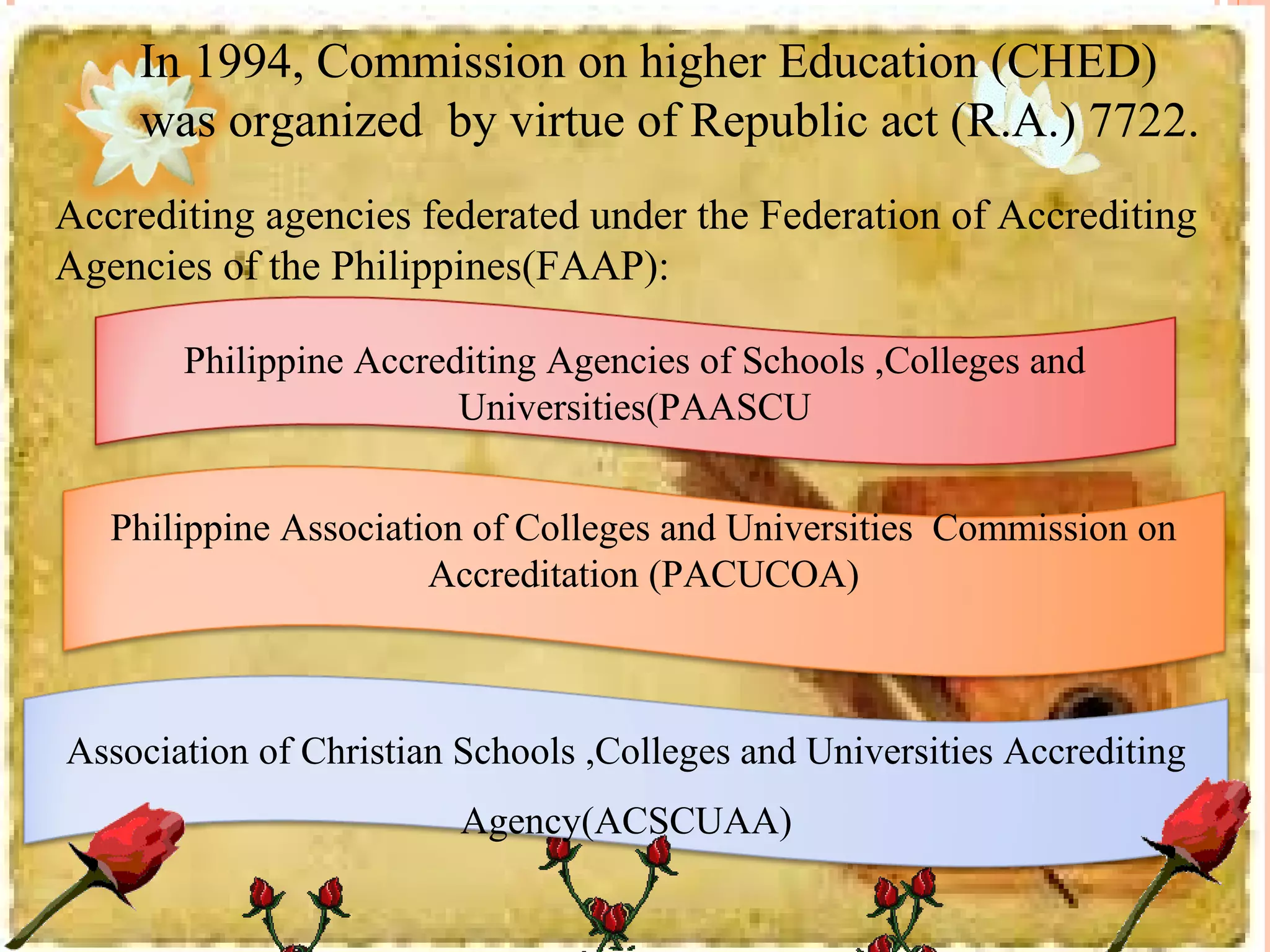
In 1994, Commission on higher Education (CHED)
was organized by virtue of Republic act (R.A.) 7722.
Accrediting agencies federated under the Federation of Accrediting
Agencies of the Philippines(FAAP):
Philippine Accrediting Agencies of Schools ,Colleges and
Universities(PAASCU
Association of Christian Schools ,Colleges and Universities Accrediting
Agency(ACSCUAA)
Philippine Association of Colleges and Universities Commission on
Accreditation (PACUCOA)
TWO ACCREDITING AGENCIES FOR
PUBLIC SCHOOLS:
Accrediting Agency for Chartered Colleges and
Universities of the Philippines(AACUP)
Association of Local Colleges and Universities
Commission on Accreditation(ALCUCOA
VOLUNTARY ACCREDITIONVOLUNTARY ACCREDITION
In the Philippines and in the
world , the accepted measure of
quality assurance in education is
voluntary accreditation.
What is voluntary Accreditation?
Voluntary Accreditation is a concept of self-
regulation which focuses on self-study and evaluation
and on the continuing improvement of educational
quality .It is both a process and a result .
As a process ,it is a form of peer review in which an
association of schools and colleges establishes sets of criteria
and procedures.
As a result ,it is a form of certification granted by a
recognized and authorized accrediting agency.
 Voluntary Accreditation is mission-centric
 Rationale for Voluntary Accreditation
Basic Principles /Characteristics of
Voluntary Accreditation
a. Accreditation is based on accepted standards.
b. Accreditation is primarily concerned with
the students learning welfare , growth and
development.
c. Accreditation provides opportunities for institutional
growth through self study, evaluation and self regulation.
d. Accreditation admits periodic review
,criticism , and readjustment of its criteria,
policies and procedures in response to changes
in Education
 Significant practical values of Education
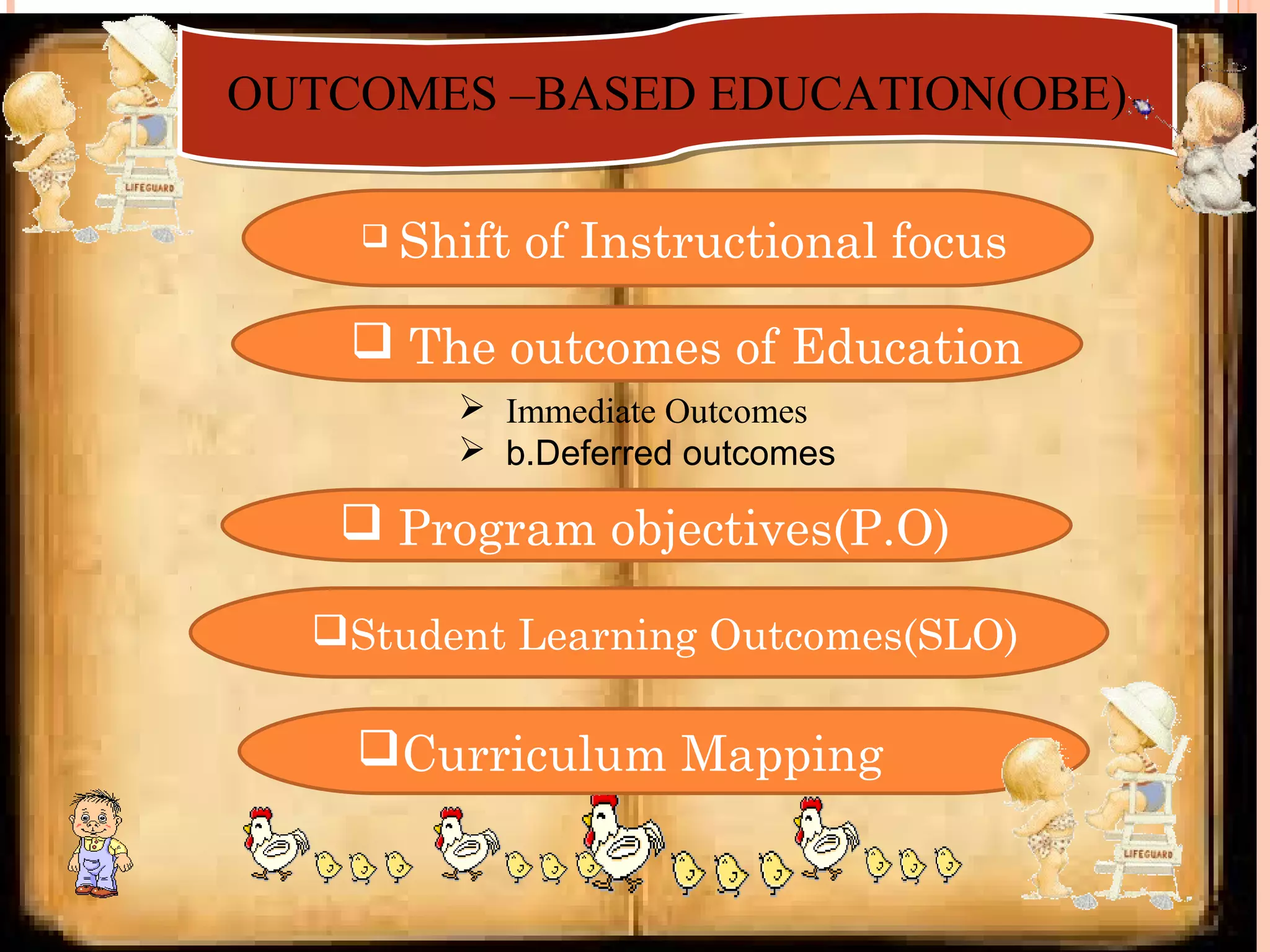
OUTCOMES –BASED EDUCATION(OBE)OUTCOMES –BASED EDUCATION(OBE)
 Shift of Instructional focus
Student Learning Outcomes(SLO)
 The outcomes of Education
 Program objectives(P.O)
Curriculum Mapping
 Immediate Outcomes
 b.Deferred outcomes
DETERMINING THE ATTAINMENT OF STUDENT LEARNING
OUTCOMES (SLO)THROUGH OUTCOMES- BASEDASSESSMENT
DETERMINING THE ATTAINMENT OF STUDENT LEARNING
OUTCOMES (SLO)THROUGH OUTCOMES- BASEDASSESSMENT
Educational Assessment
is a comprehensive process of describing,
judging and communicating the quality
of learning and performance of students
Outcome- based
assessment
requires teacher to define clearly in
language that their student can
understand and apply
 Recommended Outcomes-based
Assessment tools
Characteristics of OBA
Use of Measurable Assessment Tools
Key to OBA
What do I
need to
remember?
What do I
need to
remember?
1.Quality Assurance in Education
2.Voluntary accreditation as the recognized
instrument for quality assurance
3.Outcomes-based Education (OBE) the recent
development in voluntary accreditation :Program
outcomes and student learning outcomes.
4. Curriculum mapping by matching the
identified students learning outcomes with the
program courses.
Achieving outcomes –based education through
outcome –based assessment (OBA)
THE END!!!
Amparo , Liliavic C.
Bargasao , Danilyn
Café, Aiza L.
Commandante , Melky

QUALITY ASSURANCE IN EDUCATION THROUGH VOLUNTARY ACCREDITATION

  • 1.
    QUALITY ASSURANCE IN EDUCATIONTHROUGH VOLUNTARY ACCREDITATION QUALITY ASSURANCE IN EDUCATION THROUGH VOLUNTARY ACCREDITATION
  • 2.
    According to BritishHigher Education Council: According to former CHED Executive Director: “Quality” is the central mystery in all the variants of meaning and nuance of which the word is capable.” “Quality” is not perfection, it is improving your previous best and showing that you are at the leading edge in most aspects. What do I need to learn? What do I need to learn?
  • 3.
    QUALITY-refers to anascending degree of excellence Different Concept of Quality Different Concept of Quality Set of standardsAssurance Quality Assurance in Education
  • 4.
    LEGALBASIS OF VOLUNTARYACCREDATATION IN THE PHILIPPINES LEGALBASIS OF VOLUNTARY ACCREDATATION IN THE PHILIPPINES EDUCATION ACT OF 1982 CREATION OF THE COMMISSION ON HIGHER EDUCATION(CHED) IN 1994
  • 5.
    In 1994, Commissionon higher Education (CHED) was organized by virtue of Republic act (R.A.) 7722. Accrediting agencies federated under the Federation of Accrediting Agencies of the Philippines(FAAP): Philippine Accrediting Agencies of Schools ,Colleges and Universities(PAASCU Association of Christian Schools ,Colleges and Universities Accrediting Agency(ACSCUAA) Philippine Association of Colleges and Universities Commission on Accreditation (PACUCOA)
  • 6.
    TWO ACCREDITING AGENCIESFOR PUBLIC SCHOOLS: Accrediting Agency for Chartered Colleges and Universities of the Philippines(AACUP) Association of Local Colleges and Universities Commission on Accreditation(ALCUCOA
  • 7.
    VOLUNTARY ACCREDITIONVOLUNTARY ACCREDITION Inthe Philippines and in the world , the accepted measure of quality assurance in education is voluntary accreditation.
  • 8.
    What is voluntaryAccreditation? Voluntary Accreditation is a concept of self- regulation which focuses on self-study and evaluation and on the continuing improvement of educational quality .It is both a process and a result . As a process ,it is a form of peer review in which an association of schools and colleges establishes sets of criteria and procedures. As a result ,it is a form of certification granted by a recognized and authorized accrediting agency.
  • 9.
     Voluntary Accreditationis mission-centric  Rationale for Voluntary Accreditation Basic Principles /Characteristics of Voluntary Accreditation a. Accreditation is based on accepted standards. b. Accreditation is primarily concerned with the students learning welfare , growth and development.
  • 10.
    c. Accreditation providesopportunities for institutional growth through self study, evaluation and self regulation. d. Accreditation admits periodic review ,criticism , and readjustment of its criteria, policies and procedures in response to changes in Education  Significant practical values of Education
  • 11.
    OUTCOMES –BASED EDUCATION(OBE)OUTCOMES–BASED EDUCATION(OBE)  Shift of Instructional focus Student Learning Outcomes(SLO)  The outcomes of Education  Program objectives(P.O) Curriculum Mapping  Immediate Outcomes  b.Deferred outcomes
  • 12.
    DETERMINING THE ATTAINMENTOF STUDENT LEARNING OUTCOMES (SLO)THROUGH OUTCOMES- BASEDASSESSMENT DETERMINING THE ATTAINMENT OF STUDENT LEARNING OUTCOMES (SLO)THROUGH OUTCOMES- BASEDASSESSMENT Educational Assessment is a comprehensive process of describing, judging and communicating the quality of learning and performance of students
  • 13.
    Outcome- based assessment requires teacherto define clearly in language that their student can understand and apply
  • 14.
     Recommended Outcomes-based Assessmenttools Characteristics of OBA Use of Measurable Assessment Tools Key to OBA
  • 15.
    What do I needto remember? What do I need to remember?
  • 16.
    1.Quality Assurance inEducation 2.Voluntary accreditation as the recognized instrument for quality assurance 3.Outcomes-based Education (OBE) the recent development in voluntary accreditation :Program outcomes and student learning outcomes. 4. Curriculum mapping by matching the identified students learning outcomes with the program courses. Achieving outcomes –based education through outcome –based assessment (OBA)
  • 17.
    THE END!!! Amparo ,Liliavic C. Bargasao , Danilyn Café, Aiza L. Commandante , Melky