Spinal “Immobilization”
Treatment or
Torture?
By Luke Winkelman, PM, NRP, EMS-I 2017
Poll time!
Visit: Respond.cc
Session key: 112574
Poll results
Poll results
Poll results
Poll results
Poll results
Glossary
• Spinal Immobilization
• Spinal Motion Restriction - SMR
• Spinal Cord Injury - SCI
• Dogma
• Sacred Cow
• Evidence Based Medicine - EBM
History of SMR
• First Mentioned in 1965 by Col. Louis C
Kossuth[1]
• “move a victim from the vehicle with a minimum
of additional trauma”
• “due regard to maximum gentleness”
History of SMR
• 1967 by J.D. Farrington, MD in position article:
“Death In A Ditch”[2]
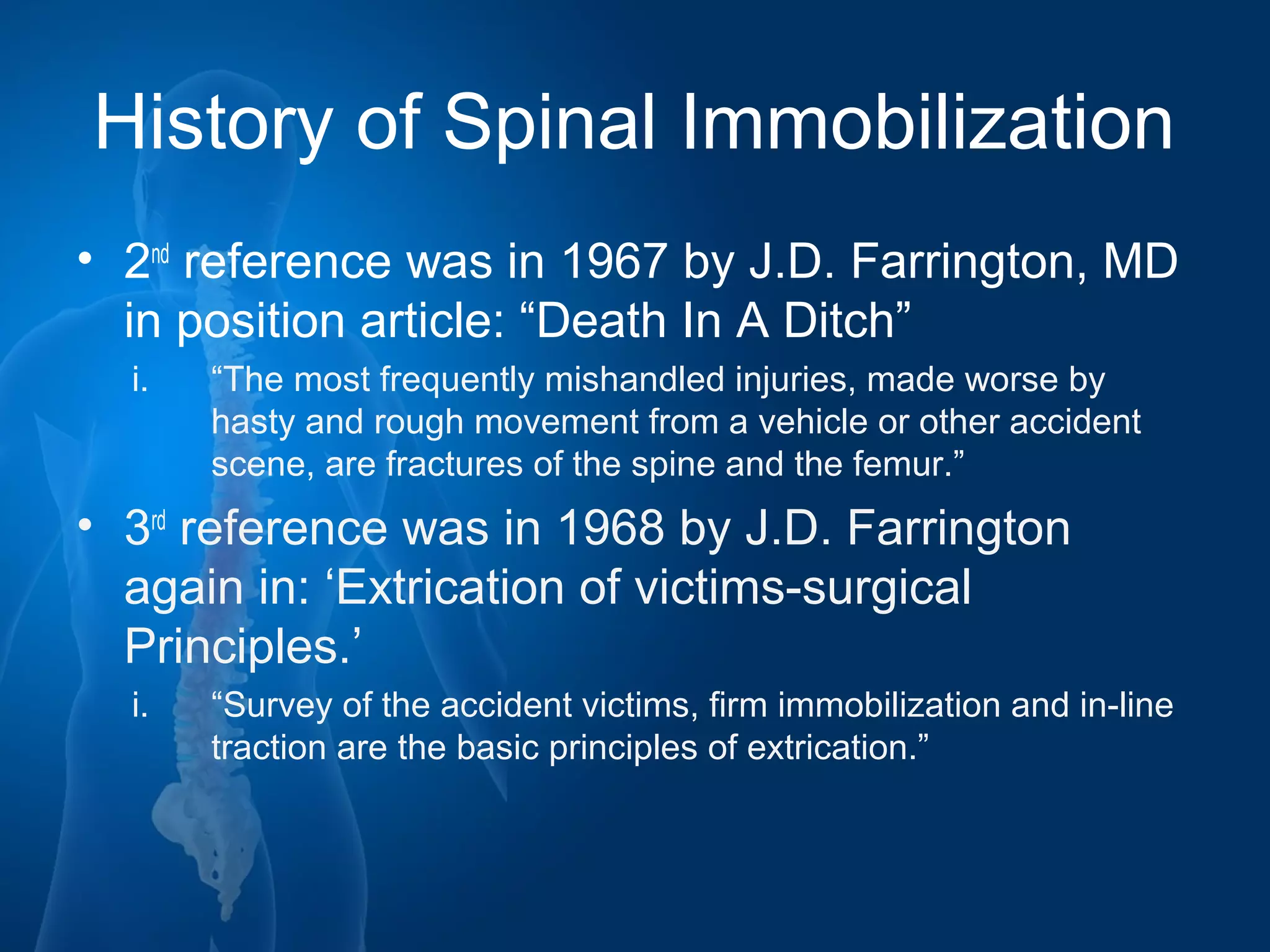
i. “…frequently mishandled injuries, made worse by hasty and
rough movement from a vehicle or other accident scene...”
• 1968 by J.D. Farrington in: ‘Extrication of
victims-surgical Principles.’[3]
i. “[I]mmobilization and in-line traction are the basic principles of
extrication.”
History of SMR
• The first EMT text to
include Spinal
Immobilization using
rigid board was
Emergency Care and
Transportation of the
Sick and Injured. [4]
• American Academy of
Orthopedic Surgeons, 1971
The Spine
• Structure
• Protection
• Flexibility
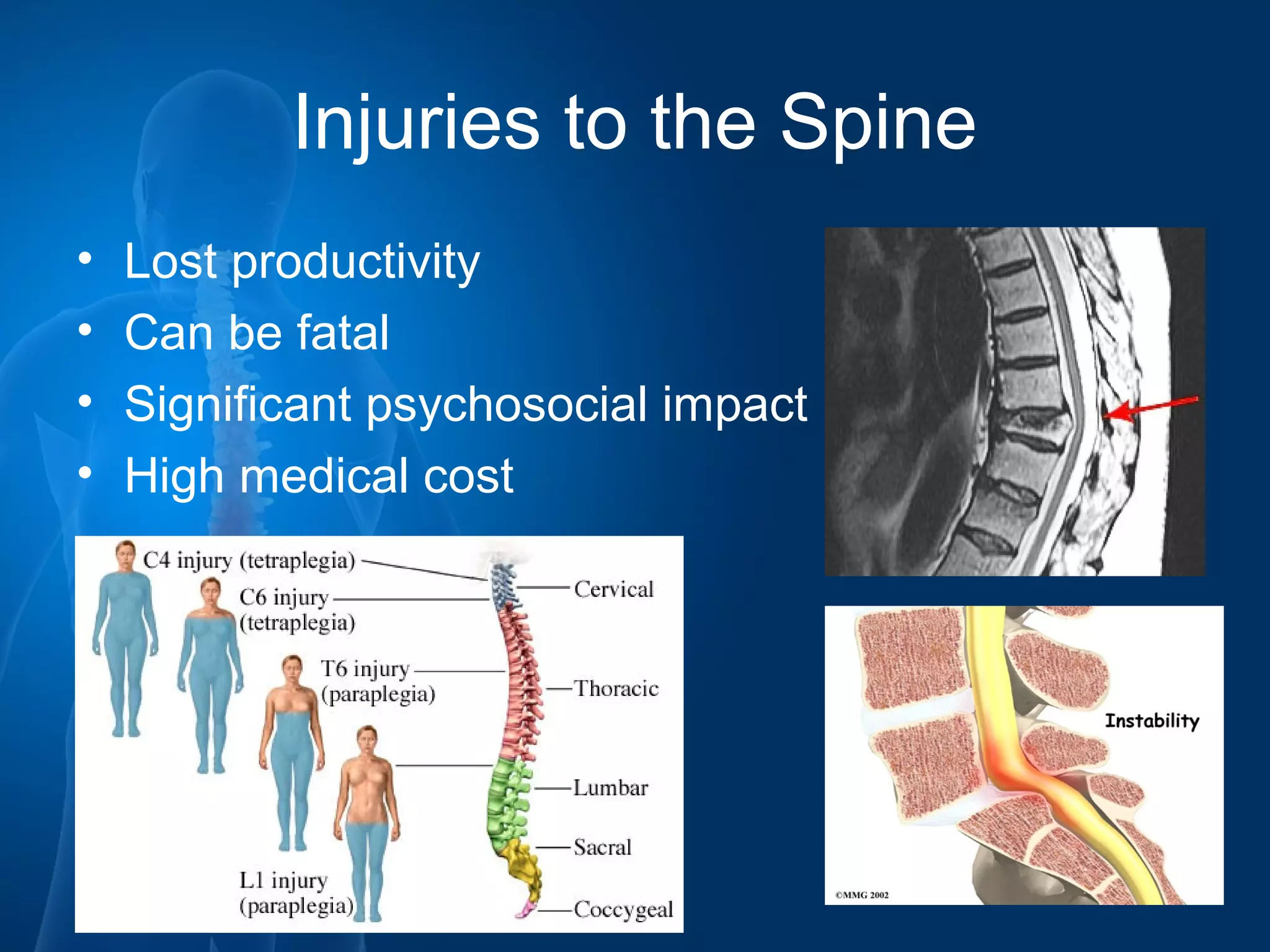
Injuries to the Spine
• Lost productivity
• Can be fatal
• Significant psychosocial impact
• High medical cost
Cost Of Spinal Cord Injury
• 253,000 people in US living with SCI
• 12,000 new cases each year
• In the US MVC related SCI estimated $34.8
billion per year -Spinal Cord Injury Information Network[5]
• SCI cost first year, $1,023,924
• SCI cost years 2+, $171,808 -National Spinal Cord Injury
Statistical Center[6]
Everybody Get’s a Backboard
MOI Indicators
• Fall from 2-3 times the patient’s
height
• Fall distance not the strongest
indicator
• Portion of body to strike first
• Surface that stops the fall
• Age, co-morbid pathophysiology
MOI Indicators
• Death in same
compartment
• Extended
Extrication
• Vehicle Damage
• Cabin intrusion >= 12 inches
• Rollover/roof deformity
Mechanism of Injury
https://www.youtube.com/watch?v=0HAGMb_jAdU [7]
MOI ALONE NOT RELIABLE
• Worst indicators: "motorcycle crash with separation
of rider," "pedestrian hit by motor vehicle," "motor vehicle
crash with rollover," and "motor vehicle crash with death
of occupant."
• Best Indicators: "ejection from a vehicle" and
"prolonged extrication time.“ - Kohn et’al. Acad Emerg Med. 2004[8]
MOI ALONE NOT RELIABLE
• Medics showed 80% accuracy predicting
disability by using patient and scene
assessment with MOI indicators.
• Decreased when MOI was only factor
Vaca FE, et al J Emerg Med. 2009 [9]
MOI Case Study
• A CLIMBER fell 1,000ft
down mountain
• Walked away
• Was found standing
up, reading a map.
NBC News 2011 [10]
Poll time!
Visit: Respond.cc
Session key: 985829
Poll results
Poll results
What are the odds?
Likelihood of Spine Injury
• “2000–6000 Newtons of force to fracture the
cervical spine” Maiman DJ, Sances A Jr, Myklebust JB, et al 1983 [11]
• Just under 1 million pt.'s immobilized, only 2–
3% of these patients actually had spinal injuries,
most were stable. Goldberg W, Mueller C, Panacek E, et al. 2001 [12]
• Common Blunt injuries (MVCs, falls from
standing & heights, assaults) only 1.2%–3.3%
had spinal injury and of those only 0.4%–0.7%
had potential to worsen. Kwan I, Bunn F. 2005; [13]
Likelihood of Spine Injury
• 7 months, Phoenix AZ
• 228 blunt force trauma patients
• 122 complaints of neck pain
• 3(0.98%)cervical injuries – stability
unknown -Am J Emerg Med. 1989 [14]
Blunt Force-MOI
No Injury Injury
Unstable InjuryStable Injury
3-5% [15]
No Damage-YETDamage Done
Conscious Obtunded
0.4-0.7% [16]
NNT=1032
NNH=66
Haut, Elliott R., et al 2010 [17]
0.38% [17]
SMR- Who MAY benefit???
So What If We Stopped?
• What if the patient was their own best
immobilizer?
• “Conventional techniques ~ up to four times more
cervical spine movement during extrication than
controlled self-extrication (Rigid Collar and patient
then self extricating)”-Engsberg JR et al; J Emerg Med. 2013 [18]
So What If We Stopped?
• Malaysia vs New Mexico 5 year study
– 120 pt’s seen at University of Malaya
• None immobilized
• 11% neurologic disability
– 334 pt’s seen at University of New Mexico
• All immobilized w/ C-Collar
• 21% neurologic disability -Acad Emerg Med. 1998 [19]
The Science Behind
“Immobilization”
…….Still waiting…….
Not Science
What could it hurt?
Pressure Ulcers
• Est. 14.8% of acute care
patients have pressure ulcers
Amlung SR, et al; 1999 [21]
• 29 wk cost per healthcare
acquired ulcer $129,248 -Am J
Surg. 2010 [22]
• Per ulcer cost $9.1-11.6
Billion/yr –Association for Healthcare Resource &
Materials Management [23]
• “Spinal immobilization for unconscious patients with
multiple injuries” Craig Norris, MD BMJ 2004 [24]
Respiratory Compromise
• Backboard Only Ann Emerg Med. 1988 [25]
i. 15 volunteers
ii. “Significant difference” in FVC and FEV1.
• Backboard & C-Collar Prehosp Emerg Care. 1999 [26]
i. 39 volunteers
ii. Wooden backboard or vacuum mattress.
iii. 15% decrease in FEV1 on average. (worse
at extremes of age).
iv. Vacuum mattress more comfortable.
Back Pain
• 21 healthy volunteers
• Immobilized for 30 minute period.
• Results: headache, sacral/lumbar pain, jaw pain
most common.
• 55% subjects moderate to severe symptoms.
• 29% developed symptoms 48 hours post
removal -Chan D Ann Emerg Med. 1994 [27]
Pop out the collar!
Journal of Trauma, 1983 [28]
Displaces Unstable Fractures
• Unstable cervical fractures
created in 7 fresh human
cadavers
• Rigid collar
• Assessed movement
• Avg 7.7mm±6.8mm axial
plane
• Avg 2.9mm±2.5mm
cranial-caudal plane
-J Trauma. 2011 [29]
Displaces Unstable Fractures
• Ankylosing Spondylitis
– 15 patients with traumatic
injury able to walk immediately
following the injury,
– 12 deteriorated
– 6 of these were due to over
extension of the kyphotic spine
(40% were complete injuries).
10-year review. Thumbikat P, et al; 2007 [30]
Cost Of a C-Collar
The EMS Store [31]
Cost Of a C-Collar
• Obligatory radiological exams >$200 [32]
• 5% patients who complain of neck pain
following blunt force have c-spine injury
Ersoy G et’al Eur J Emerg Med. 1995 [33]
Increased ICP
• 90% of pt’s with C-collar experienced significant
increases in ICP, 100% experienced decrease in GCS
- 10 consecutive pt’s Mobbs ET AL, ANZ J. Surg. 2002; [34]
• Estimates of ~34% of trauma pt’s meeting current
immobilization criteria have a head injury, and are
susceptible to rise in ICP-Daniel Kwan, MD 2014 [35]
Increased Risk of Aspiration
• Decreased ability to open mouth
• Difficulty swallowing
• Head Injury patients at increased risk for
emesis.
Br J Neurosurg. 1996 [36]
Difficult to Manage Airway
• Collar vs Manual Inline
Stabilization
– 50 surgical patients
– MILS Intubation success 66% better
than collar and board
-Heath KJ. Anesthesia 1994 [37]
MILS vs none
• 200 Elective surgery patients
• 50% failure rate in 30 seconds
with MILS vs 5.7% without.
-Thiboutot F, et al. 2009 [38]
Delayed Care/Resuscitation
• 30,956 Patients
• No group of penetrating trauma patients had any survival
benefit with spine immobilization.
• Spine immobilization was independently associated with
significantly decreased survival.
• Significantly decreased survival for GSW and for
hypotensive groups -Haut ER, Kalish BT, Efron DT, et al. 2010 [39]
So What If We Stopped?
• “Most patients who do have spinal
injuries are mechanically ‘stable’ at least
in the short term—stable in that
significant force would need to be applied
to the injured site to cause further
damage.” -Hauswald et al 2012 [40]
The Short of the Longboard
Endangered
ENDANGERED!
Technique
Technique
• Log roll? There’s GOT to be a better way
Surg Neurol Int. 2012 [41]
Technique
• The awkward log roll
“[S]tatistically significant displacements of the injured
spine.”
• Still no deterioration
Hyldmo, et’al. 2015 [42]
Poor Skill Performance
• 50 SMR subjects
• 15 (30%) at least one strap unsecured
• 44 (80%) at least 2cm slack in straps
-Duke University 2007 [43]
Liability
Liability
• 1987-1992 only 76 cases of EMS lawsuits
• Over 40% (31)of cases were dismissed
• Only 5 cases paid out $1+ Million
• Most were ambulance crash related
• Immobilization suits were less frequent than
Refusal, Consent, Abandonment, & Improper
restraint -World Association for Disaster and Emergency Medicine 1994 [44]
• 95% of EMS lawsuit “Root cause” is provider
poor attitude and patient dissatisfaction- PWW 2010 [45]
Liability
• 2002 Case Study [45,46]
• 24 yo intoxicated male
• Fell 8 ft from the top of a wall
• Pt. reports his head and neck hurt
• ”Get up, are you drunk?” “Get up, or we’re going
to call the police”
• “Snatched him up and threw each arm over their
shoulders and dragged him to the stretcher”
Liability
• 2002 Case Study Cont’d [45,46]
• Could not move his arms or legs
• Pt reports his neck “Snapped back”
• “It was like somebody hit a light switch and I just
went completely numb”
• Expert witness- “Mr. Smith’s quadriplegia is
directly attributable to the actions of the
paramedics.”
Liability
[47]
[48]
2015 IDPH EMS Protocol
IDPH EMS [49]
Positions
• NAEMSP
• “Patients without a mechanism of injury with the potential
for causing spinal injury or those patients without one of
the above clinical findings may safely have spinal
immobilization omitted. ~ should be transported in a
position of comfort.”[50]
Positions
NASEMSO
[51]
Positions
• NAEMSP & ACS Joint Statement
• “Long backboards are commonly used to attempt to
provide rigid spinal immobilization ~~ However, the
benefit of long backboards is largely unproven”
• “Utilization of backboards for spinal immobilization during
transport should be judicious, so that the potential
benefits outweigh the risks” [52]
Positions
• International Liaison Committee On Resuscitation
2015 draft [53]
The Wise Guys
Systems that have removed the LSB from
spinal immobilization protocols[54]
•State of New Hampshire
•State of Pennsylvania
•Harris County Texas (ESD 5)
•Chaffee County Colorado
•Alberta Canada
•South Australian Ambulance Service
•Johnson County Kansas
•Sedgwick County Kansas (Witchita)
The Wise Guys
https://www.youtube.com/watch?v=OyFsV2CP15A [55]
Baby Steps
• We were immobilizing
anyone that fell from a
standing height
• Now - significantly less
LSB use
• Tomorrow’s headlines:
Poll time!
Visit: Respond.cc
Session key:678810
Poll results
Poll results
Poll results
Poll results
References
References
• [1] http://journals.lww.com/jtrauma/Citation/1965/11000/THE_REMOVAL_OF_INJURED_PERSONNEL_FROM_WRECKED.4.aspx
• [2] “Death in a Ditch,” by J.D. Farrington, MD, FACS May/June 1967 edition of the American College of Surgeons Bulletin
• [3] http://journals.lww.com/jtrauma/Citation/1968/07000/EXTRICATION_OF_VICTIMS_SURGICAL_PRINCIPLES_.2.aspx
• [4] Emergency Care and Transportation of the Sick and Injured. AAOS, 1971 LC Call No.: RC87.A528
• [5] www.spinalcord.uab.edu
• [6] https://www.nscisc.uab.edu/
• [7] https://www.youtube.com/watch?v=0HAGMb_jAdU
• [8] https://www.ncbi.nlm.nih.gov/labs/articles/14709422/
• [9] https://www.ncbi.nlm.nih.gov/pubmed/19561820
• [10] http://www.nbcnews.com/id/41334296/ns/world_news-europe/t/almost-flying-climber-survives--foot-fall/#.VO-YcvnF-OU
• [11] https://www.ncbi.nlm.nih.gov/pubmed/6621839
• [12] https://www.ncbi.nlm.nih.gov/pubmed/11423806
• [13] https://www.ncbi.nlm.nih.gov/pubmed/15748015
• [14] http://www.ncbi.nlm.nih.gov/pubmed/2920074
• [15] https://www.ncbi.nlm.nih.gov/pubmed/11423806
• [16] https://www.ncbi.nlm.nih.gov/pubmed/11597285
• [17] https://www.ncbi.nlm.nih.gov/pubmed/20065766
• [18] http://www.ncbi.nlm.nih.gov/pubmed/23079144
• [19] http://www.ncbi.nlm.nih.gov/pubmed/9523928
• [20] http://www.naemsp.org/pdf/spinal.pdf
• [21] http://www.ncbi.nlm.nih.gov/pubmed/11794440
• [22] https://www.ncbi.nlm.nih.gov/pmc/articles/PMC2950802/
• [23] http://www.ahrmm.org/cqo-movement/files/leading-practices/hapu-uva-executive-summary.pdf
• [24] https://www.ncbi.nlm.nih.gov/pmc/articles/PMC515204/
• [25] https://www.ncbi.nlm.nih.gov/pubmed/3415063
• [26] https://www.ncbi.nlm.nih.gov/pubmed/10534038
• [27] https://www.ncbi.nlm.nih.gov/pubmed/8273958
• [28] https://www.ncbi.nlm.nih.gov/pubmed/6864837
References
• [29] https://www.ncbi.nlm.nih.gov/pubmed/21217496
• [30] https://www.ncbi.nlm.nih.gov/pubmed/18091492
• [31] http://www.theemsstore.com/store/product.aspx/productId/1175/
• [32] http://www.jcl.com/hospitals/average-pricing-information/x-rays#72040
• [33] http://www.ncbi.nlm.nih.gov/pubmed/9422206
• [34] http://www.neurospineclinic.com.au/pdfs/journal-articles/hard-collar-icp.pdf
• [35] http://www.slideshare.net/danielkkwan/ems-sspinal-immobilization-time-for-a-change slide-17
• [36] https://www.ncbi.nlm.nih.gov/pubmed/8922712
• [37] http://www.ncbi.nlm.nih.gov/pubmed/7802175
• [38] https://www.ncbi.nlm.nih.gov/pubmed/19396507
• [39] https://www.ncbi.nlm.nih.gov/pubmed/20065766
• [40] https://www.ncbi.nlm.nih.gov/pubmed/22962052
• [41] https://www.ncbi.nlm.nih.gov/pmc/articles/PMC3422095/
• [42] https://www.ncbi.nlm.nih.gov/pmc/articles/PMC4573694/
• [43] http://www.ncbi.nlm.nih.gov/pubmed/17613902
• [44] http://journals.cambridge.org/action/displayAbstract?fromPage=online&aid=8435291&fileId=S1049023X0004142X
• [45] https://www.ncemsf.org/about/conf2010/presentations/stark_liability.pdf
• [46]http://www2.ca3.uscourts.gov/opinarch/011895.txt
• [47] http://archive.boston.com/news/local/articles/2006/08/24/injured_woman_drowns_under_rescue_boat/?camp=pm
• [48] http://www.emsworld.com/news/10706794/settlement-reached-in-nh-fatal-airboat-rescue-lawsuit
• [49] http://www.idph.state.ia.us/ems/common/pdf/ems_protocols.pdf
• [50] http://www.naemsp.org/Documents/Position%20Papers/POSITION%20IndicationsforSpinalImmobilization.pdf
• [51] http://www.nasemso.org/Projects/ModelEMSClinicalGuidelines/documents/NASEMSO-Model-EMS-Clinical-Guidelines-DRAFT.pdf
Page 172
• [52] http://www.naemsp.org/Documents/Position%20Papers/POSITION%20EMS%20Spinal%20Precautions%20and%20the%20Use
%20of%20the%20Long%20Backboard.pdf
• [53] http://www.scancrit.com/wp-content/uploads/2015/02/ILCOR-Cervical-Collar-Guidelines-DRAFT-2015.pdf
• [54] https://www.facebook.com/groups/emtstudygroup/permalink/351267485065814/
• [55] https://www.youtube.com/watch?v=OyFsV2CP15A
Questions?

Spinal immobilization, Treatment or Torture?

  • 1.
    Spinal “Immobilization” Treatment or Torture? ByLuke Winkelman, PM, NRP, EMS-I 2017
  • 2.
  • 3.
  • 4.
  • 5.
  • 6.
  • 7.
  • 8.
    Glossary • Spinal Immobilization •Spinal Motion Restriction - SMR • Spinal Cord Injury - SCI • Dogma • Sacred Cow • Evidence Based Medicine - EBM
  • 9.
    History of SMR •First Mentioned in 1965 by Col. Louis C Kossuth[1] • “move a victim from the vehicle with a minimum of additional trauma” • “due regard to maximum gentleness”
  • 10.
    History of SMR •1967 by J.D. Farrington, MD in position article: “Death In A Ditch”[2] i. “…frequently mishandled injuries, made worse by hasty and rough movement from a vehicle or other accident scene...” • 1968 by J.D. Farrington in: ‘Extrication of victims-surgical Principles.’[3] i. “[I]mmobilization and in-line traction are the basic principles of extrication.”
  • 11.
    History of SMR •The first EMT text to include Spinal Immobilization using rigid board was Emergency Care and Transportation of the Sick and Injured. [4] • American Academy of Orthopedic Surgeons, 1971
  • 12.
    The Spine • Structure •Protection • Flexibility
  • 13.
    Injuries to theSpine • Lost productivity • Can be fatal • Significant psychosocial impact • High medical cost
  • 14.
    Cost Of SpinalCord Injury • 253,000 people in US living with SCI • 12,000 new cases each year • In the US MVC related SCI estimated $34.8 billion per year -Spinal Cord Injury Information Network[5] • SCI cost first year, $1,023,924 • SCI cost years 2+, $171,808 -National Spinal Cord Injury Statistical Center[6]
  • 15.
  • 16.
    MOI Indicators • Fallfrom 2-3 times the patient’s height • Fall distance not the strongest indicator • Portion of body to strike first • Surface that stops the fall • Age, co-morbid pathophysiology
  • 17.
    MOI Indicators • Deathin same compartment • Extended Extrication • Vehicle Damage • Cabin intrusion >= 12 inches • Rollover/roof deformity
  • 18.
  • 19.
    MOI ALONE NOTRELIABLE • Worst indicators: "motorcycle crash with separation of rider," "pedestrian hit by motor vehicle," "motor vehicle crash with rollover," and "motor vehicle crash with death of occupant." • Best Indicators: "ejection from a vehicle" and "prolonged extrication time.“ - Kohn et’al. Acad Emerg Med. 2004[8]
  • 20.
    MOI ALONE NOTRELIABLE • Medics showed 80% accuracy predicting disability by using patient and scene assessment with MOI indicators. • Decreased when MOI was only factor Vaca FE, et al J Emerg Med. 2009 [9]
  • 21.
    MOI Case Study •A CLIMBER fell 1,000ft down mountain • Walked away • Was found standing up, reading a map. NBC News 2011 [10]
  • 22.
  • 23.
  • 24.
  • 25.
  • 26.
    Likelihood of SpineInjury • “2000–6000 Newtons of force to fracture the cervical spine” Maiman DJ, Sances A Jr, Myklebust JB, et al 1983 [11] • Just under 1 million pt.'s immobilized, only 2– 3% of these patients actually had spinal injuries, most were stable. Goldberg W, Mueller C, Panacek E, et al. 2001 [12] • Common Blunt injuries (MVCs, falls from standing & heights, assaults) only 1.2%–3.3% had spinal injury and of those only 0.4%–0.7% had potential to worsen. Kwan I, Bunn F. 2005; [13]
  • 27.
    Likelihood of SpineInjury • 7 months, Phoenix AZ • 228 blunt force trauma patients • 122 complaints of neck pain • 3(0.98%)cervical injuries – stability unknown -Am J Emerg Med. 1989 [14]
  • 28.
    Blunt Force-MOI No InjuryInjury Unstable InjuryStable Injury 3-5% [15] No Damage-YETDamage Done Conscious Obtunded 0.4-0.7% [16] NNT=1032 NNH=66 Haut, Elliott R., et al 2010 [17] 0.38% [17] SMR- Who MAY benefit???
  • 29.
    So What IfWe Stopped? • What if the patient was their own best immobilizer? • “Conventional techniques ~ up to four times more cervical spine movement during extrication than controlled self-extrication (Rigid Collar and patient then self extricating)”-Engsberg JR et al; J Emerg Med. 2013 [18]
  • 30.
    So What IfWe Stopped? • Malaysia vs New Mexico 5 year study – 120 pt’s seen at University of Malaya • None immobilized • 11% neurologic disability – 334 pt’s seen at University of New Mexico • All immobilized w/ C-Collar • 21% neurologic disability -Acad Emerg Med. 1998 [19]
  • 31.
  • 32.
  • 33.
  • 34.
    Pressure Ulcers • Est.14.8% of acute care patients have pressure ulcers Amlung SR, et al; 1999 [21] • 29 wk cost per healthcare acquired ulcer $129,248 -Am J Surg. 2010 [22] • Per ulcer cost $9.1-11.6 Billion/yr –Association for Healthcare Resource & Materials Management [23] • “Spinal immobilization for unconscious patients with multiple injuries” Craig Norris, MD BMJ 2004 [24]
  • 35.
    Respiratory Compromise • BackboardOnly Ann Emerg Med. 1988 [25] i. 15 volunteers ii. “Significant difference” in FVC and FEV1. • Backboard & C-Collar Prehosp Emerg Care. 1999 [26] i. 39 volunteers ii. Wooden backboard or vacuum mattress. iii. 15% decrease in FEV1 on average. (worse at extremes of age). iv. Vacuum mattress more comfortable.
  • 36.
    Back Pain • 21healthy volunteers • Immobilized for 30 minute period. • Results: headache, sacral/lumbar pain, jaw pain most common. • 55% subjects moderate to severe symptoms. • 29% developed symptoms 48 hours post removal -Chan D Ann Emerg Med. 1994 [27]
  • 37.
    Pop out thecollar! Journal of Trauma, 1983 [28]
  • 38.
    Displaces Unstable Fractures •Unstable cervical fractures created in 7 fresh human cadavers • Rigid collar • Assessed movement • Avg 7.7mm±6.8mm axial plane • Avg 2.9mm±2.5mm cranial-caudal plane -J Trauma. 2011 [29]
  • 39.
    Displaces Unstable Fractures •Ankylosing Spondylitis – 15 patients with traumatic injury able to walk immediately following the injury, – 12 deteriorated – 6 of these were due to over extension of the kyphotic spine (40% were complete injuries). 10-year review. Thumbikat P, et al; 2007 [30]
  • 40.
    Cost Of aC-Collar The EMS Store [31]
  • 41.
    Cost Of aC-Collar • Obligatory radiological exams >$200 [32] • 5% patients who complain of neck pain following blunt force have c-spine injury Ersoy G et’al Eur J Emerg Med. 1995 [33]
  • 42.
    Increased ICP • 90%of pt’s with C-collar experienced significant increases in ICP, 100% experienced decrease in GCS - 10 consecutive pt’s Mobbs ET AL, ANZ J. Surg. 2002; [34] • Estimates of ~34% of trauma pt’s meeting current immobilization criteria have a head injury, and are susceptible to rise in ICP-Daniel Kwan, MD 2014 [35]
  • 43.
    Increased Risk ofAspiration • Decreased ability to open mouth • Difficulty swallowing • Head Injury patients at increased risk for emesis. Br J Neurosurg. 1996 [36]
  • 44.
    Difficult to ManageAirway • Collar vs Manual Inline Stabilization – 50 surgical patients – MILS Intubation success 66% better than collar and board -Heath KJ. Anesthesia 1994 [37] MILS vs none • 200 Elective surgery patients • 50% failure rate in 30 seconds with MILS vs 5.7% without. -Thiboutot F, et al. 2009 [38]
  • 45.
    Delayed Care/Resuscitation • 30,956Patients • No group of penetrating trauma patients had any survival benefit with spine immobilization. • Spine immobilization was independently associated with significantly decreased survival. • Significantly decreased survival for GSW and for hypotensive groups -Haut ER, Kalish BT, Efron DT, et al. 2010 [39]
  • 46.
    So What IfWe Stopped? • “Most patients who do have spinal injuries are mechanically ‘stable’ at least in the short term—stable in that significant force would need to be applied to the injured site to cause further damage.” -Hauswald et al 2012 [40]
  • 47.
    The Short ofthe Longboard
  • 48.
  • 49.
  • 50.
    Technique • Log roll?There’s GOT to be a better way Surg Neurol Int. 2012 [41]
  • 51.
    Technique • The awkwardlog roll “[S]tatistically significant displacements of the injured spine.” • Still no deterioration Hyldmo, et’al. 2015 [42]
  • 52.
    Poor Skill Performance •50 SMR subjects • 15 (30%) at least one strap unsecured • 44 (80%) at least 2cm slack in straps -Duke University 2007 [43]
  • 53.
  • 54.
    Liability • 1987-1992 only76 cases of EMS lawsuits • Over 40% (31)of cases were dismissed • Only 5 cases paid out $1+ Million • Most were ambulance crash related • Immobilization suits were less frequent than Refusal, Consent, Abandonment, & Improper restraint -World Association for Disaster and Emergency Medicine 1994 [44] • 95% of EMS lawsuit “Root cause” is provider poor attitude and patient dissatisfaction- PWW 2010 [45]
  • 55.
    Liability • 2002 CaseStudy [45,46] • 24 yo intoxicated male • Fell 8 ft from the top of a wall • Pt. reports his head and neck hurt • ”Get up, are you drunk?” “Get up, or we’re going to call the police” • “Snatched him up and threw each arm over their shoulders and dragged him to the stretcher”
  • 56.
    Liability • 2002 CaseStudy Cont’d [45,46] • Could not move his arms or legs • Pt reports his neck “Snapped back” • “It was like somebody hit a light switch and I just went completely numb” • Expert witness- “Mr. Smith’s quadriplegia is directly attributable to the actions of the paramedics.”
  • 57.
  • 58.
    2015 IDPH EMSProtocol IDPH EMS [49]
  • 59.
    Positions • NAEMSP • “Patientswithout a mechanism of injury with the potential for causing spinal injury or those patients without one of the above clinical findings may safely have spinal immobilization omitted. ~ should be transported in a position of comfort.”[50]
  • 60.
  • 61.
    Positions • NAEMSP &ACS Joint Statement • “Long backboards are commonly used to attempt to provide rigid spinal immobilization ~~ However, the benefit of long backboards is largely unproven” • “Utilization of backboards for spinal immobilization during transport should be judicious, so that the potential benefits outweigh the risks” [52]
  • 62.
    Positions • International LiaisonCommittee On Resuscitation 2015 draft [53]
  • 63.
    The Wise Guys Systemsthat have removed the LSB from spinal immobilization protocols[54] •State of New Hampshire •State of Pennsylvania •Harris County Texas (ESD 5) •Chaffee County Colorado •Alberta Canada •South Australian Ambulance Service •Johnson County Kansas •Sedgwick County Kansas (Witchita)
  • 64.
  • 65.
    Baby Steps • Wewere immobilizing anyone that fell from a standing height • Now - significantly less LSB use • Tomorrow’s headlines:
  • 66.
  • 67.
  • 68.
  • 69.
  • 70.
  • 71.
  • 72.
    References • [1] http://journals.lww.com/jtrauma/Citation/1965/11000/THE_REMOVAL_OF_INJURED_PERSONNEL_FROM_WRECKED.4.aspx •[2] “Death in a Ditch,” by J.D. Farrington, MD, FACS May/June 1967 edition of the American College of Surgeons Bulletin • [3] http://journals.lww.com/jtrauma/Citation/1968/07000/EXTRICATION_OF_VICTIMS_SURGICAL_PRINCIPLES_.2.aspx • [4] Emergency Care and Transportation of the Sick and Injured. AAOS, 1971 LC Call No.: RC87.A528 • [5] www.spinalcord.uab.edu • [6] https://www.nscisc.uab.edu/ • [7] https://www.youtube.com/watch?v=0HAGMb_jAdU • [8] https://www.ncbi.nlm.nih.gov/labs/articles/14709422/ • [9] https://www.ncbi.nlm.nih.gov/pubmed/19561820 • [10] http://www.nbcnews.com/id/41334296/ns/world_news-europe/t/almost-flying-climber-survives--foot-fall/#.VO-YcvnF-OU • [11] https://www.ncbi.nlm.nih.gov/pubmed/6621839 • [12] https://www.ncbi.nlm.nih.gov/pubmed/11423806 • [13] https://www.ncbi.nlm.nih.gov/pubmed/15748015 • [14] http://www.ncbi.nlm.nih.gov/pubmed/2920074 • [15] https://www.ncbi.nlm.nih.gov/pubmed/11423806 • [16] https://www.ncbi.nlm.nih.gov/pubmed/11597285 • [17] https://www.ncbi.nlm.nih.gov/pubmed/20065766 • [18] http://www.ncbi.nlm.nih.gov/pubmed/23079144 • [19] http://www.ncbi.nlm.nih.gov/pubmed/9523928 • [20] http://www.naemsp.org/pdf/spinal.pdf • [21] http://www.ncbi.nlm.nih.gov/pubmed/11794440 • [22] https://www.ncbi.nlm.nih.gov/pmc/articles/PMC2950802/ • [23] http://www.ahrmm.org/cqo-movement/files/leading-practices/hapu-uva-executive-summary.pdf • [24] https://www.ncbi.nlm.nih.gov/pmc/articles/PMC515204/ • [25] https://www.ncbi.nlm.nih.gov/pubmed/3415063 • [26] https://www.ncbi.nlm.nih.gov/pubmed/10534038 • [27] https://www.ncbi.nlm.nih.gov/pubmed/8273958 • [28] https://www.ncbi.nlm.nih.gov/pubmed/6864837
  • 73.
    References • [29] https://www.ncbi.nlm.nih.gov/pubmed/21217496 •[30] https://www.ncbi.nlm.nih.gov/pubmed/18091492 • [31] http://www.theemsstore.com/store/product.aspx/productId/1175/ • [32] http://www.jcl.com/hospitals/average-pricing-information/x-rays#72040 • [33] http://www.ncbi.nlm.nih.gov/pubmed/9422206 • [34] http://www.neurospineclinic.com.au/pdfs/journal-articles/hard-collar-icp.pdf • [35] http://www.slideshare.net/danielkkwan/ems-sspinal-immobilization-time-for-a-change slide-17 • [36] https://www.ncbi.nlm.nih.gov/pubmed/8922712 • [37] http://www.ncbi.nlm.nih.gov/pubmed/7802175 • [38] https://www.ncbi.nlm.nih.gov/pubmed/19396507 • [39] https://www.ncbi.nlm.nih.gov/pubmed/20065766 • [40] https://www.ncbi.nlm.nih.gov/pubmed/22962052 • [41] https://www.ncbi.nlm.nih.gov/pmc/articles/PMC3422095/ • [42] https://www.ncbi.nlm.nih.gov/pmc/articles/PMC4573694/ • [43] http://www.ncbi.nlm.nih.gov/pubmed/17613902 • [44] http://journals.cambridge.org/action/displayAbstract?fromPage=online&aid=8435291&fileId=S1049023X0004142X • [45] https://www.ncemsf.org/about/conf2010/presentations/stark_liability.pdf • [46]http://www2.ca3.uscourts.gov/opinarch/011895.txt • [47] http://archive.boston.com/news/local/articles/2006/08/24/injured_woman_drowns_under_rescue_boat/?camp=pm • [48] http://www.emsworld.com/news/10706794/settlement-reached-in-nh-fatal-airboat-rescue-lawsuit • [49] http://www.idph.state.ia.us/ems/common/pdf/ems_protocols.pdf • [50] http://www.naemsp.org/Documents/Position%20Papers/POSITION%20IndicationsforSpinalImmobilization.pdf • [51] http://www.nasemso.org/Projects/ModelEMSClinicalGuidelines/documents/NASEMSO-Model-EMS-Clinical-Guidelines-DRAFT.pdf Page 172 • [52] http://www.naemsp.org/Documents/Position%20Papers/POSITION%20EMS%20Spinal%20Precautions%20and%20the%20Use %20of%20the%20Long%20Backboard.pdf • [53] http://www.scancrit.com/wp-content/uploads/2015/02/ILCOR-Cervical-Collar-Guidelines-DRAFT-2015.pdf • [54] https://www.facebook.com/groups/emtstudygroup/permalink/351267485065814/ • [55] https://www.youtube.com/watch?v=OyFsV2CP15A
  • 74.

Editor's Notes

  • #4 If you encountered a walking gunshot patient, would you backboard the patient?
  • #5 If you were unsure of a patient's potential for spinal injuries, would you immobilize them to be "Safe rather than sorry"?
  • #6 Is spinal motion restriction the best treatment for a patient with a spinal injury?
  • #7 When you have immobilized trauma patients in the past, has your main reasoning been:
  • #8 Are you ready to have fun learning something new today?
  • #9 Immobilization -Use of a combination rigid cervical collar and supportive blocks on a backboard with straps http://www.guideline.gov/content.aspx?id=44234 Dogma - A belief or set of beliefs that is accepted by the members of a group without being questioned or doubted - http://www.merriam-webster.com/dictionary/dogma Sacred Cow - Someone or something that has been accepted or respected for a long time and that people are afraid or unwilling to criticize or question- http://www.merriam-webster.com/dictionary/sacred%20cow
  • #10 First Mentioned in 1965 by Col. Louis C Kossuth in The Journal of Trauma http://journals.lww.com/jtrauma/Citation/1965/11000/THE_REMOVAL_OF_INJURED_PERSONNEL_FROM_WRECKED.4.aspx
  • #11 “Death in a Ditch,” by J.D. Farrington, MD, FACS May/June 1967 edition of the American College of Surgeons Bulletin http://journals.lww.com/jtrauma/Citation/1968/07000/EXTRICATION_OF_VICTIMS_SURGICAL_PRINCIPLES_.2.aspx
  • #12 6 years after the first suggestion of a movement “device” we find back boarding included in EMS curriculum.Emergency Care and Transportation of the Sick and Injured. American Academy of Orthopedic Surgeons, 1971 Library Of Congress card no. 70-147305 LC Call No.: RC87.A528
  • #13 7-cervical 12-thoracic 5-lumbar 5-sacral 4-Coccyx Mobility and flexion spread over 25 joints (sacrum & Coccyx fused)
  • #14 Cost next slide
  • #15 Spinal Cord Injury Information Network (www.spinalcord.uab.edu) Single spinal injury cost; $1,023,924 1st year, $171,808 subsequent years National Spinal Cord Injury Statistical Center https://www.nscisc.uab.edu/ http://www.christopherreeve.org/site/c.mtKZKgMWKwG/b.5193227/k.AFB/Costs_of_Living_with_Spinal_Cord_Injury.htm
  • #18 We aren’t driving the 1970’s era vehicles anymore. Radio knobs are contoured recessed, crumple zones, multiple airbags
  • #19 https://www.youtube.com/watch?v=0HAGMb_jAdU
  • #20 2004 San Francisco Study, 700 trauma alerts triggered by MOI criteria, only 54(7.7%) required OR or ICU admission. Kohn MA, Hammel JM, Betz SW, Stangby A. Trauma team activation criteria as predictors of patient disposition in the emergency department. Acad Emerg Med. 2004;11:1-9. Other studies identifying ejection from vehicle as being a strong indicator of trauma center benefitGóngora E, Acosta JA, Wang DSY, Brandenburg K, Jablonski K, Jordan MH. Analysis of motor vehicle ejection victims admitted to a level I trauma center. J Trauma. 2001;51:854. Pediatric Ejection from vehicle a strong indicator of injury Howard A, McKeag AM, Rothman L, Comeau JL, Monk B, German A. Ejections of young children in motor vehicle crashes. J Trauma. 2003;55:126-129.
  • #21 2009 Irvine California Study, 22 crashes, Paramedics had 80% accuracy predicting disability at discharge by assessing the patient and scene in addition to MOI indicators. Vaca FE, Anderson CL, Herrera H, et al. Crash injury prediction and vehicle damage reporting by paramedics. West J Emerg Med. 2009;10:62-67.  http://www.ncbi.nlm.nih.gov/pubmed?cmd=search&term=%22Crash+injury+prediction+and+vehicle+damage+reporting+by+paramedics%22
  • #22 2011 Climber Adam Potter in Scotland falls 1,000 ft and lives http://www.nbcnews.com/id/41334296/ns/world_news-europe/t/almost-flying-climber-survives--foot-fall/#.VO-YcvnF-OU
  • #24 Approximately how many patients have you "Immobilized" in your career?
  • #25 Approximately how many patients have you encountered with a spinal injury requiring spinal surgery or a Halo?
  • #27 A single chocolate bar exerts one newton on the surface it rests on. A head hanging off of a cot exerts 47 Newtons. 2000 Newtons is roughly equivalent to 450 FtLbs of torque/shear. Maiman DJ, Sances A Jr, Myklebust JB, et al. Compression injuries of the cervical spine: a biomechanical analysis. Neurosurgery 1983;13:254–60. Goldberg W, Mueller C, Panacek E, et al. Distribution and patterns of blunt traumatic cervical spine injury. Ann Emerg Med 2001;38:17–21 http://www.emsworld.com/article/10813735/evidence-against-routine-spinal-immobilization1. Stiell IG, Wells GA, Vandemheen KL, et al. The Canadian C-Spine Rule for radiography in alert and stable trauma patients. JAMA, 2001; 286: 1,841–8. 9. Meldon SW, Brant TA, Cydulka RK, Collins TE, Shade BR. Out-of-hospital cervical spine clearance: agreement between emergency medical technicians and emergency physicians. J Trauma, 1998; 45: 1,058–61. 10. Hoffman JR, Mower WR, Wolfson AB, Todd KH, Zucker MI. Validity of a set of clinical criteria to rule out injury to the cervical spine in patients with blunt trauma. National Emergency X-Radiography Utilization Study Group. NEJM, 2000; 343: 94–9. 11. Domeier RM, Swor RA, Evans RW, et al. Multicenter prospective validation of prehospital clinical spinal clearance criteria. J Trauma, 2002; 53: 744–50. 12. Burton JH, Dunn MG, Harmon NR, Hermanson TA, Bradshaw JR. A statewide, prehospital emergency medical service selective patient spine immobilization protocol. J Trauma, 2006; 61: 161–7 13. Domeier RM, Frederiksen SM, Welch K. Prospective performance assessment of an out-of-hospital protocol for selective spine immobilization using clinical spine clearance criteria. Ann Emerg Med, 2005; 46: 123–31. 14. Kwan I, Bunn F. Effects of prehospital spinal immobilization: a systematic review of randomized trials on healthy subjects. Preh Dis Med, 2005; 20: 47–53.
  • #28 http://www.ncbi.nlm.nih.gov/pubmed/2920074
  • #29 3-5%-Goldberg W, Mueller C, Panacek E, et al. Distribution and patterns of blunt traumatic cervical spine injury. Ann Emerg Med 2001;38:17–21 0.4-0.7%-Stiell IG, Wells GA, Vandemheen KL, et al. The Canadian C-Spine Rule for radiography in alert and stable trauma patients. JAMA, 2001 NNT-NNH “to potentially contribute to death” 16 Patients harmed for every 1 benefitted by SMR45,284 PatientsHaut, Elliott R., et al. "Spine immobilization in penetrating trauma: more harm than good?." Journal of Trauma and Acute Care Surgery 68.1 (2010)http://citeseerx.ist.psu.edu/viewdoc/download?doi=10.1.1.688.1627&rep=rep1&type=pdf https://twitter.com/checklistmedic/status/439876316809027584https://www.urmc.rochester.edu/MediaLibraries/URMCMedia/flrtc/preparedness-response-tools/documents/Clemency-BLS-Spinal-Immobilizstion.pdf
  • #30 Cervical spine motion during extrication. Engsberg JR, J Emerg Med. 2013 http://www.ncbi.nlm.nih.gov/pubmed/23079144 http://millhillavecommand.blogspot.com/2012/12/in-order-to-protect-c-spine-should-we.html Extricating simulated patient using nine different extrication techniques. The patient was marked with biomechanical sensors Dixon, M et al. Biomechanical analysis of spinal immobilization during prehospital extrication: a proof of concept study. Emerg Me J. 2014 Sep;31(9):745-9 http://emj.bmj.com/content/early/2013/06/27/emermed-2013-202500 http://www.ncbi.nlm.nih.gov/pmc/articles/PMC2691505/
  • #31 Hauswald M, Ong G, Tandberg D, Omar Z. Out-of-hospital spinal immobilization: its effect on neurologic injury. Acad Emerg Med. 1998;5(3):214-9 http://www.ncbi.nlm.nih.gov/pubmed/9523928 http://www.tmhdopa.com/Insanity_-_Printable_Version_-_Jems.pdf
  • #33 1999 National Association of EMS Physicians Position Paper http://www.naemsp.org/pdf/spinal.pdf
  • #35 42,817 patients from 356 acute care facilities http://www.ncbi.nlm.nih.gov/pubmed/11794440 19 patient study 29 week cost per ulcer http://www.ncbi.nlm.nih.gov/pmc/articles/PMC2950802/ “Spinal immobilization for unconscious patients with multiple injuries” Craig Norris, MD BMJ 2004 http://www.ahrmm.org/cqo-movement/files/leading-practices/hapu-uva-executive-summary.pdf
  • #36 (FVC) forced volume vital capacity = deepest breath possible exhaled at maximum velocity for >= 6 seconds (FEV1) Forced expiratory volume in 1 second = deepest breath possible exhaled at maximum velocity, volume in first whole second Backboard only Bauer D, Kowalski R. Effect of spinal immobilization devices on pulmonary function in the healthy, nonsmoking man. Ann Emerg Med. 1988;17(9):915-8. Backboard & C-Collar Totten VY, Sugarman DB. Respiratory effects of spinal immobilization. Prehosp Emerg Care. 1999;3(4):347-52.
  • #37 Chan D, Goldberg R, Tascone A, Harmon S, Chan L. The effect of spinal immobilization on healthy volunteers. Ann Emerg Med. 1994;23(1):48-51.
  • #38 15-50 degrees of motion still allowed by cervical collar https://www.ncbi.nlm.nih.gov/pubmed/6864837 https://www.ncbi.nlm.nih.gov/pubmed/10488515
  • #39 http://www.ncbi.nlm.nih.gov/pubmed/?term=21217496 http://www.ncbi.nlm.nih.gov/pubmed/3662158
  • #40 (pronounced ank-kih-low-sing spon-dill-eye-tiss), or AS, is a form of arthritis that primarily affects the spine, although other joints can become involved. It causes inflammation of the spinal joints (vertebrae) that can lead to severe, chronic pain and discomfort. Thumbikat P, Hariharan RP, Ravichandran G, Mcclelland MR, Mathew KM. Spinal cord injury in patients with ankylosing spondylitis: a 10-year review. Spine. 2007;32(26):2989-95.
  • #41 http://www.theemsstore.com/store/product.aspx/productId/1175/Laerdal-Stifneck-Adjustable-Cervical-Collar/?gclid=Cj0KEQiAvKunBRCfsum9z6fu_5IBEiQAu4lg4lbJB-XAh75o9aP7hxvcmEV2Igm__wgB1P0KAG7wmdkaAqOR8P8HAQ
  • #42 Cost of cervical X-ray 3 views $200 – Does not include radiologist interpretation 267 ED blunt trauma patients, Thirteen (5%) patients who complained of neck pain or had neck tenderness on initial examination were found to harbour cervical spine injuries. http://www.jcl.com/hospitals/average-pricing-information/x-rays#72040 http://www.ncbi.nlm.nih.gov/pubmed/9422206
  • #43 http://www.neurospineclinic.com.au/pdfs/journal-articles/hard-collar-icp.pdfhttp://onlinelibrary.wiley.com/doi/10.1046/j.1365-2044.2001.02053.x/fullhttps://www.ncbi.nlm.nih.gov/pubmed/20015105
  • #44 http://www.ncbi.nlm.nih.gov/pubmed/8922712 http://www.uwo.ca/fhs/lwm/ebp/reviews/2007-08/Branco,C.pdf
  • #45 Heath KJ. The effect of laryngoscopy of different cervical spine immobilisation techniques. Anaesthesia. 1994;49(10):843-5. http://www.ncbi.nlm.nih.gov/pubmed/7802175 Thiboutot F, et al. Effect of manual in-line stabilization of the cervical spine in adults on the rate of difficult orotracheal intubation by direct laryngoscopy: a randomized controlled trial. Can J Anaesth. 2009;56(6):412-8.
  • #46 Haut ER, Kalish BT, Efron DT, et al. Spine immobilization in penetrating trauma: more harm than good?. J Trauma. 2010;68(1):115-20.
  • #47 Hauswald et al, A re-conceptualisation of acute spinal care 2012; http://www.wildmedcenter.com/uploads/5/9/8/2/5982510/hauswald_2012.pdf
  • #49 Photo by Bledsoe
  • #51 https://www.scienceopen.com/document/vid/0270866c-e8f1-4276-9616-3c4465506e20;jsessionid=78-7SE4eLZua4f9qxGTANNie.slave:so-app2-prd?0 Conrad BP, Rossi GD, Horodyski MB, Prasarn ML, Alemi Y, Rechtine GR. Eliminating log rolling as a spine trauma order. Surg Neurol Int. 2012;3(Suppl 3):S188-97. http://www.ncbi.nlm.nih.gov/pmc/articles/PMC3422095/
  • #52 [I]n various cadaver models, this type of rotation did produce statistically significant displacements of the injured spine. Scand J Trauma Resusc Emerg Med. 2015 Does turning trauma patients with an unstable spinal injury from the supine to a lateral position increase the risk of neurological deterioration? – A systematic review https://www.ncbi.nlm.nih.gov/pmc/articles/PMC4573694/
  • #53 Duke university observational study found of 50 SMR patients only 10% were actually secured. http://www.ncbi.nlm.nih.gov/pubmed/17613902 https://www.facebook.com/video.php?v=814391621919385&fref=nf
  • #54 What about the liability?IANAL so let’s ask one:
  • #55 https://www.ncemsf.org/about/conf2010/presentations/stark_liability.pdf http://journals.cambridge.org/action/displayAbstract?fromPage=online&aid=8435291&fileId=S1049023X0004142X
  • #56 24 yo intoxicated male, fell 8 ft from the top of a wall he was sleeping on outside his residence. Medics initiated care, the pt reports his head and neck hurt. Medic says ”Get up, are you drunk?” “Get up, or we’re going to call the police” Medics then “Snatched him up and threw each arm over their shoulders and dragged him to the stretcher” Pennsylvania https://www.ncemsf.org/about/conf2010/presentations/stark_liability.pdf
  • #57 Pennsylvania https://www.ncemsf.org/about/conf2010/presentations/stark_liability.pdf
  • #58 “Why would you take a 64-year-old lady that's got a little bump on the head and a strained ankle and strap her into a situation where if there was an accident, she couldn't get out?" said her friend Tracy Snide. The details of the 2012 settlement have not been made public.http://archive.boston.com/news/local/articles/2006/08/24/injured_woman_drowns_under_rescue_boat/?camp=pmhttp://www.reformer.com/stories/airboat-maker-claims-drowning-death-was-due-to-overloaded-boat,276189 http://www.emsworld.com/news/10706794/settlement-reached-in-nh-fatal-airboat-rescue-lawsuit
  • #59 http://www.idph.state.ia.us/ems/common/pdf/101514_spinal_protocol.pdf http://www.idph.state.ia.us/ems/common/pdf/ems_protocols.pdf Page 35
  • #60 http://www.naemsp.org/Documents/Position%20Papers/POSITION%20IndicationsforSpinalImmobilization.pdf
  • #61 http://www.nasemso.org/Projects/ModelEMSClinicalGuidelines/documents/NASEMSO-Model-EMS-Clinical-Guidelines-DRAFT.pdf Page 172
  • #62 http://www.naemsp.org/Documents/Position%20Papers/POSITION%20EMS%20Spinal%20Precautions%20and%20the%20Use%20of%20the%20Long%20Backboard.pdf
  • #63 http://www.ifrc.org/Global/Publications/Health/First-Aid-2016-Guidelines_EN.pdf Page 89 http://www.scancrit.com/wp-content/uploads/2015/02/ILCOR-Cervical-Collar-Guidelines-DRAFT-2015.pdf
  • #64 Facebook forum poll, https://www.facebook.com/groups/emtstudygroup/permalink/351267485065814/
  • #65 https://www.youtube.com/watch?v=OyFsV2CP15A
  • #68 How has this presentation changed your opinion of spinal motion restriction?
  • #69 How would you respond to an Emergency Room physician who chastises you for not immobilizing your rollover patient with no neck or back pain?
  • #70 If a patient does meet the protocol criteria for spinal motion restriction, what tools might provide the most comfort for the patient?
  • #71 Are you more more comfortable following the current Iowa spinal motion restriction protocol after attending this presentation?
  • #72 55 references were not harmed in the making of this lecture