TRIAGE
PRESENTER: APARNA RAY
MODERATOR: DR. HARSHA JAIN
CONTENTS
 INTRODUCTION
 AIM OF THE TRAUMA CARE
 LEVEL-1 TRAUMA CENTRE
 PATIENT TRANSPORT MEANS
 PREHOSPITAL
 TRIAGE:
 AIM
 GOALS
 TYPES
 TRIAGE AQUITY SYSTEMS
 BASIC COMPONENTS OF TRIAGE
 CULTURAL VALUE CONSIDERATIONS
 DETERMINE PRIORITY OF PATIENT CARE AND TRANSPORT
 TRAUMA MANAGEMENT TEAM
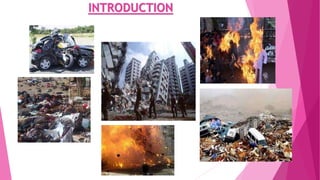
INTRODUCTION
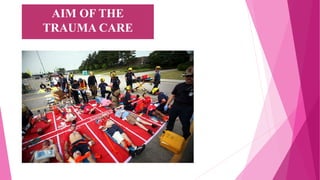
AIM OF THE
TRAUMA CARE
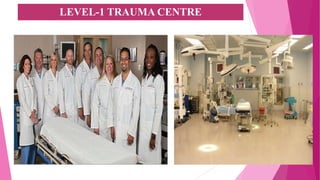
LEVEL-1 TRAUMA CENTRE
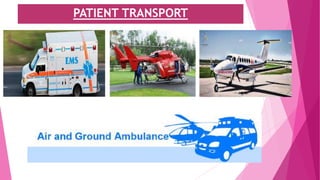
PATIENT TRANSPORT
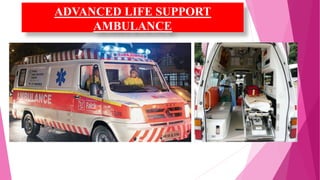
ADVANCED LIFE SUPPORT
AMBULANCE
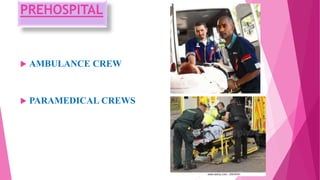
PREHOSPITAL
 AMBULANCE CREW
 PARAMEDICAL CREWS
POLAROID CAMERA
 USED FOR TAKING VISUSAL
PICTURE OF THE SCENE
CARRYING ENORMOUS VALUE IN
ASSISTING THE INDEX OF
SUSPICION OF INJURIES WHICH
MAY HAVE OCCURRED.
 THE PHOTOGRAPH COMES
ALONG WITH THE PATIENT.
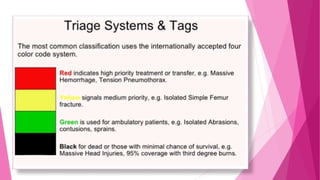
TRIAGE
• Triage is the sorting of patients based in the need for treatment
and the available resources to provide that treatment.
• Triage is the term derived from the French verb trier meaning
‘to sort’ or ‘to choose’
• Aids in seamless trauma care
AIM
 It’s the process by which patients are classified according to
the type and urgency of their conditions to get the
Right patient to the
Right place at the
Right time with the
Right care provider
 To treat the patients in the order of their clinical urgency
appropriately and timely
GOALS
1. Rapidly identify patients with urgent life threatening conditions
2. Assess/ determine severity and acuity of the problem
3. Ensuring that the patients are being treated in order of clinical
emergency
4. Ensuring that the treatment is appropriate and timely
5. Reevaluating the patients who are who are in waiting area
• Provide continued assessment and
reassessment of arriving and waiting
patients.
• Provide information and referrals to
patients and families.
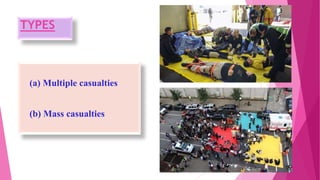
TYPES
(a) Multiple casualties
(b) Mass casualties
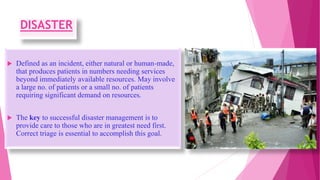
DISASTER
 Defined as an incident, either natural or human-made,
that produces patients in numbers needing services
beyond immediately available resources. May involve
a large no. of patients or a small no. of patients
requiring significant demand on resources.
 The key to successful disaster management is to
provide care to those who are in greatest need first.
Correct triage is essential to accomplish this goal.
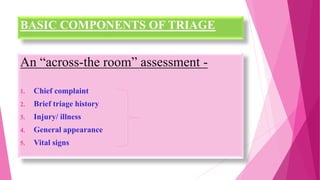
BASIC COMPONENTS OF TRIAGE
An “across-the room” assessment -
1. Chief complaint
2. Brief triage history
3. Injury/ illness
4. General appearance
5. Vital signs
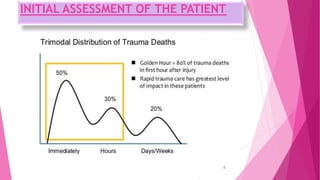
INITIAL ASSESSMENT OF THE PATIENT
 DEATH AT SCENE: Brain stem injury, airway obstruction, heart
of major vessel injury
 Early death: Airway obstruction, tension pneumothorax, cardiac
tamponade, fail chest, uncontrolled blood loss/hypovolemic shock
 Late deaths: Multiple organ failure, respiratory distress, sepsis
 KEEPING ALL THE FACTORS IN MIND DURING
ASSESSMENT TRANPORT OF PATIENTS SHOULD BE
DONE TO SAVE MAXIMUM NUMBER OF LIVES
SCORING SYSTEMS
Prehospital trauma scoring may be helpful in
determining which patients are to be transported to
trauma center
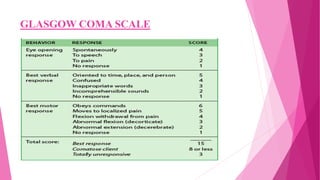
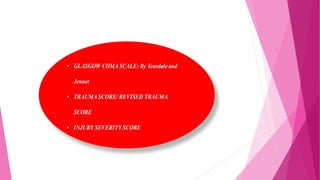
GLASGOW COMA SCALE
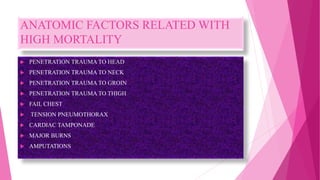
ANATOMIC FACTORS RELATED WITH
HIGH MORTALITY
 PENETRATION TRAUMA TO HEAD
 PENETRATION TRAUMA TO NECK
 PENETRATION TRAUMA TO GROIN
 PENETRATION TRAUMA TO THIGH
 FAIL CHEST
 TENSION PNEUMOTHORAX
 CARDIAC TAMPONADE
 MAJOR BURNS
 AMPUTATIONS
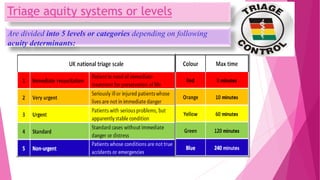
Are divided into 5 levels or categories depending on following
acuity determinants:
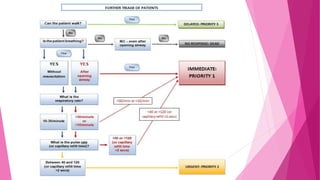
High-priority patients include those with any
of the following conditions:
 Difficulty breathing
 Poor general impression
 Unresponsive with no gag or cough reflex
 Severe chest pain
 Pale skin or other signs of poor perfusion
 Uncontrolled bleeding
 Responsive but unable to follow commands
 Severe pain in any area of the body
 Inability to move any part of the body
Transport decisions should be made at this
point, based on:
 Patient’s condition
 Availability of advanced care
 Distance of transport
 Provide rapid transport for pregnant patients who:
Have significant bleeding and pain
Are hypertensive
Have an altered mental status
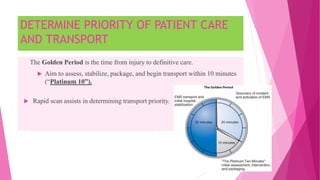
DETERMINE PRIORITY OF PATIENT CARE
AND TRANSPORT
The Golden Period is the time from injury to definitive care.
 Aim to assess, stabilize, package, and begin transport within 10 minutes
(“Platinum 10”).
 Rapid scan assists in determining transport priority.
CULTURAL VALUE CONSIDERATIONS
 Some cultures may not permit a male health care
provider to assess or examine a female patient.
 Respect these differences and honor requests from
the patient.
 A competent, rational adult has the right to refuse all
or any part of your assessment or care.
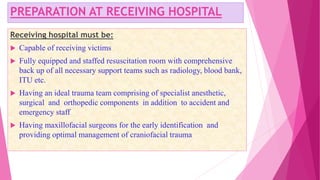
PREPARATION AT RECEIVING HOSPITAL
Receiving hospital must be:
 Capable of receiving victims
 Fully equipped and staffed resuscitation room with comprehensive
back up of all necessary support teams such as radiology, blood bank,
ITU etc.
 Having an ideal trauma team comprising of specialist anesthetic,
surgical and orthopedic components in addition to accident and
emergency staff
 Having maxillofacial surgeons for the early identification and
providing optimal management of craniofacial trauma
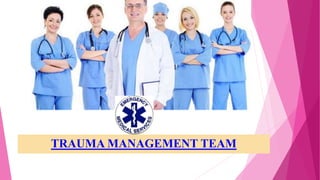
TRAUMA MANAGEMENT TEAM
TRAUMA TEAM
 All the members should put on protective clothing
 All the members should be immunized against tetanus and hepatitis B
virus
 Staff who undress the patients should initially wear more robust gloves
 Team leader should brief the team and assign specific duties about
airway and circulation
 No more than six people should be touching the patient at a time
 A final check on the equipments should be made by an assigned
team member
 Once the patient arrives the resuscitation room the patient should
be transferred from stretcher to the trolley in a co-ordinated
fashion to avoid injury to the spinal column and then further
assessment and management should be provided
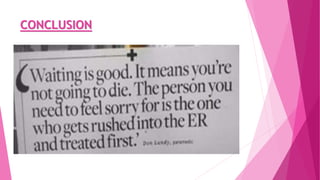
CONCLUSION
REFERENCES
 FONSECA (ORALAND MAXILLOFACIAL TRAUMA) VOLUME -1
 PETER WARD BOOTH( FACIAL TRAUMAAND ESTHETICS)
 DAVIDONS’S PRINCILPLES & PRACTICE OF MEDICINE
Triage final

Triage final

  • 2.
  • 3.
    CONTENTS  INTRODUCTION  AIMOF THE TRAUMA CARE  LEVEL-1 TRAUMA CENTRE  PATIENT TRANSPORT MEANS  PREHOSPITAL  TRIAGE:  AIM  GOALS  TYPES  TRIAGE AQUITY SYSTEMS  BASIC COMPONENTS OF TRIAGE  CULTURAL VALUE CONSIDERATIONS  DETERMINE PRIORITY OF PATIENT CARE AND TRANSPORT  TRAUMA MANAGEMENT TEAM
  • 4.
  • 5.
  • 6.
  • 7.
  • 8.
  • 9.
  • 10.
    POLAROID CAMERA  USEDFOR TAKING VISUSAL PICTURE OF THE SCENE CARRYING ENORMOUS VALUE IN ASSISTING THE INDEX OF SUSPICION OF INJURIES WHICH MAY HAVE OCCURRED.  THE PHOTOGRAPH COMES ALONG WITH THE PATIENT.
  • 11.
    TRIAGE • Triage isthe sorting of patients based in the need for treatment and the available resources to provide that treatment. • Triage is the term derived from the French verb trier meaning ‘to sort’ or ‘to choose’ • Aids in seamless trauma care
  • 12.
    AIM  It’s theprocess by which patients are classified according to the type and urgency of their conditions to get the Right patient to the Right place at the Right time with the Right care provider  To treat the patients in the order of their clinical urgency appropriately and timely
  • 13.
    GOALS 1. Rapidly identifypatients with urgent life threatening conditions 2. Assess/ determine severity and acuity of the problem 3. Ensuring that the patients are being treated in order of clinical emergency 4. Ensuring that the treatment is appropriate and timely 5. Reevaluating the patients who are who are in waiting area
  • 14.
    • Provide continuedassessment and reassessment of arriving and waiting patients. • Provide information and referrals to patients and families.
  • 15.
  • 16.
    DISASTER  Defined asan incident, either natural or human-made, that produces patients in numbers needing services beyond immediately available resources. May involve a large no. of patients or a small no. of patients requiring significant demand on resources.  The key to successful disaster management is to provide care to those who are in greatest need first. Correct triage is essential to accomplish this goal.
  • 17.
    BASIC COMPONENTS OFTRIAGE An “across-the room” assessment - 1. Chief complaint 2. Brief triage history 3. Injury/ illness 4. General appearance 5. Vital signs
  • 18.
  • 19.
     DEATH ATSCENE: Brain stem injury, airway obstruction, heart of major vessel injury  Early death: Airway obstruction, tension pneumothorax, cardiac tamponade, fail chest, uncontrolled blood loss/hypovolemic shock  Late deaths: Multiple organ failure, respiratory distress, sepsis  KEEPING ALL THE FACTORS IN MIND DURING ASSESSMENT TRANPORT OF PATIENTS SHOULD BE DONE TO SAVE MAXIMUM NUMBER OF LIVES
  • 20.
    SCORING SYSTEMS Prehospital traumascoring may be helpful in determining which patients are to be transported to trauma center
  • 21.
  • 23.
    ANATOMIC FACTORS RELATEDWITH HIGH MORTALITY  PENETRATION TRAUMA TO HEAD  PENETRATION TRAUMA TO NECK  PENETRATION TRAUMA TO GROIN  PENETRATION TRAUMA TO THIGH  FAIL CHEST  TENSION PNEUMOTHORAX  CARDIAC TAMPONADE  MAJOR BURNS  AMPUTATIONS
  • 25.
    Are divided into5 levels or categories depending on following acuity determinants:
  • 27.
    High-priority patients includethose with any of the following conditions:  Difficulty breathing  Poor general impression  Unresponsive with no gag or cough reflex  Severe chest pain  Pale skin or other signs of poor perfusion  Uncontrolled bleeding  Responsive but unable to follow commands  Severe pain in any area of the body  Inability to move any part of the body
  • 28.
    Transport decisions shouldbe made at this point, based on:  Patient’s condition  Availability of advanced care  Distance of transport  Provide rapid transport for pregnant patients who: Have significant bleeding and pain Are hypertensive Have an altered mental status
  • 29.
    DETERMINE PRIORITY OFPATIENT CARE AND TRANSPORT The Golden Period is the time from injury to definitive care.  Aim to assess, stabilize, package, and begin transport within 10 minutes (“Platinum 10”).  Rapid scan assists in determining transport priority.
  • 30.
    CULTURAL VALUE CONSIDERATIONS Some cultures may not permit a male health care provider to assess or examine a female patient.  Respect these differences and honor requests from the patient.  A competent, rational adult has the right to refuse all or any part of your assessment or care.

  • 31.
    PREPARATION AT RECEIVINGHOSPITAL Receiving hospital must be:  Capable of receiving victims  Fully equipped and staffed resuscitation room with comprehensive back up of all necessary support teams such as radiology, blood bank, ITU etc.  Having an ideal trauma team comprising of specialist anesthetic, surgical and orthopedic components in addition to accident and emergency staff  Having maxillofacial surgeons for the early identification and providing optimal management of craniofacial trauma
  • 32.
  • 33.
    TRAUMA TEAM  Allthe members should put on protective clothing  All the members should be immunized against tetanus and hepatitis B virus  Staff who undress the patients should initially wear more robust gloves  Team leader should brief the team and assign specific duties about airway and circulation
  • 34.
     No morethan six people should be touching the patient at a time  A final check on the equipments should be made by an assigned team member  Once the patient arrives the resuscitation room the patient should be transferred from stretcher to the trolley in a co-ordinated fashion to avoid injury to the spinal column and then further assessment and management should be provided
  • 35.
  • 36.
    REFERENCES  FONSECA (ORALANDMAXILLOFACIAL TRAUMA) VOLUME -1  PETER WARD BOOTH( FACIAL TRAUMAAND ESTHETICS)  DAVIDONS’S PRINCILPLES & PRACTICE OF MEDICINE