
Public
Spend Analysis: What Your Data Is Telling You and
Why It’s Worth Listening
Eric Verschut – Aegon N.V
Anders Dahlberg – Boliden AB
June 14, 2016
© 2016 SAP SE or an SAP affiliate company. All rights reserved. 2Public
Important information
This information reflects the status of SAP Ariba solution planning as of June 2016. All such
information is the Confidential Information of SAP Ariba (per the contract between our companies),
and must not be further disclosed, as stated in the confidentiality clause of that contract. This
presentation contains only intended guidance and is not binding upon SAP Ariba to any particular
course of business, product strategy, and/or development. Its content is subject to change without
notice. SAP Ariba assumes no responsibility for errors or omissions in this document. SAP Ariba
shall have no liability for damages of any kind including without limitation direct, special, indirect,
or consequential damages that may result from the use of these materials.
© 2016 SAP SE or an SAP affiliate company. All rights reserved. 3Public
Agenda
Overview and introductions
Panel presentations
 Eric Verschut – Global Lead Procurement, Aegon N.V
 Anders Dahlberg – Procurement Analyst, Boliden AB
Q&A
3Public© 2016 SAP SE or an SAP affiliate company. All rights reserved. 3Public
Overview and introductions
© 2016 SAP SE or an SAP affiliate company. All rights reserved. 5Public
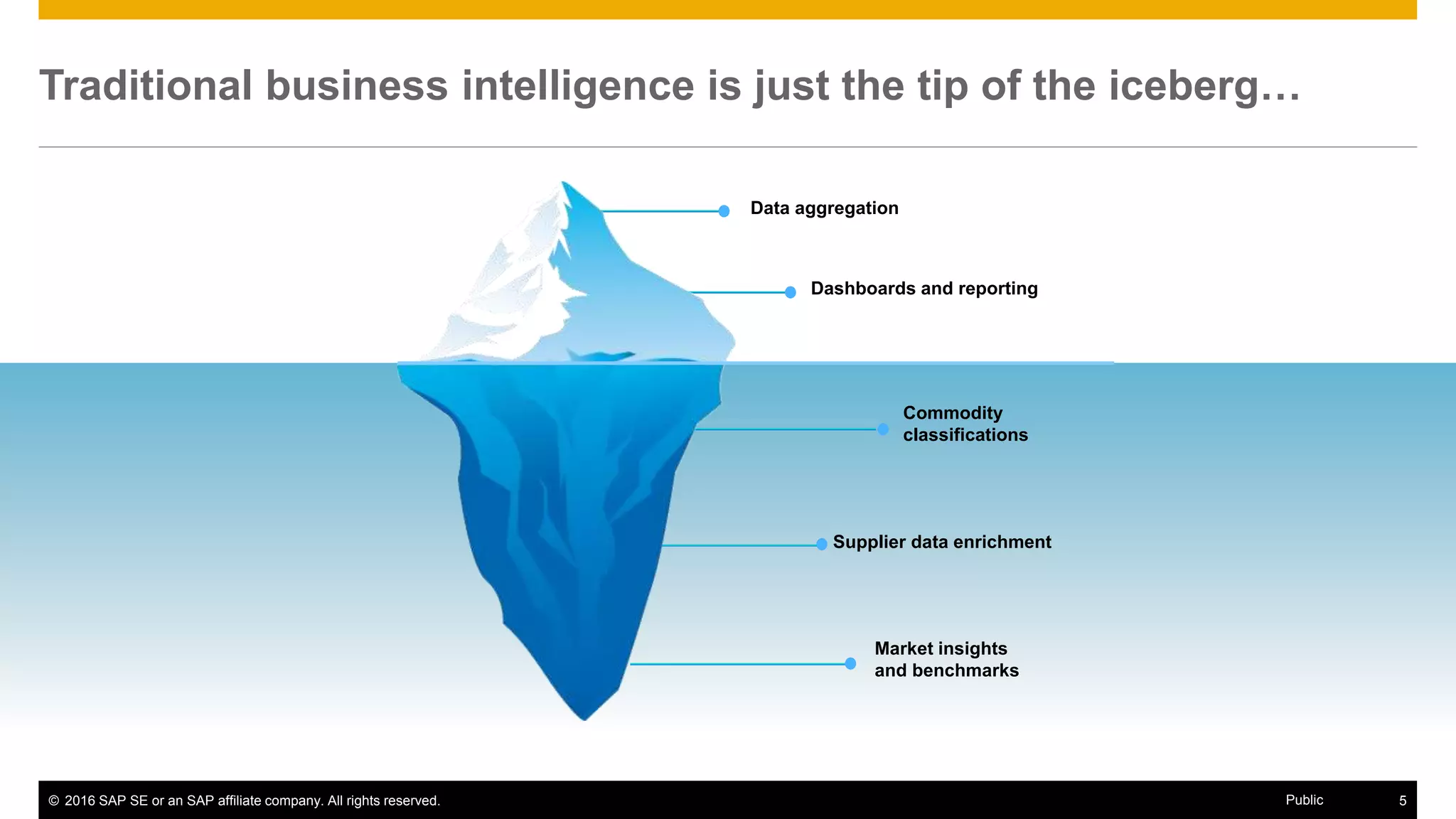
Data aggregation
Dashboards and reporting
Traditional business intelligence is just the tip of the iceberg…
Commodity
classifications
Supplier data enrichment
Market insights
and benchmarks
© 2016 SAP SE or an SAP affiliate company. All rights reserved. 6Public
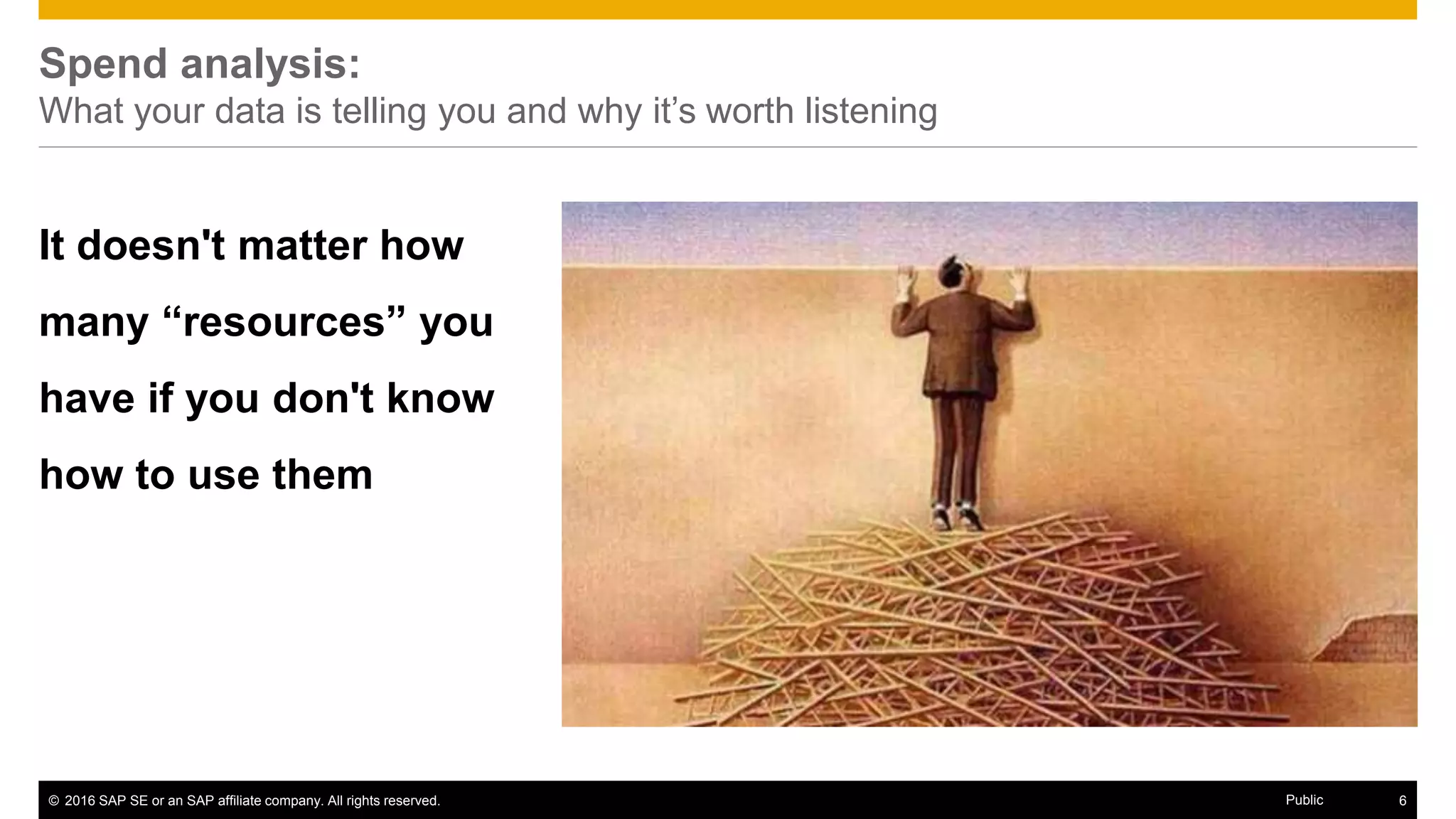
Spend analysis:
What your data is telling you and why it’s worth listening
It doesn't matter how
many “resources” you
have if you don't know
how to use them
© 2016 SAP SE or an SAP affiliate company. All rights reserved. 7Public
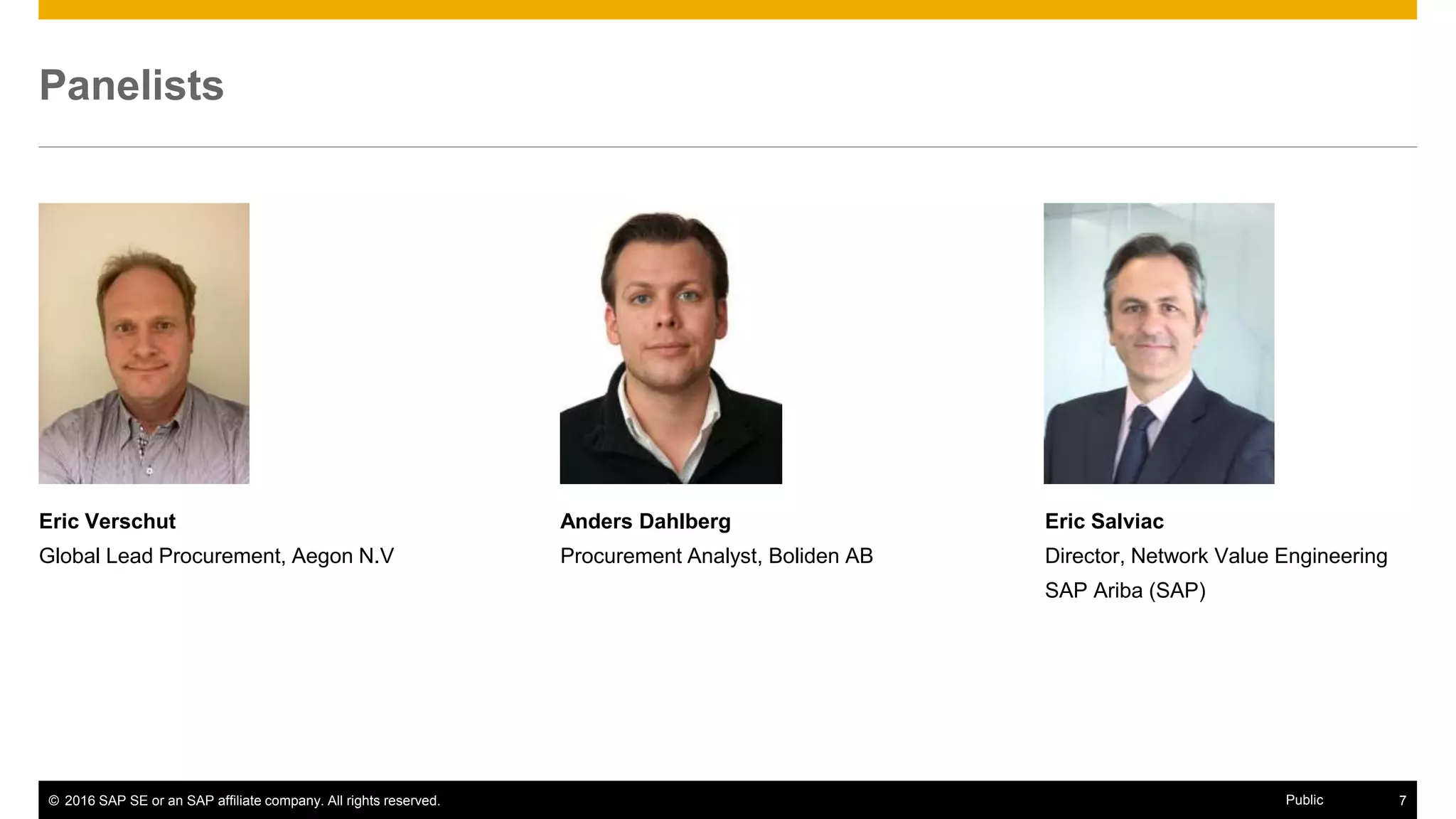
Panelists
Eric Verschut
Global Lead Procurement, Aegon N.V
Anders Dahlberg
Procurement Analyst, Boliden AB
Panel Presentations
Eric Verschut – Global Lead Procurement, Aegon N.V
Eric Verschut
SAP Ariba Live
Aegon’s journey
to Spend Visibility
Madrid, June 2016
10
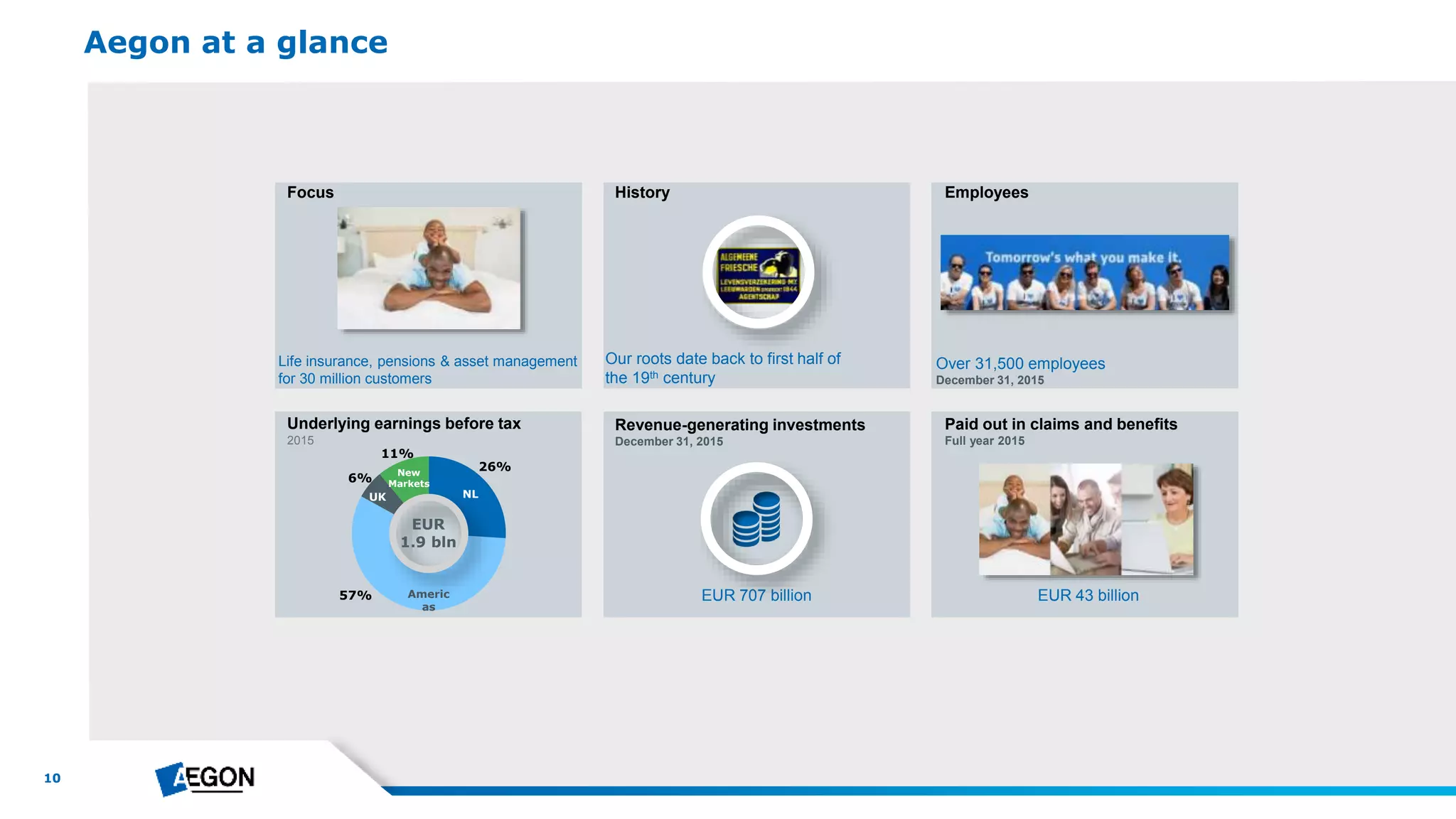
Aegon at a glance
Focus
Life insurance, pensions & asset management
for 30 million customers
Our roots date back to first half of
the 19th century
History Employees
Over 31,500 employees
December 31, 2015
Revenue-generating investments
December 31, 2015
EUR 707 billion EUR 43 billion
Paid out in claims and benefits
Full year 2015
Underlying earnings before tax
2015
26%
57%
6%
11%
Americ
as
NLUK
New
Markets
EUR
1.9 bln
11
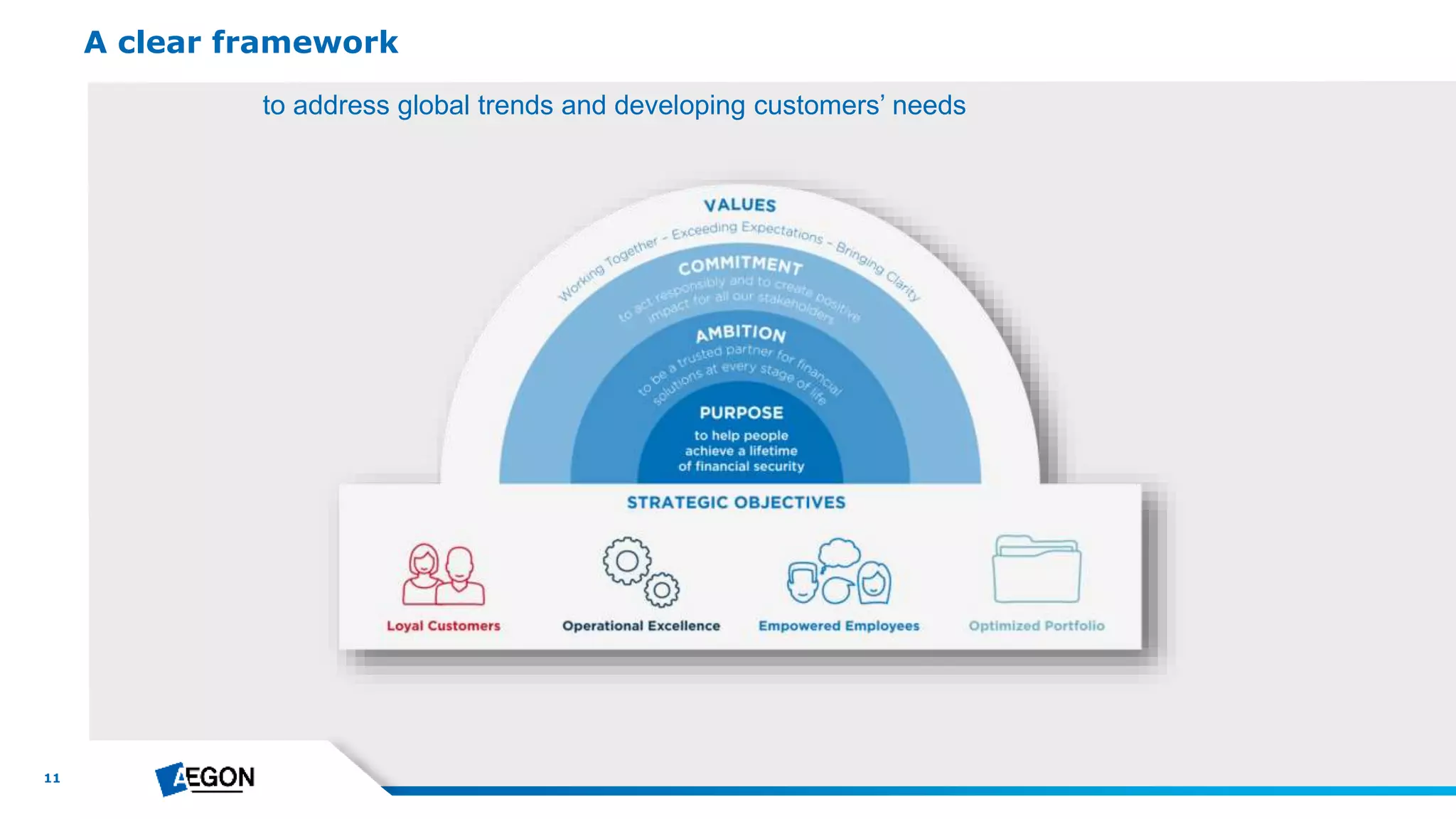
A clear framework
to address global trends and developing customers’ needs
12
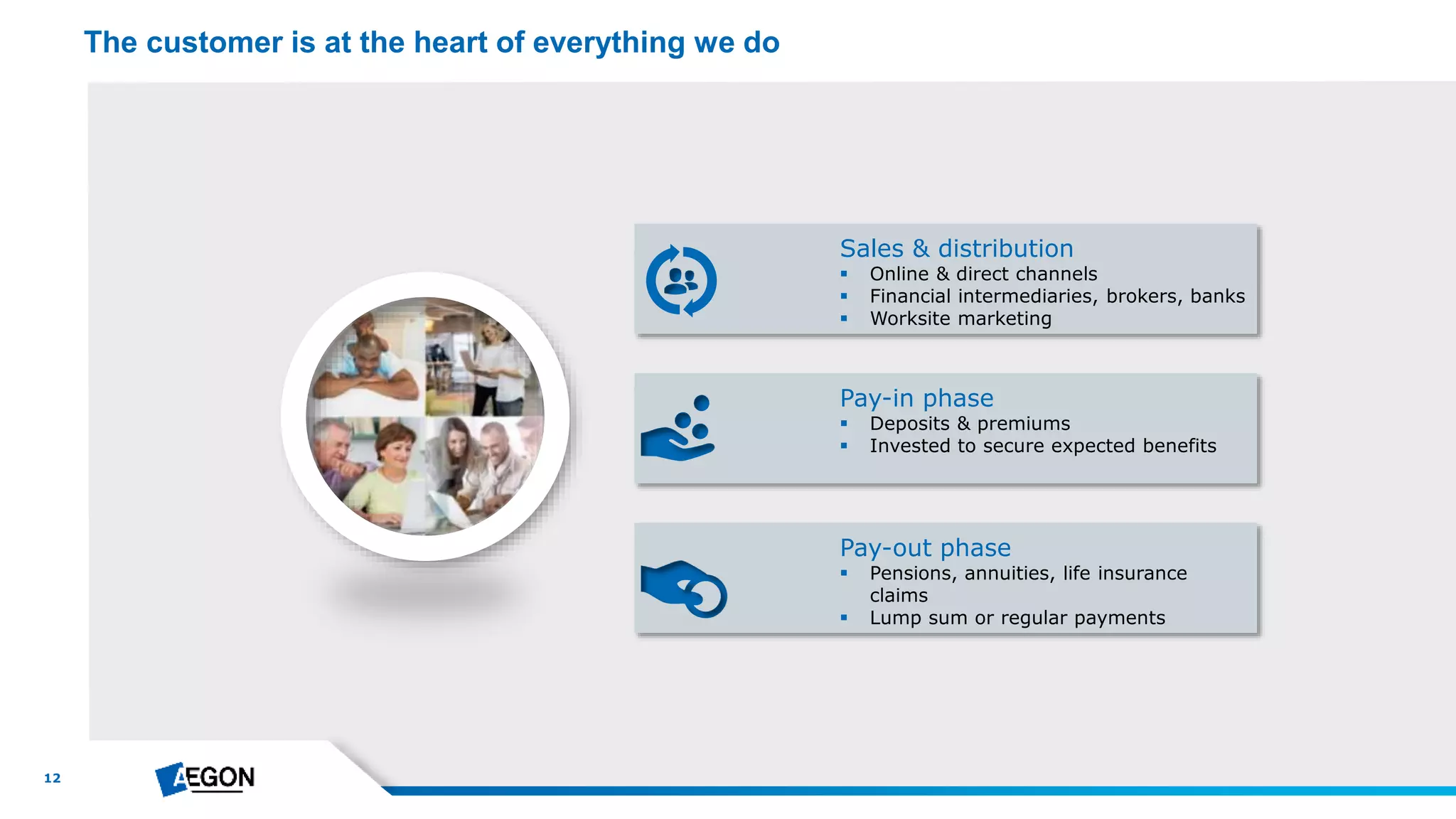
The customer is at the heart of everything we do
Sales & distribution
 Online & direct channels
 Financial intermediaries, brokers, banks
 Worksite marketing
Pay-in phase
 Deposits & premiums
 Invested to secure expected benefits
Pay-out phase
 Pensions, annuities, life insurance
claims
 Lump sum or regular payments
13
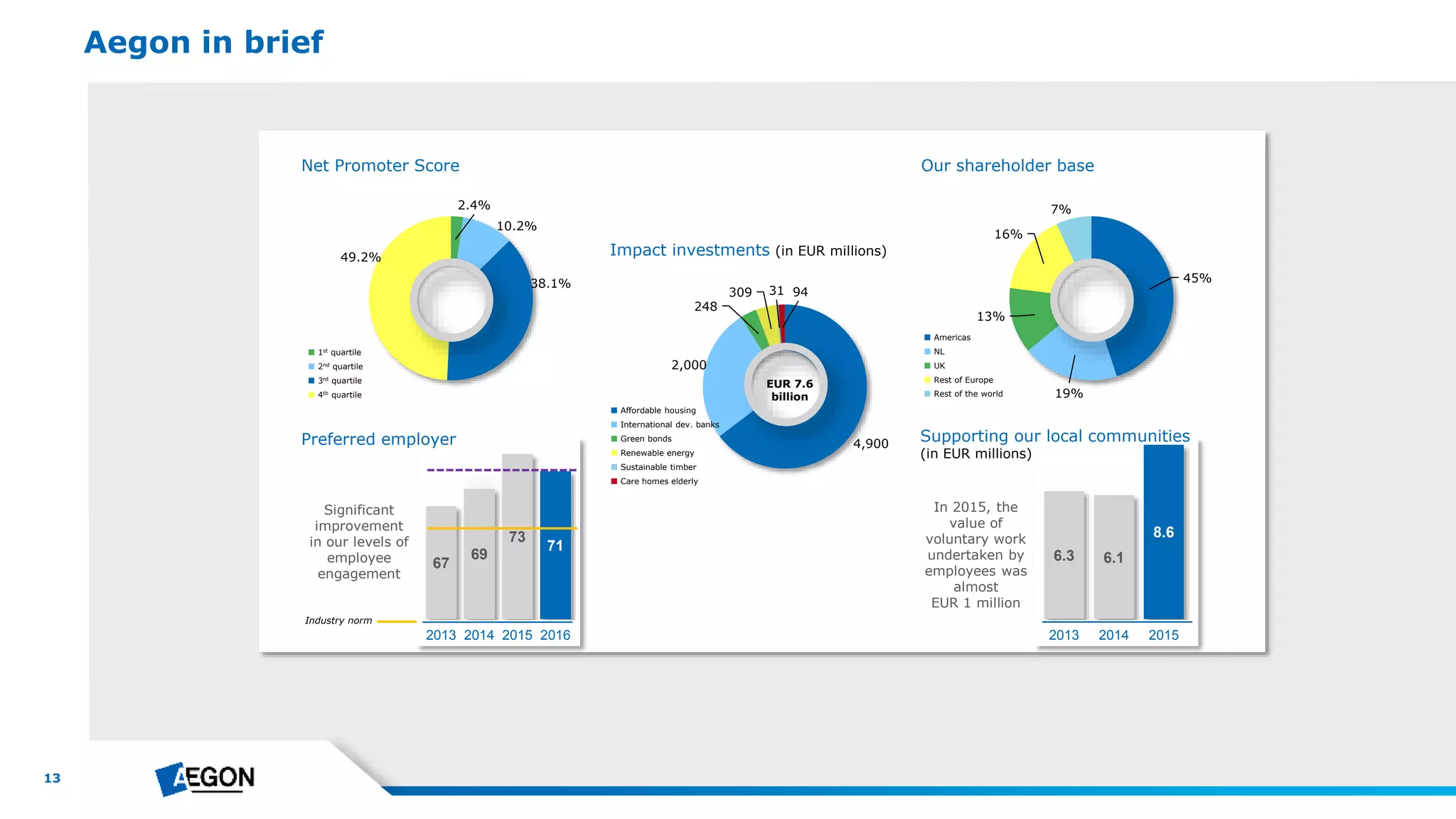
4,900
2,000
248
309 31 94
 Americas
 NL
 UK
 Rest of Europe
 Rest of the world
67
69
73
71
2013 2014 2015 2016
Aegon in brief
2.4%
10.2%
38.1%
49.2%
Net Promoter Score
Impact investments (in EUR millions)
Our shareholder base
Preferred employer Supporting our local communities
(in EUR millions)
 Affordable housing
 International dev. banks
 Green bonds
 Renewable energy
 Sustainable timber
 Care homes elderly
 1st quartile
 2nd quartile
 3rd quartile
 4th quartile
Significant
improvement
in our levels of
employee
engagement
6.3 6.1
8.6
2013 2014 2015
In 2015, the
value of
voluntary work
undertaken by
employees was
almost
EUR 1 million
45%
19%
13%
16%
7%
EUR 7.6
billion
Industry norm
1414
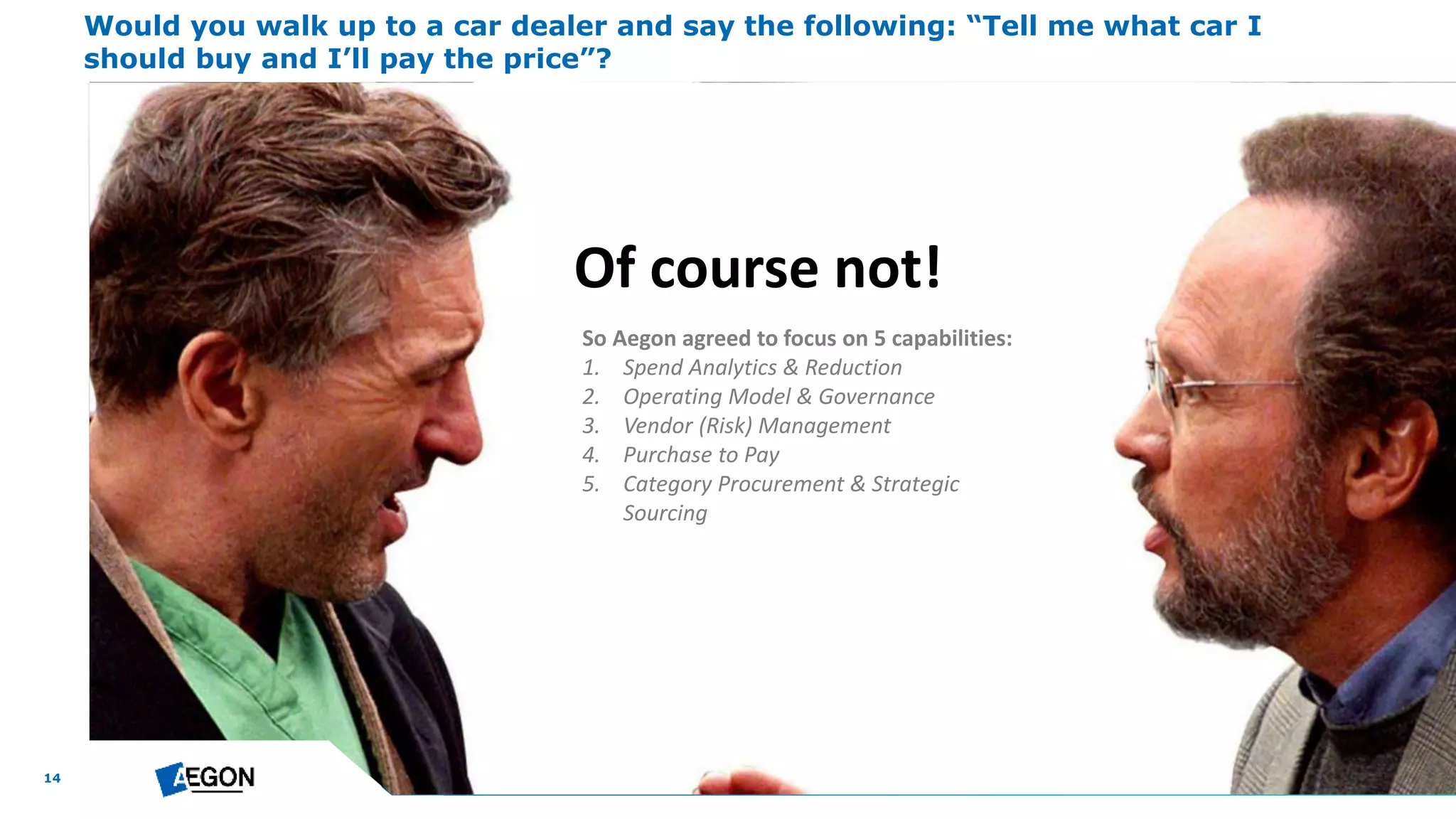
Would you walk up to a car dealer and say the following: “Tell me what car I
should buy and I’ll pay the price”?
Of course not!
So we need to:
1. Stay on top of our game
2. Level the playing field with
suppliers
3. Find ways to extract
“additional value”
Of course not!
So Aegon agreed to focus on 5 capabilities:
1. Spend Analytics & Reduction
2. Operating Model & Governance
3. Vendor (Risk) Management
4. Purchase to Pay
5. Category Procurement & Strategic
Sourcing
15
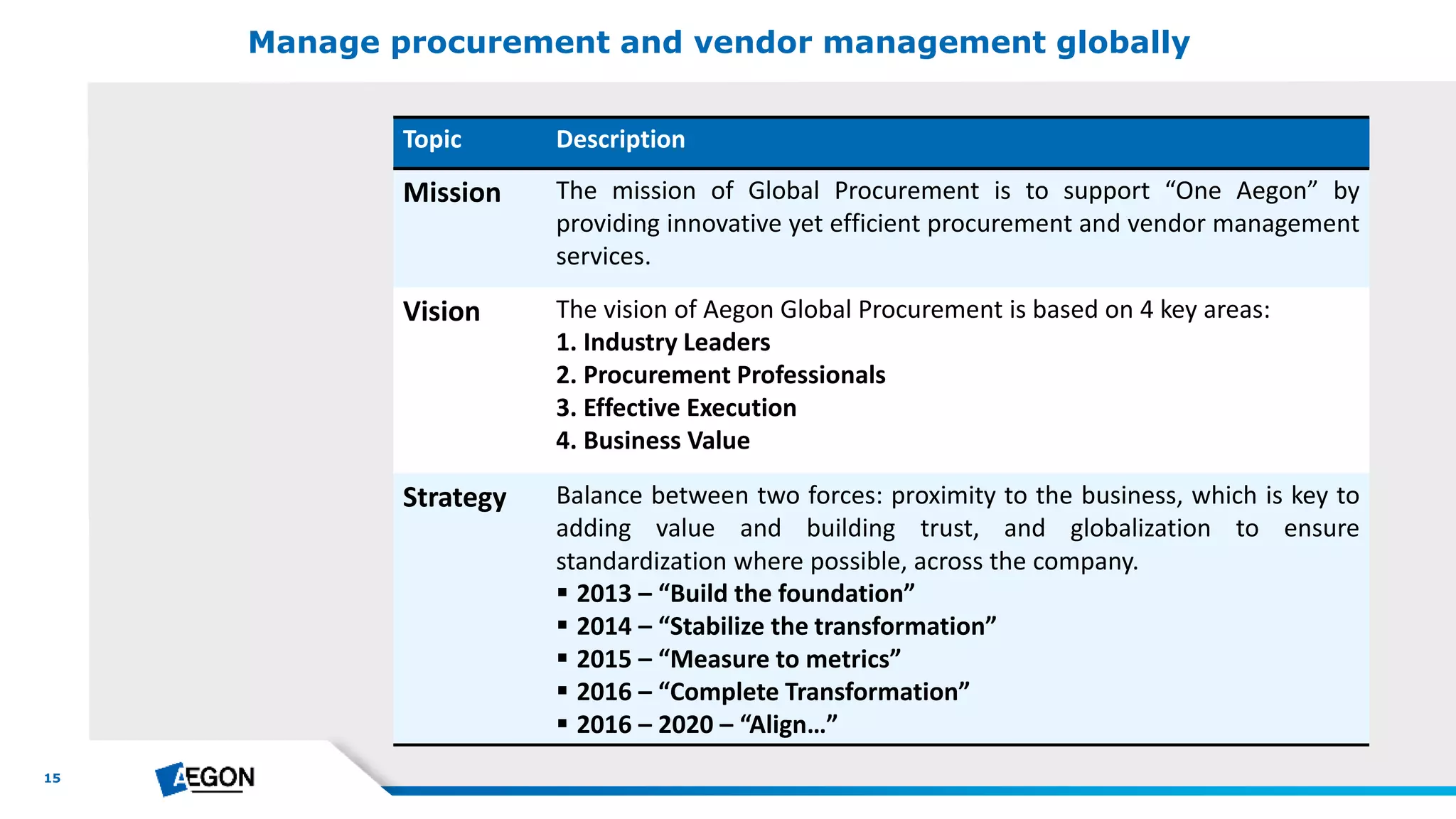
Manage procurement and vendor management globally
Topic Description
Mission The mission of Global Procurement is to support “One Aegon” by
providing innovative yet efficient procurement and vendor management
services.
Vision The vision of Aegon Global Procurement is based on 4 key areas:
1. Industry Leaders
2. Procurement Professionals
3. Effective Execution
4. Business Value
Strategy Balance between two forces: proximity to the business, which is key to
adding value and building trust, and globalization to ensure
standardization where possible, across the company.
 2013 – “Build the foundation”
 2014 – “Stabilize the transformation”
 2015 – “Measure to metrics”
 2016 – “Complete Transformation”
 2016 – 2020 – “Align…”
16
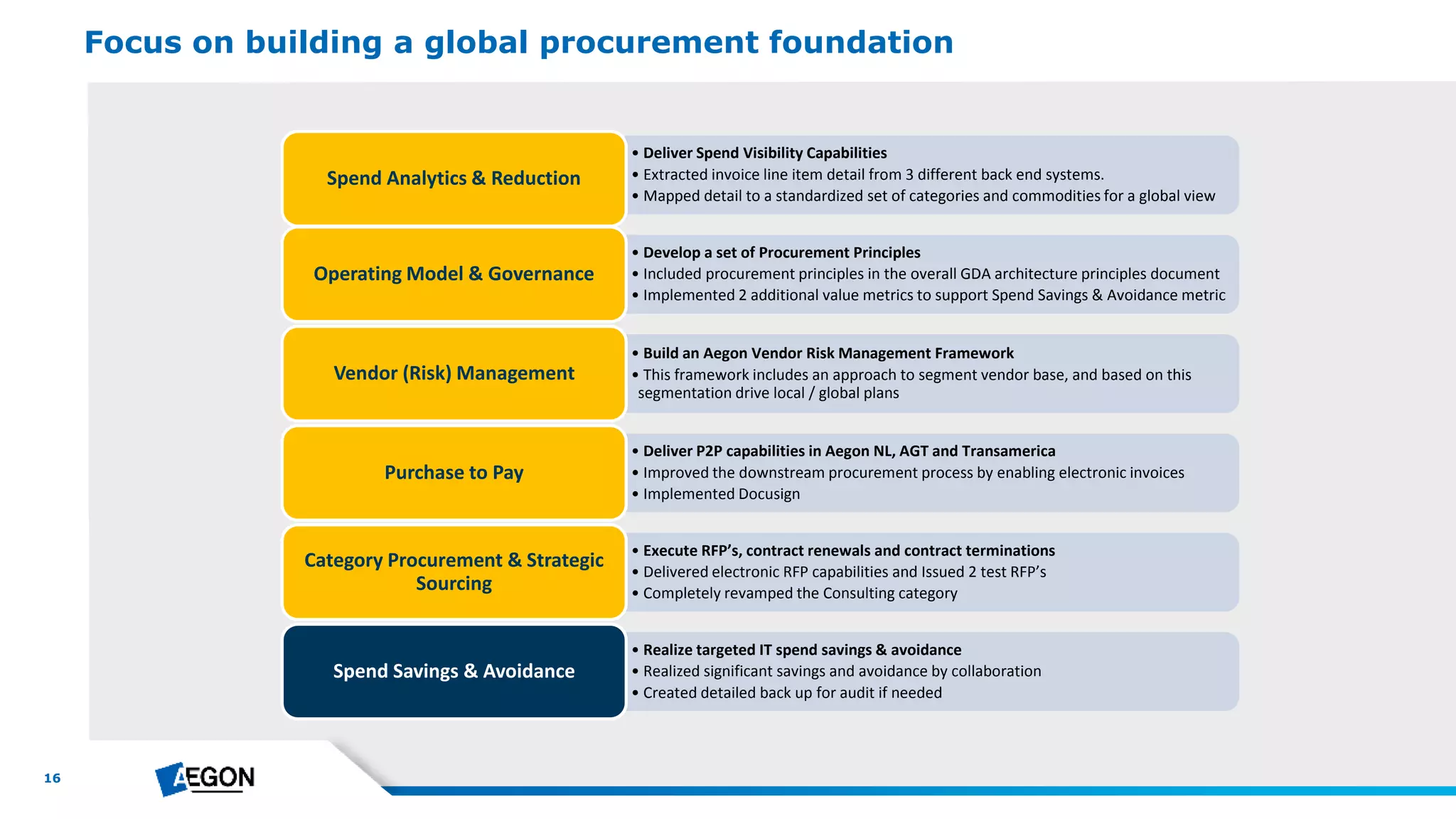
Focus on building a global procurement foundation
• Deliver Spend Visibility Capabilities
• Extracted invoice line item detail from 3 different back end systems.
• Mapped detail to a standardized set of categories and commodities for a global view
Spend Analytics & Reduction
• Develop a set of Procurement Principles
• Included procurement principles in the overall GDA architecture principles document
• Implemented 2 additional value metrics to support Spend Savings & Avoidance metric
Operating Model & Governance
• Build an Aegon Vendor Risk Management Framework
• This framework includes an approach to segment vendor base, and based on this
segmentation drive local / global plans
Vendor (Risk) Management
• Deliver P2P capabilities in Aegon NL, AGT and Transamerica
• Improved the downstream procurement process by enabling electronic invoices
• Implemented Docusign
Purchase to Pay
• Execute RFP’s, contract renewals and contract terminations
• Delivered electronic RFP capabilities and Issued 2 test RFP’s
• Completely revamped the Consulting category
Category Procurement & Strategic
Sourcing
• Realize targeted IT spend savings & avoidance
• Realized significant savings and avoidance by collaboration
• Created detailed back up for audit if needed
Spend Savings & Avoidance
17
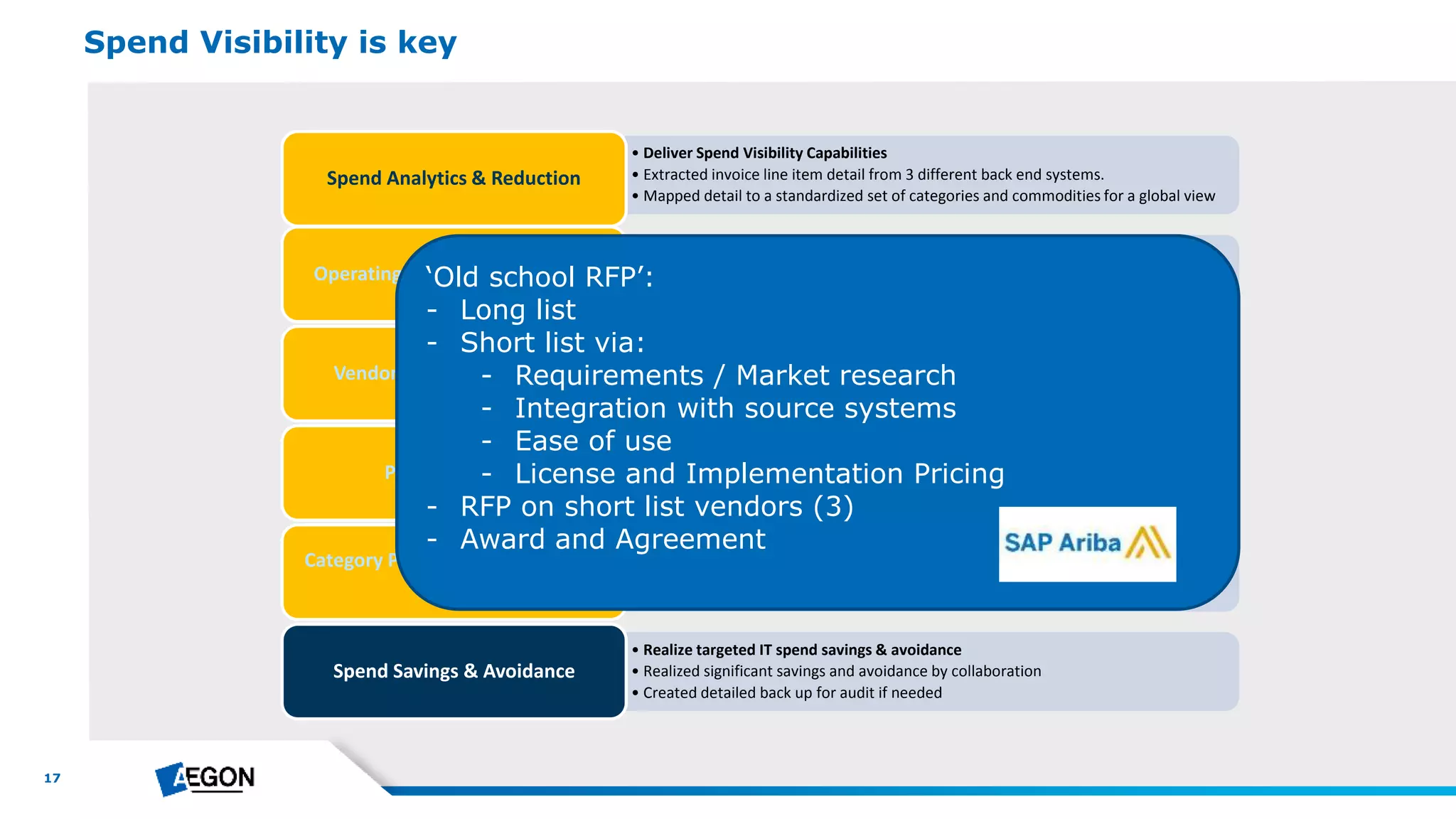
Spend Visibility is key
• Deliver Spend Visibility Capabilities
• Extracted invoice line item detail from 3 different back end systems.
• Mapped detail to a standardized set of categories and commodities for a global view
Spend Analytics & Reduction
• Develop a set of Procurement Principles
• Included procurement principles in the overall GDA architecture principles document
• Implemented 2 additional value metrics to support Spend Savings & Avoidance metric
Operating Model & Governance
• Build an Aegon Vendor Risk Management Framework
• This framework includes an approach to segment vendor base, and based on this
segmentation drive local / global plans
Vendor (Risk) Management
• Deliver P2P capabilities in Aegon NL, AGT and Transamerica
• Improved the downstream procurement process by enabling electronic invoices
• Implemented Docusign
Purchase to Pay
• Execute RFP’s, contract renewals and contract terminations
• Delivered electronic RFP capabilities and Issued 2 test RFP’s
• Completely revamped the Consulting category
Category Procurement & Strategic
Sourcing
• Realize targeted IT spend savings & avoidance
• Realized significant savings and avoidance by collaboration
• Created detailed back up for audit if needed
Spend Savings & Avoidance
‘Old school RFP’:
- Long list
- Short list via:
- Requirements / Market research
- Integration with source systems
- Ease of use
- License and Implementation Pricing
- RFP on short list vendors (3)
- Award and Agreement
18
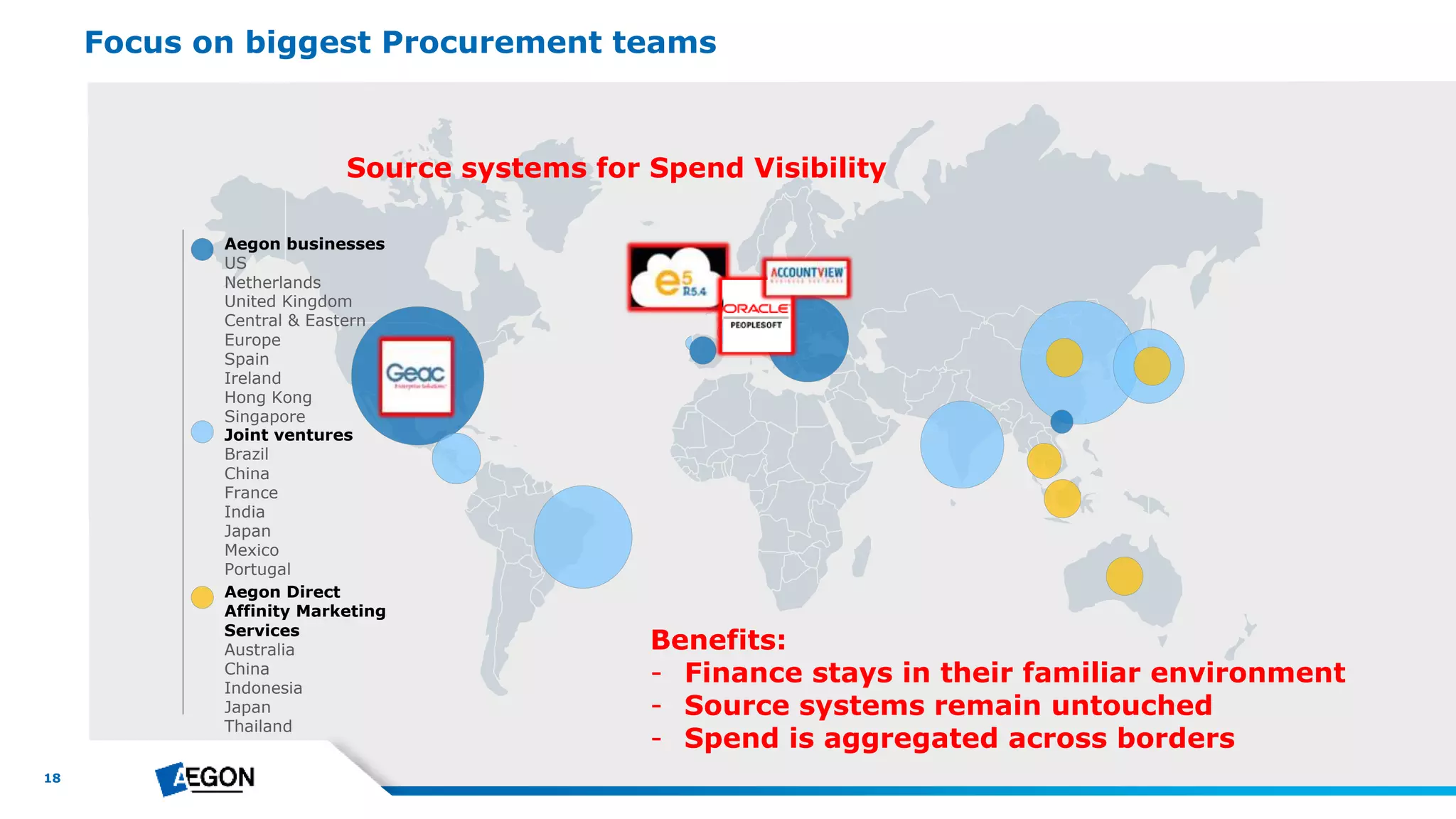
Focus on biggest Procurement teams
Aegon businesses
US
Netherlands
United Kingdom
Central & Eastern
Europe
Spain
Ireland
Hong Kong
Singapore
Joint ventures
Brazil
China
France
India
Japan
Mexico
Portugal
Aegon Direct
Affinity Marketing
Services
Australia
China
Indonesia
Japan
Thailand
Source systems for Spend Visibility
Benefits:
- Finance stays in their familiar environment
- Source systems remain untouched
- Spend is aggregated across borders
19
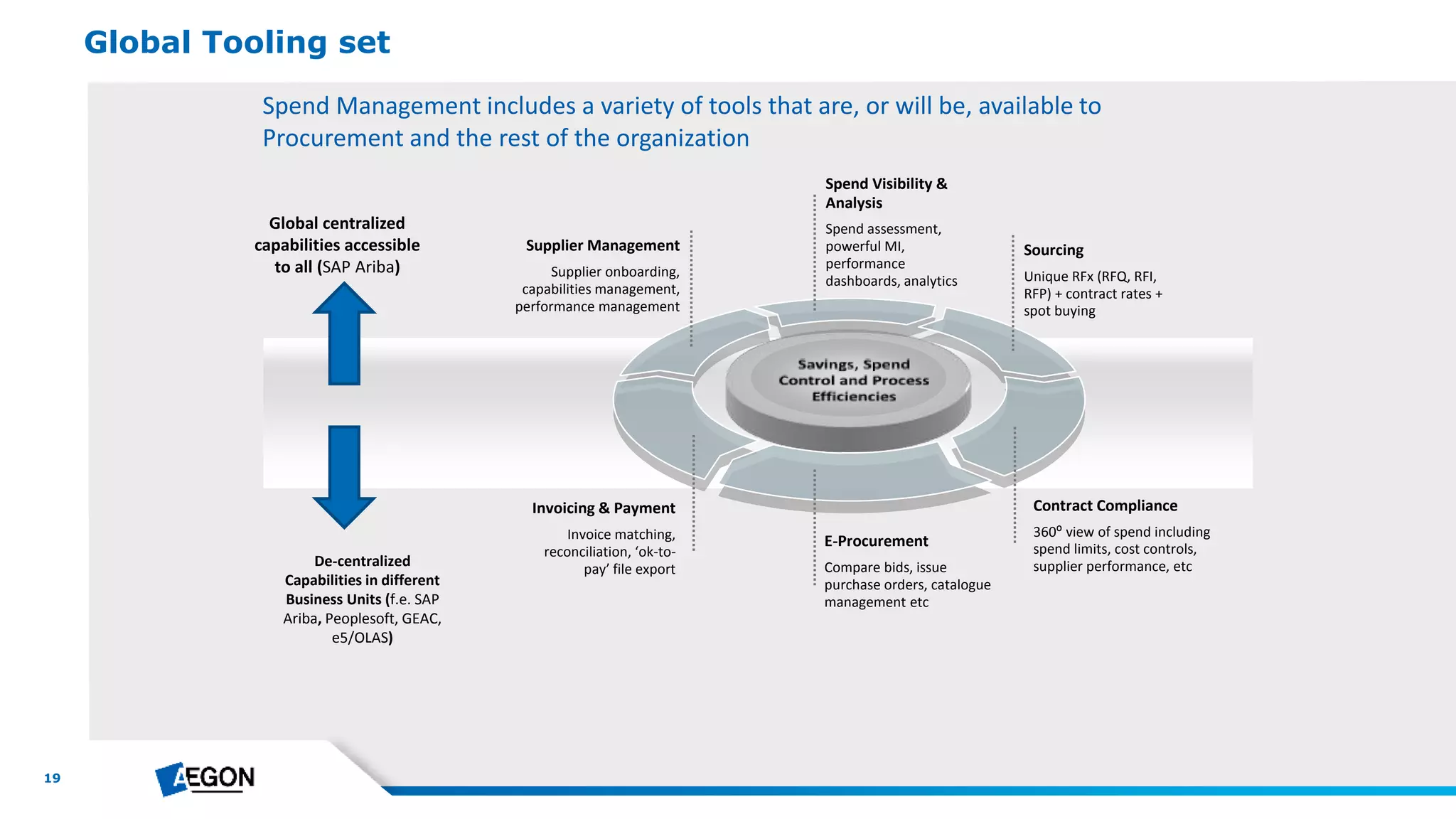
Sourcing
Unique RFx (RFQ, RFI,
RFP) + contract rates +
spot buying
Spend Visibility &
Analysis
Spend assessment,
powerful MI,
performance
dashboards, analytics
Supplier Management
Supplier onboarding,
capabilities management,
performance management
Contract Compliance
360⁰ view of spend including
spend limits, cost controls,
supplier performance, etc
Invoicing & Payment
Invoice matching,
reconciliation, ‘ok-to-
pay’ file export
E-Procurement
Compare bids, issue
purchase orders, catalogue
management etc
Global Tooling set
Global centralized
capabilities accessible
to all (SAP Ariba)
De-centralized
Capabilities in different
Business Units (f.e. SAP
Ariba, Peoplesoft, GEAC,
e5/OLAS)
Spend Management includes a variety of tools that are, or will be, available to
Procurement and the rest of the organization
20
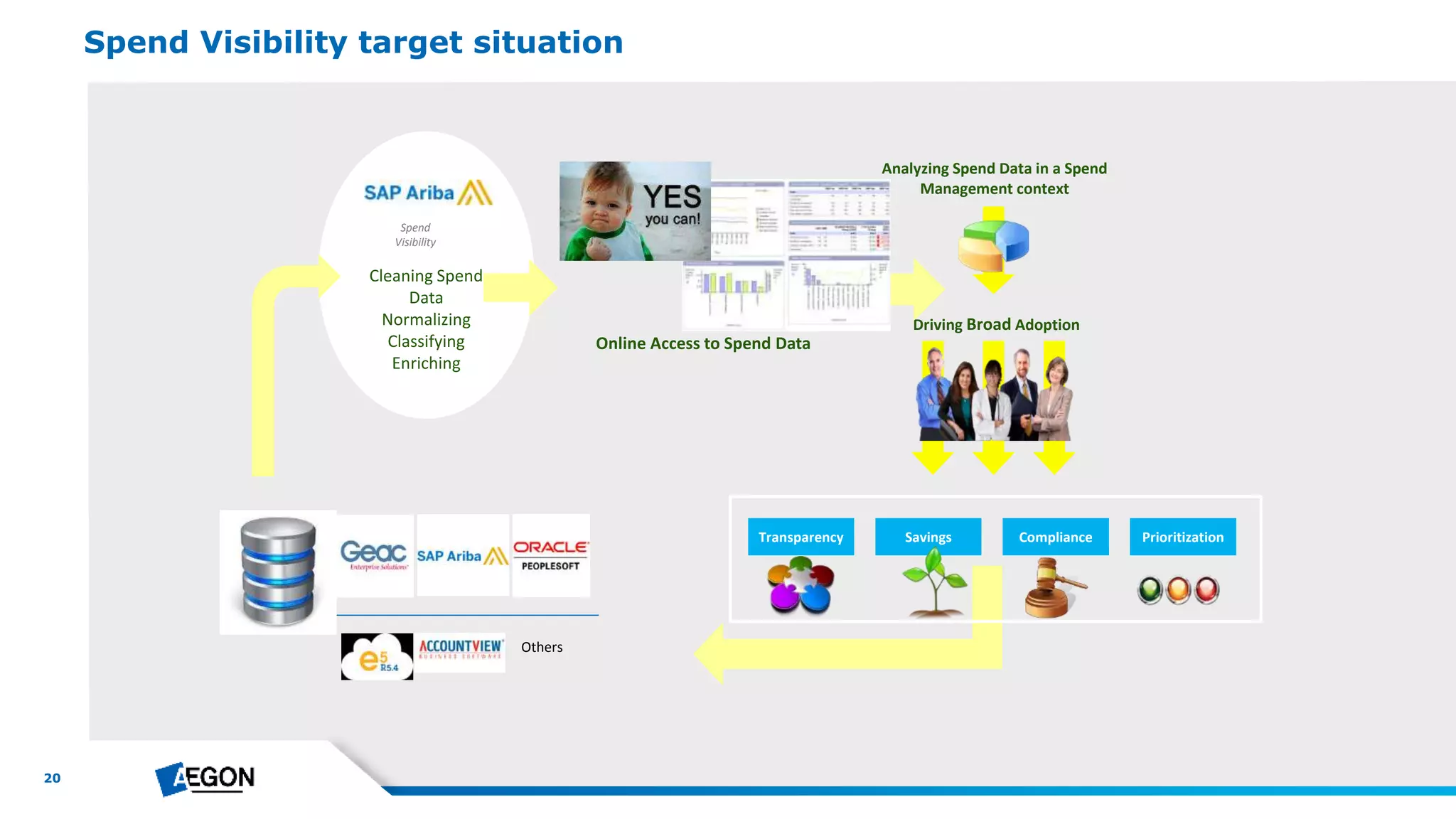
Spend Visibility target situation
Cleaning Spend
Data
Normalizing
Classifying
Enriching
Spend
Visibility
Online Access to Spend Data
Analyzing Spend Data in a Spend
Management context
Driving Broad Adoption
Transparency Savings Compliance Prioritization
Others
21
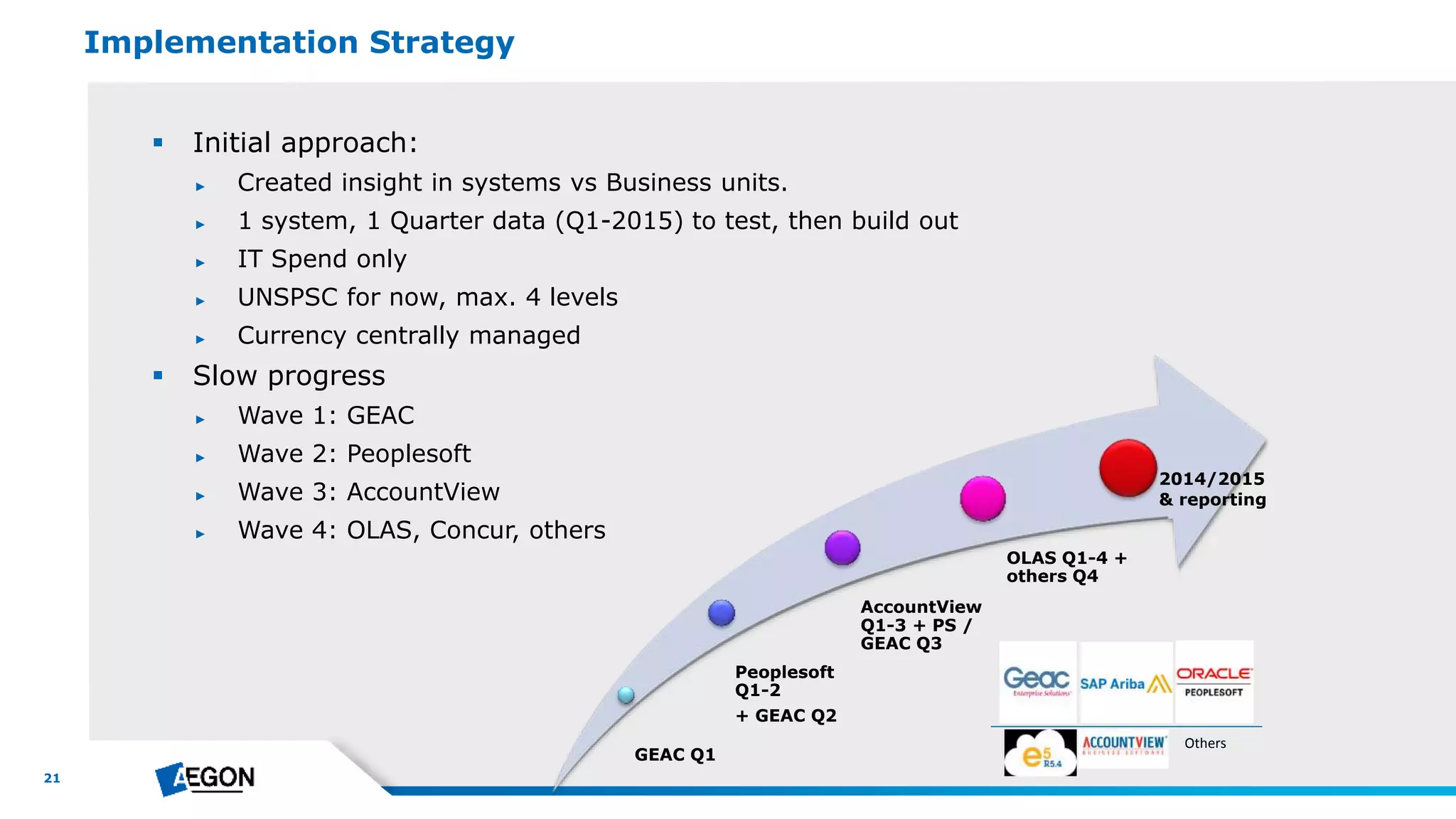
 Initial approach:
► Created insight in systems vs Business units.
► 1 system, 1 Quarter data (Q1-2015) to test, then build out
► IT Spend only
► UNSPSC for now, max. 4 levels
► Currency centrally managed
 Slow progress
► Wave 1: GEAC
► Wave 2: Peoplesoft
► Wave 3: AccountView
► Wave 4: OLAS, Concur, others
Implementation Strategy
GEAC Q1
Peoplesoft
Q1-2
+ GEAC Q2
AccountView
Q1-3 + PS /
GEAC Q3
OLAS Q1-4 +
others Q4
2014/2015
& reporting
Others
22
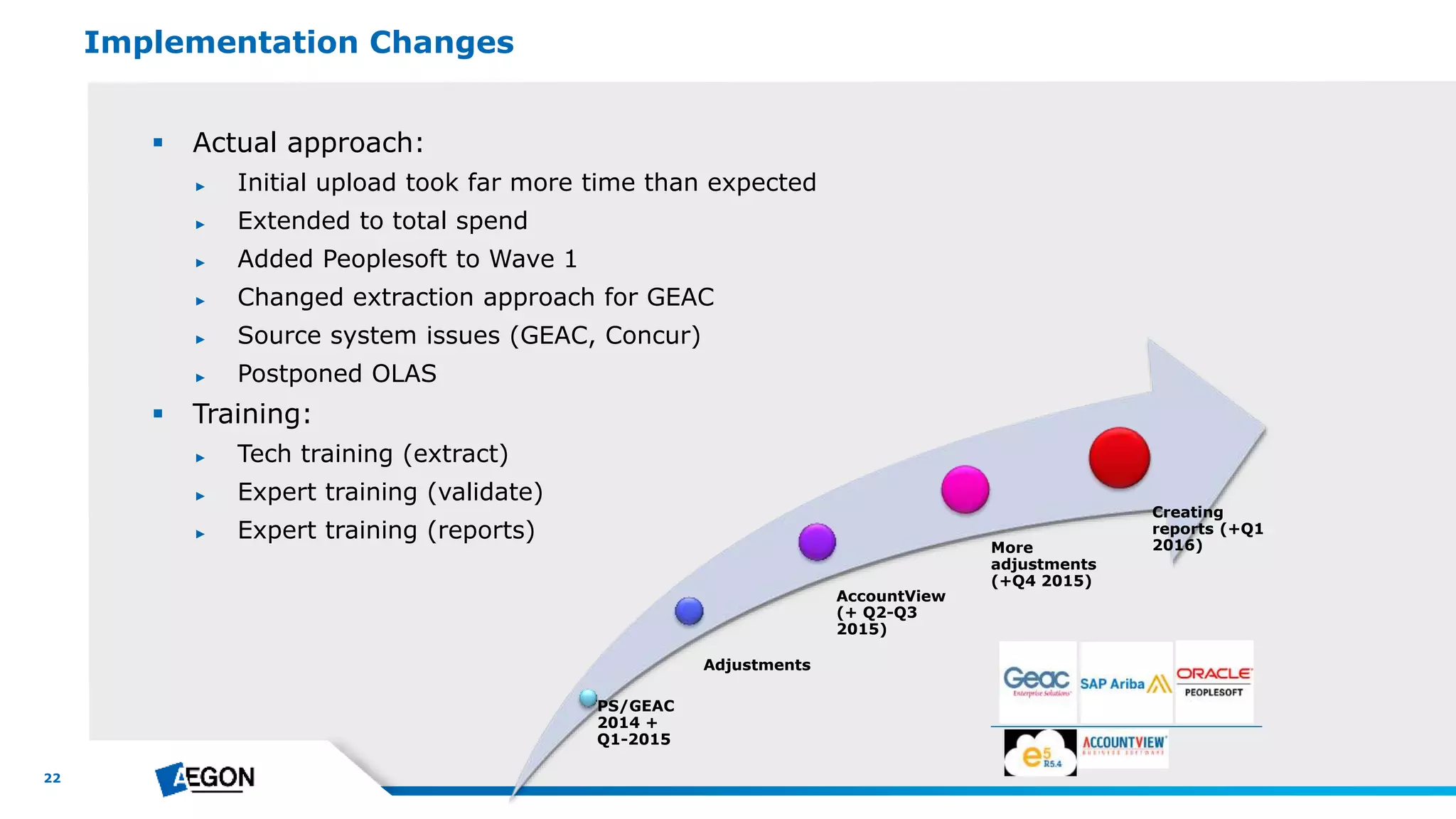
 Actual approach:
► Initial upload took far more time than expected
► Extended to total spend
► Added Peoplesoft to Wave 1
► Changed extraction approach for GEAC
► Source system issues (GEAC, Concur)
► Postponed OLAS
 Training:
► Tech training (extract)
► Expert training (validate)
► Expert training (reports)
Implementation Changes
PS/GEAC
2014 +
Q1-2015
Adjustments
AccountView
(+ Q2-Q3
2015)
More
adjustments
(+Q4 2015)
Creating
reports (+Q1
2016)
23
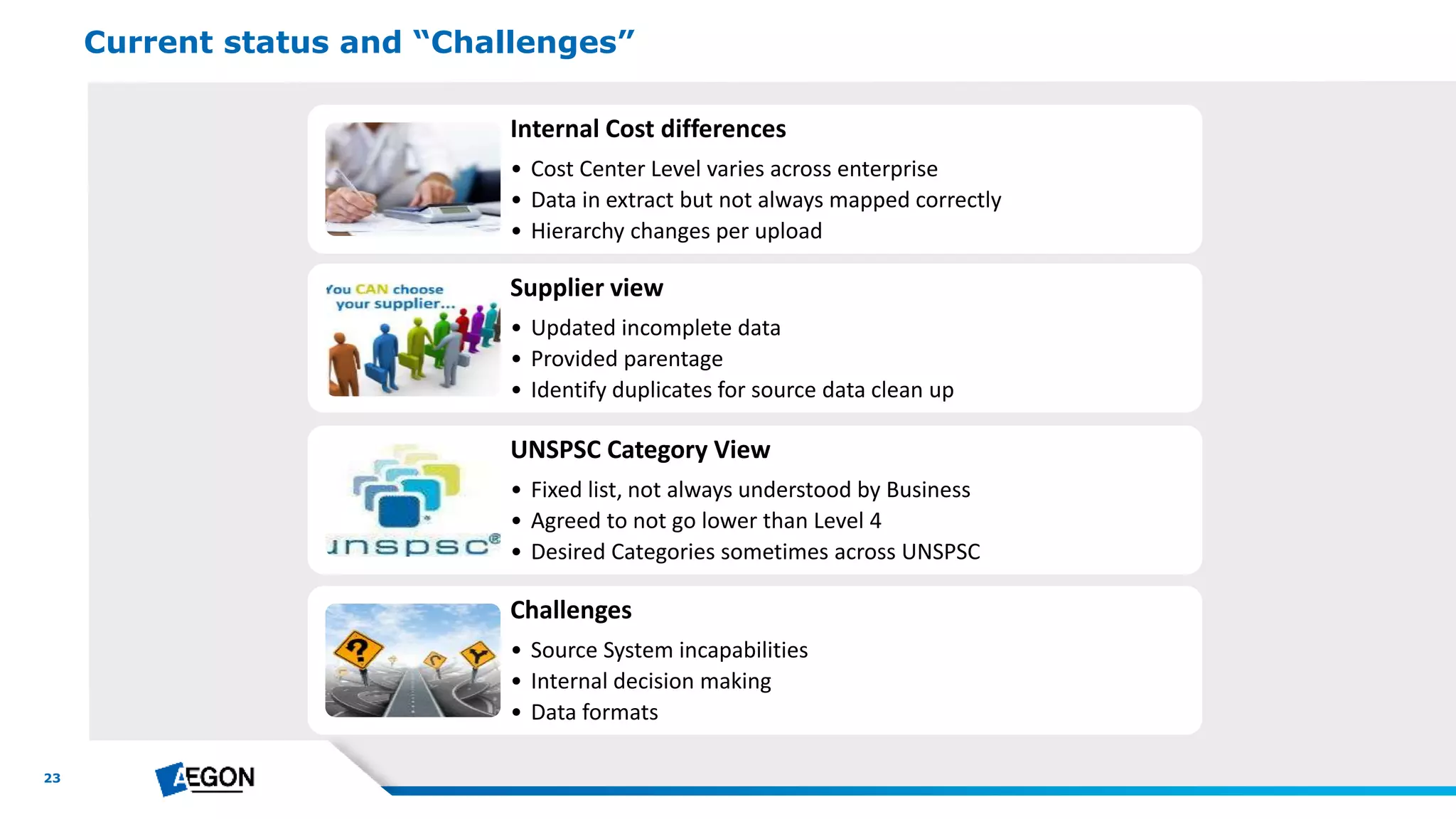
Current status and “Challenges”
Internal Cost differences
• Cost Center Level varies across enterprise
• Data in extract but not always mapped correctly
• Hierarchy changes per upload
Supplier view
• Updated incomplete data
• Provided parentage
• Identify duplicates for source data clean up
UNSPSC Category View
• Fixed list, not always understood by Business
• Agreed to not go lower than Level 4
• Desired Categories sometimes across UNSPSC
Challenges
• Source System incapabilities
• Internal decision making
• Data formats
24
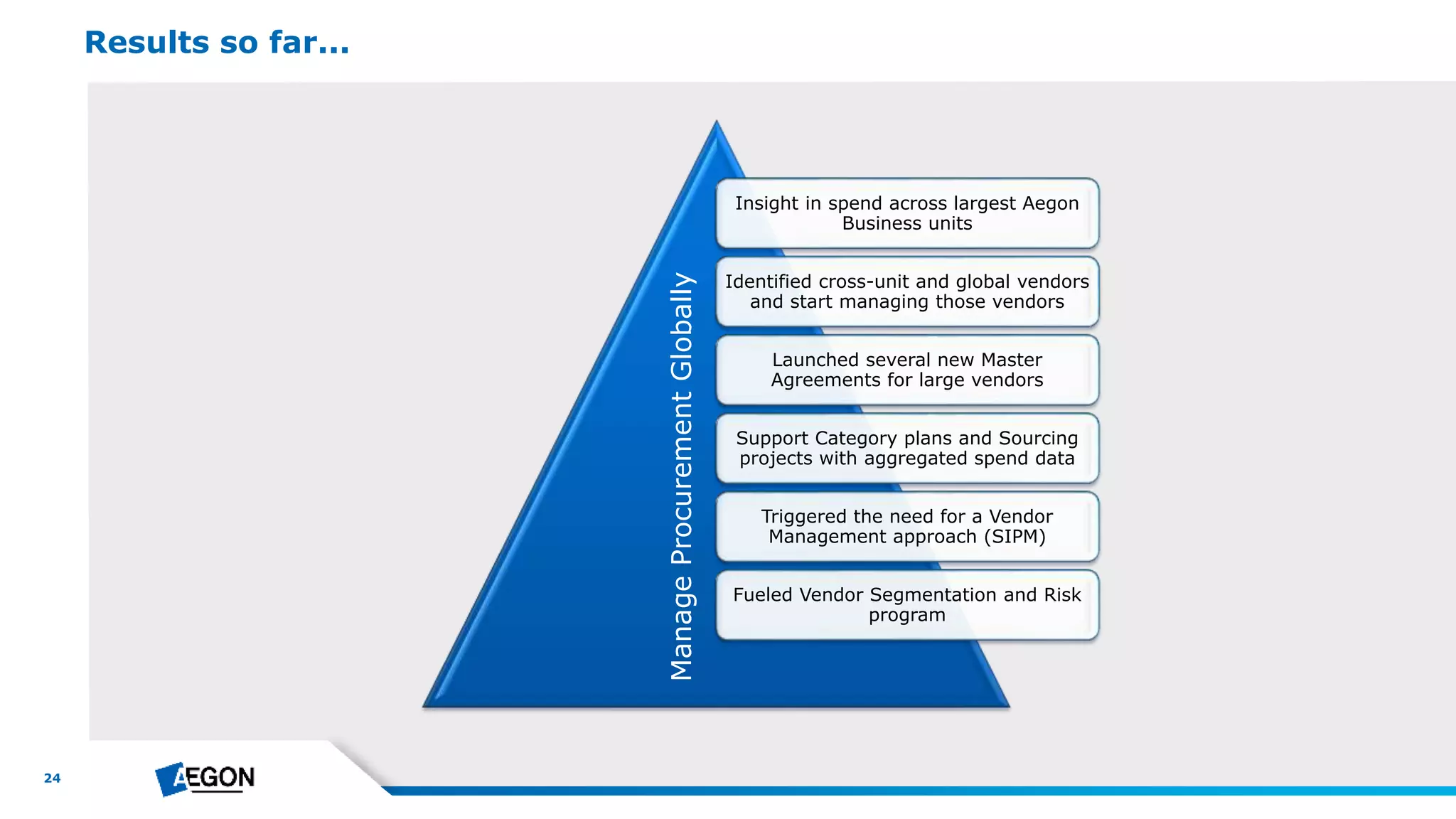
Insight in spend across largest Aegon
Business units
Identified cross-unit and global vendors
and start managing those vendors
Launched several new Master
Agreements for large vendors
Support Category plans and Sourcing
projects with aggregated spend data
Triggered the need for a Vendor
Management approach (SIPM)
Fueled Vendor Segmentation and Risk
program
Results so far...
ManageProcurementGlobally
25
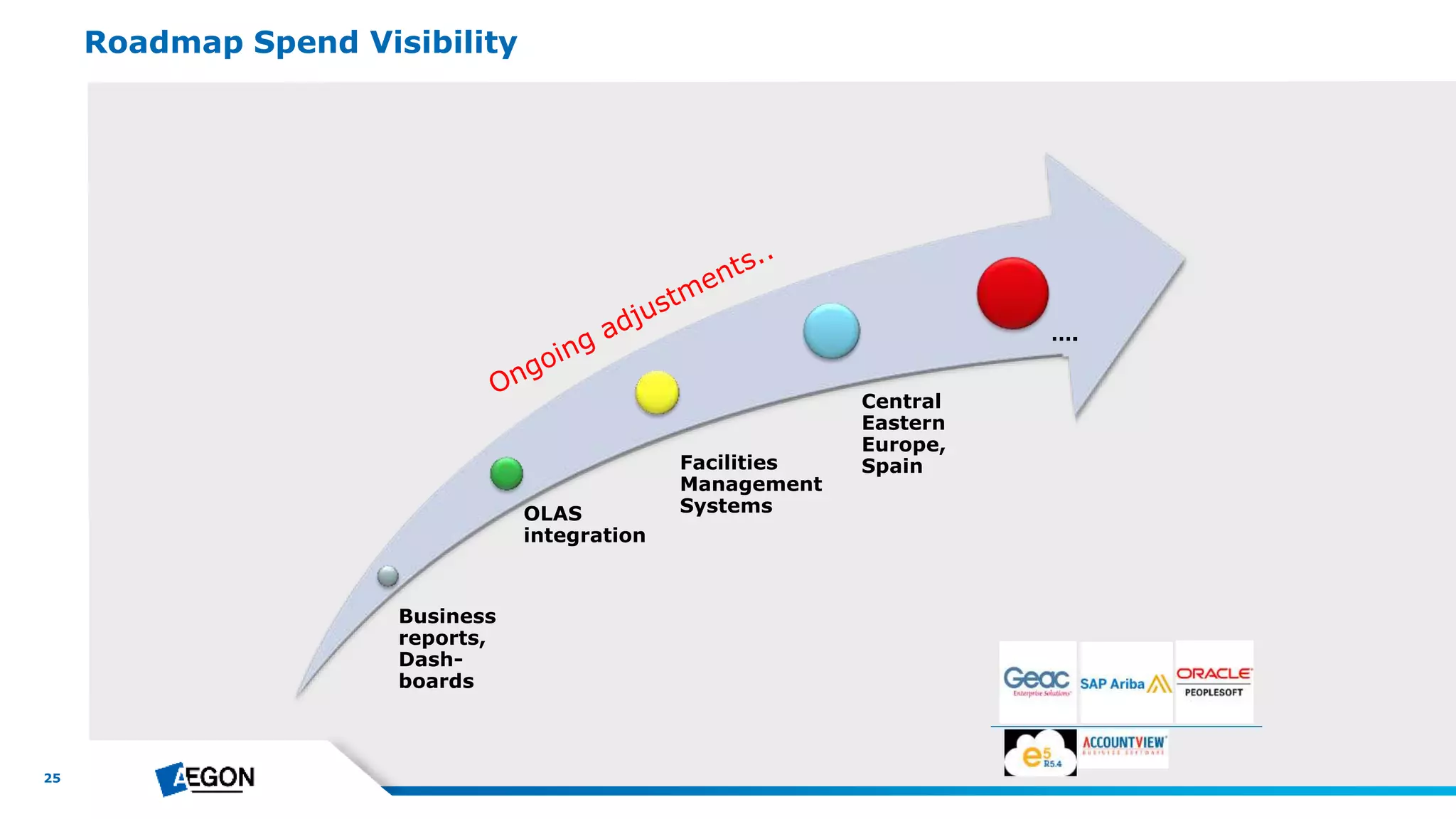
Roadmap Spend Visibility
Business
reports,
Dash-
boards
OLAS
integration
Facilities
Management
Systems
Central
Eastern
Europe,
Spain
….
26
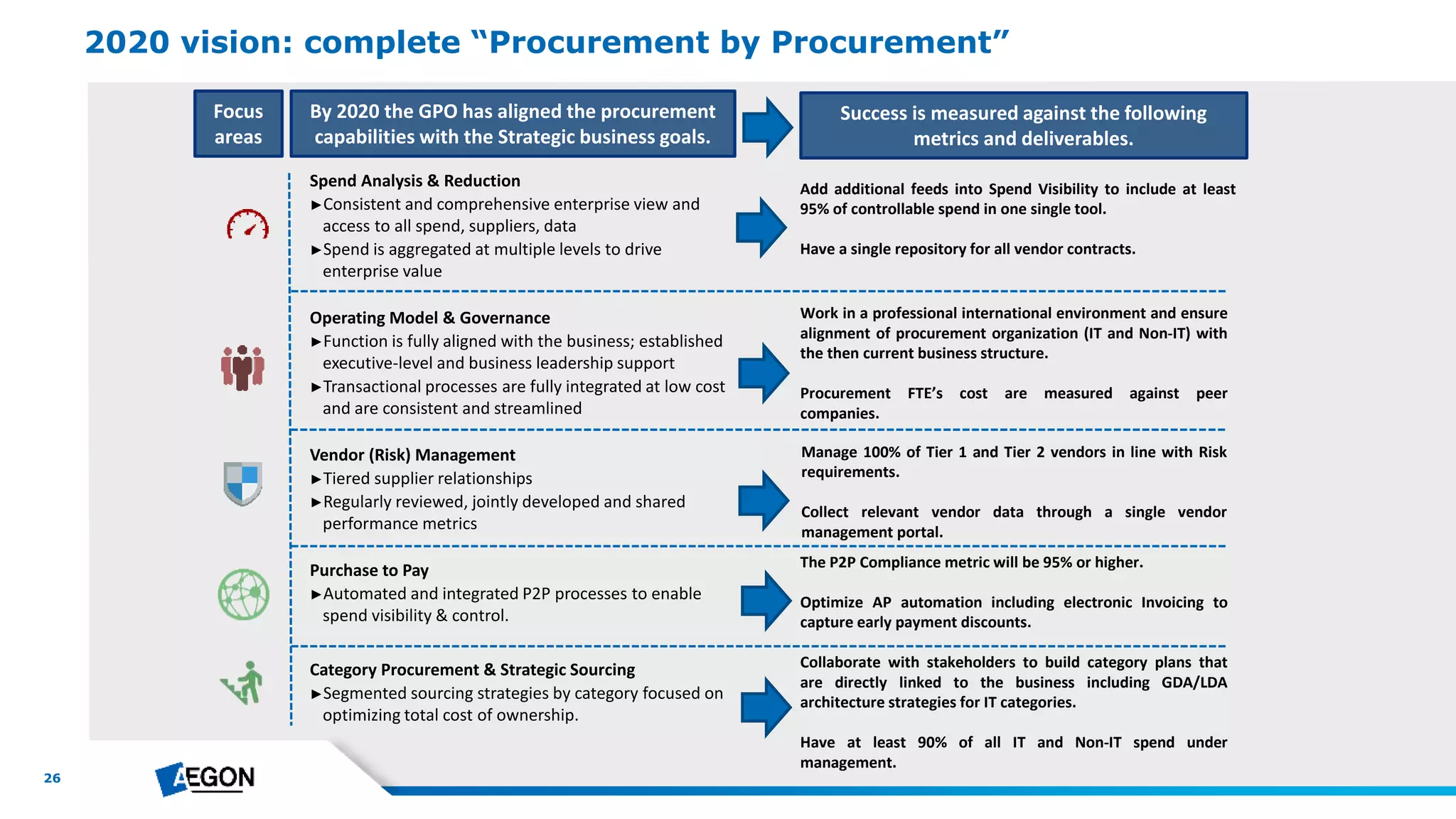
2020 vision: complete “Procurement by Procurement”
Add additional feeds into Spend Visibility to include at least
95% of controllable spend in one single tool.
Have a single repository for all vendor contracts.
Success is measured against the following
metrics and deliverables.
Work in a professional international environment and ensure
alignment of procurement organization (IT and Non-IT) with
the then current business structure.
Procurement FTE’s cost are measured against peer
companies.
Manage 100% of Tier 1 and Tier 2 vendors in line with Risk
requirements.
Collect relevant vendor data through a single vendor
management portal.
The P2P Compliance metric will be 95% or higher.
Optimize AP automation including electronic Invoicing to
capture early payment discounts.
Spend Analysis & Reduction
►Consistent and comprehensive enterprise view and
access to all spend, suppliers, data
►Spend is aggregated at multiple levels to drive
enterprise value
Operating Model & Governance
►Function is fully aligned with the business; established
executive-level and business leadership support
►Transactional processes are fully integrated at low cost
and are consistent and streamlined
Vendor (Risk) Management
►Tiered supplier relationships
►Regularly reviewed, jointly developed and shared
performance metrics
Purchase to Pay
►Automated and integrated P2P processes to enable
spend visibility & control.
Category Procurement & Strategic Sourcing
►Segmented sourcing strategies by category focused on
optimizing total cost of ownership.
By 2020 the GPO has aligned the procurement
capabilities with the Strategic business goals.
Collaborate with stakeholders to build category plans that
are directly linked to the business including GDA/LDA
architecture strategies for IT categories.
Have at least 90% of all IT and Non-IT spend under
management.
Focus
areas
27
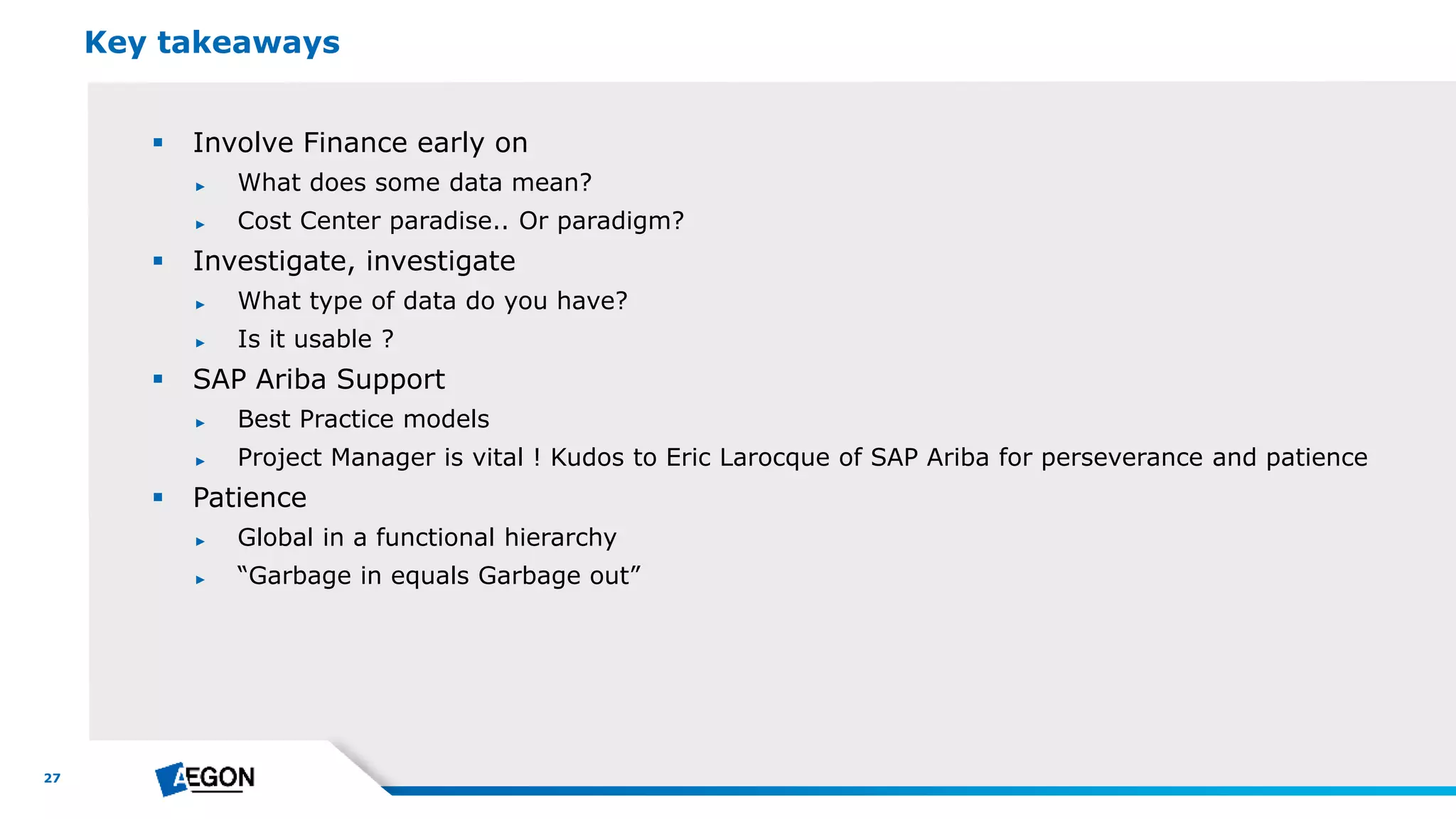
 Involve Finance early on
► What does some data mean?
► Cost Center paradise.. Or paradigm?
 Investigate, investigate
► What type of data do you have?
► Is it usable ?
 SAP Ariba Support
► Best Practice models
► Project Manager is vital ! Kudos to Eric Larocque of SAP Ariba for perseverance and patience
 Patience
► Global in a functional hierarchy
► “Garbage in equals Garbage out”
Key takeaways
Panel Presentations
Anders Dahlberg – Procurement Analyst, Boliden AB
Boliden Spend
Visibility
implementation
SAP Ariba Live
14 June 2016
Anders Dahlberg
Boliden
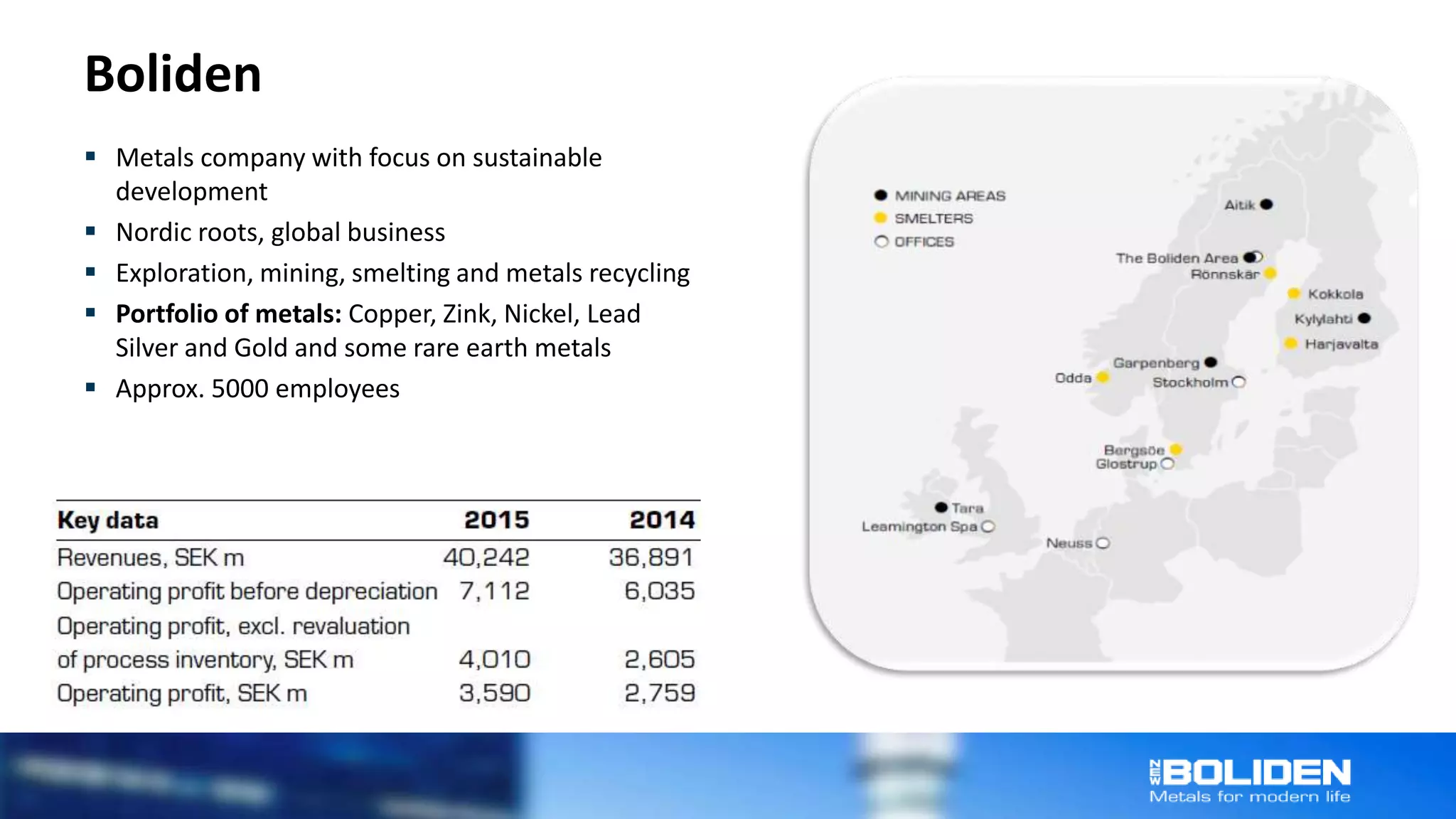
 Metals company with focus on sustainable
development
 Nordic roots, global business
 Exploration, mining, smelting and metals recycling
 Portfolio of metals: Copper, Zink, Nickel, Lead
Silver and Gold and some rare earth metals
 Approx. 5000 employees
Boliden Procurement
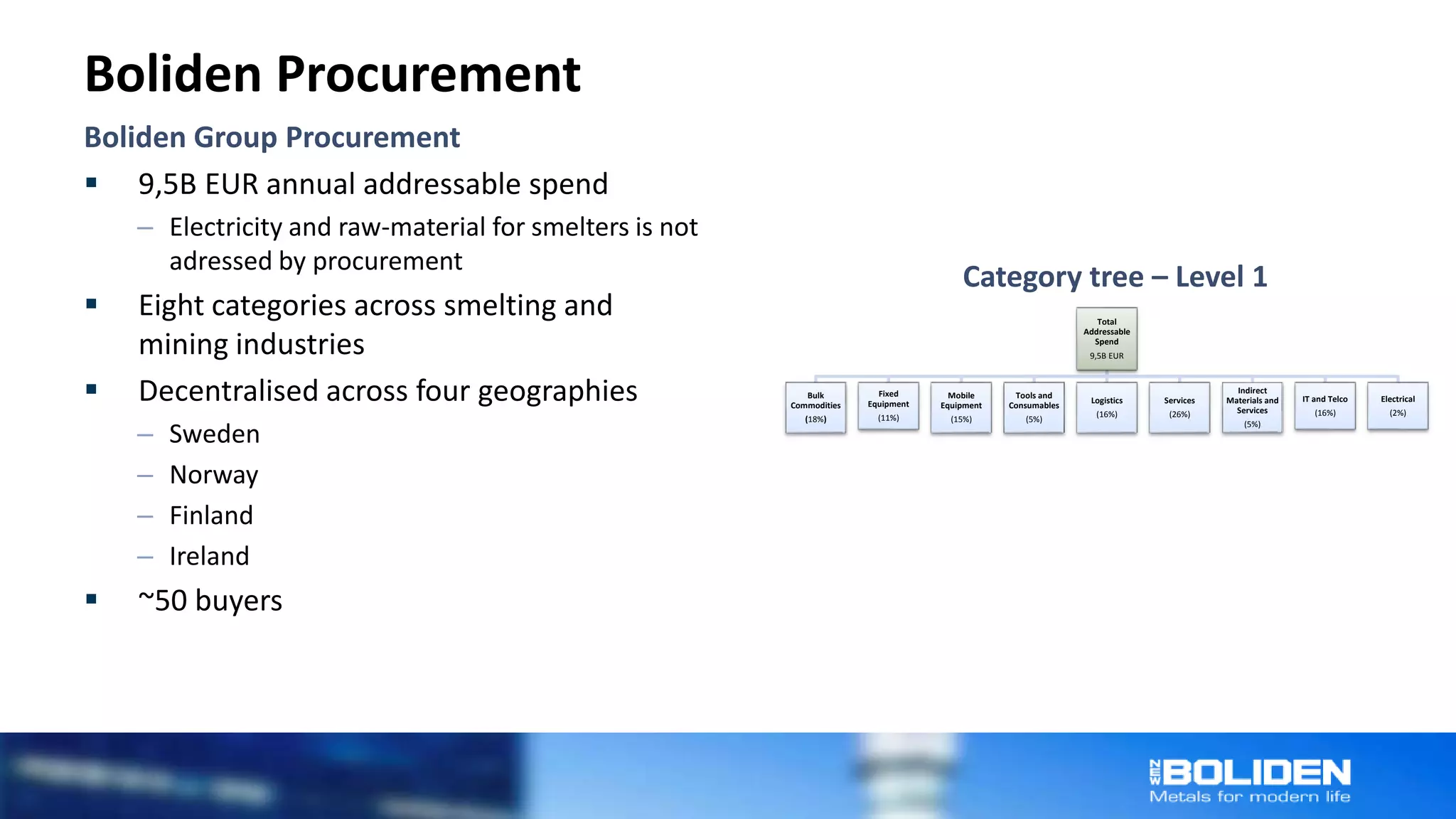
Boliden Group Procurement
 9,5B EUR annual addressable spend
‒ Electricity and raw-material for smelters is not
adressed by procurement
 Eight categories across smelting and
mining industries
 Decentralised across four geographies
‒ Sweden
‒ Norway
‒ Finland
‒ Ireland
 ~50 buyers
Total
Addressable
Spend
9,5B EUR
Bulk
Commodities
(18%)
Fixed
Equipment
(11%)
Mobile
Equipment
(15%)
Tools and
Consumables
(5%)
Logistics
(16%)
Services
(26%)
Indirect
Materials and
Services
(5%)
IT and Telco
(16%)
Electrical
(2%)
Category tree – Level 1
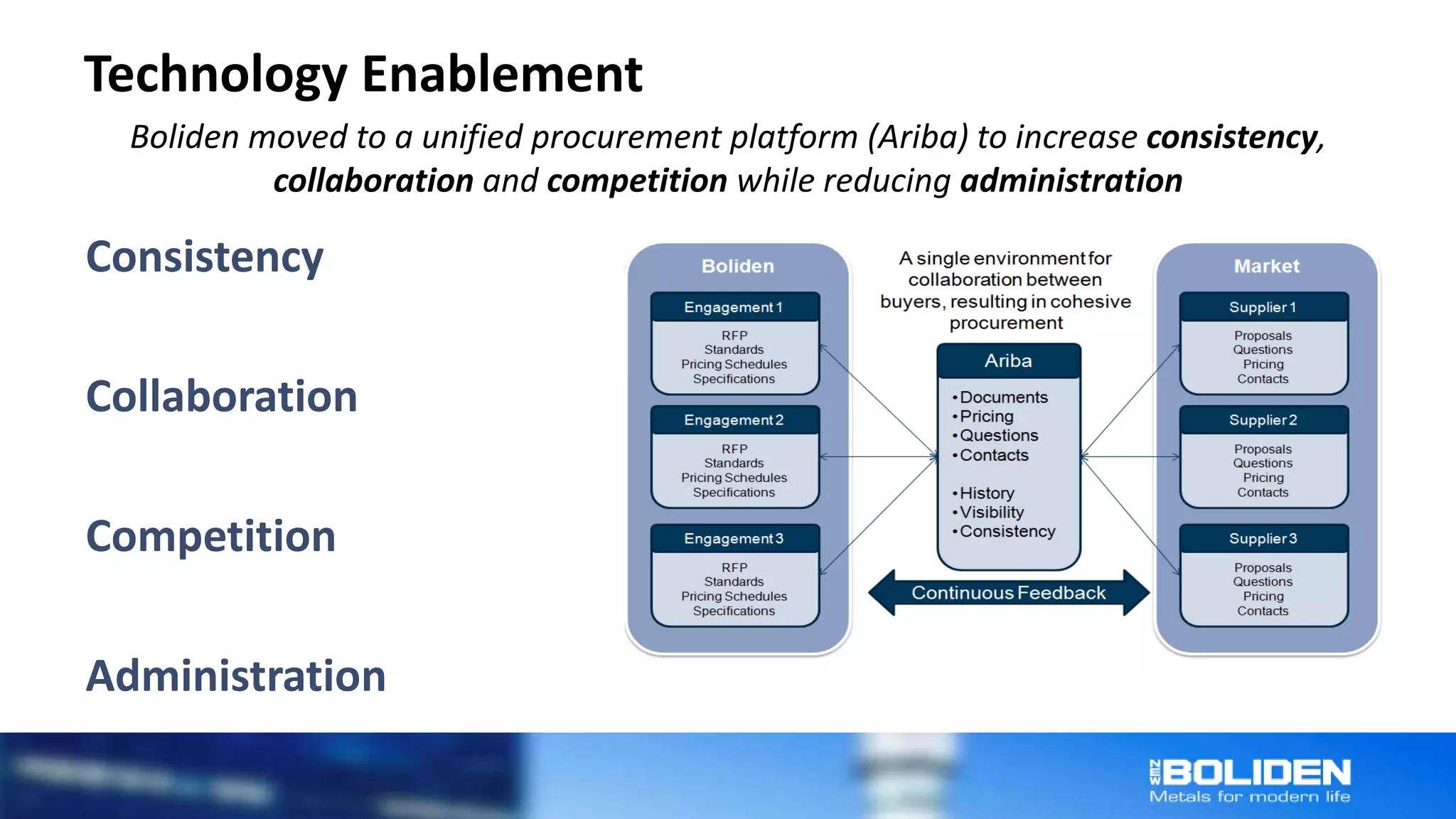
Technology Enablement
Consistency
Collaboration
Competition
Administration
Boliden moved to a unified procurement platform (Ariba) to increase consistency,
collaboration and competition while reducing administration
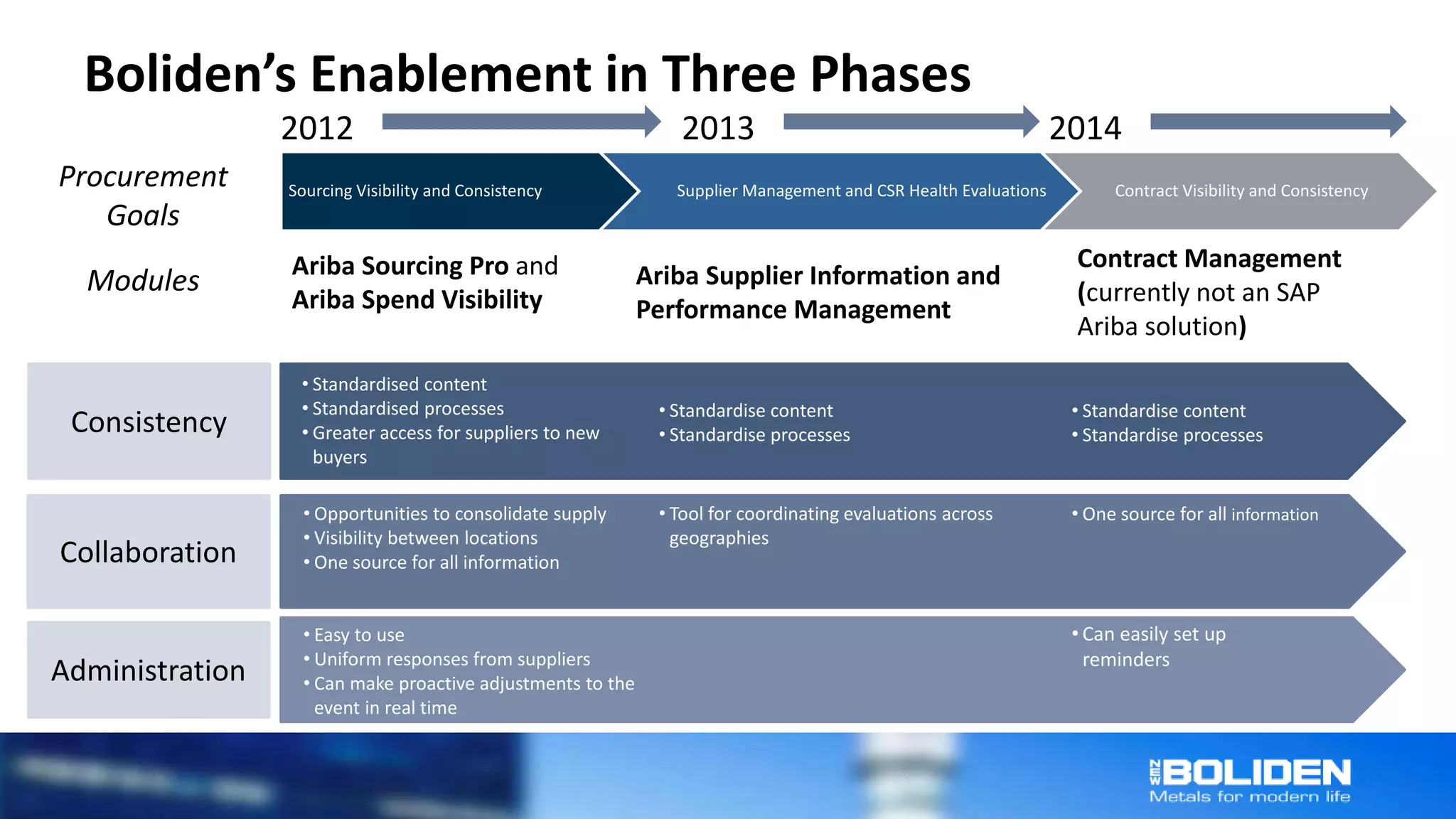
Boliden’s Enablement in Three Phases
Sourcing Visibility and Consistency Supplier Management and CSR Health Evaluations Contract Visibility and Consistency
Ariba Sourcing Pro and
Ariba Spend Visibility
Ariba Supplier Information and
Performance Management
Contract Management
(currently not an SAP
Ariba solution)
Consistency
Collaboration
Administration
• Standardised content
• Standardised processes
• Greater access for suppliers to new
buyers
• Standardise content
• Standardise processes
• Standardise content
• Standardise processes
• Opportunities to consolidate supply
• Visibility between locations
• One source for all information
• Tool for coordinating evaluations across
geographies
• One source for all information
• Easy to use
• Uniform responses from suppliers
• Can make proactive adjustments to the
event in real time
• Can easily set up
reminders
2012 2013 2014
Procurement
Goals
Modules
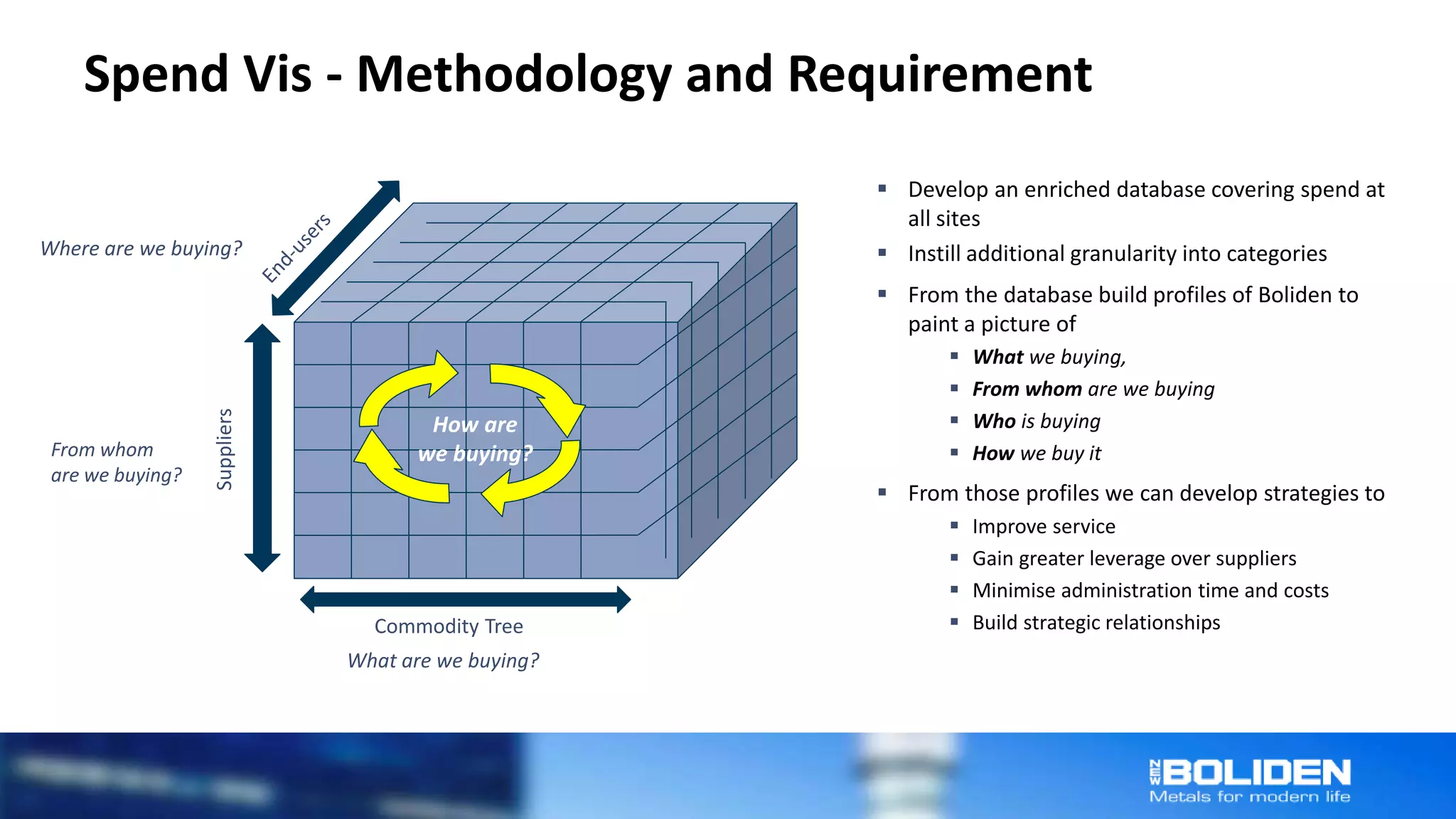
Spend Vis - Methodology and Requirement
Suppliers
From whom
are we buying?
Where are we buying?
How are
we buying?
What are we buying?
Commodity Tree
 Develop an enriched database covering spend at
all sites
 Instill additional granularity into categories
 From the database build profiles of Boliden to
paint a picture of
 What we buying,
 From whom are we buying
 Who is buying
 How we buy it
 From those profiles we can develop strategies to
 Improve service
 Gain greater leverage over suppliers
 Minimise administration time and costs
 Build strategic relationships
Exploration Mining
Milling
&
Concentrating
Concentrate
Sales
Concentrate &
Secondary
Raw Material
Purchase
Smelting
&
Refining
Metal
Sales
&
Distribution
BA Mines BA Smelters
Finance
Aitik
Copper mine
Boliden Area, Zinc mines
Garpenberg, Zinc mines
Tara, Zinc mine
Rönnskär
Harjavalta/Pori
Kokkola
Odda
Group functions
HR, EHSQ, Communications
Legal
Procurement
IT
Technology
Finance
HR, EHSQ, Communications
Finance
Cu smelters
Zn smelters
Mines
Exploration
Concentrate
Sales
Raw
Material
Purchase
Metal
Sales
Business support and risk management
System 6
System 4
System 3
System 2
Sys8
Excel
Excel
Excel
Sys9
Excel
Sys7
ExcelSystem 1
Bergsöe
Pb smelter
System 5
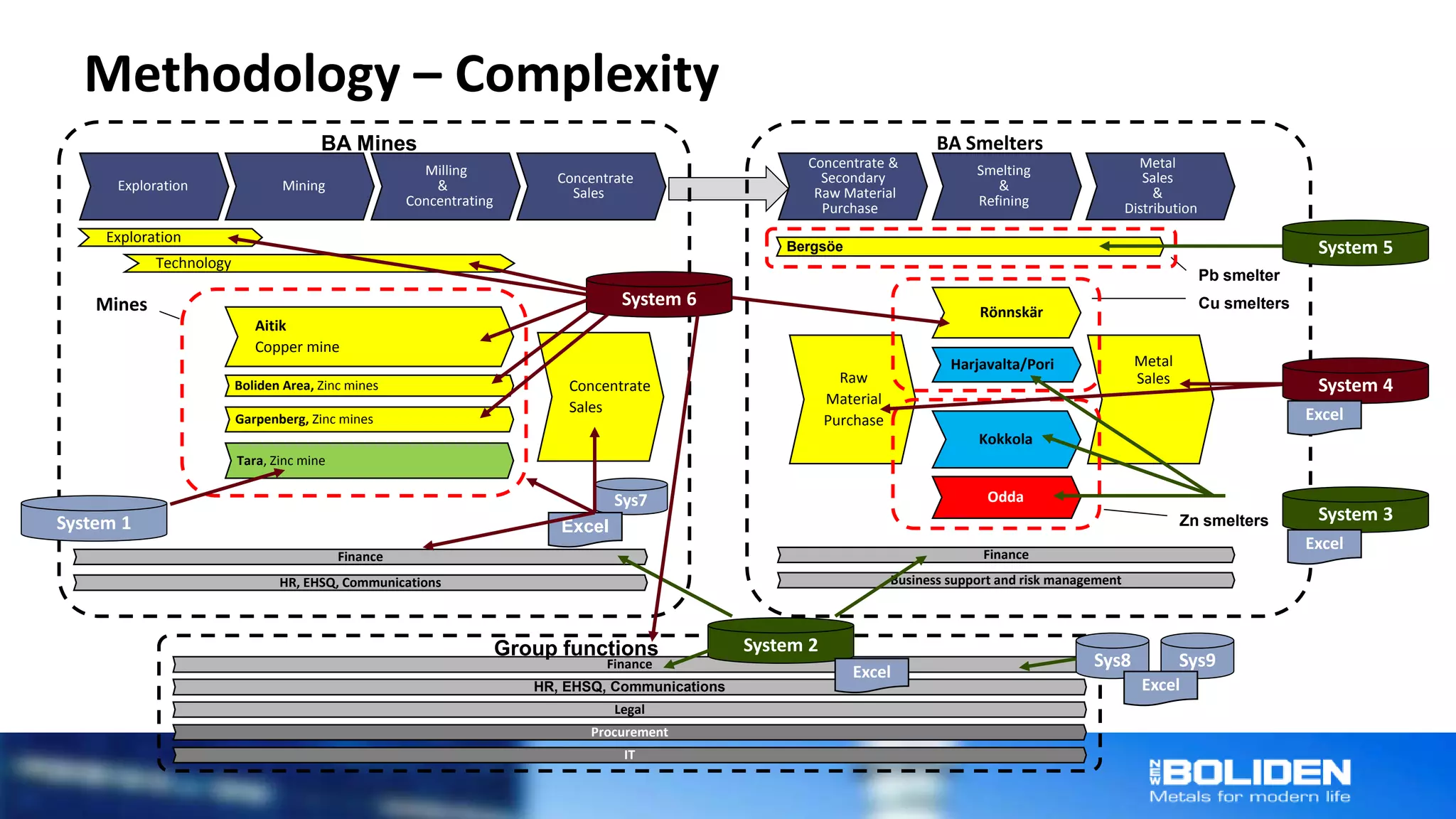
Methodology – Complexity
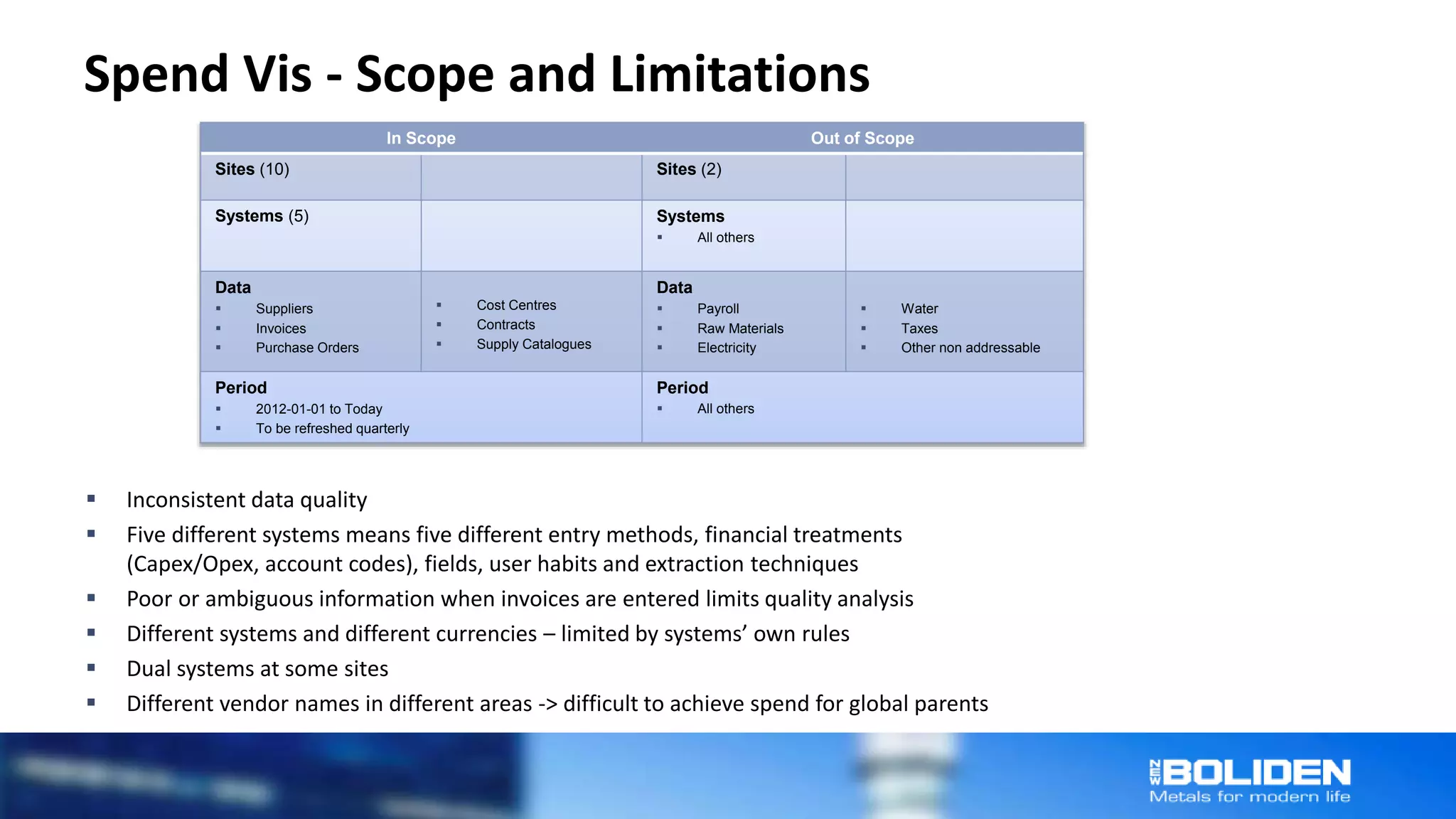
Spend Vis - Scope and Limitations
In Scope Out of Scope
Sites (10) Sites (2)
Systems (5) Systems
 All others
Data
 Suppliers
 Invoices
 Purchase Orders
 Cost Centres
 Contracts
 Supply Catalogues
Data
 Payroll
 Raw Materials
 Electricity
 Water
 Taxes
 Other non addressable
Period
 2012-01-01 to Today
 To be refreshed quarterly
Period
 All others
 Inconsistent data quality
 Five different systems means five different entry methods, financial treatments
(Capex/Opex, account codes), fields, user habits and extraction techniques
 Poor or ambiguous information when invoices are entered limits quality analysis
 Different systems and different currencies – limited by systems’ own rules
 Dual systems at some sites
 Different vendor names in different areas -> difficult to achieve spend for global parents
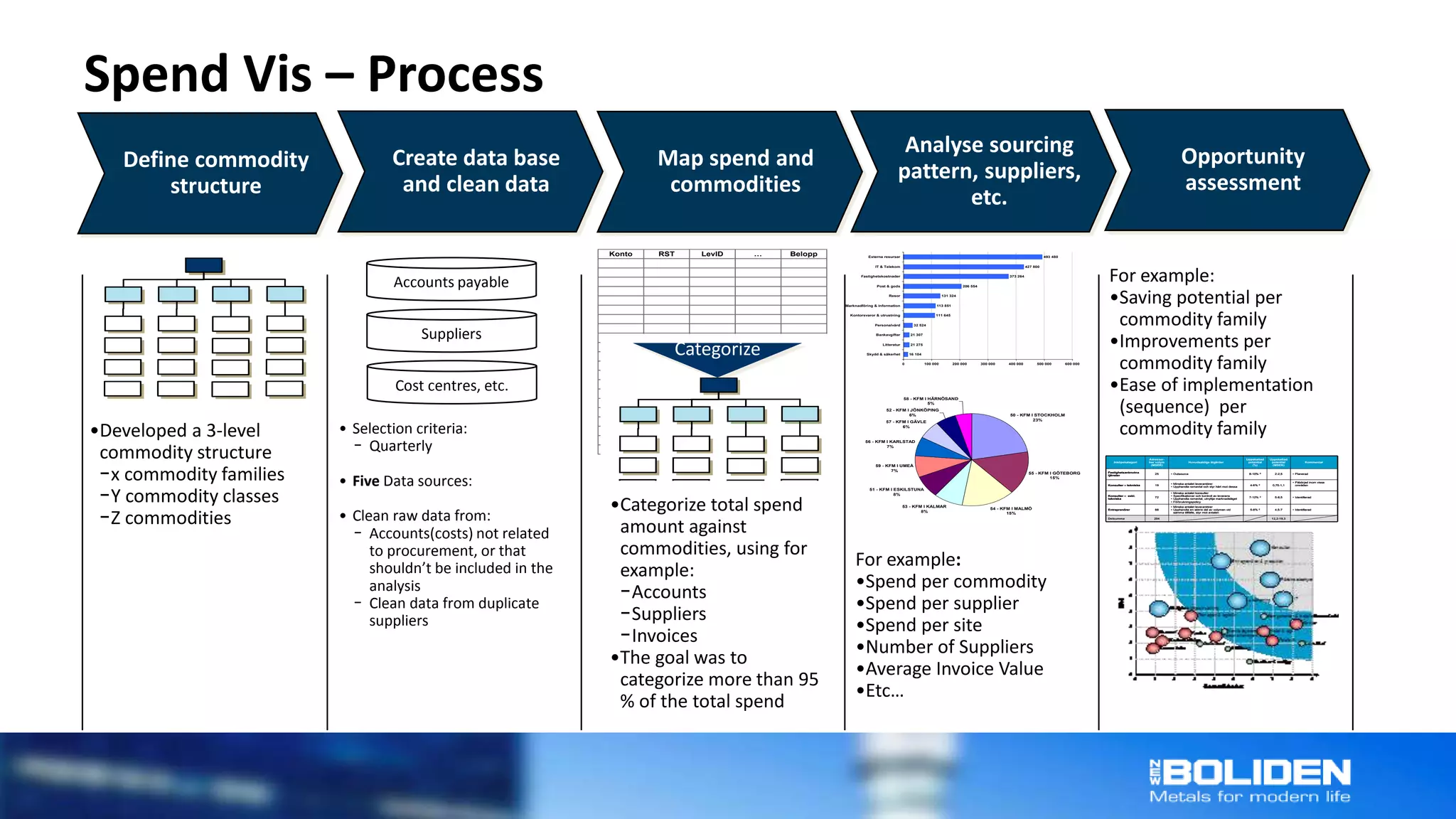
Spend Vis – Process
Cost centres, etc.
Suppliers
Create data base
and clean data
Define commodity
structure
Analyse sourcing
pattern, suppliers,
etc.
Opportunity
assessment
Accounts payable
Map spend and
commodities
Konto RST LevID Belopp…
For example:
•Saving potential per
commodity family
•Improvements per
commodity family
•Ease of implementation
(sequence) per
commodity family
16 104
21 275
21 307
32 524
111 645
113 851
131 324
206 554
373 264
427 800
493 480
0 100 000 200 000 300 000 400 000 500 000 600 000
Skydd & säkerhet
Litteratur
Bankavgifter
Personalvård
Kontorsvaror & utrustning
Marknadföring & information
Resor
Post & gods
Fastighetskostnader
IT & Telekom
Externa resurser
50 - KFM I STOCKHOLM
23%
55 - KFM I GÖTEBORG
15%
54 - KFM I MALMÖ
15%
53 - KFM I KALMAR
8%
51 - KFM I ESKILSTUNA
8%
59 - KFM I UMEÅ
7%
56 - KFM I KARLSTAD
7%
57 - KFM I GÄVLE
6%
52 - KFM I JÖNKÖPING
6%
58 - KFM I HÄRNÖSAND
5%
• Planerad2-2,58-10% 2• Outsourca25
Fastighetsanknutna
tjänster
204
88
72
19
Adresser-
bar volym
(MSEK)
12,2-19,3Delsumma
• Identifierad4,5-75-8% 2
• Minska antalet leverantörer
• Upphandla en större del av volymen vid
samma tillfälle, styr mot avtalen
Entreprenörer
• Identifierad
• Påbörjad inom vissa
områden
Kommentar
5-8,5
0,75-1,1
Uppskattad
potential
(MSEK)
7-12% 2
4-6% 2
Uppskattad
potential
(%)
• Minska antalet konsulter
• Specifikationer och kontroll av leverans
• Upphandla ramavtal, utnyttja marknadsläget
• Förbrukningspolicy
Konsulter – exkl.
tekniska
• Minska antalet leverantörer
• Upphandla ramavtal och styr hårt mot dessa
Konsulter – tekniska
Huvudsakliga åtgärderInköpskategori
• Planerad2-2,58-10% 2• Outsourca25
Fastighetsanknutna
tjänster
204
88
72
19
Adresser-
bar volym
(MSEK)
12,2-19,3Delsumma
• Identifierad4,5-75-8% 2
• Minska antalet leverantörer
• Upphandla en större del av volymen vid
samma tillfälle, styr mot avtalen
Entreprenörer
• Identifierad
• Påbörjad inom vissa
områden
Kommentar
5-8,5
0,75-1,1
Uppskattad
potential
(MSEK)
7-12% 2
4-6% 2
Uppskattad
potential
(%)
• Minska antalet konsulter
• Specifikationer och kontroll av leverans
• Upphandla ramavtal, utnyttja marknadsläget
• Förbrukningspolicy
Konsulter – exkl.
tekniska
• Minska antalet leverantörer
• Upphandla ramavtal och styr hårt mot dessa
Konsulter – tekniska
Huvudsakliga åtgärderInköpskategori
•Developed a 3-level
commodity structure
−x commodity families
−Y commodity classes
−Z commodities
• Selection criteria:
− Quarterly
• Five Data sources:
• Clean raw data from:
− Accounts(costs) not related
to procurement, or that
shouldn’t be included in the
analysis
− Clean data from duplicate
suppliers
Categorize
•Categorize total spend
amount against
commodities, using for
example:
−Accounts
−Suppliers
−Invoices
•The goal was to
categorize more than 95
% of the total spend
For example:
•Spend per commodity
•Spend per supplier
•Spend per site
•Number of Suppliers
•Average Invoice Value
•Etc…
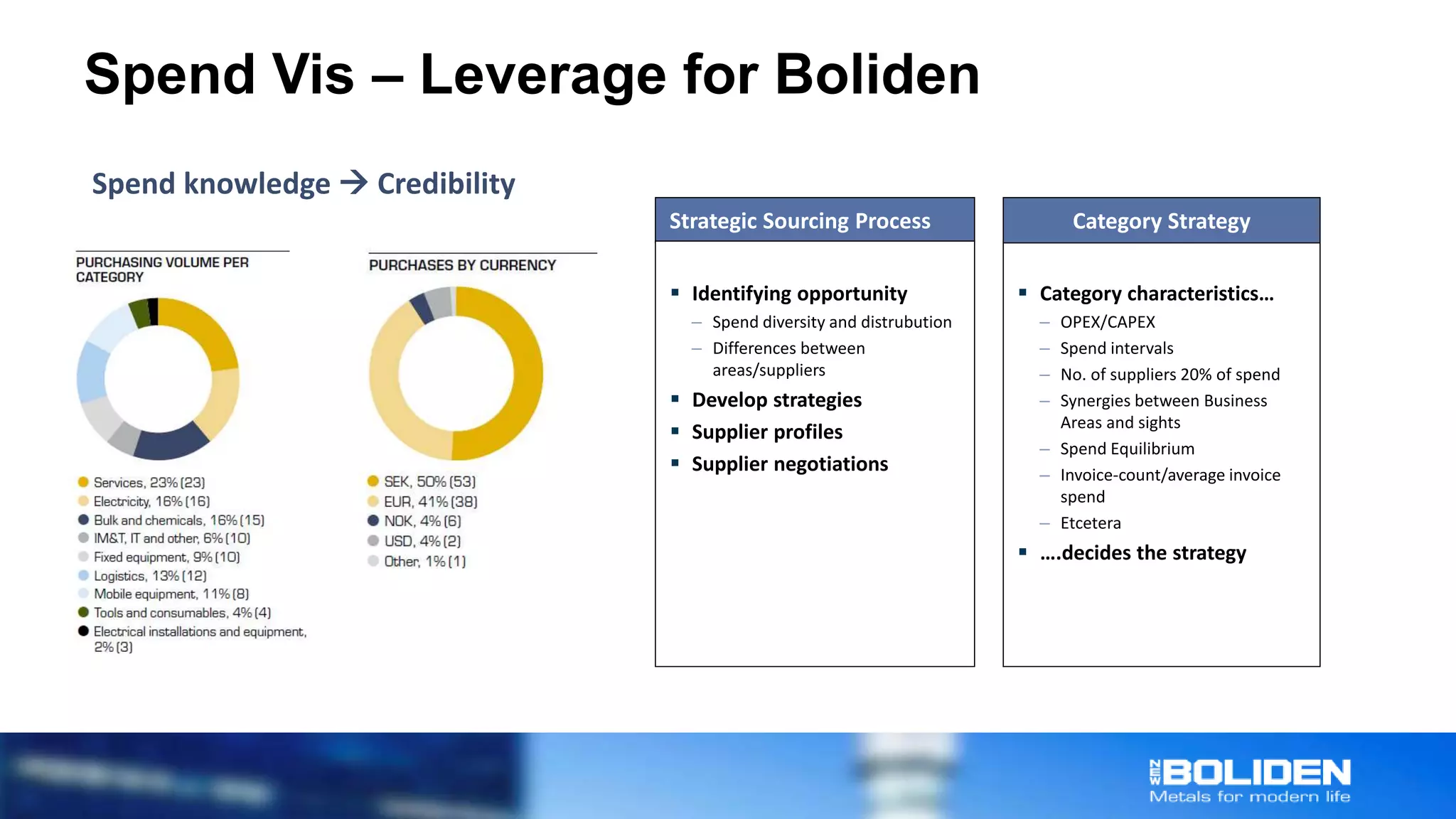
Spend Vis – Leverage for Boliden
 Category characteristics…
‒ OPEX/CAPEX
‒ Spend intervals
‒ No. of suppliers 20% of spend
‒ Synergies between Business
Areas and sights
‒ Spend Equilibrium
‒ Invoice-count/average invoice
spend
‒ Etcetera
 ….decides the strategy
Category StrategyStrategic Sourcing Process
 Identifying opportunity
‒ Spend diversity and distrubution
‒ Differences between
areas/suppliers
 Develop strategies
 Supplier profiles
 Supplier negotiations
Spend knowledge  Credibility
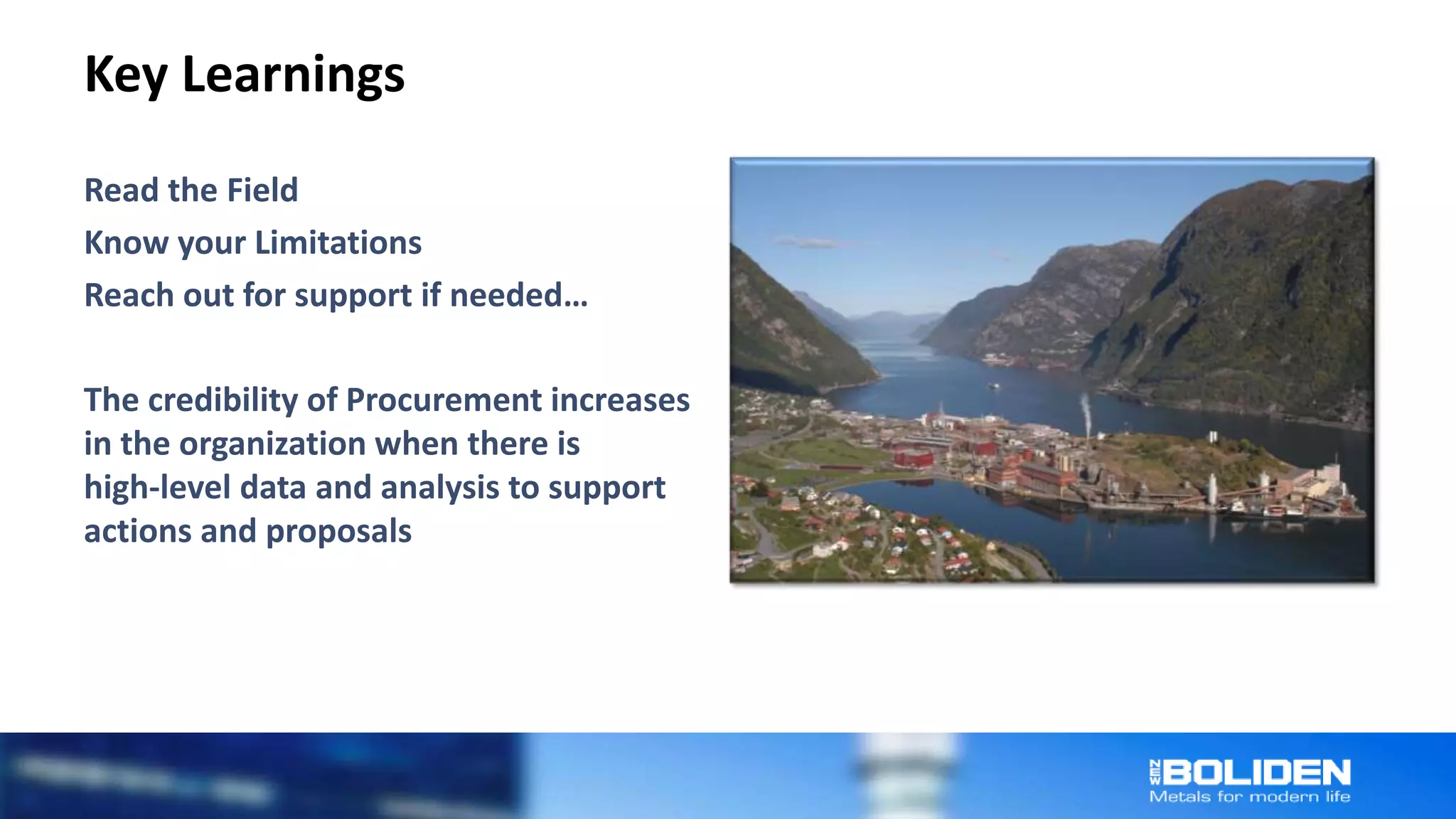
Key Learnings
Read the Field
Know your Limitations
Reach out for support if needed…
The credibility of Procurement increases
in the organization when there is
high-level data and analysis to support
actions and proposals
Thank you
Contact information:
Speakers
Eric Verschut
eric.verschut@aegon.com
Anders Dahlberg
anders.dahlberg@boliden.com
Moderator:
Xin Wang
Xin.wang03@sap.com
Eric Salviac
eric.salviac@sap.com
© 2016 SAP SE or an SAP affiliate company. All rights reserved. 41Public
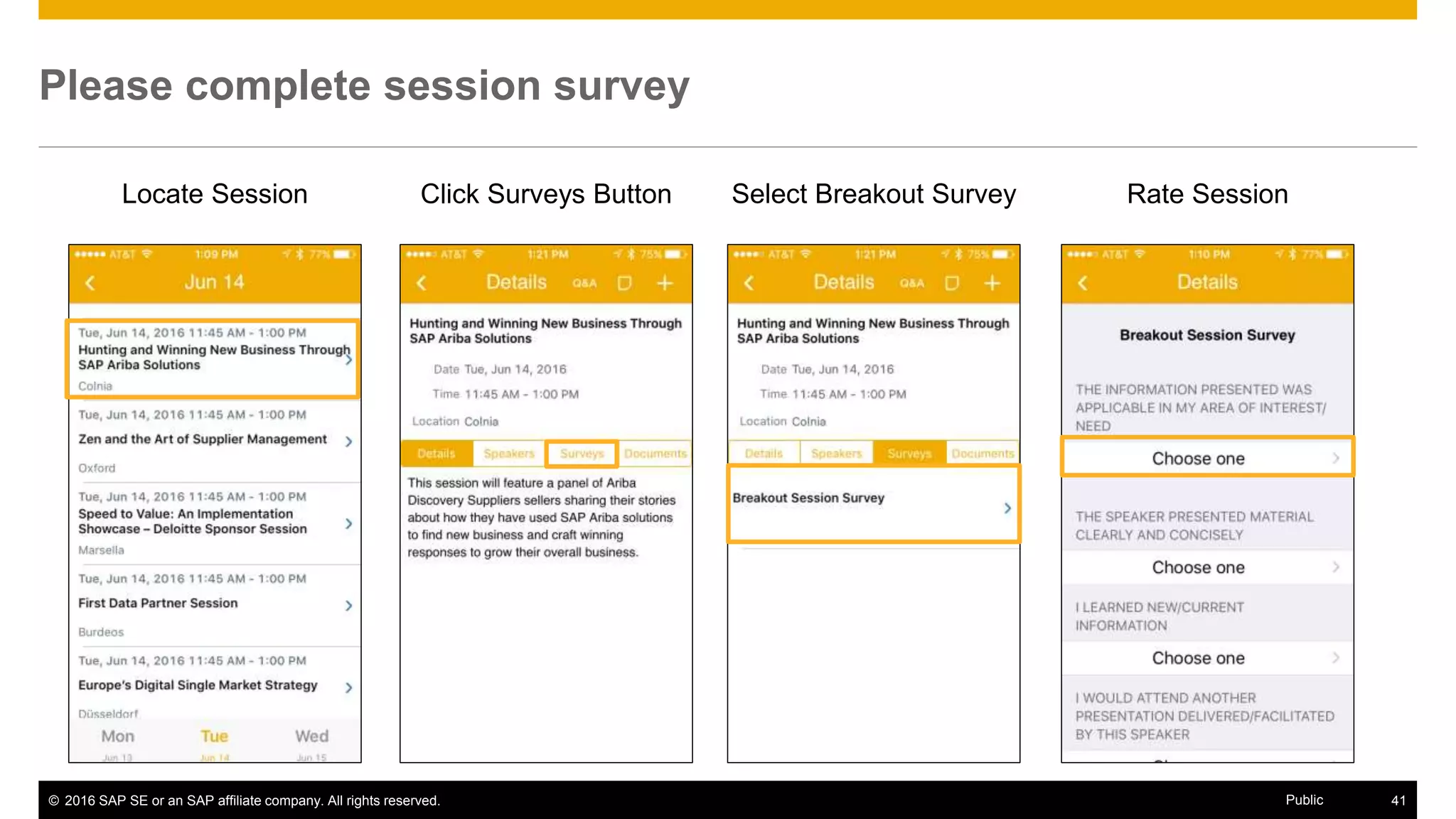
Please complete session survey
Locate Session Click Surveys Button Select Breakout Survey Rate Session

Spend Analysis: What Your Data Is Telling You and Why It’s Worth Listening

  • 1.
    Public Spend Analysis: WhatYour Data Is Telling You and Why It’s Worth Listening Eric Verschut – Aegon N.V Anders Dahlberg – Boliden AB June 14, 2016
  • 2.
    © 2016 SAPSE or an SAP affiliate company. All rights reserved. 2Public Important information This information reflects the status of SAP Ariba solution planning as of June 2016. All such information is the Confidential Information of SAP Ariba (per the contract between our companies), and must not be further disclosed, as stated in the confidentiality clause of that contract. This presentation contains only intended guidance and is not binding upon SAP Ariba to any particular course of business, product strategy, and/or development. Its content is subject to change without notice. SAP Ariba assumes no responsibility for errors or omissions in this document. SAP Ariba shall have no liability for damages of any kind including without limitation direct, special, indirect, or consequential damages that may result from the use of these materials.
  • 3.
    © 2016 SAPSE or an SAP affiliate company. All rights reserved. 3Public Agenda Overview and introductions Panel presentations  Eric Verschut – Global Lead Procurement, Aegon N.V  Anders Dahlberg – Procurement Analyst, Boliden AB Q&A 3Public© 2016 SAP SE or an SAP affiliate company. All rights reserved. 3Public
  • 4.
  • 5.
    © 2016 SAPSE or an SAP affiliate company. All rights reserved. 5Public Data aggregation Dashboards and reporting Traditional business intelligence is just the tip of the iceberg… Commodity classifications Supplier data enrichment Market insights and benchmarks
  • 6.
    © 2016 SAPSE or an SAP affiliate company. All rights reserved. 6Public Spend analysis: What your data is telling you and why it’s worth listening It doesn't matter how many “resources” you have if you don't know how to use them
  • 7.
    © 2016 SAPSE or an SAP affiliate company. All rights reserved. 7Public Panelists Eric Verschut Global Lead Procurement, Aegon N.V Anders Dahlberg Procurement Analyst, Boliden AB
  • 8.
    Panel Presentations Eric Verschut– Global Lead Procurement, Aegon N.V
  • 9.
    Eric Verschut SAP AribaLive Aegon’s journey to Spend Visibility Madrid, June 2016
  • 10.
    10 Aegon at aglance Focus Life insurance, pensions & asset management for 30 million customers Our roots date back to first half of the 19th century History Employees Over 31,500 employees December 31, 2015 Revenue-generating investments December 31, 2015 EUR 707 billion EUR 43 billion Paid out in claims and benefits Full year 2015 Underlying earnings before tax 2015 26% 57% 6% 11% Americ as NLUK New Markets EUR 1.9 bln
  • 11.
    11 A clear framework toaddress global trends and developing customers’ needs
  • 12.
    12 The customer isat the heart of everything we do Sales & distribution  Online & direct channels  Financial intermediaries, brokers, banks  Worksite marketing Pay-in phase  Deposits & premiums  Invested to secure expected benefits Pay-out phase  Pensions, annuities, life insurance claims  Lump sum or regular payments
  • 13.
    13 4,900 2,000 248 309 31 94 Americas  NL  UK  Rest of Europe  Rest of the world 67 69 73 71 2013 2014 2015 2016 Aegon in brief 2.4% 10.2% 38.1% 49.2% Net Promoter Score Impact investments (in EUR millions) Our shareholder base Preferred employer Supporting our local communities (in EUR millions)  Affordable housing  International dev. banks  Green bonds  Renewable energy  Sustainable timber  Care homes elderly  1st quartile  2nd quartile  3rd quartile  4th quartile Significant improvement in our levels of employee engagement 6.3 6.1 8.6 2013 2014 2015 In 2015, the value of voluntary work undertaken by employees was almost EUR 1 million 45% 19% 13% 16% 7% EUR 7.6 billion Industry norm
  • 14.
    1414 Would you walkup to a car dealer and say the following: “Tell me what car I should buy and I’ll pay the price”? Of course not! So we need to: 1. Stay on top of our game 2. Level the playing field with suppliers 3. Find ways to extract “additional value” Of course not! So Aegon agreed to focus on 5 capabilities: 1. Spend Analytics & Reduction 2. Operating Model & Governance 3. Vendor (Risk) Management 4. Purchase to Pay 5. Category Procurement & Strategic Sourcing
  • 15.
    15 Manage procurement andvendor management globally Topic Description Mission The mission of Global Procurement is to support “One Aegon” by providing innovative yet efficient procurement and vendor management services. Vision The vision of Aegon Global Procurement is based on 4 key areas: 1. Industry Leaders 2. Procurement Professionals 3. Effective Execution 4. Business Value Strategy Balance between two forces: proximity to the business, which is key to adding value and building trust, and globalization to ensure standardization where possible, across the company.  2013 – “Build the foundation”  2014 – “Stabilize the transformation”  2015 – “Measure to metrics”  2016 – “Complete Transformation”  2016 – 2020 – “Align…”
  • 16.
    16 Focus on buildinga global procurement foundation • Deliver Spend Visibility Capabilities • Extracted invoice line item detail from 3 different back end systems. • Mapped detail to a standardized set of categories and commodities for a global view Spend Analytics & Reduction • Develop a set of Procurement Principles • Included procurement principles in the overall GDA architecture principles document • Implemented 2 additional value metrics to support Spend Savings & Avoidance metric Operating Model & Governance • Build an Aegon Vendor Risk Management Framework • This framework includes an approach to segment vendor base, and based on this segmentation drive local / global plans Vendor (Risk) Management • Deliver P2P capabilities in Aegon NL, AGT and Transamerica • Improved the downstream procurement process by enabling electronic invoices • Implemented Docusign Purchase to Pay • Execute RFP’s, contract renewals and contract terminations • Delivered electronic RFP capabilities and Issued 2 test RFP’s • Completely revamped the Consulting category Category Procurement & Strategic Sourcing • Realize targeted IT spend savings & avoidance • Realized significant savings and avoidance by collaboration • Created detailed back up for audit if needed Spend Savings & Avoidance
  • 17.
    17 Spend Visibility iskey • Deliver Spend Visibility Capabilities • Extracted invoice line item detail from 3 different back end systems. • Mapped detail to a standardized set of categories and commodities for a global view Spend Analytics & Reduction • Develop a set of Procurement Principles • Included procurement principles in the overall GDA architecture principles document • Implemented 2 additional value metrics to support Spend Savings & Avoidance metric Operating Model & Governance • Build an Aegon Vendor Risk Management Framework • This framework includes an approach to segment vendor base, and based on this segmentation drive local / global plans Vendor (Risk) Management • Deliver P2P capabilities in Aegon NL, AGT and Transamerica • Improved the downstream procurement process by enabling electronic invoices • Implemented Docusign Purchase to Pay • Execute RFP’s, contract renewals and contract terminations • Delivered electronic RFP capabilities and Issued 2 test RFP’s • Completely revamped the Consulting category Category Procurement & Strategic Sourcing • Realize targeted IT spend savings & avoidance • Realized significant savings and avoidance by collaboration • Created detailed back up for audit if needed Spend Savings & Avoidance ‘Old school RFP’: - Long list - Short list via: - Requirements / Market research - Integration with source systems - Ease of use - License and Implementation Pricing - RFP on short list vendors (3) - Award and Agreement
  • 18.
    18 Focus on biggestProcurement teams Aegon businesses US Netherlands United Kingdom Central & Eastern Europe Spain Ireland Hong Kong Singapore Joint ventures Brazil China France India Japan Mexico Portugal Aegon Direct Affinity Marketing Services Australia China Indonesia Japan Thailand Source systems for Spend Visibility Benefits: - Finance stays in their familiar environment - Source systems remain untouched - Spend is aggregated across borders
  • 19.
    19 Sourcing Unique RFx (RFQ,RFI, RFP) + contract rates + spot buying Spend Visibility & Analysis Spend assessment, powerful MI, performance dashboards, analytics Supplier Management Supplier onboarding, capabilities management, performance management Contract Compliance 360⁰ view of spend including spend limits, cost controls, supplier performance, etc Invoicing & Payment Invoice matching, reconciliation, ‘ok-to- pay’ file export E-Procurement Compare bids, issue purchase orders, catalogue management etc Global Tooling set Global centralized capabilities accessible to all (SAP Ariba) De-centralized Capabilities in different Business Units (f.e. SAP Ariba, Peoplesoft, GEAC, e5/OLAS) Spend Management includes a variety of tools that are, or will be, available to Procurement and the rest of the organization
  • 20.
    20 Spend Visibility targetsituation Cleaning Spend Data Normalizing Classifying Enriching Spend Visibility Online Access to Spend Data Analyzing Spend Data in a Spend Management context Driving Broad Adoption Transparency Savings Compliance Prioritization Others
  • 21.
    21  Initial approach: ►Created insight in systems vs Business units. ► 1 system, 1 Quarter data (Q1-2015) to test, then build out ► IT Spend only ► UNSPSC for now, max. 4 levels ► Currency centrally managed  Slow progress ► Wave 1: GEAC ► Wave 2: Peoplesoft ► Wave 3: AccountView ► Wave 4: OLAS, Concur, others Implementation Strategy GEAC Q1 Peoplesoft Q1-2 + GEAC Q2 AccountView Q1-3 + PS / GEAC Q3 OLAS Q1-4 + others Q4 2014/2015 & reporting Others
  • 22.
    22  Actual approach: ►Initial upload took far more time than expected ► Extended to total spend ► Added Peoplesoft to Wave 1 ► Changed extraction approach for GEAC ► Source system issues (GEAC, Concur) ► Postponed OLAS  Training: ► Tech training (extract) ► Expert training (validate) ► Expert training (reports) Implementation Changes PS/GEAC 2014 + Q1-2015 Adjustments AccountView (+ Q2-Q3 2015) More adjustments (+Q4 2015) Creating reports (+Q1 2016)
  • 23.
    23 Current status and“Challenges” Internal Cost differences • Cost Center Level varies across enterprise • Data in extract but not always mapped correctly • Hierarchy changes per upload Supplier view • Updated incomplete data • Provided parentage • Identify duplicates for source data clean up UNSPSC Category View • Fixed list, not always understood by Business • Agreed to not go lower than Level 4 • Desired Categories sometimes across UNSPSC Challenges • Source System incapabilities • Internal decision making • Data formats
  • 24.
    24 Insight in spendacross largest Aegon Business units Identified cross-unit and global vendors and start managing those vendors Launched several new Master Agreements for large vendors Support Category plans and Sourcing projects with aggregated spend data Triggered the need for a Vendor Management approach (SIPM) Fueled Vendor Segmentation and Risk program Results so far... ManageProcurementGlobally
  • 25.
  • 26.
    26 2020 vision: complete“Procurement by Procurement” Add additional feeds into Spend Visibility to include at least 95% of controllable spend in one single tool. Have a single repository for all vendor contracts. Success is measured against the following metrics and deliverables. Work in a professional international environment and ensure alignment of procurement organization (IT and Non-IT) with the then current business structure. Procurement FTE’s cost are measured against peer companies. Manage 100% of Tier 1 and Tier 2 vendors in line with Risk requirements. Collect relevant vendor data through a single vendor management portal. The P2P Compliance metric will be 95% or higher. Optimize AP automation including electronic Invoicing to capture early payment discounts. Spend Analysis & Reduction ►Consistent and comprehensive enterprise view and access to all spend, suppliers, data ►Spend is aggregated at multiple levels to drive enterprise value Operating Model & Governance ►Function is fully aligned with the business; established executive-level and business leadership support ►Transactional processes are fully integrated at low cost and are consistent and streamlined Vendor (Risk) Management ►Tiered supplier relationships ►Regularly reviewed, jointly developed and shared performance metrics Purchase to Pay ►Automated and integrated P2P processes to enable spend visibility & control. Category Procurement & Strategic Sourcing ►Segmented sourcing strategies by category focused on optimizing total cost of ownership. By 2020 the GPO has aligned the procurement capabilities with the Strategic business goals. Collaborate with stakeholders to build category plans that are directly linked to the business including GDA/LDA architecture strategies for IT categories. Have at least 90% of all IT and Non-IT spend under management. Focus areas
  • 27.
    27  Involve Financeearly on ► What does some data mean? ► Cost Center paradise.. Or paradigm?  Investigate, investigate ► What type of data do you have? ► Is it usable ?  SAP Ariba Support ► Best Practice models ► Project Manager is vital ! Kudos to Eric Larocque of SAP Ariba for perseverance and patience  Patience ► Global in a functional hierarchy ► “Garbage in equals Garbage out” Key takeaways
  • 28.
    Panel Presentations Anders Dahlberg– Procurement Analyst, Boliden AB
  • 29.
    Boliden Spend Visibility implementation SAP AribaLive 14 June 2016 Anders Dahlberg
  • 30.
    Boliden  Metals companywith focus on sustainable development  Nordic roots, global business  Exploration, mining, smelting and metals recycling  Portfolio of metals: Copper, Zink, Nickel, Lead Silver and Gold and some rare earth metals  Approx. 5000 employees
  • 31.
    Boliden Procurement Boliden GroupProcurement  9,5B EUR annual addressable spend ‒ Electricity and raw-material for smelters is not adressed by procurement  Eight categories across smelting and mining industries  Decentralised across four geographies ‒ Sweden ‒ Norway ‒ Finland ‒ Ireland  ~50 buyers Total Addressable Spend 9,5B EUR Bulk Commodities (18%) Fixed Equipment (11%) Mobile Equipment (15%) Tools and Consumables (5%) Logistics (16%) Services (26%) Indirect Materials and Services (5%) IT and Telco (16%) Electrical (2%) Category tree – Level 1
  • 32.
    Technology Enablement Consistency Collaboration Competition Administration Boliden movedto a unified procurement platform (Ariba) to increase consistency, collaboration and competition while reducing administration
  • 33.
    Boliden’s Enablement inThree Phases Sourcing Visibility and Consistency Supplier Management and CSR Health Evaluations Contract Visibility and Consistency Ariba Sourcing Pro and Ariba Spend Visibility Ariba Supplier Information and Performance Management Contract Management (currently not an SAP Ariba solution) Consistency Collaboration Administration • Standardised content • Standardised processes • Greater access for suppliers to new buyers • Standardise content • Standardise processes • Standardise content • Standardise processes • Opportunities to consolidate supply • Visibility between locations • One source for all information • Tool for coordinating evaluations across geographies • One source for all information • Easy to use • Uniform responses from suppliers • Can make proactive adjustments to the event in real time • Can easily set up reminders 2012 2013 2014 Procurement Goals Modules
  • 34.
    Spend Vis -Methodology and Requirement Suppliers From whom are we buying? Where are we buying? How are we buying? What are we buying? Commodity Tree  Develop an enriched database covering spend at all sites  Instill additional granularity into categories  From the database build profiles of Boliden to paint a picture of  What we buying,  From whom are we buying  Who is buying  How we buy it  From those profiles we can develop strategies to  Improve service  Gain greater leverage over suppliers  Minimise administration time and costs  Build strategic relationships
  • 35.
    Exploration Mining Milling & Concentrating Concentrate Sales Concentrate & Secondary RawMaterial Purchase Smelting & Refining Metal Sales & Distribution BA Mines BA Smelters Finance Aitik Copper mine Boliden Area, Zinc mines Garpenberg, Zinc mines Tara, Zinc mine Rönnskär Harjavalta/Pori Kokkola Odda Group functions HR, EHSQ, Communications Legal Procurement IT Technology Finance HR, EHSQ, Communications Finance Cu smelters Zn smelters Mines Exploration Concentrate Sales Raw Material Purchase Metal Sales Business support and risk management System 6 System 4 System 3 System 2 Sys8 Excel Excel Excel Sys9 Excel Sys7 ExcelSystem 1 Bergsöe Pb smelter System 5 Methodology – Complexity
  • 36.
    Spend Vis -Scope and Limitations In Scope Out of Scope Sites (10) Sites (2) Systems (5) Systems  All others Data  Suppliers  Invoices  Purchase Orders  Cost Centres  Contracts  Supply Catalogues Data  Payroll  Raw Materials  Electricity  Water  Taxes  Other non addressable Period  2012-01-01 to Today  To be refreshed quarterly Period  All others  Inconsistent data quality  Five different systems means five different entry methods, financial treatments (Capex/Opex, account codes), fields, user habits and extraction techniques  Poor or ambiguous information when invoices are entered limits quality analysis  Different systems and different currencies – limited by systems’ own rules  Dual systems at some sites  Different vendor names in different areas -> difficult to achieve spend for global parents
  • 37.
    Spend Vis –Process Cost centres, etc. Suppliers Create data base and clean data Define commodity structure Analyse sourcing pattern, suppliers, etc. Opportunity assessment Accounts payable Map spend and commodities Konto RST LevID Belopp… For example: •Saving potential per commodity family •Improvements per commodity family •Ease of implementation (sequence) per commodity family 16 104 21 275 21 307 32 524 111 645 113 851 131 324 206 554 373 264 427 800 493 480 0 100 000 200 000 300 000 400 000 500 000 600 000 Skydd & säkerhet Litteratur Bankavgifter Personalvård Kontorsvaror & utrustning Marknadföring & information Resor Post & gods Fastighetskostnader IT & Telekom Externa resurser 50 - KFM I STOCKHOLM 23% 55 - KFM I GÖTEBORG 15% 54 - KFM I MALMÖ 15% 53 - KFM I KALMAR 8% 51 - KFM I ESKILSTUNA 8% 59 - KFM I UMEÅ 7% 56 - KFM I KARLSTAD 7% 57 - KFM I GÄVLE 6% 52 - KFM I JÖNKÖPING 6% 58 - KFM I HÄRNÖSAND 5% • Planerad2-2,58-10% 2• Outsourca25 Fastighetsanknutna tjänster 204 88 72 19 Adresser- bar volym (MSEK) 12,2-19,3Delsumma • Identifierad4,5-75-8% 2 • Minska antalet leverantörer • Upphandla en större del av volymen vid samma tillfälle, styr mot avtalen Entreprenörer • Identifierad • Påbörjad inom vissa områden Kommentar 5-8,5 0,75-1,1 Uppskattad potential (MSEK) 7-12% 2 4-6% 2 Uppskattad potential (%) • Minska antalet konsulter • Specifikationer och kontroll av leverans • Upphandla ramavtal, utnyttja marknadsläget • Förbrukningspolicy Konsulter – exkl. tekniska • Minska antalet leverantörer • Upphandla ramavtal och styr hårt mot dessa Konsulter – tekniska Huvudsakliga åtgärderInköpskategori • Planerad2-2,58-10% 2• Outsourca25 Fastighetsanknutna tjänster 204 88 72 19 Adresser- bar volym (MSEK) 12,2-19,3Delsumma • Identifierad4,5-75-8% 2 • Minska antalet leverantörer • Upphandla en större del av volymen vid samma tillfälle, styr mot avtalen Entreprenörer • Identifierad • Påbörjad inom vissa områden Kommentar 5-8,5 0,75-1,1 Uppskattad potential (MSEK) 7-12% 2 4-6% 2 Uppskattad potential (%) • Minska antalet konsulter • Specifikationer och kontroll av leverans • Upphandla ramavtal, utnyttja marknadsläget • Förbrukningspolicy Konsulter – exkl. tekniska • Minska antalet leverantörer • Upphandla ramavtal och styr hårt mot dessa Konsulter – tekniska Huvudsakliga åtgärderInköpskategori •Developed a 3-level commodity structure −x commodity families −Y commodity classes −Z commodities • Selection criteria: − Quarterly • Five Data sources: • Clean raw data from: − Accounts(costs) not related to procurement, or that shouldn’t be included in the analysis − Clean data from duplicate suppliers Categorize •Categorize total spend amount against commodities, using for example: −Accounts −Suppliers −Invoices •The goal was to categorize more than 95 % of the total spend For example: •Spend per commodity •Spend per supplier •Spend per site •Number of Suppliers •Average Invoice Value •Etc…
  • 38.
    Spend Vis –Leverage for Boliden  Category characteristics… ‒ OPEX/CAPEX ‒ Spend intervals ‒ No. of suppliers 20% of spend ‒ Synergies between Business Areas and sights ‒ Spend Equilibrium ‒ Invoice-count/average invoice spend ‒ Etcetera  ….decides the strategy Category StrategyStrategic Sourcing Process  Identifying opportunity ‒ Spend diversity and distrubution ‒ Differences between areas/suppliers  Develop strategies  Supplier profiles  Supplier negotiations Spend knowledge  Credibility
  • 39.
    Key Learnings Read theField Know your Limitations Reach out for support if needed… The credibility of Procurement increases in the organization when there is high-level data and analysis to support actions and proposals
  • 40.
    Thank you Contact information: Speakers EricVerschut eric.verschut@aegon.com Anders Dahlberg anders.dahlberg@boliden.com Moderator: Xin Wang Xin.wang03@sap.com Eric Salviac eric.salviac@sap.com
  • 41.
    © 2016 SAPSE or an SAP affiliate company. All rights reserved. 41Public Please complete session survey Locate Session Click Surveys Button Select Breakout Survey Rate Session