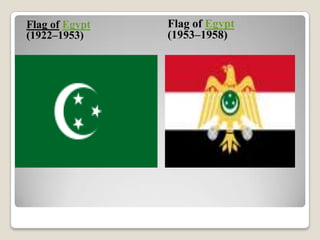
Flag of Egypt   Flag of Egypt
(1922–1953)     (1953–1958)
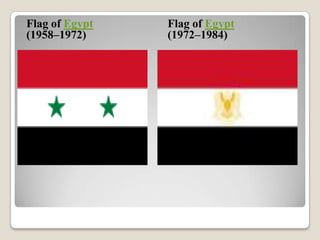
Flag of Egypt   Flag of Egypt
(1958–1972)     (1972–1984)
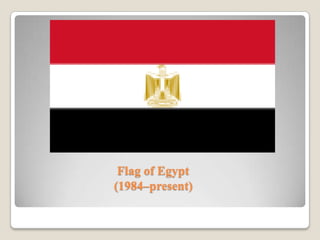
Flag of Egypt
(1984–present)
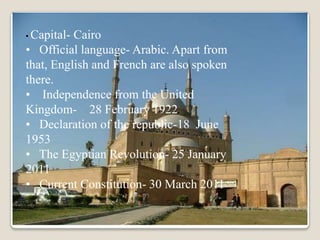
• Capital-Cairo
• Official language- Arabic. Apart from
that, English and French are also spoken
there.
• Independence from the United
Kingdom- 28 February 1922
• Declaration of the republic-18 June
1953
• The Egyptian Revolution- 25 January
2011
• Current Constitution- 30 March 2011
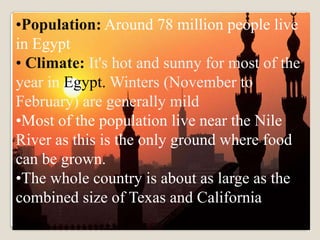
•Population: Around 78 million people live
.
in Egypt
• Climate: It's hot and sunny for most of the
year in Egypt. Winters (November to
February) are generally mild
•Most of the population live near the Nile
River as this is the only ground where food
can be grown.
•The whole country is about as large as the
combined size of Texas and California
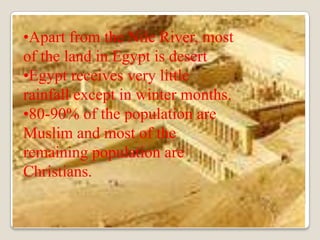
•Apart from the Nile River, most
of the land in Egypt is desert
•Egypt receives very little
rainfall except in winter months.
•80-90% of the population are
Muslim and most of the
remaining population are
Christians.
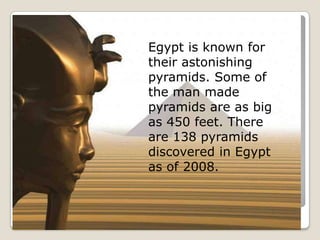
Egypt is known for
their astonishing
pyramids. Some of
the man made
pyramids are as big
as 450 feet. There
are 138 pyramids
discovered in Egypt
as of 2008.
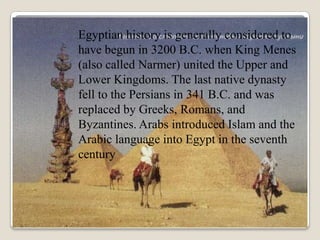
Egyptian history is generally considered to
have begun in 3200 B.C. when King Menes
(also called Narmer) united the Upper and
Lower Kingdoms. The last native dynasty
fell to the Persians in 341 B.C. and was
replaced by Greeks, Romans, and
Byzantines. Arabs introduced Islam and the
Arabic language into Egypt in the seventh
century
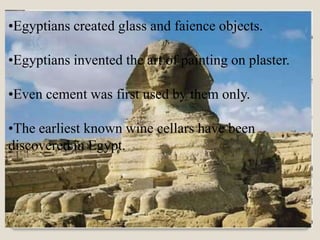
•Egyptians created glass and faience objects.

•Egyptians invented the art of painting on plaster.

•Even cement was first used by them only.

•The earliest known wine cellars have been
discovered in Egypt.
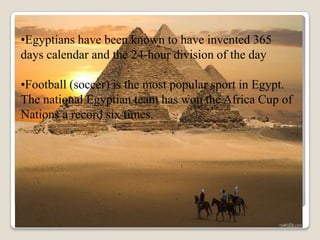
•Egyptians have been known to have invented 365
days calendar and the 24-hour division of the day

•Football (soccer) is the most popular sport in Egypt.
The national Egyptian team has won the Africa Cup of
Nations a record six times.
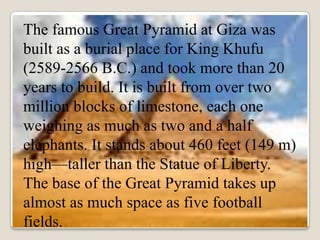
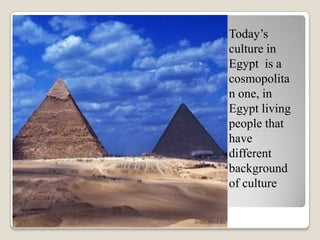
The famous Great Pyramid at Giza was
built as a burial place for King Khufu
(2589-2566 B.C.) and took more than 20
years to build. It is built from over two
million blocks of limestone, each one
weighing as much as two and a half
elephants. It stands about 460 feet (149 m)
high—taller than the Statue of Liberty.
The base of the Great Pyramid takes up
almost as much space as five football
fields.
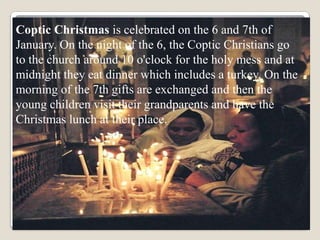
Coptic Christmas is celebrated on the 6 and 7th of
January. On the night of the 6, the Coptic Christians go
to the church around 10 o'clock for the holy mess and at
midnight they eat dinner which includes a turkey. On the
morning of the 7th gifts are exchanged and then the
young children visit their grandparents and have the
Christmas lunch at their place.
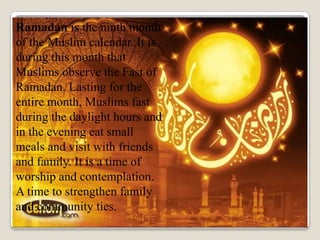
Ramadan is the ninth month
of the Muslim calendar. It is
during this month that
Muslims observe the Fast of
Ramadan. Lasting for the
entire month, Muslims fast
during the daylight hours and
in the evening eat small
meals and visit with friends
and family. It is a time of
worship and contemplation.
A time to strengthen family
and community ties.
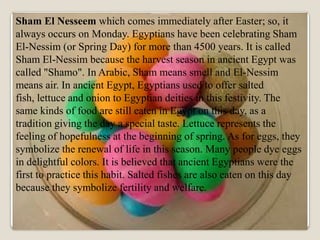
Sham El Nesseem which comes immediately after Easter; so, it
always occurs on Monday. Egyptians have been celebrating Sham
El-Nessim (or Spring Day) for more than 4500 years. It is called
Sham El-Nessim because the harvest season in ancient Egypt was
called "Shamo". In Arabic, Sham means smell and El-Nessim
means air. In ancient Egypt, Egyptians used to offer salted
fish, lettuce and onion to Egyptian deities in this festivity. The
same kinds of food are still eaten in Egypt on this day, as a
tradition giving the day a special taste. Lettuce represents the
feeling of hopefulness at the beginning of spring. As for eggs, they
symbolize the renewal of life in this season. Many people dye eggs
in delightful colors. It is believed that ancient Egyptians were the
first to practice this habit. Salted fishes are also eaten on this day
because they symbolize fertility and welfare.
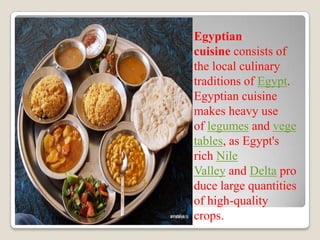
Egyptian
cuisine consists of
the local culinary
traditions of Egypt.
Egyptian cuisine
makes heavy use
of legumes and vege
tables, as Egypt's
rich Nile
Valley and Delta pro
duce large quantities
of high-quality
crops.
Today’s
culture in
Egypt is a
cosmopolita
n one, in
Egypt living
people that
have
different
background
of culture

Egypt

  • 1.
    Flag of Egypt Flag of Egypt (1922–1953) (1953–1958)
  • 2.
    Flag of Egypt Flag of Egypt (1958–1972) (1972–1984)
  • 3.
  • 4.
    • Capital-Cairo • Officiallanguage- Arabic. Apart from that, English and French are also spoken there. • Independence from the United Kingdom- 28 February 1922 • Declaration of the republic-18 June 1953 • The Egyptian Revolution- 25 January 2011 • Current Constitution- 30 March 2011
  • 5.
    •Population: Around 78million people live . in Egypt • Climate: It's hot and sunny for most of the year in Egypt. Winters (November to February) are generally mild •Most of the population live near the Nile River as this is the only ground where food can be grown. •The whole country is about as large as the combined size of Texas and California
  • 6.
    •Apart from theNile River, most of the land in Egypt is desert •Egypt receives very little rainfall except in winter months. •80-90% of the population are Muslim and most of the remaining population are Christians.
  • 7.
    Egypt is knownfor their astonishing pyramids. Some of the man made pyramids are as big as 450 feet. There are 138 pyramids discovered in Egypt as of 2008.
  • 8.
    Egyptian history isgenerally considered to have begun in 3200 B.C. when King Menes (also called Narmer) united the Upper and Lower Kingdoms. The last native dynasty fell to the Persians in 341 B.C. and was replaced by Greeks, Romans, and Byzantines. Arabs introduced Islam and the Arabic language into Egypt in the seventh century
  • 9.
    •Egyptians created glassand faience objects. •Egyptians invented the art of painting on plaster. •Even cement was first used by them only. •The earliest known wine cellars have been discovered in Egypt.
  • 10.
    •Egyptians have beenknown to have invented 365 days calendar and the 24-hour division of the day •Football (soccer) is the most popular sport in Egypt. The national Egyptian team has won the Africa Cup of Nations a record six times.
  • 11.
    The famous GreatPyramid at Giza was built as a burial place for King Khufu (2589-2566 B.C.) and took more than 20 years to build. It is built from over two million blocks of limestone, each one weighing as much as two and a half elephants. It stands about 460 feet (149 m) high—taller than the Statue of Liberty. The base of the Great Pyramid takes up almost as much space as five football fields.
  • 12.
    Coptic Christmas iscelebrated on the 6 and 7th of January. On the night of the 6, the Coptic Christians go to the church around 10 o'clock for the holy mess and at midnight they eat dinner which includes a turkey. On the morning of the 7th gifts are exchanged and then the young children visit their grandparents and have the Christmas lunch at their place.
  • 13.
    Ramadan is theninth month of the Muslim calendar. It is during this month that Muslims observe the Fast of Ramadan. Lasting for the entire month, Muslims fast during the daylight hours and in the evening eat small meals and visit with friends and family. It is a time of worship and contemplation. A time to strengthen family and community ties.
  • 14.
    Sham El Nesseemwhich comes immediately after Easter; so, it always occurs on Monday. Egyptians have been celebrating Sham El-Nessim (or Spring Day) for more than 4500 years. It is called Sham El-Nessim because the harvest season in ancient Egypt was called "Shamo". In Arabic, Sham means smell and El-Nessim means air. In ancient Egypt, Egyptians used to offer salted fish, lettuce and onion to Egyptian deities in this festivity. The same kinds of food are still eaten in Egypt on this day, as a tradition giving the day a special taste. Lettuce represents the feeling of hopefulness at the beginning of spring. As for eggs, they symbolize the renewal of life in this season. Many people dye eggs in delightful colors. It is believed that ancient Egyptians were the first to practice this habit. Salted fishes are also eaten on this day because they symbolize fertility and welfare.
  • 15.
    Egyptian cuisine consists of thelocal culinary traditions of Egypt. Egyptian cuisine makes heavy use of legumes and vege tables, as Egypt's rich Nile Valley and Delta pro duce large quantities of high-quality crops.
  • 16.
    Today’s culture in Egypt isa cosmopolita n one, in Egypt living people that have different background of culture