Specifying Clock Oscillators
Clock Oscillators
2
 Clock oscillators are the most technically
simple oscillator we offer.
 They incorporate a quartz wafer and an
electronics circuit to make the quartz
resonate.
 By applying the correct power supply to
the device, a stable output clock
waveform is provided at the output pin.
 IQD’s clock oscillator part numbers all
contain the code ‘SPXO’.
 SPXO is an acronym for Simple Packaged
Crystal Oscillator.
Clock Oscillators
3
 Electrical parameters are given on the
specification to facilitate the correct
circuit design.
 Our Application Support team can also
provide assistance if required or please
contact one of our sales offices for
further information.
 Limits given in the following
specifications are indicative of the
standard oscillator design.
Typical clock oscillator specification
4
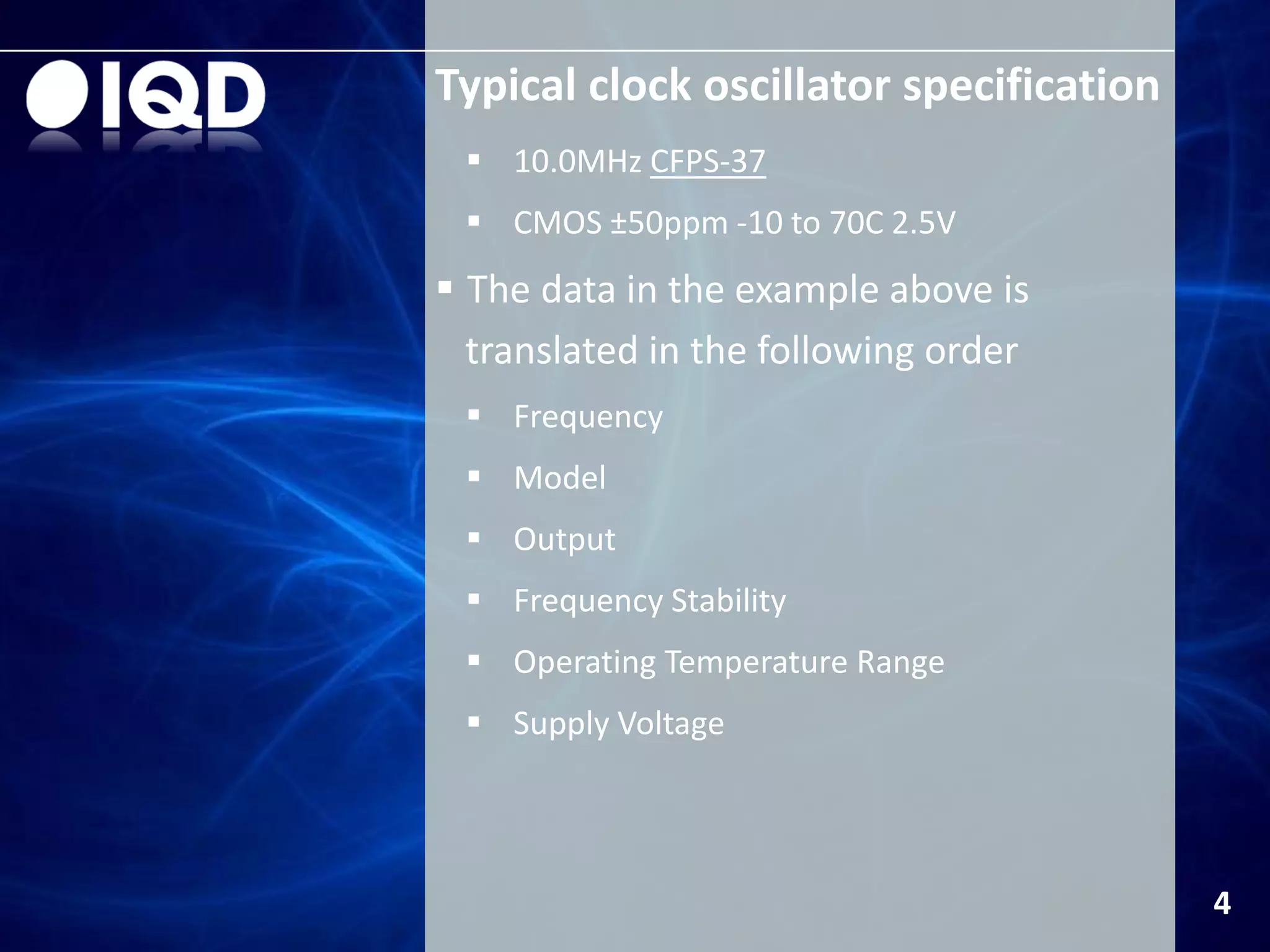
 10.0MHz CFPS-37
 CMOS ±50ppm -10 to 70C 2.5V
 The data in the example above is
translated in the following order
 Frequency
 Model
 Output
 Frequency Stability
 Operating Temperature Range
 Supply Voltage
Frequency
5
 Frequency is normally specified in
kilohertz (kHz) up to 999.999kHz and in
megahertz (MHz) from 1.0MHz.
 All IQD’s computer-generated
transaction documents follow this
standard convention automatically.
 Frequency should be specified to seven
significant figures
 If seven significant figures are not used,
we assume that any figure that might
follow those given may be taken as zero
e.g. frequency given as 16.6MHz will be
taken as 16.60, not 16.6666.
Model
6
 The model incorporates the following
information:
 Output compatibility
 Holder style
 Supply voltage
Frequency Stability
7
 Frequency stability of a clock oscillator
includes:
 Initial adjustment tolerance at room
temperature
 Tolerance over operating temperature
range
 The effect of supply voltage variation
 Frequency stability is specified as ‘parts
per million’ (ppm) and is typically
available in the range ±5ppm to
±100ppm.
Operating Temperature Ranges
8
 Standard temperature ranges
 0 to 70°C
 –10 to 70°C
 –40 to 85°C
 –40 to 125°C
 –55 to 125°C
 In general clock oscillators continue to
operate outside their normal
temperature range but with a
degradation in frequency stability.
 Damage can result if the temperatures
reached are excessive.
Additional Text Code
9
 If product is non-standard, the letter ‘T’
will appear at the end of the product
specification.
 This refers to additional text on the
data sheet to identify the non-standard
elements of the specification.
Packaging Code
10
 Tape and Reel packaging is standard for
most of our products.
 Unless individual data sheets state Tape
and Reel packaging, items will be Bulk
packed.
 Only complete reels are sold
 Packaging options available include
 Reel = Tape and Reel
 Cutt = Cut Tape
 Bulk = Bulk pack
 Tray = Tray pack
Outline Drawings
11
 All dimensions are shown in mm and
are nominal unless otherwise stated.
Marking
12
 Where space is limited some or all of
the information will be omitted/
truncated at our discretion.
 Full product description will be found
on the individual batch packaging.
Ordering Information
13
 See individual data sheets.
 More information can be found on our
website.
Standing out from the crowd
14

Specifying Clock Oscillators

  • 1.
  • 2.
    Clock Oscillators 2  Clockoscillators are the most technically simple oscillator we offer.  They incorporate a quartz wafer and an electronics circuit to make the quartz resonate.  By applying the correct power supply to the device, a stable output clock waveform is provided at the output pin.  IQD’s clock oscillator part numbers all contain the code ‘SPXO’.  SPXO is an acronym for Simple Packaged Crystal Oscillator.
  • 3.
    Clock Oscillators 3  Electricalparameters are given on the specification to facilitate the correct circuit design.  Our Application Support team can also provide assistance if required or please contact one of our sales offices for further information.  Limits given in the following specifications are indicative of the standard oscillator design.
  • 4.
    Typical clock oscillatorspecification 4  10.0MHz CFPS-37  CMOS ±50ppm -10 to 70C 2.5V  The data in the example above is translated in the following order  Frequency  Model  Output  Frequency Stability  Operating Temperature Range  Supply Voltage
  • 5.
    Frequency 5  Frequency isnormally specified in kilohertz (kHz) up to 999.999kHz and in megahertz (MHz) from 1.0MHz.  All IQD’s computer-generated transaction documents follow this standard convention automatically.  Frequency should be specified to seven significant figures  If seven significant figures are not used, we assume that any figure that might follow those given may be taken as zero e.g. frequency given as 16.6MHz will be taken as 16.60, not 16.6666.
  • 6.
    Model 6  The modelincorporates the following information:  Output compatibility  Holder style  Supply voltage
  • 7.
    Frequency Stability 7  Frequencystability of a clock oscillator includes:  Initial adjustment tolerance at room temperature  Tolerance over operating temperature range  The effect of supply voltage variation  Frequency stability is specified as ‘parts per million’ (ppm) and is typically available in the range ±5ppm to ±100ppm.
  • 8.
    Operating Temperature Ranges 8 Standard temperature ranges  0 to 70°C  –10 to 70°C  –40 to 85°C  –40 to 125°C  –55 to 125°C  In general clock oscillators continue to operate outside their normal temperature range but with a degradation in frequency stability.  Damage can result if the temperatures reached are excessive.
  • 9.
    Additional Text Code 9 If product is non-standard, the letter ‘T’ will appear at the end of the product specification.  This refers to additional text on the data sheet to identify the non-standard elements of the specification.
  • 10.
    Packaging Code 10  Tapeand Reel packaging is standard for most of our products.  Unless individual data sheets state Tape and Reel packaging, items will be Bulk packed.  Only complete reels are sold  Packaging options available include  Reel = Tape and Reel  Cutt = Cut Tape  Bulk = Bulk pack  Tray = Tray pack
  • 11.
    Outline Drawings 11  Alldimensions are shown in mm and are nominal unless otherwise stated.
  • 12.
    Marking 12  Where spaceis limited some or all of the information will be omitted/ truncated at our discretion.  Full product description will be found on the individual batch packaging.
  • 13.
    Ordering Information 13  Seeindividual data sheets.  More information can be found on our website.
  • 14.
    Standing out fromthe crowd 14