Eric Hagenimana February 24, 2015
A00015905
CHE 310
Group 1 : Immaculata, Kadidjah
Use of Hydrometer for the Specific Gravity Determination of Crude
Oil and Its Fractions Values
Abstract
As indicated by the title, the purpose of this experiment was to determine the specific gravity of
two samples namely crude oil and diesel by using the hydrometer. In this lab, 500ml of the two
substances were tested to find their corresponding specific gravities. At different temperatures,
the specific gravities of substances were measured using hydrometer. From the data obtained, it
was then clear that the specific gravity of any substance decreases as the temperature increases.
Lastly, the more useful property used to handle the petroleum liquids API gravity was calculated
for each sample.
Introduction
Specific gravity is defined as the ratio of the weight of a given volume of a material to the weight
of the same weight of water at the same temperature. The specific gravity is an important
property used to identify substances. It is important in sense that it shows how heavy a substance
is compared to water, and it will show if it will sink or float if is mixed with water. Crude oils
from different places have different specific gravity due to the different in compositions. Specific
gravity can be expressed in degrees using API gravity. Water has API density of 10, if the
substance has the API greater than ten is less dense than water while if its density is lower than
10, it is denser than water.
API gravity =
141.5
𝑠𝑝𝑒𝑐𝑖𝑓𝑖𝑐 𝑑𝑒𝑛𝑠𝑖𝑡𝑦
− 131.5
Materials and chemicals
Crude oil, diesel oil, Hydrometer and Water bath, 500 mL Cylinder and Retort Stand
Procedures
First of all 500 mL of each of crude oil, diesel samples was poured into a clean 500 mL
measuring cylinder. The cylinders were then placed into the bath and supported in place by the
retort stand. The immersion bath water was then set at 300 C. The 0.850 hydrometer was then
lowered into each Cylinder containing the samples so as to measure their corresponding specific
gravities. The hydrometer reading at the liquid surface was then recorded as the specific gravity
of the sample at 250 C. The same procedure was used to measure the specific gravity of the
samples at the different temperature values (30oC, 35oC, 40oC, 45oC, 50oC) as indicated in the
table of data.
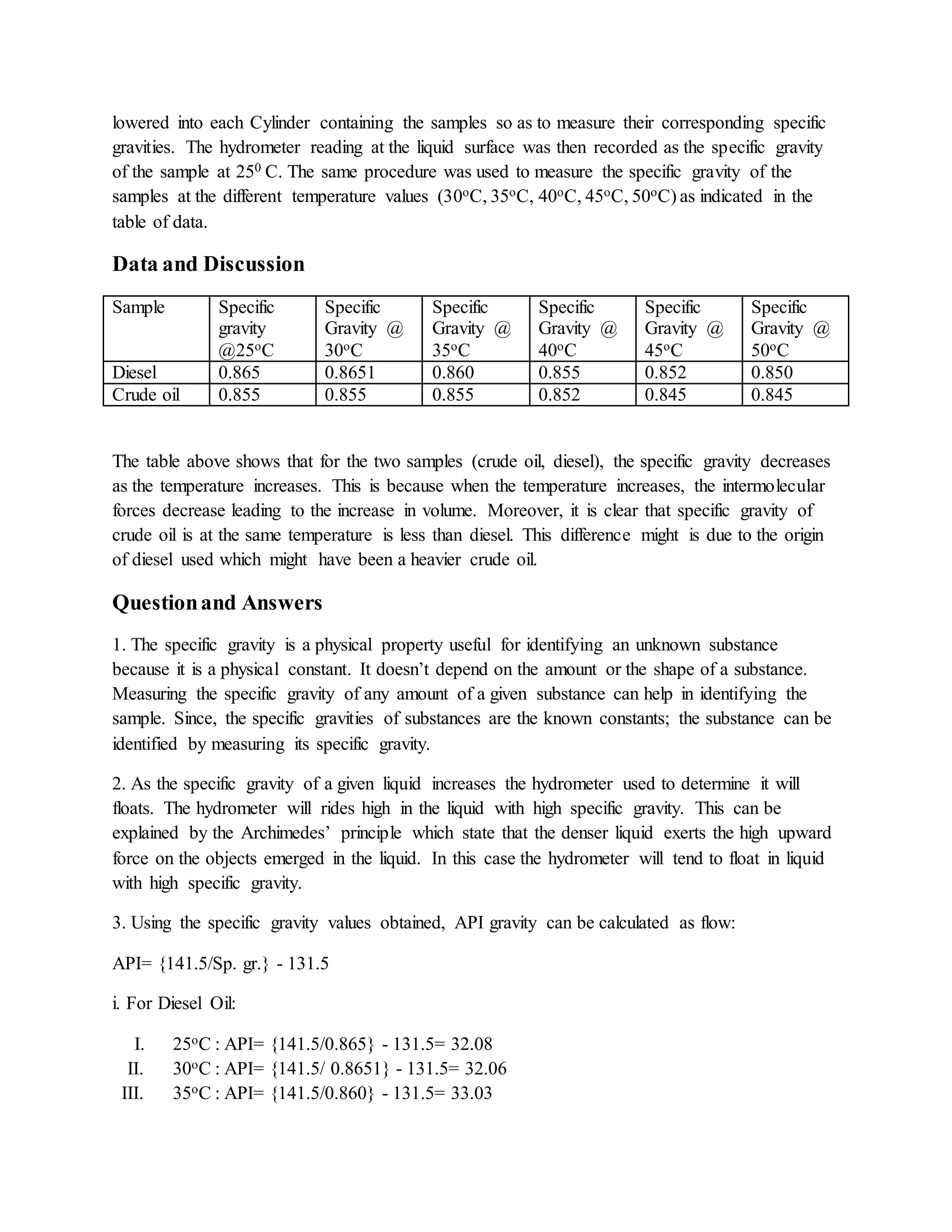
Data and Discussion
Sample Specific
gravity
@25oC
Specific
Gravity @
30oC
Specific
Gravity @
35oC
Specific
Gravity @
40oC
Specific
Gravity @
45oC
Specific
Gravity @
50oC
Diesel 0.865 0.8651 0.860 0.855 0.852 0.850
Crude oil 0.855 0.855 0.855 0.852 0.845 0.845
The table above shows that for the two samples (crude oil, diesel), the specific gravity decreases
as the temperature increases. This is because when the temperature increases, the intermolecular
forces decrease leading to the increase in volume. Moreover, it is clear that specific gravity of
crude oil is at the same temperature is less than diesel. This difference might is due to the origin
of diesel used which might have been a heavier crude oil.
Questionand Answers
1. The specific gravity is a physical property useful for identifying an unknown substance
because it is a physical constant. It doesn’t depend on the amount or the shape of a substance.
Measuring the specific gravity of any amount of a given substance can help in identifying the
sample. Since, the specific gravities of substances are the known constants; the substance can be
identified by measuring its specific gravity.
2. As the specific gravity of a given liquid increases the hydrometer used to determine it will
floats. The hydrometer will rides high in the liquid with high specific gravity. This can be
explained by the Archimedes’ principle which state that the denser liquid exerts the high upward
force on the objects emerged in the liquid. In this case the hydrometer will tend to float in liquid
with high specific gravity.
3. Using the specific gravity values obtained, API gravity can be calculated as flow:
API= {141.5/Sp. gr.} - 131.5
i. For Diesel Oil:
I. 25oC : API= {141.5/0.865} - 131.5= 32.08
II. 30oC : API= {141.5/ 0.8651} - 131.5= 32.06
III. 35oC : API= {141.5/0.860} - 131.5= 33.03
IV. 40oC : API= {141.5/0.855} - 131.5= 33.99
V. 45oC: API= {141.5/0.852} - 131.5 = 34.58
VI. 50oC : API= {141.5/0.850} - 131.5= 34.97
ii. For Crude Oil:
I. 25oC : API= {141.5/0.855} - 131.5= 33.99
II. 30oC : API= {141.5/0.855} - 131.5= 33.99
III. 35oC : API= {141.5/0.855} - 131.5= 33.99
IV. 40oC : API= {141.5/0.852} - 131.5= 34.68
V. 45oC : API= {141.5/0.845} - 131.5= 35.95
VI. 50oC : API= {141.5/0.845} - 131.5= 35.95
Contrary, the API gravity increases as the specific gravity decreases. In this case, the less dense
liquids have the larger API gravity values. It can be also help to identify the unknown sample of
substance. Eventually, the API gravity will increases as the specific gravity decreases; therefore,
as the temperature increases the API gravity also increases. At the same temperature diesel has
lower API gravity compared to crude oil this is because it is denser than crude oil.
Conclusion
From the data obtained in experiment, it is true that specific gravity of crude oil is greater than
specific gravity of diesel, which in turn is greater than that of gas condensate. Moreover the
results show that as the temperature increases, the specific density decreases due to the increase
of volume as a result of decrease in intermolecular forces caused by temperature.
Reference
Petroleum Science Lab Manual
Samir, Matar and Lewis .F, Hatch. Chemistry of Petrochemical Process, 2nd Ed.

Specific gravity

  • 1.
    Eric Hagenimana February24, 2015 A00015905 CHE 310 Group 1 : Immaculata, Kadidjah Use of Hydrometer for the Specific Gravity Determination of Crude Oil and Its Fractions Values Abstract As indicated by the title, the purpose of this experiment was to determine the specific gravity of two samples namely crude oil and diesel by using the hydrometer. In this lab, 500ml of the two substances were tested to find their corresponding specific gravities. At different temperatures, the specific gravities of substances were measured using hydrometer. From the data obtained, it was then clear that the specific gravity of any substance decreases as the temperature increases. Lastly, the more useful property used to handle the petroleum liquids API gravity was calculated for each sample. Introduction Specific gravity is defined as the ratio of the weight of a given volume of a material to the weight of the same weight of water at the same temperature. The specific gravity is an important property used to identify substances. It is important in sense that it shows how heavy a substance is compared to water, and it will show if it will sink or float if is mixed with water. Crude oils from different places have different specific gravity due to the different in compositions. Specific gravity can be expressed in degrees using API gravity. Water has API density of 10, if the substance has the API greater than ten is less dense than water while if its density is lower than 10, it is denser than water. API gravity = 141.5 𝑠𝑝𝑒𝑐𝑖𝑓𝑖𝑐 𝑑𝑒𝑛𝑠𝑖𝑡𝑦 − 131.5 Materials and chemicals Crude oil, diesel oil, Hydrometer and Water bath, 500 mL Cylinder and Retort Stand Procedures First of all 500 mL of each of crude oil, diesel samples was poured into a clean 500 mL measuring cylinder. The cylinders were then placed into the bath and supported in place by the retort stand. The immersion bath water was then set at 300 C. The 0.850 hydrometer was then
  • 2.
    lowered into eachCylinder containing the samples so as to measure their corresponding specific gravities. The hydrometer reading at the liquid surface was then recorded as the specific gravity of the sample at 250 C. The same procedure was used to measure the specific gravity of the samples at the different temperature values (30oC, 35oC, 40oC, 45oC, 50oC) as indicated in the table of data. Data and Discussion Sample Specific gravity @25oC Specific Gravity @ 30oC Specific Gravity @ 35oC Specific Gravity @ 40oC Specific Gravity @ 45oC Specific Gravity @ 50oC Diesel 0.865 0.8651 0.860 0.855 0.852 0.850 Crude oil 0.855 0.855 0.855 0.852 0.845 0.845 The table above shows that for the two samples (crude oil, diesel), the specific gravity decreases as the temperature increases. This is because when the temperature increases, the intermolecular forces decrease leading to the increase in volume. Moreover, it is clear that specific gravity of crude oil is at the same temperature is less than diesel. This difference might is due to the origin of diesel used which might have been a heavier crude oil. Questionand Answers 1. The specific gravity is a physical property useful for identifying an unknown substance because it is a physical constant. It doesn’t depend on the amount or the shape of a substance. Measuring the specific gravity of any amount of a given substance can help in identifying the sample. Since, the specific gravities of substances are the known constants; the substance can be identified by measuring its specific gravity. 2. As the specific gravity of a given liquid increases the hydrometer used to determine it will floats. The hydrometer will rides high in the liquid with high specific gravity. This can be explained by the Archimedes’ principle which state that the denser liquid exerts the high upward force on the objects emerged in the liquid. In this case the hydrometer will tend to float in liquid with high specific gravity. 3. Using the specific gravity values obtained, API gravity can be calculated as flow: API= {141.5/Sp. gr.} - 131.5 i. For Diesel Oil: I. 25oC : API= {141.5/0.865} - 131.5= 32.08 II. 30oC : API= {141.5/ 0.8651} - 131.5= 32.06 III. 35oC : API= {141.5/0.860} - 131.5= 33.03
  • 3.
    IV. 40oC :API= {141.5/0.855} - 131.5= 33.99 V. 45oC: API= {141.5/0.852} - 131.5 = 34.58 VI. 50oC : API= {141.5/0.850} - 131.5= 34.97 ii. For Crude Oil: I. 25oC : API= {141.5/0.855} - 131.5= 33.99 II. 30oC : API= {141.5/0.855} - 131.5= 33.99 III. 35oC : API= {141.5/0.855} - 131.5= 33.99 IV. 40oC : API= {141.5/0.852} - 131.5= 34.68 V. 45oC : API= {141.5/0.845} - 131.5= 35.95 VI. 50oC : API= {141.5/0.845} - 131.5= 35.95 Contrary, the API gravity increases as the specific gravity decreases. In this case, the less dense liquids have the larger API gravity values. It can be also help to identify the unknown sample of substance. Eventually, the API gravity will increases as the specific gravity decreases; therefore, as the temperature increases the API gravity also increases. At the same temperature diesel has lower API gravity compared to crude oil this is because it is denser than crude oil. Conclusion From the data obtained in experiment, it is true that specific gravity of crude oil is greater than specific gravity of diesel, which in turn is greater than that of gas condensate. Moreover the results show that as the temperature increases, the specific density decreases due to the increase of volume as a result of decrease in intermolecular forces caused by temperature. Reference Petroleum Science Lab Manual Samir, Matar and Lewis .F, Hatch. Chemistry of Petrochemical Process, 2nd Ed.