Participation and introduction guide for
schools and districts
Enable, engage and empower the voices of your
stakeholders
Speak Up
Participation Guide for
Speak Up
1. What is Speak Up?
2. Why should we participate in Speak Up this
year?
3. What benefits will we receive?
4. How do we participate?
5. What should be our goal for participation?
6. Who do we call if we need help?
1. What is Speak Up?
• The Speak Up Research Project for Digital Learning, a national initiative of
Project Tomorrow, is both a national research project and a free service to
schools and districts everywhere.
• Speak Up has three goals:
➢To collect and report on the authentic, unfiltered views and ideas of
K-12 students, educators and parents so as to inform national
discussions on the use of technology in education.
➢To provide school, district and state leaders with similar local or
regional data from stakeholders to inform their policies, programs and
funding.
➢To demonstrate to the education stakeholders, most notably students,
that their voices are important in discussions about education.
Participation Guide for
Speak Up
• Speak Up is facilitated exclusively through schools and districts.
Schools and districts register to participate to ensure data
confidentiality. All schools and districts are eligible to participate.
• Speak Up is unlike other surveys or research projects because every
participating school and district gets back all of the locally collected
data from all stakeholders.
• There is no fee for participation. There is no limit on the number of
surveys that can be submitted.
• All data collected is 100% confidential.
Participation Guide for
Speak Up
1. What is Speak Up?
• Project Tomorrow shares the national-level data with Congress, the
US Department of Education, other federal agencies, think tanks and
research organizations and education associations.
• Project Tomorrow is not in the “gotcha business.” We do not compare
schools or districts, nor do we share local data with anyone but the
participating schools and districts.
• Speak Up includes surveys for K-12 students, teachers, school
administrators, librarian media specialists, district administrators,
parents and community members.
• The surveys take about 15-20 minutes to complete.
Participation Guide for
Speak Up
1. What is Speak Up?
Participation Guide for
Speak Up
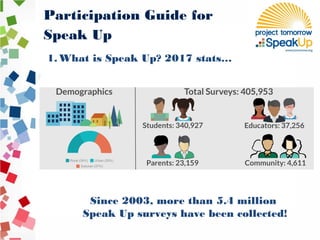
1. What is Speak Up? 2017 stats…
Since 2003, more than 5.4 million
Speak Up surveys have been collected!
2. Why should we participate?
▪ Three big reasons
▪ This year’s question themes
▪ What other education leaders say about the
value of Speak Up
▪ Open period for online surveys
Participation Guide for
Speak Up
2. Why should we participate?
Three Big Reasons:
Access the ideas of your stakeholders – especially students and
parents whose views are often difficult to collect. Speak Up is the
unbiased, 3rd party guardian of these views. Respondents are more
candid with us - we are not the district, state, or a vendor.
No need to write your own surveys – we are the experts in how
to ask audience-specific questions plus we provide you with the
national data for benchmarking anyway. Speak Up is the most cost
effective way to engage your community.
Ensure that the voices of your stakeholders are being
heard – in Washington DC and your state capitol. Be part of a
solution!
Participation Guide for
Speak Up
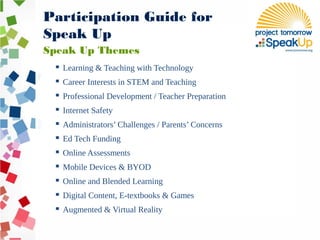
▪ Learning & Teaching with Technology
▪ Career Interests in STEM and Teaching
▪ Professional Development / Teacher Preparation
▪ Internet Safety
▪ Administrators’ Challenges / Parents’ Concerns
▪ Ed Tech Funding
▪ Online Assessments
▪ Mobile Devices & BYOD
▪ Online and Blended Learning
▪ Digital Content, E-textbooks & Games
▪ Augmented & Virtual Reality
Speak Up Themes
Participation Guide for
Speak Up
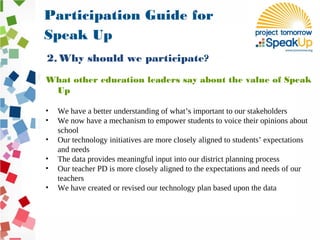
What other education leaders say about the value of Speak
Up
• We have a better understanding of what’s important to our stakeholders
• We now have a mechanism to empower students to voice their opinions about
school
• Our technology initiatives are more closely aligned to students’ expectations
and needs
• The data provides meaningful input into our district planning process
• Our teacher PD is more closely aligned to the expectations and needs of our
teachers
• We have created or revised our technology plan based upon the data
Participation Guide for
Speak Up
2. Why should we participate?
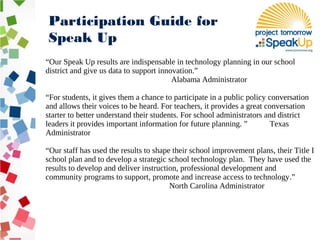
“Our Speak Up results are indispensable in technology planning in our school
district and give us data to support innovation.”
Alabama Administrator
“For students, it gives them a chance to participate in a public policy conversation
and allows their voices to be heard. For teachers, it provides a great conversation
starter to better understand their students. For school administrators and district
leaders it provides important information for future planning. ” Texas
Administrator
“Our staff has used the results to shape their school improvement plans, their Title I
school plan and to develop a strategic school technology plan. They have used the
results to develop and deliver instruction, professional development and
community programs to support, promote and increase access to technology.”
North Carolina Administrator
Participation Guide for
Speak Up
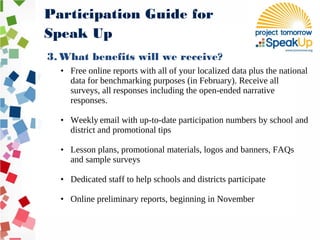
3. What benefits will we receive?
• Free online reports with all of your localized data plus the national
data for benchmarking purposes (in February). Receive all
surveys, all responses including the open-ended narrative
responses.
• Weekly email with up-to-date participation numbers by school and
district and promotional tips
• Lesson plans, promotional materials, logos and banners, FAQs
and sample surveys
• Dedicated staff to help schools and districts participate
• Online preliminary reports, beginning in November
Participation Guide for
Speak Up
• Schools & districts register to participate (for free)
• Pick a password for students to use to access their
online surveys
• Promote to parents and staff – we provide materials
• Provide way for students to take online surveys
• Review weekly survey counts
• Schools & districts get access to local survey results +
national data for benchmarks in early February
• Plan time to review your data!
4. How do we participate?
Participation Guide for
Speak Up
4. How do we participate?
Online surveys are open:
October through January
Registration now open:
www.tomorrow.org/speakup
Participation Guide for
Speak Up
5. What should be our goal?
Step 1: Decide the audiences to poll with the Speak Up surveys
Step 2: Decide what schools/classes you want to participate – or ALL
Step 3: Identify your participation goal per school or per district.
One common way to do that is to use a percentage of your current
student population (or staff) to identify that goal.
Ex: District student population = 10,000
Speak Up Goal of 25% = 2,500 students
Step 4: Determine how you are going to use our Speak Up data in the
spring and communicate those usage objectives.
Step 5: Promote and encourage participation. Use incentives to engage
your schools and stakeholder audiences!
Participation Guide for Speak Up
6. Who do we call if we need help?
Your Project Tomorrow team is available to help you anytime. Please
call or email us if you have any questions or need ideas to support your
participation.
Jenny Hostert – Speak Up Operations Manager
949-609-4660 x17
jhostert@tomorrow.org
Julie Evans – CEO
949-609-4660 x15
jevans@tomorrow.org
Participation Guide for
Speak Up
Thank you for your interest in
Speak Up, a national initiative
of Project Tomorrow.
Learn more at
www.tomorrow.org/speakup

Speak Up Participation Guide 2018

  • 1.
    Participation and introductionguide for schools and districts Enable, engage and empower the voices of your stakeholders Speak Up
  • 2.
    Participation Guide for SpeakUp 1. What is Speak Up? 2. Why should we participate in Speak Up this year? 3. What benefits will we receive? 4. How do we participate? 5. What should be our goal for participation? 6. Who do we call if we need help?
  • 3.
    1. What isSpeak Up? • The Speak Up Research Project for Digital Learning, a national initiative of Project Tomorrow, is both a national research project and a free service to schools and districts everywhere. • Speak Up has three goals: ➢To collect and report on the authentic, unfiltered views and ideas of K-12 students, educators and parents so as to inform national discussions on the use of technology in education. ➢To provide school, district and state leaders with similar local or regional data from stakeholders to inform their policies, programs and funding. ➢To demonstrate to the education stakeholders, most notably students, that their voices are important in discussions about education. Participation Guide for Speak Up
  • 4.
    • Speak Upis facilitated exclusively through schools and districts. Schools and districts register to participate to ensure data confidentiality. All schools and districts are eligible to participate. • Speak Up is unlike other surveys or research projects because every participating school and district gets back all of the locally collected data from all stakeholders. • There is no fee for participation. There is no limit on the number of surveys that can be submitted. • All data collected is 100% confidential. Participation Guide for Speak Up 1. What is Speak Up?
  • 5.
    • Project Tomorrowshares the national-level data with Congress, the US Department of Education, other federal agencies, think tanks and research organizations and education associations. • Project Tomorrow is not in the “gotcha business.” We do not compare schools or districts, nor do we share local data with anyone but the participating schools and districts. • Speak Up includes surveys for K-12 students, teachers, school administrators, librarian media specialists, district administrators, parents and community members. • The surveys take about 15-20 minutes to complete. Participation Guide for Speak Up 1. What is Speak Up?
  • 6.
    Participation Guide for SpeakUp 1. What is Speak Up? 2017 stats… Since 2003, more than 5.4 million Speak Up surveys have been collected!
  • 7.
    2. Why shouldwe participate? ▪ Three big reasons ▪ This year’s question themes ▪ What other education leaders say about the value of Speak Up ▪ Open period for online surveys Participation Guide for Speak Up
  • 8.
    2. Why shouldwe participate? Three Big Reasons: Access the ideas of your stakeholders – especially students and parents whose views are often difficult to collect. Speak Up is the unbiased, 3rd party guardian of these views. Respondents are more candid with us - we are not the district, state, or a vendor. No need to write your own surveys – we are the experts in how to ask audience-specific questions plus we provide you with the national data for benchmarking anyway. Speak Up is the most cost effective way to engage your community. Ensure that the voices of your stakeholders are being heard – in Washington DC and your state capitol. Be part of a solution! Participation Guide for Speak Up
  • 9.
    ▪ Learning &Teaching with Technology ▪ Career Interests in STEM and Teaching ▪ Professional Development / Teacher Preparation ▪ Internet Safety ▪ Administrators’ Challenges / Parents’ Concerns ▪ Ed Tech Funding ▪ Online Assessments ▪ Mobile Devices & BYOD ▪ Online and Blended Learning ▪ Digital Content, E-textbooks & Games ▪ Augmented & Virtual Reality Speak Up Themes Participation Guide for Speak Up
  • 10.
    What other educationleaders say about the value of Speak Up • We have a better understanding of what’s important to our stakeholders • We now have a mechanism to empower students to voice their opinions about school • Our technology initiatives are more closely aligned to students’ expectations and needs • The data provides meaningful input into our district planning process • Our teacher PD is more closely aligned to the expectations and needs of our teachers • We have created or revised our technology plan based upon the data Participation Guide for Speak Up 2. Why should we participate?
  • 11.
    “Our Speak Upresults are indispensable in technology planning in our school district and give us data to support innovation.” Alabama Administrator “For students, it gives them a chance to participate in a public policy conversation and allows their voices to be heard. For teachers, it provides a great conversation starter to better understand their students. For school administrators and district leaders it provides important information for future planning. ” Texas Administrator “Our staff has used the results to shape their school improvement plans, their Title I school plan and to develop a strategic school technology plan. They have used the results to develop and deliver instruction, professional development and community programs to support, promote and increase access to technology.” North Carolina Administrator Participation Guide for Speak Up
  • 12.
    3. What benefitswill we receive? • Free online reports with all of your localized data plus the national data for benchmarking purposes (in February). Receive all surveys, all responses including the open-ended narrative responses. • Weekly email with up-to-date participation numbers by school and district and promotional tips • Lesson plans, promotional materials, logos and banners, FAQs and sample surveys • Dedicated staff to help schools and districts participate • Online preliminary reports, beginning in November Participation Guide for Speak Up
  • 13.
    • Schools &districts register to participate (for free) • Pick a password for students to use to access their online surveys • Promote to parents and staff – we provide materials • Provide way for students to take online surveys • Review weekly survey counts • Schools & districts get access to local survey results + national data for benchmarks in early February • Plan time to review your data! 4. How do we participate? Participation Guide for Speak Up
  • 14.
    4. How dowe participate? Online surveys are open: October through January Registration now open: www.tomorrow.org/speakup Participation Guide for Speak Up
  • 15.
    5. What shouldbe our goal? Step 1: Decide the audiences to poll with the Speak Up surveys Step 2: Decide what schools/classes you want to participate – or ALL Step 3: Identify your participation goal per school or per district. One common way to do that is to use a percentage of your current student population (or staff) to identify that goal. Ex: District student population = 10,000 Speak Up Goal of 25% = 2,500 students Step 4: Determine how you are going to use our Speak Up data in the spring and communicate those usage objectives. Step 5: Promote and encourage participation. Use incentives to engage your schools and stakeholder audiences! Participation Guide for Speak Up
  • 16.
    6. Who dowe call if we need help? Your Project Tomorrow team is available to help you anytime. Please call or email us if you have any questions or need ideas to support your participation. Jenny Hostert – Speak Up Operations Manager 949-609-4660 x17 jhostert@tomorrow.org Julie Evans – CEO 949-609-4660 x15 jevans@tomorrow.org Participation Guide for Speak Up
  • 17.
    Thank you foryour interest in Speak Up, a national initiative of Project Tomorrow. Learn more at www.tomorrow.org/speakup