Fabian Lange

SPDY - http reloaded
(WILL BE) PART OF HTTP/2.0
HTTP Problems
•   Single request per connection. Because HTTP can only fetch one resource at a time (HTTP
    pipelining helps, but still enforces only a FIFO queue), a server delay of 500 ms prevents
    reuse of the TCP channel for additional requests. Browsers work around this problem by
    using multiple connections. Since 2008, most browsers have finally moved from 2
    connections per domain to 6.
•   Exclusively client-initiated requests. In HTTP, only the client can initiate a request. Even if
    the server knows the client needs a resource, it has no mechanism to inform the client and
    must instead wait to receive a request for the resource from the client.
•   Uncompressed request and response headers. Request headers today vary in size from
    ~200 bytes to over 2KB. As applications use more cookies and user agents expand
    features, typical header sizes of 700-800 bytes is common. For modems or ADSL
    connections, in which the uplink bandwidth is fairly low, this latency can be
    significant. Reducing the data in headers could directly improve the serialization latency to
    send requests.
•   Redundant headers. In addition, several headers are repeatedly sent across requests on the
    same channel. However, headers such as the User-Agent, Host, and Accept* are generally
    static and do not need to be resent.
•   Optional data compression. HTTP uses optional compression encodings for data. Content
    should always be sent in a compressed format.


                                           Source: http://dev.chromium.org/spdy/spdy-whitepaper
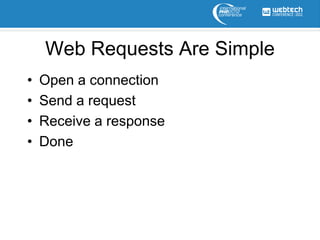
Web Requests Are Simple
•   Open a connection
•   Send a request
•   Receive a response
•   Done
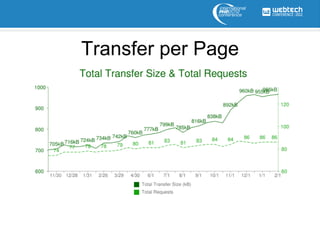
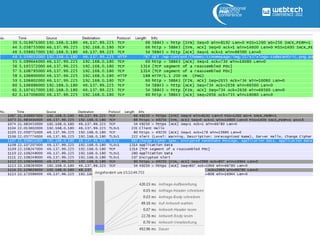
Transfer per Page
How to Avoid Requests
• Caching
• Domain Sharding
  – Browser Limits
• Keep Alive
  – Dedicated Connections
  – Waste Ressources
• Pipelining
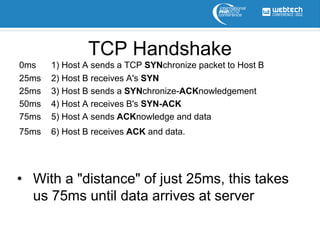
TCP Handshake
0ms    1) Host A sends a TCP SYNchronize packet to Host B
25ms   2) Host B receives A's SYN
25ms   3) Host B sends a SYNchronize-ACKnowledgement
50ms   4) Host A receives B's SYN-ACK
75ms   5) Host A sends ACKnowledge and data
75ms   6) Host B receives ACK and data.


• With a "distance" of just 25ms, this takes
  us 75ms until data arrives at server
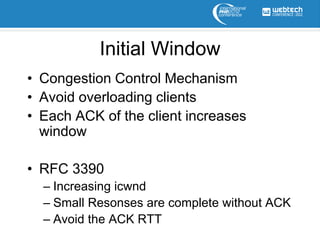
Initial Window
• Congestion Control Mechanism
• Avoid overloading clients
• Each ACK of the client increases
  window

• RFC 3390
  – Increasing icwnd
  – Small Resonses are complete without ACK
  – Avoid the ACK RTT
Pushing over http
• Push === Long Polling
• Consumes one connection on clients
• On server
  – Used to be expensive to hold
  – Modern servers have evented I/O


• WebSockets
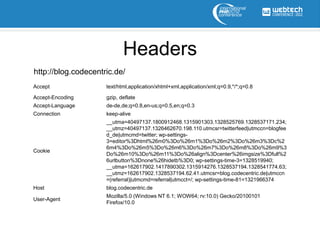
Headers
http://blog.codecentric.de/
Accept               text/html,application/xhtml+xml,application/xml;q=0.9,*/*;q=0.8

Accept-Encoding      gzip, deflate
Accept-Language      de-de,de;q=0.8,en-us;q=0.5,en;q=0.3
Connection           keep-alive
                     __utma=40497137.1800912468.1315901303.1328525769.1328537171.234;
                     __utmz=40497137.1326462670.198.110.utmcsr=twitterfeed|utmccn=blogfee
                     d_de|utmcmd=twitter; wp-settings-
                     3=editor%3Dhtml%26m0%3Do%26m1%3Do%26m2%3Do%26m3%3Dc%2
                     6m4%3Do%26m5%3Do%26m6%3Do%26m7%3Do%26m8%3Do%26m9%3
Cookie
                     Do%26m10%3Do%26m11%3Do%26align%3Dcenter%26imgsize%3Dfull%2
                     6urlbutton%3Dnone%26hidetb%3D0; wp-settings-time-3=1328519940;
                     __utma=162617902.1417890302.1315914276.1328537194.1328541774.63;
                     __utmz=162617902.1328537194.62.41.utmcsr=blog.codecentric.de|utmccn
                     =(referral)|utmcmd=referral|utmcct=/; wp-settings-time-81=1321966374
Host                 blog.codecentric.de
                     Mozilla/5.0 (Windows NT 6.1; WOW64; rv:10.0) Gecko/20100101
User-Agent
                     Firefox/10.0
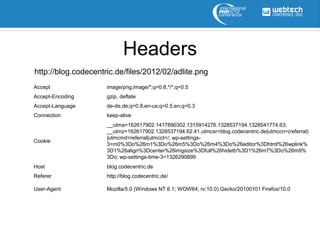
Headers
http://blog.codecentric.de/files/2012/02/adlite.png
Accept               image/png,image/*;q=0.8,*/*;q=0.5
Accept-Encoding      gzip, deflate
Accept-Language      de-de,de;q=0.8,en-us;q=0.5,en;q=0.3
Connection           keep-alive
                     __utma=162617902.1417890302.1315914276.1328537194.1328541774.63;
                     __utmz=162617902.1328537194.62.41.utmcsr=blog.codecentric.de|utmccn=(referral)
                     |utmcmd=referral|utmcct=/; wp-settings-
Cookie
                     3=m0%3Do%26m1%3Do%26m5%3Do%26m4%3Do%26editor%3Dhtml%26wplink%
                     3D1%26align%3Dcenter%26imgsize%3Dfull%26hidetb%3D1%26m7%3Do%26m9%
                     3Do; wp-settings-time-3=1326290899
Host                 blog.codecentric.de
Referer              http://blog.codecentric.de/

User-Agent           Mozilla/5.0 (Windows NT 6.1; WOW64; rv:10.0) Gecko/20100101 Firefox/10.0
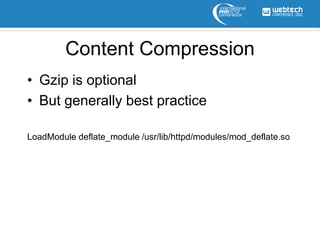
Content Compression
• Gzip is optional
• But generally best practice

LoadModule deflate_module /usr/lib/httpd/modules/mod_deflate.so
SPDY TO THE RESCUE
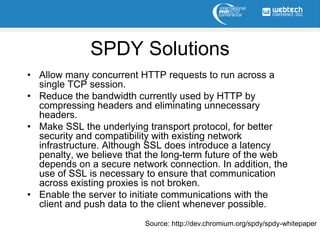
SPDY Solutions
• Allow many concurrent HTTP requests to run across a
  single TCP session.
• Reduce the bandwidth currently used by HTTP by
  compressing headers and eliminating unnecessary
  headers.
• Make SSL the underlying transport protocol, for better
  security and compatibility with existing network
  infrastructure. Although SSL does introduce a latency
  penalty, we believe that the long-term future of the web
  depends on a secure network connection. In addition, the
  use of SSL is necessary to ensure that communication
  across existing proxies is not broken.
• Enable the server to initiate communications with the
  client and push data to the client whenever possible.
                          Source: http://dev.chromium.org/spdy/spdy-whitepaper
Connection Multiplexing
• Single TCP Connection transports all
  requests
• TCP Handshake still exists
• Inital cwnd should be 16
Compression
• All data is compressed
• Includes headers
• Redundand data is removed
  – User Agent of second request is known to
    be same as on first
CRIME
       • Compression Ratio Info-leak Made
         Easy
       • Cookie value can be detected when
         compression is effective


Sources:
threatpost.com/en_us/blogs/new-attack-uses-ssltls-information-leak-hijack-https-sessions-090512
security.stackexchange.com/questions/19911/crime-how-to-beat-the-beast-successor/19914
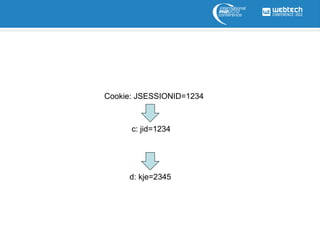
Cookie: JSESSIONID=1234


      c: jid=1234


     d: kje=2345
Cookie: JSESSIONID=1234 Cookie: JSESSIONID=9876


                 X[i] = c: jid=
                 [i]1234 [i]9876


                 Y[j] = d: kje=
                 [j]2345 [j]0987
Cookie: JSESSIONID=1234 Cookie: JSESSIONID=1235


                 X[i] = c: jid=123
                 [i]4 [i]5


                 Y[j] = d: kje=234
                 [j]5 [j]6
Fixes
• Don't compress headers
• Use a compressor that is not affected
SSL
• Not said to be a problem with HTTP
• SSL should be default
  – But actually expensive
• SSL hides SPDY traffic, so that proxies
  don't break it 
Pushing
• Long Lasting Connection By Design
• Send does not close the "request"
• Two flavors
  – Server push
  – Server hint
Compatibility
• SPDY is backwards compatible
• Uses Next Protocol Negotiation
  – tools.ietf.org/html/draft-agl-tls-
    nextprotoneg-02
Adoption
• Facebook implements and favors SPDY
 http://lists.w3.org/Archives/Public/ietf-http-wg/2012JulSep/0251.html

• Twitter implements and favors SPDY
 http://lists.w3.org/Archives/Public/ietf-http-wg/2012JulSep/0250.html

• Google implements and favors SPDY
 http://lists.w3.org/Archives/Public/ietf-http-wg/2012JulSep/0219.html

• Mozilla implements and favors SPDY
 http://lists.w3.org/Archives/Public/ietf-http-wg/2012JulSep/0156.html

• Wordpress.com uses SPDY
 https://twitter.com/wordpressdotcom/statuses/238741078172389377
Concerns
• Encryption by default renders network
  caching useless
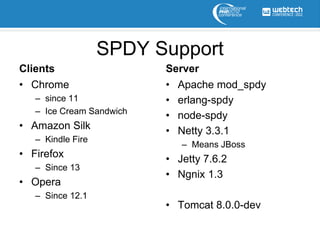
SPDY Support
Clients                   Server
• Chrome                  • Apache mod_spdy
   – since 11             • erlang-spdy
   – Ice Cream Sandwich
                          • node-spdy
• Amazon Silk             • Netty 3.3.1
   – Kindle Fire
                             – Means JBoss
• Firefox                 • Jetty 7.6.2
   – Since 13
                          • Ngnix 1.3
• Opera
   – Since 12.1
                          • Tomcat 8.0.0-dev
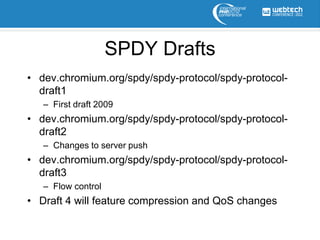
SPDY Drafts
• dev.chromium.org/spdy/spdy-protocol/spdy-protocol-
  draft1
   – First draft 2009
• dev.chromium.org/spdy/spdy-protocol/spdy-protocol-
  draft2
   – Changes to server push
• dev.chromium.org/spdy/spdy-protocol/spdy-protocol-
  draft3
   – Flow control
• Draft 4 will feature compression and QoS changes
DEMO: MIGRATING PHP ON
APACHE TO SUPPORT SPDY
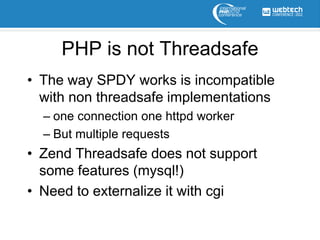
PHP is not Threadsafe
• The way SPDY works is incompatible
  with non threadsafe implementations
  – one connection one httpd worker
  – But multiple requests
• Zend Threadsafe does not support
  some features (mysql!)
• Need to externalize it with cgi
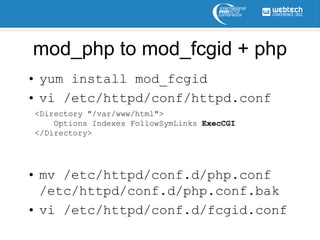
mod_php to mod_fcgid + php
• yum install mod_fcgid
• vi /etc/httpd/conf/httpd.conf
<Directory "/var/www/html">
    Options Indexes FollowSymLinks ExecCGI
</Directory>


• mv /etc/httpd/conf.d/php.conf
  /etc/httpd/conf.d/php.conf.bak
• vi /etc/httpd/conf.d/fcgid.conf
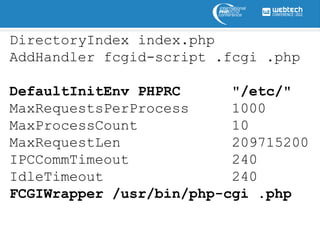
DirectoryIndex index.php
AddHandler fcgid-script .fcgi .php

DefaultInitEnv PHPRC      "/etc/"
MaxRequestsPerProcess     1000
MaxProcessCount           10
MaxRequestLen             209715200
IPCCommTimeout            240
IdleTimeout               240
FCGIWrapper /usr/bin/php-cgi .php
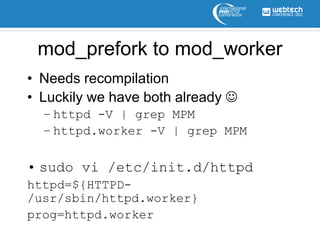
mod_prefork to mod_worker
• Needs recompilation
• Luckily we have both already 
  – httpd -V | grep MPM
  – httpd.worker -V | grep MPM

• sudo vi /etc/init.d/httpd
httpd=${HTTPD-
/usr/sbin/httpd.worker}
prog=httpd.worker
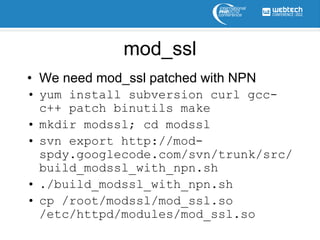
mod_ssl
• We need mod_ssl patched with NPN
• yum install subversion curl gcc-
  c++ patch binutils make
• mkdir modssl; cd modssl
• svn export http://mod-
  spdy.googlecode.com/svn/trunk/src/
  build_modssl_with_npn.sh
• ./build_modssl_with_npn.sh
• cp /root/modssl/mod_ssl.so
  /etc/httpd/modules/mod_ssl.so
[root@centos57 modssl]# ./build_modssl_with_npn.sh
Using buildroot: /tmp/tmp.CooHIy8770
Downloading http://www.openssl.org/source/openssl-1.0.1-beta2.tar.gz
######################################################################## 100.0%
Downloading http://www.apache.org/dist/httpd/httpd-2.2.21.tar.gz
######################################################################## 100.0%
Downloading https://issues.apache.org/bugzilla/attachment.cgi?id=27969context=patch
######################################################################## 100.0%
Uncompressing openssl-1.0.1-beta2.tar.gz ... done
Uncompressing httpd-2.2.21.tar.gz ... done
Applying Apache mod_ssl NPN patch ...
patching file modules/ssl/ssl_private.h
patching file modules/ssl/ssl_engine_init.c
patching file modules/ssl/ssl_engine_io.c
patching file modules/ssl/ssl_engine_kernel.c
patching file modules/ssl/mod_ssl.c
patching file modules/ssl/mod_ssl.h
done
Configuring OpenSSL ... done
Building OpenSSL (this may take a while) ... done

Configuring Apache mod_ssl ... done
Building Apache mod_ssl (this may take a while) ... done

Generated mod_ssl.so at /root/modssl/mod_ssl.so.
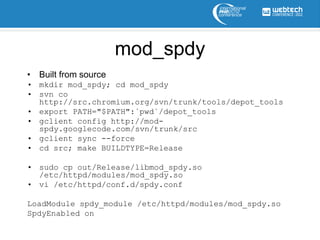
mod_spdy
• Built from source
• mkdir mod_spdy; cd mod_spdy
• svn co
  http://src.chromium.org/svn/trunk/tools/depot_tools
• export PATH="$PATH":`pwd`/depot_tools
• gclient config http://mod-
  spdy.googlecode.com/svn/trunk/src
• gclient sync --force
• cd src; make BUILDTYPE=Release

• sudo cp out/Release/libmod_spdy.so
  /etc/httpd/modules/mod_spdy.so
• vi /etc/httpd/conf.d/spdy.conf

LoadModule spdy_module /etc/httpd/modules/mod_spdy.so
SpdyEnabled on
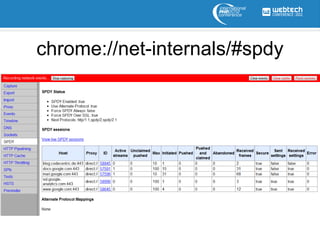
chrome://net-internals/#spdy
Is it spdy?
• www.devthought.com/2012/03/10/chro
  me-spdy-indicator/
• ckon.wordpress.com/2012/03/11/spdy-
  indicator-for-firefox/
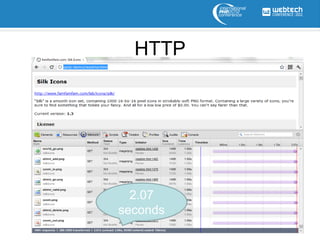
HTTP


  2.07
seconds
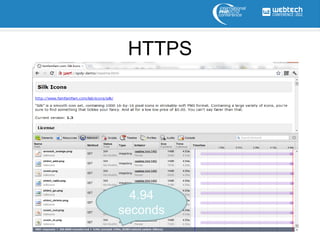
HTTPS


  4.94
seconds
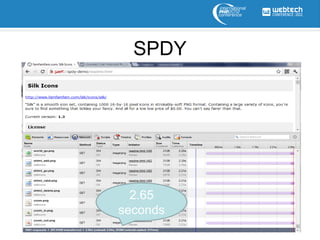
SPDY


  2.65
seconds
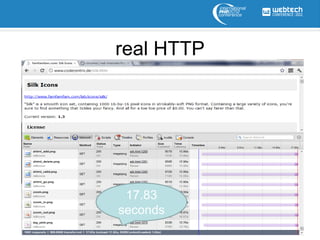
real HTTP


 17.83
seconds
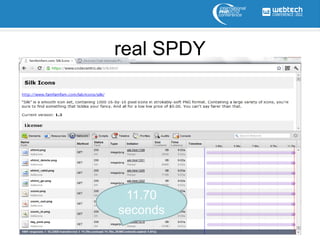
real SPDY


 11.70
seconds
Online Demo
• www.modspdy.com/world-flags/
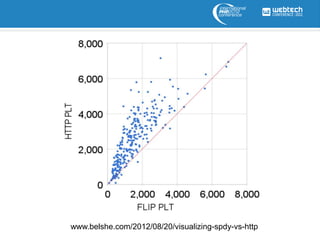
www.belshe.com/2012/08/20/visualizing-spdy-vs-http
LET'S MAKE THE WEB
FASTER

SPDY - http reloaded - WebTechConference 2012

  • 1.
    Fabian Lange SPDY -http reloaded
  • 2.
    (WILL BE) PARTOF HTTP/2.0
  • 3.
    HTTP Problems • Single request per connection. Because HTTP can only fetch one resource at a time (HTTP pipelining helps, but still enforces only a FIFO queue), a server delay of 500 ms prevents reuse of the TCP channel for additional requests. Browsers work around this problem by using multiple connections. Since 2008, most browsers have finally moved from 2 connections per domain to 6. • Exclusively client-initiated requests. In HTTP, only the client can initiate a request. Even if the server knows the client needs a resource, it has no mechanism to inform the client and must instead wait to receive a request for the resource from the client. • Uncompressed request and response headers. Request headers today vary in size from ~200 bytes to over 2KB. As applications use more cookies and user agents expand features, typical header sizes of 700-800 bytes is common. For modems or ADSL connections, in which the uplink bandwidth is fairly low, this latency can be significant. Reducing the data in headers could directly improve the serialization latency to send requests. • Redundant headers. In addition, several headers are repeatedly sent across requests on the same channel. However, headers such as the User-Agent, Host, and Accept* are generally static and do not need to be resent. • Optional data compression. HTTP uses optional compression encodings for data. Content should always be sent in a compressed format. Source: http://dev.chromium.org/spdy/spdy-whitepaper
  • 4.
    Web Requests AreSimple • Open a connection • Send a request • Receive a response • Done
  • 6.
  • 7.
    How to AvoidRequests • Caching • Domain Sharding – Browser Limits • Keep Alive – Dedicated Connections – Waste Ressources • Pipelining
  • 8.
    TCP Handshake 0ms 1) Host A sends a TCP SYNchronize packet to Host B 25ms 2) Host B receives A's SYN 25ms 3) Host B sends a SYNchronize-ACKnowledgement 50ms 4) Host A receives B's SYN-ACK 75ms 5) Host A sends ACKnowledge and data 75ms 6) Host B receives ACK and data. • With a "distance" of just 25ms, this takes us 75ms until data arrives at server
  • 10.
    Initial Window • CongestionControl Mechanism • Avoid overloading clients • Each ACK of the client increases window • RFC 3390 – Increasing icwnd – Small Resonses are complete without ACK – Avoid the ACK RTT
  • 11.
    Pushing over http •Push === Long Polling • Consumes one connection on clients • On server – Used to be expensive to hold – Modern servers have evented I/O • WebSockets
  • 12.
    Headers http://blog.codecentric.de/ Accept text/html,application/xhtml+xml,application/xml;q=0.9,*/*;q=0.8 Accept-Encoding gzip, deflate Accept-Language de-de,de;q=0.8,en-us;q=0.5,en;q=0.3 Connection keep-alive __utma=40497137.1800912468.1315901303.1328525769.1328537171.234; __utmz=40497137.1326462670.198.110.utmcsr=twitterfeed|utmccn=blogfee d_de|utmcmd=twitter; wp-settings- 3=editor%3Dhtml%26m0%3Do%26m1%3Do%26m2%3Do%26m3%3Dc%2 6m4%3Do%26m5%3Do%26m6%3Do%26m7%3Do%26m8%3Do%26m9%3 Cookie Do%26m10%3Do%26m11%3Do%26align%3Dcenter%26imgsize%3Dfull%2 6urlbutton%3Dnone%26hidetb%3D0; wp-settings-time-3=1328519940; __utma=162617902.1417890302.1315914276.1328537194.1328541774.63; __utmz=162617902.1328537194.62.41.utmcsr=blog.codecentric.de|utmccn =(referral)|utmcmd=referral|utmcct=/; wp-settings-time-81=1321966374 Host blog.codecentric.de Mozilla/5.0 (Windows NT 6.1; WOW64; rv:10.0) Gecko/20100101 User-Agent Firefox/10.0
  • 13.
    Headers http://blog.codecentric.de/files/2012/02/adlite.png Accept image/png,image/*;q=0.8,*/*;q=0.5 Accept-Encoding gzip, deflate Accept-Language de-de,de;q=0.8,en-us;q=0.5,en;q=0.3 Connection keep-alive __utma=162617902.1417890302.1315914276.1328537194.1328541774.63; __utmz=162617902.1328537194.62.41.utmcsr=blog.codecentric.de|utmccn=(referral) |utmcmd=referral|utmcct=/; wp-settings- Cookie 3=m0%3Do%26m1%3Do%26m5%3Do%26m4%3Do%26editor%3Dhtml%26wplink% 3D1%26align%3Dcenter%26imgsize%3Dfull%26hidetb%3D1%26m7%3Do%26m9% 3Do; wp-settings-time-3=1326290899 Host blog.codecentric.de Referer http://blog.codecentric.de/ User-Agent Mozilla/5.0 (Windows NT 6.1; WOW64; rv:10.0) Gecko/20100101 Firefox/10.0
  • 14.
    Content Compression • Gzipis optional • But generally best practice LoadModule deflate_module /usr/lib/httpd/modules/mod_deflate.so
  • 15.
  • 16.
    SPDY Solutions • Allowmany concurrent HTTP requests to run across a single TCP session. • Reduce the bandwidth currently used by HTTP by compressing headers and eliminating unnecessary headers. • Make SSL the underlying transport protocol, for better security and compatibility with existing network infrastructure. Although SSL does introduce a latency penalty, we believe that the long-term future of the web depends on a secure network connection. In addition, the use of SSL is necessary to ensure that communication across existing proxies is not broken. • Enable the server to initiate communications with the client and push data to the client whenever possible. Source: http://dev.chromium.org/spdy/spdy-whitepaper
  • 17.
    Connection Multiplexing • SingleTCP Connection transports all requests • TCP Handshake still exists • Inital cwnd should be 16
  • 18.
    Compression • All datais compressed • Includes headers • Redundand data is removed – User Agent of second request is known to be same as on first
  • 19.
    CRIME • Compression Ratio Info-leak Made Easy • Cookie value can be detected when compression is effective Sources: threatpost.com/en_us/blogs/new-attack-uses-ssltls-information-leak-hijack-https-sessions-090512 security.stackexchange.com/questions/19911/crime-how-to-beat-the-beast-successor/19914
  • 20.
    Cookie: JSESSIONID=1234 c: jid=1234 d: kje=2345
  • 21.
    Cookie: JSESSIONID=1234 Cookie:JSESSIONID=9876 X[i] = c: jid= [i]1234 [i]9876 Y[j] = d: kje= [j]2345 [j]0987
  • 22.
    Cookie: JSESSIONID=1234 Cookie:JSESSIONID=1235 X[i] = c: jid=123 [i]4 [i]5 Y[j] = d: kje=234 [j]5 [j]6
  • 23.
    Fixes • Don't compressheaders • Use a compressor that is not affected
  • 24.
    SSL • Not saidto be a problem with HTTP • SSL should be default – But actually expensive • SSL hides SPDY traffic, so that proxies don't break it 
  • 25.
    Pushing • Long LastingConnection By Design • Send does not close the "request" • Two flavors – Server push – Server hint
  • 26.
    Compatibility • SPDY isbackwards compatible • Uses Next Protocol Negotiation – tools.ietf.org/html/draft-agl-tls- nextprotoneg-02
  • 27.
    Adoption • Facebook implementsand favors SPDY http://lists.w3.org/Archives/Public/ietf-http-wg/2012JulSep/0251.html • Twitter implements and favors SPDY http://lists.w3.org/Archives/Public/ietf-http-wg/2012JulSep/0250.html • Google implements and favors SPDY http://lists.w3.org/Archives/Public/ietf-http-wg/2012JulSep/0219.html • Mozilla implements and favors SPDY http://lists.w3.org/Archives/Public/ietf-http-wg/2012JulSep/0156.html • Wordpress.com uses SPDY https://twitter.com/wordpressdotcom/statuses/238741078172389377
  • 28.
    Concerns • Encryption bydefault renders network caching useless
  • 29.
    SPDY Support Clients Server • Chrome • Apache mod_spdy – since 11 • erlang-spdy – Ice Cream Sandwich • node-spdy • Amazon Silk • Netty 3.3.1 – Kindle Fire – Means JBoss • Firefox • Jetty 7.6.2 – Since 13 • Ngnix 1.3 • Opera – Since 12.1 • Tomcat 8.0.0-dev
  • 31.
    SPDY Drafts • dev.chromium.org/spdy/spdy-protocol/spdy-protocol- draft1 – First draft 2009 • dev.chromium.org/spdy/spdy-protocol/spdy-protocol- draft2 – Changes to server push • dev.chromium.org/spdy/spdy-protocol/spdy-protocol- draft3 – Flow control • Draft 4 will feature compression and QoS changes
  • 32.
    DEMO: MIGRATING PHPON APACHE TO SUPPORT SPDY
  • 33.
    PHP is notThreadsafe • The way SPDY works is incompatible with non threadsafe implementations – one connection one httpd worker – But multiple requests • Zend Threadsafe does not support some features (mysql!) • Need to externalize it with cgi
  • 34.
    mod_php to mod_fcgid+ php • yum install mod_fcgid • vi /etc/httpd/conf/httpd.conf <Directory "/var/www/html"> Options Indexes FollowSymLinks ExecCGI </Directory> • mv /etc/httpd/conf.d/php.conf /etc/httpd/conf.d/php.conf.bak • vi /etc/httpd/conf.d/fcgid.conf
  • 35.
    DirectoryIndex index.php AddHandler fcgid-script.fcgi .php DefaultInitEnv PHPRC "/etc/" MaxRequestsPerProcess 1000 MaxProcessCount 10 MaxRequestLen 209715200 IPCCommTimeout 240 IdleTimeout 240 FCGIWrapper /usr/bin/php-cgi .php
  • 36.
    mod_prefork to mod_worker •Needs recompilation • Luckily we have both already  – httpd -V | grep MPM – httpd.worker -V | grep MPM • sudo vi /etc/init.d/httpd httpd=${HTTPD- /usr/sbin/httpd.worker} prog=httpd.worker
  • 37.
    mod_ssl • We needmod_ssl patched with NPN • yum install subversion curl gcc- c++ patch binutils make • mkdir modssl; cd modssl • svn export http://mod- spdy.googlecode.com/svn/trunk/src/ build_modssl_with_npn.sh • ./build_modssl_with_npn.sh • cp /root/modssl/mod_ssl.so /etc/httpd/modules/mod_ssl.so
  • 38.
    [root@centos57 modssl]# ./build_modssl_with_npn.sh Usingbuildroot: /tmp/tmp.CooHIy8770 Downloading http://www.openssl.org/source/openssl-1.0.1-beta2.tar.gz ######################################################################## 100.0% Downloading http://www.apache.org/dist/httpd/httpd-2.2.21.tar.gz ######################################################################## 100.0% Downloading https://issues.apache.org/bugzilla/attachment.cgi?id=27969context=patch ######################################################################## 100.0% Uncompressing openssl-1.0.1-beta2.tar.gz ... done Uncompressing httpd-2.2.21.tar.gz ... done Applying Apache mod_ssl NPN patch ... patching file modules/ssl/ssl_private.h patching file modules/ssl/ssl_engine_init.c patching file modules/ssl/ssl_engine_io.c patching file modules/ssl/ssl_engine_kernel.c patching file modules/ssl/mod_ssl.c patching file modules/ssl/mod_ssl.h done Configuring OpenSSL ... done Building OpenSSL (this may take a while) ... done Configuring Apache mod_ssl ... done Building Apache mod_ssl (this may take a while) ... done Generated mod_ssl.so at /root/modssl/mod_ssl.so.
  • 39.
    mod_spdy • Built fromsource • mkdir mod_spdy; cd mod_spdy • svn co http://src.chromium.org/svn/trunk/tools/depot_tools • export PATH="$PATH":`pwd`/depot_tools • gclient config http://mod- spdy.googlecode.com/svn/trunk/src • gclient sync --force • cd src; make BUILDTYPE=Release • sudo cp out/Release/libmod_spdy.so /etc/httpd/modules/mod_spdy.so • vi /etc/httpd/conf.d/spdy.conf LoadModule spdy_module /etc/httpd/modules/mod_spdy.so SpdyEnabled on
  • 40.
  • 42.
    Is it spdy? •www.devthought.com/2012/03/10/chro me-spdy-indicator/ • ckon.wordpress.com/2012/03/11/spdy- indicator-for-firefox/
  • 43.
  • 44.
  • 45.
  • 46.
  • 47.
  • 48.
  • 49.
  • 50.
    LET'S MAKE THEWEB FASTER