HTML5 - WebSockets
                          T-111.5502 Seminar on Media Technology
                                     Harri Hämäläinen
                                  harri hamalainen aalto fi


Tuesday, October 25, 11
Web communications
                           before WebSockets
                     •    HTTP protocol is based on request-response paradigm
                          -   In HTTP/0.9 and HTTP/1.0 the connection is closed after the
                              response is received
                          -   In HTTP/1.1 the persistent connection was introduced which
                              allows client to make multiple requests over the same
                              underlying TCP session
                     •    Web 2.0 needed real-time communication i.e. low latency, full-
                          duplex connections
                          -   Games, instant messaging, collaboration platforms
                     •    Various “solutions” used
                          -   AJAX, Comets, hackshacks...


                                                        2
Tuesday, October 25, 11
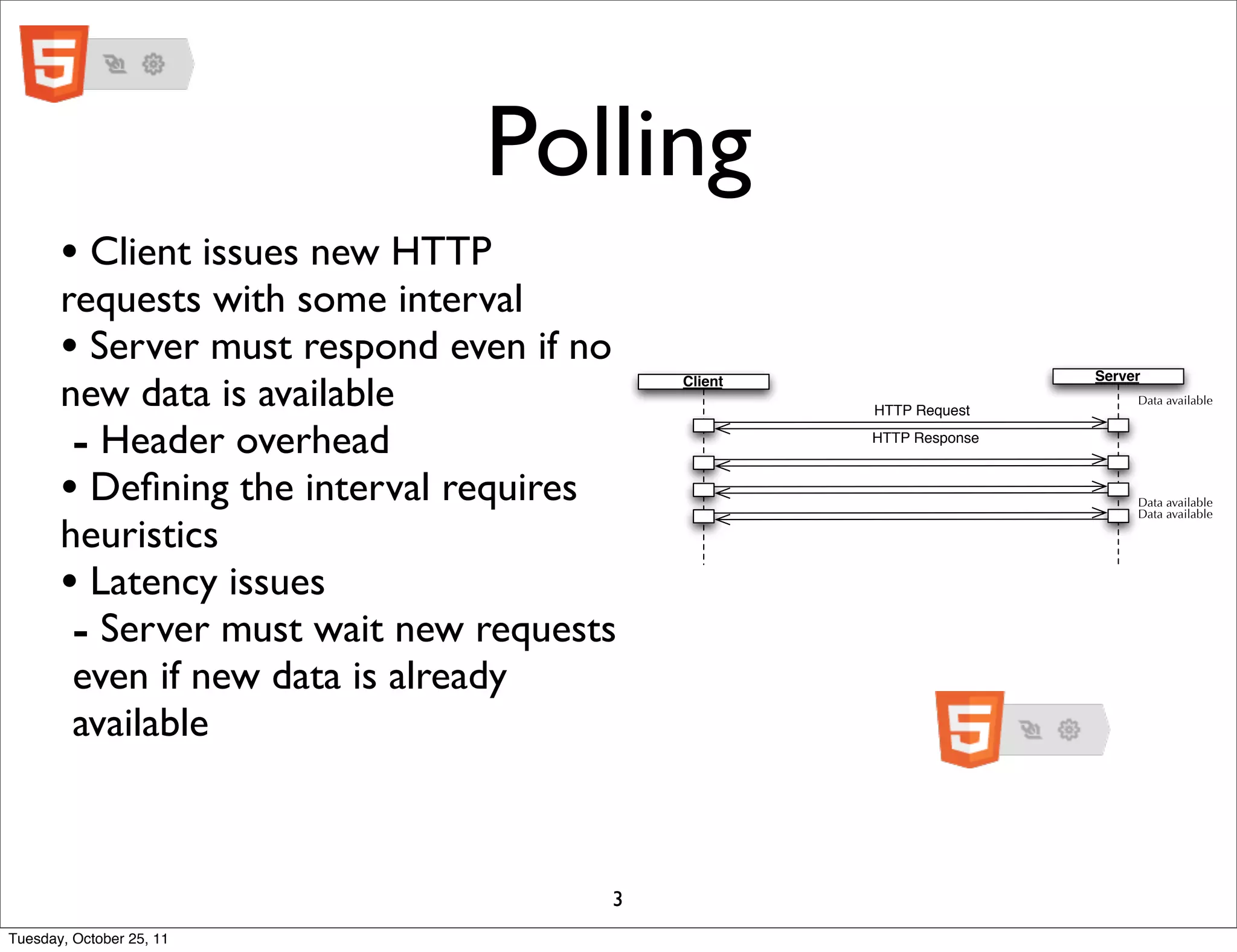
Polling
       • Client issues new HTTP
       requests with some interval
       • Server must respond even if no
       new data is available              Client                   Server
                                                                        Data available
                                                   HTTP Request

        - Header overhead                          HTTP Response


       • Defining the interval requires                                  Data available
                                                                        Data available

       heuristics
       • Latency issues
        - Server must wait new requests
        even if new data is already
        available


                                      3
Tuesday, October 25, 11
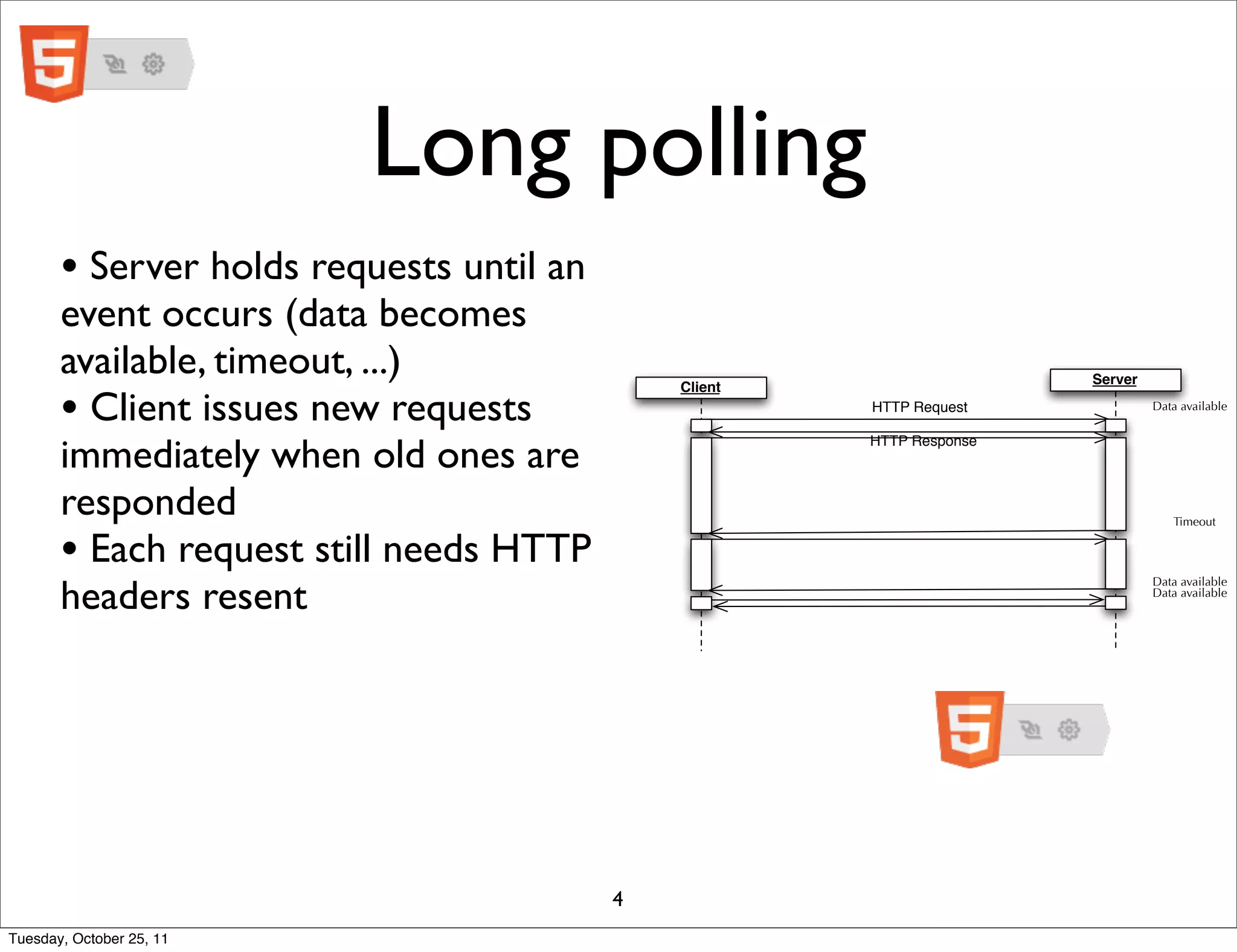
Long polling
       • Server holds requests until an
       event occurs (data becomes
       available, timeout, ...)                                        Server

       • Client issues new requests
                                              Client
                                                       HTTP Request             Data available


       immediately when old ones are
                                                       HTTP Response


       responded                                                                   Timeout


       • Each request still needs HTTP
       headers resent
                                                                                Data available
                                                                                Data available


                                          4
Tuesday, October 25, 11
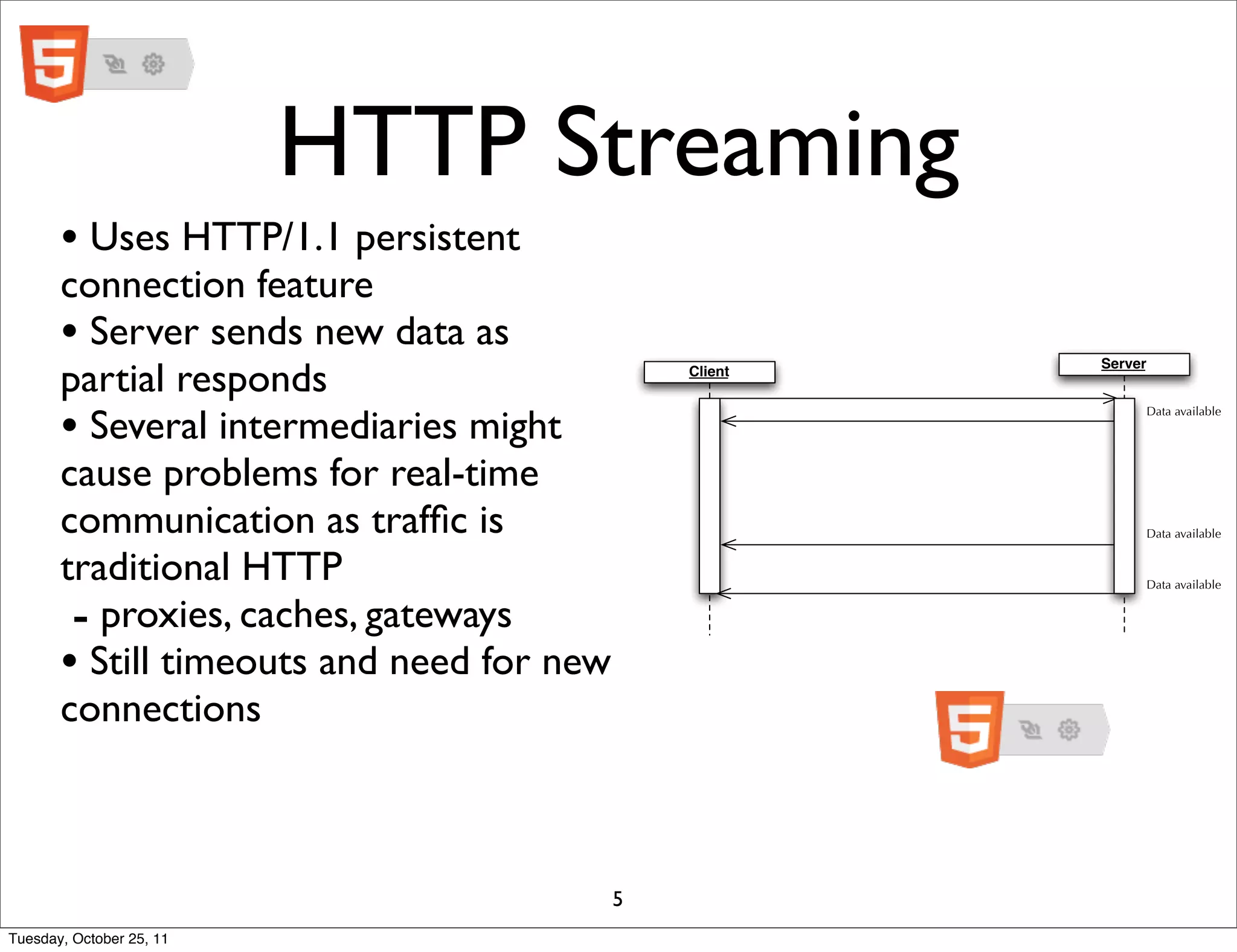
HTTP Streaming
       • Uses HTTP/1.1 persistent
       connection feature
       • Server sends new data as
       partial responds
                                                        Server
                                               Client


       • Several intermediaries might
                                                                 Data available


       cause problems for real-time
       communication as traffic is                                Data available


       traditional HTTP                                          Data available


        - proxies, caches, gateways
       • Still timeouts and need for new
       connections


                                           5
Tuesday, October 25, 11
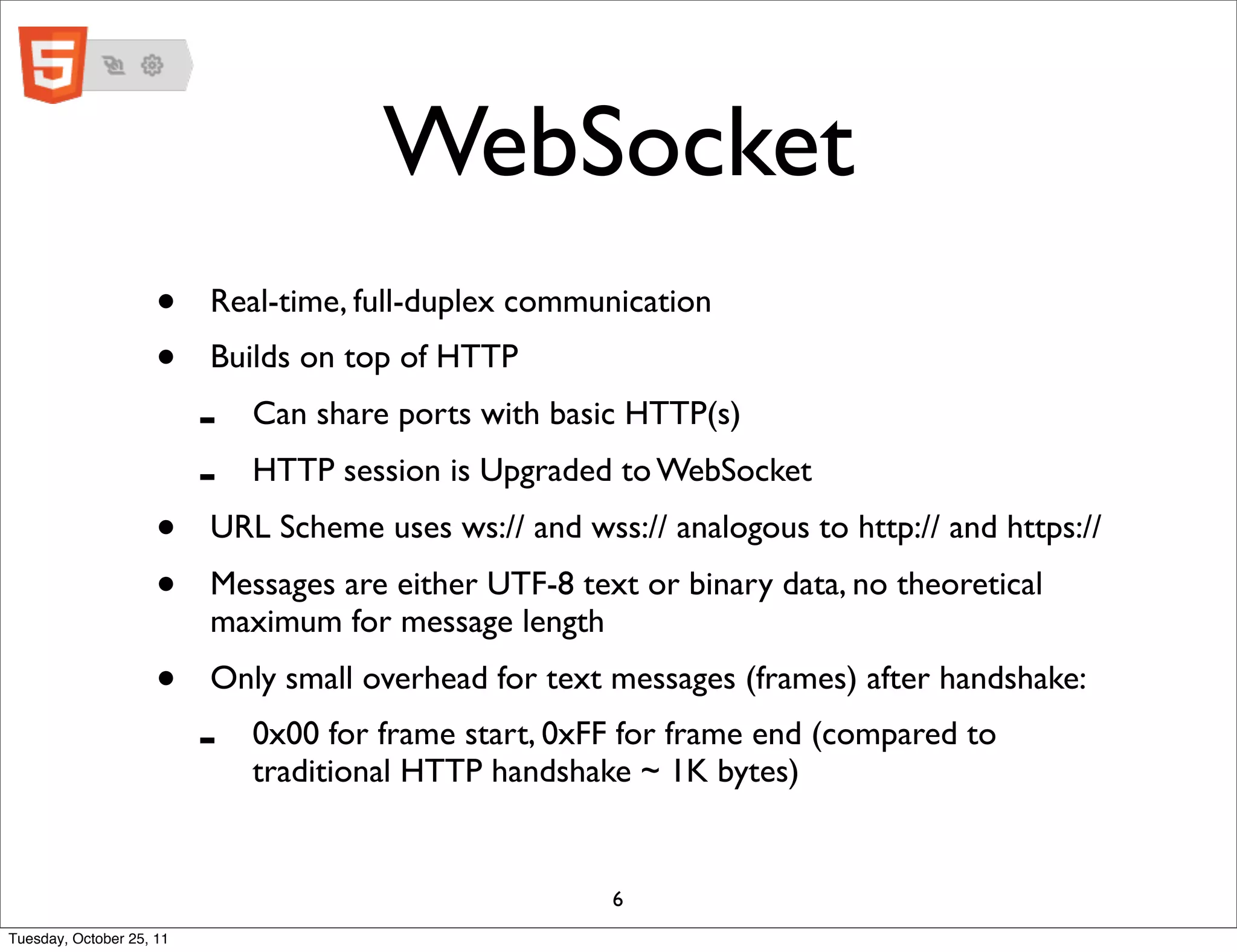
WebSocket
                     •    Real-time, full-duplex communication
                     •    Builds on top of HTTP
                          -   Can share ports with basic HTTP(s)
                          -   HTTP session is Upgraded to WebSocket
                     •    URL Scheme uses ws:// and wss:// analogous to http:// and https://
                     •    Messages are either UTF-8 text or binary data, no theoretical
                          maximum for message length
                     •    Only small overhead for text messages (frames) after handshake:
                          -   0x00 for frame start, 0xFF for frame end (compared to
                              traditional HTTP handshake ~ 1K bytes)


                                                       6
Tuesday, October 25, 11
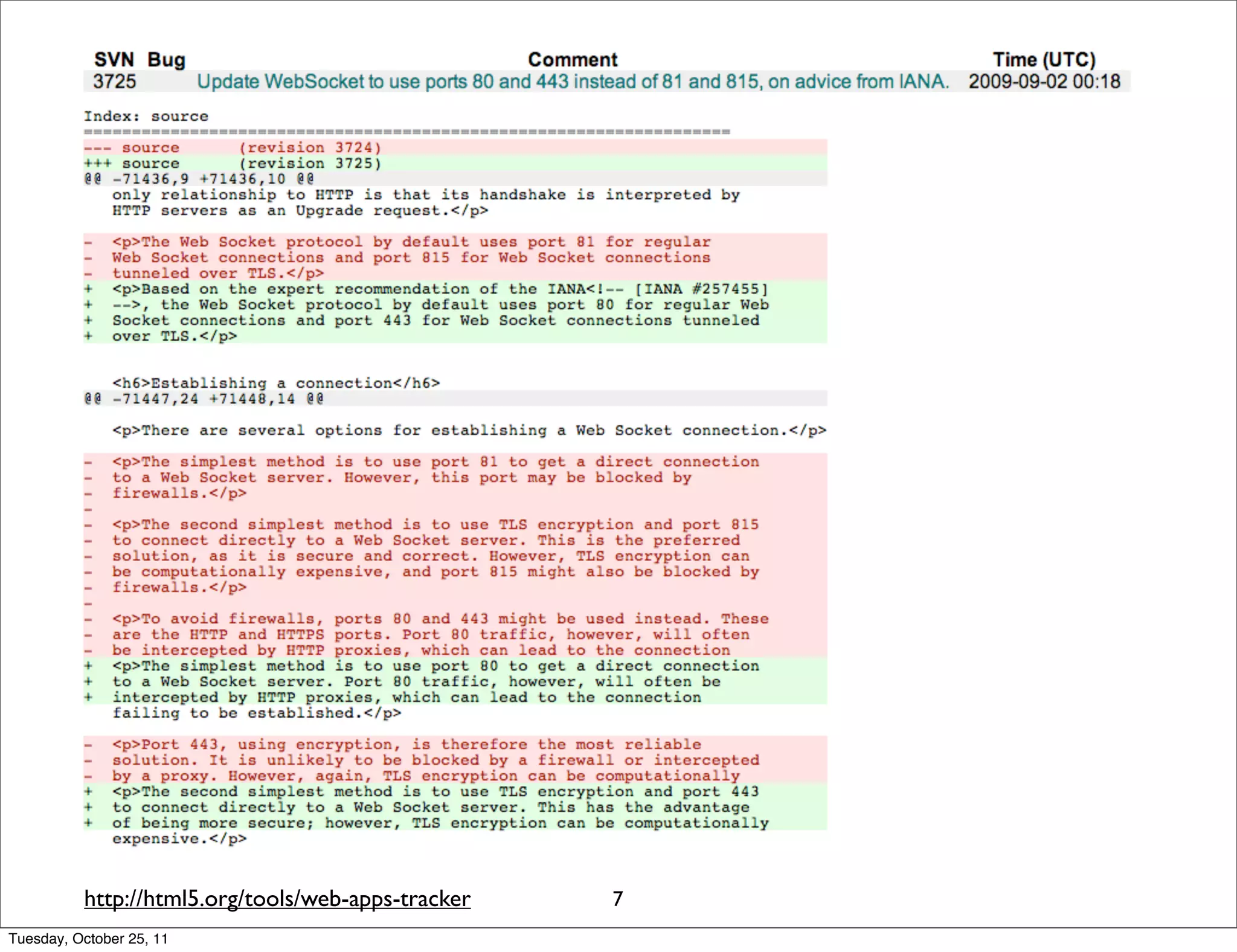
http://html5.org/tools/web-apps-tracker   7
Tuesday, October 25, 11
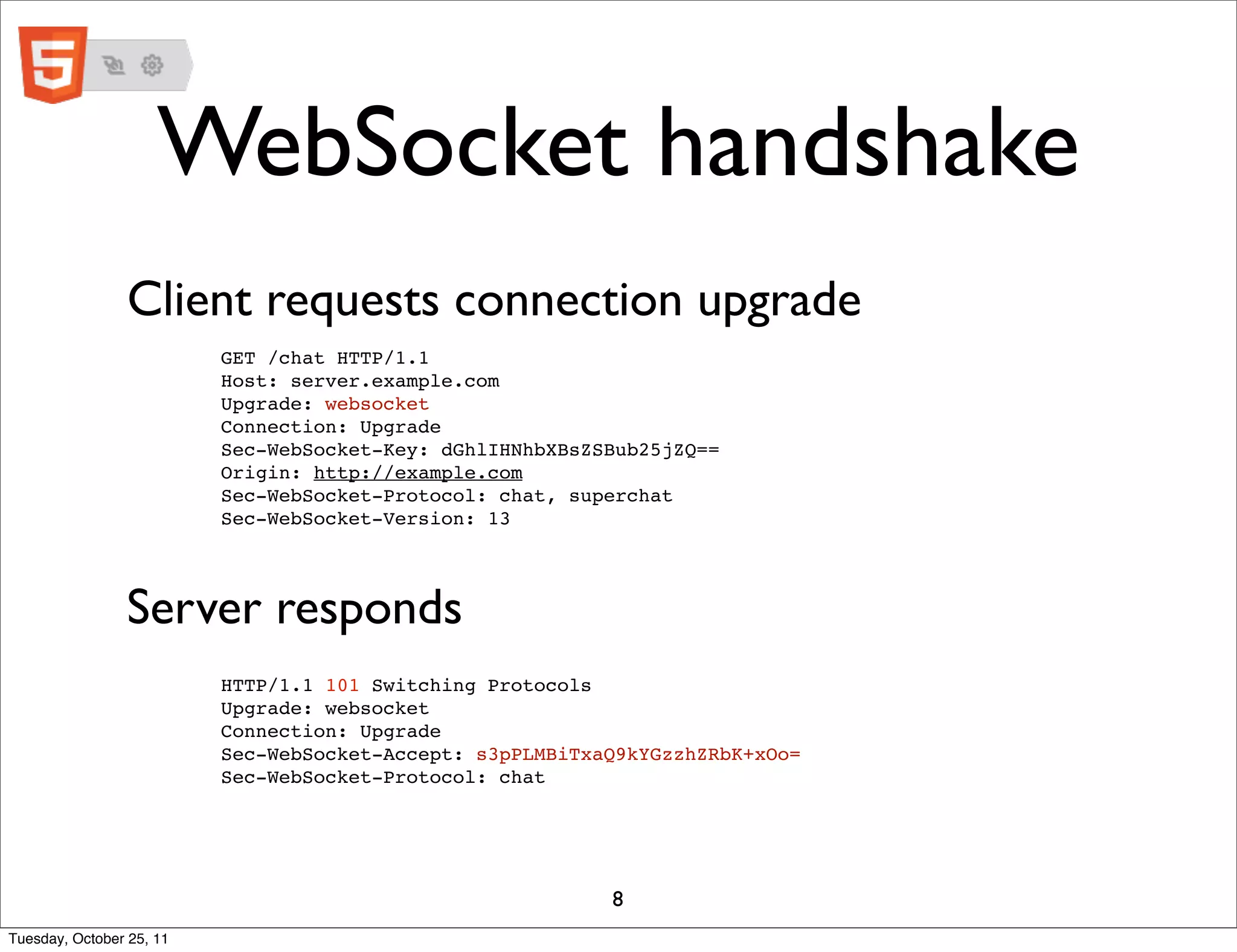
WebSocket handshake
                Client requests connection upgrade
                          GET /chat HTTP/1.1
                          Host: server.example.com
                          Upgrade: websocket
                          Connection: Upgrade
                          Sec-WebSocket-Key: dGhlIHNhbXBsZSBub25jZQ==
                          Origin: http://example.com
                          Sec-WebSocket-Protocol: chat, superchat
                          Sec-WebSocket-Version: 13


                Server responds
                          HTTP/1.1 101 Switching Protocols
                          Upgrade: websocket
                          Connection: Upgrade
                          Sec-WebSocket-Accept: s3pPLMBiTxaQ9kYGzzhZRbK+xOo=
                          Sec-WebSocket-Protocol: chat


                                                           8
Tuesday, October 25, 11
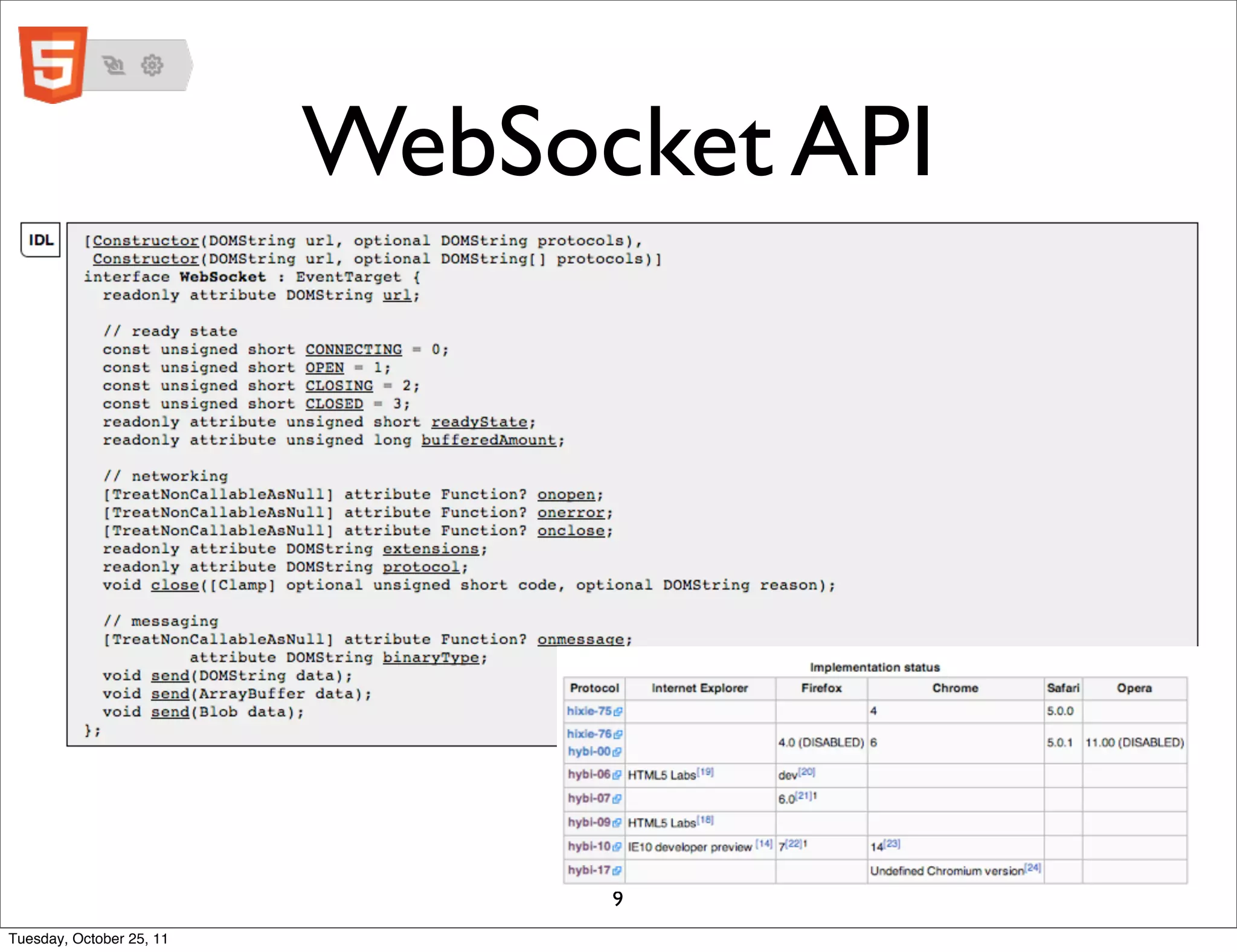
WebSocket API


                                9
Tuesday, October 25, 11
WebSocket Security

                     • Old protocol versions (hixie-75, hixie-76 /
                          hybi-00) susceptible for cache poisoning
                          attacks due to transparent proxies [a]
                     • Protocol allows origin policies
                          a: Huang; Lin-Shung, et al., Talking Yourself for Fun and Profit


                                                                            10
Tuesday, October 25, 11
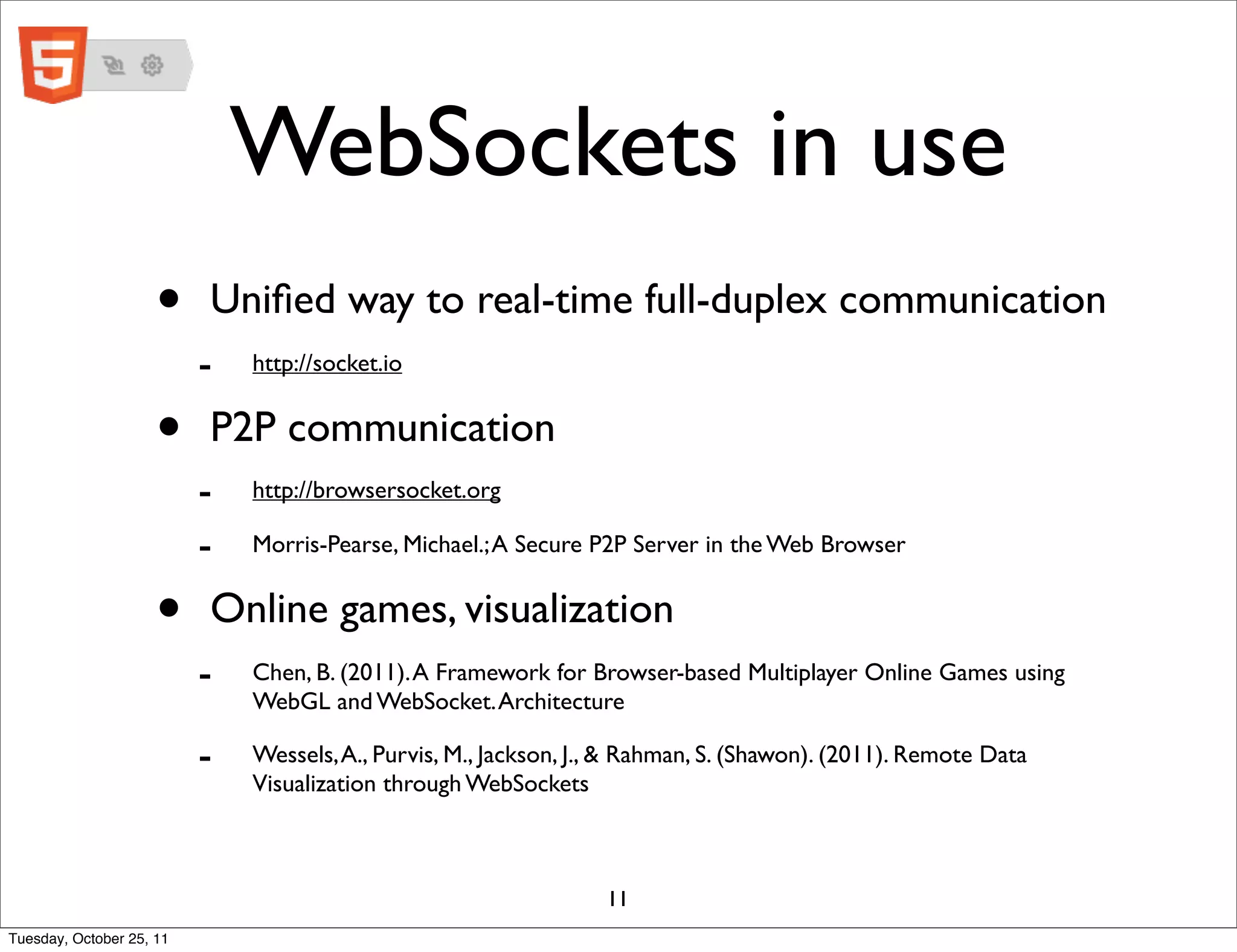
WebSockets in use
                     •     Unified way to real-time full-duplex communication
                          - http://socket.io
                     •     P2P communication
                          - http://browsersocket.org
                          - Morris-Pearse, Michael.; A Secure P2P Server in the Web Browser
                     •     Online games, visualization
                          - Chen, B. (2011). A Framework for Browser-based Multiplayer Online Games using
                              WebGL and WebSocket. Architecture

                          -   Wessels, A., Purvis, M., Jackson, J., & Rahman, S. (Shawon). (2011). Remote Data
                              Visualization through WebSockets


                                                                  11
Tuesday, October 25, 11
References
                     •    Loreto, et al., Bidirectional HTTP, Oct 2009
                     •    Huang; Lin-Shung, et al., Talking Yourself for Fun and Profit
                     •    Hickson; Ian,The WebSocket API, http://dev.w3.org/html5/
                          websockets/
                     •    HTML 5 Revision Tracker, http://html5.org/tools/web-apps-tracker
                     •    Morris-Pearse, Michael.; A Secure P2P Server in the Web Browser
                     •    Chen, B. (2011). A Framework for Browser-based Multiplayer
                          Online Games using WebGL and WebSocket. Architecture
                     •    Wessels, A., Purvis, M., Jackson, J., & Rahman, S. (Shawon). (2011).
                          Remote Data Visualization through WebSockets


                                                         12
Tuesday, October 25, 11
Demo
                          http://localhost:8888/


                                    13
Tuesday, October 25, 11

HTML5 WebSockets

  • 1.
    HTML5 - WebSockets T-111.5502 Seminar on Media Technology Harri Hämäläinen harri hamalainen aalto fi Tuesday, October 25, 11
  • 2.
    Web communications before WebSockets • HTTP protocol is based on request-response paradigm - In HTTP/0.9 and HTTP/1.0 the connection is closed after the response is received - In HTTP/1.1 the persistent connection was introduced which allows client to make multiple requests over the same underlying TCP session • Web 2.0 needed real-time communication i.e. low latency, full- duplex connections - Games, instant messaging, collaboration platforms • Various “solutions” used - AJAX, Comets, hackshacks... 2 Tuesday, October 25, 11
  • 3.
    Polling • Client issues new HTTP requests with some interval • Server must respond even if no new data is available Client Server Data available HTTP Request - Header overhead HTTP Response • Defining the interval requires Data available Data available heuristics • Latency issues - Server must wait new requests even if new data is already available 3 Tuesday, October 25, 11
  • 4.
    Long polling • Server holds requests until an event occurs (data becomes available, timeout, ...) Server • Client issues new requests Client HTTP Request Data available immediately when old ones are HTTP Response responded Timeout • Each request still needs HTTP headers resent Data available Data available 4 Tuesday, October 25, 11
  • 5.
    HTTP Streaming • Uses HTTP/1.1 persistent connection feature • Server sends new data as partial responds Server Client • Several intermediaries might Data available cause problems for real-time communication as traffic is Data available traditional HTTP Data available - proxies, caches, gateways • Still timeouts and need for new connections 5 Tuesday, October 25, 11
  • 6.
    WebSocket • Real-time, full-duplex communication • Builds on top of HTTP - Can share ports with basic HTTP(s) - HTTP session is Upgraded to WebSocket • URL Scheme uses ws:// and wss:// analogous to http:// and https:// • Messages are either UTF-8 text or binary data, no theoretical maximum for message length • Only small overhead for text messages (frames) after handshake: - 0x00 for frame start, 0xFF for frame end (compared to traditional HTTP handshake ~ 1K bytes) 6 Tuesday, October 25, 11
  • 7.
  • 8.
    WebSocket handshake Client requests connection upgrade GET /chat HTTP/1.1 Host: server.example.com Upgrade: websocket Connection: Upgrade Sec-WebSocket-Key: dGhlIHNhbXBsZSBub25jZQ== Origin: http://example.com Sec-WebSocket-Protocol: chat, superchat Sec-WebSocket-Version: 13 Server responds HTTP/1.1 101 Switching Protocols Upgrade: websocket Connection: Upgrade Sec-WebSocket-Accept: s3pPLMBiTxaQ9kYGzzhZRbK+xOo= Sec-WebSocket-Protocol: chat 8 Tuesday, October 25, 11
  • 9.
    WebSocket API 9 Tuesday, October 25, 11
  • 10.
    WebSocket Security • Old protocol versions (hixie-75, hixie-76 / hybi-00) susceptible for cache poisoning attacks due to transparent proxies [a] • Protocol allows origin policies a: Huang; Lin-Shung, et al., Talking Yourself for Fun and Profit 10 Tuesday, October 25, 11
  • 11.
    WebSockets in use • Unified way to real-time full-duplex communication - http://socket.io • P2P communication - http://browsersocket.org - Morris-Pearse, Michael.; A Secure P2P Server in the Web Browser • Online games, visualization - Chen, B. (2011). A Framework for Browser-based Multiplayer Online Games using WebGL and WebSocket. Architecture - Wessels, A., Purvis, M., Jackson, J., & Rahman, S. (Shawon). (2011). Remote Data Visualization through WebSockets 11 Tuesday, October 25, 11
  • 12.
    References • Loreto, et al., Bidirectional HTTP, Oct 2009 • Huang; Lin-Shung, et al., Talking Yourself for Fun and Profit • Hickson; Ian,The WebSocket API, http://dev.w3.org/html5/ websockets/ • HTML 5 Revision Tracker, http://html5.org/tools/web-apps-tracker • Morris-Pearse, Michael.; A Secure P2P Server in the Web Browser • Chen, B. (2011). A Framework for Browser-based Multiplayer Online Games using WebGL and WebSocket. Architecture • Wessels, A., Purvis, M., Jackson, J., & Rahman, S. (Shawon). (2011). Remote Data Visualization through WebSockets 12 Tuesday, October 25, 11
  • 13.
    Demo http://localhost:8888/ 13 Tuesday, October 25, 11