Lab Relocation 
Regulation Quick Notes 
Spark a compliant lab move with 
these quick-flip notes on the most 
important regulations to your 
move. 
1
Introduction 
The Process 
Local & Facility 
EPA 
DOT & IATA 
Conclusion 
Introduction 
2 
Lab Relocation Regulation Quicknotes
Introduction 
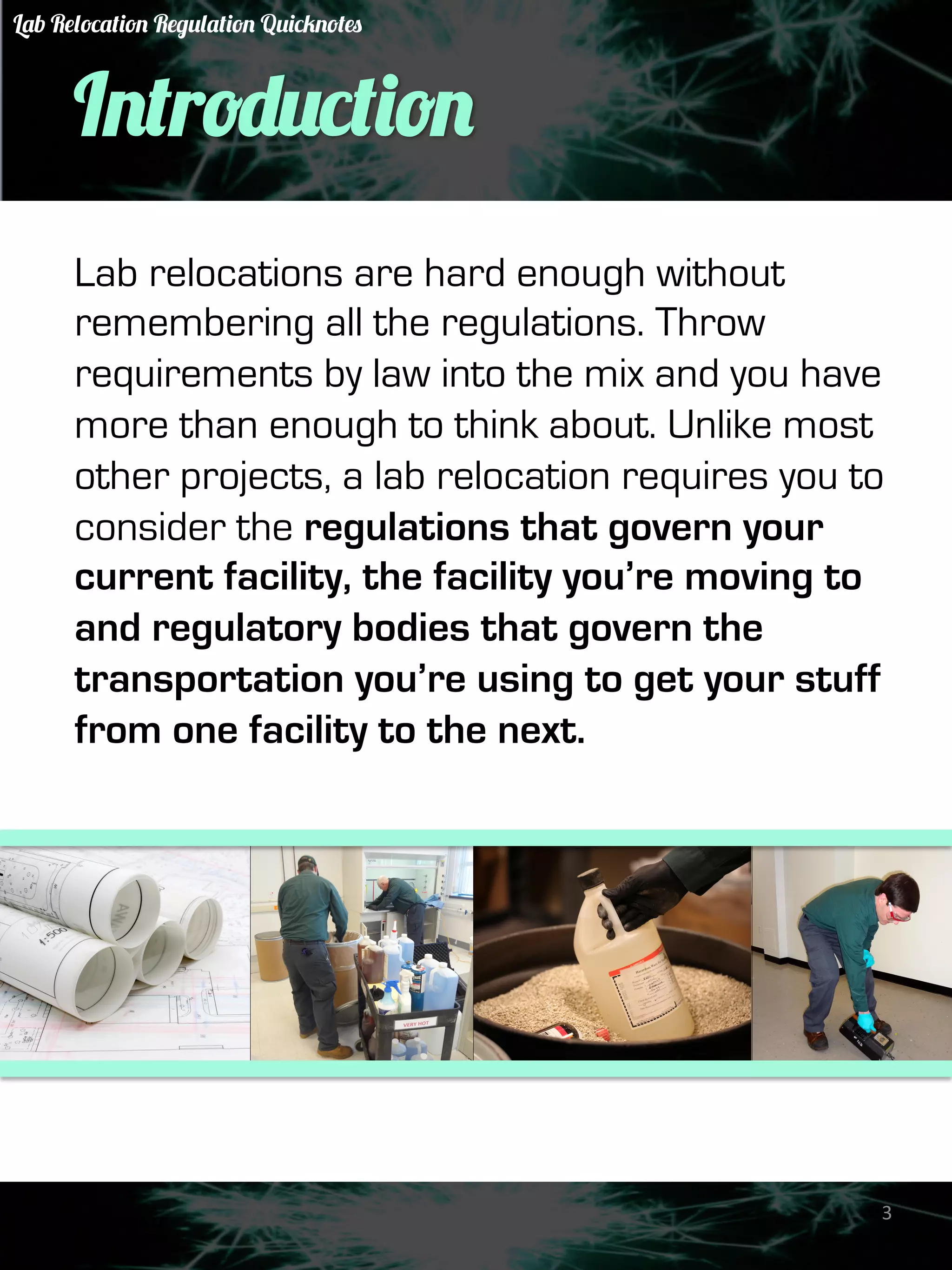
Lab relocations are hard enough without 
remembering all the regulations. Throw 
requirements by law into the mix and you have 
more than enough to think about. Unlike most 
other projects, a lab relocation requires you to 
consider the regulations that govern your 
current facility, the facility you’re moving to 
and regulatory bodies that govern the 
transportation you’re using to get your stuff 
from one facility to the next. 
3 
Lab Relocation Regulation Quicknotes
Introduction 
A&er 
your 
headache 
subsides 
from 
trying 
to 
do 
it 
on 
your 
own, 
flip 
through 
our 
quick 
)ps 
and 
summaries 
of 
the 
rules 
and 
regula)ons 
you 
need 
to 
know 
for 
your 
lab 
reloca)on 
to 
run 
smoothly. 
We’ve 
compiled 
it 
all 
in 
one 
place 
just 
for 
you. 
Let’s 
start 
with 
how 
to 
handle 
all 
these 
regulatory 
requirements. 
4 
Lab Relocation Regulation Quicknotes
Introduction 
The Process 
Local & Facility 
EPA 
DOT & IATA 
Conclusion 
The Process 
5 
Lab Relocation Regulation Quicknotes
The Process 
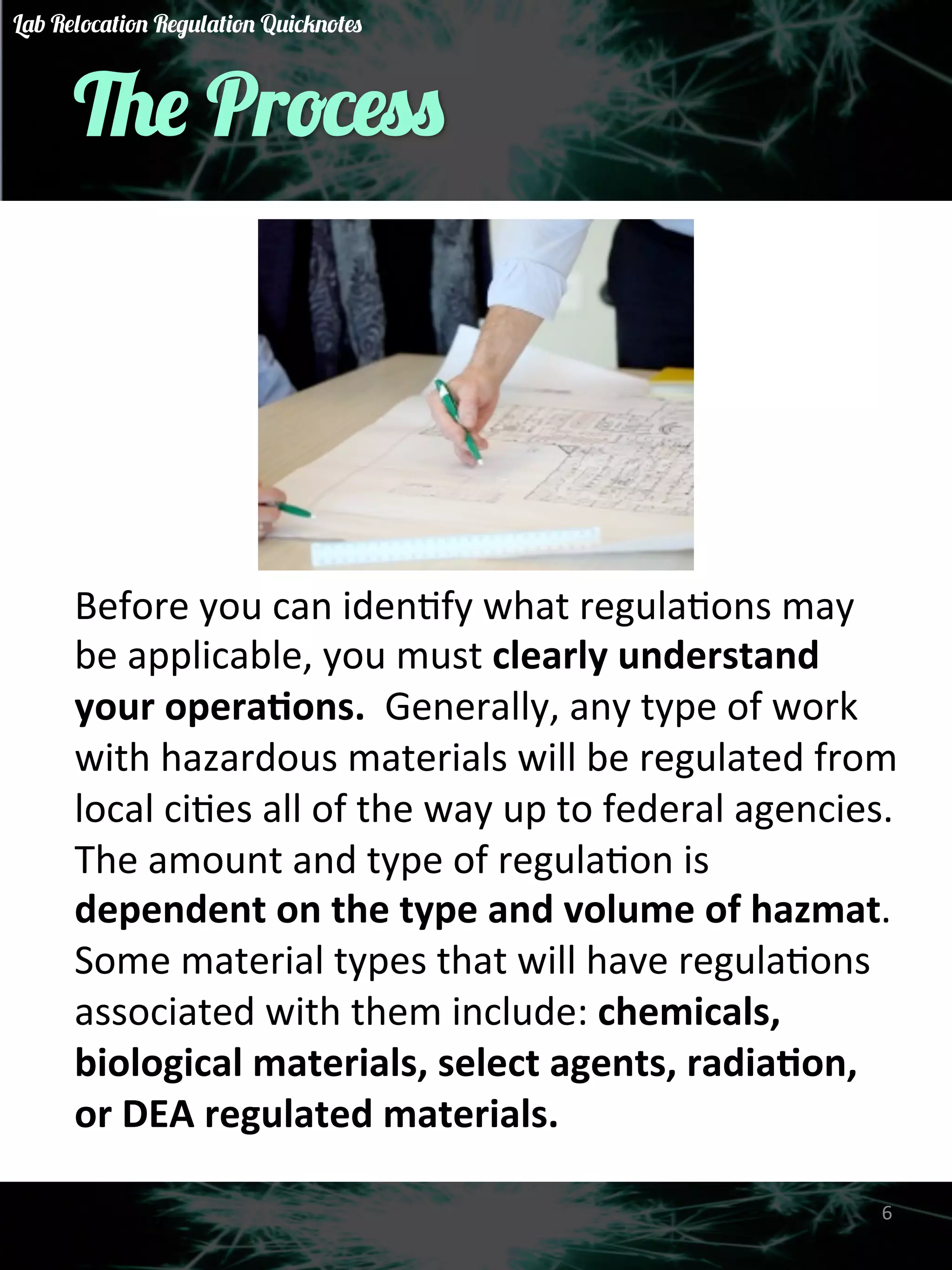
Before 
you 
can 
idenGfy 
what 
regulaGons 
may 
be 
applicable, 
you 
must 
clearly 
understand 
your 
opera)ons. 
Generally, 
any 
type 
of 
work 
with 
hazardous 
materials 
will 
be 
regulated 
from 
local 
ciGes 
all 
of 
the 
way 
up 
to 
federal 
agencies. 
The 
amount 
and 
type 
of 
regulaGon 
is 
dependent 
on 
the 
type 
and 
volume 
of 
hazmat. 
Some 
material 
types 
that 
will 
have 
regulaGons 
associated 
with 
them 
include: 
chemicals, 
biological 
materials, 
select 
agents, 
radia)on, 
or 
DEA 
regulated 
materials. 
6 
Lab Relocation Regulation Quicknotes
The Process 
When 
wading 
through 
this 
ocean 
of 
regulaGons, 
always 
begin 
by 
making 
sure 
you’re 
compliant 
with 
your 
most 
local 
requirements 
and 
regulaGons 
and 
work 
your 
way 
out 
to 
state 
and 
federal. 
Some 
towns 
and 
ciGes 
have 
specific 
requirements 
regarding 
facility 
use, 
hazmat 
regulaGons, 
and 
other 
ordinances 
that 
impact 
your 
business. 
From 
there, 
each 
state 
may 
regulate 
specific 
acGviGes 
differently. 
With 
this 
strategy 
in 
mind, 
we’ll 
first 
be 
addressing 
facility 
and 
local 
regula)ons. 
7 
Lab Relocation Regulation Quicknotes
Local & Facility 
Introduction 
The Process 
Local & Facility 
EPA 
DOT & IATA 
Conclusion 
8 
Lab Relocation Regulation Quicknotes
Local & Facility 
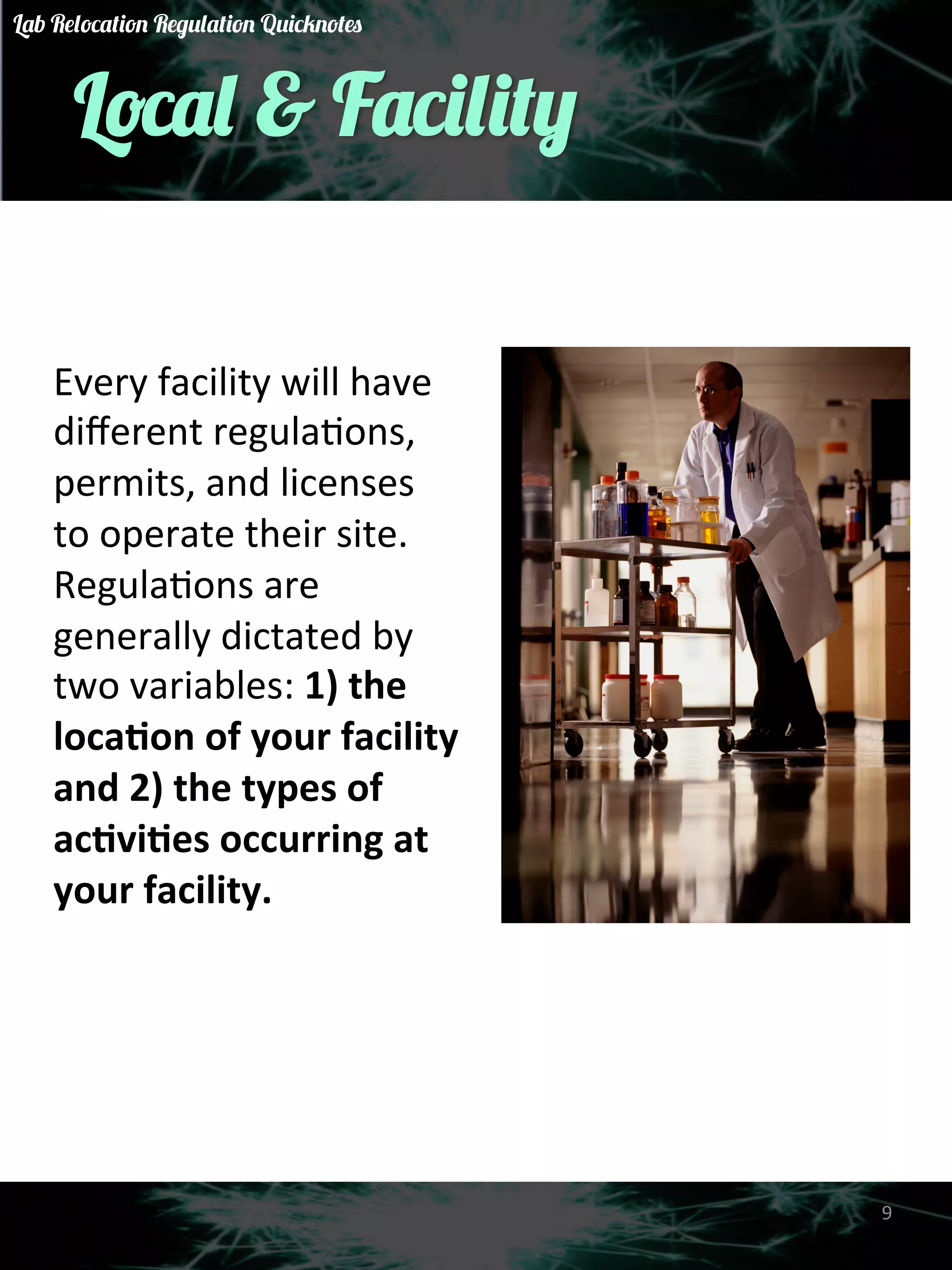
Every 
facility 
will 
have 
different 
regulaGons, 
permits, 
and 
licenses 
to 
operate 
their 
site. 
RegulaGons 
are 
generally 
dictated 
by 
two 
variables: 
1) 
the 
loca)on 
of 
your 
facility 
and 
2) 
the 
types 
of 
ac)vi)es 
occurring 
at 
your 
facility. 
9 
Lab Relocation Regulation Quicknotes
Local & Facility 
If 
you’re 
unsure 
about 
your 
faciliGes 
regulaGons 
and 
requirements, 
reach 
out 
to 
the 
property 
manager 
for 
the 
proper 
documentaGon. 
Likewise, 
local 
requirements 
can 
usually 
be 
found 
on 
the 
city’s 
website. 
If 
you 
can’t 
locate 
them 
on 
the 
site, 
contact 
the 
city 
and 
schedule 
a 
mee)ng 
to 
discuss 
requirements 
and 
necessary 
permits. 
Keep 
in 
mind 
that 
you 
have 
to 
do 
this 
for 
the 
locaGon 
you’re 
moving 
into 
as 
well 
as 
the 
locaGon 
you’re 
moving 
out 
of. 
10 
Lab Relocation Regulation Quicknotes
Local & Facility 
A&er 
determining 
citywide 
requirements, 
go 
through 
the 
same 
process 
for 
your 
state. 
Your 
state’s 
EPA 
branch 
or 
DOT 
branch 
might 
have 
addi)onal 
rules 
and 
regula)ons 
on 
top 
of 
the 
federal 
ones. 
Keep 
in 
mind, 
state 
rules 
are 
always 
more 
stringent 
than 
federal 
ones. 
11 
Lab Relocation Regulation Quicknotes
Local & Facility 
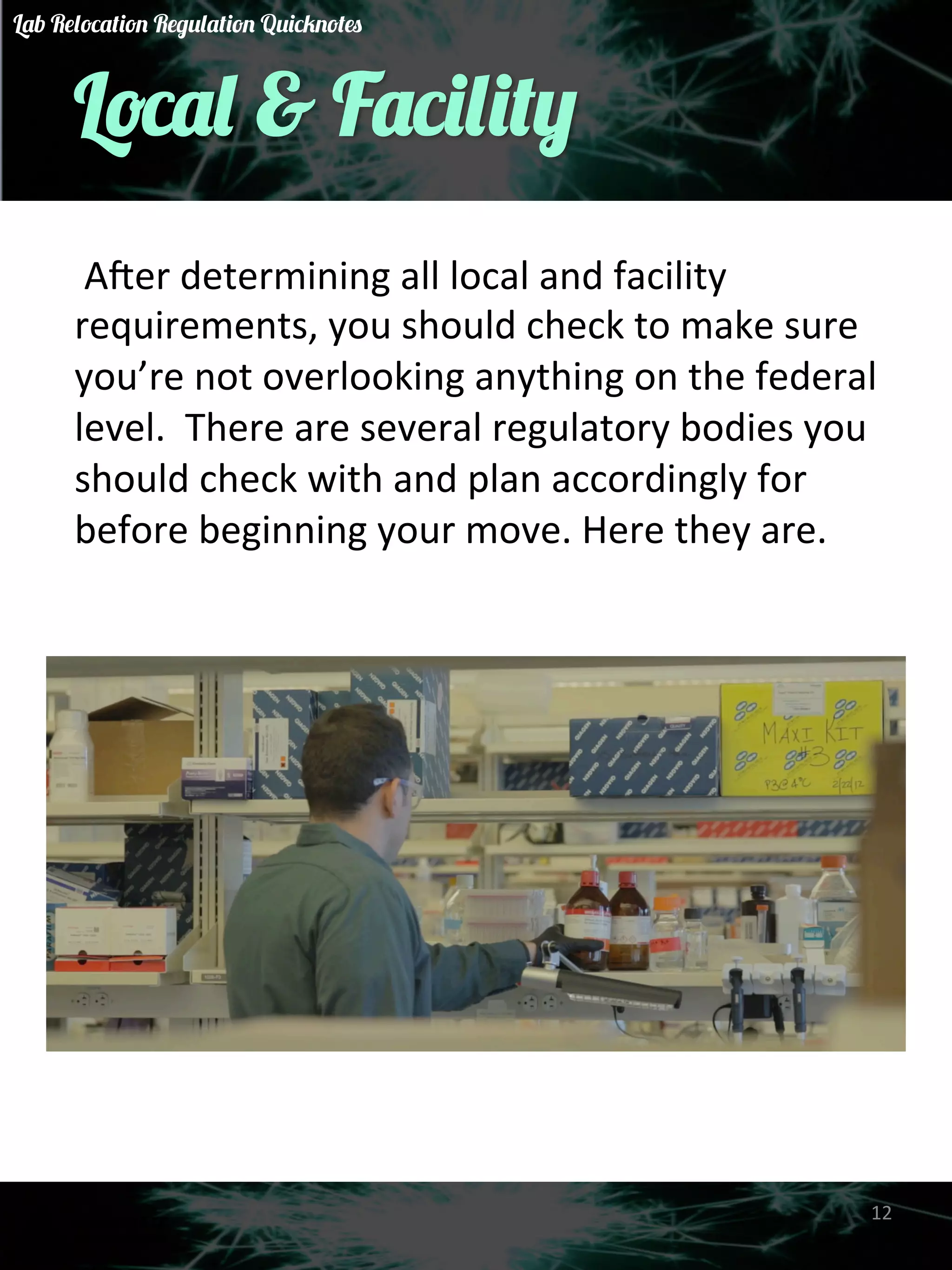
A&er 
determining 
all 
local 
and 
facility 
requirements, 
you 
should 
check 
to 
make 
sure 
you’re 
not 
overlooking 
anything 
on 
the 
federal 
level. 
There 
are 
several 
regulatory 
bodies 
you 
should 
check 
with 
and 
plan 
accordingly 
for 
before 
beginning 
your 
move. 
Here 
they 
are. 
12 
Lab Relocation Regulation Quicknotes
Introduction 
The Process 
Local & Facility 
EPA 
DOT & IATA 
Conclusion 
EPA 
13 
Lab Relocation Regulation Quicknotes
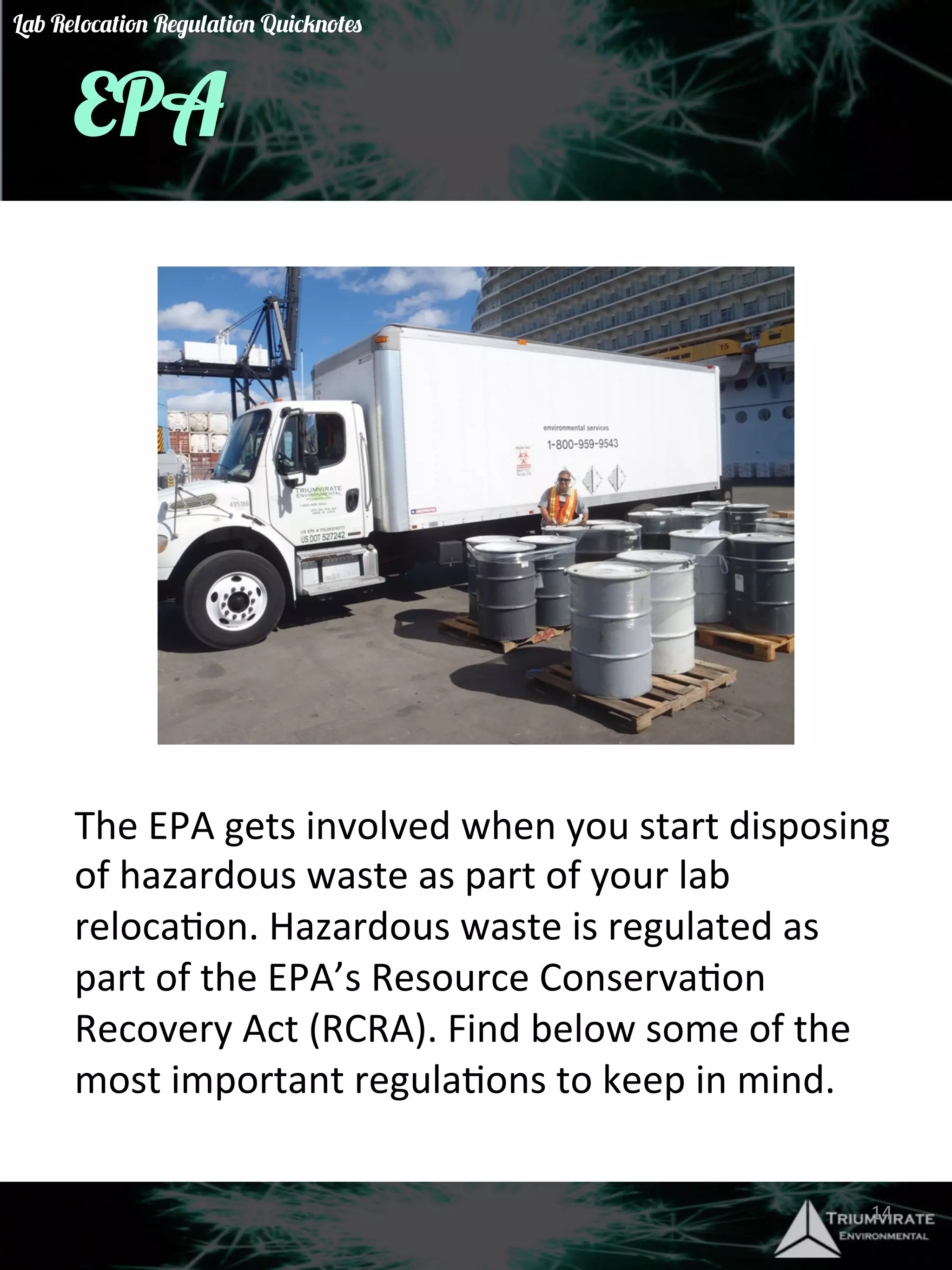
EPA 
The 
EPA 
gets 
involved 
when 
you 
start 
disposing 
of 
hazardous 
waste 
as 
part 
of 
your 
lab 
relocaGon. 
Hazardous 
waste 
is 
regulated 
as 
part 
of 
the 
EPA’s 
Resource 
ConservaGon 
Recovery 
Act 
(RCRA). 
Find 
below 
some 
of 
the 
most 
important 
regulaGons 
to 
keep 
in 
mind. 
14 
Lab Relocation Regulation Quicknotes
EPA 
Regulations 
Disposal 
of 
hazardous 
waste 
is 
regulated 
in 
RCRA 
40 
CFR 
Parts 
239 
– 
282. 
These 
regulaGons 
are 
important 
to 
know. 
The 
same 
regulaGons 
for 
waste 
disposal 
apply 
throughout 
your 
lab 
move, 
conGngent 
upon 
the 
type 
and 
amount 
of 
waste 
you’re 
disposing 
of. 
Iden)fica)on 
Make 
sure 
you’re 
following 
the 
proper 
procedures 
for 
idenGfying 
waste 
as 
hazardous, 
solid, 
or 
exempted 
waste. 
15 
Lab Relocation Regulation Quicknotes
EPA 
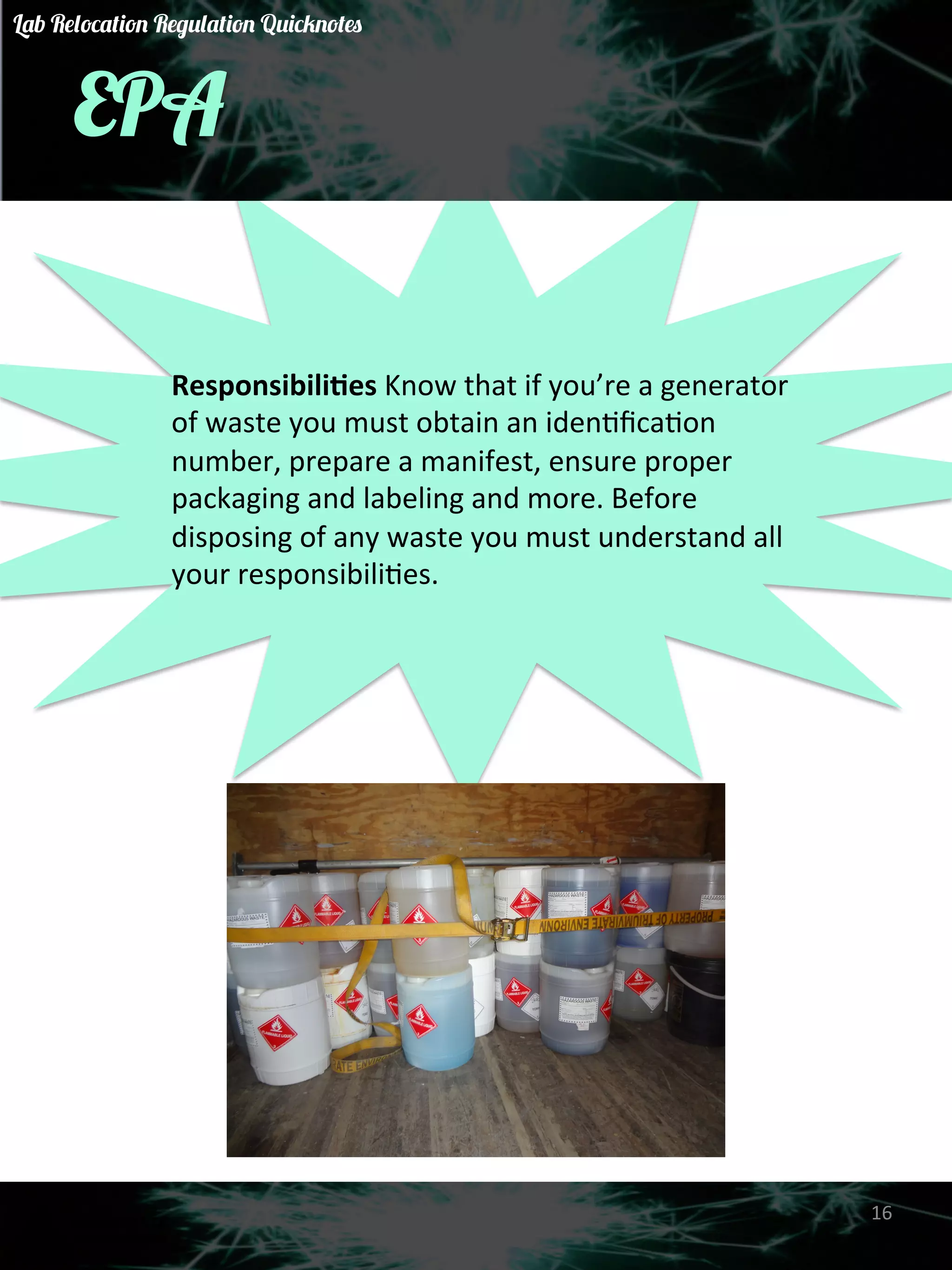
Responsibili)es 
Know 
that 
if 
you’re 
a 
generator 
of 
waste 
you 
must 
obtain 
an 
idenGficaGon 
number, 
prepare 
a 
manifest, 
ensure 
proper 
packaging 
and 
labeling 
and 
more. 
Before 
disposing 
of 
any 
waste 
you 
must 
understand 
all 
your 
responsibiliGes. 
16 
Lab Relocation Regulation Quicknotes
EPA 
Storage 
(Tanks 
and 
Containers) 
All 
waste 
must 
be 
tested 
to 
determine 
concentraGon 
before 
stored 
and 
saGsfy 
tank 
and 
emission 
standards. 
. 
This 
is 
a 
general 
overview 
of 
EPA 
standards 
in 
terms 
of 
hazardous 
waste 
removal. 
For 
more 
informaGon 
on 
hazardous 
waste 
RCRA 
regulaGons, 
visit 
their 
website 
here. 
All 
chemicals 
not 
being 
disposed 
of 
are 
probably 
being 
transported 
to 
your 
new 
facility. 
For 
these, 
you 
need 
to 
be 
mindful 
of 
DOT 
and 
IATA 
standards. 
Here 
they 
are. 
17 
Lab Relocation Regulation Quicknotes
Introduction 
The Process 
Local & Facility 
EPA 
DOT & IATA 
Conclusion 
DOT & IATA 
18 
Lab Relocation Regulation Quicknotes
DOT & IATA 
DOT 
The 
transport 
of 
hazardous 
materials 
via 
road 
and 
air 
are 
heavily 
regulated. 
If 
you 
intend 
on 
moving 
any 
hazardous 
materials 
in 
this 
way, 
you 
must 
comply 
with 
DOT 
and/or 
IATA 
transport 
regulaGons. 
These 
regulaGons 
are 
significant 
in 
scope 
and 
regulate 
both 
the 
shipper 
and 
the 
transporter. 
We’ll 
focus 
on 
DOT 
first. 
Here 
are 
some 
responsibiliGes 
you 
have 
for 
remaining 
DOT 
compliant. 
• Shippers 
are 
responsible 
for 
preparing 
and 
packaging 
hazmat 
shipments; 
there 
are 
also 
training 
and 
record 
keeping 
requirements. 
• All 
people 
involved 
with 
the 
transportaGon 
of 
hazardous 
materials 
must 
be 
DOT 
hazmat 
trained. 
19 
Lab Relocation Regulation Quicknotes
DOT & IATA 
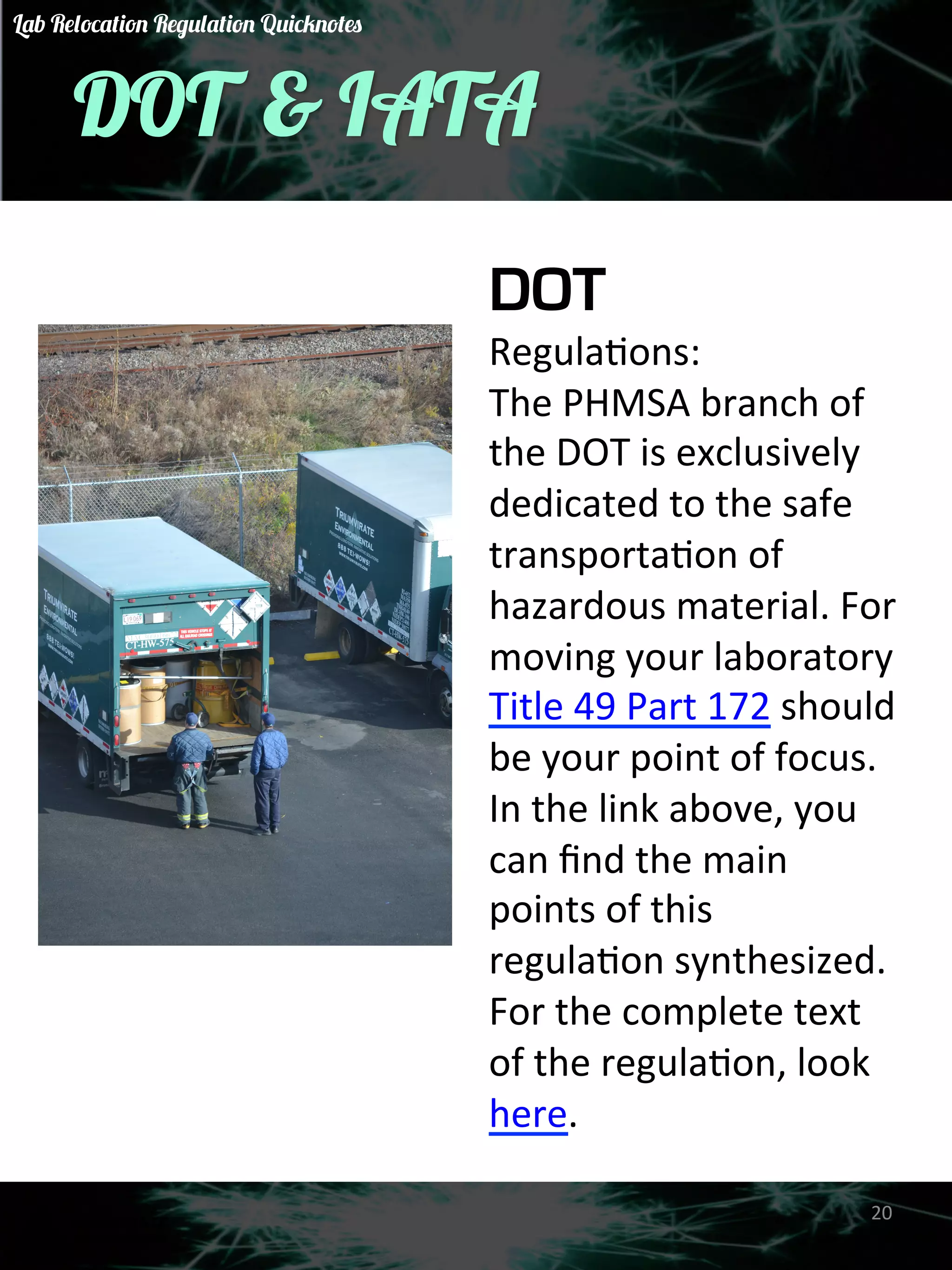
DOT 
RegulaGons: 
The 
PHMSA 
branch 
of 
the 
DOT 
is 
exclusively 
dedicated 
to 
the 
safe 
transportaGon 
of 
hazardous 
material. 
For 
moving 
your 
laboratory 
Title 
49 
Part 
172 
should 
be 
your 
point 
of 
focus. 
In 
the 
link 
above, 
you 
can 
find 
the 
main 
points 
of 
this 
regulaGon 
synthesized. 
For 
the 
complete 
text 
of 
the 
regulaGon, 
look 
here. 
20 
Lab Relocation Regulation Quicknotes
DOT & IATA 
DOT 
RegulaGons 
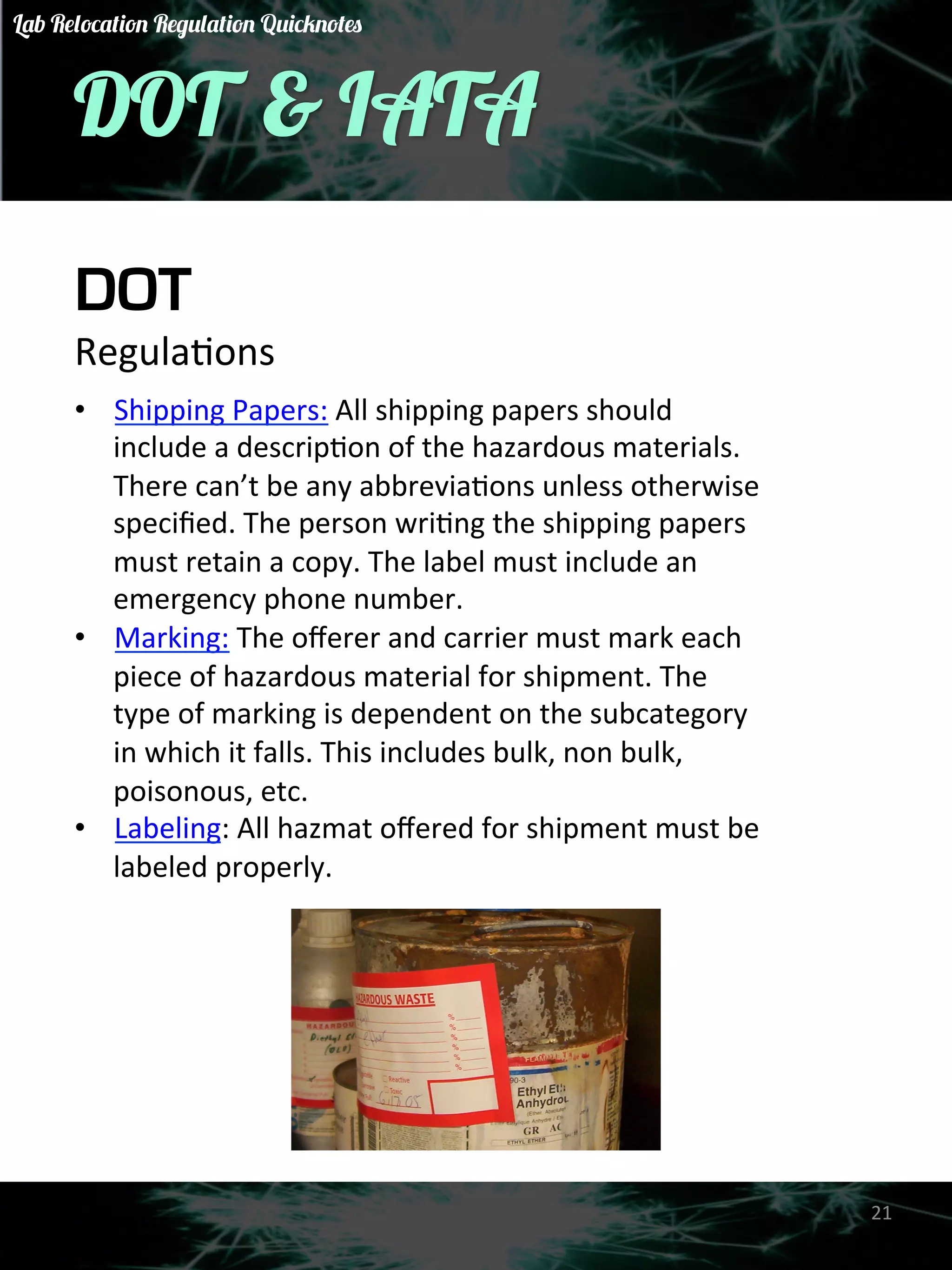
• Shipping 
Papers: 
All 
shipping 
papers 
should 
include 
a 
descripGon 
of 
the 
hazardous 
materials. 
There 
can’t 
be 
any 
abbreviaGons 
unless 
otherwise 
specified. 
The 
person 
wriGng 
the 
shipping 
papers 
must 
retain 
a 
copy. 
The 
label 
must 
include 
an 
emergency 
phone 
number. 
• Marking: 
The 
offerer 
and 
carrier 
must 
mark 
each 
piece 
of 
hazardous 
material 
for 
shipment. 
The 
type 
of 
marking 
is 
dependent 
on 
the 
subcategory 
in 
which 
it 
falls. 
This 
includes 
bulk, 
non 
bulk, 
poisonous, 
etc. 
• Labeling: 
All 
hazmat 
offered 
for 
shipment 
must 
be 
labeled 
properly. 
21 
Lab Relocation Regulation Quicknotes
DOT & IATA 
DOT 
RegulaGons 
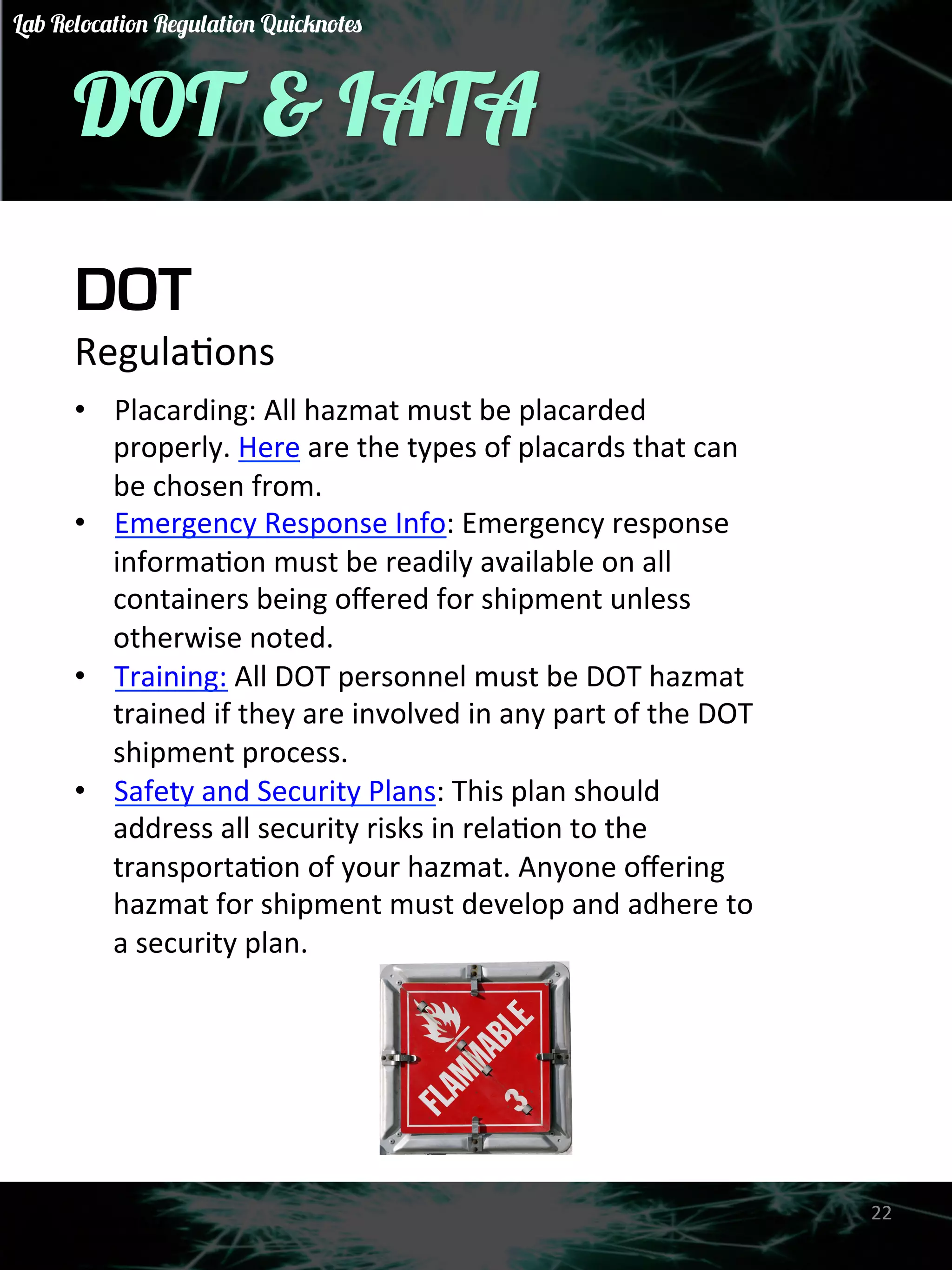
• Placarding: 
All 
hazmat 
must 
be 
placarded 
properly. 
Here 
are 
the 
types 
of 
placards 
that 
can 
be 
chosen 
from. 
• Emergency 
Response 
Info: 
Emergency 
response 
informaGon 
must 
be 
readily 
available 
on 
all 
containers 
being 
offered 
for 
shipment 
unless 
otherwise 
noted. 
• Training: 
All 
DOT 
personnel 
must 
be 
DOT 
hazmat 
trained 
if 
they 
are 
involved 
in 
any 
part 
of 
the 
DOT 
shipment 
process. 
• Safety 
and 
Security 
Plans: 
This 
plan 
should 
address 
all 
security 
risks 
in 
relaGon 
to 
the 
transportaGon 
of 
your 
hazmat. 
Anyone 
offering 
hazmat 
for 
shipment 
must 
develop 
and 
adhere 
to 
a 
security 
plan. 
22 
Lab Relocation Regulation Quicknotes
DOT & IATA 
IATA 
The 
InternaGonal 
Air 
Transport 
AssociaGon 
regulates 
air 
transportaGon 
across 
conGnents. 
These 
regulaGons 
are 
only 
applicable 
if 
you’re 
transporGng 
your 
lab 
via 
air. 
If 
these 
regulaGons 
apply 
to 
you, 
look 
here. 
23 
Lab Relocation Regulation Quicknotes
Introduction 
The Process 
Local & Facility 
EPA 
DOT & IATA 
Conclusion 
Conclusion 
24 
Lab Relocation Regulation Quicknotes
Conclusion 
Non-­‐compliance 
with 
any 
of 
these 
regulaGons 
can 
result 
in 
unsafe 
procedures 
and 
hundreds 
of 
thousands 
of 
dollars 
in 
fines. 
Some 
violaGons 
could 
even 
result 
in 
the 
shut 
down 
of 
your 
enGre 
operaGon. 
With 
the 
help 
of 
this 
guide, 
you 
can 
keep 
the 
compliance 
of 
your 
project 
operaGons 
in 
check. 
If 
you 
have 
any 
addiGonal 
quesGons 
about 
the 
compliance 
of 
your 
lab 
move, 
feel 
free 
to 
contact 
one 
of 
our 
experts. 
25 
Lab Relocation Regulation Quicknotes
Complete Lab Relocation 
Services 
Our lab relocation services are the only in the 
industry that will cover all EH&S related aspects 
of your move. Here is an overview of what we’ll 
do for you. 
• Risk assessment and mitigation 
• Environmental reporting 
• Lab move planning and logistics 
• Lab packing/unpacking 
• Lab decontamination 
Want more information on our lab relocation 
process? Check out a video walk through of our 
comprehensive process or a case study 
example. 
Video 
Walk-­‐Through 
Case 
Study 
26 
Lab Relocation Regulation Quicknotes

Lab Relocation Regulation Quicknotes

  • 1.
    Lab Relocation RegulationQuick Notes Spark a compliant lab move with these quick-flip notes on the most important regulations to your move. 1
  • 2.
    Introduction The Process Local & Facility EPA DOT & IATA Conclusion Introduction 2 Lab Relocation Regulation Quicknotes
  • 3.
    Introduction Lab relocationsare hard enough without remembering all the regulations. Throw requirements by law into the mix and you have more than enough to think about. Unlike most other projects, a lab relocation requires you to consider the regulations that govern your current facility, the facility you’re moving to and regulatory bodies that govern the transportation you’re using to get your stuff from one facility to the next. 3 Lab Relocation Regulation Quicknotes
  • 4.
    Introduction A&er your headache subsides from trying to do it on your own, flip through our quick )ps and summaries of the rules and regula)ons you need to know for your lab reloca)on to run smoothly. We’ve compiled it all in one place just for you. Let’s start with how to handle all these regulatory requirements. 4 Lab Relocation Regulation Quicknotes
  • 5.
    Introduction The Process Local & Facility EPA DOT & IATA Conclusion The Process 5 Lab Relocation Regulation Quicknotes
  • 6.
    The Process Before you can idenGfy what regulaGons may be applicable, you must clearly understand your opera)ons. Generally, any type of work with hazardous materials will be regulated from local ciGes all of the way up to federal agencies. The amount and type of regulaGon is dependent on the type and volume of hazmat. Some material types that will have regulaGons associated with them include: chemicals, biological materials, select agents, radia)on, or DEA regulated materials. 6 Lab Relocation Regulation Quicknotes
  • 7.
    The Process When wading through this ocean of regulaGons, always begin by making sure you’re compliant with your most local requirements and regulaGons and work your way out to state and federal. Some towns and ciGes have specific requirements regarding facility use, hazmat regulaGons, and other ordinances that impact your business. From there, each state may regulate specific acGviGes differently. With this strategy in mind, we’ll first be addressing facility and local regula)ons. 7 Lab Relocation Regulation Quicknotes
  • 8.
    Local & Facility Introduction The Process Local & Facility EPA DOT & IATA Conclusion 8 Lab Relocation Regulation Quicknotes
  • 9.
    Local & Facility Every facility will have different regulaGons, permits, and licenses to operate their site. RegulaGons are generally dictated by two variables: 1) the loca)on of your facility and 2) the types of ac)vi)es occurring at your facility. 9 Lab Relocation Regulation Quicknotes
  • 10.
    Local & Facility If you’re unsure about your faciliGes regulaGons and requirements, reach out to the property manager for the proper documentaGon. Likewise, local requirements can usually be found on the city’s website. If you can’t locate them on the site, contact the city and schedule a mee)ng to discuss requirements and necessary permits. Keep in mind that you have to do this for the locaGon you’re moving into as well as the locaGon you’re moving out of. 10 Lab Relocation Regulation Quicknotes
  • 11.
    Local & Facility A&er determining citywide requirements, go through the same process for your state. Your state’s EPA branch or DOT branch might have addi)onal rules and regula)ons on top of the federal ones. Keep in mind, state rules are always more stringent than federal ones. 11 Lab Relocation Regulation Quicknotes
  • 12.
    Local & Facility A&er determining all local and facility requirements, you should check to make sure you’re not overlooking anything on the federal level. There are several regulatory bodies you should check with and plan accordingly for before beginning your move. Here they are. 12 Lab Relocation Regulation Quicknotes
  • 13.
    Introduction The Process Local & Facility EPA DOT & IATA Conclusion EPA 13 Lab Relocation Regulation Quicknotes
  • 14.
    EPA The EPA gets involved when you start disposing of hazardous waste as part of your lab relocaGon. Hazardous waste is regulated as part of the EPA’s Resource ConservaGon Recovery Act (RCRA). Find below some of the most important regulaGons to keep in mind. 14 Lab Relocation Regulation Quicknotes
  • 15.
    EPA Regulations Disposal of hazardous waste is regulated in RCRA 40 CFR Parts 239 – 282. These regulaGons are important to know. The same regulaGons for waste disposal apply throughout your lab move, conGngent upon the type and amount of waste you’re disposing of. Iden)fica)on Make sure you’re following the proper procedures for idenGfying waste as hazardous, solid, or exempted waste. 15 Lab Relocation Regulation Quicknotes
  • 16.
    EPA Responsibili)es Know that if you’re a generator of waste you must obtain an idenGficaGon number, prepare a manifest, ensure proper packaging and labeling and more. Before disposing of any waste you must understand all your responsibiliGes. 16 Lab Relocation Regulation Quicknotes
  • 17.
    EPA Storage (Tanks and Containers) All waste must be tested to determine concentraGon before stored and saGsfy tank and emission standards. . This is a general overview of EPA standards in terms of hazardous waste removal. For more informaGon on hazardous waste RCRA regulaGons, visit their website here. All chemicals not being disposed of are probably being transported to your new facility. For these, you need to be mindful of DOT and IATA standards. Here they are. 17 Lab Relocation Regulation Quicknotes
  • 18.
    Introduction The Process Local & Facility EPA DOT & IATA Conclusion DOT & IATA 18 Lab Relocation Regulation Quicknotes
  • 19.
    DOT & IATA DOT The transport of hazardous materials via road and air are heavily regulated. If you intend on moving any hazardous materials in this way, you must comply with DOT and/or IATA transport regulaGons. These regulaGons are significant in scope and regulate both the shipper and the transporter. We’ll focus on DOT first. Here are some responsibiliGes you have for remaining DOT compliant. • Shippers are responsible for preparing and packaging hazmat shipments; there are also training and record keeping requirements. • All people involved with the transportaGon of hazardous materials must be DOT hazmat trained. 19 Lab Relocation Regulation Quicknotes
  • 20.
    DOT & IATA DOT RegulaGons: The PHMSA branch of the DOT is exclusively dedicated to the safe transportaGon of hazardous material. For moving your laboratory Title 49 Part 172 should be your point of focus. In the link above, you can find the main points of this regulaGon synthesized. For the complete text of the regulaGon, look here. 20 Lab Relocation Regulation Quicknotes
  • 21.
    DOT & IATA DOT RegulaGons • Shipping Papers: All shipping papers should include a descripGon of the hazardous materials. There can’t be any abbreviaGons unless otherwise specified. The person wriGng the shipping papers must retain a copy. The label must include an emergency phone number. • Marking: The offerer and carrier must mark each piece of hazardous material for shipment. The type of marking is dependent on the subcategory in which it falls. This includes bulk, non bulk, poisonous, etc. • Labeling: All hazmat offered for shipment must be labeled properly. 21 Lab Relocation Regulation Quicknotes
  • 22.
    DOT & IATA DOT RegulaGons • Placarding: All hazmat must be placarded properly. Here are the types of placards that can be chosen from. • Emergency Response Info: Emergency response informaGon must be readily available on all containers being offered for shipment unless otherwise noted. • Training: All DOT personnel must be DOT hazmat trained if they are involved in any part of the DOT shipment process. • Safety and Security Plans: This plan should address all security risks in relaGon to the transportaGon of your hazmat. Anyone offering hazmat for shipment must develop and adhere to a security plan. 22 Lab Relocation Regulation Quicknotes
  • 23.
    DOT & IATA IATA The InternaGonal Air Transport AssociaGon regulates air transportaGon across conGnents. These regulaGons are only applicable if you’re transporGng your lab via air. If these regulaGons apply to you, look here. 23 Lab Relocation Regulation Quicknotes
  • 24.
    Introduction The Process Local & Facility EPA DOT & IATA Conclusion Conclusion 24 Lab Relocation Regulation Quicknotes
  • 25.
    Conclusion Non-­‐compliance with any of these regulaGons can result in unsafe procedures and hundreds of thousands of dollars in fines. Some violaGons could even result in the shut down of your enGre operaGon. With the help of this guide, you can keep the compliance of your project operaGons in check. If you have any addiGonal quesGons about the compliance of your lab move, feel free to contact one of our experts. 25 Lab Relocation Regulation Quicknotes
  • 26.
    Complete Lab Relocation Services Our lab relocation services are the only in the industry that will cover all EH&S related aspects of your move. Here is an overview of what we’ll do for you. • Risk assessment and mitigation • Environmental reporting • Lab move planning and logistics • Lab packing/unpacking • Lab decontamination Want more information on our lab relocation process? Check out a video walk through of our comprehensive process or a case study example. Video Walk-­‐Through Case Study 26 Lab Relocation Regulation Quicknotes