Groundwater Rule:
WaterTrax   Overview and Best Practices


               Gary Lynch, VP Water Quality
                       Park Water
             Kenny Hughes, Regional Manager
                        WaterTrax
GoToWebinar Controls


  Click the button with the arrows
  to minimize your GoToWebinar
  controls


 Type your questions for us into the box
 at the bottom and press Send
A Utility Perspective of the
   Ground Water Rule


   WaterTrax Webinar
   November 10, 2009
             Gary R. Lynch
           V.P. – Water Quality
          Park Water Company
Intent of the Ground Water Rule
Correct all significant deficiencies
Eliminate source of contamination
Provide an alternate source of water
Provide treatment that reliably achieves at least
4-log treatment of viruses
Key Dates
December 1, 2009
 – GWR compliance date
December 31, 2012
 – States must have completed Sanitary Surveys
   for all Community Water Systems
December 31, 2014
 – States must have completed Sanitary Surveys
   for all Non Community Water Systems
New Challenges for GW
          Systems
Sanitary Surveys
 – Source
 – Treatment
 – Distribution system
 – Finished water storage
 – Pumps, pump facilities and controls
 – Monitoring, reporting and data verification
 – System operations and maintenance
 – Operator compliance
New Challenges (continued)
Source Water Monitoring and Reporting
 – New opportunity for M & R violations
“Treatment Technique” violations if fail to correct
significant deficiencies
Treatment – 4-log inactivation / removal
 – New level of expertise required, certified
   treatment operator
O & M / Record Keeping
 – New opportunity for M & R violations
Unintended Consequences
How Should Groundwater
      Systems Plan?
“GWS’s must provide the state with any pertinent
existing information that will enable the State to
perform the Sanitary Survey”
So, why not do your own evaluation?
 – Sanitary Survey aspects (eight)
 – Source Water Assessment Program
Gather any available information on
hydrogeology
Review well construction data
Do some source monitoring
Check For Contaminating
         Sources
Check your existing Source Water Assessment,
review for contaminating activities
Evaluate well situation to environment
 – Drainage
 – Sewers
 – Septic systems
 – Storm drains
Check Well Construction
Drilling method
 – Cable tool
 – Rotary
Gravel pack
Annular seal
Surface seal
Casing condition
Cascading water
Oil lube well / water lube well
Do Some Monitoring
Which method to use?
– E. coli
– Enterococcus
– Coliphage


    Central Basin ground water recharge basins
    recharged for >40 years with recycled water
Issues For Water Systems
Triggered Source Monitoring
 – With TCR TC+ sample, have short time to make
   distribution system determination
 – Multiple wells
    • State requires source water monitoring plan for
      representative samples
 – Initial sample at source
 – If E. coli positive, 5 repeat samples w/in 24 hrs
 – Reporting and record keeping
Source Assessment Monitoring (12 months)
 – E. coli positive will lead to immediate public notification
 – Reporting and record keeping
Issues For Water Systems
                      (continued)

Wholesaler / Consecutive System Relationship
 – Who notifies who, when?
 – Reporting and record keeping
Mixed systems (groundwater and surface water)
 – Where do you take your triggered source sample?
 – How do you determine if TC+ sample is sw related?
Public Notification
 – Different triggers for
    • Triggered source monitoring
    • Source assessment monitoring
– Special notice to the public
– CCR
– Reporting and record keeping
Issues For Water Systems
                  (continued)

Treatment
 – What to do to meet 4-log inactivation /
   removal?
 – O&M
 – Reporting and record keeping
Appropriate Level Treatment Operator
 – Reporting and record keeping
Reporting and Record Keeping
 – Documentation on any decision process
   related to rule compliance
4-log Inactivation / Removal
Inactivation
 – Disinfectants
    •   Chlorine gas – elemental Cl2 or ClO2
    •   Hypochlorite – solid or liquid
    •   Ozone
    •   UV (in combination with something else)
 – How to get CT?
    • Use existing USEPA CT tables
Removal
 – Surface water treatment
 – Membranes
    • Membrane operations and integrity testing
Combination
 – ?
How To Get CT
Dose is dependent on how long of a contact time can be
achieved before first customer
Distance to the first customer
 – Unless your lucky
    • Small pump lots
        – Build circuitous pipelines
        – Increase pipe diameter
    • Build storage
        – Acquiring land for storage
        – Construction parameters
            » Baffles
            » Separate inlet and outlet
            » others
        – Could require changing out your well pump
        – Booster pumps from storage
Challenges to Effective
  Disinfection (Inactivation)
Application of disinfectant
What means do you use to get contact time to meet 4-log?
Use of a continuous online monitor
 – GWR states online monitor must comply with CFR 141.74(a)(2)
    • DPD and amperometric titration methods only approved
    • No reagent-less monitors currently approved
    • Calibration of monitor every 5 days
Accurate readings of monitor
 – State determines residual disinfectant required
 – Must document lowest residual level every day (SCADA
   system?)
Certified Operator
 – Operator in plant
 – Wells at remote sites, no operator
Recording Disinfectant
In-line, continuous, records lowest residual level
each day
 – Failure of in-line monitor
 – Grab samples every four hours
Daily grab samples, must monitor during hour of
peak flow
 – If fall below state determined residual level,
   perform grab samples every 4 hours until
   restored
How Do You Apply a
Disinfectant to Ground Water?


Chemical feed pump                                     In-line static mixer


                     Chemical feed to discharge line
How Do You Apply a
       Disinfectant to Ground Water?


Internal Workings of
Static Mixer                 Disc (Wafer) Mixer


No Static Mixer              Static Mixer
How Do You Apply a
 Disinfectant to Ground Water?


                                                     In-line residual monitor
In-line residual
Monitor


                   Chemical feed pump with pulsation dampener
How Do You Apply a
Disinfectant to Ground Water?


                                    Commercial Cal-Hypo Unit


      Bulk Cal-Hypo system
      Down well casing chlorine application
How Do You Apply a
   Disinfectant to Ground Water?


Salt chlorine generation
(0.4% available chlorine)

                                             Rotometer

                        Chemical feed pump
                        and Rotometer
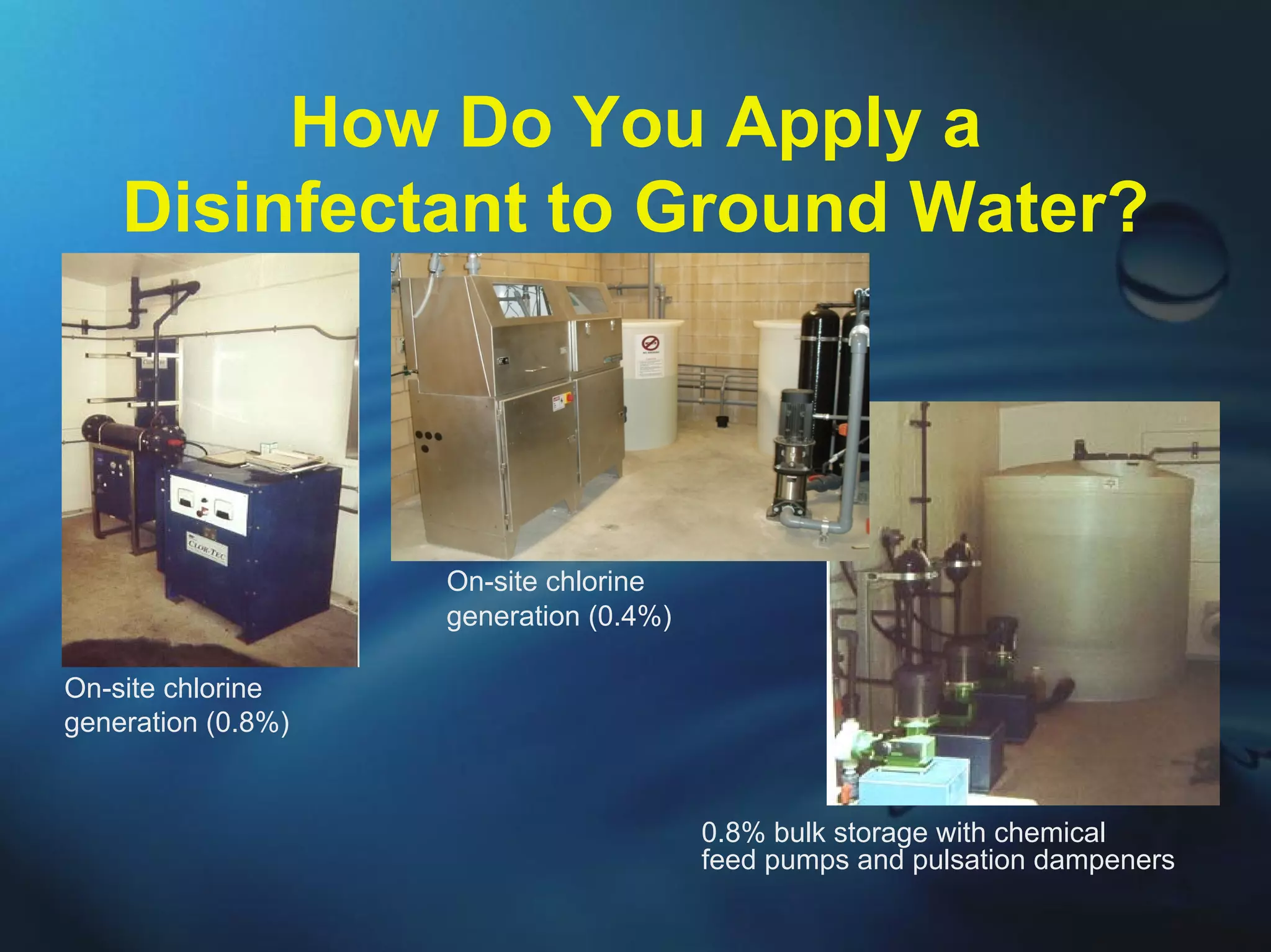
How Do You Apply a
    Disinfectant to Ground Water?


                    On-site chlorine
                    generation (0.4%)

On-site chlorine
generation (0.8%)


                                        0.8% bulk storage with chemical
                                        feed pumps and pulsation dampeners
Triggered Monitoring
Source Monitoring Plan
Issues Beyond the GWR
Triggered Source Sample
 – If source is E. coli positive and have a TC+
   resample, what does this mean?
 – This would be a public notification scenario under
   TCR
Should you quantify repeat samples with
something like Idexx Quantitray to get a density?
No distribution system residual required if doing
4-log inactivation/removal
 – Not the same as SWTR
Issues Beyond GWR (continued)
If disinfection is initiated, what about unintended
consequences?
  – EPA lists possible release of lead, copper and arsenic
    from pipelines
  – What about:
    •   Released biofilm
    •   Taste & Odor from biofilm die-off
    •   Colored water
    •   Corrosion
    •   T & O from disinfectant
    •   Iron and Manganese precipitation
    •   Compliance with Stage I and Stage II DBP Regulations
EPA Guidance
Guidance is available on EPA website
– Complying with the GWR: Small Entity
  Compliance Guide
– Consecutive System Guidance
– GWR Source Water Monitoring Methods
  Guidance
– Source Water Assessment Guide
– Sanitary Survey Guidance Manual for GW syst.
– GWR Corrective Action Guidance Manual
– GWR Triggered & Representative Source
  Water Monitoring Guidance
Conclusions
Do an advance review of your system’s ability to comply
with the GWR
GWR will be a significant challenge
Many opportunities for M & R violations
4-log inactivation/removal may not be practical, especially
for small systems
Avoid treatment if possible
 – Find other means to eliminate customer exposure to
    fecal contamination
Stay in touch with your state on their implementation
schedule
CT Calculator
EPA is developing a CT calculator to put into a
guidance manual – not done yet
Visit www.WQTS.com and you will find a CT
calculator
– Acknowledge the disclaimer and calculate your CT
  requirements based on your differing water quality
  parameters
– Then, calculate your production well’s time to first
  customer based on pipe diameter, gallons per minute
  produced and distance to first customer. Then multiply
  the disinfectant level by the time to first customer and
  see if you can meet 4-log virus inactivation
– Then what do you do?
WaterTrax Product Demo

   WaterTrax Water Data
   Management Webinar
     December 8th, 1:30pm Eastern /
     10:30am Pacific
     Register at:
     WWW.WATERTRAX.COM
WaterTrax Product Demo

   WaterTrax Water Data
   Management Webinar
     December 8th, 1:30pm Eastern /
     10:30am Pacific
     Register at:
     WWW.WATERTRAX.COM
WaterTrax Product Demo

   WaterTrax Water Data
   Management Webinar
     December 8th, 1:30pm Eastern /
     10:30am Pacific
     Register at:
     WWW.WATERTRAX.COM
WaterTrax Product Demo

   WaterTrax Water Data
   Management Webinar
     December 8th, 1:30pm Eastern /
     10:30am Pacific
     Register at:
     WWW.WATERTRAX.COM
WaterTrax Product Demo

   WaterTrax Water Data
   Management Webinar
     December 8th, 1:30pm Eastern /
     10:30am Pacific
     Register at:
     WWW.WATERTRAX.COM
WaterTrax Product Demo

   WaterTrax Water Data
   Management Webinar
     December 8th, 1:30pm Eastern /
     10:30am Pacific
     Register at:
     WWW.WATERTRAX.COM

Groundwater Rule Overview and Best Practices

  • 1.
    Groundwater Rule: WaterTrax Overview and Best Practices Gary Lynch, VP Water Quality Park Water Kenny Hughes, Regional Manager WaterTrax
  • 2.
    GoToWebinar Controls Click the button with the arrows to minimize your GoToWebinar controls Type your questions for us into the box at the bottom and press Send
  • 3.
    A Utility Perspectiveof the Ground Water Rule WaterTrax Webinar November 10, 2009 Gary R. Lynch V.P. – Water Quality Park Water Company
  • 4.
    Intent of theGround Water Rule Correct all significant deficiencies Eliminate source of contamination Provide an alternate source of water Provide treatment that reliably achieves at least 4-log treatment of viruses
  • 5.
    Key Dates December 1,2009 – GWR compliance date December 31, 2012 – States must have completed Sanitary Surveys for all Community Water Systems December 31, 2014 – States must have completed Sanitary Surveys for all Non Community Water Systems
  • 6.
    New Challenges forGW Systems Sanitary Surveys – Source – Treatment – Distribution system – Finished water storage – Pumps, pump facilities and controls – Monitoring, reporting and data verification – System operations and maintenance – Operator compliance
  • 7.
    New Challenges (continued) SourceWater Monitoring and Reporting – New opportunity for M & R violations “Treatment Technique” violations if fail to correct significant deficiencies Treatment – 4-log inactivation / removal – New level of expertise required, certified treatment operator O & M / Record Keeping – New opportunity for M & R violations Unintended Consequences
  • 8.
    How Should Groundwater Systems Plan? “GWS’s must provide the state with any pertinent existing information that will enable the State to perform the Sanitary Survey” So, why not do your own evaluation? – Sanitary Survey aspects (eight) – Source Water Assessment Program Gather any available information on hydrogeology Review well construction data Do some source monitoring
  • 9.
    Check For Contaminating Sources Check your existing Source Water Assessment, review for contaminating activities Evaluate well situation to environment – Drainage – Sewers – Septic systems – Storm drains
  • 10.
    Check Well Construction Drillingmethod – Cable tool – Rotary Gravel pack Annular seal Surface seal Casing condition Cascading water Oil lube well / water lube well
  • 11.
    Do Some Monitoring Whichmethod to use? – E. coli – Enterococcus – Coliphage Central Basin ground water recharge basins recharged for >40 years with recycled water
  • 12.
    Issues For WaterSystems Triggered Source Monitoring – With TCR TC+ sample, have short time to make distribution system determination – Multiple wells • State requires source water monitoring plan for representative samples – Initial sample at source – If E. coli positive, 5 repeat samples w/in 24 hrs – Reporting and record keeping Source Assessment Monitoring (12 months) – E. coli positive will lead to immediate public notification – Reporting and record keeping
  • 13.
    Issues For WaterSystems (continued) Wholesaler / Consecutive System Relationship – Who notifies who, when? – Reporting and record keeping Mixed systems (groundwater and surface water) – Where do you take your triggered source sample? – How do you determine if TC+ sample is sw related? Public Notification – Different triggers for • Triggered source monitoring • Source assessment monitoring – Special notice to the public – CCR – Reporting and record keeping
  • 14.
    Issues For WaterSystems (continued) Treatment – What to do to meet 4-log inactivation / removal? – O&M – Reporting and record keeping Appropriate Level Treatment Operator – Reporting and record keeping Reporting and Record Keeping – Documentation on any decision process related to rule compliance
  • 15.
    4-log Inactivation /Removal Inactivation – Disinfectants • Chlorine gas – elemental Cl2 or ClO2 • Hypochlorite – solid or liquid • Ozone • UV (in combination with something else) – How to get CT? • Use existing USEPA CT tables Removal – Surface water treatment – Membranes • Membrane operations and integrity testing Combination – ?
  • 16.
    How To GetCT Dose is dependent on how long of a contact time can be achieved before first customer Distance to the first customer – Unless your lucky • Small pump lots – Build circuitous pipelines – Increase pipe diameter • Build storage – Acquiring land for storage – Construction parameters » Baffles » Separate inlet and outlet » others – Could require changing out your well pump – Booster pumps from storage
  • 17.
    Challenges to Effective Disinfection (Inactivation) Application of disinfectant What means do you use to get contact time to meet 4-log? Use of a continuous online monitor – GWR states online monitor must comply with CFR 141.74(a)(2) • DPD and amperometric titration methods only approved • No reagent-less monitors currently approved • Calibration of monitor every 5 days Accurate readings of monitor – State determines residual disinfectant required – Must document lowest residual level every day (SCADA system?) Certified Operator – Operator in plant – Wells at remote sites, no operator
  • 18.
    Recording Disinfectant In-line, continuous,records lowest residual level each day – Failure of in-line monitor – Grab samples every four hours Daily grab samples, must monitor during hour of peak flow – If fall below state determined residual level, perform grab samples every 4 hours until restored
  • 19.
    How Do YouApply a Disinfectant to Ground Water? Chemical feed pump In-line static mixer Chemical feed to discharge line
  • 20.
    How Do YouApply a Disinfectant to Ground Water? Internal Workings of Static Mixer Disc (Wafer) Mixer No Static Mixer Static Mixer
  • 21.
    How Do YouApply a Disinfectant to Ground Water? In-line residual monitor In-line residual Monitor Chemical feed pump with pulsation dampener
  • 22.
    How Do YouApply a Disinfectant to Ground Water? Commercial Cal-Hypo Unit Bulk Cal-Hypo system Down well casing chlorine application
  • 23.
    How Do YouApply a Disinfectant to Ground Water? Salt chlorine generation (0.4% available chlorine) Rotometer Chemical feed pump and Rotometer
  • 24.
    How Do YouApply a Disinfectant to Ground Water? On-site chlorine generation (0.4%) On-site chlorine generation (0.8%) 0.8% bulk storage with chemical feed pumps and pulsation dampeners
  • 25.
  • 33.
    Issues Beyond theGWR Triggered Source Sample – If source is E. coli positive and have a TC+ resample, what does this mean? – This would be a public notification scenario under TCR Should you quantify repeat samples with something like Idexx Quantitray to get a density? No distribution system residual required if doing 4-log inactivation/removal – Not the same as SWTR
  • 34.
    Issues Beyond GWR(continued) If disinfection is initiated, what about unintended consequences? – EPA lists possible release of lead, copper and arsenic from pipelines – What about: • Released biofilm • Taste & Odor from biofilm die-off • Colored water • Corrosion • T & O from disinfectant • Iron and Manganese precipitation • Compliance with Stage I and Stage II DBP Regulations
  • 35.
    EPA Guidance Guidance isavailable on EPA website – Complying with the GWR: Small Entity Compliance Guide – Consecutive System Guidance – GWR Source Water Monitoring Methods Guidance – Source Water Assessment Guide – Sanitary Survey Guidance Manual for GW syst. – GWR Corrective Action Guidance Manual – GWR Triggered & Representative Source Water Monitoring Guidance
  • 36.
    Conclusions Do an advancereview of your system’s ability to comply with the GWR GWR will be a significant challenge Many opportunities for M & R violations 4-log inactivation/removal may not be practical, especially for small systems Avoid treatment if possible – Find other means to eliminate customer exposure to fecal contamination Stay in touch with your state on their implementation schedule
  • 37.
    CT Calculator EPA isdeveloping a CT calculator to put into a guidance manual – not done yet Visit www.WQTS.com and you will find a CT calculator – Acknowledge the disclaimer and calculate your CT requirements based on your differing water quality parameters – Then, calculate your production well’s time to first customer based on pipe diameter, gallons per minute produced and distance to first customer. Then multiply the disinfectant level by the time to first customer and see if you can meet 4-log virus inactivation – Then what do you do?
  • 38.
    WaterTrax Product Demo WaterTrax Water Data Management Webinar December 8th, 1:30pm Eastern / 10:30am Pacific Register at: WWW.WATERTRAX.COM
  • 39.
    WaterTrax Product Demo WaterTrax Water Data Management Webinar December 8th, 1:30pm Eastern / 10:30am Pacific Register at: WWW.WATERTRAX.COM
  • 40.
    WaterTrax Product Demo WaterTrax Water Data Management Webinar December 8th, 1:30pm Eastern / 10:30am Pacific Register at: WWW.WATERTRAX.COM
  • 41.
    WaterTrax Product Demo WaterTrax Water Data Management Webinar December 8th, 1:30pm Eastern / 10:30am Pacific Register at: WWW.WATERTRAX.COM
  • 42.
    WaterTrax Product Demo WaterTrax Water Data Management Webinar December 8th, 1:30pm Eastern / 10:30am Pacific Register at: WWW.WATERTRAX.COM
  • 43.
    WaterTrax Product Demo WaterTrax Water Data Management Webinar December 8th, 1:30pm Eastern / 10:30am Pacific Register at: WWW.WATERTRAX.COM