ETL: Extract, Transform,
Load
ETLis a foundational process in data management. It integrates and
prepares data for analysis or operational use.
by Saikat Basu
2.
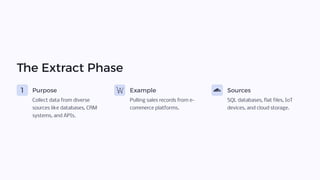
The Extract Phase
1Purpose
Collect data from diverse
sources like databases, CRM
systems, and APIs.
Example
Pulling sales records from e-
commerce platforms.
Sources
SQL databases, flat files, IoT
devices, and cloud storage.
3.
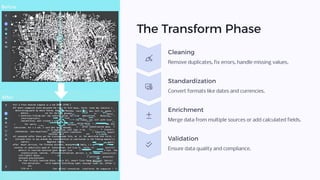
The Transform Phase
Cleaning
Removeduplicates, fix errors, handle missing values.
Standardization
Convert formats like dates and currencies.
Enrichment
Merge data from multiple sources or add calculated fields.
Validation
Ensure data quality and compliance.
4.
The Load Phase
Purpose
Storeprocessed data into target
systems like data warehouses or
application databases.
Full Load
Completely overwrite existing data
with new processed data.
Incremental Load
Append only new or updated
records to the existing dataset.
5.
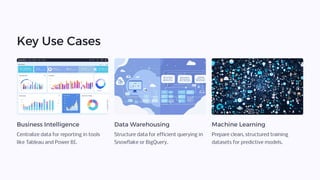
Key Use Cases
BusinessIntelligence
Centralize data for reporting in tools
like Tableau and Power BI.
Data Warehousing
Structure data for efficient querying in
Snowflake or BigQuery.
Machine Learning
Prepare clean, structured training
datasets for predictive models.
6.
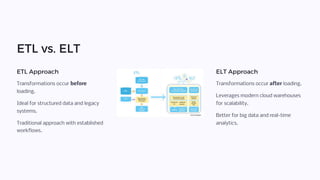
ETL vs. ELT
ETLApproach
Transformations occur before
loading.
Ideal for structured data and legacy
systems.
Traditional approach with established
workflows.
ELT Approach
Transformations occur after loading.
Leverages modern cloud warehouses
for scalability.
Better for big data and real-time
analytics.
Benefits and Challenges
Benefits
Consistency,quality, and efficiency in data processing.
Challenges
Complexity, performance optimization, and ongoing maintenance.
Example
Streaming service extracts watch history, calculates
trends, loads insights for recommendations.