The document discusses space-time modeling in GIS, emphasizing the integration of the temporal dimension to analyze changes in spatial patterns over time, driven by advances in data and computing. It outlines various approaches for representing spatiotemporal data, including snapshot and entity-based models, and introduces the space-time cube tool in ArcGIS for organizing point data across spatial and temporal dimensions. The advantages of space-time modeling include improved visualization of changes, capabilities for large data analysis, and insights into human-environment interactions.
Introduction
Although GISand geographical databases have existed for over 30 years, it has
only been within the past few that the addition of the temporal dimension has
gained a significant amount of attention.
This has been driven by the need to analyse how spatial patterns change over time
(in order to better understand large-scale Earth processes) and by the availability of
the data and computing power required by that space–time analysis.
The advent of remotely-sensed satellite data in addition to the accumulation of
other spatio-temporal observational data has made the empirical study of large-
scale, complex spatio-temporal processes possible. It also helps to understand the
dynamic behavior of the human-environment interactions by giving insight on
cause and effect relationships.
3.
Representing time andchange
Conceptually, the basic objective of any temporal database is to record or portray
change over time.
Change is normally described as an event or collection of events. For the purpose of
space–time modelling a better definition for an event might be ‘A change in state of
one or more locations, entities, or both’. For example, a change in the dominant species
within a forest, a forest fire, change of ownership of the land, or building of a road
would all be events.
Change, and therefore also events, can be distinguished in terms of their temporal
pattern
into four types:
● Continuous – going on throughout some interval of time
● Majorative – going on most of the time
● Sporadic – occurring some of the time
● Unique – occurring only once.
4.
This meansthat duration and frequency become important characteristics in describing
temporal pattern.
These patterns can be very complex: just as a spatial distribution can be random,
uniform, or clustered a temporal distribution can be chaotic, steady state, or cyclic.
Similarity of states of locations or entities through time can also be converging,
diverging, or combinations
Individual events can be characterized as clustered, forming episodes, that perhaps can
be further grouped into cycles.
Change relating to entities or locations can be sudden or gradual. Entities appear,
progress through various changes, then disappear over time. Spatially, an entity may
move, expand, shrink, change shape, split in two, or merge with an adjoining entity.
Although space and time are continuous, they are conventionally broken into discrete
units of uniform or variable length for purposes of objective measurement . Temporal
units can be seconds, minutes, days, seasons, political administrations, or other units
that may be convenient. Whether a single temporal scale or a hierarchy of scales is
used, the smallest unit of recorded time is called a ‘chronon’.
5.
APPROACHES FOR REPRESENTING
SPATIOTEMPORALDATA IN GIS
Snapshot Approach
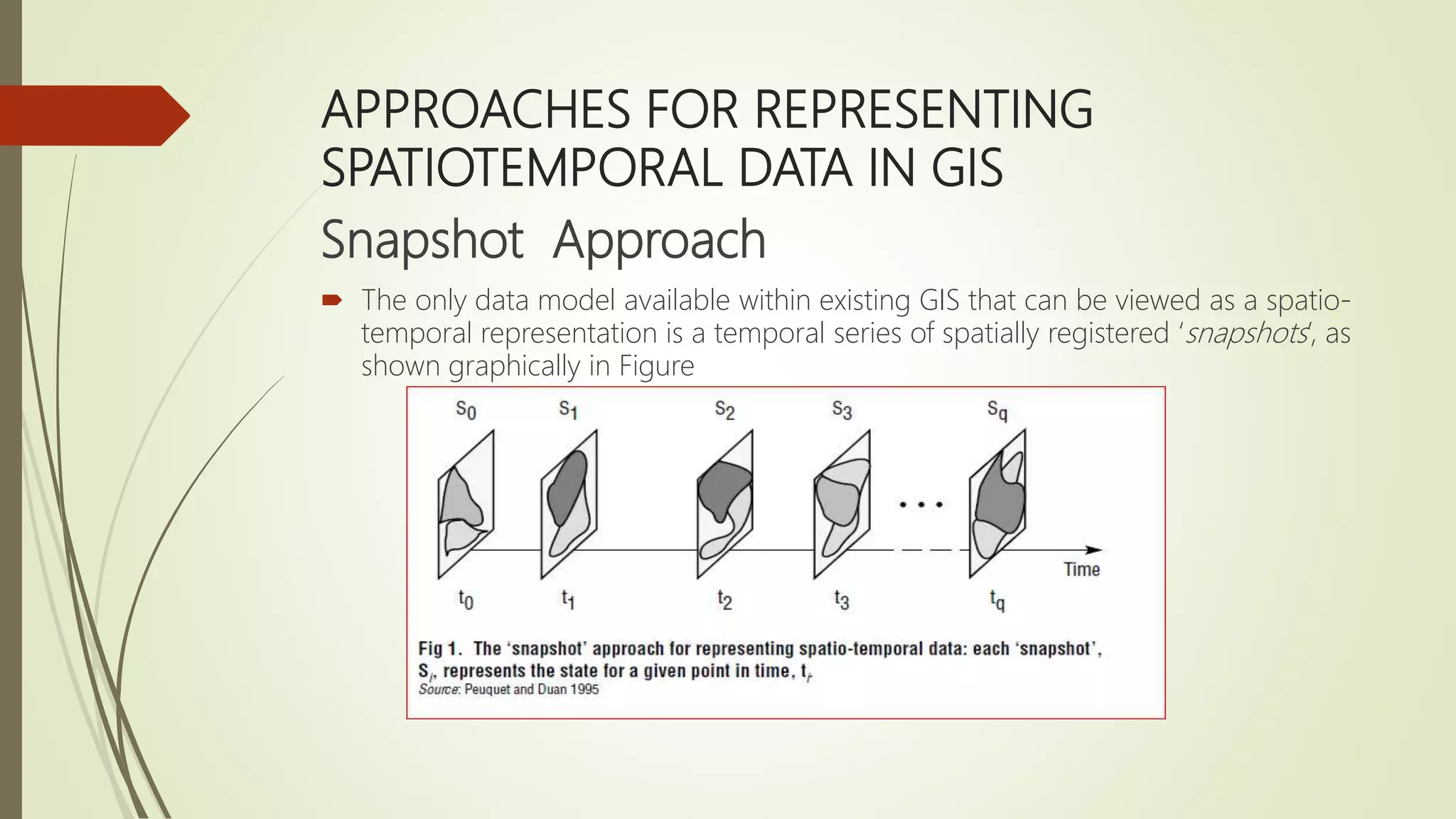
The only data model available within existing GIS that can be viewed as a spatio-
temporal representation is a temporal series of spatially registered ‘snapshots’, as
shown graphically in Figure
6.
The distinguishingfeature of the snapshot representation is that a ‘state of any
location or entity’ Si at each given point in time ti is stored as a complete image or
snapshot.
Instead of storing all information relating to a given thematic domain (e.g.
elevation or land-use) within a single layer, a layer holds information relating to a
single thematic domain at a single known time
Data are thus recorded over a series of discrete temporal intervals. Everything is
included regardless of what has or has not changed since the previous snapshot,
and the temporal distance between snapshots is not necessarily uniform.
7.
Entity-based representations for
spatiotemporaldata
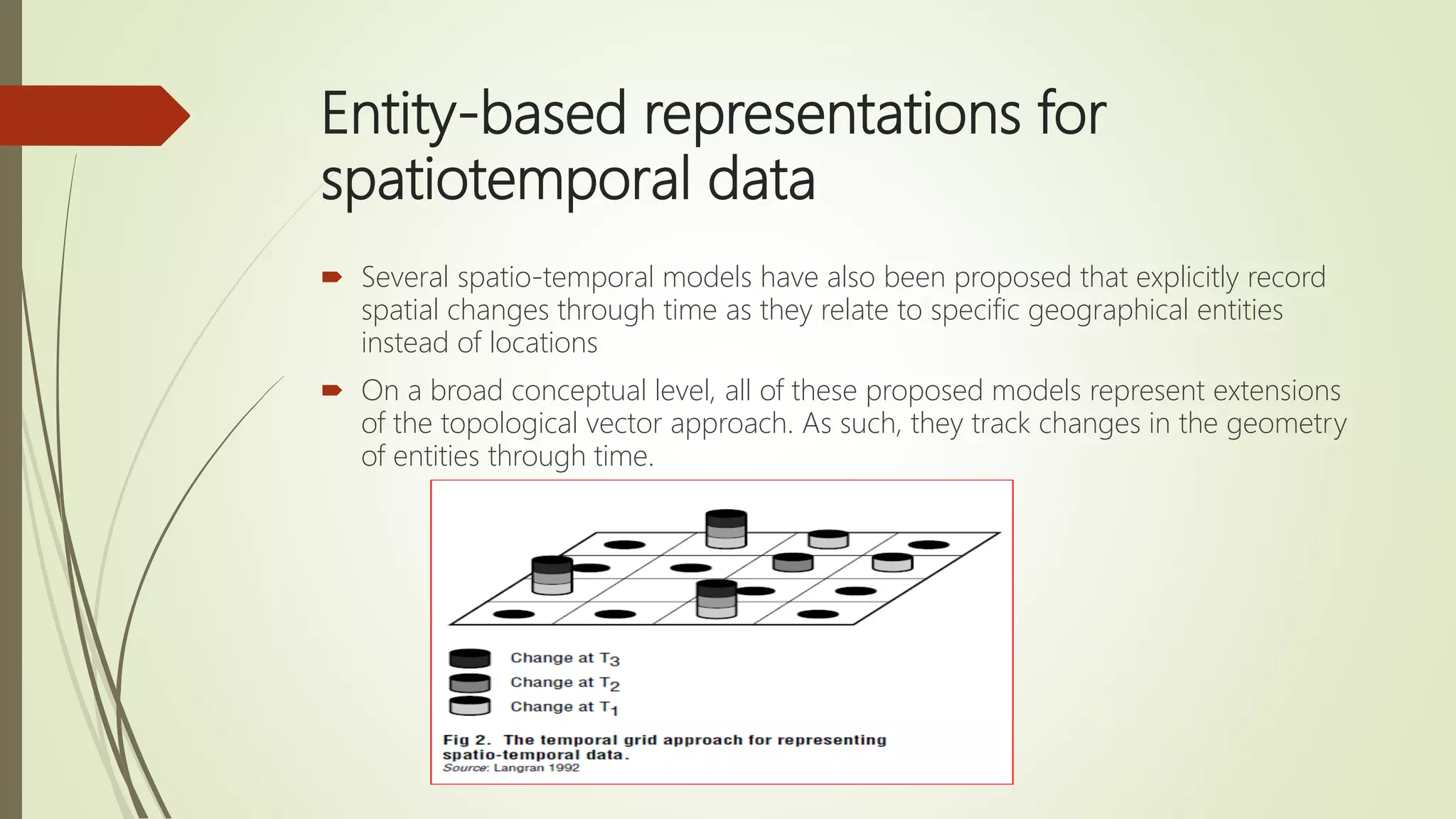
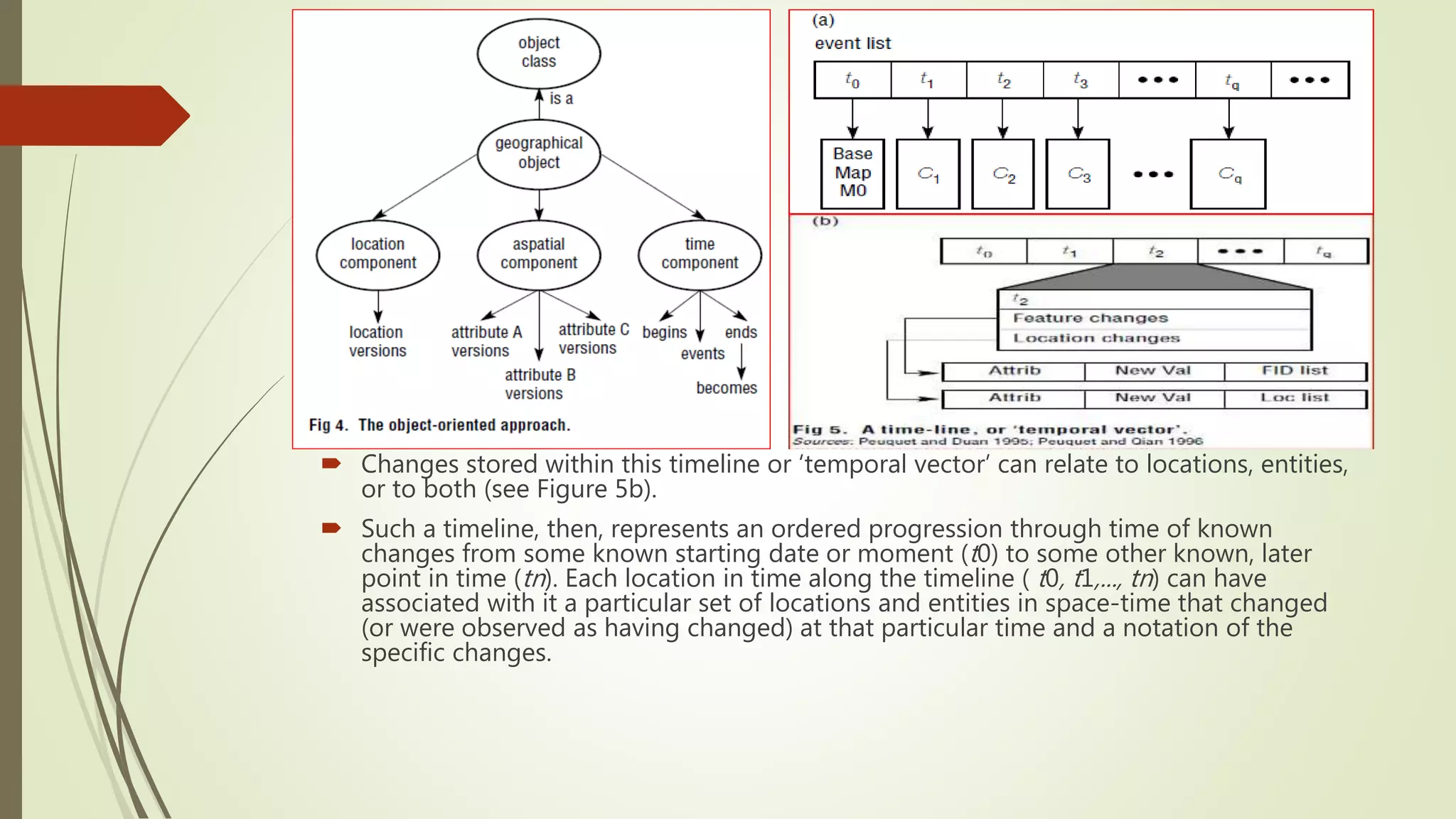
Several spatio-temporal models have also been proposed that explicitly record
spatial changes through time as they relate to specific geographical entities
instead of locations
On a broad conceptual level, all of these proposed models represent extensions
of the topological vector approach. As such, they track changes in the geometry
of entities through time.
8.
These spatiotemporalmodels rely on the concept of amendments, where any
changes subsequent to some initial point in time in the configuration of polygonal
or linear entities are incrementally recorded.
The first of these models was proposed by Langran (1989b) and relies on what she
describes as ‘amendment vectors’.
9.
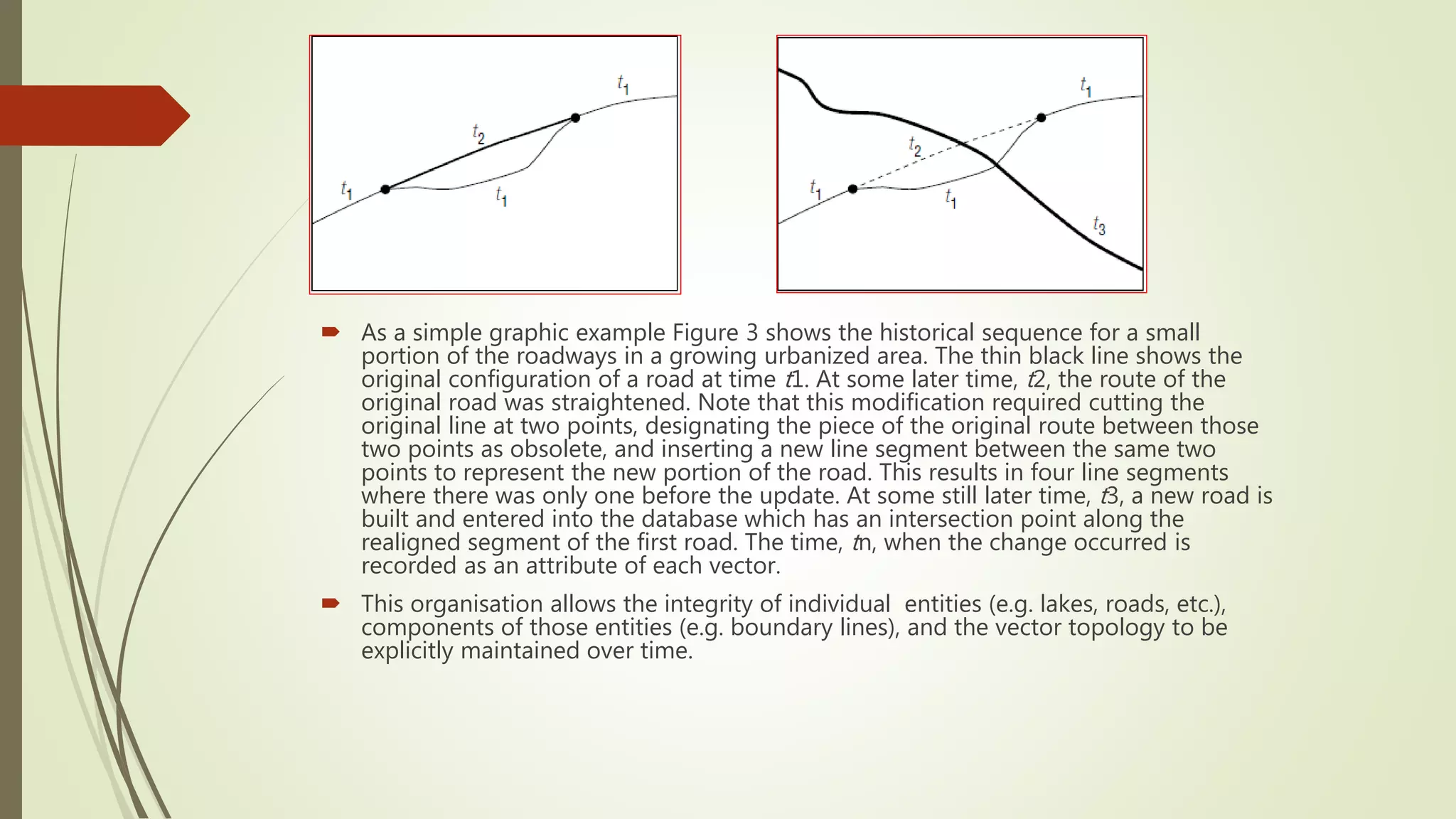
As asimple graphic example Figure 3 shows the historical sequence for a small
portion of the roadways in a growing urbanized area. The thin black line shows the
original configuration of a road at time t1. At some later time, t2, the route of the
original road was straightened. Note that this modification required cutting the
original line at two points, designating the piece of the original route between those
two points as obsolete, and inserting a new line segment between the same two
points to represent the new portion of the road. This results in four line segments
where there was only one before the update. At some still later time, t3, a new road is
built and entered into the database which has an intersection point along the
realigned segment of the first road. The time, tn, when the change occurred is
recorded as an attribute of each vector.
This organisation allows the integrity of individual entities (e.g. lakes, roads, etc.),
components of those entities (e.g. boundary lines), and the vector topology to be
explicitly maintained over time.
10.
Time-based representations for
spatiotemporaldata
Spatio-temporal representations that use time as the organisational basis have
also been proposed recently (Peuquet and Duan 1995; Peuquet and Wentz 1994).
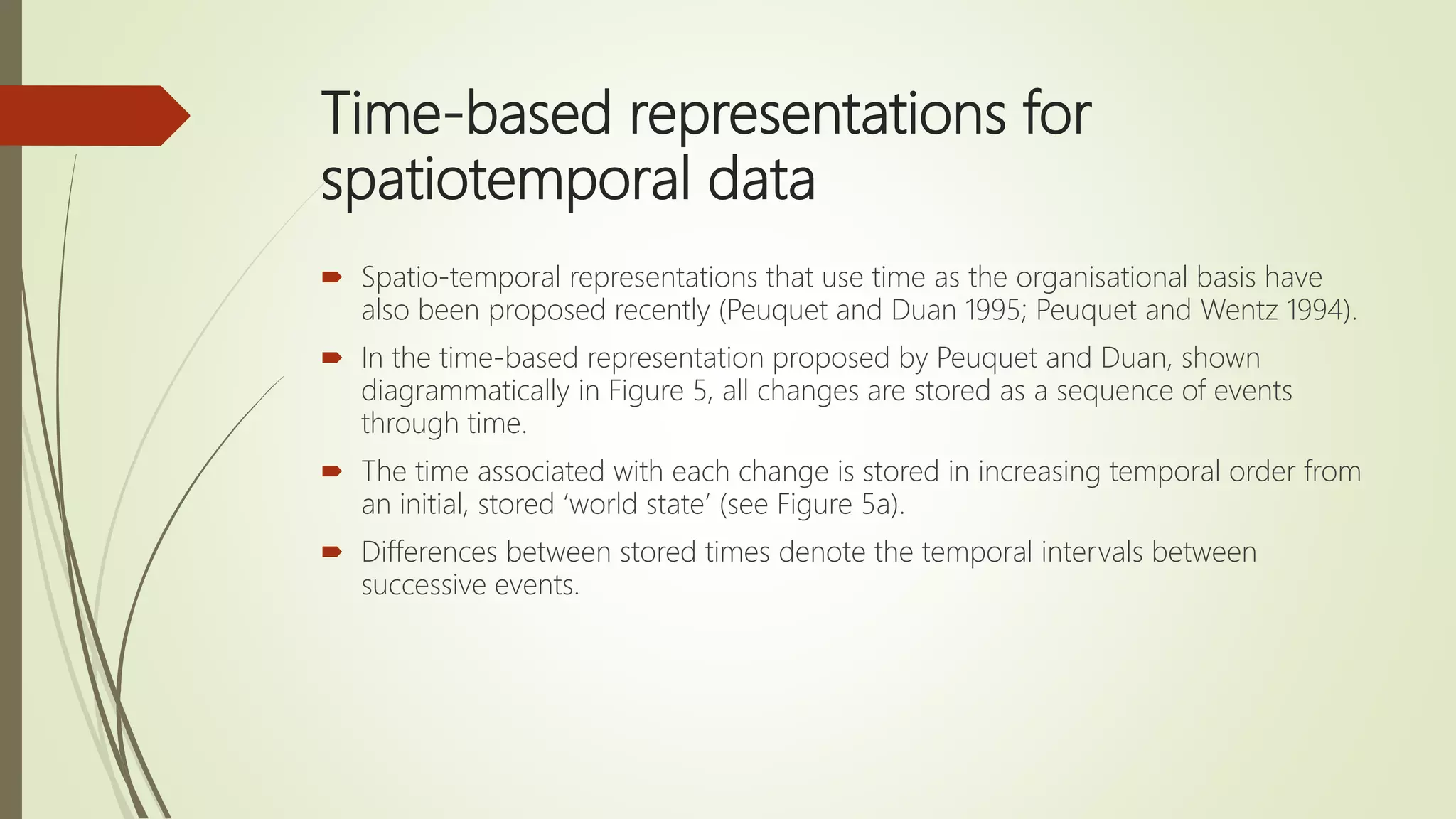
In the time-based representation proposed by Peuquet and Duan, shown
diagrammatically in Figure 5, all changes are stored as a sequence of events
through time.
The time associated with each change is stored in increasing temporal order from
an initial, stored ‘world state’ (see Figure 5a).
Differences between stored times denote the temporal intervals between
successive events.
11.
Changes storedwithin this timeline or ‘temporal vector’ can relate to locations, entities,
or to both (see Figure 5b).
Such a timeline, then, represents an ordered progression through time of known
changes from some known starting date or moment (t0) to some other known, later
point in time (tn). Each location in time along the timeline ( t0, t1,..., tn) can have
associated with it a particular set of locations and entities in space-time that changed
(or were observed as having changed) at that particular time and a notation of the
specific changes.
12.
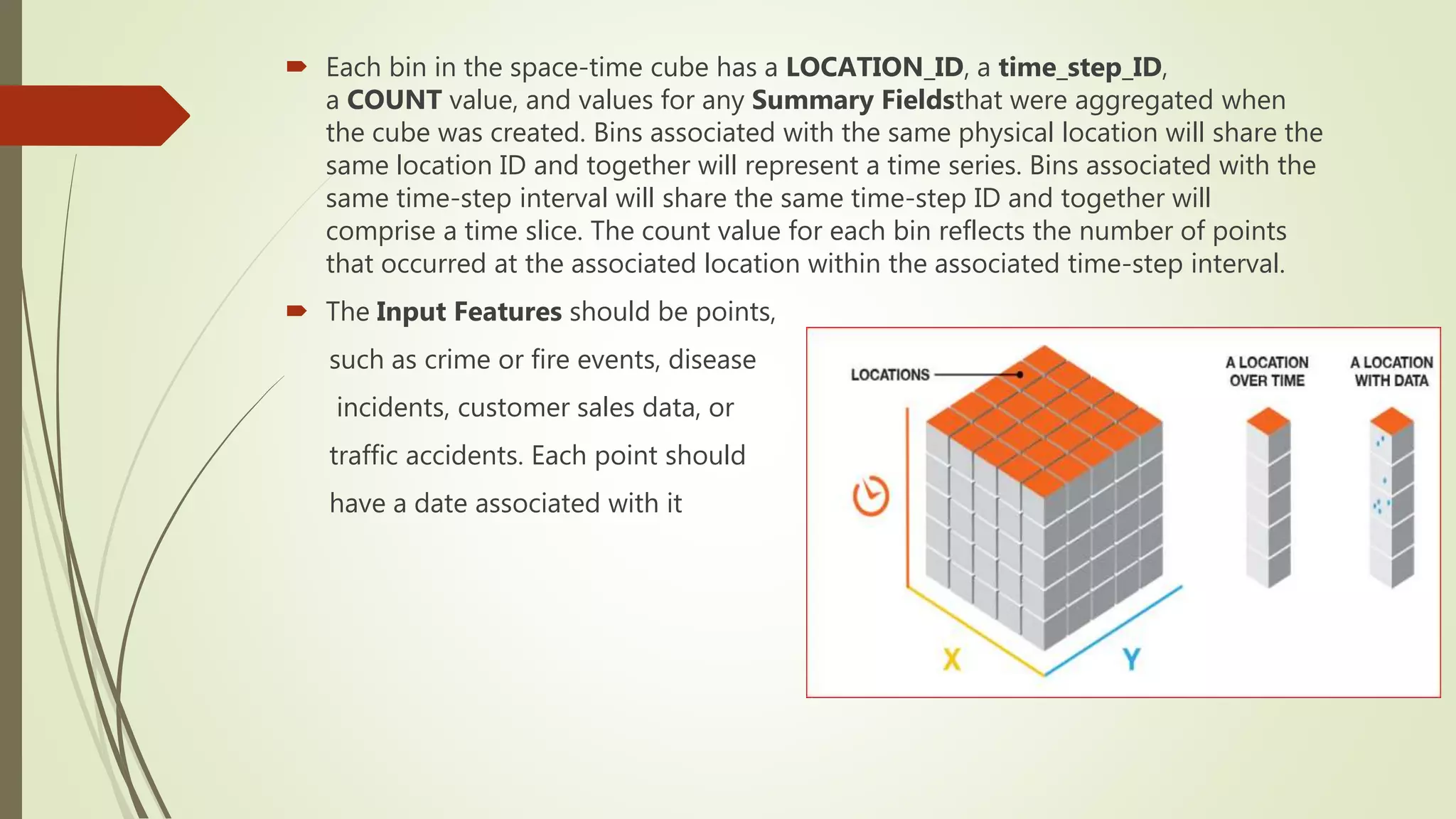
CREATE SPACE TIMECUBE (ARCGIS)
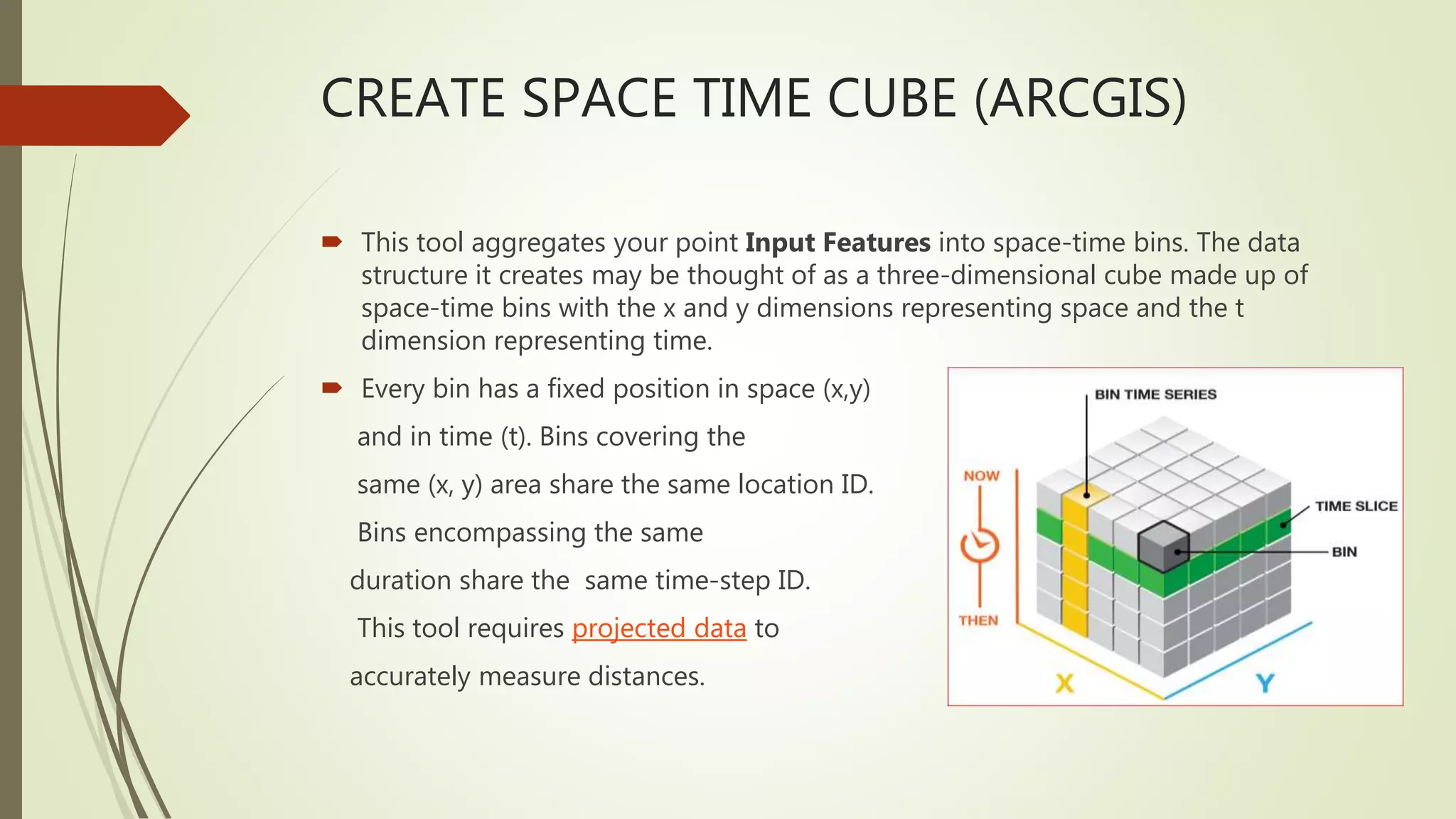
This tool aggregates your point Input Features into space-time bins. The data
structure it creates may be thought of as a three-dimensional cube made up of
space-time bins with the x and y dimensions representing space and the t
dimension representing time.
Every bin has a fixed position in space (x,y)
and in time (t). Bins covering the
same (x, y) area share the same location ID.
Bins encompassing the same
duration share the same time-step ID.
This tool requires projected data to
accurately measure distances.
13.
Each binin the space-time cube has a LOCATION_ID, a time_step_ID,
a COUNT value, and values for any Summary Fieldsthat were aggregated when
the cube was created. Bins associated with the same physical location will share the
same location ID and together will represent a time series. Bins associated with the
same time-step interval will share the same time-step ID and together will
comprise a time slice. The count value for each bin reflects the number of points
that occurred at the associated location within the associated time-step interval.
The Input Features should be points,
such as crime or fire events, disease
incidents, customer sales data, or
traffic accidents. Each point should
have a date associated with it
14.
Advantages Of Space-TimeModelling in
GIS
It enables the user to visualize and analyse the how spatial patterns change over
time , with the goal gaining insights about cause and effect relationships.
Large data can be analysed using space-time modelling
It helps for the detailed examination and understanding of Dynamics of human-
environment interaction.
An important capability of Space-time modelling is that it is able to represent the
alternative versions of the same reality. The idea of multiple realities over time is
called branching (Langran 1993; Lester 1990).
15.
References
Literature “Timein GIS and geographical databases” by ‘D J PEUQUET’
http://pro.arcgis.com/en/pro-app/tool-reference/space-time-pattern-
mining/create-space-time-cube.htm
Wikipedia