PROJECT
[AERONAUTICAL ENGINEERING]
[PRADNYA P.
NASNODKAR]
Summary
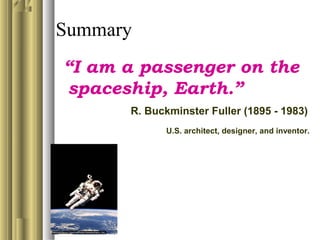
“I am a passenger on the
spaceship, Earth.”
R. Buckminster Fuller (1895 - 1983)
U.S. architect, designer, and inventor.
Progress
Aeronautics deals with the whole field of
design, manufacture, maintenance, testing,
and use of aircraft for both civilian and
military purposes. It involves the knowledge
of aerodynamics, structural design,
propulsion engines, navigation,
communication, and other related areas.
Aerospace engineering is closely allied to
aeronautics, but is concerned with the flight
of vehicles in space, beyond the earth's
atmosphere, and includes the study and
development of rocket engines, artificial
satellites, and spacecraft for the exploration
of outer space.
Introduction to AEROSPACE
That’s one small step for man, one giant
leap for mankind.” Astronaut Neil
Armstrong spoke these words on July
20, 1969, as he became the first person
ever to step onto the Moon.
An astronaut is a space traveler.
Astronauts fly into space on spaceships.
They go where there is no air, higher
than any airplane can fly. While they
orbit (go around) Earth, they are
weightless—they float and feel no
gravity.
WHO GETS TO BE AN
ASTRONAUT?
 In Neil Armstrong’s day, all astronauts were military test
pilots. Today, they’re as likely to be medical doctors,
scientists, or engineers. Astronauts are still pretty
unusual, however. Only a few hundred people have ever
traveled into space.
 Astronauts receive intense training. Then they may
prepare a year or more for a specific mission. Pilots must
be able to control all spacecraft systems and deal with
emergencies. They may need to make course changes or
dock with a space station. They must be able to land the
spacecraft. Mission specialists are experts on particular
experiments. Any astronaut may have to perform duties
in a space suit outside the craft.
WHAT DO ASTRONAUTS DO
IN SPACE?
 Most space missions do not require human passengers.
Robots and computers can do many jobs without
needing people. But astronauts can perform some
experiments in space that machines cannot. They can
examine, for example, how flames burn or how crystals
grow without gravity. Some experiments test the effects
of spaceflight on human beings. Astronauts also launch
and repair satellites, machines that orbit Earth. They also
retrieve objects in space for return to Earth.
 Astronauts may spend weeks or even months in space.
Russian cosmonaut Valeriy Polyakov holds the record
for the most consecutive days in space. He spent 438
days aboard the Mir Space Station in 1994 and 1995.
FLYING TO THE MOON
THE FIRST ASTRONAUTS
 Russian astronauts are called cosmonauts. The first person in
space was cosmonaut Yuri Gagarin. He made the trip in April
1961. The first American, a month later, was astronaut Alan
Shepard. The first capsules that carried astronauts into space
were barely large enough to hold their single passenger.
 The Apollo program began during the 1960s. Apollo was an
American project to send people to the Moon and back. There
were three astronauts in each Apollo crew. Two of them
explored the Moon while the third stayed aboard the main
spacecraft.
 Neil Armstrong, Buzz Aldrin, and Michael Collins were the crew
of Apollo 11. This was the first mission to land on the Moon.
Altogether, 12 astronauts walked on the Moon as part of the
Apollo program. They performed experiments and brought back
moon rocks for study. No one else has ever been to the Moon.
YURI GAGARIN
On April 12, 1961, the Russian
cosmonaut Yuri Gagarin blasted into
orbit. He was the first person in space
and completed an orbit of the Earth
before landing. This photograph was
taken just before lift-off.
Valentina tereshkoVa
Russian cosmonaut Valentina
Tereshkova was the first woman to enter
space. She piloted the Vostok 6 in orbit
around the Earth for four days in 1963.
Working in Space
In 1993 astronauts aboard the space
shuttle Endeavour carried out five space
walks to repair the Hubble Space
Telescope. An astronaut attached to the
remote manipulator arm prepares to
perform a repair
neil armstrong
Neil Armstrong, commander of the
Apollo 11 lunar mission, was the first
person to walk on the Moon.
Space Walking
On June 3, 1965, astronaut Edward H.
White II became the first American to
step outside a spaceship. White was
linked to the ship by a lifeline that
supplied him with oxygen. In his right
hand is a small rocket to help him move
around
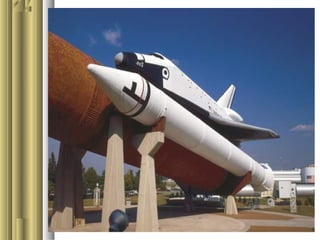
the sPaCe shUttle
During the 1980s, the United States began to
use space shuttles to send astronauts into
space. Previously, spaceships could only fly
once. Each trip required a new spaceship. Now,
space shuttles can fly into space many times.
They are launched from the top of a rocket, but
they land like an airplane. Up to seven crew
members can live aboard a shuttle.
The United States has begun research on a new
type of reusable spaceship to replace the space
shuttle. This new spaceship will use newer
technology and will be cheaper to operate than
the space shuttle. Someday astronauts may
walk on the Moon again, or even travel to other
planets!
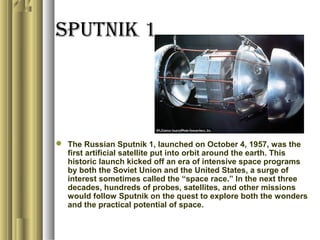
sPUtnik 1
 The Russian Sputnik 1, launched on October 4, 1957, was the
first artificial satellite put into orbit around the earth. This
historic launch kicked off an era of intensive space programs
by both the Soviet Union and the United States, a surge of
interest sometimes called the “space race.” In the next three
decades, hundreds of probes, satellites, and other missions
would follow Sputnik on the quest to explore both the wonders
and the practical potential of space.
gemini sPaCeCraft
Ten piloted Gemini spacecraft were
launched between March 1965 and
November 1966. Unlike earlier American
spacecraft, Gemini capsules were
designed to carry two astronauts. Before
returning to the earth, the crew
jettisoned the resource compartment
and the deorbiting system. The reentry
module floated to a watery splashdown
on earth using a parachute.
moDel of gemini
Space Shuttle Flight Deck
 This photo, taken with a fisheye lens, shows the flight
deck of the space shuttle. The commander and pilot are
seated at the instrument panel.
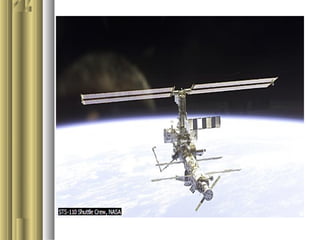
international sPaCe
station
International Space StationA
cooperative effort of 16 nations, the
International Space Station (ISS) is
the largest space station ever
constructed. It serves as an
orbiting research platform. This
photograph was taken from the
space shuttle Atlantis.
Jet engines
The three most common types of jet engines
are the turbojet, turboprop, and turbofan. Air
entering a turbojet engine is compressed and
passed into a combustion chamber, oxidizing
the fuel. Energy produced by the burning fuel
spins the turbine that drives the compressor,
creating an effective power cycle. Turboprop
engines are driven almost entirely by a
propeller mounted in front of the engine,
deriving only 10 percent of their thrust from the
exhaust jet. Turbofans combine the hot air jet
with bypassed air from a fan, also driven by the
turbine. The use of bypass air creates a quieter
engine with greater boost at low speeds,
making it a popular choice for commercial
airplanes.
SALUTE
TO
YOU
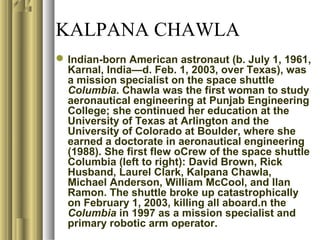
KALPANA CHAWLA
Indian-born American astronaut (b. July 1, 1961,
Karnal, India—d. Feb. 1, 2003, over Texas), was
a mission specialist on the space shuttle
Columbia. Chawla was the first woman to study
aeronautical engineering at Punjab Engineering
College; she continued her education at the
University of Texas at Arlington and the
University of Colorado at Boulder, where she
earned a doctorate in aeronautical engineering
(1988). She first flew oCrew of the space shuttle
Columbia (left to right): David Brown, Rick
Husband, Laurel Clark, Kalpana Chawla,
Michael Anderson, William McCool, and Ilan
Ramon. The shuttle broke up catastrophically
on February 1, 2003, killing all aboard.n the
Columbia in 1997 as a mission specialist and
primary robotic arm operator.
ROCKETS
Most rockets use either solid or
liquid chemical propellants. In most
liquid-propellant systems, the fuel
and oxidizer are pumped from
separate tanks into the combustion
chamber. Solid-propellant systems
carry the fuel and oxidizer already
mixed together in a solid state.
“There is nothing in the world except
empty curved space. Matter, charge,
electromagnetism, and other fields are
only manifestations of the curvature of
space.”
John Archibald Wheeler (1911 - )
U.S. theoretical physicist.
Nicolaus Copernicus
 Polish astronomer Nicolaus Copernicus revolutionized
science by postulating that the earth and other planets
revolve about a stationary sun. Developed in the early
1500s but not published until years later, his heliocentric
(sun-centered) theory disputed the Ptolemaic theory,
popular at the time, which held that the sun and the
planets revolved about the fixed earth. Copernicus at
first hesitated in publishing his findings because he
feared criticism from the scientific and religious
communities. After suffering initial disbelief and
rejection, however, the Copernican system ranked as the
most accepted concept of the universe by the late 17th
century.
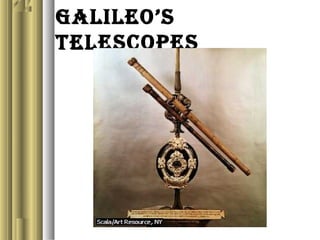
Italian physicist and astronomer Galileo
made major discoveries about celestial
objects in our solar system. In 1609,
when he heard that a spyglass had been
invented in Holland, he began to
experiment with them. The telescopes
pictured here were among those he
used. They are in the Museo della
Scienza in Florence, Italy.
Galileo’s
Telescopes
Galileo
 Italian physicist and astronomer Galileo maintained that
the earth revolved around the sun, disputing the belief
held by the Roman Catholic church that the earth was the
center of the universe. He refused to obey orders from
Rome to cease discussions of his theories and was
sentenced to life imprisonment. Galileo's work influenced
other Renaissance scientists and encouraged the
development of the scientific method.
Give me space...
space for my mind to reach
into that indigo space
shattered by stars.
I shall drag them down and wear about
my head
and fill my hands with the firefly
glimmer
of fugitive thoughts.
Monika Varma (1916 - )
Indian poet.

Project

  • 1.
  • 2.
    Summary “I am apassenger on the spaceship, Earth.” R. Buckminster Fuller (1895 - 1983) U.S. architect, designer, and inventor.
  • 3.
    Progress Aeronautics deals withthe whole field of design, manufacture, maintenance, testing, and use of aircraft for both civilian and military purposes. It involves the knowledge of aerodynamics, structural design, propulsion engines, navigation, communication, and other related areas. Aerospace engineering is closely allied to aeronautics, but is concerned with the flight of vehicles in space, beyond the earth's atmosphere, and includes the study and development of rocket engines, artificial satellites, and spacecraft for the exploration of outer space.
  • 4.
    Introduction to AEROSPACE That’sone small step for man, one giant leap for mankind.” Astronaut Neil Armstrong spoke these words on July 20, 1969, as he became the first person ever to step onto the Moon. An astronaut is a space traveler. Astronauts fly into space on spaceships. They go where there is no air, higher than any airplane can fly. While they orbit (go around) Earth, they are weightless—they float and feel no gravity.
  • 5.
    WHO GETS TOBE AN ASTRONAUT?  In Neil Armstrong’s day, all astronauts were military test pilots. Today, they’re as likely to be medical doctors, scientists, or engineers. Astronauts are still pretty unusual, however. Only a few hundred people have ever traveled into space.  Astronauts receive intense training. Then they may prepare a year or more for a specific mission. Pilots must be able to control all spacecraft systems and deal with emergencies. They may need to make course changes or dock with a space station. They must be able to land the spacecraft. Mission specialists are experts on particular experiments. Any astronaut may have to perform duties in a space suit outside the craft.
  • 6.
    WHAT DO ASTRONAUTSDO IN SPACE?  Most space missions do not require human passengers. Robots and computers can do many jobs without needing people. But astronauts can perform some experiments in space that machines cannot. They can examine, for example, how flames burn or how crystals grow without gravity. Some experiments test the effects of spaceflight on human beings. Astronauts also launch and repair satellites, machines that orbit Earth. They also retrieve objects in space for return to Earth.  Astronauts may spend weeks or even months in space. Russian cosmonaut Valeriy Polyakov holds the record for the most consecutive days in space. He spent 438 days aboard the Mir Space Station in 1994 and 1995.
  • 7.
    FLYING TO THEMOON THE FIRST ASTRONAUTS  Russian astronauts are called cosmonauts. The first person in space was cosmonaut Yuri Gagarin. He made the trip in April 1961. The first American, a month later, was astronaut Alan Shepard. The first capsules that carried astronauts into space were barely large enough to hold their single passenger.  The Apollo program began during the 1960s. Apollo was an American project to send people to the Moon and back. There were three astronauts in each Apollo crew. Two of them explored the Moon while the third stayed aboard the main spacecraft.  Neil Armstrong, Buzz Aldrin, and Michael Collins were the crew of Apollo 11. This was the first mission to land on the Moon. Altogether, 12 astronauts walked on the Moon as part of the Apollo program. They performed experiments and brought back moon rocks for study. No one else has ever been to the Moon.
  • 8.
    YURI GAGARIN On April12, 1961, the Russian cosmonaut Yuri Gagarin blasted into orbit. He was the first person in space and completed an orbit of the Earth before landing. This photograph was taken just before lift-off.
  • 9.
    Valentina tereshkoVa Russian cosmonautValentina Tereshkova was the first woman to enter space. She piloted the Vostok 6 in orbit around the Earth for four days in 1963. Working in Space In 1993 astronauts aboard the space shuttle Endeavour carried out five space walks to repair the Hubble Space Telescope. An astronaut attached to the remote manipulator arm prepares to perform a repair
  • 10.
    neil armstrong Neil Armstrong,commander of the Apollo 11 lunar mission, was the first person to walk on the Moon. Space Walking On June 3, 1965, astronaut Edward H. White II became the first American to step outside a spaceship. White was linked to the ship by a lifeline that supplied him with oxygen. In his right hand is a small rocket to help him move around
  • 11.
    the sPaCe shUttle Duringthe 1980s, the United States began to use space shuttles to send astronauts into space. Previously, spaceships could only fly once. Each trip required a new spaceship. Now, space shuttles can fly into space many times. They are launched from the top of a rocket, but they land like an airplane. Up to seven crew members can live aboard a shuttle. The United States has begun research on a new type of reusable spaceship to replace the space shuttle. This new spaceship will use newer technology and will be cheaper to operate than the space shuttle. Someday astronauts may walk on the Moon again, or even travel to other planets!
  • 12.
    sPUtnik 1  TheRussian Sputnik 1, launched on October 4, 1957, was the first artificial satellite put into orbit around the earth. This historic launch kicked off an era of intensive space programs by both the Soviet Union and the United States, a surge of interest sometimes called the “space race.” In the next three decades, hundreds of probes, satellites, and other missions would follow Sputnik on the quest to explore both the wonders and the practical potential of space.
  • 13.
    gemini sPaCeCraft Ten pilotedGemini spacecraft were launched between March 1965 and November 1966. Unlike earlier American spacecraft, Gemini capsules were designed to carry two astronauts. Before returning to the earth, the crew jettisoned the resource compartment and the deorbiting system. The reentry module floated to a watery splashdown on earth using a parachute.
  • 14.
  • 15.
    Space Shuttle FlightDeck  This photo, taken with a fisheye lens, shows the flight deck of the space shuttle. The commander and pilot are seated at the instrument panel.
  • 16.
    international sPaCe station International SpaceStationA cooperative effort of 16 nations, the International Space Station (ISS) is the largest space station ever constructed. It serves as an orbiting research platform. This photograph was taken from the space shuttle Atlantis.
  • 18.
  • 19.
    The three mostcommon types of jet engines are the turbojet, turboprop, and turbofan. Air entering a turbojet engine is compressed and passed into a combustion chamber, oxidizing the fuel. Energy produced by the burning fuel spins the turbine that drives the compressor, creating an effective power cycle. Turboprop engines are driven almost entirely by a propeller mounted in front of the engine, deriving only 10 percent of their thrust from the exhaust jet. Turbofans combine the hot air jet with bypassed air from a fan, also driven by the turbine. The use of bypass air creates a quieter engine with greater boost at low speeds, making it a popular choice for commercial airplanes.
  • 20.
  • 22.
    KALPANA CHAWLA Indian-born Americanastronaut (b. July 1, 1961, Karnal, India—d. Feb. 1, 2003, over Texas), was a mission specialist on the space shuttle Columbia. Chawla was the first woman to study aeronautical engineering at Punjab Engineering College; she continued her education at the University of Texas at Arlington and the University of Colorado at Boulder, where she earned a doctorate in aeronautical engineering (1988). She first flew oCrew of the space shuttle Columbia (left to right): David Brown, Rick Husband, Laurel Clark, Kalpana Chawla, Michael Anderson, William McCool, and Ilan Ramon. The shuttle broke up catastrophically on February 1, 2003, killing all aboard.n the Columbia in 1997 as a mission specialist and primary robotic arm operator.
  • 23.
    ROCKETS Most rockets useeither solid or liquid chemical propellants. In most liquid-propellant systems, the fuel and oxidizer are pumped from separate tanks into the combustion chamber. Solid-propellant systems carry the fuel and oxidizer already mixed together in a solid state.
  • 26.
    “There is nothingin the world except empty curved space. Matter, charge, electromagnetism, and other fields are only manifestations of the curvature of space.” John Archibald Wheeler (1911 - ) U.S. theoretical physicist.
  • 27.
    Nicolaus Copernicus  Polishastronomer Nicolaus Copernicus revolutionized science by postulating that the earth and other planets revolve about a stationary sun. Developed in the early 1500s but not published until years later, his heliocentric (sun-centered) theory disputed the Ptolemaic theory, popular at the time, which held that the sun and the planets revolved about the fixed earth. Copernicus at first hesitated in publishing his findings because he feared criticism from the scientific and religious communities. After suffering initial disbelief and rejection, however, the Copernican system ranked as the most accepted concept of the universe by the late 17th century.
  • 28.
    Italian physicist andastronomer Galileo made major discoveries about celestial objects in our solar system. In 1609, when he heard that a spyglass had been invented in Holland, he began to experiment with them. The telescopes pictured here were among those he used. They are in the Museo della Scienza in Florence, Italy.
  • 29.
  • 30.
    Galileo  Italian physicistand astronomer Galileo maintained that the earth revolved around the sun, disputing the belief held by the Roman Catholic church that the earth was the center of the universe. He refused to obey orders from Rome to cease discussions of his theories and was sentenced to life imprisonment. Galileo's work influenced other Renaissance scientists and encouraged the development of the scientific method.
  • 31.
    Give me space... spacefor my mind to reach into that indigo space shattered by stars. I shall drag them down and wear about my head and fill my hands with the firefly glimmer of fugitive thoughts. Monika Varma (1916 - ) Indian poet.