Human-Environment
System
Human
Humans have the capacity to interact
with its environment.
Human and environment have the mutual
interaction with each other.
Human have the capacity to change or
influence the balance of the society.
Human always have the capacity to
adapts to its
Environment
Environment is a complex of many
variables which surrounds man as well
as the living organisms.
Environments includes water, air, and
land and the interrelationships which
exist among system.
Systems
 It may be described as a complex of
interacting components together with
the relationships among them that
permit the identification of a boundary?
minting entity and process.
 Is a collection of components that
interact with each other to form
aggregated whole.
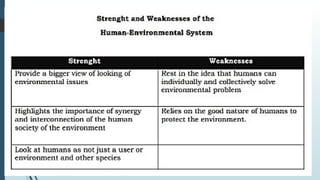
Human-Environment System
It is also known as the Coupled Human and
Natural System or CHANS
 Show how humans and the environment
both impact each other.
Integrated scientific framework for studying
the interface and reciprocal interaction that
links humans to natural sub-systems of the
planet.
Interaction between the human social system
and the ecosystem.
Human Eco-System is Complex
Adaptive System
Complex – because they have many
parts and connections
Adaptive – because they have many
structures that promote survival.
Ecosystem Services
 Modifying the environment for
human purposes and obtain
benefits.
Information
Timber
water
Land
 food
Co-evolution
The process of reciprocal evolutionary
change that occur between pairs of
species or among groups of species, as
they interact to one another
Co- Adoptation
It is the process by which two or more
species, traits, organ, or genes
undergo adoptation as a pair or
groups
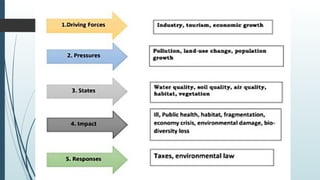
Drivers-Pressures-State-Impact-
Response (DPSIR) Model
A. Identifies the various casual chains of
link between human activities.
B. Distinguishes several categories of
indication in order to explain how the state
of environment is changed.
C. Developed by European environmental
agency (EEA to assess the environmental
problem
Filipino Psychology(Sikolohiyang Pilipino)
Filipino psychology, or Sikolohiyang Pilipino, in
Filipino, is defined as the psychology rooted
on the experience, ideas, and cultural
orientation of the Filipinos. It was formalized in
1975 by the Pambansang Samahan sa
Sikolohiyang Pilipino (National Association for
Filipino Psychology) under the leadership of
Virgilio Enriquez, who is regarded by many as
the father of Filipino Psychology
Historical Threads of Philippines
Psychological Thought
Academic Scientific Psychology or
Akademiko-siyentipikal na Sikolohiya: This
follows the American-oriented psychological
tradition that can be traced back to Wilhelm
Wundt in 1876. It was introduced in the
Philippines through formal American
education system in universities.
Academic Philosophic Psychology or
Akademiko-pilosopiya na Sikolohiya: This
was started by priest-professors at the
University of Santo Tomas 68 during the 17th
century Spanish era. This tradition originally
came from the writings of the preachers
and monks in philosophy and "pre-
scientific" Spanish elites and would later join
with the American-oriented scientific
psychology.
Ethnic Psychology or Taal na Sikolohiya:
this is the Philippine indigenous psychology in the
sense that this includes the frame of
psychological reasoning, enculturation practices,
beliefs, and proto-clinical practices that can be
culled from language, literature, myths, legends,
etc. This also includes psychological systems
worked out by Filipinos with Filipino indigenous
elements as basis (eg. Hermano Pule, Rizal,
Isabelo de los Reyes, Kalaw, etc.) and Sikolohiya
ng mga Pilipino (Psychology of the Filipino) as
formulated by Virgilio Enriquez.
Psycho-medical Systems or Siko-medikal na
mga Sistema:
A psychological tradition that is closely
related to ethnic psychology. The psycho-
medical tradition that has religion as the basis
and explanation. This includes the faith
healing practices of the babaylan and the
katalonan. According to Salazar, he believes
that “no real healing could take place if there
were no common ideology or frame of
reference… understood and accepted by
both healer and patient.”
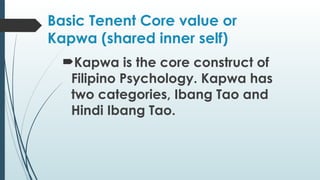
Basic Tenent Core value or
Kapwa (shared inner self)
Kapwa is the core construct of
Filipino Psychology. Kapwa has
two categories, Ibang Tao and
Hindi Ibang Tao.
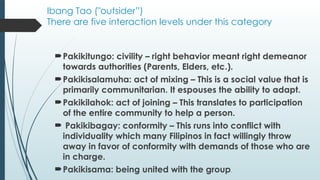
Ibang Tao ("outsider”)
There are five interaction levels under this category
Pakikitungo: civility – right behavior meant right demeanor
towards authorities (Parents, Elders, etc.).
Pakikisalamuha: act of mixing – This is a social value that is
primarily communitarian. It espouses the ability to adapt.
Pakikilahok: act of joining – This translates to participation
of the entire community to help a person.
 Pakikibagay: conformity – This runs into conflict with
individuality which many Filipinos in fact willingly throw
away in favor of conformity with demands of those who are
in charge.
Pakikisama: being united with the group.
Hindi Ibang Tao ("one-of-us")
There are three interaction levels under
this category:
Pakikipagpalagayang-loob: act of
mutual trust
Pakikisangkot: act of joining others
Pakikipagkaisa: being one with
others
Pivotal interpersonal value
Pakiramdam: Shared inner
perceptions. Filipinos use
damdam, or the inner perception
of others' emotions, as a basic
tool to guide their dealings with
other people.
Linking socio-personal value
Kagandahang-Loob: Shared
humanity. This refers to being able to
help other people in dire need due
to a perception of being together as
a part of one Filipino humanity.
Accommodative surface values
Hiya: Loosely translated as 'shyness' by most
Western psychologists, Hiya is actually 'sense of
propriety'.
Utang na loob: Norm of reciprocity. Filipinos are
expected by their neighbors to return favors—
whether these were asked for or not—when it is
needed or wanted.
Pakikisama and Pakikipagkapwa: Smooth
Interpersonal Relationship, or SIR, as coined by
Lynch (1961 and 1973). This attitude is primarily
guided by conformity with the majority
Confrontative Surface Values
Bahala_na: Bahala Na translates literally as "leave it up
to God (Bathala)" and it is used as an expression,
almost universally, in Filipino culture. Filipinos engage in
the bahala na attitude as a culture-influenced
adaptive coping strategy when faced with challenging
situations.
 Lakas ng loob: This attitude is characterized by being
courageous in the midst of problems and uncertainties.
 Pakikibaka: Literally in English, it means concurrent
clashes. It refers to the ability of the Filipino to
undertake revolutions and uprisings against a
Societal Values
Karangalan: Loosely translated to dignity, this actually refers
to what other people see in a person and how they use that
information to make a stand or judge about his/her worth.
Puri: the external aspect of dignity. May refer to how other
people judge a person of his/her worth. This compels a
common Filipino to conform to social norms, regardless how
obsolete they are.
Dangal: the internal aspect of dignity. May refer to how a
person judges his own worth.
Katarungan: Loosely translated to justice, this actually refers
toequity in giving rewards to a person.
Kalayaan: Freedom and mobility. Ironically, this may clash
with the less important value of pakikisama or pakikibagay
(conformity).
Some of the approaches and methods
used in Filipino Psychology are:
Pakikipagkuwentuhan: to tell a story'.
Panunuluyan:
stays in the home of his kalahok or participant while he
conducts the research
Pagdadalaw-dalaw: The term dalaw literally means 'visit'.
Pagtatanung-tanong
undergoes a kind of questioning session with his kalahok o
participants
Pakikiramdam
The term damdam literally means 'inner perception of
emotions'
Grade11Human-Environment System DISS.pptx

Grade11Human-Environment System DISS.pptx

  • 1.
  • 2.
    Human Humans have thecapacity to interact with its environment. Human and environment have the mutual interaction with each other. Human have the capacity to change or influence the balance of the society. Human always have the capacity to adapts to its
  • 3.
    Environment Environment is acomplex of many variables which surrounds man as well as the living organisms. Environments includes water, air, and land and the interrelationships which exist among system.
  • 4.
    Systems  It maybe described as a complex of interacting components together with the relationships among them that permit the identification of a boundary? minting entity and process.  Is a collection of components that interact with each other to form aggregated whole.
  • 5.
    Human-Environment System It isalso known as the Coupled Human and Natural System or CHANS  Show how humans and the environment both impact each other. Integrated scientific framework for studying the interface and reciprocal interaction that links humans to natural sub-systems of the planet. Interaction between the human social system and the ecosystem.
  • 6.
    Human Eco-System isComplex Adaptive System Complex – because they have many parts and connections Adaptive – because they have many structures that promote survival.
  • 7.
    Ecosystem Services  Modifyingthe environment for human purposes and obtain benefits. Information Timber water Land  food
  • 8.
    Co-evolution The process ofreciprocal evolutionary change that occur between pairs of species or among groups of species, as they interact to one another
  • 9.
    Co- Adoptation It isthe process by which two or more species, traits, organ, or genes undergo adoptation as a pair or groups
  • 10.
    Drivers-Pressures-State-Impact- Response (DPSIR) Model A.Identifies the various casual chains of link between human activities. B. Distinguishes several categories of indication in order to explain how the state of environment is changed. C. Developed by European environmental agency (EEA to assess the environmental problem
  • 13.
    Filipino Psychology(Sikolohiyang Pilipino) Filipinopsychology, or Sikolohiyang Pilipino, in Filipino, is defined as the psychology rooted on the experience, ideas, and cultural orientation of the Filipinos. It was formalized in 1975 by the Pambansang Samahan sa Sikolohiyang Pilipino (National Association for Filipino Psychology) under the leadership of Virgilio Enriquez, who is regarded by many as the father of Filipino Psychology
  • 14.
    Historical Threads ofPhilippines Psychological Thought Academic Scientific Psychology or Akademiko-siyentipikal na Sikolohiya: This follows the American-oriented psychological tradition that can be traced back to Wilhelm Wundt in 1876. It was introduced in the Philippines through formal American education system in universities.
  • 15.
    Academic Philosophic Psychologyor Akademiko-pilosopiya na Sikolohiya: This was started by priest-professors at the University of Santo Tomas 68 during the 17th century Spanish era. This tradition originally came from the writings of the preachers and monks in philosophy and "pre- scientific" Spanish elites and would later join with the American-oriented scientific psychology.
  • 16.
    Ethnic Psychology orTaal na Sikolohiya: this is the Philippine indigenous psychology in the sense that this includes the frame of psychological reasoning, enculturation practices, beliefs, and proto-clinical practices that can be culled from language, literature, myths, legends, etc. This also includes psychological systems worked out by Filipinos with Filipino indigenous elements as basis (eg. Hermano Pule, Rizal, Isabelo de los Reyes, Kalaw, etc.) and Sikolohiya ng mga Pilipino (Psychology of the Filipino) as formulated by Virgilio Enriquez.
  • 17.
    Psycho-medical Systems orSiko-medikal na mga Sistema: A psychological tradition that is closely related to ethnic psychology. The psycho- medical tradition that has religion as the basis and explanation. This includes the faith healing practices of the babaylan and the katalonan. According to Salazar, he believes that “no real healing could take place if there were no common ideology or frame of reference… understood and accepted by both healer and patient.”
  • 19.
    Basic Tenent Corevalue or Kapwa (shared inner self) Kapwa is the core construct of Filipino Psychology. Kapwa has two categories, Ibang Tao and Hindi Ibang Tao.
  • 20.
    Ibang Tao ("outsider”) Thereare five interaction levels under this category Pakikitungo: civility – right behavior meant right demeanor towards authorities (Parents, Elders, etc.). Pakikisalamuha: act of mixing – This is a social value that is primarily communitarian. It espouses the ability to adapt. Pakikilahok: act of joining – This translates to participation of the entire community to help a person.  Pakikibagay: conformity – This runs into conflict with individuality which many Filipinos in fact willingly throw away in favor of conformity with demands of those who are in charge. Pakikisama: being united with the group.
  • 21.
    Hindi Ibang Tao("one-of-us") There are three interaction levels under this category: Pakikipagpalagayang-loob: act of mutual trust Pakikisangkot: act of joining others Pakikipagkaisa: being one with others
  • 22.
    Pivotal interpersonal value Pakiramdam:Shared inner perceptions. Filipinos use damdam, or the inner perception of others' emotions, as a basic tool to guide their dealings with other people.
  • 23.
    Linking socio-personal value Kagandahang-Loob:Shared humanity. This refers to being able to help other people in dire need due to a perception of being together as a part of one Filipino humanity.
  • 24.
    Accommodative surface values Hiya:Loosely translated as 'shyness' by most Western psychologists, Hiya is actually 'sense of propriety'. Utang na loob: Norm of reciprocity. Filipinos are expected by their neighbors to return favors— whether these were asked for or not—when it is needed or wanted. Pakikisama and Pakikipagkapwa: Smooth Interpersonal Relationship, or SIR, as coined by Lynch (1961 and 1973). This attitude is primarily guided by conformity with the majority
  • 25.
    Confrontative Surface Values Bahala_na:Bahala Na translates literally as "leave it up to God (Bathala)" and it is used as an expression, almost universally, in Filipino culture. Filipinos engage in the bahala na attitude as a culture-influenced adaptive coping strategy when faced with challenging situations.  Lakas ng loob: This attitude is characterized by being courageous in the midst of problems and uncertainties.  Pakikibaka: Literally in English, it means concurrent clashes. It refers to the ability of the Filipino to undertake revolutions and uprisings against a
  • 26.
    Societal Values Karangalan: Looselytranslated to dignity, this actually refers to what other people see in a person and how they use that information to make a stand or judge about his/her worth. Puri: the external aspect of dignity. May refer to how other people judge a person of his/her worth. This compels a common Filipino to conform to social norms, regardless how obsolete they are. Dangal: the internal aspect of dignity. May refer to how a person judges his own worth. Katarungan: Loosely translated to justice, this actually refers toequity in giving rewards to a person. Kalayaan: Freedom and mobility. Ironically, this may clash with the less important value of pakikisama or pakikibagay (conformity).
  • 27.
    Some of theapproaches and methods used in Filipino Psychology are: Pakikipagkuwentuhan: to tell a story'. Panunuluyan: stays in the home of his kalahok or participant while he conducts the research Pagdadalaw-dalaw: The term dalaw literally means 'visit'. Pagtatanung-tanong undergoes a kind of questioning session with his kalahok o participants Pakikiramdam The term damdam literally means 'inner perception of emotions'