L4C: 23/09/2015
Project plan
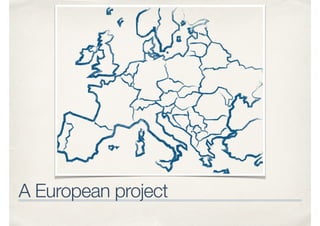
A European project
«Europe 2020 is the European Union’s ten-year jobs and growth strategy. It was launched in 2010
to create the conditions for smart, sustainable and
inclusive growth. »
Extract from European Commission website:
http://ec.europa.eu/europe2020/europe-2020-in-a-nutshell/index_en.htm
« Smart growth means improving the EU's performance in three areas:
education (encouraging people to learn, study and update their skills);
research/innovation (creating new products/services that generate growth and jobs and help address
social challenges);
digital society (using information and communication technologies to the best advantage).
Extract from European Commission website:
http://ec.europa.eu/europe2020/europe-2020-in-a-nutshell/priorities/smart-growth/index_en.htm
Education
Research and innovation
Digital society
are the 3 fundamentals of Learn for
Change;
are the 3 direct aims of Learn for
Change.
Indirect aims (through developed projects)
of Learn for Change
« Learn for Change's ambition is to become a tool for the
implementation of European Union strategy by promoting projects in the service of a smart,
sustainable and inclusive growth. »
Learn for Change fits the European strategy and it
is for this reason that it could qualify for European finance.
Direct aims:
Education
Research and innovation
Digital society
Indirect aims :
Fostering projects in the interests of
growth
smart,
sustainable,
inclusive
« Learn for Change's mission is to become
an instrument of European strategy
The European Commission will adopt this instrument
by financing and creating a dedicated programme »
« In order to convince the European
Commission to create a dedicated programme,
we'll need time and arguments: the feasibility and relevance
of the project have to be demonstrated »
Extract from « Conjectures and Refutations »
Karl Popper (1963)
Demonstrate feasibility of the project
« If I were asked : How do you know ? How do you know what you
know ? How do you know what you say ? / ... / I would reply : I do
not know / ... / But, if the problem I was trying to solve with this
hypothesis, is of interest to you, you can help me by criticizing it as
severely as you can, and if you can designate an experimental test
that you think could refute it, it is with joy that I 'll help you with it. »
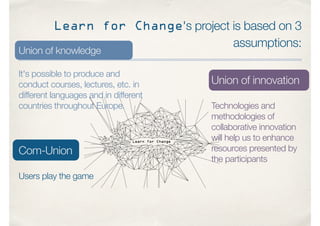
Learn for Change's project is based on 3
assumptions:
Union of knowledge
It's possible to produce and
conduct courses, lectures, etc. in
different languages and in different
countries throughout Europe.
Union of innovation
Technologies and
methodologies of
collaborative innovation
will help us to enhance
resources presented by
the participants
Com-Union
Users play the game
« We need to set up a test-
we need to produce a MOOC
in several countries;
and including with it an innovative project;
that users will co-develop. »
In order to demonstrate feasibility of the project, we
need to prove these 3 assumptions:
« A scale model of the project in the form of a MOOC -
A development tool of Learn for Change»
MOOC
« -Start to learn-
Start to Change -»
MOOC
« -Start to learn-
Start to Change -»
« The MOOC "Start to learn - Start to change"
will be about "use of collaborative innovation tools in project
management"
it will be publicized and promoted locally in
France, Germany, Poland and in Ukraine »
Co-Production of a MOOC
MOOC
« -Start to learn-
Start to Change -»
« The community formed around the MOOC may participate
in a collaborative project during and after the MOOC:
the collaborative project in question is none other
than the Learn for Change project itself. »
Co-Construction
MOOC
« -Start to learn-
Start to Change -»
« The intelligent use of community, of the resources that it
represents, by tools and methologies of collaborative innovation,
will provide the resources for the project Learn for
Change.  »
Collaborative Innovation
MOOC
« -Start to learn-
Start to Change -»
« Thousands of those people registered as part of the MOOC will turn out to be only minimally
involved, but even so their number is their strength. The are a community that is not
highly qualified, varied in nature but initially interested in the subjects.
It's an ideal resource for researching views, for support and for relaying
communication campaigns or co-funding campaigns. »
Collaborative Innovation
Crowd…
MOOC
« -Start to learn-
Start to Change -»
« Hundreds of involved users will participate in workshops solving problems
and developing solutions, related to the Learn for Change project.
Establishment of a project plan: specifications, general design, rules of governance…
Preparation of a viral marketing campaign
Preparation of financing campaign
…
Collaborative Innovation
Intelligence
collective
MOOC
« -Start to learn-
Start to Change -»
« Dozens of users with unique skills will be identified and would
be recruited or co-opted.
They will constitute the project team in charge of its
global development as well as its local development by
forming a specific country team.
Collaborative Innovation
Smartsourcing
« The success of this MOOC will demonstrate the
feasibility of the overall Learn for Change project
and will directly contribute to its development
and its deployment »
MOOC
« -Start to learn-
Start to Change -»
Definition of needs Co-building
of a solution
Recruitment
of a project team
FinancingDevelopment of the
Learn for Change
Platform
Beta-test
Launch of the
Learn for Change platform
MOOC
« -Start to learn-
Start to Change -»
« Once the feasibility of the project is proven,
its relevance has still to be demonstrated…
in order to justify European finance »
« Prospective study
to evaluate the impact of the Learn for Change project»
PROSPECTIVE STUDY
-Learn for Change-
-what does that change?-
« The relevance of a project can be evaluated by using the
ratio between the level of commitment and its effects
this is why we should evaluate the resources needed, and estimate the benefits
by means of a prospective study:
-Learn for Change-
-what does that change?- »
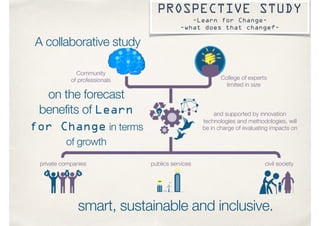
Community
of professionals
and supported by innovation
technologies and methodologies, will
be in charge of evaluating impacts on
College of experts
limited in size
civil societypublics servicesprivate companies
A collaborative study
Entrep
on the forecast
benefits of Learn
for Change in terms
of growth
smart, sustainable and inclusive.
PROSPECTIVE STUDY
-Learn for Change-
-what does that change?-
MOOC
« -Start to learn-
Start to Change -»
+
will be the main elements of the dossier to be presented in order to obtain a
European programme dedicated to the platform Learn for
Change »
« 
PROSPECTIVE STUDY
-Learn for Change-
-what does that change?-
« Proof and relevance are not enough to get a
European budget, it takes time also…
in order to convince Europe to assume ownership of the
project and create a dedicated programme »
« While waiting for agreement on a dedicated programme,
Learn for Change may use already existing European
programmes…
Erasmus + :
« EU programme for
education, training,
youth and sport »
http://ec.europa.eu/
programmes/erasmus-
plus/index_en.htm
H2020 :
« The EU framework
programme for
research and
innovation »
http://ec.europa.eu/
programmes/horizon2020/
Digital agenda for
Europe :
« proposes to better
exploit the potential
of Information and
Communication
Technologies (ICTs) in
order to foster innovation,
economic growth and
progress.http://ec.europa.eu/digital-agenda/en/
digital-agenda-europe-2020-strategy
« These programmes will ensure the financing of the
project from the launch of Lean for Change…
till the creation of a specific European programme»
Development plan
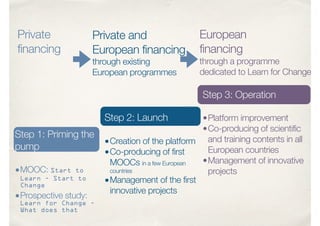
Step 1: Priming the
pump
•MOOC: Start to
Learn - Start to
Change
•Prospective study:
Learn for Change -
What does that
Step 2: Launch
•Creation of the platform
•Co-producing of first
MOOCs in a few European
countries
•Management of the first
innovative projects
Step 3: Operation
•Platform improvement
•Co-producing of scientific
and training contents in all
European countries
•Management of innovative
projects
Private
financing
Private and
European financing
through existing
European programmes
European
financing
through a programme
dedicated to Learn for Change
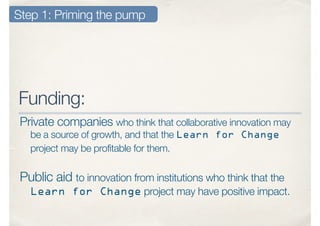
Funding:
Private companies who think that collaborative innovation may
be a source of growth, and that the Learn for Change
project may be profitable for them.
Step 1: Priming the pump
Public aid to innovation from institutions who think that the
Learn for Change project may have positive impact.
Self-financing.
Get access to
European finance
over the medium
to long term
Prepare European financing file
Prospective study :
Learn for Change - What does
that change?
MOOC
Start to Learn -
Start to Change
Definition of needs
Design of innovative solutions
Recruitment of a project team
Develop the
foundations of Learn
for Change project
Aims
Means
Results
Financing of step N°2
Development of Learn for Change
platform
Step 1: Priming the pump
Step 2: Launch
Funding:
European programmes which estimate that Learn for
Change will help them to reach specific goals:
Education for Erasmus +
Innovation for H2020
Digital society for Agenda digital for Europe
Private financing through raising capital from
companies and individuals (crowdfunding)
Heritage from step N°1
Launch
of Learn for
Change platform
Deployment
of the platform in the
different European
countries
X
Country
Beta-Test
Launch
of
Learn for Change
platform
Technical
development
of the platform
Co-creation
of MOOCs
and other
materials
Co-Design of
innovating
projects
$
Project plan Project team Funding
Step 2: Launch
Step 3: Operation
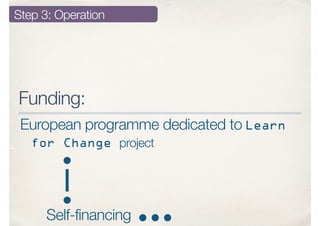
Funding: 
European programme dedicated to Learn
for Change project
Self-financing
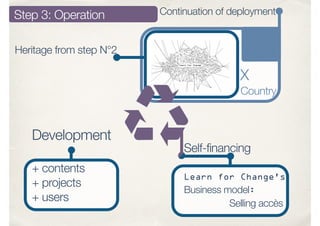
Step 3: Operation
Development
+ contents
+ projects
+ users
Self-financing
Learn for Change’s
Business model:
Selling accès
Heritage from step N°2
Continuation of deployment
X
Country
« The main mission of Lean for Change platform…
is to connect ideas, knowledge, people and project.
it's the added value of the platform. Its business model: the sale
of services giving access to resources that communities
and ideas represent. »
Self-financing
Direct incomes:
« Sale of services to access communities and ideas will cover all
or part of the running and developing costs
of Learn for Change
Indirect incomes:
« Taxes on the increase in growth and on other positive impacts of the
Learn for Change project, will be allocated (if necessary) to the operating
budget, and will cover and exceed the initial investment»
Self-financing
Prepared by Emmanuel de Bettignies -
CEO of ODAESS-Consulting

Project plan l4 c en

  • 1.
  • 2.
  • 3.
    «Europe 2020 isthe European Union’s ten-year jobs and growth strategy. It was launched in 2010 to create the conditions for smart, sustainable and inclusive growth. » Extract from European Commission website: http://ec.europa.eu/europe2020/europe-2020-in-a-nutshell/index_en.htm
  • 4.
    « Smart growth meansimproving the EU's performance in three areas: education (encouraging people to learn, study and update their skills); research/innovation (creating new products/services that generate growth and jobs and help address social challenges); digital society (using information and communication technologies to the best advantage). Extract from European Commission website: http://ec.europa.eu/europe2020/europe-2020-in-a-nutshell/priorities/smart-growth/index_en.htm
  • 5.
    Education Research and innovation Digitalsociety are the 3 fundamentals of Learn for Change; are the 3 direct aims of Learn for Change.
  • 6.
    Indirect aims (throughdeveloped projects) of Learn for Change « Learn for Change's ambition is to become a tool for the implementation of European Union strategy by promoting projects in the service of a smart, sustainable and inclusive growth. »
  • 7.
    Learn for Changefits the European strategy and it is for this reason that it could qualify for European finance. Direct aims: Education Research and innovation Digital society Indirect aims : Fostering projects in the interests of growth smart, sustainable, inclusive
  • 8.
    « Learn for Change'smission is to become an instrument of European strategy The European Commission will adopt this instrument by financing and creating a dedicated programme »
  • 9.
    « In order toconvince the European Commission to create a dedicated programme, we'll need time and arguments: the feasibility and relevance of the project have to be demonstrated »
  • 10.
    Extract from « Conjecturesand Refutations » Karl Popper (1963) Demonstrate feasibility of the project « If I were asked : How do you know ? How do you know what you know ? How do you know what you say ? / ... / I would reply : I do not know / ... / But, if the problem I was trying to solve with this hypothesis, is of interest to you, you can help me by criticizing it as severely as you can, and if you can designate an experimental test that you think could refute it, it is with joy that I 'll help you with it. »
  • 11.
    Learn for Change'sproject is based on 3 assumptions: Union of knowledge It's possible to produce and conduct courses, lectures, etc. in different languages and in different countries throughout Europe. Union of innovation Technologies and methodologies of collaborative innovation will help us to enhance resources presented by the participants Com-Union Users play the game
  • 12.
    « We need toset up a test- we need to produce a MOOC in several countries; and including with it an innovative project; that users will co-develop. » In order to demonstrate feasibility of the project, we need to prove these 3 assumptions:
  • 13.
    « A scale modelof the project in the form of a MOOC - A development tool of Learn for Change» MOOC « -Start to learn- Start to Change -»
  • 14.
    MOOC « -Start to learn- Startto Change -» « The MOOC "Start to learn - Start to change" will be about "use of collaborative innovation tools in project management" it will be publicized and promoted locally in France, Germany, Poland and in Ukraine » Co-Production of a MOOC
  • 15.
    MOOC « -Start to learn- Startto Change -» « The community formed around the MOOC may participate in a collaborative project during and after the MOOC: the collaborative project in question is none other than the Learn for Change project itself. » Co-Construction
  • 16.
    MOOC « -Start to learn- Startto Change -» « The intelligent use of community, of the resources that it represents, by tools and methologies of collaborative innovation, will provide the resources for the project Learn for Change.  » Collaborative Innovation
  • 17.
    MOOC « -Start to learn- Startto Change -» « Thousands of those people registered as part of the MOOC will turn out to be only minimally involved, but even so their number is their strength. The are a community that is not highly qualified, varied in nature but initially interested in the subjects. It's an ideal resource for researching views, for support and for relaying communication campaigns or co-funding campaigns. » Collaborative Innovation Crowd…
  • 18.
    MOOC « -Start to learn- Startto Change -» « Hundreds of involved users will participate in workshops solving problems and developing solutions, related to the Learn for Change project. Establishment of a project plan: specifications, general design, rules of governance… Preparation of a viral marketing campaign Preparation of financing campaign … Collaborative Innovation Intelligence collective
  • 19.
    MOOC « -Start to learn- Startto Change -» « Dozens of users with unique skills will be identified and would be recruited or co-opted. They will constitute the project team in charge of its global development as well as its local development by forming a specific country team. Collaborative Innovation Smartsourcing
  • 20.
    « The success ofthis MOOC will demonstrate the feasibility of the overall Learn for Change project and will directly contribute to its development and its deployment » MOOC « -Start to learn- Start to Change -»
  • 21.
    Definition of needsCo-building of a solution Recruitment of a project team FinancingDevelopment of the Learn for Change Platform Beta-test Launch of the Learn for Change platform MOOC « -Start to learn- Start to Change -»
  • 22.
    « Once the feasibilityof the project is proven, its relevance has still to be demonstrated… in order to justify European finance »
  • 23.
    « Prospective study to evaluatethe impact of the Learn for Change project» PROSPECTIVE STUDY -Learn for Change- -what does that change?-
  • 24.
    « The relevance ofa project can be evaluated by using the ratio between the level of commitment and its effects this is why we should evaluate the resources needed, and estimate the benefits by means of a prospective study: -Learn for Change- -what does that change?- »
  • 25.
    Community of professionals and supportedby innovation technologies and methodologies, will be in charge of evaluating impacts on College of experts limited in size civil societypublics servicesprivate companies A collaborative study Entrep on the forecast benefits of Learn for Change in terms of growth smart, sustainable and inclusive. PROSPECTIVE STUDY -Learn for Change- -what does that change?-
  • 26.
    MOOC « -Start to learn- Startto Change -» + will be the main elements of the dossier to be presented in order to obtain a European programme dedicated to the platform Learn for Change » «  PROSPECTIVE STUDY -Learn for Change- -what does that change?-
  • 27.
    « Proof and relevanceare not enough to get a European budget, it takes time also… in order to convince Europe to assume ownership of the project and create a dedicated programme »
  • 28.
    « While waiting foragreement on a dedicated programme, Learn for Change may use already existing European programmes… Erasmus + : « EU programme for education, training, youth and sport » http://ec.europa.eu/ programmes/erasmus- plus/index_en.htm H2020 : « The EU framework programme for research and innovation » http://ec.europa.eu/ programmes/horizon2020/ Digital agenda for Europe : « proposes to better exploit the potential of Information and Communication Technologies (ICTs) in order to foster innovation, economic growth and progress.http://ec.europa.eu/digital-agenda/en/ digital-agenda-europe-2020-strategy
  • 29.
    « These programmes willensure the financing of the project from the launch of Lean for Change… till the creation of a specific European programme»
  • 30.
  • 31.
    Step 1: Primingthe pump •MOOC: Start to Learn - Start to Change •Prospective study: Learn for Change - What does that Step 2: Launch •Creation of the platform •Co-producing of first MOOCs in a few European countries •Management of the first innovative projects Step 3: Operation •Platform improvement •Co-producing of scientific and training contents in all European countries •Management of innovative projects Private financing Private and European financing through existing European programmes European financing through a programme dedicated to Learn for Change
  • 32.
    Funding: Private companies whothink that collaborative innovation may be a source of growth, and that the Learn for Change project may be profitable for them. Step 1: Priming the pump Public aid to innovation from institutions who think that the Learn for Change project may have positive impact.
  • 33.
    Self-financing. Get access to Europeanfinance over the medium to long term Prepare European financing file Prospective study : Learn for Change - What does that change? MOOC Start to Learn - Start to Change Definition of needs Design of innovative solutions Recruitment of a project team Develop the foundations of Learn for Change project Aims Means Results Financing of step N°2 Development of Learn for Change platform Step 1: Priming the pump
  • 34.
    Step 2: Launch Funding: Europeanprogrammes which estimate that Learn for Change will help them to reach specific goals: Education for Erasmus + Innovation for H2020 Digital society for Agenda digital for Europe Private financing through raising capital from companies and individuals (crowdfunding)
  • 35.
    Heritage from stepN°1 Launch of Learn for Change platform Deployment of the platform in the different European countries X Country Beta-Test Launch of Learn for Change platform Technical development of the platform Co-creation of MOOCs and other materials Co-Design of innovating projects $ Project plan Project team Funding Step 2: Launch
  • 36.
    Step 3: Operation Funding:  Europeanprogramme dedicated to Learn for Change project Self-financing
  • 37.
    Step 3: Operation Development +contents + projects + users Self-financing Learn for Change’s Business model: Selling accès Heritage from step N°2 Continuation of deployment X Country
  • 38.
    « The main missionof Lean for Change platform… is to connect ideas, knowledge, people and project. it's the added value of the platform. Its business model: the sale of services giving access to resources that communities and ideas represent. » Self-financing
  • 39.
    Direct incomes: « Sale ofservices to access communities and ideas will cover all or part of the running and developing costs of Learn for Change Indirect incomes: « Taxes on the increase in growth and on other positive impacts of the Learn for Change project, will be allocated (if necessary) to the operating budget, and will cover and exceed the initial investment» Self-financing
  • 40.
    Prepared by Emmanuelde Bettignies - CEO of ODAESS-Consulting