Sourcing Reloaded:
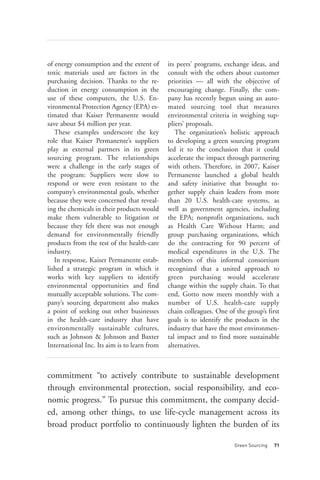
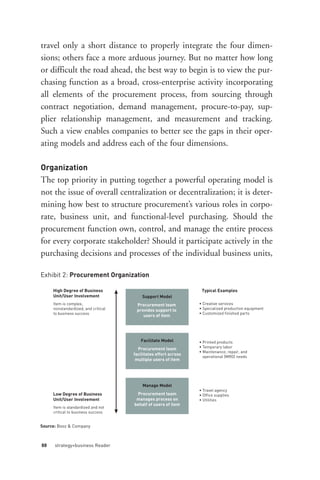
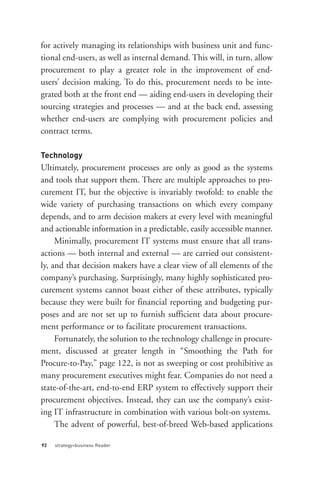
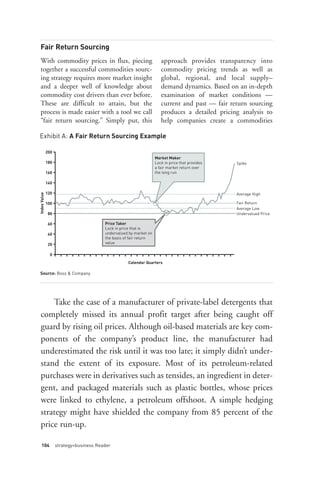
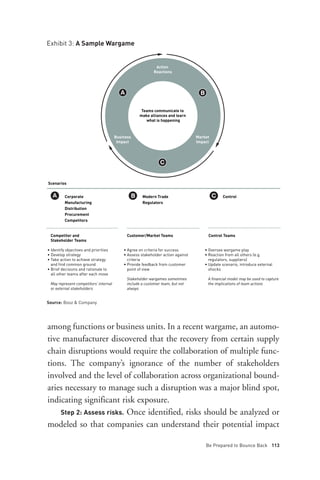
Targeting Procurement’s New
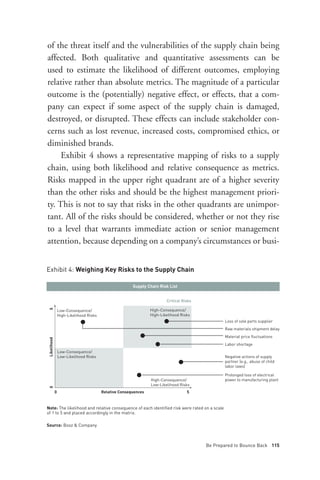
Strategic Agenda


A strategy+business Reader
Sourcing Reloaded:
Targeting Procurement’s New Strategic Agenda
A strategy+business Reader


Edited by Jeffrey Rothfeder and Georgina Grenon
With an introduction by Patrick W. Houston, Detlef Schwarting,
Robert Spieker, and Martha D. Turner


In today’s risky global business environment, supplier networks are the ulti-
mate lifeline for many companies — delivering the far-flung materials,
goods, and services that drive worldwide commerce. The sourcing function
has thus become an indispensable contributor to strategic goals and competi-
tiveness in every industry. But charting a course that positions the corporate
purchasing department as a catalyst for growth is no easy matter.

This strategy+business Reader, Sourcing Reloaded: Targeting Procurement’s
New Strategic Agenda, is packed with insights and prescriptive advice that
senior leaders and purchasing executives can use to navigate today’s most
vexing sourcing problems. Its main theme: how to balance traditional
sourcing strategies with the new, collaborative approaches needed to drive
sourcing’s effectiveness and help it attain its full potential in the face of the
demands of globalization, resilience, sustainability, complexity, and
customization.

The Reader’s 14 chapters, written by Booz & Company’s foremost sourcing
experts, cover the latest ideas and trends, including the next wave of sourcing
excellence, the new role of the CPO, green sourcing, collaborative supplier
relationships, improved strategies for commodities procurement and supply
chain resilience, and global and low-cost-country sourcing.

Sourcing Reloaded is aimed directly at companies that are determined to build
fresh purchasing capabilities that leave behind old, unprofitable sourcing
routines forever. For them, this Reader will be a helpful guide to a
revolution in the making.
Sourcing Reloaded
Sourcing Reloaded:
Targeting Procurement’s New
Strategic Agenda
A strategy+business Reader

Edited by Jeffrey Rothfeder and Georgina Grenon


With an introduction by Patrick W. Houston,
Detlef Schwarting, Robert Spieker, and Martha D. Turner
A strategy+business Reader
Published by strategy+business Books

Copyright © 2008 by Booz & Company Inc.
All rights reserved.

No reproduction is permitted in whole or
part without written permission from Booz
& Company. For permission requests,
contact Virginia Brosnan by e-mail at
brosnan_virginia@strategy-business.com.

Visit Booz & Company online at
www.booz.com

Visit strategy+business online at
www.strategy-business.com

Increase your intellectual capital by subscribing
to strategy+business. To subscribe for one year
(four issues), visit www.strategy-business.com or
call toll-free 877 829 9108. (Outside the U.S.,
call 850 682 7644.)

Design: Opto Design
Cover art: Pelato, Duarte, Lopez Pereyra

strategy+business Books
Publisher: Jonathan Gage
Editor-in-Chief: Art Kleiner
Executive Editor: Rob Norton
Managing Editor: Elizabeth Johnson
Deputy Managing Editors: Laura W. Geller,
Debaney Shepard
Senior Editors: Theodore Kinni,
Melissa Master Cavanaugh
Contents


     Introduction: Sourcing Transformation


     Sourcing’s New Frontier
     Reinventing Procurement to Drive Growth and Profitability
7


     Win-Win Sourcing
18


     The New CPO


     Getting Creative: Efficient Sourcing in Marketing
27


     Green Sourcing: Seeking the Payoff in Environmentalism
40


     The Building Blocks of a New Sourcing Approach
48


     The Collaboration Game: Building Value in the Retail Supply Chain
59


     Procurement’s New Operating Model
     by Patrick W. Houston, Detlef Schwarting, Robert Spieker,
     and Martha D. Turner


78
     by Harald Dutzler, Peter-John Liberoth, Detlef Schwarting,


86
     and Robert Spieker


     by Bill Jackson and Michael Pfitzmann


     by Simon Harper and Fabrice Saporito


     by Harald Dutzler and Martha D. Turner


     by Patrick W. Houston and Martha D. Turner


     by Simon Harper, Pertti Heinonen, Amit Kapoor,
     and Marco Kesteloo


     by Patrick W. Houston, Robert Hutchens, and Alan S. Pincus
Contents, continued


      Coping with Record-setting Commodity Prices and Volatility


      Be Prepared to Bounce Back


      Sourcing Basics That Enable Success
96


      Smoothing the Path for Procure-to-Pay: A New IT Approach
109


      Make or Buy: Three Pillars of Sound Decision Making


      Buy Globally, Think Globally
122


      Lessons from China: The Importance of Knowledge-based
132


      Sourcing in Low-cost Countries
145


      Off the Table, Into the Pocket: Capturing Procurement Savings
150


      About the Authors
162
      by Patrick W. Houston, Matthias Mueller, and Martha D. Turner


172
      by Rich Kauffeld, Dermot Shorten, and Robert Spieker


      by Jeffrey Barta, Bernhard Rieder, and James Weinberg


      by Simon Harper, Michael Pfitzmann, and Dermot Shorten


      by Simon Harper and Laura Thompson


      by Ronald Haddock, Michael Pfitzmann, and Reid Wilk


      by Harry Hawkes, Patrick W. Houston, and Martha D. Turner
Introduction:
Sourcing Transformation
by Patrick W. Houston, Detlef Schwarting,
Robert Spieker, and Martha D. Turner


IN TODAY ’ S RISKY global business environment, supplier networks
are the ultimate lifeline for many companies — delivering the far-
flung materials, goods, and services that drive worldwide commerce.
The sourcing function has thus become an indispensable contribu-
tor to the strategic goals and overall competitiveness of companies
in every industry.
     This is quite a turnabout. Not long ago, procurement was
little more than a back-office function, responsible for the down-
stream process of negotiating price-based contracts and extracting
scale benefits from increasingly unyielding groups of suppliers. Year-
over-year price improvements and day-to-day supply assurance


                                                          Introduction   7
often represented the extent of purchasing executives’ involvement
in corporate activities.
     Today that antiquated notion of sourcing is scarcely recogniz-
able in leading purchasing departments. Inexorably, these depart-
ments and their leaders have extended their sphere of influence
within the organization by proving that, given the opportunity, they
can generate substantial value.
     This value comes in many forms. For instance, procurement
departments have taken a leading role in driving cross-functional
collaboration at several large companies. They are breaking down the
silos that have isolated R&D, marketing, sales, and other corporate
Sourcing’s Challenge
departments from suppliers, because such isolation significantly
inhibits cost savings and other performance improvements. They
are using their newfound muscle to great effect — facilitating inte-
grated sourcing processes, acting as liaisons between internal depart-
ments and suppliers, and coordinating projects that are aimed at
developing innovative products and minimizing sourcing and life-
cycle costs.
    Leading purchasing departments have also demonstrated their
importance by elevating their activities to new heights, to a strategic
level far above mere cost cutting. Procurement executives can be
found at the center of critical aspects of organizational performance,
such as maximizing supply chain efficiency, reducing product devel-
opment and manufacturing cycles from design to delivery, building
operational resilience, enhancing marketing effectiveness and effi-
ciency, and collaborating with suppliers to leverage capabilities
throughout the supply chain.
    Given this wide-ranging set of activities, it is scant surprise that
in many industries, purchasing departments now influence half of
the annual operational budget. And that figure rises to 80 percent in
such sectors as manufacturing and retail.


8   strategy+business Reader
Despite sourcing’s promise and power, many companies have not
yet successfully charted a course that positions their purchasing
departments to become a catalyst for creating and capturing value,
including profitability and growth. Even as chief procurement offi-
cers (CPOs) relish the notion that they may finally earn spots on the
senior leadership teams of their companies, they must also under-
stand that only superlative performers will retain this privileged
position. Indeed, in a recent Booz & Company survey, 46 percent
of senior purchasing executives recognized that a high level of lead-
ership ability, a strong business sense, and strategic savvy are the
Globalization. Rich opportunities for profitability and product
most important traits CPOs need for the future. Conversely — and
clearly representing a sign of the times — the more traditional skills
of purchasing executives, such as tactical supply management and


    Resilience. As supply chains extend ever further into regions that
category experience, did not rank as priorities in the eyes of 95 per-
cent of the respondents.
    The opportunity to raise purchasing to the level of other critical
corporate functions also means that its leaders must shoulder their
share of the responsibility for addressing the increasingly challeng-
ing business landscape. When purchasing is managed well, compa-
nies can gain a competitive edge because they are able to overcome
the obstacles on which their competitors founder, such as:

and service supply lie in the expanding economies and growing


    Complexity/Customization. The proliferation of products and ser-
markets of India, China, and many other emerging nations; the
vast new supply alternatives driven by low-cost labor pools and new
factories opening in these countries; and the rising demand for
essential commodities. But so do difficult challenges. The com-
panies that most adeptly develop, manage, and optimize their sup-
ply networks to serve end markets around the world will have a
clear advantage.


                                                          Introduction   9
were nearly untouched just a few decades ago, their exposure to nat-
ural disasters, computer network attacks and failures, and political
upheaval is increasing. There are many ways that companies can
protect their supply chains from disruption, but few companies have
actually done so. In fact, a recent Booz & Company survey of lead-
ing supply chain executives found that 68 percent believe the great-
est risks they face are interruptions in the flow of products and
services from key suppliers, but only 46 percent of their companies
have developed well-thought-out plans to avoid such calamities.

vices that has been enabled by digital and other innovations has
Sustainability. Concerns among all stakeholders — from custom-


Four Rules for Approaching Sourcing Excellence
been a boon to growth for most companies. This is an era of
mass customization in which marketing efforts as well as products
and services can be tailored to individual customers. However, as
any good operations leader knows, this level of variation comes at a
cost — increased complexity. Those companies that can balance the
value of variety with the incremental costs of supply will be best
positioned for significant profitability. The trick for sourcing is
to work collaboratively across the company and with suppliers
to provide what customers truly value in a way that minimizes sup-
ply costs.


     Honda Motor Company has developed a no-nonsense way to
ers to investors to governments and increasingly to end consumers
— about global warming, large carbon footprints, and increased
waste are compelling companies to link green initiatives closely to
overall strategy. Much like quality, sustainability is evolving into an
integral part of the supply equation, and its dictates must be recog-
nized in the way companies produce and design their products and
services. Sourcing’s role in facing this challenge is especially impor-
tant because, for most companies, nearly two-thirds of green oppor-
tunities reside externally, in the supply chain.


10   strategy+business Reader
Simply put, in no other period has sourcing had so much power to
make a significant impact in support of a company’s strategic direc-
tion and overall competitiveness. And those organizations that are
striving to achieve sourcing excellence will enjoy the competitive
advantages it yields. For example:

eliminate the enmity that typically paralyzes purchasing’s relation-
ships with suppliers, replacing strident negotiations with open
collaboration. Ideas for collaboration are often displayed openly on
whiteboards during joint meetings, and then agreed upon by the
Procter & Gamble Company has begun a comprehensive analysis to


    Vodafone Group PLC has shifted from purely transactional procure-
end of the session. In the process, the automaker has lowered its
costs and raised overall performance.

determine how its supply chain must be transformed in the next
decade. Through this study, the company plans to develop ways to
reduce product size, create green packaging, and predict consumer
demand so that it can place its factories and distribution points
nearer its key sales markets.

ment to a much more strategic approach that includes a comprehen-
sive range of demand-side and supply-side levers and that is focused
on creating value and optimizing the total cost of equipment own-
ership in its global mobile telephony business. This transformation
has enabled the company to better utilize supplier capabilities, to
develop systematic measurement and insight into supplier perfor-
mance, and to create extensive cross-functional collaboration inter-
nally and with suppliers.
    These three examples are leading companies in the sourcing
arena, but in our view, no single organization has yet achieved all the
benefits of sourcing transformation. And no matter the stage of
development at which its sourcing function stands, any company


                                                           Introduction   11
can gain in the short and long term by “reloading” its sourcing func-
tion if it closely aligns procurement with the overall business
agenda and continuously challenges the function to enhance its
capabilities. Further, more companies should do what the best do:
improve their sourcing skills in those areas that are organizational
priorities — a tactic that begins, of course, with precisely identify-
ing those areas. From there, the path to purchasing improvement is
an incremental activity that ultimately creates a full-fledged and fun-
damental transformation.
    As sourcing leaders undertake this transformational process,
they can benefit from these four rules of the road:
1. Pick your spots.


     2. Create total transparency in purchasing costs and trade-offs.


    3. Collaborate fully with internal and external stakeholders. A more
                       Companies should start their sourcing trans-
formation by redesigning procurement procedures in simple, con-


    4. Become an influential corporate leader. Successful CPOs build
crete ways that can produce measurable and significant value. These
initial successes will build momentum within the organization for
greater levels of change.


A Source of Best Practices
Whether it be the costs, savings, and benefits of environmentally
friendly product options; the weighing of whether to buy or make
a product; or the design of a more resilient manufacturing foot-
print, the issues, implications, and ramifications of sourcing changes
should be clearly articulated and openly shared throughout the
organization.

robust sourcing process depends on participation throughout the
product life cycle, from the concept stage in R&D to the disposal or
salvage of spent products by a recycler. This requires the combined
efforts of key company departments and suppliers in the quest to
deliver innovation, reduced costs, supply chain efficiency, improved
product launches, and the reduction of silos.

their confidence and power by leveraging their position in the exec-


12   strategy+business Reader
utive suite. They ensure that purchasing plays a greater role in devel-
oping and defining the company’s strategic direction. And they
create a road map for sourcing transformation, as well as building
the skills and capabilities required to support business partners.


To help your company chart a winning course through today’s
sourcing demands, priorities, and opportunities, this strategy+
business Reader, Sourcing Reloaded, offers a compendium of best
practices culled from our experiences with purchasing executives
in companies that have successfully undertaken this work. Sourcing
Sourcing’s New Frontier. The five chapters in this section are
Reloaded shows that businesses have many ways to achieve the
highest level of procurement excellence. Whether companies are
concerned with getting the basics right or elevating the sourcing
function to new heights, this Reader includes the perspectives
and insights they need to begin the difficult but ultimately lucrative
effort to transform sourcing into a wellspring of significant
added value.
     Toward that goal, this Reader is divided into three sections:

devoted to exploring the newest sourcing ideas and trends. In “Re-
inventing Procurement to Drive Growth and Profitability,” the fresh
challenges and responsibilities of purchasing departments are
plumbed through descriptions of some of the best companies’ strate-
gies for staying ahead of the revolution in procurement’s potential to
add value.
     “Win-Win Sourcing” explains how the conventional rules of
procurement are being rewritten by a knowledge-based sourcing
approach that allows manufacturers and suppliers to establish a
long-term commitment aimed at improving each other’s capabilities
and performance.
     “The New CPO” examines the job of today’s chief procurement


                                                           Introduction   13
officer and finds that, far from being a career backwater, sourcing
leadership now involves delivering significant strategic and finan-
cial value.
     “Getting Creative: Efficient Sourcing in Marketing” explores
sourcing’s often neglected role in the purchase of marketing prod-
ucts and services, often a very sizable portion of a company’s spend-
ing that should be managed with the same rigor as other critical
functions. Indeed, all strategic services in a company, including legal
counsel, back-office operations, and retail partnerships, can apply
the lessons in this chapter.
     The final chapter in this section, “Green Sourcing: Seeking the
The Building Blocks of a New Sourcing Approach. The four chapters of
Payoff in Environmentalism,” describes how sourcing, supported by
its growing credibility in the C-suite and the ability to encourage
collaboration among corporate functions and business units, is in a
perfect position to enable a holistic, multifunctional strategy for
reducing environmental impact while cutting costs and building
better relationships with suppliers and communities.

the second section of this Reader examine the tools and techniques
that enable a strategic sourcing program.
     “The Collaboration Game: Building Value in the Retail Supply
Chain” details how building holistic, cross-functional, and collabo-
rative relationships with selected suppliers across the value chain
helps drive benefits in both revenue and cost far beyond the
outdated and ineffective tradition of haggling over the terms of sup-
ply contracts.
     “Procurement’s New Operating Model” points out the ways in
which flawed and otherwise incomplete operating models cost most
companies 5 to 10 percent of their total purchasing spend in unre-
alized savings. The primary causes: End-users do not have the tools
and processes to optimize procurement strategy, decision-making
roles are not clearly delineated, and information systems fail to pro-


14   strategy+business Reader
vide the data needed to ensure compliance with procurement poli-
cies and objectives.
     “Coping with Record-setting Commodity Prices and Volatility”
examines how to reduce the tremendous pressure that escalating
commodity and material costs are bringing to bear on companies
and on traditional procurement strategies. It offers fresh approaches
to older methods that create more transparency and a detailed
understanding of key cost drivers that can help reduce near-term
cost variability as well as achieve supply, price, quality, and sustain-
ability objectives.
     “Be Prepared to Bounce Back” explores how to combat the new
Sourcing Basics That Enable Success. The third section of this
fragility of supply chains caused by the rapid growth in outsourcing
to geographically remote partners, the increase in sole sourcing, and
the potential loss of data integrity due to the outsourcing of noncore
services such as IT.

Reader revisits perennial sourcing issues, offering insights and pre-
scriptions that CPOs can use to reload in their efforts to deal with a
globalized procurement landscape and ensure that a company’s
extended supply chain and its technology dovetail perfectly with the
needs and strategies of the organization.
     “Smoothing the Path for Procure-to-Pay: A New IT Approach”
introduces procure-to-pay, an IT strategy that eliminates the need
for one-size-fits-all purchasing systems and replaces them with
highly efficient individual modular applications, each of which
addresses a specific area of the procurement process.
     “Make or Buy: Three Pillars of Sound Decision Making” revis-
its a classic sourcing decision and offers CPOs a rigorous process
for making more objective and informed “in-house or outsource”
decisions.
     “Buy Globally, Think Globally” explores how a more robust
understanding of the economic and geopolitical dynamics of the


                                                          Introduction   15
markets in which their companies participate enables CPOs to help
their organizations take advantage of opportunities that have been
overlooked by their competitors as well as create a competitive edge
where it seemed none was available.
     “Lessons from China: The Importance of Knowledge-based
Sourcing in Low-cost Countries” examines the fast-changing con-
siderations in dealing with suppliers in low-cost nations. This chap-
ter describes how companies can use knowledge-based sourcing
to develop strong relationships with such suppliers that extend
beyond supplier costs into a careful assessment of manufacturing
and transportation economics, lead-time requirements, schedule sta-
this revolution in the making. +
bility, product design changes, and the technical skills of suppliers.
     Finally, “Off the Table, Into the Pocket: Capturing Procurement
Savings” offers companies a way to identify and capture a large por-
tion of procurement initiative savings and drive these savings to the
bottom line.
     Sourcing Reloaded is intended to provide foresight and insight
into how companies can tackle some of today’s most vexing sourc-
ing problems. It emphasizes that successful sourcing transformations
depend on carefully balancing traditional sourcing approaches with
new approaches, earmarking a portion of the gains from new pro-
curement strategies for building fresh capabilities that can drive
profit and growth in the future, and building superior purchasing
capabilities over time, in much the same way that Toyota, Honda,
and Procter & Gamble developed their sourcing functions. To
achieve similar levels of success, companies must encourage substan-
tially more proactive and radical behavior in their CPOs and ensure
that their organizations leave behind old, unprofitable sourcing rou-
tines. We hope that Sourcing Reloaded will serve as a helpful guide to


16   strategy+business Reader
Sourcing’s New Frontier
Reinventing Procurement to
Drive Growth and Profitability
by Harald Dutzler, Peter-John Liberoth, Detlef Schwarting,
and Robert Spieker

Also contributing to this article were Simon Harper
and Marco Kesteloo


OVER THE PAST    10 years, company procurement departments have
done well, on the whole, in meeting a series of new challenges.
Whether it meant working with an increasingly global vendor base
or managing partnerships with back-office service providers, pro-
curement generally accomplished the task at hand. With each suc-
cess, the visibility and importance of the function in the overall
organization grew — so much so that procurement now controls
half of the annual budget in many industries and up to 80 percent
in sectors such as manufacturing and retail.
    As confidence in procurement departments soared, companies
counted on them to take on even more challenging projects. Now,


18   strategy+business Reader
procurement chiefs are being asked to undertake a host of new
responsibilities: decrease supply chain complexity, speed products to
market, stimulate supplier innovation, enhance operational security,
and even consider the social and environmental impact of the sup-
plier in sourcing decisions.
    Addressing issues like these requires a higher level of talent and
commercial acumen than anything procurement departments have
tackled before. Indeed, these aims demand a reach beyond that
of the organizational supply nexus: They require a transformation
in the way we traditionally think of sourcing. In leading companies,
sourcing is evolving from a stand-alone function that ensures
that materials move through the supply chain at the lowest possible
cost to a nerve center that monitors, anticipates, and responds to a
variety of needs throughout the company — and even those of
its suppliers.


    More cross-functional integration.
     Many companies covet the potential rewards of this kind of
holistic, integrated approach to sourcing, but few are prepared to
implement the organizational changes such an approach demands.
Often, the sheer scope of the challenge can overwhelm manage-
ment’s ability to visualize the steps necessary to tackle it.
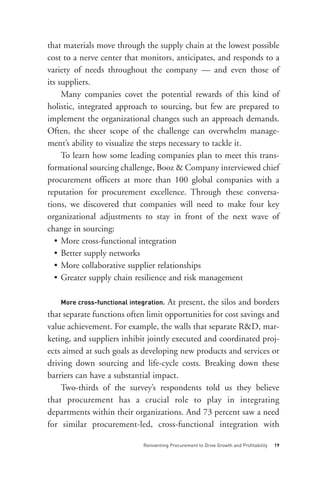
     To learn how some leading companies plan to meet this trans-
formational sourcing challenge, Booz & Company interviewed chief
procurement officers at more than 100 global companies with a
reputation for procurement excellence. Through these conversa-
tions, we discovered that companies will need to make four key
organizational adjustments to stay in front of the next wave of
change in sourcing:
   • More cross-functional integration
   • Better supply networks
   • More collaborative supplier relationships
   • Greater supply chain resilience and risk management


                               Reinventing Procurement to Drive Growth and Profitability   19
                                     At present, the silos and borders
that separate functions often limit opportunities for cost savings and
value achievement. For example, the walls that separate R&D, mar-
keting, and suppliers inhibit jointly executed and coordinated proj-
ects aimed at such goals as developing new products and services or
driving down sourcing and life-cycle costs. Breaking down these
barriers can have a substantial impact.
    Two-thirds of the survey’s respondents told us they believe
that procurement has a crucial role to play in integrating
departments within their organizations. And 73 percent saw a need
for similar procurement-led, cross-functional integration with
external suppliers and partners.
     The procurement function is well positioned to serve as the cat-
alyst for bringing internal departments and external suppliers closer
to each other: After all, the function often serves as the communica-
tion link between them. Many procurement leaders point to better
management of specifications as a key catalytic mechanism in this
effort. One CPO told us he wanted his department to learn to take
an “active role in challenging the core value” by questioning engi-
neers on their product specifications. This, the CPO believed,


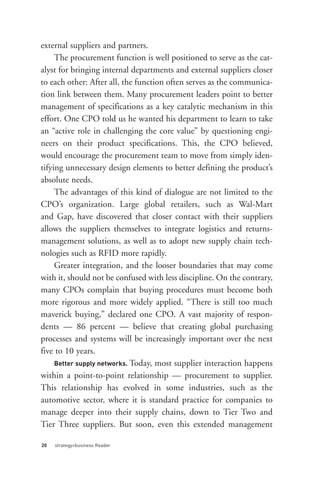
     Better supply networks. Today, most supplier interaction happens
would encourage the procurement team to move from simply iden-
tifying unnecessary design elements to better defining the product’s
absolute needs.
     The advantages of this kind of dialogue are not limited to the
CPO’s organization. Large global retailers, such as Wal-Mart
and Gap, have discovered that closer contact with their suppliers
allows the suppliers themselves to integrate logistics and returns-
management solutions, as well as to adopt new supply chain tech-
nologies such as RFID more rapidly.
     Greater integration, and the looser boundaries that may come
with it, should not be confused with less discipline. On the contrary,
many CPOs complain that buying procedures must become both


20   strategy+business Reader
more rigorous and more widely applied. “There is still too much
maverick buying,” declared one CPO. A vast majority of respon-
dents — 86 percent — believe that creating global purchasing
processes and systems will be increasingly important over the next
five to 10 years.

within a point-to-point relationship — procurement to supplier.
This relationship has evolved in some industries, such as the
automotive sector, where it is standard practice for companies to
manage deeper into their supply chains, down to Tier Two and
Tier Three suppliers. But soon, even this extended management
will not be enough.
     As we interview leading executives, increasing numbers are
telling us that the ability to orchestrate a vast network of supply
relationships will become more important. Such networks will look
at the supplier not just as a source of a material or a component,
but as a partner that will help improve delivery systems and design


     More collaborative supplier relationships. Many unrealized opportu-
products.
     These executives anticipate using a variety of strategies to
improve their ability to manage supply networks. Fully three-
quarters of respondents believe supplier cost modeling will become
more important over the next five to 10 years, as buyers seek a
greater understanding of their suppliers’ underlying expenses. And
81 percent of respondents see low-cost-country source modeling
as a crucial emerging skill. Another important opportunity, CPOs
believe, is joint action with suppliers in the continuous reduction
of waste: 47 percent see the challenge to reduce waste as a top pri-
ority, and an additional 30 percent say they will be focusing more
intently on waste reduction in the future.
     All these tools speak to the growing need of companies to gain
a deeper, more differentiated understanding of their supply net-
works. “How to manage strategic partnerships will become key,”


                             Reinventing Procurement to Drive Growth and Profitability   21
one CPO told us. Another agreed, but warned that, at present,
“there is a lack of clear approach and tools to manage this.”

nities for value arise within a company’s supplier network in areas
that neither the buyer nor individual suppliers can identify on their
own. Collaboration is needed to optimize cost, to drive top-line
growth, and, sometimes, to develop breakthrough concepts.
     CPOs still see a tremendous untapped potential in collabora-
tion. Although 86 percent of the procurement leaders we surveyed
said they have worked hard to develop collaborative partnerships
over the last three to five years, most believe their work is nowhere
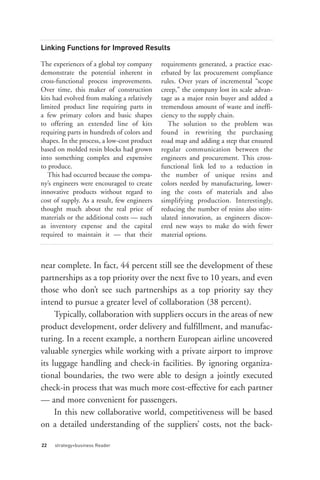
Linking Functions for Improved Results

The experiences of a global toy company      requirements generated, a practice exac-
demonstrate the potential inherent in        erbated by lax procurement compliance
cross-functional process improvements.       rules. Over years of incremental “scope
Over time, this maker of construction        creep,” the company lost its scale advan-
kits had evolved from making a relatively    tage as a major resin buyer and added a
limited product line requiring parts in      tremendous amount of waste and ineffi-
a few primary colors and basic shapes        ciency to the supply chain.
to offering an extended line of kits            The solution to the problem was
requiring parts in hundreds of colors and    found in rewriting the purchasing
shapes. In the process, a low-cost product   road map and adding a step that ensured
based on molded resin blocks had grown       regular communication between the
into something complex and expensive         engineers and procurement. This cross-
to produce.                                  functional link led to a reduction in
   This had occurred because the compa-      the number of unique resins and
ny’s engineers were encouraged to create     colors needed by manufacturing, lower-
innovative products without regard to        ing the costs of materials and also
cost of supply. As a result, few engineers   simplifying production. Interestingly,
thought much about the real price of         reducing the number of resins also stim-
materials or the additional costs — such     ulated innovation, as engineers discov-
as inventory expense and the capital         ered new ways to make do with fewer
required to maintain it — that their         material options.


near complete. In fact, 44 percent still see the development of these
partnerships as a top priority over the next five to 10 years, and even
those who don’t see such partnerships as a top priority say they


22   strategy+business Reader
intend to pursue a greater level of collaboration (38 percent).
     Typically, collaboration with suppliers occurs in the areas of new
product development, order delivery and fulfillment, and manufac-
turing. In a recent example, a northern European airline uncovered
valuable synergies while working with a private airport to improve
its luggage handling and check-in facilities. By ignoring organiza-
tional boundaries, the two were able to design a jointly executed
check-in process that was much more cost-effective for each partner
— and more convenient for passengers.
     In this new collaborative world, competitiveness will be based
on a detailed understanding of the suppliers’ costs, not the back-
Greater supply chain resilience and risk management. Many CPOs
and-forth of negotiations. Companies will gain an advantage over
their competitors not by squeezing an extra nickel out of their
suppliers’ margins, but by working with suppliers to boost the level
of efficiency in the supply network or to develop new cutting-
edge products.
     The benefits of supplier collaboration are becoming well recog-
nized. One study by the Toyota Motor Corporation found that
whereas negotiations can reduce costs by about 5 percent, collabo-
rative practices can yield as much as a 38 percent cost reduction.
Toyota analysts estimate that the benefits of collaboration stack up
this way: 5 to 10 percent in cost reduction from engineering
improvements, 5 to 8 percent in lower inventory levels through just-
in-time shipping, and, most productive of all, 15 to 20 percent in
sourcing raw materials and finding low-cost sourcing strategies for
the supplier.

believe they will need to focus more on risk and resilience than they
have in the past, because they fear that today’s extended supply
chains have made their companies vulnerable to new kinds of
dangers. A total of 68 percent of respondents believe their greatest
risk is the interruption of deliveries from key suppliers. (By compar-


                             Reinventing Procurement to Drive Growth and Profitability   23
ison, less than half as many, 31 percent, fear physical damage to
company-owned facilities or breakdowns in information security.)
     “Risk management becomes more important as a larger part of
production and development is done by partners,” said one CPO.
In fact, this heightened dependence on external partners has
exposed companies to new problems that are falling under the
purview of procurement. Issues such as a contractor’s level of social
responsibility in its labor practices are fast becoming an important
part of due diligence.
     One new kind of resilience many CPOs say they must develop
is the ability to work with their suppliers to create products that are
Meeting the Next Wave Challenge
manufactured and distributed with less carbon. And as environmen-
tal sustainability or “green” business practices become more and
more popular with customers and even become a regulatory neces-
sity in some markets, such an ability will become a greater priority.
     To build resilience and manage risk, one CPO told us, “we need
to be broader in our understanding and have people working in dif-
ferent functions across the disciplines.” Consequently, nearly half of
respondents — 45 percent — say they will be hiring professionals
with the strategic knowledge and business sense that would enable
them to tackle as-yet-unidentified social, regulatory, and environ-
mental roadblocks. Risk management is a much-needed capability
as well, according to 18 percent of the CPOs.
     (For a detailed examination of green practices, see “Green
Sourcing: Seeking the Payoff in Environmentalism,” by Patrick W.
Houston and Martha D. Turner, page 59. For more on supply chain
resilience and risk management, including how to protect the sup-
ply chain, see “Be Prepared to Bounce Back,” by Rich Kauffeld,
Dermot Shorten, and Robert Spieker, page 109.)


The last wave in sourcing’s evolution was based on disaggregation —


24   strategy+business Reader
that is, evaluating the potential value of each supplier and then mak-
ing sourcing choices based on that more granular understanding.
The next wave of sourcing will build on that foundation and extend
it in a holistic sense, propelling companies still further beyond the
old zero-sum approach to purchasing.
     First, the purchasing department will encourage cross-functional
integration to develop greater insight into the needs of the business.
Next, it will work more closely with suppliers to help them address
these insights in ways that go beyond simple price cutting. To do
this, procurement will build networks of suppliers who work togeth-
er to optimize the efficiency of the entire supply chain and engineer
innovative new ways to create value. Finally, purchasing will apply
                           these new capabilities to find ways to better manage the business
                           risks their companies face and to boost resilience. (See Exhibit 1.)


                          Exhibit 1: “Next Wave Sourcing” Key Themes
                               Better knowledge management will be essential in meeting the
                           next wave challenge. At minimum, purchasing needs to understand
                           the cost drivers of its suppliers. But that’s just the beginning. In the
                           future, a much deeper understanding will be necessary in all direc-
                           tions — among suppliers, between suppliers and procurement, and
                           between procurement and other departments within the company.
                           This requires a complex and systematic web of cross-reporting and
                           continual dialogue to ensure that the supply network learns and
                           keeps on learning as needs continue to evolve.


                                                                         Value Creation
                                                            (From price to cost and value focus, i.e.,
                               Finally, an elevated organizational commitment will be required.


                                                           growth, profit, return on capital employed)
                           For example, to release sourcing’s potential to drive growth and


                                             Cross-        Supply networks             Collaborative         Business risk
                                           functional                                    supplier            and resilience
                           profitability, the procurement department will need a strong board-


                                          integration                                  relationships
                           level presence: This will ensure that the company’s purchasing


                                          From silo to     From one-to-one           From transaction        From risk to
                                        cross-functional   supplier manage-        to collaboration and       resilience
                                       value perspective   ment to managing         capability leverage    management and
                           strategy incorporates and is aligned with its long-term goals.


                                                            supply networks                                 sustainability
                           More critically, it will help the company realize important changes,
                           such as arranging the sourcing footprint in a way that reflects


                                                People                      Supplier                      Organization

                                                            Institutionalize Knowledge and Learning


                          Source: Booz & Company


                                                                     Reinventing Procurement to Drive Growth and Profitability   25
                                                                  Successful leadership strategies
Changing business environment
next wave of procurement strategies and opportunities. +
the expected growth of the market or anticipates future require-
ments for limiting carbon output.
    But board support — or, for that matter, senior management
support — should not be a blank check. It must be given only if
procurement’s values, processes, and key performance indicators are
aligned with corporate projections and tactical plans. To accomplish
this, CPOs will need to develop a culture of continuous learning
within their departments, ensuring that the procurement team is
able to adapt to changing business conditions. At the same time,
they will need to build an infrastructure to continually raise the level
of performance management and controls. As one CPO told us,
“We need to professionalize the total procurement organization.”
    Sourcing is at an important juncture. Many companies are ready
for a procurement transformation; others are not. But simple aware-
ness is a first step. Companies that recognize the importance of
holistic sourcing practices are on their way toward implementing the


26   strategy+business Reader
Win-Win Sourcing
by Bill Jackson and Michael Pfitzmann


IT ’ S AN INTRIGUINGway to create a contract. At Honda Motor
Company, during meetings with suppliers, the executives write their
proposed actions and agreements on a whiteboard. When all the
items have been discussed, the meeting is over. The contents of the
whiteboard are then typed up, two copies are printed, the supplier
and the automaker sign them, and the contract is complete.
Thereafter, both sides focus on executing the plan. Honda and its
suppliers thus avoid the drawn-out, querulous negotiation process
that is common at other automakers, a process that can last months
and even then sometimes blows up without a resolution.
    This is one of many methods by which innovative manufac-


                                                      Win-Win Sourcing   27
turers like Honda and the Toyota Motor Corporation rewrite the
conventional rules of procurement. Their unorthodox techniques
add up to a form of procurement based on shared information and
insight: We call it knowledge-based sourcing. In this approach,
manufacturers and suppliers share a long-term commitment to
improving each other’s capabilities, starting by working together
to eliminate wasted effort and other inefficiencies. Instead of being
at odds, the two sides collaborate openly to lower costs and raise
overall performance, with the expectation that this mutual effort
will continue over many years and benefit both companies.
Businesses pursuing knowledge-based sourcing use sophisticated
costing tools and industry data, as well as discussions with other
suppliers, equipment manufacturers, and competitors, to produce
realistic cost targets that change over time. They set prices that
reflect the supplier’s true economics for each process, part, compo-
nent, and system. These prices include a reasonable profit margin
for the supplier as well as incentives for lowering costs, improving
quality, expanding innovation, and making design changes in subse-
quent years.
     Contrast this with the alternative ingrained in many purchasing
departments: price-based sourcing. Essentially, this approach pits
the interests of the supplier against those of the manufacturer. Each
side reveals as little information as possible, for fear of giving the
opposing side an edge. Components, parts, raw materials, and fin-
ished goods are purchased through a competitive bidding process,
with specific volumes and deadlines spelled out in advance (hence
those agonizing negotiations).
     The primary cost-cutting option available to manufacturers in
a price-based sourcing approach is squeezing every possible cent out
of procurement contracts. Purchasing managers focus exclusively
on attaining cost savings greater than those of the previous year;
their compensation hinges on it. Suppliers, in turn, focus on calcu-


28   strategy+business Reader
lating bids that will win them the jobs. Once they have made a suc-
cessful bid, suppliers are stuck with its terms. They have no reason
to speak openly about their true costs, because they believe that
their customers won’t pay a penny more. They have no incentive to
improve their product, its design, or its manufacturing processes.
They often feel they have no recourse except to game the system
by overstating their expenses or charging exorbitantly for design
changes. Both sides lose, and mutual suspicion and resentment
are rooted so deeply in the system that they are almost impossible
to overcome. This all-too-common story ends with rising costs,
increased time-to-market, a loss of any shared innovation practice,
Exhibit 1: Sourcing Philosophies
and, in the worst of cases, supplier bankruptcies.
     Indeed, many suppliers today are in serious trouble. With raw
material prices rising, margins cut to the bone, and purchasing
departments struggling to meet corporate expectations for cost


The perspective associated with each type of sourcing can be deeply ingrained. Managers may take
them for granted — until they switch their approach.
reductions, suppliers are under pressure from all directions. In the
motor vehicle industry, many suppliers, including Collins &


                            Price-Based Customer                           Knowledge-Based Customer
Aikman, Dana, Delphi, Dura, Federal Mogul, and Tower
Automotive, have filed for bankruptcy. Even suppliers with a long
record of success have been squeezed, with profit margins often


View of the         A market of competitive, independent               An integral part of the business network,
falling below the cost of capital. These financial crises, in turn, are


supply base         providers bidding against one another              essential for competitive advantage
presenting a huge cost to buyers. The expenses associated with the


Cost management    • Seeks leverage on suppliers for price and       • Sets targets with suppliers that are based on
                     product improvements                              cost and performance
bankruptcy of major suppliers can easily swamp contract savings.


                   • Will switch suppliers to gain improvement       • Increases efficiency through sharing knowledge
                     or a slightly lower price                         and making a long-term commitment to
     No wonder knowledge-based procurement models, and the


                                                                       suppliers
                   • Constantly monitors market for new suppliers
                     to drive competition primarily on price         • Encourages suppliers to achieve an
management philosophy underlying them, are becoming more


                                                                       advantage over the market through continuous
                                                                       improvement
attractive to many manufacturers. (See Exhibit 1.) Although they


                                                                     • Promotes competition through dual sourcing
                                                                       and being the buyer of choice


The relationship   • High level of mistrust — relationship hinges    • High level of cooperation — relationship is
with suppliers       on leverage                                       focused on improvement

                   • Customer does not want to be too dependent      • Creates integrated relationships based on
                     on one supplier (for fear of losing leverage)     mutual learning, teaching, and quality-related
                                                                       efforts
                   • Often ends up combative or antagonistic
                                                                     • Demands operational excellence and relentless
                                                                       improvement


Source: Booz & Company


                                                                                            Win-Win Sourcing            29
are not perfect, the Toyota and Honda sourcing models consis-
tently earn high marks from suppliers — along with favorable terms.
As one automobile manufacturing executive put it recently, “Honda
cost estimators can tell suppliers their own costs within 1 percent
accuracy.” That’s meaningful because suppliers are often unable to
identify their own manufacturing expenses with anything near this
degree of certainty and, thus, often suffer cost overruns. Backed by
accurate cost information, automakers and suppliers can jointly
develop a performance improvement plan to reach their cost goals.
     Manufacturers are equally rewarded. For companies that adopt
the Toyota/Honda approach, the acquisition costs for parts such as
pistons, exhaust manifolds, and cylinder heads are 35 to 55 percent
lower than for those using traditional procurement models. Several
factors account for this. First, product and part designs can be deliv-
ered at lower costs. Second, productivity and quality improve as
suppliers practice joint process coordination and improvement.
Third, manufacturers’ purchasing departments can be quite small
because they work with fewer, more strategically chosen suppliers.
Fourth, warranty costs drop as much as 3 percentage points. Finally,
fewer components need to be reengineered after launch, and as a
result, both the manufacturer and the supplier avoid the added


30   strategy+business Reader
costs of changing product designs at the most expensive time —
during production.
     For all these reasons, in everyday practice, knowledge-based
sourcing consistently outperforms the traditional bid-based model.
This is true for companies in a variety of industries, and particular-
ly for repeat purchases of anything that is not a true commodity.
     In most cases, even taking into account annual price cuts of
approximately 5 percent, the quoted price under competitive bid-
ding doesn’t approach the agreed-to cost under knowledge-based
sourcing for the life of the contract. (See Exhibit 2.) More impor-
tant, this form of win-win sourcing ensures that the knowledge
Exhibit 2: Two Pricing Models

Price-Based Sourcing:                                                   –5%
A Recipe for Mediocrity
Customers pressure suppliers to reduce prices, often                                  –5%
demanding annual price cuts of, say, 5 percent. Although
this approach appears advantaged because of the significant
year-over-year savings, customers actually pay more as                                                  –5%
suppliers inflate their initial price in expectation of future
                                                                                                               Agreed-to cost


demands for price cuts.


Knowledge-Based Sourcing:
A Win-Win Approach                                                                         Ideal
                                                                                                               Agreed-to cost


Customer and supplier work together to achieve the lowest                                   cost
cost design up front. They agree on a price that is close to                     Update
but higher than ideal cost; this price reflects the supplier’s                    cost             Supplier
true costs plus a reasonable margin for the supplier. Over                     standards            quote
time, the price is further reduced to reflect productivity
improvements. This approach consistently outperforms
traditional price-based sourcing on an absolute basis.
                                                                                Supplier
                                                                              improvement          Agreed-to


Source: Booz & Company
                                                                                program               cost

                                                                 Time
Price


gained and improvements made on one program or product will be
transferred to the next. Meanwhile, the improvement plan contin-
ues to achieve new levels of success each year, until productivity
gains draw the supplier ever nearer to ideal cost expectations, which
reflect more closely the supply and demand realities.
     Yet as advantageous — and profitably innovative — as
knowledge-based sourcing can be, many companies, particularly
Western ones, have had a hard time adopting it. Some executives


                                                                                                   Win-Win Sourcing      31
find it difficult to accept the idea that knowledge-based purchasing
savings of 3 percent per year could be more profitable than the 5
percent annual savings mandated under the price-based system.
“Impossible,” one chief financial officer protested. But it’s not im-
possible. It merely requires a company to overcome its ingrained
habits and internal obstacles. The path to knowledge-based sourcing
includes reframing supplier relationships, building and sharing
knowledge along the supply chain, and instituting new employee
training in factory processes, product development, and industry
operations so that employees can accurately gauge ideal costs and
potential cost improvements.
Don’t Copy Toyota
For executives and procurement managers who want to adopt
knowledge-based sourcing, but who have not grown up with Asian
purchasing techniques, a framework can translate these techniques
into more familiar Western-style rubrics. American and European
businesses that adopt knowledge-based sourcing often need a new
set of formal cost and performance metrics and new employee
incentives. These standards replace old price-based sourcing metrics,
which were most likely aimed at attaining those old-fashioned an-
nual procurement cost savings. The new metrics are designed to
help managers work closely with suppliers, in an atmosphere of
mutual trust, to achieve the ideal cost for each item. They incorpo-
rate improved supplier measurement techniques, worker evaluation
programs, and a system of salaries and bonuses geared to meeting
performance goals — not to meeting narrowly defined purchase
price or cost objectives.
    Such metrics should not be direct copies of the Toyota or Honda
metrics. Indeed, the best knowledge-based sourcing practices are tai-
lored to each company’s situation. For example, Toyota typically
favors suppliers whose factories are in close proximity to the
automaker’s plants, and so does Honda; the automakers frequently


32   strategy+business Reader
acquire an ownership stake in the businesses. Although at times this
leads to somewhat higher costs because suppliers are located in more
developed and expensive regions, both Toyota and Honda prefer this
system because it minimizes product lead times, eliminates quality
and disruption risks, affords them more control, and dovetails well
with just-in-time, lean manufacturing philosophies.
    But this approach overlooks the favorable economics found in
low-labor-cost nations like China, India, Vietnam, and the
Philippines, benefits that should be strongly considered — though
not necessarily as the dominant factor — in a procurement pro-
gram. Through carefully constructed strategic relationships with key
1. Establish suppliers as strategic long-term partners. Toyota invests
suppliers elsewhere around the world, Western companies can coun-
terbalance the advantages that Japanese companies gain from prox-
imity and ownership.
    Every company has internal strengths that can allow it to change
models. But for an organization to fully make the transition to
knowledge-based sourcing, it must take four critical actions:

directly in its suppliers — using a keiretsu model of interlocking
ownership — to manage its alliances. But that isn’t necessary. More
important is an alignment of goals and cultures.
    In fact, one of Toyota’s preferred suppliers is not part of its
keiretsu. Johnson Controls Inc., a U.S.-based company that makes
automotive interior and battery products, has been cited by Toyota
for perfectly matching the automaker’s standards of quality, on-time
delivery, diversity, and performance excellence. By sharing opera-
tions, knowledge, and expertise, Toyota and Johnson Controls have
developed a mutual learning and development pact buoyed by a
steady rate of manufacturing improvement.
    The same is true for most other Toyota suppliers. They often
describe the automaker as both their best customer (providing pre-
dictable volumes and profitable margins) and their most demanding


                                                         Win-Win Sourcing   33
customer (requiring excellence in performance, continuous
improvement, and the highest quality at the lowest total cost).
    For suppliers to become willing partners, they must be con-
vinced that the new knowledge-based practices — setting cost,
quality, and delivery targets, and then more ambitious ideal cost and
performance levels — will not be used against them. It must be clear
that suppliers who meet the required standards and consistently
improve performance will benefit from more consistent business,
which in turn will allow them to operate more efficiently and enjoy
higher profit margins in the future.
    Long-term partnership does not mean exclusivity. At times,
2. Set up an ongoing system to eliminate waste through collaboration
across the supply chain.
when these relationships are not producing the expected returns,


Exhibit 3: Supplier Support Model
manufacturers choose a second supply source as a backup. Chiefly,
this creates competition that encourages the original supplier to
meet its targets and protects the manufacturer from receiving parts
that are lower in quality, more expensive, or delayed. If a supplier is
continually unable to raise its performance to agreed-on levels, man-


Manufacturers who follow a knowledge-based sourcing model must often educate their suppliers.
As suppliers gain proficiency, their role changes — from novice to full-fledged partner in a lean
ufacturers should transfer some volume to the secondary source,


production network.
always in hopes of eventually improving the initial supplier’s opera-
tions so that it can take on more business again.


                                                           Stable suppliers
                       One facet of knowledge-based sourcing that


                                                     ers
                                                 pli                                   Ma
                                                                                         tur
                                            up
many manufacturers readily embrace is the drive for transparency in


                                      ces                                                   es
                                                                                                 up
                                 Novi                                                               plie
        SUPPLIER                                                                                         rs
costs. Suppliers are asked to reveal their ideal cost performance, or


           STAGE
the cost to produce components under perfect circumstances. In a
true collaboration, this knowledge would then lead to a mutual


             Objective      Achieve stability              Improve production        Operate in a lean
                                                                                     network
effort between suppliers and manufacturers to improve production


                 Focus      Reactive; address              Proactive; concentrate    Forward looking;
                            quality issues and             on continuous             seek even greater
throughput, quality, and delivery, with the ideal cost performance


                            capability gaps                improvement               sophistication

     Level of customer      Hands-on                       Facilitation              Very little; suppliers
           involvement                                                               are self-directed

        Customer role       Teaching, training,            Teaching, training,       Networking, showcase
                            problem solving                facilitating, strategic   benchmarking
                                                           partnering


Source: Booz & Company


34    strategy+business Reader
demonstrating the potential savings that suppliers could achieve. In
many current cases, however, the ideal cost performance becomes
yet another target, a new form of leverage that manufacturers use
to press suppliers to cut their margins. This defeats the entire
knowledge-based effort; rather than providing incentives to collabo-
rate, it gives suppliers every reason to obfuscate their true costs.
    Instead, deliberately design the costing approach as a self-
reinforcing learning process for both buyer and supplier. Establish
up front that the ideal performance levels in cost, quality, delivery,
and innovation are expected to continually change. For each compo-
nent, suppliers should submit a cost breakdown — that is, what they
believe it would cost at their current level of productivity to produce
the item. Working with suppliers, manufacturers then reset this
price on the basis of industry data, productivity benchmarks, and a
competitive analysis. Ultimately, this process is meant to produce an
“agreed-to cost” that is acceptable to both the manufacturer and the
supplier, providing competitive cost and performance for the manu-
facturer and profit margins and stable volume for the supplier.
    As they collaborate to achieve these continually changing per-
formance goals, manufacturer and supplier develop a manufacturing
improvement plan together. This plan lowers the supplier’s cost fur-


                                                       Win-Win Sourcing   35
ther over time while improving the quality of the output and the
performance of the factory. The extent of the manufacturer’s
involvement depends on the supplier’s capabilities and process
sophistication. (See Exhibit 3.) Although more hands-on assistance
may be required to address quality issues and build capabilities at
some suppliers, the most mature suppliers are largely self-directed in
their continuous improvement efforts. Even with the most sophisti-
cated suppliers, a consistent focus on open communication and
mutual assistance helps reduce waste along the supply chain.
    One fascinating example of this virtuous learning circle occurred
in the late 1990s, when Toyota asked the Exxon Mobil Corporation
3. Get it right the first time. Because the price-based system favors
to produce motor oil at 30 percent below its bid. At first, the oil giant
was convinced that this was impossible and told Toyota management
so, adding a few choice words about what the automaker knew — or
didn’t know — about motor oil. But six months later, after exploring
Toyota’s offer more closely, ExxonMobil had a change of heart. It
turned out that Toyota’s assignment was possible, and ExxonMobil
agreed to the deal and used the knowledge gained to improve its cost
structure for all its jobs. ExxonMobil likely would never have realized
this performance reward without the benefit of Toyota’s sourcing
model. It helped that Toyota’s executives were willing to challenge
established attitudes. Indeed, a capability for constructive challenge
will make more of a difference to a knowledge-based sourcing initia-
tive than any number of borrowed best practices.

cost reduction over quality, it often leads companies to launch prod-
ucts on deadline but with unresolved flaws — which must then be
corrected in subsequent releases, recalls, and updates. Engineers
often end up tinkering with aspects of the post-release product,
sometimes for months, trying to justify the additional retooling
costs by arguing that the changes will add product value. Some
manufacturers even demand from suppliers the option of reengi-


36   strategy+business Reader
neering products after launch, billing the requirement as a cost
reduction measure.
     But no matter how it is justified, the net effect of the price-based
system is to raise design and engineering costs — for three reasons.
First, it sanctions sloppy engineering; if suppliers know that
redesigns are likely, they may feel less pressure to insist on flawless
engineering the first time. Second, and more pragmatically, suppli-
ers figure out the game very quickly; they build in features that will
then be removed to give the appearance of saving costs. In a
moment of candor, one designer at an automotive company said, “I
always overdesign the product so I can hit my cost reduction targets
4. Respect and develop human capabilities. Underpinning knowl-
after launch.” Third, when overhead and marketing costs are fac-
tored in, engineers working on an already launched program create
only a third of the value of those involved in a new effort.
     With knowledge-based sourcing, a short time after product
launch, the engineers are pulled from the project and redirected
toward developing new products or new versions of existing prod-
ucts. The manufacturing function, meanwhile, can focus attention
on in-plant productivity improvements, not on retooling for prod-
uct redesigns. In other words, by creating a well-managed up-front
phase, manufacturers gain a long-term, significant, and often unex-
pected benefit. Suppliers are equally enthusiastic. “U.S. automakers
reinvent for each program,” said one supplier. “They make eight to
10 design changes for each program, while Toyota makes maybe
two. What’s more, [the Detroit manufacturers] continue to change
up to the last minute but don’t want to pay for the changes.”

edge-based sourcing is a significant degree of people development.
Toyota and Honda, as well as many other Japanese companies, work
to instill in their employees a profound sense of cooperation. They
also build a deep and company-specific well of product and process
knowledge, identifying and codifying their best practices and


                                                      Win-Win Sourcing   37
pursuing ideal performance levels with their supply base. Few
Western companies can claim this type of educated workforce, so
a major training effort is needed to improve overall procurement
performance.
     In companies that pursue knowledge-based sourcing successful-
ly, we see the following skills present among a wide range of employ-
ees, whether on the shop floor or in the purchasing department:
   • They can map the underlying processes, materials, and tech-
     nologies that lead to or promote competitive performance.
   • They can produce cost models that accurately reflect supplier
     and industry economics.
• They can identify world-class factory output.
     • They can help suppliers reach recognized top-of-the-line
       standards.


The Path to a New Model
    Shifting from a traditional manufacturing model to this new
knowledge paradigm is culturally difficult. Managers at many com-
panies change jobs often; this makes it virtually impossible to
acquire the depth of experience and information needed to work
closely with suppliers on continuous cost and performance improve-
ment. Moreover, compensation is usually based on straightforward
cost and revenue benchmarks, not on quality and performance
improvements. That is why one of the first steps for a company to
take is to design creative incentives that reward employees for suc-
cessful long-term supplier relationships and for improved commu-
nication among purchasing, engineering, and the executive suite.
These incentives can alter old-fashioned perceptions quickly. Other
forms of support include focused training — on topics such as sup-
plier relationship management and development, cost modeling,
and industry economics — and career tracks that allow people to
grow and develop without shifting positions. Some companies have
successfully developed and implemented a training and certification


38    strategy+business Reader
program for cost management that encompasses much of the engi-
neering organization and all of purchasing.


The practice of knowledge-based sourcing is still evolving; a “next-
generation” approach is emerging now as more companies in a vari-
ety of industries adopt Japanese techniques and incorporate them
into their own corporate cultures. The most effective manufacturers
will build up supply chain management teams with differentiated
capabilities, balancing commercial, technological, and managerial
skills. They will align their values, incentives, and key performance
tain of reaching the end. +
indicators with the relationship-based system, focusing on perfor-
mance management and support instead of by-the-book cost reduc-
tions. They will build networks of suppliers who will work together
more regularly and effectively across the value chain, ensuring com-
patibility among components and seamlessness among their pro-
cesses. Finally, they will adopt more modular approaches, in which
components are distinctive when necessary but standardized when
distinction matters little to customers. In short, careful attention to
sourcing quality and logic will finally be seen as the strategic capa-
bility it deserves to be, positioned with a top management mandate.
     To be sure, a knowledge-based sourcing model is not appropri-
ate for every situation. If a company is buying a part or component
just once and is unlikely to require the supplier in the future, there
is little need to spend resources on improving operational and sys-
temic output. However, any company’s most important supplier


Editor’s Note
agreements involve the most essential components. In those cases,
manufacturing productivity improvements are critical in maintain-
ing high quality, reliability, and a continuously advantageous cost
base. The move to knowledge-based sourcing may not be easy, but
by implementing the four steps outlined here, most companies will
find themselves on the road to making the transition, relatively cer-


                                                       Win-Win Sourcing   39
First published in strategy+business, Summer 2007.
The New CPO
by Simon Harper and Fabrice Saporito


PURCHASING USED TO     be a boring function that most companies took
for granted; it involved a lot of transactional work and tedious rep-
etition — important activities for day-to-day or even moment-to-
moment operations, but not critical to the organization’s overall
planning and financial performance.
     Anyone with basic negotiating skills could manage procure-
ment, it was often said; deeper strategic thinking and serious deal
making took place elsewhere. For a nine-to-fiver, it wasn’t a bad way
to eke out a living. For an ambitious businessperson, however, pur-
chasing was nothing but a dead end.
     But that’s all changed. The growth in outsourcing, the drive for


40   strategy+business Reader
efficiency, and the dramatic cost savings that can be delivered by
well-managed supply chains and pricing analytics have transformed
purchasing into a strategic function in many companies. The best of
them now view procurement as a potential asset, one that is as
important as research, product design, finance, and marketing.
These companies realize that many of the questions that executives
must answer correctly to succeed in today’s commercial environ-
ment are intimately and directly linked to purchasing: What work
should we farm out? What work should we keep? With what com-
panies should we partner? How many suppliers should we have?
What should our relationship be with our suppliers? All of these
strategic questions now fall squarely on the desk of the chief pro-
curement officer.
    Of course, recognizing that the procurement department is not
the career backwater it was once considered and capturing the sig-
nificant strategic and financial value embedded in this function are
two different things. Indeed, to profit from an elevated respect for
procurement, many companies will have to undo decades of bad
habits in the recruitment, training, and development of their pur-
chasing professionals. No longer can they afford to place competent
but unimaginative people in these jobs. Nor can they afford to
ignore their current procurement staffers by offering them few
chances of advancement and neglecting their skills.
    Hiring the merely good is not enough for organizations that
want to build world-class purchasing departments. Instead, they
must make stellar appointments — filling the senior procurement
jobs with people who can become tomorrow’s top corporate leaders.
Managerial talent of this caliber doesn’t develop by accident.
Businesses hone executive abilities by identifying and encouraging
promising individuals and providing them with the right opportu-
nities over years, even decades.
    Slowly but inexorably, the programs that are needed to develop


                                                         The New CPO   41
top purchasing executives are being implemented at more and more
organizations. In fact, procurement managers themselves evince a
budding sense of optimism about their prospects, a sharp change
from prior, gloomier assessments. In a recent Booz & Company
survey of 100 CPOs and supply chain management leaders, 66 per-
cent of respondents said the CPO will play a larger role in setting
business strategy in the next five to 10 years, and 44 percent of
respondents said activities in the purchasing department will be a
top priority. (See Exhibit 1.) The general conviction in the executive
suite seems to be, as one respondent put it, “Procurement needs to
be more strategic — closer to the CEO agenda.”
Exhibit 1: CPO Role in Business Strategy

     What is the role of the CPO in defining the      How important will CPO involvement in
       business strategy of the company?            defining business strategy be in 5–10 years?


     Major role   7%                               Top priority   44%


                                                         More     22%
Important role    27%

                                                         Same     29%

  Limited role    27%
                                                          Less     3%


       No role    39%                                     N/A      2%


Source: Booz & Company survey


     This suggests that although it will continue to be important for


     1. Recruit from top schools. The bad news is that, by and large,
the purchasing professional to have functional expertise enabling
him or her to get the best deal on paper clips (as well as to leverage
more value from the entire supply base), strategic capabilities, polit-
ical savvy, and leadership talent are increasingly important priorities
and prerequisites for CPOs. In fact, our survey revealed that 46 per-
cent of senior purchasing executives believe that strategic under-
standing and overall business sense will be the most important traits


42     strategy+business Reader
for purchasing managers in the future. Meanwhile, two traditional
measures of purchasing professionals’ functional expertise — their
ability to manage supplier networks and their understanding of the
products or services they are buying — weren’t rated as the top pri-
ority by even 5 percent of respondents. (See Exhibit 2.) The chal-
lenge for tomorrow’s procurement officers, noted one CPO, will be
“setting the strategic agenda through growth and innovation.”
     Companies determined to develop a new generation of corpo-
rate procurement leaders — while maintaining a competitive supply
chain — should take five steps in particular:
2. Pay a competitive salary. The growing corporate realization of
companies have not bothered to seek out the best and the brightest
for purchasing; most recruiting has historically been internal. The
result, of course, was a self-fulfilling prophecy: Second-tier candi-


Exhibit 2: The Importance of Future Capabilities
dates couldn’t raise purchasing to a strategic competence, and their
underperformance seemed to justify the function’s relegation to a
supporting role. If procurement is to achieve its promise, companies
must seek out top performers to fill these jobs.
     The good news is that the level and quality of purchasing talent
is rising. Responding to the new demand, some top business and
industrial management schools have added purchasing to their cur-


                       Which two of the following capabilities do you believe will be most
                             important for purchasing professionals in the future?
riculum. For example, Helsinki University of Technology, a for-
ward-thinking business school whose students consistently beat
their European and American peers in international business case


   Strategic understanding and overall business sense     46%                                          13%
competitions, recently added a purchasing and supply management


Cross-functional supply and value chain understanding     15%                       21%
curriculum within its industrial management major. The university


                              Supplier cost modeling      4%            24%
developed the innovative course of study with the support of lead-


                                   Risk management        18%                 4%
ing Finnish corporations.


              Ability to manage supplier relationships    9%           10%                Most important

            Deep technical understanding of category      3%     13%                      Second most important
the enormous business impact that procurement can create has stim-


                   Ability to manage network supplier     3%    10%


Source: Booz & Company survey
                                                         0%                   20%         40%                 60%


                                                                                              The New CPO         43
3. Rotate functional assignments. It is essential to the development
ulated healthy increases in the earnings of procurement and supply
chain professionals. The magazine Purchasing reported in December
2007 that on average, U.S. purchasing professionals earned
US$84,611, up from $64,300 in 2002 — a 30 percent increase in
five years. In the United Kingdom, purchasing directors’ compensa-
tion rose steeply as well — to £76,000 ($157,000) in 2007, up a full
14 percent from the year before, according to a survey conducted by
the Chartered Institute of Purchasing and Supply and compensation
experts the Croner Company.
     Underpaying for purchasing executives in such an environment
is a penny-wise, pound-foolish strategy. Worse, an insistence on
clinging to old pay scales — that is, not paying purchasing execu-
tives on par with other top managers — will simply ensure that the
company hires the same old kinds of individuals, only worse.

of future purchasing leaders that they obtain the widest possible
training and experience within the organization. Leading corpora-
tions already routinely move executive candidates from one job to
another to broaden their knowledge of overall operations. At IBM,
for example, the most promising purchasing employees may spend
a few years in finance, market intelligence, or even global services


44   strategy+business Reader
before being shifted back to supplier management. Similarly,
Nokia’s procurement rotation plan gives its purchasing staff a taste
of what it’s like to deal with different types of expenditures or cate-
gories of supplies and services.
     Rotation programs not only create new opportunities for the
individual procurement executives but also benefit the company.
Two- to three-year rotations infuse fresh blood and new ideas into
the top purchasing ranks, prevent the development of counterpro-
ductive personal relationships between buyers and suppliers, and
reduce the risk that bottlenecks will arise from relying on a limited
number of experts who specialize in buying an even smaller number
4. Revise and expand training.
of products and services.
                                   The training required to function
effectively as a purchasing officer is much more complex than it was
just a few years ago, because it must include both traditional pur-
chasing expertise and broader financial and managerial skills.
     Procurement professionals still need such core skills as negotia-
tion techniques, supplier market analysis, and cost modeling, but
training programs involving these once-basic skills often require revi-
sion as the field of purchasing becomes more advanced and challeng-
ing. For example, traditional cost modeling involved little more than
short-term analysis of commodities markets to lock in prices over
perhaps a three- to 12-month period. But these days that’s only the
beginning. CPOs now must be adept at macroeconomics and have
wider corporate finance skills to manage futures, puts and calls, fixed


     5. Create career paths for purchasing talent. Ironically, although
contracts, and other strategies and instruments that are designed to
cover purchases over many years. CPOs increasingly need the finan-
cial acuity to accurately forecast supplier prices 24 months out or
more so they can make better decisions about long-term contracts
for oil and other commodities or the raw materials that should be
used in their company’s manufacturing processes and products.
     In some industries, such as the airline industry, the last few years


                                                            The New CPO   45
have demonstrated that the cost management of a key commodity
like fuel oil can sometimes be the key not just to profitability but
also to corporate survival. For example, with long-term hedging
of more than 80 percent of its energy costs, Southwest Airlines
avoided the turbulence many airlines suffered when jet fuel prices
nearly tripled between 2002 and 2005.
     To help develop the broad areas of expertise that procurement
officers need to thrive in the new purchasing environment, compa-
nies should turn again to top business schools for general manage-
ment training.
capabilities training is an investment that yields a higher return in
the short term, it’s also one that carries a greater risk to the depart-
ment. Equipped with a wider array of skills and more expertise,
purchasing professionals will find it easier than ever to leave their
companies for better opportunities — and high industry turnover
rates suggest that these budding executives aren’t shy about taking
advantage of new offers.
     To prevent such a brain drain and ensure that companies and
individuals are capturing the full potential of their purchasing tal-
ent, it is essential that companies offer concrete and compelling
career paths for procurement professionals. To determine which
procurement executives deserve special treatment, human resources
departments should build into performance appraisals and measure-
ment the new set of skills needed by purchasing managers, such as a
higher degree of financial acumen and finely honed strategic think-
ing. Moreover, the company must reward procurement officers who
meet certain cost and delivery targets with greater compensation.
     The purchasing department should be viewed as a training
ground for senior corporate positions. If the anecdotal evidence is
any indication, the best senior purchasing officers are fully capable
of filling those spots. For instance, Richard Purcell, former


46   strategy+business Reader
Microsoft CPO, is now chief executive officer of the Corporate Pri-
vacy Group, a consultancy on business privacy practices. And Pekka
Ojanpää, after only a year as CPO at Kemira Oyj, the leading chem-
ical supplier to the pulp and paper industry, was named president of
its Kemira Specialty division. In February 2008, he was named pres-
ident of Kemira Water.
     Some might argue that thinking of well-trained and innovative
purchasing managers as indispensable talent assets is a short-term
phenomenon that will generate only a modicum of real change
within most organizations before it disappears. But we see the rising
need and desire for highly skilled purchasing professionals as a lag-
smart purchasing professionals to adopt a new perspective. +
ging indicator in the long-term trend of supply chain revolution.
Over the past 30 years, business thinkers have become increasingly
aware of the crucial role that the supply chain plays in corporate suc-
cess. Yet even as they realized that the supply chain was a profit
engine, executives and purchasing professionals alike remained
oddly unaware of the purchasing department’s contribution to the
efficiency of that engine. It is time for both smart companies and


                                                          The New CPO   47
Getting Creative:
Efficient Sourcing in Marketing
by Harald Dutzler and Martha D. Turner


THE LARGE RETAIL   bank’s approach to buying marketing-related ser-
vices and materials was typical. On direct marketing efforts, decen-
tralized business units worked with advertising agencies of their
choice — agencies usually chosen on the basis of demonstrated
capabilities, their understanding of the nuances of the individual
businesses, and the personal relationships they had built over time.
The relative cost was hard to compare, as each of the bank’s business
units negotiated its own agreements with its marketing partners.
Pricing was usually project-based, with no standardization from one
business unit to another, even when it involved universally used
items, such as envelopes, mailing inserts, and postcards, or when


48   strategy+business Reader
units shared the same vendors.
     This sadly common scenario speaks volumes about the sourcing
side of marketing at large companies. Although creative develop-
ment is met with great attention to detail — no marketer would let
poorly written direct mail copy or artwork go out to half a million
customers or approve a point-of-sale placard that was off-message —
the sourcing of marketing materials or services rarely gets the same
scrutiny.
     In a way, this is understandable. A marketer’s first currency is
image — what people see, hear, or touch that draws them to a prod-
uct or service. But to focus on marketing’s end product at the
Leaving Money on the Table
expense of the sourcing process is to miss a very large opportunity
both corporation-wide and for marketers themselves. After all, mar-
keting materials and services can represent upwards of a quarter of
many companies’ total purchasing costs.


If marketing provides such a tangible opportunity for cost savings,
why have so few companies found a way to increase the function’s
purchasing efficiency? For one thing, when companies give their
local marketing departments an undue amount of autonomy to
work their magic, including allowing them to select vendors and
make buying decisions independently, the result is a wide and
uncontrolled proliferation of specification and service levels, along
with a fragmented vendor base.
    One consequence is a lack of consistency in the bidding process.
A provider to one business unit may get the job because it offers the
lowest price, but a similar supplier to another business unit may win
a contract simply because it has been the go-to vendor for many
years and the local marketing manager can’t imagine switching sup-
pliers. The results of narrow, relationship-based vendor selection can
be extremely damaging, both to the company and to the suppliers


                                                        Getting Creative   49
that are ostensibly benefiting. For example, a restaurant chain was
recently forced to end its relationship with a fulfillment vendor
because the growth of the chain’s footprint and associated marketing
needs outstripped the vendor’s capacity and capabilities. With the
overwhelming majority of its revenue gone, the fulfillment house
unfortunately went out of business.
    Another reason that marketing spending lacks controls and is
often wasteful lies in the limited interaction, at least historically,
between marketing and purchasing departments. Even at companies
that are trying to change that dynamic, purchasing directors often
do not have enough direct experience working with creative agencies
and media buyers — marketing’s primary cost centers — to know
how to implement more advantageous contracts.
     The results of companies with which we have worked demon-
strate that the benefits of addressing this disconnect can be substan-
tial. The cost savings from bringing marketing and procurement
together in a dedicated program to raise the efficiency of marketing
procurement start at 5 percent and can climb as high as 40 percent
across spending categories. That can mean tens of millions of dollars
in savings at companies that depend heavily on marketing, such as
those in the consumer packaged goods, pharmaceutical, and auto
industries. And although some marketers have harbored concerns
that any efficiency gains would be achieved at the expense of mar-
keting creativity, those fears, by and large, have not been justified.
     On the contrary, what chief marketing officers (CMOs) of some
leading-edge companies have discovered is that more efficient sourc-
ing actually leads to greater marketing effectiveness and a stronger
emphasis on creativity. This is true because one by-product of
greater procurement efficiency — say, in the form of designating
certain suppliers as strategic vendors — is less time spent on man-
aging processes and more time spent on developing core marketing
programs and activities. Further, when the CMO allows marketers


50   strategy+business Reader
to reinvest a portion of the savings generated from sourcing, they
can use the money to fund new creative efforts and invest more in
successful campaigns. In short, in this era of cost cutting, efficient
sourcing can enable marketing to do more with less.
     To gain the maximum benefit to their bottom lines and market-
ing efforts, companies will have to ensure that marketing and pro-
curement departments collaborate to an unprecedented degree. This
is not an indirect way of saying that marketing should be prepared
to relinquish control of its budget. Rather, it’s a prescription for a
new paradigm, in which purchasing can bring a fresh rigor to the
effectiveness of marketing expenditures.
1. Analyze Marketing Spending in Detail
    This tighter collaboration between marketing and procurement
won’t come naturally; it is a change that requires careful planning
and oversight. And although there is no silver bullet for achieving
this task, there are steps that companies can take to begin the process
of managing their marketing dollars more efficiently.


It is hard to buy marketing products and services efficiently without
knowing where and how the money is currently being spent. Yet this
is precisely the situation in which most CMOs of large companies
find themselves: They don’t have a detailed understanding of the
composition of their marketing expenditures or a comprehensive
profile of their supply base.
     This is because most marketing budgets are complicated, di-
vided between “above the line” items such as advertising and creative
services, meant to build brand awareness, and “below the line”
spending in targeted areas such as promotion, direct mail, and
point-of-sale, as well as prepress, printing, and fulfillment services.
Further, most marketers manage against budgets and campaigns
rather than focusing on the compliance of individual vendors to
contractual terms. Also, because brands tend to operate in silos,


                                                        Getting Creative   51
many CMOs cannot get a clear picture of spending across brands.
No wonder it’s so hard to keep it all straight: Marketing spending
isn’t a line item; it’s a scattergram.
     Nevertheless, setting a clear baseline by establishing where the
money is being spent is crucial to a CMO’s ability to identify
opportunities and develop insights for improvement. In the large
retail bank described above, the CMO was able to gain critical
knowledge of variations in prices and service-level agreements, as
well as the financial institution’s multiple internal points of contact
with suppliers, by conducting a thorough baseline diagnostic that
encompassed all of the bank’s marketing activities. That, in turn,
2. Adopt a More Rigorous Approach to Spending


     Supply levers. Supply levers offer a broad opportunity to become
allowed the CMO to drive toward more efficient sourcing by delin-
eating points of synergy and opportunities for greater collaboration
across brands.


Marketing can become more disciplined about controlling costs in
two ways. The first is attacking supply levers by rebidding and con-
solidating the vendor base, a process that marketing and procure-
ment can and should undertake together. The second is through the
manipulation of demand and process levers, the requirements
placed on suppliers by the marketing staffers themselves.

more efficient. This is partly because upwards of 70 percent of the
marketing budget lends itself to definition by a standard set of spec-
ifications — e.g., trim size, paper weight, color, finish, and binding
for printed materials. Companies that want to become efficient
about marketing sourcing must be willing to adhere to rigorous
pricing levels for standard products and services. They should also
establish and maintain enterprise-wide rate cards or pricing grids
for services such as graphics work, so that an individual business
unit knows what it can expect to pay for different design elements


52   strategy+business Reader
and for agency resources, such as the services of a copywriter or cre-
ative director.
     This discipline should extend to special situations in which the
marketing concept requires unusual purchases (think of a totem
pole, or a branded mobile that might hang in a store), creating
unique specifications so complex that it is not possible or does not
make sense to establish a rate card. In such cases, it is best to use a
“market basket” approach, meaning that the company asks for prices
for a representative set of services and uses those estimates to deter-
mine a preferred set of vendors. As the need for special items arises,
only these preferred vendors are asked to bid on the work.
Demand and process levers. On the creative side, demand and
    For companies in which print runs are a major component of
marketing costs, disaggregating fixed print costs from variable ones
is a good approach. Here, the relatively high fixed costs of print
setup are amortized over longer print runs. So if a marketer knows
she needs 200,000 print pieces in August and another 100,000 in
November, she orders a whole print run of 300,000 at once. Or, if
this is impossible, marketers might identify suppliers that are inher-
ently better — and hence less expensive — at running jobs of the
particular sizes needed.

process levers — which include the job’s complexity and deadlines;
the composition in terms of number of colors, trim size, paper
grade, and use of colors; the number of revisions and changes;
the extent of quality control; and the type of technology employed
— can be even more fruitful than pricing levers when brought
under control.
    Marketing should take the lead in managing the company’s
demand levers, with purchasing playing a facilitating role. As is the
case with the supply levers, improvements won’t happen until mar-
keting managers clearly understand the specifications of each job.
Only then can marketing take steps — harmonizing the size of


                                                        Getting Creative   53
posters, ruling out special colors that require the interruption of a
print run, and the like — to address what it buys, and how.
    On the process side, one change that marketing and procure-
ment may jointly pursue is handling more creative and production
work either in-house or offshore. This is the classic make-versus-buy
question, made more relevant in an era of cost-effective digital tech-
nology, which enables companies to do high-quality, low-cost pro-
duction work internally, possibly through independent contractors.
Another increasingly common tactic is to use one vendor to oversee
a larger fragmented supplier base, as part of an effort to minimize
internal administrative work.
3. Deploy Decision Support Tools to End-Users


4. Create a Clear Delineation of Roles and Responsibilities
Companies that are most serious about controlling demand-side
marketing expenditures are equipping marketing managers with
decision support tools for day-to-day procurement. These software
tools can serve many purposes. They can alert marketers when their
current suppliers are overly expensive, less experienced, or less capa-
ble compared with others. They can automate price comparisons
among multiple vendors, for instance, for doing an initial order of a
print and fulfillment project and for handling repeat orders, and
help marketers after they have selected a vendor, by highlighting the
cost trade-offs of, say, opting for nonstandard dimensions, custom
colors, or services, such as campaign planning. They can also be use-
ful in compliance analysis, offering tangible metrics that quantify
the results of marketing’s efforts.
    These tools come in a variety of forms — from simple Excel
spreadsheets based on vendor pricing grids to more robust workflow
management systems, such as Aprimo or NewlineNoosh — but
they have the same purpose: to create greater transparency into costs
of decisions that marketers make on a day-to-day basis while simul-
taneously enhancing their creativity and agility.


54   strategy+business Reader
Cost savings from marketing sourcing won’t happen at a company
where decision rights and lines of responsibility aren’t clearly delin-
eated both within marketing and between marketing and purchas-
ing. Within marketing, categories of spending that span business
units, such as media buying, should be centrally managed, with
marketing executives taking the lead in directly selecting the vendors
and executing the marketing strategy. In categories such as local
sponsorships and other regional and business unit events, central-
ized execution is often not feasible. In those cases, corporate market-
ing’s role should be to ensure that a vendor selection process is in
5. Define an Operating Model
place and the individual business units know how to execute the
process and adhere to corporate or brand standards.
     There also needs to be clear cross-functional delineation of roles
between marketing and procurement. Typically, final decision rights
remain with marketing, while procurement works to facilitate and
continually improve the effectiveness of sourcing strategies. But in
all cases, leaders in the functions must determine for themselves the
proper roles of the two functions across the full procurement life
cycle — from defining the category strategy to structuring the bid
and negotiating the contract to performing ongoing vendor man-
agement and measurement and tracking. They must also decide
who will play the lead and supporting roles at each stage of the
sourcing cycle. When this collaboration is properly positioned with
mutually agreed-upon goals, marketers often become enthusiastic
about working with procurement.


In order to purchase marketing products and services more effi-
ciently on a sustained basis, a company needs to develop an operat-
ing model to manage the effort. This structure is governed by the
roles and responsibilities described above, but it will vary depending


                                                        Getting Creative   55
on the nature of the company’s marketing activities.
    In companies where marketing is relatively standardized across
business units, a centralized department that all the business units
use as an interface in their dealings with external creative agencies
and vendors may be the best model. This group’s responsibilities
could also include purchases that span the marketing organization,
such as market research, brochures and other collateral, direct mail,
and the development of novelties or giveaways.
    Where there is more differentiation — whether in product or
customer type — multiple sourcing centers located in and shared
across major business units or regions are more effective. For in-
6. Use Change Management to Implement the New Paradigm
stance, a large consumer packaged goods company with major inde-
pendent business units may establish a sourcing center in each. In
this distributed model, coordinating mechanisms will be needed to
ensure that different business units and brands can take advantage
of one another’s efforts.


The previous steps require companies to change established strate-
gies and practices and implement new ones. Some of these changes
can be as basic as making an ironclad commitment to adhere to a
new price schedule for incumbent vendors; others can be complex,
such as a shift to a streamlined set of preferred vendors that must be
used regardless of local preferences.
     Irrespective of the scale of the marketing sourcing agenda,
the appropriate application of change management must be an-
ticipated and provided if these initiatives are to succeed. And,
although it’s true that higher levels of change and gains in effi-
ciency are positively correlated, this does not imply that every com-
pany should aim for a maximum amount of change in a minimum
amount of time. Many companies need to approach change care-
fully, with an accurate sense of their own change capacity and


56   strategy+business Reader
with an eye toward building the capabilities needed to sustain the
change effort.
     To build support and avoid surprises, the transformation to
more efficient sourcing of marketing requires comprehensive com-
munication about the initiative’s objectives and approaches. It also
requires a well-defined project structure that includes detailed work
plans, clear direction, and frequent reviews to keep the project
on track.
     When the marketing sourcing initiative is ambitious, the
involvement of senior executives is critical. It can be as simple
as making sure that influential leaders in marketing conspicuously
The Fruits of Optimized Sourcing
use the new processes and tools and, thus, drive adoption by ex-
ample. Or it can be a more formal kind of leadership in which the
CMO and CPO sponsor the initiative directly, participating in
the plan design, communicating its benefits, and even calling on
other senior executives, such as the CEO, CFO, and COO, for the
occasional show-of-force pep talk to midlevel managers and the rank
and file.


An encouraging aspect of sourcing marketing more efficiently is that
the payoff can materialize relatively quickly. Often, merely creating
more visibility into a supplier’s relationships across a firm and dis-
cussing the level of business with the supplier can elicit more favor-
able pricing. It is a good idea to look for this low-hanging fruit and
harvest it with tightly controlled, guaranteed-to-succeed pilot proj-
ects. The quick wins that come out of such projects naturally relieve
some of the organization’s resistance to change and create momen-
tum for wider adoption.
     For the longer term, much higher benefits should be targeted
and pursued. One consumer products company was able to target
up to 8 percent in savings on creative services by developing a more


                                                        Getting Creative   57
competitive bidding process for choosing agencies. It targeted 16
percent savings by utilizing lower-cost resources, including internal
graphic designers, for less complicated work. And it targeted 18
percent savings by adopting a preferred set of enterprise-wide ven-
dors. Overall, the company’s cost reduction target reached 42 per-
cent: a US$10 million savings in a firm spending $25 million on
creative services!
     In short, a company that undertakes a marketing sourcing ini-
tiative can expect extensive return on its investment. Improved eco-
nomics provides more money for other marketing initiatives — or
higher profits for shareholders. New analytical tools and data result
marketer’s fundamental decision-making autonomy. +
in better-trained marketing personnel capable of making more
informed decisions about project specifications, job allocation, and
purchasing. Deeper insight into supplier activities and more careful
development of supplier relationships produce better price, service,
and quality, as well as more reliable deliveries. And all of this can be
achieved without interfering with creative goals or treading on the


58   strategy+business Reader
Green Sourcing: Seeking the
Payoff in Environmentalism
by Patrick W. Houston and Martha D. Turner


WHEN THE SENIOR     vice president of supply chain management and
sourcing at a global consumer packaged goods (CPG) company
decided to look into procuring more environmentally responsible
materials and packaging, he knew what he didn’t want: a “green-
washing” program with no strategic objective except the right to say
the company was reducing its carbon footprint. As with any other
major initiative, he had a mandate from his executive team to create
substantial benefit for the business, with a connection to a target
market and a fundamental link to the brand proposition. Beyond
that mandate, however, he was less certain. Having identified green
sourcing as the right goal to pursue, what should he do next?


                                                        Green Sourcing   59
    Today, organizations around the world are being compelled —
by their employees, their customers, their products’ end consumers,
and their supply chain partners — to undertake green initiatives.
But although they are caught in a deluge of information and opin-
ions about the importance of being green, they find much less reli-
able information and advice about the mechanics of beginning, let
alone maintaining, an effective green shift in operations.
    Although this particular senior vice president didn’t know where
to go, he was starting in a good place. Sourcing, having gained its
credibility in the C-suite, lies at the nexus of a number of functions
and business units, and is therefore in a position to influence action
A Clear Look at Green
across an organization; it can be a strong leverage point for starting
a green initiative. By working with senior leaders in other func-
tions, sourcing executives enable a successful, holistic, multifunc-
tional strategy for reducing environmental impact while cutting
costs and building better relationships with suppliers and commu-
nities. They can do so by instituting gradual improvements and
continually making the green initiative more relevant to the com-
pany’s overall strategy.


Green sourcing is not a departure from the way sourcing is cur-
rently being practiced; it’s an augmentation. When considering the
trade-offs between one material, service, or supplier and another, the
sourcing function has traditionally measured the value of each by
analyzing either the economics of the deal or the deal’s impact on the
customer. Green sourcing starts with the same considerations, but it
also takes into account the environmental impact of a particular
choice, be it transportation, materials, energy source, or packaging
design, on the ecological footprint made by a product or service.
    It’s essential for a company to have a rigorous and carefully
structured sourcing program in place before attempting a green


60   strategy+business Reader
sourcing initiative. Such a program requires even deeper insight
than does a traditional strategic sourcing program because the
choices among environmentally friendly products and services can
be extremely complex; thus, it is also essential to have a network of
suppliers that can provide the necessary transparency. To fully
understand the trade-offs inherent in their choices, sourcing execu-
tives must be able to analyze the entire value chain of a product or
service in terms of cost, customer benefit, and environmental
impact. In doing so, they can make certain that various components
in that chain interact in a way that benefits the whole system.
    The classic example of these value chain interdependencies is a
32-watt, energy-efficient lightbulb that costs US$6. It may appear
more expensive than a 100-watt bulb that’s available for 75 cents,
but the green bulb actually has a lower cost of ownership once other
factors are taken into account. Its 10,000-hour life is 10 times
longer than the life of the cheaper bulb — and it will burn only
$48 worth of electricity, compared with $150 worth for the conven-
tional bulb. A shift in lightbulb supplies, however, may be worth
making only when multiplied across a company’s dozens of facilities
around the world.
     Today, such analysis can go far beyond lightbulbs; similar trade-
offs exist among a wide range of materials and services, including
renewable energy, janitorial supplies, packaging, and many aspects
of building construction. Although not all choices will yield the
clear value proposition of the lightbulb example, they are worthy of
closer examination.
     This kind of careful scrutiny yields a significant advantage.
When a company learns more about the impact of various choices
throughout its value chain, it is better able to control and poten-
tially reduce costs. Green sourcing has a number of other benefits as
well. At an obvious level, it allows companies to capitalize on the
growing awareness of green issues, helping them to attract cus-


                                                        Green Sourcing   61
tomers, motivate current employees, and recruit new employees. It
enables companies to respond more effectively to regulation, or even
to anticipate it. Finally, green sourcing allows companies to deliver
on the promises made in corporate social responsibility (CSR)
reports: According to the “Green Purchasing Report,” a 2007 study
from the research firm eyeforprocurement, fulfilling the CSR mis-
sion was the primary reason that survey respondents pursued green
sourcing initiatives.
     Beyond those benefits, green sourcing encourages the same kind
of in-depth, widespread awareness of practices and processes that
companies have gained from adopting Lean Six Sigma, process opti-
Pressures and Enablers
mization, collaborative decision making, and other quality-oriented
methods. Indeed, the potential of green sourcing today is reminis-
cent of the quality movement in the late 1980s, when that idea had
just begun to mature. That was the era in which, following the lec-
tures of W. Edwards Deming and the examples of the Toyota Motor
Corporation and other Japanese manufacturers, companies began to
systematically focus on eliminating waste and making operations
more reliable. To accomplish these goals, they had to give up the
idea that improving product quality was “overengineering,” and that
better products cost more to produce. Instead, when production
processes were understood and continuously improved, costs con-
tinually dropped. As an additional benefit, companies were able to
tout the quality of their products to customers and back up the
claims with hard evidence. Within a few years, in many companies,
quality took its place alongside price and service to become the third
full-fledged element of strategic sourcing. Today, thanks to changing
circumstances and new enablers, environmental sustainability is
poised to become an important fourth element.


Public opinion, government regulation, the competitive landscape,


62   strategy+business Reader
and investor interest are making it necessary for companies to take
a stand on green sourcing. The idea that the natural environment is
declining at a dangerous rate is far more commonly accepted now
than it was 10 or 15 years ago, and society at large is becoming more
committed to sustainability — pushing individual consumers to fac-
tor environmental considerations into their buying decisions.
     Governments are also becoming more aggressive in requiring
companies to make changes to their manufacturing processes. First,
there are more regulations than ever, addressing such issues as man-
dated carbon trading schemes and cap and trade programs.
Multinational companies, especially, are under pressure to somehow
reconcile the varying standards among different countries and even
among different regions in the same country. For instance, many
countries in Europe are pushing companies to reduce carbon emis-
sions and use more recyclable materials in their products. This leaves
management with the conundrum of whether to align the whole
company’s policies with the highest common denominator and bear
the costs of setting stringent standards worldwide, or to deal with
the complexity of a patchwork of standards in operations around
the globe.
     Second, governments are promoting green materials and services
as buyers in their own right: Both the U.S. federal government and
local governments have been leaders in the use of hybrid vehicles,
the adoption of paper with a high percentage of postconsumer
waste, and the construction of buildings certified by the U.S. Green
Building Council’s Leadership in Energy and Environmental Design
(LEED) program. The U.S. federal government, for example, has
undertaken a multiyear renovation of the Pentagon that uses many
recycled products, including more than 59,000 square feet of carpet
tiles made from recycled material and 53,500 linear feet of recycled
steel wall studs.
     With the demand for green products on the rise, many investors


                                                        Green Sourcing   63
are more attracted to green companies, as evidenced by the creation
of the Dow Jones Sustainability Indexes and their U.K. counterpart,
the FTSE4Good Index Series, which track the performance of,
respectively, sustainability-driven companies and companies meet-
ing global CSR standards. Institutional funds that invest along
social guidelines in Europe and the U.S. also appear to be encourag-
ing more businesses to think about sustainability: In recent years,
these funds have reached $4 trillion in assets — enough to buy 91
percent of all outstanding Nasdaq stocks and more than enough to
ensure that green stays at the top of every corporate agenda.
     Meanwhile, as both internal and external pressures drive the
need for change in sourcing practices, a number of elements are
making such change more feasible. Foremost among these elements
is the increasingly collaborative nature of supplier relationships. This
allows more visibility into sourcing decisions and makes it easier to
define mutually beneficial goals. For instance, DuPont Packaging
and Industrial Polymers announced in 2007 that it was collaborat-
ing with Plantic Technologies Ltd., an Australian bioplastics com-
pany, to develop polymers based on corn starches that could be used
for cosmetics and food packaging and to market them under the
DuPont Biomax brand. The partnership offered advantages to both
companies: It broadened Plantic’s market reach, and it brought
DuPont closer to its goal of growing revenues from nondepletable
resources to $8 billion by 2015 — a goal that the company clearly
states it can achieve only by supplementing its own research and
development with that of strategic partners.
      Another element making green sourcing more feasible is an
increase in requests from the top. Procurement officers have been
tasked by the C-suite with investigating alternatives and weighing
trade-offs among price, service, quality, and sustainability. For
instance, they might be asked to determine whether the company
can save money by substituting tools and supplies that use energy


64   strategy+business Reader
and water more efficiently, have more recycled fiber, are built to last
longer, or can be sourced somewhere nearer to where they are need-
ed. Furthermore, because sourcing influences 40 to 45 percent of
the cost base of most companies — a percentage that is growing —
it is recognized as a strong potential agent of change. Sourcing’s con-
trol over those expenditures today tends to be more comprehensive
than it once was, since the sourcing function extends more and
more to operations that touch every part of the company, including
those areas not traditionally under the influence of procurement,
such as marketing and professional services like the legal depart-
ment. Sourcing is now recognized as a competitive tool for manag-
Justifying the Investment
ing costs, services, and supplier relationships.
    Finally, green sourcing is enabled by new technologies —
including more efficient energy options, brighter LEDs, and trans-
portation designed to burn cleaner fuels — and by new processes,
thanks to computer models that help companies analyze options
and trade-offs.


Despite the pressing need for greener practices and the recent
advances discussed above, good practices (let alone best practices) in
green sourcing are not yet clearly defined, and there are still hurdles
to overcome in creating those definitions. At one large CPG com-
pany, for instance, a number of executives stated that they were
committed to green initiatives and sustainable sourcing — but they
had trouble defining what that meant in terms of their day-to-day
decision making. Green sourcing is still treated as an incremental
part of the procurement function, rather than as a full-fledged
dimension of strategic sourcing. According to the Green Purchasing
Report, only 31 percent of 188 companies surveyed in a variety of
industries were actively practicing green purchasing. Even some
companies that have launched green sourcing initiatives have not


                                                         Green Sourcing   65
tied them to one another, to goals at the business unit or brand lev-
els, or to the company’s overall strategy.
     Ultimately, no green initiative will succeed unless it has a
proven value: better economics for the company, benefits to the cus-
tomer, or a marketing advantage. To date, articulating this value has
proven difficult. In terms of the bottom line, the costs and benefits
of green sourcing have been diffuse and hard to quantify. As with
quality, it has taken some time for green sourcing to move past its
reputation as an expensive add-on valuable only to companies that
are willing to pay more to assuage their ecological concerns.
Customers, for their part, will buy green products or services in
Approach to costs. Traditionally, the sourcing function has been
numbers that justify the investment only when the seller can con-
clusively show the benefits — that fuel costs are lower, that the
products will last longer, or that the use of the service will be more
pleasant and less wasteful than any alternatives.
     The fundamentals of green sourcing are similar to those of qual-
ity in three ways: approach to costs, brand appeal, and cross-
functional insights into processes.

pressured to cut costs rather than to consider the sustainability of
materials and services. But the underlying goal of both quality and
green sourcing is the same: to eliminate waste. In eliminating waste,
sourcing organizations gain a way to look at value rather than costs,
by taking into account the total cost of ownership. The quest for
quality required companies to give up the idea that better products
cost more to manufacture and thus raise prices for consumers; green
sourcing means giving up the idea that environmental quality costs
more. Take, for example, the trade-off between petroleum-based and
soy-based lubricants used for manufacturing. At first glance, petro-
leum seems the cheaper choice, at $1,500 for an annual purchase of
300 gallons, compared with $3,195 for soy. But petroleum has costs
that are not immediately obvious: $300 per year in waste, $2,400 in


66   strategy+business Reader
spill administration, $1,000 to minimize the waste from spills.
When these factors are taken into account, the monetary cost of
using petroleum-based lubricant for a year is $5,200 — and that’s
not considering the less quantifiable environmental cost of using a
nonrenewable resource. With no such add-ons, soy is clearly the
more cost-effective choice, in addition to being more environmen-
tally friendly.
     Furthermore, green sourcing leads to holistic efficiencies by
forcing companies to pay continual attention to the whole supply
chain and their overall carbon footprint. (See Exhibit 1.) The pitfalls
of focusing on just one area were borne out by a study conducted
Exhibit 1: Simplified Life-Cycle Analysis in Paper Production
Conducting a life-cycle analysis with a value chain perspective uncovers greener
sourcing alternatives.


                            Recycle                                       Raw Material Procurement
                          • Use bleaching that is totally chlorine      • Use more recycled paper fiber, a thinner
        Disposal            free or free of processed chlorine            grade, or a smaller trim size
                          • Use alternative energy sources for          • Use alternative fuels
                            purification and removing ink               • Use paper from a sustainably managed source
                                                                        • Minimize colors and coatings or use soy-based ink

                                               Reuse


                                                                          Processing/Manufacturing
                     Use                                                • Use alternative energy sources for production
                   • Use alternative-fuel or hybrid vehicles              such as renewable energy (wind, solar, and
                   • Print double-sided pages                             hydropower) and biomass (combustion of wood
                   • Reduce consumption                                   fuel and paper sludge)

                                                 Distribution
                                                 and Retail
                                               • Use alternative-fuel
                                                 or hybrid vehicles


Source: Booz & Company
                                               • Minimize packaging


    Brand appeal. Just as Ford Motor Company became indelibly
for Trinity Mirror PLC, a U.K. newspaper publisher, by the Carbon
Trust, a U.K.-based research and advisory group, on how to reduce
the ecological impact of Trinity Mirror’s publications. The easy
assumption would be to move from virgin paper to recycled, but the
Carbon Trust found it was not that simple. Looking at the entire
value chain, the group determined that 80 percent of the total car-


                                                                                                      Green Sourcing          67
bon emissions come from paper production. If the supplier that
makes the paper uses a carbon energy source to make 50 percent
recycled paper, it actually creates greater carbon emissions than it
would by using a hydraulic energy source to make 100 percent
virgin paper. As a result, the Carbon Trust indicated that the ideal
solution would be to buy paper with high recycled content from a
supplier using low-carbon energy sources.

associated with quality during the years of its “Quality Is Job One”
ad campaign, a few forward-looking brands today are making green
look both functional and cool. For companies that want to do the
same, it’s important for green sourcing initiatives to be tied to the
brand’s identity. Clif Bar & Company, for instance, makes energy
bars from organic ingredients and promotes a healthy, outdoorsy
image; given that background, the company’s espoused five aspira-
tions (to support its planet, community, people, business, and
brands) make sense, as do the measures that support these aspira-
tions, such as purchasing all of its energy from NativeEnergy, a


     Cross-functional insights into processes. In evaluating the environ-
renewable-energy wind farm owned by Native Americans and farm-
ers; running its fleet on biodiesel; substituting fractionated palm
kernel oil for the more frequently used, chemically processed par-
tially hydrogenated oil; and using recycled materials for packaging.
     Even companies whose products don’t evoke hikes in the Sierra
Nevada can build a green brand, supported by the right initiatives.
Look at the Starbucks Corporation. There is nothing intrinsically
green about coffee, which had a successful run for many years with-
out being tied to environmental sustainability. But from its incep-
tion, Starbucks has worked to minimize its environmental impact,
whether in store design or in the sourcing of its coffee beans, and it
is always looking for new ways to do so. Recently, the company
switched to thinner trash bags, which reduced the amount of plas-
tic it sent to landfills by 750,000 pounds per year and produced


68   strategy+business Reader
annual savings of $500,000. Starbucks has not been shy about shar-
ing news of these efforts with consumers; support for the environ-
ment is a key part of the company’s brand proposition.

mental impact of the value chain from end to end, the procurement
function cannot act alone. It must develop a strong sourcing organ-
ization that ties together the supply chain, marketing, innovation,
and research and development, as well as an operating model that
sustains and supports ongoing collaboration with all these internal
stakeholders and with external partners, such as suppliers.
     An isolated sourcing organization that has not developed these
Elements of an Initiative


     Setting a vision. Appropriately conceived, a green sourcing initia-
links will be limited to small ventures into green sourcing, such as
ordering recycled paper or reconditioned toner cartridges, rather


Exhibit 2: A Framework for Building Green Sourcing Capability
than comprehensive changes such as those made by Trinity Mirror.
Anheuser-Busch Companies Inc. provides a good example of how
such partnerships can offer advantages that cannot be developed in
a vacuum. In conjunction with its suppliers, Anheuser-Busch
reduced the lid diameter for four types of cans, saving 17.5 million


A variety of capabilities come together in a green sourcing strategy, with decision rights and
information flows aligned holistically. The broader the section of the triangle, the more people
pounds of aluminum in 2006 — which not only reduced the


who are directly involved; arrows represent directly designed information flows, tracking
results in cost savings and waste reduction and tying all the parts of the supply chain together.
amount of energy needed to produce, transport, and recycle the
cans, but saved money as well.


To reap the benefits of green sourcing, companies must tackle the


Vision                                                     Set
issue at a number of levels, from the visionary down to the tactical.


CEO and top team                                         “green”
                                                                             Insight
                                                        direction
(See Exhibit 2.)


Strategic                                       Policies and procedures,
Business unit leaders and                    innovation, staff development,
chief procurement officers               investment in eco-technology, supplier
                                                                                             Business metrics
                                      collaboration, adoption of targets and metrics
tive allows a company to create an internal and external identity for


Operational                             Life-cycle analysis, tra
                                                         is, trade-off evaluation,
itself, as opposed to having its identity defined by outsiders. In


                                                                                                          Operational
Line management                  demand management, procurement, contract negotiation                     measures

Tactical                      Reduction                  Reuse                         Recycling
Day-to-day operations


Source: Booz & Company


                                                                                                   Green Sourcing       69
A Permanente State of Green

At Kaiser Permanente, green sourcing is      wanted that money to be spent in a way
just one part of an overall corporate        that supported the company’s values. It
strategy that reflects the deep roots that   turned out that making purchasing deci-
environmental awareness has in the orga-     sions based in part on environmental
nization’s culture.                          criteria didn’t just “save the earth” — it
   “Rachel Carson, who is still recognized   also saved money.
as one of the people who kicked off             “One of the myths you have to address
the environmental movement, came to          right up front is that cost-cutting initia-
address a number of Kaiser Permanente        tives and environmentally responsible
physicians back in 1963,” says Robert        initiatives are in any way in conflict,” says
Gotto, senior sourcing director for Kaiser   Gotto. “We have a list of more than 30
Permanente, an integrated health plan        initiatives, delivered through the green
and provider based in Oakland, Calif.,       sourcing program, in which we made en-
that provides care to members through        vironmentally preferable choices. Most of
a network of hospitals and clinics. “She     those initiatives have been cost-neutral,
was a pretty controversial figure at the     but there have been a significant number
time, and Kaiser Permanente reached out      that have delivered cost savings — about
to her because the physicians wanted to      $9 million annually. None of them have
understand her ideas and how they were       involved a cost increase.”
relevant to the health-care industry.”          Some savings have come from meas-
   Nearly a half century later, care for     ures unique to the health-care industry,
the environment is almost as firmly          such as replacing some single-use medical
embedded in the organization’s culture as    devices (such as trocars, which are ports
is care for patients. In 2001, Kaiser        that introduce instruments into blood
Permanente formed an environmental           vessels) with those that can be re-
stewardship council that chose three         processed by suppliers and safely used
major areas of focus: green buildings,       again; this initiative represents savings


70   strategy+business Reader
environmentally responsible purchasing,      of about $2 million annually for Kaiser
and environmentally sustainable opera-       Permanente. Others are more widely
tions. The decision to make purchasing       applicable, such as the organization’s pol-
a major part of the strategy stemmed         icy that all desktop and laptop computers
from the fact that Kaiser Permanente         be purchased according to Electronic
spends about US$14 billion per year          Product Environmental Assessment Tool
on various products and services, and it     guidelines, which ensures that the level


devising an overall green vision, a company should consider its
brand image, mission, and history; companies with a portfolio of
brands should look at each one to understand how its image can be
linked to green initiatives. 3M Company, for example, has a 32-year
history of building its green identity. It has defined its vision as a
of energy consumption and the extent of       its peers’ programs, exchange ideas, and
toxic materials used are factors in the       consult with the others about customer
purchasing decision. Thanks to the re-        priorities — all with the objective of
duction in energy consumption in the          encouraging change. Finally, the com-
use of these computers, the U.S. En-          pany has recently begun using an auto-
vironmental Protection Agency (EPA) es-       mated sourcing tool that measures
timated that Kaiser Permanente would          environmental criteria in weighing sup-
save about $4 million per year.               pliers’ proposals.
   These examples underscore the key             The organization’s holistic approach
role that Kaiser Permanente’s suppliers       to developing a green sourcing program
play as external partners in its green        led it to the conclusion that it could
sourcing program. The relationships           accelerate the impact through partnering
were a challenge in the early stages of       with others. Therefore, in 2007, Kaiser
the program: Suppliers were slow to           Permanente launched a global health
respond or were even resistant to the         and safety initiative that brought to-
company’s environmental goals, whether        gether supply chain leaders from more
because they were concerned that reveal-      than 20 U.S. health-care systems, as
ing the chemicals in their products would     well as government agencies, including
make them vulnerable to litigation or         the EPA; nonprofit organizations, such
because they felt there was not enough        as Health Care Without Harm; and
demand for environmentally friendly           group purchasing organizations, which
products from the rest of the health-care     do the contracting for 90 percent of
industry.                                     medical expenditures in the U.S. The
   In response, Kaiser Permanente estab-      members of this informal consortium
lished a strategic program in which it        recognized that a united approach to
works with key suppliers to identify          green purchasing would accelerate
environmental opportunities and find          change within the supply chain. To that


                                                                       Green Sourcing   71
mutually acceptable solutions. The com-       end, Gotto now meets monthly with a
pany’s sourcing department also makes         number of U.S. health-care supply
a point of seeking out other businesses       chain colleagues. One of the group’s first
in the health-care industry that have         goals is to identify the products in the
environmentally sustainable cultures,         industry that have the most environmen-
such as Johnson & Johnson and Baxter          tal impact and to find more sustainable
International Inc. Its aim is to learn from   alternatives.


commitment “to actively contribute to sustainable development
through environmental protection, social responsibility, and eco-
nomic progress.” To pursue this commitment, the company decid-
ed, among other things, to use life-cycle management across its
broad product portfolio to continuously lighten the burden of its
products on the environment, to set and achieve aggressive pollution


     Determining action. With a vision in place, a company must define
prevention goals, and to make such prevention profitable by devel-
oping new technologies and products to serve that market. This
strategy has led to the reformulation of many of 3M’s products and
processes, reducing the amount of pollutants it would otherwise
have emitted over the last 32 years by 2.6 billion pounds and saving
a total of $1 billion.
     Other companies are in earlier stages of this process. Cadbury
Schweppes PLC, for example, launched its “Purple Goes Green” ini-
tiative, so named for the distinctive hue of its candy packaging, in
2007 with the goal of combating climate change by reducing its
use of energy, packaging, and water. The company is backing up
its vision by setting concrete goals to achieve by 2020: It aims to cut
its carbon emissions in half; reduce its packaging by 10 percent
per ton of product; introduce water-reduction programs in water-
scarce sites; and use more environmentally sustainable forms of
packaging, including 60 percent biodegradable and 100 percent
recyclable packaging.

the activities that will make its vision a reality. These fall loosely into
two categories. First (identified as “strategic” in Exhibit 2) are the


72   strategy+business Reader
broad, all-encompassing activities that support the execution and
branding of greenness at the company level. These are the measures
that allow the company to meet the objectives outlined in its vision
— to take the Cadbury example, using alternative energy sources
would be one of the activities underscoring the company’s vision of
reducing carbon emissions. Marketing efforts, such as the creation
of the Purple Goes Green program and its dissemination to the
public, are also included in this category. The marketing of green
efforts should generate recognition and goodwill among consumers,
employees, and other stakeholders.
     The second category is made up of more narrowly targeted oper-
Managing demand. In strategic sourcing, demand management
ational and tactical activities that are specifically intended to drive
business and increase revenue and profit for a particular brand,


     Building collaborative supplier relationships. Suppliers can be key
product, or service. An example is promoting a newly repackaged
product to consumers on the basis of its reduced material content or
its new biodegradable packaging.

typically entails specifying the right product with the right charac-
teristics and the right price point to provide the best value to the
customer without creating a disadvantage for the company — for
instance, by adding unnecessary cost complexity. Green sourcing has
the same goals, but seeks to meet customers’ needs while adhering
to an even more stringent set of specifications, such as trying
to identify opportunities to reduce emissions. Companies need to
understand their customers’ needs and develop their green strategy
around those needs, providing visibility into customers’ habits ver-
sus the value and cost associated with options in, for example, prod-
uct design or packaging specifications. With this information on the
table, a company can work to serve its customers while crafting solu-
tions in line with its overall green strategy.

partners in helping companies develop green sourcing strategies,


                                                          Green Sourcing   73
offering ideas about product innovation and how to reduce environ-
mental harm throughout the supply chain. For instance, a company
sourcing a particular kind of produce would need suppliers’ input to
determine which would have more of an effect on the overall carbon
footprint — sourcing produce grown locally that requires a hot-
house or sourcing it at a distance with the associated transportation
impact. This was the trade-off that the U.K.’s Marks & Spencer
PLC studied in early 2007, when the retailer announced that it
would double its regional food sourcing, minimize the amount of
food transported by air, and mark all food that did travel by air
freight with the label “flown” to make consumers aware of the
Conducting cradle-to-cradle analysis. Such analysis examines the


     Implementing material, technology, and process innovation. Sourcing
carbon impact of that purchase. A company can also help its suppli-
ers develop their own green sourcing initiatives, as integrated health
plan and provider Kaiser Permanente is doing with its partners.

entire life cycle of a product or service with the goal of producing it,
distributing it, and disposing of it (or, in the case of a service, dis-
posing of the materials and by-products associated with it) in a way
that renders its total impact environmentally neutral. As one can
imagine, it’s an intensive exercise and may not be realistic in every


     Measuring a set of the gains. All of these elements must be support-
case. However, even a focus on a few high-leverage areas can uncov-
er significant savings. For example, Sonoco Products Company, a
supplier of industrial and consumer packaging, found that using
composite materials instead of steel in its cans would reduce the
cans’ weight by 27 percent, the energy their production required by
34 percent, and greenhouse gas emitted in the process by 20 percent.

looks at using the right kinds of materials, technology, and process-
es supported by the right kind of organization. In traditional strate-
gic sourcing, this may entail finding low-cost, high-value sourcing
materials, making technology more efficient, or developing new
inventory control techniques. In green sourcing, it may mean work-


74   strategy+business Reader
ing with suppliers to purchase materials with a higher percentage of
recycled content, to implement technology that is more energy effi-
cient, or to develop more paperless transactions. In all cases, imple-
mentation demands an end-to-end perspective on production and
service costs, including key cost drivers.

ed by appropriate metrics (shown as arrows to the right of the trian-
gle in Exhibit 2). Measurement is a critical element, yet one that few
companies have tackled; those that have waded in are using a vari-
ety of standards as they attempt to certify and audit their green prac-
tices and those of their suppliers. A number of industries have heard
calls for standardization, which must be heeded as soon as possible.
     Difficulty in measuring results is a major reason that green ini-
tiatives fail. As with traditional strategic sourcing, the final (and
ongoing) step in a green sourcing plan is to set specific targets and
measure the results. One groundbreaking program involving suppli-
ers has been implemented by Wal-Mart Stores Inc., which requires
its suppliers to respond to questions about their packaging, provid-
ing such details as the amount of recycled content used and the ratio
of product to package. Wal-Mart assigns each supplier a score based
on its answers. The company will use this data to reduce the amount
of packaging it uses by 5 percent by 2013. About 97,000 products
are currently being evaluated in this way; the company aims to put
160,000 through the process.
     Hewlett-Packard Company also uses a sophisticated audit pro-
cess; it evaluates its suppliers’ environmental permits and reporting,
pollution prevention and resource reduction, hazardous substances,
wastewater and solid waste, air emissions, and product content. The
company further recognizes that its effect on the environment
stretches beyond its own processes and those of its suppliers, and
thus trains suppliers to audit their own partners.
     Developing metrics is challenging. It is difficult to measure the


                                                        Green Sourcing   75
benefits of green sourcing because they cut across so many dimen-
sions. Whereas the value of reduced errors could be easily quantified
during the early days of the quality movement, the positive results
of, for instance, cleaning up a manufacturing process may be
harder to measure because they involve so many parameters, includ-
ing customer goodwill, political regulation, and operational costs.
However, leading companies have already begun measuring them-
selves on such elements as greenhouse gas emissions, energy
efficiency, the use of environmentally sustainable raw materials, the
carbon footprint of facilities, and water efficiency. Setting concrete
goals along these lines — as Cadbury and others have done — and
Pushing through Uncertainty
communicating explicit targets to suppliers are highly motivating
ways to make sure that the vision set at the highest level is realized
in practice.


sourcing can look for comparable results. +
    In attempting to quantify the benefits of green sourcing, it’s
important to remember that it is a long-term effort and to strategize
accordingly. The quality movement, for instance, took several
decades to achieve sustainable results, and there was a further lag
before its reputation caught up. Companies should aspire to early
victories to build support but recognize that green sourcing is not a
quick fix.


Although many companies have undertaken some steps toward
green sourcing, most have yet to take a holistic approach that pro-
vides a comprehensive view of its benefits or ties it to overall corpo-


Editor’s Note:
rate strategy. Companies need to better assess their efforts at green
sourcing and improve its impact on growth and the bottom line.
     Just as the current state of green sourcing reminds senior man-
agers of the excitement of the early days of the quality movement, it
has also spurred other emotions. The dawn of any change move-
ment in operations and practices is marked by uncertainty, concern,


76    strategy+business Reader
and even fear. But green sourcing has amassed enough evidence of
its value to prove that it, like quality, is no flash in the pan. For those
who persevered with quality initiatives, the rewards were substantial
in cost savings, more effective operations, and a stronger connection
with customers. Those companies that fully engage today in green


First published as “Start with Sourcing” in strategy+business, Summer 2008.
The Building Blocks of a
New Sourcing Approach
The Collaboration Game: Building
Value in the Retail Supply Chain
by Simon Harper, Pertti Heinonen, Amit Kapoor, and Marco Kesteloo


RETAILERS HAVE HISTORICALLY     maintained an adversarial relationship
with consumer packaged goods (CPG) companies, their primary
suppliers. Negotiations over price, promotional support, and mar-
keting budgets, among other persistent areas of disagreement, often
result in damaged relationships and minor gains — only to have the
fights resume the following year. For some buyers, this annual wran-
gling is seen as an important part of the job — and even fun. To
them, facing down suppliers is a kind of sport.
     But if their goal is to maximize profitability, buyers would be
wise to take up tennis instead. As good as old-fashioned haggling
may feel, it generally results in very little actual good, as retailers and


78   strategy+business Reader
suppliers overlook the many ways that they could gain from their
partnership.
     Changing these old habits is not a particularly new aspiration.
For more than a decade, retailers and suppliers have tried to learn to
collaborate more and move beyond the old zero-sum games. Their
initiatives have included assigning “captains” to work with each
other on ways to drive category growth and forming industry groups
(such as Efficient Consumer Response and Collaborative Planning,
Forecasting, and Replenishment) that pursue supply chain opti-
mization. Yet despite all the hard work, only partial success has
been achieved. A recent Booz & Company survey of European
Watch Value, Not Price
retailers and manufacturers found that less than 20 percent of
respondents were “very satisfied” with the results of their current
collaborative initiatives.
    Even now, the most successful collaborative relationships are
mostly pilot projects involving a retailer and a single supplier
focused on fixing a particular problem in a particular category. Only
about 30 percent of the projects involve multiple partners and mul-
tiple categories, according to Booz & Company research. Broad-
based strategic collaboration remains a rarity, and most retailers still
do not consider building collaborative value a core activity.


Retailer–supplier partnerships have failed primarily because buyers
tend to view their value in a limited way: purely as a means of
extracting lower prices or extra promotional dollars from CPG sup-
pliers in their yearly negotiations. Buyers often walk away from a
negotiation feeling successful, unaware that their victory may well
have been compromised by the failure to address issues that could
have much more impact on retailer and supplier profits, such as in-
store availability. The shelves are still not fully stocked, and what
seemed like a highly profitable day’s work is actually only a slightly


                                                    The Collaboration Game   79
larger share of a smaller pie.
    These negotiations overlook proven opportunities for enhanc-
ing revenues and profits simply because the annual dialogue about
products and prices traditionally includes only retail buyers and
the suppliers’ field sales teams. This restricted dialogue eliminates
the possibility of external and internal partnerships that can raise
the level of the negotiation and add value to the annual supply
plan. Having the buyer be the sole point of communication with
the supplier also encourages a silo mentality within retail compa-
nies, in which buyers are separated from their peers in marketing,
supply chain, planning, and store operations — and that results
Revenue/margin enhancement. Working jointly to harness comple-
in much less creativity in dealing with suppliers.
    Companies that want to build holistic relationships with select-
ed suppliers across the value chain that can result in higher revenue
and lower costs than the old haggling habits must pursue collabora-
tion and cross-functional participation. More cooperation at annu-
al purchasing meetings and during the year could improve returns
for those on both sides of the negotiating table. For example, a


Exhibit 1: Collaborative Levers for Enhanced Profitability
retailer can provide more advantageous shelf availability to a CPG
company if the two parties agree on joint programs for replenish-
ment merchandising and promotion. Programs like these require
the up-front participation of store operations and supply chain plan-
ning managers. And this is not a unique example. A wide spectrum
of possible collaborative measures can raise revenue, improve effi-
ciency, and cut costs for both retailers and their suppliers. (See


  Revenue/Margin Enhancement                 Process Improvement                          Cost Reduction
Exhibit 1.)


 • Increasing penetration of           • Launching new products                 • Decreasing shortage
   core products                         collaboratively                        • Enhancing distribution efficiency
mentary skills and apply the knowledge needed to grow a category


 • Building multiyear strategies to    • Improving effectiveness of marketing   • Redesigning display operating model
   grow/build the category               efforts                                • Optimizing the role of merchandisers
can be a win-win proposition. This effort can be as simple as link-


 • Managing/reallocating shelf space   • Jointly improving promotion planning   • Reducing returns
   and products                          and management                         • Improving efficiency through supply
 • Driving consumer convenience and    • Practicing life-cycle management         chain improvements
ing the supplier’s consumer insight to the retailer’s promotional


   impulse shopping                    • Utilizing POS data and improving
 • Collaborating more closely with       on-shelf availability
capabilities. For example, Migros Türk Ticaret Anonim Sirketi, one


   private labels                      • Improving demand forecasting


Source: Booz & Company
of Turkey’s largest supermarket chains, worked with Unilever to use


80     strategy+business Reader
consumer response and store layout data to increase sales of hair
conditioner. Beginning with a survey conducted at an interactive in-
Process improvement. A wide range of supplier-related processes
store coupon kiosk, Unilever and Migros discovered that shoppers
were not buying hair conditioner for a variety of reasons, including
simply feeling that they didn’t need to (18 percent) and believing
that it was too expensive (12 percent). With that new knowledge,
Migros and Unilever tweaked their sales program, increasing price
promotions and reallocating shelf space so that conditioner and
shampoo were sold together in hopes of establishing conditioner as
a necessity in the shoppers’ minds. As a result of this campaign,
Migros’s overall conditioner revenue increased by 25 percent, and


     Cost reduction. Supply chain improvements such as more efficient
the chain’s sales of Unilever conditioner grew by 36 percent.

can be improved by more collaborative retailer–supplier relation-
ships, including promotion planning and execution, demand fore-
casting, and stock replenishment. One of the best sources of in-
formation for improving these processes is the retailer’s point-of-sale
(POS) data. For instance, by examining POS data to identify pur-
chasing patterns at certain Tesco supermarkets, Kellogg Company
found that most of its out-of-stocks at the United Kingdom retail-
er’s stores occurred midweek, in the afternoon. Consequently,
Kellogg’s adjusted its shipping schedules — and in the process
helped Tesco recapture more than £2 million (US$4 million) in lost


                                                   The Collaboration Game   81
sales and improve customer satisfaction. In a similar initiative, Kraft
Foods Inc. used U.K. food retailer J Sainsbury PLC’s POS data to
improve in-store availability of cheeses during promotional periods.
The accuracy of forecasted returns from promotions increased by 20
percent, reducing the risk of both understocking and overstocking.

distribution, streamlined inventory, increased product availability,
and improved merchandising operations are all within reach of col-
laborative retailer–supplier relationships as well. For example, large
U.K. health and beauty retailer Boots, working with a leading sup-
plier of hair accessories, came up with a system to cut labor costs and
From Supplier to Partner
improve the supplier’s displays at the same time. By designing an
intuitive, color-coded product display system, the retailer cut setup
times from 60 minutes to about 15 and reduced overall store
rebuilds from eight weeks to two; this faster path to installing and


     Generate a full basket of possibilities, but home in on a few prioritized
changing promotional campaigns helped Boots increase sales of hair


opportunities that are most important to both businesses.
accessories by double digits in the first year alone.


Despite the promise of collaboration, few retailers have succeeded in
creating such partnerships with their suppliers. It is not difficult to
find pockets of excellence within a given retailer–supplier relation-
ship, such as buyers who work diligently on promotional planning,


     Establish an open dialogue, but make sure that the terms of all agree-
but these tend to be isolated successes — more like pilot programs


ments are explicitly defined up front.
than established partnerships. Most retailers have found it difficult
to expand successful pilot programs into a broad, strategic agenda
for deeper supplier collaboration, largely because of the challenge
involved in learning to work cross-functionally.
    Nevertheless, this challenge can be met. Broad-based collabora-
tion between retailers and suppliers is possible if careful attention is
paid to how the relationship is structured. A few key guidelines can
make all the difference in undertaking this task:


82   strategy+business Reader
                                                         Think holisti-
cally about revenue and cost, and challenge current ways of work
and operating procedures in order to identify as many potential
avenues to improvement as possible. Although some of these oppor-
tunities can be pursued unilaterally, the best opportunities for col-
laborative sourcing improvement are typically those where the data,
skills, and insights of the supplier and retailer intersect.

                                    Specific agreements on targets,
responsibilities, and accountabilities should be locked in as early
Create transparency by sharing benefits, costs, and information openly,
but build in appropriate confidentiality measures.


    Set both short- and long-term agendas with supply partners to capture
value quickly but still pursue the big ideas.


    Gain top-level support, but stay focused on the execution. Col-
as possible, along with explicit expectations.

                                               Collaborative partner-


    Be more open with all suppliers, but choose collaboration partners
ships require parties to move “beyond the gut” to a more fact-based


wisely. Given that a collaborative approach is more resource intensive
relationship. This cannot succeed without trust and transparency.
An up-front agreement on how to share data across the value chain
is essential — as is a clear understanding of how the companies will
share the benefits and costs of their joint initiatives. Perhaps even
more important for building trust is a clear understanding of the
areas that each party wants to keep off-limits.

                                          Find a mutually beneficial
improvement idea that will provide each partner with a quick gain.
This will help build momentum for tackling more complex, and
often more lucrative, opportunities down the road.

laboration is less a matter of what is agreed on in the boardroom
than what is actually done in the warehouse and on the shelf. Only
by managing and monitoring progress with adequate tracking pro-
cedures and metrics is it possible to drive success.


                                                      The Collaboration Game   83
and requires more cross-functional engagement than other ap-
proaches, supplier partners should be selected on a broad set of cri-
teria that go far beyond their share of the supply spend. The chosen
candidates should reflect the retailer’s strategic aspirations and
demonstrate a serious interest in building a deeper relationship. The
selection should also reflect where a collaborative effort can yield the
most value creation, such as taking aim at low-margin categories or
poor supply chain performance.
     One northern European retailer followed these guidelines to
very good effect. This retailer had been playing the same old price-
based game as competitors whittled away at its once dominant share
of a stagnant national market. Then, a major global retailer, which
enjoyed a significant cost advantage, announced its intention to
enter the retailer’s home market — a move that was expected to cre-
ate a much more severe and sudden decline in the retailer’s results.
Faced with this grim news, the company’s executive team decided to
revamp its strategy.
    One of the most daring changes the executives undertook came
in the form of an offer to the company’s biggest suppliers: “Work
with us to review the entire value chain, from production all the way
to the shelf, to look for opportunities to improve performance and
revenue,” they said. “Afterward, we’ll make those improvements and
share the gains equally.”
    More than 10 top suppliers agreed, and all the players set to
work. The partners agreed to a three-year commitment, which gave
the retailer and its suppliers ample time to understand and improve
complex processes for mutual gain. The commitment also encour-
aged the retailer to invest in the process of building a strong individ-
ual relationship with each strategic supplier, as well as developing
the internal capabilities needed to ensure sustainability, including
coaching and skills transfer. At the same time, the partners stayed


84   strategy+business Reader
focused by agreeing to identify improvements and establish plans
not in months or quarters, but in just eight weeks, making it easier
for both sides to dedicate the staff needed to improve their systems.
    Further, the retailer made a genuine commitment to openness.
All partners shared data to gain a more complete sense of the value
chain. When the data was sensitive, to help reassure suppliers that it
would not be used against them, it was routed through a third party
(in this case, Booz & Company), which acted as a neutral broker to
protect the data from misuse.
    After the opportunities were identified, plans were drawn up
detailing a new operating model capable of capturing the potential
all comes down to ensuring that both sides gain from the venture. +
gains. At the same time, the retailer’s executive team worked to insti-
tutionalize the tools and techniques needed to make the changes
happen. And even as immediate gains were achieved, many long-
term changes were undertaken to ensure that the forward momen-
tum was maintained.
     This collaborative effort has already added 5 to 10 percent in
value to overall profitability across all 10 suppliers. Two-thirds of the
gains were generated by incremental sales, and one-third came from
cost reduction. Value was added in many ways, including increased
use of private labels, improved shipping and logistics, and better
cooperation between suppliers. The biggest single source of value:
better category management, which was responsible for roughly
one-third of the overall gains.
     After so many false starts, it is tempting to dismiss retailer–
supplier collaboration as an idea that looks good on paper but is
nearly impossible in practice. In fact, as the retailer described above
discovered, collaboration can work. Trust is a key ingredient: Once
suppliers feel certain that strategic partnership proposals aren’t just
another negotiating trick, many of them are keen to drive such part-
nerships forward. As with any successful commercial partnership, it


                                                    The Collaboration Game   85
Procurement’s New Operating Model
by Patrick W. Houston, Robert Hutchens, and Alan S. Pincus


BY NOW, MOST    companies have ridden one or more strategic sourcing
waves that have collectively saved their organizations billions of dol-
lars. Yet even after having benefited from these initiatives, the aver-
age company still leaves on the table unrealized savings equaling 5
to 10 percent of its total spending. These savings are not lost because
of ill-conceived strategies or organizational incompetence; rather,
their loss is inherent in flawed or incomplete procurement operat-
ing models.
     There are many reasons that the operating models constructed
to procure and pay for goods and services prove inadequate. They
may not include the processes, tools, or resources needed to fully


86   strategy+business Reader
execute the sourcing strategy. They may not be properly connected
to organizational decision making or sufficiently integrated into key
corporate planning processes. Decision-making authority and ac-
countability may not be clearly defined. Or the IT systems that
enable them may be fragmented, impeding efficiency and clouding
the visibility necessary to ensure compliance with overall purchasing
policies and objectives.
     In order to mitigate these problems and deliver on purchasing’s
cost, quality, and service commitments, companies must evaluate
and design their procurement operating models along four fun-
damental dimensions: organization, processes, technology, and per-
Exhibit 1: Today’s Procurement Operating Model
formance management. (See Exhibit 1.) Together, these four ele-
ments determine an operating model’s effectiveness at executing a
company’s sourcing strategies. And because any model is only as
strong as its weakest link, each element must be developed fully and
aligned properly. A company may develop a series of nearly perfect
procurement processes, but without clearly defined mechanisms for
managing and measuring performance, procurement will struggle to
ensure compliance and achieve its overall strategic goals. Similarly,


                                      1. Organization
procurement technology may provide all the information needed for


                                                             • Capabilities
                                                             • Structure/alignment
executives to make well-informed purchasing decisions, but that


                                                             • Roles and responsibilities
                                                             • Decision rights
capability is largely meaningless if the procurement organization has
not also clarified the decision rights that identify who will make
those decisions and be accountable for their outcomes.


                                      4. Performance
                                         Management
    Most procurement organizations excel along one, two, or even
three of the operating model dimensions, but very few have fully


                                      • Metrics
developed and aligned all four of them. Some companies need to


                                      • Management process


          3. Technology                                                   2. Processes


          • Systems functionality                                          • Strategic
          • Decision support tools                                         • Tactical
          • Accessibility/usability                                        • Executional


Source: Booz & Company
                                                                           • Client relations
                                                                           • Supplier management


                                                        Procurement’s New Operating Model          87
Organization
travel only a short distance to properly integrate the four dimen-
sions; others face a more arduous journey. But no matter how long


Exhibit 2: Procurement Organization
or difficult the road ahead, the best way to begin is to view the pur-
chasing function as a broad, cross-enterprise activity incorporating
all elements of the procurement process, from sourcing through
contract negotiation, demand management, procure-to-pay, sup-
plier relationship management, and measurement and tracking.
Such a view enables companies to better see the gaps in their oper-
ating models and address each of the four dimensions.


      High Degree of Business                                       Typical Examples
      Unit/User Involvement                Support Model
                                        Procurement team
                                        provides support to
                                           users of item
     • Item is complex,                                            • Creative services
The top priority in putting together a powerful operating model is


       nonstandardized, and critical                               • Specialized production equipment
       to business success                                         • Customized finished parts
not the issue of overall centralization or decentralization; it is deter-


                                          Facilitate Model
mining how best to structure procurement’s various roles in corpo-


                                         Procurement team
                                       facilitates effort across
                                                                   • Printed products
rate, business unit, and functional-level purchasing. Should the


                                                                   • Temporary labor


                                        multiple users of item
                                                                   • Maintenance, repair, and
                                                                     operational (MRO) needs
procurement function own, control, and manage the entire process
for every corporate stakeholder? Should it participate actively in the


                                           Manage Model
purchasing decisions and processes of the individual business units,


      Low Degree of Business            Procurement team
      Unit/User Involvement             manages process on
                                                                   • Travel agency


                                       behalf of users of item
                                                                   • Office supplies
                                                                   • Utilities
     • Item is standardized and not
       critical to business success


Source: Booz & Company


88     strategy+business Reader
functions, and geographic regions in which the company operates?
Or should it merely carry out those purchasing decisions?
     Deciding where to land on this spectrum of options, from man-
aging to facilitating to supporting, involves sorting out a complex
mix of issues: How will the decision affect a company’s ability to get
the most bang for its buck? How will it affect the choice of suppli-
ers, their degree of engagement in the procurement process, and the
nature of the company’s relationships with them? Would complete
ownership of the function allow for greater process efficiency, or
would the potential resulting inflexibility make the process less effi-
cient? Would purchasing’s alignment with overall strategic goals suf-
fer if procurement were to take on the role of passive supporter?
     In our view, the ideal procurement organization must balance
the desire to leverage purchasing power through complete owner-
ship with the need to maintain the flexibility of the individual busi-
ness units, functions, and regions. That balance is struck not only
in the way procurement — and its accompanying processes and
technologies — is structured, but in how the various roles, respon-
sibilities, and decision rights are allocated between the corporate
procurement organization and the various procurement functions
attached to the business unit, functional, and regional stakeholders.


                                           Procurement’s New Operating Model   89
     As Exhibit 2 illustrates, the amount of influence exercised by
corporate procurement should vary depending on what is being pur-
chased and by whom. When specific business units or functions
must purchase complex, business-critical, nonstandardized items
such as specialized production equipment and materials or cus-
tomized finished parts, the business units and functions should con-
duct most of the sourcing and procurement activity because the
effective purchase of such goods and services depends on the knowl-
edge of the user. Central procurement could play a “support” role,
performing cost modeling or providing industry and market re-
search, but the business unit or function would make the actual sup-
Processes
ply decisions and structure its own implementation strategies.
     For products or services that are less business specific but still
must be somewhat tailored — such as temporary labor or mainte-
nance, repair, and operational needs — procurement might play a
facilitating role on behalf of a wider variety of business units or func-
tions. It might establish, for example, the guidelines for evaluating
and scoring requests for proposals, while the business unit deter-
mines the exact specifications for the products or services it needs.
     Finally, for purely standardized purchases that are not critical to
business success, such as travel, office supplies, and utilities, procure-
ment should completely manage the process from start to finish.
     Every purchasing department must identify where and how to
exert its influence and leverage its knowledge of process and tech-
nology, managing where necessary, facilitating where desirable, and
supporting where most helpful. Doing so will allow it to determine
the structure best suited to its various roles and the processes, tools,
and capabilities needed to ensure that it has the maximum impact
on overall spending.


Every purchasing organization that stands out from the pack main-


90   strategy+business Reader
tains carefully defined and disciplined processes at every level, from
strategic to transactional, across the entire procurement life cycle.
Just as important, end-users across enterprises that manage the pro-
curement process successfully understand those processes and will-
ingly adhere to them — even when purchasing does not “own” the
procurement decision. Well-structured, widely understood process-
es enhance transparency and ensure compliance with procurement
guidelines, thus enabling companies to capture even more savings.
    Purchasing processes break down into three categories: sourcing
strategy, execution, and ongoing supplier and customer manage-
ment. Sourcing strategy processes typically harbor a great deal of
value, because they determine spending patterns, define require-
ments for products and services to be purchased, structure rela-
tionships with suppliers, and develop supporting contractual
arrangements and internal policies. The challenge in optimizing
sourcing processes lies in clearly defining and implementing them in
such a way that they consistently drive fact-based, cross-functional
decision making. Ultimately, these processes must generate the
insights into economic and market conditions and internal demand
needed to select the right supply structure and supplier pool for the
company as a whole.
    Procurement execution processes encompass activities such as
requisitioning, purchase orders, goods receipt, and invoicing. Here,
procurement should seek to establish clearly structured, easily
understood, and easily used systems and tools to streamline execu-
tion and manage compliance on the part of end-users. Often over-
looked, procure-to-pay processes generally deserve close attention,
as the benefits of consolidating and streamlining them can reduce a
company’s total spending by 1 to 5 percent. Still, many companies
have yet to holistically review the processes (many of which are frag-
mented legacy structures) that support procure-to-pay activities.
This inattention can undermine compliance, weaken adherence to


                                          Procurement’s New Operating Model   91
favorable pricing terms, and encourage maverick buying among
end-users.
    Finally, the processes for ongoing supplier and customer man-
agement are vital to the success of any procurement operation. The
new paradigm in dealing with suppliers is collaborative relation-
ships, which allow companies to work closely with vendors to best
meet both parties’ needs. However, the cooperative nature of such
relationships demands far greater participation on the part of pro-
curement professionals in order to capture the hoped-for gains in
cost savings, service, quality, and innovation.
    At the same time, procurement must design clear processes
Technology
for actively managing its relationships with business unit and func-
tional end-users, as well as internal demand. This will, in turn, allow
procurement to play a greater role in the improvement of end-
users’ decision making. To do this, procurement needs to be inte-
grated both at the front end — aiding end-users in developing their
sourcing strategies and processes — and at the back end, assessing
whether end-users are complying with procurement policies and
contract terms.


Ultimately, procurement processes are only as good as the systems
and tools that support them. There are multiple approaches to pro-
curement IT, but the objective is invariably twofold: to enable the
wide variety of purchasing transactions on which every company
depends, and to arm decision makers at every level with meaningful
and actionable information in a predictable, easily accessible manner.
     Minimally, procurement IT systems must ensure that all trans-
actions — both internal and external — are carried out consistent-
ly, and that decision makers have a clear view of all elements of the
company’s purchasing. Surprisingly, many highly sophisticated pro-
curement systems cannot boast either of these attributes, typically


92   strategy+business Reader
because they were built for financial reporting and budgeting pur-
poses and are not set up to furnish sufficient data about procure-
ment performance or to facilitate procurement transactions.
     Fortunately, the solution to the technology challenge in procure-
ment, discussed at greater length in “Smoothing the Path for
Procure-to-Pay,” page 122, is not as sweeping or cost prohibitive as
many procurement executives might fear. Companies do not need a
state-of-the-art, end-to-end ERP system to effectively support their
procurement objectives. Instead, they can use the company’s exist-
ing IT infrastructure in combination with various bolt-on systems.
     The advent of powerful, best-of-breed Web-based applications
Performance Measurement
allows for easy integration of any number of functions into the pro-
curement system: supplier portals that let end-users source products
and services on their own; end-user interfaces that manage the actu-
al procurement process through purchase order and payment; even
performance management systems that provide increased trans-
parency throughout the entire process. Through a combination of
policy and systems adjustments, supplements to existing IT archi-
tecture, and improved data management techniques, these reno-
vated systems can boost transaction accuracy and compliance while
generating more accurate and timely spending analyses to support
both supply and demand management decisions.


The final dimension of a successful procurement operating model is
measurement and assessment of performance. Although specific
procurement metrics vary, top companies typically adopt a common
management process and framework to assess not only the cost sav-
ings generated through procurement programs but also how much
value procurement is generating on an ongoing basis.
    Aided by the technology infrastructure described above, a com-
mon framework is typically designed to illuminate a company’s


                                         Procurement’s New Operating Model   93
procurement performance against specific objectives. To be effec-
tive, however, performance management systems must provide
stakeholders with the transparency needed to see and interpret the
results, conveying sufficient information to generate confidence
and buy-in among decision makers. The systems must enable these
key constituencies to provide feedback regarding methods and
results. The goal is to stimulate a dialogue with business units and
functions concerning realistic goal setting, joint accountability,
and continuous improvement.
    A combination of procurement dashboards, budget data, and
continuing assessment against global benchmarks can help in mea-
Procuring Competitive Advantage
suring, setting, and refining overall performance goals. The secret to
success in performance management, however, can be captured in
three words: Less is more. Metrics should be focused, practical, and
actionable. They should furnish insight into both procurement effi-
ciency (such as spending per full-time employee and procurement
organizational costs as a percentage of spending) and effectiveness
(including savings and cost avoidance, cost index performance, per-
centage of spend under purchase orders, and percentage of spend
with procurement influence). Dashboards dedicated to individual
spending categories should highlight not only absolute spending
and savings but, more important, the state of and trends in cost and
performance drivers for that category.
    Tracking performance is an integral component of procure-
ment’s new operating model if for no other reason than that it helps
procurement establish credibility with its business unit and func-
tional clients.


The benefits of adopting the right procurement model for your
organization are substantial, not only in terms of cost reduction but
also in the ability to better focus resources, enhance value from sup-


94   strategy+business Reader
plier collaboration and innovation, and more fully capture contrac-
tual promises.
     However, despite having launched successful procurement ini-
tiatives, too many companies, in too many industries, find that they
have yet to complete the journey. They may have made many of the
right moves in implementing the latest capabilities across the pro-
curement life cycle, yet they rightly suspect there is still significant
value to be realized. That value, we believe, will come not through a
better or brighter strategy, but through more consistent execution
of existing strategies.
     Companies that successfully execute a “procurement agenda”
is invariably positive and significant. +
can deliver a great deal of value, but only if they have the right oper-
ating model, one that integrates organization structure with best-
practice processes supported by appropriate information technology
and performance measurement systems. Of course, the “right” oper-
ating model will vary from company to company. It depends on the
organization’s existing structure and culture, as well as the role that
procurement plays in managing the purchase of goods and services
across categories, business units, functions, and geographies. How
much a new operating model will affect overall spending varies by
business strategy and the broader corporate agenda, but the impact


                                           Procurement’s New Operating Model   95
Coping with Record-setting
          Commodity Prices and Volatility
          by Patrick W. Houston, Matthias Mueller, and Martha D. Turner


          Exhibit 1: Commodity Price Increases, 1992–2008

               600                                      (Index: January 1992)                                Oil
          IN THE PAST   few years, the price of many commodities has risen
          sharply — jumping precipitously in early 2008 to record or near-


               500
          record levels. Add in the weakening dollar, weather-related crop


               400                                                                                           All
                                                                                                             Commodities
          shortfalls, increasing market speculation, and general margin pres-


               300
          sure, and it comes as no surprise that commodity prices are now a


                                                                                                             Food
                                                                                                             Commodities
          front-and-center issue for every company.


               200
              Since 2006, oil prices have risen 100 percent, and corn is up 300


               100
          percent. The turmoil isn’t affecting only agriculture and energy.


                0
                 1992       1994        1996         1998        2000        2002        2004        2006   2008


          Note: Food commodities index is a composite of corn, soybean, wheat, and rice price indexes.
                                                               Monthly


          Source: U.S. Department of Agriculture, International Monetary Fund


          96     strategy+business Reader
Index Value
Exhibit 2: Historical Volatility Trends in Three Agricultural Commodities

           100%                                  (January 1992–July 2008)
                                                                                                          Wheat

           80%
                                                                                                          Soybean

           60%
                                                                                                          Corn


           40%


           20%


            0%
              Jan. ’92     Oct. ’94   Jul. ’97         Apr. ’00       Jan. ’03      Oct. ’05       Jul. ’08


       Source: CME Group
                                                       Monthly
% Change


       As shown in Exhibit 1, the costs of all key commodities, including
       basic and precious metals and energy derivatives like resin, have bal-
       looned as well. Price volatility is also rising. In March 2008, a
       Chicago Board of Trade index of price volatility showed that traders
       expected wheat prices to rise or fall by more than 72 percent in the
       subsequent 12 months, the highest level of volatility since 1980.
       Soybean and corn volatility also surpassed historical monthly aver-
       ages. (See Exhibit 2.)
           The degree to which companies depend on any particular com-


                                                 Coping with Record-setting Commodity Prices and Volatility       97
       modity varies across industries, and among individual companies
       and products. Yet few sectors have been immune from the recent
       run-up in prices. Whether because of the price of steel for cars, resin
       for household product packaging, aluminum for soda cans, grain for
       breakfast cereals, or jet fuel for airlines, the distress has scarred many
       balance sheets. Tyson Foods Inc. reported a loss of US$5 million in
       the second quarter of 2008, compared with a profit of $68 million
       in the same period a year before, due in part to higher commodity
       costs. Procter & Gamble Company reported that higher commod-
       ity and energy costs reduced its gross margins by more than 220
       basis points in the first quarter of 2008. And it’s likely that there will
be much more bad news in the coming years: Although it’s difficult
to foretell the length or severity of any given price cycle, most
experts predict that commodity prices will experience upward pres-
sure and volatility through 2012 at least.
    Some companies try to soften the impact of rising commodity
prices on margins by squeezing efficiency gains out of their supply
chains and manufacturing functions, substituting less expensive
items for costly material components, and streamlining selling,
general, and administrative costs. Other companies have succeeded
in passing along increased commodity prices to customers or
consumers. In 2007, Nestlé SA, the world’s largest food company,
increased prices across its strong portfolio of products by 3 percent,
compared with increases of 1.5 percent, 2 percent, and 1.6 percent,
respectively, in the three previous years. Dow Chemical Company,
facing a 42 percent jump in energy costs in the first quarter of
2008, imposed an unprecedented 20 percent price increase — the
biggest one-time hike in the company’s 111-year history. Still other
companies are making more dramatic structural changes to cope
with escalating costs. For example, P&G announced that it was
shifting manufacturing sites closer to consumers to decrease trans-
portation costs.


98   strategy+business Reader
    But such efforts are one-off, or at least finite, measures — not
an enduring plan for dealing with ballooning commodity costs.
They are not sufficient in an environment in which a company’s
success will be measured by how it buys as much as how it sells. To
profit in such an environment, a company must create a fine-tuned
approach to handling commodity price shocks that integrates deep
insight into underlying cost drivers with improved pricing trans-
parency and strategic foresight. Such an approach cannot prevent
prices from rising, of course, but it can delay the impact of higher
prices, opening a window of time to adjust operational processes to
new conditions in the supply markets and occasionally even creat-
Traditional Commodities Strategies


Exhibit 3: Risk Management Options
ing a competitive advantage. A strategic approach can also limit the
damage that commodity price volatility and supply disruptions can
inflict on quarterly earnings targets, and leave the company better
positioned for the turbulent years to come.


     Option                          Description                                         Characteristics
The goal of a successful commodities strategy is threefold: to secure


 1.
 Market-based
supply, mitigate risk, and minimize pricing volatility. Historically,


 Pricing
                   • Let commodity pricing swing fully with the           • Lowest cost
                     market through either a direct or indirect           • Highest volatility
proactive companies have relied on a range of commodity manage-


                     market index (e.g., no position)                     • Risk borne by purchaser


 2.
 Collar Pricing
ment options to meet these objectives. (See Exhibit 3.) The suitabil-


                   • Let commodity pricing swing within agreed-on         • Low cost
                     limits, as contracted directly with supplier(s)      • Bound volatility
ity of each approach differs by commodity and market — as


                                                                          • Element of risk shared between buyer and


 3.
                                                                            supplier


 Fixed Pricing
do the unique circumstances that impact commodity prices. The


                   • Fix commodity pricing directly with supplier         • Low cost
                                                                          • No volatility (short term)
utility of each approach is also dictated by a company’s time hori-


                                                                          • Risk borne by purchaser who takes a position


 4.
                                                                            vs. market


 Financial Hedge
zon: Some strategies will not change the price a company pays


                   • Arrange pricing directly with supplier (1 or 2       • Some cost
                     above), then transact a financial hedge to lock      • Can eliminate volatility
today — and may even require near-term investment — but could


                     in pricing                                           • Risk borne by purchaser, who takes a position


 5.
                                                                            vs. market


 Operational
 Hedge
                   • In conjunction with 1, 2, or 4 above, purchase and   • Some cost
                     inventory material in attempt to “buy low”           • Managed volatility
                                                                          • Risk of taking wrong bet vs. market


 6.
 Backward
 Integration
                   • Own/take a position in the direct, producing         • High fixed costs
                     assets of the commodity (e.g., buy the farm/         • Low volatility (usually)
                     manufacturing plant)                                 • Can be very risky and requires an understanding
                                                                            of running the new business and an explicit
                                                                            strategic need


Source: Booz & Company


                                                Coping with Record-setting Commodity Prices and Volatility                  99
have positive long-term results.
     Fixed pricing was a commonplace strategy in the past, but it no
longer works. With commodity prices extremely volatile and in
many cases trending nowhere but up, few suppliers are willing to
lock in a long-term price, whether it be firm-discounted or even
at-market. A more likely arrangement is market-based pricing,
which typically relies on transparent and available barometers such
as market indexes to monitor and set prices. The General Motors
Corporation has an agreement with suppliers to adjust prices
monthly for parts made from aluminum on the basis of the spot
price of the commodity on the New York Mercantile Exchange. A
hybrid strategy that incorporates a bit of market-based and fixed
pricing is collar pricing, which lets the commodity price swing
between a minimum and maximum. If the cost of the commodity
drops below expectations, the supplier profits because the buyer is
bound to purchase it at above-market rates; if the price rises above
forecasts, the buyer pays less than market rates.
     When commodity prices are wavering, companies that are con-
fident they have gauged the marketplace well often turn to hedging,
which entails using futures or options contracts to minimize adverse
price swings prior to an anticipated sale or purchase of a commod-


100   strategy+business Reader
ity. Consider Southwest Airlines Company. More than 15 years ago,
Southwest locked in an aggressive hedging strategy that allowed it to
buy oil at $32 a barrel for 65 percent of its fuel needs in 2006, $31
a barrel for 45 percent of its needs in 2007, $33 a barrel for 30 per-
cent of its needs in 2008, and $35 a barrel for one-fourth of its needs
in 2009. Given current prices of over $100 a barrel, the airline’s
seemingly uncanny strategy has given it a significant leg up on its
competitors, few of which matched the accuracy of Southwest’s
long-range reading of the oil market.
     For companies that can afford to buy and hold the commodities
they need, an operational hedge may be a more viable alternative.
Using this approach, a company anticipating a price increase buys a
large amount of a commodity — enough to cover its needs for the
next few years, for example — at current market prices and puts it
in inventory, thus protecting the company from paying more for the
commodity if its price indeed rises. This is a fairly aggressive strat-
egy in terms of cost; expenses, such as the use of operating capital
and storage of the commodity, must be weighed against the poten-
tial savings of advance purchases.
     An even more aggressive strategy favored by some companies is
backward integration. In this process, a buyer simply acquires its
commodity supplier or parts maker — or takes a stake in the com-
pany — so that it has a ready amount of the commodity available at
the lowest possible cost. This is a high-risk approach: Besides having
to lay out significant amounts of cash to complete the deal, the
buyer must weave the supplier’s operations into its overall organiza-
tional structure and successfully run the new business. Nevertheless,
some businesses find that backward integration is the only compet-
itive option at their disposal. For example, a major clothing maker,
facing a growing demand for products made from organic cotton,
was concerned that a shortage of the much-needed commodity
would force it to limit the large volume runs that allowed it to offer


                            Coping with Record-setting Commodity Prices and Volatility 101
retailers apparel at lower prices than its rivals could. Consequently,
the company acquired a stake in an Indian organic cotton farm,
securing a long-term supply and giving the farmer enough new cap-
ital to cultivate more cotton and gain organic certification for addi-
tional farms.
     Although traditional strategies such as these can still be quite
useful, many companies have been caught short by the recent price
run-ups and increased volatility of commodities markets — and are
stymied by sharply changing micro- and macroeconomic conditions
that have led to supply shortages as well as price escalation. They’ve
found that many of the old rules no longer apply and that more and
Exhibit 4: Urea Prices vs. Natural Gas Prices, 1988–2008
                                                                                            Fertilizer
              $600                                                                           (Urea)


              $500


              $400


                                                                                              Natural Gas
              $300


              $200                                                                            (Feedstock)


              $100


                $0
                  1988                1993                 1998               2003   2008


          Source: U.S. Department of Energy, U.S. Department of Agriculture
$/Short Ton


          deeper insight into the reasons behind commodity price instability
          is needed. In the past, for example, companies that relied primarily
          on indexes and hedging focused on managing price volatility, but
          assumed a nearly unlimited supply market with some modest level
          of seasonal or climatic supply–demand perturbations. As a conse-
          quence, they have found themselves unprepared to foresee, or han-
          dle, severe price and supply disturbances occurring simultaneously
          in commodities markets.


          102    strategy+business Reader
              One example: A consumer packaged goods (CPG) company was
          caught unawares by a sudden spike in synthetic urea (fertilizer)
          prices, despite its diligence in tracking the price of important feed-
          stock commodities used in producing it, such as natural gas.
          Looking more closely — something the company now wishes it had
          done sooner — it found that urea prices had recently “broken away”
          from the underlying feedstock index (as seen in Exhibit 4), a change
          driven by lagging capacity in urea plants and supplier consolidation.
          Furthermore, the CPG company learned that because of urea short-
          ages, it would face smaller allocations in the upcoming year.
              Meanwhile, some of the company’s weaker but more prescient
competitors, which had taken long-term positions in urea during
depressed spot markets, realized significant earnings gains and made
inroads into the larger company’s core markets. Faced with this


    1. Profile commodities risks. Assess the extent of your company’s
competitive threat, the CPG company had to fight the temptation
to embrace rash, short-term steps, such as backward integration
with a urea provider. Instead, the company undertook a comprehen-
sive examination of the market drivers affecting urea prices, which
allowed it to buy a sufficient quantity of the fertilizer to cover short-
term needs and mitigate the damage of imminent price escalation.
The company also identified several capacity expansion projects
under way that in the next two to three years would not only ease
urea pricing but also provide a short window when supply would
overshoot demand, offering an opportunity to lock in low prices for
the long run.
    Our experience suggests that no matter what the current eco-
nomic environment looks like or which strategy is selected to man-
age unstable commodity prices, a company must take three steps to
ensure that its commodity procurement efforts are properly man-
aged in terms of cost, risk, and supply and to support the continued
profitability of its goods or services.


                             Coping with Record-setting Commodity Prices and Volatility 103
sourcing risks — whether the concern is price, physical availability,
or both — by mapping the corporate-wide commodities needs and
the organization’s price exposure by commodity, business unit, and
location. Analyze the flow of materials through the entire supply
chain, going as far back as second- and third-tier suppliers. Each
commodity can then be ranked in terms of the degree to which
a sudden increase in price or decrease in supply might affect the
business. In performing this exercise, companies typically find that
they face supply risks they had not previously considered, and that
they are more exposed to price movements in a commodity than
they had realized.
Fair Return Sourcing


          Exhibit A: A Fair Return Sourcing Example

              200
                                                                    Market Maker
              180                                                   Lock in price that provides   Spike
                                                                    a fair market return over
              160                                                   the long run

              140
          With commodity prices in flux, piecing                       approach provides transparency into


              120                                                                                 Average High
          together a successful commodities sourc-                     commodity pricing trends as well as


              100                                                                                 Fair Return
          ing strategy requires more market insight                    global, regional, and local supply–


                                                                                                  Average Low
               80                                                                                 Undervalued Price
          and a deeper well of knowledge about                         demand dynamics. Based on an in-depth


                                         Price Taker
          commodity cost drivers than ever before.


               60
                                                                       examination of market conditions —


                                         Lock in price that is
          These are difficult to attain, but the                       current and past — fair return sourcing


               40                        undervalued by market on
                                         the basis of fair return
          process is made easier with a tool we call                   produces a detailed pricing analysis to


               20                        value
          “fair return sourcing.” Simply put, this                     help companies create a commodities


                0


          Source: Booz & Company
                                                    Calendar Quarters
Index Value


          104       strategy+business Reader
              Take the case of a manufacturer of private-label detergents that
          completely missed its annual profit target after being caught off
          guard by rising oil prices. Although oil-based materials are key com-
          ponents of the company’s product line, the manufacturer had
          underestimated the risk until it was too late; it simply didn’t under-
          stand the extent of its exposure. Most of its petroleum-related
          purchases were in derivatives such as tensides, an ingredient in deter-
          gent, and packaged materials such as plastic bottles, whose prices
          were linked to ethylene, a petroleum offshoot. A simple hedging
          strategy might have shielded the company from 85 percent of the
          price run-up.
purchasing strategy that reduces the im-       plier. For example, market makers, com-
pact of price variability.                     panies that have significant leverage over
   Implemention of fair return sourcing        suppliers because of the sheer volume of
begins with an exploration of cost param-      their purchases, may seek to lock in a fair
eters for a given commodity. Included are      return, which will maintain security and
the factors that most influence the price      certainty of supply at a price that will pro-
of the commodity, such as transporta-          vide a balanced and sustainable return for
tion, labor, and raw material costs; the       both buyer and seller over the long term.
commodity’s relative price sensitivity to      On the other hand, price takers — small-
changes in each of its underlying cost         er companies with no influence over sup-
drivers; and historical and geographic         pliers or commodity prices — could rely
price trends for these drivers. This cost      on the fair return model to chart when a
analysis is combined with marketplace          commodity is underpriced, pinpointing
insights — among them, production by           the best time to buy. (See Exhibit A.)


     2. Understand commodities market dynamics. Gain a better under-
country, supply and demand trends, and            Perhaps most important, fair return
pricing data. What emerges is a “fair pric-    sourcing can facilitate collaboration be-
ing” estimate — a likely range of scenar-      tween a company and its suppliers, creat-
ios for how much the commodity and its         ing partnerships that use the model as a
by-products will cost over a period of         basis for purchasing agreements. Among
time, depending on real and potential          many other benefits, coping with market
changes in market conditions.                  changes together can prevent the supplier
   Armed with this analysis, companies         from amplifying a shift in the market,
can use fair return sourcing to determine      such as labor rate increases or currency
near- and long-term commodities pur-           devaluations, and can protect the buyer
chasing opportunities, depending on the        from being put at risk by an unexpected
market power of the buyer and the sup-         price spike.


                                   Coping with Record-setting Commodity Prices and Volatility 105
     Companies can also underestimate their exposure to commod-
ity pricing if they purchase materials from another part of the world,
where fluctuations in exchange rates affect prices. For instance, the
weak U.S. dollar has helped reduce the impact of rising commodity
prices, many of which are priced in dollars, on some European com-
panies. However, that advantage, held since 2002, could easily turn
into a disadvantage if the dollar bounces back.

standing of external economics and internal demand by addressing
these critical questions: What are the most important cost drivers of
the commodities we purchase? How is the business environment
changing for suppliers? What external influences have an impact on
demand and price volatility? What is the suppliers’ competitive
landscape? How much buying (and selling) power do we have?
Thoughtful answers should lead to the deep insights needed to cre-


     3. Address supply, price, and risk goals. Build on the insights gained
ate a tailored sourcing strategy. In many cases, companies will find
that building this overall understanding of the market is a fairly
straightforward, yet enlightening, endeavor.
     More complex products, such as those based on several raw
materials and dynamic markets — among them are citrus products,
which are affected by local conditions, and resin-based products
closely linked to oil volatility — frequently require deeper analysis.
In these cases, it is often helpful for a company to develop a multi-
variable cost model for each component commodity included in its
products. Such analytics can be used to maintain a dashboard of
critical market factors that provides continuous data about the
direction of commodity prices. That, in turn, will allow companies
to set well-chosen maximum and minimum commodity pricing col-
lars, to enter into contracts of suitable length that minimize expo-
sure to commodity price shocks, and to price their own products
more carefully, keeping an informed eye on shifts in the cost of their
underlying commodities.


106   strategy+business Reader
from studying risks and commodities market dynamics to craft
commodity-specific strategies that address the near- and long-term
goals needed to ensure cost stability and manage both supply and
risk. This process includes examining supply chain resilience —
identifying which links in the company’s global supplier footprint
are most vulnerable to disruption because of political or climatic
instability. How a company designs its strategy will often depend on
its time horizon and its relative buying power. For example, opera-
tional hedging may be appropriate for some commodities, such as
corn-based products that could be disrupted by natural disasters,
but securing supply through long-term contracts may be more
important for commodities with limited sources, such as precious
metals. Even in cases in which a company has significant market
leverage by dint of the sheer volume of its purchases, market insights
may enable it to time its purchases better to take advantage of
swings or dips in pricing.
    An effective and winning commodities strategy must be built
with expertise from across the company — product development,
marketing, sourcing, finance, manufacturing. Changing product
specifications to reduce internal demand for a commodity
whose price is rising rapidly, for example, can be a powerful solution
to higher costs, but it requires significant internal cross-functional
coordination. In 2004, Florida suffered an unprecedented four
hurricanes in one season, which wiped out two-thirds of the
state’s grapefruit crop. Consequently, the cost of grapefruit oil
shot from $10 a pound up to $70, forcing beverage and fragrance
producers that relied on grapefruit oil as a key ingredient to
find alternatives. Many of them tapped the knowledge of their
design and development teams to reformulate their recipes using
other natural ingredients. The grapefruit oil market has since
rebounded, but companies that changed their specifications gained


                            Coping with Record-setting Commodity Prices and Volatility 107
new knowledge of substances that mimicked grapefruit oil, mitigat-
ing the risk from future crop shortfalls and reducing overall ingredi-
ent costs.
    Companies that successfully leverage greater insight into com-
modities markets to improve their approach to commodities
management can gain significant competitive advantage. Done
well, taking such an approach ensures mutually beneficial and sus-
tainable solutions with suppliers that not only mitigate price volatil-
ity but also reflect the true economic cost of production — and
lead to both decreased procurement spending and increased share-
holder value when compared with a “sit and wait/do nothing”
nities today. +
approach. Although no strategy can provide perfect foresight, a
diligent approach to commodities purchasing can yield the knowl-
edge needed to make better-informed decisions and trade-offs, and
prepare a company better for the future while managing opportu-


108   strategy+business Reader
Be Prepared to Bounce Back
by Rich Kauffeld, Dermot Shorten, and Robert Spieker


IN OCTOBER   1998, Hurricane Mitch blew through Central America,
destroying roads, bridges, railroad tracks, factories, and fields upon
fields of crops. Two major banana producers lost much of their
Central American capacity, but the two fared quite differently.
     Dole Food Company suffered devastation to 70 percent of its
40,000 acres in Honduras, Guatemala, and Nicaragua, or roughly
one-quarter of its worldwide production. Because the company had
no strategy for alternative sources of bananas in the region, its
Central American inventories were interrupted for more than a year.
     By contrast, Chiquita Brands International Inc. was able to
maintain a steady supply of bananas from the hurricane-ravaged


                                                   Be Prepared to Bounce Back 109
region, despite significant damage to its plantations, by tapping
those among its network of partners whose land was undamaged
and by improving productivity at other locations, such as Panama.
     In the fourth quarter of 1998, Dole’s revenue declined some 4
percent, while Chiquita’s grew by the same amount.
     This tale of two companies aptly captures the challenges pro-
curement chiefs face in managing supply chains that have become
increasingly fragmented and brittle, thanks to the combination of
rapid growth in outsourcing to geographically distant partners and
suppliers, a developing focus on sole sourcing to better capitalize on
price advantages, and the hesitancy of company executives to set up
Exhibit 1: Greatest Supply Chain Risks to Organizations

          Interruption in supplies from key suppliers   68%

                   Physical damage to owned facility    35%

           IT breakdown/information security breach     31%

Large-scale natural catastrophe in area of operations   30%

                                  Loss of key people    17%

            Nonphysical disruptions to owned facility   13%


 Source: Booz & Company survey


shockproof supplier networks. Indeed, the notion of supply chain
resilience has been raised and dropped repeatedly at most companies
in recent years as disastrous events elevated the visibility of the issue
and relatively calm periods relegated it to the back burner again,
usually with few fail-safe mechanisms implemented. In the end,
considering the dangerous business environment that exists today
— one in which a supply chain can be disrupted by bad weather,
political upheaval in emerging nations, supplier incompetence,
environmental disasters, or terrorism — it’s no surprise that com-
pany executives are frequently left muttering statements that start
with, “We should have….”
     A recent Booz & Company survey asked leading supply chain


110     strategy+business Reader
executives in various industries about their understanding of supply
chain risks. (See Exhibits 1 and 2.) The survey revealed that most
companies, regardless of industry, perceive the greatest risk to their
supply chain to be interruptions in deliveries from key suppliers, a
risk exacerbated by the tendency to sole source. Survey results also
revealed that the majority of respondents did not have detailed mit-
igation plans for such an event.
     In recent years, most companies have sought to maximize the
efficiency of their supply chain, emphasizing speed, agility, and
especially cost. In fact, cost justification is the biggest impediment
to truly dedicating the time and resources needed to build in resil-
Exhibit 2: Survey Respondents’ Level of Preparedness for Various Risks
ience. Whereas designing for efficiency emphasizes flexible supply
chains that minimize costs, supply chain resilience planning bal-
ances this view by ensuring that these supply networks are not
so flimsy that they crack under the pressure of unforeseen cir-
cumstances. The trouble is that activities that make the supply
chain more resilient — buffer inventory, redundant sourcing, mul-
timodal logistics contingencies, and continuity planning — are
often labeled unnecessary expenses and equated to over-insuring


                                        71%
business operations.


                                                                  Detailed, well-thought-out plans
     This emphasis on efficiency is also borne out in most organi-


                                                                  High-level plans
                    60%
                                                                  No specific plans
zations’ metrics. While many companies have explicit objectives


                                                                  Not prepared at all
                                                                  Don’t know
and initiatives related to efficiency, such as cost and inventory


46%
                                                                                                        43%
reduction or the implementation of just-in-time production,


  38%
                                                                                  36%
resilience often remains an implicit concern. Such a discrepancy is


                                                            33%                      34%                   34%
                       30%
hardly surprising, as it is difficult to define a set of metrics that


                                                                26%

                                                                   21%
measure protection against supply chain risk. Ultimately, the


                                           18%                                          19%
                                                                       17%
                                                                                                               15%
      13%
                                                                                              9%
                           7%                                                                                        6%
                                               5%
                                                    3% 3%                    3%
            1% 2%               2% 1%                                                              2%                     2%

  Interruption      Physical damage      IT breakdown/      Large-scale natural   Loss of key people       Nonphysical
in supplies from    to owned facility     information          catastrophe in                              disruptions
  key suppliers                          security breach     area of operations                          to owned facility


Source: Booz & Company survey


                                                                                  Be Prepared to Bounce Back 111
Moving toward Resilience


    Step 1: Anticipate risks. Disruptions in today’s supply chain can
absence of disruption is the most important measure of success.
However, there are metrics that can indicate a supply chain’s overall
resilience, such as safety stock levels, supplier lead times, and the
number of relationships with sole sourcers. And if companies work
at it diligently enough, they can achieve a high level of both effi-
ciency and resilience.


A successful supply chain resilience framework begins with a robust
identification of risks. This process involves taking a holistic view of
the supply chain operating units and functions to uncover shared
risks in the supply chain and also to ensure that risk management
strategies are consistent throughout. Along the way, risks are accu-
rately prioritized and measured to provide the basis for effective risk
management strategies. The process culminates in a program that
will inject supply chain resilience into the corporation.

be caused by events as diverse as the failure of sole source suppliers,
labor disputes, and earthquakes. To establish a comprehensive risk
inventory, stakeholders from every point along the supply chain —
procurement, manufacturing, distribution, marketing — need


112   strategy+business Reader
to be engaged and brought together to understand the risks inher-
ent in their functions and in the links between their functions. Their
varied perspectives help to ensure that each of the critical risk areas
is uncovered.
    An effective approach to this step includes the use of wargames
to identify supply chain risks. More advanced than typical inter-
views, wargames allow stakeholders to interact and uncover deeper
risks within the supply chain. (See Exhibit 3.) Participants’ reactions
to certain scenarios help to uncover hidden risks and also identify
especially challenging risks, such as those that require complex
responses with little warning and those that require collaboration
Exhibit 3: A Sample Wargame


                                                            Action
                                                           Reactions


                                                    Teams communicate to
                                                   make alliances and learn
                                                      what is happening


                                       Business                                  Market
                                        Impact                                   Impact


Scenarios


          Corporate                                  Modern Trade                             Control
          Manufacturing                              Regulators
          Distribution
          Procurement
          Competitors


 Competitor and                              Customer/Market Teams                    Control Teams
 Stakeholder Teams

• Identify objectives and priorities       • Agree on criteria for success           • Oversee wargame play
• Develop strategy                         • Assess stakeholder action against       • Reaction from all others (e.g.
• Take action to achieve strategy            criteria                                  regulators, suppliers)
  and find common ground                   • Provide feedback from customer          • Update scenario, introduce external
• Brief decisions and rationale to           point of view                             shocks
  all other teams after each move


Source: Booz & Company


    Step 2: Assess risks. Once identified, risks should be analyzed or
                                             Stakeholder wargames sometimes           A financial model may be used to capture
 May represent competitors’ internal         include a customer team, but not         the implications of team actions
 or external stakeholders                    always


                                                                                     Be Prepared to Bounce Back 113
among functions or business units. In a recent wargame, an automo-
tive manufacturer discovered that the recovery from certain supply
chain disruptions would require the collaboration of multiple func-
tions. The company’s ignorance of the number of stakeholders
involved and the level of collaboration across organizational bound-
aries necessary to manage such a disruption was a major blind spot,
indicating significant risk exposure.

modeled so that companies can understand their potential impact
on the supply chain and business in terms of both the likelihood of
the event and the magnitude of the disruption. Mathematical mod-
els drive much supply chain planning, but physical topology mod-
els and dynamic supply chain simulations can provide fresh insights
into the potential impact of important risks. For example, a physi-
cal topology model depicts the links between critical supply chain
systems, processes, and infrastructure to illuminate interdependen-
cies that may not be obvious. An understanding of how this com-
plex web of systems and processes supports the supply chain can
provide a more robust analysis and is often a critical element in a
broad-based review.
     Recently, a Fortune 50 global pharmaceutical company set out
to develop an enterprise-wide risk management and business conti-
nuity program that could reveal the interdependencies among peo-
ple, processes, and technologies across the organization. The com-
pany began by developing a model to depict the relationships in its
business and operating environments. The model highlights shared
resources, such as key personnel, infrastructure, and suppliers, show-
ing these concentration points across the enterprise, including those
in the logistics and supply chain. By understanding these relation-
ships, the company could evaluate the complete impact of any


114   strategy+business Reader
potential disruption.
     After developing an accurate depiction of the supply chain,
companies should prioritize potential supply chain disruptions by
characterizing the likelihood and magnitude of the outcomes they
would cause. In comparing risks, it is important to distinguish
between events and their outcomes. For example, a shipping facility
can become inoperable in many ways: hurricanes, chemical spills,
and strikes, to name a few. But for analytical tractability, it is
better to focus on the outcome — in this case, the inoperability of
the facility — regardless of the cause.
     The likelihood of a given outcome is driven by both the nature
of the threat itself and the vulnerabilities of the supply chain being


         Exhibit 4: Weighing Key Risks to the Supply Chain
         affected. Both qualitative and quantitative assessments can be
         used to estimate the likelihood of different outcomes, employing
         relative rather than absolute metrics. The magnitude of a particular
         outcome is the (potentially) negative effect, or effects, that a com-
         pany can expect if some aspect of the supply chain is damaged,
         destroyed, or disrupted. These effects can include stakeholder con-
         cerns such as lost revenue, increased costs, compromised ethics, or
         diminished brands.


                                                        Supply Chain Risk List
              Exhibit 4 shows a representative mapping of risks to a supply
         chain, using both likelihood and relative consequence as metrics.


                                                                         Critical Risks
         Risks mapped in the upper right quadrant are of a higher severity


                 Low-Consequence/                                High-Consequence/
                 High-Likelihood Risks                           High-Likelihood Risks
         than the other risks and should be the highest management priori-


                                                                                                       Loss of sole parts supplier
                                                                                                       Raw materials shipment delay
         ty. This is not to say that risks in the other quadrants are unimpor-


                                                                                                       Material price fluctuations
                                                                                                       Labor shortage
         tant. All of the risks should be considered, whether or not they rise


                 Low-Consequence/
                 Low-Likelihood Risks                                                                  Negative actions of supply
         to a level that warrants immediate action or senior management


                                                                                                       partner (e.g., abuse of child
                                                                                                       labor laws)
         attention, because depending on a company’s circumstances or busi-


                                                                                                       Prolonged loss of electrical
                                                                 High-Consequence/                     power to manufacturing plant
                                                                 Low-Likelihood Risks
             0                           Relative Consequences                      5


         Note: The likelihood and relative consequence of each identified risk were rated on a scale
         of 1 to 5 and placed accordingly in the matrix.

         Source: Booz & Company


                                                                                          Be Prepared to Bounce Back 115
5
Likelihood
0
Step 3: Act against the risks. By offering a holistic view of the
ness environment, even risks that are a bit under the radar may
require a response now or sometime in the future.

supply chain and a common understanding of the greatest risks for


Exhibit 5: Sample Actionable Risk Mitigation Plan
all stakeholders, risk identification and measurement provide a base-
line for the development of mitigation strategies. Additionally, they
provide a basis for informed decision making about risk manage-
ment initiatives.
     Addressing supply chain risks will likely require several tactical
risk management activities, such as holding more inventory stock.
In our experience, though, effective long-term risk management is
the result of a broad consideration of risk management goals rather


Risk                    Mitigations                                  Horizon       Impact
than a narrow focus on specific risk management activities.


Raw material is         Review current contractual arrangements      Short-term        S    P   Q   CSR
sole sourced            to ensure contracts adequately protect       mitigations
                        company interests
     As a pragmatic illustration of how a risk management plan can


                        Determine if a 2- to 3-year contract
be established, consider the efforts of a leading consumer packaged


                        is required
goods firm examining the dangers it faced in sole sourcing of raw


S:     Supply           In the absence of a reasonable substitute,   Long-term         S    P   Q   CSR
P:     Price            work with the finance department to build    resilience
materials. (See Exhibit 5.) To determine how best to address this


Q:     Quality          a business case to seek an equity stake      strategies
CSR:   Corporate        in supplier
risk, management explored the impact of its immediate and long-


       Social
       Responsibility
term actions on supply, price, quality, and corporate social responsi-


   Major impact
bility. The company found it needed to rethink the structure of its


   Some impact


Source: Booz & Company


116      strategy+business Reader
Step 4: Designate a coordinator. The implementation of risk man-
existing contractual terms and conditions and to evaluate the pur-
chase of a stake in the supplier for longer-term risk mitigation.
     Workshops and modeling exercises of the sort used to anticipate
risks can also be valuable in providing insight into the best risk man-
agement goals and activities. For example, a wargame can facilitate
a discussion among supply chain stakeholders to plan potential risk
management activities. Similarly, risk management plans can be ver-


A Resilient Environment
ified using simulation tools that can show the potential effects, in
key metrics, of a change in supply chain strategy or activities. The
output of a successful risk management exercise will produce both
actionable risk management plans for curbing immediate threats
and a game plan detailing the long-term changes needed to increase
the supply chain’s resilience.

agement activities and strategies requires rigorous adherence to
processes, roles and responsibilities, and governance structure so
that the risk management program doesn’t become stale and ineffec-
tive. Companies can create a new position, such as that of coordina-
tor of business continuity management, to supervise the risk
management plan or assign the responsibility to an existing role.
The coordinator should be responsible for maintaining all docu-


                                                Be Prepared to Bounce Back 117
ments and electronic files related to the program, conducting a
periodic review to ensure accuracy (e.g., confirming that the right
phone numbers are listed), scheduling and overseeing regular exer-
cises, and alerting senior management when the plan needs to be
updated because of significant changes in the supply chain or sub-
stantial new threats.


The mechanics of implementing a resilience plan vary significantly
and depend heavily on an individual organization’s circumstances.
However, since the goal of business continuity is universal, there are
Make risk management ongoing. It’s important to note that identi-
undoubtedly common characteristics among all companies that
offer good examples of resilience. Our research has led us to identify
several elements of successful risk-conscious supply chains.

fying risk is not a one-off exercise. Building and maintaining supply
chain resilience requires a company to be continually aware of the
risks it faces. An organization should consider not only recent fail-
ures and mishaps, but also internal circumstances with the potential
to cause disruption and impair its ability to operate.
     Often, companies fail to update their risk management docu-
ments when new supply chain initiatives or external threats (e.g., an
avian flu pandemic) appear. As new risks crop up, they need to be
worked into existing risk management strategies or added as new
initiatives. The success of such a change initiative requires regular
review and adequate resources.
     The General Motors Corporation has proactively increased its
risk awareness through sophisticated tracking of its Tier One and
sole source suppliers in close to real time, constantly monitoring the
possible disruptions that could occur in their geographic locations.
In moments of crisis, such as an impending hurricane or a labor
threat, GM can ship parts to other supplier locations to avoid hic-


118   strategy+business Reader
cups in its manufacturing operations.
     Similarly, one Fortune 50 consumer products company created
such a comprehensive and constantly updated assessment program
that it was able to produce a heat map demonstrating the relative
position of each raw material it purchased on two dimensions: risk
rating and brand impact. In this way, the company learned that,
for example, its orange drink unit was highly susceptible to disrup-
tion by crop failures and operational slowdowns at its blending
operations. With this knowledge, more energetic surveillance efforts
could be directed at the company’s orange drink line, which was
a critical source of revenue.
Develop a partnership approach.


    Understand the culture. As management teams design and embrace
                                    For years, people have been boast-
ing about the benefits of partnership with key suppliers. However,
in most instances, the partnership ends with public formalities. For
true resilience, a culture of information sharing with key suppliers is
a must, incorporating joint teams, regular tests of the supply chain
that include all relevant parties, and frequent conversations with
suppliers to understand their concerns.
    Cisco offers a good example of how sharing information can
minimize supply chain risks. The company mandates that its sup-
pliers allow it to examine their processes for adequate business
continuity plans and second-source suppliers that could fill in if a
disruption occurs. It’s a sound policy, and it signals that Cisco, like
any savvy company striving for resilience, realizes that supply chains
are only as good as their weakest link.

a supply chain resilience plan, it is important to remain cognizant
of the role corporate culture plays in the organization’s daily
operations. For instance, while a plan may show the need for an
inventory buffer, the simple suggestion of creating such a buffer
would be counterintuitive to any organization using the Toyota
production system, which touts the importance of just-in-time prin-


                                                 Be Prepared to Bounce Back 119
ciples. In such cases, it’s important to find a balance between devel-
oping the right plan for the culture and convincing the culture that
some changes are necessary.
    Companies that want to embrace a resiliency plan must have the
culture in place to propagate success. Although the actual balance
may differ by organization, the ingredients are often the same. First,
there must be organizational acceptance, which starts at the top.
Localized buy-in and subsequent activity then become catalysts to
developing a workable structure that is inculcated into the daily
operations. It is also important to ensure that previously established
incentives are not at odds with any resilience initiatives; for instance,
but with some forethought, risk need not threaten extinction. +
if teams are rewarded for running a lean operation, it may be diffi-
cult to build in the redundancies necessary for a resilient operation.
     Creating supply chain resilience requires more than utilizing the
framework to identify, assess, and mitigate enterprise risks. The
long-term success of a resilient supply chain also depends heavily on
the organization’s ability to foster a culture of reliability that stretch-
es across departmental borders. The constant drive to lower supply
chain costs will continue to increase any company’s risk exposure,


Editor’s Note


120   strategy+business Reader
Adapted from “Prepare to Bounce Back,” 2008.
Sourcing Basics
That Enable Success
Smoothing the Path for
Procure-to-Pay: A New IT Approach
by Jeffrey Barta, Bernhard Rieder, and James Weinberg


THE IT SYSTEMS  that support purchasing are a critical determinant of
procurement effectiveness. Consider the example of a large utility
company — let’s call it Acme Power — that was created out of a
wave of mergers and struggled for almost a year to integrate its pur-
chasing function. The effort was in many ways a fool’s errand:
Procurement, like the company at large, was riddled with overly
complex and redundant IT systems that created structural barriers
to integration and improvement.
    Nowhere was this more obvious than in Acme’s indirect pur-
chasing efforts. Through a tightly run, centralized procurement
organization, the company was able to control its direct spending,


122   strategy+business Reader
including the large-scale purchases of commodities and materials
that fed its power plants, but its indirect spending — for items
needed less regularly, such as computers, furnishings, and office sup-
plies — was another story. Despite Acme’s efforts to centralize indi-
rect spending through its company-wide procurement group, the
function remained fragmented. The company had identified goals
and adopted policies for controlling indirect spending. But it hadn’t
put into place the standards, processes, and IT systems needed to
manage these purchases. The result: Costs remained high, and com-
pliance with the new policies remained low.
    This situation was exacerbated by the company’s overall IT
infrastructure, which was adequate to support procurement’s direct
spending function but was in no shape to support the effort to
rationalize its indirect spending — which was fragmented through-
out the organization and marked by highly decentralized end-user
buying. Numerous acquisitions had left a legacy of several ERP
systems and incompatible data standards and processes, which
resulted in a slow and sporadic flow of information across the com-
pany. Consequently, purchasing was unable to track and control
indirect spending.
    Many companies find themselves in a position similar to that of
Acme Power: They have their direct spending under control, but
their indirect spending is far less disciplined and much too costly.
Despite their best efforts, neither their processes nor their IT sys-
tems are up to the task of controlling this spending.
    A common solution to this problem is to make a significant
investment in a one-size-fits-all purchasing system that promises to
completely automate the sourcing, requisition, and buying process-
es. Theoretically, the structure and processes provided by these sys-
tems lower the cost of each purchasing transaction. Unfortunately,
such systems have not, for the most part, earned the return on
investment that companies have hoped for. They are very expensive


                                         Smoothing the Path for Procure-to-Pay 123
to license, implement, and maintain; too inflexible, not providing
the adaptability needed to make future improvements in purchasing
processes; and difficult to integrate with large ERP systems.
    In order to reform procure-to-pay — essentially, the second half
of the procurement process, in which employees actually purchase
the items or services negotiated with vendors during the first half of
the process — companies need to have a holistic understanding of
the IT systems that support it. Replacing procurement’s existing IT
infrastructure with an end-to-end solution is not the answer. The
best approach avoids the inefficiencies and integration problems of
large systems by blending together individual modular applications,
Ambitious Goals
each meant to address a specific area of the procurement process.
Many of these applications are Web-based, allowing them to be
swiftly integrated with other applications in the purchasing system,
and easily modified as processes change. These modular applications
can fill the gaps in a company’s purchasing system as needed, while
using the applications already in place to the extent possible. In this
way, they can fulfill virtually all the goals of end-to-end procure-
ment suites, at lower cost and with faster implementation.


The primary operational goal of every purchasing department is to
make sure the company is supplied — in a timely and cost-effective
fashion — with the equipment, supplies, materials, and services it
needs to operate. Achieving this aim is a highly complex endeavor.
It involves a concerted effort to automate as much of the procure-
ment process as possible, in hopes that the technology will enable
closer monitoring of costs and thus help to maximize savings.
Strong purchasing departments are always on the lookout for more
ways to capture savings and limit year-over-year incremental in-
creases from suppliers, while minimizing transaction costs.
     At the operational level, well-tuned purchasing departments


124   strategy+business Reader
seek to standardize the procurement and sourcing processes
throughout their companies by broadening the reach of procure-
ment controls without increasing head count. In an ideal world,
there would be visible, consistent, and coordinated processes across
the enterprise. To accomplish this, purchasing teams must have
access to the information necessary to evaluate their own perfor-
mance, including savings benchmarks and metrics, supplier per-
formance, and pricing histories.
     An integrated IT system supporting procure-to-pay processes
can help accomplish these goals in several ways. It can limit transac-
tion costs by reducing paper-based processes to a minimum, poten-
The Process Problem
tially lowering the cost of creating purchase orders 10-fold, and by
establishing a procurement model based on user self-service. It can
also increase compliance with purchasing rules and supplier con-
tracts by slashing maverick spending — that is, purchases made out-
side the purchasing system — through a purchase order preapproval
process and by enforcing the use of preferred suppliers. Using cus-
tomized budgetary reporting analyses and category-level views of
expenditures, the technology can also identify significant savings
opportunities by increasing visibility into purchasing spend. This, in
turn, allows companies to move to a strategic approach to sourcing.
And because the modular technology can be implemented in a low-
cost, step-by-step fashion, it affords a significantly faster return on
investment without massive up-front capital expenditures or even
extensive time devoted to training workers.


Before Acme Power could embark on designing the IT system sup-
porting procure-to-pay, it needed to rationalize its overall purchas-
ing processes. In its efforts to instill some discipline into the indirect
spend effort, Acme’s procurement department had instituted poli-
cies involving suppliers, decision rights, and approval processes


                                           Smoothing the Path for Procure-to-Pay 125
designed to reduce maverick spending and increase compliance. Yet
the process — or rather, processes — still varied from department to
department, and requests for similar items could take a variety of
routes through the system. Although some supplies and materials
were under strategic contract, or were bid for competitively, many
others were not. Some charges were paid through paper invoices,
others through the ERP system, still others via the electronic data
interchange system. Fully 55 percent of indirect spend transactions,
representing 62 percent of the value of all indirect purchasing trans-
actions, were conducted without any purchase order at all.
    The solution to Acme’s procurement processes began with an
analysis of a typical end-user’s view of the purchasing function.
Confronted with the need to buy materials, supplies, or services, the
end-user had a choice between contract buying and spot buying.
Buying against an existing contract (or open contract buying) is
cheaper, faster, and easier to use, and can be automated with the
proper technology. On the other hand, one-off (or spot) buying is
typically slower, in part because it requires human interaction with
someone in the purchasing department, and thus is ultimately more
expensive. Unfortunately, end-users at Acme were choosing spot
buying far too often.
    Further analysis revealed that Acme’s end-users had a choice
of seven purchasing channels, or ways to purchase items. Un-
fortunately, procurement’s processes overlooked some channels
entirely and supported others in a fragmented, hit-or-miss manner
that allowed plenty of exceptions.
    To remedy these conditions, procurement defined a new process
model that eliminated many of the spot-buying options and
reduced the seven purchasing channels to three, while leaving room
for (very occasional) exceptions, typically involving verbal orders.
    The first channel was a fully automated procure-to-pay process
for purchases made under existing strategic contracts. Between the


126   strategy+business Reader
time the end-user places the order — on a Web-based interface —
and the order is received and checked and a receipt is generated,
there is no human intervention of any kind; the order proceeds
through sourcing, procuring, and then payment untouched by
human hands.
    The second channel involves low-value indirect purchases,
made primarily with a procurement card held by the end-user.
Here, the end-user is involved in sourcing the item, but then pro-
curement, receiving, and payment are again entirely automated.
This method drastically reduces transaction costs for low-cost items
and bypasses the procurement department, while capturing the
The Solution for Procure-to-Pay
details of the transaction in a single data warehouse.
     The third channel, designed for so-called structured buys —
major items that are not under any strategic contract — is the most
complex. Here, the end-user works with the procurement depart-
ment to source the item, the purchase order is faxed to the supplier,
a goods receipt is issued when the item arrives, and a paper invoice
is generated for payment. Although expensive and time-consuming,
such transactions do allow the purchasing department to identify
opportunities to negotiate new strategic contracts with suppliers. In
other words, even for less-than-routine purchases, a well-defined
work cadence is created. This is particularly useful when adding sup-
porting systems, technology or otherwise.


Although this was clearly a much streamlined procurement model,
it needed an equally agile IT system to run it, and Acme’s existing
software was not up to the task. Consequently, the company revised
its architecture from end to end, using modular technology to fill
in the gaps without ripping out the entire procurement infrastruc-
ture. In addition, Acme management decided to alter the interfaces
between different parts of the procurement system, making sure


                                         Smoothing the Path for Procure-to-Pay 127
that they shared a common backbone. These included a supplier
portal that would allow end-users to source items on their own, a
new sourcing tool kit, a new accounts payable system, an enhanced
management reporting tool for tracking performance of the new
system and providing greater visibility into overall expenditures, and
a new contractor tracking tool for improved insight into services
procurement.
     The resulting system provides all the tools necessary to automate
Acme’s entire end-to-end procurement process. It offers end-users
who are sourcing items the maximum use of supply and materials
catalogs and identifies materials and services already under
contract, as well as the preferred vendors and contract pricing
for every item. It also tracks detailed item-level data and spending
data against preferred supplier agreements and loads information
about contracts, supplies, and services into real-time supplier
catalogs. At the procurement stage, the system generates purchase
orders and sends them electronically to suppliers via their preferred
route: XML, EDI, auto-fax, or e-mail. Then, when the items are
received or the contractor services completed, it generates receipts
and feeds them to the accounts payable system, all the while track-
ing critical contractor spend data. Finally, when it comes time for
payment, the system feeds supplier invoices into the accounts
payable system, matches and reconciles purchase orders and receipts,
captures and tracks payment data, and sends the data back into the
requisitioning system.
    Ultimately, of course, Acme’s success in transforming its pro-
curement function depended on making sure the entire company
complied with the new processes and channeled the greatest num-
ber of purchases into the procure-to-pay system. Ensuring compli-
ance with supplier contracts dramatically reduced the number of
suppliers Acme dealt with, and that smaller supply base made the
company’s strategic sourcing efforts more efficient, while simplify-


128   strategy+business Reader
ing the payment process and producing more accurate and complete
data on how much was being spent.
    As is often the case, the success of the new initiative required the
buy-in of top executives. The company also worked hard to educate
employees not just about the new procurement processes but also
about the benefits to the entire company of the changes being made.
    Two years after Acme Power undertook the restructuring of its
procurement function, it was saving US$30 million annually in pur-
chasing operations. Given that the total spend had been $1.2 billion
per year, the initiative resulted in annual savings of 2.5 percent —
not a bad return.
Pay as You Go


     Baselining. The first step is to gain a clear understanding of the
Among the many virtues of implementing a modular system for
procure-to-pay processes is the ability to get started quickly, thanks
to the use of Web-based applications. The initial savings can then be
earmarked for building out the longer-term, more complex parts of
the project. This approach also provides a faster return on invest-
ment, with considerably less project risk. It begins with developing a
clear and complete road map, from baselining to project completion.

key elements of spending and to do it quickly: What policies are in
place to control and manage spending? How much money is actu-
ally being spent, and what is it being spent on? Which suppliers are
used most regularly, and which ones only occasionally? Which sup-
pliers are operating under long-term, strategic contracts, and which
are not? How exactly do the purchasing processes work, and how
variable are they?
     At this time, it is also critical to identify the company’s purchas-
ing needs and define the objectives of the new system. That means
developing an understanding of the company’s purchasing require-
ments, as well as the drivers of cost in the current system and
existing service or quality problems that the new system will have


                                          Smoothing the Path for Procure-to-Pay 129
to address.
     Once these two baselining steps are taken, the goal is to use the
information gained to form a hypothesis about how and where costs
can be taken out of the system. Begin by estimating the potential
savings from each source — whether process or spending itself.
Categorize and prioritize the savings opportunities. Then develop
those opportunities into actionable ideas.
     During this stage, it is also crucial to review the current IT sys-
tems supporting procurement, define the gaps where processes that
could be automated have not been, and begin to develop an imple-
mentation plan for the project stages required to complete the
Easy wins. The second stage of the process involves implement-
transformation. Work to gain executive buy-in at the earliest stages
of the project in order to ensure a smooth transition and high lev-
els of compliance.
    The baselining exercise itself should take no more than 12
weeks. Companies that tackle this stage aggressively can identify
some easy wins that will create momentum and provide funding for
the more intense technology build-out to follow.

ing and achieving the easy wins. These often include Web-based,


    Longer-term planning. The final stage of the project involves push-
externally hosted purchasing applications that are easily implement-
ed and managed, and can quickly bring significant savings. Such
applications typically feature supply catalogs with pricing informa-
tion, technology for managing the approval process, and transaction
systems for automating much of the actual purchasing. These sys-
tems can track and analyze how much is being spent, allowing man-
agers to quickly understand the cost savings being captured. That
information can in turn be used to gain further buy-in for the later,
more complex stages of the project.
    At the same time, companies should launch the change manage-
ment effort to gain buy-in from users and increase compliance. This
involves expanding the communications program regarding the new


130   strategy+business Reader
systems, training employees in the new processes and systems, and
working to maintain executive buy-in. The centralization of the pur-
chasing organization should also begin at this stage; that will provide
a head start on promoting the implementation of the more difficult
steps to come.

ing the process gains already accomplished deeper into the corpora-
tion and extending the procure-to-pay IT systems to produce an
end-to-end technology footprint. At this stage, much of what was
learned from the earlier effort to put in place the easy wins will come
into play. Processes can be adjusted to capture further savings.
the processes. +
Pushing policies throughout all divisions of the organization will
further the effort to gain compliance. And the information captured
will assist in narrowing the supplier field and structuring strategic
contracts with the most frequently used suppliers.
     The fuller understanding of the purchasing process gained ear-
lier will help guide the filling of technology gaps over the long
term. This usually involves further automation of the purchasing
process, from beginning to end. Closer links to the ERP system
allow purchase authorization without human intervention, and pur-
chase orders can be generated automatically. The more complete
the system, the better the information generated, which in turn will
aid the organization in continuous adjustment and refinement of


                                        Smoothing the Path for Procure-to-Pay 131
Make or Buy:
Three Pillars of Sound Decision Making
by Simon Harper, Michael Pfitzmann, and Dermot Shorten


AS WESTERN COMPANIES       come under increasing pressure to cut
expenses and improve their return on assets, the dilemma of whether
to keep key functions in-house or outsource them has taken center
stage. Manufacturing units are identified most often with “make or
buy” decisions because third-party suppliers in eastern Europe,
China, and other low-cost regions hold out the promise of signifi-
cant advantages that many brownfield plants in developed nations
can’t offer. But other critical activities — such as human resources,
information technology, maintenance, and customer relations —
can gain (or lose) just as much from outsourcing and shouldn’t be
neglected when the options are considered.


132   strategy+business Reader
    What does this mean for chief procurement officers? CPOs can
and should lead business units in conducting detailed analyses that
thoroughly evaluate the costs, benefits, risks, and rewards of out-
sourcing and the implications of keeping the activity in-house.
    Before giving up on in-house operations, a company must
objectively assess its core competencies and measure them against
world-class standards. CPOs, with their proficiency in overseeing
and managing third-party suppliers to generate the highest possible
level of quality and productivity, know the right questions to ask to
make these determinations. Among them: If our manufacturing or
HR capabilities are below global benchmarks, can they be improved
to reach maximum performance and efficiency, and would the ben-
efits of those capabilities surpass the benefits that we would obtain
from outsourcing? If so, what resources are required, and how long
would it take to reach noticeably improved performance? Are tech-
nology innovation and alignment necessary for us to have a compet-
itive edge? Do our customers expect a high level of service and
response, much greater than we could offer if we outsourced call
centers to, say, India?
     If, after these questions are answered, outsourcing is chosen,
CPOs can work with the business unit to find the right partner.
Pivotal indicators such as business strategies, manufacturing and
engineering capabilities, design and innovation skills, labor costs,
staff skills, employee training programs, the ability to scale, capacity
utilization, and the social policies of the potential partner must be
assessed. In addition, the risks in outsourcing must be accurately
gauged, whether they relate to the supply chain or to proprietary
technology and intellectual property.
     CPOs can also help structure outsourcing deals to protect their
companies from quality, delivery, and other material failures.
Lessons learned from procurement — for example, the importance
of maintaining the right balance between collaboration and compe-


                                                           Make or Buy 133
tition — are similar to those that must be applied to outsourcing
arrangements, in which the perceived value of the relationship may
cloud people’s initial judgment and lead to serious problems a few
years later.
     Because they have no direct management responsibility over
departments that may be considering outsourcing, CPOs can pro-
duce an unbiased “right-sourcing” evaluation that takes into account
all the possible consequences — economic, human, and technolog-
ical — of outsourcing or maintaining internal operations. This is an
extremely important task because too often these choices are based
on precedent and poor or incomplete analysis. Keeping the process
Pillar 1: Business Strategy
in-house is typically preferred only because the capability and capac-
ity already exists internally. And outsourcing is frequently an emo-
tional response, a way to avoid fixing processes that have become
inefficient and flabby but whose true potential is not completely
understood. In other words, outsourcing may be a poor alternative
to confronting internal inefficiencies and, in the process, improving
company performance.
    Faced with this level of inertia, CPOs must challenge their
organizations to make more objective and informed make-or-buy
decisions. Indeed, it is the responsibility of CPOs to ensure that all
the right trade-offs have been evaluated and all the possibilities have
been considered. This is far from their typical position: Procurement
officers, if they are involved in these choices at all, are usually
brought in after high-level deliberations, not during them.
    Booz & Company has developed a framework to help simplify
the decision. It is built on three key pillars: business strategy, risks,
and economic factors. (See Exhibit 1.)


Business strategy includes the strategic importance to the company
of the product or service that is being considered for outsourcing,


134   strategy+business Reader
as well as the process, technologies, or skills required to make
the product or deliver the service. These factors must be considered
not merely in light of the current competitive environment but
also in anticipation of how that environment might change in
the future.
    As a rule, it’s desirable to choose in-house capabilities when a
product or a function is critical to a company’s performance or is
considered a core operation. For instance, if a product is time-sensi-
tive or prone to frequent design changes, third-party manufacturing
would likely be a mistake. Conversely, outsourcing tends to be a
good choice when companies are seeking to:
Exhibit 1: Weighing the Make–Buy Decision

                                Make (In-House)                                 Pillars                                  Buy (Outsource)

                     • In-house process differentiates the       • Attractiveness of the process/business     • Process/business is unattractive
                       product or service                        • Criticality for overall business success     (e.g., hard to find workers, strict
                     • Capability has synergies across             – Proprietary processes                      regulatory environment)
                       the business                                – Product differentiation                  • Materials or processes are not critical
                     • Supply market is hostile or               • Industry dynamics and competitive            to end products or marketing efforts
                       controlled by competitors                   positioning                                • Supply market is suitable for building
                     • Need to “push the technology or           • Dynamics of the technology or                close partnerships
                       capability envelope”                        capability                                 • Suppliers are willing and able to
                                                                   – Rate of change                             meet innovation needs
                                                                   – Risk to core capabilities


                     • Few or no alternative sources             • Holdup risks                               • Holdup risk is low or sufficiently
                       of supply                                 • Availability of alternative sources and      managed through contract of broader
                     • High supply market risks                    switching costs                              business relationship
                     • Imperative to couple supply and           • Supply market risks (if foreign-sourced)   • Low switching costs and easily access-
                       usage (real-time/short lead time)           – Political stability                        ible alternative sources of supply
                       for quick response or quality               – Exchange rate volatility                 • Uncoupling the supply chain has
                     • Sensitive intellectual property           • Transportation risks                         little impact
                       involved in process/product                 – Lead times                               • No sensitive intellectual property
                                                                   – Supply disruptions                         involved
                                                                 • Intellectual property protection


                     • Internal cost advantage or cost parity,   • Relative economic and operating            • Suppliers have lower costs or better
                       high quality                                performance advantage                        quality


                       •
                     • Significant recent investment in            – Scale and utilization                    • Major new investments are required
                       process technology that cannot be           – Efficiency                               • Suppliers have lower ROI targets
Business Strategy


                       recovered                                   – Reliability                              • Insufficient or weak in-house skills/
                     • Investments meet required return            – Factor costs                               capabilities; skills are difficult to
                       on invested capital                         – Quality                                    acquire


                       •
                     • Company has strong, defensible            • Capital requirements and financial
                       skills base                                 returns


                       •
                                                                 • Level of skills and expertise


                    Source: Booz & Company


                       •
                       •
Risks


                       •
                       •
Economic Factors


                           Eliminate the burden of capital- or labor-intensive processes on
                           the balance sheet


                                                                                                                                 Make or Buy 135
                           Reduce costs
                           Gain flexibility to adjust output in response to changing
                           demand
                           Phase out management of paperwork or training
                           Supervise fewer workers
                           Gain access to new process or network technologies
                           Leverage external expertise

                        Milwaukee-based Harley-Davidson Inc. illustrates the impor-
                    tance of business strategy in determining whether to make a prod-
                    uct or buy it from a third party. The motorcycle company continues
to thrive, in part because of its decision to manufacture mostly in-
house in the United States. Harley-Davidson’s “Made in America”
brand image is so strong today that consumers don’t care if the com-
pany’s motorcycle accessories and ancillary merchandise such as
clothing are produced overseas by outsourcers; those operations are
peripheral to the brand image of Harley-Davidson’s primary prod-


Exhibit 2: Identifying Strategic, Core, and Outsourcing Potential
ucts. (Ironically, when the German beer maker Löwenbräu licensed
North American production to another Milwaukee-based business
— Miller Brewing Company — in the mid-1970s, Löwenbräu’s
attractiveness to U.S. customers fell because the product no longer
had the cachet of a genuine German beer.)
     The CPO could lead the discussion among senior management
aimed at resolving which aspects of the organization rise to such a
level of strategic importance that they must not be outsourced.


                         Yes
Strategic value can be a subtle thing. For instance, if a product is


                                                                                        Ensure adequate
                                                                                          investment
                  Future competitive
based on proprietary technology or hard-won and coveted intellec-


  Process         advantage and/or
                                                                                            STRATEGIC


                  emerging technology?   High
                                                                                        Ensure world-class
tual property, outsourcing is probably not a good idea. Ethical


                                                                                            capability
concerns also merit consideration. A company’s reputation can


                                     Core criticality          Yes
                                                                     Renegotiate
                                                                                              CORE


                         No          ranking
be seriously harmed if the company is connected to unsavory


                                                                                         Unwind/manage
                                                                                           investment
activities such as sweatshop production, child labor, or environmen-


                                                        Preexisting commitments?
                                           Low                                     No


Source: Booz & Company
                                                                                           OUTSOURCING
tally damaging manufacturing techniques — all of which are


136   strategy+business Reader
routine at some outsourcers. Exhibit 2 outlines the beginning of
Pillar 2: Risks
the process in which the strategic value of the services and manufac-
turing processes under consideration for outsourcing can be
sorted into their respective categories: strategic, core, and outsourc-
ing candidates.
    Of course, outsourcing is worth considering under certain con-
ditions. If a product or function has essentially become a commod-
ity or is derived from factors other than unique or differentiating
capabilities, and the possibility of moving production or manage-
ment to a third party does not give rise to significant risk to the
company’s strategy, outsourcing could be the perfect solution.
    Moreover, when outsourcing is called for, CPOs can use their
knowledge of the supply base to compare potential outsourcers’
technologies, product development and supply chain management
capabilities, and ability to work in partnership. And a CPO can
evaluate whether his or her own company has the skills and
resources needed to manage outsourcers so they make continuous
quality and cost improvements over the life of the contract. Without
that, the outsourcing arrangement will probably deliver disappoint-
ing results.


                                                           Make or Buy 137
Risks include lower quality, reliability, and predictability of out-
sourced solutions as compared with in-house manufacturing or
services, as well as risks inherent in the process of identifying and
selecting the right supplier and structuring a workable ongoing
relationship.
    The CPO has multiple roles to play in managing risk. He or she
should encourage the organization to view the supply chain or ser-
vice providers as partners that deliver an entire product or manage
an entire function. The CPO must also oversee risk assessment dur-
ing a make-or-buy evaluation with much more diligence than would
be necessary in traditional sourcing. Also, the CPO should supervise
the writing of the contract so that it protects the organization from
the outsourcer’s deficiencies.
    When there are multiple suppliers, a single failure in the chain
may not be fatal. And when suppliers are making components rather
than finished products, manufacturing errors will likely be caught
during assembly and not be passed on to the consumer directly. But
because outsourcing introduces such a wide array of new risks,
CPOs must be keenly aware of any potential pitfalls with suppliers,
and evaluate outsourcing partners on the basis of their importance
to the organization. Failure of service could be devastating in an out-
sourced critical operation, such as an IT network, a payroll process-
ing system, or component manufacturing, whereas a glitch in a
training program or a long-term product development plan would
be much less of a problem.
    It is rare for companies to hire multiple outsourcers for the
same service, but the General Motors Corporation did just that in
2006 in a highly publicized decision, primarily to minimize risk.
Though some critics warned that it would be a management
headache, the automaker split its US$15 billion contract for IT
services among Capgemini, Covisint, EDS, Hewlett-Packard, IBM,
and Wipro.


138   strategy+business Reader
    As it turns out, GM has benefited from the strategy in a num-
ber of ways. First, multiple suppliers encourage competition, mini-
mizing the chances that the contract’s cost competitiveness will
decrease over time. Second, system failures at any of the companies
will not harm GM’s entire IT infrastructure. Third, as opposed to
the 10-year term of GM’s prior IT arrangements, the contracts are
for only five years, which limits the automaker’s long-term financial
risk and ensures accountability from the outsourcers.
    In addition, GM and the IT suppliers jointly developed stan-
dardized approaches for all five companies to follow — involving
matters as varied as systems delivery and supplier interactions with
the automaker — aimed at producing greater efficiency in the IT
services provided.
     Crucial to the mitigation of risk is the supplier selection process.
It must be based on a clear understanding of the supplier’s strategy,
operations, and cost structure. Choosing the lowest bid is not suffi-
cient. Only a supplier that has a compatible business strategy and
will maintain an advantaged cost position over time can offer com-
petitive prices in the long term.
     Outsourcing a broken process — for instance, a human
resources benefits call center that is not equipped with the right
answers to the most prevalent questions — will end up costing
much more than it would if the function were fixed before being
handed off to a third-party provider. The outsourcer will likely
charge a significant amount to repair the process, and as an outside
operation it will probably not know enough about the organization’s
needs to repair it properly.
     The financial health of the outsourcer must be considered as
well. Will the company still be in business in a year? In five years?
And is the company too dependent on this outsourcing contract
for its survival? CPOs regularly assess all these issues in putting
together contracts.


                                                            Make or Buy 139
     Understanding the risks associated with the location of an
external supplier is equally important. Besides gauging the source
country’s political stability, companies need to assess the safety and
lead times of transport arrangements. They must also identify and
evaluate potential secondary carriers or routes, or find backup
suppliers in a different region that can provide incremental volume
during peaks in demand or disruptions of the primary source
of supply.
     Supply chain management is a highly complex function, espe-
cially when combined with outsourced manufacturing of products
or outsourced processes that require unique capabilities or assets
Pillar 3: Economic Factors
and thus are difficult or expensive to re-source. But even these
“holdup” risks — that is, risks that a supplier will exploit a cus-


Exhibit 3: Managing Holdup Risks
tomer’s highly dependent relationship by raising prices or demand-
ing better terms — can often be managed with external solutions.
It is critical, however, to consider the options and determine the
best alternatives before any commitments are made with a supplier,
because outsourcing contracts can be difficult to amend or break.
(See Exhibit 3.)


                 Option                                   Advantages                                Disadvantages
The economic factors include the impact of outsourcing on capital


 Control production through direct          • Highest level of control over operations   • Capital requirements
 ownership or joint venture                                                              • Management efforts
expenditures, return on invested capital, and return on assets, as well


 Have multiple suppliers for each           • Potential backup for contingencies         • Higher cost through redundant
as the possible savings achieved through outsourcing.


 product or service with significant        • Strong competition                           operations, lower volume with
 holdup potential                           • Easy supplier assessment/comparison          each supplier
                                                                                         • Potential for inconsistent quality
    The CPO’s primary focus should be to shift the discussion from


                                                                                         • More supplier coordination/
                                                                                           management required
the price of a finished product to the overall cost of providing the


 Select only one supplier for each          • No capital requirements                    • Need enough products or services
 product or service, but split overall      • Competition through prospects of             with similar capability requirements to
product or service. To do that, he or she must identify the supplier’s


 volume among suppliers to stimulate          gaining future/additional business           split total volume among suppliers
 competition                                                                             • Potential loss of economies of scale if
cost drivers and design a pricing mechanism that reflects the current


                                                                                           volume is small and suppliers cannot
                                                                                           leverage additional volume
underlying costs and how the costs might change in the future. The


 Create situation with similar incentives   • No capital requirements                    • No alternatives/backup for
 for customer, original equipment           • Truly strategic partnership                  contingencies
 manufacturer, and supplier                 • Partner’s interest in long-term            • May require close-to-exclusive
                                              success keeps total costs low                relationship and thus loss of scale
                                                                                         • Supplier may charge premium for
                                                                                           possible exclusivity agreement


Source: Booz & Company


140   strategy+business Reader
goal is to make sure that ongoing improvements in cost are covered
in the contract and are shared between the outsourcer and the
CPO’s organization. It is important to find an effective gain-sharing
mechanism that properly rewards the supplier for taking action but
passes the ongoing improvements on to the buyer. Sometimes this
requires placing staff at the outsourcer’s headquarters to encourage
and monitor continuous improvement.
    To understand how critical appropriate pricing mechanisms are,
consider that most companies base the decision on whether to out-
source solely on estimates of the in-house versus the external costs
associated with the outsourced operation — that is, the price of each


  • Shipping and handling
piece made or the cost of running an HR department or an IT net-


  • Expanded inventories
work — rather than on the total costs.


  • Administrative expenses, such as supplier management
    Among the total costs that must be considered are the outlays
for managing the outsource provider, especially as the outsourced
process changes. These can be significant. For example, software
customization on a third-party information technology network can
add a huge surcharge to the outsourcing deal. Handling the cus-
tomization in-house, where the IT department can work closely and
more productively with end-users to meet their needs, might be
much less costly.


                                                          Make or Buy 141
    In addition, when outsourcing partners are not chosen properly,
organizations frequently attempt to protect themselves from failures
or delays by duplicating in-house some of the effort that was origi-
nally farmed out. This results in multiple costs for the same project,
potential expenses that are often not considered when the outsourc-
ing deal is made. The costs that are most frequently ignored in out-
sourcing manufacturing operations:


    and quality control
•
  •
  •
      Added complexity and its impact on lean flows
      Lower return on invested capital
      Production reliability and quality control

     Considering all this, relying on a one-time quote to gauge the
competitiveness of an external supplier is generally not sufficient.
Chief procurement officers can save their companies from this mis-
take by factoring into the outsourcing equation the economic effects
of relative wage rates, labor productivity, equipment and staff
utilization, the leanness of both the labor base and functional
processes, the capacity for process and product innovation, and rel-
ative purchasing power.
     Possible top-line gains from keeping production in-house must
be calculated as well. In choosing not to outsource, some companies
have enjoyed significant revenue growth by taking advantage of
the speed and quality of internal innovation cycles, the ability to
deliver customized products to nearby consumers quickly and with
little advance planning, and the possibility of leveraging new lines of
business from a favored supplier’s proposal.
     Expectations must be clearly articulated so the company can
avoid unpleasant surprises once the supplier feels the business


142   strategy+business Reader
is locked in or thinks that its current performance will be sufficient
in the future. It is vital to provide up front the appropriate specifi-
cations and current and future deadlines, to the extent that they are
known. Any misunderstanding about the scope of the outsourcing
program will surely be costly and damaging to an organization.
     The contract must reflect how the business will unfold rather
than its state at the signing of the agreement. In outsourcing, CPOs
must be vigilant about creating a customized contract rather than
simply offering the standard terms and conditions.
     A successful outsourcing relationship often includes the sharing
of savings from productivity improvements, so that both parties
have an incentive to collaborate. During the course of the relation-
ship, it is also important to find the right balance between fully
transparent supplier operations and micromanagement, or the per-
ception of it.
     Once the outsourcing decision has been made and suppliers
have been selected, it is essential to agree up front on a fair and bal-
anced pricing mechanism, productivity improvement and cost
reduction expectations, and the required degree of responsiveness
to design, service, or delivery changes.
     Outsourcing contract terms span multiple years; five- and
10-year agreements are not uncommon. During that term, howev-
er, business conditions frequently change, resulting in significant
modifications in what is required from the outsourcer. For example,
production rates may need to be increased or decreased depending
on the market performance of the products. A hike in volume is
apt to reduce production costs because it allows the outsourcer to
put excess capacity to work. Unless this benefit is shared fairly
between outsourcing partners, the venture often deteriorates; after
all, why should the outsourcer alone gain from improved market
conditions? Similarly, should volume requirements fall, the out-
sourcer’s production costs are likely to rise; that increase, too, should


                                                            Make or Buy 143
be shared. In the short term, outsourcing relationships can normal-
ly survive imbalances, but for the partnership to endure for a long
time, the contract must provide a fair mechanism for considering
the cost implications of any major changes.
     As demonstrated by the variety of factors and risks that need
to be taken into account in the three pillars, the decision of in-house
versus outsource should not be made without careful analysis.
The CPO is essential to making sure that this analysis is initiated
and conducted diligently and objectively. This will put some strain
on CPOs and their organizations, and new capabilities will be
required. But by viewing the process as a logical extension of the
sive about making sure that their input is clearly articulated. +
procurement role, both the CPO and the purchasing department
will be able to handle the new responsibilities with a high level
of skill.
    Although the choice to keep an activity in-house or use an
outsourcer may be cross-functional and strategic, it is the role of the
CPO and the procurement function to make any outsourcing deci-
sion work. Consequently, purchasing executives should not be pas-


Editor’s Note


144   strategy+business Reader
Adapted from “Make Versus Buy: A Decision Framework” in Manufacturing Realities
(strategy+business Books, 2006)
Buy Globally, Think Globally
by Simon Harper and Laura Thompson


IT ’ S NOT UNUSUAL   for procurement teams to react sluggishly to
macroeconomic changes. A case in point: Purchasing departments
of many European apparel retailers were apparently caught off guard
in 2005 by the “bra wars,” during which Chinese-made textiles
piled up in E.U. warehouses, barred from sale as a trade dispute sim-
mered. Claiming to be innocent victims of an intergovernmental
squabble, retailers moaned that millions of euros in lost sales were at
stake because of the unexpected turn of events. But in fact, the
retailers should have been more prepared; the saber rattling over
importing inexpensive Chinese apparel into the E.U. had been
going on for some time.


                                                 Buy Globally, Think Globally 145
    The problem is that many procurement officers are running
their long, complex 21st-century supply chains with a parochial
20th-century outlook. Often, they don’t stop to think about how an
event such as a war or a change in tax policy in a distant part of the
world can have an impact on the availability of a commodity or
service their company needs.
    In truth, these blind spots are good news for any procurement
officer who is willing to do a bit of homework. An understanding
of the economic and geopolitical dynamics of the markets in
which a company participates can lead to many opportunities over-
looked by its competitors and can create a competitive edge where
seemingly none was available.
      For some commodities, a procurement manager can profit from
knowledge of regular cyclical price swings by locking in prices at the
bottom of a cycle. For others, an understanding of the market can
help procurement officers see when a permanent shift has occurred.
The price of sugar, for example, is set not merely by the demand for
sugar as a food ingredient, but also by the growing need for sugar as
a raw material for ethanol, thanks largely to Brazil’s ambitious
ethanol fuel program. As a result, whereas sugar once hewed to its
own seasonal supply-and-demand cycles, it now also tracks the price
of oil — a fact that a company could use to gain an advantage over
competitors who monitor only seasonal cycles.
     In addition to overall commodity price movements, currency
fluctuations can provide a source of savings. Although currency
management has been simplified by the introduction of the euro,
it is still an important factor to keep an eye on. Does the U.S. dol-
lar seem to be heading down? Maybe it makes sense to lock in a
dollar price on Christmas stock early. Japanese yen seem too un-
certain? A company could hedge now, and prevent an unexpectedly
high price tag later on, or make sure a contract is denominated
in the company’s currency. Sometimes, a currency-related op-


146   strategy+business Reader
portunity may exist even when one’s direct purchases are made in a
single currency. For example, if a company pays in euros but one
of the key commodities used by an upstream supplier is priced in
U.S. dollars, it’s possible to disaggregate the dollar-denominated
costs and negotiate a discount if the dollar has declined against
the euro.
     The same divide-and-conquer gambit can work well for uncov-
ering other kinds of cost drivers. By separating the value of under-
lying commodities in a product, one can more easily see what the
true cost should be. Vendors are all too quick to demand higher
prices when some of their cost factors go up, but are understand-
ably less than eager to point out when those same prices go down
again. A knowledgeable procurement manager with access to a bit
of price data might call the vendor and say, “Hang on, why am I
still paying the same as I did last month, now that sugar is down 3
cents per pound?”
     As well as monitoring daily, weekly, or monthly fluctuations in
prices, it’s also crucial to understand trends in macroeconomic fac-
tors over the long haul. For example, a company that spots rising
labor costs in a low-cost country where it is outsourcing, such as
China, could gain enough time to scout out partners in less costly


  1. Which categories within our procurement expenditures are
locations before its existing agreement becomes uncompetitive.
     A little global foresight also allows a company to create a signif-


  2. What are the economic, regulatory, and political cost factors
icant competitive advantage by anticipating a price spike or a com-
modity shortage better than its rivals can. For example, in 2005,


  3. How would changes in those factors affect the overall perfor-
some businesses were surprised by China’s cardboard shortage, real-
izing the problem only when orders started to arrive in weak, bulky
boxes made of wheat or rice straw. Sourcing managers who were
aware that China faced a serious shortage of harvestable trees, and
that non-wood fibers accounted for nearly 85 percent of the pulp
China produced, had already planned for suitable alternative pack-
aging — or sought to specify the grade of shipping material in con-


                                                 Buy Globally, Think Globally 147
tracts. But those who failed to foresee the problem found themselves
coping with damaged cargo.
     Anticipating all the possible permutations that can affect sourc-
ing appears to require a highly sophisticated level of foresight, but
answering four simple questions can make it relatively easy to take
advantage of (or at least not be harmed by) global conditions:

     strategic enough to warrant close attention?

     behind these key categories?
4.
      mance of our current sourcing arrangements?
      How can our team best monitor these potential changes?

     The first question requires little more than diligent self-analysis;
the second and third can be addressed by sending out an all-points
bulletin throughout the organization for, say, legal, finance, and tax
experts to flag relevant changes in economic and geopolitical condi-
tions pertaining to the purchases that the company has determined
are strategic. In addition, procurement staffers can be directed to
read articles in newspapers and trade journals involving these items
or, in the case of a commodity, to closely monitor the sector via Web
sites that cover it. Also, blogs are becoming increasingly valuable
sources of industry information. And even casual conversations with
suppliers can be useful. If a vendor is moving its manufacturing
from country X to country Y, a simple “why?” may uncover deeper
changes in the market.
     As for the fourth question, once the most important cost factors
are identified, they can often be tracked relatively easily by creating
a simple online dashboard of commodity prices or even by subscrib-
ing to online news alert services such as those offered by Google. For
major commodities, price quotes only a few minutes old are often


148   strategy+business Reader
available online at no cost, and most industries have newsletters and
other publications that track price trends. And this kind of data is
not confined to raw materials. For almost any product manufac-
tured in large quantities, even such high-tech goods as flat-screen
displays and computer memory chips, it is almost certain that some-
one somewhere monitors its price.
     Of course, it’s one thing to subscribe to a report or install a
widget on a procurement manager’s screen. It’s another to make sure
the manager and the department make good use of the information.
One way to embed awareness of economic factors into the procure-
ment team’s day-to-day operations is to set key performance indica-
unlimited as the challenges. +
tors for expenditure categories that incorporate appropriate
macroeconomic factors. For example, if a particular metal is 30
percent of a part’s cost and the entire product is priced in U.S. dol-
lars, assessing the procurement manager’s contract prices against
currency fluctuations will provide a good litmus test of the manag-
er’s performance. It might sound great that a buyer was able to avoid
a price increase on a part over the past year, but if the dollar is down
5 percent, that accomplishment begins to look less impressive.
     In most cases, global sourcing analysis primarily identifies
opportunities for cost savings by making pricing more transparent,
trends more obvious, and negotiations less prone to deception. But
smart procurement can also create value and increase profits when it
is used to develop consumer insight and anticipate changing buying
patterns. For example, Whole Foods, one of the few profitable gro-
cery chains in the U.S., has employed a deep analysis of consumer


Editor’s Note
purchasing trends to fill its stores with organic foods, tapping into a
growing and well-heeled customer base that is willing to pay more
for items without additives and other unnatural ingredients. Those
and similar eco-friendly preferences seem likely to proliferate in the
future, so why wouldn’t a savvy food buyer be proactive and lead his
company in capitalizing on the geopolitical hot topic of climate


                                                                       Buy Globally, Think Globally 149
change by sourcing “carbon-neutral” food?
     Indeed, for the globally savvy CPO, the opportunities may be as


First published as “All the World’s Your Stage” in European Leaders in Procurement (Spring 2007).
Lessons from China:
The Importance of Knowledge-based
Sourcing in Low-cost Countries
by Ronald Haddock, Michael Pfitzmann, and Reid Wilk


ONE MAJOR AUTO - RELATED   manufacturer based in the United States
recently learned a painful lesson in China. Top management was in
a hurry to drive down the cost of parts, which was no surprise in
light of the problems hampering the U.S. automotive industry. But
the company went about finding Chinese suppliers in a decidedly
old-fashioned way: It sent out requests for proposals (RFPs) to
dozens of parts suppliers that it did not know. Many suppliers sub-
mitted bids for the work, but as is typically the case with such bids,
they did not include essential information, such as a supplier’s
capacity to fill the company’s orders on a timely basis, its ability to
deliver high-quality parts, or its cost basis for making the parts.


150   strategy+business Reader
Without this information, it was impossible for the company to
make sound selection decisions, and the effort eventually failed.
    Compare that with the experience of a top U.S. retailer, which
over the years had built a broad supply base in China, doing busi-
ness with hundreds of companies. To seize an advantage over its U.S.
competitors, the retailer decided to narrow this supply base — lim-
iting the companies from which it purchased items to those that it
most trusted and sharing more extensive information with the cho-
sen companies to ensure deeper relationships. In so doing, the retail-
er was able to benefit from supplier expertise, and it achieved a 33
to 50 percent advantage over its competitors in terms of the time
China’s Changing Realities
needed to introduce new products to the American market.
    For years, it has been clear to practitioners that sourcing from
China and other low-cost countries (LCCs) requires a rigorous and
thorough approach, particularly when companies are seeking more
highly engineered or otherwise complex products, for which the
ability to understand nuances in suppliers’ capabilities or to influ-
ence design or production is required. Nevertheless, the myth that
bids from Chinese or other suppliers can be fully understood by
smart analysts in a back room a continent away still persists in some
quarters. Many U.S. and European manufacturers still send RFPs to
Chinese suppliers without ever setting foot on the mainland.


Such practices will no longer work, partly because of important
structural shifts under way in China’s economy and its competitive-
ness compared with other LCCs. According to a new survey by Booz
& Company and the American Chamber of Commerce in
Shanghai, some 50 percent of multinational companies doing busi-
ness in China think the nation’s competitiveness in low-cost manu-
facturing is eroding. Almost a fifth, or 17 percent, are considering
— and in some cases already pursuing — a shift of operations to


                                                     Lessons from China 151
even lower-cost countries such as India, Vietnam, and Thailand. At
the same time, the vast majority of these companies find China to
be highly attractive as a growth market, thanks to its expanding
economy and a middle class that continues to grow by tens of mil-
lions of people every year.
    The primary reasons for China’s declining competitiveness in
manufacturing are commodity and wage inflation, the rising value
of the Chinese currency, high real costs of talent due to low em-
ployee retention, and the failure of many manufacturers to imple-
ment efficient and lean operational systems in their plants.
    As a result of these pressures, companies will find it increasing-
The Knowledge-based Sourcing Choice
ly necessary to pursue a dual strategy of using the Chinese platform
for making more sophisticated product components for export and
simultaneously seeking to penetrate the domestic market. This
means taking a more holistic view of how sourcing fits into a com-
pany’s overall activities in China, and it requires a deeper level of
management engagement.
    Other pressures are mounting as well. The problems in supply
chains in China — particularly the use of low-quality, dangerous
materials and the prevalence of shoddy workmanship — that have
affected manufacturers of products as varied as toys, pet food, and
medicines have demonstrated that Western companies must have
deeper footprints on the mainland. And it is becoming increasingly
evident that the best techniques for protecting one’s intellectual
property in China, in the absence of effective governmental agree-
ments, center on having one’s own employees monitoring the com-
petitive landscape. Companies including the General Motors
Corporation and Cisco Systems Inc. have been stung by the emer-
gence of copycat products from rivals operating seemingly right
under their noses.


152   strategy+business Reader
For all these reasons, multinationals should consider adopting the
new approach to working with LCC suppliers that we call knowledge-
based sourcing, which significantly increases companies’ insight into
their supply bases. In addition to understanding their suppliers’ pro-
duction costs, companies that practice knowledge-based sourcing
carefully assess manufacturing and transportation economics, lead-
time requirements, schedule stability, the likely degree of product
design changes, and the technical skills of the suppliers.
    The use of knowledge-based sourcing in China is a controversial
idea for some Western CEOs and chief procurement officers. In
their minds, an investment of this magnitude, which can require
Practical Steps toward Implementing Knowledge-based
Sourcing in China


   • Develop a vision for how the supply


                                                • Recruit a team (using as many locals


   • Segment your supply-side needs and


   • Develop a forward-looking knowl-
Agree on the mind-set you will employ. Is    edge development strategy across com-
China a new center of global competitive     modities and suppliers, defining which
advantage or is it merely a low-value-       knowledge should be developed internal-
added low-cost country?                      ly, which should be outsourced to
                                             third parties such as Li & Fung, and
base will evolve over time, recognizing      which should be developed by your
that your company may well need to play      suppliers.
a central role in shaping this supply base
rather than simply segmenting it and         as possible) that has the mind-set, ex-
developing approaches to suppliers.          perience, and commitment to implement
                                             your tailored approach. This typically
develop a supply base strategy that          involves people with specific technical
defines roles, relationships, and commit-    skills as well as business development
ments by commodity category, supplier        skills. In some cases, significant efforts
relationship, and other factors. Which       may have to be put toward building
commodities and suppliers are truly          supplier capabilities, including joint
strategic? Which are or should be purely     investments and the insertion of profes-
transactional?                               sionals who can think across this range
                                             of requirements.


maintaining a staff of dozens or hundreds of people in China, could
offset any possible gains from sourcing there. Wal-Mart seems to
adhere to this view. It requires its suppliers to participate in an an-
nual bidding process that consistently awards contracts to the low-


                                                                  Lessons from China 153
est bidder (even as, critics allege, the quality of its products
declines). That serves the purpose of driving the price down with
each passing year, and that, not developing strategic supplier rela-
tionships, is Wal-Mart’s primary motivation.
    But it’s a different game entirely for companies interested in
long-term, innovation-based relationships and for retailers seeking
to improve product design and quality or to secure access to unique
capabilities. If top Western executives need to change their product
designs in response to new tastes or market demands anywhere
in the world, to what extent can they count on Chinese suppliers
to understand those realities and to accommodate them if they
do not have a close partnership?
     Moreover, consider the costs that companies can incur if they
fail to pay close attention to their suppliers. Mattel Inc., for
instance, was forced to recall more than 20 million toys — mostly
because of lead paint — that had been sold from November 2006
through August 2007. What Mattel and other companies learned
from this experience was the importance of having the right people
and processes in place from the outset; in other words, a greater up-
front investment in supplier relationships diminishes the risk of hav-
ing to pay far more to put out the fire after a problem has erupted.
     Of course, a company contemplating sourcing in China could
conclude that the nature and scope of its buying is so limited that it
does not make economic sense to build a knowledge-based sourcing
system. For a company that sources such a low volume of products
from China that the cost benefit of “better sourcing” is not offset by
the cost of a team that can manage it, the answer may be outsourc-
ing to one of the many Chinese sourcing and logistics companies
that essentially help businesses gain the insight to better manage
knowledge-based sourcing. Li & Fung Ltd., a Hong Kong–based
company, has been one of the pioneers in this area.
     Implementation of a knowledge-based sourcing strategy is made


154   strategy+business Reader
a bit more complicated by local conditions in China that managers
must take into account as they determine how deeply to embed this
approach into their companies’ operations. One variable is supplier
base maturity. Some industries today have very sophisticated suppli-
ers and supply bases in China, while others are still quite primitive.
The maturity level is driven by historical factors, such as how long a
specific industry has been using Chinese suppliers and the magni-
tude of the cost advantage that Chinese suppliers have offered over
the industry’s previously established or domestic supply base.
     One of the earliest industries that set up shop in China was elec-
tronics, and today much of that sector’s global supply chain resides
there, driven by outsourcing from Hong Kong, Taiwan, the United
States, Europe, Japan, and South Korea. The auto industry made its
first major foray into China in the 1980s and 1990s, when Japanese
manufacturers extended their supply base into the country well


Three Knowledge-based Sourcing Imperatives
ahead of U.S. and European vehicle manufacturers. As a result of
these early activities, Chinese electronics suppliers are in fact world
class, and auto suppliers are rapidly moving in this direction. By
contrast, major oil and gas companies have only recently begun to
establish bona fide sourcing teams in China.
     A second key variable in a company’s decision of how deeply to
embed a knowledge-based sourcing strategy is China’s importance
to the company globally. Different CEOs view China from different
perspectives. Some see it as a center of gravity for their global sup-
ply base; others perceive it, correctly in some cases, as just another
sourcing location. Companies that consider China to be a new loca-
tion for developing global competitive advantage across operations
— for example, in product development as well as in marketing,
sales, and aftermarket services — experience the role of the supply
base in one way; companies that are sourcing limited, low-value-
added, semi-processed materials or components experience it in a
substantially different way. Where China is central to global strate-


                                                      Lessons from China 155
gy and involved in potentially highly profitable activities, the expec-
tations for the supply base and supplier capabilities will necessarily
be elevated.


When companies decide that a knowledge-based sourcing approach
in China (or another LCC) is right for them, they must invest in
developing strong relationships with potential and existing suppli-
ers. Knowledge-based sourcing is more resource intensive at the
outset, but its ability to drive down costs and improve quality over
the long run repays that investment many times over. Particularly
1. Know your suppliers inside out. Understand current and potential
in China and other LCCs, there is wisdom, and profit, in the
knowledge gained. In the changing Chinese environment, three
imperatives are essential to implementation of a knowledge-based
sourcing strategy:

suppliers’ true cost positions. We have heard of many cases in which
a supplier in China or another LCC did not understand its own
costs. It won work from major manufacturers and retailers only to
discover that it was losing money by fulfilling its contracts. Not sur-
prisingly, these relationships fell into crisis.


     2. Develop strong relationships with fewer suppliers. Identify a few
     Visit suppliers and see their technical capabilities and capacity
with your own eyes. This includes their machinery and equipment,
their process technologies, the number and qualifications of their
employees, and the like. A bid is no guarantee of a supplier’s willing-
ness and ability to meet current volume and quality requirements or
its future competitiveness.
     Assess supplier performance against major cost drivers (includ-
ing wages and benefits, productivity, facility and process/equipment
scale and utilization, logistics, and access to raw materials). Low
labor costs and the ability to obtain cheap raw materials and com-
ponents are just two possible elements of cost structure. To gain true


156   strategy+business Reader
advantage, it is important to establish the ideal combination of
world-class performance with location, scale, process technologies
and automation, and success in execution. It will then be possible to
rate potential suppliers against that ideal and determine how close a
supplier from an LCC can come to meeting it. In some cases, it
might be more advantageous to select a supplier closer to home.

suppliers that are willing to commit to a long-term relationship and
to jointly creating a competitive advantage. Offer an enduring and
profitable business relationship to each supplier and, in turn, de-
mand its commitment to meeting cost, delivery, quality, and, if
applicable, innovation targets. This will likely require local resources
dedicated to supplier development, which means working with the
supplier to achieve ambitious jointly established targets.
     To avoid fragmentation of the supply base, stop bidding out
each part and dropping suppliers anytime another company offers a
better deal. It is difficult for suppliers to develop the right capabili-
ties, make customer-specific investments, and work together well if
they’re not confident of continuity.
     Beware of the risks of a large supply base into which you have


     3. Work jointly with your suppliers on continuous improvement. Focus
little insight and over which you have little control. The dangers
include divisive conflicts within the supplier’s leadership team,
financial problems, shifts in the supplier’s strategy or customer base,
and deteriorating performance. These problems could go unnoticed
until crucial shipments are missed, costs mysteriously escalate, or
quality suddenly nose-dives.
     Avoid the transactional costs associated with managing many
suppliers. Each supplier, particularly one far away from a customer’s
locations, requires valuable and often expensive resources in pur-
chasing, engineering, and other functions to manage purchasing
orders and financial transactions, to review and discuss quality and
delivery performance, and to work on innovation and product


                                                       Lessons from China 157
design changes. The larger the supply base, the more resources are
required to manage transactions, control supplier performance, and
address issues in the relationships. These resources could be better
spent on valuable activities such as working on an innovative or
lower-cost product design.

on developing suppliers’ capabilities and advancing their competi-
tiveness over time. Set ambitious but realistic targets for better per-
formance in cost, quality, delivery, or innovation, and work with
your suppliers, not against them, in achieving those goals. Successful
continuous improvement requires agreed-on objectives, transpar-
ency of current and anticipated costs and processes, and the sharing
of improvement ideas.
    Large customers often have internal knowledge about advanced
concepts such as lean manufacturing that many low-cost suppliers
have not yet developed. Improving low-cost suppliers’ capabilities in
that regard can create a big payoff for both parties. If you have a
smaller, more dedicated supply base, you can afford to invest in rela-
tionships and ensure a higher level of coordination in the entire
supply chain.
      General Motors’ sourcing program in China reflects both the
demands and the benefits of knowledge-based sourcing. GM is very
active in China; the company has a joint venture in Shanghai with
the SAIC Motor Corporation and sells a million vehicles a year in
China, making it the number one player in the market. GM also
purchases US$2 billion worth of parts each year from Chinese man-
ufacturers to ship to its plants in Asia and North America. In 2007,
the automaker bought many different types of components in
China to fill its North American assembly needs, led by aluminum
wheels, chromed parts, and electronics such as radios, according to
Bo Andersson, GM’s group vice president of global purchasing and
supply chain.


158   strategy+business Reader
    In addition to staff assigned to the joint venture with
SAIC, Andersson has put in place a veritable knowledge-based
sourcing blitz, with 250 GM purchasing professionals in China
working with suppliers to monitor and upgrade their capabilities,
as well as to build strong relationships that can redound to GM’s
advantage. “We now have a third of our people in Beijing, a third
in Shanghai, and a third in Guangzhou,” Andersson says. “But
we’re moving much, much more into the countryside.” This move
deeper into China’s mainland is part of an effort to seek new
Chinese suppliers and reduce GM’s dependence on large multina-
tional suppliers, which charge standardized global prices that are
higher than China-based prices.
    Andersson and his purchasing team are trying to find
more people like Jiang Yintai, president and owner of Shanghai
Daimay Automotive Interior Company. Currently, GM buys more
than 5 million sun visors a year from Daimay. “It’s a privately
held company, and Jiang loves our business,” says Andersson. “He
helped us to go from 100-plus sun visor families to just four. He’s
now making steering wheels for us, and he’s doing the same type of
transformation.”
    GM’s goal is to find more of these local entrepreneurs and take
an active hand in the evolution of their businesses. “It may take us
10 years to develop them, but we’d rather do that and have loyal
suppliers forever,” Andersson explains. “Our strategy is based on the
fact that we are willing to do a lot of work with people who have the
right mind-set and the right culture and the right cost structure, ver-
sus just sourcing from China. What we’re doing is much more dif-
ficult, but the payoff is much better and the loyalty from these
suppliers is very different.”
    Other Western companies have also shifted their focus in China
from traditional practices to knowledge-based sourcing. Like GM,
one Tier One automotive supplier based in Europe began its effort


                                                      Lessons from China 159
to cultivate a robust Chinese supply base by establishing a strong
supplier development team in that nation. This team assists new
Chinese suppliers as they develop their capabilities to meet contract
requirements, and helps existing preferred suppliers evolve into full-
fledged partners.
    The Tier One supplier also invested in several development cen-
ters in China. These centers support both the company’s own local
production and its supply base to optimize designs to suit the local
market. One surprising gain: The centers have helped suppliers
reduce costs by replacing raw materials formerly imported from the
U.S., Europe, and Japan with domestically sourced raw materials.
A Mind-set of Long-term Commitment
As GM and the Tier One supplier have discovered, knowledge-
based sourcing places a high premium on identifying the right
supplier and building an enduring relationship. It’s not quite as
complex or as time-consuming as finding a full-fledged joint ven-
ture partner, but it does take more time than simply calling for bids.
There are no shortcuts in this kind of relationship building.
    The mind-set of knowledge-based sourcing is also different from
the shotgun RFP approach in this respect: Companies should work
closely with suppliers, so closely that they might even jointly accept
responsibility for a supplier meeting its cost and delivery per-
formance targets. There should be no uncertainty and absolutely
no surprises. The old mentality was simply to tell LCC suppliers,
“Just meet your deadlines. We don’t care how you do it or what
kinds of parts and materials you use.” That approach, of course, is
no longer wise.
    A crucial aspect of a positive supplier relationship is mutual
commitment. As GM found with Daimay, it is important for pur-
chasing managers to educate suppliers about how they want to do
business and to spend time with suppliers to gear them up. If the
two parties can achieve a mutuality of purpose, over time, the com-


160   strategy+business Reader
pany can truly leverage the relationship and help the supplier devel-
op and expand its business. If a company doesn’t demonstrate this
type of deep commitment, the supplier’s inclination is to do the bare
minimum necessary to get the business.
    The ability to adopt and use a knowledge-based sourcing
approach takes on particular urgency in view of the rising currency
and cost structure in China. Companies that want to hold their
margins and maintain access to that fast-growing economy must
increase the efficiency of their Chinese supply base. Even those man-
ufacturers and retailers that choose to simply shift their supply base
to a lower-cost country, such as India, Vietnam, or Thailand, would
practices in sourcing from the start. +
do well to observe the essential truths of knowledge-based sourcing.
As these emerging economies prosper, it is very likely that they will
go through the same evolution that China is now. When that hap-
pens, the winning multinationals in those countries will be those
that learned from their experience in China and implemented best


                                                    Lessons from China 161
Off the Table, Into the Pocket:
Capturing Procurement Savings
by Harry Hawkes, Patrick W. Houston, and Martha D. Turner


IF YOUR COMPANY is striving to capture procurement savings, you’ve
no doubt heard complaints like these:

      My head of procurement is claiming €250 million in savings a year.
      I’ve asked him why I cannot see this in the profitability of the divi-
      sions. He says he doesn’t know. He assumes the divisions are compro-
      mising his savings with spending increases and unauthorized “mav-
      erick buys” from local suppliers. — CEO, global logistics provider

      We made significant strides in reducing our costs for procured mar-
      keting materials and services — reaching up to 50 percent in cost


162   strategy+business Reader
      reductions in some cases and achieving an almost 10-fold increase
      versus our target. Unfortunately, we had no mechanism to affect the
      already established budget, so all the incremental savings were
      quickly spent. — Head of purchasing, North American con-
      sumer products company

In this frugal business environment, many companies are refocusing
their purchasing efforts to be as thrifty as possible. For example,
Johnson & Johnson plans to cut as much as US$1.6 billion in
costs out of its $6.8 billion procurement budget in FY08, and
Citigroup announced a major overhaul and centralization of its pro-
curement programs, aimed at cutting $4.6 billion from $22.2 bil-
lion in costs by 2009.
     But as attested by the perplexed tone of the quotes above, it is
very common to find big gaps between planned savings, actual sav-
ings on the table, and actual savings in pocket and applied to the
bottom line. Despite their best intentions, too many companies dis-
cover that a large proportion of the savings their procurement exec-
utives promised seems to leak away. In fact, our experience indicates


Why Leakage Occurs
that most companies realize no more than 50 percent of the procure-
ment savings they plan for. Others see an even more dire situation:
According to a 2008 report by the Center for Advanced Purchasing
Studies, even though 46 percent of U.S. corporations’ revenue is ear-
marked for the purchase of goods and services, and corporate pro-
curement departments manage more than 80 percent of those expen-
ditures, the typical corporate-wide savings program is able to realize
cost savings of only 4 percent. Moreover, one-third of those savings
represent cost avoidance, which never drops to the bottom line.
     Clearly, the impact from savings leakage in procurement efforts
can be significant — so significant that finding a way to plug the
holes and minimize the leakage is just as important as identifying
and capturing procurement savings in the first place. The good news


                                                Off the Table, Into the Pocket 163
is that the problem of leakage can be fixed. The fix takes a number
of cues from the way leading companies approach cross-functional
cost reduction initiatives; they achieve success by using a set of
explicit execution, decision-making, and tracking mechanisms.
Without such structural rigor, no focused savings program —
whether a one-off savings initiative or an ongoing procurement
effort — will fully produce its intended results.


Essentially, leakage is the result of four factors (the first three are
closely related to a lack of buy-in between procurement and the
Saving the Savings


    1. Overestimating. Too often, the assumptions used to project pro-
Consider the typical, yet challenging         at odds, and no savings will be achieved
example of achieving savings in the area of   without aligning their incentives and
marketing, specifically media buying. Let’s   objectives. Therefore, step one is to secure
assume that through supplier interactions     management commitment and establish a
and economic analysis, procurement iden-      cross-functional marketing/procurement
tifies significant savings opportunities      team for the initiative.
along several fronts, including switching        But even though marketing is part of
to a lower-cost but higher-value media        the project team, the department is likely


    2. Dubious budgeting. Once a particular department determines its
buying agency and instituting specific        to seek to minimize the savings opportu-
demand-side savings opportunities, such       nities; after all, its argument will be that
as volume commitments, regional splits,       any such savings will adversely affect the
and lower-cost designs. If you think the      creative product. Here is where the bro-
savings will make it to the bottom line in    kering process comes into play: Someone
the absence of the six elements for mini-     needs to break the tie, either by commit-
mizing leakage described in this chapter,     tee or through explicit decision-making
think again.                                  authority.
   First, the agendas of the marketing and       Media buying is a budget-driven spend-
procurement departments are inherently        ing category in which savings typically


affected functions or divisions):

curement savings are simply too optimistic or too aggressive. Such
assumptions typically arise because of poor benchmarks, an incom-
plete understanding of current and forecasted spending, or miscon-


164   strategy+business Reader
ceptions about the cost drivers that affect savings, such as supplier
economics. Ultimately, these problems result from a lack of rigor
and departmental input into the underlying assumptions.

expected savings, those expectations may be intentionally watered
down when they are incorporated into departmental budgets — the
goal being to provide a budgetary cushion to make sure budgeting
expectations are met. Again, lack of organizational buy-in typically
leads to this behavior. The result: The full amount of the expected
savings never appears.
    A corollary to this tactic involves the lack of a mechanism for
mean that you get more to spend to            tion — including savings targets, project
hit the budget, so $5 million in savings      milestones, and baseline assumptions —


     3. Poor demand management and compliance. Savings evaporate
usually translates to $5 million more to      must be clearly articulated. If not, prepare
spend. Therefore, unless the budget is        for slippage in both execution and the
adjusted to compensate for the money          ability to measure performance.
saved — unless strong-form budgeting is          Finally, even if all else goes well, to truly
practiced — the savings will simply evap-     identify the savings you have captured,
orate. Again, senior management broker-       you need to be able to clearly measure
ing and cross-functional teaming will help    your results against the original plans and
to avoid this problem.                        assumptions. That’s certainly more easily
   Then comes the argument that a chang-      said than done, but if you don’t figure out
ing media buying environment requires         how to measure the variance, you’ll never
additional spending or requires that sav-     fully understand why the savings were or
ings be allocated differently: “What was      were not achieved. Was it a change in the
the basis of savings measurement? Well,       spend assumptions? Did you buy what
we’re operating under different conditions    you said you would, and from the suppli-


     4. Changes in baseline assumptions. Despite the best intentions, the
now, so we can’t possibly save what we said   ers you said you would use?
we would.” Here is where initiative defini-


capturing the additional savings created if the savings initiative ex-
ceeds expectations. In this case, the exact target savings are achieved,
but any additional savings — which were not budgeted for — are
simply spent elsewhere.


                                                              Off the Table, Into the Pocket 165
when companies start buying products from vendors other than
those identified by the procurement process. So, for example,
instead of a 20 x 20 inch poster in black and white, marketing may
purchase a 31.5 x 43 inch full-color, embossed poster from a vendor
that does not have the best negotiated prices and isn’t on the
approved list. Unless these “off-plan” decisions are made with a clear
picture of the business trade-offs and the impact on targeted savings,
functional and divisional budget owners may seek solutions that are
less than optimal for the company as a whole.

effect of inflationary pressures can be impossible to avoid; for exam-
Plugging the Holes in Savings Initiatives


“Hard” Tactical Challenges
ple, when increases in raw material costs and wage rates generate
higher prices for vendors, the increases are often passed along to
companies. To further complicate matters, a company may change
what it is buying and from whom it buys. In either case, it is criti-
cal to have a well-documented baseline that enables the company to
explain the impact of such shifts and account for them in the calcu-
lation of procurement savings.


     1. Initiative definition. Transparency is necessary to ensure adequate
Six elements must be in place for an organization to minimize leak-
age and maximize the delivery of savings from procurement pro-
grams to the bottom line. Three of these elements — initiative
definition, “strong-form” budgeting, and well-defined measurement
and tracking — are tactical and require hard-wiring, as well as some
modifications to existing processes. The other three — senior man-
agement commitment, cross-functional engagement, and the bro-
kering process — are “softer,” company-wide elements, but they are
no less critical to maximizing the savings potential and making
savings stick.


166   strategy+business Reader
The tactical, business-process challenges inherent in savings initia-
tives can be intractable for many companies, particularly those with-
out a culture of intensive cost management. Here are some ways to
address these critical elements:

recognition of expenditures and savings and is an important basis
for internal brokering and future negotiations, whether for ongoing
procurement savings efforts or as part of a one-off cost-cutting ini-
tiative. Structured tools, such as the “project sheet,” can be a huge
help in making sure that the savings process is sufficiently articu-
lated so that clear responsibilities, targets, milestones, and baseline
• Documenting who is responsible for what and defining the


  • Clarifying spending assumptions from which savings expecta-


  • Committing to a schedule, including specific milestones, for


  • Establishing savings targets to be tracked against savings achieved
  • Setting up a system in finance to monitor whether procure-


    2. Strong-form budgeting. Rigorous budgeting is fundamental to


Exhibit 1: Sample Procurement Savings Initiative Project Sheet
assumptions are understood by all — including procurement,
finance, and individual departments. (See Exhibit 1.) Key activities
in initiative definition include:

    cross-functional teams

    tions can be explicitly measured


                               Industrial supplies
    execution


                               Development of preferred vendor    Jay Doc (procurement), Pat Dodd (maintenance),
                               Spend consolidation                Jane Jones (manufacturing), Pete Franklin (finance)
 Commodity Project                                                                          Team Members
 Title Savings
 Levers


 Kickoff                                      April 1                                Year 1            Year 2      Year 3
 Baseline approval                            April 21            Target             $0.6              $1.1        $1.3
    Milestone Activity              Planned Date of Completion                   Savings Summary ($ millions)


 RFP development/issue                        May 15              Achieved           $0.3              $1.4        $1.5
    ment’s targets for project costs and savings are being met


 RFP analysis                                 June 7              Budgeted           $0.3              $1.0        $1.2
 Negotiations                                 July 15
 Supplier selection                           July 31
 Savings start                              September 1
the procurement savings process. As a rule, budgeted savings will
guide maximum savings. If you set the budgeted amount of savings


 • Baseline unit pricing from sample invoices                     • 30 percent response rate on RFP requiring
 • Forecast volume based on baseline volume adjusted for            extension of time line to allow more responses
                     Baseline Assumptions                                                     Issues


   percent sales forecast increase
too low, you are apt to end up with this artificially reduced amount.


 • Scope covers all six facilities in U.S. (five plants and HQ)


 • Need to respond to questions submitted by RFP respondents      • Many products in category (paint, plastics, lubricants,
 • Draft responses to supplier questions and get input from         etc.) are petroleum-based and therefore subject to
                     Notes/Comments                                                           Risks


   functional team members before sending                           significant price increases in the short run, potentially
                                                                    minimizing or eliminating “cash” savings


Source: Booz & Company


                                                                                      Off the Table, Into the Pocket 167
• Finance must clearly link the savings initiative to the functional/


   • Adjustments to the budgets must also include changes in the sav-


     3. Well-defined measurement and tracking. Poor measurement and
The budgeting process sets the commitment early on and allows for
visibility into realized savings. It also provides the framework in
which all departments and functions must work with procurement
to achieve the targeted savings. Two additional elements are critical
if the budgeting process is to be effective:

     divisional budgets.

     ings targets to create a true measure of actual versus expected
     spend. Thus, if savings exceed the originally budgeted amount,


   • The procurement function must accurately track the overall
     the plan would be adjusted accordingly. For example, if the final
     outcome of a rigorous RFP and negotiation process yields savings
     that are higher than originally estimated, this upside needs to be
     captured in the budget or the savings will “fall off the table.”

tracking of current spending and future savings is the bane of most
procurement savings efforts. It is always difficult to isolate and “see”
the savings that have actually fallen to the bottom line even when
you have cross-functional teaming, a clearly documented baseline, a
well-defined savings initiative, and a tightly crafted budgeting
process. Savings can disappear for many reasons: some manageable,


168   strategy+business Reader
such as maverick buying or specification changes; some unmanage-
able, such as inflation or changes in demand. Critical to knowing
you have captured the anticipated savings is creating visibility into
the savings identification process and successfully managing the
link between finance and procurement. (See Exhibit 2.) There are
several requirements that need to be in place for this to happen:

     progress of the project. The project sheet used to help define
     the initiative can also be used for monitoring. Such a tool cap-
     tures procurement’s progress and compares it with established
     milestones.
Exhibit 2: Savings Measurement Tracking

  Develop Savings           Create            Track Projects and                    Develop and
   Opportunities            Project              Update Status                        Monitor
                             Sheet             (Savings, Timing)                      Metrics


                                                                                      Ongoing


  •
        Procurement and Function                                                   Reconciliation
                                        Procurement Support Services                  of Major
                                                 Liaison                             Variances
        Finance


                                          Map
                                                            Build Savings          Track Budget
                                        Savings
                                                             into Budget            Variance vs.
                                      Estimates to
                                                                                  Expected Impact
                                        Budget


Source: Booz & Company


  •


  •


“Soft” Organizational Challenges
      All budgetary adjustments must be linked to departmental
      budgets. This process allows for savings to be built into every
      budget. Adjustments are made for changes in baseline assump-
      tions as well as for the impact of increased savings, and then are
      tied back to individual procurement project tracking sheets.
      Actual savings must be tracked against budgeted savings on an
      exception basis. Broad variances from planned savings and their
      subsequent effect on budgets should be highlighted; price and
      volume variances should be normalized as appropriate to check
      for true procurement impacts.


                                                                   Off the Table, Into the Pocket 169
      Commodity dashboards must be monitored. Drivers of devia-
      tion from expected savings results can be explained — e.g., vol-
      ume, specifications of the product mix, vendor changes from
      original plan and baseline — and reconciled with the exception-
      based tracking by finance.


No enterprise-wide savings initiative has much chance of succeeding
if certain organizational issues have not been dealt with. Such issues
invariably involve top management leadership, interdepartmental
buy-in, and consensus on decision rights.
1. Senior management commitment.


     2. Cross-functional engagement. Similarly, because procurement


     3. Brokering process. Given the divergent views that procurement
                                         Nearly every significant pur-
chasing initiative works across organizational and functional bound-
aries to drive savings within budgets that purchasing does not own.
And because it is often difficult to get cooperation among diverse
departments, these initiatives must have executive sponsorship at
the highest level of the organization in order to manage the process
through any potential organizational friction and provide the neces-
sary incentive for change.

itself does not own a budget and has limited decision-making
authority, cross-functional engagement is a key element for success.
Indeed, it is required throughout the specific savings initiative —
from the early identification of potential savings (baselining, savings
identification and estimation, RFP development, and negotiations)
to the embedding of the expected savings in the appropriate budgets
to measurement and tracking of the results.

and the other functions hold about purchasing savings — for exam-
ple, marketing may have a natural allergy to standard materials
because it believes they inhibit creativity, while procurement may
seek to streamline the SKU portfolio to gain better leverage and


170   strategy+business Reader
economies of scale — it is critical to have a process for resolving
stalemates that arise during decision making, and to arrive at the
right business decisions without stumbling. Often an executive body
or committee is necessary to oversee this process and establish or
clarify decision rights. Decisions that require brokering come in
many forms: Is the savings initiative worth pursuing? What
resources should we dedicate to the effort? How much of the ex-
pected savings should we budget? Should we budget for greater
savings than are likely achievable in order to provide more of an
incentive to save? What should we do with excess savings: reinvest
them or bring them to the bottom line?
company’s pocket. +
    Getting money into your company’s pocket is just as difficult as
putting money on the table — and in our experience worth just as
much. No matter how skillful your procurement organization is at
finding and negotiating savings, a flawed process for defining and
capturing those savings can significantly hamper your ability to real-
ize those benefits and may negate any sourcing advantages you
might have negotiated.
    It’s more than likely that any company that has successfully led
a cross-functional cost reduction program in any area has experi-
enced the elements required for procurement savings success. The
challenge, however, lies in instituting the elements of the savings
process as a matter of ongoing business practice — hard-wiring the
process and changing the organizational approach.
    Instituting these changes can lead to significant increases in the
amount of money that makes it to the bottom line of the company.


Editor’s Note:
With many companies experiencing a near 50 percent leakage of
savings identification and capture, even a slight improvement
will translate into big benefits — benefits that justify overcoming
the organization’s initial resistance to change. In the end, it’s not
magic but a whole lot of process discipline and organizational buy-
in that is required to move the money off the table and into your


                                               Off the Table, Into the Pocket 171
First published, 2005.
About the Authors


(jeffrey.barta@booz.com) is an associate with         (harry.hawkes@booz.com) has 19 years of expe-
JEFFREY BARTA                                         HARRY HAWKES

Booz & Company based in Chicago. He special-          rience with Booz & Company and is a partner in
izes in sourcing and procurement operations,          New York and Cleveland. The global leader of
with a particular focus on procurement technol-       the firm’s operations practice for media and
ogy and strategic sourcing programs across a          entertainment clients, he focuses on performance
broad range of industries.                            improvement, operations restructuring, and
                                                      major organizational change programs.

(harald.dutzler@booz.com) is a principal with
HARALD DUTZLER

Booz & Company based in Vienna. His areas of          (pertti.heinonen@booz.com) is a principal in
                                                      PERTTI HEINONEN

expertise include performance improvement             Booz & Company’s Helsinki office. He advises
programs through strategic sourcing and supply        clients in the retail, consumer, and health-care
chain management, particularly in the con-            industries on strategy, procurement, and value
sumer goods and retail industries.                    chain collaboration.


(georgina.grenon@booz.com), based in Paris, is        (pat.houston@booz.com) is a partner with Booz &
GEORGINA GRENON                                       PATRICK W. HOUSTON

director of Booz & Company’s global business          Company based in New Jersey who has over 13
development and intellectual capital efforts in       years of global consulting experience. The leader
operations, manufacturing, sourcing, and logis-       of the firm’s strategic sourcing practice in North
tics. She recently led an ongoing initiative in       America, he specializes in operational and orga-
energy-efficient and sustainable supply chain         nizational transformation with particular empha-
management and sourcing.                              sis on sourcing and supply chain initiatives.


(ronald.haddock@booz.com) is a Booz &                 (robert.hutchens@booz.com) is a partner with
RONALD HADDOCK                                        ROBERT HUTCHENS

Company partner based in Zurich. He has been          Booz & Company based in New York. He works
with the firm since 1994, including 10 years in       with companies in the pharmaceutical, medical
Asia in the China, India, and Korea offices. During   supply, and consumer products industries on a
his recent assignment in Shanghai, he led the         range of operational and strategic issues.
auto and industrials practice in greater China.

                                                      (bill.jackson@booz.com) is a senior partner with
                                                      BILL JACKSON

(simon.harper@booz.com) is a partner in Booz          Booz & Company based in Chicago. He works on
SIMON HARPER

& Company’s London office. He advises clients         major organizational change programs, includ-
in the retail, consumer, and telecommunica-           ing restructurings, postmerger integrations, and
tions industries on operations strategy, pro-         growth, for a variety of industrial clients, espe-
curement, and supply chain transformation.            cially those in the global automotive industry.


172   strategy+business Reader
(amit.kapoor@booz.com) is a senior associate in      (matthias.w.mueller@booz.com) is an associate
AMIT KAPOOR                                          MATTHIAS MUELLER

Booz & Company’s London office. He specializes       in Booz & Company’s Berlin office. He special-
in the optimization of sourcing, supply chain, and   izes in procurement across a broad range of
value chain collaboration strategies for retail      industries, with particular emphasis on automo-
and consumer packaged goods companies.               tive and other industrial clients, and he has spe-
                                                     cific expertise in raw material hedging, supply
                                                     chain finance, and working capital optimization.
(richard.kauffeld@booz.com) is a Booz &
RICH KAUFFELD

Company partner based in New York. He focus-
es on corporate and business unit strategy, sup-     (michael.pfitzmann@booz.com) is a principal with
                                                     MICHAEL PFITZMANN

ply chain management, and transformational           Booz & Company in Chicago. He serves automo-
improvement programs for consumer products           tive and other industrial clients and specializes in
companies and retailers.                             sourcing, competitive cost analysis, manufactur-
                                                     ing strategy, and operations management.

(marco.kesteloo@booz.com) is a partner with
MARCO KESTELOO

Booz & Company based in Amsterdam. He focus-         (alan.pincus@booz.com) is a principal with Booz &
                                                     ALAN S. PINCUS

es on assignments in the areas of strategy, oper-    Company based in New Jersey. He has over 15
ations, and organizational management, and has       years of experience assisting clients with key
extensive value chain experience with companies      issues pertaining to sourcing and procurement
in the retail, consumer goods, and automotive        transformation, and he has specific expertise in
industries in Europe and North America.              strategic sourcing, procurement-related organiza-
                                                     tion design and performance management, and
                                                     e-sourcing and procurement technology.
(peter-john.liberoth@booz.com) is a partner with
PETER-JOHN LIBEROTH

Booz & Company based in Copenhagen. He has
over 16 years of experience, specializing in sup-    (bernhard.rieder@booz.com) is a partner with
                                                     BERNHARD RIEDER

ply chain management, strategy and transforma-       Booz & Company based in the Munich office.
tion, and strategic sourcing, and has worked with    He is a member of the global information tech-
consumer goods, energy, utility, construction,       nology practice and focuses on the interaction
and manufacturing and packaging companies.           between organization/process design and sys-
                                                     tems implementation.


                                                     (jeffrey.rothfeder@ne.booz.com) is a senior editor
                                                     JEFFREY ROTHFEDER

                                                     of strategy+business and writes frequently about
                                                     manufacturing, technology, environment, privacy,
                                                     and security. His latest book is McIlhenny’s Gold:


                                                                                 About the Authors 173
                                                     How a Louisiana Family Built the Tabasco Empire.
About the Authors, continued


(fabrice.saporito@booz.com) is a principal with     (laura.thompson@booz.com) is an associate in
FABRICE SAPORITO                                    LAURA THOMPSON

Booz & Company in Dubai. He focuses on oper-        Booz & Company’s London office. She special-
ations strategy and major transformational          izes in procurement across a broad range of
efforts, and has specific expertise in business     industries with particular emphasis on retail
strategy, strategic sourcing, complexity reduc-     and consumer businesses.
tion, and supply chain management in the
energy, heavy industrial, consumer goods, and
telecom sectors.                                    (martha.turner@booz.com) is a principal in Booz
                                                    MARTHA D. TURNER

                                                    & Company’s New York office and co-leader of
                                                    the North American sourcing practice. She spe-
(detlef.schwarting@booz.com) is a partner with      cializes in driving operational and sourcing
DETLEF SCHWARTING

Booz & Company in Düsseldorf. He focuses            transformation efforts for a variety of industries,
on the procurement process: building best-          with a particular focus on consumer-media
practice sourcing organizations and capabilities,   companies and specific expertise in marketing
realizing short-term and long-term results,         and green sourcing.
and implementing cross-functional processes,
mainly in the high-tech, health-care, and auto-
motive industries.                                  (jim.weinberg@booz.com) is a partner with Booz
                                                    JAMES WEINBERG

                                                    & Company based in McLean, Va. An officer in
                                                    the global information technology practice, he
formerly was a partner with Booz & Company in       focuses on strategic transformation programs
DERMOT SHORTEN

New York.                                           and building IT-enabled capabilities for automo-
                                                    tive, aerospace, and industrial companies.

(robert.spieker@booz.com) is a principal with
ROBERT SPIEKER

Booz & Company based in Amsterdam. He               (reid.wilk@booz.com) is a senior executive advi-
                                                    REID WILK

focuses on leveraging sourcing, supply chain,       sor with Booz & Company based in Detroit. He
and logistics to drive performance improvement      leads the firm’s sourcing business in the auto-
and build capabilities, and has extensive experi-   motive/industrial market and works with a vari-
ence with logistics, consumer products, and         ety of automotive, industrial, and consumer
retail companies.                                   products clients. He has nearly 20 years of
                                                    experience in sourcing and business strategy in
                                                    the automotive industry.


174   strategy+business Reader
BOOZ   &   COMPANYis a leading global management consulting firm,
helping the world’s top businesses, governments, and organizations.

Our founder, Edwin Booz, defined the profession when he estab-
lished the first management consulting firm in 1914.

Today, with more than 3,300 people in 58 offices around the world,
we bring foresight and knowledge, deep functional expertise, and
a practical approach to building capabilities and delivering real
impact. We work closely with our clients to create and deliver essen-
tial advantage.


                                                     About the Authors 175
For our management magazine strategy+business, visit www.strategy-
business.com.

Visit www.booz.com to learn more about Booz & Company.
Booz & Company
Worldwide Offices


Asia                North America      Europe       South America
Beijing             Atlanta            Amsterdam    Buenos Aires
Hong Kong           Chicago            Berlin       Rio de Janeiro
Mumbai              Cleveland          Copenhagen   Santiago
Seoul               Dallas             Dublin       São Paulo
Shanghai            Detroit            Düsseldorf
Taipei              Florham Park, NJ   Frankfurt
Tokyo               Houston            Helsinki
                    Los Angeles        London
Australia,          McLean, VA         Madrid
New Zealand,        Mexico City        Milan
Southeast Asia      New York City      Moscow
Adelaide            Parsippany, NJ     Munich
Auckland            San Francisco      Oslo
Bangkok                                Paris
Brisbane                               Rome
Canberra                               Stockholm
Jakarta                                Stuttgart
Kuala Lumpur                           Vienna
Melbourne                              Warsaw
Sydney                                 Zurich

Middle East
Abu Dhabi
Beirut
Cairo
Dubai
Riyadh
Sourcing reloaded

Sourcing reloaded

  • 1.
    Sourcing Reloaded: Targeting Procurement’sNew Strategic Agenda A strategy+business Reader
  • 2.
    Sourcing Reloaded: Targeting Procurement’sNew Strategic Agenda A strategy+business Reader Edited by Jeffrey Rothfeder and Georgina Grenon With an introduction by Patrick W. Houston, Detlef Schwarting, Robert Spieker, and Martha D. Turner In today’s risky global business environment, supplier networks are the ulti- mate lifeline for many companies — delivering the far-flung materials, goods, and services that drive worldwide commerce. The sourcing function has thus become an indispensable contributor to strategic goals and competi- tiveness in every industry. But charting a course that positions the corporate purchasing department as a catalyst for growth is no easy matter. This strategy+business Reader, Sourcing Reloaded: Targeting Procurement’s New Strategic Agenda, is packed with insights and prescriptive advice that senior leaders and purchasing executives can use to navigate today’s most vexing sourcing problems. Its main theme: how to balance traditional sourcing strategies with the new, collaborative approaches needed to drive sourcing’s effectiveness and help it attain its full potential in the face of the demands of globalization, resilience, sustainability, complexity, and customization. The Reader’s 14 chapters, written by Booz & Company’s foremost sourcing experts, cover the latest ideas and trends, including the next wave of sourcing excellence, the new role of the CPO, green sourcing, collaborative supplier relationships, improved strategies for commodities procurement and supply chain resilience, and global and low-cost-country sourcing. Sourcing Reloaded is aimed directly at companies that are determined to build fresh purchasing capabilities that leave behind old, unprofitable sourcing routines forever. For them, this Reader will be a helpful guide to a revolution in the making.
  • 3.
  • 4.
    Sourcing Reloaded: Targeting Procurement’sNew Strategic Agenda A strategy+business Reader Edited by Jeffrey Rothfeder and Georgina Grenon With an introduction by Patrick W. Houston, Detlef Schwarting, Robert Spieker, and Martha D. Turner
  • 5.
    A strategy+business Reader Publishedby strategy+business Books Copyright © 2008 by Booz & Company Inc. All rights reserved. No reproduction is permitted in whole or part without written permission from Booz & Company. For permission requests, contact Virginia Brosnan by e-mail at brosnan_virginia@strategy-business.com. Visit Booz & Company online at www.booz.com Visit strategy+business online at www.strategy-business.com Increase your intellectual capital by subscribing to strategy+business. To subscribe for one year (four issues), visit www.strategy-business.com or call toll-free 877 829 9108. (Outside the U.S., call 850 682 7644.) Design: Opto Design Cover art: Pelato, Duarte, Lopez Pereyra strategy+business Books Publisher: Jonathan Gage Editor-in-Chief: Art Kleiner Executive Editor: Rob Norton Managing Editor: Elizabeth Johnson Deputy Managing Editors: Laura W. Geller, Debaney Shepard Senior Editors: Theodore Kinni, Melissa Master Cavanaugh
  • 6.
    Contents Introduction: Sourcing Transformation Sourcing’s New Frontier Reinventing Procurement to Drive Growth and Profitability 7 Win-Win Sourcing 18 The New CPO Getting Creative: Efficient Sourcing in Marketing 27 Green Sourcing: Seeking the Payoff in Environmentalism 40 The Building Blocks of a New Sourcing Approach 48 The Collaboration Game: Building Value in the Retail Supply Chain 59 Procurement’s New Operating Model by Patrick W. Houston, Detlef Schwarting, Robert Spieker, and Martha D. Turner 78 by Harald Dutzler, Peter-John Liberoth, Detlef Schwarting, 86 and Robert Spieker by Bill Jackson and Michael Pfitzmann by Simon Harper and Fabrice Saporito by Harald Dutzler and Martha D. Turner by Patrick W. Houston and Martha D. Turner by Simon Harper, Pertti Heinonen, Amit Kapoor, and Marco Kesteloo by Patrick W. Houston, Robert Hutchens, and Alan S. Pincus
  • 7.
    Contents, continued Coping with Record-setting Commodity Prices and Volatility Be Prepared to Bounce Back Sourcing Basics That Enable Success 96 Smoothing the Path for Procure-to-Pay: A New IT Approach 109 Make or Buy: Three Pillars of Sound Decision Making Buy Globally, Think Globally 122 Lessons from China: The Importance of Knowledge-based 132 Sourcing in Low-cost Countries 145 Off the Table, Into the Pocket: Capturing Procurement Savings 150 About the Authors 162 by Patrick W. Houston, Matthias Mueller, and Martha D. Turner 172 by Rich Kauffeld, Dermot Shorten, and Robert Spieker by Jeffrey Barta, Bernhard Rieder, and James Weinberg by Simon Harper, Michael Pfitzmann, and Dermot Shorten by Simon Harper and Laura Thompson by Ronald Haddock, Michael Pfitzmann, and Reid Wilk by Harry Hawkes, Patrick W. Houston, and Martha D. Turner
  • 8.
    Introduction: Sourcing Transformation by PatrickW. Houston, Detlef Schwarting, Robert Spieker, and Martha D. Turner IN TODAY ’ S RISKY global business environment, supplier networks are the ultimate lifeline for many companies — delivering the far- flung materials, goods, and services that drive worldwide commerce. The sourcing function has thus become an indispensable contribu- tor to the strategic goals and overall competitiveness of companies in every industry. This is quite a turnabout. Not long ago, procurement was little more than a back-office function, responsible for the down- stream process of negotiating price-based contracts and extracting scale benefits from increasingly unyielding groups of suppliers. Year- over-year price improvements and day-to-day supply assurance Introduction 7 often represented the extent of purchasing executives’ involvement in corporate activities. Today that antiquated notion of sourcing is scarcely recogniz- able in leading purchasing departments. Inexorably, these depart- ments and their leaders have extended their sphere of influence within the organization by proving that, given the opportunity, they can generate substantial value. This value comes in many forms. For instance, procurement departments have taken a leading role in driving cross-functional collaboration at several large companies. They are breaking down the silos that have isolated R&D, marketing, sales, and other corporate
  • 9.
    Sourcing’s Challenge departments fromsuppliers, because such isolation significantly inhibits cost savings and other performance improvements. They are using their newfound muscle to great effect — facilitating inte- grated sourcing processes, acting as liaisons between internal depart- ments and suppliers, and coordinating projects that are aimed at developing innovative products and minimizing sourcing and life- cycle costs. Leading purchasing departments have also demonstrated their importance by elevating their activities to new heights, to a strategic level far above mere cost cutting. Procurement executives can be found at the center of critical aspects of organizational performance, such as maximizing supply chain efficiency, reducing product devel- opment and manufacturing cycles from design to delivery, building operational resilience, enhancing marketing effectiveness and effi- ciency, and collaborating with suppliers to leverage capabilities throughout the supply chain. Given this wide-ranging set of activities, it is scant surprise that in many industries, purchasing departments now influence half of the annual operational budget. And that figure rises to 80 percent in such sectors as manufacturing and retail. 8 strategy+business Reader Despite sourcing’s promise and power, many companies have not yet successfully charted a course that positions their purchasing departments to become a catalyst for creating and capturing value, including profitability and growth. Even as chief procurement offi- cers (CPOs) relish the notion that they may finally earn spots on the senior leadership teams of their companies, they must also under- stand that only superlative performers will retain this privileged position. Indeed, in a recent Booz & Company survey, 46 percent of senior purchasing executives recognized that a high level of lead- ership ability, a strong business sense, and strategic savvy are the
  • 10.
    Globalization. Rich opportunitiesfor profitability and product most important traits CPOs need for the future. Conversely — and clearly representing a sign of the times — the more traditional skills of purchasing executives, such as tactical supply management and Resilience. As supply chains extend ever further into regions that category experience, did not rank as priorities in the eyes of 95 per- cent of the respondents. The opportunity to raise purchasing to the level of other critical corporate functions also means that its leaders must shoulder their share of the responsibility for addressing the increasingly challeng- ing business landscape. When purchasing is managed well, compa- nies can gain a competitive edge because they are able to overcome the obstacles on which their competitors founder, such as: and service supply lie in the expanding economies and growing Complexity/Customization. The proliferation of products and ser- markets of India, China, and many other emerging nations; the vast new supply alternatives driven by low-cost labor pools and new factories opening in these countries; and the rising demand for essential commodities. But so do difficult challenges. The com- panies that most adeptly develop, manage, and optimize their sup- ply networks to serve end markets around the world will have a clear advantage. Introduction 9 were nearly untouched just a few decades ago, their exposure to nat- ural disasters, computer network attacks and failures, and political upheaval is increasing. There are many ways that companies can protect their supply chains from disruption, but few companies have actually done so. In fact, a recent Booz & Company survey of lead- ing supply chain executives found that 68 percent believe the great- est risks they face are interruptions in the flow of products and services from key suppliers, but only 46 percent of their companies have developed well-thought-out plans to avoid such calamities. vices that has been enabled by digital and other innovations has
  • 11.
    Sustainability. Concerns amongall stakeholders — from custom- Four Rules for Approaching Sourcing Excellence been a boon to growth for most companies. This is an era of mass customization in which marketing efforts as well as products and services can be tailored to individual customers. However, as any good operations leader knows, this level of variation comes at a cost — increased complexity. Those companies that can balance the value of variety with the incremental costs of supply will be best positioned for significant profitability. The trick for sourcing is to work collaboratively across the company and with suppliers to provide what customers truly value in a way that minimizes sup- ply costs. Honda Motor Company has developed a no-nonsense way to ers to investors to governments and increasingly to end consumers — about global warming, large carbon footprints, and increased waste are compelling companies to link green initiatives closely to overall strategy. Much like quality, sustainability is evolving into an integral part of the supply equation, and its dictates must be recog- nized in the way companies produce and design their products and services. Sourcing’s role in facing this challenge is especially impor- tant because, for most companies, nearly two-thirds of green oppor- tunities reside externally, in the supply chain. 10 strategy+business Reader Simply put, in no other period has sourcing had so much power to make a significant impact in support of a company’s strategic direc- tion and overall competitiveness. And those organizations that are striving to achieve sourcing excellence will enjoy the competitive advantages it yields. For example: eliminate the enmity that typically paralyzes purchasing’s relation- ships with suppliers, replacing strident negotiations with open collaboration. Ideas for collaboration are often displayed openly on whiteboards during joint meetings, and then agreed upon by the
  • 12.
    Procter & GambleCompany has begun a comprehensive analysis to Vodafone Group PLC has shifted from purely transactional procure- end of the session. In the process, the automaker has lowered its costs and raised overall performance. determine how its supply chain must be transformed in the next decade. Through this study, the company plans to develop ways to reduce product size, create green packaging, and predict consumer demand so that it can place its factories and distribution points nearer its key sales markets. ment to a much more strategic approach that includes a comprehen- sive range of demand-side and supply-side levers and that is focused on creating value and optimizing the total cost of equipment own- ership in its global mobile telephony business. This transformation has enabled the company to better utilize supplier capabilities, to develop systematic measurement and insight into supplier perfor- mance, and to create extensive cross-functional collaboration inter- nally and with suppliers. These three examples are leading companies in the sourcing arena, but in our view, no single organization has yet achieved all the benefits of sourcing transformation. And no matter the stage of development at which its sourcing function stands, any company Introduction 11 can gain in the short and long term by “reloading” its sourcing func- tion if it closely aligns procurement with the overall business agenda and continuously challenges the function to enhance its capabilities. Further, more companies should do what the best do: improve their sourcing skills in those areas that are organizational priorities — a tactic that begins, of course, with precisely identify- ing those areas. From there, the path to purchasing improvement is an incremental activity that ultimately creates a full-fledged and fun- damental transformation. As sourcing leaders undertake this transformational process, they can benefit from these four rules of the road:
  • 13.
    1. Pick yourspots. 2. Create total transparency in purchasing costs and trade-offs. 3. Collaborate fully with internal and external stakeholders. A more Companies should start their sourcing trans- formation by redesigning procurement procedures in simple, con- 4. Become an influential corporate leader. Successful CPOs build crete ways that can produce measurable and significant value. These initial successes will build momentum within the organization for greater levels of change. A Source of Best Practices Whether it be the costs, savings, and benefits of environmentally friendly product options; the weighing of whether to buy or make a product; or the design of a more resilient manufacturing foot- print, the issues, implications, and ramifications of sourcing changes should be clearly articulated and openly shared throughout the organization. robust sourcing process depends on participation throughout the product life cycle, from the concept stage in R&D to the disposal or salvage of spent products by a recycler. This requires the combined efforts of key company departments and suppliers in the quest to deliver innovation, reduced costs, supply chain efficiency, improved product launches, and the reduction of silos. their confidence and power by leveraging their position in the exec- 12 strategy+business Reader utive suite. They ensure that purchasing plays a greater role in devel- oping and defining the company’s strategic direction. And they create a road map for sourcing transformation, as well as building the skills and capabilities required to support business partners. To help your company chart a winning course through today’s sourcing demands, priorities, and opportunities, this strategy+ business Reader, Sourcing Reloaded, offers a compendium of best practices culled from our experiences with purchasing executives in companies that have successfully undertaken this work. Sourcing
  • 14.
    Sourcing’s New Frontier.The five chapters in this section are Reloaded shows that businesses have many ways to achieve the highest level of procurement excellence. Whether companies are concerned with getting the basics right or elevating the sourcing function to new heights, this Reader includes the perspectives and insights they need to begin the difficult but ultimately lucrative effort to transform sourcing into a wellspring of significant added value. Toward that goal, this Reader is divided into three sections: devoted to exploring the newest sourcing ideas and trends. In “Re- inventing Procurement to Drive Growth and Profitability,” the fresh challenges and responsibilities of purchasing departments are plumbed through descriptions of some of the best companies’ strate- gies for staying ahead of the revolution in procurement’s potential to add value. “Win-Win Sourcing” explains how the conventional rules of procurement are being rewritten by a knowledge-based sourcing approach that allows manufacturers and suppliers to establish a long-term commitment aimed at improving each other’s capabilities and performance. “The New CPO” examines the job of today’s chief procurement Introduction 13 officer and finds that, far from being a career backwater, sourcing leadership now involves delivering significant strategic and finan- cial value. “Getting Creative: Efficient Sourcing in Marketing” explores sourcing’s often neglected role in the purchase of marketing prod- ucts and services, often a very sizable portion of a company’s spend- ing that should be managed with the same rigor as other critical functions. Indeed, all strategic services in a company, including legal counsel, back-office operations, and retail partnerships, can apply the lessons in this chapter. The final chapter in this section, “Green Sourcing: Seeking the
  • 15.
    The Building Blocksof a New Sourcing Approach. The four chapters of Payoff in Environmentalism,” describes how sourcing, supported by its growing credibility in the C-suite and the ability to encourage collaboration among corporate functions and business units, is in a perfect position to enable a holistic, multifunctional strategy for reducing environmental impact while cutting costs and building better relationships with suppliers and communities. the second section of this Reader examine the tools and techniques that enable a strategic sourcing program. “The Collaboration Game: Building Value in the Retail Supply Chain” details how building holistic, cross-functional, and collabo- rative relationships with selected suppliers across the value chain helps drive benefits in both revenue and cost far beyond the outdated and ineffective tradition of haggling over the terms of sup- ply contracts. “Procurement’s New Operating Model” points out the ways in which flawed and otherwise incomplete operating models cost most companies 5 to 10 percent of their total purchasing spend in unre- alized savings. The primary causes: End-users do not have the tools and processes to optimize procurement strategy, decision-making roles are not clearly delineated, and information systems fail to pro- 14 strategy+business Reader vide the data needed to ensure compliance with procurement poli- cies and objectives. “Coping with Record-setting Commodity Prices and Volatility” examines how to reduce the tremendous pressure that escalating commodity and material costs are bringing to bear on companies and on traditional procurement strategies. It offers fresh approaches to older methods that create more transparency and a detailed understanding of key cost drivers that can help reduce near-term cost variability as well as achieve supply, price, quality, and sustain- ability objectives. “Be Prepared to Bounce Back” explores how to combat the new
  • 16.
    Sourcing Basics ThatEnable Success. The third section of this fragility of supply chains caused by the rapid growth in outsourcing to geographically remote partners, the increase in sole sourcing, and the potential loss of data integrity due to the outsourcing of noncore services such as IT. Reader revisits perennial sourcing issues, offering insights and pre- scriptions that CPOs can use to reload in their efforts to deal with a globalized procurement landscape and ensure that a company’s extended supply chain and its technology dovetail perfectly with the needs and strategies of the organization. “Smoothing the Path for Procure-to-Pay: A New IT Approach” introduces procure-to-pay, an IT strategy that eliminates the need for one-size-fits-all purchasing systems and replaces them with highly efficient individual modular applications, each of which addresses a specific area of the procurement process. “Make or Buy: Three Pillars of Sound Decision Making” revis- its a classic sourcing decision and offers CPOs a rigorous process for making more objective and informed “in-house or outsource” decisions. “Buy Globally, Think Globally” explores how a more robust understanding of the economic and geopolitical dynamics of the Introduction 15 markets in which their companies participate enables CPOs to help their organizations take advantage of opportunities that have been overlooked by their competitors as well as create a competitive edge where it seemed none was available. “Lessons from China: The Importance of Knowledge-based Sourcing in Low-cost Countries” examines the fast-changing con- siderations in dealing with suppliers in low-cost nations. This chap- ter describes how companies can use knowledge-based sourcing to develop strong relationships with such suppliers that extend beyond supplier costs into a careful assessment of manufacturing and transportation economics, lead-time requirements, schedule sta-
  • 17.
    this revolution inthe making. + bility, product design changes, and the technical skills of suppliers. Finally, “Off the Table, Into the Pocket: Capturing Procurement Savings” offers companies a way to identify and capture a large por- tion of procurement initiative savings and drive these savings to the bottom line. Sourcing Reloaded is intended to provide foresight and insight into how companies can tackle some of today’s most vexing sourc- ing problems. It emphasizes that successful sourcing transformations depend on carefully balancing traditional sourcing approaches with new approaches, earmarking a portion of the gains from new pro- curement strategies for building fresh capabilities that can drive profit and growth in the future, and building superior purchasing capabilities over time, in much the same way that Toyota, Honda, and Procter & Gamble developed their sourcing functions. To achieve similar levels of success, companies must encourage substan- tially more proactive and radical behavior in their CPOs and ensure that their organizations leave behind old, unprofitable sourcing rou- tines. We hope that Sourcing Reloaded will serve as a helpful guide to 16 strategy+business Reader
  • 18.
  • 19.
    Reinventing Procurement to DriveGrowth and Profitability by Harald Dutzler, Peter-John Liberoth, Detlef Schwarting, and Robert Spieker Also contributing to this article were Simon Harper and Marco Kesteloo OVER THE PAST 10 years, company procurement departments have done well, on the whole, in meeting a series of new challenges. Whether it meant working with an increasingly global vendor base or managing partnerships with back-office service providers, pro- curement generally accomplished the task at hand. With each suc- cess, the visibility and importance of the function in the overall organization grew — so much so that procurement now controls half of the annual budget in many industries and up to 80 percent in sectors such as manufacturing and retail. As confidence in procurement departments soared, companies counted on them to take on even more challenging projects. Now, 18 strategy+business Reader procurement chiefs are being asked to undertake a host of new responsibilities: decrease supply chain complexity, speed products to market, stimulate supplier innovation, enhance operational security, and even consider the social and environmental impact of the sup- plier in sourcing decisions. Addressing issues like these requires a higher level of talent and commercial acumen than anything procurement departments have tackled before. Indeed, these aims demand a reach beyond that of the organizational supply nexus: They require a transformation in the way we traditionally think of sourcing. In leading companies, sourcing is evolving from a stand-alone function that ensures
  • 20.
    that materials movethrough the supply chain at the lowest possible cost to a nerve center that monitors, anticipates, and responds to a variety of needs throughout the company — and even those of its suppliers. More cross-functional integration. Many companies covet the potential rewards of this kind of holistic, integrated approach to sourcing, but few are prepared to implement the organizational changes such an approach demands. Often, the sheer scope of the challenge can overwhelm manage- ment’s ability to visualize the steps necessary to tackle it. To learn how some leading companies plan to meet this trans- formational sourcing challenge, Booz & Company interviewed chief procurement officers at more than 100 global companies with a reputation for procurement excellence. Through these conversa- tions, we discovered that companies will need to make four key organizational adjustments to stay in front of the next wave of change in sourcing: • More cross-functional integration • Better supply networks • More collaborative supplier relationships • Greater supply chain resilience and risk management Reinventing Procurement to Drive Growth and Profitability 19 At present, the silos and borders that separate functions often limit opportunities for cost savings and value achievement. For example, the walls that separate R&D, mar- keting, and suppliers inhibit jointly executed and coordinated proj- ects aimed at such goals as developing new products and services or driving down sourcing and life-cycle costs. Breaking down these barriers can have a substantial impact. Two-thirds of the survey’s respondents told us they believe that procurement has a crucial role to play in integrating departments within their organizations. And 73 percent saw a need for similar procurement-led, cross-functional integration with
  • 21.
    external suppliers andpartners. The procurement function is well positioned to serve as the cat- alyst for bringing internal departments and external suppliers closer to each other: After all, the function often serves as the communica- tion link between them. Many procurement leaders point to better management of specifications as a key catalytic mechanism in this effort. One CPO told us he wanted his department to learn to take an “active role in challenging the core value” by questioning engi- neers on their product specifications. This, the CPO believed, Better supply networks. Today, most supplier interaction happens would encourage the procurement team to move from simply iden- tifying unnecessary design elements to better defining the product’s absolute needs. The advantages of this kind of dialogue are not limited to the CPO’s organization. Large global retailers, such as Wal-Mart and Gap, have discovered that closer contact with their suppliers allows the suppliers themselves to integrate logistics and returns- management solutions, as well as to adopt new supply chain tech- nologies such as RFID more rapidly. Greater integration, and the looser boundaries that may come with it, should not be confused with less discipline. On the contrary, many CPOs complain that buying procedures must become both 20 strategy+business Reader more rigorous and more widely applied. “There is still too much maverick buying,” declared one CPO. A vast majority of respon- dents — 86 percent — believe that creating global purchasing processes and systems will be increasingly important over the next five to 10 years. within a point-to-point relationship — procurement to supplier. This relationship has evolved in some industries, such as the automotive sector, where it is standard practice for companies to manage deeper into their supply chains, down to Tier Two and Tier Three suppliers. But soon, even this extended management
  • 22.
    will not beenough. As we interview leading executives, increasing numbers are telling us that the ability to orchestrate a vast network of supply relationships will become more important. Such networks will look at the supplier not just as a source of a material or a component, but as a partner that will help improve delivery systems and design More collaborative supplier relationships. Many unrealized opportu- products. These executives anticipate using a variety of strategies to improve their ability to manage supply networks. Fully three- quarters of respondents believe supplier cost modeling will become more important over the next five to 10 years, as buyers seek a greater understanding of their suppliers’ underlying expenses. And 81 percent of respondents see low-cost-country source modeling as a crucial emerging skill. Another important opportunity, CPOs believe, is joint action with suppliers in the continuous reduction of waste: 47 percent see the challenge to reduce waste as a top pri- ority, and an additional 30 percent say they will be focusing more intently on waste reduction in the future. All these tools speak to the growing need of companies to gain a deeper, more differentiated understanding of their supply net- works. “How to manage strategic partnerships will become key,” Reinventing Procurement to Drive Growth and Profitability 21 one CPO told us. Another agreed, but warned that, at present, “there is a lack of clear approach and tools to manage this.” nities for value arise within a company’s supplier network in areas that neither the buyer nor individual suppliers can identify on their own. Collaboration is needed to optimize cost, to drive top-line growth, and, sometimes, to develop breakthrough concepts. CPOs still see a tremendous untapped potential in collabora- tion. Although 86 percent of the procurement leaders we surveyed said they have worked hard to develop collaborative partnerships over the last three to five years, most believe their work is nowhere
  • 23.
    Linking Functions forImproved Results The experiences of a global toy company requirements generated, a practice exac- demonstrate the potential inherent in erbated by lax procurement compliance cross-functional process improvements. rules. Over years of incremental “scope Over time, this maker of construction creep,” the company lost its scale advan- kits had evolved from making a relatively tage as a major resin buyer and added a limited product line requiring parts in tremendous amount of waste and ineffi- a few primary colors and basic shapes ciency to the supply chain. to offering an extended line of kits The solution to the problem was requiring parts in hundreds of colors and found in rewriting the purchasing shapes. In the process, a low-cost product road map and adding a step that ensured based on molded resin blocks had grown regular communication between the into something complex and expensive engineers and procurement. This cross- to produce. functional link led to a reduction in This had occurred because the compa- the number of unique resins and ny’s engineers were encouraged to create colors needed by manufacturing, lower- innovative products without regard to ing the costs of materials and also cost of supply. As a result, few engineers simplifying production. Interestingly, thought much about the real price of reducing the number of resins also stim- materials or the additional costs — such ulated innovation, as engineers discov- as inventory expense and the capital ered new ways to make do with fewer required to maintain it — that their material options. near complete. In fact, 44 percent still see the development of these partnerships as a top priority over the next five to 10 years, and even those who don’t see such partnerships as a top priority say they 22 strategy+business Reader intend to pursue a greater level of collaboration (38 percent). Typically, collaboration with suppliers occurs in the areas of new product development, order delivery and fulfillment, and manufac- turing. In a recent example, a northern European airline uncovered valuable synergies while working with a private airport to improve its luggage handling and check-in facilities. By ignoring organiza- tional boundaries, the two were able to design a jointly executed check-in process that was much more cost-effective for each partner — and more convenient for passengers. In this new collaborative world, competitiveness will be based on a detailed understanding of the suppliers’ costs, not the back-
  • 24.
    Greater supply chainresilience and risk management. Many CPOs and-forth of negotiations. Companies will gain an advantage over their competitors not by squeezing an extra nickel out of their suppliers’ margins, but by working with suppliers to boost the level of efficiency in the supply network or to develop new cutting- edge products. The benefits of supplier collaboration are becoming well recog- nized. One study by the Toyota Motor Corporation found that whereas negotiations can reduce costs by about 5 percent, collabo- rative practices can yield as much as a 38 percent cost reduction. Toyota analysts estimate that the benefits of collaboration stack up this way: 5 to 10 percent in cost reduction from engineering improvements, 5 to 8 percent in lower inventory levels through just- in-time shipping, and, most productive of all, 15 to 20 percent in sourcing raw materials and finding low-cost sourcing strategies for the supplier. believe they will need to focus more on risk and resilience than they have in the past, because they fear that today’s extended supply chains have made their companies vulnerable to new kinds of dangers. A total of 68 percent of respondents believe their greatest risk is the interruption of deliveries from key suppliers. (By compar- Reinventing Procurement to Drive Growth and Profitability 23 ison, less than half as many, 31 percent, fear physical damage to company-owned facilities or breakdowns in information security.) “Risk management becomes more important as a larger part of production and development is done by partners,” said one CPO. In fact, this heightened dependence on external partners has exposed companies to new problems that are falling under the purview of procurement. Issues such as a contractor’s level of social responsibility in its labor practices are fast becoming an important part of due diligence. One new kind of resilience many CPOs say they must develop is the ability to work with their suppliers to create products that are
  • 25.
    Meeting the NextWave Challenge manufactured and distributed with less carbon. And as environmen- tal sustainability or “green” business practices become more and more popular with customers and even become a regulatory neces- sity in some markets, such an ability will become a greater priority. To build resilience and manage risk, one CPO told us, “we need to be broader in our understanding and have people working in dif- ferent functions across the disciplines.” Consequently, nearly half of respondents — 45 percent — say they will be hiring professionals with the strategic knowledge and business sense that would enable them to tackle as-yet-unidentified social, regulatory, and environ- mental roadblocks. Risk management is a much-needed capability as well, according to 18 percent of the CPOs. (For a detailed examination of green practices, see “Green Sourcing: Seeking the Payoff in Environmentalism,” by Patrick W. Houston and Martha D. Turner, page 59. For more on supply chain resilience and risk management, including how to protect the sup- ply chain, see “Be Prepared to Bounce Back,” by Rich Kauffeld, Dermot Shorten, and Robert Spieker, page 109.) The last wave in sourcing’s evolution was based on disaggregation — 24 strategy+business Reader that is, evaluating the potential value of each supplier and then mak- ing sourcing choices based on that more granular understanding. The next wave of sourcing will build on that foundation and extend it in a holistic sense, propelling companies still further beyond the old zero-sum approach to purchasing. First, the purchasing department will encourage cross-functional integration to develop greater insight into the needs of the business. Next, it will work more closely with suppliers to help them address these insights in ways that go beyond simple price cutting. To do this, procurement will build networks of suppliers who work togeth- er to optimize the efficiency of the entire supply chain and engineer
  • 26.
    innovative new waysto create value. Finally, purchasing will apply these new capabilities to find ways to better manage the business risks their companies face and to boost resilience. (See Exhibit 1.) Exhibit 1: “Next Wave Sourcing” Key Themes Better knowledge management will be essential in meeting the next wave challenge. At minimum, purchasing needs to understand the cost drivers of its suppliers. But that’s just the beginning. In the future, a much deeper understanding will be necessary in all direc- tions — among suppliers, between suppliers and procurement, and between procurement and other departments within the company. This requires a complex and systematic web of cross-reporting and continual dialogue to ensure that the supply network learns and keeps on learning as needs continue to evolve. Value Creation (From price to cost and value focus, i.e., Finally, an elevated organizational commitment will be required. growth, profit, return on capital employed) For example, to release sourcing’s potential to drive growth and Cross- Supply networks Collaborative Business risk functional supplier and resilience profitability, the procurement department will need a strong board- integration relationships level presence: This will ensure that the company’s purchasing From silo to From one-to-one From transaction From risk to cross-functional supplier manage- to collaboration and resilience value perspective ment to managing capability leverage management and strategy incorporates and is aligned with its long-term goals. supply networks sustainability More critically, it will help the company realize important changes, such as arranging the sourcing footprint in a way that reflects People Supplier Organization Institutionalize Knowledge and Learning Source: Booz & Company Reinventing Procurement to Drive Growth and Profitability 25 Successful leadership strategies Changing business environment
  • 27.
    next wave ofprocurement strategies and opportunities. + the expected growth of the market or anticipates future require- ments for limiting carbon output. But board support — or, for that matter, senior management support — should not be a blank check. It must be given only if procurement’s values, processes, and key performance indicators are aligned with corporate projections and tactical plans. To accomplish this, CPOs will need to develop a culture of continuous learning within their departments, ensuring that the procurement team is able to adapt to changing business conditions. At the same time, they will need to build an infrastructure to continually raise the level of performance management and controls. As one CPO told us, “We need to professionalize the total procurement organization.” Sourcing is at an important juncture. Many companies are ready for a procurement transformation; others are not. But simple aware- ness is a first step. Companies that recognize the importance of holistic sourcing practices are on their way toward implementing the 26 strategy+business Reader
  • 28.
    Win-Win Sourcing by BillJackson and Michael Pfitzmann IT ’ S AN INTRIGUINGway to create a contract. At Honda Motor Company, during meetings with suppliers, the executives write their proposed actions and agreements on a whiteboard. When all the items have been discussed, the meeting is over. The contents of the whiteboard are then typed up, two copies are printed, the supplier and the automaker sign them, and the contract is complete. Thereafter, both sides focus on executing the plan. Honda and its suppliers thus avoid the drawn-out, querulous negotiation process that is common at other automakers, a process that can last months and even then sometimes blows up without a resolution. This is one of many methods by which innovative manufac- Win-Win Sourcing 27 turers like Honda and the Toyota Motor Corporation rewrite the conventional rules of procurement. Their unorthodox techniques add up to a form of procurement based on shared information and insight: We call it knowledge-based sourcing. In this approach, manufacturers and suppliers share a long-term commitment to improving each other’s capabilities, starting by working together to eliminate wasted effort and other inefficiencies. Instead of being at odds, the two sides collaborate openly to lower costs and raise overall performance, with the expectation that this mutual effort will continue over many years and benefit both companies. Businesses pursuing knowledge-based sourcing use sophisticated
  • 29.
    costing tools andindustry data, as well as discussions with other suppliers, equipment manufacturers, and competitors, to produce realistic cost targets that change over time. They set prices that reflect the supplier’s true economics for each process, part, compo- nent, and system. These prices include a reasonable profit margin for the supplier as well as incentives for lowering costs, improving quality, expanding innovation, and making design changes in subse- quent years. Contrast this with the alternative ingrained in many purchasing departments: price-based sourcing. Essentially, this approach pits the interests of the supplier against those of the manufacturer. Each side reveals as little information as possible, for fear of giving the opposing side an edge. Components, parts, raw materials, and fin- ished goods are purchased through a competitive bidding process, with specific volumes and deadlines spelled out in advance (hence those agonizing negotiations). The primary cost-cutting option available to manufacturers in a price-based sourcing approach is squeezing every possible cent out of procurement contracts. Purchasing managers focus exclusively on attaining cost savings greater than those of the previous year; their compensation hinges on it. Suppliers, in turn, focus on calcu- 28 strategy+business Reader lating bids that will win them the jobs. Once they have made a suc- cessful bid, suppliers are stuck with its terms. They have no reason to speak openly about their true costs, because they believe that their customers won’t pay a penny more. They have no incentive to improve their product, its design, or its manufacturing processes. They often feel they have no recourse except to game the system by overstating their expenses or charging exorbitantly for design changes. Both sides lose, and mutual suspicion and resentment are rooted so deeply in the system that they are almost impossible to overcome. This all-too-common story ends with rising costs, increased time-to-market, a loss of any shared innovation practice,
  • 30.
    Exhibit 1: SourcingPhilosophies and, in the worst of cases, supplier bankruptcies. Indeed, many suppliers today are in serious trouble. With raw material prices rising, margins cut to the bone, and purchasing departments struggling to meet corporate expectations for cost The perspective associated with each type of sourcing can be deeply ingrained. Managers may take them for granted — until they switch their approach. reductions, suppliers are under pressure from all directions. In the motor vehicle industry, many suppliers, including Collins & Price-Based Customer Knowledge-Based Customer Aikman, Dana, Delphi, Dura, Federal Mogul, and Tower Automotive, have filed for bankruptcy. Even suppliers with a long record of success have been squeezed, with profit margins often View of the A market of competitive, independent An integral part of the business network, falling below the cost of capital. These financial crises, in turn, are supply base providers bidding against one another essential for competitive advantage presenting a huge cost to buyers. The expenses associated with the Cost management • Seeks leverage on suppliers for price and • Sets targets with suppliers that are based on product improvements cost and performance bankruptcy of major suppliers can easily swamp contract savings. • Will switch suppliers to gain improvement • Increases efficiency through sharing knowledge or a slightly lower price and making a long-term commitment to No wonder knowledge-based procurement models, and the suppliers • Constantly monitors market for new suppliers to drive competition primarily on price • Encourages suppliers to achieve an management philosophy underlying them, are becoming more advantage over the market through continuous improvement attractive to many manufacturers. (See Exhibit 1.) Although they • Promotes competition through dual sourcing and being the buyer of choice The relationship • High level of mistrust — relationship hinges • High level of cooperation — relationship is with suppliers on leverage focused on improvement • Customer does not want to be too dependent • Creates integrated relationships based on on one supplier (for fear of losing leverage) mutual learning, teaching, and quality-related efforts • Often ends up combative or antagonistic • Demands operational excellence and relentless improvement Source: Booz & Company Win-Win Sourcing 29
  • 31.
    are not perfect,the Toyota and Honda sourcing models consis- tently earn high marks from suppliers — along with favorable terms. As one automobile manufacturing executive put it recently, “Honda cost estimators can tell suppliers their own costs within 1 percent accuracy.” That’s meaningful because suppliers are often unable to identify their own manufacturing expenses with anything near this degree of certainty and, thus, often suffer cost overruns. Backed by accurate cost information, automakers and suppliers can jointly develop a performance improvement plan to reach their cost goals. Manufacturers are equally rewarded. For companies that adopt the Toyota/Honda approach, the acquisition costs for parts such as pistons, exhaust manifolds, and cylinder heads are 35 to 55 percent lower than for those using traditional procurement models. Several factors account for this. First, product and part designs can be deliv- ered at lower costs. Second, productivity and quality improve as suppliers practice joint process coordination and improvement. Third, manufacturers’ purchasing departments can be quite small because they work with fewer, more strategically chosen suppliers. Fourth, warranty costs drop as much as 3 percentage points. Finally, fewer components need to be reengineered after launch, and as a result, both the manufacturer and the supplier avoid the added 30 strategy+business Reader costs of changing product designs at the most expensive time — during production. For all these reasons, in everyday practice, knowledge-based sourcing consistently outperforms the traditional bid-based model. This is true for companies in a variety of industries, and particular- ly for repeat purchases of anything that is not a true commodity. In most cases, even taking into account annual price cuts of approximately 5 percent, the quoted price under competitive bid- ding doesn’t approach the agreed-to cost under knowledge-based sourcing for the life of the contract. (See Exhibit 2.) More impor- tant, this form of win-win sourcing ensures that the knowledge
  • 32.
    Exhibit 2: TwoPricing Models Price-Based Sourcing: –5% A Recipe for Mediocrity Customers pressure suppliers to reduce prices, often –5% demanding annual price cuts of, say, 5 percent. Although this approach appears advantaged because of the significant year-over-year savings, customers actually pay more as –5% suppliers inflate their initial price in expectation of future Agreed-to cost demands for price cuts. Knowledge-Based Sourcing: A Win-Win Approach Ideal Agreed-to cost Customer and supplier work together to achieve the lowest cost cost design up front. They agree on a price that is close to Update but higher than ideal cost; this price reflects the supplier’s cost Supplier true costs plus a reasonable margin for the supplier. Over standards quote time, the price is further reduced to reflect productivity improvements. This approach consistently outperforms traditional price-based sourcing on an absolute basis. Supplier improvement Agreed-to Source: Booz & Company program cost Time Price gained and improvements made on one program or product will be transferred to the next. Meanwhile, the improvement plan contin- ues to achieve new levels of success each year, until productivity gains draw the supplier ever nearer to ideal cost expectations, which reflect more closely the supply and demand realities. Yet as advantageous — and profitably innovative — as knowledge-based sourcing can be, many companies, particularly Western ones, have had a hard time adopting it. Some executives Win-Win Sourcing 31 find it difficult to accept the idea that knowledge-based purchasing savings of 3 percent per year could be more profitable than the 5 percent annual savings mandated under the price-based system. “Impossible,” one chief financial officer protested. But it’s not im- possible. It merely requires a company to overcome its ingrained habits and internal obstacles. The path to knowledge-based sourcing includes reframing supplier relationships, building and sharing knowledge along the supply chain, and instituting new employee training in factory processes, product development, and industry operations so that employees can accurately gauge ideal costs and potential cost improvements.
  • 33.
    Don’t Copy Toyota Forexecutives and procurement managers who want to adopt knowledge-based sourcing, but who have not grown up with Asian purchasing techniques, a framework can translate these techniques into more familiar Western-style rubrics. American and European businesses that adopt knowledge-based sourcing often need a new set of formal cost and performance metrics and new employee incentives. These standards replace old price-based sourcing metrics, which were most likely aimed at attaining those old-fashioned an- nual procurement cost savings. The new metrics are designed to help managers work closely with suppliers, in an atmosphere of mutual trust, to achieve the ideal cost for each item. They incorpo- rate improved supplier measurement techniques, worker evaluation programs, and a system of salaries and bonuses geared to meeting performance goals — not to meeting narrowly defined purchase price or cost objectives. Such metrics should not be direct copies of the Toyota or Honda metrics. Indeed, the best knowledge-based sourcing practices are tai- lored to each company’s situation. For example, Toyota typically favors suppliers whose factories are in close proximity to the automaker’s plants, and so does Honda; the automakers frequently 32 strategy+business Reader acquire an ownership stake in the businesses. Although at times this leads to somewhat higher costs because suppliers are located in more developed and expensive regions, both Toyota and Honda prefer this system because it minimizes product lead times, eliminates quality and disruption risks, affords them more control, and dovetails well with just-in-time, lean manufacturing philosophies. But this approach overlooks the favorable economics found in low-labor-cost nations like China, India, Vietnam, and the Philippines, benefits that should be strongly considered — though not necessarily as the dominant factor — in a procurement pro- gram. Through carefully constructed strategic relationships with key
  • 34.
    1. Establish suppliersas strategic long-term partners. Toyota invests suppliers elsewhere around the world, Western companies can coun- terbalance the advantages that Japanese companies gain from prox- imity and ownership. Every company has internal strengths that can allow it to change models. But for an organization to fully make the transition to knowledge-based sourcing, it must take four critical actions: directly in its suppliers — using a keiretsu model of interlocking ownership — to manage its alliances. But that isn’t necessary. More important is an alignment of goals and cultures. In fact, one of Toyota’s preferred suppliers is not part of its keiretsu. Johnson Controls Inc., a U.S.-based company that makes automotive interior and battery products, has been cited by Toyota for perfectly matching the automaker’s standards of quality, on-time delivery, diversity, and performance excellence. By sharing opera- tions, knowledge, and expertise, Toyota and Johnson Controls have developed a mutual learning and development pact buoyed by a steady rate of manufacturing improvement. The same is true for most other Toyota suppliers. They often describe the automaker as both their best customer (providing pre- dictable volumes and profitable margins) and their most demanding Win-Win Sourcing 33 customer (requiring excellence in performance, continuous improvement, and the highest quality at the lowest total cost). For suppliers to become willing partners, they must be con- vinced that the new knowledge-based practices — setting cost, quality, and delivery targets, and then more ambitious ideal cost and performance levels — will not be used against them. It must be clear that suppliers who meet the required standards and consistently improve performance will benefit from more consistent business, which in turn will allow them to operate more efficiently and enjoy higher profit margins in the future. Long-term partnership does not mean exclusivity. At times,
  • 35.
    2. Set upan ongoing system to eliminate waste through collaboration across the supply chain. when these relationships are not producing the expected returns, Exhibit 3: Supplier Support Model manufacturers choose a second supply source as a backup. Chiefly, this creates competition that encourages the original supplier to meet its targets and protects the manufacturer from receiving parts that are lower in quality, more expensive, or delayed. If a supplier is continually unable to raise its performance to agreed-on levels, man- Manufacturers who follow a knowledge-based sourcing model must often educate their suppliers. As suppliers gain proficiency, their role changes — from novice to full-fledged partner in a lean ufacturers should transfer some volume to the secondary source, production network. always in hopes of eventually improving the initial supplier’s opera- tions so that it can take on more business again. Stable suppliers One facet of knowledge-based sourcing that ers pli Ma tur up many manufacturers readily embrace is the drive for transparency in ces es up Novi plie SUPPLIER rs costs. Suppliers are asked to reveal their ideal cost performance, or STAGE the cost to produce components under perfect circumstances. In a true collaboration, this knowledge would then lead to a mutual Objective Achieve stability Improve production Operate in a lean network effort between suppliers and manufacturers to improve production Focus Reactive; address Proactive; concentrate Forward looking; quality issues and on continuous seek even greater throughput, quality, and delivery, with the ideal cost performance capability gaps improvement sophistication Level of customer Hands-on Facilitation Very little; suppliers involvement are self-directed Customer role Teaching, training, Teaching, training, Networking, showcase problem solving facilitating, strategic benchmarking partnering Source: Booz & Company 34 strategy+business Reader
  • 36.
    demonstrating the potentialsavings that suppliers could achieve. In many current cases, however, the ideal cost performance becomes yet another target, a new form of leverage that manufacturers use to press suppliers to cut their margins. This defeats the entire knowledge-based effort; rather than providing incentives to collabo- rate, it gives suppliers every reason to obfuscate their true costs. Instead, deliberately design the costing approach as a self- reinforcing learning process for both buyer and supplier. Establish up front that the ideal performance levels in cost, quality, delivery, and innovation are expected to continually change. For each compo- nent, suppliers should submit a cost breakdown — that is, what they believe it would cost at their current level of productivity to produce the item. Working with suppliers, manufacturers then reset this price on the basis of industry data, productivity benchmarks, and a competitive analysis. Ultimately, this process is meant to produce an “agreed-to cost” that is acceptable to both the manufacturer and the supplier, providing competitive cost and performance for the manu- facturer and profit margins and stable volume for the supplier. As they collaborate to achieve these continually changing per- formance goals, manufacturer and supplier develop a manufacturing improvement plan together. This plan lowers the supplier’s cost fur- Win-Win Sourcing 35 ther over time while improving the quality of the output and the performance of the factory. The extent of the manufacturer’s involvement depends on the supplier’s capabilities and process sophistication. (See Exhibit 3.) Although more hands-on assistance may be required to address quality issues and build capabilities at some suppliers, the most mature suppliers are largely self-directed in their continuous improvement efforts. Even with the most sophisti- cated suppliers, a consistent focus on open communication and mutual assistance helps reduce waste along the supply chain. One fascinating example of this virtuous learning circle occurred in the late 1990s, when Toyota asked the Exxon Mobil Corporation
  • 37.
    3. Get itright the first time. Because the price-based system favors to produce motor oil at 30 percent below its bid. At first, the oil giant was convinced that this was impossible and told Toyota management so, adding a few choice words about what the automaker knew — or didn’t know — about motor oil. But six months later, after exploring Toyota’s offer more closely, ExxonMobil had a change of heart. It turned out that Toyota’s assignment was possible, and ExxonMobil agreed to the deal and used the knowledge gained to improve its cost structure for all its jobs. ExxonMobil likely would never have realized this performance reward without the benefit of Toyota’s sourcing model. It helped that Toyota’s executives were willing to challenge established attitudes. Indeed, a capability for constructive challenge will make more of a difference to a knowledge-based sourcing initia- tive than any number of borrowed best practices. cost reduction over quality, it often leads companies to launch prod- ucts on deadline but with unresolved flaws — which must then be corrected in subsequent releases, recalls, and updates. Engineers often end up tinkering with aspects of the post-release product, sometimes for months, trying to justify the additional retooling costs by arguing that the changes will add product value. Some manufacturers even demand from suppliers the option of reengi- 36 strategy+business Reader neering products after launch, billing the requirement as a cost reduction measure. But no matter how it is justified, the net effect of the price-based system is to raise design and engineering costs — for three reasons. First, it sanctions sloppy engineering; if suppliers know that redesigns are likely, they may feel less pressure to insist on flawless engineering the first time. Second, and more pragmatically, suppli- ers figure out the game very quickly; they build in features that will then be removed to give the appearance of saving costs. In a moment of candor, one designer at an automotive company said, “I always overdesign the product so I can hit my cost reduction targets
  • 38.
    4. Respect anddevelop human capabilities. Underpinning knowl- after launch.” Third, when overhead and marketing costs are fac- tored in, engineers working on an already launched program create only a third of the value of those involved in a new effort. With knowledge-based sourcing, a short time after product launch, the engineers are pulled from the project and redirected toward developing new products or new versions of existing prod- ucts. The manufacturing function, meanwhile, can focus attention on in-plant productivity improvements, not on retooling for prod- uct redesigns. In other words, by creating a well-managed up-front phase, manufacturers gain a long-term, significant, and often unex- pected benefit. Suppliers are equally enthusiastic. “U.S. automakers reinvent for each program,” said one supplier. “They make eight to 10 design changes for each program, while Toyota makes maybe two. What’s more, [the Detroit manufacturers] continue to change up to the last minute but don’t want to pay for the changes.” edge-based sourcing is a significant degree of people development. Toyota and Honda, as well as many other Japanese companies, work to instill in their employees a profound sense of cooperation. They also build a deep and company-specific well of product and process knowledge, identifying and codifying their best practices and Win-Win Sourcing 37 pursuing ideal performance levels with their supply base. Few Western companies can claim this type of educated workforce, so a major training effort is needed to improve overall procurement performance. In companies that pursue knowledge-based sourcing successful- ly, we see the following skills present among a wide range of employ- ees, whether on the shop floor or in the purchasing department: • They can map the underlying processes, materials, and tech- nologies that lead to or promote competitive performance. • They can produce cost models that accurately reflect supplier and industry economics.
  • 39.
    • They canidentify world-class factory output. • They can help suppliers reach recognized top-of-the-line standards. The Path to a New Model Shifting from a traditional manufacturing model to this new knowledge paradigm is culturally difficult. Managers at many com- panies change jobs often; this makes it virtually impossible to acquire the depth of experience and information needed to work closely with suppliers on continuous cost and performance improve- ment. Moreover, compensation is usually based on straightforward cost and revenue benchmarks, not on quality and performance improvements. That is why one of the first steps for a company to take is to design creative incentives that reward employees for suc- cessful long-term supplier relationships and for improved commu- nication among purchasing, engineering, and the executive suite. These incentives can alter old-fashioned perceptions quickly. Other forms of support include focused training — on topics such as sup- plier relationship management and development, cost modeling, and industry economics — and career tracks that allow people to grow and develop without shifting positions. Some companies have successfully developed and implemented a training and certification 38 strategy+business Reader program for cost management that encompasses much of the engi- neering organization and all of purchasing. The practice of knowledge-based sourcing is still evolving; a “next- generation” approach is emerging now as more companies in a vari- ety of industries adopt Japanese techniques and incorporate them into their own corporate cultures. The most effective manufacturers will build up supply chain management teams with differentiated capabilities, balancing commercial, technological, and managerial skills. They will align their values, incentives, and key performance
  • 40.
    tain of reachingthe end. + indicators with the relationship-based system, focusing on perfor- mance management and support instead of by-the-book cost reduc- tions. They will build networks of suppliers who will work together more regularly and effectively across the value chain, ensuring com- patibility among components and seamlessness among their pro- cesses. Finally, they will adopt more modular approaches, in which components are distinctive when necessary but standardized when distinction matters little to customers. In short, careful attention to sourcing quality and logic will finally be seen as the strategic capa- bility it deserves to be, positioned with a top management mandate. To be sure, a knowledge-based sourcing model is not appropri- ate for every situation. If a company is buying a part or component just once and is unlikely to require the supplier in the future, there is little need to spend resources on improving operational and sys- temic output. However, any company’s most important supplier Editor’s Note agreements involve the most essential components. In those cases, manufacturing productivity improvements are critical in maintain- ing high quality, reliability, and a continuously advantageous cost base. The move to knowledge-based sourcing may not be easy, but by implementing the four steps outlined here, most companies will find themselves on the road to making the transition, relatively cer- Win-Win Sourcing 39 First published in strategy+business, Summer 2007.
  • 41.
    The New CPO bySimon Harper and Fabrice Saporito PURCHASING USED TO be a boring function that most companies took for granted; it involved a lot of transactional work and tedious rep- etition — important activities for day-to-day or even moment-to- moment operations, but not critical to the organization’s overall planning and financial performance. Anyone with basic negotiating skills could manage procure- ment, it was often said; deeper strategic thinking and serious deal making took place elsewhere. For a nine-to-fiver, it wasn’t a bad way to eke out a living. For an ambitious businessperson, however, pur- chasing was nothing but a dead end. But that’s all changed. The growth in outsourcing, the drive for 40 strategy+business Reader efficiency, and the dramatic cost savings that can be delivered by well-managed supply chains and pricing analytics have transformed purchasing into a strategic function in many companies. The best of them now view procurement as a potential asset, one that is as important as research, product design, finance, and marketing. These companies realize that many of the questions that executives must answer correctly to succeed in today’s commercial environ- ment are intimately and directly linked to purchasing: What work should we farm out? What work should we keep? With what com- panies should we partner? How many suppliers should we have? What should our relationship be with our suppliers? All of these
  • 42.
    strategic questions nowfall squarely on the desk of the chief pro- curement officer. Of course, recognizing that the procurement department is not the career backwater it was once considered and capturing the sig- nificant strategic and financial value embedded in this function are two different things. Indeed, to profit from an elevated respect for procurement, many companies will have to undo decades of bad habits in the recruitment, training, and development of their pur- chasing professionals. No longer can they afford to place competent but unimaginative people in these jobs. Nor can they afford to ignore their current procurement staffers by offering them few chances of advancement and neglecting their skills. Hiring the merely good is not enough for organizations that want to build world-class purchasing departments. Instead, they must make stellar appointments — filling the senior procurement jobs with people who can become tomorrow’s top corporate leaders. Managerial talent of this caliber doesn’t develop by accident. Businesses hone executive abilities by identifying and encouraging promising individuals and providing them with the right opportu- nities over years, even decades. Slowly but inexorably, the programs that are needed to develop The New CPO 41 top purchasing executives are being implemented at more and more organizations. In fact, procurement managers themselves evince a budding sense of optimism about their prospects, a sharp change from prior, gloomier assessments. In a recent Booz & Company survey of 100 CPOs and supply chain management leaders, 66 per- cent of respondents said the CPO will play a larger role in setting business strategy in the next five to 10 years, and 44 percent of respondents said activities in the purchasing department will be a top priority. (See Exhibit 1.) The general conviction in the executive suite seems to be, as one respondent put it, “Procurement needs to be more strategic — closer to the CEO agenda.”
  • 43.
    Exhibit 1: CPORole in Business Strategy What is the role of the CPO in defining the How important will CPO involvement in business strategy of the company? defining business strategy be in 5–10 years? Major role 7% Top priority 44% More 22% Important role 27% Same 29% Limited role 27% Less 3% No role 39% N/A 2% Source: Booz & Company survey This suggests that although it will continue to be important for 1. Recruit from top schools. The bad news is that, by and large, the purchasing professional to have functional expertise enabling him or her to get the best deal on paper clips (as well as to leverage more value from the entire supply base), strategic capabilities, polit- ical savvy, and leadership talent are increasingly important priorities and prerequisites for CPOs. In fact, our survey revealed that 46 per- cent of senior purchasing executives believe that strategic under- standing and overall business sense will be the most important traits 42 strategy+business Reader for purchasing managers in the future. Meanwhile, two traditional measures of purchasing professionals’ functional expertise — their ability to manage supplier networks and their understanding of the products or services they are buying — weren’t rated as the top pri- ority by even 5 percent of respondents. (See Exhibit 2.) The chal- lenge for tomorrow’s procurement officers, noted one CPO, will be “setting the strategic agenda through growth and innovation.” Companies determined to develop a new generation of corpo- rate procurement leaders — while maintaining a competitive supply chain — should take five steps in particular:
  • 44.
    2. Pay acompetitive salary. The growing corporate realization of companies have not bothered to seek out the best and the brightest for purchasing; most recruiting has historically been internal. The result, of course, was a self-fulfilling prophecy: Second-tier candi- Exhibit 2: The Importance of Future Capabilities dates couldn’t raise purchasing to a strategic competence, and their underperformance seemed to justify the function’s relegation to a supporting role. If procurement is to achieve its promise, companies must seek out top performers to fill these jobs. The good news is that the level and quality of purchasing talent is rising. Responding to the new demand, some top business and industrial management schools have added purchasing to their cur- Which two of the following capabilities do you believe will be most important for purchasing professionals in the future? riculum. For example, Helsinki University of Technology, a for- ward-thinking business school whose students consistently beat their European and American peers in international business case Strategic understanding and overall business sense 46% 13% competitions, recently added a purchasing and supply management Cross-functional supply and value chain understanding 15% 21% curriculum within its industrial management major. The university Supplier cost modeling 4% 24% developed the innovative course of study with the support of lead- Risk management 18% 4% ing Finnish corporations. Ability to manage supplier relationships 9% 10% Most important Deep technical understanding of category 3% 13% Second most important the enormous business impact that procurement can create has stim- Ability to manage network supplier 3% 10% Source: Booz & Company survey 0% 20% 40% 60% The New CPO 43
  • 45.
    3. Rotate functionalassignments. It is essential to the development ulated healthy increases in the earnings of procurement and supply chain professionals. The magazine Purchasing reported in December 2007 that on average, U.S. purchasing professionals earned US$84,611, up from $64,300 in 2002 — a 30 percent increase in five years. In the United Kingdom, purchasing directors’ compensa- tion rose steeply as well — to £76,000 ($157,000) in 2007, up a full 14 percent from the year before, according to a survey conducted by the Chartered Institute of Purchasing and Supply and compensation experts the Croner Company. Underpaying for purchasing executives in such an environment is a penny-wise, pound-foolish strategy. Worse, an insistence on clinging to old pay scales — that is, not paying purchasing execu- tives on par with other top managers — will simply ensure that the company hires the same old kinds of individuals, only worse. of future purchasing leaders that they obtain the widest possible training and experience within the organization. Leading corpora- tions already routinely move executive candidates from one job to another to broaden their knowledge of overall operations. At IBM, for example, the most promising purchasing employees may spend a few years in finance, market intelligence, or even global services 44 strategy+business Reader before being shifted back to supplier management. Similarly, Nokia’s procurement rotation plan gives its purchasing staff a taste of what it’s like to deal with different types of expenditures or cate- gories of supplies and services. Rotation programs not only create new opportunities for the individual procurement executives but also benefit the company. Two- to three-year rotations infuse fresh blood and new ideas into the top purchasing ranks, prevent the development of counterpro- ductive personal relationships between buyers and suppliers, and reduce the risk that bottlenecks will arise from relying on a limited number of experts who specialize in buying an even smaller number
  • 46.
    4. Revise andexpand training. of products and services. The training required to function effectively as a purchasing officer is much more complex than it was just a few years ago, because it must include both traditional pur- chasing expertise and broader financial and managerial skills. Procurement professionals still need such core skills as negotia- tion techniques, supplier market analysis, and cost modeling, but training programs involving these once-basic skills often require revi- sion as the field of purchasing becomes more advanced and challeng- ing. For example, traditional cost modeling involved little more than short-term analysis of commodities markets to lock in prices over perhaps a three- to 12-month period. But these days that’s only the beginning. CPOs now must be adept at macroeconomics and have wider corporate finance skills to manage futures, puts and calls, fixed 5. Create career paths for purchasing talent. Ironically, although contracts, and other strategies and instruments that are designed to cover purchases over many years. CPOs increasingly need the finan- cial acuity to accurately forecast supplier prices 24 months out or more so they can make better decisions about long-term contracts for oil and other commodities or the raw materials that should be used in their company’s manufacturing processes and products. In some industries, such as the airline industry, the last few years The New CPO 45 have demonstrated that the cost management of a key commodity like fuel oil can sometimes be the key not just to profitability but also to corporate survival. For example, with long-term hedging of more than 80 percent of its energy costs, Southwest Airlines avoided the turbulence many airlines suffered when jet fuel prices nearly tripled between 2002 and 2005. To help develop the broad areas of expertise that procurement officers need to thrive in the new purchasing environment, compa- nies should turn again to top business schools for general manage- ment training.
  • 47.
    capabilities training isan investment that yields a higher return in the short term, it’s also one that carries a greater risk to the depart- ment. Equipped with a wider array of skills and more expertise, purchasing professionals will find it easier than ever to leave their companies for better opportunities — and high industry turnover rates suggest that these budding executives aren’t shy about taking advantage of new offers. To prevent such a brain drain and ensure that companies and individuals are capturing the full potential of their purchasing tal- ent, it is essential that companies offer concrete and compelling career paths for procurement professionals. To determine which procurement executives deserve special treatment, human resources departments should build into performance appraisals and measure- ment the new set of skills needed by purchasing managers, such as a higher degree of financial acumen and finely honed strategic think- ing. Moreover, the company must reward procurement officers who meet certain cost and delivery targets with greater compensation. The purchasing department should be viewed as a training ground for senior corporate positions. If the anecdotal evidence is any indication, the best senior purchasing officers are fully capable of filling those spots. For instance, Richard Purcell, former 46 strategy+business Reader Microsoft CPO, is now chief executive officer of the Corporate Pri- vacy Group, a consultancy on business privacy practices. And Pekka Ojanpää, after only a year as CPO at Kemira Oyj, the leading chem- ical supplier to the pulp and paper industry, was named president of its Kemira Specialty division. In February 2008, he was named pres- ident of Kemira Water. Some might argue that thinking of well-trained and innovative purchasing managers as indispensable talent assets is a short-term phenomenon that will generate only a modicum of real change within most organizations before it disappears. But we see the rising need and desire for highly skilled purchasing professionals as a lag-
  • 48.
    smart purchasing professionalsto adopt a new perspective. + ging indicator in the long-term trend of supply chain revolution. Over the past 30 years, business thinkers have become increasingly aware of the crucial role that the supply chain plays in corporate suc- cess. Yet even as they realized that the supply chain was a profit engine, executives and purchasing professionals alike remained oddly unaware of the purchasing department’s contribution to the efficiency of that engine. It is time for both smart companies and The New CPO 47
  • 49.
    Getting Creative: Efficient Sourcingin Marketing by Harald Dutzler and Martha D. Turner THE LARGE RETAIL bank’s approach to buying marketing-related ser- vices and materials was typical. On direct marketing efforts, decen- tralized business units worked with advertising agencies of their choice — agencies usually chosen on the basis of demonstrated capabilities, their understanding of the nuances of the individual businesses, and the personal relationships they had built over time. The relative cost was hard to compare, as each of the bank’s business units negotiated its own agreements with its marketing partners. Pricing was usually project-based, with no standardization from one business unit to another, even when it involved universally used items, such as envelopes, mailing inserts, and postcards, or when 48 strategy+business Reader units shared the same vendors. This sadly common scenario speaks volumes about the sourcing side of marketing at large companies. Although creative develop- ment is met with great attention to detail — no marketer would let poorly written direct mail copy or artwork go out to half a million customers or approve a point-of-sale placard that was off-message — the sourcing of marketing materials or services rarely gets the same scrutiny. In a way, this is understandable. A marketer’s first currency is image — what people see, hear, or touch that draws them to a prod- uct or service. But to focus on marketing’s end product at the
  • 50.
    Leaving Money onthe Table expense of the sourcing process is to miss a very large opportunity both corporation-wide and for marketers themselves. After all, mar- keting materials and services can represent upwards of a quarter of many companies’ total purchasing costs. If marketing provides such a tangible opportunity for cost savings, why have so few companies found a way to increase the function’s purchasing efficiency? For one thing, when companies give their local marketing departments an undue amount of autonomy to work their magic, including allowing them to select vendors and make buying decisions independently, the result is a wide and uncontrolled proliferation of specification and service levels, along with a fragmented vendor base. One consequence is a lack of consistency in the bidding process. A provider to one business unit may get the job because it offers the lowest price, but a similar supplier to another business unit may win a contract simply because it has been the go-to vendor for many years and the local marketing manager can’t imagine switching sup- pliers. The results of narrow, relationship-based vendor selection can be extremely damaging, both to the company and to the suppliers Getting Creative 49 that are ostensibly benefiting. For example, a restaurant chain was recently forced to end its relationship with a fulfillment vendor because the growth of the chain’s footprint and associated marketing needs outstripped the vendor’s capacity and capabilities. With the overwhelming majority of its revenue gone, the fulfillment house unfortunately went out of business. Another reason that marketing spending lacks controls and is often wasteful lies in the limited interaction, at least historically, between marketing and purchasing departments. Even at companies that are trying to change that dynamic, purchasing directors often do not have enough direct experience working with creative agencies
  • 51.
    and media buyers— marketing’s primary cost centers — to know how to implement more advantageous contracts. The results of companies with which we have worked demon- strate that the benefits of addressing this disconnect can be substan- tial. The cost savings from bringing marketing and procurement together in a dedicated program to raise the efficiency of marketing procurement start at 5 percent and can climb as high as 40 percent across spending categories. That can mean tens of millions of dollars in savings at companies that depend heavily on marketing, such as those in the consumer packaged goods, pharmaceutical, and auto industries. And although some marketers have harbored concerns that any efficiency gains would be achieved at the expense of mar- keting creativity, those fears, by and large, have not been justified. On the contrary, what chief marketing officers (CMOs) of some leading-edge companies have discovered is that more efficient sourc- ing actually leads to greater marketing effectiveness and a stronger emphasis on creativity. This is true because one by-product of greater procurement efficiency — say, in the form of designating certain suppliers as strategic vendors — is less time spent on man- aging processes and more time spent on developing core marketing programs and activities. Further, when the CMO allows marketers 50 strategy+business Reader to reinvest a portion of the savings generated from sourcing, they can use the money to fund new creative efforts and invest more in successful campaigns. In short, in this era of cost cutting, efficient sourcing can enable marketing to do more with less. To gain the maximum benefit to their bottom lines and market- ing efforts, companies will have to ensure that marketing and pro- curement departments collaborate to an unprecedented degree. This is not an indirect way of saying that marketing should be prepared to relinquish control of its budget. Rather, it’s a prescription for a new paradigm, in which purchasing can bring a fresh rigor to the effectiveness of marketing expenditures.
  • 52.
    1. Analyze MarketingSpending in Detail This tighter collaboration between marketing and procurement won’t come naturally; it is a change that requires careful planning and oversight. And although there is no silver bullet for achieving this task, there are steps that companies can take to begin the process of managing their marketing dollars more efficiently. It is hard to buy marketing products and services efficiently without knowing where and how the money is currently being spent. Yet this is precisely the situation in which most CMOs of large companies find themselves: They don’t have a detailed understanding of the composition of their marketing expenditures or a comprehensive profile of their supply base. This is because most marketing budgets are complicated, di- vided between “above the line” items such as advertising and creative services, meant to build brand awareness, and “below the line” spending in targeted areas such as promotion, direct mail, and point-of-sale, as well as prepress, printing, and fulfillment services. Further, most marketers manage against budgets and campaigns rather than focusing on the compliance of individual vendors to contractual terms. Also, because brands tend to operate in silos, Getting Creative 51 many CMOs cannot get a clear picture of spending across brands. No wonder it’s so hard to keep it all straight: Marketing spending isn’t a line item; it’s a scattergram. Nevertheless, setting a clear baseline by establishing where the money is being spent is crucial to a CMO’s ability to identify opportunities and develop insights for improvement. In the large retail bank described above, the CMO was able to gain critical knowledge of variations in prices and service-level agreements, as well as the financial institution’s multiple internal points of contact with suppliers, by conducting a thorough baseline diagnostic that encompassed all of the bank’s marketing activities. That, in turn,
  • 53.
    2. Adopt aMore Rigorous Approach to Spending Supply levers. Supply levers offer a broad opportunity to become allowed the CMO to drive toward more efficient sourcing by delin- eating points of synergy and opportunities for greater collaboration across brands. Marketing can become more disciplined about controlling costs in two ways. The first is attacking supply levers by rebidding and con- solidating the vendor base, a process that marketing and procure- ment can and should undertake together. The second is through the manipulation of demand and process levers, the requirements placed on suppliers by the marketing staffers themselves. more efficient. This is partly because upwards of 70 percent of the marketing budget lends itself to definition by a standard set of spec- ifications — e.g., trim size, paper weight, color, finish, and binding for printed materials. Companies that want to become efficient about marketing sourcing must be willing to adhere to rigorous pricing levels for standard products and services. They should also establish and maintain enterprise-wide rate cards or pricing grids for services such as graphics work, so that an individual business unit knows what it can expect to pay for different design elements 52 strategy+business Reader and for agency resources, such as the services of a copywriter or cre- ative director. This discipline should extend to special situations in which the marketing concept requires unusual purchases (think of a totem pole, or a branded mobile that might hang in a store), creating unique specifications so complex that it is not possible or does not make sense to establish a rate card. In such cases, it is best to use a “market basket” approach, meaning that the company asks for prices for a representative set of services and uses those estimates to deter- mine a preferred set of vendors. As the need for special items arises, only these preferred vendors are asked to bid on the work.
  • 54.
    Demand and processlevers. On the creative side, demand and For companies in which print runs are a major component of marketing costs, disaggregating fixed print costs from variable ones is a good approach. Here, the relatively high fixed costs of print setup are amortized over longer print runs. So if a marketer knows she needs 200,000 print pieces in August and another 100,000 in November, she orders a whole print run of 300,000 at once. Or, if this is impossible, marketers might identify suppliers that are inher- ently better — and hence less expensive — at running jobs of the particular sizes needed. process levers — which include the job’s complexity and deadlines; the composition in terms of number of colors, trim size, paper grade, and use of colors; the number of revisions and changes; the extent of quality control; and the type of technology employed — can be even more fruitful than pricing levers when brought under control. Marketing should take the lead in managing the company’s demand levers, with purchasing playing a facilitating role. As is the case with the supply levers, improvements won’t happen until mar- keting managers clearly understand the specifications of each job. Only then can marketing take steps — harmonizing the size of Getting Creative 53 posters, ruling out special colors that require the interruption of a print run, and the like — to address what it buys, and how. On the process side, one change that marketing and procure- ment may jointly pursue is handling more creative and production work either in-house or offshore. This is the classic make-versus-buy question, made more relevant in an era of cost-effective digital tech- nology, which enables companies to do high-quality, low-cost pro- duction work internally, possibly through independent contractors. Another increasingly common tactic is to use one vendor to oversee a larger fragmented supplier base, as part of an effort to minimize internal administrative work.
  • 55.
    3. Deploy DecisionSupport Tools to End-Users 4. Create a Clear Delineation of Roles and Responsibilities Companies that are most serious about controlling demand-side marketing expenditures are equipping marketing managers with decision support tools for day-to-day procurement. These software tools can serve many purposes. They can alert marketers when their current suppliers are overly expensive, less experienced, or less capa- ble compared with others. They can automate price comparisons among multiple vendors, for instance, for doing an initial order of a print and fulfillment project and for handling repeat orders, and help marketers after they have selected a vendor, by highlighting the cost trade-offs of, say, opting for nonstandard dimensions, custom colors, or services, such as campaign planning. They can also be use- ful in compliance analysis, offering tangible metrics that quantify the results of marketing’s efforts. These tools come in a variety of forms — from simple Excel spreadsheets based on vendor pricing grids to more robust workflow management systems, such as Aprimo or NewlineNoosh — but they have the same purpose: to create greater transparency into costs of decisions that marketers make on a day-to-day basis while simul- taneously enhancing their creativity and agility. 54 strategy+business Reader Cost savings from marketing sourcing won’t happen at a company where decision rights and lines of responsibility aren’t clearly delin- eated both within marketing and between marketing and purchas- ing. Within marketing, categories of spending that span business units, such as media buying, should be centrally managed, with marketing executives taking the lead in directly selecting the vendors and executing the marketing strategy. In categories such as local sponsorships and other regional and business unit events, central- ized execution is often not feasible. In those cases, corporate market- ing’s role should be to ensure that a vendor selection process is in
  • 56.
    5. Define anOperating Model place and the individual business units know how to execute the process and adhere to corporate or brand standards. There also needs to be clear cross-functional delineation of roles between marketing and procurement. Typically, final decision rights remain with marketing, while procurement works to facilitate and continually improve the effectiveness of sourcing strategies. But in all cases, leaders in the functions must determine for themselves the proper roles of the two functions across the full procurement life cycle — from defining the category strategy to structuring the bid and negotiating the contract to performing ongoing vendor man- agement and measurement and tracking. They must also decide who will play the lead and supporting roles at each stage of the sourcing cycle. When this collaboration is properly positioned with mutually agreed-upon goals, marketers often become enthusiastic about working with procurement. In order to purchase marketing products and services more effi- ciently on a sustained basis, a company needs to develop an operat- ing model to manage the effort. This structure is governed by the roles and responsibilities described above, but it will vary depending Getting Creative 55 on the nature of the company’s marketing activities. In companies where marketing is relatively standardized across business units, a centralized department that all the business units use as an interface in their dealings with external creative agencies and vendors may be the best model. This group’s responsibilities could also include purchases that span the marketing organization, such as market research, brochures and other collateral, direct mail, and the development of novelties or giveaways. Where there is more differentiation — whether in product or customer type — multiple sourcing centers located in and shared across major business units or regions are more effective. For in-
  • 57.
    6. Use ChangeManagement to Implement the New Paradigm stance, a large consumer packaged goods company with major inde- pendent business units may establish a sourcing center in each. In this distributed model, coordinating mechanisms will be needed to ensure that different business units and brands can take advantage of one another’s efforts. The previous steps require companies to change established strate- gies and practices and implement new ones. Some of these changes can be as basic as making an ironclad commitment to adhere to a new price schedule for incumbent vendors; others can be complex, such as a shift to a streamlined set of preferred vendors that must be used regardless of local preferences. Irrespective of the scale of the marketing sourcing agenda, the appropriate application of change management must be an- ticipated and provided if these initiatives are to succeed. And, although it’s true that higher levels of change and gains in effi- ciency are positively correlated, this does not imply that every com- pany should aim for a maximum amount of change in a minimum amount of time. Many companies need to approach change care- fully, with an accurate sense of their own change capacity and 56 strategy+business Reader with an eye toward building the capabilities needed to sustain the change effort. To build support and avoid surprises, the transformation to more efficient sourcing of marketing requires comprehensive com- munication about the initiative’s objectives and approaches. It also requires a well-defined project structure that includes detailed work plans, clear direction, and frequent reviews to keep the project on track. When the marketing sourcing initiative is ambitious, the involvement of senior executives is critical. It can be as simple as making sure that influential leaders in marketing conspicuously
  • 58.
    The Fruits ofOptimized Sourcing use the new processes and tools and, thus, drive adoption by ex- ample. Or it can be a more formal kind of leadership in which the CMO and CPO sponsor the initiative directly, participating in the plan design, communicating its benefits, and even calling on other senior executives, such as the CEO, CFO, and COO, for the occasional show-of-force pep talk to midlevel managers and the rank and file. An encouraging aspect of sourcing marketing more efficiently is that the payoff can materialize relatively quickly. Often, merely creating more visibility into a supplier’s relationships across a firm and dis- cussing the level of business with the supplier can elicit more favor- able pricing. It is a good idea to look for this low-hanging fruit and harvest it with tightly controlled, guaranteed-to-succeed pilot proj- ects. The quick wins that come out of such projects naturally relieve some of the organization’s resistance to change and create momen- tum for wider adoption. For the longer term, much higher benefits should be targeted and pursued. One consumer products company was able to target up to 8 percent in savings on creative services by developing a more Getting Creative 57 competitive bidding process for choosing agencies. It targeted 16 percent savings by utilizing lower-cost resources, including internal graphic designers, for less complicated work. And it targeted 18 percent savings by adopting a preferred set of enterprise-wide ven- dors. Overall, the company’s cost reduction target reached 42 per- cent: a US$10 million savings in a firm spending $25 million on creative services! In short, a company that undertakes a marketing sourcing ini- tiative can expect extensive return on its investment. Improved eco- nomics provides more money for other marketing initiatives — or higher profits for shareholders. New analytical tools and data result
  • 59.
    marketer’s fundamental decision-makingautonomy. + in better-trained marketing personnel capable of making more informed decisions about project specifications, job allocation, and purchasing. Deeper insight into supplier activities and more careful development of supplier relationships produce better price, service, and quality, as well as more reliable deliveries. And all of this can be achieved without interfering with creative goals or treading on the 58 strategy+business Reader
  • 60.
    Green Sourcing: Seekingthe Payoff in Environmentalism by Patrick W. Houston and Martha D. Turner WHEN THE SENIOR vice president of supply chain management and sourcing at a global consumer packaged goods (CPG) company decided to look into procuring more environmentally responsible materials and packaging, he knew what he didn’t want: a “green- washing” program with no strategic objective except the right to say the company was reducing its carbon footprint. As with any other major initiative, he had a mandate from his executive team to create substantial benefit for the business, with a connection to a target market and a fundamental link to the brand proposition. Beyond that mandate, however, he was less certain. Having identified green sourcing as the right goal to pursue, what should he do next? Green Sourcing 59 Today, organizations around the world are being compelled — by their employees, their customers, their products’ end consumers, and their supply chain partners — to undertake green initiatives. But although they are caught in a deluge of information and opin- ions about the importance of being green, they find much less reli- able information and advice about the mechanics of beginning, let alone maintaining, an effective green shift in operations. Although this particular senior vice president didn’t know where to go, he was starting in a good place. Sourcing, having gained its credibility in the C-suite, lies at the nexus of a number of functions and business units, and is therefore in a position to influence action
  • 61.
    A Clear Lookat Green across an organization; it can be a strong leverage point for starting a green initiative. By working with senior leaders in other func- tions, sourcing executives enable a successful, holistic, multifunc- tional strategy for reducing environmental impact while cutting costs and building better relationships with suppliers and commu- nities. They can do so by instituting gradual improvements and continually making the green initiative more relevant to the com- pany’s overall strategy. Green sourcing is not a departure from the way sourcing is cur- rently being practiced; it’s an augmentation. When considering the trade-offs between one material, service, or supplier and another, the sourcing function has traditionally measured the value of each by analyzing either the economics of the deal or the deal’s impact on the customer. Green sourcing starts with the same considerations, but it also takes into account the environmental impact of a particular choice, be it transportation, materials, energy source, or packaging design, on the ecological footprint made by a product or service. It’s essential for a company to have a rigorous and carefully structured sourcing program in place before attempting a green 60 strategy+business Reader sourcing initiative. Such a program requires even deeper insight than does a traditional strategic sourcing program because the choices among environmentally friendly products and services can be extremely complex; thus, it is also essential to have a network of suppliers that can provide the necessary transparency. To fully understand the trade-offs inherent in their choices, sourcing execu- tives must be able to analyze the entire value chain of a product or service in terms of cost, customer benefit, and environmental impact. In doing so, they can make certain that various components in that chain interact in a way that benefits the whole system. The classic example of these value chain interdependencies is a
  • 62.
    32-watt, energy-efficient lightbulbthat costs US$6. It may appear more expensive than a 100-watt bulb that’s available for 75 cents, but the green bulb actually has a lower cost of ownership once other factors are taken into account. Its 10,000-hour life is 10 times longer than the life of the cheaper bulb — and it will burn only $48 worth of electricity, compared with $150 worth for the conven- tional bulb. A shift in lightbulb supplies, however, may be worth making only when multiplied across a company’s dozens of facilities around the world. Today, such analysis can go far beyond lightbulbs; similar trade- offs exist among a wide range of materials and services, including renewable energy, janitorial supplies, packaging, and many aspects of building construction. Although not all choices will yield the clear value proposition of the lightbulb example, they are worthy of closer examination. This kind of careful scrutiny yields a significant advantage. When a company learns more about the impact of various choices throughout its value chain, it is better able to control and poten- tially reduce costs. Green sourcing has a number of other benefits as well. At an obvious level, it allows companies to capitalize on the growing awareness of green issues, helping them to attract cus- Green Sourcing 61 tomers, motivate current employees, and recruit new employees. It enables companies to respond more effectively to regulation, or even to anticipate it. Finally, green sourcing allows companies to deliver on the promises made in corporate social responsibility (CSR) reports: According to the “Green Purchasing Report,” a 2007 study from the research firm eyeforprocurement, fulfilling the CSR mis- sion was the primary reason that survey respondents pursued green sourcing initiatives. Beyond those benefits, green sourcing encourages the same kind of in-depth, widespread awareness of practices and processes that companies have gained from adopting Lean Six Sigma, process opti-
  • 63.
    Pressures and Enablers mization,collaborative decision making, and other quality-oriented methods. Indeed, the potential of green sourcing today is reminis- cent of the quality movement in the late 1980s, when that idea had just begun to mature. That was the era in which, following the lec- tures of W. Edwards Deming and the examples of the Toyota Motor Corporation and other Japanese manufacturers, companies began to systematically focus on eliminating waste and making operations more reliable. To accomplish these goals, they had to give up the idea that improving product quality was “overengineering,” and that better products cost more to produce. Instead, when production processes were understood and continuously improved, costs con- tinually dropped. As an additional benefit, companies were able to tout the quality of their products to customers and back up the claims with hard evidence. Within a few years, in many companies, quality took its place alongside price and service to become the third full-fledged element of strategic sourcing. Today, thanks to changing circumstances and new enablers, environmental sustainability is poised to become an important fourth element. Public opinion, government regulation, the competitive landscape, 62 strategy+business Reader and investor interest are making it necessary for companies to take a stand on green sourcing. The idea that the natural environment is declining at a dangerous rate is far more commonly accepted now than it was 10 or 15 years ago, and society at large is becoming more committed to sustainability — pushing individual consumers to fac- tor environmental considerations into their buying decisions. Governments are also becoming more aggressive in requiring companies to make changes to their manufacturing processes. First, there are more regulations than ever, addressing such issues as man- dated carbon trading schemes and cap and trade programs. Multinational companies, especially, are under pressure to somehow
  • 64.
    reconcile the varyingstandards among different countries and even among different regions in the same country. For instance, many countries in Europe are pushing companies to reduce carbon emis- sions and use more recyclable materials in their products. This leaves management with the conundrum of whether to align the whole company’s policies with the highest common denominator and bear the costs of setting stringent standards worldwide, or to deal with the complexity of a patchwork of standards in operations around the globe. Second, governments are promoting green materials and services as buyers in their own right: Both the U.S. federal government and local governments have been leaders in the use of hybrid vehicles, the adoption of paper with a high percentage of postconsumer waste, and the construction of buildings certified by the U.S. Green Building Council’s Leadership in Energy and Environmental Design (LEED) program. The U.S. federal government, for example, has undertaken a multiyear renovation of the Pentagon that uses many recycled products, including more than 59,000 square feet of carpet tiles made from recycled material and 53,500 linear feet of recycled steel wall studs. With the demand for green products on the rise, many investors Green Sourcing 63 are more attracted to green companies, as evidenced by the creation of the Dow Jones Sustainability Indexes and their U.K. counterpart, the FTSE4Good Index Series, which track the performance of, respectively, sustainability-driven companies and companies meet- ing global CSR standards. Institutional funds that invest along social guidelines in Europe and the U.S. also appear to be encourag- ing more businesses to think about sustainability: In recent years, these funds have reached $4 trillion in assets — enough to buy 91 percent of all outstanding Nasdaq stocks and more than enough to ensure that green stays at the top of every corporate agenda. Meanwhile, as both internal and external pressures drive the
  • 65.
    need for changein sourcing practices, a number of elements are making such change more feasible. Foremost among these elements is the increasingly collaborative nature of supplier relationships. This allows more visibility into sourcing decisions and makes it easier to define mutually beneficial goals. For instance, DuPont Packaging and Industrial Polymers announced in 2007 that it was collaborat- ing with Plantic Technologies Ltd., an Australian bioplastics com- pany, to develop polymers based on corn starches that could be used for cosmetics and food packaging and to market them under the DuPont Biomax brand. The partnership offered advantages to both companies: It broadened Plantic’s market reach, and it brought DuPont closer to its goal of growing revenues from nondepletable resources to $8 billion by 2015 — a goal that the company clearly states it can achieve only by supplementing its own research and development with that of strategic partners. Another element making green sourcing more feasible is an increase in requests from the top. Procurement officers have been tasked by the C-suite with investigating alternatives and weighing trade-offs among price, service, quality, and sustainability. For instance, they might be asked to determine whether the company can save money by substituting tools and supplies that use energy 64 strategy+business Reader and water more efficiently, have more recycled fiber, are built to last longer, or can be sourced somewhere nearer to where they are need- ed. Furthermore, because sourcing influences 40 to 45 percent of the cost base of most companies — a percentage that is growing — it is recognized as a strong potential agent of change. Sourcing’s con- trol over those expenditures today tends to be more comprehensive than it once was, since the sourcing function extends more and more to operations that touch every part of the company, including those areas not traditionally under the influence of procurement, such as marketing and professional services like the legal depart- ment. Sourcing is now recognized as a competitive tool for manag-
  • 66.
    Justifying the Investment ingcosts, services, and supplier relationships. Finally, green sourcing is enabled by new technologies — including more efficient energy options, brighter LEDs, and trans- portation designed to burn cleaner fuels — and by new processes, thanks to computer models that help companies analyze options and trade-offs. Despite the pressing need for greener practices and the recent advances discussed above, good practices (let alone best practices) in green sourcing are not yet clearly defined, and there are still hurdles to overcome in creating those definitions. At one large CPG com- pany, for instance, a number of executives stated that they were committed to green initiatives and sustainable sourcing — but they had trouble defining what that meant in terms of their day-to-day decision making. Green sourcing is still treated as an incremental part of the procurement function, rather than as a full-fledged dimension of strategic sourcing. According to the Green Purchasing Report, only 31 percent of 188 companies surveyed in a variety of industries were actively practicing green purchasing. Even some companies that have launched green sourcing initiatives have not Green Sourcing 65 tied them to one another, to goals at the business unit or brand lev- els, or to the company’s overall strategy. Ultimately, no green initiative will succeed unless it has a proven value: better economics for the company, benefits to the cus- tomer, or a marketing advantage. To date, articulating this value has proven difficult. In terms of the bottom line, the costs and benefits of green sourcing have been diffuse and hard to quantify. As with quality, it has taken some time for green sourcing to move past its reputation as an expensive add-on valuable only to companies that are willing to pay more to assuage their ecological concerns. Customers, for their part, will buy green products or services in
  • 67.
    Approach to costs.Traditionally, the sourcing function has been numbers that justify the investment only when the seller can con- clusively show the benefits — that fuel costs are lower, that the products will last longer, or that the use of the service will be more pleasant and less wasteful than any alternatives. The fundamentals of green sourcing are similar to those of qual- ity in three ways: approach to costs, brand appeal, and cross- functional insights into processes. pressured to cut costs rather than to consider the sustainability of materials and services. But the underlying goal of both quality and green sourcing is the same: to eliminate waste. In eliminating waste, sourcing organizations gain a way to look at value rather than costs, by taking into account the total cost of ownership. The quest for quality required companies to give up the idea that better products cost more to manufacture and thus raise prices for consumers; green sourcing means giving up the idea that environmental quality costs more. Take, for example, the trade-off between petroleum-based and soy-based lubricants used for manufacturing. At first glance, petro- leum seems the cheaper choice, at $1,500 for an annual purchase of 300 gallons, compared with $3,195 for soy. But petroleum has costs that are not immediately obvious: $300 per year in waste, $2,400 in 66 strategy+business Reader spill administration, $1,000 to minimize the waste from spills. When these factors are taken into account, the monetary cost of using petroleum-based lubricant for a year is $5,200 — and that’s not considering the less quantifiable environmental cost of using a nonrenewable resource. With no such add-ons, soy is clearly the more cost-effective choice, in addition to being more environmen- tally friendly. Furthermore, green sourcing leads to holistic efficiencies by forcing companies to pay continual attention to the whole supply chain and their overall carbon footprint. (See Exhibit 1.) The pitfalls of focusing on just one area were borne out by a study conducted
  • 68.
    Exhibit 1: SimplifiedLife-Cycle Analysis in Paper Production Conducting a life-cycle analysis with a value chain perspective uncovers greener sourcing alternatives. Recycle Raw Material Procurement • Use bleaching that is totally chlorine • Use more recycled paper fiber, a thinner Disposal free or free of processed chlorine grade, or a smaller trim size • Use alternative energy sources for • Use alternative fuels purification and removing ink • Use paper from a sustainably managed source • Minimize colors and coatings or use soy-based ink Reuse Processing/Manufacturing Use • Use alternative energy sources for production • Use alternative-fuel or hybrid vehicles such as renewable energy (wind, solar, and • Print double-sided pages hydropower) and biomass (combustion of wood • Reduce consumption fuel and paper sludge) Distribution and Retail • Use alternative-fuel or hybrid vehicles Source: Booz & Company • Minimize packaging Brand appeal. Just as Ford Motor Company became indelibly for Trinity Mirror PLC, a U.K. newspaper publisher, by the Carbon Trust, a U.K.-based research and advisory group, on how to reduce the ecological impact of Trinity Mirror’s publications. The easy assumption would be to move from virgin paper to recycled, but the Carbon Trust found it was not that simple. Looking at the entire value chain, the group determined that 80 percent of the total car- Green Sourcing 67 bon emissions come from paper production. If the supplier that makes the paper uses a carbon energy source to make 50 percent recycled paper, it actually creates greater carbon emissions than it would by using a hydraulic energy source to make 100 percent virgin paper. As a result, the Carbon Trust indicated that the ideal solution would be to buy paper with high recycled content from a supplier using low-carbon energy sources. associated with quality during the years of its “Quality Is Job One” ad campaign, a few forward-looking brands today are making green look both functional and cool. For companies that want to do the
  • 69.
    same, it’s importantfor green sourcing initiatives to be tied to the brand’s identity. Clif Bar & Company, for instance, makes energy bars from organic ingredients and promotes a healthy, outdoorsy image; given that background, the company’s espoused five aspira- tions (to support its planet, community, people, business, and brands) make sense, as do the measures that support these aspira- tions, such as purchasing all of its energy from NativeEnergy, a Cross-functional insights into processes. In evaluating the environ- renewable-energy wind farm owned by Native Americans and farm- ers; running its fleet on biodiesel; substituting fractionated palm kernel oil for the more frequently used, chemically processed par- tially hydrogenated oil; and using recycled materials for packaging. Even companies whose products don’t evoke hikes in the Sierra Nevada can build a green brand, supported by the right initiatives. Look at the Starbucks Corporation. There is nothing intrinsically green about coffee, which had a successful run for many years with- out being tied to environmental sustainability. But from its incep- tion, Starbucks has worked to minimize its environmental impact, whether in store design or in the sourcing of its coffee beans, and it is always looking for new ways to do so. Recently, the company switched to thinner trash bags, which reduced the amount of plas- tic it sent to landfills by 750,000 pounds per year and produced 68 strategy+business Reader annual savings of $500,000. Starbucks has not been shy about shar- ing news of these efforts with consumers; support for the environ- ment is a key part of the company’s brand proposition. mental impact of the value chain from end to end, the procurement function cannot act alone. It must develop a strong sourcing organ- ization that ties together the supply chain, marketing, innovation, and research and development, as well as an operating model that sustains and supports ongoing collaboration with all these internal stakeholders and with external partners, such as suppliers. An isolated sourcing organization that has not developed these
  • 70.
    Elements of anInitiative Setting a vision. Appropriately conceived, a green sourcing initia- links will be limited to small ventures into green sourcing, such as ordering recycled paper or reconditioned toner cartridges, rather Exhibit 2: A Framework for Building Green Sourcing Capability than comprehensive changes such as those made by Trinity Mirror. Anheuser-Busch Companies Inc. provides a good example of how such partnerships can offer advantages that cannot be developed in a vacuum. In conjunction with its suppliers, Anheuser-Busch reduced the lid diameter for four types of cans, saving 17.5 million A variety of capabilities come together in a green sourcing strategy, with decision rights and information flows aligned holistically. The broader the section of the triangle, the more people pounds of aluminum in 2006 — which not only reduced the who are directly involved; arrows represent directly designed information flows, tracking results in cost savings and waste reduction and tying all the parts of the supply chain together. amount of energy needed to produce, transport, and recycle the cans, but saved money as well. To reap the benefits of green sourcing, companies must tackle the Vision Set issue at a number of levels, from the visionary down to the tactical. CEO and top team “green” Insight direction (See Exhibit 2.) Strategic Policies and procedures, Business unit leaders and innovation, staff development, chief procurement officers investment in eco-technology, supplier Business metrics collaboration, adoption of targets and metrics tive allows a company to create an internal and external identity for Operational Life-cycle analysis, tra is, trade-off evaluation, itself, as opposed to having its identity defined by outsiders. In Operational Line management demand management, procurement, contract negotiation measures Tactical Reduction Reuse Recycling Day-to-day operations Source: Booz & Company Green Sourcing 69
  • 71.
    A Permanente Stateof Green At Kaiser Permanente, green sourcing is wanted that money to be spent in a way just one part of an overall corporate that supported the company’s values. It strategy that reflects the deep roots that turned out that making purchasing deci- environmental awareness has in the orga- sions based in part on environmental nization’s culture. criteria didn’t just “save the earth” — it “Rachel Carson, who is still recognized also saved money. as one of the people who kicked off “One of the myths you have to address the environmental movement, came to right up front is that cost-cutting initia- address a number of Kaiser Permanente tives and environmentally responsible physicians back in 1963,” says Robert initiatives are in any way in conflict,” says Gotto, senior sourcing director for Kaiser Gotto. “We have a list of more than 30 Permanente, an integrated health plan initiatives, delivered through the green and provider based in Oakland, Calif., sourcing program, in which we made en- that provides care to members through vironmentally preferable choices. Most of a network of hospitals and clinics. “She those initiatives have been cost-neutral, was a pretty controversial figure at the but there have been a significant number time, and Kaiser Permanente reached out that have delivered cost savings — about to her because the physicians wanted to $9 million annually. None of them have understand her ideas and how they were involved a cost increase.” relevant to the health-care industry.” Some savings have come from meas- Nearly a half century later, care for ures unique to the health-care industry, the environment is almost as firmly such as replacing some single-use medical embedded in the organization’s culture as devices (such as trocars, which are ports is care for patients. In 2001, Kaiser that introduce instruments into blood Permanente formed an environmental vessels) with those that can be re- stewardship council that chose three processed by suppliers and safely used major areas of focus: green buildings, again; this initiative represents savings 70 strategy+business Reader environmentally responsible purchasing, of about $2 million annually for Kaiser and environmentally sustainable opera- Permanente. Others are more widely tions. The decision to make purchasing applicable, such as the organization’s pol- a major part of the strategy stemmed icy that all desktop and laptop computers from the fact that Kaiser Permanente be purchased according to Electronic spends about US$14 billion per year Product Environmental Assessment Tool on various products and services, and it guidelines, which ensures that the level devising an overall green vision, a company should consider its brand image, mission, and history; companies with a portfolio of brands should look at each one to understand how its image can be linked to green initiatives. 3M Company, for example, has a 32-year history of building its green identity. It has defined its vision as a
  • 72.
    of energy consumptionand the extent of its peers’ programs, exchange ideas, and toxic materials used are factors in the consult with the others about customer purchasing decision. Thanks to the re- priorities — all with the objective of duction in energy consumption in the encouraging change. Finally, the com- use of these computers, the U.S. En- pany has recently begun using an auto- vironmental Protection Agency (EPA) es- mated sourcing tool that measures timated that Kaiser Permanente would environmental criteria in weighing sup- save about $4 million per year. pliers’ proposals. These examples underscore the key The organization’s holistic approach role that Kaiser Permanente’s suppliers to developing a green sourcing program play as external partners in its green led it to the conclusion that it could sourcing program. The relationships accelerate the impact through partnering were a challenge in the early stages of with others. Therefore, in 2007, Kaiser the program: Suppliers were slow to Permanente launched a global health respond or were even resistant to the and safety initiative that brought to- company’s environmental goals, whether gether supply chain leaders from more because they were concerned that reveal- than 20 U.S. health-care systems, as ing the chemicals in their products would well as government agencies, including make them vulnerable to litigation or the EPA; nonprofit organizations, such because they felt there was not enough as Health Care Without Harm; and demand for environmentally friendly group purchasing organizations, which products from the rest of the health-care do the contracting for 90 percent of industry. medical expenditures in the U.S. The In response, Kaiser Permanente estab- members of this informal consortium lished a strategic program in which it recognized that a united approach to works with key suppliers to identify green purchasing would accelerate environmental opportunities and find change within the supply chain. To that Green Sourcing 71 mutually acceptable solutions. The com- end, Gotto now meets monthly with a pany’s sourcing department also makes number of U.S. health-care supply a point of seeking out other businesses chain colleagues. One of the group’s first in the health-care industry that have goals is to identify the products in the environmentally sustainable cultures, industry that have the most environmen- such as Johnson & Johnson and Baxter tal impact and to find more sustainable International Inc. Its aim is to learn from alternatives. commitment “to actively contribute to sustainable development through environmental protection, social responsibility, and eco- nomic progress.” To pursue this commitment, the company decid- ed, among other things, to use life-cycle management across its broad product portfolio to continuously lighten the burden of its
  • 73.
    products on theenvironment, to set and achieve aggressive pollution Determining action. With a vision in place, a company must define prevention goals, and to make such prevention profitable by devel- oping new technologies and products to serve that market. This strategy has led to the reformulation of many of 3M’s products and processes, reducing the amount of pollutants it would otherwise have emitted over the last 32 years by 2.6 billion pounds and saving a total of $1 billion. Other companies are in earlier stages of this process. Cadbury Schweppes PLC, for example, launched its “Purple Goes Green” ini- tiative, so named for the distinctive hue of its candy packaging, in 2007 with the goal of combating climate change by reducing its use of energy, packaging, and water. The company is backing up its vision by setting concrete goals to achieve by 2020: It aims to cut its carbon emissions in half; reduce its packaging by 10 percent per ton of product; introduce water-reduction programs in water- scarce sites; and use more environmentally sustainable forms of packaging, including 60 percent biodegradable and 100 percent recyclable packaging. the activities that will make its vision a reality. These fall loosely into two categories. First (identified as “strategic” in Exhibit 2) are the 72 strategy+business Reader broad, all-encompassing activities that support the execution and branding of greenness at the company level. These are the measures that allow the company to meet the objectives outlined in its vision — to take the Cadbury example, using alternative energy sources would be one of the activities underscoring the company’s vision of reducing carbon emissions. Marketing efforts, such as the creation of the Purple Goes Green program and its dissemination to the public, are also included in this category. The marketing of green efforts should generate recognition and goodwill among consumers, employees, and other stakeholders. The second category is made up of more narrowly targeted oper-
  • 74.
    Managing demand. Instrategic sourcing, demand management ational and tactical activities that are specifically intended to drive business and increase revenue and profit for a particular brand, Building collaborative supplier relationships. Suppliers can be key product, or service. An example is promoting a newly repackaged product to consumers on the basis of its reduced material content or its new biodegradable packaging. typically entails specifying the right product with the right charac- teristics and the right price point to provide the best value to the customer without creating a disadvantage for the company — for instance, by adding unnecessary cost complexity. Green sourcing has the same goals, but seeks to meet customers’ needs while adhering to an even more stringent set of specifications, such as trying to identify opportunities to reduce emissions. Companies need to understand their customers’ needs and develop their green strategy around those needs, providing visibility into customers’ habits ver- sus the value and cost associated with options in, for example, prod- uct design or packaging specifications. With this information on the table, a company can work to serve its customers while crafting solu- tions in line with its overall green strategy. partners in helping companies develop green sourcing strategies, Green Sourcing 73 offering ideas about product innovation and how to reduce environ- mental harm throughout the supply chain. For instance, a company sourcing a particular kind of produce would need suppliers’ input to determine which would have more of an effect on the overall carbon footprint — sourcing produce grown locally that requires a hot- house or sourcing it at a distance with the associated transportation impact. This was the trade-off that the U.K.’s Marks & Spencer PLC studied in early 2007, when the retailer announced that it would double its regional food sourcing, minimize the amount of food transported by air, and mark all food that did travel by air freight with the label “flown” to make consumers aware of the
  • 75.
    Conducting cradle-to-cradle analysis.Such analysis examines the Implementing material, technology, and process innovation. Sourcing carbon impact of that purchase. A company can also help its suppli- ers develop their own green sourcing initiatives, as integrated health plan and provider Kaiser Permanente is doing with its partners. entire life cycle of a product or service with the goal of producing it, distributing it, and disposing of it (or, in the case of a service, dis- posing of the materials and by-products associated with it) in a way that renders its total impact environmentally neutral. As one can imagine, it’s an intensive exercise and may not be realistic in every Measuring a set of the gains. All of these elements must be support- case. However, even a focus on a few high-leverage areas can uncov- er significant savings. For example, Sonoco Products Company, a supplier of industrial and consumer packaging, found that using composite materials instead of steel in its cans would reduce the cans’ weight by 27 percent, the energy their production required by 34 percent, and greenhouse gas emitted in the process by 20 percent. looks at using the right kinds of materials, technology, and process- es supported by the right kind of organization. In traditional strate- gic sourcing, this may entail finding low-cost, high-value sourcing materials, making technology more efficient, or developing new inventory control techniques. In green sourcing, it may mean work- 74 strategy+business Reader ing with suppliers to purchase materials with a higher percentage of recycled content, to implement technology that is more energy effi- cient, or to develop more paperless transactions. In all cases, imple- mentation demands an end-to-end perspective on production and service costs, including key cost drivers. ed by appropriate metrics (shown as arrows to the right of the trian- gle in Exhibit 2). Measurement is a critical element, yet one that few companies have tackled; those that have waded in are using a vari- ety of standards as they attempt to certify and audit their green prac- tices and those of their suppliers. A number of industries have heard
  • 76.
    calls for standardization,which must be heeded as soon as possible. Difficulty in measuring results is a major reason that green ini- tiatives fail. As with traditional strategic sourcing, the final (and ongoing) step in a green sourcing plan is to set specific targets and measure the results. One groundbreaking program involving suppli- ers has been implemented by Wal-Mart Stores Inc., which requires its suppliers to respond to questions about their packaging, provid- ing such details as the amount of recycled content used and the ratio of product to package. Wal-Mart assigns each supplier a score based on its answers. The company will use this data to reduce the amount of packaging it uses by 5 percent by 2013. About 97,000 products are currently being evaluated in this way; the company aims to put 160,000 through the process. Hewlett-Packard Company also uses a sophisticated audit pro- cess; it evaluates its suppliers’ environmental permits and reporting, pollution prevention and resource reduction, hazardous substances, wastewater and solid waste, air emissions, and product content. The company further recognizes that its effect on the environment stretches beyond its own processes and those of its suppliers, and thus trains suppliers to audit their own partners. Developing metrics is challenging. It is difficult to measure the Green Sourcing 75 benefits of green sourcing because they cut across so many dimen- sions. Whereas the value of reduced errors could be easily quantified during the early days of the quality movement, the positive results of, for instance, cleaning up a manufacturing process may be harder to measure because they involve so many parameters, includ- ing customer goodwill, political regulation, and operational costs. However, leading companies have already begun measuring them- selves on such elements as greenhouse gas emissions, energy efficiency, the use of environmentally sustainable raw materials, the carbon footprint of facilities, and water efficiency. Setting concrete goals along these lines — as Cadbury and others have done — and
  • 77.
    Pushing through Uncertainty communicatingexplicit targets to suppliers are highly motivating ways to make sure that the vision set at the highest level is realized in practice. sourcing can look for comparable results. + In attempting to quantify the benefits of green sourcing, it’s important to remember that it is a long-term effort and to strategize accordingly. The quality movement, for instance, took several decades to achieve sustainable results, and there was a further lag before its reputation caught up. Companies should aspire to early victories to build support but recognize that green sourcing is not a quick fix. Although many companies have undertaken some steps toward green sourcing, most have yet to take a holistic approach that pro- vides a comprehensive view of its benefits or ties it to overall corpo- Editor’s Note: rate strategy. Companies need to better assess their efforts at green sourcing and improve its impact on growth and the bottom line. Just as the current state of green sourcing reminds senior man- agers of the excitement of the early days of the quality movement, it has also spurred other emotions. The dawn of any change move- ment in operations and practices is marked by uncertainty, concern, 76 strategy+business Reader and even fear. But green sourcing has amassed enough evidence of its value to prove that it, like quality, is no flash in the pan. For those who persevered with quality initiatives, the rewards were substantial in cost savings, more effective operations, and a stronger connection with customers. Those companies that fully engage today in green First published as “Start with Sourcing” in strategy+business, Summer 2008.
  • 78.
    The Building Blocksof a New Sourcing Approach
  • 79.
    The Collaboration Game:Building Value in the Retail Supply Chain by Simon Harper, Pertti Heinonen, Amit Kapoor, and Marco Kesteloo RETAILERS HAVE HISTORICALLY maintained an adversarial relationship with consumer packaged goods (CPG) companies, their primary suppliers. Negotiations over price, promotional support, and mar- keting budgets, among other persistent areas of disagreement, often result in damaged relationships and minor gains — only to have the fights resume the following year. For some buyers, this annual wran- gling is seen as an important part of the job — and even fun. To them, facing down suppliers is a kind of sport. But if their goal is to maximize profitability, buyers would be wise to take up tennis instead. As good as old-fashioned haggling may feel, it generally results in very little actual good, as retailers and 78 strategy+business Reader suppliers overlook the many ways that they could gain from their partnership. Changing these old habits is not a particularly new aspiration. For more than a decade, retailers and suppliers have tried to learn to collaborate more and move beyond the old zero-sum games. Their initiatives have included assigning “captains” to work with each other on ways to drive category growth and forming industry groups (such as Efficient Consumer Response and Collaborative Planning, Forecasting, and Replenishment) that pursue supply chain opti- mization. Yet despite all the hard work, only partial success has been achieved. A recent Booz & Company survey of European
  • 80.
    Watch Value, NotPrice retailers and manufacturers found that less than 20 percent of respondents were “very satisfied” with the results of their current collaborative initiatives. Even now, the most successful collaborative relationships are mostly pilot projects involving a retailer and a single supplier focused on fixing a particular problem in a particular category. Only about 30 percent of the projects involve multiple partners and mul- tiple categories, according to Booz & Company research. Broad- based strategic collaboration remains a rarity, and most retailers still do not consider building collaborative value a core activity. Retailer–supplier partnerships have failed primarily because buyers tend to view their value in a limited way: purely as a means of extracting lower prices or extra promotional dollars from CPG sup- pliers in their yearly negotiations. Buyers often walk away from a negotiation feeling successful, unaware that their victory may well have been compromised by the failure to address issues that could have much more impact on retailer and supplier profits, such as in- store availability. The shelves are still not fully stocked, and what seemed like a highly profitable day’s work is actually only a slightly The Collaboration Game 79 larger share of a smaller pie. These negotiations overlook proven opportunities for enhanc- ing revenues and profits simply because the annual dialogue about products and prices traditionally includes only retail buyers and the suppliers’ field sales teams. This restricted dialogue eliminates the possibility of external and internal partnerships that can raise the level of the negotiation and add value to the annual supply plan. Having the buyer be the sole point of communication with the supplier also encourages a silo mentality within retail compa- nies, in which buyers are separated from their peers in marketing, supply chain, planning, and store operations — and that results
  • 81.
    Revenue/margin enhancement. Workingjointly to harness comple- in much less creativity in dealing with suppliers. Companies that want to build holistic relationships with select- ed suppliers across the value chain that can result in higher revenue and lower costs than the old haggling habits must pursue collabora- tion and cross-functional participation. More cooperation at annu- al purchasing meetings and during the year could improve returns for those on both sides of the negotiating table. For example, a Exhibit 1: Collaborative Levers for Enhanced Profitability retailer can provide more advantageous shelf availability to a CPG company if the two parties agree on joint programs for replenish- ment merchandising and promotion. Programs like these require the up-front participation of store operations and supply chain plan- ning managers. And this is not a unique example. A wide spectrum of possible collaborative measures can raise revenue, improve effi- ciency, and cut costs for both retailers and their suppliers. (See Revenue/Margin Enhancement Process Improvement Cost Reduction Exhibit 1.) • Increasing penetration of • Launching new products • Decreasing shortage core products collaboratively • Enhancing distribution efficiency mentary skills and apply the knowledge needed to grow a category • Building multiyear strategies to • Improving effectiveness of marketing • Redesigning display operating model grow/build the category efforts • Optimizing the role of merchandisers can be a win-win proposition. This effort can be as simple as link- • Managing/reallocating shelf space • Jointly improving promotion planning • Reducing returns and products and management • Improving efficiency through supply • Driving consumer convenience and • Practicing life-cycle management chain improvements ing the supplier’s consumer insight to the retailer’s promotional impulse shopping • Utilizing POS data and improving • Collaborating more closely with on-shelf availability capabilities. For example, Migros Türk Ticaret Anonim Sirketi, one private labels • Improving demand forecasting Source: Booz & Company of Turkey’s largest supermarket chains, worked with Unilever to use 80 strategy+business Reader consumer response and store layout data to increase sales of hair conditioner. Beginning with a survey conducted at an interactive in-
  • 82.
    Process improvement. Awide range of supplier-related processes store coupon kiosk, Unilever and Migros discovered that shoppers were not buying hair conditioner for a variety of reasons, including simply feeling that they didn’t need to (18 percent) and believing that it was too expensive (12 percent). With that new knowledge, Migros and Unilever tweaked their sales program, increasing price promotions and reallocating shelf space so that conditioner and shampoo were sold together in hopes of establishing conditioner as a necessity in the shoppers’ minds. As a result of this campaign, Migros’s overall conditioner revenue increased by 25 percent, and Cost reduction. Supply chain improvements such as more efficient the chain’s sales of Unilever conditioner grew by 36 percent. can be improved by more collaborative retailer–supplier relation- ships, including promotion planning and execution, demand fore- casting, and stock replenishment. One of the best sources of in- formation for improving these processes is the retailer’s point-of-sale (POS) data. For instance, by examining POS data to identify pur- chasing patterns at certain Tesco supermarkets, Kellogg Company found that most of its out-of-stocks at the United Kingdom retail- er’s stores occurred midweek, in the afternoon. Consequently, Kellogg’s adjusted its shipping schedules — and in the process helped Tesco recapture more than £2 million (US$4 million) in lost The Collaboration Game 81 sales and improve customer satisfaction. In a similar initiative, Kraft Foods Inc. used U.K. food retailer J Sainsbury PLC’s POS data to improve in-store availability of cheeses during promotional periods. The accuracy of forecasted returns from promotions increased by 20 percent, reducing the risk of both understocking and overstocking. distribution, streamlined inventory, increased product availability, and improved merchandising operations are all within reach of col- laborative retailer–supplier relationships as well. For example, large U.K. health and beauty retailer Boots, working with a leading sup- plier of hair accessories, came up with a system to cut labor costs and
  • 83.
    From Supplier toPartner improve the supplier’s displays at the same time. By designing an intuitive, color-coded product display system, the retailer cut setup times from 60 minutes to about 15 and reduced overall store rebuilds from eight weeks to two; this faster path to installing and Generate a full basket of possibilities, but home in on a few prioritized changing promotional campaigns helped Boots increase sales of hair opportunities that are most important to both businesses. accessories by double digits in the first year alone. Despite the promise of collaboration, few retailers have succeeded in creating such partnerships with their suppliers. It is not difficult to find pockets of excellence within a given retailer–supplier relation- ship, such as buyers who work diligently on promotional planning, Establish an open dialogue, but make sure that the terms of all agree- but these tend to be isolated successes — more like pilot programs ments are explicitly defined up front. than established partnerships. Most retailers have found it difficult to expand successful pilot programs into a broad, strategic agenda for deeper supplier collaboration, largely because of the challenge involved in learning to work cross-functionally. Nevertheless, this challenge can be met. Broad-based collabora- tion between retailers and suppliers is possible if careful attention is paid to how the relationship is structured. A few key guidelines can make all the difference in undertaking this task: 82 strategy+business Reader Think holisti- cally about revenue and cost, and challenge current ways of work and operating procedures in order to identify as many potential avenues to improvement as possible. Although some of these oppor- tunities can be pursued unilaterally, the best opportunities for col- laborative sourcing improvement are typically those where the data, skills, and insights of the supplier and retailer intersect. Specific agreements on targets, responsibilities, and accountabilities should be locked in as early
  • 84.
    Create transparency bysharing benefits, costs, and information openly, but build in appropriate confidentiality measures. Set both short- and long-term agendas with supply partners to capture value quickly but still pursue the big ideas. Gain top-level support, but stay focused on the execution. Col- as possible, along with explicit expectations. Collaborative partner- Be more open with all suppliers, but choose collaboration partners ships require parties to move “beyond the gut” to a more fact-based wisely. Given that a collaborative approach is more resource intensive relationship. This cannot succeed without trust and transparency. An up-front agreement on how to share data across the value chain is essential — as is a clear understanding of how the companies will share the benefits and costs of their joint initiatives. Perhaps even more important for building trust is a clear understanding of the areas that each party wants to keep off-limits. Find a mutually beneficial improvement idea that will provide each partner with a quick gain. This will help build momentum for tackling more complex, and often more lucrative, opportunities down the road. laboration is less a matter of what is agreed on in the boardroom than what is actually done in the warehouse and on the shelf. Only by managing and monitoring progress with adequate tracking pro- cedures and metrics is it possible to drive success. The Collaboration Game 83 and requires more cross-functional engagement than other ap- proaches, supplier partners should be selected on a broad set of cri- teria that go far beyond their share of the supply spend. The chosen candidates should reflect the retailer’s strategic aspirations and demonstrate a serious interest in building a deeper relationship. The selection should also reflect where a collaborative effort can yield the most value creation, such as taking aim at low-margin categories or poor supply chain performance. One northern European retailer followed these guidelines to very good effect. This retailer had been playing the same old price-
  • 85.
    based game ascompetitors whittled away at its once dominant share of a stagnant national market. Then, a major global retailer, which enjoyed a significant cost advantage, announced its intention to enter the retailer’s home market — a move that was expected to cre- ate a much more severe and sudden decline in the retailer’s results. Faced with this grim news, the company’s executive team decided to revamp its strategy. One of the most daring changes the executives undertook came in the form of an offer to the company’s biggest suppliers: “Work with us to review the entire value chain, from production all the way to the shelf, to look for opportunities to improve performance and revenue,” they said. “Afterward, we’ll make those improvements and share the gains equally.” More than 10 top suppliers agreed, and all the players set to work. The partners agreed to a three-year commitment, which gave the retailer and its suppliers ample time to understand and improve complex processes for mutual gain. The commitment also encour- aged the retailer to invest in the process of building a strong individ- ual relationship with each strategic supplier, as well as developing the internal capabilities needed to ensure sustainability, including coaching and skills transfer. At the same time, the partners stayed 84 strategy+business Reader focused by agreeing to identify improvements and establish plans not in months or quarters, but in just eight weeks, making it easier for both sides to dedicate the staff needed to improve their systems. Further, the retailer made a genuine commitment to openness. All partners shared data to gain a more complete sense of the value chain. When the data was sensitive, to help reassure suppliers that it would not be used against them, it was routed through a third party (in this case, Booz & Company), which acted as a neutral broker to protect the data from misuse. After the opportunities were identified, plans were drawn up detailing a new operating model capable of capturing the potential
  • 86.
    all comes downto ensuring that both sides gain from the venture. + gains. At the same time, the retailer’s executive team worked to insti- tutionalize the tools and techniques needed to make the changes happen. And even as immediate gains were achieved, many long- term changes were undertaken to ensure that the forward momen- tum was maintained. This collaborative effort has already added 5 to 10 percent in value to overall profitability across all 10 suppliers. Two-thirds of the gains were generated by incremental sales, and one-third came from cost reduction. Value was added in many ways, including increased use of private labels, improved shipping and logistics, and better cooperation between suppliers. The biggest single source of value: better category management, which was responsible for roughly one-third of the overall gains. After so many false starts, it is tempting to dismiss retailer– supplier collaboration as an idea that looks good on paper but is nearly impossible in practice. In fact, as the retailer described above discovered, collaboration can work. Trust is a key ingredient: Once suppliers feel certain that strategic partnership proposals aren’t just another negotiating trick, many of them are keen to drive such part- nerships forward. As with any successful commercial partnership, it The Collaboration Game 85
  • 87.
    Procurement’s New OperatingModel by Patrick W. Houston, Robert Hutchens, and Alan S. Pincus BY NOW, MOST companies have ridden one or more strategic sourcing waves that have collectively saved their organizations billions of dol- lars. Yet even after having benefited from these initiatives, the aver- age company still leaves on the table unrealized savings equaling 5 to 10 percent of its total spending. These savings are not lost because of ill-conceived strategies or organizational incompetence; rather, their loss is inherent in flawed or incomplete procurement operat- ing models. There are many reasons that the operating models constructed to procure and pay for goods and services prove inadequate. They may not include the processes, tools, or resources needed to fully 86 strategy+business Reader execute the sourcing strategy. They may not be properly connected to organizational decision making or sufficiently integrated into key corporate planning processes. Decision-making authority and ac- countability may not be clearly defined. Or the IT systems that enable them may be fragmented, impeding efficiency and clouding the visibility necessary to ensure compliance with overall purchasing policies and objectives. In order to mitigate these problems and deliver on purchasing’s cost, quality, and service commitments, companies must evaluate and design their procurement operating models along four fun- damental dimensions: organization, processes, technology, and per-
  • 88.
    Exhibit 1: Today’sProcurement Operating Model formance management. (See Exhibit 1.) Together, these four ele- ments determine an operating model’s effectiveness at executing a company’s sourcing strategies. And because any model is only as strong as its weakest link, each element must be developed fully and aligned properly. A company may develop a series of nearly perfect procurement processes, but without clearly defined mechanisms for managing and measuring performance, procurement will struggle to ensure compliance and achieve its overall strategic goals. Similarly, 1. Organization procurement technology may provide all the information needed for • Capabilities • Structure/alignment executives to make well-informed purchasing decisions, but that • Roles and responsibilities • Decision rights capability is largely meaningless if the procurement organization has not also clarified the decision rights that identify who will make those decisions and be accountable for their outcomes. 4. Performance Management Most procurement organizations excel along one, two, or even three of the operating model dimensions, but very few have fully • Metrics developed and aligned all four of them. Some companies need to • Management process 3. Technology 2. Processes • Systems functionality • Strategic • Decision support tools • Tactical • Accessibility/usability • Executional Source: Booz & Company • Client relations • Supplier management Procurement’s New Operating Model 87
  • 89.
    Organization travel only ashort distance to properly integrate the four dimen- sions; others face a more arduous journey. But no matter how long Exhibit 2: Procurement Organization or difficult the road ahead, the best way to begin is to view the pur- chasing function as a broad, cross-enterprise activity incorporating all elements of the procurement process, from sourcing through contract negotiation, demand management, procure-to-pay, sup- plier relationship management, and measurement and tracking. Such a view enables companies to better see the gaps in their oper- ating models and address each of the four dimensions. High Degree of Business Typical Examples Unit/User Involvement Support Model Procurement team provides support to users of item • Item is complex, • Creative services The top priority in putting together a powerful operating model is nonstandardized, and critical • Specialized production equipment to business success • Customized finished parts not the issue of overall centralization or decentralization; it is deter- Facilitate Model mining how best to structure procurement’s various roles in corpo- Procurement team facilitates effort across • Printed products rate, business unit, and functional-level purchasing. Should the • Temporary labor multiple users of item • Maintenance, repair, and operational (MRO) needs procurement function own, control, and manage the entire process for every corporate stakeholder? Should it participate actively in the Manage Model purchasing decisions and processes of the individual business units, Low Degree of Business Procurement team Unit/User Involvement manages process on • Travel agency behalf of users of item • Office supplies • Utilities • Item is standardized and not critical to business success Source: Booz & Company 88 strategy+business Reader
  • 90.
    functions, and geographicregions in which the company operates? Or should it merely carry out those purchasing decisions? Deciding where to land on this spectrum of options, from man- aging to facilitating to supporting, involves sorting out a complex mix of issues: How will the decision affect a company’s ability to get the most bang for its buck? How will it affect the choice of suppli- ers, their degree of engagement in the procurement process, and the nature of the company’s relationships with them? Would complete ownership of the function allow for greater process efficiency, or would the potential resulting inflexibility make the process less effi- cient? Would purchasing’s alignment with overall strategic goals suf- fer if procurement were to take on the role of passive supporter? In our view, the ideal procurement organization must balance the desire to leverage purchasing power through complete owner- ship with the need to maintain the flexibility of the individual busi- ness units, functions, and regions. That balance is struck not only in the way procurement — and its accompanying processes and technologies — is structured, but in how the various roles, respon- sibilities, and decision rights are allocated between the corporate procurement organization and the various procurement functions attached to the business unit, functional, and regional stakeholders. Procurement’s New Operating Model 89 As Exhibit 2 illustrates, the amount of influence exercised by corporate procurement should vary depending on what is being pur- chased and by whom. When specific business units or functions must purchase complex, business-critical, nonstandardized items such as specialized production equipment and materials or cus- tomized finished parts, the business units and functions should con- duct most of the sourcing and procurement activity because the effective purchase of such goods and services depends on the knowl- edge of the user. Central procurement could play a “support” role, performing cost modeling or providing industry and market re- search, but the business unit or function would make the actual sup-
  • 91.
    Processes ply decisions andstructure its own implementation strategies. For products or services that are less business specific but still must be somewhat tailored — such as temporary labor or mainte- nance, repair, and operational needs — procurement might play a facilitating role on behalf of a wider variety of business units or func- tions. It might establish, for example, the guidelines for evaluating and scoring requests for proposals, while the business unit deter- mines the exact specifications for the products or services it needs. Finally, for purely standardized purchases that are not critical to business success, such as travel, office supplies, and utilities, procure- ment should completely manage the process from start to finish. Every purchasing department must identify where and how to exert its influence and leverage its knowledge of process and tech- nology, managing where necessary, facilitating where desirable, and supporting where most helpful. Doing so will allow it to determine the structure best suited to its various roles and the processes, tools, and capabilities needed to ensure that it has the maximum impact on overall spending. Every purchasing organization that stands out from the pack main- 90 strategy+business Reader tains carefully defined and disciplined processes at every level, from strategic to transactional, across the entire procurement life cycle. Just as important, end-users across enterprises that manage the pro- curement process successfully understand those processes and will- ingly adhere to them — even when purchasing does not “own” the procurement decision. Well-structured, widely understood process- es enhance transparency and ensure compliance with procurement guidelines, thus enabling companies to capture even more savings. Purchasing processes break down into three categories: sourcing strategy, execution, and ongoing supplier and customer manage- ment. Sourcing strategy processes typically harbor a great deal of
  • 92.
    value, because theydetermine spending patterns, define require- ments for products and services to be purchased, structure rela- tionships with suppliers, and develop supporting contractual arrangements and internal policies. The challenge in optimizing sourcing processes lies in clearly defining and implementing them in such a way that they consistently drive fact-based, cross-functional decision making. Ultimately, these processes must generate the insights into economic and market conditions and internal demand needed to select the right supply structure and supplier pool for the company as a whole. Procurement execution processes encompass activities such as requisitioning, purchase orders, goods receipt, and invoicing. Here, procurement should seek to establish clearly structured, easily understood, and easily used systems and tools to streamline execu- tion and manage compliance on the part of end-users. Often over- looked, procure-to-pay processes generally deserve close attention, as the benefits of consolidating and streamlining them can reduce a company’s total spending by 1 to 5 percent. Still, many companies have yet to holistically review the processes (many of which are frag- mented legacy structures) that support procure-to-pay activities. This inattention can undermine compliance, weaken adherence to Procurement’s New Operating Model 91 favorable pricing terms, and encourage maverick buying among end-users. Finally, the processes for ongoing supplier and customer man- agement are vital to the success of any procurement operation. The new paradigm in dealing with suppliers is collaborative relation- ships, which allow companies to work closely with vendors to best meet both parties’ needs. However, the cooperative nature of such relationships demands far greater participation on the part of pro- curement professionals in order to capture the hoped-for gains in cost savings, service, quality, and innovation. At the same time, procurement must design clear processes
  • 93.
    Technology for actively managingits relationships with business unit and func- tional end-users, as well as internal demand. This will, in turn, allow procurement to play a greater role in the improvement of end- users’ decision making. To do this, procurement needs to be inte- grated both at the front end — aiding end-users in developing their sourcing strategies and processes — and at the back end, assessing whether end-users are complying with procurement policies and contract terms. Ultimately, procurement processes are only as good as the systems and tools that support them. There are multiple approaches to pro- curement IT, but the objective is invariably twofold: to enable the wide variety of purchasing transactions on which every company depends, and to arm decision makers at every level with meaningful and actionable information in a predictable, easily accessible manner. Minimally, procurement IT systems must ensure that all trans- actions — both internal and external — are carried out consistent- ly, and that decision makers have a clear view of all elements of the company’s purchasing. Surprisingly, many highly sophisticated pro- curement systems cannot boast either of these attributes, typically 92 strategy+business Reader because they were built for financial reporting and budgeting pur- poses and are not set up to furnish sufficient data about procure- ment performance or to facilitate procurement transactions. Fortunately, the solution to the technology challenge in procure- ment, discussed at greater length in “Smoothing the Path for Procure-to-Pay,” page 122, is not as sweeping or cost prohibitive as many procurement executives might fear. Companies do not need a state-of-the-art, end-to-end ERP system to effectively support their procurement objectives. Instead, they can use the company’s exist- ing IT infrastructure in combination with various bolt-on systems. The advent of powerful, best-of-breed Web-based applications
  • 94.
    Performance Measurement allows foreasy integration of any number of functions into the pro- curement system: supplier portals that let end-users source products and services on their own; end-user interfaces that manage the actu- al procurement process through purchase order and payment; even performance management systems that provide increased trans- parency throughout the entire process. Through a combination of policy and systems adjustments, supplements to existing IT archi- tecture, and improved data management techniques, these reno- vated systems can boost transaction accuracy and compliance while generating more accurate and timely spending analyses to support both supply and demand management decisions. The final dimension of a successful procurement operating model is measurement and assessment of performance. Although specific procurement metrics vary, top companies typically adopt a common management process and framework to assess not only the cost sav- ings generated through procurement programs but also how much value procurement is generating on an ongoing basis. Aided by the technology infrastructure described above, a com- mon framework is typically designed to illuminate a company’s Procurement’s New Operating Model 93 procurement performance against specific objectives. To be effec- tive, however, performance management systems must provide stakeholders with the transparency needed to see and interpret the results, conveying sufficient information to generate confidence and buy-in among decision makers. The systems must enable these key constituencies to provide feedback regarding methods and results. The goal is to stimulate a dialogue with business units and functions concerning realistic goal setting, joint accountability, and continuous improvement. A combination of procurement dashboards, budget data, and continuing assessment against global benchmarks can help in mea-
  • 95.
    Procuring Competitive Advantage suring,setting, and refining overall performance goals. The secret to success in performance management, however, can be captured in three words: Less is more. Metrics should be focused, practical, and actionable. They should furnish insight into both procurement effi- ciency (such as spending per full-time employee and procurement organizational costs as a percentage of spending) and effectiveness (including savings and cost avoidance, cost index performance, per- centage of spend under purchase orders, and percentage of spend with procurement influence). Dashboards dedicated to individual spending categories should highlight not only absolute spending and savings but, more important, the state of and trends in cost and performance drivers for that category. Tracking performance is an integral component of procure- ment’s new operating model if for no other reason than that it helps procurement establish credibility with its business unit and func- tional clients. The benefits of adopting the right procurement model for your organization are substantial, not only in terms of cost reduction but also in the ability to better focus resources, enhance value from sup- 94 strategy+business Reader plier collaboration and innovation, and more fully capture contrac- tual promises. However, despite having launched successful procurement ini- tiatives, too many companies, in too many industries, find that they have yet to complete the journey. They may have made many of the right moves in implementing the latest capabilities across the pro- curement life cycle, yet they rightly suspect there is still significant value to be realized. That value, we believe, will come not through a better or brighter strategy, but through more consistent execution of existing strategies. Companies that successfully execute a “procurement agenda”
  • 96.
    is invariably positiveand significant. + can deliver a great deal of value, but only if they have the right oper- ating model, one that integrates organization structure with best- practice processes supported by appropriate information technology and performance measurement systems. Of course, the “right” oper- ating model will vary from company to company. It depends on the organization’s existing structure and culture, as well as the role that procurement plays in managing the purchase of goods and services across categories, business units, functions, and geographies. How much a new operating model will affect overall spending varies by business strategy and the broader corporate agenda, but the impact Procurement’s New Operating Model 95
  • 97.
    Coping with Record-setting Commodity Prices and Volatility by Patrick W. Houston, Matthias Mueller, and Martha D. Turner Exhibit 1: Commodity Price Increases, 1992–2008 600 (Index: January 1992) Oil IN THE PAST few years, the price of many commodities has risen sharply — jumping precipitously in early 2008 to record or near- 500 record levels. Add in the weakening dollar, weather-related crop 400 All Commodities shortfalls, increasing market speculation, and general margin pres- 300 sure, and it comes as no surprise that commodity prices are now a Food Commodities front-and-center issue for every company. 200 Since 2006, oil prices have risen 100 percent, and corn is up 300 100 percent. The turmoil isn’t affecting only agriculture and energy. 0 1992 1994 1996 1998 2000 2002 2004 2006 2008 Note: Food commodities index is a composite of corn, soybean, wheat, and rice price indexes. Monthly Source: U.S. Department of Agriculture, International Monetary Fund 96 strategy+business Reader Index Value
  • 98.
    Exhibit 2: HistoricalVolatility Trends in Three Agricultural Commodities 100% (January 1992–July 2008) Wheat 80% Soybean 60% Corn 40% 20% 0% Jan. ’92 Oct. ’94 Jul. ’97 Apr. ’00 Jan. ’03 Oct. ’05 Jul. ’08 Source: CME Group Monthly % Change As shown in Exhibit 1, the costs of all key commodities, including basic and precious metals and energy derivatives like resin, have bal- looned as well. Price volatility is also rising. In March 2008, a Chicago Board of Trade index of price volatility showed that traders expected wheat prices to rise or fall by more than 72 percent in the subsequent 12 months, the highest level of volatility since 1980. Soybean and corn volatility also surpassed historical monthly aver- ages. (See Exhibit 2.) The degree to which companies depend on any particular com- Coping with Record-setting Commodity Prices and Volatility 97 modity varies across industries, and among individual companies and products. Yet few sectors have been immune from the recent run-up in prices. Whether because of the price of steel for cars, resin for household product packaging, aluminum for soda cans, grain for breakfast cereals, or jet fuel for airlines, the distress has scarred many balance sheets. Tyson Foods Inc. reported a loss of US$5 million in the second quarter of 2008, compared with a profit of $68 million in the same period a year before, due in part to higher commodity costs. Procter & Gamble Company reported that higher commod- ity and energy costs reduced its gross margins by more than 220 basis points in the first quarter of 2008. And it’s likely that there will
  • 99.
    be much morebad news in the coming years: Although it’s difficult to foretell the length or severity of any given price cycle, most experts predict that commodity prices will experience upward pres- sure and volatility through 2012 at least. Some companies try to soften the impact of rising commodity prices on margins by squeezing efficiency gains out of their supply chains and manufacturing functions, substituting less expensive items for costly material components, and streamlining selling, general, and administrative costs. Other companies have succeeded in passing along increased commodity prices to customers or consumers. In 2007, Nestlé SA, the world’s largest food company, increased prices across its strong portfolio of products by 3 percent, compared with increases of 1.5 percent, 2 percent, and 1.6 percent, respectively, in the three previous years. Dow Chemical Company, facing a 42 percent jump in energy costs in the first quarter of 2008, imposed an unprecedented 20 percent price increase — the biggest one-time hike in the company’s 111-year history. Still other companies are making more dramatic structural changes to cope with escalating costs. For example, P&G announced that it was shifting manufacturing sites closer to consumers to decrease trans- portation costs. 98 strategy+business Reader But such efforts are one-off, or at least finite, measures — not an enduring plan for dealing with ballooning commodity costs. They are not sufficient in an environment in which a company’s success will be measured by how it buys as much as how it sells. To profit in such an environment, a company must create a fine-tuned approach to handling commodity price shocks that integrates deep insight into underlying cost drivers with improved pricing trans- parency and strategic foresight. Such an approach cannot prevent prices from rising, of course, but it can delay the impact of higher prices, opening a window of time to adjust operational processes to new conditions in the supply markets and occasionally even creat-
  • 100.
    Traditional Commodities Strategies Exhibit3: Risk Management Options ing a competitive advantage. A strategic approach can also limit the damage that commodity price volatility and supply disruptions can inflict on quarterly earnings targets, and leave the company better positioned for the turbulent years to come. Option Description Characteristics The goal of a successful commodities strategy is threefold: to secure 1. Market-based supply, mitigate risk, and minimize pricing volatility. Historically, Pricing • Let commodity pricing swing fully with the • Lowest cost market through either a direct or indirect • Highest volatility proactive companies have relied on a range of commodity manage- market index (e.g., no position) • Risk borne by purchaser 2. Collar Pricing ment options to meet these objectives. (See Exhibit 3.) The suitabil- • Let commodity pricing swing within agreed-on • Low cost limits, as contracted directly with supplier(s) • Bound volatility ity of each approach differs by commodity and market — as • Element of risk shared between buyer and 3. supplier Fixed Pricing do the unique circumstances that impact commodity prices. The • Fix commodity pricing directly with supplier • Low cost • No volatility (short term) utility of each approach is also dictated by a company’s time hori- • Risk borne by purchaser who takes a position 4. vs. market Financial Hedge zon: Some strategies will not change the price a company pays • Arrange pricing directly with supplier (1 or 2 • Some cost above), then transact a financial hedge to lock • Can eliminate volatility today — and may even require near-term investment — but could in pricing • Risk borne by purchaser, who takes a position 5. vs. market Operational Hedge • In conjunction with 1, 2, or 4 above, purchase and • Some cost inventory material in attempt to “buy low” • Managed volatility • Risk of taking wrong bet vs. market 6. Backward Integration • Own/take a position in the direct, producing • High fixed costs assets of the commodity (e.g., buy the farm/ • Low volatility (usually) manufacturing plant) • Can be very risky and requires an understanding of running the new business and an explicit strategic need Source: Booz & Company Coping with Record-setting Commodity Prices and Volatility 99
  • 101.
    have positive long-termresults. Fixed pricing was a commonplace strategy in the past, but it no longer works. With commodity prices extremely volatile and in many cases trending nowhere but up, few suppliers are willing to lock in a long-term price, whether it be firm-discounted or even at-market. A more likely arrangement is market-based pricing, which typically relies on transparent and available barometers such as market indexes to monitor and set prices. The General Motors Corporation has an agreement with suppliers to adjust prices monthly for parts made from aluminum on the basis of the spot price of the commodity on the New York Mercantile Exchange. A hybrid strategy that incorporates a bit of market-based and fixed pricing is collar pricing, which lets the commodity price swing between a minimum and maximum. If the cost of the commodity drops below expectations, the supplier profits because the buyer is bound to purchase it at above-market rates; if the price rises above forecasts, the buyer pays less than market rates. When commodity prices are wavering, companies that are con- fident they have gauged the marketplace well often turn to hedging, which entails using futures or options contracts to minimize adverse price swings prior to an anticipated sale or purchase of a commod- 100 strategy+business Reader ity. Consider Southwest Airlines Company. More than 15 years ago, Southwest locked in an aggressive hedging strategy that allowed it to buy oil at $32 a barrel for 65 percent of its fuel needs in 2006, $31 a barrel for 45 percent of its needs in 2007, $33 a barrel for 30 per- cent of its needs in 2008, and $35 a barrel for one-fourth of its needs in 2009. Given current prices of over $100 a barrel, the airline’s seemingly uncanny strategy has given it a significant leg up on its competitors, few of which matched the accuracy of Southwest’s long-range reading of the oil market. For companies that can afford to buy and hold the commodities they need, an operational hedge may be a more viable alternative.
  • 102.
    Using this approach,a company anticipating a price increase buys a large amount of a commodity — enough to cover its needs for the next few years, for example — at current market prices and puts it in inventory, thus protecting the company from paying more for the commodity if its price indeed rises. This is a fairly aggressive strat- egy in terms of cost; expenses, such as the use of operating capital and storage of the commodity, must be weighed against the poten- tial savings of advance purchases. An even more aggressive strategy favored by some companies is backward integration. In this process, a buyer simply acquires its commodity supplier or parts maker — or takes a stake in the com- pany — so that it has a ready amount of the commodity available at the lowest possible cost. This is a high-risk approach: Besides having to lay out significant amounts of cash to complete the deal, the buyer must weave the supplier’s operations into its overall organiza- tional structure and successfully run the new business. Nevertheless, some businesses find that backward integration is the only compet- itive option at their disposal. For example, a major clothing maker, facing a growing demand for products made from organic cotton, was concerned that a shortage of the much-needed commodity would force it to limit the large volume runs that allowed it to offer Coping with Record-setting Commodity Prices and Volatility 101 retailers apparel at lower prices than its rivals could. Consequently, the company acquired a stake in an Indian organic cotton farm, securing a long-term supply and giving the farmer enough new cap- ital to cultivate more cotton and gain organic certification for addi- tional farms. Although traditional strategies such as these can still be quite useful, many companies have been caught short by the recent price run-ups and increased volatility of commodities markets — and are stymied by sharply changing micro- and macroeconomic conditions that have led to supply shortages as well as price escalation. They’ve found that many of the old rules no longer apply and that more and
  • 103.
    Exhibit 4: UreaPrices vs. Natural Gas Prices, 1988–2008 Fertilizer $600 (Urea) $500 $400 Natural Gas $300 $200 (Feedstock) $100 $0 1988 1993 1998 2003 2008 Source: U.S. Department of Energy, U.S. Department of Agriculture $/Short Ton deeper insight into the reasons behind commodity price instability is needed. In the past, for example, companies that relied primarily on indexes and hedging focused on managing price volatility, but assumed a nearly unlimited supply market with some modest level of seasonal or climatic supply–demand perturbations. As a conse- quence, they have found themselves unprepared to foresee, or han- dle, severe price and supply disturbances occurring simultaneously in commodities markets. 102 strategy+business Reader One example: A consumer packaged goods (CPG) company was caught unawares by a sudden spike in synthetic urea (fertilizer) prices, despite its diligence in tracking the price of important feed- stock commodities used in producing it, such as natural gas. Looking more closely — something the company now wishes it had done sooner — it found that urea prices had recently “broken away” from the underlying feedstock index (as seen in Exhibit 4), a change driven by lagging capacity in urea plants and supplier consolidation. Furthermore, the CPG company learned that because of urea short- ages, it would face smaller allocations in the upcoming year. Meanwhile, some of the company’s weaker but more prescient
  • 104.
    competitors, which hadtaken long-term positions in urea during depressed spot markets, realized significant earnings gains and made inroads into the larger company’s core markets. Faced with this 1. Profile commodities risks. Assess the extent of your company’s competitive threat, the CPG company had to fight the temptation to embrace rash, short-term steps, such as backward integration with a urea provider. Instead, the company undertook a comprehen- sive examination of the market drivers affecting urea prices, which allowed it to buy a sufficient quantity of the fertilizer to cover short- term needs and mitigate the damage of imminent price escalation. The company also identified several capacity expansion projects under way that in the next two to three years would not only ease urea pricing but also provide a short window when supply would overshoot demand, offering an opportunity to lock in low prices for the long run. Our experience suggests that no matter what the current eco- nomic environment looks like or which strategy is selected to man- age unstable commodity prices, a company must take three steps to ensure that its commodity procurement efforts are properly man- aged in terms of cost, risk, and supply and to support the continued profitability of its goods or services. Coping with Record-setting Commodity Prices and Volatility 103 sourcing risks — whether the concern is price, physical availability, or both — by mapping the corporate-wide commodities needs and the organization’s price exposure by commodity, business unit, and location. Analyze the flow of materials through the entire supply chain, going as far back as second- and third-tier suppliers. Each commodity can then be ranked in terms of the degree to which a sudden increase in price or decrease in supply might affect the business. In performing this exercise, companies typically find that they face supply risks they had not previously considered, and that they are more exposed to price movements in a commodity than they had realized.
  • 105.
    Fair Return Sourcing Exhibit A: A Fair Return Sourcing Example 200 Market Maker 180 Lock in price that provides Spike a fair market return over 160 the long run 140 With commodity prices in flux, piecing approach provides transparency into 120 Average High together a successful commodities sourc- commodity pricing trends as well as 100 Fair Return ing strategy requires more market insight global, regional, and local supply– Average Low 80 Undervalued Price and a deeper well of knowledge about demand dynamics. Based on an in-depth Price Taker commodity cost drivers than ever before. 60 examination of market conditions — Lock in price that is These are difficult to attain, but the current and past — fair return sourcing 40 undervalued by market on the basis of fair return process is made easier with a tool we call produces a detailed pricing analysis to 20 value “fair return sourcing.” Simply put, this help companies create a commodities 0 Source: Booz & Company Calendar Quarters Index Value 104 strategy+business Reader Take the case of a manufacturer of private-label detergents that completely missed its annual profit target after being caught off guard by rising oil prices. Although oil-based materials are key com- ponents of the company’s product line, the manufacturer had underestimated the risk until it was too late; it simply didn’t under- stand the extent of its exposure. Most of its petroleum-related purchases were in derivatives such as tensides, an ingredient in deter- gent, and packaged materials such as plastic bottles, whose prices were linked to ethylene, a petroleum offshoot. A simple hedging strategy might have shielded the company from 85 percent of the price run-up.
  • 106.
    purchasing strategy thatreduces the im- plier. For example, market makers, com- pact of price variability. panies that have significant leverage over Implemention of fair return sourcing suppliers because of the sheer volume of begins with an exploration of cost param- their purchases, may seek to lock in a fair eters for a given commodity. Included are return, which will maintain security and the factors that most influence the price certainty of supply at a price that will pro- of the commodity, such as transporta- vide a balanced and sustainable return for tion, labor, and raw material costs; the both buyer and seller over the long term. commodity’s relative price sensitivity to On the other hand, price takers — small- changes in each of its underlying cost er companies with no influence over sup- drivers; and historical and geographic pliers or commodity prices — could rely price trends for these drivers. This cost on the fair return model to chart when a analysis is combined with marketplace commodity is underpriced, pinpointing insights — among them, production by the best time to buy. (See Exhibit A.) 2. Understand commodities market dynamics. Gain a better under- country, supply and demand trends, and Perhaps most important, fair return pricing data. What emerges is a “fair pric- sourcing can facilitate collaboration be- ing” estimate — a likely range of scenar- tween a company and its suppliers, creat- ios for how much the commodity and its ing partnerships that use the model as a by-products will cost over a period of basis for purchasing agreements. Among time, depending on real and potential many other benefits, coping with market changes in market conditions. changes together can prevent the supplier Armed with this analysis, companies from amplifying a shift in the market, can use fair return sourcing to determine such as labor rate increases or currency near- and long-term commodities pur- devaluations, and can protect the buyer chasing opportunities, depending on the from being put at risk by an unexpected market power of the buyer and the sup- price spike. Coping with Record-setting Commodity Prices and Volatility 105 Companies can also underestimate their exposure to commod- ity pricing if they purchase materials from another part of the world, where fluctuations in exchange rates affect prices. For instance, the weak U.S. dollar has helped reduce the impact of rising commodity prices, many of which are priced in dollars, on some European com- panies. However, that advantage, held since 2002, could easily turn into a disadvantage if the dollar bounces back. standing of external economics and internal demand by addressing these critical questions: What are the most important cost drivers of the commodities we purchase? How is the business environment
  • 107.
    changing for suppliers?What external influences have an impact on demand and price volatility? What is the suppliers’ competitive landscape? How much buying (and selling) power do we have? Thoughtful answers should lead to the deep insights needed to cre- 3. Address supply, price, and risk goals. Build on the insights gained ate a tailored sourcing strategy. In many cases, companies will find that building this overall understanding of the market is a fairly straightforward, yet enlightening, endeavor. More complex products, such as those based on several raw materials and dynamic markets — among them are citrus products, which are affected by local conditions, and resin-based products closely linked to oil volatility — frequently require deeper analysis. In these cases, it is often helpful for a company to develop a multi- variable cost model for each component commodity included in its products. Such analytics can be used to maintain a dashboard of critical market factors that provides continuous data about the direction of commodity prices. That, in turn, will allow companies to set well-chosen maximum and minimum commodity pricing col- lars, to enter into contracts of suitable length that minimize expo- sure to commodity price shocks, and to price their own products more carefully, keeping an informed eye on shifts in the cost of their underlying commodities. 106 strategy+business Reader from studying risks and commodities market dynamics to craft commodity-specific strategies that address the near- and long-term goals needed to ensure cost stability and manage both supply and risk. This process includes examining supply chain resilience — identifying which links in the company’s global supplier footprint are most vulnerable to disruption because of political or climatic instability. How a company designs its strategy will often depend on its time horizon and its relative buying power. For example, opera- tional hedging may be appropriate for some commodities, such as corn-based products that could be disrupted by natural disasters,
  • 108.
    but securing supplythrough long-term contracts may be more important for commodities with limited sources, such as precious metals. Even in cases in which a company has significant market leverage by dint of the sheer volume of its purchases, market insights may enable it to time its purchases better to take advantage of swings or dips in pricing. An effective and winning commodities strategy must be built with expertise from across the company — product development, marketing, sourcing, finance, manufacturing. Changing product specifications to reduce internal demand for a commodity whose price is rising rapidly, for example, can be a powerful solution to higher costs, but it requires significant internal cross-functional coordination. In 2004, Florida suffered an unprecedented four hurricanes in one season, which wiped out two-thirds of the state’s grapefruit crop. Consequently, the cost of grapefruit oil shot from $10 a pound up to $70, forcing beverage and fragrance producers that relied on grapefruit oil as a key ingredient to find alternatives. Many of them tapped the knowledge of their design and development teams to reformulate their recipes using other natural ingredients. The grapefruit oil market has since rebounded, but companies that changed their specifications gained Coping with Record-setting Commodity Prices and Volatility 107 new knowledge of substances that mimicked grapefruit oil, mitigat- ing the risk from future crop shortfalls and reducing overall ingredi- ent costs. Companies that successfully leverage greater insight into com- modities markets to improve their approach to commodities management can gain significant competitive advantage. Done well, taking such an approach ensures mutually beneficial and sus- tainable solutions with suppliers that not only mitigate price volatil- ity but also reflect the true economic cost of production — and lead to both decreased procurement spending and increased share- holder value when compared with a “sit and wait/do nothing”
  • 109.
    nities today. + approach.Although no strategy can provide perfect foresight, a diligent approach to commodities purchasing can yield the knowl- edge needed to make better-informed decisions and trade-offs, and prepare a company better for the future while managing opportu- 108 strategy+business Reader
  • 110.
    Be Prepared toBounce Back by Rich Kauffeld, Dermot Shorten, and Robert Spieker IN OCTOBER 1998, Hurricane Mitch blew through Central America, destroying roads, bridges, railroad tracks, factories, and fields upon fields of crops. Two major banana producers lost much of their Central American capacity, but the two fared quite differently. Dole Food Company suffered devastation to 70 percent of its 40,000 acres in Honduras, Guatemala, and Nicaragua, or roughly one-quarter of its worldwide production. Because the company had no strategy for alternative sources of bananas in the region, its Central American inventories were interrupted for more than a year. By contrast, Chiquita Brands International Inc. was able to maintain a steady supply of bananas from the hurricane-ravaged Be Prepared to Bounce Back 109 region, despite significant damage to its plantations, by tapping those among its network of partners whose land was undamaged and by improving productivity at other locations, such as Panama. In the fourth quarter of 1998, Dole’s revenue declined some 4 percent, while Chiquita’s grew by the same amount. This tale of two companies aptly captures the challenges pro- curement chiefs face in managing supply chains that have become increasingly fragmented and brittle, thanks to the combination of rapid growth in outsourcing to geographically distant partners and suppliers, a developing focus on sole sourcing to better capitalize on price advantages, and the hesitancy of company executives to set up
  • 111.
    Exhibit 1: GreatestSupply Chain Risks to Organizations Interruption in supplies from key suppliers 68% Physical damage to owned facility 35% IT breakdown/information security breach 31% Large-scale natural catastrophe in area of operations 30% Loss of key people 17% Nonphysical disruptions to owned facility 13% Source: Booz & Company survey shockproof supplier networks. Indeed, the notion of supply chain resilience has been raised and dropped repeatedly at most companies in recent years as disastrous events elevated the visibility of the issue and relatively calm periods relegated it to the back burner again, usually with few fail-safe mechanisms implemented. In the end, considering the dangerous business environment that exists today — one in which a supply chain can be disrupted by bad weather, political upheaval in emerging nations, supplier incompetence, environmental disasters, or terrorism — it’s no surprise that com- pany executives are frequently left muttering statements that start with, “We should have….” A recent Booz & Company survey asked leading supply chain 110 strategy+business Reader executives in various industries about their understanding of supply chain risks. (See Exhibits 1 and 2.) The survey revealed that most companies, regardless of industry, perceive the greatest risk to their supply chain to be interruptions in deliveries from key suppliers, a risk exacerbated by the tendency to sole source. Survey results also revealed that the majority of respondents did not have detailed mit- igation plans for such an event. In recent years, most companies have sought to maximize the efficiency of their supply chain, emphasizing speed, agility, and especially cost. In fact, cost justification is the biggest impediment to truly dedicating the time and resources needed to build in resil-
  • 112.
    Exhibit 2: SurveyRespondents’ Level of Preparedness for Various Risks ience. Whereas designing for efficiency emphasizes flexible supply chains that minimize costs, supply chain resilience planning bal- ances this view by ensuring that these supply networks are not so flimsy that they crack under the pressure of unforeseen cir- cumstances. The trouble is that activities that make the supply chain more resilient — buffer inventory, redundant sourcing, mul- timodal logistics contingencies, and continuity planning — are often labeled unnecessary expenses and equated to over-insuring 71% business operations. Detailed, well-thought-out plans This emphasis on efficiency is also borne out in most organi- High-level plans 60% No specific plans zations’ metrics. While many companies have explicit objectives Not prepared at all Don’t know and initiatives related to efficiency, such as cost and inventory 46% 43% reduction or the implementation of just-in-time production, 38% 36% resilience often remains an implicit concern. Such a discrepancy is 33% 34% 34% 30% hardly surprising, as it is difficult to define a set of metrics that 26% 21% measure protection against supply chain risk. Ultimately, the 18% 19% 17% 15% 13% 9% 7% 6% 5% 3% 3% 3% 1% 2% 2% 1% 2% 2% Interruption Physical damage IT breakdown/ Large-scale natural Loss of key people Nonphysical in supplies from to owned facility information catastrophe in disruptions key suppliers security breach area of operations to owned facility Source: Booz & Company survey Be Prepared to Bounce Back 111
  • 113.
    Moving toward Resilience Step 1: Anticipate risks. Disruptions in today’s supply chain can absence of disruption is the most important measure of success. However, there are metrics that can indicate a supply chain’s overall resilience, such as safety stock levels, supplier lead times, and the number of relationships with sole sourcers. And if companies work at it diligently enough, they can achieve a high level of both effi- ciency and resilience. A successful supply chain resilience framework begins with a robust identification of risks. This process involves taking a holistic view of the supply chain operating units and functions to uncover shared risks in the supply chain and also to ensure that risk management strategies are consistent throughout. Along the way, risks are accu- rately prioritized and measured to provide the basis for effective risk management strategies. The process culminates in a program that will inject supply chain resilience into the corporation. be caused by events as diverse as the failure of sole source suppliers, labor disputes, and earthquakes. To establish a comprehensive risk inventory, stakeholders from every point along the supply chain — procurement, manufacturing, distribution, marketing — need 112 strategy+business Reader to be engaged and brought together to understand the risks inher- ent in their functions and in the links between their functions. Their varied perspectives help to ensure that each of the critical risk areas is uncovered. An effective approach to this step includes the use of wargames to identify supply chain risks. More advanced than typical inter- views, wargames allow stakeholders to interact and uncover deeper risks within the supply chain. (See Exhibit 3.) Participants’ reactions to certain scenarios help to uncover hidden risks and also identify especially challenging risks, such as those that require complex responses with little warning and those that require collaboration
  • 114.
    Exhibit 3: ASample Wargame Action Reactions Teams communicate to make alliances and learn what is happening Business Market Impact Impact Scenarios Corporate Modern Trade Control Manufacturing Regulators Distribution Procurement Competitors Competitor and Customer/Market Teams Control Teams Stakeholder Teams • Identify objectives and priorities • Agree on criteria for success • Oversee wargame play • Develop strategy • Assess stakeholder action against • Reaction from all others (e.g. • Take action to achieve strategy criteria regulators, suppliers) and find common ground • Provide feedback from customer • Update scenario, introduce external • Brief decisions and rationale to point of view shocks all other teams after each move Source: Booz & Company Step 2: Assess risks. Once identified, risks should be analyzed or Stakeholder wargames sometimes A financial model may be used to capture May represent competitors’ internal include a customer team, but not the implications of team actions or external stakeholders always Be Prepared to Bounce Back 113 among functions or business units. In a recent wargame, an automo- tive manufacturer discovered that the recovery from certain supply chain disruptions would require the collaboration of multiple func- tions. The company’s ignorance of the number of stakeholders involved and the level of collaboration across organizational bound- aries necessary to manage such a disruption was a major blind spot, indicating significant risk exposure. modeled so that companies can understand their potential impact
  • 115.
    on the supplychain and business in terms of both the likelihood of the event and the magnitude of the disruption. Mathematical mod- els drive much supply chain planning, but physical topology mod- els and dynamic supply chain simulations can provide fresh insights into the potential impact of important risks. For example, a physi- cal topology model depicts the links between critical supply chain systems, processes, and infrastructure to illuminate interdependen- cies that may not be obvious. An understanding of how this com- plex web of systems and processes supports the supply chain can provide a more robust analysis and is often a critical element in a broad-based review. Recently, a Fortune 50 global pharmaceutical company set out to develop an enterprise-wide risk management and business conti- nuity program that could reveal the interdependencies among peo- ple, processes, and technologies across the organization. The com- pany began by developing a model to depict the relationships in its business and operating environments. The model highlights shared resources, such as key personnel, infrastructure, and suppliers, show- ing these concentration points across the enterprise, including those in the logistics and supply chain. By understanding these relation- ships, the company could evaluate the complete impact of any 114 strategy+business Reader potential disruption. After developing an accurate depiction of the supply chain, companies should prioritize potential supply chain disruptions by characterizing the likelihood and magnitude of the outcomes they would cause. In comparing risks, it is important to distinguish between events and their outcomes. For example, a shipping facility can become inoperable in many ways: hurricanes, chemical spills, and strikes, to name a few. But for analytical tractability, it is better to focus on the outcome — in this case, the inoperability of the facility — regardless of the cause. The likelihood of a given outcome is driven by both the nature
  • 116.
    of the threatitself and the vulnerabilities of the supply chain being Exhibit 4: Weighing Key Risks to the Supply Chain affected. Both qualitative and quantitative assessments can be used to estimate the likelihood of different outcomes, employing relative rather than absolute metrics. The magnitude of a particular outcome is the (potentially) negative effect, or effects, that a com- pany can expect if some aspect of the supply chain is damaged, destroyed, or disrupted. These effects can include stakeholder con- cerns such as lost revenue, increased costs, compromised ethics, or diminished brands. Supply Chain Risk List Exhibit 4 shows a representative mapping of risks to a supply chain, using both likelihood and relative consequence as metrics. Critical Risks Risks mapped in the upper right quadrant are of a higher severity Low-Consequence/ High-Consequence/ High-Likelihood Risks High-Likelihood Risks than the other risks and should be the highest management priori- Loss of sole parts supplier Raw materials shipment delay ty. This is not to say that risks in the other quadrants are unimpor- Material price fluctuations Labor shortage tant. All of the risks should be considered, whether or not they rise Low-Consequence/ Low-Likelihood Risks Negative actions of supply to a level that warrants immediate action or senior management partner (e.g., abuse of child labor laws) attention, because depending on a company’s circumstances or busi- Prolonged loss of electrical High-Consequence/ power to manufacturing plant Low-Likelihood Risks 0 Relative Consequences 5 Note: The likelihood and relative consequence of each identified risk were rated on a scale of 1 to 5 and placed accordingly in the matrix. Source: Booz & Company Be Prepared to Bounce Back 115 5 Likelihood 0
  • 117.
    Step 3: Actagainst the risks. By offering a holistic view of the ness environment, even risks that are a bit under the radar may require a response now or sometime in the future. supply chain and a common understanding of the greatest risks for Exhibit 5: Sample Actionable Risk Mitigation Plan all stakeholders, risk identification and measurement provide a base- line for the development of mitigation strategies. Additionally, they provide a basis for informed decision making about risk manage- ment initiatives. Addressing supply chain risks will likely require several tactical risk management activities, such as holding more inventory stock. In our experience, though, effective long-term risk management is the result of a broad consideration of risk management goals rather Risk Mitigations Horizon Impact than a narrow focus on specific risk management activities. Raw material is Review current contractual arrangements Short-term S P Q CSR sole sourced to ensure contracts adequately protect mitigations company interests As a pragmatic illustration of how a risk management plan can Determine if a 2- to 3-year contract be established, consider the efforts of a leading consumer packaged is required goods firm examining the dangers it faced in sole sourcing of raw S: Supply In the absence of a reasonable substitute, Long-term S P Q CSR P: Price work with the finance department to build resilience materials. (See Exhibit 5.) To determine how best to address this Q: Quality a business case to seek an equity stake strategies CSR: Corporate in supplier risk, management explored the impact of its immediate and long- Social Responsibility term actions on supply, price, quality, and corporate social responsi- Major impact bility. The company found it needed to rethink the structure of its Some impact Source: Booz & Company 116 strategy+business Reader
  • 118.
    Step 4: Designatea coordinator. The implementation of risk man- existing contractual terms and conditions and to evaluate the pur- chase of a stake in the supplier for longer-term risk mitigation. Workshops and modeling exercises of the sort used to anticipate risks can also be valuable in providing insight into the best risk man- agement goals and activities. For example, a wargame can facilitate a discussion among supply chain stakeholders to plan potential risk management activities. Similarly, risk management plans can be ver- A Resilient Environment ified using simulation tools that can show the potential effects, in key metrics, of a change in supply chain strategy or activities. The output of a successful risk management exercise will produce both actionable risk management plans for curbing immediate threats and a game plan detailing the long-term changes needed to increase the supply chain’s resilience. agement activities and strategies requires rigorous adherence to processes, roles and responsibilities, and governance structure so that the risk management program doesn’t become stale and ineffec- tive. Companies can create a new position, such as that of coordina- tor of business continuity management, to supervise the risk management plan or assign the responsibility to an existing role. The coordinator should be responsible for maintaining all docu- Be Prepared to Bounce Back 117 ments and electronic files related to the program, conducting a periodic review to ensure accuracy (e.g., confirming that the right phone numbers are listed), scheduling and overseeing regular exer- cises, and alerting senior management when the plan needs to be updated because of significant changes in the supply chain or sub- stantial new threats. The mechanics of implementing a resilience plan vary significantly and depend heavily on an individual organization’s circumstances. However, since the goal of business continuity is universal, there are
  • 119.
    Make risk managementongoing. It’s important to note that identi- undoubtedly common characteristics among all companies that offer good examples of resilience. Our research has led us to identify several elements of successful risk-conscious supply chains. fying risk is not a one-off exercise. Building and maintaining supply chain resilience requires a company to be continually aware of the risks it faces. An organization should consider not only recent fail- ures and mishaps, but also internal circumstances with the potential to cause disruption and impair its ability to operate. Often, companies fail to update their risk management docu- ments when new supply chain initiatives or external threats (e.g., an avian flu pandemic) appear. As new risks crop up, they need to be worked into existing risk management strategies or added as new initiatives. The success of such a change initiative requires regular review and adequate resources. The General Motors Corporation has proactively increased its risk awareness through sophisticated tracking of its Tier One and sole source suppliers in close to real time, constantly monitoring the possible disruptions that could occur in their geographic locations. In moments of crisis, such as an impending hurricane or a labor threat, GM can ship parts to other supplier locations to avoid hic- 118 strategy+business Reader cups in its manufacturing operations. Similarly, one Fortune 50 consumer products company created such a comprehensive and constantly updated assessment program that it was able to produce a heat map demonstrating the relative position of each raw material it purchased on two dimensions: risk rating and brand impact. In this way, the company learned that, for example, its orange drink unit was highly susceptible to disrup- tion by crop failures and operational slowdowns at its blending operations. With this knowledge, more energetic surveillance efforts could be directed at the company’s orange drink line, which was a critical source of revenue.
  • 120.
    Develop a partnershipapproach. Understand the culture. As management teams design and embrace For years, people have been boast- ing about the benefits of partnership with key suppliers. However, in most instances, the partnership ends with public formalities. For true resilience, a culture of information sharing with key suppliers is a must, incorporating joint teams, regular tests of the supply chain that include all relevant parties, and frequent conversations with suppliers to understand their concerns. Cisco offers a good example of how sharing information can minimize supply chain risks. The company mandates that its sup- pliers allow it to examine their processes for adequate business continuity plans and second-source suppliers that could fill in if a disruption occurs. It’s a sound policy, and it signals that Cisco, like any savvy company striving for resilience, realizes that supply chains are only as good as their weakest link. a supply chain resilience plan, it is important to remain cognizant of the role corporate culture plays in the organization’s daily operations. For instance, while a plan may show the need for an inventory buffer, the simple suggestion of creating such a buffer would be counterintuitive to any organization using the Toyota production system, which touts the importance of just-in-time prin- Be Prepared to Bounce Back 119 ciples. In such cases, it’s important to find a balance between devel- oping the right plan for the culture and convincing the culture that some changes are necessary. Companies that want to embrace a resiliency plan must have the culture in place to propagate success. Although the actual balance may differ by organization, the ingredients are often the same. First, there must be organizational acceptance, which starts at the top. Localized buy-in and subsequent activity then become catalysts to developing a workable structure that is inculcated into the daily operations. It is also important to ensure that previously established incentives are not at odds with any resilience initiatives; for instance,
  • 121.
    but with someforethought, risk need not threaten extinction. + if teams are rewarded for running a lean operation, it may be diffi- cult to build in the redundancies necessary for a resilient operation. Creating supply chain resilience requires more than utilizing the framework to identify, assess, and mitigate enterprise risks. The long-term success of a resilient supply chain also depends heavily on the organization’s ability to foster a culture of reliability that stretch- es across departmental borders. The constant drive to lower supply chain costs will continue to increase any company’s risk exposure, Editor’s Note 120 strategy+business Reader Adapted from “Prepare to Bounce Back,” 2008.
  • 122.
  • 123.
    Smoothing the Pathfor Procure-to-Pay: A New IT Approach by Jeffrey Barta, Bernhard Rieder, and James Weinberg THE IT SYSTEMS that support purchasing are a critical determinant of procurement effectiveness. Consider the example of a large utility company — let’s call it Acme Power — that was created out of a wave of mergers and struggled for almost a year to integrate its pur- chasing function. The effort was in many ways a fool’s errand: Procurement, like the company at large, was riddled with overly complex and redundant IT systems that created structural barriers to integration and improvement. Nowhere was this more obvious than in Acme’s indirect pur- chasing efforts. Through a tightly run, centralized procurement organization, the company was able to control its direct spending, 122 strategy+business Reader including the large-scale purchases of commodities and materials that fed its power plants, but its indirect spending — for items needed less regularly, such as computers, furnishings, and office sup- plies — was another story. Despite Acme’s efforts to centralize indi- rect spending through its company-wide procurement group, the function remained fragmented. The company had identified goals and adopted policies for controlling indirect spending. But it hadn’t put into place the standards, processes, and IT systems needed to manage these purchases. The result: Costs remained high, and com- pliance with the new policies remained low. This situation was exacerbated by the company’s overall IT
  • 124.
    infrastructure, which wasadequate to support procurement’s direct spending function but was in no shape to support the effort to rationalize its indirect spending — which was fragmented through- out the organization and marked by highly decentralized end-user buying. Numerous acquisitions had left a legacy of several ERP systems and incompatible data standards and processes, which resulted in a slow and sporadic flow of information across the com- pany. Consequently, purchasing was unable to track and control indirect spending. Many companies find themselves in a position similar to that of Acme Power: They have their direct spending under control, but their indirect spending is far less disciplined and much too costly. Despite their best efforts, neither their processes nor their IT sys- tems are up to the task of controlling this spending. A common solution to this problem is to make a significant investment in a one-size-fits-all purchasing system that promises to completely automate the sourcing, requisition, and buying process- es. Theoretically, the structure and processes provided by these sys- tems lower the cost of each purchasing transaction. Unfortunately, such systems have not, for the most part, earned the return on investment that companies have hoped for. They are very expensive Smoothing the Path for Procure-to-Pay 123 to license, implement, and maintain; too inflexible, not providing the adaptability needed to make future improvements in purchasing processes; and difficult to integrate with large ERP systems. In order to reform procure-to-pay — essentially, the second half of the procurement process, in which employees actually purchase the items or services negotiated with vendors during the first half of the process — companies need to have a holistic understanding of the IT systems that support it. Replacing procurement’s existing IT infrastructure with an end-to-end solution is not the answer. The best approach avoids the inefficiencies and integration problems of large systems by blending together individual modular applications,
  • 125.
    Ambitious Goals each meantto address a specific area of the procurement process. Many of these applications are Web-based, allowing them to be swiftly integrated with other applications in the purchasing system, and easily modified as processes change. These modular applications can fill the gaps in a company’s purchasing system as needed, while using the applications already in place to the extent possible. In this way, they can fulfill virtually all the goals of end-to-end procure- ment suites, at lower cost and with faster implementation. The primary operational goal of every purchasing department is to make sure the company is supplied — in a timely and cost-effective fashion — with the equipment, supplies, materials, and services it needs to operate. Achieving this aim is a highly complex endeavor. It involves a concerted effort to automate as much of the procure- ment process as possible, in hopes that the technology will enable closer monitoring of costs and thus help to maximize savings. Strong purchasing departments are always on the lookout for more ways to capture savings and limit year-over-year incremental in- creases from suppliers, while minimizing transaction costs. At the operational level, well-tuned purchasing departments 124 strategy+business Reader seek to standardize the procurement and sourcing processes throughout their companies by broadening the reach of procure- ment controls without increasing head count. In an ideal world, there would be visible, consistent, and coordinated processes across the enterprise. To accomplish this, purchasing teams must have access to the information necessary to evaluate their own perfor- mance, including savings benchmarks and metrics, supplier per- formance, and pricing histories. An integrated IT system supporting procure-to-pay processes can help accomplish these goals in several ways. It can limit transac- tion costs by reducing paper-based processes to a minimum, poten-
  • 126.
    The Process Problem tiallylowering the cost of creating purchase orders 10-fold, and by establishing a procurement model based on user self-service. It can also increase compliance with purchasing rules and supplier con- tracts by slashing maverick spending — that is, purchases made out- side the purchasing system — through a purchase order preapproval process and by enforcing the use of preferred suppliers. Using cus- tomized budgetary reporting analyses and category-level views of expenditures, the technology can also identify significant savings opportunities by increasing visibility into purchasing spend. This, in turn, allows companies to move to a strategic approach to sourcing. And because the modular technology can be implemented in a low- cost, step-by-step fashion, it affords a significantly faster return on investment without massive up-front capital expenditures or even extensive time devoted to training workers. Before Acme Power could embark on designing the IT system sup- porting procure-to-pay, it needed to rationalize its overall purchas- ing processes. In its efforts to instill some discipline into the indirect spend effort, Acme’s procurement department had instituted poli- cies involving suppliers, decision rights, and approval processes Smoothing the Path for Procure-to-Pay 125 designed to reduce maverick spending and increase compliance. Yet the process — or rather, processes — still varied from department to department, and requests for similar items could take a variety of routes through the system. Although some supplies and materials were under strategic contract, or were bid for competitively, many others were not. Some charges were paid through paper invoices, others through the ERP system, still others via the electronic data interchange system. Fully 55 percent of indirect spend transactions, representing 62 percent of the value of all indirect purchasing trans- actions, were conducted without any purchase order at all. The solution to Acme’s procurement processes began with an
  • 127.
    analysis of atypical end-user’s view of the purchasing function. Confronted with the need to buy materials, supplies, or services, the end-user had a choice between contract buying and spot buying. Buying against an existing contract (or open contract buying) is cheaper, faster, and easier to use, and can be automated with the proper technology. On the other hand, one-off (or spot) buying is typically slower, in part because it requires human interaction with someone in the purchasing department, and thus is ultimately more expensive. Unfortunately, end-users at Acme were choosing spot buying far too often. Further analysis revealed that Acme’s end-users had a choice of seven purchasing channels, or ways to purchase items. Un- fortunately, procurement’s processes overlooked some channels entirely and supported others in a fragmented, hit-or-miss manner that allowed plenty of exceptions. To remedy these conditions, procurement defined a new process model that eliminated many of the spot-buying options and reduced the seven purchasing channels to three, while leaving room for (very occasional) exceptions, typically involving verbal orders. The first channel was a fully automated procure-to-pay process for purchases made under existing strategic contracts. Between the 126 strategy+business Reader time the end-user places the order — on a Web-based interface — and the order is received and checked and a receipt is generated, there is no human intervention of any kind; the order proceeds through sourcing, procuring, and then payment untouched by human hands. The second channel involves low-value indirect purchases, made primarily with a procurement card held by the end-user. Here, the end-user is involved in sourcing the item, but then pro- curement, receiving, and payment are again entirely automated. This method drastically reduces transaction costs for low-cost items and bypasses the procurement department, while capturing the
  • 128.
    The Solution forProcure-to-Pay details of the transaction in a single data warehouse. The third channel, designed for so-called structured buys — major items that are not under any strategic contract — is the most complex. Here, the end-user works with the procurement depart- ment to source the item, the purchase order is faxed to the supplier, a goods receipt is issued when the item arrives, and a paper invoice is generated for payment. Although expensive and time-consuming, such transactions do allow the purchasing department to identify opportunities to negotiate new strategic contracts with suppliers. In other words, even for less-than-routine purchases, a well-defined work cadence is created. This is particularly useful when adding sup- porting systems, technology or otherwise. Although this was clearly a much streamlined procurement model, it needed an equally agile IT system to run it, and Acme’s existing software was not up to the task. Consequently, the company revised its architecture from end to end, using modular technology to fill in the gaps without ripping out the entire procurement infrastruc- ture. In addition, Acme management decided to alter the interfaces between different parts of the procurement system, making sure Smoothing the Path for Procure-to-Pay 127 that they shared a common backbone. These included a supplier portal that would allow end-users to source items on their own, a new sourcing tool kit, a new accounts payable system, an enhanced management reporting tool for tracking performance of the new system and providing greater visibility into overall expenditures, and a new contractor tracking tool for improved insight into services procurement. The resulting system provides all the tools necessary to automate Acme’s entire end-to-end procurement process. It offers end-users who are sourcing items the maximum use of supply and materials catalogs and identifies materials and services already under
  • 129.
    contract, as wellas the preferred vendors and contract pricing for every item. It also tracks detailed item-level data and spending data against preferred supplier agreements and loads information about contracts, supplies, and services into real-time supplier catalogs. At the procurement stage, the system generates purchase orders and sends them electronically to suppliers via their preferred route: XML, EDI, auto-fax, or e-mail. Then, when the items are received or the contractor services completed, it generates receipts and feeds them to the accounts payable system, all the while track- ing critical contractor spend data. Finally, when it comes time for payment, the system feeds supplier invoices into the accounts payable system, matches and reconciles purchase orders and receipts, captures and tracks payment data, and sends the data back into the requisitioning system. Ultimately, of course, Acme’s success in transforming its pro- curement function depended on making sure the entire company complied with the new processes and channeled the greatest num- ber of purchases into the procure-to-pay system. Ensuring compli- ance with supplier contracts dramatically reduced the number of suppliers Acme dealt with, and that smaller supply base made the company’s strategic sourcing efforts more efficient, while simplify- 128 strategy+business Reader ing the payment process and producing more accurate and complete data on how much was being spent. As is often the case, the success of the new initiative required the buy-in of top executives. The company also worked hard to educate employees not just about the new procurement processes but also about the benefits to the entire company of the changes being made. Two years after Acme Power undertook the restructuring of its procurement function, it was saving US$30 million annually in pur- chasing operations. Given that the total spend had been $1.2 billion per year, the initiative resulted in annual savings of 2.5 percent — not a bad return.
  • 130.
    Pay as YouGo Baselining. The first step is to gain a clear understanding of the Among the many virtues of implementing a modular system for procure-to-pay processes is the ability to get started quickly, thanks to the use of Web-based applications. The initial savings can then be earmarked for building out the longer-term, more complex parts of the project. This approach also provides a faster return on invest- ment, with considerably less project risk. It begins with developing a clear and complete road map, from baselining to project completion. key elements of spending and to do it quickly: What policies are in place to control and manage spending? How much money is actu- ally being spent, and what is it being spent on? Which suppliers are used most regularly, and which ones only occasionally? Which sup- pliers are operating under long-term, strategic contracts, and which are not? How exactly do the purchasing processes work, and how variable are they? At this time, it is also critical to identify the company’s purchas- ing needs and define the objectives of the new system. That means developing an understanding of the company’s purchasing require- ments, as well as the drivers of cost in the current system and existing service or quality problems that the new system will have Smoothing the Path for Procure-to-Pay 129 to address. Once these two baselining steps are taken, the goal is to use the information gained to form a hypothesis about how and where costs can be taken out of the system. Begin by estimating the potential savings from each source — whether process or spending itself. Categorize and prioritize the savings opportunities. Then develop those opportunities into actionable ideas. During this stage, it is also crucial to review the current IT sys- tems supporting procurement, define the gaps where processes that could be automated have not been, and begin to develop an imple- mentation plan for the project stages required to complete the
  • 131.
    Easy wins. Thesecond stage of the process involves implement- transformation. Work to gain executive buy-in at the earliest stages of the project in order to ensure a smooth transition and high lev- els of compliance. The baselining exercise itself should take no more than 12 weeks. Companies that tackle this stage aggressively can identify some easy wins that will create momentum and provide funding for the more intense technology build-out to follow. ing and achieving the easy wins. These often include Web-based, Longer-term planning. The final stage of the project involves push- externally hosted purchasing applications that are easily implement- ed and managed, and can quickly bring significant savings. Such applications typically feature supply catalogs with pricing informa- tion, technology for managing the approval process, and transaction systems for automating much of the actual purchasing. These sys- tems can track and analyze how much is being spent, allowing man- agers to quickly understand the cost savings being captured. That information can in turn be used to gain further buy-in for the later, more complex stages of the project. At the same time, companies should launch the change manage- ment effort to gain buy-in from users and increase compliance. This involves expanding the communications program regarding the new 130 strategy+business Reader systems, training employees in the new processes and systems, and working to maintain executive buy-in. The centralization of the pur- chasing organization should also begin at this stage; that will provide a head start on promoting the implementation of the more difficult steps to come. ing the process gains already accomplished deeper into the corpora- tion and extending the procure-to-pay IT systems to produce an end-to-end technology footprint. At this stage, much of what was learned from the earlier effort to put in place the easy wins will come into play. Processes can be adjusted to capture further savings.
  • 132.
    the processes. + Pushingpolicies throughout all divisions of the organization will further the effort to gain compliance. And the information captured will assist in narrowing the supplier field and structuring strategic contracts with the most frequently used suppliers. The fuller understanding of the purchasing process gained ear- lier will help guide the filling of technology gaps over the long term. This usually involves further automation of the purchasing process, from beginning to end. Closer links to the ERP system allow purchase authorization without human intervention, and pur- chase orders can be generated automatically. The more complete the system, the better the information generated, which in turn will aid the organization in continuous adjustment and refinement of Smoothing the Path for Procure-to-Pay 131
  • 133.
    Make or Buy: ThreePillars of Sound Decision Making by Simon Harper, Michael Pfitzmann, and Dermot Shorten AS WESTERN COMPANIES come under increasing pressure to cut expenses and improve their return on assets, the dilemma of whether to keep key functions in-house or outsource them has taken center stage. Manufacturing units are identified most often with “make or buy” decisions because third-party suppliers in eastern Europe, China, and other low-cost regions hold out the promise of signifi- cant advantages that many brownfield plants in developed nations can’t offer. But other critical activities — such as human resources, information technology, maintenance, and customer relations — can gain (or lose) just as much from outsourcing and shouldn’t be neglected when the options are considered. 132 strategy+business Reader What does this mean for chief procurement officers? CPOs can and should lead business units in conducting detailed analyses that thoroughly evaluate the costs, benefits, risks, and rewards of out- sourcing and the implications of keeping the activity in-house. Before giving up on in-house operations, a company must objectively assess its core competencies and measure them against world-class standards. CPOs, with their proficiency in overseeing and managing third-party suppliers to generate the highest possible level of quality and productivity, know the right questions to ask to make these determinations. Among them: If our manufacturing or HR capabilities are below global benchmarks, can they be improved
  • 134.
    to reach maximumperformance and efficiency, and would the ben- efits of those capabilities surpass the benefits that we would obtain from outsourcing? If so, what resources are required, and how long would it take to reach noticeably improved performance? Are tech- nology innovation and alignment necessary for us to have a compet- itive edge? Do our customers expect a high level of service and response, much greater than we could offer if we outsourced call centers to, say, India? If, after these questions are answered, outsourcing is chosen, CPOs can work with the business unit to find the right partner. Pivotal indicators such as business strategies, manufacturing and engineering capabilities, design and innovation skills, labor costs, staff skills, employee training programs, the ability to scale, capacity utilization, and the social policies of the potential partner must be assessed. In addition, the risks in outsourcing must be accurately gauged, whether they relate to the supply chain or to proprietary technology and intellectual property. CPOs can also help structure outsourcing deals to protect their companies from quality, delivery, and other material failures. Lessons learned from procurement — for example, the importance of maintaining the right balance between collaboration and compe- Make or Buy 133 tition — are similar to those that must be applied to outsourcing arrangements, in which the perceived value of the relationship may cloud people’s initial judgment and lead to serious problems a few years later. Because they have no direct management responsibility over departments that may be considering outsourcing, CPOs can pro- duce an unbiased “right-sourcing” evaluation that takes into account all the possible consequences — economic, human, and technolog- ical — of outsourcing or maintaining internal operations. This is an extremely important task because too often these choices are based on precedent and poor or incomplete analysis. Keeping the process
  • 135.
    Pillar 1: BusinessStrategy in-house is typically preferred only because the capability and capac- ity already exists internally. And outsourcing is frequently an emo- tional response, a way to avoid fixing processes that have become inefficient and flabby but whose true potential is not completely understood. In other words, outsourcing may be a poor alternative to confronting internal inefficiencies and, in the process, improving company performance. Faced with this level of inertia, CPOs must challenge their organizations to make more objective and informed make-or-buy decisions. Indeed, it is the responsibility of CPOs to ensure that all the right trade-offs have been evaluated and all the possibilities have been considered. This is far from their typical position: Procurement officers, if they are involved in these choices at all, are usually brought in after high-level deliberations, not during them. Booz & Company has developed a framework to help simplify the decision. It is built on three key pillars: business strategy, risks, and economic factors. (See Exhibit 1.) Business strategy includes the strategic importance to the company of the product or service that is being considered for outsourcing, 134 strategy+business Reader as well as the process, technologies, or skills required to make the product or deliver the service. These factors must be considered not merely in light of the current competitive environment but also in anticipation of how that environment might change in the future. As a rule, it’s desirable to choose in-house capabilities when a product or a function is critical to a company’s performance or is considered a core operation. For instance, if a product is time-sensi- tive or prone to frequent design changes, third-party manufacturing would likely be a mistake. Conversely, outsourcing tends to be a good choice when companies are seeking to:
  • 136.
    Exhibit 1: Weighingthe Make–Buy Decision Make (In-House) Pillars Buy (Outsource) • In-house process differentiates the • Attractiveness of the process/business • Process/business is unattractive product or service • Criticality for overall business success (e.g., hard to find workers, strict • Capability has synergies across – Proprietary processes regulatory environment) the business – Product differentiation • Materials or processes are not critical • Supply market is hostile or • Industry dynamics and competitive to end products or marketing efforts controlled by competitors positioning • Supply market is suitable for building • Need to “push the technology or • Dynamics of the technology or close partnerships capability envelope” capability • Suppliers are willing and able to – Rate of change meet innovation needs – Risk to core capabilities • Few or no alternative sources • Holdup risks • Holdup risk is low or sufficiently of supply • Availability of alternative sources and managed through contract of broader • High supply market risks switching costs business relationship • Imperative to couple supply and • Supply market risks (if foreign-sourced) • Low switching costs and easily access- usage (real-time/short lead time) – Political stability ible alternative sources of supply for quick response or quality – Exchange rate volatility • Uncoupling the supply chain has • Sensitive intellectual property • Transportation risks little impact involved in process/product – Lead times • No sensitive intellectual property – Supply disruptions involved • Intellectual property protection • Internal cost advantage or cost parity, • Relative economic and operating • Suppliers have lower costs or better high quality performance advantage quality • • Significant recent investment in – Scale and utilization • Major new investments are required process technology that cannot be – Efficiency • Suppliers have lower ROI targets Business Strategy recovered – Reliability • Insufficient or weak in-house skills/ • Investments meet required return – Factor costs capabilities; skills are difficult to on invested capital – Quality acquire • • Company has strong, defensible • Capital requirements and financial skills base returns • • Level of skills and expertise Source: Booz & Company • • Risks • • Economic Factors Eliminate the burden of capital- or labor-intensive processes on the balance sheet Make or Buy 135 Reduce costs Gain flexibility to adjust output in response to changing demand Phase out management of paperwork or training Supervise fewer workers Gain access to new process or network technologies Leverage external expertise Milwaukee-based Harley-Davidson Inc. illustrates the impor- tance of business strategy in determining whether to make a prod- uct or buy it from a third party. The motorcycle company continues
  • 137.
    to thrive, inpart because of its decision to manufacture mostly in- house in the United States. Harley-Davidson’s “Made in America” brand image is so strong today that consumers don’t care if the com- pany’s motorcycle accessories and ancillary merchandise such as clothing are produced overseas by outsourcers; those operations are peripheral to the brand image of Harley-Davidson’s primary prod- Exhibit 2: Identifying Strategic, Core, and Outsourcing Potential ucts. (Ironically, when the German beer maker Löwenbräu licensed North American production to another Milwaukee-based business — Miller Brewing Company — in the mid-1970s, Löwenbräu’s attractiveness to U.S. customers fell because the product no longer had the cachet of a genuine German beer.) The CPO could lead the discussion among senior management aimed at resolving which aspects of the organization rise to such a level of strategic importance that they must not be outsourced. Yes Strategic value can be a subtle thing. For instance, if a product is Ensure adequate investment Future competitive based on proprietary technology or hard-won and coveted intellec- Process advantage and/or STRATEGIC emerging technology? High Ensure world-class tual property, outsourcing is probably not a good idea. Ethical capability concerns also merit consideration. A company’s reputation can Core criticality Yes Renegotiate CORE No ranking be seriously harmed if the company is connected to unsavory Unwind/manage investment activities such as sweatshop production, child labor, or environmen- Preexisting commitments? Low No Source: Booz & Company OUTSOURCING tally damaging manufacturing techniques — all of which are 136 strategy+business Reader routine at some outsourcers. Exhibit 2 outlines the beginning of
  • 138.
    Pillar 2: Risks theprocess in which the strategic value of the services and manufac- turing processes under consideration for outsourcing can be sorted into their respective categories: strategic, core, and outsourc- ing candidates. Of course, outsourcing is worth considering under certain con- ditions. If a product or function has essentially become a commod- ity or is derived from factors other than unique or differentiating capabilities, and the possibility of moving production or manage- ment to a third party does not give rise to significant risk to the company’s strategy, outsourcing could be the perfect solution. Moreover, when outsourcing is called for, CPOs can use their knowledge of the supply base to compare potential outsourcers’ technologies, product development and supply chain management capabilities, and ability to work in partnership. And a CPO can evaluate whether his or her own company has the skills and resources needed to manage outsourcers so they make continuous quality and cost improvements over the life of the contract. Without that, the outsourcing arrangement will probably deliver disappoint- ing results. Make or Buy 137 Risks include lower quality, reliability, and predictability of out- sourced solutions as compared with in-house manufacturing or services, as well as risks inherent in the process of identifying and selecting the right supplier and structuring a workable ongoing relationship. The CPO has multiple roles to play in managing risk. He or she should encourage the organization to view the supply chain or ser- vice providers as partners that deliver an entire product or manage an entire function. The CPO must also oversee risk assessment dur- ing a make-or-buy evaluation with much more diligence than would be necessary in traditional sourcing. Also, the CPO should supervise
  • 139.
    the writing ofthe contract so that it protects the organization from the outsourcer’s deficiencies. When there are multiple suppliers, a single failure in the chain may not be fatal. And when suppliers are making components rather than finished products, manufacturing errors will likely be caught during assembly and not be passed on to the consumer directly. But because outsourcing introduces such a wide array of new risks, CPOs must be keenly aware of any potential pitfalls with suppliers, and evaluate outsourcing partners on the basis of their importance to the organization. Failure of service could be devastating in an out- sourced critical operation, such as an IT network, a payroll process- ing system, or component manufacturing, whereas a glitch in a training program or a long-term product development plan would be much less of a problem. It is rare for companies to hire multiple outsourcers for the same service, but the General Motors Corporation did just that in 2006 in a highly publicized decision, primarily to minimize risk. Though some critics warned that it would be a management headache, the automaker split its US$15 billion contract for IT services among Capgemini, Covisint, EDS, Hewlett-Packard, IBM, and Wipro. 138 strategy+business Reader As it turns out, GM has benefited from the strategy in a num- ber of ways. First, multiple suppliers encourage competition, mini- mizing the chances that the contract’s cost competitiveness will decrease over time. Second, system failures at any of the companies will not harm GM’s entire IT infrastructure. Third, as opposed to the 10-year term of GM’s prior IT arrangements, the contracts are for only five years, which limits the automaker’s long-term financial risk and ensures accountability from the outsourcers. In addition, GM and the IT suppliers jointly developed stan- dardized approaches for all five companies to follow — involving matters as varied as systems delivery and supplier interactions with
  • 140.
    the automaker —aimed at producing greater efficiency in the IT services provided. Crucial to the mitigation of risk is the supplier selection process. It must be based on a clear understanding of the supplier’s strategy, operations, and cost structure. Choosing the lowest bid is not suffi- cient. Only a supplier that has a compatible business strategy and will maintain an advantaged cost position over time can offer com- petitive prices in the long term. Outsourcing a broken process — for instance, a human resources benefits call center that is not equipped with the right answers to the most prevalent questions — will end up costing much more than it would if the function were fixed before being handed off to a third-party provider. The outsourcer will likely charge a significant amount to repair the process, and as an outside operation it will probably not know enough about the organization’s needs to repair it properly. The financial health of the outsourcer must be considered as well. Will the company still be in business in a year? In five years? And is the company too dependent on this outsourcing contract for its survival? CPOs regularly assess all these issues in putting together contracts. Make or Buy 139 Understanding the risks associated with the location of an external supplier is equally important. Besides gauging the source country’s political stability, companies need to assess the safety and lead times of transport arrangements. They must also identify and evaluate potential secondary carriers or routes, or find backup suppliers in a different region that can provide incremental volume during peaks in demand or disruptions of the primary source of supply. Supply chain management is a highly complex function, espe- cially when combined with outsourced manufacturing of products or outsourced processes that require unique capabilities or assets
  • 141.
    Pillar 3: EconomicFactors and thus are difficult or expensive to re-source. But even these “holdup” risks — that is, risks that a supplier will exploit a cus- Exhibit 3: Managing Holdup Risks tomer’s highly dependent relationship by raising prices or demand- ing better terms — can often be managed with external solutions. It is critical, however, to consider the options and determine the best alternatives before any commitments are made with a supplier, because outsourcing contracts can be difficult to amend or break. (See Exhibit 3.) Option Advantages Disadvantages The economic factors include the impact of outsourcing on capital Control production through direct • Highest level of control over operations • Capital requirements ownership or joint venture • Management efforts expenditures, return on invested capital, and return on assets, as well Have multiple suppliers for each • Potential backup for contingencies • Higher cost through redundant as the possible savings achieved through outsourcing. product or service with significant • Strong competition operations, lower volume with holdup potential • Easy supplier assessment/comparison each supplier • Potential for inconsistent quality The CPO’s primary focus should be to shift the discussion from • More supplier coordination/ management required the price of a finished product to the overall cost of providing the Select only one supplier for each • No capital requirements • Need enough products or services product or service, but split overall • Competition through prospects of with similar capability requirements to product or service. To do that, he or she must identify the supplier’s volume among suppliers to stimulate gaining future/additional business split total volume among suppliers competition • Potential loss of economies of scale if cost drivers and design a pricing mechanism that reflects the current volume is small and suppliers cannot leverage additional volume underlying costs and how the costs might change in the future. The Create situation with similar incentives • No capital requirements • No alternatives/backup for for customer, original equipment • Truly strategic partnership contingencies manufacturer, and supplier • Partner’s interest in long-term • May require close-to-exclusive success keeps total costs low relationship and thus loss of scale • Supplier may charge premium for possible exclusivity agreement Source: Booz & Company 140 strategy+business Reader
  • 142.
    goal is tomake sure that ongoing improvements in cost are covered in the contract and are shared between the outsourcer and the CPO’s organization. It is important to find an effective gain-sharing mechanism that properly rewards the supplier for taking action but passes the ongoing improvements on to the buyer. Sometimes this requires placing staff at the outsourcer’s headquarters to encourage and monitor continuous improvement. To understand how critical appropriate pricing mechanisms are, consider that most companies base the decision on whether to out- source solely on estimates of the in-house versus the external costs associated with the outsourced operation — that is, the price of each • Shipping and handling piece made or the cost of running an HR department or an IT net- • Expanded inventories work — rather than on the total costs. • Administrative expenses, such as supplier management Among the total costs that must be considered are the outlays for managing the outsource provider, especially as the outsourced process changes. These can be significant. For example, software customization on a third-party information technology network can add a huge surcharge to the outsourcing deal. Handling the cus- tomization in-house, where the IT department can work closely and more productively with end-users to meet their needs, might be much less costly. Make or Buy 141 In addition, when outsourcing partners are not chosen properly, organizations frequently attempt to protect themselves from failures or delays by duplicating in-house some of the effort that was origi- nally farmed out. This results in multiple costs for the same project, potential expenses that are often not considered when the outsourc- ing deal is made. The costs that are most frequently ignored in out- sourcing manufacturing operations: and quality control
  • 143.
    • • • Added complexity and its impact on lean flows Lower return on invested capital Production reliability and quality control Considering all this, relying on a one-time quote to gauge the competitiveness of an external supplier is generally not sufficient. Chief procurement officers can save their companies from this mis- take by factoring into the outsourcing equation the economic effects of relative wage rates, labor productivity, equipment and staff utilization, the leanness of both the labor base and functional processes, the capacity for process and product innovation, and rel- ative purchasing power. Possible top-line gains from keeping production in-house must be calculated as well. In choosing not to outsource, some companies have enjoyed significant revenue growth by taking advantage of the speed and quality of internal innovation cycles, the ability to deliver customized products to nearby consumers quickly and with little advance planning, and the possibility of leveraging new lines of business from a favored supplier’s proposal. Expectations must be clearly articulated so the company can avoid unpleasant surprises once the supplier feels the business 142 strategy+business Reader is locked in or thinks that its current performance will be sufficient in the future. It is vital to provide up front the appropriate specifi- cations and current and future deadlines, to the extent that they are known. Any misunderstanding about the scope of the outsourcing program will surely be costly and damaging to an organization. The contract must reflect how the business will unfold rather than its state at the signing of the agreement. In outsourcing, CPOs must be vigilant about creating a customized contract rather than simply offering the standard terms and conditions. A successful outsourcing relationship often includes the sharing of savings from productivity improvements, so that both parties
  • 144.
    have an incentiveto collaborate. During the course of the relation- ship, it is also important to find the right balance between fully transparent supplier operations and micromanagement, or the per- ception of it. Once the outsourcing decision has been made and suppliers have been selected, it is essential to agree up front on a fair and bal- anced pricing mechanism, productivity improvement and cost reduction expectations, and the required degree of responsiveness to design, service, or delivery changes. Outsourcing contract terms span multiple years; five- and 10-year agreements are not uncommon. During that term, howev- er, business conditions frequently change, resulting in significant modifications in what is required from the outsourcer. For example, production rates may need to be increased or decreased depending on the market performance of the products. A hike in volume is apt to reduce production costs because it allows the outsourcer to put excess capacity to work. Unless this benefit is shared fairly between outsourcing partners, the venture often deteriorates; after all, why should the outsourcer alone gain from improved market conditions? Similarly, should volume requirements fall, the out- sourcer’s production costs are likely to rise; that increase, too, should Make or Buy 143 be shared. In the short term, outsourcing relationships can normal- ly survive imbalances, but for the partnership to endure for a long time, the contract must provide a fair mechanism for considering the cost implications of any major changes. As demonstrated by the variety of factors and risks that need to be taken into account in the three pillars, the decision of in-house versus outsource should not be made without careful analysis. The CPO is essential to making sure that this analysis is initiated and conducted diligently and objectively. This will put some strain on CPOs and their organizations, and new capabilities will be required. But by viewing the process as a logical extension of the
  • 145.
    sive about makingsure that their input is clearly articulated. + procurement role, both the CPO and the purchasing department will be able to handle the new responsibilities with a high level of skill. Although the choice to keep an activity in-house or use an outsourcer may be cross-functional and strategic, it is the role of the CPO and the procurement function to make any outsourcing deci- sion work. Consequently, purchasing executives should not be pas- Editor’s Note 144 strategy+business Reader Adapted from “Make Versus Buy: A Decision Framework” in Manufacturing Realities (strategy+business Books, 2006)
  • 146.
    Buy Globally, ThinkGlobally by Simon Harper and Laura Thompson IT ’ S NOT UNUSUAL for procurement teams to react sluggishly to macroeconomic changes. A case in point: Purchasing departments of many European apparel retailers were apparently caught off guard in 2005 by the “bra wars,” during which Chinese-made textiles piled up in E.U. warehouses, barred from sale as a trade dispute sim- mered. Claiming to be innocent victims of an intergovernmental squabble, retailers moaned that millions of euros in lost sales were at stake because of the unexpected turn of events. But in fact, the retailers should have been more prepared; the saber rattling over importing inexpensive Chinese apparel into the E.U. had been going on for some time. Buy Globally, Think Globally 145 The problem is that many procurement officers are running their long, complex 21st-century supply chains with a parochial 20th-century outlook. Often, they don’t stop to think about how an event such as a war or a change in tax policy in a distant part of the world can have an impact on the availability of a commodity or service their company needs. In truth, these blind spots are good news for any procurement officer who is willing to do a bit of homework. An understanding of the economic and geopolitical dynamics of the markets in which a company participates can lead to many opportunities over- looked by its competitors and can create a competitive edge where
  • 147.
    seemingly none wasavailable. For some commodities, a procurement manager can profit from knowledge of regular cyclical price swings by locking in prices at the bottom of a cycle. For others, an understanding of the market can help procurement officers see when a permanent shift has occurred. The price of sugar, for example, is set not merely by the demand for sugar as a food ingredient, but also by the growing need for sugar as a raw material for ethanol, thanks largely to Brazil’s ambitious ethanol fuel program. As a result, whereas sugar once hewed to its own seasonal supply-and-demand cycles, it now also tracks the price of oil — a fact that a company could use to gain an advantage over competitors who monitor only seasonal cycles. In addition to overall commodity price movements, currency fluctuations can provide a source of savings. Although currency management has been simplified by the introduction of the euro, it is still an important factor to keep an eye on. Does the U.S. dol- lar seem to be heading down? Maybe it makes sense to lock in a dollar price on Christmas stock early. Japanese yen seem too un- certain? A company could hedge now, and prevent an unexpectedly high price tag later on, or make sure a contract is denominated in the company’s currency. Sometimes, a currency-related op- 146 strategy+business Reader portunity may exist even when one’s direct purchases are made in a single currency. For example, if a company pays in euros but one of the key commodities used by an upstream supplier is priced in U.S. dollars, it’s possible to disaggregate the dollar-denominated costs and negotiate a discount if the dollar has declined against the euro. The same divide-and-conquer gambit can work well for uncov- ering other kinds of cost drivers. By separating the value of under- lying commodities in a product, one can more easily see what the true cost should be. Vendors are all too quick to demand higher prices when some of their cost factors go up, but are understand-
  • 148.
    ably less thaneager to point out when those same prices go down again. A knowledgeable procurement manager with access to a bit of price data might call the vendor and say, “Hang on, why am I still paying the same as I did last month, now that sugar is down 3 cents per pound?” As well as monitoring daily, weekly, or monthly fluctuations in prices, it’s also crucial to understand trends in macroeconomic fac- tors over the long haul. For example, a company that spots rising labor costs in a low-cost country where it is outsourcing, such as China, could gain enough time to scout out partners in less costly 1. Which categories within our procurement expenditures are locations before its existing agreement becomes uncompetitive. A little global foresight also allows a company to create a signif- 2. What are the economic, regulatory, and political cost factors icant competitive advantage by anticipating a price spike or a com- modity shortage better than its rivals can. For example, in 2005, 3. How would changes in those factors affect the overall perfor- some businesses were surprised by China’s cardboard shortage, real- izing the problem only when orders started to arrive in weak, bulky boxes made of wheat or rice straw. Sourcing managers who were aware that China faced a serious shortage of harvestable trees, and that non-wood fibers accounted for nearly 85 percent of the pulp China produced, had already planned for suitable alternative pack- aging — or sought to specify the grade of shipping material in con- Buy Globally, Think Globally 147 tracts. But those who failed to foresee the problem found themselves coping with damaged cargo. Anticipating all the possible permutations that can affect sourc- ing appears to require a highly sophisticated level of foresight, but answering four simple questions can make it relatively easy to take advantage of (or at least not be harmed by) global conditions: strategic enough to warrant close attention? behind these key categories?
  • 149.
    4. mance of our current sourcing arrangements? How can our team best monitor these potential changes? The first question requires little more than diligent self-analysis; the second and third can be addressed by sending out an all-points bulletin throughout the organization for, say, legal, finance, and tax experts to flag relevant changes in economic and geopolitical condi- tions pertaining to the purchases that the company has determined are strategic. In addition, procurement staffers can be directed to read articles in newspapers and trade journals involving these items or, in the case of a commodity, to closely monitor the sector via Web sites that cover it. Also, blogs are becoming increasingly valuable sources of industry information. And even casual conversations with suppliers can be useful. If a vendor is moving its manufacturing from country X to country Y, a simple “why?” may uncover deeper changes in the market. As for the fourth question, once the most important cost factors are identified, they can often be tracked relatively easily by creating a simple online dashboard of commodity prices or even by subscrib- ing to online news alert services such as those offered by Google. For major commodities, price quotes only a few minutes old are often 148 strategy+business Reader available online at no cost, and most industries have newsletters and other publications that track price trends. And this kind of data is not confined to raw materials. For almost any product manufac- tured in large quantities, even such high-tech goods as flat-screen displays and computer memory chips, it is almost certain that some- one somewhere monitors its price. Of course, it’s one thing to subscribe to a report or install a widget on a procurement manager’s screen. It’s another to make sure the manager and the department make good use of the information. One way to embed awareness of economic factors into the procure- ment team’s day-to-day operations is to set key performance indica-
  • 150.
    unlimited as thechallenges. + tors for expenditure categories that incorporate appropriate macroeconomic factors. For example, if a particular metal is 30 percent of a part’s cost and the entire product is priced in U.S. dol- lars, assessing the procurement manager’s contract prices against currency fluctuations will provide a good litmus test of the manag- er’s performance. It might sound great that a buyer was able to avoid a price increase on a part over the past year, but if the dollar is down 5 percent, that accomplishment begins to look less impressive. In most cases, global sourcing analysis primarily identifies opportunities for cost savings by making pricing more transparent, trends more obvious, and negotiations less prone to deception. But smart procurement can also create value and increase profits when it is used to develop consumer insight and anticipate changing buying patterns. For example, Whole Foods, one of the few profitable gro- cery chains in the U.S., has employed a deep analysis of consumer Editor’s Note purchasing trends to fill its stores with organic foods, tapping into a growing and well-heeled customer base that is willing to pay more for items without additives and other unnatural ingredients. Those and similar eco-friendly preferences seem likely to proliferate in the future, so why wouldn’t a savvy food buyer be proactive and lead his company in capitalizing on the geopolitical hot topic of climate Buy Globally, Think Globally 149 change by sourcing “carbon-neutral” food? Indeed, for the globally savvy CPO, the opportunities may be as First published as “All the World’s Your Stage” in European Leaders in Procurement (Spring 2007).
  • 151.
    Lessons from China: TheImportance of Knowledge-based Sourcing in Low-cost Countries by Ronald Haddock, Michael Pfitzmann, and Reid Wilk ONE MAJOR AUTO - RELATED manufacturer based in the United States recently learned a painful lesson in China. Top management was in a hurry to drive down the cost of parts, which was no surprise in light of the problems hampering the U.S. automotive industry. But the company went about finding Chinese suppliers in a decidedly old-fashioned way: It sent out requests for proposals (RFPs) to dozens of parts suppliers that it did not know. Many suppliers sub- mitted bids for the work, but as is typically the case with such bids, they did not include essential information, such as a supplier’s capacity to fill the company’s orders on a timely basis, its ability to deliver high-quality parts, or its cost basis for making the parts. 150 strategy+business Reader Without this information, it was impossible for the company to make sound selection decisions, and the effort eventually failed. Compare that with the experience of a top U.S. retailer, which over the years had built a broad supply base in China, doing busi- ness with hundreds of companies. To seize an advantage over its U.S. competitors, the retailer decided to narrow this supply base — lim- iting the companies from which it purchased items to those that it most trusted and sharing more extensive information with the cho- sen companies to ensure deeper relationships. In so doing, the retail- er was able to benefit from supplier expertise, and it achieved a 33 to 50 percent advantage over its competitors in terms of the time
  • 152.
    China’s Changing Realities neededto introduce new products to the American market. For years, it has been clear to practitioners that sourcing from China and other low-cost countries (LCCs) requires a rigorous and thorough approach, particularly when companies are seeking more highly engineered or otherwise complex products, for which the ability to understand nuances in suppliers’ capabilities or to influ- ence design or production is required. Nevertheless, the myth that bids from Chinese or other suppliers can be fully understood by smart analysts in a back room a continent away still persists in some quarters. Many U.S. and European manufacturers still send RFPs to Chinese suppliers without ever setting foot on the mainland. Such practices will no longer work, partly because of important structural shifts under way in China’s economy and its competitive- ness compared with other LCCs. According to a new survey by Booz & Company and the American Chamber of Commerce in Shanghai, some 50 percent of multinational companies doing busi- ness in China think the nation’s competitiveness in low-cost manu- facturing is eroding. Almost a fifth, or 17 percent, are considering — and in some cases already pursuing — a shift of operations to Lessons from China 151 even lower-cost countries such as India, Vietnam, and Thailand. At the same time, the vast majority of these companies find China to be highly attractive as a growth market, thanks to its expanding economy and a middle class that continues to grow by tens of mil- lions of people every year. The primary reasons for China’s declining competitiveness in manufacturing are commodity and wage inflation, the rising value of the Chinese currency, high real costs of talent due to low em- ployee retention, and the failure of many manufacturers to imple- ment efficient and lean operational systems in their plants. As a result of these pressures, companies will find it increasing-
  • 153.
    The Knowledge-based SourcingChoice ly necessary to pursue a dual strategy of using the Chinese platform for making more sophisticated product components for export and simultaneously seeking to penetrate the domestic market. This means taking a more holistic view of how sourcing fits into a com- pany’s overall activities in China, and it requires a deeper level of management engagement. Other pressures are mounting as well. The problems in supply chains in China — particularly the use of low-quality, dangerous materials and the prevalence of shoddy workmanship — that have affected manufacturers of products as varied as toys, pet food, and medicines have demonstrated that Western companies must have deeper footprints on the mainland. And it is becoming increasingly evident that the best techniques for protecting one’s intellectual property in China, in the absence of effective governmental agree- ments, center on having one’s own employees monitoring the com- petitive landscape. Companies including the General Motors Corporation and Cisco Systems Inc. have been stung by the emer- gence of copycat products from rivals operating seemingly right under their noses. 152 strategy+business Reader For all these reasons, multinationals should consider adopting the new approach to working with LCC suppliers that we call knowledge- based sourcing, which significantly increases companies’ insight into their supply bases. In addition to understanding their suppliers’ pro- duction costs, companies that practice knowledge-based sourcing carefully assess manufacturing and transportation economics, lead- time requirements, schedule stability, the likely degree of product design changes, and the technical skills of the suppliers. The use of knowledge-based sourcing in China is a controversial idea for some Western CEOs and chief procurement officers. In their minds, an investment of this magnitude, which can require
  • 154.
    Practical Steps towardImplementing Knowledge-based Sourcing in China • Develop a vision for how the supply • Recruit a team (using as many locals • Segment your supply-side needs and • Develop a forward-looking knowl- Agree on the mind-set you will employ. Is edge development strategy across com- China a new center of global competitive modities and suppliers, defining which advantage or is it merely a low-value- knowledge should be developed internal- added low-cost country? ly, which should be outsourced to third parties such as Li & Fung, and base will evolve over time, recognizing which should be developed by your that your company may well need to play suppliers. a central role in shaping this supply base rather than simply segmenting it and as possible) that has the mind-set, ex- developing approaches to suppliers. perience, and commitment to implement your tailored approach. This typically develop a supply base strategy that involves people with specific technical defines roles, relationships, and commit- skills as well as business development ments by commodity category, supplier skills. In some cases, significant efforts relationship, and other factors. Which may have to be put toward building commodities and suppliers are truly supplier capabilities, including joint strategic? Which are or should be purely investments and the insertion of profes- transactional? sionals who can think across this range of requirements. maintaining a staff of dozens or hundreds of people in China, could offset any possible gains from sourcing there. Wal-Mart seems to adhere to this view. It requires its suppliers to participate in an an- nual bidding process that consistently awards contracts to the low- Lessons from China 153 est bidder (even as, critics allege, the quality of its products declines). That serves the purpose of driving the price down with each passing year, and that, not developing strategic supplier rela- tionships, is Wal-Mart’s primary motivation. But it’s a different game entirely for companies interested in long-term, innovation-based relationships and for retailers seeking to improve product design and quality or to secure access to unique capabilities. If top Western executives need to change their product designs in response to new tastes or market demands anywhere in the world, to what extent can they count on Chinese suppliers to understand those realities and to accommodate them if they
  • 155.
    do not havea close partnership? Moreover, consider the costs that companies can incur if they fail to pay close attention to their suppliers. Mattel Inc., for instance, was forced to recall more than 20 million toys — mostly because of lead paint — that had been sold from November 2006 through August 2007. What Mattel and other companies learned from this experience was the importance of having the right people and processes in place from the outset; in other words, a greater up- front investment in supplier relationships diminishes the risk of hav- ing to pay far more to put out the fire after a problem has erupted. Of course, a company contemplating sourcing in China could conclude that the nature and scope of its buying is so limited that it does not make economic sense to build a knowledge-based sourcing system. For a company that sources such a low volume of products from China that the cost benefit of “better sourcing” is not offset by the cost of a team that can manage it, the answer may be outsourc- ing to one of the many Chinese sourcing and logistics companies that essentially help businesses gain the insight to better manage knowledge-based sourcing. Li & Fung Ltd., a Hong Kong–based company, has been one of the pioneers in this area. Implementation of a knowledge-based sourcing strategy is made 154 strategy+business Reader a bit more complicated by local conditions in China that managers must take into account as they determine how deeply to embed this approach into their companies’ operations. One variable is supplier base maturity. Some industries today have very sophisticated suppli- ers and supply bases in China, while others are still quite primitive. The maturity level is driven by historical factors, such as how long a specific industry has been using Chinese suppliers and the magni- tude of the cost advantage that Chinese suppliers have offered over the industry’s previously established or domestic supply base. One of the earliest industries that set up shop in China was elec- tronics, and today much of that sector’s global supply chain resides
  • 156.
    there, driven byoutsourcing from Hong Kong, Taiwan, the United States, Europe, Japan, and South Korea. The auto industry made its first major foray into China in the 1980s and 1990s, when Japanese manufacturers extended their supply base into the country well Three Knowledge-based Sourcing Imperatives ahead of U.S. and European vehicle manufacturers. As a result of these early activities, Chinese electronics suppliers are in fact world class, and auto suppliers are rapidly moving in this direction. By contrast, major oil and gas companies have only recently begun to establish bona fide sourcing teams in China. A second key variable in a company’s decision of how deeply to embed a knowledge-based sourcing strategy is China’s importance to the company globally. Different CEOs view China from different perspectives. Some see it as a center of gravity for their global sup- ply base; others perceive it, correctly in some cases, as just another sourcing location. Companies that consider China to be a new loca- tion for developing global competitive advantage across operations — for example, in product development as well as in marketing, sales, and aftermarket services — experience the role of the supply base in one way; companies that are sourcing limited, low-value- added, semi-processed materials or components experience it in a substantially different way. Where China is central to global strate- Lessons from China 155 gy and involved in potentially highly profitable activities, the expec- tations for the supply base and supplier capabilities will necessarily be elevated. When companies decide that a knowledge-based sourcing approach in China (or another LCC) is right for them, they must invest in developing strong relationships with potential and existing suppli- ers. Knowledge-based sourcing is more resource intensive at the outset, but its ability to drive down costs and improve quality over the long run repays that investment many times over. Particularly
  • 157.
    1. Know yoursuppliers inside out. Understand current and potential in China and other LCCs, there is wisdom, and profit, in the knowledge gained. In the changing Chinese environment, three imperatives are essential to implementation of a knowledge-based sourcing strategy: suppliers’ true cost positions. We have heard of many cases in which a supplier in China or another LCC did not understand its own costs. It won work from major manufacturers and retailers only to discover that it was losing money by fulfilling its contracts. Not sur- prisingly, these relationships fell into crisis. 2. Develop strong relationships with fewer suppliers. Identify a few Visit suppliers and see their technical capabilities and capacity with your own eyes. This includes their machinery and equipment, their process technologies, the number and qualifications of their employees, and the like. A bid is no guarantee of a supplier’s willing- ness and ability to meet current volume and quality requirements or its future competitiveness. Assess supplier performance against major cost drivers (includ- ing wages and benefits, productivity, facility and process/equipment scale and utilization, logistics, and access to raw materials). Low labor costs and the ability to obtain cheap raw materials and com- ponents are just two possible elements of cost structure. To gain true 156 strategy+business Reader advantage, it is important to establish the ideal combination of world-class performance with location, scale, process technologies and automation, and success in execution. It will then be possible to rate potential suppliers against that ideal and determine how close a supplier from an LCC can come to meeting it. In some cases, it might be more advantageous to select a supplier closer to home. suppliers that are willing to commit to a long-term relationship and to jointly creating a competitive advantage. Offer an enduring and profitable business relationship to each supplier and, in turn, de- mand its commitment to meeting cost, delivery, quality, and, if
  • 158.
    applicable, innovation targets.This will likely require local resources dedicated to supplier development, which means working with the supplier to achieve ambitious jointly established targets. To avoid fragmentation of the supply base, stop bidding out each part and dropping suppliers anytime another company offers a better deal. It is difficult for suppliers to develop the right capabili- ties, make customer-specific investments, and work together well if they’re not confident of continuity. Beware of the risks of a large supply base into which you have 3. Work jointly with your suppliers on continuous improvement. Focus little insight and over which you have little control. The dangers include divisive conflicts within the supplier’s leadership team, financial problems, shifts in the supplier’s strategy or customer base, and deteriorating performance. These problems could go unnoticed until crucial shipments are missed, costs mysteriously escalate, or quality suddenly nose-dives. Avoid the transactional costs associated with managing many suppliers. Each supplier, particularly one far away from a customer’s locations, requires valuable and often expensive resources in pur- chasing, engineering, and other functions to manage purchasing orders and financial transactions, to review and discuss quality and delivery performance, and to work on innovation and product Lessons from China 157 design changes. The larger the supply base, the more resources are required to manage transactions, control supplier performance, and address issues in the relationships. These resources could be better spent on valuable activities such as working on an innovative or lower-cost product design. on developing suppliers’ capabilities and advancing their competi- tiveness over time. Set ambitious but realistic targets for better per- formance in cost, quality, delivery, or innovation, and work with your suppliers, not against them, in achieving those goals. Successful continuous improvement requires agreed-on objectives, transpar-
  • 159.
    ency of currentand anticipated costs and processes, and the sharing of improvement ideas. Large customers often have internal knowledge about advanced concepts such as lean manufacturing that many low-cost suppliers have not yet developed. Improving low-cost suppliers’ capabilities in that regard can create a big payoff for both parties. If you have a smaller, more dedicated supply base, you can afford to invest in rela- tionships and ensure a higher level of coordination in the entire supply chain. General Motors’ sourcing program in China reflects both the demands and the benefits of knowledge-based sourcing. GM is very active in China; the company has a joint venture in Shanghai with the SAIC Motor Corporation and sells a million vehicles a year in China, making it the number one player in the market. GM also purchases US$2 billion worth of parts each year from Chinese man- ufacturers to ship to its plants in Asia and North America. In 2007, the automaker bought many different types of components in China to fill its North American assembly needs, led by aluminum wheels, chromed parts, and electronics such as radios, according to Bo Andersson, GM’s group vice president of global purchasing and supply chain. 158 strategy+business Reader In addition to staff assigned to the joint venture with SAIC, Andersson has put in place a veritable knowledge-based sourcing blitz, with 250 GM purchasing professionals in China working with suppliers to monitor and upgrade their capabilities, as well as to build strong relationships that can redound to GM’s advantage. “We now have a third of our people in Beijing, a third in Shanghai, and a third in Guangzhou,” Andersson says. “But we’re moving much, much more into the countryside.” This move deeper into China’s mainland is part of an effort to seek new Chinese suppliers and reduce GM’s dependence on large multina- tional suppliers, which charge standardized global prices that are
  • 160.
    higher than China-basedprices. Andersson and his purchasing team are trying to find more people like Jiang Yintai, president and owner of Shanghai Daimay Automotive Interior Company. Currently, GM buys more than 5 million sun visors a year from Daimay. “It’s a privately held company, and Jiang loves our business,” says Andersson. “He helped us to go from 100-plus sun visor families to just four. He’s now making steering wheels for us, and he’s doing the same type of transformation.” GM’s goal is to find more of these local entrepreneurs and take an active hand in the evolution of their businesses. “It may take us 10 years to develop them, but we’d rather do that and have loyal suppliers forever,” Andersson explains. “Our strategy is based on the fact that we are willing to do a lot of work with people who have the right mind-set and the right culture and the right cost structure, ver- sus just sourcing from China. What we’re doing is much more dif- ficult, but the payoff is much better and the loyalty from these suppliers is very different.” Other Western companies have also shifted their focus in China from traditional practices to knowledge-based sourcing. Like GM, one Tier One automotive supplier based in Europe began its effort Lessons from China 159 to cultivate a robust Chinese supply base by establishing a strong supplier development team in that nation. This team assists new Chinese suppliers as they develop their capabilities to meet contract requirements, and helps existing preferred suppliers evolve into full- fledged partners. The Tier One supplier also invested in several development cen- ters in China. These centers support both the company’s own local production and its supply base to optimize designs to suit the local market. One surprising gain: The centers have helped suppliers reduce costs by replacing raw materials formerly imported from the U.S., Europe, and Japan with domestically sourced raw materials.
  • 161.
    A Mind-set ofLong-term Commitment As GM and the Tier One supplier have discovered, knowledge- based sourcing places a high premium on identifying the right supplier and building an enduring relationship. It’s not quite as complex or as time-consuming as finding a full-fledged joint ven- ture partner, but it does take more time than simply calling for bids. There are no shortcuts in this kind of relationship building. The mind-set of knowledge-based sourcing is also different from the shotgun RFP approach in this respect: Companies should work closely with suppliers, so closely that they might even jointly accept responsibility for a supplier meeting its cost and delivery per- formance targets. There should be no uncertainty and absolutely no surprises. The old mentality was simply to tell LCC suppliers, “Just meet your deadlines. We don’t care how you do it or what kinds of parts and materials you use.” That approach, of course, is no longer wise. A crucial aspect of a positive supplier relationship is mutual commitment. As GM found with Daimay, it is important for pur- chasing managers to educate suppliers about how they want to do business and to spend time with suppliers to gear them up. If the two parties can achieve a mutuality of purpose, over time, the com- 160 strategy+business Reader pany can truly leverage the relationship and help the supplier devel- op and expand its business. If a company doesn’t demonstrate this type of deep commitment, the supplier’s inclination is to do the bare minimum necessary to get the business. The ability to adopt and use a knowledge-based sourcing approach takes on particular urgency in view of the rising currency and cost structure in China. Companies that want to hold their margins and maintain access to that fast-growing economy must increase the efficiency of their Chinese supply base. Even those man- ufacturers and retailers that choose to simply shift their supply base to a lower-cost country, such as India, Vietnam, or Thailand, would
  • 162.
    practices in sourcingfrom the start. + do well to observe the essential truths of knowledge-based sourcing. As these emerging economies prosper, it is very likely that they will go through the same evolution that China is now. When that hap- pens, the winning multinationals in those countries will be those that learned from their experience in China and implemented best Lessons from China 161
  • 163.
    Off the Table,Into the Pocket: Capturing Procurement Savings by Harry Hawkes, Patrick W. Houston, and Martha D. Turner IF YOUR COMPANY is striving to capture procurement savings, you’ve no doubt heard complaints like these: My head of procurement is claiming €250 million in savings a year. I’ve asked him why I cannot see this in the profitability of the divi- sions. He says he doesn’t know. He assumes the divisions are compro- mising his savings with spending increases and unauthorized “mav- erick buys” from local suppliers. — CEO, global logistics provider We made significant strides in reducing our costs for procured mar- keting materials and services — reaching up to 50 percent in cost 162 strategy+business Reader reductions in some cases and achieving an almost 10-fold increase versus our target. Unfortunately, we had no mechanism to affect the already established budget, so all the incremental savings were quickly spent. — Head of purchasing, North American con- sumer products company In this frugal business environment, many companies are refocusing their purchasing efforts to be as thrifty as possible. For example, Johnson & Johnson plans to cut as much as US$1.6 billion in costs out of its $6.8 billion procurement budget in FY08, and Citigroup announced a major overhaul and centralization of its pro-
  • 164.
    curement programs, aimedat cutting $4.6 billion from $22.2 bil- lion in costs by 2009. But as attested by the perplexed tone of the quotes above, it is very common to find big gaps between planned savings, actual sav- ings on the table, and actual savings in pocket and applied to the bottom line. Despite their best intentions, too many companies dis- cover that a large proportion of the savings their procurement exec- utives promised seems to leak away. In fact, our experience indicates Why Leakage Occurs that most companies realize no more than 50 percent of the procure- ment savings they plan for. Others see an even more dire situation: According to a 2008 report by the Center for Advanced Purchasing Studies, even though 46 percent of U.S. corporations’ revenue is ear- marked for the purchase of goods and services, and corporate pro- curement departments manage more than 80 percent of those expen- ditures, the typical corporate-wide savings program is able to realize cost savings of only 4 percent. Moreover, one-third of those savings represent cost avoidance, which never drops to the bottom line. Clearly, the impact from savings leakage in procurement efforts can be significant — so significant that finding a way to plug the holes and minimize the leakage is just as important as identifying and capturing procurement savings in the first place. The good news Off the Table, Into the Pocket 163 is that the problem of leakage can be fixed. The fix takes a number of cues from the way leading companies approach cross-functional cost reduction initiatives; they achieve success by using a set of explicit execution, decision-making, and tracking mechanisms. Without such structural rigor, no focused savings program — whether a one-off savings initiative or an ongoing procurement effort — will fully produce its intended results. Essentially, leakage is the result of four factors (the first three are closely related to a lack of buy-in between procurement and the
  • 165.
    Saving the Savings 1. Overestimating. Too often, the assumptions used to project pro- Consider the typical, yet challenging at odds, and no savings will be achieved example of achieving savings in the area of without aligning their incentives and marketing, specifically media buying. Let’s objectives. Therefore, step one is to secure assume that through supplier interactions management commitment and establish a and economic analysis, procurement iden- cross-functional marketing/procurement tifies significant savings opportunities team for the initiative. along several fronts, including switching But even though marketing is part of to a lower-cost but higher-value media the project team, the department is likely 2. Dubious budgeting. Once a particular department determines its buying agency and instituting specific to seek to minimize the savings opportu- demand-side savings opportunities, such nities; after all, its argument will be that as volume commitments, regional splits, any such savings will adversely affect the and lower-cost designs. If you think the creative product. Here is where the bro- savings will make it to the bottom line in kering process comes into play: Someone the absence of the six elements for mini- needs to break the tie, either by commit- mizing leakage described in this chapter, tee or through explicit decision-making think again. authority. First, the agendas of the marketing and Media buying is a budget-driven spend- procurement departments are inherently ing category in which savings typically affected functions or divisions): curement savings are simply too optimistic or too aggressive. Such assumptions typically arise because of poor benchmarks, an incom- plete understanding of current and forecasted spending, or miscon- 164 strategy+business Reader ceptions about the cost drivers that affect savings, such as supplier economics. Ultimately, these problems result from a lack of rigor and departmental input into the underlying assumptions. expected savings, those expectations may be intentionally watered down when they are incorporated into departmental budgets — the goal being to provide a budgetary cushion to make sure budgeting expectations are met. Again, lack of organizational buy-in typically leads to this behavior. The result: The full amount of the expected savings never appears. A corollary to this tactic involves the lack of a mechanism for
  • 166.
    mean that youget more to spend to tion — including savings targets, project hit the budget, so $5 million in savings milestones, and baseline assumptions — 3. Poor demand management and compliance. Savings evaporate usually translates to $5 million more to must be clearly articulated. If not, prepare spend. Therefore, unless the budget is for slippage in both execution and the adjusted to compensate for the money ability to measure performance. saved — unless strong-form budgeting is Finally, even if all else goes well, to truly practiced — the savings will simply evap- identify the savings you have captured, orate. Again, senior management broker- you need to be able to clearly measure ing and cross-functional teaming will help your results against the original plans and to avoid this problem. assumptions. That’s certainly more easily Then comes the argument that a chang- said than done, but if you don’t figure out ing media buying environment requires how to measure the variance, you’ll never additional spending or requires that sav- fully understand why the savings were or ings be allocated differently: “What was were not achieved. Was it a change in the the basis of savings measurement? Well, spend assumptions? Did you buy what we’re operating under different conditions you said you would, and from the suppli- 4. Changes in baseline assumptions. Despite the best intentions, the now, so we can’t possibly save what we said ers you said you would use? we would.” Here is where initiative defini- capturing the additional savings created if the savings initiative ex- ceeds expectations. In this case, the exact target savings are achieved, but any additional savings — which were not budgeted for — are simply spent elsewhere. Off the Table, Into the Pocket 165 when companies start buying products from vendors other than those identified by the procurement process. So, for example, instead of a 20 x 20 inch poster in black and white, marketing may purchase a 31.5 x 43 inch full-color, embossed poster from a vendor that does not have the best negotiated prices and isn’t on the approved list. Unless these “off-plan” decisions are made with a clear picture of the business trade-offs and the impact on targeted savings, functional and divisional budget owners may seek solutions that are less than optimal for the company as a whole. effect of inflationary pressures can be impossible to avoid; for exam-
  • 167.
    Plugging the Holesin Savings Initiatives “Hard” Tactical Challenges ple, when increases in raw material costs and wage rates generate higher prices for vendors, the increases are often passed along to companies. To further complicate matters, a company may change what it is buying and from whom it buys. In either case, it is criti- cal to have a well-documented baseline that enables the company to explain the impact of such shifts and account for them in the calcu- lation of procurement savings. 1. Initiative definition. Transparency is necessary to ensure adequate Six elements must be in place for an organization to minimize leak- age and maximize the delivery of savings from procurement pro- grams to the bottom line. Three of these elements — initiative definition, “strong-form” budgeting, and well-defined measurement and tracking — are tactical and require hard-wiring, as well as some modifications to existing processes. The other three — senior man- agement commitment, cross-functional engagement, and the bro- kering process — are “softer,” company-wide elements, but they are no less critical to maximizing the savings potential and making savings stick. 166 strategy+business Reader The tactical, business-process challenges inherent in savings initia- tives can be intractable for many companies, particularly those with- out a culture of intensive cost management. Here are some ways to address these critical elements: recognition of expenditures and savings and is an important basis for internal brokering and future negotiations, whether for ongoing procurement savings efforts or as part of a one-off cost-cutting ini- tiative. Structured tools, such as the “project sheet,” can be a huge help in making sure that the savings process is sufficiently articu- lated so that clear responsibilities, targets, milestones, and baseline
  • 168.
    • Documenting whois responsible for what and defining the • Clarifying spending assumptions from which savings expecta- • Committing to a schedule, including specific milestones, for • Establishing savings targets to be tracked against savings achieved • Setting up a system in finance to monitor whether procure- 2. Strong-form budgeting. Rigorous budgeting is fundamental to Exhibit 1: Sample Procurement Savings Initiative Project Sheet assumptions are understood by all — including procurement, finance, and individual departments. (See Exhibit 1.) Key activities in initiative definition include: cross-functional teams tions can be explicitly measured Industrial supplies execution Development of preferred vendor Jay Doc (procurement), Pat Dodd (maintenance), Spend consolidation Jane Jones (manufacturing), Pete Franklin (finance) Commodity Project Team Members Title Savings Levers Kickoff April 1 Year 1 Year 2 Year 3 Baseline approval April 21 Target $0.6 $1.1 $1.3 Milestone Activity Planned Date of Completion Savings Summary ($ millions) RFP development/issue May 15 Achieved $0.3 $1.4 $1.5 ment’s targets for project costs and savings are being met RFP analysis June 7 Budgeted $0.3 $1.0 $1.2 Negotiations July 15 Supplier selection July 31 Savings start September 1 the procurement savings process. As a rule, budgeted savings will guide maximum savings. If you set the budgeted amount of savings • Baseline unit pricing from sample invoices • 30 percent response rate on RFP requiring • Forecast volume based on baseline volume adjusted for extension of time line to allow more responses Baseline Assumptions Issues percent sales forecast increase too low, you are apt to end up with this artificially reduced amount. • Scope covers all six facilities in U.S. (five plants and HQ) • Need to respond to questions submitted by RFP respondents • Many products in category (paint, plastics, lubricants, • Draft responses to supplier questions and get input from etc.) are petroleum-based and therefore subject to Notes/Comments Risks functional team members before sending significant price increases in the short run, potentially minimizing or eliminating “cash” savings Source: Booz & Company Off the Table, Into the Pocket 167
  • 169.
    • Finance mustclearly link the savings initiative to the functional/ • Adjustments to the budgets must also include changes in the sav- 3. Well-defined measurement and tracking. Poor measurement and The budgeting process sets the commitment early on and allows for visibility into realized savings. It also provides the framework in which all departments and functions must work with procurement to achieve the targeted savings. Two additional elements are critical if the budgeting process is to be effective: divisional budgets. ings targets to create a true measure of actual versus expected spend. Thus, if savings exceed the originally budgeted amount, • The procurement function must accurately track the overall the plan would be adjusted accordingly. For example, if the final outcome of a rigorous RFP and negotiation process yields savings that are higher than originally estimated, this upside needs to be captured in the budget or the savings will “fall off the table.” tracking of current spending and future savings is the bane of most procurement savings efforts. It is always difficult to isolate and “see” the savings that have actually fallen to the bottom line even when you have cross-functional teaming, a clearly documented baseline, a well-defined savings initiative, and a tightly crafted budgeting process. Savings can disappear for many reasons: some manageable, 168 strategy+business Reader such as maverick buying or specification changes; some unmanage- able, such as inflation or changes in demand. Critical to knowing you have captured the anticipated savings is creating visibility into the savings identification process and successfully managing the link between finance and procurement. (See Exhibit 2.) There are several requirements that need to be in place for this to happen: progress of the project. The project sheet used to help define the initiative can also be used for monitoring. Such a tool cap- tures procurement’s progress and compares it with established milestones.
  • 170.
    Exhibit 2: SavingsMeasurement Tracking Develop Savings Create Track Projects and Develop and Opportunities Project Update Status Monitor Sheet (Savings, Timing) Metrics Ongoing • Procurement and Function Reconciliation Procurement Support Services of Major Liaison Variances Finance Map Build Savings Track Budget Savings into Budget Variance vs. Estimates to Expected Impact Budget Source: Booz & Company • • “Soft” Organizational Challenges All budgetary adjustments must be linked to departmental budgets. This process allows for savings to be built into every budget. Adjustments are made for changes in baseline assump- tions as well as for the impact of increased savings, and then are tied back to individual procurement project tracking sheets. Actual savings must be tracked against budgeted savings on an exception basis. Broad variances from planned savings and their subsequent effect on budgets should be highlighted; price and volume variances should be normalized as appropriate to check for true procurement impacts. Off the Table, Into the Pocket 169 Commodity dashboards must be monitored. Drivers of devia- tion from expected savings results can be explained — e.g., vol- ume, specifications of the product mix, vendor changes from original plan and baseline — and reconciled with the exception- based tracking by finance. No enterprise-wide savings initiative has much chance of succeeding if certain organizational issues have not been dealt with. Such issues invariably involve top management leadership, interdepartmental buy-in, and consensus on decision rights.
  • 171.
    1. Senior managementcommitment. 2. Cross-functional engagement. Similarly, because procurement 3. Brokering process. Given the divergent views that procurement Nearly every significant pur- chasing initiative works across organizational and functional bound- aries to drive savings within budgets that purchasing does not own. And because it is often difficult to get cooperation among diverse departments, these initiatives must have executive sponsorship at the highest level of the organization in order to manage the process through any potential organizational friction and provide the neces- sary incentive for change. itself does not own a budget and has limited decision-making authority, cross-functional engagement is a key element for success. Indeed, it is required throughout the specific savings initiative — from the early identification of potential savings (baselining, savings identification and estimation, RFP development, and negotiations) to the embedding of the expected savings in the appropriate budgets to measurement and tracking of the results. and the other functions hold about purchasing savings — for exam- ple, marketing may have a natural allergy to standard materials because it believes they inhibit creativity, while procurement may seek to streamline the SKU portfolio to gain better leverage and 170 strategy+business Reader economies of scale — it is critical to have a process for resolving stalemates that arise during decision making, and to arrive at the right business decisions without stumbling. Often an executive body or committee is necessary to oversee this process and establish or clarify decision rights. Decisions that require brokering come in many forms: Is the savings initiative worth pursuing? What resources should we dedicate to the effort? How much of the ex- pected savings should we budget? Should we budget for greater savings than are likely achievable in order to provide more of an incentive to save? What should we do with excess savings: reinvest them or bring them to the bottom line?
  • 172.
    company’s pocket. + Getting money into your company’s pocket is just as difficult as putting money on the table — and in our experience worth just as much. No matter how skillful your procurement organization is at finding and negotiating savings, a flawed process for defining and capturing those savings can significantly hamper your ability to real- ize those benefits and may negate any sourcing advantages you might have negotiated. It’s more than likely that any company that has successfully led a cross-functional cost reduction program in any area has experi- enced the elements required for procurement savings success. The challenge, however, lies in instituting the elements of the savings process as a matter of ongoing business practice — hard-wiring the process and changing the organizational approach. Instituting these changes can lead to significant increases in the amount of money that makes it to the bottom line of the company. Editor’s Note: With many companies experiencing a near 50 percent leakage of savings identification and capture, even a slight improvement will translate into big benefits — benefits that justify overcoming the organization’s initial resistance to change. In the end, it’s not magic but a whole lot of process discipline and organizational buy- in that is required to move the money off the table and into your Off the Table, Into the Pocket 171 First published, 2005.
  • 173.
    About the Authors (jeffrey.barta@booz.com)is an associate with (harry.hawkes@booz.com) has 19 years of expe- JEFFREY BARTA HARRY HAWKES Booz & Company based in Chicago. He special- rience with Booz & Company and is a partner in izes in sourcing and procurement operations, New York and Cleveland. The global leader of with a particular focus on procurement technol- the firm’s operations practice for media and ogy and strategic sourcing programs across a entertainment clients, he focuses on performance broad range of industries. improvement, operations restructuring, and major organizational change programs. (harald.dutzler@booz.com) is a principal with HARALD DUTZLER Booz & Company based in Vienna. His areas of (pertti.heinonen@booz.com) is a principal in PERTTI HEINONEN expertise include performance improvement Booz & Company’s Helsinki office. He advises programs through strategic sourcing and supply clients in the retail, consumer, and health-care chain management, particularly in the con- industries on strategy, procurement, and value sumer goods and retail industries. chain collaboration. (georgina.grenon@booz.com), based in Paris, is (pat.houston@booz.com) is a partner with Booz & GEORGINA GRENON PATRICK W. HOUSTON director of Booz & Company’s global business Company based in New Jersey who has over 13 development and intellectual capital efforts in years of global consulting experience. The leader operations, manufacturing, sourcing, and logis- of the firm’s strategic sourcing practice in North tics. She recently led an ongoing initiative in America, he specializes in operational and orga- energy-efficient and sustainable supply chain nizational transformation with particular empha- management and sourcing. sis on sourcing and supply chain initiatives. (ronald.haddock@booz.com) is a Booz & (robert.hutchens@booz.com) is a partner with RONALD HADDOCK ROBERT HUTCHENS Company partner based in Zurich. He has been Booz & Company based in New York. He works with the firm since 1994, including 10 years in with companies in the pharmaceutical, medical Asia in the China, India, and Korea offices. During supply, and consumer products industries on a his recent assignment in Shanghai, he led the range of operational and strategic issues. auto and industrials practice in greater China. (bill.jackson@booz.com) is a senior partner with BILL JACKSON (simon.harper@booz.com) is a partner in Booz Booz & Company based in Chicago. He works on SIMON HARPER & Company’s London office. He advises clients major organizational change programs, includ- in the retail, consumer, and telecommunica- ing restructurings, postmerger integrations, and tions industries on operations strategy, pro- growth, for a variety of industrial clients, espe- curement, and supply chain transformation. cially those in the global automotive industry. 172 strategy+business Reader
  • 174.
    (amit.kapoor@booz.com) is asenior associate in (matthias.w.mueller@booz.com) is an associate AMIT KAPOOR MATTHIAS MUELLER Booz & Company’s London office. He specializes in Booz & Company’s Berlin office. He special- in the optimization of sourcing, supply chain, and izes in procurement across a broad range of value chain collaboration strategies for retail industries, with particular emphasis on automo- and consumer packaged goods companies. tive and other industrial clients, and he has spe- cific expertise in raw material hedging, supply chain finance, and working capital optimization. (richard.kauffeld@booz.com) is a Booz & RICH KAUFFELD Company partner based in New York. He focus- es on corporate and business unit strategy, sup- (michael.pfitzmann@booz.com) is a principal with MICHAEL PFITZMANN ply chain management, and transformational Booz & Company in Chicago. He serves automo- improvement programs for consumer products tive and other industrial clients and specializes in companies and retailers. sourcing, competitive cost analysis, manufactur- ing strategy, and operations management. (marco.kesteloo@booz.com) is a partner with MARCO KESTELOO Booz & Company based in Amsterdam. He focus- (alan.pincus@booz.com) is a principal with Booz & ALAN S. PINCUS es on assignments in the areas of strategy, oper- Company based in New Jersey. He has over 15 ations, and organizational management, and has years of experience assisting clients with key extensive value chain experience with companies issues pertaining to sourcing and procurement in the retail, consumer goods, and automotive transformation, and he has specific expertise in industries in Europe and North America. strategic sourcing, procurement-related organiza- tion design and performance management, and e-sourcing and procurement technology. (peter-john.liberoth@booz.com) is a partner with PETER-JOHN LIBEROTH Booz & Company based in Copenhagen. He has over 16 years of experience, specializing in sup- (bernhard.rieder@booz.com) is a partner with BERNHARD RIEDER ply chain management, strategy and transforma- Booz & Company based in the Munich office. tion, and strategic sourcing, and has worked with He is a member of the global information tech- consumer goods, energy, utility, construction, nology practice and focuses on the interaction and manufacturing and packaging companies. between organization/process design and sys- tems implementation. (jeffrey.rothfeder@ne.booz.com) is a senior editor JEFFREY ROTHFEDER of strategy+business and writes frequently about manufacturing, technology, environment, privacy, and security. His latest book is McIlhenny’s Gold: About the Authors 173 How a Louisiana Family Built the Tabasco Empire.
  • 175.
    About the Authors,continued (fabrice.saporito@booz.com) is a principal with (laura.thompson@booz.com) is an associate in FABRICE SAPORITO LAURA THOMPSON Booz & Company in Dubai. He focuses on oper- Booz & Company’s London office. She special- ations strategy and major transformational izes in procurement across a broad range of efforts, and has specific expertise in business industries with particular emphasis on retail strategy, strategic sourcing, complexity reduc- and consumer businesses. tion, and supply chain management in the energy, heavy industrial, consumer goods, and telecom sectors. (martha.turner@booz.com) is a principal in Booz MARTHA D. TURNER & Company’s New York office and co-leader of the North American sourcing practice. She spe- (detlef.schwarting@booz.com) is a partner with cializes in driving operational and sourcing DETLEF SCHWARTING Booz & Company in Düsseldorf. He focuses transformation efforts for a variety of industries, on the procurement process: building best- with a particular focus on consumer-media practice sourcing organizations and capabilities, companies and specific expertise in marketing realizing short-term and long-term results, and green sourcing. and implementing cross-functional processes, mainly in the high-tech, health-care, and auto- motive industries. (jim.weinberg@booz.com) is a partner with Booz JAMES WEINBERG & Company based in McLean, Va. An officer in the global information technology practice, he formerly was a partner with Booz & Company in focuses on strategic transformation programs DERMOT SHORTEN New York. and building IT-enabled capabilities for automo- tive, aerospace, and industrial companies. (robert.spieker@booz.com) is a principal with ROBERT SPIEKER Booz & Company based in Amsterdam. He (reid.wilk@booz.com) is a senior executive advi- REID WILK focuses on leveraging sourcing, supply chain, sor with Booz & Company based in Detroit. He and logistics to drive performance improvement leads the firm’s sourcing business in the auto- and build capabilities, and has extensive experi- motive/industrial market and works with a vari- ence with logistics, consumer products, and ety of automotive, industrial, and consumer retail companies. products clients. He has nearly 20 years of experience in sourcing and business strategy in the automotive industry. 174 strategy+business Reader
  • 176.
    BOOZ & COMPANYis a leading global management consulting firm, helping the world’s top businesses, governments, and organizations. Our founder, Edwin Booz, defined the profession when he estab- lished the first management consulting firm in 1914. Today, with more than 3,300 people in 58 offices around the world, we bring foresight and knowledge, deep functional expertise, and a practical approach to building capabilities and delivering real impact. We work closely with our clients to create and deliver essen- tial advantage. About the Authors 175 For our management magazine strategy+business, visit www.strategy- business.com. Visit www.booz.com to learn more about Booz & Company.
  • 177.
    Booz & Company WorldwideOffices Asia North America Europe South America Beijing Atlanta Amsterdam Buenos Aires Hong Kong Chicago Berlin Rio de Janeiro Mumbai Cleveland Copenhagen Santiago Seoul Dallas Dublin São Paulo Shanghai Detroit Düsseldorf Taipei Florham Park, NJ Frankfurt Tokyo Houston Helsinki Los Angeles London Australia, McLean, VA Madrid New Zealand, Mexico City Milan Southeast Asia New York City Moscow Adelaide Parsippany, NJ Munich Auckland San Francisco Oslo Bangkok Paris Brisbane Rome Canberra Stockholm Jakarta Stuttgart Kuala Lumpur Vienna Melbourne Warsaw Sydney Zurich Middle East Abu Dhabi Beirut Cairo Dubai Riyadh