












THETHREE SKILLS BEHIND
EFFECTIVE NEGOTIATIONS
EBOOK
.
2
Copyright © 2019 Richardson. All rights reserved.
More sales professionals need higher-
level skills that equip them to navigate
the negotiation process.
Profitability in sales is in question.
Richardson’s four
decades of work across
industries shows that
sales professionals can
become effective
negotiators by focusing
on three key phases:
Copyright © 2019 Richardson. All rights reserved.
• Opening
• Trading
• Controlling
OPENING: MAKINGTHE OFFER
Copyright © 2019 Richardson. All rights reserved.
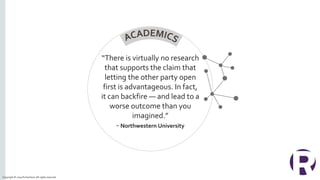
“There is virtually no research
that supports the claim that
letting the other party open
first is advantageous. In fact,
it can backfire — and lead to a
worse outcome than you
imagined.”
- Northwestern University
Copyright © 2019 Richardson. All rights reserved.
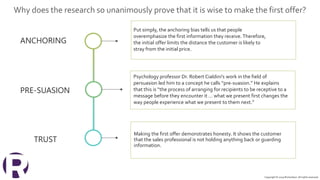
ANCHORING
Put simply, the anchoring bias tells us that people
overemphasize the first information they receive. Therefore,
the initial offer limits the distance the customer is likely to
stray from the initial price.
PRE-SUASION
Psychology professor Dr. Robert Cialdini’s work in the field of
persuasion led him to a concept he calls “pre-suasion.” He explains
that this is “the process of arranging for recipients to be receptive to a
message before they encounter it … what we present first changes the
way people experience what we present to them next.”
TRUST
Making the first offer demonstrates honesty. It shows the customer
that the sales professional is not holding anything back or guarding
information.
Copyright © 2019 Richardson. All rights reserved.
Why does the research so unanimously prove that it is wise to make the first offer?
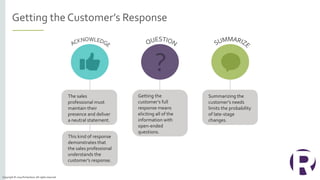
Getting the Customer’s Response
?
The sales
professional must
maintain their
presence and deliver
a neutral statement.
Getting the
customer’s full
response means
eliciting all of the
information with
open-ended
questions.
Summarizing the
customer’s needs
limits the probability
of late-stage
changes.
This kind of response
demonstrates that
the sales professional
understands the
customer’s response.
Copyright © 2019 Richardson. All rights reserved.
CONTROLLING:
ADDRESSING DEMANDS
Copyright © 2019 Richardson. All rights reserved.
Customer demands are
inevitable in negotiations.To
manage the customer’s
demands, sales professionals
must remember that a
demand is simply an unserved
need.
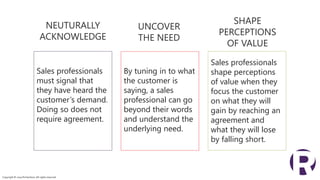
Sales professionals
must signal that
they have heard the
customer’s demand.
Doing so does not
require agreement.
By tuning in to what
the customer is
saying, a sales
professional can go
beyond their words
and understand the
underlying need.
Copyright © 2019 Richardson. All rights reserved.
NEUTURALLY
ACKNOWLEDGE
UNCOVER
THE NEED
SHAPE
PERCEPTIONS
OF VALUE
Sales professionals
shape perceptions
of value when they
focus the customer
on what they will
gain by reaching an
agreement and
what they will lose
by falling short.
TRADING: GIVINGTO GET
Copyright © 2019 Richardson. All rights reserved.
Trading is one of the negotiator’s most powerful
tools. It is powerful because it guards the negotiator
against one of the most common traps in a
negotiation: making a concession.
13
The solution to this trap is a focus on
trading.When a sales professional engages
in trading, they are giving something and
getting something in return.
Copyright © 2019 Richardson. All rights reserved.
Knowing what to trade
means knowing the value
of what is being traded.
While itemizing tradable
deal characteristics, sales
professionals should also
examine what it is they
want in return.
Trades should be spaced
in increments to make
their value more
perceptible.
Trades are more than just
an effective way to keep
the negotiation moving
forward.They are also a
way to establish trust.
Sales professionals need to
trade with care.That is, they
must choose what they are
trading judiciously.
Sales professionals must
lead with their trade first.
This approach gets the
customer’s attention and
prevents them from
becoming too focused on
what they will be giving.
Copyright © 2019 Richardson. All rights reserved.
Giving to Get
TheThree Pillars of Negotiation Strategy
The value of equipping your sales team with training is clear.
OPENING
The opening of a negotiation sets the tone for the rest of the
exchange.
CONTROLLING
Control is about converting demands to needs.
TRADING
Trading ensures that the sales professional only offers
something to the customer with the expectation that they will
get something in return.
Copyright © 2019 Richardson. All rights reserved.
company/richardson/
https://www.richardson.com/blog/
www.richardson.com
US: 215-940-9255
EMEA: +44 (0) 20 7917 1806
APAC: +61 (0) 8 8376 1667
info@richardson.com
LET’S GET IN TOUCH
Click here to Download the full ebook: https://hubs.ly/H0lTMNR0
About Richardson
Richardson is a global sales training and
performance improvement company
focused on helping you drive revenue and
grow long-term customer relationships.
Our market proven sales and coaching
methodology combined with our active
learning approach ensures your sales
teams learn, master, and apply new
behaviors when and where they matter
most - in front of the buyer. Get to know us
and learn about how we help drive the
world’s most inspiring sales organizations
to their next level of excellence.
17
THANK
YOU

Tips for Effective Negotiations in Sales

  • 1.
  • 2.
    . 2 Copyright © 2019Richardson. All rights reserved. More sales professionals need higher- level skills that equip them to navigate the negotiation process. Profitability in sales is in question.
  • 3.
    Richardson’s four decades ofwork across industries shows that sales professionals can become effective negotiators by focusing on three key phases: Copyright © 2019 Richardson. All rights reserved. • Opening • Trading • Controlling
  • 4.
    OPENING: MAKINGTHE OFFER Copyright© 2019 Richardson. All rights reserved.
  • 5.
    “There is virtuallyno research that supports the claim that letting the other party open first is advantageous. In fact, it can backfire — and lead to a worse outcome than you imagined.” - Northwestern University Copyright © 2019 Richardson. All rights reserved.
  • 6.
    ANCHORING Put simply, theanchoring bias tells us that people overemphasize the first information they receive. Therefore, the initial offer limits the distance the customer is likely to stray from the initial price. PRE-SUASION Psychology professor Dr. Robert Cialdini’s work in the field of persuasion led him to a concept he calls “pre-suasion.” He explains that this is “the process of arranging for recipients to be receptive to a message before they encounter it … what we present first changes the way people experience what we present to them next.” TRUST Making the first offer demonstrates honesty. It shows the customer that the sales professional is not holding anything back or guarding information. Copyright © 2019 Richardson. All rights reserved. Why does the research so unanimously prove that it is wise to make the first offer?
  • 7.
    Getting the Customer’sResponse ? The sales professional must maintain their presence and deliver a neutral statement. Getting the customer’s full response means eliciting all of the information with open-ended questions. Summarizing the customer’s needs limits the probability of late-stage changes. This kind of response demonstrates that the sales professional understands the customer’s response. Copyright © 2019 Richardson. All rights reserved.
  • 8.
    CONTROLLING: ADDRESSING DEMANDS Copyright ©2019 Richardson. All rights reserved.
  • 9.
    Copyright © 2019Richardson. All rights reserved. Customer demands are inevitable in negotiations.To manage the customer’s demands, sales professionals must remember that a demand is simply an unserved need.
  • 10.
    Sales professionals must signalthat they have heard the customer’s demand. Doing so does not require agreement. By tuning in to what the customer is saying, a sales professional can go beyond their words and understand the underlying need. Copyright © 2019 Richardson. All rights reserved. NEUTURALLY ACKNOWLEDGE UNCOVER THE NEED SHAPE PERCEPTIONS OF VALUE Sales professionals shape perceptions of value when they focus the customer on what they will gain by reaching an agreement and what they will lose by falling short.
  • 11.
    TRADING: GIVINGTO GET Copyright© 2019 Richardson. All rights reserved.
  • 12.
    Copyright © 2019Richardson. All rights reserved. Trading is one of the negotiator’s most powerful tools. It is powerful because it guards the negotiator against one of the most common traps in a negotiation: making a concession.
  • 13.
    13 The solution tothis trap is a focus on trading.When a sales professional engages in trading, they are giving something and getting something in return. Copyright © 2019 Richardson. All rights reserved.
  • 14.
    Knowing what totrade means knowing the value of what is being traded. While itemizing tradable deal characteristics, sales professionals should also examine what it is they want in return. Trades should be spaced in increments to make their value more perceptible. Trades are more than just an effective way to keep the negotiation moving forward.They are also a way to establish trust. Sales professionals need to trade with care.That is, they must choose what they are trading judiciously. Sales professionals must lead with their trade first. This approach gets the customer’s attention and prevents them from becoming too focused on what they will be giving. Copyright © 2019 Richardson. All rights reserved. Giving to Get
  • 15.
    TheThree Pillars ofNegotiation Strategy The value of equipping your sales team with training is clear. OPENING The opening of a negotiation sets the tone for the rest of the exchange. CONTROLLING Control is about converting demands to needs. TRADING Trading ensures that the sales professional only offers something to the customer with the expectation that they will get something in return. Copyright © 2019 Richardson. All rights reserved.
  • 16.
    company/richardson/ https://www.richardson.com/blog/ www.richardson.com US: 215-940-9255 EMEA: +44(0) 20 7917 1806 APAC: +61 (0) 8 8376 1667 info@richardson.com LET’S GET IN TOUCH Click here to Download the full ebook: https://hubs.ly/H0lTMNR0
  • 17.
    About Richardson Richardson isa global sales training and performance improvement company focused on helping you drive revenue and grow long-term customer relationships. Our market proven sales and coaching methodology combined with our active learning approach ensures your sales teams learn, master, and apply new behaviors when and where they matter most - in front of the buyer. Get to know us and learn about how we help drive the world’s most inspiring sales organizations to their next level of excellence. 17
  • 18.

Editor's Notes

  • #15 LINA: clean up to look good. Early Stages: Build relationships with all stakeholders Understand business and individual needs Gauge interest, comfort level, agreement, and alignment Assess the power structure Share insight about the issue and stakeholder needs and perspectives to clarify thinking and align perspectives  Float ideas to gauge reaction and foster buy-in Uncover perceptions of risk and share perspective on how to mitigate risk Middle: Synthesize the different perspectives and needs into one cohesive case-for-change storyline Share insight about the issue, stakeholder needs, and solution options to clarify thinking and align perspectives  Reinforce common ground Uncover and understand points of stakeholder misalignment Share perspective and ideas to meet all needs Develop, adjust, and refine the solution based on evolving requirements  Address concerns over risk Later: Reinforce common ground Address areas of misalignment Resolve late-stage concerns and reinforce personal value Highlight the risk of no change and delay in decision to drive momentum