What is world class
procurement?
Gerard Chick
Chief Knowledge Officer
Optimum Procurement Group
My Agenda today
An quick outline of Optimum Procurement Group
A little bit of background on procurement’s evolution
A look at what has brought this change about – and how you can take steps to position
procurement in your organisation
Some discussion on contemporary procurement skill sets
What good looks like
A couple of takeaways for you to think about.
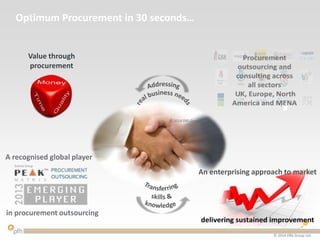
Value through
procurement
Optimum Procurement in 30 seconds…
A recognised global player
in procurement outsourcing
An enterprising approach to market
© 2014 OBS Group Ltd.
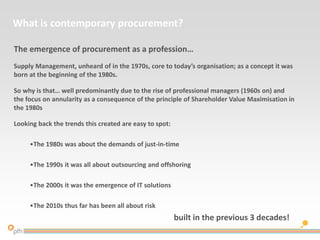
What is contemporary procurement?
The emergence of procurement as a profession…
Supply Management, unheard of in the 1970s, core to today’s organisation; as a concept it was
born at the beginning of the 1980s.
So why is that… well predominantly due to the rise of professional managers (1960s on) and
the focus on annularity as a consequence of the principle of Shareholder Value Maximisation in
the 1980s
Looking back the trends this created are easy to spot:
•The 1980s was about the demands of just-in-time
•The 1990s it was all about outsourcing and offshoring
•The 2000s it was the emergence of IT solutions
•The 2010s thus far has been all about risk
built in the previous 3 decades!
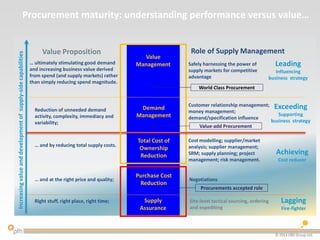
Value Proposition Role of Supply Management
Increasingvalueanddevelopmentofsupply-sidecapabilities
… and at the right price and quality;
Purchase Cost
Reduction
Negotiations
Total Cost of
Ownership
Reduction
… and by reducing total supply costs.
Cost modelling; supplier/market
analysis; supplier management;
SRM; supply planning; project
management; risk management.
Achieving
Cost reducer
Supply
Assurance
Site-level tactical sourcing, ordering
and expediting
Right stuff, right place, right time;
Demand
Management
Reduction of unneeded demand
activity, complexity, immediacy and
variability;
Customer relationship management;
money management;
demand/specification influence
Exceeding
Supporting
business strategy
… ultimately stimulating good demand
and increasing business value derived
from spend (and supply markets) rather
than simply reducing spend magnitude.
Value
Management Safely harnessing the power of
supply markets for competitive
advantage
Leading
Influencing
business strategy
World Class Procurement
Value-add Procurement
Procurements accepted role
Lagging
Fire-fighter
© 2014 OBS Group Ltd.
Procurement maturity: understanding performance versus value…
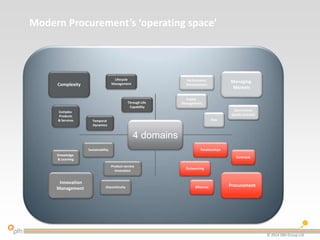
Modern Procurement’s ‘operating space’
Managing
Markets
Performance
Measurement
Risk
Governance
(public-private)
Supply
Management
Innovation
Management
Knowledge
& Learning
Sustainability
Product-service
Innovation
Discontinuity Procurement
Outsourcing
Relationships
Contracts
Alliances
Complexity
Through Life
Capability
Complex
Products
& Services
Lifecycle
Management
Temporal
Dynamics
4 domains
© 2014 OBS Group Ltd.
Low
High
High
Profitimpact
Supply risk
1- 9 yrs 10 - 50 yrs
Co-creationofvalue
ContractualfocusRelationalfocus
Traditional
procurement
Procuring
routine performance
Complex
contractual
management
PCP
CoPS
e.g. PFI
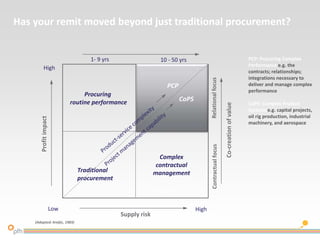
Has your remit moved beyond just traditional procurement?
PCP: Procuring Complex
Performance e.g. the
contracts; relationships;
integrations necessary to
deliver and manage complex
performance
CoPS: Complex Product
Systems e.g. capital projects,
oil rig production, industrial
machinery, and aerospace
(Adapted: Kraljic, 1983)
© 2011 OBS Group Ltd.
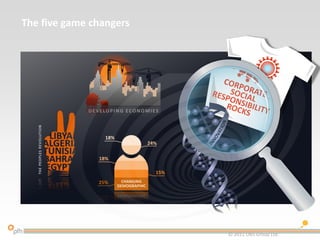
The five game changers
DEVELOPING ECONOMIES
18%
18%
15%
25%
24%
CHANGING
DEMOGRAPHIC
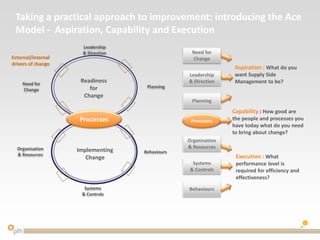
Taking a practical approach to improvement: introducing the Ace
Model - Aspiration, Capability and Execution
Capability : How good are
the people and processes you
have today what do you need
to bring about change?
Execution : What
performance level is
required for efficiency and
effectiveness?
Aspiration : What do you
want Supply Side
Management to be?
Implementing
Change
Readiness
for
Change
Planning
Leadership
& Direction
Processes
Organisation
& Resources
Behaviours
Systems
& Controls
Need for
Change
External/internal
drivers of change
Planning
Leadership
& Direction
Processes
Organisation
& Resources
Behaviours
Systems
& Controls
Need for
Change
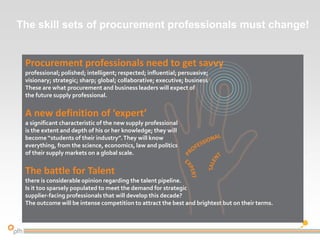
Procurement professionals need to get savvy
professional; polished; intelligent; respected; influential; persuasive;
visionary; strategic; sharp; global; collaborative; executive; business savvy.
These are what procurement and business leaders will expect of
the future supply professional.
A new definition of ‘expert’
a significant characteristic of the new supply professional
is the extent and depth of his or her knowledge; they will
become “students of their industry”.They will know
everything, from the science, economics, law and politics
of their supply markets on a global scale.
The battle for Talent
there is considerable opinion regarding the talent pipeline.
Is it too sparsely populated to meet the demand for strategic
supplier-facing professionals that will develop this decade?
The outcome will be intense competition to attract the best and brightest but on their terms.
The skill sets of procurement professionals must change!
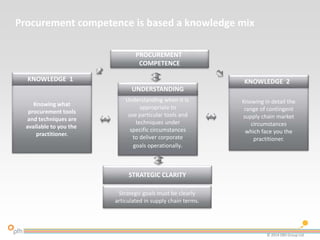
PROCUREMENT
COMPETENCE
Knowing what
procurement tools
and techniques are
available to you the
practitioner.
Understanding when it is
appropriate to
use particular tools and
techniques under
specific circumstances
to deliver corporate
goals operationally.
Knowing in detail the
range of contingent
supply chain market
circumstances
which face you the
practitioner.
Strategic goals must be clearly
articulated in supply chain terms.
KNOWLEDGE 1 KNOWLEDGE 2
UNDERSTANDING
STRATEGIC CLARITY
Procurement competence is based a knowledge mix
© 2014 OBS Group Ltd.
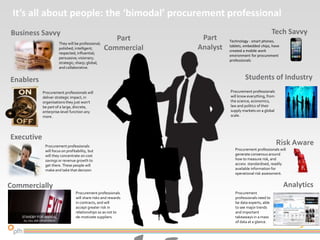
Technology - smart phones,
tablets, embedded chips, have
created a mobile work
environment for procurement
professionals
Tech Savvy
They will be professional;
polished; intelligent;
respected; influential;
persuasive; visionary;
strategic; sharp; global;
and collaborative.
Business Savvy
Procurement professionals
will know everything, from
the science, economics,
law and politics of their
supply markets on a global
scale.
Students of Industry
Procurement professionals will
generate consensus around
how to measure risk, and
access standardised, readily
available information for
operational risk assessment.
Risk Aware
Procurement
professionals need to
be data experts, able
to see major trends
and important
takeaways in a mass
of data at a glance.
Analytics
Procurement professionals will
deliver strategic impact, in
organisations they just won’t
be part of a large, discrete,
enterprise-level function any
more.
Enablers
Procurement professionals
will focus on profitability, but
will they concentrate on cost
savings or revenue growth to
get there. These people will
make and take that decision
Executive
Procurement professionals
will share risks and rewards
in contracts, and will
accept greater risk in
relationships so as not to
de-motivate suppliers.
Commercially
Prudent
Part
Commercial
Part
Analyst
It’s all about people: the ‘bimodal’ procurement professional
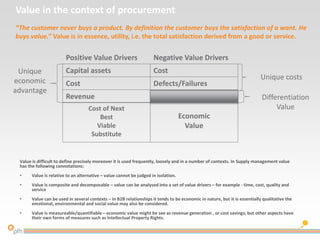
Positive Value Drivers
Cost
Capital assets
Revenue
Negative Value Drivers
Defects/Failures
Cost
Cost of Next
Best
Viable
Substitute
Economic
Value
Unique costs
Unique
economic
advantage
Differentiation
Value
Value is difficult to define precisely moreover it is used frequently, loosely and in a number of contexts. In Supply management value
has the following connotations:
• Value is relative to an alternative – value cannot be judged in isolation.
• Value is composite and decomposable – value can be analysed into a set of value drivers – for example - time, cost, quality and
service
• Value can be used in several contexts – in B2B relationships it tends to be economic in nature, but it is essentially qualitative the
emotional, environmental and social value may also be considered.
• Value is measureable/quantifiable – economic value might be see as revenue generation , or cost savings; but other aspects have
their own forms of measures such as Intellectual Property Rights.
Value in the context of procurement
“The customer never buys a product. By definition the customer buys the satisfaction of a want. He
buys value.” Value is in essence, utility, i.e. the total satisfaction derived from a good or service.
Value: procurement’s latest game changer
Is it time to re-evaluate strategic procurement and look to establish Value
Procurement?
Today procurement professionals are under considerable pressure to deliver
value adding business performance – but what might this entail?
It is no longer enough to build a supply management capability that is
efficient, demand-driven and transparent – perhaps this requires a market
facing mind-set
Procurement must offer the organisation something that is value adding; a
new supply management where the strategic scope of procurement’s value is
delivered via – innovation; a networked function and focus
Will value procurement will be category management’s legacy?
Today procurement leaders face a dichotomy: Cost (reduction) - v –Value (creation)
CPOs have think hard about how well they understand the market
CPOs must be truly market facing; not focusing only on their internal clients and
stakeholders;
Procurement has reached a ‘tipping point’
CPOs must create an equilibrium in their focus between the business and the market it
serves
This is where the next big windfalls will come from, the next big gains, the next
competitive advantage.
10 things the best procurement organisations do!
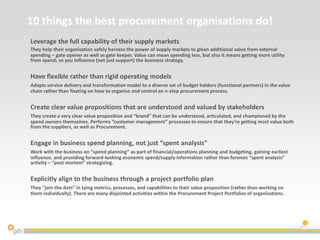
Leverage the full capability of their supply markets
They help their organisation safely harness the power of supply markets to glean additional value from external
spending – gate opener as well as gate keeper. Value can mean spending less, but also it means getting more utility
from spend; so you influence (not just support) the business strategy.
Have flexible rather than rigid operating models
Adapts service delivery and transformation model to a diverse set of budget holders (functional partners) in the value
chain rather than fixating on how to organise and control an n-step procurement process.
Create clear value propositions that are understood and valued by stakeholders
They create a very clear value proposition and “brand” that can be understood, articulated, and championed by the
spend owners themselves. Performs “customer management” processes to ensure that they’re getting most value both
from the suppliers, as well as Procurement.
Engage in business spend planning, not just “spent analysis”
Work with the business on “spend planning” as part of financial/operations planning and budgeting, gaining earliest
influence, and providing forward-looking economic spend/supply information rather than forensic “spent analysis”
activity – “post mortem” strategizing.
Explicitly align to the business through a project portfolio plan
They “join the dots” in tying metrics, processes, and capabilities to their value proposition (rather than working on
them individually). There are many disjointed activities within the Procurement Project Portfolios of organisations.
10 things the best procurement organisations do!
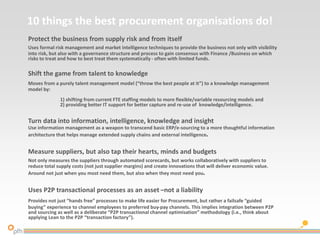
Protect the business from supply risk and from itself
Uses formal risk management and market intelligence techniques to provide the business not only with visibility
into risk, but also with a governance structure and process to gain consensus with Finance /Business on which
risks to treat and how to best treat them systematically - often with limited funds.
Shift the game from talent to knowledge
Moves from a purely talent management model (“throw the best people at it”) to a knowledge management
model by:
1) shifting from current FTE staffing models to more flexible/variable resourcing models and
2) providing better IT support for better capture and re-use of knowledge/intelligence.
Turn data into information, intelligence, knowledge and insight
Use information management as a weapon to transcend basic ERP/e-sourcing to a more thoughtful information
architecture that helps manage extended supply chains and external intelligence.
Measure suppliers, but also tap their hearts, minds and budgets
Not only measures the suppliers through automated scorecards, but works collaboratively with suppliers to
reduce total supply costs (not just supplier margins) and create innovations that will deliver economic value.
Around not just when you most need them, but also when they most need you.
Uses P2P transactional processes as an asset –not a liability
Provides not just “hands free” processes to make life easier for Procurement, but rather a failsafe “guided
buying” experience to channel employees to preferred buy-pay channels. This implies integration between P2P
and sourcing as well as a deliberate “P2P transactional channel optimisation” methodology (i.e., think about
applying Lean to the P2P “transaction factory”).
Question Time

World class procurement and your business

  • 1.
    What is worldclass procurement? Gerard Chick Chief Knowledge Officer Optimum Procurement Group
  • 2.
    My Agenda today Anquick outline of Optimum Procurement Group A little bit of background on procurement’s evolution A look at what has brought this change about – and how you can take steps to position procurement in your organisation Some discussion on contemporary procurement skill sets What good looks like A couple of takeaways for you to think about.
  • 3.
    Value through procurement Optimum Procurementin 30 seconds… A recognised global player in procurement outsourcing An enterprising approach to market © 2014 OBS Group Ltd. © 2014 OBS Group Ltd.
  • 4.
    What is contemporaryprocurement? The emergence of procurement as a profession… Supply Management, unheard of in the 1970s, core to today’s organisation; as a concept it was born at the beginning of the 1980s. So why is that… well predominantly due to the rise of professional managers (1960s on) and the focus on annularity as a consequence of the principle of Shareholder Value Maximisation in the 1980s Looking back the trends this created are easy to spot: •The 1980s was about the demands of just-in-time •The 1990s it was all about outsourcing and offshoring •The 2000s it was the emergence of IT solutions •The 2010s thus far has been all about risk built in the previous 3 decades!
  • 5.
    Value Proposition Roleof Supply Management Increasingvalueanddevelopmentofsupply-sidecapabilities … and at the right price and quality; Purchase Cost Reduction Negotiations Total Cost of Ownership Reduction … and by reducing total supply costs. Cost modelling; supplier/market analysis; supplier management; SRM; supply planning; project management; risk management. Achieving Cost reducer Supply Assurance Site-level tactical sourcing, ordering and expediting Right stuff, right place, right time; Demand Management Reduction of unneeded demand activity, complexity, immediacy and variability; Customer relationship management; money management; demand/specification influence Exceeding Supporting business strategy … ultimately stimulating good demand and increasing business value derived from spend (and supply markets) rather than simply reducing spend magnitude. Value Management Safely harnessing the power of supply markets for competitive advantage Leading Influencing business strategy World Class Procurement Value-add Procurement Procurements accepted role Lagging Fire-fighter © 2014 OBS Group Ltd. Procurement maturity: understanding performance versus value…
  • 6.
    Modern Procurement’s ‘operatingspace’ Managing Markets Performance Measurement Risk Governance (public-private) Supply Management Innovation Management Knowledge & Learning Sustainability Product-service Innovation Discontinuity Procurement Outsourcing Relationships Contracts Alliances Complexity Through Life Capability Complex Products & Services Lifecycle Management Temporal Dynamics 4 domains © 2014 OBS Group Ltd.
  • 7.
    Low High High Profitimpact Supply risk 1- 9yrs 10 - 50 yrs Co-creationofvalue ContractualfocusRelationalfocus Traditional procurement Procuring routine performance Complex contractual management PCP CoPS e.g. PFI Has your remit moved beyond just traditional procurement? PCP: Procuring Complex Performance e.g. the contracts; relationships; integrations necessary to deliver and manage complex performance CoPS: Complex Product Systems e.g. capital projects, oil rig production, industrial machinery, and aerospace (Adapted: Kraljic, 1983)
  • 8.
    © 2011 OBSGroup Ltd. The five game changers DEVELOPING ECONOMIES 18% 18% 15% 25% 24% CHANGING DEMOGRAPHIC
  • 9.
    Taking a practicalapproach to improvement: introducing the Ace Model - Aspiration, Capability and Execution Capability : How good are the people and processes you have today what do you need to bring about change? Execution : What performance level is required for efficiency and effectiveness? Aspiration : What do you want Supply Side Management to be? Implementing Change Readiness for Change Planning Leadership & Direction Processes Organisation & Resources Behaviours Systems & Controls Need for Change External/internal drivers of change Planning Leadership & Direction Processes Organisation & Resources Behaviours Systems & Controls Need for Change
  • 10.
    Procurement professionals needto get savvy professional; polished; intelligent; respected; influential; persuasive; visionary; strategic; sharp; global; collaborative; executive; business savvy. These are what procurement and business leaders will expect of the future supply professional. A new definition of ‘expert’ a significant characteristic of the new supply professional is the extent and depth of his or her knowledge; they will become “students of their industry”.They will know everything, from the science, economics, law and politics of their supply markets on a global scale. The battle for Talent there is considerable opinion regarding the talent pipeline. Is it too sparsely populated to meet the demand for strategic supplier-facing professionals that will develop this decade? The outcome will be intense competition to attract the best and brightest but on their terms. The skill sets of procurement professionals must change!
  • 11.
    PROCUREMENT COMPETENCE Knowing what procurement tools andtechniques are available to you the practitioner. Understanding when it is appropriate to use particular tools and techniques under specific circumstances to deliver corporate goals operationally. Knowing in detail the range of contingent supply chain market circumstances which face you the practitioner. Strategic goals must be clearly articulated in supply chain terms. KNOWLEDGE 1 KNOWLEDGE 2 UNDERSTANDING STRATEGIC CLARITY Procurement competence is based a knowledge mix © 2014 OBS Group Ltd.
  • 12.
    Technology - smartphones, tablets, embedded chips, have created a mobile work environment for procurement professionals Tech Savvy They will be professional; polished; intelligent; respected; influential; persuasive; visionary; strategic; sharp; global; and collaborative. Business Savvy Procurement professionals will know everything, from the science, economics, law and politics of their supply markets on a global scale. Students of Industry Procurement professionals will generate consensus around how to measure risk, and access standardised, readily available information for operational risk assessment. Risk Aware Procurement professionals need to be data experts, able to see major trends and important takeaways in a mass of data at a glance. Analytics Procurement professionals will deliver strategic impact, in organisations they just won’t be part of a large, discrete, enterprise-level function any more. Enablers Procurement professionals will focus on profitability, but will they concentrate on cost savings or revenue growth to get there. These people will make and take that decision Executive Procurement professionals will share risks and rewards in contracts, and will accept greater risk in relationships so as not to de-motivate suppliers. Commercially Prudent Part Commercial Part Analyst It’s all about people: the ‘bimodal’ procurement professional
  • 13.
    Positive Value Drivers Cost Capitalassets Revenue Negative Value Drivers Defects/Failures Cost Cost of Next Best Viable Substitute Economic Value Unique costs Unique economic advantage Differentiation Value Value is difficult to define precisely moreover it is used frequently, loosely and in a number of contexts. In Supply management value has the following connotations: • Value is relative to an alternative – value cannot be judged in isolation. • Value is composite and decomposable – value can be analysed into a set of value drivers – for example - time, cost, quality and service • Value can be used in several contexts – in B2B relationships it tends to be economic in nature, but it is essentially qualitative the emotional, environmental and social value may also be considered. • Value is measureable/quantifiable – economic value might be see as revenue generation , or cost savings; but other aspects have their own forms of measures such as Intellectual Property Rights. Value in the context of procurement “The customer never buys a product. By definition the customer buys the satisfaction of a want. He buys value.” Value is in essence, utility, i.e. the total satisfaction derived from a good or service.
  • 14.
    Value: procurement’s latestgame changer Is it time to re-evaluate strategic procurement and look to establish Value Procurement? Today procurement professionals are under considerable pressure to deliver value adding business performance – but what might this entail? It is no longer enough to build a supply management capability that is efficient, demand-driven and transparent – perhaps this requires a market facing mind-set Procurement must offer the organisation something that is value adding; a new supply management where the strategic scope of procurement’s value is delivered via – innovation; a networked function and focus
  • 15.
    Will value procurementwill be category management’s legacy? Today procurement leaders face a dichotomy: Cost (reduction) - v –Value (creation) CPOs have think hard about how well they understand the market CPOs must be truly market facing; not focusing only on their internal clients and stakeholders; Procurement has reached a ‘tipping point’ CPOs must create an equilibrium in their focus between the business and the market it serves This is where the next big windfalls will come from, the next big gains, the next competitive advantage.
  • 16.
    10 things thebest procurement organisations do! Leverage the full capability of their supply markets They help their organisation safely harness the power of supply markets to glean additional value from external spending – gate opener as well as gate keeper. Value can mean spending less, but also it means getting more utility from spend; so you influence (not just support) the business strategy. Have flexible rather than rigid operating models Adapts service delivery and transformation model to a diverse set of budget holders (functional partners) in the value chain rather than fixating on how to organise and control an n-step procurement process. Create clear value propositions that are understood and valued by stakeholders They create a very clear value proposition and “brand” that can be understood, articulated, and championed by the spend owners themselves. Performs “customer management” processes to ensure that they’re getting most value both from the suppliers, as well as Procurement. Engage in business spend planning, not just “spent analysis” Work with the business on “spend planning” as part of financial/operations planning and budgeting, gaining earliest influence, and providing forward-looking economic spend/supply information rather than forensic “spent analysis” activity – “post mortem” strategizing. Explicitly align to the business through a project portfolio plan They “join the dots” in tying metrics, processes, and capabilities to their value proposition (rather than working on them individually). There are many disjointed activities within the Procurement Project Portfolios of organisations.
  • 17.
    10 things thebest procurement organisations do! Protect the business from supply risk and from itself Uses formal risk management and market intelligence techniques to provide the business not only with visibility into risk, but also with a governance structure and process to gain consensus with Finance /Business on which risks to treat and how to best treat them systematically - often with limited funds. Shift the game from talent to knowledge Moves from a purely talent management model (“throw the best people at it”) to a knowledge management model by: 1) shifting from current FTE staffing models to more flexible/variable resourcing models and 2) providing better IT support for better capture and re-use of knowledge/intelligence. Turn data into information, intelligence, knowledge and insight Use information management as a weapon to transcend basic ERP/e-sourcing to a more thoughtful information architecture that helps manage extended supply chains and external intelligence. Measure suppliers, but also tap their hearts, minds and budgets Not only measures the suppliers through automated scorecards, but works collaboratively with suppliers to reduce total supply costs (not just supplier margins) and create innovations that will deliver economic value. Around not just when you most need them, but also when they most need you. Uses P2P transactional processes as an asset –not a liability Provides not just “hands free” processes to make life easier for Procurement, but rather a failsafe “guided buying” experience to channel employees to preferred buy-pay channels. This implies integration between P2P and sourcing as well as a deliberate “P2P transactional channel optimisation” methodology (i.e., think about applying Lean to the P2P “transaction factory”).
  • 18.