The Power
of Enablement
Bridging the Sales Productivity Gap
IN ASSOCIATION WITH:
Contents
Overview........................................................................................................................................................................ 2
Key Findings................................................................................................................................................................. 3
Management Focus on Sales Enablement and Sales Productivity..................................................... 5
Aligning Sales and Marketing............................................................................................................................... 7
Content Is the Sales Productivity Secret.........................................................................................................9
The Advantage of Value Conversations.........................................................................................................12
The “How” to Productivity = Efficiency + Effectiveness..........................................................................15
Conclusion....................................................................................................................................................................18
Survey Methodology...............................................................................................................................................19
Acknowledgments...................................................................................................................................................19
About Brainshark.................................................................................................................................................... 20
2 | The Power of Enablement: Bridging the Sales Productivity Gap
Overview
As selling gets more costly and buyers become more informed, sales
productivity continues to present challenges for all companies. But the
difficulties are not the same across the board. Those with top-performing sales
teams see real and measurable results from their focus on best-in-class sales
practices—having a defined sales enablement function, strong alignment of
sales and marketing, and a focus on content and technology to improve both
the efficiency and effectiveness of their sales force.
In short, they recognize the importance of
sales productivity for the company’s survival and suc-
cess—it’s a strategic priority.
Sales enablement is a potent formula for improv-
ing sales productivity (defined as revenue per rep). This
is borne out by the fact that sales enablement is a key
focus for companies with best-in-class sales organiza-
tions: 59% of leading companies have a defined sales
enablement role.
And while there are notable performance differ-
ences between high performers and low performers,
very few companies escape productivity challenges—
they all look for ways to increase revenue per rep and
narrow the gap between top-performing salespeo-
ple and the rest of the team. Companies that are at
or below plan often struggle to meet or exceed reve-
nue targets and are significantly hampered by the sales
activities that leading companies seem to do well. Yet
even top-performing companies face challenges with
some of these issues, offering room to improve their
performance even more.
To understand what makes best-in-class sales organi-
zations tick and identify opportunities to close the sales
productivity gap, Forbes Insights and Brainshark sur-
veyed 216 top executives in companies headquartered
in the U.S. during the summer of 2015. As the survey
reveals, there is no single point of failure or success for
sales organizations. All companies face a combination
of factors that together affect productivity. To over-
come these challenging issues, companies need to find
a solution that addresses both halves of sales productiv-
ity—efficiency and effectiveness—and learn to work
collaboratively to deliver value messages to their cus-
tomers and top-line sales results to the C-suite.
Best versus the Rest
What separates leaders in sales productivity from organiza-
tions still struggling with this critical issue? Top-performing
companies—the top 10% of enterprises—are identified in
the Forbes Insights/Brainshark survey as those executives
whose organizations:
• Are above plan or well above plan in achieving
revenue targets
• Rank sales productivity as the top priority relative to
other key areas of management focus
• Self-identified as being “above average” or “leading
the way” with regard to sales productivity
Copyright © 2015 Forbes Insights | 3
Key Findings
Sales productivity and sales enablement are dead center on management’s radar screen.
Three-fifths of top-performing companies have a defined sales enablement role. And C-level executives in all com-
panies realize the critical value of sales productivity to achieving growth and competitive advantage.
Leading companies value alignment of sales and marketing.
Three-fourths of top-performing organizations have strong alignment between sales and marketing; poorly per-
forming companies notably do not.
Top sales organizations recognize the key role content plays in sales productivity.
Investment in content is helping top-performing firms succeed—top sales organizations are less likely to consider
the amount of time reps spend creating or looking for content as a top productivity challenge, and nearly half want
sales enablement technology to help them more easily create high-quality sales content.
Leading companies excel at providing consistent sales messages.
Seven out of 10 top-performing companies are able to provide a consistent sales message, compared with just
four out of 10 for those with less sales success.
Investments in improving efficiency and effectiveness provide value to the sales organization.
Best-in-class companies know that many factors work together to drive productivity and look to technology as a
way to address this need.
4 | The Power of Enablement: Bridging the Sales Productivity Gap
“Sales enablement is about creating ever-increasing sales
productivity from the day the rep arrives at the company.”
	 Jay Barrows
	 Chief Sales Officer
	GE Intelligent Platforms
Copyright © 2015 Forbes Insights | 5
I
t would be hard to find a CEO who wouldn’t
say that increasing revenue and reducing cost
of sales is one of their top three or four goals,”
says Jackie Quint, global director of sales
enablement at Extreme Networks. “This is
why sales enablement has become so critical.”
Yet the job of those in the C-suite is to see the
big picture for the entire company. So they view the
sales function through another lens in addition to rev-
enue—how it helps to meet or exceed corporate goals
and objectives.
“CEOs fundamentally don’t want to hear about
tools; they don’t care,” says Walter Rogers, CEO of
CCI Global Holdings LLC. “They want to hear about
how to connect their end-point vision, such as produc-
tivity or profitability, to a strategy.”
Companies succeed when the issue of sales enable-
ment and sales productivity is top of mind for the
management team. Sales enablement is a key focus for
companies at the top of the productivity scale—59%
of top-performing companies have a defined sales
enablement role, as do 72% of all companies that report
revenues more than 25% above plan.
“Sales enablement is about creating ever-increas-
ing sales productivity from the day the rep arrives at
the company,” says Jay Barrows, chief sales officer at GE
Intelligent Platforms. “Hiring reps with the right subject
matter experience and giving them the right process, the
right accounts, the right tools…to help ensure they pri-
oritize every day so they can be effective, productive and
massively impactful.”
When management pays attention to enabling their
sales teams, it makes a real difference. The evidence
is in the performance of “the rest” of the companies
in the survey, or those not leading the way in sales.
Only 30% of underperforming companies have a sales
enablement role in their organizations.
Companies across the productivity continuum rec-
ognize the key role sales productivity needs to play
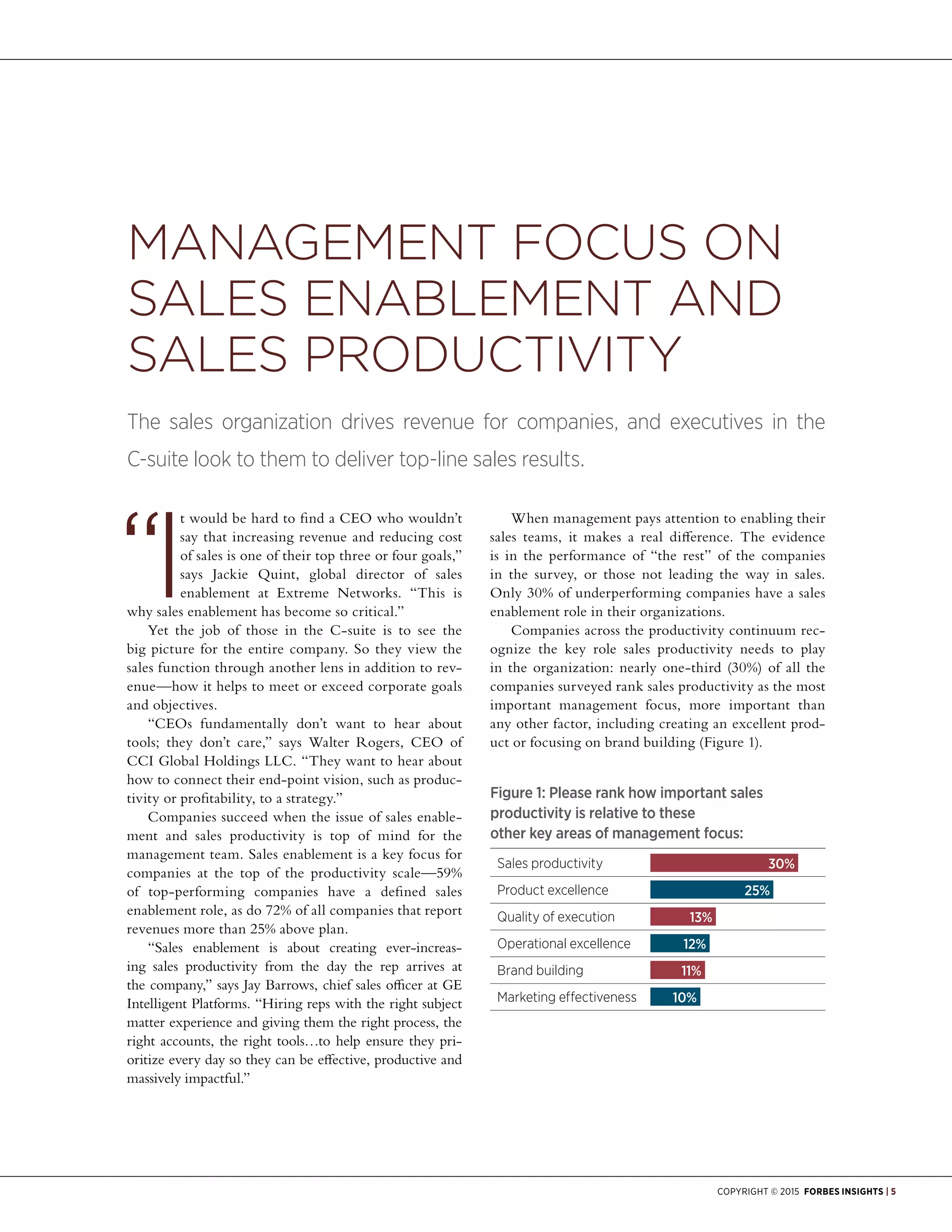
in the organization: nearly one-third (30%) of all the
companies surveyed rank sales productivity as the most
important management focus, more important than
any other factor, including creating an excellent prod-
uct or focusing on brand building (Figure 1).
Management Focus on
Sales Enablement and
Sales Productivity
The sales organization drives revenue for companies, and executives in the
C-suite look to them to deliver top-line sales results.
Figure 1: Please rank how important sales
productivity is relative to these
other key areas of management focus:
Sales productivity	 30%
Product excellence	 25%
Quality of execution	 13%
Operational excellence	 12%
Brand building	 11%
Marketing effectiveness	 10%
6 | The Power of Enablement: Bridging the Sales Productivity Gap
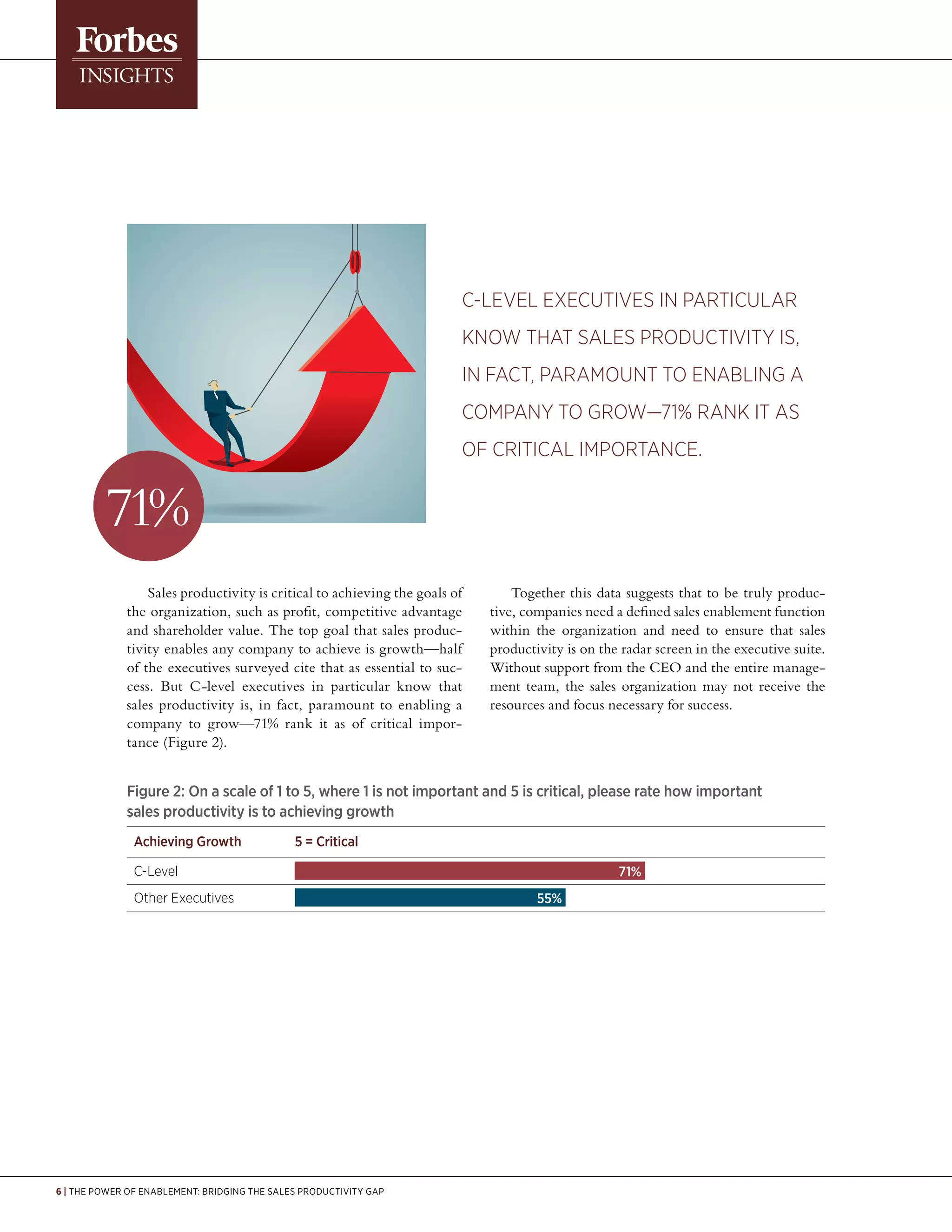
Sales productivity is critical to achieving the goals of
the organization, such as profit, competitive advantage
and shareholder value. The top goal that sales produc-
tivity enables any company to achieve is growth—half
of the executives surveyed cite that as essential to suc-
cess. But C-level executives in particular know that
sales productivity is, in fact, paramount to enabling a
company to grow—71% rank it as of critical impor-
tance (Figure 2).
Together this data suggests that to be truly produc-
tive, companies need a defined sales enablement function
within the organization and need to ensure that sales
productivity is on the radar screen in the executive suite.
Without support from the CEO and the entire manage-
ment team, the sales organization may not receive the
resources and focus necessary for success.
Figure 2: On a scale of 1 to 5, where 1 is not important and 5 is critical, please rate how important
sales productivity is to achieving growth
Achieving Growth	 5 = Critical
C-Level		 71% 	
Other Executives	 55% 					
C-level executives in particular
know that sales productivity is,
in fact, paramount to enabling a
company to grow—71% rank it as
of critical importance.
71%
Copyright © 2015 Forbes Insights | 7
Aligning Sales
and Marketing
Top-performing companies value a strong sales enablement function and
understand the importance of aligning sales and marketing teams. These
companies know that sales enablement is best addressed by having the
function sit inside the sales organization and then work closely with teams
outside sales as well.
T
he sales enablement function exists
because it is getting harder and harder to
get reps to the point where they maxi-
mize every customer interaction,” says
Jim Ninivaggi, service director, sales
enablement strategies at SiriusDecisions. “Reps are over-
whelmed with content, communications, events and the
like. Companies need to have a function in place that
acts like a buffer, to orchestrate and deliver information
to reps in a way they can find, digest and utilize.”
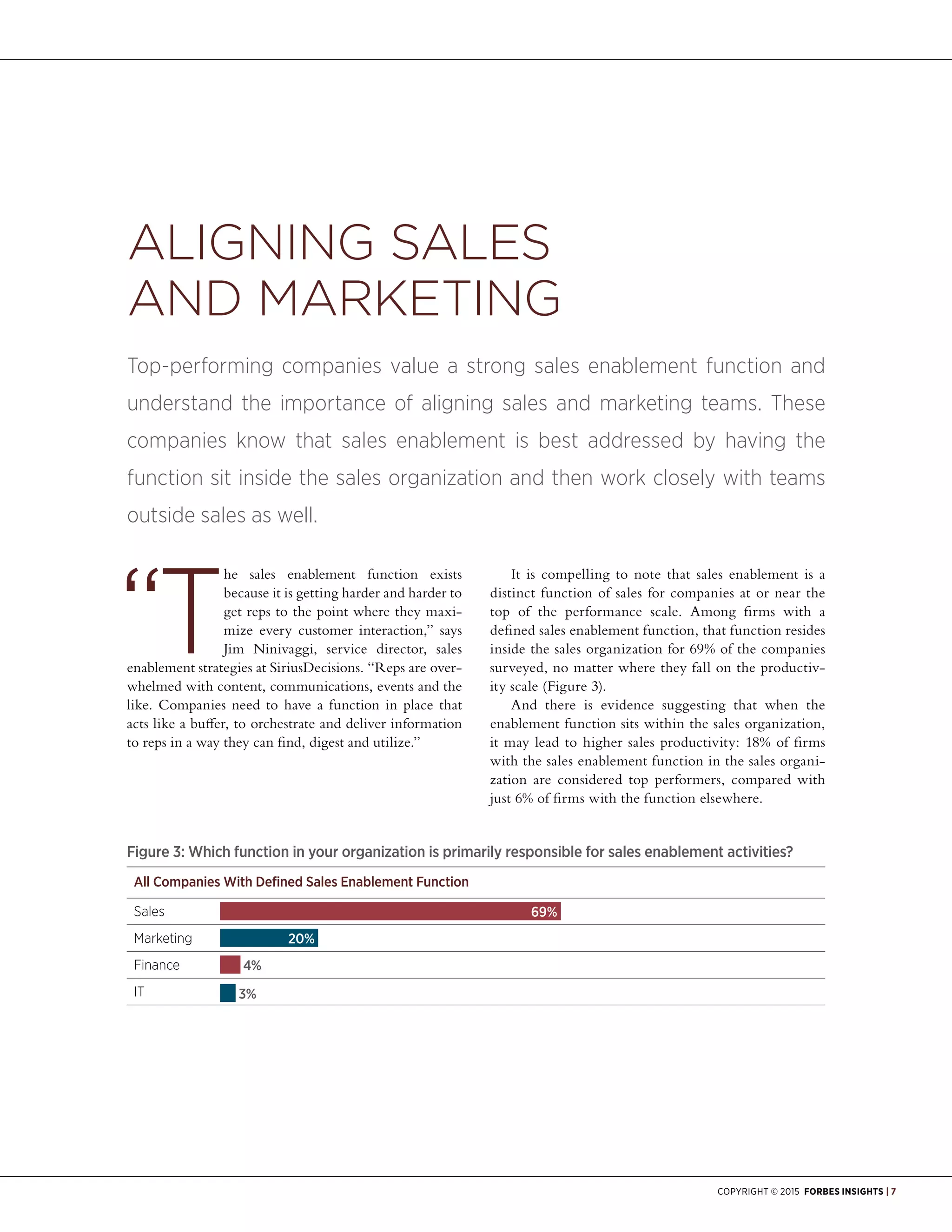
It is compelling to note that sales enablement is a
distinct function of sales for companies at or near the
top of the performance scale. Among firms with a
defined sales enablement function, that function resides
inside the sales organization for 69% of the companies
surveyed, no matter where they fall on the productiv-
ity scale (Figure 3).
And there is evidence suggesting that when the
enablement function sits within the sales organization,
it may lead to higher sales productivity: 18% of firms
with the sales enablement function in the sales organi-
zation are considered top performers, compared with
just 6% of firms with the function elsewhere.
Figure 3: Which function in your organization is primarily responsible for sales enablement activities?
All Companies With Defined Sales Enablement Function
Sales	 69% 		
Marketing	 20% 	
Finance	 4% 		
IT	 3%
8 | The Power of Enablement: Bridging the Sales Productivity Gap
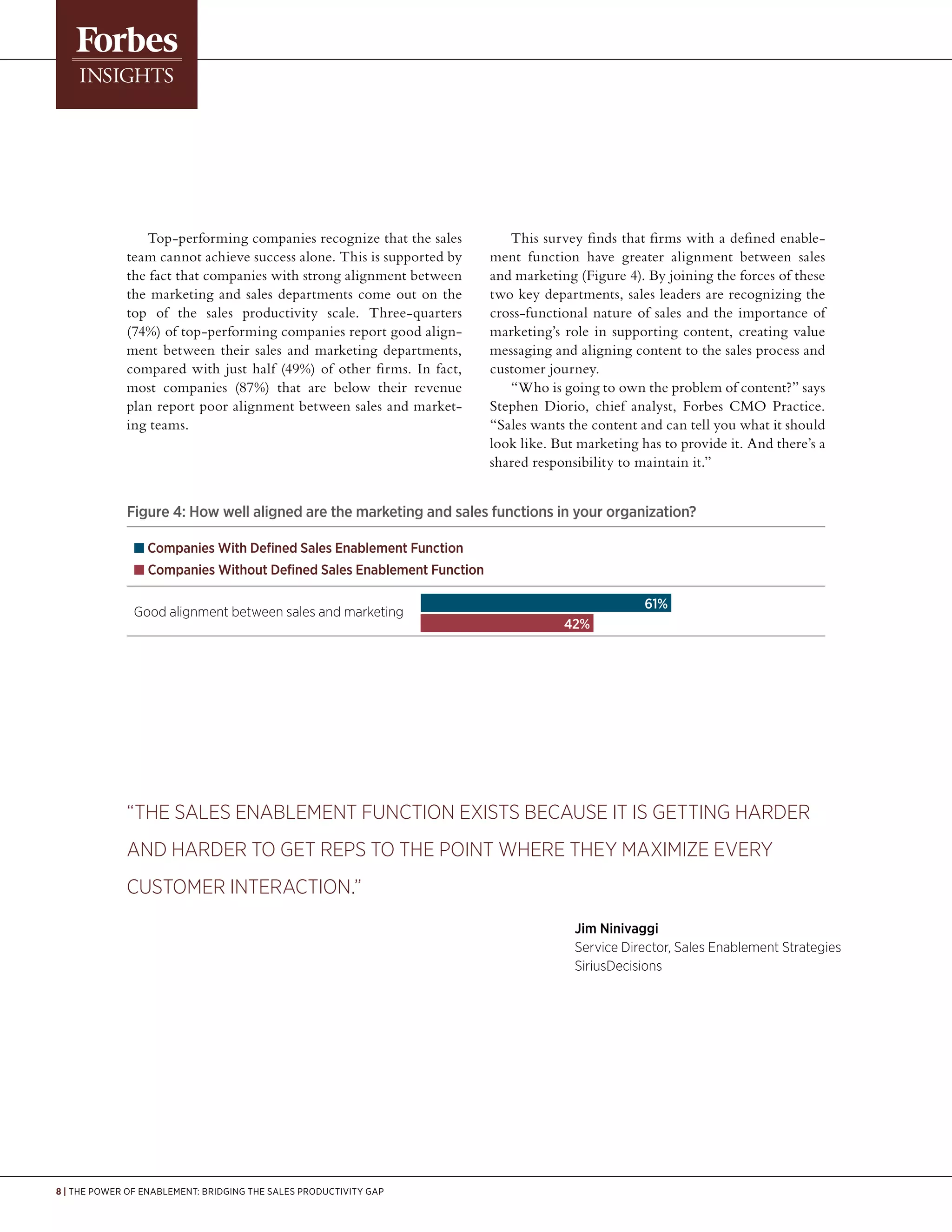
Top-performing companies recognize that the sales
team cannot achieve success alone. This is supported by
the fact that companies with strong alignment between
the marketing and sales departments come out on the
top of the sales productivity scale. Three-quarters
(74%) of top-performing companies report good align-
ment between their sales and marketing departments,
compared with just half (49%) of other firms. In fact,
most companies (87%) that are below their revenue
plan report poor alignment between sales and market-
ing teams.
This survey finds that firms with a defined enable-
ment function have greater alignment between sales
and marketing (Figure 4). By joining the forces of these
two key departments, sales leaders are recognizing the
cross-functional nature of sales and the importance of
marketing’s role in supporting content, creating value
messaging and aligning content to the sales process and
customer journey.
“Who is going to own the problem of content?” says
Stephen Diorio, chief analyst, Forbes CMO Practice.
“Sales wants the content and can tell you what it should
look like. But marketing has to provide it. And there’s a
shared responsibility to maintain it.”
Figure 4: How well aligned are the marketing and sales functions in your organization?
n Companies With Defined Sales Enablement Function
n Companies Without Defined Sales Enablement Function
Good alignment between sales and marketing
	 42%
61%
“The sales enablement function exists because it is getting harder
and harder to get reps to the point where they maximize every
customer interaction.”
								Jim Ninivaggi
								Service Director, Sales Enablement Strategies
								SiriusDecisions
Copyright © 2015 Forbes Insights | 9
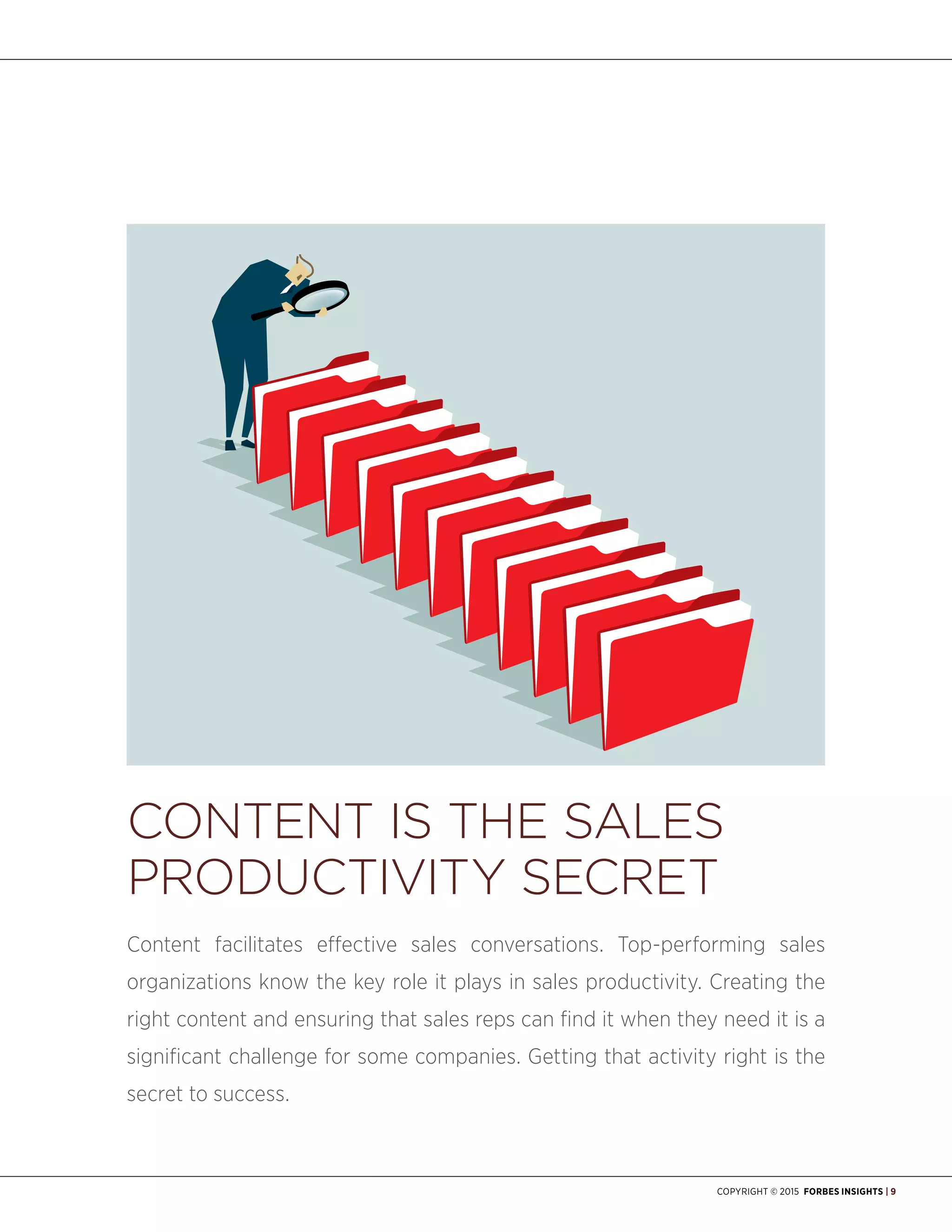
Content Is the Sales
Productivity Secret
Content facilitates effective sales conversations. Top-performing sales
organizations know the key role it plays in sales productivity. Creating the
right content and ensuring that sales reps can find it when they need it is a
significant challenge for some companies. Getting that activity right is the
secret to success.
10 | The Power of Enablement: Bridging the Sales Productivity Gap
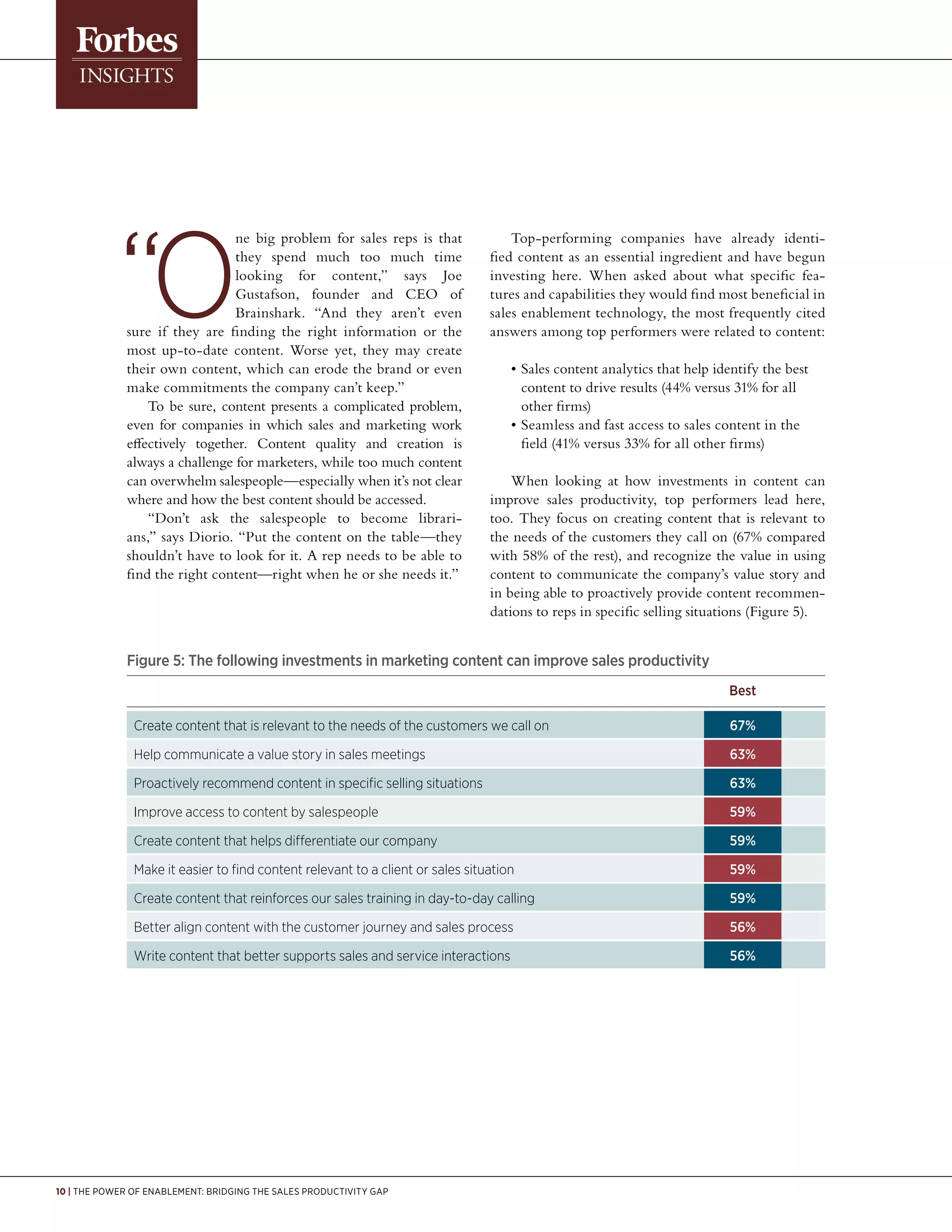
Figure 5: The following investments in marketing content can improve sales productivity
				 Best
Create content that is relevant to the needs of the customers we call on
	
67%
Help communicate a value story in sales meetings
	
63%
Proactively recommend content in specific selling situations
	
63%
Improve access to content by salespeople
		
59%
Create content that helps differentiate our company
	
59%
Make it easier to find content relevant to a client or sales situation
	
59%
Create content that reinforces our sales training in day-to-day calling
	
59%
Better align content with the customer journey and sales process
	
56%
Write content that better supports sales and service interactions
	
56%
O
ne big problem for sales reps is that
they spend much too much time
looking for content,” says Joe
Gustafson, founder and CEO of
Brainshark. “And they aren’t even
sure if they are finding the right information or the
most up-to-date content. Worse yet, they may create
their own content, which can erode the brand or even
make commitments the company can’t keep.”
To be sure, content presents a complicated problem,
even for companies in which sales and marketing work
effectively together. Content quality and creation is
always a challenge for marketers, while too much content
can overwhelm salespeople—especially when it’s not clear
where and how the best content should be accessed.
“Don’t ask the salespeople to become librari-
ans,” says Diorio. “Put the content on the table—they
shouldn’t have to look for it. A rep needs to be able to
find the right content—right when he or she needs it.”
Top-performing companies have already identi-
fied content as an essential ingredient and have begun
investing here. When asked about what specific fea-
tures and capabilities they would find most beneficial in
sales enablement technology, the most frequently cited
answers among top performers were related to content:
•	Sales content analytics that help identify the best
content to drive results (44% versus 31% for all
other firms)
•	Seamless and fast access to sales content in the
field (41% versus 33% for all other firms)
When looking at how investments in content can
improve sales productivity, top performers lead here,
too. They focus on creating content that is relevant to
the needs of the customers they call on (67% compared
with 58% of the rest), and recognize the value in using
content to communicate the company’s value story and
in being able to proactively provide content recommen-
dations to reps in specific selling situations (Figure 5).
Copyright © 2015 Forbes Insights | 11
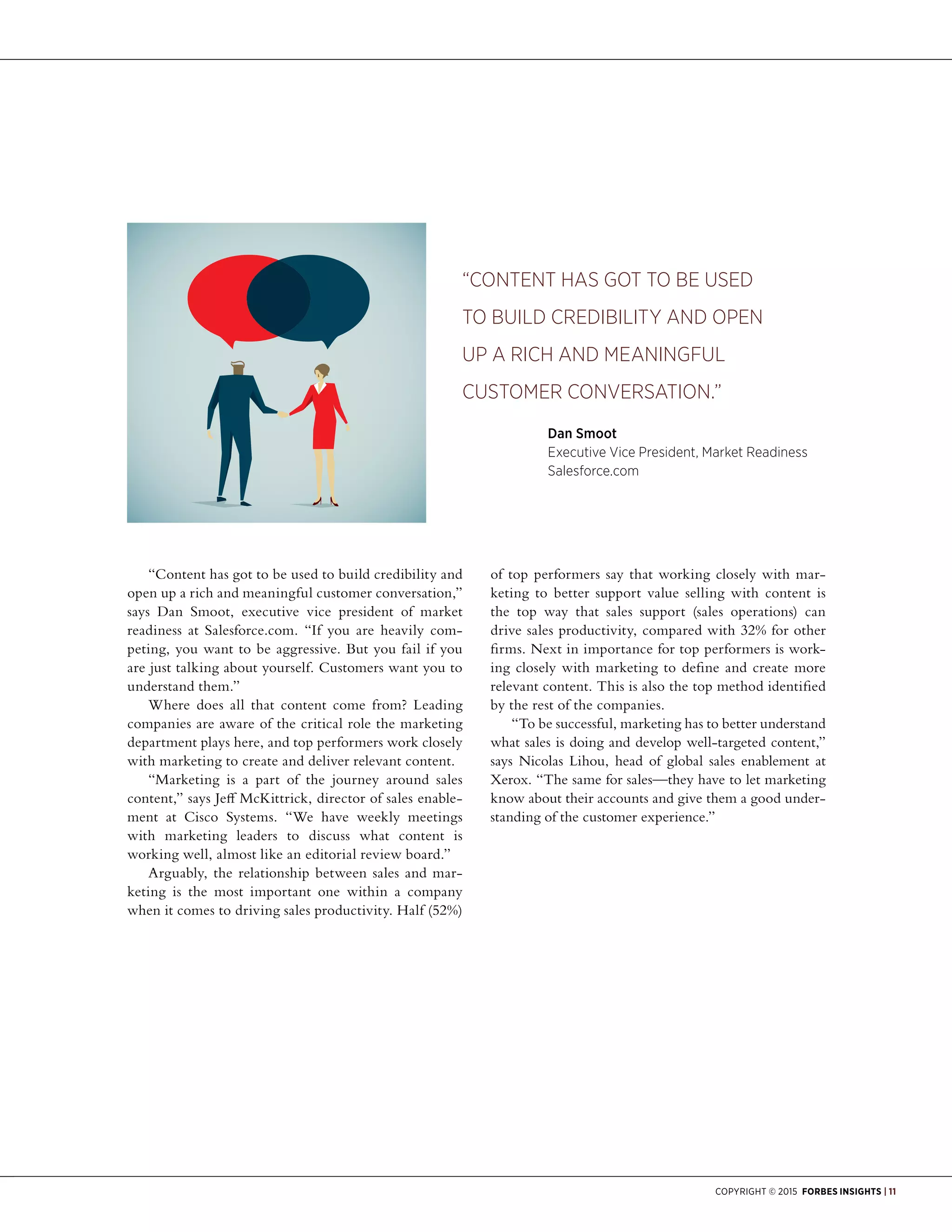
“Content has got to be used to build credibility and
open up a rich and meaningful customer conversation,”
says Dan Smoot, executive vice president of market
readiness at Salesforce.com. “If you are heavily com-
peting, you want to be aggressive. But you fail if you
are just talking about yourself. Customers want you to
understand them.”
Where does all that content come from? Leading
companies are aware of the critical role the marketing
department plays here, and top performers work closely
with marketing to create and deliver relevant content.
“Marketing is a part of the journey around sales
content,” says Jeff McKittrick, director of sales enable-
ment at Cisco Systems. “We have weekly meetings
with marketing leaders to discuss what content is
working well, almost like an editorial review board.”
Arguably, the relationship between sales and mar-
keting is the most important one within a company
when it comes to driving sales productivity. Half (52%)
of top performers say that working closely with mar-
keting to better support value selling with content is
the top way that sales support (sales operations) can
drive sales productivity, compared with 32% for other
firms. Next in importance for top performers is work-
ing closely with marketing to define and create more
relevant content. This is also the top method identified
by the rest of the companies.
“To be successful, marketing has to better understand
what sales is doing and develop well-targeted content,”
says Nicolas Lihou, head of global sales enablement at
Xerox. “The same for sales—they have to let marketing
know about their accounts and give them a good under-
standing of the customer experience.”
“Content has got to be used
to build credibility and open
up a rich and meaningful
customer conversation.”
	 Dan Smoot
	 Executive Vice President, Market Readiness
	Salesforce.com
12 | The Power of Enablement: Bridging the Sales Productivity Gap
ompanies leading the way in sales produc-
tivity focus on enabling salespeople to
consistently engage in these value conversa-
tions. The key differentiator here is
consistency of the sales message. When
asked to identify top challenges to productivity, 70% of
top-performing companies report that the ability to
deliver a consistent message is not a challenge at all,
and in fact, they do it well. In contrast, only 37% of all
other firms think they have a handle on this.
“Value messaging and value conversations have to
be consistent from end to end, so the salesperson tells
the same story as marketing, but tuned to the buyer’s
needs,” says Diorio.
Consistency requires alignment across the entire
organization, as well as skill development and training to
ensure salespeople know the core selling themes. They
also need access to the necessary content and resources to
engage with buyers and support their sales conversations.
As companies consider all the moving parts that
contribute to sales productivity, those at the front of
the pack know that human capital makes a difference.
Both individual contributors and front-line sales man-
agers have roles here.
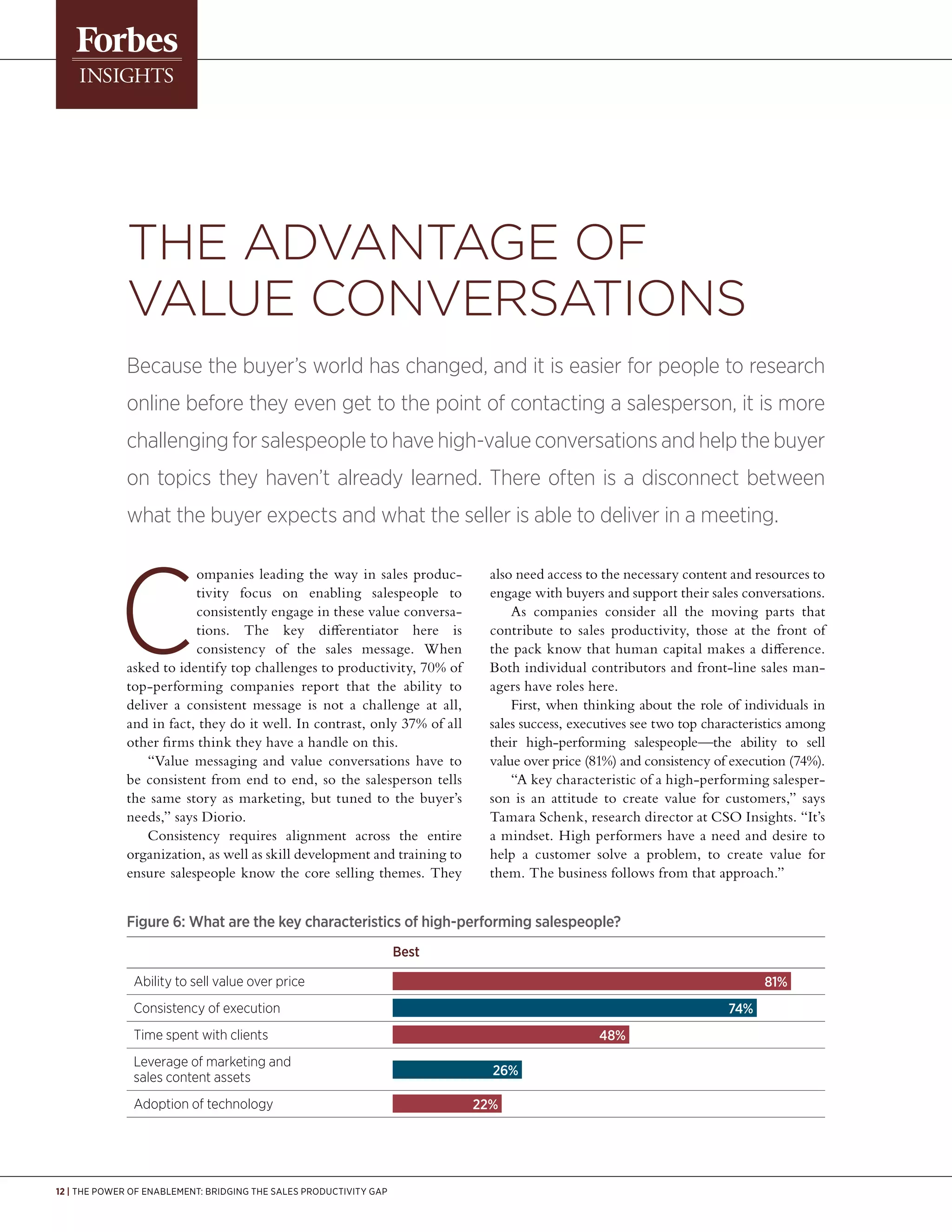
First, when thinking about the role of individuals in
sales success, executives see two top characteristics among
their high-performing salespeople—the ability to sell
value over price (81%) and consistency of execution (74%).
“A key characteristic of a high-performing salesper-
son is an attitude to create value for customers,” says
Tamara Schenk, research director at CSO Insights. “It’s
a mindset. High performers have a need and desire to
help a customer solve a problem, to create value for
them. The business follows from that approach.”
The Advantage of
Value Conversations
Because the buyer’s world has changed, and it is easier for people to research
online before they even get to the point of contacting a salesperson, it is more
challenging for salespeople to have high-value conversations and help the buyer
on topics they haven’t already learned. There often is a disconnect between
what the buyer expects and what the seller is able to deliver in a meeting.
Figure 6: What are the key characteristics of high-performing salespeople?
			Best
Ability to sell value over price		 81%
Consistency of execution		 74%
Time spent with clients		 48%
Leverage of marketing and
sales content assets		 26%
Adoption of technology		 22%
Copyright © 2015 Forbes Insights | 13
Companies with top sales organizations also pay
particular attention to front-line sales managers. When
these managers have the right information and the right
tools, they can more effectively coach salespeople in a
way that has a measurable impact on sales outcomes.
“Front-line sales managers are the most important
people to hire in the company,” says Smoot. “If you
don’t have great sales leaders, that is your first line of
fault. We had some issues, and now we spend as much
time talking about sales leadership as we do about indi-
vidual contributors.”
Schenk agrees. “Front-line managers have the
highest effect in any sales organization. Just think
about how many salespeople they lead on average. Why
wouldn’t you invest in the front-line sales managers
first, knowing that this investment can impact six to
12 people?”
This layer of management is an important cog in
the machine of top-performing companies, especially
in coaching and supporting the reps they manage.
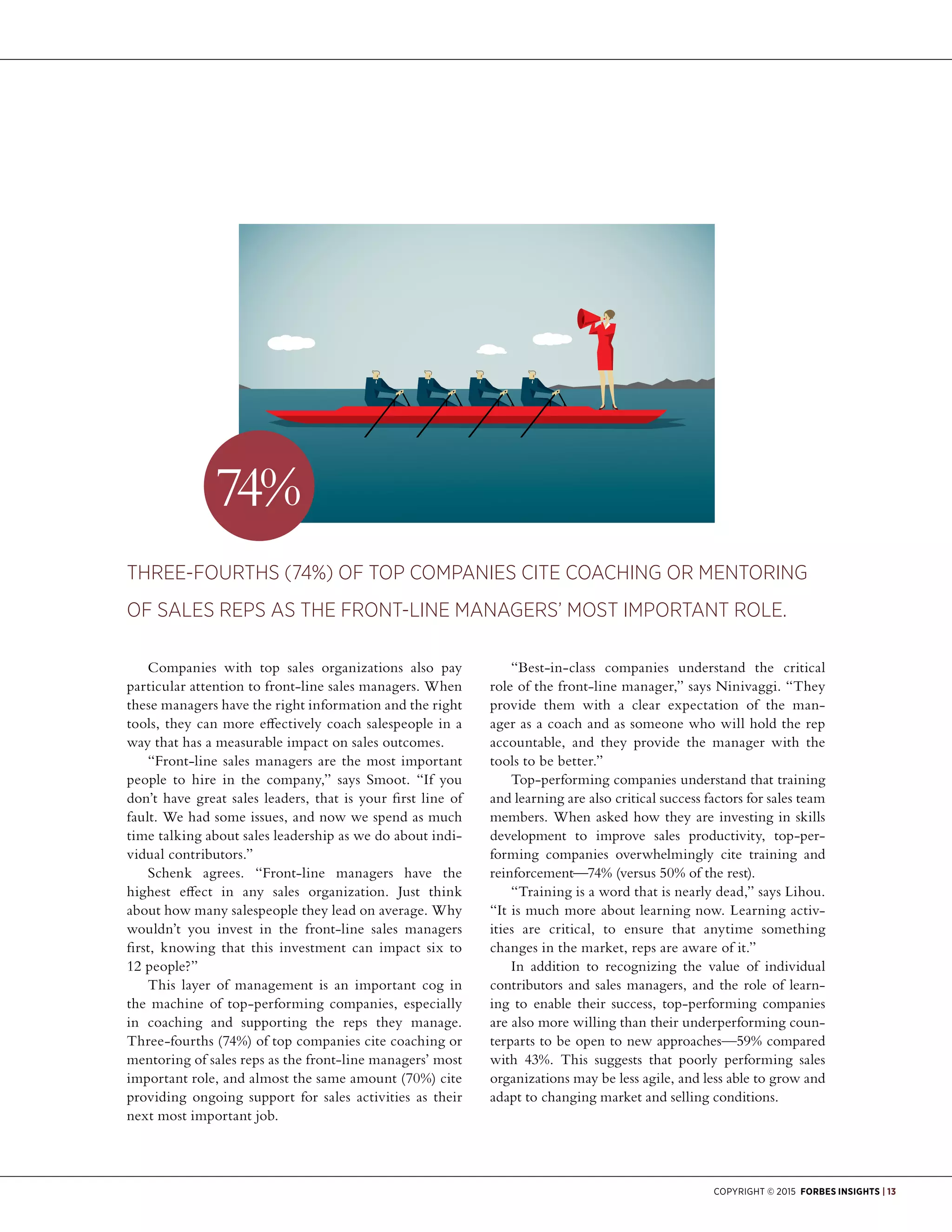
Three-fourths (74%) of top companies cite coaching or
mentoring of sales reps as the front-line managers’ most
important role, and almost the same amount (70%) cite
providing ongoing support for sales activities as their
next most important job.
“Best-in-class companies understand the critical
role of the front-line manager,” says Ninivaggi. “They
provide them with a clear expectation of the man-
ager as a coach and as someone who will hold the rep
accountable, and they provide the manager with the
tools to be better.”
Top-performing companies understand that training
and learning are also critical success factors for sales team
members. When asked how they are investing in skills
development to improve sales productivity, top-per-
forming companies overwhelmingly cite training and
reinforcement—74% (versus 50% of the rest).
“Training is a word that is nearly dead,” says Lihou.
“It is much more about learning now. Learning activ-
ities are critical, to ensure that anytime something
changes in the market, reps are aware of it.”
In addition to recognizing the value of individual
contributors and sales managers, and the role of learn-
ing to enable their success, top-performing companies
are also more willing than their underperforming coun-
terparts to be open to new approaches—59% compared
with 43%. This suggests that poorly performing sales
organizations may be less agile, and less able to grow and
adapt to changing market and selling conditions.
Three-fourths (74%) of top companies cite coaching or mentoring
of sales reps as the front-line managers’ most important role.
74%
14 | The Power of Enablement: Bridging the Sales Productivity Gap
When looking at how they invest in technology to drive sales,
top-performing companies are investing at a higher rate than their
counterparts in underperforming companies.
Copyright © 2015 Forbes Insights | 15
our out of the top five sales productivity chal-
lenges deal with effectiveness of sales
reps—onboarding new sales reps, cutting time
to close first deals for new reps, shortening the
sales cycle, increasing percentage of reps who
reach quota (Figure 7). Top performers have already
identified these impactful areas and are less likely to have
critical issues there. They have also found ways to speed
up the process outside of core selling activities and iden-
tified how to make reps more efficient.
Top-tier companies know that many factors work
together to drive efficiency and effectiveness within a
sales team. That means that there are many things that
compete for attention, as management considers how
to apportion limited budgets and finds ways to simplify
and streamline the selling process. Technology is part
of the answer, and an aspect that requires a thought-
ful approach.
“Technology plays an important role,” says Schenk.
“The sequence is important, though. Companies
should have a solid foundation of strategies, processes
and methodologies. That will enable them to select the
right technology and be well prepared for a successful
implementation. If the homework is done before, tech-
nology can create a lot of value for an organization.”
For organizations with a strong and consistent
methodology, technology is an incredible tool—one
that helps their reps train and prepare faster, find the
right content and communicate the right messaging to
each customer.
“Salespeople are spending hours searching for
information and recreating things,” says Lihou. “They
are mobile and doing things in the car or a coffee shop.
The resources should be available to them, and access to
those resources can now be enabled with technology.”
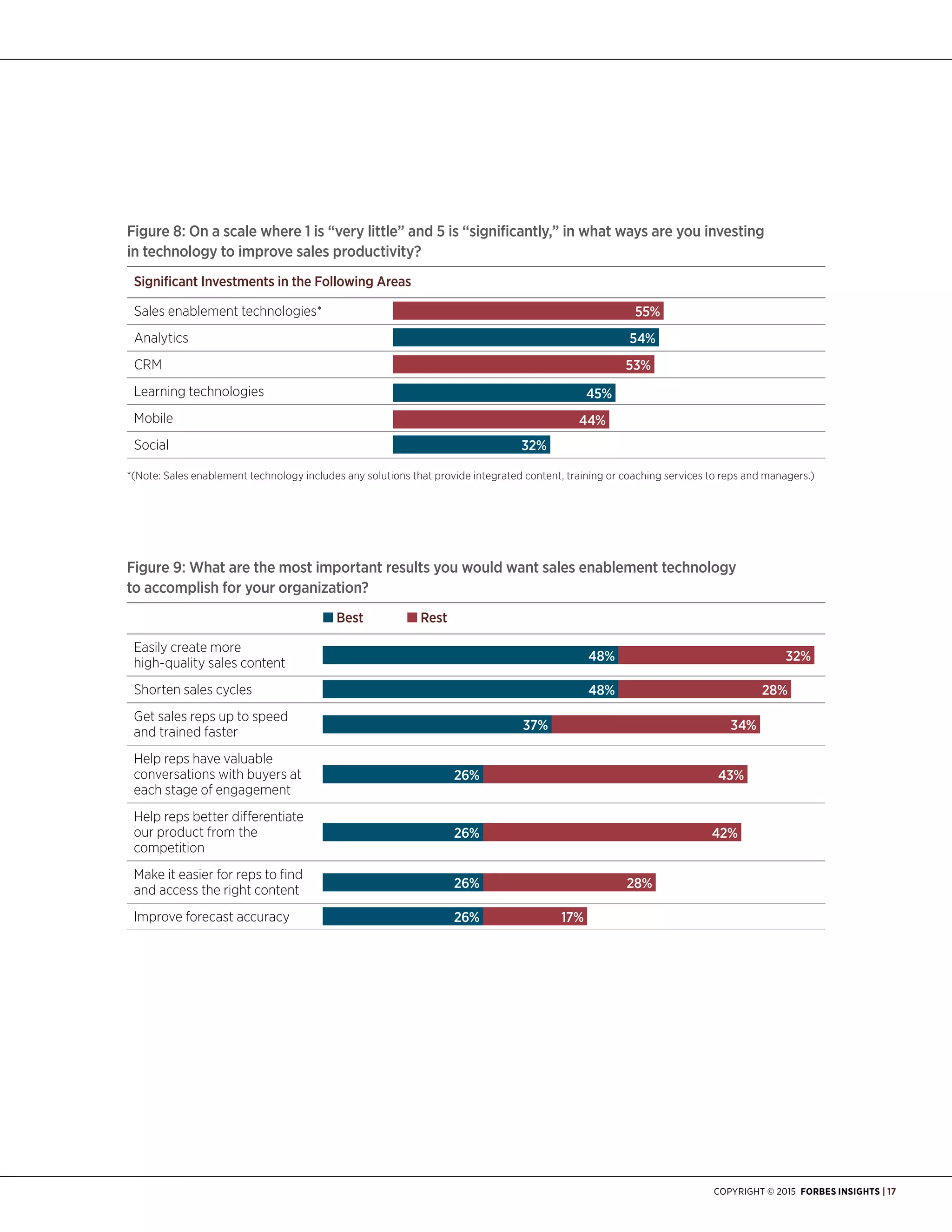
When looking at how they invest in technology to
drive sales, top-performing companies are investing
at a higher rate than their counterparts in underper-
forming companies. And they are looking to sales
enablement technologies, analytics, CRM systems and
learning technologies to make the difference for their
teams (Figure 8).
The “How” to
Productivity =
Efficiency +
Effectiveness
Companies with successful sales organizations know that sales productivity is
about being both efficient and effective. “Sales enablement is about how to
improve productivity of sales by squeezing out inefficiencies and maximizing
effectiveness,” says Ninivaggi. “The salesperson has to show up on the call, be
knowledgeable and skillful, and have the right assets.”
16 | The Power of Enablement: Bridging the Sales Productivity Gap
In today’s climate, companies face a plethora of tech-
nology options. There are many available solutions with
the goal of helping sales reps become more produc-
tive—to the degree that it creates confusion. It may even
reduce sales productivity in organizations that do not
approach a technology solution thoughtfully. With the
number of functions that need to work together to drive
true sales productivity, this makes the case for compa-
nies to look to sales enablement platform solutions rather
than to individual or piecemeal technology approaches.
“What we are running into is that some compa-
nies have upwards of five to 10 different productivity
tools, and that makes it challenging for sales reps,” says
Quint. “There is a tipping point where [using] too
many of these applications has a negative impact.”
Companies with successful sales organizations
know that productivity is about being both efficient
and effective. And they recognize that sales enable-
ment technology can help take them to the next level.
Top-performing companies look to sales enablement
technology to consistently empower their sales reps
beyond the basics—to improve their efficiency and
effectiveness by enabling marketing to create high-
quality sales content, shortening the sales cycle and
ensuring salespeople get up to speed and trained faster.
Companies that are not performing well look to
sales enablement technology for more-fundamen-
tal selling tasks like enabling value conversations with
buyers and differentiating the company’s product from
the competition (Figure 9).
Figure 7: What are the top things that are holding back your organization from achieving
its full potential today?*
				 Rest 	Best
Cutting the time it takes for new reps to close first deals
	
43%
	
19%
Onboarding new reps quickly and effectively	
41%
	
26%
Increasing percentage of reps who reach quota
	
41%
	
19%
Shortening sales cycles
			
39%
	
26%
Reduce time reps waste searching for content	
39%
	
22%
Coaching/mentoring reps throughout the selling process
	
38%
	
19%
Improve forecast accuracy			 38%
	
11%
Increasing deal sizes			 37%
	
26%
Increase CRM (customer relationship management) system adoption
	
36%
	
26%
Selling new or acquired products		 32%
	
15%
Reduce time reps spend creating their own content	
31%
	
19%
Understand how content affects sales cycles
	
31%
	
15%
Consistency of sales messages
		
30%
	
11%
*Respondents rated these factors as either materially impacting sales productivity or a critical problem and a top reason their salespeople do
not perform well.
Copyright © 2015 Forbes Insights | 17
Figure 8: On a scale where 1 is “very little” and 5 is “significantly,” in what ways are you investing
in technology to improve sales productivity?
Significant Investments in the Following Areas
Sales enablement technologies*	 55%
Analytics			 54% 	
CRM			 53%
Learning technologies		 45%
Mobile			 44%
Social			 32%
*(Note: Sales enablement technology includes any solutions that provide integrated content, training or coaching services to reps and managers.)
Figure 9: What are the most important results you would want sales enablement technology
to accomplish for your organization?
		 n Best		 n Rest
Easily create more
high-quality sales content	 32%48%
Shorten sales cycles	 28%48%
Get sales reps up to speed
and trained faster	 34%		 37% 	
Help reps have valuable
conversations with buyers at
each stage of engagement 	
43%26%
Help reps better differentiate
our product from the
competition		
42%26%
Make it easier for reps to find
and access the right content	 28%26%
Improve forecast accuracy	 17%26%
18 | The Power of Enablement: Bridging the Sales Productivity Gap
Conclusion
It is possible for companies to achieve dramatic
improvements in sales productivity. The infor-
mation to do so is out there—top-performing
companies are exceeding their goals every day.
To join the ranks of these leading sales organiza-
tions, companies would do well to recognize the critical success factors of top
companies and follow their lead in key areas such as onboarding, continuous
learning, and coaching powered by content and analytics.
ales organizations need to make sales enable-
ment and sales productivity a priority for the
company as a whole. And they need to work
to ensure support for this mission from the
C-suite. They should also recognize that a
sales enablement function cannot provide enough value
on its own. The road to success involves aligning with
other teams in the company, especially marketing, and
working together to create and deliver value for
customers.
To bridge the sales productivity gap, struggling
companies need to understand the key role of con-
tent in empowering reps—to make sense of the client’s
challenges and meet their needs—in other words, to
deliver value in every sales meeting. And they need
to put the right technology and resources in place to
enable reps and everyone in the organization to deliver
a consistent sales message.
Finally, successful sales organizations know that
enablement is all about improving both efficiency and
effectiveness. In today’s world one of the most pow-
erful ways to accomplish this is with sales enablement
technology that addresses the comprehensive need.
Businesses with inefficient and ineffective sales
processes are not reaching their potential. Their sales
productivity is way off the mark as they struggle to
increase revenue per rep and narrow the gap between
their top salespeople and the rest of the team. And even
top performers know there is room for improvement.
Not every sales enablement function looks the
same, and there are many different levers a company
can pull in an effort to make its sales force more pro-
ductive. But no matter what that function looks like,
companies that prioritize sales productivity, work col-
laboratively to deliver the company’s value message
and recognize the value of investing in technology to
improve both efficiency and effectiveness will start to
close that gap and make their way to the top of the list.
Copyright © 2015 Forbes Insights | 19
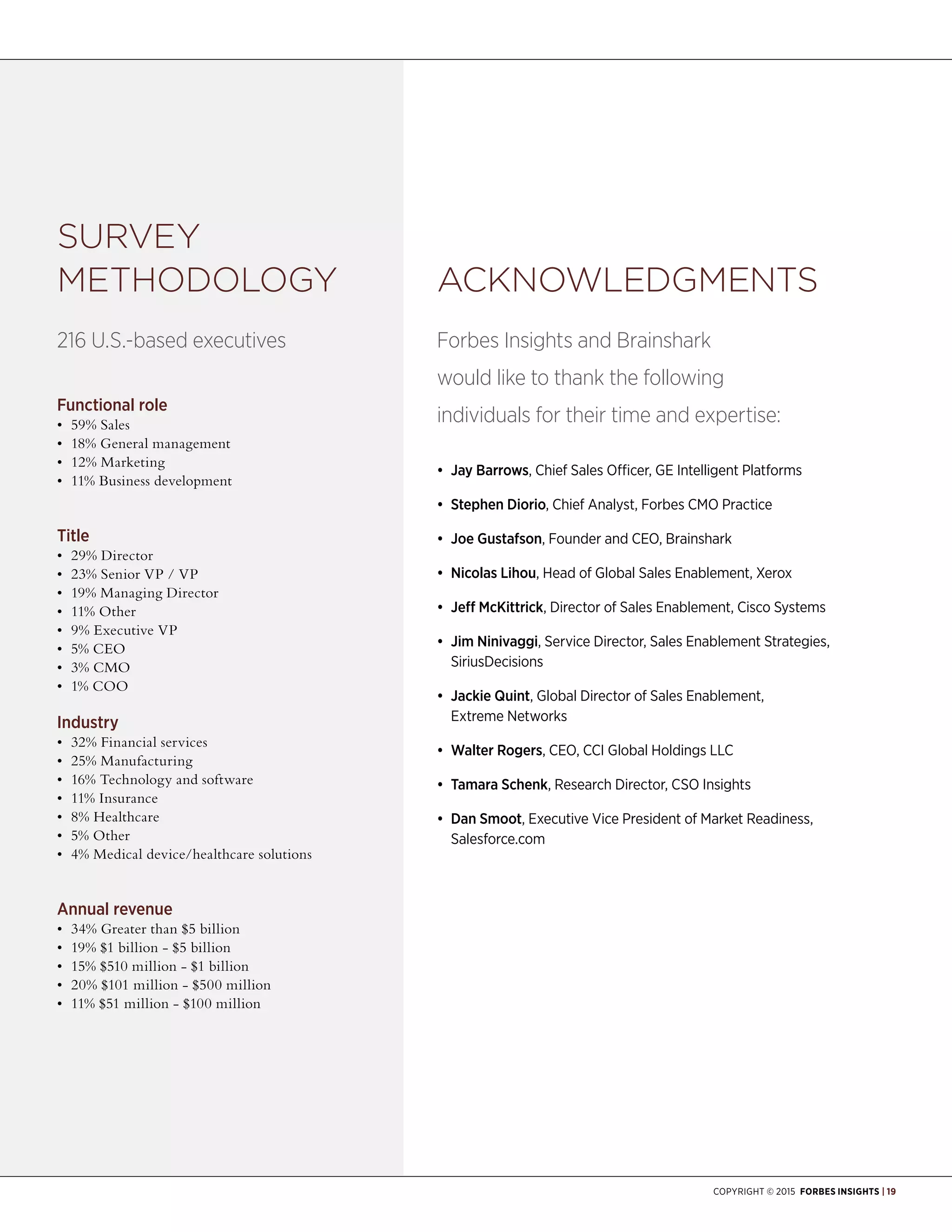
Functional role
•	 59% Sales
•	 18% General management
•	 12% Marketing
•	 11% Business development
Title
•	 29% Director
•	 23% Senior VP / VP
•	 19% Managing Director
•	 11% Other
•	 9% Executive VP
•	 5% CEO
•	 3% CMO
•	 1% COO
Industry
•	 32% Financial services
•	 25% Manufacturing
•	 16% Technology and software
•	 11% Insurance
•	 8% Healthcare
•	 5% Other
•	 4% Medical device/healthcare solutions
Annual revenue
•	 34% Greater than $5 billion
•	 19% $1 billion - $5 billion
•	 15% $510 million - $1 billion
•	 20% $101 million - $500 million
•	 11% $51 million - $100 million
Survey
Methodology
216 U.S.-based executives
Acknowledgments
Forbes Insights and Brainshark
would like to thank the following
individuals for their time and expertise:
	
•	 Jay Barrows, Chief Sales Officer, GE Intelligent Platforms
•	 Stephen Diorio, Chief Analyst, Forbes CMO Practice
•	 Joe Gustafson, Founder and CEO, Brainshark
•	 Nicolas Lihou, Head of Global Sales Enablement, Xerox
•	 Jeff McKittrick, Director of Sales Enablement, Cisco Systems
•	 Jim Ninivaggi, Service Director, Sales Enablement Strategies,
SiriusDecisions
•	 Jackie Quint, Global Director of Sales Enablement,
Extreme Networks
•	 Walter Rogers, CEO, CCI Global Holdings LLC
•	 Tamara Schenk, Research Director, CSO Insights
•	 Dan Smoot, Executive Vice President of Market Readiness,
Salesforce.com
20 | The Power of Enablement: Bridging the Sales Productivity Gap
ABout Brainshark
Brainshark sales enablement solutions help organizations harness
the power of content to achieve faster training, better coaching and
more successful sales conversations.
Brainshark simplifies the creation and delivery of content to ensure
salespeople are always up-to-date with the information and
resources they need—anytime, anywhere, and from any device.
Tight integration with Salesforce empowers reps with fast, seamless
access to the right content and training for every selling situation.
Detailed analytics enable managers to tie content directly to
revenue, identify the best sales opportunities, and use best practices
to coach B players to perform like A players.
Thousands of companies—including half of the Fortune 100—rely on
Brainshark to improve sales productivity and increase the impact of
their sales, marketing, and training communications.
Learn more at www.brainshark.com.
Contact
Brainshark Inc.
866.276.7427
info@brainshark.com
About
Forbes Insights
Forbes Insights is the strategic research and thought leadership practice of Forbes Media, publisher
of Forbes magazine and Forbes.com, whose combined media properties reach nearly 75 million
business decision makers worldwide on a monthly basis. Taking advantage of a proprietary database
of senior-level executives in the Forbes community, Forbes Insights conducts research on a host of
topics of interest to C-level executives, senior marketing professionals, small business owners and
those who aspire to positions of leadership, as well as providing deep insights into issues and trends
surrounding wealth creation and wealth management.
499 Washington Blvd., Jersey City, NJ 07310 | 212.366.8890 | www.forbes.com/forbesinsights
Forbes Insights
Bruce Rogers
Chief Insights Officer
Erika Maguire
Project Manager
Editorial
Kasia Wandycz Moreno, Director
Hugo S. Moreno, Director
Manya Chylinski, Report Author
Kari Pagnano, Designer
Research
Ross Gagnon, Director
Kimberly Kurata, Research Analyst
Sales
North America
Brian McLeod, Commercial Director
Matthew Muszala, Manager
William Thompson, Manager
Europe
Charles Yardley, Managing Director
Middle East/Asia/Pacific
Serene Lee, Executive Director

The power of Enablement - Bridging the Sales Gap -Brainshark Forbes Insights 2015_web

  • 1.
    The Power of Enablement Bridgingthe Sales Productivity Gap IN ASSOCIATION WITH:
  • 2.
    Contents Overview........................................................................................................................................................................ 2 Key Findings.................................................................................................................................................................3 Management Focus on Sales Enablement and Sales Productivity..................................................... 5 Aligning Sales and Marketing............................................................................................................................... 7 Content Is the Sales Productivity Secret.........................................................................................................9 The Advantage of Value Conversations.........................................................................................................12 The “How” to Productivity = Efficiency + Effectiveness..........................................................................15 Conclusion....................................................................................................................................................................18 Survey Methodology...............................................................................................................................................19 Acknowledgments...................................................................................................................................................19 About Brainshark.................................................................................................................................................... 20
  • 3.
    2 | ThePower of Enablement: Bridging the Sales Productivity Gap Overview As selling gets more costly and buyers become more informed, sales productivity continues to present challenges for all companies. But the difficulties are not the same across the board. Those with top-performing sales teams see real and measurable results from their focus on best-in-class sales practices—having a defined sales enablement function, strong alignment of sales and marketing, and a focus on content and technology to improve both the efficiency and effectiveness of their sales force. In short, they recognize the importance of sales productivity for the company’s survival and suc- cess—it’s a strategic priority. Sales enablement is a potent formula for improv- ing sales productivity (defined as revenue per rep). This is borne out by the fact that sales enablement is a key focus for companies with best-in-class sales organiza- tions: 59% of leading companies have a defined sales enablement role. And while there are notable performance differ- ences between high performers and low performers, very few companies escape productivity challenges— they all look for ways to increase revenue per rep and narrow the gap between top-performing salespeo- ple and the rest of the team. Companies that are at or below plan often struggle to meet or exceed reve- nue targets and are significantly hampered by the sales activities that leading companies seem to do well. Yet even top-performing companies face challenges with some of these issues, offering room to improve their performance even more. To understand what makes best-in-class sales organi- zations tick and identify opportunities to close the sales productivity gap, Forbes Insights and Brainshark sur- veyed 216 top executives in companies headquartered in the U.S. during the summer of 2015. As the survey reveals, there is no single point of failure or success for sales organizations. All companies face a combination of factors that together affect productivity. To over- come these challenging issues, companies need to find a solution that addresses both halves of sales productiv- ity—efficiency and effectiveness—and learn to work collaboratively to deliver value messages to their cus- tomers and top-line sales results to the C-suite. Best versus the Rest What separates leaders in sales productivity from organiza- tions still struggling with this critical issue? Top-performing companies—the top 10% of enterprises—are identified in the Forbes Insights/Brainshark survey as those executives whose organizations: • Are above plan or well above plan in achieving revenue targets • Rank sales productivity as the top priority relative to other key areas of management focus • Self-identified as being “above average” or “leading the way” with regard to sales productivity
  • 4.
    Copyright © 2015Forbes Insights | 3 Key Findings Sales productivity and sales enablement are dead center on management’s radar screen. Three-fifths of top-performing companies have a defined sales enablement role. And C-level executives in all com- panies realize the critical value of sales productivity to achieving growth and competitive advantage. Leading companies value alignment of sales and marketing. Three-fourths of top-performing organizations have strong alignment between sales and marketing; poorly per- forming companies notably do not. Top sales organizations recognize the key role content plays in sales productivity. Investment in content is helping top-performing firms succeed—top sales organizations are less likely to consider the amount of time reps spend creating or looking for content as a top productivity challenge, and nearly half want sales enablement technology to help them more easily create high-quality sales content. Leading companies excel at providing consistent sales messages. Seven out of 10 top-performing companies are able to provide a consistent sales message, compared with just four out of 10 for those with less sales success. Investments in improving efficiency and effectiveness provide value to the sales organization. Best-in-class companies know that many factors work together to drive productivity and look to technology as a way to address this need.
  • 5.
    4 | ThePower of Enablement: Bridging the Sales Productivity Gap “Sales enablement is about creating ever-increasing sales productivity from the day the rep arrives at the company.” Jay Barrows Chief Sales Officer GE Intelligent Platforms
  • 6.
    Copyright © 2015Forbes Insights | 5 I t would be hard to find a CEO who wouldn’t say that increasing revenue and reducing cost of sales is one of their top three or four goals,” says Jackie Quint, global director of sales enablement at Extreme Networks. “This is why sales enablement has become so critical.” Yet the job of those in the C-suite is to see the big picture for the entire company. So they view the sales function through another lens in addition to rev- enue—how it helps to meet or exceed corporate goals and objectives. “CEOs fundamentally don’t want to hear about tools; they don’t care,” says Walter Rogers, CEO of CCI Global Holdings LLC. “They want to hear about how to connect their end-point vision, such as produc- tivity or profitability, to a strategy.” Companies succeed when the issue of sales enable- ment and sales productivity is top of mind for the management team. Sales enablement is a key focus for companies at the top of the productivity scale—59% of top-performing companies have a defined sales enablement role, as do 72% of all companies that report revenues more than 25% above plan. “Sales enablement is about creating ever-increas- ing sales productivity from the day the rep arrives at the company,” says Jay Barrows, chief sales officer at GE Intelligent Platforms. “Hiring reps with the right subject matter experience and giving them the right process, the right accounts, the right tools…to help ensure they pri- oritize every day so they can be effective, productive and massively impactful.” When management pays attention to enabling their sales teams, it makes a real difference. The evidence is in the performance of “the rest” of the companies in the survey, or those not leading the way in sales. Only 30% of underperforming companies have a sales enablement role in their organizations. Companies across the productivity continuum rec- ognize the key role sales productivity needs to play in the organization: nearly one-third (30%) of all the companies surveyed rank sales productivity as the most important management focus, more important than any other factor, including creating an excellent prod- uct or focusing on brand building (Figure 1). Management Focus on Sales Enablement and Sales Productivity The sales organization drives revenue for companies, and executives in the C-suite look to them to deliver top-line sales results. Figure 1: Please rank how important sales productivity is relative to these other key areas of management focus: Sales productivity 30% Product excellence 25% Quality of execution 13% Operational excellence 12% Brand building 11% Marketing effectiveness 10%
  • 7.
    6 | ThePower of Enablement: Bridging the Sales Productivity Gap Sales productivity is critical to achieving the goals of the organization, such as profit, competitive advantage and shareholder value. The top goal that sales produc- tivity enables any company to achieve is growth—half of the executives surveyed cite that as essential to suc- cess. But C-level executives in particular know that sales productivity is, in fact, paramount to enabling a company to grow—71% rank it as of critical impor- tance (Figure 2). Together this data suggests that to be truly produc- tive, companies need a defined sales enablement function within the organization and need to ensure that sales productivity is on the radar screen in the executive suite. Without support from the CEO and the entire manage- ment team, the sales organization may not receive the resources and focus necessary for success. Figure 2: On a scale of 1 to 5, where 1 is not important and 5 is critical, please rate how important sales productivity is to achieving growth Achieving Growth 5 = Critical C-Level 71% Other Executives 55% C-level executives in particular know that sales productivity is, in fact, paramount to enabling a company to grow—71% rank it as of critical importance. 71%
  • 8.
    Copyright © 2015Forbes Insights | 7 Aligning Sales and Marketing Top-performing companies value a strong sales enablement function and understand the importance of aligning sales and marketing teams. These companies know that sales enablement is best addressed by having the function sit inside the sales organization and then work closely with teams outside sales as well. T he sales enablement function exists because it is getting harder and harder to get reps to the point where they maxi- mize every customer interaction,” says Jim Ninivaggi, service director, sales enablement strategies at SiriusDecisions. “Reps are over- whelmed with content, communications, events and the like. Companies need to have a function in place that acts like a buffer, to orchestrate and deliver information to reps in a way they can find, digest and utilize.” It is compelling to note that sales enablement is a distinct function of sales for companies at or near the top of the performance scale. Among firms with a defined sales enablement function, that function resides inside the sales organization for 69% of the companies surveyed, no matter where they fall on the productiv- ity scale (Figure 3). And there is evidence suggesting that when the enablement function sits within the sales organization, it may lead to higher sales productivity: 18% of firms with the sales enablement function in the sales organi- zation are considered top performers, compared with just 6% of firms with the function elsewhere. Figure 3: Which function in your organization is primarily responsible for sales enablement activities? All Companies With Defined Sales Enablement Function Sales 69% Marketing 20% Finance 4% IT 3%
  • 9.
    8 | ThePower of Enablement: Bridging the Sales Productivity Gap Top-performing companies recognize that the sales team cannot achieve success alone. This is supported by the fact that companies with strong alignment between the marketing and sales departments come out on the top of the sales productivity scale. Three-quarters (74%) of top-performing companies report good align- ment between their sales and marketing departments, compared with just half (49%) of other firms. In fact, most companies (87%) that are below their revenue plan report poor alignment between sales and market- ing teams. This survey finds that firms with a defined enable- ment function have greater alignment between sales and marketing (Figure 4). By joining the forces of these two key departments, sales leaders are recognizing the cross-functional nature of sales and the importance of marketing’s role in supporting content, creating value messaging and aligning content to the sales process and customer journey. “Who is going to own the problem of content?” says Stephen Diorio, chief analyst, Forbes CMO Practice. “Sales wants the content and can tell you what it should look like. But marketing has to provide it. And there’s a shared responsibility to maintain it.” Figure 4: How well aligned are the marketing and sales functions in your organization? n Companies With Defined Sales Enablement Function n Companies Without Defined Sales Enablement Function Good alignment between sales and marketing 42% 61% “The sales enablement function exists because it is getting harder and harder to get reps to the point where they maximize every customer interaction.” Jim Ninivaggi Service Director, Sales Enablement Strategies SiriusDecisions
  • 10.
    Copyright © 2015Forbes Insights | 9 Content Is the Sales Productivity Secret Content facilitates effective sales conversations. Top-performing sales organizations know the key role it plays in sales productivity. Creating the right content and ensuring that sales reps can find it when they need it is a significant challenge for some companies. Getting that activity right is the secret to success.
  • 11.
    10 | ThePower of Enablement: Bridging the Sales Productivity Gap Figure 5: The following investments in marketing content can improve sales productivity Best Create content that is relevant to the needs of the customers we call on 67% Help communicate a value story in sales meetings 63% Proactively recommend content in specific selling situations 63% Improve access to content by salespeople 59% Create content that helps differentiate our company 59% Make it easier to find content relevant to a client or sales situation 59% Create content that reinforces our sales training in day-to-day calling 59% Better align content with the customer journey and sales process 56% Write content that better supports sales and service interactions 56% O ne big problem for sales reps is that they spend much too much time looking for content,” says Joe Gustafson, founder and CEO of Brainshark. “And they aren’t even sure if they are finding the right information or the most up-to-date content. Worse yet, they may create their own content, which can erode the brand or even make commitments the company can’t keep.” To be sure, content presents a complicated problem, even for companies in which sales and marketing work effectively together. Content quality and creation is always a challenge for marketers, while too much content can overwhelm salespeople—especially when it’s not clear where and how the best content should be accessed. “Don’t ask the salespeople to become librari- ans,” says Diorio. “Put the content on the table—they shouldn’t have to look for it. A rep needs to be able to find the right content—right when he or she needs it.” Top-performing companies have already identi- fied content as an essential ingredient and have begun investing here. When asked about what specific fea- tures and capabilities they would find most beneficial in sales enablement technology, the most frequently cited answers among top performers were related to content: • Sales content analytics that help identify the best content to drive results (44% versus 31% for all other firms) • Seamless and fast access to sales content in the field (41% versus 33% for all other firms) When looking at how investments in content can improve sales productivity, top performers lead here, too. They focus on creating content that is relevant to the needs of the customers they call on (67% compared with 58% of the rest), and recognize the value in using content to communicate the company’s value story and in being able to proactively provide content recommen- dations to reps in specific selling situations (Figure 5).
  • 12.
    Copyright © 2015Forbes Insights | 11 “Content has got to be used to build credibility and open up a rich and meaningful customer conversation,” says Dan Smoot, executive vice president of market readiness at Salesforce.com. “If you are heavily com- peting, you want to be aggressive. But you fail if you are just talking about yourself. Customers want you to understand them.” Where does all that content come from? Leading companies are aware of the critical role the marketing department plays here, and top performers work closely with marketing to create and deliver relevant content. “Marketing is a part of the journey around sales content,” says Jeff McKittrick, director of sales enable- ment at Cisco Systems. “We have weekly meetings with marketing leaders to discuss what content is working well, almost like an editorial review board.” Arguably, the relationship between sales and mar- keting is the most important one within a company when it comes to driving sales productivity. Half (52%) of top performers say that working closely with mar- keting to better support value selling with content is the top way that sales support (sales operations) can drive sales productivity, compared with 32% for other firms. Next in importance for top performers is work- ing closely with marketing to define and create more relevant content. This is also the top method identified by the rest of the companies. “To be successful, marketing has to better understand what sales is doing and develop well-targeted content,” says Nicolas Lihou, head of global sales enablement at Xerox. “The same for sales—they have to let marketing know about their accounts and give them a good under- standing of the customer experience.” “Content has got to be used to build credibility and open up a rich and meaningful customer conversation.” Dan Smoot Executive Vice President, Market Readiness Salesforce.com
  • 13.
    12 | ThePower of Enablement: Bridging the Sales Productivity Gap ompanies leading the way in sales produc- tivity focus on enabling salespeople to consistently engage in these value conversa- tions. The key differentiator here is consistency of the sales message. When asked to identify top challenges to productivity, 70% of top-performing companies report that the ability to deliver a consistent message is not a challenge at all, and in fact, they do it well. In contrast, only 37% of all other firms think they have a handle on this. “Value messaging and value conversations have to be consistent from end to end, so the salesperson tells the same story as marketing, but tuned to the buyer’s needs,” says Diorio. Consistency requires alignment across the entire organization, as well as skill development and training to ensure salespeople know the core selling themes. They also need access to the necessary content and resources to engage with buyers and support their sales conversations. As companies consider all the moving parts that contribute to sales productivity, those at the front of the pack know that human capital makes a difference. Both individual contributors and front-line sales man- agers have roles here. First, when thinking about the role of individuals in sales success, executives see two top characteristics among their high-performing salespeople—the ability to sell value over price (81%) and consistency of execution (74%). “A key characteristic of a high-performing salesper- son is an attitude to create value for customers,” says Tamara Schenk, research director at CSO Insights. “It’s a mindset. High performers have a need and desire to help a customer solve a problem, to create value for them. The business follows from that approach.” The Advantage of Value Conversations Because the buyer’s world has changed, and it is easier for people to research online before they even get to the point of contacting a salesperson, it is more challenging for salespeople to have high-value conversations and help the buyer on topics they haven’t already learned. There often is a disconnect between what the buyer expects and what the seller is able to deliver in a meeting. Figure 6: What are the key characteristics of high-performing salespeople? Best Ability to sell value over price 81% Consistency of execution 74% Time spent with clients 48% Leverage of marketing and sales content assets 26% Adoption of technology 22%
  • 14.
    Copyright © 2015Forbes Insights | 13 Companies with top sales organizations also pay particular attention to front-line sales managers. When these managers have the right information and the right tools, they can more effectively coach salespeople in a way that has a measurable impact on sales outcomes. “Front-line sales managers are the most important people to hire in the company,” says Smoot. “If you don’t have great sales leaders, that is your first line of fault. We had some issues, and now we spend as much time talking about sales leadership as we do about indi- vidual contributors.” Schenk agrees. “Front-line managers have the highest effect in any sales organization. Just think about how many salespeople they lead on average. Why wouldn’t you invest in the front-line sales managers first, knowing that this investment can impact six to 12 people?” This layer of management is an important cog in the machine of top-performing companies, especially in coaching and supporting the reps they manage. Three-fourths (74%) of top companies cite coaching or mentoring of sales reps as the front-line managers’ most important role, and almost the same amount (70%) cite providing ongoing support for sales activities as their next most important job. “Best-in-class companies understand the critical role of the front-line manager,” says Ninivaggi. “They provide them with a clear expectation of the man- ager as a coach and as someone who will hold the rep accountable, and they provide the manager with the tools to be better.” Top-performing companies understand that training and learning are also critical success factors for sales team members. When asked how they are investing in skills development to improve sales productivity, top-per- forming companies overwhelmingly cite training and reinforcement—74% (versus 50% of the rest). “Training is a word that is nearly dead,” says Lihou. “It is much more about learning now. Learning activ- ities are critical, to ensure that anytime something changes in the market, reps are aware of it.” In addition to recognizing the value of individual contributors and sales managers, and the role of learn- ing to enable their success, top-performing companies are also more willing than their underperforming coun- terparts to be open to new approaches—59% compared with 43%. This suggests that poorly performing sales organizations may be less agile, and less able to grow and adapt to changing market and selling conditions. Three-fourths (74%) of top companies cite coaching or mentoring of sales reps as the front-line managers’ most important role. 74%
  • 15.
    14 | ThePower of Enablement: Bridging the Sales Productivity Gap When looking at how they invest in technology to drive sales, top-performing companies are investing at a higher rate than their counterparts in underperforming companies.
  • 16.
    Copyright © 2015Forbes Insights | 15 our out of the top five sales productivity chal- lenges deal with effectiveness of sales reps—onboarding new sales reps, cutting time to close first deals for new reps, shortening the sales cycle, increasing percentage of reps who reach quota (Figure 7). Top performers have already identified these impactful areas and are less likely to have critical issues there. They have also found ways to speed up the process outside of core selling activities and iden- tified how to make reps more efficient. Top-tier companies know that many factors work together to drive efficiency and effectiveness within a sales team. That means that there are many things that compete for attention, as management considers how to apportion limited budgets and finds ways to simplify and streamline the selling process. Technology is part of the answer, and an aspect that requires a thought- ful approach. “Technology plays an important role,” says Schenk. “The sequence is important, though. Companies should have a solid foundation of strategies, processes and methodologies. That will enable them to select the right technology and be well prepared for a successful implementation. If the homework is done before, tech- nology can create a lot of value for an organization.” For organizations with a strong and consistent methodology, technology is an incredible tool—one that helps their reps train and prepare faster, find the right content and communicate the right messaging to each customer. “Salespeople are spending hours searching for information and recreating things,” says Lihou. “They are mobile and doing things in the car or a coffee shop. The resources should be available to them, and access to those resources can now be enabled with technology.” When looking at how they invest in technology to drive sales, top-performing companies are investing at a higher rate than their counterparts in underper- forming companies. And they are looking to sales enablement technologies, analytics, CRM systems and learning technologies to make the difference for their teams (Figure 8). The “How” to Productivity = Efficiency + Effectiveness Companies with successful sales organizations know that sales productivity is about being both efficient and effective. “Sales enablement is about how to improve productivity of sales by squeezing out inefficiencies and maximizing effectiveness,” says Ninivaggi. “The salesperson has to show up on the call, be knowledgeable and skillful, and have the right assets.”
  • 17.
    16 | ThePower of Enablement: Bridging the Sales Productivity Gap In today’s climate, companies face a plethora of tech- nology options. There are many available solutions with the goal of helping sales reps become more produc- tive—to the degree that it creates confusion. It may even reduce sales productivity in organizations that do not approach a technology solution thoughtfully. With the number of functions that need to work together to drive true sales productivity, this makes the case for compa- nies to look to sales enablement platform solutions rather than to individual or piecemeal technology approaches. “What we are running into is that some compa- nies have upwards of five to 10 different productivity tools, and that makes it challenging for sales reps,” says Quint. “There is a tipping point where [using] too many of these applications has a negative impact.” Companies with successful sales organizations know that productivity is about being both efficient and effective. And they recognize that sales enable- ment technology can help take them to the next level. Top-performing companies look to sales enablement technology to consistently empower their sales reps beyond the basics—to improve their efficiency and effectiveness by enabling marketing to create high- quality sales content, shortening the sales cycle and ensuring salespeople get up to speed and trained faster. Companies that are not performing well look to sales enablement technology for more-fundamen- tal selling tasks like enabling value conversations with buyers and differentiating the company’s product from the competition (Figure 9). Figure 7: What are the top things that are holding back your organization from achieving its full potential today?* Rest Best Cutting the time it takes for new reps to close first deals 43% 19% Onboarding new reps quickly and effectively 41% 26% Increasing percentage of reps who reach quota 41% 19% Shortening sales cycles 39% 26% Reduce time reps waste searching for content 39% 22% Coaching/mentoring reps throughout the selling process 38% 19% Improve forecast accuracy 38% 11% Increasing deal sizes 37% 26% Increase CRM (customer relationship management) system adoption 36% 26% Selling new or acquired products 32% 15% Reduce time reps spend creating their own content 31% 19% Understand how content affects sales cycles 31% 15% Consistency of sales messages 30% 11% *Respondents rated these factors as either materially impacting sales productivity or a critical problem and a top reason their salespeople do not perform well.
  • 18.
    Copyright © 2015Forbes Insights | 17 Figure 8: On a scale where 1 is “very little” and 5 is “significantly,” in what ways are you investing in technology to improve sales productivity? Significant Investments in the Following Areas Sales enablement technologies* 55% Analytics 54% CRM 53% Learning technologies 45% Mobile 44% Social 32% *(Note: Sales enablement technology includes any solutions that provide integrated content, training or coaching services to reps and managers.) Figure 9: What are the most important results you would want sales enablement technology to accomplish for your organization? n Best n Rest Easily create more high-quality sales content 32%48% Shorten sales cycles 28%48% Get sales reps up to speed and trained faster 34% 37% Help reps have valuable conversations with buyers at each stage of engagement 43%26% Help reps better differentiate our product from the competition 42%26% Make it easier for reps to find and access the right content 28%26% Improve forecast accuracy 17%26%
  • 19.
    18 | ThePower of Enablement: Bridging the Sales Productivity Gap Conclusion It is possible for companies to achieve dramatic improvements in sales productivity. The infor- mation to do so is out there—top-performing companies are exceeding their goals every day. To join the ranks of these leading sales organiza- tions, companies would do well to recognize the critical success factors of top companies and follow their lead in key areas such as onboarding, continuous learning, and coaching powered by content and analytics. ales organizations need to make sales enable- ment and sales productivity a priority for the company as a whole. And they need to work to ensure support for this mission from the C-suite. They should also recognize that a sales enablement function cannot provide enough value on its own. The road to success involves aligning with other teams in the company, especially marketing, and working together to create and deliver value for customers. To bridge the sales productivity gap, struggling companies need to understand the key role of con- tent in empowering reps—to make sense of the client’s challenges and meet their needs—in other words, to deliver value in every sales meeting. And they need to put the right technology and resources in place to enable reps and everyone in the organization to deliver a consistent sales message. Finally, successful sales organizations know that enablement is all about improving both efficiency and effectiveness. In today’s world one of the most pow- erful ways to accomplish this is with sales enablement technology that addresses the comprehensive need. Businesses with inefficient and ineffective sales processes are not reaching their potential. Their sales productivity is way off the mark as they struggle to increase revenue per rep and narrow the gap between their top salespeople and the rest of the team. And even top performers know there is room for improvement. Not every sales enablement function looks the same, and there are many different levers a company can pull in an effort to make its sales force more pro- ductive. But no matter what that function looks like, companies that prioritize sales productivity, work col- laboratively to deliver the company’s value message and recognize the value of investing in technology to improve both efficiency and effectiveness will start to close that gap and make their way to the top of the list.
  • 20.
    Copyright © 2015Forbes Insights | 19 Functional role • 59% Sales • 18% General management • 12% Marketing • 11% Business development Title • 29% Director • 23% Senior VP / VP • 19% Managing Director • 11% Other • 9% Executive VP • 5% CEO • 3% CMO • 1% COO Industry • 32% Financial services • 25% Manufacturing • 16% Technology and software • 11% Insurance • 8% Healthcare • 5% Other • 4% Medical device/healthcare solutions Annual revenue • 34% Greater than $5 billion • 19% $1 billion - $5 billion • 15% $510 million - $1 billion • 20% $101 million - $500 million • 11% $51 million - $100 million Survey Methodology 216 U.S.-based executives Acknowledgments Forbes Insights and Brainshark would like to thank the following individuals for their time and expertise: • Jay Barrows, Chief Sales Officer, GE Intelligent Platforms • Stephen Diorio, Chief Analyst, Forbes CMO Practice • Joe Gustafson, Founder and CEO, Brainshark • Nicolas Lihou, Head of Global Sales Enablement, Xerox • Jeff McKittrick, Director of Sales Enablement, Cisco Systems • Jim Ninivaggi, Service Director, Sales Enablement Strategies, SiriusDecisions • Jackie Quint, Global Director of Sales Enablement, Extreme Networks • Walter Rogers, CEO, CCI Global Holdings LLC • Tamara Schenk, Research Director, CSO Insights • Dan Smoot, Executive Vice President of Market Readiness, Salesforce.com
  • 21.
    20 | ThePower of Enablement: Bridging the Sales Productivity Gap ABout Brainshark Brainshark sales enablement solutions help organizations harness the power of content to achieve faster training, better coaching and more successful sales conversations. Brainshark simplifies the creation and delivery of content to ensure salespeople are always up-to-date with the information and resources they need—anytime, anywhere, and from any device. Tight integration with Salesforce empowers reps with fast, seamless access to the right content and training for every selling situation. Detailed analytics enable managers to tie content directly to revenue, identify the best sales opportunities, and use best practices to coach B players to perform like A players. Thousands of companies—including half of the Fortune 100—rely on Brainshark to improve sales productivity and increase the impact of their sales, marketing, and training communications. Learn more at www.brainshark.com. Contact Brainshark Inc. 866.276.7427 info@brainshark.com
  • 22.
    About Forbes Insights Forbes Insightsis the strategic research and thought leadership practice of Forbes Media, publisher of Forbes magazine and Forbes.com, whose combined media properties reach nearly 75 million business decision makers worldwide on a monthly basis. Taking advantage of a proprietary database of senior-level executives in the Forbes community, Forbes Insights conducts research on a host of topics of interest to C-level executives, senior marketing professionals, small business owners and those who aspire to positions of leadership, as well as providing deep insights into issues and trends surrounding wealth creation and wealth management. 499 Washington Blvd., Jersey City, NJ 07310 | 212.366.8890 | www.forbes.com/forbesinsights Forbes Insights Bruce Rogers Chief Insights Officer Erika Maguire Project Manager Editorial Kasia Wandycz Moreno, Director Hugo S. Moreno, Director Manya Chylinski, Report Author Kari Pagnano, Designer Research Ross Gagnon, Director Kimberly Kurata, Research Analyst Sales North America Brian McLeod, Commercial Director Matthew Muszala, Manager William Thompson, Manager Europe Charles Yardley, Managing Director Middle East/Asia/Pacific Serene Lee, Executive Director