Rapid Advance
Mergers & Acquisitions, Partnerships, Restructurings, Turnarounds
and Divestitures in High Technology
David J. Litwiller
Copyright © 2008 by David J. Litwiller.
All rights reserved. Except as permitted under the U.S. Copyright Act of 1976,
no part of this publication may be reproduced, distributed or transmitted in
any form or by any means without prior written permission of the author.
Library of Congress Cataloging-in-Publication Data
For Cynthia, Kyla and Heather
v
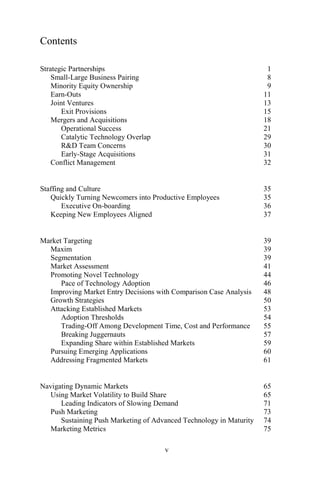
Contents
Strategic Partnerships 1
Small-Large Business Pairing 8
Minority Equity Ownership 9
Earn-Outs 11
Joint Ventures 13
Exit Provisions 15
Mergers and Acquisitions 18
Operational Success 21
Catalytic Technology Overlap 29
R&D Team Concerns 30
Early-Stage Acquisitions 31
Conflict Management 32
Staffing and Culture 35
Quickly Turning Newcomers into Productive Employees 35
Executive On-boarding 36
Keeping New Employees Aligned 37
Market Targeting 39
Maxim 39
Segmentation 39
Market Assessment 41
Promoting Novel Technology 44
Pace of Technology Adoption 46
Improving Market Entry Decisions with Comparison Case Analysis 48
Growth Strategies 50
Attacking Established Markets 53
Adoption Thresholds 54
Trading-Off Among Development Time, Cost and Performance 55
Breaking Juggernauts 57
Expanding Share within Established Markets 59
Pursuing Emerging Applications 60
Addressing Fragmented Markets 61
Navigating Dynamic Markets 65
Using Market Volatility to Build Share 65
Leading Indicators of Slowing Demand 71
Push Marketing 73
Sustaining Push Marketing of Advanced Technology in Maturity 74
Marketing Metrics 75
vi
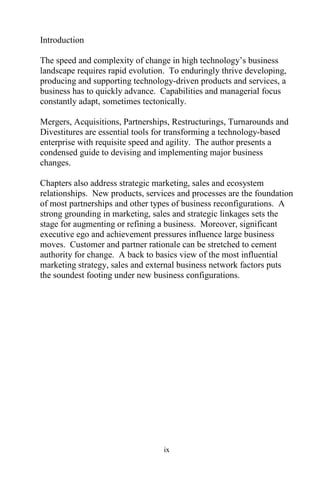
Ecosystem Relationships 79
Recruiting Partners 79
Setting Interoperability Standards 80
Industry Associations 90
Growing Sales 91
Success Formula 91
Variation 93
First Customers 93
Learn Quickly 93
Staffing 94
Diagnosing Trouble 94
Scaling-Up 96
Indirect Channel Sales 97
Cross Selling 97
Performance Metrics 100
OEM Customers 100
Customer Funded Development 101
Good Practice 103
Other Comments 103
Restructuring 105
Turnarounds 109
Divesting 121
Decision to Dispose 122
Objectives 125
Process 126
Preparation 126
Sale Method 133
Creating Competitive Auction Bidding 136
Marketing and Appraisal 139
Audience 139
Collateral Documents 139
Due Diligence 142
Negotiating 143
Signing to Closing 143
Separation 144
Timeline 145
Communication 146
Challenges and Advice 147
Advisors 148
vii
Bibliography 151
About the Author 155
ix
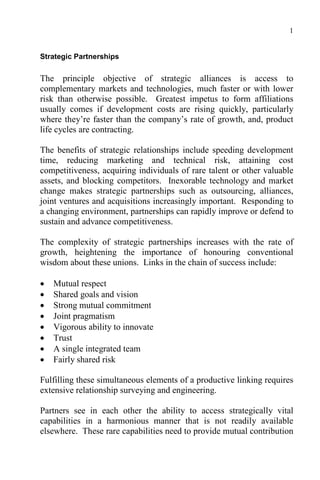
Introduction
The speed and complexity of change in high technology’s business
landscape requires rapid evolution. To enduringly thrive developing,
producing and supporting technology-driven products and services, a
business has to quickly advance. Capabilities and managerial focus
constantly adapt, sometimes tectonically.
Mergers, Acquisitions, Partnerships, Restructurings, Turnarounds and
Divestitures are essential tools for transforming a technology-based
enterprise with requisite speed and agility. The author presents a
condensed guide to devising and implementing major business
changes.
Chapters also address strategic marketing, sales and ecosystem
relationships. New products, services and processes are the foundation
of most partnerships and other types of business reconfigurations. A
strong grounding in marketing, sales and strategic linkages sets the
stage for augmenting or refining a business. Moreover, significant
executive ego and achievement pressures influence large business
moves. Customer and partner rationale can be stretched to cement
authority for change. A back to basics view of the most influential
marketing strategy, sales and external business network factors puts
the soundest footing under new business configurations.
1
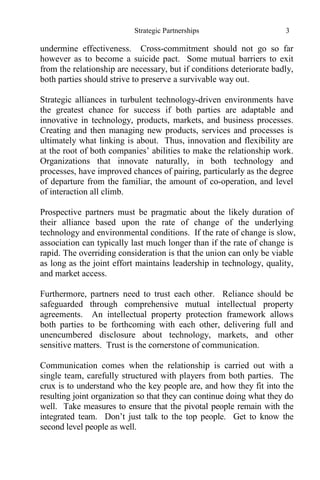
Strategic Partnerships
The principle objective of strategic alliances is access to
complementary markets and technologies, much faster or with lower
risk than otherwise possible. Greatest impetus to form affiliations
usually comes if development costs are rising quickly, particularly
where they’re faster than the company’s rate of growth, and, product
life cycles are contracting.
The benefits of strategic relationships include speeding development
time, reducing marketing and technical risk, attaining cost
competitiveness, acquiring individuals of rare talent or other valuable
assets, and blocking competitors. Inexorable technology and market
change makes strategic partnerships such as outsourcing, alliances,
joint ventures and acquisitions increasingly important. Responding to
a changing environment, partnerships can rapidly improve or defend to
sustain and advance competitiveness.
The complexity of strategic partnerships increases with the rate of
growth, heightening the importance of honouring conventional
wisdom about these unions. Links in the chain of success include:
 Mutual respect
 Shared goals and vision
 Strong mutual commitment
 Joint pragmatism
 Vigorous ability to innovate
 Trust
 A single integrated team
 Fairly shared risk
Fulfilling these simultaneous elements of a productive linking requires
extensive relationship surveying and engineering.
Partners see in each other the ability to access strategically vital
capabilities in a harmonious manner that is not readily available
elsewhere. These rare capabilities need to provide mutual contribution
2 Rapid Advance
that will be sustainable over the long-term. Joint dependence sets the
stage for the other elements of a successful partnership. Both
organizations need to feel that they have picked winner partners, and
mutually work to make each other and the combination successful.
The boundaries of partnership must be well defined, such as whether it
is for a technology, product group, application sector or geographic
market. Articulating limits for the relationship is usually crucial to
achieving buy-in on both sides, and at several management levels.
Defined boundaries also reduce the likelihood of migration into
competitive positions.
Partners must have similar objectives, shared vision and strategy, as
well as compatible cultures, values and personalities. These are the
foundation of success. They are fundamental to a workable pairing of
two entities, yet also among the most difficult aspects of prospective
partnerships to assess. Vision and culture embody many things, and
one can never have complete information about another. Even when a
partnership seems harmonious at one point in time, the subtleties of
different history and personalities, as well as unforeseen future events
means that there are many forces that can separate objectives.
Communication, shared vision and common strategy keep outlooks
aligned.
Compatibility of culture, personality and values, as well as trust enable
two other aspects of the pathway to success: a willingness to change
that engenders adaptability; and, open access to each others’ strategies,
which abets effective planning.
At the same time, the strong mutual commitment at the core of any
successful, sustainable relationship must be cemented in ways so that
when things get tough, neither party can easily walk away. This
begins with unwavering support at the outset from senior management
at both firms. Commitment paves the way for measures such as
investing in each other, sharing development costs, and contractually
committing to supply and purchase terms. Prospective partners must
have comparable stakes in the success of the venture. Otherwise, a
more traditional superior-subordinate relationship will arise from the
different importance each party places on the relationship, which will
Strategic Partnerships 3
undermine effectiveness. Cross-commitment should not go so far
however as to become a suicide pact. Some mutual barriers to exit
from the relationship are necessary, but if conditions deteriorate badly,
both parties should strive to preserve a survivable way out.
Strategic alliances in turbulent technology-driven environments have
the greatest chance for success if both parties are adaptable and
innovative in technology, products, markets, and business processes.
Creating and then managing new products, services and processes is
ultimately what linking is about. Thus, innovation and flexibility are
at the root of both companies’ abilities to make the relationship work.
Organizations that innovate naturally, in both technology and
processes, have improved chances of pairing, particularly as the degree
of departure from the familiar, the amount of co-operation, and level
of interaction all climb.
Prospective partners must be pragmatic about the likely duration of
their alliance based upon the rate of change of the underlying
technology and environmental conditions. If the rate of change is slow,
association can typically last much longer than if the rate of change is
rapid. The overriding consideration is that the union can only be viable
as long as the joint effort maintains leadership in technology, quality,
and market access.
Furthermore, partners need to trust each other. Reliance should be
safeguarded through comprehensive mutual intellectual property
agreements. An intellectual property protection framework allows
both parties to be forthcoming with each other, delivering full and
unencumbered disclosure about technology, markets, and other
sensitive matters. Trust is the cornerstone of communication.
Communication comes when the relationship is carried out with a
single team, carefully structured with players from both parties. The
crux is to understand who the key people are, and how they fit into the
resulting joint organization so that they can continue doing what they do
well. Take measures to ensure that the pivotal people remain with the
integrated team. Don’t just talk to the top people. Get to know the
second level people as well.
4 Rapid Advance
The skill is to figure out who are the most connected experts. They are
often not in the most prominent positions on a traditional organizational
chart. They are identified by asking a wide range of people which
colleagues they consult most frequently, who they turn to for help, and
who boost their energy levels. This is how to get a sense of how work
really gets done among a group, to help identify talent, and nurture the
most in-the-know employees. A single team of the brightest and best
among the two groups is then more easily built.
The unifying force of a single and consistent team, as well as channels
for regular and open communication among them contribute to a
successful co-operation. High bandwidth, low overhead
communication channels vitally foster adaptability to prevail in a
changing environment.
Partners must also fairly share risk. Cross investment is one
dimension, in both money and sweat equity. Partner firms need to
develop cross-functional capabilities, and be committed on both sides
to understanding each other’s processes, systems, workflows,
organizational structure, priorities, and reward systems. The two sides
can’t just get familiar with each others’ products and technology.
Knowing the way each other functions helps work get done across
organizational boundaries. Partners can then better make mutual
obligations to specific business, technology, competitiveness, and
quality milestones. Formal performance yard sticks help to signal for
corrective action as combined effort progresses. Up front
understandings and obligations diminish the likelihood for partners to
subjectively criticise each other, and maintains focus of both on
critical objectives.
Among the most important characteristics of strategic partnerships is
to deliver the whole product necessary to win market leadership. Why
is this so important? The reason is the largest and most profitable
revenue streams flow to market leaders, creating longevity of an
attractive market position to retain priority attention from the coterie.
Furthermore, with market leadership and the whole product, success
becomes more likely. This is because the fate of the initiative is then
largely within the collaborators’ control, rather than a disproportionate
dependence on outsiders who may be difficult to influence. Partners
Strategic Partnerships 5
need to construct a relationship with market leadership and the whole
product as prime objectives.
When formulating and operating a joint effort, partners sustain success
by making required compromises in equal measure at the same time.
Trade-offs by one should not be made in exchange for unspecified
future considerations from the other. This leads to disappointed
expectations, and can undermine an otherwise sound co-operation.
Investments by both partners throughout the alliance should be
specific and mutually agreed upon.
Regardless of planning and efforts to make exchanges in real-time,
disputes will arise. A conflict resolution process gives each party a
defined avenue of redress for unforeseen issues that come up. A
dissention work-out mechanism should be part of the up-front
partnership agreement. After difficulty strikes, agreeing upon a
resolution vehicle becomes significantly more difficult.
Firms seeking competitive advantage through joint efforts can pursue
different levels of involvement. Strategic partnerships cover a
spectrum from low to high co-operation and interaction:
 Purchase agreement, where even this basic level of partnership can
be complicated for strategically critical elements because of
exclusivity and mutual obligations
 Patent or technology license
 Franchise
 Cross-license
 R&D consortium
 Co-production
 Product or market exclusivity
 Minority equity participation
 Joint venture
 Merger
 Acquisition
Considering this spectrum, lower co-operation and interaction
alliances can often come together more quickly, as well as disband
6 Rapid Advance
more easily when the basis for the alliance changes. Less involved
structures also provide an easier environment in which to bring in
multiple partners. Higher co-operation and interaction alliances
should be used as the scale of investment and cost of failure climb.
Whatever legal form, and sharing of risk and reward, partnerships
between companies are like any other where the greater the interaction
and co-operation, the more particular each company should be. Many
possibilities for joint ventures, mergers and acquisitions should be
evaluated, but only a minority completed. The right ingredients and
timing are rare. Businesses must be particular when contemplating
prospective partnerships, especially as the relationship becomes more
involved.
Characterizing a prospective partnership requires detailed due
diligence. It is a significant part of obtaining reliable information
about the quality of the assets on the other side. However, unlike the
perceptions of some, the purpose of due diligence isn’t so one can find
issues in order to negotiate better. Some jockeying goes on, but
arming for negotiation is not the lasting value of due diligence. The
larger and ongoing benefit that endures after the partnership goes into
operation is to identify issues so the relationship can be better
managed.
To fully assess opportunity and risk factors, due diligence in
evaluating potential partners should include:
 Technology
 Products, including products under development
 Markets
 Sales, service and support
 Marketing
 Customers, especially customer satisfaction
 Operations, including production and sourcing
 Legal and regulatory circumstances
 Management
 Employees
 Culture
Strategic Partnerships 7
Financial considerations should also be part of investigations for
strategic partnerships. However, a trait of relationships offering rare
opportunity for dramatic growth is typically that financial profiles of
current circumstances are of lesser importance than other due diligence
items. 1
This is because non-financial matters dominate joint
innovation capability and the capacity of joined organizations to create
competitive advantage and sustained long-term increases in
shareholder value.
Nevertheless, financial due diligence should cover:
 Return on investment
 Earnings per share contribution
 Discounted cash flow: estimated future cash flows discounted back
to present value
 Residual (terminal) value
 Free cash flow: earnings plus non-cash charges, less the capital
investment needed to maintain the business
 Economic value added: a combination of net profit and rate of
return, in a single statistic; net operating profit after tax, minus the
weighted average cost of capital
Most of the preceding partnership discussion has been about formation
and operation. However, cessation must also be considered. Some
take the view that cessation of a consociation is a sign of failure, as it
is in marriage. But, in changing technology and market circumstances,
an end is often a natural outcome, even with a short life span. Partner
companies’ failure to plan for termination is more often the avoidable
shortcoming. Greater time typically is invested in formative decisions
than cessation. Management of partnering firms should consider how
1
The most common exception to a secondary role for near-term financial
circumstances is in acquisitions where the firm to be acquired is comparable in size
or larger than the acquirer. In such cases, the acquirer may not have the financial
resources to carry the target, should significant difficulties within the target business
arise post-transaction. If so, financial due diligence, particularly regarding margins,
cash flow and net income becomes a chief due diligence and decision matter.
8 Rapid Advance
to terminate the united effort, including buyout provisions, and the
effect on each of the parent companies.
Small-Large Business Pairing
There are special considerations for small firms. A common issue for
a small organization seeking strategic partnership is that the
prospective partner is much larger and better established. This
incongruity presents some interesting challenges. Regardless of size,
the bottom line remains that both see in each other the ability to access
strategically vital capabilities in a harmonious manner which is not
readily available elsewhere, and a mutual significant ongoing
contribution. But, timing is significant, particularly for the larger
partner.
Sizeable prospective partners generally are best approached in slow
times. Overtures to larger partners during quieter times are important
when the initial business volume prospects from the collaboration are
low, as often happens while technology, product and market
development take place. Larger potential partners need to be solicited
when they will be more receptive to speculative ventures to fuel
growth. This is when they have the best chance to see the need for
significant innovation to propel future expansion and most likely to
take an open-minded look at the potential of the smaller player’s
technology and capabilities.
Partnerships of disproportionately sized companies also need to
contemplate an instability effect when considering interaction short of
merger or acquisition. If the little company ends up being important to
the big one, the big company often cannot risk not owning the little
one. On the other hand, if the little company ends up being
unimportant to the big one, it will be cast-off, often badly wounded.
The smaller company frequently needs to be willing to be absorbed or
be cast-off, as one of the costs of the partnership. Exclusivity and
take-over provisions are common requirements of a larger partner that
can lead to the instability effect. Stable long-term co-existence for
disproportionately sized partners, who haven’t merged, is unusual.
Strategic Partnerships 9
Partnerships of dissimilarly sized business also can undergo increased
risk of “hold-up” compared to like-sized collaborating entities.
Typically, one firm or the other makes investments specific to the
particular co-operative project, where those assets have limited value
in other uses. The gravity of sole-purpose investments is often much
greater for the smaller firm. The mismatch of dependency and sunk
costs for the partners creates the possibility that the other firm will
delay, in terms of payment or other corresponding forms of
participation, in order to gain advantage, perpetuate the status quo, or
renegotiate the terms of the deal.2
Managers need to assess hold-up hazards, and the effort necessary to
monitor and avert opportunistic behaviour. Determining risk, and the
amount of work to avoid difficulty, requires a clear understanding of
relationship-specific asset investments. Where the risk of hold-up
would otherwise be considerable, equity ownership by one firm in
another is often a vehicle for bringing alignment of interests,
especially between disparately sized firms.
Minority Equity Ownership
Short of complete ownership, partial equity participation by one firm
in a (typically) smaller partner is one of the significant influence-ors
that partners have to help align objectives and incentives. The way
partial equity ownership helps is by giving the entity buying-in real
skin in the game of the target’s business. It works best when the
buying-in party delivers a major piece of the puzzle that the investee
company is missing, and when there is joint desire to work together
rather than a forced marriage.
Building on these elements of success, the degree of equity ownership
of one firm in another can be used to provide:
 Exclusivity and control
2
“Choosing Equity Stakes in Technology Sourcing Relationships,” Kale and
Puranam, California Management Review, Spring 2004
10 Rapid Advance
 Alignment of interests
 Inter-organizational co-ordination, including linking or regrouping
activities across organizational boundaries to share knowledge and
control
At the same time, the cost for one firm taking an equity stake in
another, especially a smaller firm, can be summarized as:
 Reduced entrepreneurial motivation for the staff and management
of the target, due to changed incentives and work conditions
 Commitment cost to a particular technology, in an environment of
uncertain viability for the technology
 Commitment cost to a particular marketplace approach when there
is volatility about the structure of the industry, the target
marketplace, or demand for the technology
Equity ownership plays an important role accessing valuable resources,
ensuring they remain unique and difficult to imitate. The benefits and
costs of equity participation for both sides can be assessed using the
above framework.
As the benefits of equity ownership grow, and the costs decline, the
degree of equity ownership of one partnering business in another
should increase.
Where the benefits and costs do not point to a clear conclusion about
equity participation, creative deal-structuring and post-transaction
business unit incentives are one way of reducing complexity.
However, an unclear cost-benefit assessment of equity participation is
more often a signal that the partnership with an equity stake may not
be a good bet.
Strategic Partnerships 11
Earn-Outs
Equity participation often is suitable, but there is a valuation gap
between buyer and seller. To bridge the separation, a contingent
payment is the typical contractual mechanism. This is a variable
payment tied to future performance of the acquired business. It
addresses future business risk when exchanging significant ownership.
In the technology arena earn-outs are common. Many companies are
targeted for equity investment or acquisition after they have created
valuable technology, but before time has proven out that value in the
marketplace through revenues and profits. The advantage of an earn-
out is to create incentive within the acquired business for future
performance. It is a way for the seller to obtain a higher price, as they
prove the market value in the future. As well, contingent payment
lowers the purchaser’s risk of overpaying, lessens the impact of
differences in information and outlook between purchaser and seller at
the time of the transaction, and provides credibility from the seller
about the asset’s worth.
At the same time, earn-outs carry challenges and unintended
consequences. They can strain the new working relationship if
structured improperly. One difficulty can be the incentive for the
target’s management to maximize the payout formula at a defined
moment in time, which can be at odds with the better long-term
interest of the business. To create a more balanced view between
short- and long-range, graduated payments staged over the term of the
variable payment are usually better than one-time payment schemes.
Another consideration with contingent payments in equity transactions
is if structural integration with the acquirer is necessary for co-
ordinated operation. After amalgamation, it often becomes difficult to
evaluate or even measure the acquired unit’s stand-alone performance.
Linking the contingent payout to actions beyond the target
management’s control introduces significant complexity when
operational integration is foreseeable. Earn-outs are most successful
when the operating entity continues to be largely independent after the
investment or acquisition. In particular, the budgets for marketing and
development as well as distribution channel access should be
12 Rapid Advance
definitive. This way, both sides of the earn-out agreement have
greater assurance that the target entity will have the resources to
deliver its potential.
A further piece of the earn-out puzzle is management retention.
Where extensive integration and control of the acquired entity is likely,
but it is still desirable to retain the unit’s incoming management for
continuity or leadership, it can be better to replace the contingent
payment with a flat retention package. This is a fixed monetary sum
the target’s management receives for staying a certain period of time
post-transaction. To provide flexibility and buyer protection, the static
stay-pay incentive should include the option at the purchaser’s
convenience to pay out and part ways with the target’s management.
A fixed fee mechanism gives the acquirer the latitude it needs to make
structural and management changes to achieve integration. Sometimes,
the acquired management cannot break themselves of the habits of
independence, and rebuff integration efforts. The difficulties may
even be partly due to overreaching commitments of the acquirer during
sale negotiations about post-transaction independence. However
integration friction arises, a flat retention incentive with a unilateral
pay-out option for the acquirer reduces the risk of acquiring inexorable
management liabilities that impair co-ordination. In particular, a flat
sum buy-out clause curtails the possibility of the acquirer being held
hostage by the target’s management about changes that ultimately
inhibit the ability to make the equity partnership work.
The pragmatic implication of these factors for an earn-out is that the
time frame should typically be no more than three years. Integration
becomes more difficult to avoid the further into the future the
contingency term extends. At some point, operations will be
integrated, or set aside, and it will make sense to eliminate the trouble
of earn-out calculations.
Contingent payments are a constructive tool in equity purchase deal
structuring to align purchase value and incentives, but that utility has
limits. As a practical matter, they are best used when an acquirer and
target have an incoming valuation for the acquired business that is
within a factor of five of each other. If the valuation spread is larger,
Strategic Partnerships 13
typically even an earn-out will not provide enough of a bridge in time,
information and value to reach an agreement. At the other end of
valuation difference, when the gap is small and valuations by
purchaser and target are within 20% of each other, usually it is better
to continue negotiating and arrive at a single monetary figure. When
valuations are this close, the negotiations and post-transaction control
risk around a contingent payment mechanism can introduce more
complexity than it eliminates. With a small valuation gap, it is usually
better for both sides to transact at a single final valuation without
resorting to an earn-out.
When earn-outs are used, they can be based on revenues, operating
income, development goals or other factors. Definition and
interpretation issues can complicate earn-outs, so measurements and
milestones should be picked that are well defined and subject to little
interpretation. Subjective or complex formulae muddy the waters.
It is also important to uncover as much as possible about each side’s
risk preference and motivations during negotiation, in order to
structure an earn-out that meets both parties’ objectives. Unspoken
ambitions behind equity participation or sale will complicate the
contingent payment, as well as the partnership.
Earn-outs can be a good way to bridge a price gap between buyer and
seller, when they cannot arrive at a single figure. But life is simpler if
the transaction can be structured without a contingent payment. Every
avenue should be explored to reach a meeting of minds for valuation
and future incentives without an earn-out, before entering into one.
Nevertheless, under the right conditions of valuation gap, managerial
control, measurability and access to resources post-transaction, earn-
outs can play a role aligning incentives and valuation.
Joint Ventures
Among the range of partnership mechanisms, joint venture (JV)
deserves special mention. As a definition, a JV is a company funded
by two or more partners, who then jointly share in its profits, losses,
and management.
14 Rapid Advance
Joint ventures are typically used where:
1. An opportunity is strategically imperative for the partners, but the
cost or risk for either company to go it alone is prohibitive. Also,
access to some foreign markets can mandate engaging a local
partner in a JV.
2. Informational differences exist among prospective partners,
especially major mismatches that depend on deep and often tacit
knowledge which do not tend to be revealed well during due
diligence. These forms of private information can arise from
market knowledge, technology, or business processes. Operation
of the JV provides a mechanism for assimilating information and
developing a shared outlook.
3. The cost of collaboration over the near term is relatively small, and
uncertainties or information transfer will be resolved over the
medium term.
Under these circumstances, JVs tend to align incentives with
manageable unintended consequences to form effective partnership
mechanisms. As time goes on, JV’s can often be sequential
investments, leading to future investments and outright buyout, as
uncertainties diminish.
In some ways, JV’s are even more complex than acquisitions. JV’s
can bring in issues that never need to be addressed in an outright
business purchase. In an acquisition, after the close there is a single
owner with full decision authority. JV’s in contrast generate ongoing
issues to be resolved among two or more parent companies regarding
operations, management and governance. JV’s are also complex to
negotiate and operate because in many ways they are an unnatural
business form: JV’s require sharing, and most business strategy is
about capturing.
JV’s typically require a series of contracts to implement,
contemplating many contingencies and conflicts that may arise, and a
mechanism to deal with them. As a result, JV’s commonly take twice
Strategic Partnerships 15
as long as acquisitions to negotiate. Whereas acquisitions typically
take three to six months to complete, six to twelve months can elapse
initiating a JV. The time commitment to enter a JV can come as a
shock since some people envision a JV as a smaller deal than an
acquisition. People are usually mistaken who expect comparatively
faster deal structuring and implementation for JV’s than M&A.
Considering operation, splits of ownership and control have a strong
impact on downstream roles and responsibilities for JV partnering
companies:
 50%/50% provides equal influence over management, operations
and governance, but at the price of perpetual negotiation among
parents.
 Asymmetrical ownership requires that the minority partner cede
almost all managerial and operational control. The test for a
prospective minority partner is whether they’re ready to step aside.
 There are jurisdiction-specific thresholds of ownership and voting
control that dictate whether the owner companies need to report the
performance of the JV in their consolidated financial statements.
Especially if significant operating losses are expected from a JV,
financial reporting obligations can shape ownership split preference.
Exit Provisions
Much of the discussion about JV’s deals with formation, but
termination also needs attention. Joint ventures are usually transitory
structures, lasting six years as a broad average. With a relatively short
life span, partners need clear agreement at the outset about how the
end of the venture will be handled. A JV can come to an end when it
has achieved both parents’ objectives. It can also come to a
conclusion because of poor performance or parent deadlock. The
parties to a joint effort need to consider termination during the
formation of the venture.
By way of motivation to consider completion of the JV during front-
end negotiations, consider that about 85% of JV’s end in acquisition
16 Rapid Advance
by one of the partners. To boot, there is even an operational and
success probability dividend for the JV from defining exit conditions
during formation. It arises because absent an adequate separation
agreement, the strains of operating the partnership with no viable way
out encourages each partner to appropriate as much value as possible
from the alliance. Aggressive partner behaviour sours relations and
provokes animosity. Under such dysfunction, performance diminishes
and can even tip the JV into demise. Documented exit conditions from
the outset reduce strain in the relationship of the JV and help it to
succeed.
To put exit provisions in place, both sides need to express conditions
under which it makes sense to divest their interest, or to terminate the
venture, and the manner in which those outcomes will be carried out.
Master exit conditions usually include four components:
1) Exit triggers, defining the point of disengagement
2) Each party’s rights in a separation to assets, products, employees
and third party relationships such as suppliers, customers and
partners
3) Articulation of the disengagement process, including strategic
options, guidelines for creating the disengagement team, and
timelines
4) Communication plan, embracing customers, employees, suppliers,
partners, financial markets and other relevant constituencies
Considering the first item, exit triggers, typical circumstances to
provoke the end of the JV include the inability of the alliance to meet
certain milestones, performance metrics or service levels. Other
dissolution conditions commonly used are breaches of contract terms,
and, insolvency, change of control, or strategic re-direction of one of
the partners. Completion of the JV’s objectives, or, sharply changed
competitive circumstances can also signal that it is time to disband.
Next among exit elements are separation entitlements for the partners,
covering the post-JV period:
Strategic Partnerships 17
 Inventory of products, materials, equipment, IP, land, and facilities
 Revenue sharing, royalties, licensing, and options to buy or sell
products and services in the future that were created within the JV
 Rights and obligations to fulfil contractual commitments from the
JV, including to customers, suppliers, service providers, employees
and finance entities
These separation privileges should also aim to reach closure on
liabilities for disengaging partners. Delineating entitlements and
liabilities sets the stage to detail the process of disengagement,
including:
 Rights of first refusal regarding separation claims
 Mandatory unwind period, to give each partner enough time to
implement its exit plan, as well as giving the JV the time it needs to
meet its obligations and stay competitive if it is to remain a going
concern
 Formation of the core disengagement team. The team usually
includes members from the JV, as well as each corporate parent.
Best disjoining results often come from assigning new personnel
from the parent companies, apart from those that oversaw the JV, to
promote impartiality in the separation team through the process
 Timeline
These items represent the broad elements of defining exit conditions
for a JV that respects its likely transitory nature, as well as operational
benefits of having clearly defined exit provisions.
Since partner buyout is a common outcome, as a minimum endgame
JV partners can use a nominal cost put option. It gives each party the
right to sell their part of the business after an initial term for a nominal
sum, so that they have a clear way out from a JV that isn’t working.
18 Rapid Advance
The put option may also include a penalty clause for invoking the put
prior to the expiration date of the initial term of the JV.
For a structured buyout under stronger JV performance, there is often
also a call option in the form of a shotgun clause. This is where both
parties offer a price at which they will buy the whole business. The
parent that proposes the higher valuation tender wins. The other side
gets a payment for being bought-out that they should consider
reasonable. As an alternative to a shotgun, especially when there are
strong ownership or parent resource disparities, each side can also
arrange a fair market valuation, with a negotiated sale price, and an
option to go to arbitration to break negotiation deadlock.
Detailing disengagement terms adds value to a JV. However, the
complexity of separation scenarios highlights that joint ventures are a
complex tool for managing risks and rewards in a competitive
landscape. They are a powerful way to achieve business objectives.
There are many situations where JVs are appropriate. But, the time
and difficulty initiating and operating a JV means that there should be
ample exploration of whether there is an alternative contractual way to
get the same result, before deciding to enter into a JV.
Mergers and Acquisitions
Companies that sustain rapid growth generally achieve much of it
organically, but often augment internal activities with the highest form of
partnership: mergers and acquisitions (M&A). M&A acumen is
frequently a key skill for high growth, technology-driven enterprises.
Strategic Partnerships 19
The M&A motivation is that in a fast changing, technology driven
industry, it is nearly impossible for an established company to fully
develop and experiment with all of the technologies and business models
that will potentially affect the competitive landscape. Even if the money
can be found to finance so much activity, the war for talent makes it
practically impossible to find enough skilled people. External
technology development, business formation and Darwinian forces need
to have room to play out. The winners can then be acquired.
The need to rely in part on external means to achieve world-class
products grows with increasing product complexity. M&A also becomes
more important with increasing specialization among industry players, or
decreasing product life cycles.
M&A succeeds through innovation in technology, products and
business processes. But, the speed of innovation and adaptation is
vastly different between organic development and M&A. The
difference in speed, and the underlying power of change, is a crucial
distinction. In a technology-centric business, the time to move
organically from idea, through product development, launch and
marketplace ramp-up to a point of significant positive top-line and
bottom-line financial impact is typically three to six years. The time
can be a bit faster in some asset-light businesses, and stretch
considerably longer in asset-intensive businesses such as large-scale
capital equipment and biotechnology. But, three to six years from idea
to significant positive financial impact is the norm. The organically
growing business usually has three to six years to fully adapt and
evolve for major initiatives.
Contrast this with M&A. In M&A, integration needs to happen in
three to six months – remarkably faster. Some aspects of integration
take longer, but substantial portions of activities need to merge this
quickly. The scope of interaction goes far beyond establishing a
standardized accounting or enterprise resource planning system.
Technology M&A usually has one to two quarters to develop
collaborative programs. Unified projects span R&D, strategic
marketing, operations and management processes. M&A needs
adaptation to happen across the business an order of magnitude faster
than organic change. One can think of M&A like adding a high
20 Rapid Advance
combustion substance such as nitrous oxide to the fuel stream of a
piston engine. A suitably adaptable, conditioned system can
constructively harness the increased power from the higher energy
input, unlike a poorly designed or unprepared system that will rebel.
The shock wave of innovation in M&A propagates through business
processes, products, and the culture of a company. M&A can make
the company move much faster, and productively so, but only with the
right opportunities, attitudes, capabilities, and execution. Years of
organic technology and marketplace development can compress into
just a few months through M&A, but the force necessary to achieve
this velocity of change deserves a lot of respect.
The harsh reality of M&A is that by objective measures, a significant
proportion fails to meet up-front expectations, even with the best
intentions and apparent fit of the partnering businesses at the outset.
External and internal events in technology, markets, preferences, and
key personnel can present barriers to success. Management must
understand the typical sources of difficulty, and design the relationship
to counteract detrimental forces.
First off, the core business of the acquirer has to be sound. If the
acquirer gets into trouble during integration, the internal crisis distracts
from making the acquisition work. Deals built on strength are far
more likely to succeed than ones not.
Even with a healthy acquirer, the challenges in M&A are significant.
So must be the opportunity. An exact quantification of the probability
of M&A success is difficult to define, in part because of different
measures of success.3
A magnitude estimate is that only 30%- 50% of
mergers and acquisitions will create any net shareholder value for the
acquiring company, let alone the competitive advantage expected at
the outset. Management faithfulness to the principles of sound
strategic alliances and attention to detail in execution can improve the
3
Value improvement measures for M&A transactions vary. Parameters that
contribute to variation of valuation include short-run or long-term stock
performance; accounting measures of profit or efficiency; bidder and target
valuation; market valuation, and others.
Strategic Partnerships 21
odds considerably. The 30%-50% success check is the acid test when
contemplating partnership: The decision about entering into the
arrangement needs to be based on the down-side scenario that it has
only a 30%-50% chance of creating net value. Is the potential
strategic benefit of the deal persuasive enough to go forward in the
face of such risk, knowing the up-front and opportunity cost?
The question of opportunity and risk pulls into focus the imperative for
strategic unions: They cannot just provide a framework for modest
growth or cost savings. They must enable sustained, dramatic,
compounding growth and strategic influence for both partners,
significantly above the level that would otherwise be achieved. This is
usually the only way that the potential payback can be justified against
significant risks. Moreover, addressable opportunities for superior
growth and industry influence in M&A are the wellspring of
stimulating activities and emotional resolve within staff to successfully
operational-ize M&A.
Operational Success
The best way to create energy and enthusiasm for M&A is to
immediately form a new product, service and process roadmap for the
combined business, leveraging the assets of both enterprises. The
roadmap needs to be formed without bias or prejudice. Pre-transaction
notions of how each business competed and differentiated need to be
checked at the door coming in. The post-transaction roadmap for
products and services should be evaluated only for its impact for
employees, customers and shareholders. A compelling post-M&A
roadmap creates unique, new assets which draw heavily on the highest
value, and most strategic capabilities of the incoming units. When the
two business work to create compelling new product offerings in this
way, there is a lot for stakeholders to be excited about, making it easier
to get behind the transaction and operational-ize its potential.
Implementation capability comes down to the availability of resources.
It is relatively easy to qualitatively describe the areas of positive
interaction in a business combination. The general plan for how to
gain advantage needs to be matched with a path to integration with
mainstream operations. This is the way to give intentions force, by
22 Rapid Advance
describing who is doing what and by when, as well as coming to terms
with what other activities will assume lower priority to make room for
the high impact opportunities in the merger or acquisition. As the
people and assets increase that can be readily re-deployed to take
advantage of the opportunities in the transaction, the likelihood of
success grows. Resource freedom gives executives the power to
liberate latent value in the merger or acquisition post-transaction.
A test of conviction and ability to exploit the highest impact
opportunities in a transaction is the 20% rule. It says that in the
highest leverage area of integration, the acquirer needs to be able to
liberate 20% of the target’s capacity to pursue high impact post-
transaction opportunities. The key leverage areas are usually sales,
technology, product development or operational efficiency. Generally,
the liberated 20% of the target’s capacity is matched with at least the
same absolute level of resources from the acquirer, to collaborate with
sufficient depth on both sides of the effort, and assimilate.
The 20% rule is demanding. Few companies have 20% of any key
function underutilized. This degree of collaboration commitment tests
management’s conviction to making the deal work, and finding
opportunities in the combination worthy of setting aside pre-
transaction plans.
As the level of liberate-able resources falls below 20%, the speed and
impact of a positive contribution diminishes. Delayed impact calls
into question the merit of the deal. Slow roll-out decreases the
likelihood of success, because change left until later is much harder to
initiate than change at the outset of the combination. People
acclimatise to an expectation of little rewiring that is usually
unrealistic. Furthermore, the risk of delayed impact is compounded by
increased chance of unfavourable shifts in the competitive landscape
as the collaboration timeline extends. The 20% rule, and the implied
urgency and magnitude of integration, is one of many measures to help
assess M&A, and implement successfully.
The challenges in M&A mean that not only must one observe the
previously discussed considerations for strategic partnerships. There
are a number of elements especially important in M&A:
Strategic Partnerships 23
 Value Levers Know and agree upon the value drivers in the merger
or acquisition. Rank them, and focus resources on the priorities.
Don’t get bogged down in low value activities.
 Feedback Systematically monitor performance achieving stated
objectives in the highest value areas, and apply corrective feedback.
Execution in the areas of highest competitive impact is everything.
 Method of Operation The method of operation for the combined
organization must be articulated in detail during negotiation and due
diligence. It is not a detail of implementation to be worked out after
the deal closes. Decide which senior executives and key staff will be
in which roles, including back-up choices for people who leave or
turn down new assignments.
 Bandwidth Matching Match the inbound and outbound bandwidth
for communication and material flow through the two organizations
as quickly as possible. For example, the customer service response
capacity for the target company whose products will be quickly
marketed through the acquirer’s larger distribution channel have to
be brought into synchronisation. Bandwidth mismatches create long
response times, slowing integration and raising apprehensions about
the acquisition’s merit.
 Integrate Quickly Integrate in 90 days. Drawing integration out
introduces more complexity than it overcomes. Leaving an acquired
business alone keeps people happy for six months at most. A
gradual transition may seem like the way to avoid rocking the boat,
but it only prolongs inevitable integration issues that become more
difficult when left until later. Few executives ever look back at a
merger or acquisition and wish they had integrated slower.
Integration should be driven with the same intensity as if the
company were failing. The need for rapid integration means cultural
due diligence is a must, to ensure compatibility and the ability to
combine quickly.
24 Rapid Advance
 Cultural Due Diligence Complete cultural due diligence
immediately after the legal closing date. Cultural investigation
usually competes with the need for confidentiality during pre-
transaction due diligence. Often, only limited data points of cultural
discovery are available until after the deal is announced. Even if a
portion of cultural investigation with staff and partners must wait
until after the deal is unveiled, there should be prompt post-
transaction investigation at multiple organizational levels and
functions of similarity and differences:
 Centralized vs. decentralized decision making
 Speed in making decisions (slow vs. quick)
 Time horizon for decisions (short-term vs. long-term)
 Level of teamwork
 How conflict is managed (degree of openness and confrontation)
 Entrepreneurial behaviour and risk acceptance
 Process vs. results orientation
 How performance is measured and valued
 Focus on responsibility and accountability
 Degree of horizontal co-operation (across functions, business
units and product lines)
 Level of politics
 Emphasis on rules, procedures, and policies
 Nature of communication (openness and honesty; speed; medium
- voice, e-mail, face-to-face, documents, on-line)
 Willingness to change
 Compatibility Acknowledge the consistency of cultures and
executive egos of the two separate entities. As they diverge, the
complexity, duration, and risk of integrating the two businesses grow
exponentially. The further apart they are, the tougher the early
decisions become to quickly overcome differences in strategy and
culture. Increasing size of the acquisition target also drives
integration complexity up geometrically, similarly calling for early
strong actions.
 Dedicated Team Plan for distraction of senior management during
the merge. The intensive period of integration for a substantial
merger partner lasts six months or longer. To minimize the
Strategic Partnerships 25
unproductive disruption to each business, there must be a dedicated
integration team led by someone who is primarily focused on the
integration. The integration team needs to act quickly to smother
centrifugal forces among competing elements of the two
organizations. The team also must rapidly establish organization-
wide investment and operating policies, performance requirements,
compensation structures, employment terms, and career development
paths for executives and other key employees.
 Early Win Create at least one early win from the acquisition.
Examples of early wins include hitting a near-term revenue target,
strategic account win, or margin increase. Best of all is achieving a
business objective that neither business would have achieved alone.
An early win provides a clear signal to all stakeholders of the merit
of the acquisition. It also quells residual elements of discord down
the organizations that inevitably exists. An early win begins a
virtuous cycle supporting the merger or acquisition, as people
increasingly believe in the merit of the transaction.
 Leader Selection When choosing executives to run the acquired
business, balance the desire for organizational familiarity with the
importance of cultural consistency. One school of thought is that the
executives running the acquired business should be those with long
tenures in the target business. The argument is their familiarity and
networks will overcome all else. The other school says that long-
running executives of the acquired business will stick to old ways.
This train of thought argues that newer people are more likely to
have the right outlook for change, and a new culture. Both ideas
have merit. The best executives for an acquired business are those
who strike the best available balance. On one side of the judgement
is knowledge of the acquired organization, its industry, and
emotional capital with the employees of the acquired business to
inspire them to achieve objectives. The other side is respect for the
acquirer, willingness to change, and enthusiasm to adopt the new
culture. There is no one best extreme choice between an incumbent
and a parachuted-in head for an acquired business. The decision is
based on the factors of organizational familiarity and cultural
consistency to guide the best selection for executives to run the target
business.
26 Rapid Advance
 Retention Incentives Develop a strategy for retaining key
executives and staff. This often includes a financial retention bonus,
“stay pay,” for sticking through the merger period. This helps
employees to look beyond the intense stress during integration. The
expertise of these people is much more valuable than the technology,
products, or market access that they’ve developed. Generally, an
acquisition will struggle to succeed if they leave.
 Cultural Translation Create fluid communication and cohesion of
strategies and cultures. Modern communication technology helps
with e-mail, videoconferencing, common electronic work surfaces,
and low-cost telecommunications. But, there is no substitute for
face-to-face contact. Early in the integration process an individual is
needed who can serve as a Rosetta Stone – someone to translate the
two businesses’ processes and terminology. In smaller acquisitions,
the interpreter can be a single person with deep history and expertise
in the capabilities of the acquirer, who can act as an on-the-ground
presence at the target. In larger acquisitions, the Rosetta Stone needs
to be a multi-person team with extensive knowledge of the culture
and competitively significant advantages of both the acquirer and the
target. Whether an individual or a group, the interpreter body should
commence a development program to create the most rapid
communication between businesses, and cohesion of strategies. An
interactive development project early in the integration process
forces people to work together, understand each other, and provides
the opportunity to draw upon each others’ strengths. Because of the
intensity and complexity of communication carrying out
collaborative development programs, sustained meeting of minds is
more easily achieved with a local partner than a remote one.
 Audit Concerns Regularly audit the concerns of stakeholders.
Communication is frequently a silent victim in M&A. Limited
communication conceals problems until it is too late. The concerns
of stakeholders, especially customers, must be uncovered and acted
upon.
Customer satisfaction in the post-merger period is often one of the
most telling leading indicators of long-term M&A success.
Strategic Partnerships 27
Customer dissatisfaction manifests itself in higher customer care
costs, pricing and profit pressure, and even revenue losses from
defections. Any of these setbacks can undermine the efficiencies and
opportunities upon which the merger was based. Tracking customer
satisfaction, maintaining a running dialog with large customers
during the post-acquisition period, and acting early upon causes of
any deterioration in customer satisfaction, all help to give the
transaction the best chances for success.
 Communicate Establish regular communication with stakeholders,
especially customers and employees. They are usually tense when a
merger or acquisition is unfolding. They all want to know what it
means for them, and how the merger or acquisition alters their
previous relationship. Start talking with stakeholders immediately
after announcing the acquisition, and repeat key messages frequently
throughout the integration process. People need to be constantly
reminded and reassured of the big picture as they face moments of
intense localised stress during periods of transformation. Weekly
updates are appropriate to communicate status, progress, and major
decisions.
 Customers Keep customers, especially key accounts, at the centre of
attention. Inform customers about how the combined organization is
protecting customers’ interests through the integration. Regularly
and consistently communicate plans and any changes in products,
service and delivery. This includes availability, ordering processes,
support, and, future collateral material. Also, make sure to get the
message out about the strategic direction for the new combined
organization so customers can share the sense of excitement and
opportunity in the transaction.
 Recognition Be generous with public recognition of those who
exemplify desired behaviour, to reinforce the strengths of the
transaction. In particular, pay attention to high output team players.
At the same time, come to terms with renegades and under-
performers that are a particular drag on M&A success.
 Best-of-Breed Practices An acquirer should adopt practices of the
acquired firm that are superior, especially if the businesses are
28 Rapid Advance
comparable in size. A best-of-breed approach retains accumulated
knowledge, which is a priority in M&A. It also shows respect for
the acquired firm. Adopting superior practices of the target helps
morale among the employees of the acquired firm. It encourages
the combined entity to adopt best practices. Furthermore, it makes
it easier for people from the two businesses to work together down
the road.
In the case where the target company bet one way on an issue, and
the acquirer another, management must handle matters carefully.
Not-Invented-Here syndrome is alive and well in technology
companies. The acquirer must make it part of the company’s
culture to assume that the acquired firm may have superior
approaches.
 Common Financial Metrics Similar measures of financial and
operational performance are a boundary condition to success, so
that strength and difficulty is viewed and communicated the same
way. Common terminology, formulae and timing of measurement
as well as reporting all contribute to unifying financial evaluation.
The bottom line in sustainable value creation is to keep objectives in
focus, and to not lose track of them in the distraction of the day-to-day
issues that can otherwise consume a merger or acquisition.
While most of the foregoing applies to all businesses, technology-
driven or not, there is an additional success factor in high-technology
M&A. In high technology, one is often acquiring pivotal technologies
in an early form – the seeds of great things yet to come, rather than the
final form. A core capability for an acquirer’s R&D becomes
qualifying, assimilating, extending and refining new technologies.
This is the way to realize burgeoning potential. The outlook of
ongoing R&D shifts towards making things better, rather than as much
attention on breakthrough innovation. This is because some of the
breakthroughs will be brought in from outside, but all technologies
must be effectively assimilated and product-ized to deliver the value of
technology M&A.
Strategic Partnerships 29
Catalytic Technology Overlap
Where technology is to be assimilated through M&A, the degree of
innovation sought from the business combination post-transaction is a
major consideration. Technology may not be the motivator, even in
technology-based businesses. Examples of non-technical drivers
include gains in market share, market consolidation, sales force
efficiency, financial engineering, or financial opportunism. In such
cases, little new post-transaction technology is expected beyond what
the two organizations would have achieved independently. Other deals
are about breaking into entirely new markets, with target technology of
little overlap with the acquirer’s. These situations may also have
inconsequential need for technology collaboration post-transaction.
Where partial technology overlap exists, the opportunities grow for
increased technical innovation from the marriage. Where generating
increased post-transaction innovation is at a premium, the optimal
degree of overlap of the two businesses’ technologies is usually in the
range between 15% and 40%.4
Greater commonality isn’t necessarily better. Similar knowledge
beyond this range usually delivers few technology benefits. With
technology overlap greater than 40%, there is often too little
differentiation of the R&D groups for them to respect the unique
talents and perspectives of the other. The relationship frequently
becomes overly competitive, with Not-Invented-Here syndrome and
restricted information flow as the R&D groups struggle to retain
separate identities and spirits of invention. Technological
collaboration becomes stifled where overlay of capabilities is too high.
Even obvious efficiency gain opportunities through eliminating R&D
redundancy can prove difficult to realize because of territorialism in a
high imbricate scenario. Moreover, with extensive technology overlap,
even if people want to collaborate, they can’t effectively challenge
each other because their capabilities are so similar.
At the other end of the technology commonality range, white space
deals are difficult to make work. Weakly related technologies are
4
“Shopping for R&D,” Mary Kwak, MIT Sloan Management Review, Winter 2002
30 Rapid Advance
often not easy to absorb. The R&D domain knowledge, language,
tools, and challenges are too different to effectively build upon each
other. Without a reasonable amount of technology overlap, people
can’t communicate well enough or understand each other’s issues in
sufficient depth to develop world class capabilities. A moderate
degree of common ground, usually 15% to 40% of pre-transaction
skills and activities, provides optimal innovation stimulation when
grafting technologies in M&A.
R&D Team Concerns
Another technology-specific consideration in M&A is the concerns of
the R&D groups. These groups need special attention as the life-blood
of the combined entity. During an acquisition, the acquirer’s R&D
group can be distressed that the decision was made to invest in an
outside company, rather than investing in their own R&D to develop
similar capabilities or grow into the same markets. At the same time,
the target’s R&D group can be concerned about restrictions or
obligations regarding their future activities. Both concerns should be
explicitly answered.
For the acquirer’s R&D team, management should undertake a frank
dialogue to address concerns. The discussion should articulate the
need to build a market position quickly, and also include any biases of
capital markets or investors favouring acquisitions, IP issues,
imperatives about overcoming competitive barriers, and other factors
encouraging acquisitions. The discourse should continue throughout
the integration process. Management must explain and reinforce why
acquisition was a preferred and necessary route even if some elements
are uncomfortable for the acquirer’s R&D team.
To intercept apprehensions among the target’s R&D group, the scope
of future R&D activities should be clearly spelled out during the
integration process. If changes in R&D activities are going to take
place, it is better to get these out in the open. Better still is to discuss
the positives, such as capabilities and reach of the combined business
that the target business could not have attained as quickly. While
some R&D staff in the target may leave, uncertainty is worse. Clear
expectations communicated to everyone in the target’s R&D group
Strategic Partnerships 31
reduce consternation. Transparent communication creates a positive
first impression that the acquirer is honest and forthright, for lasting
benefit.
Early-Stage Acquisitions
An M&A situation that arises frequently in high technology is a
mature business acquires an early-stage one. There are three special
considerations with this disparity that both businesses need to plan for,
in order to make the transaction a success:5
 The first is the thinness of management in most early-stage firms.
A larger corporate purchaser can end up dismayed by the amount
of resources that need to go into overdue managerial support. Start-
ups are often for sale because the present management does not
have the depth to sustain-ably grow the business to satisfy
investors.
 Second is whether the start-up is truly a business or just an exciting
technology. Businesses have a clear path to profitability, self-
sufficiency, and self-perpetuation. An interesting technology is
not enough.
 The third concern when acquiring early-stage companies is to
respect the soul of a start-up. Early stage companies have cultures
of intense spirit. Retaining core employees usually depends upon
preserving a similar culture. Starving the flame of passion and
expression is risky. Once the flame is gone, it is virtually
impossible to rekindle, and the value of the new enterprise can
sharply decline.
Acquisition success with early-stage companies increases when a
larger acquirer is fully aware of a start-up’s management depth, its
stage of development along the road to becoming a true business, and
the culture and flexibility the start-up needs to retain to succeed at
what it does and keep pivotal employees.
5
“High Tech Start Up,” John Nesheim, The Free Press, NY, 2000
32 Rapid Advance
Conflict Management
In any strategic partnership, there will be conflict. The more involved
the relationship, the greater the potential for complex disagreements.
A fast-changing technology and competitive landscape adds fuel to the
fire. As the degree of interaction in a partnership climbs, and the pace
of environmental change increases, the more defined the conflict
management process should become.
All conflict resolution has to be based on a shared decision framework,
called the reference framework. This joint frame of reference
describes how success will be measured together, the metrics to use,
and the optimizing criteria for trade-offs when tensions or exclusive
choices arise.
Certain types of conflict are to be avoided and suppressed, such as
territorialism, political gaming, and other manoeuvres not grounded in
the agreed-upon reference. Outright mistrust of a key player in the
collaboration is also something to promptly repair. However, not all
dissidence is bad.
Some rivalry in a joint effort is desirable and healthy, where the strain:
 Arises from new technologies, products, customer service delivery
methods, and business processes
 Takes advantage of the combined capabilities of both partnering
businesses, in valuable and market-focused ways
 Comes from stretching the areas of interaction in ways difficult to
do as independent companies
Conflict fitting this description is to be discovered, created and
embraced. Side-stepping such encounters are missed opportunities to
gain significant competitive advantage in a partnership.
The way to put effort into healthy tensions, while dispatching
unproductive ones, is to have a defined conflict management process.
Strategic Partnerships 33
There are two parts to conflict resolution: 1) managing flare-ups at the
point of occurrence, and, 2) managing escalation. It is important to
have a process for addressing conflict at source, and governing
escalation. Otherwise, a vicious cycle can take hold of ever-smaller
issues being summarily referred further and further up the chain of
command of each partnering organization, undermining trust, creating
grudges, and harming execution speed.
To deal with friction at its source, have a transparent, widely-known
way that all players will deal with dissidence, and, force the discussion
to centre on statistically significant data sets, and direct experiences,
rather than anecdotes and second hand information. A method for
handling disagreements at source, as well as using facts and data, will
be much more effective than some common tonics like teamwork
training sessions, re-jigging incentive systems, or relying largely on
changing reporting lines. These measures of training, incentives and
reporting can help to deal with collaboration discord to a degree, but
they are supporting elements rather than primary success factors of
managing conflict at its origin in a partnership. A protocol for
handling disputes at source is the most important way of productively
channelling the energy of a disagreement.
Have those at the conflict source apply a common set of trade-off
criteria to the decision at hand. Often, disagreements arise because of
different priorities and interpretations of events by team players.
Productivity will slide if people debate endlessly back and forth across
the table about preferred, competing outcomes. Rather, the same
people need to have common criteria linked to the reference
framework, and apply it to the decision matter on the table. This way,
people are using the same measure of success, in the same way, and
can better invest effort in designing a creative solution to the dispute
that keeps it from being a zero sum game.
Even with common criteria for decisions in place and combined effort
to find solutions, some disagreements need to be escalated to more
senior management. When escalation happens, there should be joint
advance up the management chains in both partnering organizations.
34 Rapid Advance
Firstly, team players from both sides present disagreement together to
their bosses. A single voice helps team members clarify differences in
perspective, language, information access, and strategic objectives.
Forcing unified explanation of a mismatch often resolves difficulty on
the spot. Moreover, joint communication at escalation avoids
suspicion, surprises, and damaged personal relationships. These
negative outcomes are associated with unilateral communication and
transmission up one partnering business’ management chain, when
different messages are going up the other side’s hierarchy.
Secondly, insist that a manager in one business resolves escalated
conflicts directly with her management counterpart in the other
business. Sometimes a manager on one side or the other, receiving a
conflict from subordinates, will attempt to resolve the situation quickly
and decisively by herself. Unilateral managerial responses like this
carry significant downstream costs in a complex, interacting
partnership. Disputes need to be resolved bi-laterally, despite the
implied communication overhead.
Pair-wise management interaction across partnering organizational
boundaries can feel cumbersome. But, collaborative resolution by
managers overseeing a joint effort that has come under dispute is more
productive over the long-term. Bi-lateral conflict elevation and
resolution minimizes any sense that one side lost resolving an issue,
keeping trust high, preventing turf battles, and preserving a healthier
environment for future collaboration.
A defined conflict management method increases the likelihood of
long-term success in a strategic partnership. What sometimes gets lost
in the dynamic of making a partnership work is the disagreements
from differences in perspective, competencies, access to information
and strategic focus generate much of the value that can come from
collaboration across business boundaries. The quest for too much
harmony can obstruct teamwork and competitive advantage. When
different competencies and perspectives tackle a problem together, it
greatly increases the chances for a truly innovation solution to generate
industry-leading capabilities. Conflict is to be managed according to
articulated and communicated rules, but differences are not to be
avoided altogether.
35
Staffing and Culture
Quickly Turning Newcomers into Productive Employees
Rapid growth and internal change pushes managers to assimilate a lot of
new employees. Roles and relationships evolve quickly when a business
transitions. During periods of fast expansion, restructuring or turnover, it
is not uncommon to have 30% or more of staff as newcomers each year.
With long learning curves for new hires, especially highly skilled
professional and executive positions, the productivity impact of rapid
integration is considerable.
The most important aspect of rapid on-boarding in technology-driven
business is to get people connected with, and contributing to, the right
interpersonal networks. These are the communication pathways that
will give people ongoing access to technical know-how, political
insight and cultural sensitivity. Make it plain to new staffers that they
are to ask questions with first projects, rather than letting pride or
independence get in the way. Recent additions should also be
encouraged to undertake exploratory conversations with colleagues, to
understand the assets and experience around them.
The importance of environmental discovery: Without awareness and
access to the assets around them, employees can be reluctant to exhibit
ignorance, and will forego asking questions. Employees can then re-
invent solutions that already exist. Employees in a vacuum of
personal contacts may ask counsel of the first person they happened to
meet, when that person may only know a small part of the business.
The goal of introductory activities is to wire people into interpersonal
networks that build awareness of others’ skills and knowledge. Those
strengths can then be tapped when new activities demand new
information and perspectives. Initial tasks should be designed to get
people interacting with those who have the cultural awareness, political
acumen, and technical experience to help the recent addition make
efficient choices. New staff can then become rapidly productive, and
able to take on more difficult tasks.
36 Rapid Advance
At the same time, first assignments should be challenging. Some would
prefer first tasks be simple and quickly achievable to build momentum
with success. However, experience often shows a challenging first
project to be better for integration. A demonstrably demanding first task
helps establish the right work habits and expectations. More importantly
though, the newcomer desire to prove oneself during a demanding first
project helps to build respect among colleagues, creating regard for the
new person’s capabilities and embedding them in the communication
fabric of the business. Especially when a new team member brings
significant incoming experience, expertise and industry contacts, the new
ideas and perspectives help make the business more innovative and
competitive. Building a newcomers’ reputation creates a currency for
the individual that can be leveraged in future projects.
Taking a relational approach to bringing new people on board is an effort,
but it does not usually require a greater investment of managerial time
than traditional approaches to training and personnel integration. When
a new employee develops the right set of co-worker relationships, they
quickly have less need to approach management for advice and
information.
Executive On-boarding
Helping a new executive successfully climb on board requires areas of
special emphasis, and some additional considerations, compared with
staff and junior management roles. Executives need a detailed plan for
getting up to speed, forging effective relationships, and accomplishing
what is expected in their sphere of influence. It is best if this plan is
formed prior to commencing employment. It also helps to have a
communication strategy and business plan in place on the first day.
An incoming senior manager needs to work out which relationships
matter, both those whom she most needs to work with and impress, as
well as those who could undermine her. These relationships should
cover not just the formal organizational chart and board of directors, but
also the power broker subset with outsized influence among those groups.
Hostility to the incomer among existing management should be
identified, particularly among those passed over for the job that the new
Staffing and Culture 37
executive is filling. People who were passed over that do not quickly
demonstrate enthusiasm and loyalty for the new leadership in the first
few months need to be removed. New executives often move too slowly
pruning insubordinates, and there is no time in most executive landings
for distraction from disaffected staff.
Turning to relationships, they should be fostered starting with initial
meetings and a schedule for follow-up sessions, as well as team
formation.
Team coalescence, accomplishment and momentum for success are
advanced with a set of concrete projects. The programs should have
specific, achievable milestones, and the ability to achieve some
unarguable victories. Projects with urgency and near-term measurability
create on-going contact and collaboration for relationships and teams.
Furthermore, achievement early on helps greatly to advance the
credibility of the new executive and motivation of her team.
Keeping New Employees Aligned
It is great sport to scoff at the afflictions of large companies. But, rapidly
growing businesses can quickly get big, especially when an increasingly
large number and proportion of the employee base are new to their
positions. A fast expanding business can start to bog down from culture
atrophy when there aren’t sufficient reference points to guide newcomers
about acceptable behaviour.
Culture is the only way to bring harmonization to the thousands of small
decisions that staff and managers make every day. A rapidly growing
business needs to work to impart the right culture lessons to rookies.
New hire and new manager orientation needs to include lectures on
products, markets, customers and operations. There should also be
history lessons from old-timers about the pivotal events and experiences
that made the business what it is today. There should be seminars about
the company’s goals and its technology. A shared sense of history and
method of competition help newcomers to be productive, and keep a
quickly growing company on the right trajectory.
39
Market Targeting
The essence of marketing is to drive the business to commanding
positions in customer sectors where the achievement of corporate
objectives is likely. Those who enjoy sustained success have a
commanding presence in specific segments. The primary difference
between large and small companies is the size of those niches.
Growing, successful companies are not just minor players in large
markets; they are dominant players in specific sectors. Marketing’s
role is to create a strong image of the organization’s prominence to
identified markets, and lead the company to those segments. This
includes bringing present and future requirements of customers into
the business.
Maxim
Focus on specific markets – application, geography and customer
purchase behaviour. Failure to target squanders limited resources.
Succeeding takes longer and is more complex than just about anyone
imagines at the outset. It is better to attend to one sector than it is to
fragment effort trying to find the perfect market across many sectors.
Concentrating resources provides greater cohesion of activity, better
application understanding, faster learning, closer customer
relationships, and a more secure position. In other words, it is tough
for a generalist to compete with a specialist. When one market has
been successfully attacked, then branch out to others.
Segmentation
Following from the importance of concentrating resources, nothing
can be managed if it is too big. Markets should be segmented into the
largest units of homogeneous key needs, decision processes, and
buying criteria, and, separated by heterogeneous ones. To be most
useful, segments should be easily reached and served, sizeable enough
to justify a unique strategy, and distinctive in response profile.
Segmentation improves executive attention, aiding recognition of
40 Rapid Advance
opportunities and threats. It pushes management closer to customers,
facilitating greater understanding of buyers’ needs. Engagement
accesses information critical to strategy formulation, and allows
smaller firms to compete with larger and better-established players.
A less formal way of looking at this: Really understand what segment
will be owned. An insurgent vendor needs to be best of breed in that
niche so that people will think of it when they buy. The size of the sector
has to be large enough to provide sufficient market, but not so big that
competitors that can’t be handled will retain the upper hand.
However, segments should never be viewed as intransigent. A belief
in static segments belies the nature of changing technology and
markets, creating a false sense of security. Segmentation evolves with
competitive conditions. The biggest threat is usually convergence of
previously distinct market segments, broken down by advancing cost-
performance from technological advance.
The best defence is offence. Always look for the rich part of the
market, mapping revenue and profit vs. performance by segment. Aim
to provide performance from aggressive application of the latest
technology that meets the needs of the majority of the market, at a cost
affordable to most. An interesting perspective can be gained by asking
what it would take to win the majority of buyers even without
promotional activities.
The principal front to be wary of is the low end of the marketplace. It
is a frequent source of segment transgression. The pattern of the low-
end is to regularly add features and performance of the high-end, yet
maintain traditional low price. There are few segments at the
commodity end of the market. Investment thresholds are much greater
than in the high-end. The business model of the low-end is difficult to
replicate when those competitors leapfrog a higher-cost player. The
reason is momentum is difficult to re-build with a sizeable
organization and a higher-cost operating structure. It is best to
routinely purge assumptions based on segment history. Doing so
considers segment definitions based upon the optimal performance of
available technology, customer preferences, and migration of both
technological and market factors.
Market Targeting 41
For many companies in the premium performance space, segment
renewal can be counterintuitive. They often started in high-end sectors
where greater bootstrapping from high profit margins is possible.
Success can seem to reinforce the merit of a high-end position, with little
further critical analysis. Whatever the historical reason for a premium
performance position though, intense day-to-day activity of those
immersed in the high-end can occlude low-end forces.
Market Assessment
Market assessment looks at the company’s ability to create
differentiation that offers buyers a clear and meaningful advantage,
and also provides adequate return-on-investment (ROI).
Market appraisal typically addresses:
 Fit with corporate strategy
 Segment-ability of the market to identifiable groups with similar
requirements
 Market maturity, and the need for innovation
 Market size and growth rate
 Accessibility of market chains and webs for supply and
distribution
 Leverage potential of infrastructure, both internal and external
 Key market choice and rejection influences
 Economic climate and volatility
 Human and capital resource requirements and availability
 Cultural fit
 Achievability of required technology performance
 Adaptability to required operational performance in technology,
product (features, quality, reliability), brand, sales, promotions,
and support
 Attainable revenue, and profit
 How success in the market will transform the company
42 Rapid Advance
The outset assessment is followed by a Porter analysis of current and
anticipated future competitive forces within the industry:
 Bargaining power of suppliers, based upon the number of suppliers,
switching costs, threat of supplier forward integration, and the
significance of the subject industry to that supplier group
 Negotiating power of customers: size and market share of
customers, switching costs between competitive products, and,
threat of backward integration
 Likelihood of new entrants, which grow as product differentiation,
capital requirements, and barriers to distribution access all
diminish
 Risk of substitute technologies creating radically different business
conditions
 Degree of rivalry among current competitors, which becomes
higher as the number of players increases, products become
undifferentiated, industry growth decreases, and fixed costs rise
 Influence of complementary players and potential partners
 The evolution of the above factors over time, and whether
competitive forces are moving toward or away from the company
Perspective on the last point, how the competitive landscape may
change over time, can be aided by locating where a market is in the
industrial innovation cycle. The process typically takes the following
form:
A significant innovation starts the cycle, which is
followed by a period of agitation where neither
manufacturers nor customers are sure what the product
should be. Standards are few, and both the old and
various incarnations of the new compete. New entrants
abound, and competition increases. Incumbent players of
Market Targeting 43
previous technology may have to unlearn what made
them successful in the past to continue competing.
The fluid phase closes when a dominant design emerges.
Competition becomes more intense. Product innovation
yields to production and support process innovation.
Capital investments increase to reduce costs and refine
performance. Consolidation takes place; the strong
become stronger. An oligopoly emerges. If open
standards are adopted, then brand names, distribution and
service become critical.
Subsequent discontinuous innovation will usually cause
one of two outcomes. Small innovations, requiring most
of the capabilities of the preceding state of the industry
tend to extend the state of oligopoly. Major departures
on the other hand require the dominant players of the
preceding state to unlearn much of what they know.
Former strengths can become burdens. Under the major
departure condition, the innovation cycle begins again.
Consideration for the state of the innovation cycle, as well as Porter
analysis, provides the foundation for a systematic assessment of the
enterprise’s strengths, weaknesses, opportunities and threats in a
market. This looks at the present and into the future, to evaluate
market attractiveness for entry. The life cycle framework helps to
design and execute strategy for exploiting innovation. Ultimately, the
value of this effort is to help find one or two highly significant things
in the competitive landscape that can be changed to favorably alter the
environment.
Market analysis thus forms the basis for it’s descendent of marketing
strategy. Marketing strategy in turn spawns plans in products, pricing,
distribution, promotion and support, which themselves have lateral
relationships with other elements of corporate strategy from
technology, to operations and finance. A sound survey of available
market information, and analysis, builds strategy upon the strongest
footing possible to improve the probability of success.
44 Rapid Advance
What does this all mean? In plain cautionary language, it means solve
a generic problem, and really move with the technology. Don’t just
react to isolated hot buttons. And, don’t fall in love with a technical
solution concept isolated from a wider range of system technology
forces that may otherwise alter the identified opportunity before it can
be capitalized upon.
Promoting Novel Technology
Novel technology takes customers beyond their experiences and
traditional usage models. Marketing it holds several unique and subtle
challenges. Promoting novel technology is about describing its
benefits in terms customers will understand, and then removing or
minimizing real and perceived risks. This paves the way for rapid
adoption.
Innovation adoption rates and penetration are affected by five
characteristics that describe customer implications for the technology:
1. Complexity of adoption
2. Trial-ability
3. Compatibility with buyers’ values
4. Relative quality advantage
5. Communicability of benefits
Generally, innovation will only be adopted as fast and far as the
weakest link allows. Marketing innovation requires the supplier to
understand customer impacts of the technology, to build upon
advantages and overcome weaknesses.
Above all else, customers do not want to make mistakes. They want to
be knowledgeable in their decisions, and proud of them. The novel
technology promoter must help customers reach a state of confident
understanding.
Customers move toward self-assured awareness in three distinct
phases: education, confidence building, and finally sustained demand
in the presence of mimicking products from competitors. The
Market Targeting 45
sequence may iterate with different levels of management when the
product is being sold to commercial or industrial customers, depending
on the scope of the change that the new technology introduces for the
user, and the size of the customer organization.
Preparation to promote fresh technology begins by gaining knowledge
about the customer’s entire usage process, both upstream and
downstream from the intended insertion point of the new product. In
complex processes and systems, there may be many technical,
operational, human, and marketing effects to understand and embrace
before marketing efforts can begin in earnest.
After understanding customer implications, promotion goes into
motion with education. The objective should be to create a
demonstration of capabilities that has a lot of intuitive and emotional
appeal, sometimes known as a “wow-factor” - a striking look or a
previously unattainable experience. A novel technology should not
rely entirely on specifications.
Teaching begins by filling in whatever gaps in customers’ experiences
limit appreciating the value of the new in their applications.
Customers must be educated so that they can analyze the situation for
themselves and make an informed decision about adoption. They
should get to know the underlying science, capabilities, and limitations.
Their goal is to understand how the product enables new capabilities
and overcomes dominant issues with current technology, as well as the
tradeoffs. A caution though is that a customer’s decision process
needs to be driven by the articulation of reality, rather than the
exhortation of fear. Fear plays to the incumbent. By addressing
opportunity and educating customers, they can then become
comfortable with choosing to adopt the new.
Where the value proposition is radically different from the familiar
past, education may additionally entail the understanding and
acknowledgement of new metrics of performance. Potential buyers
can then come to appreciate for themselves the value of the new.
Radically different technology may also require educating the
customer’s customers, if they are a significant piece of the puzzle to
46 Rapid Advance
create demand for the new technology. Passively waiting for trickle
down learning and feedback through a multi-link market chain retards
widespread adoption. Technology promoters undertake multi-path
dialog to understand the dynamic of the technology throughout the
market chain and evolve the product concept.
After education, the ensuing step is to build confidence in the
technology and its evolving maturity. Assurance is bolstered by
demonstrating customer satisfaction in all regards, and adoption or
recommendation by opinion leaders. The technology must be shown
to equal or exceed established expectations from predecessor
technologies in critical respects. This step removes reasons why the
customer would not want to adopt the new technology. Cost,
reliability, ease of use, ease of interface, security of supply and safety
are all pivotal confidence concerns for customers contemplating
widespread adoption.
The final piece promoting novel technology takes place when the
market crowds with competitive offerings that mimic the performance
of the new. Specmanship and aggressive sales pitches by competitors
confuse and frustrate users. Advocacy efforts should then focus on
end-users of the technology, with a goal to rise above the confusing
furor in the eyes of customers to create market pull.
Pace of Technology Adoption
One of the difficult questions with marketing novel technology is
projecting the pace of adoption. As the time frame varies, the speed of
investment and the degree to which supporting infrastructure can be
developed both change considerably. A faster pace of market
penetration calls for aggressive early investments, and increasing
utilization of established infrastructure for production, support and
distribution. A slower pace of market penetration suggests a more
cautious roll-out of investments while the technology is refined to
meet the needs of mainstream customers.
Keeping a realistic expectation about the time scale of success helps
the business to focus, and make better strategic and tactical plans.
Decisions in step with the timing of implementation help to deploy
Market Targeting 47
resources effectively. Where the time frame is longer, there are more
options to hold off on some commitments until later, when the market
and the industry will be more settled. Investments can be better
targeted and less risky. Where the time frame is shorter, resources
have to deploy more rapidly in order to secure competitive footing.
Making sound investment decisions, including being comfortable with
when to be aggressive and when to be more conservative, relies upon
an understanding of the timing and forces governing adoption.
There are two leading influences over the pace of technology adoption.
One is access to supporting industry infrastructure, including agreeable
user behaviour. The other major issue governing speed of take-up is the
maturity of the incumbent functional satisfaction that the novel
technology is intended to displace. Both of these factors have a
disproportionately large contribution to the speed with which a
technology can move to significant market penetration.
Once a technology begins to push existing infrastructure or channels to
market in directions they’re not inclined to go, the time scale of adoption
can easily stretch out by years. Or, if a technology requires changes in
users’ behaviour or attitudes toward acceptance that are untested and
potentially controversial, the time scale of success in marketing novel
technologies can similarly expand.
Rapid acceptance of novel technology generally comes about only in
well-developed industries with leverage of in-place infrastructure,
business models and customer behaviour. Promoters of novel
technologies should look for ways to transform their intended approach
in order to make greater use of the industry assets already in place. It
takes discipline to invest the intellectual energy into making most of the
existing ecosystem better. Confidence in the new technology leads
managers to think they can extensively re-write the existing basis of
competition more often than they should.
Nevertheless, purveyors of new paradigms may need to go it alone.
Where re-use of existing industry assets is not practical, then promoters
of novel technology usually do well to consider that the time scale of
success will likely stretch out. Significant new capabilities and attitudes
take years to develop. Investment choices and management approaches
48 Rapid Advance
improve with a healthier sense of the time-scale of technology
maturation, infrastructure development and market adoption.
Improving Market Entry Decisions with Comparison Case
Analysis
“Our situation is unique,” can be one of the most expensive assertions in
business. When mulling market ingress, there are several biases that can
colour market entry decisions. Emotionally appealing arguments, select
anecdotes that appear confirmatory, individuals’ bias, and group decision
impairments are the usual contributors.
All told, there are numerous issues in information gathering, filtering and
decision-making. Important information that is observable or inferable
can go missing from the discussion, be understated or even
misrepresented. The end result is that often an entry decision is clouded
by overly optimistic expectations for the time to develop a market, the
cost of doing so, ultimately achievable market share, and long-run
efficiency.
To put up-front ingress choices on more solid footing, one of the most
powerful tools is the use of reference case analysis. Precedent examples
look at several past supplier experiences coming to the same or similar
marketplace with an analogous product. Using comparisons is an
admission that there have been other smart people who had their fair
share of opportunity and problems in representative circumstances. By
looking at a number of cases, the favourable track records of the
successful are counterbalanced by those who faced greater adversity. A
more level view then emerges of adoption time, cost and other factors to
better inform the market entry decision. Moreover, because it is external
data that forms reference cases, much of the human bias and managerial
decision impairments are suppressed compared with anecdotal, emotion-
driven mechanisms.
One reason reference cases are powerful is that each instance contains all
of the information relevant to a suppliers’ past trajectory building a
position, including both external and internal factors. It impounds the
external investments required to change customer behaviour and
Market Targeting 49
purchase decisions, develop suitable sales and support, and create or
adapt complementary infrastructure. Precedents also highlight issues
past suppliers overcame with internal obstacles scaling up: training staff,
getting quality and service levels up, and, refining the enabling
technology.
Reference case analysis is most effective using multiple cases. One or
two references are usually not enough. Too few examples can present an
overly optimistic or negative picture. Generally, five to six cases gives
enough variation to provide a good decision compass. More cases are
desirable in concept, but there are diminishing returns to the extra effort.
Five or six well selected cases tend to reveal the range of experiences
past entrants had for time and cost to build a market position, attainable
market share, as well as other outcome factors.
To make the most of past ingress examples, they should be adapted to
present circumstances. Changes arise from industry growth, maturity
and evolving structure of the competitive environment. There are
several predictors of success in market entry that help to condition past
examples to present circumstances:
 Size of entry, relative to the minimum efficient scale at the time of
jumping in
 Relatedness of market entered, compared to the supplier’s incoming
business
 Complementary assets on-hand, particularly marketing and
distribution, but also technology and operations. Alternatively,
looking at whether the product is a first or later generation one from
the supplier infers much about the complementary assets on hand
 Order of entry. Initiators benefit from green field customer
expectations, but lack supporting infrastructure. Later entrants need to
battle incumbents, but have the benefit of riding the coattails of
supporting infrastructure and customer behaviour created by earlier
incomers
50 Rapid Advance
 Industry life-cycle, whether the industry is closer to the formative
stages when entry is easier, or consolidation when it is more difficult
 Degree of innovation and foment in the target industry
 Regulatory barriers to adoption and any regulatory changes
Not only do reference cases reduce bias and emotion, they cut down on
politicking. They are especially helpful in multiple business unit
company settings. In multi-business line enterprises, there can be several
units competing for resources. The basis of investment comparison can
be quite different among them, as competitive and operational
circumstances vary. One of the easiest dimensions of business planning
to overstate, to angle for better resource allocation, is revenue and market
share targets for new development programmes. External precedents
carefully translated to current conditions tend to better inform the likely
speed of building a market position. Employing reference cases before
committing resources to major market entry decisions is a potent way to
counter politics and territorialism. This technique can prevent distortion
when multiple players are competing for development resources.
Growth Strategies
There are three growth variables: technology, applications and customers
(T, A, C). Each ranges continuously from old to new (0 to 1). The three
dimensions define the space for expanding.
Market Targeting 51
0,0,0 Generate the natural growth possible with traditional technology,
applications and customers. The market space, technology, and application
criticality need a satisfactory trajectory.
0,0,1 Win new customers by taking market share from competitors. With old
technology though, it is difficult without devolving to a price war, where
margins for all competitors decline, yet often market shares do not change
significantly as competitors match moves with the initiator.
0,1,0 Deliver a greater range of products and services to existing customers,
leveraging relationships. It is most easily achieved with commodities. The
challenge of this strategy in technologically differentiated spaces is to deliver
solutions that are cohesive across a range of customers to retain operating
leverage. Often this strategy requires extensive customisation of solutions for
each customer.
0,1,1 Build a market for old technology in new applications, with new
customers. It combines the challenges of the previous two strategies, and is
usually demanding to execute.
1,0,0 Sell new technology to traditional customers and applications. It
generally depends upon building customer acceptance for recurring technology
replacement or complementary technologies. The supplier has to deliver a
steady stream of new, desirable features and benefits.
1,0,1 Deliver new technology to new users, but in traditional applications. This
is usually the way to build market share without descending into an
undifferentiated price war.
1,1,0 Expand the range of technologies and application solutions supplied to
existing customers. In markets where customer relationships take a long time to
win, but are usually sustained for a similarly long time, leveraging customer
relationships with new products and services is a common growth model.
1,1,1 A long shot. It admits that almost everything about the traditional
business has to significantly change in order to grow. It abandons much of
what has made the firm successful, and takes it into uncharted waters. This is
risky and volatile. It is generally the domain of start-ups. The closest that
established firms usually come is to reduce one dimension from entirely new, to
an extension of traditional technology, customers or applications, to retain more
of the existing strengths of the business as assets.
52 Rapid Advance
By tailoring strategy to achieve the right balance of leverage, growth,
challenge and risk, the optimal point on the continuum between old and
new for each variable can be achieved.
Risk is often the most difficult to objectively assess. Managerial
intuition can be a poor predictor of success when an enterprise reaches
outside of its traditional power zone. To gauge the probability of success,
defined as generating returns above the cost of invested capital, there are
two main variables: 1) strength of the business in its core market, and, 2)
distance of the new line of business from the core.
A clear market-share leader in its core market has about a 50% chance of
success entering an immediately adjacent space. As the adjacency drops
off, the success rate falls. There is roughly a 10% step-down as the
technology goes from familiar to remote, 10% for applications, and 10%
for customers. The outcome: Even a business with tremendous strength
and scale in its core market needs to contemplate a probability of success
of about 20% venturing into largely new territory on all three dimensions.
Businesses with second-tier status in core markets are more challenged
in outreach efforts. They do not have as much surplus capital,
management bandwidth and resources in R&D, operations and market
development to divert to new efforts. Secondary players in one market
have about a 25% probability of success entering adjacent markets. The
success likelihood drops by 5% steps as technology, applications and
customers get more remote. At the outer extent, secondary players’
chance of success is about 10% venturing into entirely new areas.
However, there is a prominent exception to these rates of achievement:
dramatic cost reductions. This is where technology can be re-designed to
sustain-ably reduce selling price by 3* to 10* versus alternatives. If
substantial price compression can be achieved for a technology of proven
utility, new applications and customer demand usually arise of sufficient
strength to overcome competitive resistance. The probability of success
reaching out to new applications and customers roughly doubles in the
dramatic cost reduction instance compared to what it would otherwise be.
Market Targeting 53
Attacking Established Markets
Going after established markets with replacement technology imposes
specific performance demands which vary with circumstances.
As a candidate selling environment, a replacement market offers
proven demand, developed and demonstrated by predecessor
technology. Especially when faced with high investment stakes, the
risk of going after a latent market, or the time to develop it, is often
unacceptable to stakeholders. Replacement markets are most important
to target when the investment is large to make a technology
commercially viable. Technology that is successfully chosen as a
replacement can build large sales volume quickly.
There are both opportunities and challenges distinctive to replacement
markets. They both stem from the norms established by the incumbent.
On the positive side, the ecosystem is known. The realm of certainty
includes competition, customers, and user expectations. Thus, product
definition for a replacement market can comprehensively define
customer needs, specifications and optimal trade-offs. It is then
relatively straightforward to be aggressive in the areas of a product that
will give most impact.
On the coin’s other side, the difficulty of replacement markets is the
many established expectations in cost and performance of previous
technologies, and conservatism among mainstream customers. Human
nature is to be cautious of change when much is at stake. The
customer does not easily give things up when moving from old to new
technology. The status quo can be the biggest competitor. Often there
are at least minor tradeoffs that the customer needs to make to adopt
more advanced technology. There is some pain for customers making
the shift, even if just the tradeoff that the new technology is not proven
like the old.
The hurdle of established expectations and patterns of behavior from
the previous technology slows adoption of the insurgent. To maximize
the probability of adoption and overcome the user risk premium, a
successor technology should have evolved to provide convenience and
54 Rapid Advance
beneficial attributes of the older technology, at the same time as
delivering significant new benefits.
Adoption Thresholds
There are two adoption thresholds affecting replacement markets. One
arises where a new technology provides a marginal performance
advance. The other occurs if the technology provides an order of
magnitude breakthrough. The requirements to trigger market uptake
are different in these situations.
Under the scenario of marginal performance advance, a reliably
sustainable performance boost of at least 50% compared to a
predecessor technology in at least one attribute of primary importance
is usually required to provoke serious consideration of conversion. A
lesser increment is usually deemed too small for users to justify
incurring the cost and risk of utilizing something unproven.
Furthermore, the 50% minimum boost must be coupled with at least
some improvements in other primary attributes, virtually no
degradation in primary attributes, and only minimal negatives, if any,
in secondary characteristics. If related costs and inconvenience are
minimally different from the incumbent technology, a 50%
performance advance in a primary parameter from a new technology is
usually sufficient to trigger adoption.
The second selection situation requires a larger performance increment.
It is where the customer will experience significant tradeoffs using
new technology compared to the incumbent. An order-of-magnitude
enhancement in at least one primary product attribute is typically
required to achieve significant uptake. The dimensions of cost and
convenience that can impose the trade-off include: price, performance,
service, security of supply, and ease-of-use. The test of foreseeable
success within this performance profile is whether the breakthrough is
sufficient to create or carve-out a new usage model segment, despite
shortcomings on some traditional measures. Anything less than a
stunning breakthrough in one area that creates new ways of using the
product, in the face of significant shortcomings in other attributes,
usually leaves the bulk of the market with enough reason to avoid the
new.
Market Targeting 55
Reluctance toward novel technology that imposes some set-backs can
be deceptive at the outset. Prospective customers often express
enthusiasm for innovation that offers advantages when asked at an
early conversational stage. They may do so despite acknowledged
weaknesses, since there is little tangible cost. Most people want to
stimulate the availability of alternatives when they incur little expense.
Early users may even jump on board, despite performance shortfalls,
further building ill-fated belief in large-scale future selection.
Adoption can stall with mainstream users because of shortfalls against
the incumbent. Even with early encouraging signs of usage, the
criteria for longer-term and larger success is to deliver benefits into
customer hands that are game-changing positive in at least one major
respect. This is the most reliable way to achieve significant, sustained
adoption of breakthrough technology.
Trading-Off Among Development Time, Cost and Performance
Whether looking at the breakthrough or incremental advance condition
when approaching a replacement market, both profiles of adoption
success have a strong influence on R&D and product development
choices. Exchanges between schedule, budget and performance
fluctuate, adapting to new information during development.
Sometimes R&D gets cut short and product ushered out to market.
Often, development is hurried to the point performance declines
appreciably compared with initial targets. When this happens, the
product can be left in an infant state, short of the capability profile
needed to unlock targeted user volumes.
When development needs to be curtailed, it is better to narrow the
initial application focus with a reduced configuration of product that
still resoundingly meets the needs of a more select initial user base. In
other words, under budgetary or schedule pressures, revisit the
question, “What is the minimum complexity product and service that
we can productively sell that embodies our core technology and
sustainable competitive differentiation?”
After accommodating performance as an onset condition of success in
replacement markets, a second development issue is time. An agent of
56 Rapid Advance
a new paradigm needs the will and the means to wait a considerable
length of time for the market to start to transition, particularly if the
product has appreciable shortcomings compared to established
expectations. The issues for users and complementors associated with
moving to a new technology, whether they are technical or business in
nature, dampen the adoption rate of the successor. Frequently,
transition times for new technologies are forecast aggressively, only to
be extended as a conservative market waits to climb on board and
competitors tune up their wares in response to the interlocutor.
Customer and complementor thinking also mature during a gradual
ramp-up period, potentially requiring newcomer product configuration
iteration, if not enabling technology refinement.
To crack the code to pull in the mainstream of targeted users, two to
three full product development generations can be required.
Significant adoption cannot be relied upon unless development
capacity for three product iterations is available to achieve required
levels of performance, and alignment of complementary products and
services. The company offering replacement technology must have
the ability to wait out a protracting delay, and keep up with evolving
requirements to achieve sufficient product performance. A sputtering
adoption pattern cannot be reliably overcome otherwise because of
marketplace evolution.
Another reason for hesitating early adoption of product and service is
the impossibility of fully predicting people’s reactions when
discussing the hypothetical. Even presenting a product that fully
meets described requirements from earlier discussions with target
users, deployment in a full range of real-world conditions exposes
complexities that are difficult to identify beforehand. It takes time and
development bandwidth to accommodate new findings. Without the
resources to sustain a two to three generation development, the effort
put into attempting to capture a market with new technology can be
irretrievably lost - much work wasted for lack of will or means to do
more.
To get the best perspective on the delicate early days going to a
replacement market with new technology, it is advisable to locate
expertise on selling to the same market or a similar one with
Market Targeting 57
replacement technology. Experience illuminates surprise requirements
and dynamics from past forays. The wisdom forged in prior
participation highlights likely investments and navigation skills at a
depth beyond what can be extracted or discerned from conversation
with potential customers and partners. Every industry has its own set
of norms and biases. There is always more to the requirements for the
product and its support than are first evident. This is particularly true
for mission critical and liability sensitive industries that have a big
down side if the new technology fails to meet requirements. A
seasoned inside view of going into the same market is valuable.
Breaking Juggernauts
The most difficult replacement challenge is displacing a juggernaut
technology. It is one of such broad appeal to pervasively hold target
markets. Dominant technologies have proven appeal for the
preponderance of their audience.
Many times, markets presently controlled by a limited number of
suppliers or technological solutions are especially enticing to
technology-centric new entrants. A commanding market position of
present suppliers often means incumbents get by advancing the
technology they offer to customers at a slower rate than would
otherwise be the case. Over time, the technology gap grows between
the level of performance and quality that is possible, and what is
readily available to buyers.
A technology-based new vendor to the application identifies the
opportunity to exploit the gap, delivering more advanced technology
to carve out a market position. While the entrepreneurial opening and
end-customer impact may be real from a technological perspective,
there are other acute forces to weigh in a balanced market entry
decision. Distribution is often a powerful point of control, especially
with physical products or ones intensive in hands-on service. Brand
equity, customer relationships and other legacy assets can also be
robust sustaining assets of a hegemony incumbent or oligopoly for an
upstart to overcome.
58 Rapid Advance
A strong majority of market power concentrated in one technology,
product, supplier, or oligopoly usually means that the majority of user
needs are economically met with existing products and technology.
Left unsatisfied, there would be more fragmentation of suppliers and
differing technological approaches to serving customers.
The net result is that replacement market challenges for a newcomer
are amplified under the juggernaut incumbency condition, because the
needs of such a large swath of the target user base are being
sufficiently met with a narrow range of product and services. For a
prospective entrant, the bottom line is that virtually no performance or
other product attribute compromises can be tolerated when an
incumbent technology has such powerful advantages as to achieve
70% or greater market share. Basically, all benefits of the old must be
preserved, and the market’s significant concerns or costs with the old
substantially improved.
Such a stiff adoption threshold can come as a shock to companies from
beginnings in niche markets. In more fragmented markets, a few
significant benefits are often enough to develop sales volume, even
with marginal tradeoffs compared to the technologies used in
mainstream markets. The dissonance between niche experience and
mainstream reality arises from growth of the business. The need for
larger target markets to sustain growth at increased size brings
companies with a legacy of supplying niche sectors face-to-face with
the dynamics of breaking the hammer lock of a pervasive incumbent in
a bigger, more homogeneous selling environment. Past experience in
niche markets can be misguided to the success drivers in a larger,
cohesive target industry.
The goal of replacing a pervasive technology has particularly strong
influence on product development program choices. The conventional
pursuit of fast time-to-market is often wrong in the case of upstaging a
juggernaut. Expedited development is especially dangerous if as a
result product capability falls below that of the incumbent in some
respects. The performance of challenger technology has to be without
performance compromises compared to the incumbent, especially
when the challenger technology requires rapid adoption.
Shortcomings play to the incumbent. Deficiencies allow traditional
Market Targeting 59
suppliers to sow fear, uncertainty and doubt about the new player in
the minds of customers and partners. Unlike more competitively
diverse situations, time-to-market comes a more distant second as a
development priority compared to performance when entering markets
under the pervasive hold of an incumbent or oligopoly.
Upstaging a stranglehold demands uncompromising performance
compared to the incumbent and significant new benefits. The
challenger can leave little reason for the market to retain the
incumbent. The incumbent has the momentum of history, sufficient
performance, and an arsenal of non-technological assets to influence
the majority of the user base to maintain its position if there is any
weakness or indecision about the successor candidate.
Expanding Share within Established Markets
There are a few ways to size up the risk and reward of a potential
opportunity for expansion into proven, mature markets. These
augment traditional strategic and marketing analysis:
1. The financing heuristic is: to gain a dollar of annual revenue in an
established market requires investing one dollar in start-up, unless
the attacker has significant leverage from incoming technology,
market access, or operational skill, to reduce the scale of
investment.
2. Pick fights carefully, and be sure to have the resources to stay in
the fight until the end. To have to walk away part way through
usually results in virtually no gain, significant unrecoverable costs,
and potentially large opportunity cost.
3. A conventional requirement is to be able to achieve 15% to 25%
market share to be able to stay in the ring with larger players.
Smaller share risks failing to achieve critical mass and sufficient
ecosystem influence. The goal should be to achieve #1 or a strong
#2 position in any market. Profitability is the ultimate measure of
success and staying power. Most industries exhibit the characteristic
that more than 75% of the total profit pool is captured by the top two
players.
60 Rapid Advance
4. The IP barriers to entry for an established market may be unusually
high, and must be assessed. IP barriers can rapidly undo an
otherwise sound technology and marketing strategy for entering an
established market.
Pursuing Emerging Applications
In contrast to a mature market, an emerging market has fewer
expectations. Embryonic applications can adopt technology and
products in a less refined state - particularly moving away from
consumer applications toward more specialized scientific and
industrial uses. Comparatively less consuming forays into emerging
markets are possible than for an established one. Faster, lower cost
probe-and-learn exercises can be carried out, allowing the supplier to
more nimbly track the characteristically turbulent requirements of an
emerging market.
Formative environments favour the most agile businesses, which are
usually the small ones. Furthermore, entering markets when they are
new is critical for those companies that do not have the financing,
personnel and technology to attack more mature markets and
competitors.
For the small firm, potential rewards in an emerging market are large
if the concept catches on. But, the risk is also significant because
requirements and the total value proposition that will unfold for
customers are not entirely discernible. Furthermore, a long market
maturation time opens the possibility of alternate technology being
adopted, or underlying forces changing the emerging market as it
develops, so that the potential opportunity can disappear or reform in
an unexpected state.
To give the best chance of success, the canon of establishing a new
market is to remove the dominant constraints on adoption and growth.
These can be enabling prices, technical performance, interoperability,
or other characteristics of sufficient compulsion to trigger widespread
adoption. Moreover, upstarts should focus as much as possible on
Market Targeting 61
system-level solutions, rather than components. Insurgents need to
solve as much of the problem as they can. Component innovations are
less successful than breakthroughs in system architecture, although
system architecture breakthroughs can be embodied or controlled
through suitable component products.
Addressing Fragmented Markets
The most cohesive market to pursue is a large one that can utilize a
single product or a limited number of products. However, many high
technology markets are fragmented, serving a range of applications
and specifications.
Whether a diversified market is the basis for an entire business, or path
to extend an established business from a more consolidated historical
core, there are several product- and technology-centric traits for
winning in fragmented markets. The success factors arise out of
respecting the relatively limited market size in a given time period for
individual product offerings in a heterogeneous marketplace:
 Long Product Life Cycles. When a product is unlikely to have
large usage volume in the short-term, it needs longevity to recoup
development and introduction costs. Durable products often serve
as components, and interface with the exterior world of the
systems they’re embedded within. Taking the form of components
enables deployment in many systems and usage models over time.
Also, as boundary components they interact with physical
properties and interfaces where throughput and accuracy
requirements do not change as rapidly as many types of
technologies. This way, system architectures can be updated, even
if select enabling components do not need to advance as rapidly.
Long-term relevance improves by defining capabilities with a
scope of functionality and interfaces to allow re-use in multiple
system platforms, applications, and product generations.
 Capacity for Product Life Cycle Extensions. Perpetuation is
enhanced when products are designed to adapt over time to provide
life-cycle extensions with low incremental development cost.
62 Rapid Advance
Extended relevance measures include: performance enhancing
tweaks, cost-reduced versions (through reduced configuration or
screening); lower resource demands in the component’s operating
environment; and, greater flexibility and tolerance to operating
circumstances.
 Secure Long-Term Produce-ability. Long lived products’
underlying technology and manufacturing platforms need secure
long-term availability, and adaptability to likely changes in
performance or availability of contributing inputs.
 Barriers to Entry. As part of assuring a long-term payback, a
wide ranging product portfolio is generally one needing significant
trade secrecy or rare and proprietary resources that contribute to
the enabling technology. The more imitation can be suppressed
through trade secrecy protection of enabling IP and unique assets,
the less competition develops with time, and the more likely that
pricing power and profitability can hold up to achieve a strong
return on investment. Also, the more customers rely on a range of
parameters, rather than just one or a few, the less frequently a
product can be upstaged on all fronts by competitors. A range of
functions, applications and specifications helps to limit
compatibility of alternative products, providing a competitive
hurdle.
 Design Complexity. A related barrier to entry that helps to
minimize low-cost competition is devising design methods that
utilize a fair dose of art, and not just formula-driven science or an
algorithm to reduce the functional concept to its final
implementation. As design and implementation come to rely more
on human expertise, and are less dictated by the design tools or
libraries of standard contributing cells, the threat of low-cost
competition diminishes. Furthermore, deep applications
knowledge of system-level performance issues, and insights about
the interfaces between the component and the system it contributes
to, help lift the potential for innovation and defensibility.
 Barriers to Exit. Customer reliance upon proprietary
development or usage tools for a component technology helps lock
Market Targeting 63
them in. Particularly in fragmented markets, where new usage
situations arise regularly for components even with a single
customer, attachment to unique support tools helps create binding
power to keep competitors at bay. Proprietary adoption tools
provide a barrier to displacement, especially by challengers that
would attempt a commodity dumping strategy.
 Pricing Strength. Pricing and margins tend to hold up when the
contribution of component technologies correlates strongly with
end-system performance and differentiation.
 Low Cost Development and Production. To support the
proliferation of designs, both development and production costs
need to be held in check. A leading factor for suppressing design
and production cost is to try to use low cost or depreciated capital
assets. Also, significant platform commonality in design and
production assist in rapid and cost-effective creation of derivative
products. In the case of manufactured goods, low cost production
usually also requires an ability to manufacture in a trailing-edge
environment. The desirable twist on the overall theme of lagging
manufacturing technology is to make a few selective areas of
technology leadership from which to generate rare IP, defensibility,
and product performance in the most leveraged and re-purpose-
able areas. As low cost development and production is attained,
the business can try out a wider diversity of approaches to
servicing target markets. The result is easier learning and
adaptation to technology and market conditions, even to the
extreme of trial-and-error approaches.
 Steadily Target New Applications. Efficient expansion of use,
particularly to embryonic applications, starts with building blocks.
When an application is new, it is difficult to know how customers
are going to use a component or drive the volumes. A portfolio of
enabling building blocks gets customers on board as a starting
point, offering a horizontal technology engine that can be tailored
to individual needs. IP and technological differentiation are then
improved in specific areas most relevant to promising applications.
Finally, more and more of the system concept is embodied in the
64 Rapid Advance
component technology, consistent with the model for development
and production cost to which the business adheres.
Longevity, defensibility, and cost-effectiveness of development and
production all help create an environment to succeed in fragmented
marketplaces. The other element of winning in diversified industries
is the financial monitoring and control one of cost accounting. With a
large number of products and customers, the cost of developing,
maintaining and supporting each can vary considerably. As well, each
product’s cost can change significantly during its life-cycle because of
volume, evolving usage modes, or changes in base technologies. With
a large number of products and long life-cycles, product-level cost
accounting is an essential navigating tool. Financial reporting with
heterogeneous product lines needs to be able to track current costs
realizing and sustaining each product, as well as supporting business
processes and IT infrastructure for product- and customer-level profit
and loss monitoring.
65
Navigating Dynamic Markets
Using Market Volatility to Build Share
The most opportune time to build market share is in a general industry
down cycle. During bad times, those that continue to invest in
advancing technology, solutions, and market share do so when most
competitors are in a predominantly defensive stance. Resistance is
lower, and share can be gained faster. Opportunistic positioning
generates superior growth during the next upswing.
The dominant challenge of using market volatility to increase growth
is structuring core capabilities and costs. The trick is to be able to
sustain aggressive investments in the most leveraged and
differentiating capabilities, even while the business is in a downswing.
Consistency is important. It is very tough to build a technology
company if every downdraft requires severe changes. The enterprise
needs to be able to thrive through business cycles without setting aside
the most important strategies.
With suitably defined and managed core competencies, plus efficient
outsourcing of non-core activities, targeted investment can more easily
continue through difficult conditions. In a technology-driven business,
continuing investment areas always include research, development and
product engineering. Additional differentiating activities may also be
included as core during a downturn, depending on the competitive
character of the business.
Higher margins than competitors from a technology- and market-
leadership position also contribute to preserving spending flexibility.
So does a hyper-competitive outlook and unwavering enthusiasm
about the target market. These extinguish any sense of complacency,
even when the near future looks rough, to keep up market- and
technology-leadership.
Technology leadership plays a role in another way to sustain
investments in a downswing. Old technology typically takes
66 Rapid Advance
disproportionately large blows during a slow-down. Customer
purchases in times of trouble usually shift toward technology upgrades.
Customers in difficult circumstances want to enhance positioning
through improved performance and rapid payback with select
technology advances. They generally will not pursue capacity
expansions or other more brute force motivations in product or service
purchases that might favour the old. During a downturn, technology
leaders are most likely to preserve revenue, and thus enjoy simpler
options for sustaining competitiveness-enhancing investment.
The victors in downturns return to sound strategy, if they ever strayed.
They rededicate themselves to the ways the company is unique, and
how it can offer a value package that is distinct and sustainable.
Peripheral activities of low strategic significance, which may have
gone unnoticed during better times when growth and enthusiasm
masked shortcomings, should be abandoned. A slowdown is when to
make changes that would be difficult during better times. Across the
board cuts are a sign of weak management and squandered opportunity.
Cuts should be selective, removing the weak to protect the
strategically strong, and move the company toward a more competitive,
differentiated, and enduring position.
As part of the return to strategic priorities, winners in downturns focus
on core markets. Some would prefer to hedge bets in tough
circumstances with typical diversification – entering new businesses
with little chance of achieving market leadership and efficiency,
hoping that winners will offset losers. But, this type of diversification
dilutes the company, and makes circumstances more volatile rather
than less. Winners reinforce the primary business in downturns.
Downturn opportunists buttress the core through internal investment,
as well as with external acquisitions. Conventional wisdom is to
forego acquisitions during general industry down-cycles, on the
argument that they are risky because companies that are available and
affordable are often in trouble, and could pull down an acquirer that
itself may be in a fragile state. However, acquisitions that strengthen
the main business (as opposed to ones that create inefficient,
unfocused diversification) are an asset in a downturn. Downturn
Navigating Dynamic Markets 67
winners don’t stop spending on acquisitions in a down-cycle; they
spend on bargains to further reinforce the core business.
There are several additional tactical considerations to help manage
downswings to exploit subsequent upswings:
 Prepare Leading indicators of economic performance signal
months ahead of time when it is becoming more likely that a
marketplace will go soft. During the earliest stage when indicators
signal potential trouble ahead, before a slowdown has materialized,
is when much business damage often gets done. The usual forms
of damage are misguided investments, hiring, ill-advised capital
expenditures and inventory build-ups. These kinds of resource
allocations should come under closer attention and conservation as
warning signs suggest a softening outlook.
 Covet cash Cash is king. A business cannot go under if it has cash.
The more cash it has, the more options it has. During tough times,
cash may be tough to raise through debt or equity. Raise capital
during good times, and exploit the balance sheet during bad times.
The balance sheet is a reservoir that can be wrung-out during a
downswing to release cash, from places like inventory.
 Attend to the balance sheet As the slowdown takes hold and
trouble deepens, the more important it becomes to focus on the
balance sheet. A cash flow driven turnaround is unlikely to work
fast enough in circumstances so treacherous that the company’s
viability is at risk. Realizing value from current assets is often the
best way to rescue the situation if difficulties become severe.
 Retain the resources to respond to the upturn when it comes
This applies to people, physical assets and finances. The value of
enduring the downturn comes during the subsequent upturn. The
business needs to both reach the upturn, and exploit it, to capture
the bounty of the downturn’s stress.
 Anticipate the severity of the downturn Gauging the appropriate
resources to retain in a slowdown depends on the degree to which
the industry became overstretched during the up-cycle. Shedding
68 Rapid Advance
too many resources loses knowledge and assets unnecessarily.
Parting ways with too few consumes precious cash with
insufficient payback. Forecasting factors to consider about the
likely depth and duration of a down-stroke include:
 Historical volatility and recovery time of end-markets
 Degree of growth and duration of the preceding expansion.
Longer and larger expansions typically introduce greater
intertwined excesses to work off before a consistent recovery
can get underway
 The number of links in the market chain to ultimate customer
demand. Each link offers a cascading amplification factor
compared to real end demand that adds to the time for a
correction to fully settle out
 The relative ease with which industry participants could access
investment capital during recently departed good times,
compared with average times. Sources of capital to consider
include vendor financing, the state of private- and public-
capital markets, and cash generation of industry players. The
more readily capital was available, the more overblown the
good times likely were, and the longer things will take to
unwind
 Deepen relationships Take advantage of time moving a bit more
slowly in a downturn. Use this time wisely. A slowdown is an
opportunity for salespeople and executives to spend more time
with the most active and promising customers and better
understand them. Instead of the frenzy of filling orders of the
upswing, the downswing is a more natural time to build lasting
relationships. A similar argument applies to other supporting
players in the eco-system, such as suppliers and complementors.
 Recruit Use the improved availability of high quality talent on the
employment market in a slowdown to strengthen sales, engineering
and management. It is much harder to find and attract the best
executives, R&D staff, and salespeople when times are good. A
Navigating Dynamic Markets 69
better skill level can be brought into the business, and usually more
economically, by bringing in key management and staff when
times are slow.
 Consider leapfrogging a generation of technology, to get ahead
of the competition. Skipping a generation of technology may seem
counterintuitive. But, if the next generation of technology to be
developed is projected to come to market at a time when few
customers would be buying, skipping to the following generation
can save significantly on total R&D expense. A technology
generation leapfrogging tactic during tough times can put a
business ahead of its peers at the end of a downturn, by delivering
more advanced products when the market is vibrant, and lowering
total R&D investment.
 Don’t accept a downturn as fait accomplit. New applications
and approaches can still drive growth, even in a down market.
 Look for incremental opportunities in products or technology
with a rapid return on investment for users. Customer investments
in difficult times often shift to items with the greatest certainty of
fast payback. Instead of seeking disruptive technologies,
especially those with untested usage models, customer priorities in
tough market conditions often come back to products and services
that quickly and clearly augment existing business models.
 Communicate more, especially with employees. Some
executives would rather clam up when times are tough. But, if
things are bad, employees know. You’re not making things any
worse by going out and talking to them. A downturn is an
opportunity to bond and create a sense of shared mission. A
positive, clear mission in times of distress is a major advantage
when rivals may be wavering. It is an antidote to fears among
employees and partners that instils confidence and keeps the
business moving forward. Sticking together in times of trouble
galvanises the organization and makes it much stronger through
future good times and bad.
70 Rapid Advance
 Treat business partners and vendors as team mates, striving for
productivity gains. The conventional approach in a downturn is to
demand price reductions from suppliers and partners. Yet, the
value of a small price cut is often more than offset by reduced
morale, co-operation and productivity from those partners in the
future. A more valuable and enduring approach is to work with
them in a down-cycle to gain efficiency, by eliminating duplicate
operations, improving cycle times, lowering inventories, and
improving forecasting, to generate costs savings that will be shared.
 Resist price erosion Be cautious about giving in to price
reductions for bottom feeding customers. In weak conditions,
some customers will increase the pressure on vendors to reduce
prices. With an already weak order book, the financially pressed
are most likely to succumb. However, reduced pricing
expectations in the marketplace may be difficult to reverse during
subsequent upturns, causing lasting erosion of margins.
 Re-focus on integrity in financial reporting and goals Up
markets can cause companies to try to make good news appear
even better in order to stand out. This is often done with creative
financial reporting. Financial goals become partially decoupled
from fundamental business performance. To put things back on
track, poor financial results in an overall landscape of weak
financial performance are the best conditions to make adjustments
in goals and reporting to increase their integrity. High quality
financial reporting and goals present a less distorted picture for
managers and investors in the future, to clear up the way the
business is viewed.
If outright misstatement of financial performance is suspected, the
most frequent culprits are revenue recognition and overstated
assets. Typical revenue representation problems are premature or
fictitious recognition. Asset overstatements often come from
capitalizing items that should be expensed; overvaluing inventory,
plant, equipment and other assets; and, under-representing
allowances for receivables and warranty.
Navigating Dynamic Markets 71
Ability to consistently and advantageously exploit general industry
downswings is a defining trait for companies that develop an enduring
stakeholder image for being well managed. The aura of resiliency and
opportunity becomes self-reinforcing as the company attracts stronger
partners, and gains greater tolerance to setbacks than peers through the
loyalty of employees, suppliers, and customers. Together, inspiring
confidence in others along with flexibility to sustain competitiveness
investments help exploit volatility to build market share and increase
growth. For the strong, the worse the general market gets in the near-
term, the better it becomes later.
The up cycle has its own challenges for executing properly, and
maximizing growth. Down cycles though are more about strategy,
alignment, and evaluating performance of the business in key areas. A
down stroke is a time to plant the seeds of improvement. Areas to
consider getting ahead in when time is moving more slowly include
the product line, M&A, management and staff, business processes, and
even the business model itself.
The ultimate strategy for cyclical downturns is to use the downswing
as the time to enter related, new markets. The down stroke is when
entry barriers are lowest. In comparison, a new marketplace entrant
during an upturn faces rising investment from competitors, rising
production and R&D, human capital that is fully utilized and
effectively not available, as well as overall prosperity from established
firms. Despite the attraction of rising prices and demand during boom
times, an upturn is the worst time to mount a challenge as an
interlocutor. Downturns are when resources in talent and technology
come available. General industry downdrafts provide the best resource
leverage opportunities for firms that have the preparation, means, and
timing to take advantage of them for entry.
Leading Indicators of Slowing Demand
For marketplaces that follow the broader economy, leading indicators
of a coming slowdown include Treasury yield curve, oil prices, copper
futures, and the stock prices of bell weather companies in the sector.
72 Rapid Advance
 An inverted yield curve, where short-term maturity Treasury
notes bear higher yields than longer term ones (typically
comparing two year vs. ten year), indicates an expectation of
interest rate cuts to stimulate a slowing economy. Inversion is a
rare condition. Under normal circumstances for major central bank
Treasuries long maturity notes should bear higher rates than short
term ones because of higher risk inherent over a longer period.
 Slackening oil prices frequently reflect in part an expectation of a
slowing rate of growth in demand due to declining economic
growth.
 Copper future prices. Copper is sometimes called the “professor
metal” as it is used proportionally in the major sectors of the
economy. Copper is more reflective than other commodity metals
in this respect. Copper is used in residential, business, and
government construction. It is employed in consumer and
industrial products, both discretionary and capital equipment.
Significant new supplies take years to develop. Major trends in the
prices of copper futures tend to correlate with the outlook for the
overall economy.
 Stock prices of bell weather companies tend to do a reasonable
job of looking ahead three to six months.
Additional leading guidance arises from GDP. With the majority of
GDP tied to consumer spending, measures of changing consumer
spending are usually a vantage point for the broader economy’s
outlook.
Another forecasting tool is extended periods of slowing growth.
Significant marketplace deterioration often follows a prelude stage
with reduced rates of expansion, prior to more severe drops.
Navigating Dynamic Markets 73
Push Marketing
A maturing technology-driven company needs a vehicle for customer
testing of unproven, but potentially promising concepts. This
preserves the ability to be creative in the marketplace, so that ideas are
not prematurely and detrimentally frozen. Without the capability to
prospect, the ability to sense what is possible is lost. Lacking capacity
to test dreams, chances for creating sustained, dramatic growth
diminish.
Prospecting by pushing products into the selling arena is the marketing
analogue of the long-term R&D function. It is where high-risk, often
discontinuous, technology, product or market concept trial balloons
can be dispatched. This is central to the ability to make hedge-bets on
future tectonic shifts in the competitive environment, so that required
changes in company direction can be established sufficiently ahead of
time. When any technology, product or market concepts are radically
different from established expectations, customer valuation of product
characteristics cannot be entirely anticipated. The most meaningful
market feedback can only be obtained when potential customers have
gotten their hands on a real embodiment of the product concept, to
evaluate it for themselves in their own circumstances. Substantial
investments in the development of discontinuous technologies require
a corresponding investment in advanced marketing activities. These
span scoping-out of prospective markets, through concept-product
definition, to customer evaluation management, and include budgeting
for pricing, promotion, distribution, and service tests.
The import of pushing products to the marketplace means a
mechanism is required to stay in direct contact with the end market,
even if this is not usually a prime consideration for day-to-day
operations.
Protecting IP is often a major concern when doing missionary
marketing. In consumer markets, there may be little choice but to
accept information leakage risk as the price of gaining user feedback
because of the relatively large sample sizes required to gain a
meaningful statistical sample. In industrial markets, smaller sample
sizes afford greater opportunity to maintain confidentiality of
74 Rapid Advance
advanced information. Provisions such as confidentiality agreements
should be in place to provide some protection, but it is most important
to work with trustworthy customers who value this access to early
information, and feel a sense of obligation.
Sustaining Push Marketing of Advanced Technology in Maturity
Promoting ultra-advanced technology, defined as technology far
beyond conventional usage, requires special considerations as the
market is composed only of early adopters. It is also typically highly
fragmented. Emerging marketplace customers will usually not have
yet evolved to consistent requirements. In some cases, they are not
even well considered. Performance needs, adoption patterns, sales
volumes and overall probabilities of success are almost impossible to
meaningfully predict.
Market feedback information in such a landscape helps to test instincts
and assumptions about the potential reward. This data about market
acceptance of advanced technology also helps to identify both risk and
opportunity that may not have been evident from cursory consideration.
However, the speculative circumstance of ultra-advanced technology
will almost always come down to a bold moment of vision, belief and
commitment. To continue to grow and prosper in high technology, one
must be able to accept such risks and move forward.
This is not easy in growing organizations that naturally tend toward
formal operating processes, and ever-more conservative attitudes about
risk. A strictly analytical approach becomes debilitating. A risk-
taking attitude must be actively championed to retain the
organizational mettle to bring advanced technologies to market in the
face of significant risk. Analytical market assessment must be
balanced with market- and technology-savvy insight, and the ability to
act on well-founded intuition.
The penultimate ingredient is to keep experiments efficient by being
quick, cheap and learning fast. The minimum saleable form of product
should go out to users as rapidly as possible, and evolve at high
velocity.
Navigating Dynamic Markets 75
The ultimate success factor is to maintain discipline curtailing failures.
Mainly, this comes down to steering ongoing investment away from
projects that objectively are not gaining traction. Stop-loss thresholds
from the outset help keep emotion and bias out of decisions about
whether to continue investment in struggling efforts.
Instinctively, the marketing department is not the source of some
really innovative solution concepts. This is contrary to the structured
approach to product definition and development that successful
companies evolve to for much of their development activity.
Engineering needs a strong voice in creating the most radical and
innovative products, both product developers as well as manufacturing
process people. Responding solely to customers diminishes
competitive advantage since competitors can source the same
information. Customers may be unwilling or unable to envision
radically better ways of doing things. As part of the long term recipe
for success, the most aggressive technologies and solution concepts
build upon the discernable needs of the target market, as well as
enthusiastic anticipation of future needs with technology push, to
culminate in push marketing of ultra-advanced technology.
Marketing Metrics
Measures of marketing performance range from qualitative and
subjective for the start-up, to statistical and psychometric for the
established firm. Regardless of the company’s state of development,
there are several metrics that indicate marketing performance. These are
defined below. Also described are select unintended consequences, to
highlight typical concerns measuring marketing performance.
 Market Orientation
Marketplace awareness is built into the business’ strategy and
operating processes when evidenced by systematic collection,
analysis, dissemination, and use of market information.
 Market Share
76 Rapid Advance
Market share tends to correlate strongly with cash flow and profit.
The unintended consequence is that overly competitive pursuit of
market share can be counter-productive to profitable decision
making.
If market share is changing, answer the following questions to help
guide marketing and overall strategic planning:
 When we win share, why do we win?
 When we lose share, why do we lose?
 Customer Satisfaction
Improved customer satisfaction generally leads to increased revenue
and even larger profit expansion due to lowered marketing costs.
Further benefit is usually due to high correlation between levels of
customer satisfaction, and financial performance indicators like
return on assets and return on equity.
Satisfaction factors to survey typically include:
 Ease of doing business
 Compatibility of terms and conditions of license or sale
 Knowledge and capability of the sales force
 Responsiveness, defined as the times required to fill a customer
request for quotation, order, or service
 Ease of implementation
 Functionality, utility, and performance of the product
 Confidence the vendor will provide sufficiently advanced
technology in the future
 Quality of the product, support (technical, commercial, logistical)
and documentation
 Price satisfaction
 Contentment with the vendor’s customer focus
Investigating these areas helps to understand what customers are
doing and thinking. In particular, responses highlight changes in
marketing strategy and tactics that will best drive revenue growth
and profit. Organizing findings by customer size, customer position
Navigating Dynamic Markets 77
in the market web, application market, geography, and other
delineations help to sharpen focus on performance areas that are
going well, and others that are candidates for improvement.
Surveys are part of assessing customer satisfaction, but rarely give all
the data to fully read the situation. Customer visits complete the
picture, and talking not just with customers in consistent or rising
order patterns, but declining or defecting ones too. Visits help to
understand what can be done better, and above all, to get a sense if
each customer would recommend to a friend the products or services
they are receiving. Willingness to refer to a friend is in many ways
the ultimate test of customer satisfaction.
An occasional issue with measuring customer satisfaction is the error
of including outlier customers that are not consistent with the firm’s
strategic outlook. In such cases, high satisfaction can be a sign of
improperly invested resources. Customer satisfaction tracking
should be viewed in the context of changes in target markets, before
committing to actions aimed at improving satisfaction.
 Customer Loyalty
Loyalty is usually monitored by tracking the following three
measures:
1) Revenue generated in each time period
2) Cost of servicing and retaining in each time period
3) Length of retention
These inputs help identify the most desirable customers, how well
they are being engaged, and what it takes to hold onto them.
Customer loyalty cost information in particular helps guide choices
about increasing customer satisfaction. Cost awareness contributes
to deciding if enhanced customer service standards will create
enough switching or retention to justify higher expense.
78 Rapid Advance
 Brand Equity
Strong brands allow firms to: charge price premiums over unbranded
or poorly branded products; extend the company’s business more
easily into other product categories; and, reduce perceived risk for
customers and partners, as well as employees and investors.
Measuring brand equity shows how well the company’s strategy,
marketing activities and expenditures match awareness in the
marketplace. Knowledge of brand strength and consistency helps
determine the right amount of spending on promotions, and
investments in other parts of the business, to meet brand strength
objectives.
79
Ecosystem Relationships
Recruiting Partners
Insurgent purveyors of new technology need to recruit partners which
are integral to the market web of the old paradigm. Those players,
who have large investments in the old standard, usually need to be
convinced to adopt the new before a sweeping shift can take place.
Demonstrated willingness to change by those with so much at stake in
the old technology greatly facilitates market acceptance of the new. It
is an endorsement that carries a lot of weight.
Partners are best chosen that provide not only deployment know-how
for the new, but also the ability to visibly and strongly penetrate the
market. Lacking such influential partners, strong resistance to change
can be expected from the mainstream of the target market, as well as
impaired access to the more prominent distribution channels.
The pitfall securing partners from the status quo is if their agenda is to
nominally embrace the new technology to gain restricted access, and
then nefariously use their position to hold it up to extend the previous
state of competitive structure. Relationships need to be structured so
that there are clear obligations and incentives to promote the new
technology in a manner beneficial to both producer and the partner
recruited from the old paradigm. With proper deal structuring, the risk
and impact of hold-up can be minimized, to successfully engage with
influential partners that come from the predecessor technology.
A complementary technique to reduce partner hold-up risk is to work
with the second or third place player from the old order. These
participants have something to win by welcoming innovation to gain
market share, where their achievements were limited in the previous
competitive alignment. In contrast, the largest players have the most
to lose if industry structure or competitive strength alters because of
new technology. Nevertheless, there are rare cases when the largest
player from the old order as a prospective partner will see the potential
of the upcoming, embrace it and promote it. But, powerful vested
80 Rapid Advance
interests often impair such a pure response from the market leader
from the previous era. A strong number two or number three player
often has better natural motivation to promote the new, while still
having the competitive scale to be efficient and successful as a partner.
Attracting partners and customers becomes easier after the
breakthrough when influential lead users in the mainstream
marketplace have adopted the new technology. At the breakout
juncture, market push shifts toward market pull, when the followers
jump on the bandwagon.
Setting Interoperability Standards
Most technology-based products and services do not exist in isolation.
A given offering will usually need to interact with several related
technologies as part of contributing effectively to a larger system or
network. Interoperability standards help to manage complexity,
communication, and technological change. 6
Defined interaction
protocols assist in creating stability in technology-driven environments,
accelerating development of new products among contributing players
in an industry ecosystem.
Most importantly, interoperability standards among adjacent system
elements broaden the appeal of new technologies. Defined interaction
protocols increase the rate of development of new applications, create
flexibility, and improve the industry’s ability to exploit price-
performance benefits. In contrast, a lack of standards keeps
interoperability intensive in engineering resources, imposing high
fixed costs. Defined interfaces and standards that create
interoperability not only accelerate the adoption of new technologies;
they expand the market and increase the chances for smaller firms to
succeed. The importance of standards formation for accelerating and
lowering the cost of deploying new technology makes it a significant
issue for many high-tech companies, both small and large.
6
“What’s Next for Google,” Ferguson, MIT Technology Review, January 2005
Ecosystem Relationships 81
The challenge though for small companies in particular is they usually
cannot independently define standards for a broad industry.
Sometimes standardization is achieved through non-proprietary efforts
managed by governments, standards bodies, or industry coalitions.
If a company wants to be a leader defining the interoperability
protocols for an industry, it will likely have to rely in part on the
resources of others because of the size of the endeavour. The lead
company must do just enough in development, applications
engineering, production and marketing to attract desirable partners to
do the rest. The way to do this is to provide persuasive financial
opportunities for everyone. The trick, as the leading company that
wants to retain control of the emerging industry, is to specify and
maintain control over the central interfaces and standards that
everyone else will adopt, yet provide ample opportunity for product
differentiation by other players.7
Where the core technology depends on contributions from multiple
players, success is much more likely with layering rather than merging
of contributions. Layering retains a distinct identity to each donor’s
piece, whereas merging does not. Merging technologies in multi-party
protocols is difficult for several reasons: contributor ego that their way
is best, responsibilities to different shareholders, struggles for power,
and finite governance capabilities for the interoperability core.
Layering, with effort on integration and ease of use of the core, is the
more probable formula for multi-party transfusions to an
interoperability body of technology.
The winning formula for standard architectures is one that is
proprietary at its core and difficult to clone, but also externally open.
An interoperability protocol should provide publicly accessible
interfaces upon which a variety of applications can be constructed, or
uses implemented, by independent vendors and users.
Defined interactions form the foundation for the activities of everyone
else. In an environment of complex technologies, control of the
interfaces allows the leading company to preserve the most desirable
7
“Start-up,” Jerry Kaplan, Penguin, 1995
82 Rapid Advance
and profitable elements of the overall system for itself, as well as the
option to generate licensing revenue from complementary players who
adopt the standard. Success defining key interfaces and attracting
partners provides the leading company a commanding position and
usually also a substantial revenue stream. Control of the interfaces
also gives the steering company significant influence over
improvements and extensions, and has a large impact on future
standards.
The spoils in standards battles are usually large. They are typically
winner-take-all, which means that they are almost always brutal. The
more a market benefits from positive feedback based on network
effects8
from adopting a standard, the harsher a standards fight usually
becomes.9
Highly networked industries frequently see the winning
architecture’s market share reach above 70%, whereas 40% market
share is a traditional heuristic for the leader’s share in industries with
only light network effects. Companies and business units that lose
protocol battles in networked environments are more than twice as
likely to fail as those that win. The process of re-forming around a
different standard is difficult for a player committed to an alternate
method. Standards battles are not for the faint of heart or wallet.
To increase the chances of success promoting a standard, apply it in a
way that gives users convenience, but allows component and system
designers’ flexibility to create innovative designs. The model for an
adoptable technical standard has three components. One is a workable
kernel that people can easily add to. The second is a modular design
so that people only need to understand the part that they want to work
on. The third is a small, decisive team overseeing the standard to set
guidelines and select the best ideas. Once all three elements are in
place, vendors working with the standard can pursue best-of-breed
solutions without having to assume responsibility for the entire
solution investment.
8
Network effect describes the value of networking, and the importance of
compatibility with the network, both growing as the number of users, available
information, and services increase.
9
“The Art of Standards Wars,” Shapiro and Varian, California Management Review,
Winter 1999
Ecosystem Relationships 83
Sincere focus on user convenience creates the environment for success
when developing an interface standard. What users want is
independence from, or transparency to, variables in the system.
Attention to user amenity eases adoption and implementation of a
standard.
At the same time, vendors adopting an interoperability standard are
often concerned that the marketplace will be turned into a commodity
environment. They fear that low-cost suppliers will take away the
market. Or, they dread the scenario that only the lowest common
denominator of performance can be agreed upon in the standard.
These commoditization concerns are valid only if the convention is
defined poorly, in a way that limits the ability of vendors to innovate
and maximize performance of their products. Well-defined
specifications do not impose such restrictions. Thoughtful standards
allow vendors to achieve high and differentiated levels of capability,
so that the marketplace does not devolve prematurely to a commodity
landscape, or suffer from restricted performance. Enduring
conventions foster competition among vendors, driving progress based
on compatibility.
It is sometimes difficult to draw the line in technology standards
between the common areas that are to be standardized, and the areas of
proprietary innovation and competition. The challenge in
distinguishing between the two usually climbs the earlier in its life
cycle a technology concept or platform is when people try to define
interfaces. If the common area becomes too large, there may not be
enough room for different vendors to innovate. On the other hand, if
the technology commons in the standard is too small, generating the
entire solution remains intensive in engineering effort, and the
efficiencies to be gained from interoperability weakened.
Reaching an economically effective standard that people can
comfortably settle on will be easier with firstly, a well-defined range
of applications, and secondly, reasonable predictability of performance
and likely future advancements of the technology at its heart. The
more predictable the performance of the technology, the easier it
becomes for people to be decisive about the applications and value of
agreed upon interaction. When the target applications and economic
84 Rapid Advance
compulsions from the protocol are clear, along with the opportunities
and limitations of the enabling technology, it is much simpler to
decide what should be in the technology commons, and what to
reserve as areas of vendor innovation and competition. A technology
that has evolved to a predictable trajectory of performance, along with
a clear notion of target applications that share many common traits,
help form the environment in which interfaces can be set to enhance
innovation.
To create longevity for an interoperation definition, exploit the likely
advances of contributing technologies. The more a standard can
evolve in tandem with improvements in surrounding technology, the
larger a following it can develop. Consider the example of Ethernet. It
was originally designed in 1973 to send data at three megabits per
second, yet it has evolved to speeds beyond ten gigabits per second.
The Ethernet protocol was created in a way that was able to take
advantage of gains in computing power, keeping it relevant and strong
by allowing it to move in step with related technology.10
Durability is also improved when a protocol does not presuppose
aspects of interaction that are likely to evolve in unpredictable ways.
Simplicity in the areas most likely to change keeps a standard flexible,
to incorporate improvements without violating the fundamental design.
Ethernet also serves as a model for adaptability. Part of Ethernet’s
success is attributable to flexibility of transmission medium. The way
Ethernet was defined did not depend on a particular transmission
medium. From copper wire to fibre optic cable to wireless, Ethernet
was able to adapt without reworking the core concept of the standard,
creating sustainability and expanding appeal.
Broadening the applicability of a standard helps small players in
particular. The benefit of interoperability can be dramatic for them
because it expands the accessible market. Interoperability is a threat
however to some smaller players who rely on the inefficiencies of an
amorphous market for much of their competitive advantage. The
paradox for small players is that by designing in compliance with
competitors’ products, business can be gained. The loss of business
10
“Ethernet:The Big Three-O,” The Economist, May 24th
, 2003
Ecosystem Relationships 85
from adoption of open standards is typically more than offset by
increased business from expansion of the overall industry, and access
to customers that would otherwise fear unrecoverable investments in
closed interfaces with a small player. Especially as an industry
matures, the benefits of compatibility often overtake those of isolation.
Participating in industry standardization efforts can expand the market
for smaller companies, often dramatically.
Furthermore, smaller players in an architecture convention formation
effort who provide strong input to the standard’s creation benefit from
disproportionately high levels of exposure, industry networking, and a
levelled playing field with larger players. Small players usually have
much more to gain than they have to lose by participating in a
standard’s definition and implementation.
The penetration and influence of a small player can magnify when
larger players are slow initially to react to the coming demand for
harmonization. The momentum of the status quo can lead entrenched
players to scepticism about the timing and onset of a new
interoperability requirement. Incumbents will often under-invest in
developing capabilities with a new protocol, preferring a wait and see
attitude toward smaller players. Analysis and decision mechanisms in
large organizations can withhold action, until evidence is
incontrovertible that a new technical framework is taking hold. When
the power players do move, they tend to stampede to adopt the new.
For the smaller player, the deficit of development effort by larger
players in the early days of a new standard can spell opportunity. As
the case for the new interoperability method becomes compelling,
large players are often motivated to rapidly license or otherwise
acquire enabling technology from smaller players if buy vs. make is
superior. It often is at a late stage. The rush of majors to get on board
can quickly build the newer company’s business and marketplace
presence after the initial period of hesitation abates.
To make the most of a standards initiative, proponents need a critical
mass of participants: a group with a shared view and resources to
rapidly drive a new standard to a commanding market position.
Participants to attract go beyond competitors. Necessary collaborators
are complementors and customers – especially large customers who
86 Rapid Advance
can tip the balance with their purchase decisions. All of the
constituencies of suppliers, complementors, competitors and
customers can be partners in the dynamic to set interfaces.
Markets are becoming increasingly networked as a result of
globalization and communications technology. As networks
strengthen in markets, interdependency between players grows.
Decision making about new interoperability protocols becomes more
interconnected. Each participant will switch to a new convention only
when it believes others will do so too.
Especially for small companies, partners need to be ambitiously
recruited. Typically, the critical mass of industry participants consists
of the players who in aggregate hold, or will hold, 50% of the market.
For small companies, this is a critical threshold of participation
because a standard is of little value until all of the necessary pieces are
in place to deliver new convenience or capabilities to the end market.
One of the positioning nuances for a smaller player building market
presence is to deliver its offering as complementary, rather then
competitive, to existing power players in the network. As larger
players see themselves participating in the value of the new innovation,
and generating increased returns from their existing infrastructure and
investments, they are more likely to participate. Complementary
product positioning to the incumbents in an interconnected
marketplace will give the smaller player an easier path to a wider
market.
In contrast to a smaller player, a company with dominant market share
is in a considerably different position where interoperability standards
are concerned. The biggest vendor in an industry can usually impose
standards on others. A disproportionately high number of smaller
players will conform to align themselves with the leader to be part of
the largest cohesive pool of business, and benefit from tag-along
effects. Furthermore, for the largest player in an industry, the
remaining business to be gained through open-ness is much smaller
than for the small company case. A dominant company will generally
gain the most business by defining standards that best suit its interests,
and encouraging others to follow.
Ecosystem Relationships 87
Regardless of the promulgator’s size, to attract and then maintain
attention from multiple players, speed counts. To assure relevance,
standard writing needs to be much faster than the life cycle of the
products employing it. Furthermore, fast design cycles and early deals
with pivotal customers help build a market position for a new
interoperability model quickly. Otherwise, the standardization push
can languish, and risks then either factionalizing over time or
becoming technologically outdated.
To build an environment that fosters success, victory must be expected
by participants and customers. Anticipation often has a significant
self-fulfilling component. Aggressive marketing, early product
announcements, prominent allies, and visible commitments to the
technology all help to build expectations of success. An early air of
success may be part illusion, but it is part fact as well in that it
becomes self-reinforcing.
To further increase the aura of success, and build confidence in a
protocol, the standard-setting company or industry body needs to
provide certification programs for third-party products. This is to
assure conformance. Certification programs provide ongoing oversight
and control, delivering reliability and sustainability.
The specification of performance, and not just architecture, has a lot of
influence on certifying conformance. Otherwise, important aspects of
performance can be ambiguous or missed altogether, and harm the
protocol effort. The way performance is specified can hide as much as
it reveals. Usually when forging standards, as much time needs to be
spent on what is specified and particularly how, as is spent on
architecture.
Another interoperability area that deserves attention is a non-technical
one. There are legal aspects of standards formation related to
competition law that formation participants need to respect. Protocols
have to be constructed in a pro-competitive fashion, from the
standpoint of customers.11
Members in a standard-setting organization
11
http://www.ftc.gov/speeches/other/standardsetting.htm
88 Rapid Advance
bear responsibility for their conduct as it relates to industry
competition and any anti-competitive behaviour.
There are related legal issues surrounding individual intellectual
property rights among participants that impact the protocol. Once a
preliminary definition has crystallized, all participants should assert in
writing the IP rights (IPR) they hold that affect the standard. Up-front
display is important as there are significant precedents penalizing
belated assertion of IPR in standards formation. Delayed IPR
proclamation can be construed as an attempt to engage in an unfair
method of competition or to monopolize a market. An IP
representation step puts everyone on notice that promoting protected
technology to the standard-setting body has to be with full disclosure.
Where declarations indicate no IP conflicts, the adoption phase can
commence with greater certainty that the standard will not be hijacked
or ambushed by patent trolling.
If there are IP rights that members hold relevant to the envisioned
standard, determinations are then made about terms of that IP’s use to
adopters. Often, a pool of IP held by standard-setting participants can
be created along with a universal licensing framework. The
framework should include cost, as well as terms and conditions of
licensure. With a licensing system in place for IP embodied in an
interoperability standard, users can gain clearance with a minimum of
time, expense, and uncertainty compared to negotiating with
individual IP rights holders.
Overall, when all is said and done with standards, what should never
drop out of sight is that the difference between success and failure is
the product. Standards initiatives don’t create success, great products
do. Product excellence sharply improves the chances of success
setting the interoperability standard that others will adopt, to drive
innovation, market adoption, and strategic influence.
In summary, an enduring interoperability standard has six traits:12
12
“Bob Metcalfe Interview”, Electronic Engineering Times, November 14, 2005
Ecosystem Relationships 89
1) Wide industry involvement in formation and evolution
2) Implementations promote rivalry
3) Fierce competition among vendors, driving progress
4) Competition based on compatibility, so that buyers can choose
vendors
5) Evolution based on market interaction, so the standard adapts
rapidly
6) High premium on backward and forward compatibility
90 Rapid Advance
Industry Associations
Industry associations can be powerful bodies of change for the good.
They are effective if nearly all significant players are members, and
unanimously acknowledge at least one vital, ongoing issue requiring
co-ordination. Typically, strong industry associations develop if most
players strategically depend upon at least one joint effort, such as
shared future generation R&D, building a suitable labour pool,
political lobbying, mutually agreed-upon standards, or product launch
timing.
Without pressure for cohesion and synchronisation, industry associations
lack a sufficient unifying influence. They then tend to be less focused,
and attract lower calibre participants. Weaker industry associations often
devolve to a support group for participants seeking to legitimise their
importance, instead of fulfilling strategic objectives. Absent issues
demanding cohesion of the majority of the industry, secondary benefits
of association involvement will often be wrongly cited as primary
motivations: overall industry promotion, investor relations, networking
between complementary players, discussion of general industry trends,
and competitive intelligence.
These are all useful by-products of affiliation, but active and prominent
association is only called for if the success of the industry depends upon
inter-tuned activities. This attracts critical mass for the association to
endure and grow. A participating company is then in a position to
realize sustained strategic value and legitimacy from its involvement,
and affect meaningful directions for the broader industry.
91
Growing Sales
There is a preferred model for building the sales team, selling
infrastructure, and increasing revenue in an early-stage technology
company or a new line of business. The same lessons carry over to
energizing sales in a recently augmented or renewed enterprise. An
orderly sequence constructing the sales organization is one matched to
the evolving maturity of technology, product and service delivery.
Keeping sales personnel and process development in step with the rest
of operations promotes spryness, while keeping costs to minimum
efficient levels.
Success Formula
There is a turning point in expanding sales. It comes around ten
million dollars in annual turnover. The challenges in sales before
reaching ten million are distinct from the dominant pressures after.
There is a kind of sound barrier to accelerating revenue around this
threshold that sets the action framework. The most important practices
for success differ on one side of the frontier from the other.
The reason for the change in tone is that sales and the sales
organization can only efficiently grow once the product and service
offering has been refined to a point of repeatable deployment that
resonates with leading customers.
Prior to reaching the recurrence condition, the sales team needs to be
small. It should be the VP of Sales, plus a staff of two or three.
Learning and adapting take time. Constrained size keeps inertia down
and flexibility high while the sales group hones in on what works best.
The alternative of excess sales force investment at an early stage
implies overconfidence in the business plan. People then won’t
experiment enough, nor evolve as rapidly as they otherwise would.
Too much spending on a sales force at an early stage of company
development isn’t just wasteful, it can be self-inhibiting.
92 Rapid Advance
As a case in point, there is a catalyst fallacy to resist. Some would try
to advance the onset of significant revenue by overstaffing the sales
group. Those so inclined usually believe that more feet on the street at
an embryonic state will force revenue and business growth. Often this
is done applying reference cases out of context, drawing analogy from
other businesses at a rapid stage of post-$10 million growth where
salesperson deployment can be a strong influence to drive revenue
expansion.
The pre-$10 million stage of business development is different. In
pre-pubescent companies, applying more salespeople usually fails to
yield more business because the success formula for recurring sales
has not yet distilled. Surfeit sales bandwidth raises a cacophony of
voices, making the winning selling formula harder to sort out. A lean
sales group generates greater sales and growth at an early stage of
company development.
To crack the code of gaining customer traction at start-up, the VP of
Sales needs to be a missionary. She needs to figure out the application
markets of greatest relevance at the same time as developing sales
tools and selling techniques that work best and can be taught to others.
Sales activity in this early stage of development is largely direct, and
highly consultative with customers. Inward, sales representatives need
to build bridges across functions within their companies to meet
customer needs. Success comes from solution selling and product
morphing that responds to a limited number of vertical markets.
Past ten million in yearly turnover, the character of growing changes.
Different kinds of salespeople are efficacious. They systematize the
selling process developed by the missionary, relying on a more
predictable product and service delivery. Institutionalizing practices
means creating methods that can easily be replicated, to support rapid
scaling. Sales leaders operating beyond the ten million divide promote
more structured sales activity, and adapt techniques to multiple
channels including indirect.
Growing Sales 93
Variation
The ten million dollar annual sales threshold for changing drivers in
expanding sales is an approximation. In small markets, or fragmented
ones, the threshold is often somewhat less where the sales growth
dynamic changes from honing to repeat-and-go scaling. Whereas in
large and homogeneous markets, zeroing-in can continue up to $20
million in annual revenue, or even beyond, before a confidently
reproduce-able product and selling process is in hand.
First Customers
Early stage sales effort should focus on customers who are likely to
buy themselves, and are also best positioned to influence the purchase
decisions of others in the mass of the target market. At the same time,
there is an artifice to be mindful of: the most motivated early
customers are not necessarily the most persuasive among their peers.
They may merely be curious or seeking notoriety. The alpha
individuals that can move the mass of the buying herd need to be
pinpointed and recruited as first users.
Learn Quickly
A prolonged stealth mode carries increasing risk of missing the mark
of what paying customers will adopt quickly. Get trusted customer
input early on evolving technology and product concepts helps stay on
the mark. Also, marketing the minimum complexity product that gets
the differentiating technology into a useable, billable form keeps
feedback and learning quick. The advantages of secrecy diminish as
the expected form of the product crystallizes. Learning and impact
accelerate with speedy customer usage and rapid iteration.
94 Rapid Advance
Staffing
Customers want salespeople who understand their problems. These
are representatives who can sell within the context of the customer’s
vertical and business. A salesperson must be aware of the financial
proposition and risk profile for commercialization to define the return
on investment for the customer. However, sales staff needs to do this
for the purchaser without getting too caught up in the innovation and
underlying technology.
Also, salespeople need credibility with the R&D staff in their
companies, especially in the earliest days. The sales team needs to
authoritatively relate customer needs to product and technology
requirements that R&D will buy into.
Diagnosing Trouble
When sales are behind plan during the early days, it is important to
isolate causality. The scapegoat for a shortfall is often the VP of Sales.
However, the product, company, or marketplace may be the issue.
One bad hire of a VP Sales may be a legitimate mistake. But, further
churn of the senior sales executive is a classic sign of misreading
shortcomings when a young business misses plan.
Sometimes, the marketplace is the difficulty. It may not exist or
doesn’t care about the solution on offer. Market vibrancy and
plausible demand are confirmed by seeing:
 Direct and recurring competitors in target accounts
 Steady flow of new customer requests for proposal
 Consistent customer usage scenarios
 Widespread awareness and clear articulation in the competitive
environment of the company’s position and offering
Growing Sales 95
 Legitimate customer and partner activity. This is exhibited by
significant resource investments on their part, preferably from larger
incumbent players. The more exclusive are user and partner
investments, the better
In other cases of revenue weakness, the company itself may be the
problem. Company capability is verified with:
 Energy and pace of change. When little changes from week to week
and month to month, capabilities usually aren’t evolving fast enough
 Ability to stabilize the product to a repeatable, deployable form
meeting customer expectations
 A common view among the Board of Directors, CEO and VP of
Sales of how to build sales
 Consistent positioning, priorities and mission. Violent thrashing
indicates compass failure. When flailing occurs, it may be that the
company’s technology and operations are more at fault for revenue
underage, rather than the sales team
All early stage technology companies iterate the product and value
package as they hone in on their long-term vocation. The challenge is
to identify if difficulties gaining revenue are part of natural evolution,
or are more adverse reflections of operating in a market vacuum,
problems in technology and operations, or sales management itself.
The sales executive tends to be the culprit for underwhelming sales
where:
 Input from the sales group toward defining and refining a
resounding product and service package is scattered and does not
converge quickly
 There is little evolving discipline in how to qualify leads and move
a prospect to closing. Checklists aren’t used or don’t improve.
96 Rapid Advance
The art of the deal is seen as the whole formula for sales, rather
than attempting to reduce routine aspects to a repeatable process,
and use art to complete the skill mix
 Salespeople spend a lot of time on unlikely deals because there’s
no rigor about essential events to progress through. Sales cycles
languish in “good meetings” that don’t reach a sufficient
transaction
 The pipeline is stagnant, where sales staff can’t work on promising
deals because they spend too much time on prospects that aren’t
moving ahead
 Sales pipeline reviews are muddy, where colorful stories are
associated with each prospect, but basic questions of where deals
stand aren’t clearly answered and progress is ambiguous
 A high proportion of prospects sales staff expect to imminently
close either evaporate or buy elsewhere at the last minute
Scaling-Up
Get the selling process right in one big geographic region, with a
familiar culture and purchasing profile, before transposing to other
geographic markets. Layering major differences in distance, language,
time zone, transaction terms, and culture upon an immature selling
process detracts from getting to the right selling formula.
However, there are exceptions to geographic focus in early sales
effort:
 Where the sale is predominantly web-based
 Application-tailored product markets where the R&D challenges of
straddling new uses may be far greater than extending a proven
application winner to new geographies
Growing Sales 97
 The product is a solution seeking a problem to solve. It has
capability that has proven robust and deployable, but the best
applications are not known, and a lot of possible applications need
to be probed
Indirect Channel Sales
Most rapidly growing technology businesses will adopt a component
of indirect distribution as they mature. Grafting a third party sales
force as an indirect channel works best when the new salespeople are
able to sell the added product or service to at least 33% of their
existing customers and identical decision influencers. As the person-
to-person distance grows between existing product lines and new for
target individuals salespeople communicate with, effectiveness
splicing sales forces falls off rapidly. Above one-third overlap, the
benefits of indirect sales will usually more than offset the
communication and control overhead of making an indirect channel
relationship work.
Cross Selling
In mergers, acquisitions and other strategic relationships, a common
value driver is partners’ sales forces selling each others’ products and
services, to expand market share and increase margins. Cross selling
shares characteristics of indirect channel sales. Joint sales bring in
additional management concerns because of lengthened
communication pathways, decision authority, and potential for
diminished accountability compared with a sales force of single
pedigree and responsibility.
Necessary conditions for sales force A to be confident selling
business B’s products to their customers, and vice versa:
 Ability to maintain customer satisfaction, with demonstrated
quality, reliability and delivery performance
98 Rapid Advance
 Cross sale customers receiving similar priority from businesses A
and B, to protect customer relationships and ensure needs are met
 An up front map of future gains from cross selling, segmented by
products, customers, applications, and geographic markets
There is a significant training component to effective cross selling:
 Education about the offerings, with hands-on experience
 Familiarity with sales tools and collateral
 Knowledge of how the other sales force and business works,
including pathways for communication, decision authority, how
performance is evaluated, reward systems, and incentives
 How to access R&D and other resources to facilitate information
flow to customers
Expectations should be set for the activities of a sales force handling a
new set of products:
 A defined portion of time to be spent cross selling, as compared to
single business sales effort and account maintenance
 Identification of who is responsible for cross selling to existing
accounts, and who is looking after it in new account development
Data sharing keeps two groups in sync as events progress:
 Frequent pipeline sharing and reviews. Face-to-face is best to
build familiarity and trust
 Discourse about new prospects and their needs
 Account interaction logging in a joint database
Growing Sales 99
 Discussion with product source businesses early in the selling
cycle about negotiating posture on deals with exceptional pricing,
terms or performance requirements
 Action item tracking and follow-up
Several metrics of performance help convey shared objectives in cross
selling:
 Number of joint sales opportunities in the pipeline
 Proportion of revenue from cross sale accounts
 Market share gains
 Customer satisfaction, especially if there are a significant number
of account responsibility changes as a result of organizing for cross
selling
Compensation is a contributor to the right sales force conduct, but
should not be relied upon as the sole impetus for sales force behavior
in joint selling:
 A distinct portion of remuneration should be tied to cross results.
Compensation moves away from a single revenue or margin target.
Achieving full commission requires a contribution from cross sales,
usually at least 10% of total formula weighting, as well as meeting
an overall sales or profit goal
 Sales-linked compensation may need to extend to people beyond
the sales force who have a large influence on cross selling account
success, such as customer facing R&D staff
To make the most of cross selling, management should additionally be
ready to tackle major instances of dysfunction rooted in territorialism,
information hoarding and cultural aversion to change. Also,
promoting success stories, especially those of sales staff who were
initially skeptical, helps others to come on board.
100 Rapid Advance
Performance Metrics
In the early days, monitor the resources that go into closing each sale:
money, time of key staff and management, and time on the calendar.
Selling-cycle input data indicates the rate that sales can realistically
grow from a small base. Account development evidence also
illuminates which kinds of investments in staff, training, products or
services will likely yield the best acceleration of revenue and market
reach as the business develops.
OEM Customers
A desirable customer in many business-to-business industries is the
original equipment manufacturer (OEM). The effort and expense of
designing in the component product leads to significant follow-on
revenues. A predictable relationship often follows, once order rates
settle out.
The first consideration when targeting OEMs is that they value five
attributes of components above others:
1. Small size
2. Low cost
3. Performance
4. Reliability
5. Ease of integration
Widespread success in marketing to OEMs requires the presence of all
five attributes at industry-leading levels.
Otherwise, success selling to OEMs will usually be limited. Often,
companies have a subset of these product attributes, and are successful in
marketing to some early-adopter or small-volume OEMs. Seeing the
virtue of reduced design-in support and service costs with such
customers, they then pursue OEMs as a primary target market, only to
Growing Sales 101
become entangled in difficulties whose root cause resides in the missing
links.
Even with the right mix of product attributes, OEM markets are not for
the faint of heart. Completing development of the component product
only gets the vendor to the table. The ante is committing to a customer’s
design cycle. Ultimate success is subject to customer risks in technology,
product development, market development, financing, and political
issues. Adding further volatility is isolation from the end customer.
Launch and forecasting errors compound with each link in the market
chain to the final buyer.
Obtaining a large volume of OEM users is rarely a smooth journey until
the customer base becomes broad in numbers, life-cycle stage,
applications, and economic cycle diversification. It is a worthwhile
endeavour under the right conditions, however, as the ultimate payoff
can be significant.
Customer Funded Development
A R&D intensive business that has successfully established its
reputation may either solicit or be approached by potential customers
to take on commissioned, custom developments. If the company is in
its early stages or thinly funded, the decision of whether to take on
such a development may not be in question - it may be necessary for
survival. However, if the company does not require development
contract intake to survive, custom development is often a double-
edged sword.
On the positive side, custom developments provide:
 Funding for engineering programs
 Extended core competencies
 New products and markets, albeit with possible exclusivity
limitations
102 Rapid Advance
 Diversification of customer base
On the negative side, custom developments can:
 Defocus engineering manpower from strategic value- and
technology-enhancing activities into peripheral activities when the
scope of custom development extends significantly beyond the
company’s desired areas of expertise
 Burden staff with overhead activities, particularly in
administratively intensive project areas such as military,
government, or regulated medical technologies
 Run significantly over budget, since contracts can require
unfamiliar program elements that are prone to cost estimating
errors
 Incur opportunity costs and time-to-market penalties for the core
business, reducing growth. Doing so can restrict access to capital
and investor liquidity
 Create volatile cash flow and morale due to boom-bust
characteristics, if the company is unable to find a steady flow of
work. Custom development fits and starts are difficult to deal with,
unless rapid growth in other areas reliably absorbs the employees
formerly working on contract projects when they conclude
Exclusivity restrictions are often a tipping factor. Rapid growth
potential improves if a company can steer clear of broad exclusivity
conditions over core technology. A market-centered entity, behaving
in a strategic manner must know what markets it wants to be in and
which ones it does not. It has to own the technologies, other know-
how and market access rights to be a preferred vendor to its chosen
applications. This way, customers seeking exclusivity will only have
grounds for configuration-specific aspects, not for fundamental
capabilities that are central to the company’s access to broader target
markets. The more complete the technology portfolio is at the point
where exclusivity terms engage, the greater leverage the supplier can
Growing Sales 103
exert when doing custom development, and retain access to the larger
marketplace.
Good Practice
Bring R&D in contact with strategic customers at pivotal moments.
R&D engagement infuses customer needs into the culture of the
business, and lowers internal barriers among functional groups that
can otherwise grow. Furthermore, mandating that development staff
take a role in account development during the early days helps keep
the sales team lean when small size and agility are paramount.
Other Comments
 A sale is not complete until the customer is satisfied and cash
collected
 The outlook of a distribution channel is only a partial reflection of
the marketplace. When seeking input on major strategy and
investment decisions as the business grows, keep up direct contact
with the end market
 The business’ value is enhanced when it can routinely generate
quarterly and annual forecasts for revenue and profits, and then hit
them. It is an institutional skill to create and meet projections,
relying significantly on the sales force and processes. Accurate
financial estimation takes time to learn, and is easiest to weave into
the skill rubric of the enterprise if practiced and diffused as the
business develops
105
Restructuring
Restructuring realigns the organization to take advantage of growth
opportunities that are underexploited in the current structure, or to
defensively ward-off threats that the present configuration does not
address well. Small structural change is sometimes known as patching,
whereas large structural modification is usually defined as reorganization.
Restructuring begins with a solid and articulated sense of target markets,
product roadmaps, a revenue model, a strategy for getting to target
markets, a shared vision for the degree of market- and technology-
leadership to be attained, and a process for dynamic strategic
repositioning. With a clear image of how the business is to function and
compete in the future, the probability for restructuring success is
markedly higher.
To get buy-in when realigning the business, it is important to create a
shared reality among senior management of how the business is to
succeed in the future. Forming a base of support for significant change
begins by meeting with top managers individually so they can
communicate their views on a number of questions:
 What attributes should the business keep through the coming
changes?
 What harm to the company do they foresee as a result of the
restructuring?
 What should the new organizational structure achieve?
 What do they want from the top leadership through the realignment?
A published summary of findings from these meetings helps unify the
company around new and renewed goals, creating coherence and
urgency for the new configuration.
Restructuring manipulates the organization through splits, additions,
combinations, transfers and exits. The goal of redesign is to position
resources with the right focus and size to address market opportunities.
106 Rapid Advance
One challenge is to give prime growth opportunities organizational
prominence comparable to larger traditional units. Smaller units often
lack the resources and market position to exercise self-determination as
effectively as larger groups, so adapted management systems may be
appropriate. Product creation and market development responsibilities
should usually reside within one unit. Otherwise there may be increased
risk of a lack of individual responsibility and accountability for execution
on the best opportunities.
The size of small units should be set to balance motivation and agility
with competitive scale, efficiency, and access to critical know-how. The
right trade-off allows managers to attend to the demands of key customer
segments, and to track rapidly changing markets and adapt business
models, but without excessive overhead.
Modularity abets restructuring along with consistency of metrics and
compensation. Modularity means that there are well-defined interfaces
between units, so they can be moved around the organization with
relative ease. Consistent metrics and reward mechanisms provide similar
ways to assess revenue, profit, customer satisfaction, and product
development across the company. Disparity of metrics or compensation
can erect barriers to movement that impede restructuring.
However, no restructuring will be perfect. An organizational
configuration can force some of the most important managerial ties, but
not all of them in a dynamic, knowledge-based business. Work still
needs to get done that does not flow naturally out of the formal hierarchy.
Even with new relationships that are sympathetic to major business
drivers, after a restructuring it can take months or even years for people
to evolve into strong knowledge-generation and decision making
relationships in the new system. Effectiveness and adaptability of major
business processes often comes down to having people with a strong
desire to collaborate and drive the business to new heights, without too
much reliance on the drawn organizational chart. Individual interest in
working together and succeeding collectively springs from personal
outlook, culture and reward systems, rather than formal management
reporting lines.
Restructuring 107
Reconfiguring the formal structure is a straightforward, and at times
blunt, instrument of change. A revised hierarchy can create new and
more useful managerial ties. Restructuring desire needs to be tempered
though with recognition that rapid adaptability is as much about peoples’
willingness to contribute to critical business objectives, regardless of
formal reporting lines, than an optimal conceptual hierarchy. While not
the whole puzzle, restructuring is important to obtaining scale, focus,
authority, responsibility and co-operation.
109
Turnarounds
Revamping requires personnel change at the top. When tectonic changes
in corporate character and outlook are needed, the only course of action
is to bring in a leadership team with significant new blood – those who
are not committed to old relationships and customs, but who do embody
the new culture the business needs to assimilate to succeed. The reason
for re-tooling the senior management group: Even when an executive
who was in charge during a period of decline admits mistakes and
embraces new ways, scepticism about the person from staff, customers
and shareholders is natural and a liability. It is very difficult for an
executive closely associated with past deterioration to ignite the
organizational energy for radical change to flourish. Significant
management turnover is required for deep change to take root.
Putting leadership renewal in quantitative terms, in the biggest
organizational shifts about 40% of the new management team should
come from outside. In deep transformations, importing a strong minority
of senior management strikes the optimal balance between fresh
perspective while retaining accumulated knowledge of technology,
products, operations, customers and markets. Both a new outlook and a
realistic sense of how the business creates value and competes are
needed to guide the business in new ways. Bringing in a significant
minority of the management team from outside helps establish a new
direction. The balance of transformational senior management with
amassed knowledge of the business should be drawn from the ambitious
younger set within the company who will replace their more senior
predecessors who would have resisted change.13
In total, turning over
70% to 80% of senior management is common for major change to take
root and thrive – especially when a business has become set in its ways.
13
A fine line promoting from within at a time of major change is to be cautious
about promoting people beyond their capabilities. Especially in crisis circumstances,
within which many major organizational changes are conducted, people are often
promoted beyond their abilities in order to plug holes, retain staff or bolster morale.
People given elevated responsibilities need to be capable of carrying out those duties,
to get the crisis over with as quickly as possible. Inappropriate promotions prolong
and deepen the crisis, even though they may seem like an expedient way to improve
matters in the short-term.
110 Rapid Advance
Categorically, every member of the new leadership team must exemplify
the desired culture of the future.
Culture starts and ends with the CEO. Especially at times of upheaval,
the CEO sets the tone for the behaviour that the company as a whole is to
exhibit. The need for acknowledged leadership is at its zenith when
trying to chart a new course, to overcome the remnants of previous
visions, strategies and modes of operation. Cultural consistency in the
words and actions of the CEO with what is being asked of the rest of the
organization inspires everyone to take the business on a new heading.
At times of profound change, the whole organization cannot be moved at
once, and it is usually futile to try. Leverage is needed, and is achieved
by building conviction to change in concentric rings emanating from the
CEO through the company. Build manageable gearing ratios between
layers of the business. Usually, a ratio between concentric rings of about
1:10 creates leverage, while preserving enough contact from one ring to
the next to affect change. This method of concentric rings of interaction
radiating out from the leader is typically the best way to achieve radical
change at a reasonable pace.
At the same time senior managers should increase contact with
subordinates, and not just direct reports but second level reports as well.
Interacting regularly in at least two levels of management keeps
everyone on their toes, promotes transparent dialog, and ensures
information is transmitted and received correctly. In a turnaround there
is no room for information loss or delay. Impaired execution would
otherwise result when the business can least afford it.
To get change moving in the first place, the most creative people need to
be encouraged to follow their instincts to a focused objective. Give
them the freedom to pursue their passions. Corporate decline is reversed
when people are empowered anew, so that secrecy is replaced with
dialog, blame and mistrust with respect, turf protection with
collaboration, inefficiency with productivity, and passivity with initiative.
Senior management needs to actively intervene in each of these areas
which affect the psychology of a turnaround. Otherwise, a dark vision of
the future can become a self-fulfilling prophecy. Liberating talent to take
Turnarounds 111
radical new approaches is the way to break the cycle of decline and the
culture of fear.
Start the recovery by fostering new approaches at a cultural and
leadership level. The staying power for renewal is drawn from a
constructive basis for rebuilding the business. Setting a positive
foundation requires coming to terms with the information, decision and
execution failures of the previous mode of operation. Major situations of
distress typically incubate over long periods of time. Warning signals go
unnoticed, usually because of incomplete or erroneous information.
Distress also builds up due to inappropriate assumptions among those in
positions of power, or an unwillingness to ask tough questions. Further
contributing to calamitous business circumstances are cultural biases
against caution, and decision maker inability to place resources in areas
that matter most to sustainable success. Over-optimism among
executives, and, biases among culture, informational discovery and
acceptance need to be first identified, then unwound and finally replaced.
Once there is a new cultural awakening linked with attainable business
objectives, and the supporting communication and decision frameworks
are in place to sustain a recovery, then word needs to get out and stay out
that the company is moving forward. This usually involves an
aggressive PR campaign, as well as regularly announcing new products,
services and other tangible signs of progress. A vigorous
communication plan and attention to implementation detail reinforces the
message that the ship has taken a new direction.
A frequent challenge when leading major change is the need to forge a
new mode of operation within the boundaries of existing resources. The
model of epidemiology for unleashing radical change can be particularly
helpful in the case of redirecting existing assets that are often invested in
previous patterns of behaviour. The central idea is that once a critical
mass of people has bought into a new modus operandi, the rest will
follow relatively quickly. This is known as tipping point leadership.14
14
“Tipping Point Leadership,” Kim and Mauborgne, Harvard Business Review,
April 2003
112 Rapid Advance
Tipping point leadership can be boiled down to four main components:
recognizing the need for change; identifying resources to invoke change;
motivating people to desired ends; and, overcoming politics and
countervailing factions.
Impediments of the Mind
The biggest struggle in initiating radical change is often getting people to
agree on what the current problems are, their underlying causes, and the
importance of rehabilitation. In corporate settings, a significant source of
dispute in acknowledging problems is the use of statistics and select data
sets. Individual measures of performance can hide as much as they
reveal, so that one viewpoint’s evidence to support a thesis can be
weakened or contradicted by a different set of data. Fact-based
management is a desirable objective, but the complexities of the real
world can be overwhelming. When statistics or specific data points do
not provide an incontrovertible case for needed changes, it is necessary
to force key managers face-to-face with the problems to overcome.
When management is on the front lines, it is much harder for them to
deny the need for change. Forcing executives to stare at uncomfortable
realities spurs decisive change. Management engagement with
difficulties fast tracks the emergence of a common viewpoint about what
the problems are, usually about how to fix them, and the urgency to do
so.
Resources
Limited resources in a situation needing major reform can slow or reduce
the pace of progress. Limited bandwidth to pursue the new agenda can
sometimes go so far as to constrain the business to the previous mode of
operation.
Sidestepping resource hurdles starts by prioritizing the areas most in
need of change, and activities with the biggest payoff. With articulated
priorities and payoffs in hand, a strong pragmatic basis exists for
investment decisions.
Liberate-able resources are the engine of reinvigoration when they can
be efficiently applied to a new, high impact initiative. Get bandwidth by
Turnarounds 113
cutting back administrative overhead in low leverage areas. Another
source of capacity is to help people to identify their own self-interest in
longer-term gains returning from shouldering the load of near-term
change. Individuals who know they will benefit from long-term
improvements are likely to stretch themselves in the near-term, creating
additional fuel to get new initiatives moving.
Motivation
It is not enough for employees to recognize what needs to be done. They
also must want to do what is necessary to achieve radical change. Start
with identifying the most influential people inside (or even outside) the
organization. These are the people with the skills, connections, powers
of persuasion and control of resources who will have a
disproportionately large effect on whether the rest of the business will
follow the new agenda. The few who can affect the many need to be
identified and aggressively recruited to support and implement radical
change.
Even with leading influencers on board, an operating structure needs to
be put in place to be sure that motivation for the right reforms takes root.
One way to promote desired behaviour is to increase the accountability
of managers and key staff for their actions in peer reviewed settings.
Another way to drive people to a targeted end is to create a series of
goals that are incrementally digestible. The importance of a series of
goals becomes most important when the ultimate target is aggressive.
Politics
Organizations of appreciable size impose politics that can restrict the
beneficial impact of a change initiative. Political impediments need to
be actively identified and then combated. Unchecked, there are usually
powerful vested interests that will resist reforms through plotting and
intrigue.
A leading antidote to counterproductive politics is to involve a senior,
respected insider from the existing mode of operation who is prepared to
support and work toward the new modus operandi. A respected and
visible catalyst helps to silence critics early on. Insiders with deep
114 Rapid Advance
knowledge of the organization also tend to know who is likely to fight
new initiatives. Opposition to change can then be pinpointed and
silenced. Furthermore, a change agent drawn from the existing way of
doing things can usually contribute a lot by anticipating contradicting
arguments from vested interests. Compelling counter arguments for
change can then be more easily presented with indisputable facts and
leadership by example.
Encourage open discussions. Discouraging typical political
manoeuvring tools of sidebar conversations and biased fact sets sends
out the message that action is based on rigorous assessments, and open
deliberation. Automated reporting of salient performance measures
helps to monitor progress moving from old to new behaviours, where
political interests might otherwise restrict information flow.
Drawing on these four ideas of tipping point change leadership, and
other models for altering behaviour in organizations, radical change
follows similar implementation guidelines as mergers and acquisitions.
The human dimension of dislocation and change breeding uncertainty
and fear is largely the same in major change initiatives as in M&A. The
apprehensions and doubts that naturally arise in corporate transformation
should be actively overcome in the following ways:
 Value Drivers Know and agree upon the value drivers. Rank them,
and focus resources on the priorities. Don’t get bogged down in low-
value activities. Areas to place attention during radical change
usually include the supply chain (procurement), customer
development, service delivery, and project management of primary
competitiveness-enhancing activities. Keep an unwavering eye on
crisp execution, and tight risk management.
 Know the Numbers Get a firm grip of the real size of the attainable
marketplace and achievable pace of adoption. Often in distress
situations a contributory factor is oversized expectations about the
end market. This ballooning is often based on false economies, past
glories, or sentiments about market size that are out of step with the
real performance of current products. Frequent culprits in mis-
estimation are beliefs that existing customers or contacts can be sold
to, cross-sold to, or up-sold to, when the drivers behind customer
Turnarounds 115
purchasing may have significantly altered because of external or
internal events. A forward-looking overview of markets, customers,
purchasing motivation, purchasing power, profit pools and adoption
time-scales at the outset of a transformation help to determine
priorities, and set the right scale and objectives for the business.
 Development Performance If a radical change depends in part on
developing and launching new products, come to terms with how
well the business performs in conceiving, developing, and reaching
profitable revenue generation with new products. In particular,
identify areas where there are frequent surprises and delays, where
concepts are not systematically reduced to predictable practice. If
product-driven change is required, knowing what does and doesn’t
work in the way that new products are conceived, developed and
launched helps to put the transformation on solid footing. Also
important is to know where new technologies are called for and
which skills to rapidly improve. Development and support resources
can then be shifted to areas where a strong return on investment is
likely.
 Debt Be careful about debt load if debt is required to help finance the
rebuild. Debt becomes significant when it reaches more than 50% of
the business’ equity. Taking on debt above this level needs to be
based on strong cash flow and cash generation in select parts of the
enterprise to service the debt, or on bricks and mortar assets to secure
it. Otherwise, the debt can prove destructive, especially if the
business encounters unexpected challenges. Some debt can leverage
the assets of a business, to help fuel a turnaround. But, the amount of
debt needs to be held in check or else the risk becomes unwieldy.
 Feedback Systematically monitor performance in the highest value
areas, and apply corrective feedback. Increase management review
frequency during times of trouble. Examination that would take
place weekly under more stable conditions should become daily
during a transformation. Monthly assessments in normal course
behaviour transition to weekly. Increasing the rate of evaluation
keeps attention up and deviations low. Performance monitoring may
need to be carried out in a less scripted fashion during a recovery
116 Rapid Advance
than normal times, so that administrative overhead does not eat into
efficiency.
 Dismantle Impediments Remove bureaucracy that stifles initiative,
and foster collaboration that leverages all assets to create a stronger
business, in a sustainable manner. Keep customers at the centre of
discussion.
 Energy Energize the workforce through leadership – a compelling
vision grounded in reality, and leading by example. Don’t rely
entirely on administrative moves such as slashing budgets or selling
off assets.
 Method of Operation The method of operation of the new
organization must be articulated during change planning. This is not
a detail of implementation to be worked out after the changes are
announced. When reworking communication and decision
pathways, strive for simplification and clarity in reporting, objectives
and knowledge access.
 Truth There is a fine line between truth and reconciliation. Speak to
where the organization stands. Do it in a way that doesn’t make
people wrong, but at the same time does not leave them in denial
about what really needs to change and how fast.
 Build Upon Strengths Reinforce the strengths upon which the
rebuild of the business is based. Remind employees and partners
about the assets the company has going for it, and provide clear
evidence about how these are being strengthened through the
transition.
 Change Quickly Make structural and directional changes within 90
days. Better yet is 30 days. The alternative of drawing a
transformation out introduces more complexity than it overcomes. A
gradual transition may seem like the way to avoid creating excessive
fears. But, moving slowly only prolongs inevitable change issues,
and they become more difficult when left until later. Fast
implementation reduces anxiety and politicking. At the same time,
Turnarounds 117
one also needs to be realistic about the achievable pace of
transformation, and ultimate limitations. A turnaround is much less
likely to breed undermining cynicism and discouragement if it
openly acknowledges the practical extent of what can be changed
and by when.
 Fast, Flexible Teams Continually reorganizing is disruptive,
especially for a troubled business. Redrawing the organizational
chart is a blunt instrument of change and only marginally effective in
isolation. Some restructuring may be essential to create more
effective managerial ties. Senior managers should also augment the
organizational chart with flexible working groups, and occasionally
temporary ones, that open new relationships and ways of tackling
problems.
 Management Priorities Plan for distraction among senior
management during the transition period. Leading a major change is
an all-consuming task. Leaders at times of upheaval need to be ready
and able to put the business on their backs and carry it to higher
ground. Senior managers leading major changes will not be able to
place as much attention on routine matters while the transition is in
full swing. Top executives will only get back to a routine that
resembles the normal once the renewal has developed a momentum
and positive energy of its own.
 Early Win Create at least one early win from the metamorphosis. A
triumph provides a clear signal of merit to all stakeholders, quelling
the inevitable residual elements of discord down the organization.
This begins a virtuous cycle supporting the change. With clear goals
and an early tangible success upon which to build, people spend
more time looking toward the future than worrying about the past.
 Exploit Resonance Be sensitive to both external and internal
rhythms. Capitalize on moments of opportunity and high morale.
This is the best chance to overcome resistance to change and to set
the agenda, rather than having to defensively respond to external
events.
118 Rapid Advance
 Communicate Establish regular communication to stakeholders,
especially customers and employees. Start immediately at the
announcement of the new direction. Then repeat key messages
frequently throughout the transformation. People need to be
constantly reminded and reassured of the big picture as they face
moments of intense localised stress during periods of upheaval.
 Audit Concerns Regularly audit the concerns of stakeholders.
Communication is frequently a silent victim in turnaround efforts,
concealing problems until it is too late. The concerns of stakeholders
must be uncovered and acted upon. Of particular importance are
employees, and the culture of the business. Communication issues or
interpretation differences often engender culture difficulties.
Cultural problems are like an insidious disease. They keep coming
back unless they are persistently smothered, particularly when a
company is recovering from a rough period. Regularly auditing
concerns of staff and management gives early warning if a culture
problem is coming out of remission, so that suitable treatment can be
quickly dispatched.
 Customers Inform customers about how the transformed
organization is protecting their interests. Plans and any changes
should be regularly and consistently communicated. This includes
dialog about products, service and delivery, availability, ordering
processes, support, future collateral material, and, a clearly stated
strategic direction for the new organization.
 Recognition Be generous with public recognition of those who
exemplify desired behaviour, to reinforce many of the above ideas.
Stroke the professionalism and capabilities of employees. Take
every opportunity to commend their teamwork and progress, and
promote these virtues as the reason for success achieving milestones
on the company’s new course.
Above all else during radical change, the first moments of the process are
precious. This time is when the new management team can ask basic
questions about what the business is doing and why, before becoming
integrated into the culture. New managers entering a distressed business
need to capitalize on their ability to disentangle impaired system
Turnarounds 119
dynamics, because they are not caught up in them. An incoming team
can put a name and a handle to problems that have gone unexpressed.
Questioning fundamentals at the beginning serves to expose deficiencies
that may not be as apparent to those consumed in the business.
However, the new leadership has only one kick at the can. Once the new
leadership team becomes assimilated, fundamental questions become
harder to ask. The valuable first moments of change are lost - often
irretrievably. The dawn of a transformation is the best time to ask hard
questions, and challenge fundamental assumptions about the business in
need of radical change.
Turning around a business is complexity exchange – taking confusion
and weakness priced at a discount, and later selling clarity with strength
at a premium. It is not about finding something that no one has seen
before. Rather, creativity at a transformation is about seeing the
potential of a business that already exists, figuring out how to tap latent
strength, and carrying out the plan.
Divesting 121
Divesting
Like pruning a plant to keep it in peak health, part of growing and
prospering in business is to sell select pieces of the enterprise when
conditions call for it. As a business expands and matures, parts can
become long-term burdens due to changing competitive conditions and
execution difficulties. Suspect circumstances include slow growth,
low returns, too much volatility, loss of confidence from stakeholders,
or ebb of strategic impact. Divesting is a tool for rapidly shaping
enterprise stature to meet current and upcoming demands.
Efficient resource allocation, including capital as well as attention of
management and key staff, requires finding a permanent solution for
low performance or oblique business areas. Extricable segments that
cannot be remedied or reoriented in a timely manner, but have
sufficient assets to be sale-able, are candidates to sell.15
The clearest candidates for disposal are parts of the enterprises which
can have much greater value in the hands of another owner. Viable
buyers are businesses that can achieve strategic acceleration using the
assets of the target unit, and have the wherewithal to overcome the
unit’s weaknesses.
For an enterprise new to selling business units, the willingness and
capability to efficiently sell is a learned skill. By climbing this
learning curve the business will gain the know-how for creating a
ready market for business unit exchange as part of long-run efficiency.
Divestiture skill is a component of the natural maturity for a business
maintaining above-market rates of growth and financial performance.
15
Divestiture in this chapter refers to an outright sale of a division or substantial
assets thereof, as compared to an equity carve-out, spin-off, split-off or tracking
stock form of exit.
122 Rapid Advance
Decision to Dispose
Half the battle is the decision. Concluding to divest a candidate part of
the business is difficult. But if the choice is made within a robust
strategic and financial framework it will be much simpler to execute.
There are typically several disposal decision impediments to surmount,
starting with line managers.
Operating management is often reluctant to give up. They fear loss of
reputation or employment. Expressing diminished expectations can
even be seen as treasonous in close-knit corporate cultures. As well,
there is a gambler instinct. Many people are willing to commit
resources to a desirable outcome, if an unlikely one, far beyond what
the chance is really worth.
Pragmatically, by the time a business unit’s tangential nature or
problems become acute, remedy from within is often too difficult and
time consuming compared to better alternative resource uses. The
reason to cut bait: the challenges of a struggling or misaligned unit are
frequently the product of several kinds of partiality, especially with
developmental technology businesses. A series of distorted
information flows and decisions, often spanning years, lead to over-
commitment.
A sampling of the mélange of management obfuscations that lead to
the need to unload:
 Bad original information, basing initial resource commitments on
data that was wrong or improperly interpreted
 Confirmation bias, seeking out information that supports the
original decision to invest and at the same time discounting contrary
signals that arise
 Sunk cost fallacy, factoring in unrecoverable costs that have
already been incurred in ongoing choices to press forward
Divesting 123
 Anchoring, insufficiently adjusting initial estimates based on new,
reliable and actionable facts
 Bipolarity, group decision making riskier than any member of the
group would choose because of a safety-in-numbers kind of security
impression
 Group think, reluctance of dissenting views to voice themselves for
fear of alienation from the group
These and other executive aberrations in the gathering and processing
of information mean that some investments turn out to have been poor
choices from the start. Other underperformers or misaligned pieces
may have been valid resource deployments at an earlier time, but
circumstances changed.
Either way, in an enterprise with scale and diversity of business lines,
there can be significant asset bases with unacceptable cost to keep, and
significantly higher foreseeable value under new ownership. These are
the systemic issues to keep at the fore when deciding to divest.
There exist related immediate issues that can slow or confuse the
decision to dispose of a unit. Defenders will typically point to
optimistic anecdotes. Examples include an energetic launch event,
quality estimates, production forecasts, or other points of reference to
suggest the imminence of success. Such favorable instances may be
true, but they represent low-cost expressions of future opportunity to
preserve the status quo. Single experiences miss a lot of relevant
information.
The metrics to zero in on are: strategic misfit, weak demand, low or
declining market share, poor or deteriorating financial returns,
inexorable competition, low customer satisfaction, inability to develop
product in a timely fashion with required cost-performance, loss of
stakeholder confidence, and unpredictability. These measures of
capability rely on larger data sets, with less selection bias than
anecdotes. Broad indicators better inform the choice to dispose a line
of business.
124 Rapid Advance
One way to overcome management resistance to capitulate and divest
poor performers and weakly fitting units is to use forcing criteria.
These are quantitative guidelines that help surmount reluctance to
admit failure, poor management and declining relevance. Targeting
divestiture rates helps shift away from reactive disposal to more
forward-looking. Disposal becomes a natural part of optimizing the
shape of a multi-faceted business.
Guidelines that help consider divestiture regularly:
 Aim to divest 7% per year. Misfit and severable parts of a business
usually exist once a company has matured from hyper-growth
toward industry rates of growth or lower. The presence of divest-
able laggards or outliers is common if the business has evolved to
multiple operating sites, product lines, or technologies. A goal to
divest 7% or so of the business per year keeps the prune-able in
view. The 7% gauge can be applied to revenue, headcount, capital
spending, R&D spending, or other quantitative attributes. No matter
how it is applied, the 7% target drives people to routinely consider
which significant parts of the enterprise have become the least
productive and what to do about them.
 Target to dispose at 30% to 40% of the rate at which new business
units are acquired or incubated. Once acquisitions or incubations of
new, additional lines of business are a regular part of business
activity, there is a significant rate of natural failure to confront.
Sometimes it is the whole of something that was acquired or
germinated that needs to go. Other times it is only a subset. In
either case, parting ways with business units at 30%-40% of the rate
at which they germinate or come on board keeps the failures and
diverging parts moving out to more productive settings.
Quantitative models help keep disposal on the agenda as a way to
maintain fitness. However, the most powerful prompting to dispose or
otherwise come to terms with poor or maladjusted performers is not
quantitative. It is the penalty for falling behind; infection of the core
business with undesirable attributes. When awkward parts of the
business are retained at length, there is a strong tendency for their
flaws to couple into the mainstream. Especially with weak units,
Divesting 125
distorted information analysis, decisions, and resource allocations
become viral. Without a paced effort to divest poor and awkward
elements, healthier and more promising parts of the enterprise can be
damaged.
Objectives
There are a handful of interrelated objectives for business unit disposal.
The weighting among factors depends on circumstances. The most
prominent divesting objectives:
1. Increase shareholder value by better shaping the future business
portfolio, and getting a higher price for the outgoing unit as a seller
than as its owner
2. Enhance profitability
3. Focus management and emphasize core competencies
Other common targets of disposal:
 Better competitive performance
 Raise cash or pay down debt
 Reduce risk
 Re-establish stakeholder confidence
There may be additional reasons to divest including regulatory or
government intervention, motivation of staff and management, and,
reducing inter-business unit competitive friction.
Once motivated to dispose, there is a prominent goal when executing:
minimize disruption to the remaining business. Distraction is reduced
by divesting as quickly as possible.
The benefit of speed applies both to the point in the life of the business
unit, as well as rapidity after the sale process begins. Once indicators
point to disposal, comebacks sufficient to reverse course are rare.
Competitive crowding usually intensifies as time goes by, diminishing
the unit’s stature. An early, rapid sale will usually capture more value
126 Rapid Advance
for the seller and other stakeholders in the unit compared with later,
slower transfer.
Process
Upon establishing the objectives of disposal and reaching the decision
to exit, there are a customary series of preparations and events to reach
a sale. The main elements are: deciding which assets to include,
assembling relevant descriptive data, selecting the right sale method
for value and flexibility, creating marketing collateral documents,
promoting the business to potential suitors, due diligence by suitors,
bidding and sale negotiations, purchase contract signing, closing, and
post-transaction separation.
As a rule, the better the early elements of the divestiture process, the
faster and smoother the sale.
Preparation
The components of a firm foundation for divestiture:
Carve-Out Financial Statements These show historical and projected
future financial performance of the business unit on a stand-alone basis.
They include balance sheet, cash flow, and income statement. To
rapidly value the business, suitors need an income statement of
sufficient detail to show revenue, gross margin, EBITDA, EBIT, and
net profit (NIAT). The balance sheet should show working capital and
book value, with details on aging of accounts receivable, accounts
payable, and depreciation policies. Employee headcount is also
customarily noted as it is one of the most real-time measures of
business size, especially for businesses that have not yet achieved self-
sustaining cash flow.
Financial statements are usually one of the most difficult items to
prepare. They are a catch basin for differing viewpoints. Most
complex to resolve are variations among the seller’s management
about where the business unit is going as well as the level of optimism
Divesting 127
and aggressiveness to be built into the divestiture marketing effort.
Preparing the economic picture at the outset forces these decisions
early, crystallizing the context for most of what follows.
Readying the carve-out financial picture is tricky because it requires a
range of assumptions about efficiencies for the unit on a stand-alone
basis. Direct costs are relatively straightforward to determine, but
historically shared costs with other business units of the seller require
greater judgment to allocate.
Where the inter-company cost allocations that envisioned suitors are
expected to achieve vary widely from the seller’s, a second set of
carve-out financial statements are often helpful. These financial
statements expressly exclude all inter-company allocated costs.
Suitors can then analyze and insert their own cost and overhead
estimates to model financial performance of the unit.
For both kinds of carve-out presentation, it is conventional that the
financials look back three years. Projections should go out at least one
year in businesses that have not yet achieved predictive revenue levels.
Forecasts should extend out as much as three years in businesses that
have achieved a presaging trajectory.
Making the financial projections conservative is the safe approach for
reducing the risk of late-stage negative surprises in the sale process.
Why? The consequences of up-side and down-side surprises as the
disposal advances are not symmetrical. Underperformance for the unit
late in the sale process compared with the plan published at the outset
tends to slow the sale process, harm value, and even scare off suitors
entirely. Buyers are nervous. Whereas, execution ahead of projection
helps everyone get comfortable. Good news during diligence and
negotiations builds a sense of trust. Credibility eases the sale and
subsequent separation of the transferring unit. Above-plan
performance affords the vendor late-stage flexibility negotiating and
carrying out the final transaction.
Over-performance is far easier to accept late in the sale trajectory than
misses. A fast, organized disposal is facilitated with conservative
128 Rapid Advance
financial forecasts that leave some room for good news to come out as
the sale progresses.
Growth Plan The build-up plan reconciles a cohesive growth story for
the target business with internal evolution of technology, operations
and market reach. At the same time, the outlook needs to be coherent
with the external competitive environment.
Most important is to challenge all forecast assumptions and rationalize
them. Postulations underpinning the plan will be interrogated by
suitors as part of due diligence. It is far better to know about, prepare
for, and present key sensitivities in the business’ outlook, rather than
having them come out as downstream surprises during suitor
investigations.
Internal Diligence The seller’s staff briefly assumes the role of suitor
and evaluates the outgoing business using an acquirer’s due diligence
check-list. Sell-side diligence helps identify if there are significant
deficiencies or disputes that can be remedied before marketing begins.
Self-assessment should also seek out latent assets that can be
monetized in a sale, such as tax-loss carry-forwards, R&D or
manufacturing subsidies that may be available, as well as written-off
equipment or inventory that may have value to a new owner. Internal
diligence often enhances sale value. Self-appraisal can also guide the
suitors to target, inform the marketing message to get the sale process
underway, and indicate the probable shape of transaction.
Future of Management and Key Staff Map the path of management
and key staff in the target unit. Doing so reduces apprehensions about
career at a time of business ownership and context uncertainty.
Important staff and management are then more likely to remain
through the sale. If the intention to sell the business will be announced
before a final purchase agreement is reached with a buyer, retention
incentives should be considered for high impact employees. This is
stay-pay linked to remaining with the transferring business unit
through the transaction. Retention incentives can also be attached to
achieving important interim business objectives that are expected to
facilitate the sale or enhance valuation.
Divesting 129
External Diligence Three external areas are surveyed: valuation
comparables, marketplace, and outside constituencies touching the
transferring unit.
 Valuation Comparables Reference transaction valuation multiples
show the range of price points for similar sales and context for high-
and low-value deals. Comparable data helps show what prices may
be achievable for the disposal, and the likely high leverage financial
and situation factors. Valuations of public companies in similar
lines of business should also be detailed for the same reasons.
Multiples to review include enterprise value (EV) ones of
EV/EBITDA, EV/EBIT, EV/NIAT and EV/Employee. Equity
multiples of interest include Price/EBITDA, Price/EBIT,
Price/NIAT, and Price/Book Value
 Marketplace forecasts and competitive outlook for the products and
technologies of the target unit from respected research firms and
investment analysts
 Analysis of the outside constituencies the unit impacts, to assess
how they will view a sale, and ways to make the transaction
productive for them
Potential Buyers and Message The universe of plausible buyers is
identified and the marketing story for the business developed that is
most likely to attract interest. The pitch should make the case for how
the unit for sale can build on potential buyers’ strengths, shore up their
weaknesses, create future opportunities and defend against upcoming
threats. The message should reinforce the way the transferring
business can accelerate the engine of sustainable earnings growth for
prospective new owners.
Setting the messaging anatomy for maximum impact requires
knowledge of likely investigators. Appraisers who will look at the
unit need to be targeted, and with better aim than a mere sense of
possible suitor industry sectors. Requisite targeting precision for the
marketing disclosures is achieved starting with strategic analysis of
specific candidate suitor businesses, as well as their tax and capital
130 Rapid Advance
access issues. This reverse due diligence includes pinpointing the way
the unit can add the most value to each potential buyer.
When evaluating potential suitors, there is an important distinction
between financial and strategic players, particularly when selling
smaller asset bases or business units suffering from notable problem
areas.
A purchaser in the same or related industry has assets to assist the
target unit. The strategic buyer will usually be less intimidated by the
risk profile of operations. Purchasers in related lines of business can
potentially also find economies of scale or scope within their incoming
enterprise from which to gain efficiency with the new unit.
Financial buyers do not usually have such flexibility. Financial suitors
are more conservative and demanding in due diligence.
Unaccustomed to the risk profile of business unit operations, they have
few operating assets to contribute if post-transaction negatives surface.
Strong competitive threats, light asset bases, limited revenue diversity,
or history of failed financial buyouts in the sector tend to alarm suitors
from capital markets. Financial players also typically have a shorter
time frame for harvesting their investment.
As a guideline, financial buyers will pay between three- and six-times
EBITDA for a business. Financial buyers are also attracted to
predictability, consistency of cash flow, and externally audited
financial data for the unit. Conversely, strategic buyers are more
likely to pay elevated valuations and be willing to acquire under more
volatile conditions.
Divesting 131
Preferred Form of Sale The preferred structure of the sale is
expressed. While there will be give and take over form during
purchase negotiations, a clear sense of the breadth and structure of a
favored transaction helps keep priorities clear as events unfold,
including:
 Assets or equity
 Scope, describing what is in and out of the sale. This covers:
technology, products, brands, licenses, market access, customer
relationships, physical assets (real estate, buildings, equipment), IT,
and, working capital
 Dual use technologies that will be kept by the seller and licensed to
the buyer, or vice versa
 Buyer’s access to future technology upgrades and development
resources from the seller, if there is integration of technologies
between the seller’s continuing activities and the transitioning
business unit, or vice versa
 Transition services the seller would provide for a period post-
transaction, such as treasury, accounts receivable collection, human
resources management, or IT
 Indemnities
 Non-competition agreement
 Consideration and form, such as cash, other assets, shares, vendor
financing in the form of a promissory note of future payment, or
convertible debt instrument
 Contingent payments
 Residual equity stake
 Time scale for executing a transaction, and subsequent separation
As well, tax, legal and employment matters can have a strong
influence on the desired form of sale.
Taken together, the preparations spanning carve-out financials to
preferred form of sale set the stage for the marketing documents, as
well as foretelling some of the more likely forms for the purchase
contract. Further, these groundwork efforts also tend to highlight
difficulties with the unit that can quickly be repaired or excised to
enhance value and sale potential.
132 Rapid Advance
A few considerations when laying the groundwork: Delicacy is
required in the research phase. Digging too deeply into the operations
of a business unit with information requests to its staff in advance of a
sale announcement can set off apprehensions for employees that
restructuring, sale, or closure may be pending.
Another sensitive matter is contingent roadmaps for the sale effort.
There are a lot of changes and possibilities that emerge as divesting
efforts get rolling. The more volatile a unit’s circumstances, the more
agile disposal plans need to become.
Identifying major decision forks before the sale gets underway helps
protect management decision discipline within the seller as events
unfold. Without a roadmap and contingency plans, surprises,
especially negative ones, can trigger emotional decisions or an
overemphasis on tactical stresses that are counterproductive to larger
objectives. Usually, lapses involve changing decision criteria affecting
the sale mid-course without a valid and objective reason. Prior
scenario planning for the sale process mitigates management bias for
the seller as conditions change.
Contingent roadmaps project the major checkpoints anticipated during
the marketing and sale effort. They identify the highest impact
prospective internal and external events. The more probable alternate
courses that would be followed are then described that would reduce
uncertainty, advance upon targets or adopt new targets. These include
landmarks such as completion of major R&D tasks, landing major
customers, changes in suitor attributes, or competitive developments.
Contingency preparedness requires knowledge of several values for
the business unit on an ongoing basis during marketing and sale:
 Alternate buyer sale value, a quantity updated dynamically as
suitors respond and drop out over the course of marketing and sale,
less any expected restructuring cost obligations to achieve sale
 Keep value, its worth to the current owner including future infusions
of capital
Divesting 133
 Harvest value, the value to the current owner without any new
infusions of capital
 Liquidation value, its worth under an orderly wind-down should a
sale as a going concern not be concluded, and retention not be
desirable
These dynamic reference points are navigational aids for any sale.
They are most important to keep in view for a unit on the boundary for
whether to sell or shut, informing the walk away number for the
dashboard. The decision about the best course of action for a business
near the sale-shut dividing line is particularly sensitive to changes over
the course of sale in development and operations, the competitive
environment, and the market of candidate buyers.
Sale Method
There are three main business sale methods to select from: bilateral
negotiating with a single suitor from the start; negotiating with a
limited number of participants; and, managed auctioning with a large
number of initial contacts to prospective buyers. There are benefits
and trade-offs for each sale mechanism with respect to achieving
maximum value, exit speed, confidentiality, business continuity and
fallback options.
134 Rapid Advance
In overview, the positives and hazards are:
 Bilateral sales can be targeted, with potential for quick exit,
confidentiality and business continuity. However, one to one sales
carry the risk of no a ready fallback option, and limited valuation
leverage.
 Limited Number of Participant sale efforts can also be targeted,
and reasonably quick. However, confidentiality can limit the pool
of prospective buyers.
 Managed Auctions provide potential for maximum value and
ready fallback options, but at the risk of business disruption from
confidentiality loss.
A bilateral negotiation is most appropriate where the best suitor is
obvious and unique. This is a buyer with the strategic outlook and
financial resources that can readily offer a price with appropriate
consideration above what other prospective suitors could likely muster,
and better deal terms, conditions and speed.
When a premier suitor can be identified, a one to one deal can usually
be negotiated quickly and confidentially from the outset. A
deterministic process reduces disruption for employees, customers and
other stakeholders in the transferring business. Bilateral marketing
and sale is usually best if a business unit is fragile and cannot tolerate
the erosion that a period of uncertainty may trigger in terms of staff,
intellectual property, customers or partner interest.
The danger employing one to one negotiation from the start: should
significant difficulties arise over the course of selling the business,
there are no primed standby alternative buyers. Exit speed, valuation,
and deal structure flexibility can suffer if negotiations bog down in one
to one marketing and sale.
Divesting 135
At the other end of the spectrum of business sale types is a managed
auction. This mechanism is best used when there are a wide range of
possible buyers at the outset, but not a clear preferred suitor that can be
relied upon to carry out a transaction. Auction is also appropriate
when a defensible process is needed to achieve maximum value. An
auction has a major advantage with ample contestants. With a
sufficient number of plausible buyers informed about the assets,
competitive bidding should induce offers at or near the maximum each
suitor is willing to pay. Multiple offers also provide ready fallback
options if discussions with any one suitor do not turn out.
The down side of auctioning is the notification of pending sale to a
large number of people. They also receive a description of the asset.
Relatively open disclosure about the planned sale including financial
and strategic details can harm the target business. Even with
confidentiality agreements in place, word usually gets out once more
than a handful of people know about an upcoming sale and the nature
of the assets on offer. Depending upon the liquidity of the local
employment market and substitutability for the business’ products or
services, employees and customers can defect during the period of
uncertainty.
Depending upon the character of the asset to be disposed and the
market it is being sold into, intermediate forms between 1:1 and
managed auction are possible which will balance valuation, flexibility,
fallback options, speed, confidentiality and business continuity.
Circumstances may also warrant changing business sale methods mid
course. Information about potential bidders arrives during marketing.
Conditions of the business unit change. This knowledge can suggest
shifting from a limited negotiation to a more broadly marketed and
competitively bid sale if interest turns out to be higher than expected.
Equally, buyer signals or unexpected fragilities with the business unit
early in the process can indicate a move from a wider field toward
limited or exclusive negotiations with greater rapidity than originally
intended.
136 Rapid Advance
In the normal course, however, without persuasive evidence to take a
narrow approach, a tightly managed multiple bidder marketing and
sale model is usually best.
Creating Competitive Auction Bidding
It is a statistical game to find the best buyer for a business unit in a
managed auction. The dynamic is not a deterministic one. Many
plausible acquirers need to be solicited. Not all that are contacted will
be interested because of timing, financial, or strategic factors.
Moreover, several motivated purchasers need to be ready to carry out a
transaction in order to drive up valuation, and flexibility in deal terms
and conditions for the seller. The implication is that a large number of
prospective buyers with a strategic or financial interest in the asset
must be contacted in order to create a competitive auction market.
There is a high reduction ratio between initial outreaches and active
pursuits, and further high compression to sale. The compression rate
is especially high for smaller asset sales, those with transaction prices
below $50 million where the target business may still be
developmental or not yet have achieved competitive scale.
The following shows guideline statistics for marketing and sale of a
business with a transaction price up to $50 million. It indicates the
size of the starting pipeline of participants, and yield from stage to
stage moving through marketing and sale:
 The starting pipeline requires forty to fifty participants. These are
plausible buyers identified during marketing preparations. They
are contacted with an introductory memorandum and
confidentiality agreement to sign back in order to get more detailed
information about the asset
 The next stage is active appraisals, in which typically twenty of
the initially solicited parties respond positively and enter into the
confidentiality agreement. They then receive and go on to review
the offering memorandum and other confidential information
Divesting 137
 The following stage is active pursuits. Usually about five active
appraisers will enter formal bids to become active suitors
 Among the tenders, there will typically be two suitable bids
 A pair of suitable bids leads normally yields one executed
purchase
The fulcrum of the process is the number of formal bids. Five or more
tenders are needed so that there is competition to drive up values and
term flexibility for the seller. Volume creates alternatives for the
vendor. With sufficient numbers, bidders are unlikely to identify all of
the competitors before submitting offers. Generally, if there are fewer
tenders than five there is significant risk the players will figure out
who else is bidding, especially in networked industries, and be able to
game their offers to the detriment of the seller. With five or more bids
there is enough positive tension to provide satisfactory vendor choice.
Among five formal bids, there will usually be at least two tenders
acceptable for exclusive negotiations. The importance of having more
than one suitable bid is to have a ready alternative if negotiations with
the lead bidder get stuck or come apart. If there is only one acceptable
bid, the next best available option is poor should purchase negotiations
become distressed. Two or more palatable offers help the seller’s end
game dynamics during purchase negotiations.
The takeaway message is this: forty or more plausible buyers need to
be identified when preparing to market the business. Substantially
fewer viable prospects call into question whether a competitive
bidding process is the suitable way to divest. With initial outreach
numbers significantly smaller than forty, a sale through a competitive
bidding process may still be possible for a small business unit, but
chance plays a larger role in the outcome rather than effort or planning.
Valuation often drops.
Statistical mechanics of competitive auctioning shift with larger assets,
transactions above $50 million. The major difference when selling
138 Rapid Advance
more substantial businesses is that the reduction ratio of participants is
lower, especially during early stages of the process.
With a larger transferring enterprise, fewer starting contacts are
typically required to achieve competitive bidding and a successful
transaction. The reason is that with a larger business in play,
prospective suitors are easier to identify during sale preparations.
Candidate buyers have more management depth and access to capital
to carry out acquisitions. Moreover, the unit going on the block has
greater infrastructure, competitive scale and certainty. The
transferring business unit thus typically demands fewer resources of
the new owner. More of the tenable initial buyers are likely to become
active suitors. With a well selected group of initial contacts, large
asset disposal can start with about 20 plausible buyers for initial
outreach in order to achieve a sale with sufficient competition and
choice for the seller.
Another advantage in the sale of a larger business unit is the
willingness of multiple suitors to compete at late stages of the sale
process. With small unit sales, prospective buyers are less likely to
spend the time and money in detailed late-stage due diligence unless
they have a window of exclusive negotiation. In larger deals, the
transaction values become high enough that suitors will more willingly
invest in comprehensive due diligence and negotiation prior to
obtaining exclusivity.
Multiple bidding rounds become possible with bigger transactions.
Instead of a single pass through the sequence of due diligence, bidding,
suitor selection and purchase negotiations, there can be iteration,
sometimes as much as three cycles. At each round, further disclosure
is provided, followed by suitors refining their tender offers and
essential terms of a deal. The field of suitors is narrowed at the end of
each round based on value, terms and risks of their bids. The next
then cycle begins.
In multi-round bidding sequences the first round is customarily based
on documentary due diligence, with subsequent rounds based on
access to facilities, management, and increasingly sensitive customer,
supplier and financial information. Letters-of-Intent become
Divesting 139
progressively more detailed at each round, advancing toward a final
purchase agreement.
Marketing and Appraisal
The initial marketing effort builds upon a series of documents prepared
by the seller. To construct disclosures to prospective buyers for
maximum impact and efficient sale requires a clear sense of: 1) target
audience; and, 2) how wide a net to cast among potential suitors at the
outset.
Audience
With audience research and analysis in hand from the preparation
stage, marketing documents are written. They are promotional pieces.
They lay out the strategic rational for acquiring the assets through the
eyes of the reader. The purpose of authoring to appeal to the
perspective of a suitor’s strategy is so as to not merely rely on
financial projections to convey the merit of the business.
Promotional items make it easy for reviewers to see how the assets can
deliver strategic impact and financial return to improve or defend their
businesses.
Collateral Documents
With a grasp of the target audience, appropriate out-bound marketing
messages, and, financial data, preparations then move to writing
collateral documents. The main documents in order of delivery are the
introductory memorandum, offering memorandum, and management
presentation.
Introductory Memorandum The teaser document is two pages or
less. It is the first overture to potential suitors. This overview gives a
brief profile of the target business: technology, products, markets,
140 Rapid Advance
customers, operations, strategic impact, and, categories of beneficially
impacted potential buyers. It is a non-confidential disclosure designed
to interest initial contacts in what is going on the block, but without
getting into extensive proprietary information. The teaser
memorandum closes with an invitation to sign-back an accompanying
confidentiality agreement to receive more detailed and proprietary
business unit disclosure.
Offering Memorandum The next document is much more revealing,
the offering memorandum (OM). It is customarily 25 to 50 pages,
providing the past and current overview of the business unit for sale.
The prospectus is delivered in confidence. It provides articulation
beyond what is in the public domain about the business’ finances,
strategy, operations, technology, intellectual property, products,
quality, partnerships, staffing and key individuals. The OM should
present an impressive but credible picture of the business, laying out
the major opportunities and benefits for potential acquirers.
Management Presentation The third collateral instrument is the
management presentation deck. It briefly recaps the OM, and
customarily goes on to provide greater forward-looking emphasis,
including longer-range financial projections. It also further explores
future technology and market trends that can drive the business down
the line. The presentation is usually 15 to 30 slides. In addition to its
scripted content, the presentation allows suitors to meet and hear from
management of the target unit, and participate in questions and
answers. The management presentation thus provides not only greater
dialog about the business’ outlook than the OM, but also a first hand
impression of unit management’s dedication, knowledge, intellect and
communication skills.
There are several supporting documents and assemblies of data to
ready as well:
Confidentiality Agreement The confidentiality agreement (CA) is
alternatively referred to as a non-disclosure agreement. It describes
both the seller and suitor obligations to protect sensitive information
that flows in the course of due diligence, negotiation and integration
planning. It also protects both should the transaction not be
Divesting 141
consummated, typically including IP provisions and non-solicitation of
employees. For public companies, stand-still clauses may be included.
As noted above, the CA accompanies the teaser memorandum to
protect the OM and other disclosures. It is best if the CA is the same
for all suitors, so that uniform rights and restrictions apply regardless
of which party ultimately ends up as proprietor of the target unit.
Bid Instructions An associated letter to ready during marketing
preparations is one that lays out bidding instructions and timeline. The
main elements of this correspondence are the disclosures to be
accessed during investigation and bidding, the bid deadline, and the
required elements of a valid tender.
For multi-round auctions, an adapted instruction letter initiating each
cycle describes the diligence and tender process. To define the scope
of permitted investigations for the upcoming round, the instruction
letter should foretell the information and management access to be
provided during later investigation and bidding rounds. This way,
suitors are less likely to prematurely jump ahead.
Purchase Letter of Intent Commonly, there is another non-
promotional item to prepare at the same time as other collateral, a
standard form purchase letter of intent (LOI). When the desired
transaction structure is specific and known to the seller, issuing a
standard form non-binding LOI describing the favored form helps
qualify indicative offers for the business.
To hone the diligence and negotiations to follow, the LOI should be
sent accompanying the OM. Appraisers who tender are instructed to
use the provided LOI as the basis of their offer, marking it up to reflect
important differences in deal structure and terms for their candidacy.
The benefit of a reference LOI is that it creates greater comparability
among tenders. In addition to price as a decision tool for the seller, the
further the LOI is altered by suitors, the more it loads down the real
valuation and likelihood of successfully concluding a transaction.
Using a reference LOI will pay off in more reliable bids and an easier
path to the final purchase agreement.
142 Rapid Advance
Data Room The data room provides full-length copies of articles,
contracts, filings and financial statements describing all aspects of the
business, including physical assets, leases, employees, suppliers,
customers, partners, regulatory filings and certifications, IP, and
licensing, among others. At the same time promotional documents are
prepared, as well as LOI, CA, and bid instructions, so too should the
data room. Concurrent assembly of the data room aids consistency
among all disclosures. Data room disclosures frequently run to several
thousand pages. They follow conventional multi-page checklists of
items to be investigated.
Frequently Asked Questions One last and useful document is
frequently asked questions (FAQ). It is a living document that evolves
through the course of marketing and sale. As investigator questions
come up during appraisal and due diligence, answers should be logged
in the FAQ when they contain information supplemental to the OM,
presentation deck, and data room. Responses can then be provided to
all investigators if appropriate, or the same answers re-used for similar
questions that arise at a later time.
Due Diligence
Due diligence is a steady effort for both buyer and seller that starts at
initial appraisal, and continues through pursuit, purchase negotiations
and closing. The reputation of the due diligence stage is to expose
concealed or under-represented weaknesses. For sure, identifying
shortcomings or misrepresentations is part of due diligence. But, if
due diligence is only viewed through the lens of avoiding negatives,
opportunity is lost.
Some also see due diligence for gaining information that will enhance
leverage for subsequent negotiations. This too is a piece of what it can
do.
Avoiding mistakes and gaining advantage are part of the game, but the
best use of due diligence by both sides is to build knowledge to
optimize the shape of the transaction. Especially important is to
itemize and characterize deal-stoppers and deal-shapers early during
Divesting 143
investigation and negotiations. These are must-have features of a deal,
and the highest leverage points. When due diligence is used primarily
to fine tune a mutually beneficial transaction, it contributes the most
value to the sale.
Negotiating
Negotiations will start shortly after initial appraisal. Bargaining and
accommodation becomes progressively more involved as disclosures
become more revealing. Documentation to reflect the state of
negotiations gets correspondingly more extensive, moving from LOI
through draft purchase contracts, often in multiple steps of expansion
and detail to reach a signed purchase agreement.
Signing to Closing
Between signing and closing is the time to prepare a detailed project
plan and resource allocation for separation of the unit from the selling
parent and integration into the buyer.
In addition to project planning, the pre-closing period is used to settle
the seller’s inter-company accounts for products and services with the
transferring unit.
At this time, the buyer finalizes financing, if external financing or
approval is needed.
Both buyer and seller should also apply steady effort to any
controllable factors that can reduce uncertainty and look-back
adjustments.
Just prior to closing, it is customary for representatives of the buyer
and seller to conduct a joint verification walk-through of the assets.
This confirms presence and expected condition of all assets, including
facilities, equipment, and property.
144 Rapid Advance
Also immediately prior to closing, if there have been significant
changes in working capital compared to the time of due diligence, such
as inventory, accounts receivable or accounts payable, there can be
adjustments in deal price to reflect changes. Akin to working capital,
the state of completion of R&D tasks and other achievement
milestones are evaluated relative to those expected during negotiations.
Pricing is similarly adapted for deviations in development or
operations.
Separation
The separation and integration phase begins after closing when the unit
is extricated from the seller and amalgamated with the buyer. This
stage typically requires corporate and outside resources from the seller
similar to those for an acquisition. Legal separation comes first,
followed by de facto separation of interwoven processes and systems.
For continuity with the representations and disclosures provided
during marketing and purchase discussions, it is best if the same team
carries out the disengagement and integration. These are the people
who prepared disclosures, performed due diligence and conducted
negotiations. Keeping the same people involved improves consistency,
accountability and speed.
During the separation interval, any required transitional services are
provided from seller to buyer, such as, treasury, IT, human resource
administration, or accounts receivable, in order to bridge the time
interval after closing until purchaser business process integration is
achieved.
Divesting 145
Timeline
An orderly disposal that achieves high value takes a while. A typical
divestiture timeline:
 Preparation usually takes four to six weeks, to create carve-out
financial statements, conduct internal and external diligence, chart
pathways for management and key staff, identify the sale team, and
make repairs to any fix-able issues with governance, contracts and
disputes
 The start generally requires two to three weeks, to author the OM
and other collateral documents, contact prospective suitors, and
execute the CA with respondents who wish to appraise the
business unit
 Appraisal typically lasts three to four weeks, allowing appraisers
to review the OM and any preliminary data room documents
provided by the seller, as well as investigate the target unit’s
competitive environment
 Active pursuit often spans two to three weeks, to provide for
offers to be received, initial term sheet negotiated, and best offer
selected
 Final due diligence frequently requires six to eight weeks to
complete investigations, negotiate a definitive purchase agreement,
and work out the transaction schedule
 Closing can take place any time after the purchase agreement is
executed. Sometimes the closing date is set based on achievement
of operational milestones as a risk reduction measure, or
synchronized to fiscal interval end dates to reduce accounting and
audit overhead
 Separation follows, and can take from twelve to twenty-four
weeks to disengage the target unit from the seller, integrate with
the buyer, and provide transition services
146 Rapid Advance
In total, four to six months typically elapse from the decision to divest
until a definitive purchase agreement is reached. Separation after
closing can take another three to six months.
Sometimes, there is pressure to accelerate the disposal schedule. Often,
overly aggressive timetables mean that preparations get rushed, and
quality suffers. Suitor interest, negotiating leverage and deal
complexity can all change unfavorably. When timelines get
compressed, the expected outcome is diminished value.
Communication
There are “Killer D’s” that can undermine business unit sale among
the seller’s stakeholders: defeat, demoralization, dissension, disruption,
defensiveness and division of loyalty. Confidentiality helps resist
these forces, but is not always possible. When an upcoming disposal
has been disclosed, steady communication to involved parties about
the merits of the divestiture counts for a lot to hold the D’s at bay.
For employees, the constructive message is that divestiture is not a
sign of failure, but of strategic strength. It is a natural part of choosing
evolution over continuity, to adapt at the speed of the competitive
environment. Both the selling parent and the transferring unit can
progress farther and faster than under the previous relationship. This
success underlies career success for management and staff.
Employees will also have concerns about continuation of employment,
career prospects and stature, changes in compensation and culture, and,
news about the sale effort as it progresses.
Shareholders want to know how the sale will increase shareholder
value by capitalizing a higher price as seller than owner, and, improve
focus for the remaining business. Equally, shareholders want to
minimize the risk of value loss as a result of the sale.
Divesting 147
Customers and partners want to know that their interests are being
protected through the transition with the opportunity for both the seller
and the transitioning unit to better pursue their goals. At the same
time, customers and partners are usually concerned about potential
changes in service levels and commitments.
Suppliers seek information about continuation and expansion of
revenue streams, as well as any changes in contractual terms, pricing,
payment and creditworthiness.
Additional constituencies to consider and interact with are media and
regulators. Media are primarily interested with impacts on employees,
customers, and community, as well as the buyer’s reputation.
Regulators want to be notified of competitive implications,
employment or other legal notices, and continued compliance with
laws and regulations.
Challenges and Advice
 Earlier is better in business unit disposal. One cannot time a sale
perfectly, but it is usually better to sell before it is too late. Avoid
reactionary selling when problems or differences have become
severe
 It is easier to react to advances than trying to turn on potential
buyers
 Start slow, and finish fast. Attention to detail at the front-end oils
the wheels for the back-end, keeping erosion of the transferring unit
to a minimum
 Deal with strategic issues first and practical concerns second, so the
right influences shape decision frameworks and transaction structure
 Throughout, keep revisiting how the transferring business can be
better under new ownership
148 Rapid Advance
 It is easy for effort to wane during disposal. Divesting is as
complicated as acquiring, but those involved tend not to attack a
sale with the same vigor because of a sense of failure. To counteract
disappointment and its byproducts, the team involved in the
transaction needs to be energized with regular communication about
its merits
 The most significant issues will be unearthed by a good buyer
during due diligence. Disposal isn’t a means to conceal
accumulated management missteps. Divesting can largely remove
bad business unit strategy and execution from future concern for the
seller’s management, but not erase it from the sale process
 A reflex for some managers facing the need to divest a unit is to
hedge, seeking to put the activity into a joint venture with one or
more partners. A joint venture is rarely a good divestiture strategy,
since the seller’s management needs to be substantially rid of it for
focus, profitability or other reasons. JVs are time consuming to
initiate, and complex to operate. Nevertheless, there are cases
where the seller can productively assume a JV stake in which the
transitioning unit is contributed. In such instances, an important
feature is normally to specify limited downstream resource demands
from the seller by the JV. Participation in a JV with capped
resource demands can furnish a low cost option on the upside
potential of the transferring unit without imposing high downstream
liabilities upon the seller
Advisors
In advance of marketing a business for sale, there is the question of
whether to involve an investment banker or other similar transaction
advisor. On the plus side, bankers add credibility and can help
procedural discipline of the marketing and sale effort. They can also
contribute a considerable amount of preparatory work such as writing
the offering memorandum, financial modeling and reference
transaction research, as well as providing advice and experience with
financial, tax and legal issues. Bankers can provide expertise,
Divesting 149
perspective, and bandwidth. In some cases, involving bankers is
obligatory if the seller’s governance requires engaging an advisor.
On the negative side, as domain specialization, risk, and technical
sophistication increase in the assets to be sold, bankers have less value.
Further, it can be difficult to attract the best bankers for transactions
under $20 million, resulting in significant cost for questionable
advisory talent as deal sizes go down. Use of boutique investment
banks and domain specialists can help obtain better people on smaller
deals.
151
Bibliography
Strategic Partnerships
“Ally or Acquire” Roberts et al., MITSloan Management Review, Fall, 2001
“Bad Deals” Vermeulen, Wall St. Journal, Apr. 28, 2007
“Best practices in joint venture audits” Applegate, Internal Auditor, Apr.
1998
“Caution: Earnouts Ahead” Harris, CFO Magazine, June 3, 2002
“The CFO’s Perspective on Alliances” CFO Publishing Corp., May, 2004
“Choosing Equity Stakes in Technology Sourcing Relationships” Kale et al.,
California Management Review, Spring, 2004
“Collaborative Advantage: The Art of Alliances” Kanter, Harvard Business
Review, Jul.-Aug., 2004
“Little fish, big pond” Mayor, Electronic Business, Apr. 2005
“Making Acquisitions Work: Capturing Value After the Deal” Harbison et al.,
Booz Allen & Hamilton, 1999
“Managing Partner Relations in Joint Ventures” Buchel, MITSloan
Management Review, Summer, 2003
“The Office Chart That Really Counts” McGregor, BusinessWeek, Feb. 27,
2006
“Preparing for the Exit” Gulati et al, Sloan Review, Mar. 3, 2007
“The Reverse Hostage Syndrome” Welch, BusinessWeek, July 30, 2007
“Six Keys to Successful Earnouts” Metz, T.V. Metz & Co., Oct., 2006
“Using Joint Ventures to Achieve Strategic Objectives” Coallier et al,
PricewaterhouseCoopers, 2003
“Why Companies Should Have Open Business Models” Chesbrough,
MITSloan Management Review, Winter 2007
Staffing and Culture
“The Best Place to Work Now” Morris, Fortune, Jan. 31, 2006
“How to Take the Reins at Top Speed” McGregor, BusinessWeek, Feb. 5,
2007
Market Targeting
“Assessing Risk Across an Innovation Portfolio” Day, Harvard Business
Review, Dec., 2007
“Beating the odds in market entry” Horn et al., McKinsey Quarterly, 2005 #4
“Beyond the Core” Zook, Harvard Business School Press, 2004
152 Rapid Advance
“Intel on Wheels” The Economist, Oct. 31, 1998
“Marketing Novel Technology: An Historical Lesson” Lam, Solid State
Technology, Oct., 1997
Navigating Dynamic Markets
“Fuzzy Numbers” Henry, BusinessWeek, Oct. 4, 2004
“How to Capitalize on the Downturn” Roberts, Electronic Business, April
2003
“How to Profit from a Downturn” Porter, Wall St. Journal, Nov. 12, 2001
“How Smart Businesses Adopt New Technology” Afuah, Electronics Journal,
July, 1998
“The Inevitability of Business Cycles” Korczynski, Solid State Technology,
Dec., 1996
“Strategy and the Crystal Cycle” Mathews, California Management Review,
Winter, 2005
Ecosystem Relationships
“Inside the Tornado” Moore, HarperBusiness, 1995
“The Fortune of the Commons” Economist, May 10, 2003
“Lanchester Redux” Schuler, Channel Magazine, June-July 1998
“The Many Faces of Multi-Firm Alliances” Hwang et al, California
Management Review, Spring, 1997
“Standards May Make Digital Cameras Click” Taylor, Electronic
Engineering Times, Dec. 21, 1998
“Startup” Kaplan, Penguin, 1994
“When Marketing Practices Raise Antitrust Concerns” Bush et al, MITSloan
Management Review, Summer, 2005
“The Willing Partner” Frankel, Technology Review, July 2005
Growing Sales
“Cross Selling or Cross Purposes” Harding, Harvard Business Review, July-
August, 2004
“Keeping your sales force after the merger” Bekier et al, McKinsey
Quarterly, 2002 #4
“Matthews’ Gospel” Report on Business Magazine, June 1996
“Refocusing the sales force to cross-sell” McKinsey Quarterly, Dec., 2007
“Sustaining Rapid & Profitable Growth” Jaruzelski et al, Booz Allen &
Hamilton, Nov., 1999
153
Restructuring
“Five Frogs on a Log” Feldman et al, PriceWaterhouse Coopers, 1999
Turnarounds
“Assuming Leadership: The First 100 Days” Ducasse et al, Boston
Consulting Group, 2003
“How Lucent Lost It” Lowenstein, Technology Review, Feb. 2005
“How Symbol Got Its Mojo Back” Hempel, BusinessWeek, Mar. 12, 2007
“The Right Way to Shake Up a Company” Berfield, BusinessWeek, Feb. 12,
2007
“Saving the Business Without Losing the Company” Ghosn, Harvard
Business Review, Jan. 2002
“A year after Fiorina, Hurd makes his mark at HP” McCarthy, Globe & Mail,
Feb. 8, 2006
Divesting
“Divestiture: Strategy’s Missing Link” Dranikoff et al, Harvard Business
Review, May, 2002
“Divesting for Success” KPMG, 2002
“Hidden Value Let Loose” Morrison, BusinessWeek, Nov. 14, 2005
“Learning to let go: Making better exit decisions” Horn et al., McKinsey
Quarterly, 2006 #2
“Managing divestitures for value and liquidity” Cornwell et. Al,
PricewaterhouseCoopers, 2005
“Venture Capital and the Finance of Innovation” Metrick, Wiley & Sons,
2007
155
About the Author
Dave Litwiller is a senior executive in high technology, based in
Waterloo, Ontario. His background is in wireless devices, precision
electro-mechanics, semiconductors, electro-optics, MEMS, and biotech
instrumentation. He serves as an advisor for various private corporations
in matters of strategy, technology, and business development. Mr.
Litwiller is a frequent speaker at technology start-up forums and
executive conferences on business strategy.

Rapid Advance - Mergers & Acquisitions, Partnerships, Restructurings, Turnarounds

  • 1.
    Rapid Advance Mergers &Acquisitions, Partnerships, Restructurings, Turnarounds and Divestitures in High Technology David J. Litwiller
  • 2.
    Copyright © 2008by David J. Litwiller. All rights reserved. Except as permitted under the U.S. Copyright Act of 1976, no part of this publication may be reproduced, distributed or transmitted in any form or by any means without prior written permission of the author. Library of Congress Cataloging-in-Publication Data
  • 3.
    For Cynthia, Kylaand Heather
  • 5.
    v Contents Strategic Partnerships 1 Small-LargeBusiness Pairing 8 Minority Equity Ownership 9 Earn-Outs 11 Joint Ventures 13 Exit Provisions 15 Mergers and Acquisitions 18 Operational Success 21 Catalytic Technology Overlap 29 R&D Team Concerns 30 Early-Stage Acquisitions 31 Conflict Management 32 Staffing and Culture 35 Quickly Turning Newcomers into Productive Employees 35 Executive On-boarding 36 Keeping New Employees Aligned 37 Market Targeting 39 Maxim 39 Segmentation 39 Market Assessment 41 Promoting Novel Technology 44 Pace of Technology Adoption 46 Improving Market Entry Decisions with Comparison Case Analysis 48 Growth Strategies 50 Attacking Established Markets 53 Adoption Thresholds 54 Trading-Off Among Development Time, Cost and Performance 55 Breaking Juggernauts 57 Expanding Share within Established Markets 59 Pursuing Emerging Applications 60 Addressing Fragmented Markets 61 Navigating Dynamic Markets 65 Using Market Volatility to Build Share 65 Leading Indicators of Slowing Demand 71 Push Marketing 73 Sustaining Push Marketing of Advanced Technology in Maturity 74 Marketing Metrics 75
  • 6.
    vi Ecosystem Relationships 79 RecruitingPartners 79 Setting Interoperability Standards 80 Industry Associations 90 Growing Sales 91 Success Formula 91 Variation 93 First Customers 93 Learn Quickly 93 Staffing 94 Diagnosing Trouble 94 Scaling-Up 96 Indirect Channel Sales 97 Cross Selling 97 Performance Metrics 100 OEM Customers 100 Customer Funded Development 101 Good Practice 103 Other Comments 103 Restructuring 105 Turnarounds 109 Divesting 121 Decision to Dispose 122 Objectives 125 Process 126 Preparation 126 Sale Method 133 Creating Competitive Auction Bidding 136 Marketing and Appraisal 139 Audience 139 Collateral Documents 139 Due Diligence 142 Negotiating 143 Signing to Closing 143 Separation 144 Timeline 145 Communication 146 Challenges and Advice 147 Advisors 148
  • 7.
  • 9.
    ix Introduction The speed andcomplexity of change in high technology’s business landscape requires rapid evolution. To enduringly thrive developing, producing and supporting technology-driven products and services, a business has to quickly advance. Capabilities and managerial focus constantly adapt, sometimes tectonically. Mergers, Acquisitions, Partnerships, Restructurings, Turnarounds and Divestitures are essential tools for transforming a technology-based enterprise with requisite speed and agility. The author presents a condensed guide to devising and implementing major business changes. Chapters also address strategic marketing, sales and ecosystem relationships. New products, services and processes are the foundation of most partnerships and other types of business reconfigurations. A strong grounding in marketing, sales and strategic linkages sets the stage for augmenting or refining a business. Moreover, significant executive ego and achievement pressures influence large business moves. Customer and partner rationale can be stretched to cement authority for change. A back to basics view of the most influential marketing strategy, sales and external business network factors puts the soundest footing under new business configurations.
  • 11.
    1 Strategic Partnerships The principleobjective of strategic alliances is access to complementary markets and technologies, much faster or with lower risk than otherwise possible. Greatest impetus to form affiliations usually comes if development costs are rising quickly, particularly where they’re faster than the company’s rate of growth, and, product life cycles are contracting. The benefits of strategic relationships include speeding development time, reducing marketing and technical risk, attaining cost competitiveness, acquiring individuals of rare talent or other valuable assets, and blocking competitors. Inexorable technology and market change makes strategic partnerships such as outsourcing, alliances, joint ventures and acquisitions increasingly important. Responding to a changing environment, partnerships can rapidly improve or defend to sustain and advance competitiveness. The complexity of strategic partnerships increases with the rate of growth, heightening the importance of honouring conventional wisdom about these unions. Links in the chain of success include:  Mutual respect  Shared goals and vision  Strong mutual commitment  Joint pragmatism  Vigorous ability to innovate  Trust  A single integrated team  Fairly shared risk Fulfilling these simultaneous elements of a productive linking requires extensive relationship surveying and engineering. Partners see in each other the ability to access strategically vital capabilities in a harmonious manner that is not readily available elsewhere. These rare capabilities need to provide mutual contribution
  • 12.
    2 Rapid Advance thatwill be sustainable over the long-term. Joint dependence sets the stage for the other elements of a successful partnership. Both organizations need to feel that they have picked winner partners, and mutually work to make each other and the combination successful. The boundaries of partnership must be well defined, such as whether it is for a technology, product group, application sector or geographic market. Articulating limits for the relationship is usually crucial to achieving buy-in on both sides, and at several management levels. Defined boundaries also reduce the likelihood of migration into competitive positions. Partners must have similar objectives, shared vision and strategy, as well as compatible cultures, values and personalities. These are the foundation of success. They are fundamental to a workable pairing of two entities, yet also among the most difficult aspects of prospective partnerships to assess. Vision and culture embody many things, and one can never have complete information about another. Even when a partnership seems harmonious at one point in time, the subtleties of different history and personalities, as well as unforeseen future events means that there are many forces that can separate objectives. Communication, shared vision and common strategy keep outlooks aligned. Compatibility of culture, personality and values, as well as trust enable two other aspects of the pathway to success: a willingness to change that engenders adaptability; and, open access to each others’ strategies, which abets effective planning. At the same time, the strong mutual commitment at the core of any successful, sustainable relationship must be cemented in ways so that when things get tough, neither party can easily walk away. This begins with unwavering support at the outset from senior management at both firms. Commitment paves the way for measures such as investing in each other, sharing development costs, and contractually committing to supply and purchase terms. Prospective partners must have comparable stakes in the success of the venture. Otherwise, a more traditional superior-subordinate relationship will arise from the different importance each party places on the relationship, which will
  • 13.
    Strategic Partnerships 3 undermineeffectiveness. Cross-commitment should not go so far however as to become a suicide pact. Some mutual barriers to exit from the relationship are necessary, but if conditions deteriorate badly, both parties should strive to preserve a survivable way out. Strategic alliances in turbulent technology-driven environments have the greatest chance for success if both parties are adaptable and innovative in technology, products, markets, and business processes. Creating and then managing new products, services and processes is ultimately what linking is about. Thus, innovation and flexibility are at the root of both companies’ abilities to make the relationship work. Organizations that innovate naturally, in both technology and processes, have improved chances of pairing, particularly as the degree of departure from the familiar, the amount of co-operation, and level of interaction all climb. Prospective partners must be pragmatic about the likely duration of their alliance based upon the rate of change of the underlying technology and environmental conditions. If the rate of change is slow, association can typically last much longer than if the rate of change is rapid. The overriding consideration is that the union can only be viable as long as the joint effort maintains leadership in technology, quality, and market access. Furthermore, partners need to trust each other. Reliance should be safeguarded through comprehensive mutual intellectual property agreements. An intellectual property protection framework allows both parties to be forthcoming with each other, delivering full and unencumbered disclosure about technology, markets, and other sensitive matters. Trust is the cornerstone of communication. Communication comes when the relationship is carried out with a single team, carefully structured with players from both parties. The crux is to understand who the key people are, and how they fit into the resulting joint organization so that they can continue doing what they do well. Take measures to ensure that the pivotal people remain with the integrated team. Don’t just talk to the top people. Get to know the second level people as well.
  • 14.
    4 Rapid Advance Theskill is to figure out who are the most connected experts. They are often not in the most prominent positions on a traditional organizational chart. They are identified by asking a wide range of people which colleagues they consult most frequently, who they turn to for help, and who boost their energy levels. This is how to get a sense of how work really gets done among a group, to help identify talent, and nurture the most in-the-know employees. A single team of the brightest and best among the two groups is then more easily built. The unifying force of a single and consistent team, as well as channels for regular and open communication among them contribute to a successful co-operation. High bandwidth, low overhead communication channels vitally foster adaptability to prevail in a changing environment. Partners must also fairly share risk. Cross investment is one dimension, in both money and sweat equity. Partner firms need to develop cross-functional capabilities, and be committed on both sides to understanding each other’s processes, systems, workflows, organizational structure, priorities, and reward systems. The two sides can’t just get familiar with each others’ products and technology. Knowing the way each other functions helps work get done across organizational boundaries. Partners can then better make mutual obligations to specific business, technology, competitiveness, and quality milestones. Formal performance yard sticks help to signal for corrective action as combined effort progresses. Up front understandings and obligations diminish the likelihood for partners to subjectively criticise each other, and maintains focus of both on critical objectives. Among the most important characteristics of strategic partnerships is to deliver the whole product necessary to win market leadership. Why is this so important? The reason is the largest and most profitable revenue streams flow to market leaders, creating longevity of an attractive market position to retain priority attention from the coterie. Furthermore, with market leadership and the whole product, success becomes more likely. This is because the fate of the initiative is then largely within the collaborators’ control, rather than a disproportionate dependence on outsiders who may be difficult to influence. Partners
  • 15.
    Strategic Partnerships 5 needto construct a relationship with market leadership and the whole product as prime objectives. When formulating and operating a joint effort, partners sustain success by making required compromises in equal measure at the same time. Trade-offs by one should not be made in exchange for unspecified future considerations from the other. This leads to disappointed expectations, and can undermine an otherwise sound co-operation. Investments by both partners throughout the alliance should be specific and mutually agreed upon. Regardless of planning and efforts to make exchanges in real-time, disputes will arise. A conflict resolution process gives each party a defined avenue of redress for unforeseen issues that come up. A dissention work-out mechanism should be part of the up-front partnership agreement. After difficulty strikes, agreeing upon a resolution vehicle becomes significantly more difficult. Firms seeking competitive advantage through joint efforts can pursue different levels of involvement. Strategic partnerships cover a spectrum from low to high co-operation and interaction:  Purchase agreement, where even this basic level of partnership can be complicated for strategically critical elements because of exclusivity and mutual obligations  Patent or technology license  Franchise  Cross-license  R&D consortium  Co-production  Product or market exclusivity  Minority equity participation  Joint venture  Merger  Acquisition Considering this spectrum, lower co-operation and interaction alliances can often come together more quickly, as well as disband
  • 16.
    6 Rapid Advance moreeasily when the basis for the alliance changes. Less involved structures also provide an easier environment in which to bring in multiple partners. Higher co-operation and interaction alliances should be used as the scale of investment and cost of failure climb. Whatever legal form, and sharing of risk and reward, partnerships between companies are like any other where the greater the interaction and co-operation, the more particular each company should be. Many possibilities for joint ventures, mergers and acquisitions should be evaluated, but only a minority completed. The right ingredients and timing are rare. Businesses must be particular when contemplating prospective partnerships, especially as the relationship becomes more involved. Characterizing a prospective partnership requires detailed due diligence. It is a significant part of obtaining reliable information about the quality of the assets on the other side. However, unlike the perceptions of some, the purpose of due diligence isn’t so one can find issues in order to negotiate better. Some jockeying goes on, but arming for negotiation is not the lasting value of due diligence. The larger and ongoing benefit that endures after the partnership goes into operation is to identify issues so the relationship can be better managed. To fully assess opportunity and risk factors, due diligence in evaluating potential partners should include:  Technology  Products, including products under development  Markets  Sales, service and support  Marketing  Customers, especially customer satisfaction  Operations, including production and sourcing  Legal and regulatory circumstances  Management  Employees  Culture
  • 17.
    Strategic Partnerships 7 Financialconsiderations should also be part of investigations for strategic partnerships. However, a trait of relationships offering rare opportunity for dramatic growth is typically that financial profiles of current circumstances are of lesser importance than other due diligence items. 1 This is because non-financial matters dominate joint innovation capability and the capacity of joined organizations to create competitive advantage and sustained long-term increases in shareholder value. Nevertheless, financial due diligence should cover:  Return on investment  Earnings per share contribution  Discounted cash flow: estimated future cash flows discounted back to present value  Residual (terminal) value  Free cash flow: earnings plus non-cash charges, less the capital investment needed to maintain the business  Economic value added: a combination of net profit and rate of return, in a single statistic; net operating profit after tax, minus the weighted average cost of capital Most of the preceding partnership discussion has been about formation and operation. However, cessation must also be considered. Some take the view that cessation of a consociation is a sign of failure, as it is in marriage. But, in changing technology and market circumstances, an end is often a natural outcome, even with a short life span. Partner companies’ failure to plan for termination is more often the avoidable shortcoming. Greater time typically is invested in formative decisions than cessation. Management of partnering firms should consider how 1 The most common exception to a secondary role for near-term financial circumstances is in acquisitions where the firm to be acquired is comparable in size or larger than the acquirer. In such cases, the acquirer may not have the financial resources to carry the target, should significant difficulties within the target business arise post-transaction. If so, financial due diligence, particularly regarding margins, cash flow and net income becomes a chief due diligence and decision matter.
  • 18.
    8 Rapid Advance toterminate the united effort, including buyout provisions, and the effect on each of the parent companies. Small-Large Business Pairing There are special considerations for small firms. A common issue for a small organization seeking strategic partnership is that the prospective partner is much larger and better established. This incongruity presents some interesting challenges. Regardless of size, the bottom line remains that both see in each other the ability to access strategically vital capabilities in a harmonious manner which is not readily available elsewhere, and a mutual significant ongoing contribution. But, timing is significant, particularly for the larger partner. Sizeable prospective partners generally are best approached in slow times. Overtures to larger partners during quieter times are important when the initial business volume prospects from the collaboration are low, as often happens while technology, product and market development take place. Larger potential partners need to be solicited when they will be more receptive to speculative ventures to fuel growth. This is when they have the best chance to see the need for significant innovation to propel future expansion and most likely to take an open-minded look at the potential of the smaller player’s technology and capabilities. Partnerships of disproportionately sized companies also need to contemplate an instability effect when considering interaction short of merger or acquisition. If the little company ends up being important to the big one, the big company often cannot risk not owning the little one. On the other hand, if the little company ends up being unimportant to the big one, it will be cast-off, often badly wounded. The smaller company frequently needs to be willing to be absorbed or be cast-off, as one of the costs of the partnership. Exclusivity and take-over provisions are common requirements of a larger partner that can lead to the instability effect. Stable long-term co-existence for disproportionately sized partners, who haven’t merged, is unusual.
  • 19.
    Strategic Partnerships 9 Partnershipsof dissimilarly sized business also can undergo increased risk of “hold-up” compared to like-sized collaborating entities. Typically, one firm or the other makes investments specific to the particular co-operative project, where those assets have limited value in other uses. The gravity of sole-purpose investments is often much greater for the smaller firm. The mismatch of dependency and sunk costs for the partners creates the possibility that the other firm will delay, in terms of payment or other corresponding forms of participation, in order to gain advantage, perpetuate the status quo, or renegotiate the terms of the deal.2 Managers need to assess hold-up hazards, and the effort necessary to monitor and avert opportunistic behaviour. Determining risk, and the amount of work to avoid difficulty, requires a clear understanding of relationship-specific asset investments. Where the risk of hold-up would otherwise be considerable, equity ownership by one firm in another is often a vehicle for bringing alignment of interests, especially between disparately sized firms. Minority Equity Ownership Short of complete ownership, partial equity participation by one firm in a (typically) smaller partner is one of the significant influence-ors that partners have to help align objectives and incentives. The way partial equity ownership helps is by giving the entity buying-in real skin in the game of the target’s business. It works best when the buying-in party delivers a major piece of the puzzle that the investee company is missing, and when there is joint desire to work together rather than a forced marriage. Building on these elements of success, the degree of equity ownership of one firm in another can be used to provide:  Exclusivity and control 2 “Choosing Equity Stakes in Technology Sourcing Relationships,” Kale and Puranam, California Management Review, Spring 2004
  • 20.
    10 Rapid Advance Alignment of interests  Inter-organizational co-ordination, including linking or regrouping activities across organizational boundaries to share knowledge and control At the same time, the cost for one firm taking an equity stake in another, especially a smaller firm, can be summarized as:  Reduced entrepreneurial motivation for the staff and management of the target, due to changed incentives and work conditions  Commitment cost to a particular technology, in an environment of uncertain viability for the technology  Commitment cost to a particular marketplace approach when there is volatility about the structure of the industry, the target marketplace, or demand for the technology Equity ownership plays an important role accessing valuable resources, ensuring they remain unique and difficult to imitate. The benefits and costs of equity participation for both sides can be assessed using the above framework. As the benefits of equity ownership grow, and the costs decline, the degree of equity ownership of one partnering business in another should increase. Where the benefits and costs do not point to a clear conclusion about equity participation, creative deal-structuring and post-transaction business unit incentives are one way of reducing complexity. However, an unclear cost-benefit assessment of equity participation is more often a signal that the partnership with an equity stake may not be a good bet.
  • 21.
    Strategic Partnerships 11 Earn-Outs Equityparticipation often is suitable, but there is a valuation gap between buyer and seller. To bridge the separation, a contingent payment is the typical contractual mechanism. This is a variable payment tied to future performance of the acquired business. It addresses future business risk when exchanging significant ownership. In the technology arena earn-outs are common. Many companies are targeted for equity investment or acquisition after they have created valuable technology, but before time has proven out that value in the marketplace through revenues and profits. The advantage of an earn- out is to create incentive within the acquired business for future performance. It is a way for the seller to obtain a higher price, as they prove the market value in the future. As well, contingent payment lowers the purchaser’s risk of overpaying, lessens the impact of differences in information and outlook between purchaser and seller at the time of the transaction, and provides credibility from the seller about the asset’s worth. At the same time, earn-outs carry challenges and unintended consequences. They can strain the new working relationship if structured improperly. One difficulty can be the incentive for the target’s management to maximize the payout formula at a defined moment in time, which can be at odds with the better long-term interest of the business. To create a more balanced view between short- and long-range, graduated payments staged over the term of the variable payment are usually better than one-time payment schemes. Another consideration with contingent payments in equity transactions is if structural integration with the acquirer is necessary for co- ordinated operation. After amalgamation, it often becomes difficult to evaluate or even measure the acquired unit’s stand-alone performance. Linking the contingent payout to actions beyond the target management’s control introduces significant complexity when operational integration is foreseeable. Earn-outs are most successful when the operating entity continues to be largely independent after the investment or acquisition. In particular, the budgets for marketing and development as well as distribution channel access should be
  • 22.
    12 Rapid Advance definitive.This way, both sides of the earn-out agreement have greater assurance that the target entity will have the resources to deliver its potential. A further piece of the earn-out puzzle is management retention. Where extensive integration and control of the acquired entity is likely, but it is still desirable to retain the unit’s incoming management for continuity or leadership, it can be better to replace the contingent payment with a flat retention package. This is a fixed monetary sum the target’s management receives for staying a certain period of time post-transaction. To provide flexibility and buyer protection, the static stay-pay incentive should include the option at the purchaser’s convenience to pay out and part ways with the target’s management. A fixed fee mechanism gives the acquirer the latitude it needs to make structural and management changes to achieve integration. Sometimes, the acquired management cannot break themselves of the habits of independence, and rebuff integration efforts. The difficulties may even be partly due to overreaching commitments of the acquirer during sale negotiations about post-transaction independence. However integration friction arises, a flat retention incentive with a unilateral pay-out option for the acquirer reduces the risk of acquiring inexorable management liabilities that impair co-ordination. In particular, a flat sum buy-out clause curtails the possibility of the acquirer being held hostage by the target’s management about changes that ultimately inhibit the ability to make the equity partnership work. The pragmatic implication of these factors for an earn-out is that the time frame should typically be no more than three years. Integration becomes more difficult to avoid the further into the future the contingency term extends. At some point, operations will be integrated, or set aside, and it will make sense to eliminate the trouble of earn-out calculations. Contingent payments are a constructive tool in equity purchase deal structuring to align purchase value and incentives, but that utility has limits. As a practical matter, they are best used when an acquirer and target have an incoming valuation for the acquired business that is within a factor of five of each other. If the valuation spread is larger,
  • 23.
    Strategic Partnerships 13 typicallyeven an earn-out will not provide enough of a bridge in time, information and value to reach an agreement. At the other end of valuation difference, when the gap is small and valuations by purchaser and target are within 20% of each other, usually it is better to continue negotiating and arrive at a single monetary figure. When valuations are this close, the negotiations and post-transaction control risk around a contingent payment mechanism can introduce more complexity than it eliminates. With a small valuation gap, it is usually better for both sides to transact at a single final valuation without resorting to an earn-out. When earn-outs are used, they can be based on revenues, operating income, development goals or other factors. Definition and interpretation issues can complicate earn-outs, so measurements and milestones should be picked that are well defined and subject to little interpretation. Subjective or complex formulae muddy the waters. It is also important to uncover as much as possible about each side’s risk preference and motivations during negotiation, in order to structure an earn-out that meets both parties’ objectives. Unspoken ambitions behind equity participation or sale will complicate the contingent payment, as well as the partnership. Earn-outs can be a good way to bridge a price gap between buyer and seller, when they cannot arrive at a single figure. But life is simpler if the transaction can be structured without a contingent payment. Every avenue should be explored to reach a meeting of minds for valuation and future incentives without an earn-out, before entering into one. Nevertheless, under the right conditions of valuation gap, managerial control, measurability and access to resources post-transaction, earn- outs can play a role aligning incentives and valuation. Joint Ventures Among the range of partnership mechanisms, joint venture (JV) deserves special mention. As a definition, a JV is a company funded by two or more partners, who then jointly share in its profits, losses, and management.
  • 24.
    14 Rapid Advance Jointventures are typically used where: 1. An opportunity is strategically imperative for the partners, but the cost or risk for either company to go it alone is prohibitive. Also, access to some foreign markets can mandate engaging a local partner in a JV. 2. Informational differences exist among prospective partners, especially major mismatches that depend on deep and often tacit knowledge which do not tend to be revealed well during due diligence. These forms of private information can arise from market knowledge, technology, or business processes. Operation of the JV provides a mechanism for assimilating information and developing a shared outlook. 3. The cost of collaboration over the near term is relatively small, and uncertainties or information transfer will be resolved over the medium term. Under these circumstances, JVs tend to align incentives with manageable unintended consequences to form effective partnership mechanisms. As time goes on, JV’s can often be sequential investments, leading to future investments and outright buyout, as uncertainties diminish. In some ways, JV’s are even more complex than acquisitions. JV’s can bring in issues that never need to be addressed in an outright business purchase. In an acquisition, after the close there is a single owner with full decision authority. JV’s in contrast generate ongoing issues to be resolved among two or more parent companies regarding operations, management and governance. JV’s are also complex to negotiate and operate because in many ways they are an unnatural business form: JV’s require sharing, and most business strategy is about capturing. JV’s typically require a series of contracts to implement, contemplating many contingencies and conflicts that may arise, and a mechanism to deal with them. As a result, JV’s commonly take twice
  • 25.
    Strategic Partnerships 15 aslong as acquisitions to negotiate. Whereas acquisitions typically take three to six months to complete, six to twelve months can elapse initiating a JV. The time commitment to enter a JV can come as a shock since some people envision a JV as a smaller deal than an acquisition. People are usually mistaken who expect comparatively faster deal structuring and implementation for JV’s than M&A. Considering operation, splits of ownership and control have a strong impact on downstream roles and responsibilities for JV partnering companies:  50%/50% provides equal influence over management, operations and governance, but at the price of perpetual negotiation among parents.  Asymmetrical ownership requires that the minority partner cede almost all managerial and operational control. The test for a prospective minority partner is whether they’re ready to step aside.  There are jurisdiction-specific thresholds of ownership and voting control that dictate whether the owner companies need to report the performance of the JV in their consolidated financial statements. Especially if significant operating losses are expected from a JV, financial reporting obligations can shape ownership split preference. Exit Provisions Much of the discussion about JV’s deals with formation, but termination also needs attention. Joint ventures are usually transitory structures, lasting six years as a broad average. With a relatively short life span, partners need clear agreement at the outset about how the end of the venture will be handled. A JV can come to an end when it has achieved both parents’ objectives. It can also come to a conclusion because of poor performance or parent deadlock. The parties to a joint effort need to consider termination during the formation of the venture. By way of motivation to consider completion of the JV during front- end negotiations, consider that about 85% of JV’s end in acquisition
  • 26.
    16 Rapid Advance byone of the partners. To boot, there is even an operational and success probability dividend for the JV from defining exit conditions during formation. It arises because absent an adequate separation agreement, the strains of operating the partnership with no viable way out encourages each partner to appropriate as much value as possible from the alliance. Aggressive partner behaviour sours relations and provokes animosity. Under such dysfunction, performance diminishes and can even tip the JV into demise. Documented exit conditions from the outset reduce strain in the relationship of the JV and help it to succeed. To put exit provisions in place, both sides need to express conditions under which it makes sense to divest their interest, or to terminate the venture, and the manner in which those outcomes will be carried out. Master exit conditions usually include four components: 1) Exit triggers, defining the point of disengagement 2) Each party’s rights in a separation to assets, products, employees and third party relationships such as suppliers, customers and partners 3) Articulation of the disengagement process, including strategic options, guidelines for creating the disengagement team, and timelines 4) Communication plan, embracing customers, employees, suppliers, partners, financial markets and other relevant constituencies Considering the first item, exit triggers, typical circumstances to provoke the end of the JV include the inability of the alliance to meet certain milestones, performance metrics or service levels. Other dissolution conditions commonly used are breaches of contract terms, and, insolvency, change of control, or strategic re-direction of one of the partners. Completion of the JV’s objectives, or, sharply changed competitive circumstances can also signal that it is time to disband. Next among exit elements are separation entitlements for the partners, covering the post-JV period:
  • 27.
    Strategic Partnerships 17 Inventory of products, materials, equipment, IP, land, and facilities  Revenue sharing, royalties, licensing, and options to buy or sell products and services in the future that were created within the JV  Rights and obligations to fulfil contractual commitments from the JV, including to customers, suppliers, service providers, employees and finance entities These separation privileges should also aim to reach closure on liabilities for disengaging partners. Delineating entitlements and liabilities sets the stage to detail the process of disengagement, including:  Rights of first refusal regarding separation claims  Mandatory unwind period, to give each partner enough time to implement its exit plan, as well as giving the JV the time it needs to meet its obligations and stay competitive if it is to remain a going concern  Formation of the core disengagement team. The team usually includes members from the JV, as well as each corporate parent. Best disjoining results often come from assigning new personnel from the parent companies, apart from those that oversaw the JV, to promote impartiality in the separation team through the process  Timeline These items represent the broad elements of defining exit conditions for a JV that respects its likely transitory nature, as well as operational benefits of having clearly defined exit provisions. Since partner buyout is a common outcome, as a minimum endgame JV partners can use a nominal cost put option. It gives each party the right to sell their part of the business after an initial term for a nominal sum, so that they have a clear way out from a JV that isn’t working.
  • 28.
    18 Rapid Advance Theput option may also include a penalty clause for invoking the put prior to the expiration date of the initial term of the JV. For a structured buyout under stronger JV performance, there is often also a call option in the form of a shotgun clause. This is where both parties offer a price at which they will buy the whole business. The parent that proposes the higher valuation tender wins. The other side gets a payment for being bought-out that they should consider reasonable. As an alternative to a shotgun, especially when there are strong ownership or parent resource disparities, each side can also arrange a fair market valuation, with a negotiated sale price, and an option to go to arbitration to break negotiation deadlock. Detailing disengagement terms adds value to a JV. However, the complexity of separation scenarios highlights that joint ventures are a complex tool for managing risks and rewards in a competitive landscape. They are a powerful way to achieve business objectives. There are many situations where JVs are appropriate. But, the time and difficulty initiating and operating a JV means that there should be ample exploration of whether there is an alternative contractual way to get the same result, before deciding to enter into a JV. Mergers and Acquisitions Companies that sustain rapid growth generally achieve much of it organically, but often augment internal activities with the highest form of partnership: mergers and acquisitions (M&A). M&A acumen is frequently a key skill for high growth, technology-driven enterprises.
  • 29.
    Strategic Partnerships 19 TheM&A motivation is that in a fast changing, technology driven industry, it is nearly impossible for an established company to fully develop and experiment with all of the technologies and business models that will potentially affect the competitive landscape. Even if the money can be found to finance so much activity, the war for talent makes it practically impossible to find enough skilled people. External technology development, business formation and Darwinian forces need to have room to play out. The winners can then be acquired. The need to rely in part on external means to achieve world-class products grows with increasing product complexity. M&A also becomes more important with increasing specialization among industry players, or decreasing product life cycles. M&A succeeds through innovation in technology, products and business processes. But, the speed of innovation and adaptation is vastly different between organic development and M&A. The difference in speed, and the underlying power of change, is a crucial distinction. In a technology-centric business, the time to move organically from idea, through product development, launch and marketplace ramp-up to a point of significant positive top-line and bottom-line financial impact is typically three to six years. The time can be a bit faster in some asset-light businesses, and stretch considerably longer in asset-intensive businesses such as large-scale capital equipment and biotechnology. But, three to six years from idea to significant positive financial impact is the norm. The organically growing business usually has three to six years to fully adapt and evolve for major initiatives. Contrast this with M&A. In M&A, integration needs to happen in three to six months – remarkably faster. Some aspects of integration take longer, but substantial portions of activities need to merge this quickly. The scope of interaction goes far beyond establishing a standardized accounting or enterprise resource planning system. Technology M&A usually has one to two quarters to develop collaborative programs. Unified projects span R&D, strategic marketing, operations and management processes. M&A needs adaptation to happen across the business an order of magnitude faster than organic change. One can think of M&A like adding a high
  • 30.
    20 Rapid Advance combustionsubstance such as nitrous oxide to the fuel stream of a piston engine. A suitably adaptable, conditioned system can constructively harness the increased power from the higher energy input, unlike a poorly designed or unprepared system that will rebel. The shock wave of innovation in M&A propagates through business processes, products, and the culture of a company. M&A can make the company move much faster, and productively so, but only with the right opportunities, attitudes, capabilities, and execution. Years of organic technology and marketplace development can compress into just a few months through M&A, but the force necessary to achieve this velocity of change deserves a lot of respect. The harsh reality of M&A is that by objective measures, a significant proportion fails to meet up-front expectations, even with the best intentions and apparent fit of the partnering businesses at the outset. External and internal events in technology, markets, preferences, and key personnel can present barriers to success. Management must understand the typical sources of difficulty, and design the relationship to counteract detrimental forces. First off, the core business of the acquirer has to be sound. If the acquirer gets into trouble during integration, the internal crisis distracts from making the acquisition work. Deals built on strength are far more likely to succeed than ones not. Even with a healthy acquirer, the challenges in M&A are significant. So must be the opportunity. An exact quantification of the probability of M&A success is difficult to define, in part because of different measures of success.3 A magnitude estimate is that only 30%- 50% of mergers and acquisitions will create any net shareholder value for the acquiring company, let alone the competitive advantage expected at the outset. Management faithfulness to the principles of sound strategic alliances and attention to detail in execution can improve the 3 Value improvement measures for M&A transactions vary. Parameters that contribute to variation of valuation include short-run or long-term stock performance; accounting measures of profit or efficiency; bidder and target valuation; market valuation, and others.
  • 31.
    Strategic Partnerships 21 oddsconsiderably. The 30%-50% success check is the acid test when contemplating partnership: The decision about entering into the arrangement needs to be based on the down-side scenario that it has only a 30%-50% chance of creating net value. Is the potential strategic benefit of the deal persuasive enough to go forward in the face of such risk, knowing the up-front and opportunity cost? The question of opportunity and risk pulls into focus the imperative for strategic unions: They cannot just provide a framework for modest growth or cost savings. They must enable sustained, dramatic, compounding growth and strategic influence for both partners, significantly above the level that would otherwise be achieved. This is usually the only way that the potential payback can be justified against significant risks. Moreover, addressable opportunities for superior growth and industry influence in M&A are the wellspring of stimulating activities and emotional resolve within staff to successfully operational-ize M&A. Operational Success The best way to create energy and enthusiasm for M&A is to immediately form a new product, service and process roadmap for the combined business, leveraging the assets of both enterprises. The roadmap needs to be formed without bias or prejudice. Pre-transaction notions of how each business competed and differentiated need to be checked at the door coming in. The post-transaction roadmap for products and services should be evaluated only for its impact for employees, customers and shareholders. A compelling post-M&A roadmap creates unique, new assets which draw heavily on the highest value, and most strategic capabilities of the incoming units. When the two business work to create compelling new product offerings in this way, there is a lot for stakeholders to be excited about, making it easier to get behind the transaction and operational-ize its potential. Implementation capability comes down to the availability of resources. It is relatively easy to qualitatively describe the areas of positive interaction in a business combination. The general plan for how to gain advantage needs to be matched with a path to integration with mainstream operations. This is the way to give intentions force, by
  • 32.
    22 Rapid Advance describingwho is doing what and by when, as well as coming to terms with what other activities will assume lower priority to make room for the high impact opportunities in the merger or acquisition. As the people and assets increase that can be readily re-deployed to take advantage of the opportunities in the transaction, the likelihood of success grows. Resource freedom gives executives the power to liberate latent value in the merger or acquisition post-transaction. A test of conviction and ability to exploit the highest impact opportunities in a transaction is the 20% rule. It says that in the highest leverage area of integration, the acquirer needs to be able to liberate 20% of the target’s capacity to pursue high impact post- transaction opportunities. The key leverage areas are usually sales, technology, product development or operational efficiency. Generally, the liberated 20% of the target’s capacity is matched with at least the same absolute level of resources from the acquirer, to collaborate with sufficient depth on both sides of the effort, and assimilate. The 20% rule is demanding. Few companies have 20% of any key function underutilized. This degree of collaboration commitment tests management’s conviction to making the deal work, and finding opportunities in the combination worthy of setting aside pre- transaction plans. As the level of liberate-able resources falls below 20%, the speed and impact of a positive contribution diminishes. Delayed impact calls into question the merit of the deal. Slow roll-out decreases the likelihood of success, because change left until later is much harder to initiate than change at the outset of the combination. People acclimatise to an expectation of little rewiring that is usually unrealistic. Furthermore, the risk of delayed impact is compounded by increased chance of unfavourable shifts in the competitive landscape as the collaboration timeline extends. The 20% rule, and the implied urgency and magnitude of integration, is one of many measures to help assess M&A, and implement successfully. The challenges in M&A mean that not only must one observe the previously discussed considerations for strategic partnerships. There are a number of elements especially important in M&A:
  • 33.
    Strategic Partnerships 23 Value Levers Know and agree upon the value drivers in the merger or acquisition. Rank them, and focus resources on the priorities. Don’t get bogged down in low value activities.  Feedback Systematically monitor performance achieving stated objectives in the highest value areas, and apply corrective feedback. Execution in the areas of highest competitive impact is everything.  Method of Operation The method of operation for the combined organization must be articulated in detail during negotiation and due diligence. It is not a detail of implementation to be worked out after the deal closes. Decide which senior executives and key staff will be in which roles, including back-up choices for people who leave or turn down new assignments.  Bandwidth Matching Match the inbound and outbound bandwidth for communication and material flow through the two organizations as quickly as possible. For example, the customer service response capacity for the target company whose products will be quickly marketed through the acquirer’s larger distribution channel have to be brought into synchronisation. Bandwidth mismatches create long response times, slowing integration and raising apprehensions about the acquisition’s merit.  Integrate Quickly Integrate in 90 days. Drawing integration out introduces more complexity than it overcomes. Leaving an acquired business alone keeps people happy for six months at most. A gradual transition may seem like the way to avoid rocking the boat, but it only prolongs inevitable integration issues that become more difficult when left until later. Few executives ever look back at a merger or acquisition and wish they had integrated slower. Integration should be driven with the same intensity as if the company were failing. The need for rapid integration means cultural due diligence is a must, to ensure compatibility and the ability to combine quickly.
  • 34.
    24 Rapid Advance Cultural Due Diligence Complete cultural due diligence immediately after the legal closing date. Cultural investigation usually competes with the need for confidentiality during pre- transaction due diligence. Often, only limited data points of cultural discovery are available until after the deal is announced. Even if a portion of cultural investigation with staff and partners must wait until after the deal is unveiled, there should be prompt post- transaction investigation at multiple organizational levels and functions of similarity and differences:  Centralized vs. decentralized decision making  Speed in making decisions (slow vs. quick)  Time horizon for decisions (short-term vs. long-term)  Level of teamwork  How conflict is managed (degree of openness and confrontation)  Entrepreneurial behaviour and risk acceptance  Process vs. results orientation  How performance is measured and valued  Focus on responsibility and accountability  Degree of horizontal co-operation (across functions, business units and product lines)  Level of politics  Emphasis on rules, procedures, and policies  Nature of communication (openness and honesty; speed; medium - voice, e-mail, face-to-face, documents, on-line)  Willingness to change  Compatibility Acknowledge the consistency of cultures and executive egos of the two separate entities. As they diverge, the complexity, duration, and risk of integrating the two businesses grow exponentially. The further apart they are, the tougher the early decisions become to quickly overcome differences in strategy and culture. Increasing size of the acquisition target also drives integration complexity up geometrically, similarly calling for early strong actions.  Dedicated Team Plan for distraction of senior management during the merge. The intensive period of integration for a substantial merger partner lasts six months or longer. To minimize the
  • 35.
    Strategic Partnerships 25 unproductivedisruption to each business, there must be a dedicated integration team led by someone who is primarily focused on the integration. The integration team needs to act quickly to smother centrifugal forces among competing elements of the two organizations. The team also must rapidly establish organization- wide investment and operating policies, performance requirements, compensation structures, employment terms, and career development paths for executives and other key employees.  Early Win Create at least one early win from the acquisition. Examples of early wins include hitting a near-term revenue target, strategic account win, or margin increase. Best of all is achieving a business objective that neither business would have achieved alone. An early win provides a clear signal to all stakeholders of the merit of the acquisition. It also quells residual elements of discord down the organizations that inevitably exists. An early win begins a virtuous cycle supporting the merger or acquisition, as people increasingly believe in the merit of the transaction.  Leader Selection When choosing executives to run the acquired business, balance the desire for organizational familiarity with the importance of cultural consistency. One school of thought is that the executives running the acquired business should be those with long tenures in the target business. The argument is their familiarity and networks will overcome all else. The other school says that long- running executives of the acquired business will stick to old ways. This train of thought argues that newer people are more likely to have the right outlook for change, and a new culture. Both ideas have merit. The best executives for an acquired business are those who strike the best available balance. On one side of the judgement is knowledge of the acquired organization, its industry, and emotional capital with the employees of the acquired business to inspire them to achieve objectives. The other side is respect for the acquirer, willingness to change, and enthusiasm to adopt the new culture. There is no one best extreme choice between an incumbent and a parachuted-in head for an acquired business. The decision is based on the factors of organizational familiarity and cultural consistency to guide the best selection for executives to run the target business.
  • 36.
    26 Rapid Advance Retention Incentives Develop a strategy for retaining key executives and staff. This often includes a financial retention bonus, “stay pay,” for sticking through the merger period. This helps employees to look beyond the intense stress during integration. The expertise of these people is much more valuable than the technology, products, or market access that they’ve developed. Generally, an acquisition will struggle to succeed if they leave.  Cultural Translation Create fluid communication and cohesion of strategies and cultures. Modern communication technology helps with e-mail, videoconferencing, common electronic work surfaces, and low-cost telecommunications. But, there is no substitute for face-to-face contact. Early in the integration process an individual is needed who can serve as a Rosetta Stone – someone to translate the two businesses’ processes and terminology. In smaller acquisitions, the interpreter can be a single person with deep history and expertise in the capabilities of the acquirer, who can act as an on-the-ground presence at the target. In larger acquisitions, the Rosetta Stone needs to be a multi-person team with extensive knowledge of the culture and competitively significant advantages of both the acquirer and the target. Whether an individual or a group, the interpreter body should commence a development program to create the most rapid communication between businesses, and cohesion of strategies. An interactive development project early in the integration process forces people to work together, understand each other, and provides the opportunity to draw upon each others’ strengths. Because of the intensity and complexity of communication carrying out collaborative development programs, sustained meeting of minds is more easily achieved with a local partner than a remote one.  Audit Concerns Regularly audit the concerns of stakeholders. Communication is frequently a silent victim in M&A. Limited communication conceals problems until it is too late. The concerns of stakeholders, especially customers, must be uncovered and acted upon. Customer satisfaction in the post-merger period is often one of the most telling leading indicators of long-term M&A success.
  • 37.
    Strategic Partnerships 27 Customerdissatisfaction manifests itself in higher customer care costs, pricing and profit pressure, and even revenue losses from defections. Any of these setbacks can undermine the efficiencies and opportunities upon which the merger was based. Tracking customer satisfaction, maintaining a running dialog with large customers during the post-acquisition period, and acting early upon causes of any deterioration in customer satisfaction, all help to give the transaction the best chances for success.  Communicate Establish regular communication with stakeholders, especially customers and employees. They are usually tense when a merger or acquisition is unfolding. They all want to know what it means for them, and how the merger or acquisition alters their previous relationship. Start talking with stakeholders immediately after announcing the acquisition, and repeat key messages frequently throughout the integration process. People need to be constantly reminded and reassured of the big picture as they face moments of intense localised stress during periods of transformation. Weekly updates are appropriate to communicate status, progress, and major decisions.  Customers Keep customers, especially key accounts, at the centre of attention. Inform customers about how the combined organization is protecting customers’ interests through the integration. Regularly and consistently communicate plans and any changes in products, service and delivery. This includes availability, ordering processes, support, and, future collateral material. Also, make sure to get the message out about the strategic direction for the new combined organization so customers can share the sense of excitement and opportunity in the transaction.  Recognition Be generous with public recognition of those who exemplify desired behaviour, to reinforce the strengths of the transaction. In particular, pay attention to high output team players. At the same time, come to terms with renegades and under- performers that are a particular drag on M&A success.  Best-of-Breed Practices An acquirer should adopt practices of the acquired firm that are superior, especially if the businesses are
  • 38.
    28 Rapid Advance comparablein size. A best-of-breed approach retains accumulated knowledge, which is a priority in M&A. It also shows respect for the acquired firm. Adopting superior practices of the target helps morale among the employees of the acquired firm. It encourages the combined entity to adopt best practices. Furthermore, it makes it easier for people from the two businesses to work together down the road. In the case where the target company bet one way on an issue, and the acquirer another, management must handle matters carefully. Not-Invented-Here syndrome is alive and well in technology companies. The acquirer must make it part of the company’s culture to assume that the acquired firm may have superior approaches.  Common Financial Metrics Similar measures of financial and operational performance are a boundary condition to success, so that strength and difficulty is viewed and communicated the same way. Common terminology, formulae and timing of measurement as well as reporting all contribute to unifying financial evaluation. The bottom line in sustainable value creation is to keep objectives in focus, and to not lose track of them in the distraction of the day-to-day issues that can otherwise consume a merger or acquisition. While most of the foregoing applies to all businesses, technology- driven or not, there is an additional success factor in high-technology M&A. In high technology, one is often acquiring pivotal technologies in an early form – the seeds of great things yet to come, rather than the final form. A core capability for an acquirer’s R&D becomes qualifying, assimilating, extending and refining new technologies. This is the way to realize burgeoning potential. The outlook of ongoing R&D shifts towards making things better, rather than as much attention on breakthrough innovation. This is because some of the breakthroughs will be brought in from outside, but all technologies must be effectively assimilated and product-ized to deliver the value of technology M&A.
  • 39.
    Strategic Partnerships 29 CatalyticTechnology Overlap Where technology is to be assimilated through M&A, the degree of innovation sought from the business combination post-transaction is a major consideration. Technology may not be the motivator, even in technology-based businesses. Examples of non-technical drivers include gains in market share, market consolidation, sales force efficiency, financial engineering, or financial opportunism. In such cases, little new post-transaction technology is expected beyond what the two organizations would have achieved independently. Other deals are about breaking into entirely new markets, with target technology of little overlap with the acquirer’s. These situations may also have inconsequential need for technology collaboration post-transaction. Where partial technology overlap exists, the opportunities grow for increased technical innovation from the marriage. Where generating increased post-transaction innovation is at a premium, the optimal degree of overlap of the two businesses’ technologies is usually in the range between 15% and 40%.4 Greater commonality isn’t necessarily better. Similar knowledge beyond this range usually delivers few technology benefits. With technology overlap greater than 40%, there is often too little differentiation of the R&D groups for them to respect the unique talents and perspectives of the other. The relationship frequently becomes overly competitive, with Not-Invented-Here syndrome and restricted information flow as the R&D groups struggle to retain separate identities and spirits of invention. Technological collaboration becomes stifled where overlay of capabilities is too high. Even obvious efficiency gain opportunities through eliminating R&D redundancy can prove difficult to realize because of territorialism in a high imbricate scenario. Moreover, with extensive technology overlap, even if people want to collaborate, they can’t effectively challenge each other because their capabilities are so similar. At the other end of the technology commonality range, white space deals are difficult to make work. Weakly related technologies are 4 “Shopping for R&D,” Mary Kwak, MIT Sloan Management Review, Winter 2002
  • 40.
    30 Rapid Advance oftennot easy to absorb. The R&D domain knowledge, language, tools, and challenges are too different to effectively build upon each other. Without a reasonable amount of technology overlap, people can’t communicate well enough or understand each other’s issues in sufficient depth to develop world class capabilities. A moderate degree of common ground, usually 15% to 40% of pre-transaction skills and activities, provides optimal innovation stimulation when grafting technologies in M&A. R&D Team Concerns Another technology-specific consideration in M&A is the concerns of the R&D groups. These groups need special attention as the life-blood of the combined entity. During an acquisition, the acquirer’s R&D group can be distressed that the decision was made to invest in an outside company, rather than investing in their own R&D to develop similar capabilities or grow into the same markets. At the same time, the target’s R&D group can be concerned about restrictions or obligations regarding their future activities. Both concerns should be explicitly answered. For the acquirer’s R&D team, management should undertake a frank dialogue to address concerns. The discussion should articulate the need to build a market position quickly, and also include any biases of capital markets or investors favouring acquisitions, IP issues, imperatives about overcoming competitive barriers, and other factors encouraging acquisitions. The discourse should continue throughout the integration process. Management must explain and reinforce why acquisition was a preferred and necessary route even if some elements are uncomfortable for the acquirer’s R&D team. To intercept apprehensions among the target’s R&D group, the scope of future R&D activities should be clearly spelled out during the integration process. If changes in R&D activities are going to take place, it is better to get these out in the open. Better still is to discuss the positives, such as capabilities and reach of the combined business that the target business could not have attained as quickly. While some R&D staff in the target may leave, uncertainty is worse. Clear expectations communicated to everyone in the target’s R&D group
  • 41.
    Strategic Partnerships 31 reduceconsternation. Transparent communication creates a positive first impression that the acquirer is honest and forthright, for lasting benefit. Early-Stage Acquisitions An M&A situation that arises frequently in high technology is a mature business acquires an early-stage one. There are three special considerations with this disparity that both businesses need to plan for, in order to make the transaction a success:5  The first is the thinness of management in most early-stage firms. A larger corporate purchaser can end up dismayed by the amount of resources that need to go into overdue managerial support. Start- ups are often for sale because the present management does not have the depth to sustain-ably grow the business to satisfy investors.  Second is whether the start-up is truly a business or just an exciting technology. Businesses have a clear path to profitability, self- sufficiency, and self-perpetuation. An interesting technology is not enough.  The third concern when acquiring early-stage companies is to respect the soul of a start-up. Early stage companies have cultures of intense spirit. Retaining core employees usually depends upon preserving a similar culture. Starving the flame of passion and expression is risky. Once the flame is gone, it is virtually impossible to rekindle, and the value of the new enterprise can sharply decline. Acquisition success with early-stage companies increases when a larger acquirer is fully aware of a start-up’s management depth, its stage of development along the road to becoming a true business, and the culture and flexibility the start-up needs to retain to succeed at what it does and keep pivotal employees. 5 “High Tech Start Up,” John Nesheim, The Free Press, NY, 2000
  • 42.
    32 Rapid Advance ConflictManagement In any strategic partnership, there will be conflict. The more involved the relationship, the greater the potential for complex disagreements. A fast-changing technology and competitive landscape adds fuel to the fire. As the degree of interaction in a partnership climbs, and the pace of environmental change increases, the more defined the conflict management process should become. All conflict resolution has to be based on a shared decision framework, called the reference framework. This joint frame of reference describes how success will be measured together, the metrics to use, and the optimizing criteria for trade-offs when tensions or exclusive choices arise. Certain types of conflict are to be avoided and suppressed, such as territorialism, political gaming, and other manoeuvres not grounded in the agreed-upon reference. Outright mistrust of a key player in the collaboration is also something to promptly repair. However, not all dissidence is bad. Some rivalry in a joint effort is desirable and healthy, where the strain:  Arises from new technologies, products, customer service delivery methods, and business processes  Takes advantage of the combined capabilities of both partnering businesses, in valuable and market-focused ways  Comes from stretching the areas of interaction in ways difficult to do as independent companies Conflict fitting this description is to be discovered, created and embraced. Side-stepping such encounters are missed opportunities to gain significant competitive advantage in a partnership. The way to put effort into healthy tensions, while dispatching unproductive ones, is to have a defined conflict management process.
  • 43.
    Strategic Partnerships 33 Thereare two parts to conflict resolution: 1) managing flare-ups at the point of occurrence, and, 2) managing escalation. It is important to have a process for addressing conflict at source, and governing escalation. Otherwise, a vicious cycle can take hold of ever-smaller issues being summarily referred further and further up the chain of command of each partnering organization, undermining trust, creating grudges, and harming execution speed. To deal with friction at its source, have a transparent, widely-known way that all players will deal with dissidence, and, force the discussion to centre on statistically significant data sets, and direct experiences, rather than anecdotes and second hand information. A method for handling disagreements at source, as well as using facts and data, will be much more effective than some common tonics like teamwork training sessions, re-jigging incentive systems, or relying largely on changing reporting lines. These measures of training, incentives and reporting can help to deal with collaboration discord to a degree, but they are supporting elements rather than primary success factors of managing conflict at its origin in a partnership. A protocol for handling disputes at source is the most important way of productively channelling the energy of a disagreement. Have those at the conflict source apply a common set of trade-off criteria to the decision at hand. Often, disagreements arise because of different priorities and interpretations of events by team players. Productivity will slide if people debate endlessly back and forth across the table about preferred, competing outcomes. Rather, the same people need to have common criteria linked to the reference framework, and apply it to the decision matter on the table. This way, people are using the same measure of success, in the same way, and can better invest effort in designing a creative solution to the dispute that keeps it from being a zero sum game. Even with common criteria for decisions in place and combined effort to find solutions, some disagreements need to be escalated to more senior management. When escalation happens, there should be joint advance up the management chains in both partnering organizations.
  • 44.
    34 Rapid Advance Firstly,team players from both sides present disagreement together to their bosses. A single voice helps team members clarify differences in perspective, language, information access, and strategic objectives. Forcing unified explanation of a mismatch often resolves difficulty on the spot. Moreover, joint communication at escalation avoids suspicion, surprises, and damaged personal relationships. These negative outcomes are associated with unilateral communication and transmission up one partnering business’ management chain, when different messages are going up the other side’s hierarchy. Secondly, insist that a manager in one business resolves escalated conflicts directly with her management counterpart in the other business. Sometimes a manager on one side or the other, receiving a conflict from subordinates, will attempt to resolve the situation quickly and decisively by herself. Unilateral managerial responses like this carry significant downstream costs in a complex, interacting partnership. Disputes need to be resolved bi-laterally, despite the implied communication overhead. Pair-wise management interaction across partnering organizational boundaries can feel cumbersome. But, collaborative resolution by managers overseeing a joint effort that has come under dispute is more productive over the long-term. Bi-lateral conflict elevation and resolution minimizes any sense that one side lost resolving an issue, keeping trust high, preventing turf battles, and preserving a healthier environment for future collaboration. A defined conflict management method increases the likelihood of long-term success in a strategic partnership. What sometimes gets lost in the dynamic of making a partnership work is the disagreements from differences in perspective, competencies, access to information and strategic focus generate much of the value that can come from collaboration across business boundaries. The quest for too much harmony can obstruct teamwork and competitive advantage. When different competencies and perspectives tackle a problem together, it greatly increases the chances for a truly innovation solution to generate industry-leading capabilities. Conflict is to be managed according to articulated and communicated rules, but differences are not to be avoided altogether.
  • 45.
    35 Staffing and Culture QuicklyTurning Newcomers into Productive Employees Rapid growth and internal change pushes managers to assimilate a lot of new employees. Roles and relationships evolve quickly when a business transitions. During periods of fast expansion, restructuring or turnover, it is not uncommon to have 30% or more of staff as newcomers each year. With long learning curves for new hires, especially highly skilled professional and executive positions, the productivity impact of rapid integration is considerable. The most important aspect of rapid on-boarding in technology-driven business is to get people connected with, and contributing to, the right interpersonal networks. These are the communication pathways that will give people ongoing access to technical know-how, political insight and cultural sensitivity. Make it plain to new staffers that they are to ask questions with first projects, rather than letting pride or independence get in the way. Recent additions should also be encouraged to undertake exploratory conversations with colleagues, to understand the assets and experience around them. The importance of environmental discovery: Without awareness and access to the assets around them, employees can be reluctant to exhibit ignorance, and will forego asking questions. Employees can then re- invent solutions that already exist. Employees in a vacuum of personal contacts may ask counsel of the first person they happened to meet, when that person may only know a small part of the business. The goal of introductory activities is to wire people into interpersonal networks that build awareness of others’ skills and knowledge. Those strengths can then be tapped when new activities demand new information and perspectives. Initial tasks should be designed to get people interacting with those who have the cultural awareness, political acumen, and technical experience to help the recent addition make efficient choices. New staff can then become rapidly productive, and able to take on more difficult tasks.
  • 46.
    36 Rapid Advance Atthe same time, first assignments should be challenging. Some would prefer first tasks be simple and quickly achievable to build momentum with success. However, experience often shows a challenging first project to be better for integration. A demonstrably demanding first task helps establish the right work habits and expectations. More importantly though, the newcomer desire to prove oneself during a demanding first project helps to build respect among colleagues, creating regard for the new person’s capabilities and embedding them in the communication fabric of the business. Especially when a new team member brings significant incoming experience, expertise and industry contacts, the new ideas and perspectives help make the business more innovative and competitive. Building a newcomers’ reputation creates a currency for the individual that can be leveraged in future projects. Taking a relational approach to bringing new people on board is an effort, but it does not usually require a greater investment of managerial time than traditional approaches to training and personnel integration. When a new employee develops the right set of co-worker relationships, they quickly have less need to approach management for advice and information. Executive On-boarding Helping a new executive successfully climb on board requires areas of special emphasis, and some additional considerations, compared with staff and junior management roles. Executives need a detailed plan for getting up to speed, forging effective relationships, and accomplishing what is expected in their sphere of influence. It is best if this plan is formed prior to commencing employment. It also helps to have a communication strategy and business plan in place on the first day. An incoming senior manager needs to work out which relationships matter, both those whom she most needs to work with and impress, as well as those who could undermine her. These relationships should cover not just the formal organizational chart and board of directors, but also the power broker subset with outsized influence among those groups. Hostility to the incomer among existing management should be identified, particularly among those passed over for the job that the new
  • 47.
    Staffing and Culture37 executive is filling. People who were passed over that do not quickly demonstrate enthusiasm and loyalty for the new leadership in the first few months need to be removed. New executives often move too slowly pruning insubordinates, and there is no time in most executive landings for distraction from disaffected staff. Turning to relationships, they should be fostered starting with initial meetings and a schedule for follow-up sessions, as well as team formation. Team coalescence, accomplishment and momentum for success are advanced with a set of concrete projects. The programs should have specific, achievable milestones, and the ability to achieve some unarguable victories. Projects with urgency and near-term measurability create on-going contact and collaboration for relationships and teams. Furthermore, achievement early on helps greatly to advance the credibility of the new executive and motivation of her team. Keeping New Employees Aligned It is great sport to scoff at the afflictions of large companies. But, rapidly growing businesses can quickly get big, especially when an increasingly large number and proportion of the employee base are new to their positions. A fast expanding business can start to bog down from culture atrophy when there aren’t sufficient reference points to guide newcomers about acceptable behaviour. Culture is the only way to bring harmonization to the thousands of small decisions that staff and managers make every day. A rapidly growing business needs to work to impart the right culture lessons to rookies. New hire and new manager orientation needs to include lectures on products, markets, customers and operations. There should also be history lessons from old-timers about the pivotal events and experiences that made the business what it is today. There should be seminars about the company’s goals and its technology. A shared sense of history and method of competition help newcomers to be productive, and keep a quickly growing company on the right trajectory.
  • 49.
    39 Market Targeting The essenceof marketing is to drive the business to commanding positions in customer sectors where the achievement of corporate objectives is likely. Those who enjoy sustained success have a commanding presence in specific segments. The primary difference between large and small companies is the size of those niches. Growing, successful companies are not just minor players in large markets; they are dominant players in specific sectors. Marketing’s role is to create a strong image of the organization’s prominence to identified markets, and lead the company to those segments. This includes bringing present and future requirements of customers into the business. Maxim Focus on specific markets – application, geography and customer purchase behaviour. Failure to target squanders limited resources. Succeeding takes longer and is more complex than just about anyone imagines at the outset. It is better to attend to one sector than it is to fragment effort trying to find the perfect market across many sectors. Concentrating resources provides greater cohesion of activity, better application understanding, faster learning, closer customer relationships, and a more secure position. In other words, it is tough for a generalist to compete with a specialist. When one market has been successfully attacked, then branch out to others. Segmentation Following from the importance of concentrating resources, nothing can be managed if it is too big. Markets should be segmented into the largest units of homogeneous key needs, decision processes, and buying criteria, and, separated by heterogeneous ones. To be most useful, segments should be easily reached and served, sizeable enough to justify a unique strategy, and distinctive in response profile. Segmentation improves executive attention, aiding recognition of
  • 50.
    40 Rapid Advance opportunitiesand threats. It pushes management closer to customers, facilitating greater understanding of buyers’ needs. Engagement accesses information critical to strategy formulation, and allows smaller firms to compete with larger and better-established players. A less formal way of looking at this: Really understand what segment will be owned. An insurgent vendor needs to be best of breed in that niche so that people will think of it when they buy. The size of the sector has to be large enough to provide sufficient market, but not so big that competitors that can’t be handled will retain the upper hand. However, segments should never be viewed as intransigent. A belief in static segments belies the nature of changing technology and markets, creating a false sense of security. Segmentation evolves with competitive conditions. The biggest threat is usually convergence of previously distinct market segments, broken down by advancing cost- performance from technological advance. The best defence is offence. Always look for the rich part of the market, mapping revenue and profit vs. performance by segment. Aim to provide performance from aggressive application of the latest technology that meets the needs of the majority of the market, at a cost affordable to most. An interesting perspective can be gained by asking what it would take to win the majority of buyers even without promotional activities. The principal front to be wary of is the low end of the marketplace. It is a frequent source of segment transgression. The pattern of the low- end is to regularly add features and performance of the high-end, yet maintain traditional low price. There are few segments at the commodity end of the market. Investment thresholds are much greater than in the high-end. The business model of the low-end is difficult to replicate when those competitors leapfrog a higher-cost player. The reason is momentum is difficult to re-build with a sizeable organization and a higher-cost operating structure. It is best to routinely purge assumptions based on segment history. Doing so considers segment definitions based upon the optimal performance of available technology, customer preferences, and migration of both technological and market factors.
  • 51.
    Market Targeting 41 Formany companies in the premium performance space, segment renewal can be counterintuitive. They often started in high-end sectors where greater bootstrapping from high profit margins is possible. Success can seem to reinforce the merit of a high-end position, with little further critical analysis. Whatever the historical reason for a premium performance position though, intense day-to-day activity of those immersed in the high-end can occlude low-end forces. Market Assessment Market assessment looks at the company’s ability to create differentiation that offers buyers a clear and meaningful advantage, and also provides adequate return-on-investment (ROI). Market appraisal typically addresses:  Fit with corporate strategy  Segment-ability of the market to identifiable groups with similar requirements  Market maturity, and the need for innovation  Market size and growth rate  Accessibility of market chains and webs for supply and distribution  Leverage potential of infrastructure, both internal and external  Key market choice and rejection influences  Economic climate and volatility  Human and capital resource requirements and availability  Cultural fit  Achievability of required technology performance  Adaptability to required operational performance in technology, product (features, quality, reliability), brand, sales, promotions, and support  Attainable revenue, and profit  How success in the market will transform the company
  • 52.
    42 Rapid Advance Theoutset assessment is followed by a Porter analysis of current and anticipated future competitive forces within the industry:  Bargaining power of suppliers, based upon the number of suppliers, switching costs, threat of supplier forward integration, and the significance of the subject industry to that supplier group  Negotiating power of customers: size and market share of customers, switching costs between competitive products, and, threat of backward integration  Likelihood of new entrants, which grow as product differentiation, capital requirements, and barriers to distribution access all diminish  Risk of substitute technologies creating radically different business conditions  Degree of rivalry among current competitors, which becomes higher as the number of players increases, products become undifferentiated, industry growth decreases, and fixed costs rise  Influence of complementary players and potential partners  The evolution of the above factors over time, and whether competitive forces are moving toward or away from the company Perspective on the last point, how the competitive landscape may change over time, can be aided by locating where a market is in the industrial innovation cycle. The process typically takes the following form: A significant innovation starts the cycle, which is followed by a period of agitation where neither manufacturers nor customers are sure what the product should be. Standards are few, and both the old and various incarnations of the new compete. New entrants abound, and competition increases. Incumbent players of
  • 53.
    Market Targeting 43 previoustechnology may have to unlearn what made them successful in the past to continue competing. The fluid phase closes when a dominant design emerges. Competition becomes more intense. Product innovation yields to production and support process innovation. Capital investments increase to reduce costs and refine performance. Consolidation takes place; the strong become stronger. An oligopoly emerges. If open standards are adopted, then brand names, distribution and service become critical. Subsequent discontinuous innovation will usually cause one of two outcomes. Small innovations, requiring most of the capabilities of the preceding state of the industry tend to extend the state of oligopoly. Major departures on the other hand require the dominant players of the preceding state to unlearn much of what they know. Former strengths can become burdens. Under the major departure condition, the innovation cycle begins again. Consideration for the state of the innovation cycle, as well as Porter analysis, provides the foundation for a systematic assessment of the enterprise’s strengths, weaknesses, opportunities and threats in a market. This looks at the present and into the future, to evaluate market attractiveness for entry. The life cycle framework helps to design and execute strategy for exploiting innovation. Ultimately, the value of this effort is to help find one or two highly significant things in the competitive landscape that can be changed to favorably alter the environment. Market analysis thus forms the basis for it’s descendent of marketing strategy. Marketing strategy in turn spawns plans in products, pricing, distribution, promotion and support, which themselves have lateral relationships with other elements of corporate strategy from technology, to operations and finance. A sound survey of available market information, and analysis, builds strategy upon the strongest footing possible to improve the probability of success.
  • 54.
    44 Rapid Advance Whatdoes this all mean? In plain cautionary language, it means solve a generic problem, and really move with the technology. Don’t just react to isolated hot buttons. And, don’t fall in love with a technical solution concept isolated from a wider range of system technology forces that may otherwise alter the identified opportunity before it can be capitalized upon. Promoting Novel Technology Novel technology takes customers beyond their experiences and traditional usage models. Marketing it holds several unique and subtle challenges. Promoting novel technology is about describing its benefits in terms customers will understand, and then removing or minimizing real and perceived risks. This paves the way for rapid adoption. Innovation adoption rates and penetration are affected by five characteristics that describe customer implications for the technology: 1. Complexity of adoption 2. Trial-ability 3. Compatibility with buyers’ values 4. Relative quality advantage 5. Communicability of benefits Generally, innovation will only be adopted as fast and far as the weakest link allows. Marketing innovation requires the supplier to understand customer impacts of the technology, to build upon advantages and overcome weaknesses. Above all else, customers do not want to make mistakes. They want to be knowledgeable in their decisions, and proud of them. The novel technology promoter must help customers reach a state of confident understanding. Customers move toward self-assured awareness in three distinct phases: education, confidence building, and finally sustained demand in the presence of mimicking products from competitors. The
  • 55.
    Market Targeting 45 sequencemay iterate with different levels of management when the product is being sold to commercial or industrial customers, depending on the scope of the change that the new technology introduces for the user, and the size of the customer organization. Preparation to promote fresh technology begins by gaining knowledge about the customer’s entire usage process, both upstream and downstream from the intended insertion point of the new product. In complex processes and systems, there may be many technical, operational, human, and marketing effects to understand and embrace before marketing efforts can begin in earnest. After understanding customer implications, promotion goes into motion with education. The objective should be to create a demonstration of capabilities that has a lot of intuitive and emotional appeal, sometimes known as a “wow-factor” - a striking look or a previously unattainable experience. A novel technology should not rely entirely on specifications. Teaching begins by filling in whatever gaps in customers’ experiences limit appreciating the value of the new in their applications. Customers must be educated so that they can analyze the situation for themselves and make an informed decision about adoption. They should get to know the underlying science, capabilities, and limitations. Their goal is to understand how the product enables new capabilities and overcomes dominant issues with current technology, as well as the tradeoffs. A caution though is that a customer’s decision process needs to be driven by the articulation of reality, rather than the exhortation of fear. Fear plays to the incumbent. By addressing opportunity and educating customers, they can then become comfortable with choosing to adopt the new. Where the value proposition is radically different from the familiar past, education may additionally entail the understanding and acknowledgement of new metrics of performance. Potential buyers can then come to appreciate for themselves the value of the new. Radically different technology may also require educating the customer’s customers, if they are a significant piece of the puzzle to
  • 56.
    46 Rapid Advance createdemand for the new technology. Passively waiting for trickle down learning and feedback through a multi-link market chain retards widespread adoption. Technology promoters undertake multi-path dialog to understand the dynamic of the technology throughout the market chain and evolve the product concept. After education, the ensuing step is to build confidence in the technology and its evolving maturity. Assurance is bolstered by demonstrating customer satisfaction in all regards, and adoption or recommendation by opinion leaders. The technology must be shown to equal or exceed established expectations from predecessor technologies in critical respects. This step removes reasons why the customer would not want to adopt the new technology. Cost, reliability, ease of use, ease of interface, security of supply and safety are all pivotal confidence concerns for customers contemplating widespread adoption. The final piece promoting novel technology takes place when the market crowds with competitive offerings that mimic the performance of the new. Specmanship and aggressive sales pitches by competitors confuse and frustrate users. Advocacy efforts should then focus on end-users of the technology, with a goal to rise above the confusing furor in the eyes of customers to create market pull. Pace of Technology Adoption One of the difficult questions with marketing novel technology is projecting the pace of adoption. As the time frame varies, the speed of investment and the degree to which supporting infrastructure can be developed both change considerably. A faster pace of market penetration calls for aggressive early investments, and increasing utilization of established infrastructure for production, support and distribution. A slower pace of market penetration suggests a more cautious roll-out of investments while the technology is refined to meet the needs of mainstream customers. Keeping a realistic expectation about the time scale of success helps the business to focus, and make better strategic and tactical plans. Decisions in step with the timing of implementation help to deploy
  • 57.
    Market Targeting 47 resourceseffectively. Where the time frame is longer, there are more options to hold off on some commitments until later, when the market and the industry will be more settled. Investments can be better targeted and less risky. Where the time frame is shorter, resources have to deploy more rapidly in order to secure competitive footing. Making sound investment decisions, including being comfortable with when to be aggressive and when to be more conservative, relies upon an understanding of the timing and forces governing adoption. There are two leading influences over the pace of technology adoption. One is access to supporting industry infrastructure, including agreeable user behaviour. The other major issue governing speed of take-up is the maturity of the incumbent functional satisfaction that the novel technology is intended to displace. Both of these factors have a disproportionately large contribution to the speed with which a technology can move to significant market penetration. Once a technology begins to push existing infrastructure or channels to market in directions they’re not inclined to go, the time scale of adoption can easily stretch out by years. Or, if a technology requires changes in users’ behaviour or attitudes toward acceptance that are untested and potentially controversial, the time scale of success in marketing novel technologies can similarly expand. Rapid acceptance of novel technology generally comes about only in well-developed industries with leverage of in-place infrastructure, business models and customer behaviour. Promoters of novel technologies should look for ways to transform their intended approach in order to make greater use of the industry assets already in place. It takes discipline to invest the intellectual energy into making most of the existing ecosystem better. Confidence in the new technology leads managers to think they can extensively re-write the existing basis of competition more often than they should. Nevertheless, purveyors of new paradigms may need to go it alone. Where re-use of existing industry assets is not practical, then promoters of novel technology usually do well to consider that the time scale of success will likely stretch out. Significant new capabilities and attitudes take years to develop. Investment choices and management approaches
  • 58.
    48 Rapid Advance improvewith a healthier sense of the time-scale of technology maturation, infrastructure development and market adoption. Improving Market Entry Decisions with Comparison Case Analysis “Our situation is unique,” can be one of the most expensive assertions in business. When mulling market ingress, there are several biases that can colour market entry decisions. Emotionally appealing arguments, select anecdotes that appear confirmatory, individuals’ bias, and group decision impairments are the usual contributors. All told, there are numerous issues in information gathering, filtering and decision-making. Important information that is observable or inferable can go missing from the discussion, be understated or even misrepresented. The end result is that often an entry decision is clouded by overly optimistic expectations for the time to develop a market, the cost of doing so, ultimately achievable market share, and long-run efficiency. To put up-front ingress choices on more solid footing, one of the most powerful tools is the use of reference case analysis. Precedent examples look at several past supplier experiences coming to the same or similar marketplace with an analogous product. Using comparisons is an admission that there have been other smart people who had their fair share of opportunity and problems in representative circumstances. By looking at a number of cases, the favourable track records of the successful are counterbalanced by those who faced greater adversity. A more level view then emerges of adoption time, cost and other factors to better inform the market entry decision. Moreover, because it is external data that forms reference cases, much of the human bias and managerial decision impairments are suppressed compared with anecdotal, emotion- driven mechanisms. One reason reference cases are powerful is that each instance contains all of the information relevant to a suppliers’ past trajectory building a position, including both external and internal factors. It impounds the external investments required to change customer behaviour and
  • 59.
    Market Targeting 49 purchasedecisions, develop suitable sales and support, and create or adapt complementary infrastructure. Precedents also highlight issues past suppliers overcame with internal obstacles scaling up: training staff, getting quality and service levels up, and, refining the enabling technology. Reference case analysis is most effective using multiple cases. One or two references are usually not enough. Too few examples can present an overly optimistic or negative picture. Generally, five to six cases gives enough variation to provide a good decision compass. More cases are desirable in concept, but there are diminishing returns to the extra effort. Five or six well selected cases tend to reveal the range of experiences past entrants had for time and cost to build a market position, attainable market share, as well as other outcome factors. To make the most of past ingress examples, they should be adapted to present circumstances. Changes arise from industry growth, maturity and evolving structure of the competitive environment. There are several predictors of success in market entry that help to condition past examples to present circumstances:  Size of entry, relative to the minimum efficient scale at the time of jumping in  Relatedness of market entered, compared to the supplier’s incoming business  Complementary assets on-hand, particularly marketing and distribution, but also technology and operations. Alternatively, looking at whether the product is a first or later generation one from the supplier infers much about the complementary assets on hand  Order of entry. Initiators benefit from green field customer expectations, but lack supporting infrastructure. Later entrants need to battle incumbents, but have the benefit of riding the coattails of supporting infrastructure and customer behaviour created by earlier incomers
  • 60.
    50 Rapid Advance Industry life-cycle, whether the industry is closer to the formative stages when entry is easier, or consolidation when it is more difficult  Degree of innovation and foment in the target industry  Regulatory barriers to adoption and any regulatory changes Not only do reference cases reduce bias and emotion, they cut down on politicking. They are especially helpful in multiple business unit company settings. In multi-business line enterprises, there can be several units competing for resources. The basis of investment comparison can be quite different among them, as competitive and operational circumstances vary. One of the easiest dimensions of business planning to overstate, to angle for better resource allocation, is revenue and market share targets for new development programmes. External precedents carefully translated to current conditions tend to better inform the likely speed of building a market position. Employing reference cases before committing resources to major market entry decisions is a potent way to counter politics and territorialism. This technique can prevent distortion when multiple players are competing for development resources. Growth Strategies There are three growth variables: technology, applications and customers (T, A, C). Each ranges continuously from old to new (0 to 1). The three dimensions define the space for expanding.
  • 61.
    Market Targeting 51 0,0,0Generate the natural growth possible with traditional technology, applications and customers. The market space, technology, and application criticality need a satisfactory trajectory. 0,0,1 Win new customers by taking market share from competitors. With old technology though, it is difficult without devolving to a price war, where margins for all competitors decline, yet often market shares do not change significantly as competitors match moves with the initiator. 0,1,0 Deliver a greater range of products and services to existing customers, leveraging relationships. It is most easily achieved with commodities. The challenge of this strategy in technologically differentiated spaces is to deliver solutions that are cohesive across a range of customers to retain operating leverage. Often this strategy requires extensive customisation of solutions for each customer. 0,1,1 Build a market for old technology in new applications, with new customers. It combines the challenges of the previous two strategies, and is usually demanding to execute. 1,0,0 Sell new technology to traditional customers and applications. It generally depends upon building customer acceptance for recurring technology replacement or complementary technologies. The supplier has to deliver a steady stream of new, desirable features and benefits. 1,0,1 Deliver new technology to new users, but in traditional applications. This is usually the way to build market share without descending into an undifferentiated price war. 1,1,0 Expand the range of technologies and application solutions supplied to existing customers. In markets where customer relationships take a long time to win, but are usually sustained for a similarly long time, leveraging customer relationships with new products and services is a common growth model. 1,1,1 A long shot. It admits that almost everything about the traditional business has to significantly change in order to grow. It abandons much of what has made the firm successful, and takes it into uncharted waters. This is risky and volatile. It is generally the domain of start-ups. The closest that established firms usually come is to reduce one dimension from entirely new, to an extension of traditional technology, customers or applications, to retain more of the existing strengths of the business as assets.
  • 62.
    52 Rapid Advance Bytailoring strategy to achieve the right balance of leverage, growth, challenge and risk, the optimal point on the continuum between old and new for each variable can be achieved. Risk is often the most difficult to objectively assess. Managerial intuition can be a poor predictor of success when an enterprise reaches outside of its traditional power zone. To gauge the probability of success, defined as generating returns above the cost of invested capital, there are two main variables: 1) strength of the business in its core market, and, 2) distance of the new line of business from the core. A clear market-share leader in its core market has about a 50% chance of success entering an immediately adjacent space. As the adjacency drops off, the success rate falls. There is roughly a 10% step-down as the technology goes from familiar to remote, 10% for applications, and 10% for customers. The outcome: Even a business with tremendous strength and scale in its core market needs to contemplate a probability of success of about 20% venturing into largely new territory on all three dimensions. Businesses with second-tier status in core markets are more challenged in outreach efforts. They do not have as much surplus capital, management bandwidth and resources in R&D, operations and market development to divert to new efforts. Secondary players in one market have about a 25% probability of success entering adjacent markets. The success likelihood drops by 5% steps as technology, applications and customers get more remote. At the outer extent, secondary players’ chance of success is about 10% venturing into entirely new areas. However, there is a prominent exception to these rates of achievement: dramatic cost reductions. This is where technology can be re-designed to sustain-ably reduce selling price by 3* to 10* versus alternatives. If substantial price compression can be achieved for a technology of proven utility, new applications and customer demand usually arise of sufficient strength to overcome competitive resistance. The probability of success reaching out to new applications and customers roughly doubles in the dramatic cost reduction instance compared to what it would otherwise be.
  • 63.
    Market Targeting 53 AttackingEstablished Markets Going after established markets with replacement technology imposes specific performance demands which vary with circumstances. As a candidate selling environment, a replacement market offers proven demand, developed and demonstrated by predecessor technology. Especially when faced with high investment stakes, the risk of going after a latent market, or the time to develop it, is often unacceptable to stakeholders. Replacement markets are most important to target when the investment is large to make a technology commercially viable. Technology that is successfully chosen as a replacement can build large sales volume quickly. There are both opportunities and challenges distinctive to replacement markets. They both stem from the norms established by the incumbent. On the positive side, the ecosystem is known. The realm of certainty includes competition, customers, and user expectations. Thus, product definition for a replacement market can comprehensively define customer needs, specifications and optimal trade-offs. It is then relatively straightforward to be aggressive in the areas of a product that will give most impact. On the coin’s other side, the difficulty of replacement markets is the many established expectations in cost and performance of previous technologies, and conservatism among mainstream customers. Human nature is to be cautious of change when much is at stake. The customer does not easily give things up when moving from old to new technology. The status quo can be the biggest competitor. Often there are at least minor tradeoffs that the customer needs to make to adopt more advanced technology. There is some pain for customers making the shift, even if just the tradeoff that the new technology is not proven like the old. The hurdle of established expectations and patterns of behavior from the previous technology slows adoption of the insurgent. To maximize the probability of adoption and overcome the user risk premium, a successor technology should have evolved to provide convenience and
  • 64.
    54 Rapid Advance beneficialattributes of the older technology, at the same time as delivering significant new benefits. Adoption Thresholds There are two adoption thresholds affecting replacement markets. One arises where a new technology provides a marginal performance advance. The other occurs if the technology provides an order of magnitude breakthrough. The requirements to trigger market uptake are different in these situations. Under the scenario of marginal performance advance, a reliably sustainable performance boost of at least 50% compared to a predecessor technology in at least one attribute of primary importance is usually required to provoke serious consideration of conversion. A lesser increment is usually deemed too small for users to justify incurring the cost and risk of utilizing something unproven. Furthermore, the 50% minimum boost must be coupled with at least some improvements in other primary attributes, virtually no degradation in primary attributes, and only minimal negatives, if any, in secondary characteristics. If related costs and inconvenience are minimally different from the incumbent technology, a 50% performance advance in a primary parameter from a new technology is usually sufficient to trigger adoption. The second selection situation requires a larger performance increment. It is where the customer will experience significant tradeoffs using new technology compared to the incumbent. An order-of-magnitude enhancement in at least one primary product attribute is typically required to achieve significant uptake. The dimensions of cost and convenience that can impose the trade-off include: price, performance, service, security of supply, and ease-of-use. The test of foreseeable success within this performance profile is whether the breakthrough is sufficient to create or carve-out a new usage model segment, despite shortcomings on some traditional measures. Anything less than a stunning breakthrough in one area that creates new ways of using the product, in the face of significant shortcomings in other attributes, usually leaves the bulk of the market with enough reason to avoid the new.
  • 65.
    Market Targeting 55 Reluctancetoward novel technology that imposes some set-backs can be deceptive at the outset. Prospective customers often express enthusiasm for innovation that offers advantages when asked at an early conversational stage. They may do so despite acknowledged weaknesses, since there is little tangible cost. Most people want to stimulate the availability of alternatives when they incur little expense. Early users may even jump on board, despite performance shortfalls, further building ill-fated belief in large-scale future selection. Adoption can stall with mainstream users because of shortfalls against the incumbent. Even with early encouraging signs of usage, the criteria for longer-term and larger success is to deliver benefits into customer hands that are game-changing positive in at least one major respect. This is the most reliable way to achieve significant, sustained adoption of breakthrough technology. Trading-Off Among Development Time, Cost and Performance Whether looking at the breakthrough or incremental advance condition when approaching a replacement market, both profiles of adoption success have a strong influence on R&D and product development choices. Exchanges between schedule, budget and performance fluctuate, adapting to new information during development. Sometimes R&D gets cut short and product ushered out to market. Often, development is hurried to the point performance declines appreciably compared with initial targets. When this happens, the product can be left in an infant state, short of the capability profile needed to unlock targeted user volumes. When development needs to be curtailed, it is better to narrow the initial application focus with a reduced configuration of product that still resoundingly meets the needs of a more select initial user base. In other words, under budgetary or schedule pressures, revisit the question, “What is the minimum complexity product and service that we can productively sell that embodies our core technology and sustainable competitive differentiation?” After accommodating performance as an onset condition of success in replacement markets, a second development issue is time. An agent of
  • 66.
    56 Rapid Advance anew paradigm needs the will and the means to wait a considerable length of time for the market to start to transition, particularly if the product has appreciable shortcomings compared to established expectations. The issues for users and complementors associated with moving to a new technology, whether they are technical or business in nature, dampen the adoption rate of the successor. Frequently, transition times for new technologies are forecast aggressively, only to be extended as a conservative market waits to climb on board and competitors tune up their wares in response to the interlocutor. Customer and complementor thinking also mature during a gradual ramp-up period, potentially requiring newcomer product configuration iteration, if not enabling technology refinement. To crack the code to pull in the mainstream of targeted users, two to three full product development generations can be required. Significant adoption cannot be relied upon unless development capacity for three product iterations is available to achieve required levels of performance, and alignment of complementary products and services. The company offering replacement technology must have the ability to wait out a protracting delay, and keep up with evolving requirements to achieve sufficient product performance. A sputtering adoption pattern cannot be reliably overcome otherwise because of marketplace evolution. Another reason for hesitating early adoption of product and service is the impossibility of fully predicting people’s reactions when discussing the hypothetical. Even presenting a product that fully meets described requirements from earlier discussions with target users, deployment in a full range of real-world conditions exposes complexities that are difficult to identify beforehand. It takes time and development bandwidth to accommodate new findings. Without the resources to sustain a two to three generation development, the effort put into attempting to capture a market with new technology can be irretrievably lost - much work wasted for lack of will or means to do more. To get the best perspective on the delicate early days going to a replacement market with new technology, it is advisable to locate expertise on selling to the same market or a similar one with
  • 67.
    Market Targeting 57 replacementtechnology. Experience illuminates surprise requirements and dynamics from past forays. The wisdom forged in prior participation highlights likely investments and navigation skills at a depth beyond what can be extracted or discerned from conversation with potential customers and partners. Every industry has its own set of norms and biases. There is always more to the requirements for the product and its support than are first evident. This is particularly true for mission critical and liability sensitive industries that have a big down side if the new technology fails to meet requirements. A seasoned inside view of going into the same market is valuable. Breaking Juggernauts The most difficult replacement challenge is displacing a juggernaut technology. It is one of such broad appeal to pervasively hold target markets. Dominant technologies have proven appeal for the preponderance of their audience. Many times, markets presently controlled by a limited number of suppliers or technological solutions are especially enticing to technology-centric new entrants. A commanding market position of present suppliers often means incumbents get by advancing the technology they offer to customers at a slower rate than would otherwise be the case. Over time, the technology gap grows between the level of performance and quality that is possible, and what is readily available to buyers. A technology-based new vendor to the application identifies the opportunity to exploit the gap, delivering more advanced technology to carve out a market position. While the entrepreneurial opening and end-customer impact may be real from a technological perspective, there are other acute forces to weigh in a balanced market entry decision. Distribution is often a powerful point of control, especially with physical products or ones intensive in hands-on service. Brand equity, customer relationships and other legacy assets can also be robust sustaining assets of a hegemony incumbent or oligopoly for an upstart to overcome.
  • 68.
    58 Rapid Advance Astrong majority of market power concentrated in one technology, product, supplier, or oligopoly usually means that the majority of user needs are economically met with existing products and technology. Left unsatisfied, there would be more fragmentation of suppliers and differing technological approaches to serving customers. The net result is that replacement market challenges for a newcomer are amplified under the juggernaut incumbency condition, because the needs of such a large swath of the target user base are being sufficiently met with a narrow range of product and services. For a prospective entrant, the bottom line is that virtually no performance or other product attribute compromises can be tolerated when an incumbent technology has such powerful advantages as to achieve 70% or greater market share. Basically, all benefits of the old must be preserved, and the market’s significant concerns or costs with the old substantially improved. Such a stiff adoption threshold can come as a shock to companies from beginnings in niche markets. In more fragmented markets, a few significant benefits are often enough to develop sales volume, even with marginal tradeoffs compared to the technologies used in mainstream markets. The dissonance between niche experience and mainstream reality arises from growth of the business. The need for larger target markets to sustain growth at increased size brings companies with a legacy of supplying niche sectors face-to-face with the dynamics of breaking the hammer lock of a pervasive incumbent in a bigger, more homogeneous selling environment. Past experience in niche markets can be misguided to the success drivers in a larger, cohesive target industry. The goal of replacing a pervasive technology has particularly strong influence on product development program choices. The conventional pursuit of fast time-to-market is often wrong in the case of upstaging a juggernaut. Expedited development is especially dangerous if as a result product capability falls below that of the incumbent in some respects. The performance of challenger technology has to be without performance compromises compared to the incumbent, especially when the challenger technology requires rapid adoption. Shortcomings play to the incumbent. Deficiencies allow traditional
  • 69.
    Market Targeting 59 suppliersto sow fear, uncertainty and doubt about the new player in the minds of customers and partners. Unlike more competitively diverse situations, time-to-market comes a more distant second as a development priority compared to performance when entering markets under the pervasive hold of an incumbent or oligopoly. Upstaging a stranglehold demands uncompromising performance compared to the incumbent and significant new benefits. The challenger can leave little reason for the market to retain the incumbent. The incumbent has the momentum of history, sufficient performance, and an arsenal of non-technological assets to influence the majority of the user base to maintain its position if there is any weakness or indecision about the successor candidate. Expanding Share within Established Markets There are a few ways to size up the risk and reward of a potential opportunity for expansion into proven, mature markets. These augment traditional strategic and marketing analysis: 1. The financing heuristic is: to gain a dollar of annual revenue in an established market requires investing one dollar in start-up, unless the attacker has significant leverage from incoming technology, market access, or operational skill, to reduce the scale of investment. 2. Pick fights carefully, and be sure to have the resources to stay in the fight until the end. To have to walk away part way through usually results in virtually no gain, significant unrecoverable costs, and potentially large opportunity cost. 3. A conventional requirement is to be able to achieve 15% to 25% market share to be able to stay in the ring with larger players. Smaller share risks failing to achieve critical mass and sufficient ecosystem influence. The goal should be to achieve #1 or a strong #2 position in any market. Profitability is the ultimate measure of success and staying power. Most industries exhibit the characteristic that more than 75% of the total profit pool is captured by the top two players.
  • 70.
    60 Rapid Advance 4.The IP barriers to entry for an established market may be unusually high, and must be assessed. IP barriers can rapidly undo an otherwise sound technology and marketing strategy for entering an established market. Pursuing Emerging Applications In contrast to a mature market, an emerging market has fewer expectations. Embryonic applications can adopt technology and products in a less refined state - particularly moving away from consumer applications toward more specialized scientific and industrial uses. Comparatively less consuming forays into emerging markets are possible than for an established one. Faster, lower cost probe-and-learn exercises can be carried out, allowing the supplier to more nimbly track the characteristically turbulent requirements of an emerging market. Formative environments favour the most agile businesses, which are usually the small ones. Furthermore, entering markets when they are new is critical for those companies that do not have the financing, personnel and technology to attack more mature markets and competitors. For the small firm, potential rewards in an emerging market are large if the concept catches on. But, the risk is also significant because requirements and the total value proposition that will unfold for customers are not entirely discernible. Furthermore, a long market maturation time opens the possibility of alternate technology being adopted, or underlying forces changing the emerging market as it develops, so that the potential opportunity can disappear or reform in an unexpected state. To give the best chance of success, the canon of establishing a new market is to remove the dominant constraints on adoption and growth. These can be enabling prices, technical performance, interoperability, or other characteristics of sufficient compulsion to trigger widespread adoption. Moreover, upstarts should focus as much as possible on
  • 71.
    Market Targeting 61 system-levelsolutions, rather than components. Insurgents need to solve as much of the problem as they can. Component innovations are less successful than breakthroughs in system architecture, although system architecture breakthroughs can be embodied or controlled through suitable component products. Addressing Fragmented Markets The most cohesive market to pursue is a large one that can utilize a single product or a limited number of products. However, many high technology markets are fragmented, serving a range of applications and specifications. Whether a diversified market is the basis for an entire business, or path to extend an established business from a more consolidated historical core, there are several product- and technology-centric traits for winning in fragmented markets. The success factors arise out of respecting the relatively limited market size in a given time period for individual product offerings in a heterogeneous marketplace:  Long Product Life Cycles. When a product is unlikely to have large usage volume in the short-term, it needs longevity to recoup development and introduction costs. Durable products often serve as components, and interface with the exterior world of the systems they’re embedded within. Taking the form of components enables deployment in many systems and usage models over time. Also, as boundary components they interact with physical properties and interfaces where throughput and accuracy requirements do not change as rapidly as many types of technologies. This way, system architectures can be updated, even if select enabling components do not need to advance as rapidly. Long-term relevance improves by defining capabilities with a scope of functionality and interfaces to allow re-use in multiple system platforms, applications, and product generations.  Capacity for Product Life Cycle Extensions. Perpetuation is enhanced when products are designed to adapt over time to provide life-cycle extensions with low incremental development cost.
  • 72.
    62 Rapid Advance Extendedrelevance measures include: performance enhancing tweaks, cost-reduced versions (through reduced configuration or screening); lower resource demands in the component’s operating environment; and, greater flexibility and tolerance to operating circumstances.  Secure Long-Term Produce-ability. Long lived products’ underlying technology and manufacturing platforms need secure long-term availability, and adaptability to likely changes in performance or availability of contributing inputs.  Barriers to Entry. As part of assuring a long-term payback, a wide ranging product portfolio is generally one needing significant trade secrecy or rare and proprietary resources that contribute to the enabling technology. The more imitation can be suppressed through trade secrecy protection of enabling IP and unique assets, the less competition develops with time, and the more likely that pricing power and profitability can hold up to achieve a strong return on investment. Also, the more customers rely on a range of parameters, rather than just one or a few, the less frequently a product can be upstaged on all fronts by competitors. A range of functions, applications and specifications helps to limit compatibility of alternative products, providing a competitive hurdle.  Design Complexity. A related barrier to entry that helps to minimize low-cost competition is devising design methods that utilize a fair dose of art, and not just formula-driven science or an algorithm to reduce the functional concept to its final implementation. As design and implementation come to rely more on human expertise, and are less dictated by the design tools or libraries of standard contributing cells, the threat of low-cost competition diminishes. Furthermore, deep applications knowledge of system-level performance issues, and insights about the interfaces between the component and the system it contributes to, help lift the potential for innovation and defensibility.  Barriers to Exit. Customer reliance upon proprietary development or usage tools for a component technology helps lock
  • 73.
    Market Targeting 63 themin. Particularly in fragmented markets, where new usage situations arise regularly for components even with a single customer, attachment to unique support tools helps create binding power to keep competitors at bay. Proprietary adoption tools provide a barrier to displacement, especially by challengers that would attempt a commodity dumping strategy.  Pricing Strength. Pricing and margins tend to hold up when the contribution of component technologies correlates strongly with end-system performance and differentiation.  Low Cost Development and Production. To support the proliferation of designs, both development and production costs need to be held in check. A leading factor for suppressing design and production cost is to try to use low cost or depreciated capital assets. Also, significant platform commonality in design and production assist in rapid and cost-effective creation of derivative products. In the case of manufactured goods, low cost production usually also requires an ability to manufacture in a trailing-edge environment. The desirable twist on the overall theme of lagging manufacturing technology is to make a few selective areas of technology leadership from which to generate rare IP, defensibility, and product performance in the most leveraged and re-purpose- able areas. As low cost development and production is attained, the business can try out a wider diversity of approaches to servicing target markets. The result is easier learning and adaptation to technology and market conditions, even to the extreme of trial-and-error approaches.  Steadily Target New Applications. Efficient expansion of use, particularly to embryonic applications, starts with building blocks. When an application is new, it is difficult to know how customers are going to use a component or drive the volumes. A portfolio of enabling building blocks gets customers on board as a starting point, offering a horizontal technology engine that can be tailored to individual needs. IP and technological differentiation are then improved in specific areas most relevant to promising applications. Finally, more and more of the system concept is embodied in the
  • 74.
    64 Rapid Advance componenttechnology, consistent with the model for development and production cost to which the business adheres. Longevity, defensibility, and cost-effectiveness of development and production all help create an environment to succeed in fragmented marketplaces. The other element of winning in diversified industries is the financial monitoring and control one of cost accounting. With a large number of products and customers, the cost of developing, maintaining and supporting each can vary considerably. As well, each product’s cost can change significantly during its life-cycle because of volume, evolving usage modes, or changes in base technologies. With a large number of products and long life-cycles, product-level cost accounting is an essential navigating tool. Financial reporting with heterogeneous product lines needs to be able to track current costs realizing and sustaining each product, as well as supporting business processes and IT infrastructure for product- and customer-level profit and loss monitoring.
  • 75.
    65 Navigating Dynamic Markets UsingMarket Volatility to Build Share The most opportune time to build market share is in a general industry down cycle. During bad times, those that continue to invest in advancing technology, solutions, and market share do so when most competitors are in a predominantly defensive stance. Resistance is lower, and share can be gained faster. Opportunistic positioning generates superior growth during the next upswing. The dominant challenge of using market volatility to increase growth is structuring core capabilities and costs. The trick is to be able to sustain aggressive investments in the most leveraged and differentiating capabilities, even while the business is in a downswing. Consistency is important. It is very tough to build a technology company if every downdraft requires severe changes. The enterprise needs to be able to thrive through business cycles without setting aside the most important strategies. With suitably defined and managed core competencies, plus efficient outsourcing of non-core activities, targeted investment can more easily continue through difficult conditions. In a technology-driven business, continuing investment areas always include research, development and product engineering. Additional differentiating activities may also be included as core during a downturn, depending on the competitive character of the business. Higher margins than competitors from a technology- and market- leadership position also contribute to preserving spending flexibility. So does a hyper-competitive outlook and unwavering enthusiasm about the target market. These extinguish any sense of complacency, even when the near future looks rough, to keep up market- and technology-leadership. Technology leadership plays a role in another way to sustain investments in a downswing. Old technology typically takes
  • 76.
    66 Rapid Advance disproportionatelylarge blows during a slow-down. Customer purchases in times of trouble usually shift toward technology upgrades. Customers in difficult circumstances want to enhance positioning through improved performance and rapid payback with select technology advances. They generally will not pursue capacity expansions or other more brute force motivations in product or service purchases that might favour the old. During a downturn, technology leaders are most likely to preserve revenue, and thus enjoy simpler options for sustaining competitiveness-enhancing investment. The victors in downturns return to sound strategy, if they ever strayed. They rededicate themselves to the ways the company is unique, and how it can offer a value package that is distinct and sustainable. Peripheral activities of low strategic significance, which may have gone unnoticed during better times when growth and enthusiasm masked shortcomings, should be abandoned. A slowdown is when to make changes that would be difficult during better times. Across the board cuts are a sign of weak management and squandered opportunity. Cuts should be selective, removing the weak to protect the strategically strong, and move the company toward a more competitive, differentiated, and enduring position. As part of the return to strategic priorities, winners in downturns focus on core markets. Some would prefer to hedge bets in tough circumstances with typical diversification – entering new businesses with little chance of achieving market leadership and efficiency, hoping that winners will offset losers. But, this type of diversification dilutes the company, and makes circumstances more volatile rather than less. Winners reinforce the primary business in downturns. Downturn opportunists buttress the core through internal investment, as well as with external acquisitions. Conventional wisdom is to forego acquisitions during general industry down-cycles, on the argument that they are risky because companies that are available and affordable are often in trouble, and could pull down an acquirer that itself may be in a fragile state. However, acquisitions that strengthen the main business (as opposed to ones that create inefficient, unfocused diversification) are an asset in a downturn. Downturn
  • 77.
    Navigating Dynamic Markets67 winners don’t stop spending on acquisitions in a down-cycle; they spend on bargains to further reinforce the core business. There are several additional tactical considerations to help manage downswings to exploit subsequent upswings:  Prepare Leading indicators of economic performance signal months ahead of time when it is becoming more likely that a marketplace will go soft. During the earliest stage when indicators signal potential trouble ahead, before a slowdown has materialized, is when much business damage often gets done. The usual forms of damage are misguided investments, hiring, ill-advised capital expenditures and inventory build-ups. These kinds of resource allocations should come under closer attention and conservation as warning signs suggest a softening outlook.  Covet cash Cash is king. A business cannot go under if it has cash. The more cash it has, the more options it has. During tough times, cash may be tough to raise through debt or equity. Raise capital during good times, and exploit the balance sheet during bad times. The balance sheet is a reservoir that can be wrung-out during a downswing to release cash, from places like inventory.  Attend to the balance sheet As the slowdown takes hold and trouble deepens, the more important it becomes to focus on the balance sheet. A cash flow driven turnaround is unlikely to work fast enough in circumstances so treacherous that the company’s viability is at risk. Realizing value from current assets is often the best way to rescue the situation if difficulties become severe.  Retain the resources to respond to the upturn when it comes This applies to people, physical assets and finances. The value of enduring the downturn comes during the subsequent upturn. The business needs to both reach the upturn, and exploit it, to capture the bounty of the downturn’s stress.  Anticipate the severity of the downturn Gauging the appropriate resources to retain in a slowdown depends on the degree to which the industry became overstretched during the up-cycle. Shedding
  • 78.
    68 Rapid Advance toomany resources loses knowledge and assets unnecessarily. Parting ways with too few consumes precious cash with insufficient payback. Forecasting factors to consider about the likely depth and duration of a down-stroke include:  Historical volatility and recovery time of end-markets  Degree of growth and duration of the preceding expansion. Longer and larger expansions typically introduce greater intertwined excesses to work off before a consistent recovery can get underway  The number of links in the market chain to ultimate customer demand. Each link offers a cascading amplification factor compared to real end demand that adds to the time for a correction to fully settle out  The relative ease with which industry participants could access investment capital during recently departed good times, compared with average times. Sources of capital to consider include vendor financing, the state of private- and public- capital markets, and cash generation of industry players. The more readily capital was available, the more overblown the good times likely were, and the longer things will take to unwind  Deepen relationships Take advantage of time moving a bit more slowly in a downturn. Use this time wisely. A slowdown is an opportunity for salespeople and executives to spend more time with the most active and promising customers and better understand them. Instead of the frenzy of filling orders of the upswing, the downswing is a more natural time to build lasting relationships. A similar argument applies to other supporting players in the eco-system, such as suppliers and complementors.  Recruit Use the improved availability of high quality talent on the employment market in a slowdown to strengthen sales, engineering and management. It is much harder to find and attract the best executives, R&D staff, and salespeople when times are good. A
  • 79.
    Navigating Dynamic Markets69 better skill level can be brought into the business, and usually more economically, by bringing in key management and staff when times are slow.  Consider leapfrogging a generation of technology, to get ahead of the competition. Skipping a generation of technology may seem counterintuitive. But, if the next generation of technology to be developed is projected to come to market at a time when few customers would be buying, skipping to the following generation can save significantly on total R&D expense. A technology generation leapfrogging tactic during tough times can put a business ahead of its peers at the end of a downturn, by delivering more advanced products when the market is vibrant, and lowering total R&D investment.  Don’t accept a downturn as fait accomplit. New applications and approaches can still drive growth, even in a down market.  Look for incremental opportunities in products or technology with a rapid return on investment for users. Customer investments in difficult times often shift to items with the greatest certainty of fast payback. Instead of seeking disruptive technologies, especially those with untested usage models, customer priorities in tough market conditions often come back to products and services that quickly and clearly augment existing business models.  Communicate more, especially with employees. Some executives would rather clam up when times are tough. But, if things are bad, employees know. You’re not making things any worse by going out and talking to them. A downturn is an opportunity to bond and create a sense of shared mission. A positive, clear mission in times of distress is a major advantage when rivals may be wavering. It is an antidote to fears among employees and partners that instils confidence and keeps the business moving forward. Sticking together in times of trouble galvanises the organization and makes it much stronger through future good times and bad.
  • 80.
    70 Rapid Advance Treat business partners and vendors as team mates, striving for productivity gains. The conventional approach in a downturn is to demand price reductions from suppliers and partners. Yet, the value of a small price cut is often more than offset by reduced morale, co-operation and productivity from those partners in the future. A more valuable and enduring approach is to work with them in a down-cycle to gain efficiency, by eliminating duplicate operations, improving cycle times, lowering inventories, and improving forecasting, to generate costs savings that will be shared.  Resist price erosion Be cautious about giving in to price reductions for bottom feeding customers. In weak conditions, some customers will increase the pressure on vendors to reduce prices. With an already weak order book, the financially pressed are most likely to succumb. However, reduced pricing expectations in the marketplace may be difficult to reverse during subsequent upturns, causing lasting erosion of margins.  Re-focus on integrity in financial reporting and goals Up markets can cause companies to try to make good news appear even better in order to stand out. This is often done with creative financial reporting. Financial goals become partially decoupled from fundamental business performance. To put things back on track, poor financial results in an overall landscape of weak financial performance are the best conditions to make adjustments in goals and reporting to increase their integrity. High quality financial reporting and goals present a less distorted picture for managers and investors in the future, to clear up the way the business is viewed. If outright misstatement of financial performance is suspected, the most frequent culprits are revenue recognition and overstated assets. Typical revenue representation problems are premature or fictitious recognition. Asset overstatements often come from capitalizing items that should be expensed; overvaluing inventory, plant, equipment and other assets; and, under-representing allowances for receivables and warranty.
  • 81.
    Navigating Dynamic Markets71 Ability to consistently and advantageously exploit general industry downswings is a defining trait for companies that develop an enduring stakeholder image for being well managed. The aura of resiliency and opportunity becomes self-reinforcing as the company attracts stronger partners, and gains greater tolerance to setbacks than peers through the loyalty of employees, suppliers, and customers. Together, inspiring confidence in others along with flexibility to sustain competitiveness investments help exploit volatility to build market share and increase growth. For the strong, the worse the general market gets in the near- term, the better it becomes later. The up cycle has its own challenges for executing properly, and maximizing growth. Down cycles though are more about strategy, alignment, and evaluating performance of the business in key areas. A down stroke is a time to plant the seeds of improvement. Areas to consider getting ahead in when time is moving more slowly include the product line, M&A, management and staff, business processes, and even the business model itself. The ultimate strategy for cyclical downturns is to use the downswing as the time to enter related, new markets. The down stroke is when entry barriers are lowest. In comparison, a new marketplace entrant during an upturn faces rising investment from competitors, rising production and R&D, human capital that is fully utilized and effectively not available, as well as overall prosperity from established firms. Despite the attraction of rising prices and demand during boom times, an upturn is the worst time to mount a challenge as an interlocutor. Downturns are when resources in talent and technology come available. General industry downdrafts provide the best resource leverage opportunities for firms that have the preparation, means, and timing to take advantage of them for entry. Leading Indicators of Slowing Demand For marketplaces that follow the broader economy, leading indicators of a coming slowdown include Treasury yield curve, oil prices, copper futures, and the stock prices of bell weather companies in the sector.
  • 82.
    72 Rapid Advance An inverted yield curve, where short-term maturity Treasury notes bear higher yields than longer term ones (typically comparing two year vs. ten year), indicates an expectation of interest rate cuts to stimulate a slowing economy. Inversion is a rare condition. Under normal circumstances for major central bank Treasuries long maturity notes should bear higher rates than short term ones because of higher risk inherent over a longer period.  Slackening oil prices frequently reflect in part an expectation of a slowing rate of growth in demand due to declining economic growth.  Copper future prices. Copper is sometimes called the “professor metal” as it is used proportionally in the major sectors of the economy. Copper is more reflective than other commodity metals in this respect. Copper is used in residential, business, and government construction. It is employed in consumer and industrial products, both discretionary and capital equipment. Significant new supplies take years to develop. Major trends in the prices of copper futures tend to correlate with the outlook for the overall economy.  Stock prices of bell weather companies tend to do a reasonable job of looking ahead three to six months. Additional leading guidance arises from GDP. With the majority of GDP tied to consumer spending, measures of changing consumer spending are usually a vantage point for the broader economy’s outlook. Another forecasting tool is extended periods of slowing growth. Significant marketplace deterioration often follows a prelude stage with reduced rates of expansion, prior to more severe drops.
  • 83.
    Navigating Dynamic Markets73 Push Marketing A maturing technology-driven company needs a vehicle for customer testing of unproven, but potentially promising concepts. This preserves the ability to be creative in the marketplace, so that ideas are not prematurely and detrimentally frozen. Without the capability to prospect, the ability to sense what is possible is lost. Lacking capacity to test dreams, chances for creating sustained, dramatic growth diminish. Prospecting by pushing products into the selling arena is the marketing analogue of the long-term R&D function. It is where high-risk, often discontinuous, technology, product or market concept trial balloons can be dispatched. This is central to the ability to make hedge-bets on future tectonic shifts in the competitive environment, so that required changes in company direction can be established sufficiently ahead of time. When any technology, product or market concepts are radically different from established expectations, customer valuation of product characteristics cannot be entirely anticipated. The most meaningful market feedback can only be obtained when potential customers have gotten their hands on a real embodiment of the product concept, to evaluate it for themselves in their own circumstances. Substantial investments in the development of discontinuous technologies require a corresponding investment in advanced marketing activities. These span scoping-out of prospective markets, through concept-product definition, to customer evaluation management, and include budgeting for pricing, promotion, distribution, and service tests. The import of pushing products to the marketplace means a mechanism is required to stay in direct contact with the end market, even if this is not usually a prime consideration for day-to-day operations. Protecting IP is often a major concern when doing missionary marketing. In consumer markets, there may be little choice but to accept information leakage risk as the price of gaining user feedback because of the relatively large sample sizes required to gain a meaningful statistical sample. In industrial markets, smaller sample sizes afford greater opportunity to maintain confidentiality of
  • 84.
    74 Rapid Advance advancedinformation. Provisions such as confidentiality agreements should be in place to provide some protection, but it is most important to work with trustworthy customers who value this access to early information, and feel a sense of obligation. Sustaining Push Marketing of Advanced Technology in Maturity Promoting ultra-advanced technology, defined as technology far beyond conventional usage, requires special considerations as the market is composed only of early adopters. It is also typically highly fragmented. Emerging marketplace customers will usually not have yet evolved to consistent requirements. In some cases, they are not even well considered. Performance needs, adoption patterns, sales volumes and overall probabilities of success are almost impossible to meaningfully predict. Market feedback information in such a landscape helps to test instincts and assumptions about the potential reward. This data about market acceptance of advanced technology also helps to identify both risk and opportunity that may not have been evident from cursory consideration. However, the speculative circumstance of ultra-advanced technology will almost always come down to a bold moment of vision, belief and commitment. To continue to grow and prosper in high technology, one must be able to accept such risks and move forward. This is not easy in growing organizations that naturally tend toward formal operating processes, and ever-more conservative attitudes about risk. A strictly analytical approach becomes debilitating. A risk- taking attitude must be actively championed to retain the organizational mettle to bring advanced technologies to market in the face of significant risk. Analytical market assessment must be balanced with market- and technology-savvy insight, and the ability to act on well-founded intuition. The penultimate ingredient is to keep experiments efficient by being quick, cheap and learning fast. The minimum saleable form of product should go out to users as rapidly as possible, and evolve at high velocity.
  • 85.
    Navigating Dynamic Markets75 The ultimate success factor is to maintain discipline curtailing failures. Mainly, this comes down to steering ongoing investment away from projects that objectively are not gaining traction. Stop-loss thresholds from the outset help keep emotion and bias out of decisions about whether to continue investment in struggling efforts. Instinctively, the marketing department is not the source of some really innovative solution concepts. This is contrary to the structured approach to product definition and development that successful companies evolve to for much of their development activity. Engineering needs a strong voice in creating the most radical and innovative products, both product developers as well as manufacturing process people. Responding solely to customers diminishes competitive advantage since competitors can source the same information. Customers may be unwilling or unable to envision radically better ways of doing things. As part of the long term recipe for success, the most aggressive technologies and solution concepts build upon the discernable needs of the target market, as well as enthusiastic anticipation of future needs with technology push, to culminate in push marketing of ultra-advanced technology. Marketing Metrics Measures of marketing performance range from qualitative and subjective for the start-up, to statistical and psychometric for the established firm. Regardless of the company’s state of development, there are several metrics that indicate marketing performance. These are defined below. Also described are select unintended consequences, to highlight typical concerns measuring marketing performance.  Market Orientation Marketplace awareness is built into the business’ strategy and operating processes when evidenced by systematic collection, analysis, dissemination, and use of market information.  Market Share
  • 86.
    76 Rapid Advance Marketshare tends to correlate strongly with cash flow and profit. The unintended consequence is that overly competitive pursuit of market share can be counter-productive to profitable decision making. If market share is changing, answer the following questions to help guide marketing and overall strategic planning:  When we win share, why do we win?  When we lose share, why do we lose?  Customer Satisfaction Improved customer satisfaction generally leads to increased revenue and even larger profit expansion due to lowered marketing costs. Further benefit is usually due to high correlation between levels of customer satisfaction, and financial performance indicators like return on assets and return on equity. Satisfaction factors to survey typically include:  Ease of doing business  Compatibility of terms and conditions of license or sale  Knowledge and capability of the sales force  Responsiveness, defined as the times required to fill a customer request for quotation, order, or service  Ease of implementation  Functionality, utility, and performance of the product  Confidence the vendor will provide sufficiently advanced technology in the future  Quality of the product, support (technical, commercial, logistical) and documentation  Price satisfaction  Contentment with the vendor’s customer focus Investigating these areas helps to understand what customers are doing and thinking. In particular, responses highlight changes in marketing strategy and tactics that will best drive revenue growth and profit. Organizing findings by customer size, customer position
  • 87.
    Navigating Dynamic Markets77 in the market web, application market, geography, and other delineations help to sharpen focus on performance areas that are going well, and others that are candidates for improvement. Surveys are part of assessing customer satisfaction, but rarely give all the data to fully read the situation. Customer visits complete the picture, and talking not just with customers in consistent or rising order patterns, but declining or defecting ones too. Visits help to understand what can be done better, and above all, to get a sense if each customer would recommend to a friend the products or services they are receiving. Willingness to refer to a friend is in many ways the ultimate test of customer satisfaction. An occasional issue with measuring customer satisfaction is the error of including outlier customers that are not consistent with the firm’s strategic outlook. In such cases, high satisfaction can be a sign of improperly invested resources. Customer satisfaction tracking should be viewed in the context of changes in target markets, before committing to actions aimed at improving satisfaction.  Customer Loyalty Loyalty is usually monitored by tracking the following three measures: 1) Revenue generated in each time period 2) Cost of servicing and retaining in each time period 3) Length of retention These inputs help identify the most desirable customers, how well they are being engaged, and what it takes to hold onto them. Customer loyalty cost information in particular helps guide choices about increasing customer satisfaction. Cost awareness contributes to deciding if enhanced customer service standards will create enough switching or retention to justify higher expense.
  • 88.
    78 Rapid Advance Brand Equity Strong brands allow firms to: charge price premiums over unbranded or poorly branded products; extend the company’s business more easily into other product categories; and, reduce perceived risk for customers and partners, as well as employees and investors. Measuring brand equity shows how well the company’s strategy, marketing activities and expenditures match awareness in the marketplace. Knowledge of brand strength and consistency helps determine the right amount of spending on promotions, and investments in other parts of the business, to meet brand strength objectives.
  • 89.
    79 Ecosystem Relationships Recruiting Partners Insurgentpurveyors of new technology need to recruit partners which are integral to the market web of the old paradigm. Those players, who have large investments in the old standard, usually need to be convinced to adopt the new before a sweeping shift can take place. Demonstrated willingness to change by those with so much at stake in the old technology greatly facilitates market acceptance of the new. It is an endorsement that carries a lot of weight. Partners are best chosen that provide not only deployment know-how for the new, but also the ability to visibly and strongly penetrate the market. Lacking such influential partners, strong resistance to change can be expected from the mainstream of the target market, as well as impaired access to the more prominent distribution channels. The pitfall securing partners from the status quo is if their agenda is to nominally embrace the new technology to gain restricted access, and then nefariously use their position to hold it up to extend the previous state of competitive structure. Relationships need to be structured so that there are clear obligations and incentives to promote the new technology in a manner beneficial to both producer and the partner recruited from the old paradigm. With proper deal structuring, the risk and impact of hold-up can be minimized, to successfully engage with influential partners that come from the predecessor technology. A complementary technique to reduce partner hold-up risk is to work with the second or third place player from the old order. These participants have something to win by welcoming innovation to gain market share, where their achievements were limited in the previous competitive alignment. In contrast, the largest players have the most to lose if industry structure or competitive strength alters because of new technology. Nevertheless, there are rare cases when the largest player from the old order as a prospective partner will see the potential of the upcoming, embrace it and promote it. But, powerful vested
  • 90.
    80 Rapid Advance interestsoften impair such a pure response from the market leader from the previous era. A strong number two or number three player often has better natural motivation to promote the new, while still having the competitive scale to be efficient and successful as a partner. Attracting partners and customers becomes easier after the breakthrough when influential lead users in the mainstream marketplace have adopted the new technology. At the breakout juncture, market push shifts toward market pull, when the followers jump on the bandwagon. Setting Interoperability Standards Most technology-based products and services do not exist in isolation. A given offering will usually need to interact with several related technologies as part of contributing effectively to a larger system or network. Interoperability standards help to manage complexity, communication, and technological change. 6 Defined interaction protocols assist in creating stability in technology-driven environments, accelerating development of new products among contributing players in an industry ecosystem. Most importantly, interoperability standards among adjacent system elements broaden the appeal of new technologies. Defined interaction protocols increase the rate of development of new applications, create flexibility, and improve the industry’s ability to exploit price- performance benefits. In contrast, a lack of standards keeps interoperability intensive in engineering resources, imposing high fixed costs. Defined interfaces and standards that create interoperability not only accelerate the adoption of new technologies; they expand the market and increase the chances for smaller firms to succeed. The importance of standards formation for accelerating and lowering the cost of deploying new technology makes it a significant issue for many high-tech companies, both small and large. 6 “What’s Next for Google,” Ferguson, MIT Technology Review, January 2005
  • 91.
    Ecosystem Relationships 81 Thechallenge though for small companies in particular is they usually cannot independently define standards for a broad industry. Sometimes standardization is achieved through non-proprietary efforts managed by governments, standards bodies, or industry coalitions. If a company wants to be a leader defining the interoperability protocols for an industry, it will likely have to rely in part on the resources of others because of the size of the endeavour. The lead company must do just enough in development, applications engineering, production and marketing to attract desirable partners to do the rest. The way to do this is to provide persuasive financial opportunities for everyone. The trick, as the leading company that wants to retain control of the emerging industry, is to specify and maintain control over the central interfaces and standards that everyone else will adopt, yet provide ample opportunity for product differentiation by other players.7 Where the core technology depends on contributions from multiple players, success is much more likely with layering rather than merging of contributions. Layering retains a distinct identity to each donor’s piece, whereas merging does not. Merging technologies in multi-party protocols is difficult for several reasons: contributor ego that their way is best, responsibilities to different shareholders, struggles for power, and finite governance capabilities for the interoperability core. Layering, with effort on integration and ease of use of the core, is the more probable formula for multi-party transfusions to an interoperability body of technology. The winning formula for standard architectures is one that is proprietary at its core and difficult to clone, but also externally open. An interoperability protocol should provide publicly accessible interfaces upon which a variety of applications can be constructed, or uses implemented, by independent vendors and users. Defined interactions form the foundation for the activities of everyone else. In an environment of complex technologies, control of the interfaces allows the leading company to preserve the most desirable 7 “Start-up,” Jerry Kaplan, Penguin, 1995
  • 92.
    82 Rapid Advance andprofitable elements of the overall system for itself, as well as the option to generate licensing revenue from complementary players who adopt the standard. Success defining key interfaces and attracting partners provides the leading company a commanding position and usually also a substantial revenue stream. Control of the interfaces also gives the steering company significant influence over improvements and extensions, and has a large impact on future standards. The spoils in standards battles are usually large. They are typically winner-take-all, which means that they are almost always brutal. The more a market benefits from positive feedback based on network effects8 from adopting a standard, the harsher a standards fight usually becomes.9 Highly networked industries frequently see the winning architecture’s market share reach above 70%, whereas 40% market share is a traditional heuristic for the leader’s share in industries with only light network effects. Companies and business units that lose protocol battles in networked environments are more than twice as likely to fail as those that win. The process of re-forming around a different standard is difficult for a player committed to an alternate method. Standards battles are not for the faint of heart or wallet. To increase the chances of success promoting a standard, apply it in a way that gives users convenience, but allows component and system designers’ flexibility to create innovative designs. The model for an adoptable technical standard has three components. One is a workable kernel that people can easily add to. The second is a modular design so that people only need to understand the part that they want to work on. The third is a small, decisive team overseeing the standard to set guidelines and select the best ideas. Once all three elements are in place, vendors working with the standard can pursue best-of-breed solutions without having to assume responsibility for the entire solution investment. 8 Network effect describes the value of networking, and the importance of compatibility with the network, both growing as the number of users, available information, and services increase. 9 “The Art of Standards Wars,” Shapiro and Varian, California Management Review, Winter 1999
  • 93.
    Ecosystem Relationships 83 Sincerefocus on user convenience creates the environment for success when developing an interface standard. What users want is independence from, or transparency to, variables in the system. Attention to user amenity eases adoption and implementation of a standard. At the same time, vendors adopting an interoperability standard are often concerned that the marketplace will be turned into a commodity environment. They fear that low-cost suppliers will take away the market. Or, they dread the scenario that only the lowest common denominator of performance can be agreed upon in the standard. These commoditization concerns are valid only if the convention is defined poorly, in a way that limits the ability of vendors to innovate and maximize performance of their products. Well-defined specifications do not impose such restrictions. Thoughtful standards allow vendors to achieve high and differentiated levels of capability, so that the marketplace does not devolve prematurely to a commodity landscape, or suffer from restricted performance. Enduring conventions foster competition among vendors, driving progress based on compatibility. It is sometimes difficult to draw the line in technology standards between the common areas that are to be standardized, and the areas of proprietary innovation and competition. The challenge in distinguishing between the two usually climbs the earlier in its life cycle a technology concept or platform is when people try to define interfaces. If the common area becomes too large, there may not be enough room for different vendors to innovate. On the other hand, if the technology commons in the standard is too small, generating the entire solution remains intensive in engineering effort, and the efficiencies to be gained from interoperability weakened. Reaching an economically effective standard that people can comfortably settle on will be easier with firstly, a well-defined range of applications, and secondly, reasonable predictability of performance and likely future advancements of the technology at its heart. The more predictable the performance of the technology, the easier it becomes for people to be decisive about the applications and value of agreed upon interaction. When the target applications and economic
  • 94.
    84 Rapid Advance compulsionsfrom the protocol are clear, along with the opportunities and limitations of the enabling technology, it is much simpler to decide what should be in the technology commons, and what to reserve as areas of vendor innovation and competition. A technology that has evolved to a predictable trajectory of performance, along with a clear notion of target applications that share many common traits, help form the environment in which interfaces can be set to enhance innovation. To create longevity for an interoperation definition, exploit the likely advances of contributing technologies. The more a standard can evolve in tandem with improvements in surrounding technology, the larger a following it can develop. Consider the example of Ethernet. It was originally designed in 1973 to send data at three megabits per second, yet it has evolved to speeds beyond ten gigabits per second. The Ethernet protocol was created in a way that was able to take advantage of gains in computing power, keeping it relevant and strong by allowing it to move in step with related technology.10 Durability is also improved when a protocol does not presuppose aspects of interaction that are likely to evolve in unpredictable ways. Simplicity in the areas most likely to change keeps a standard flexible, to incorporate improvements without violating the fundamental design. Ethernet also serves as a model for adaptability. Part of Ethernet’s success is attributable to flexibility of transmission medium. The way Ethernet was defined did not depend on a particular transmission medium. From copper wire to fibre optic cable to wireless, Ethernet was able to adapt without reworking the core concept of the standard, creating sustainability and expanding appeal. Broadening the applicability of a standard helps small players in particular. The benefit of interoperability can be dramatic for them because it expands the accessible market. Interoperability is a threat however to some smaller players who rely on the inefficiencies of an amorphous market for much of their competitive advantage. The paradox for small players is that by designing in compliance with competitors’ products, business can be gained. The loss of business 10 “Ethernet:The Big Three-O,” The Economist, May 24th , 2003
  • 95.
    Ecosystem Relationships 85 fromadoption of open standards is typically more than offset by increased business from expansion of the overall industry, and access to customers that would otherwise fear unrecoverable investments in closed interfaces with a small player. Especially as an industry matures, the benefits of compatibility often overtake those of isolation. Participating in industry standardization efforts can expand the market for smaller companies, often dramatically. Furthermore, smaller players in an architecture convention formation effort who provide strong input to the standard’s creation benefit from disproportionately high levels of exposure, industry networking, and a levelled playing field with larger players. Small players usually have much more to gain than they have to lose by participating in a standard’s definition and implementation. The penetration and influence of a small player can magnify when larger players are slow initially to react to the coming demand for harmonization. The momentum of the status quo can lead entrenched players to scepticism about the timing and onset of a new interoperability requirement. Incumbents will often under-invest in developing capabilities with a new protocol, preferring a wait and see attitude toward smaller players. Analysis and decision mechanisms in large organizations can withhold action, until evidence is incontrovertible that a new technical framework is taking hold. When the power players do move, they tend to stampede to adopt the new. For the smaller player, the deficit of development effort by larger players in the early days of a new standard can spell opportunity. As the case for the new interoperability method becomes compelling, large players are often motivated to rapidly license or otherwise acquire enabling technology from smaller players if buy vs. make is superior. It often is at a late stage. The rush of majors to get on board can quickly build the newer company’s business and marketplace presence after the initial period of hesitation abates. To make the most of a standards initiative, proponents need a critical mass of participants: a group with a shared view and resources to rapidly drive a new standard to a commanding market position. Participants to attract go beyond competitors. Necessary collaborators are complementors and customers – especially large customers who
  • 96.
    86 Rapid Advance cantip the balance with their purchase decisions. All of the constituencies of suppliers, complementors, competitors and customers can be partners in the dynamic to set interfaces. Markets are becoming increasingly networked as a result of globalization and communications technology. As networks strengthen in markets, interdependency between players grows. Decision making about new interoperability protocols becomes more interconnected. Each participant will switch to a new convention only when it believes others will do so too. Especially for small companies, partners need to be ambitiously recruited. Typically, the critical mass of industry participants consists of the players who in aggregate hold, or will hold, 50% of the market. For small companies, this is a critical threshold of participation because a standard is of little value until all of the necessary pieces are in place to deliver new convenience or capabilities to the end market. One of the positioning nuances for a smaller player building market presence is to deliver its offering as complementary, rather then competitive, to existing power players in the network. As larger players see themselves participating in the value of the new innovation, and generating increased returns from their existing infrastructure and investments, they are more likely to participate. Complementary product positioning to the incumbents in an interconnected marketplace will give the smaller player an easier path to a wider market. In contrast to a smaller player, a company with dominant market share is in a considerably different position where interoperability standards are concerned. The biggest vendor in an industry can usually impose standards on others. A disproportionately high number of smaller players will conform to align themselves with the leader to be part of the largest cohesive pool of business, and benefit from tag-along effects. Furthermore, for the largest player in an industry, the remaining business to be gained through open-ness is much smaller than for the small company case. A dominant company will generally gain the most business by defining standards that best suit its interests, and encouraging others to follow.
  • 97.
    Ecosystem Relationships 87 Regardlessof the promulgator’s size, to attract and then maintain attention from multiple players, speed counts. To assure relevance, standard writing needs to be much faster than the life cycle of the products employing it. Furthermore, fast design cycles and early deals with pivotal customers help build a market position for a new interoperability model quickly. Otherwise, the standardization push can languish, and risks then either factionalizing over time or becoming technologically outdated. To build an environment that fosters success, victory must be expected by participants and customers. Anticipation often has a significant self-fulfilling component. Aggressive marketing, early product announcements, prominent allies, and visible commitments to the technology all help to build expectations of success. An early air of success may be part illusion, but it is part fact as well in that it becomes self-reinforcing. To further increase the aura of success, and build confidence in a protocol, the standard-setting company or industry body needs to provide certification programs for third-party products. This is to assure conformance. Certification programs provide ongoing oversight and control, delivering reliability and sustainability. The specification of performance, and not just architecture, has a lot of influence on certifying conformance. Otherwise, important aspects of performance can be ambiguous or missed altogether, and harm the protocol effort. The way performance is specified can hide as much as it reveals. Usually when forging standards, as much time needs to be spent on what is specified and particularly how, as is spent on architecture. Another interoperability area that deserves attention is a non-technical one. There are legal aspects of standards formation related to competition law that formation participants need to respect. Protocols have to be constructed in a pro-competitive fashion, from the standpoint of customers.11 Members in a standard-setting organization 11 http://www.ftc.gov/speeches/other/standardsetting.htm
  • 98.
    88 Rapid Advance bearresponsibility for their conduct as it relates to industry competition and any anti-competitive behaviour. There are related legal issues surrounding individual intellectual property rights among participants that impact the protocol. Once a preliminary definition has crystallized, all participants should assert in writing the IP rights (IPR) they hold that affect the standard. Up-front display is important as there are significant precedents penalizing belated assertion of IPR in standards formation. Delayed IPR proclamation can be construed as an attempt to engage in an unfair method of competition or to monopolize a market. An IP representation step puts everyone on notice that promoting protected technology to the standard-setting body has to be with full disclosure. Where declarations indicate no IP conflicts, the adoption phase can commence with greater certainty that the standard will not be hijacked or ambushed by patent trolling. If there are IP rights that members hold relevant to the envisioned standard, determinations are then made about terms of that IP’s use to adopters. Often, a pool of IP held by standard-setting participants can be created along with a universal licensing framework. The framework should include cost, as well as terms and conditions of licensure. With a licensing system in place for IP embodied in an interoperability standard, users can gain clearance with a minimum of time, expense, and uncertainty compared to negotiating with individual IP rights holders. Overall, when all is said and done with standards, what should never drop out of sight is that the difference between success and failure is the product. Standards initiatives don’t create success, great products do. Product excellence sharply improves the chances of success setting the interoperability standard that others will adopt, to drive innovation, market adoption, and strategic influence. In summary, an enduring interoperability standard has six traits:12 12 “Bob Metcalfe Interview”, Electronic Engineering Times, November 14, 2005
  • 99.
    Ecosystem Relationships 89 1)Wide industry involvement in formation and evolution 2) Implementations promote rivalry 3) Fierce competition among vendors, driving progress 4) Competition based on compatibility, so that buyers can choose vendors 5) Evolution based on market interaction, so the standard adapts rapidly 6) High premium on backward and forward compatibility
  • 100.
    90 Rapid Advance IndustryAssociations Industry associations can be powerful bodies of change for the good. They are effective if nearly all significant players are members, and unanimously acknowledge at least one vital, ongoing issue requiring co-ordination. Typically, strong industry associations develop if most players strategically depend upon at least one joint effort, such as shared future generation R&D, building a suitable labour pool, political lobbying, mutually agreed-upon standards, or product launch timing. Without pressure for cohesion and synchronisation, industry associations lack a sufficient unifying influence. They then tend to be less focused, and attract lower calibre participants. Weaker industry associations often devolve to a support group for participants seeking to legitimise their importance, instead of fulfilling strategic objectives. Absent issues demanding cohesion of the majority of the industry, secondary benefits of association involvement will often be wrongly cited as primary motivations: overall industry promotion, investor relations, networking between complementary players, discussion of general industry trends, and competitive intelligence. These are all useful by-products of affiliation, but active and prominent association is only called for if the success of the industry depends upon inter-tuned activities. This attracts critical mass for the association to endure and grow. A participating company is then in a position to realize sustained strategic value and legitimacy from its involvement, and affect meaningful directions for the broader industry.
  • 101.
    91 Growing Sales There isa preferred model for building the sales team, selling infrastructure, and increasing revenue in an early-stage technology company or a new line of business. The same lessons carry over to energizing sales in a recently augmented or renewed enterprise. An orderly sequence constructing the sales organization is one matched to the evolving maturity of technology, product and service delivery. Keeping sales personnel and process development in step with the rest of operations promotes spryness, while keeping costs to minimum efficient levels. Success Formula There is a turning point in expanding sales. It comes around ten million dollars in annual turnover. The challenges in sales before reaching ten million are distinct from the dominant pressures after. There is a kind of sound barrier to accelerating revenue around this threshold that sets the action framework. The most important practices for success differ on one side of the frontier from the other. The reason for the change in tone is that sales and the sales organization can only efficiently grow once the product and service offering has been refined to a point of repeatable deployment that resonates with leading customers. Prior to reaching the recurrence condition, the sales team needs to be small. It should be the VP of Sales, plus a staff of two or three. Learning and adapting take time. Constrained size keeps inertia down and flexibility high while the sales group hones in on what works best. The alternative of excess sales force investment at an early stage implies overconfidence in the business plan. People then won’t experiment enough, nor evolve as rapidly as they otherwise would. Too much spending on a sales force at an early stage of company development isn’t just wasteful, it can be self-inhibiting.
  • 102.
    92 Rapid Advance Asa case in point, there is a catalyst fallacy to resist. Some would try to advance the onset of significant revenue by overstaffing the sales group. Those so inclined usually believe that more feet on the street at an embryonic state will force revenue and business growth. Often this is done applying reference cases out of context, drawing analogy from other businesses at a rapid stage of post-$10 million growth where salesperson deployment can be a strong influence to drive revenue expansion. The pre-$10 million stage of business development is different. In pre-pubescent companies, applying more salespeople usually fails to yield more business because the success formula for recurring sales has not yet distilled. Surfeit sales bandwidth raises a cacophony of voices, making the winning selling formula harder to sort out. A lean sales group generates greater sales and growth at an early stage of company development. To crack the code of gaining customer traction at start-up, the VP of Sales needs to be a missionary. She needs to figure out the application markets of greatest relevance at the same time as developing sales tools and selling techniques that work best and can be taught to others. Sales activity in this early stage of development is largely direct, and highly consultative with customers. Inward, sales representatives need to build bridges across functions within their companies to meet customer needs. Success comes from solution selling and product morphing that responds to a limited number of vertical markets. Past ten million in yearly turnover, the character of growing changes. Different kinds of salespeople are efficacious. They systematize the selling process developed by the missionary, relying on a more predictable product and service delivery. Institutionalizing practices means creating methods that can easily be replicated, to support rapid scaling. Sales leaders operating beyond the ten million divide promote more structured sales activity, and adapt techniques to multiple channels including indirect.
  • 103.
    Growing Sales 93 Variation Theten million dollar annual sales threshold for changing drivers in expanding sales is an approximation. In small markets, or fragmented ones, the threshold is often somewhat less where the sales growth dynamic changes from honing to repeat-and-go scaling. Whereas in large and homogeneous markets, zeroing-in can continue up to $20 million in annual revenue, or even beyond, before a confidently reproduce-able product and selling process is in hand. First Customers Early stage sales effort should focus on customers who are likely to buy themselves, and are also best positioned to influence the purchase decisions of others in the mass of the target market. At the same time, there is an artifice to be mindful of: the most motivated early customers are not necessarily the most persuasive among their peers. They may merely be curious or seeking notoriety. The alpha individuals that can move the mass of the buying herd need to be pinpointed and recruited as first users. Learn Quickly A prolonged stealth mode carries increasing risk of missing the mark of what paying customers will adopt quickly. Get trusted customer input early on evolving technology and product concepts helps stay on the mark. Also, marketing the minimum complexity product that gets the differentiating technology into a useable, billable form keeps feedback and learning quick. The advantages of secrecy diminish as the expected form of the product crystallizes. Learning and impact accelerate with speedy customer usage and rapid iteration.
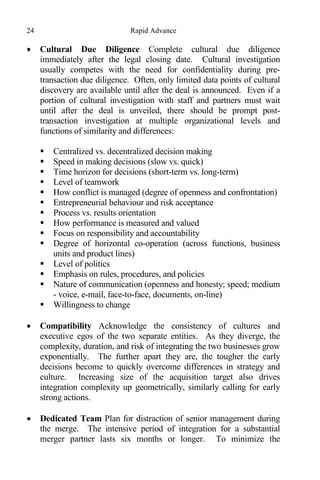
  • 104.
    94 Rapid Advance Staffing Customerswant salespeople who understand their problems. These are representatives who can sell within the context of the customer’s vertical and business. A salesperson must be aware of the financial proposition and risk profile for commercialization to define the return on investment for the customer. However, sales staff needs to do this for the purchaser without getting too caught up in the innovation and underlying technology. Also, salespeople need credibility with the R&D staff in their companies, especially in the earliest days. The sales team needs to authoritatively relate customer needs to product and technology requirements that R&D will buy into. Diagnosing Trouble When sales are behind plan during the early days, it is important to isolate causality. The scapegoat for a shortfall is often the VP of Sales. However, the product, company, or marketplace may be the issue. One bad hire of a VP Sales may be a legitimate mistake. But, further churn of the senior sales executive is a classic sign of misreading shortcomings when a young business misses plan. Sometimes, the marketplace is the difficulty. It may not exist or doesn’t care about the solution on offer. Market vibrancy and plausible demand are confirmed by seeing:  Direct and recurring competitors in target accounts  Steady flow of new customer requests for proposal  Consistent customer usage scenarios  Widespread awareness and clear articulation in the competitive environment of the company’s position and offering
  • 105.
    Growing Sales 95 Legitimate customer and partner activity. This is exhibited by significant resource investments on their part, preferably from larger incumbent players. The more exclusive are user and partner investments, the better In other cases of revenue weakness, the company itself may be the problem. Company capability is verified with:  Energy and pace of change. When little changes from week to week and month to month, capabilities usually aren’t evolving fast enough  Ability to stabilize the product to a repeatable, deployable form meeting customer expectations  A common view among the Board of Directors, CEO and VP of Sales of how to build sales  Consistent positioning, priorities and mission. Violent thrashing indicates compass failure. When flailing occurs, it may be that the company’s technology and operations are more at fault for revenue underage, rather than the sales team All early stage technology companies iterate the product and value package as they hone in on their long-term vocation. The challenge is to identify if difficulties gaining revenue are part of natural evolution, or are more adverse reflections of operating in a market vacuum, problems in technology and operations, or sales management itself. The sales executive tends to be the culprit for underwhelming sales where:  Input from the sales group toward defining and refining a resounding product and service package is scattered and does not converge quickly  There is little evolving discipline in how to qualify leads and move a prospect to closing. Checklists aren’t used or don’t improve.
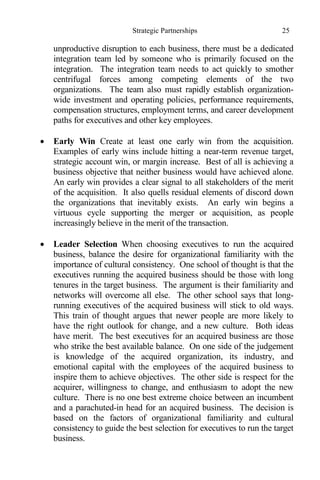
  • 106.
    96 Rapid Advance Theart of the deal is seen as the whole formula for sales, rather than attempting to reduce routine aspects to a repeatable process, and use art to complete the skill mix  Salespeople spend a lot of time on unlikely deals because there’s no rigor about essential events to progress through. Sales cycles languish in “good meetings” that don’t reach a sufficient transaction  The pipeline is stagnant, where sales staff can’t work on promising deals because they spend too much time on prospects that aren’t moving ahead  Sales pipeline reviews are muddy, where colorful stories are associated with each prospect, but basic questions of where deals stand aren’t clearly answered and progress is ambiguous  A high proportion of prospects sales staff expect to imminently close either evaporate or buy elsewhere at the last minute Scaling-Up Get the selling process right in one big geographic region, with a familiar culture and purchasing profile, before transposing to other geographic markets. Layering major differences in distance, language, time zone, transaction terms, and culture upon an immature selling process detracts from getting to the right selling formula. However, there are exceptions to geographic focus in early sales effort:  Where the sale is predominantly web-based  Application-tailored product markets where the R&D challenges of straddling new uses may be far greater than extending a proven application winner to new geographies
  • 107.
    Growing Sales 97 The product is a solution seeking a problem to solve. It has capability that has proven robust and deployable, but the best applications are not known, and a lot of possible applications need to be probed Indirect Channel Sales Most rapidly growing technology businesses will adopt a component of indirect distribution as they mature. Grafting a third party sales force as an indirect channel works best when the new salespeople are able to sell the added product or service to at least 33% of their existing customers and identical decision influencers. As the person- to-person distance grows between existing product lines and new for target individuals salespeople communicate with, effectiveness splicing sales forces falls off rapidly. Above one-third overlap, the benefits of indirect sales will usually more than offset the communication and control overhead of making an indirect channel relationship work. Cross Selling In mergers, acquisitions and other strategic relationships, a common value driver is partners’ sales forces selling each others’ products and services, to expand market share and increase margins. Cross selling shares characteristics of indirect channel sales. Joint sales bring in additional management concerns because of lengthened communication pathways, decision authority, and potential for diminished accountability compared with a sales force of single pedigree and responsibility. Necessary conditions for sales force A to be confident selling business B’s products to their customers, and vice versa:  Ability to maintain customer satisfaction, with demonstrated quality, reliability and delivery performance
  • 108.
    98 Rapid Advance Cross sale customers receiving similar priority from businesses A and B, to protect customer relationships and ensure needs are met  An up front map of future gains from cross selling, segmented by products, customers, applications, and geographic markets There is a significant training component to effective cross selling:  Education about the offerings, with hands-on experience  Familiarity with sales tools and collateral  Knowledge of how the other sales force and business works, including pathways for communication, decision authority, how performance is evaluated, reward systems, and incentives  How to access R&D and other resources to facilitate information flow to customers Expectations should be set for the activities of a sales force handling a new set of products:  A defined portion of time to be spent cross selling, as compared to single business sales effort and account maintenance  Identification of who is responsible for cross selling to existing accounts, and who is looking after it in new account development Data sharing keeps two groups in sync as events progress:  Frequent pipeline sharing and reviews. Face-to-face is best to build familiarity and trust  Discourse about new prospects and their needs  Account interaction logging in a joint database
  • 109.
    Growing Sales 99 Discussion with product source businesses early in the selling cycle about negotiating posture on deals with exceptional pricing, terms or performance requirements  Action item tracking and follow-up Several metrics of performance help convey shared objectives in cross selling:  Number of joint sales opportunities in the pipeline  Proportion of revenue from cross sale accounts  Market share gains  Customer satisfaction, especially if there are a significant number of account responsibility changes as a result of organizing for cross selling Compensation is a contributor to the right sales force conduct, but should not be relied upon as the sole impetus for sales force behavior in joint selling:  A distinct portion of remuneration should be tied to cross results. Compensation moves away from a single revenue or margin target. Achieving full commission requires a contribution from cross sales, usually at least 10% of total formula weighting, as well as meeting an overall sales or profit goal  Sales-linked compensation may need to extend to people beyond the sales force who have a large influence on cross selling account success, such as customer facing R&D staff To make the most of cross selling, management should additionally be ready to tackle major instances of dysfunction rooted in territorialism, information hoarding and cultural aversion to change. Also, promoting success stories, especially those of sales staff who were initially skeptical, helps others to come on board.
  • 110.
    100 Rapid Advance PerformanceMetrics In the early days, monitor the resources that go into closing each sale: money, time of key staff and management, and time on the calendar. Selling-cycle input data indicates the rate that sales can realistically grow from a small base. Account development evidence also illuminates which kinds of investments in staff, training, products or services will likely yield the best acceleration of revenue and market reach as the business develops. OEM Customers A desirable customer in many business-to-business industries is the original equipment manufacturer (OEM). The effort and expense of designing in the component product leads to significant follow-on revenues. A predictable relationship often follows, once order rates settle out. The first consideration when targeting OEMs is that they value five attributes of components above others: 1. Small size 2. Low cost 3. Performance 4. Reliability 5. Ease of integration Widespread success in marketing to OEMs requires the presence of all five attributes at industry-leading levels. Otherwise, success selling to OEMs will usually be limited. Often, companies have a subset of these product attributes, and are successful in marketing to some early-adopter or small-volume OEMs. Seeing the virtue of reduced design-in support and service costs with such customers, they then pursue OEMs as a primary target market, only to
  • 111.
    Growing Sales 101 becomeentangled in difficulties whose root cause resides in the missing links. Even with the right mix of product attributes, OEM markets are not for the faint of heart. Completing development of the component product only gets the vendor to the table. The ante is committing to a customer’s design cycle. Ultimate success is subject to customer risks in technology, product development, market development, financing, and political issues. Adding further volatility is isolation from the end customer. Launch and forecasting errors compound with each link in the market chain to the final buyer. Obtaining a large volume of OEM users is rarely a smooth journey until the customer base becomes broad in numbers, life-cycle stage, applications, and economic cycle diversification. It is a worthwhile endeavour under the right conditions, however, as the ultimate payoff can be significant. Customer Funded Development A R&D intensive business that has successfully established its reputation may either solicit or be approached by potential customers to take on commissioned, custom developments. If the company is in its early stages or thinly funded, the decision of whether to take on such a development may not be in question - it may be necessary for survival. However, if the company does not require development contract intake to survive, custom development is often a double- edged sword. On the positive side, custom developments provide:  Funding for engineering programs  Extended core competencies  New products and markets, albeit with possible exclusivity limitations
  • 112.
    102 Rapid Advance Diversification of customer base On the negative side, custom developments can:  Defocus engineering manpower from strategic value- and technology-enhancing activities into peripheral activities when the scope of custom development extends significantly beyond the company’s desired areas of expertise  Burden staff with overhead activities, particularly in administratively intensive project areas such as military, government, or regulated medical technologies  Run significantly over budget, since contracts can require unfamiliar program elements that are prone to cost estimating errors  Incur opportunity costs and time-to-market penalties for the core business, reducing growth. Doing so can restrict access to capital and investor liquidity  Create volatile cash flow and morale due to boom-bust characteristics, if the company is unable to find a steady flow of work. Custom development fits and starts are difficult to deal with, unless rapid growth in other areas reliably absorbs the employees formerly working on contract projects when they conclude Exclusivity restrictions are often a tipping factor. Rapid growth potential improves if a company can steer clear of broad exclusivity conditions over core technology. A market-centered entity, behaving in a strategic manner must know what markets it wants to be in and which ones it does not. It has to own the technologies, other know- how and market access rights to be a preferred vendor to its chosen applications. This way, customers seeking exclusivity will only have grounds for configuration-specific aspects, not for fundamental capabilities that are central to the company’s access to broader target markets. The more complete the technology portfolio is at the point where exclusivity terms engage, the greater leverage the supplier can
  • 113.
    Growing Sales 103 exertwhen doing custom development, and retain access to the larger marketplace. Good Practice Bring R&D in contact with strategic customers at pivotal moments. R&D engagement infuses customer needs into the culture of the business, and lowers internal barriers among functional groups that can otherwise grow. Furthermore, mandating that development staff take a role in account development during the early days helps keep the sales team lean when small size and agility are paramount. Other Comments  A sale is not complete until the customer is satisfied and cash collected  The outlook of a distribution channel is only a partial reflection of the marketplace. When seeking input on major strategy and investment decisions as the business grows, keep up direct contact with the end market  The business’ value is enhanced when it can routinely generate quarterly and annual forecasts for revenue and profits, and then hit them. It is an institutional skill to create and meet projections, relying significantly on the sales force and processes. Accurate financial estimation takes time to learn, and is easiest to weave into the skill rubric of the enterprise if practiced and diffused as the business develops
  • 115.
    105 Restructuring Restructuring realigns theorganization to take advantage of growth opportunities that are underexploited in the current structure, or to defensively ward-off threats that the present configuration does not address well. Small structural change is sometimes known as patching, whereas large structural modification is usually defined as reorganization. Restructuring begins with a solid and articulated sense of target markets, product roadmaps, a revenue model, a strategy for getting to target markets, a shared vision for the degree of market- and technology- leadership to be attained, and a process for dynamic strategic repositioning. With a clear image of how the business is to function and compete in the future, the probability for restructuring success is markedly higher. To get buy-in when realigning the business, it is important to create a shared reality among senior management of how the business is to succeed in the future. Forming a base of support for significant change begins by meeting with top managers individually so they can communicate their views on a number of questions:  What attributes should the business keep through the coming changes?  What harm to the company do they foresee as a result of the restructuring?  What should the new organizational structure achieve?  What do they want from the top leadership through the realignment? A published summary of findings from these meetings helps unify the company around new and renewed goals, creating coherence and urgency for the new configuration. Restructuring manipulates the organization through splits, additions, combinations, transfers and exits. The goal of redesign is to position resources with the right focus and size to address market opportunities.
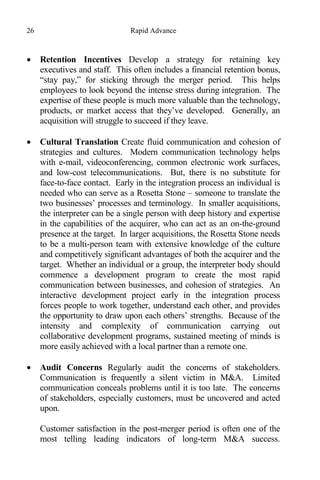
  • 116.
    106 Rapid Advance Onechallenge is to give prime growth opportunities organizational prominence comparable to larger traditional units. Smaller units often lack the resources and market position to exercise self-determination as effectively as larger groups, so adapted management systems may be appropriate. Product creation and market development responsibilities should usually reside within one unit. Otherwise there may be increased risk of a lack of individual responsibility and accountability for execution on the best opportunities. The size of small units should be set to balance motivation and agility with competitive scale, efficiency, and access to critical know-how. The right trade-off allows managers to attend to the demands of key customer segments, and to track rapidly changing markets and adapt business models, but without excessive overhead. Modularity abets restructuring along with consistency of metrics and compensation. Modularity means that there are well-defined interfaces between units, so they can be moved around the organization with relative ease. Consistent metrics and reward mechanisms provide similar ways to assess revenue, profit, customer satisfaction, and product development across the company. Disparity of metrics or compensation can erect barriers to movement that impede restructuring. However, no restructuring will be perfect. An organizational configuration can force some of the most important managerial ties, but not all of them in a dynamic, knowledge-based business. Work still needs to get done that does not flow naturally out of the formal hierarchy. Even with new relationships that are sympathetic to major business drivers, after a restructuring it can take months or even years for people to evolve into strong knowledge-generation and decision making relationships in the new system. Effectiveness and adaptability of major business processes often comes down to having people with a strong desire to collaborate and drive the business to new heights, without too much reliance on the drawn organizational chart. Individual interest in working together and succeeding collectively springs from personal outlook, culture and reward systems, rather than formal management reporting lines.
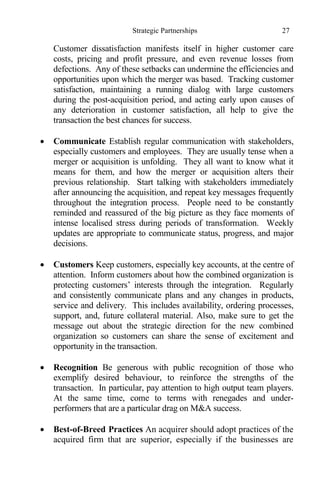
  • 117.
    Restructuring 107 Reconfiguring theformal structure is a straightforward, and at times blunt, instrument of change. A revised hierarchy can create new and more useful managerial ties. Restructuring desire needs to be tempered though with recognition that rapid adaptability is as much about peoples’ willingness to contribute to critical business objectives, regardless of formal reporting lines, than an optimal conceptual hierarchy. While not the whole puzzle, restructuring is important to obtaining scale, focus, authority, responsibility and co-operation.
  • 119.
    109 Turnarounds Revamping requires personnelchange at the top. When tectonic changes in corporate character and outlook are needed, the only course of action is to bring in a leadership team with significant new blood – those who are not committed to old relationships and customs, but who do embody the new culture the business needs to assimilate to succeed. The reason for re-tooling the senior management group: Even when an executive who was in charge during a period of decline admits mistakes and embraces new ways, scepticism about the person from staff, customers and shareholders is natural and a liability. It is very difficult for an executive closely associated with past deterioration to ignite the organizational energy for radical change to flourish. Significant management turnover is required for deep change to take root. Putting leadership renewal in quantitative terms, in the biggest organizational shifts about 40% of the new management team should come from outside. In deep transformations, importing a strong minority of senior management strikes the optimal balance between fresh perspective while retaining accumulated knowledge of technology, products, operations, customers and markets. Both a new outlook and a realistic sense of how the business creates value and competes are needed to guide the business in new ways. Bringing in a significant minority of the management team from outside helps establish a new direction. The balance of transformational senior management with amassed knowledge of the business should be drawn from the ambitious younger set within the company who will replace their more senior predecessors who would have resisted change.13 In total, turning over 70% to 80% of senior management is common for major change to take root and thrive – especially when a business has become set in its ways. 13 A fine line promoting from within at a time of major change is to be cautious about promoting people beyond their capabilities. Especially in crisis circumstances, within which many major organizational changes are conducted, people are often promoted beyond their abilities in order to plug holes, retain staff or bolster morale. People given elevated responsibilities need to be capable of carrying out those duties, to get the crisis over with as quickly as possible. Inappropriate promotions prolong and deepen the crisis, even though they may seem like an expedient way to improve matters in the short-term.
  • 120.
    110 Rapid Advance Categorically,every member of the new leadership team must exemplify the desired culture of the future. Culture starts and ends with the CEO. Especially at times of upheaval, the CEO sets the tone for the behaviour that the company as a whole is to exhibit. The need for acknowledged leadership is at its zenith when trying to chart a new course, to overcome the remnants of previous visions, strategies and modes of operation. Cultural consistency in the words and actions of the CEO with what is being asked of the rest of the organization inspires everyone to take the business on a new heading. At times of profound change, the whole organization cannot be moved at once, and it is usually futile to try. Leverage is needed, and is achieved by building conviction to change in concentric rings emanating from the CEO through the company. Build manageable gearing ratios between layers of the business. Usually, a ratio between concentric rings of about 1:10 creates leverage, while preserving enough contact from one ring to the next to affect change. This method of concentric rings of interaction radiating out from the leader is typically the best way to achieve radical change at a reasonable pace. At the same time senior managers should increase contact with subordinates, and not just direct reports but second level reports as well. Interacting regularly in at least two levels of management keeps everyone on their toes, promotes transparent dialog, and ensures information is transmitted and received correctly. In a turnaround there is no room for information loss or delay. Impaired execution would otherwise result when the business can least afford it. To get change moving in the first place, the most creative people need to be encouraged to follow their instincts to a focused objective. Give them the freedom to pursue their passions. Corporate decline is reversed when people are empowered anew, so that secrecy is replaced with dialog, blame and mistrust with respect, turf protection with collaboration, inefficiency with productivity, and passivity with initiative. Senior management needs to actively intervene in each of these areas which affect the psychology of a turnaround. Otherwise, a dark vision of the future can become a self-fulfilling prophecy. Liberating talent to take
  • 121.
    Turnarounds 111 radical newapproaches is the way to break the cycle of decline and the culture of fear. Start the recovery by fostering new approaches at a cultural and leadership level. The staying power for renewal is drawn from a constructive basis for rebuilding the business. Setting a positive foundation requires coming to terms with the information, decision and execution failures of the previous mode of operation. Major situations of distress typically incubate over long periods of time. Warning signals go unnoticed, usually because of incomplete or erroneous information. Distress also builds up due to inappropriate assumptions among those in positions of power, or an unwillingness to ask tough questions. Further contributing to calamitous business circumstances are cultural biases against caution, and decision maker inability to place resources in areas that matter most to sustainable success. Over-optimism among executives, and, biases among culture, informational discovery and acceptance need to be first identified, then unwound and finally replaced. Once there is a new cultural awakening linked with attainable business objectives, and the supporting communication and decision frameworks are in place to sustain a recovery, then word needs to get out and stay out that the company is moving forward. This usually involves an aggressive PR campaign, as well as regularly announcing new products, services and other tangible signs of progress. A vigorous communication plan and attention to implementation detail reinforces the message that the ship has taken a new direction. A frequent challenge when leading major change is the need to forge a new mode of operation within the boundaries of existing resources. The model of epidemiology for unleashing radical change can be particularly helpful in the case of redirecting existing assets that are often invested in previous patterns of behaviour. The central idea is that once a critical mass of people has bought into a new modus operandi, the rest will follow relatively quickly. This is known as tipping point leadership.14 14 “Tipping Point Leadership,” Kim and Mauborgne, Harvard Business Review, April 2003
  • 122.
    112 Rapid Advance Tippingpoint leadership can be boiled down to four main components: recognizing the need for change; identifying resources to invoke change; motivating people to desired ends; and, overcoming politics and countervailing factions. Impediments of the Mind The biggest struggle in initiating radical change is often getting people to agree on what the current problems are, their underlying causes, and the importance of rehabilitation. In corporate settings, a significant source of dispute in acknowledging problems is the use of statistics and select data sets. Individual measures of performance can hide as much as they reveal, so that one viewpoint’s evidence to support a thesis can be weakened or contradicted by a different set of data. Fact-based management is a desirable objective, but the complexities of the real world can be overwhelming. When statistics or specific data points do not provide an incontrovertible case for needed changes, it is necessary to force key managers face-to-face with the problems to overcome. When management is on the front lines, it is much harder for them to deny the need for change. Forcing executives to stare at uncomfortable realities spurs decisive change. Management engagement with difficulties fast tracks the emergence of a common viewpoint about what the problems are, usually about how to fix them, and the urgency to do so. Resources Limited resources in a situation needing major reform can slow or reduce the pace of progress. Limited bandwidth to pursue the new agenda can sometimes go so far as to constrain the business to the previous mode of operation. Sidestepping resource hurdles starts by prioritizing the areas most in need of change, and activities with the biggest payoff. With articulated priorities and payoffs in hand, a strong pragmatic basis exists for investment decisions. Liberate-able resources are the engine of reinvigoration when they can be efficiently applied to a new, high impact initiative. Get bandwidth by
  • 123.
    Turnarounds 113 cutting backadministrative overhead in low leverage areas. Another source of capacity is to help people to identify their own self-interest in longer-term gains returning from shouldering the load of near-term change. Individuals who know they will benefit from long-term improvements are likely to stretch themselves in the near-term, creating additional fuel to get new initiatives moving. Motivation It is not enough for employees to recognize what needs to be done. They also must want to do what is necessary to achieve radical change. Start with identifying the most influential people inside (or even outside) the organization. These are the people with the skills, connections, powers of persuasion and control of resources who will have a disproportionately large effect on whether the rest of the business will follow the new agenda. The few who can affect the many need to be identified and aggressively recruited to support and implement radical change. Even with leading influencers on board, an operating structure needs to be put in place to be sure that motivation for the right reforms takes root. One way to promote desired behaviour is to increase the accountability of managers and key staff for their actions in peer reviewed settings. Another way to drive people to a targeted end is to create a series of goals that are incrementally digestible. The importance of a series of goals becomes most important when the ultimate target is aggressive. Politics Organizations of appreciable size impose politics that can restrict the beneficial impact of a change initiative. Political impediments need to be actively identified and then combated. Unchecked, there are usually powerful vested interests that will resist reforms through plotting and intrigue. A leading antidote to counterproductive politics is to involve a senior, respected insider from the existing mode of operation who is prepared to support and work toward the new modus operandi. A respected and visible catalyst helps to silence critics early on. Insiders with deep
  • 124.
    114 Rapid Advance knowledgeof the organization also tend to know who is likely to fight new initiatives. Opposition to change can then be pinpointed and silenced. Furthermore, a change agent drawn from the existing way of doing things can usually contribute a lot by anticipating contradicting arguments from vested interests. Compelling counter arguments for change can then be more easily presented with indisputable facts and leadership by example. Encourage open discussions. Discouraging typical political manoeuvring tools of sidebar conversations and biased fact sets sends out the message that action is based on rigorous assessments, and open deliberation. Automated reporting of salient performance measures helps to monitor progress moving from old to new behaviours, where political interests might otherwise restrict information flow. Drawing on these four ideas of tipping point change leadership, and other models for altering behaviour in organizations, radical change follows similar implementation guidelines as mergers and acquisitions. The human dimension of dislocation and change breeding uncertainty and fear is largely the same in major change initiatives as in M&A. The apprehensions and doubts that naturally arise in corporate transformation should be actively overcome in the following ways:  Value Drivers Know and agree upon the value drivers. Rank them, and focus resources on the priorities. Don’t get bogged down in low- value activities. Areas to place attention during radical change usually include the supply chain (procurement), customer development, service delivery, and project management of primary competitiveness-enhancing activities. Keep an unwavering eye on crisp execution, and tight risk management.  Know the Numbers Get a firm grip of the real size of the attainable marketplace and achievable pace of adoption. Often in distress situations a contributory factor is oversized expectations about the end market. This ballooning is often based on false economies, past glories, or sentiments about market size that are out of step with the real performance of current products. Frequent culprits in mis- estimation are beliefs that existing customers or contacts can be sold to, cross-sold to, or up-sold to, when the drivers behind customer
  • 125.
    Turnarounds 115 purchasing mayhave significantly altered because of external or internal events. A forward-looking overview of markets, customers, purchasing motivation, purchasing power, profit pools and adoption time-scales at the outset of a transformation help to determine priorities, and set the right scale and objectives for the business.  Development Performance If a radical change depends in part on developing and launching new products, come to terms with how well the business performs in conceiving, developing, and reaching profitable revenue generation with new products. In particular, identify areas where there are frequent surprises and delays, where concepts are not systematically reduced to predictable practice. If product-driven change is required, knowing what does and doesn’t work in the way that new products are conceived, developed and launched helps to put the transformation on solid footing. Also important is to know where new technologies are called for and which skills to rapidly improve. Development and support resources can then be shifted to areas where a strong return on investment is likely.  Debt Be careful about debt load if debt is required to help finance the rebuild. Debt becomes significant when it reaches more than 50% of the business’ equity. Taking on debt above this level needs to be based on strong cash flow and cash generation in select parts of the enterprise to service the debt, or on bricks and mortar assets to secure it. Otherwise, the debt can prove destructive, especially if the business encounters unexpected challenges. Some debt can leverage the assets of a business, to help fuel a turnaround. But, the amount of debt needs to be held in check or else the risk becomes unwieldy.  Feedback Systematically monitor performance in the highest value areas, and apply corrective feedback. Increase management review frequency during times of trouble. Examination that would take place weekly under more stable conditions should become daily during a transformation. Monthly assessments in normal course behaviour transition to weekly. Increasing the rate of evaluation keeps attention up and deviations low. Performance monitoring may need to be carried out in a less scripted fashion during a recovery
  • 126.
    116 Rapid Advance thannormal times, so that administrative overhead does not eat into efficiency.  Dismantle Impediments Remove bureaucracy that stifles initiative, and foster collaboration that leverages all assets to create a stronger business, in a sustainable manner. Keep customers at the centre of discussion.  Energy Energize the workforce through leadership – a compelling vision grounded in reality, and leading by example. Don’t rely entirely on administrative moves such as slashing budgets or selling off assets.  Method of Operation The method of operation of the new organization must be articulated during change planning. This is not a detail of implementation to be worked out after the changes are announced. When reworking communication and decision pathways, strive for simplification and clarity in reporting, objectives and knowledge access.  Truth There is a fine line between truth and reconciliation. Speak to where the organization stands. Do it in a way that doesn’t make people wrong, but at the same time does not leave them in denial about what really needs to change and how fast.  Build Upon Strengths Reinforce the strengths upon which the rebuild of the business is based. Remind employees and partners about the assets the company has going for it, and provide clear evidence about how these are being strengthened through the transition.  Change Quickly Make structural and directional changes within 90 days. Better yet is 30 days. The alternative of drawing a transformation out introduces more complexity than it overcomes. A gradual transition may seem like the way to avoid creating excessive fears. But, moving slowly only prolongs inevitable change issues, and they become more difficult when left until later. Fast implementation reduces anxiety and politicking. At the same time,
  • 127.
    Turnarounds 117 one alsoneeds to be realistic about the achievable pace of transformation, and ultimate limitations. A turnaround is much less likely to breed undermining cynicism and discouragement if it openly acknowledges the practical extent of what can be changed and by when.  Fast, Flexible Teams Continually reorganizing is disruptive, especially for a troubled business. Redrawing the organizational chart is a blunt instrument of change and only marginally effective in isolation. Some restructuring may be essential to create more effective managerial ties. Senior managers should also augment the organizational chart with flexible working groups, and occasionally temporary ones, that open new relationships and ways of tackling problems.  Management Priorities Plan for distraction among senior management during the transition period. Leading a major change is an all-consuming task. Leaders at times of upheaval need to be ready and able to put the business on their backs and carry it to higher ground. Senior managers leading major changes will not be able to place as much attention on routine matters while the transition is in full swing. Top executives will only get back to a routine that resembles the normal once the renewal has developed a momentum and positive energy of its own.  Early Win Create at least one early win from the metamorphosis. A triumph provides a clear signal of merit to all stakeholders, quelling the inevitable residual elements of discord down the organization. This begins a virtuous cycle supporting the change. With clear goals and an early tangible success upon which to build, people spend more time looking toward the future than worrying about the past.  Exploit Resonance Be sensitive to both external and internal rhythms. Capitalize on moments of opportunity and high morale. This is the best chance to overcome resistance to change and to set the agenda, rather than having to defensively respond to external events.
  • 128.
    118 Rapid Advance Communicate Establish regular communication to stakeholders, especially customers and employees. Start immediately at the announcement of the new direction. Then repeat key messages frequently throughout the transformation. People need to be constantly reminded and reassured of the big picture as they face moments of intense localised stress during periods of upheaval.  Audit Concerns Regularly audit the concerns of stakeholders. Communication is frequently a silent victim in turnaround efforts, concealing problems until it is too late. The concerns of stakeholders must be uncovered and acted upon. Of particular importance are employees, and the culture of the business. Communication issues or interpretation differences often engender culture difficulties. Cultural problems are like an insidious disease. They keep coming back unless they are persistently smothered, particularly when a company is recovering from a rough period. Regularly auditing concerns of staff and management gives early warning if a culture problem is coming out of remission, so that suitable treatment can be quickly dispatched.  Customers Inform customers about how the transformed organization is protecting their interests. Plans and any changes should be regularly and consistently communicated. This includes dialog about products, service and delivery, availability, ordering processes, support, future collateral material, and, a clearly stated strategic direction for the new organization.  Recognition Be generous with public recognition of those who exemplify desired behaviour, to reinforce many of the above ideas. Stroke the professionalism and capabilities of employees. Take every opportunity to commend their teamwork and progress, and promote these virtues as the reason for success achieving milestones on the company’s new course. Above all else during radical change, the first moments of the process are precious. This time is when the new management team can ask basic questions about what the business is doing and why, before becoming integrated into the culture. New managers entering a distressed business need to capitalize on their ability to disentangle impaired system
  • 129.
    Turnarounds 119 dynamics, becausethey are not caught up in them. An incoming team can put a name and a handle to problems that have gone unexpressed. Questioning fundamentals at the beginning serves to expose deficiencies that may not be as apparent to those consumed in the business. However, the new leadership has only one kick at the can. Once the new leadership team becomes assimilated, fundamental questions become harder to ask. The valuable first moments of change are lost - often irretrievably. The dawn of a transformation is the best time to ask hard questions, and challenge fundamental assumptions about the business in need of radical change. Turning around a business is complexity exchange – taking confusion and weakness priced at a discount, and later selling clarity with strength at a premium. It is not about finding something that no one has seen before. Rather, creativity at a transformation is about seeing the potential of a business that already exists, figuring out how to tap latent strength, and carrying out the plan.
  • 131.
    Divesting 121 Divesting Like pruninga plant to keep it in peak health, part of growing and prospering in business is to sell select pieces of the enterprise when conditions call for it. As a business expands and matures, parts can become long-term burdens due to changing competitive conditions and execution difficulties. Suspect circumstances include slow growth, low returns, too much volatility, loss of confidence from stakeholders, or ebb of strategic impact. Divesting is a tool for rapidly shaping enterprise stature to meet current and upcoming demands. Efficient resource allocation, including capital as well as attention of management and key staff, requires finding a permanent solution for low performance or oblique business areas. Extricable segments that cannot be remedied or reoriented in a timely manner, but have sufficient assets to be sale-able, are candidates to sell.15 The clearest candidates for disposal are parts of the enterprises which can have much greater value in the hands of another owner. Viable buyers are businesses that can achieve strategic acceleration using the assets of the target unit, and have the wherewithal to overcome the unit’s weaknesses. For an enterprise new to selling business units, the willingness and capability to efficiently sell is a learned skill. By climbing this learning curve the business will gain the know-how for creating a ready market for business unit exchange as part of long-run efficiency. Divestiture skill is a component of the natural maturity for a business maintaining above-market rates of growth and financial performance. 15 Divestiture in this chapter refers to an outright sale of a division or substantial assets thereof, as compared to an equity carve-out, spin-off, split-off or tracking stock form of exit.
  • 132.
    122 Rapid Advance Decisionto Dispose Half the battle is the decision. Concluding to divest a candidate part of the business is difficult. But if the choice is made within a robust strategic and financial framework it will be much simpler to execute. There are typically several disposal decision impediments to surmount, starting with line managers. Operating management is often reluctant to give up. They fear loss of reputation or employment. Expressing diminished expectations can even be seen as treasonous in close-knit corporate cultures. As well, there is a gambler instinct. Many people are willing to commit resources to a desirable outcome, if an unlikely one, far beyond what the chance is really worth. Pragmatically, by the time a business unit’s tangential nature or problems become acute, remedy from within is often too difficult and time consuming compared to better alternative resource uses. The reason to cut bait: the challenges of a struggling or misaligned unit are frequently the product of several kinds of partiality, especially with developmental technology businesses. A series of distorted information flows and decisions, often spanning years, lead to over- commitment. A sampling of the mélange of management obfuscations that lead to the need to unload:  Bad original information, basing initial resource commitments on data that was wrong or improperly interpreted  Confirmation bias, seeking out information that supports the original decision to invest and at the same time discounting contrary signals that arise  Sunk cost fallacy, factoring in unrecoverable costs that have already been incurred in ongoing choices to press forward
  • 133.
    Divesting 123  Anchoring,insufficiently adjusting initial estimates based on new, reliable and actionable facts  Bipolarity, group decision making riskier than any member of the group would choose because of a safety-in-numbers kind of security impression  Group think, reluctance of dissenting views to voice themselves for fear of alienation from the group These and other executive aberrations in the gathering and processing of information mean that some investments turn out to have been poor choices from the start. Other underperformers or misaligned pieces may have been valid resource deployments at an earlier time, but circumstances changed. Either way, in an enterprise with scale and diversity of business lines, there can be significant asset bases with unacceptable cost to keep, and significantly higher foreseeable value under new ownership. These are the systemic issues to keep at the fore when deciding to divest. There exist related immediate issues that can slow or confuse the decision to dispose of a unit. Defenders will typically point to optimistic anecdotes. Examples include an energetic launch event, quality estimates, production forecasts, or other points of reference to suggest the imminence of success. Such favorable instances may be true, but they represent low-cost expressions of future opportunity to preserve the status quo. Single experiences miss a lot of relevant information. The metrics to zero in on are: strategic misfit, weak demand, low or declining market share, poor or deteriorating financial returns, inexorable competition, low customer satisfaction, inability to develop product in a timely fashion with required cost-performance, loss of stakeholder confidence, and unpredictability. These measures of capability rely on larger data sets, with less selection bias than anecdotes. Broad indicators better inform the choice to dispose a line of business.
  • 134.
    124 Rapid Advance Oneway to overcome management resistance to capitulate and divest poor performers and weakly fitting units is to use forcing criteria. These are quantitative guidelines that help surmount reluctance to admit failure, poor management and declining relevance. Targeting divestiture rates helps shift away from reactive disposal to more forward-looking. Disposal becomes a natural part of optimizing the shape of a multi-faceted business. Guidelines that help consider divestiture regularly:  Aim to divest 7% per year. Misfit and severable parts of a business usually exist once a company has matured from hyper-growth toward industry rates of growth or lower. The presence of divest- able laggards or outliers is common if the business has evolved to multiple operating sites, product lines, or technologies. A goal to divest 7% or so of the business per year keeps the prune-able in view. The 7% gauge can be applied to revenue, headcount, capital spending, R&D spending, or other quantitative attributes. No matter how it is applied, the 7% target drives people to routinely consider which significant parts of the enterprise have become the least productive and what to do about them.  Target to dispose at 30% to 40% of the rate at which new business units are acquired or incubated. Once acquisitions or incubations of new, additional lines of business are a regular part of business activity, there is a significant rate of natural failure to confront. Sometimes it is the whole of something that was acquired or germinated that needs to go. Other times it is only a subset. In either case, parting ways with business units at 30%-40% of the rate at which they germinate or come on board keeps the failures and diverging parts moving out to more productive settings. Quantitative models help keep disposal on the agenda as a way to maintain fitness. However, the most powerful prompting to dispose or otherwise come to terms with poor or maladjusted performers is not quantitative. It is the penalty for falling behind; infection of the core business with undesirable attributes. When awkward parts of the business are retained at length, there is a strong tendency for their flaws to couple into the mainstream. Especially with weak units,
  • 135.
    Divesting 125 distorted informationanalysis, decisions, and resource allocations become viral. Without a paced effort to divest poor and awkward elements, healthier and more promising parts of the enterprise can be damaged. Objectives There are a handful of interrelated objectives for business unit disposal. The weighting among factors depends on circumstances. The most prominent divesting objectives: 1. Increase shareholder value by better shaping the future business portfolio, and getting a higher price for the outgoing unit as a seller than as its owner 2. Enhance profitability 3. Focus management and emphasize core competencies Other common targets of disposal:  Better competitive performance  Raise cash or pay down debt  Reduce risk  Re-establish stakeholder confidence There may be additional reasons to divest including regulatory or government intervention, motivation of staff and management, and, reducing inter-business unit competitive friction. Once motivated to dispose, there is a prominent goal when executing: minimize disruption to the remaining business. Distraction is reduced by divesting as quickly as possible. The benefit of speed applies both to the point in the life of the business unit, as well as rapidity after the sale process begins. Once indicators point to disposal, comebacks sufficient to reverse course are rare. Competitive crowding usually intensifies as time goes by, diminishing the unit’s stature. An early, rapid sale will usually capture more value
  • 136.
    126 Rapid Advance forthe seller and other stakeholders in the unit compared with later, slower transfer. Process Upon establishing the objectives of disposal and reaching the decision to exit, there are a customary series of preparations and events to reach a sale. The main elements are: deciding which assets to include, assembling relevant descriptive data, selecting the right sale method for value and flexibility, creating marketing collateral documents, promoting the business to potential suitors, due diligence by suitors, bidding and sale negotiations, purchase contract signing, closing, and post-transaction separation. As a rule, the better the early elements of the divestiture process, the faster and smoother the sale. Preparation The components of a firm foundation for divestiture: Carve-Out Financial Statements These show historical and projected future financial performance of the business unit on a stand-alone basis. They include balance sheet, cash flow, and income statement. To rapidly value the business, suitors need an income statement of sufficient detail to show revenue, gross margin, EBITDA, EBIT, and net profit (NIAT). The balance sheet should show working capital and book value, with details on aging of accounts receivable, accounts payable, and depreciation policies. Employee headcount is also customarily noted as it is one of the most real-time measures of business size, especially for businesses that have not yet achieved self- sustaining cash flow. Financial statements are usually one of the most difficult items to prepare. They are a catch basin for differing viewpoints. Most complex to resolve are variations among the seller’s management about where the business unit is going as well as the level of optimism
  • 137.
    Divesting 127 and aggressivenessto be built into the divestiture marketing effort. Preparing the economic picture at the outset forces these decisions early, crystallizing the context for most of what follows. Readying the carve-out financial picture is tricky because it requires a range of assumptions about efficiencies for the unit on a stand-alone basis. Direct costs are relatively straightforward to determine, but historically shared costs with other business units of the seller require greater judgment to allocate. Where the inter-company cost allocations that envisioned suitors are expected to achieve vary widely from the seller’s, a second set of carve-out financial statements are often helpful. These financial statements expressly exclude all inter-company allocated costs. Suitors can then analyze and insert their own cost and overhead estimates to model financial performance of the unit. For both kinds of carve-out presentation, it is conventional that the financials look back three years. Projections should go out at least one year in businesses that have not yet achieved predictive revenue levels. Forecasts should extend out as much as three years in businesses that have achieved a presaging trajectory. Making the financial projections conservative is the safe approach for reducing the risk of late-stage negative surprises in the sale process. Why? The consequences of up-side and down-side surprises as the disposal advances are not symmetrical. Underperformance for the unit late in the sale process compared with the plan published at the outset tends to slow the sale process, harm value, and even scare off suitors entirely. Buyers are nervous. Whereas, execution ahead of projection helps everyone get comfortable. Good news during diligence and negotiations builds a sense of trust. Credibility eases the sale and subsequent separation of the transferring unit. Above-plan performance affords the vendor late-stage flexibility negotiating and carrying out the final transaction. Over-performance is far easier to accept late in the sale trajectory than misses. A fast, organized disposal is facilitated with conservative
  • 138.
    128 Rapid Advance financialforecasts that leave some room for good news to come out as the sale progresses. Growth Plan The build-up plan reconciles a cohesive growth story for the target business with internal evolution of technology, operations and market reach. At the same time, the outlook needs to be coherent with the external competitive environment. Most important is to challenge all forecast assumptions and rationalize them. Postulations underpinning the plan will be interrogated by suitors as part of due diligence. It is far better to know about, prepare for, and present key sensitivities in the business’ outlook, rather than having them come out as downstream surprises during suitor investigations. Internal Diligence The seller’s staff briefly assumes the role of suitor and evaluates the outgoing business using an acquirer’s due diligence check-list. Sell-side diligence helps identify if there are significant deficiencies or disputes that can be remedied before marketing begins. Self-assessment should also seek out latent assets that can be monetized in a sale, such as tax-loss carry-forwards, R&D or manufacturing subsidies that may be available, as well as written-off equipment or inventory that may have value to a new owner. Internal diligence often enhances sale value. Self-appraisal can also guide the suitors to target, inform the marketing message to get the sale process underway, and indicate the probable shape of transaction. Future of Management and Key Staff Map the path of management and key staff in the target unit. Doing so reduces apprehensions about career at a time of business ownership and context uncertainty. Important staff and management are then more likely to remain through the sale. If the intention to sell the business will be announced before a final purchase agreement is reached with a buyer, retention incentives should be considered for high impact employees. This is stay-pay linked to remaining with the transferring business unit through the transaction. Retention incentives can also be attached to achieving important interim business objectives that are expected to facilitate the sale or enhance valuation.
  • 139.
    Divesting 129 External DiligenceThree external areas are surveyed: valuation comparables, marketplace, and outside constituencies touching the transferring unit.  Valuation Comparables Reference transaction valuation multiples show the range of price points for similar sales and context for high- and low-value deals. Comparable data helps show what prices may be achievable for the disposal, and the likely high leverage financial and situation factors. Valuations of public companies in similar lines of business should also be detailed for the same reasons. Multiples to review include enterprise value (EV) ones of EV/EBITDA, EV/EBIT, EV/NIAT and EV/Employee. Equity multiples of interest include Price/EBITDA, Price/EBIT, Price/NIAT, and Price/Book Value  Marketplace forecasts and competitive outlook for the products and technologies of the target unit from respected research firms and investment analysts  Analysis of the outside constituencies the unit impacts, to assess how they will view a sale, and ways to make the transaction productive for them Potential Buyers and Message The universe of plausible buyers is identified and the marketing story for the business developed that is most likely to attract interest. The pitch should make the case for how the unit for sale can build on potential buyers’ strengths, shore up their weaknesses, create future opportunities and defend against upcoming threats. The message should reinforce the way the transferring business can accelerate the engine of sustainable earnings growth for prospective new owners. Setting the messaging anatomy for maximum impact requires knowledge of likely investigators. Appraisers who will look at the unit need to be targeted, and with better aim than a mere sense of possible suitor industry sectors. Requisite targeting precision for the marketing disclosures is achieved starting with strategic analysis of specific candidate suitor businesses, as well as their tax and capital
  • 140.
    130 Rapid Advance accessissues. This reverse due diligence includes pinpointing the way the unit can add the most value to each potential buyer. When evaluating potential suitors, there is an important distinction between financial and strategic players, particularly when selling smaller asset bases or business units suffering from notable problem areas. A purchaser in the same or related industry has assets to assist the target unit. The strategic buyer will usually be less intimidated by the risk profile of operations. Purchasers in related lines of business can potentially also find economies of scale or scope within their incoming enterprise from which to gain efficiency with the new unit. Financial buyers do not usually have such flexibility. Financial suitors are more conservative and demanding in due diligence. Unaccustomed to the risk profile of business unit operations, they have few operating assets to contribute if post-transaction negatives surface. Strong competitive threats, light asset bases, limited revenue diversity, or history of failed financial buyouts in the sector tend to alarm suitors from capital markets. Financial players also typically have a shorter time frame for harvesting their investment. As a guideline, financial buyers will pay between three- and six-times EBITDA for a business. Financial buyers are also attracted to predictability, consistency of cash flow, and externally audited financial data for the unit. Conversely, strategic buyers are more likely to pay elevated valuations and be willing to acquire under more volatile conditions.
  • 141.
    Divesting 131 Preferred Formof Sale The preferred structure of the sale is expressed. While there will be give and take over form during purchase negotiations, a clear sense of the breadth and structure of a favored transaction helps keep priorities clear as events unfold, including:  Assets or equity  Scope, describing what is in and out of the sale. This covers: technology, products, brands, licenses, market access, customer relationships, physical assets (real estate, buildings, equipment), IT, and, working capital  Dual use technologies that will be kept by the seller and licensed to the buyer, or vice versa  Buyer’s access to future technology upgrades and development resources from the seller, if there is integration of technologies between the seller’s continuing activities and the transitioning business unit, or vice versa  Transition services the seller would provide for a period post- transaction, such as treasury, accounts receivable collection, human resources management, or IT  Indemnities  Non-competition agreement  Consideration and form, such as cash, other assets, shares, vendor financing in the form of a promissory note of future payment, or convertible debt instrument  Contingent payments  Residual equity stake  Time scale for executing a transaction, and subsequent separation As well, tax, legal and employment matters can have a strong influence on the desired form of sale. Taken together, the preparations spanning carve-out financials to preferred form of sale set the stage for the marketing documents, as well as foretelling some of the more likely forms for the purchase contract. Further, these groundwork efforts also tend to highlight difficulties with the unit that can quickly be repaired or excised to enhance value and sale potential.
  • 142.
    132 Rapid Advance Afew considerations when laying the groundwork: Delicacy is required in the research phase. Digging too deeply into the operations of a business unit with information requests to its staff in advance of a sale announcement can set off apprehensions for employees that restructuring, sale, or closure may be pending. Another sensitive matter is contingent roadmaps for the sale effort. There are a lot of changes and possibilities that emerge as divesting efforts get rolling. The more volatile a unit’s circumstances, the more agile disposal plans need to become. Identifying major decision forks before the sale gets underway helps protect management decision discipline within the seller as events unfold. Without a roadmap and contingency plans, surprises, especially negative ones, can trigger emotional decisions or an overemphasis on tactical stresses that are counterproductive to larger objectives. Usually, lapses involve changing decision criteria affecting the sale mid-course without a valid and objective reason. Prior scenario planning for the sale process mitigates management bias for the seller as conditions change. Contingent roadmaps project the major checkpoints anticipated during the marketing and sale effort. They identify the highest impact prospective internal and external events. The more probable alternate courses that would be followed are then described that would reduce uncertainty, advance upon targets or adopt new targets. These include landmarks such as completion of major R&D tasks, landing major customers, changes in suitor attributes, or competitive developments. Contingency preparedness requires knowledge of several values for the business unit on an ongoing basis during marketing and sale:  Alternate buyer sale value, a quantity updated dynamically as suitors respond and drop out over the course of marketing and sale, less any expected restructuring cost obligations to achieve sale  Keep value, its worth to the current owner including future infusions of capital
  • 143.
    Divesting 133  Harvestvalue, the value to the current owner without any new infusions of capital  Liquidation value, its worth under an orderly wind-down should a sale as a going concern not be concluded, and retention not be desirable These dynamic reference points are navigational aids for any sale. They are most important to keep in view for a unit on the boundary for whether to sell or shut, informing the walk away number for the dashboard. The decision about the best course of action for a business near the sale-shut dividing line is particularly sensitive to changes over the course of sale in development and operations, the competitive environment, and the market of candidate buyers. Sale Method There are three main business sale methods to select from: bilateral negotiating with a single suitor from the start; negotiating with a limited number of participants; and, managed auctioning with a large number of initial contacts to prospective buyers. There are benefits and trade-offs for each sale mechanism with respect to achieving maximum value, exit speed, confidentiality, business continuity and fallback options.
  • 144.
    134 Rapid Advance Inoverview, the positives and hazards are:  Bilateral sales can be targeted, with potential for quick exit, confidentiality and business continuity. However, one to one sales carry the risk of no a ready fallback option, and limited valuation leverage.  Limited Number of Participant sale efforts can also be targeted, and reasonably quick. However, confidentiality can limit the pool of prospective buyers.  Managed Auctions provide potential for maximum value and ready fallback options, but at the risk of business disruption from confidentiality loss. A bilateral negotiation is most appropriate where the best suitor is obvious and unique. This is a buyer with the strategic outlook and financial resources that can readily offer a price with appropriate consideration above what other prospective suitors could likely muster, and better deal terms, conditions and speed. When a premier suitor can be identified, a one to one deal can usually be negotiated quickly and confidentially from the outset. A deterministic process reduces disruption for employees, customers and other stakeholders in the transferring business. Bilateral marketing and sale is usually best if a business unit is fragile and cannot tolerate the erosion that a period of uncertainty may trigger in terms of staff, intellectual property, customers or partner interest. The danger employing one to one negotiation from the start: should significant difficulties arise over the course of selling the business, there are no primed standby alternative buyers. Exit speed, valuation, and deal structure flexibility can suffer if negotiations bog down in one to one marketing and sale.
  • 145.
    Divesting 135 At theother end of the spectrum of business sale types is a managed auction. This mechanism is best used when there are a wide range of possible buyers at the outset, but not a clear preferred suitor that can be relied upon to carry out a transaction. Auction is also appropriate when a defensible process is needed to achieve maximum value. An auction has a major advantage with ample contestants. With a sufficient number of plausible buyers informed about the assets, competitive bidding should induce offers at or near the maximum each suitor is willing to pay. Multiple offers also provide ready fallback options if discussions with any one suitor do not turn out. The down side of auctioning is the notification of pending sale to a large number of people. They also receive a description of the asset. Relatively open disclosure about the planned sale including financial and strategic details can harm the target business. Even with confidentiality agreements in place, word usually gets out once more than a handful of people know about an upcoming sale and the nature of the assets on offer. Depending upon the liquidity of the local employment market and substitutability for the business’ products or services, employees and customers can defect during the period of uncertainty. Depending upon the character of the asset to be disposed and the market it is being sold into, intermediate forms between 1:1 and managed auction are possible which will balance valuation, flexibility, fallback options, speed, confidentiality and business continuity. Circumstances may also warrant changing business sale methods mid course. Information about potential bidders arrives during marketing. Conditions of the business unit change. This knowledge can suggest shifting from a limited negotiation to a more broadly marketed and competitively bid sale if interest turns out to be higher than expected. Equally, buyer signals or unexpected fragilities with the business unit early in the process can indicate a move from a wider field toward limited or exclusive negotiations with greater rapidity than originally intended.
  • 146.
    136 Rapid Advance Inthe normal course, however, without persuasive evidence to take a narrow approach, a tightly managed multiple bidder marketing and sale model is usually best. Creating Competitive Auction Bidding It is a statistical game to find the best buyer for a business unit in a managed auction. The dynamic is not a deterministic one. Many plausible acquirers need to be solicited. Not all that are contacted will be interested because of timing, financial, or strategic factors. Moreover, several motivated purchasers need to be ready to carry out a transaction in order to drive up valuation, and flexibility in deal terms and conditions for the seller. The implication is that a large number of prospective buyers with a strategic or financial interest in the asset must be contacted in order to create a competitive auction market. There is a high reduction ratio between initial outreaches and active pursuits, and further high compression to sale. The compression rate is especially high for smaller asset sales, those with transaction prices below $50 million where the target business may still be developmental or not yet have achieved competitive scale. The following shows guideline statistics for marketing and sale of a business with a transaction price up to $50 million. It indicates the size of the starting pipeline of participants, and yield from stage to stage moving through marketing and sale:  The starting pipeline requires forty to fifty participants. These are plausible buyers identified during marketing preparations. They are contacted with an introductory memorandum and confidentiality agreement to sign back in order to get more detailed information about the asset  The next stage is active appraisals, in which typically twenty of the initially solicited parties respond positively and enter into the confidentiality agreement. They then receive and go on to review the offering memorandum and other confidential information
  • 147.
    Divesting 137  Thefollowing stage is active pursuits. Usually about five active appraisers will enter formal bids to become active suitors  Among the tenders, there will typically be two suitable bids  A pair of suitable bids leads normally yields one executed purchase The fulcrum of the process is the number of formal bids. Five or more tenders are needed so that there is competition to drive up values and term flexibility for the seller. Volume creates alternatives for the vendor. With sufficient numbers, bidders are unlikely to identify all of the competitors before submitting offers. Generally, if there are fewer tenders than five there is significant risk the players will figure out who else is bidding, especially in networked industries, and be able to game their offers to the detriment of the seller. With five or more bids there is enough positive tension to provide satisfactory vendor choice. Among five formal bids, there will usually be at least two tenders acceptable for exclusive negotiations. The importance of having more than one suitable bid is to have a ready alternative if negotiations with the lead bidder get stuck or come apart. If there is only one acceptable bid, the next best available option is poor should purchase negotiations become distressed. Two or more palatable offers help the seller’s end game dynamics during purchase negotiations. The takeaway message is this: forty or more plausible buyers need to be identified when preparing to market the business. Substantially fewer viable prospects call into question whether a competitive bidding process is the suitable way to divest. With initial outreach numbers significantly smaller than forty, a sale through a competitive bidding process may still be possible for a small business unit, but chance plays a larger role in the outcome rather than effort or planning. Valuation often drops. Statistical mechanics of competitive auctioning shift with larger assets, transactions above $50 million. The major difference when selling
  • 148.
    138 Rapid Advance moresubstantial businesses is that the reduction ratio of participants is lower, especially during early stages of the process. With a larger transferring enterprise, fewer starting contacts are typically required to achieve competitive bidding and a successful transaction. The reason is that with a larger business in play, prospective suitors are easier to identify during sale preparations. Candidate buyers have more management depth and access to capital to carry out acquisitions. Moreover, the unit going on the block has greater infrastructure, competitive scale and certainty. The transferring business unit thus typically demands fewer resources of the new owner. More of the tenable initial buyers are likely to become active suitors. With a well selected group of initial contacts, large asset disposal can start with about 20 plausible buyers for initial outreach in order to achieve a sale with sufficient competition and choice for the seller. Another advantage in the sale of a larger business unit is the willingness of multiple suitors to compete at late stages of the sale process. With small unit sales, prospective buyers are less likely to spend the time and money in detailed late-stage due diligence unless they have a window of exclusive negotiation. In larger deals, the transaction values become high enough that suitors will more willingly invest in comprehensive due diligence and negotiation prior to obtaining exclusivity. Multiple bidding rounds become possible with bigger transactions. Instead of a single pass through the sequence of due diligence, bidding, suitor selection and purchase negotiations, there can be iteration, sometimes as much as three cycles. At each round, further disclosure is provided, followed by suitors refining their tender offers and essential terms of a deal. The field of suitors is narrowed at the end of each round based on value, terms and risks of their bids. The next then cycle begins. In multi-round bidding sequences the first round is customarily based on documentary due diligence, with subsequent rounds based on access to facilities, management, and increasingly sensitive customer, supplier and financial information. Letters-of-Intent become
  • 149.
    Divesting 139 progressively moredetailed at each round, advancing toward a final purchase agreement. Marketing and Appraisal The initial marketing effort builds upon a series of documents prepared by the seller. To construct disclosures to prospective buyers for maximum impact and efficient sale requires a clear sense of: 1) target audience; and, 2) how wide a net to cast among potential suitors at the outset. Audience With audience research and analysis in hand from the preparation stage, marketing documents are written. They are promotional pieces. They lay out the strategic rational for acquiring the assets through the eyes of the reader. The purpose of authoring to appeal to the perspective of a suitor’s strategy is so as to not merely rely on financial projections to convey the merit of the business. Promotional items make it easy for reviewers to see how the assets can deliver strategic impact and financial return to improve or defend their businesses. Collateral Documents With a grasp of the target audience, appropriate out-bound marketing messages, and, financial data, preparations then move to writing collateral documents. The main documents in order of delivery are the introductory memorandum, offering memorandum, and management presentation. Introductory Memorandum The teaser document is two pages or less. It is the first overture to potential suitors. This overview gives a brief profile of the target business: technology, products, markets,
  • 150.
    140 Rapid Advance customers,operations, strategic impact, and, categories of beneficially impacted potential buyers. It is a non-confidential disclosure designed to interest initial contacts in what is going on the block, but without getting into extensive proprietary information. The teaser memorandum closes with an invitation to sign-back an accompanying confidentiality agreement to receive more detailed and proprietary business unit disclosure. Offering Memorandum The next document is much more revealing, the offering memorandum (OM). It is customarily 25 to 50 pages, providing the past and current overview of the business unit for sale. The prospectus is delivered in confidence. It provides articulation beyond what is in the public domain about the business’ finances, strategy, operations, technology, intellectual property, products, quality, partnerships, staffing and key individuals. The OM should present an impressive but credible picture of the business, laying out the major opportunities and benefits for potential acquirers. Management Presentation The third collateral instrument is the management presentation deck. It briefly recaps the OM, and customarily goes on to provide greater forward-looking emphasis, including longer-range financial projections. It also further explores future technology and market trends that can drive the business down the line. The presentation is usually 15 to 30 slides. In addition to its scripted content, the presentation allows suitors to meet and hear from management of the target unit, and participate in questions and answers. The management presentation thus provides not only greater dialog about the business’ outlook than the OM, but also a first hand impression of unit management’s dedication, knowledge, intellect and communication skills. There are several supporting documents and assemblies of data to ready as well: Confidentiality Agreement The confidentiality agreement (CA) is alternatively referred to as a non-disclosure agreement. It describes both the seller and suitor obligations to protect sensitive information that flows in the course of due diligence, negotiation and integration planning. It also protects both should the transaction not be
  • 151.
    Divesting 141 consummated, typicallyincluding IP provisions and non-solicitation of employees. For public companies, stand-still clauses may be included. As noted above, the CA accompanies the teaser memorandum to protect the OM and other disclosures. It is best if the CA is the same for all suitors, so that uniform rights and restrictions apply regardless of which party ultimately ends up as proprietor of the target unit. Bid Instructions An associated letter to ready during marketing preparations is one that lays out bidding instructions and timeline. The main elements of this correspondence are the disclosures to be accessed during investigation and bidding, the bid deadline, and the required elements of a valid tender. For multi-round auctions, an adapted instruction letter initiating each cycle describes the diligence and tender process. To define the scope of permitted investigations for the upcoming round, the instruction letter should foretell the information and management access to be provided during later investigation and bidding rounds. This way, suitors are less likely to prematurely jump ahead. Purchase Letter of Intent Commonly, there is another non- promotional item to prepare at the same time as other collateral, a standard form purchase letter of intent (LOI). When the desired transaction structure is specific and known to the seller, issuing a standard form non-binding LOI describing the favored form helps qualify indicative offers for the business. To hone the diligence and negotiations to follow, the LOI should be sent accompanying the OM. Appraisers who tender are instructed to use the provided LOI as the basis of their offer, marking it up to reflect important differences in deal structure and terms for their candidacy. The benefit of a reference LOI is that it creates greater comparability among tenders. In addition to price as a decision tool for the seller, the further the LOI is altered by suitors, the more it loads down the real valuation and likelihood of successfully concluding a transaction. Using a reference LOI will pay off in more reliable bids and an easier path to the final purchase agreement.
  • 152.
    142 Rapid Advance DataRoom The data room provides full-length copies of articles, contracts, filings and financial statements describing all aspects of the business, including physical assets, leases, employees, suppliers, customers, partners, regulatory filings and certifications, IP, and licensing, among others. At the same time promotional documents are prepared, as well as LOI, CA, and bid instructions, so too should the data room. Concurrent assembly of the data room aids consistency among all disclosures. Data room disclosures frequently run to several thousand pages. They follow conventional multi-page checklists of items to be investigated. Frequently Asked Questions One last and useful document is frequently asked questions (FAQ). It is a living document that evolves through the course of marketing and sale. As investigator questions come up during appraisal and due diligence, answers should be logged in the FAQ when they contain information supplemental to the OM, presentation deck, and data room. Responses can then be provided to all investigators if appropriate, or the same answers re-used for similar questions that arise at a later time. Due Diligence Due diligence is a steady effort for both buyer and seller that starts at initial appraisal, and continues through pursuit, purchase negotiations and closing. The reputation of the due diligence stage is to expose concealed or under-represented weaknesses. For sure, identifying shortcomings or misrepresentations is part of due diligence. But, if due diligence is only viewed through the lens of avoiding negatives, opportunity is lost. Some also see due diligence for gaining information that will enhance leverage for subsequent negotiations. This too is a piece of what it can do. Avoiding mistakes and gaining advantage are part of the game, but the best use of due diligence by both sides is to build knowledge to optimize the shape of the transaction. Especially important is to itemize and characterize deal-stoppers and deal-shapers early during
  • 153.
    Divesting 143 investigation andnegotiations. These are must-have features of a deal, and the highest leverage points. When due diligence is used primarily to fine tune a mutually beneficial transaction, it contributes the most value to the sale. Negotiating Negotiations will start shortly after initial appraisal. Bargaining and accommodation becomes progressively more involved as disclosures become more revealing. Documentation to reflect the state of negotiations gets correspondingly more extensive, moving from LOI through draft purchase contracts, often in multiple steps of expansion and detail to reach a signed purchase agreement. Signing to Closing Between signing and closing is the time to prepare a detailed project plan and resource allocation for separation of the unit from the selling parent and integration into the buyer. In addition to project planning, the pre-closing period is used to settle the seller’s inter-company accounts for products and services with the transferring unit. At this time, the buyer finalizes financing, if external financing or approval is needed. Both buyer and seller should also apply steady effort to any controllable factors that can reduce uncertainty and look-back adjustments. Just prior to closing, it is customary for representatives of the buyer and seller to conduct a joint verification walk-through of the assets. This confirms presence and expected condition of all assets, including facilities, equipment, and property.
  • 154.
    144 Rapid Advance Alsoimmediately prior to closing, if there have been significant changes in working capital compared to the time of due diligence, such as inventory, accounts receivable or accounts payable, there can be adjustments in deal price to reflect changes. Akin to working capital, the state of completion of R&D tasks and other achievement milestones are evaluated relative to those expected during negotiations. Pricing is similarly adapted for deviations in development or operations. Separation The separation and integration phase begins after closing when the unit is extricated from the seller and amalgamated with the buyer. This stage typically requires corporate and outside resources from the seller similar to those for an acquisition. Legal separation comes first, followed by de facto separation of interwoven processes and systems. For continuity with the representations and disclosures provided during marketing and purchase discussions, it is best if the same team carries out the disengagement and integration. These are the people who prepared disclosures, performed due diligence and conducted negotiations. Keeping the same people involved improves consistency, accountability and speed. During the separation interval, any required transitional services are provided from seller to buyer, such as, treasury, IT, human resource administration, or accounts receivable, in order to bridge the time interval after closing until purchaser business process integration is achieved.
  • 155.
    Divesting 145 Timeline An orderlydisposal that achieves high value takes a while. A typical divestiture timeline:  Preparation usually takes four to six weeks, to create carve-out financial statements, conduct internal and external diligence, chart pathways for management and key staff, identify the sale team, and make repairs to any fix-able issues with governance, contracts and disputes  The start generally requires two to three weeks, to author the OM and other collateral documents, contact prospective suitors, and execute the CA with respondents who wish to appraise the business unit  Appraisal typically lasts three to four weeks, allowing appraisers to review the OM and any preliminary data room documents provided by the seller, as well as investigate the target unit’s competitive environment  Active pursuit often spans two to three weeks, to provide for offers to be received, initial term sheet negotiated, and best offer selected  Final due diligence frequently requires six to eight weeks to complete investigations, negotiate a definitive purchase agreement, and work out the transaction schedule  Closing can take place any time after the purchase agreement is executed. Sometimes the closing date is set based on achievement of operational milestones as a risk reduction measure, or synchronized to fiscal interval end dates to reduce accounting and audit overhead  Separation follows, and can take from twelve to twenty-four weeks to disengage the target unit from the seller, integrate with the buyer, and provide transition services
  • 156.
    146 Rapid Advance Intotal, four to six months typically elapse from the decision to divest until a definitive purchase agreement is reached. Separation after closing can take another three to six months. Sometimes, there is pressure to accelerate the disposal schedule. Often, overly aggressive timetables mean that preparations get rushed, and quality suffers. Suitor interest, negotiating leverage and deal complexity can all change unfavorably. When timelines get compressed, the expected outcome is diminished value. Communication There are “Killer D’s” that can undermine business unit sale among the seller’s stakeholders: defeat, demoralization, dissension, disruption, defensiveness and division of loyalty. Confidentiality helps resist these forces, but is not always possible. When an upcoming disposal has been disclosed, steady communication to involved parties about the merits of the divestiture counts for a lot to hold the D’s at bay. For employees, the constructive message is that divestiture is not a sign of failure, but of strategic strength. It is a natural part of choosing evolution over continuity, to adapt at the speed of the competitive environment. Both the selling parent and the transferring unit can progress farther and faster than under the previous relationship. This success underlies career success for management and staff. Employees will also have concerns about continuation of employment, career prospects and stature, changes in compensation and culture, and, news about the sale effort as it progresses. Shareholders want to know how the sale will increase shareholder value by capitalizing a higher price as seller than owner, and, improve focus for the remaining business. Equally, shareholders want to minimize the risk of value loss as a result of the sale.
  • 157.
    Divesting 147 Customers andpartners want to know that their interests are being protected through the transition with the opportunity for both the seller and the transitioning unit to better pursue their goals. At the same time, customers and partners are usually concerned about potential changes in service levels and commitments. Suppliers seek information about continuation and expansion of revenue streams, as well as any changes in contractual terms, pricing, payment and creditworthiness. Additional constituencies to consider and interact with are media and regulators. Media are primarily interested with impacts on employees, customers, and community, as well as the buyer’s reputation. Regulators want to be notified of competitive implications, employment or other legal notices, and continued compliance with laws and regulations. Challenges and Advice  Earlier is better in business unit disposal. One cannot time a sale perfectly, but it is usually better to sell before it is too late. Avoid reactionary selling when problems or differences have become severe  It is easier to react to advances than trying to turn on potential buyers  Start slow, and finish fast. Attention to detail at the front-end oils the wheels for the back-end, keeping erosion of the transferring unit to a minimum  Deal with strategic issues first and practical concerns second, so the right influences shape decision frameworks and transaction structure  Throughout, keep revisiting how the transferring business can be better under new ownership
  • 158.
    148 Rapid Advance It is easy for effort to wane during disposal. Divesting is as complicated as acquiring, but those involved tend not to attack a sale with the same vigor because of a sense of failure. To counteract disappointment and its byproducts, the team involved in the transaction needs to be energized with regular communication about its merits  The most significant issues will be unearthed by a good buyer during due diligence. Disposal isn’t a means to conceal accumulated management missteps. Divesting can largely remove bad business unit strategy and execution from future concern for the seller’s management, but not erase it from the sale process  A reflex for some managers facing the need to divest a unit is to hedge, seeking to put the activity into a joint venture with one or more partners. A joint venture is rarely a good divestiture strategy, since the seller’s management needs to be substantially rid of it for focus, profitability or other reasons. JVs are time consuming to initiate, and complex to operate. Nevertheless, there are cases where the seller can productively assume a JV stake in which the transitioning unit is contributed. In such instances, an important feature is normally to specify limited downstream resource demands from the seller by the JV. Participation in a JV with capped resource demands can furnish a low cost option on the upside potential of the transferring unit without imposing high downstream liabilities upon the seller Advisors In advance of marketing a business for sale, there is the question of whether to involve an investment banker or other similar transaction advisor. On the plus side, bankers add credibility and can help procedural discipline of the marketing and sale effort. They can also contribute a considerable amount of preparatory work such as writing the offering memorandum, financial modeling and reference transaction research, as well as providing advice and experience with financial, tax and legal issues. Bankers can provide expertise,
  • 159.
    Divesting 149 perspective, andbandwidth. In some cases, involving bankers is obligatory if the seller’s governance requires engaging an advisor. On the negative side, as domain specialization, risk, and technical sophistication increase in the assets to be sold, bankers have less value. Further, it can be difficult to attract the best bankers for transactions under $20 million, resulting in significant cost for questionable advisory talent as deal sizes go down. Use of boutique investment banks and domain specialists can help obtain better people on smaller deals.
  • 161.
    151 Bibliography Strategic Partnerships “Ally orAcquire” Roberts et al., MITSloan Management Review, Fall, 2001 “Bad Deals” Vermeulen, Wall St. Journal, Apr. 28, 2007 “Best practices in joint venture audits” Applegate, Internal Auditor, Apr. 1998 “Caution: Earnouts Ahead” Harris, CFO Magazine, June 3, 2002 “The CFO’s Perspective on Alliances” CFO Publishing Corp., May, 2004 “Choosing Equity Stakes in Technology Sourcing Relationships” Kale et al., California Management Review, Spring, 2004 “Collaborative Advantage: The Art of Alliances” Kanter, Harvard Business Review, Jul.-Aug., 2004 “Little fish, big pond” Mayor, Electronic Business, Apr. 2005 “Making Acquisitions Work: Capturing Value After the Deal” Harbison et al., Booz Allen & Hamilton, 1999 “Managing Partner Relations in Joint Ventures” Buchel, MITSloan Management Review, Summer, 2003 “The Office Chart That Really Counts” McGregor, BusinessWeek, Feb. 27, 2006 “Preparing for the Exit” Gulati et al, Sloan Review, Mar. 3, 2007 “The Reverse Hostage Syndrome” Welch, BusinessWeek, July 30, 2007 “Six Keys to Successful Earnouts” Metz, T.V. Metz & Co., Oct., 2006 “Using Joint Ventures to Achieve Strategic Objectives” Coallier et al, PricewaterhouseCoopers, 2003 “Why Companies Should Have Open Business Models” Chesbrough, MITSloan Management Review, Winter 2007 Staffing and Culture “The Best Place to Work Now” Morris, Fortune, Jan. 31, 2006 “How to Take the Reins at Top Speed” McGregor, BusinessWeek, Feb. 5, 2007 Market Targeting “Assessing Risk Across an Innovation Portfolio” Day, Harvard Business Review, Dec., 2007 “Beating the odds in market entry” Horn et al., McKinsey Quarterly, 2005 #4 “Beyond the Core” Zook, Harvard Business School Press, 2004
  • 162.
    152 Rapid Advance “Intelon Wheels” The Economist, Oct. 31, 1998 “Marketing Novel Technology: An Historical Lesson” Lam, Solid State Technology, Oct., 1997 Navigating Dynamic Markets “Fuzzy Numbers” Henry, BusinessWeek, Oct. 4, 2004 “How to Capitalize on the Downturn” Roberts, Electronic Business, April 2003 “How to Profit from a Downturn” Porter, Wall St. Journal, Nov. 12, 2001 “How Smart Businesses Adopt New Technology” Afuah, Electronics Journal, July, 1998 “The Inevitability of Business Cycles” Korczynski, Solid State Technology, Dec., 1996 “Strategy and the Crystal Cycle” Mathews, California Management Review, Winter, 2005 Ecosystem Relationships “Inside the Tornado” Moore, HarperBusiness, 1995 “The Fortune of the Commons” Economist, May 10, 2003 “Lanchester Redux” Schuler, Channel Magazine, June-July 1998 “The Many Faces of Multi-Firm Alliances” Hwang et al, California Management Review, Spring, 1997 “Standards May Make Digital Cameras Click” Taylor, Electronic Engineering Times, Dec. 21, 1998 “Startup” Kaplan, Penguin, 1994 “When Marketing Practices Raise Antitrust Concerns” Bush et al, MITSloan Management Review, Summer, 2005 “The Willing Partner” Frankel, Technology Review, July 2005 Growing Sales “Cross Selling or Cross Purposes” Harding, Harvard Business Review, July- August, 2004 “Keeping your sales force after the merger” Bekier et al, McKinsey Quarterly, 2002 #4 “Matthews’ Gospel” Report on Business Magazine, June 1996 “Refocusing the sales force to cross-sell” McKinsey Quarterly, Dec., 2007 “Sustaining Rapid & Profitable Growth” Jaruzelski et al, Booz Allen & Hamilton, Nov., 1999
  • 163.
    153 Restructuring “Five Frogs ona Log” Feldman et al, PriceWaterhouse Coopers, 1999 Turnarounds “Assuming Leadership: The First 100 Days” Ducasse et al, Boston Consulting Group, 2003 “How Lucent Lost It” Lowenstein, Technology Review, Feb. 2005 “How Symbol Got Its Mojo Back” Hempel, BusinessWeek, Mar. 12, 2007 “The Right Way to Shake Up a Company” Berfield, BusinessWeek, Feb. 12, 2007 “Saving the Business Without Losing the Company” Ghosn, Harvard Business Review, Jan. 2002 “A year after Fiorina, Hurd makes his mark at HP” McCarthy, Globe & Mail, Feb. 8, 2006 Divesting “Divestiture: Strategy’s Missing Link” Dranikoff et al, Harvard Business Review, May, 2002 “Divesting for Success” KPMG, 2002 “Hidden Value Let Loose” Morrison, BusinessWeek, Nov. 14, 2005 “Learning to let go: Making better exit decisions” Horn et al., McKinsey Quarterly, 2006 #2 “Managing divestitures for value and liquidity” Cornwell et. Al, PricewaterhouseCoopers, 2005 “Venture Capital and the Finance of Innovation” Metrick, Wiley & Sons, 2007
  • 165.
    155 About the Author DaveLitwiller is a senior executive in high technology, based in Waterloo, Ontario. His background is in wireless devices, precision electro-mechanics, semiconductors, electro-optics, MEMS, and biotech instrumentation. He serves as an advisor for various private corporations in matters of strategy, technology, and business development. Mr. Litwiller is a frequent speaker at technology start-up forums and executive conferences on business strategy.