Presented by Team 2 : Boukhalfa Taha Benamar Soukaina El Hatimi Lamyae Lakribssi Kaoutar Sahli Mohamed Salah  EIS SIMULATION WHAT WE LEARNED Academic   Year   2011/2012 Professor : Pietri José
Plan  1.  The   Context   2.  The  Strategy   3.  The Change 4.  Results   5.  Team  dynamic   6.  Our Team 7.  A good strategy
1- The  Context   Our team is sent for 6 months by EuroComm Corporation to introduce an innovation in one of its subsidiaries : Teleswitches LTD.   The innovation is the Executive Information System that is supposed to increase the company’s performance. Ann Finkelbaum, the CEO of Teleswitches, has been asked to implement the EIS for 2 years but was against any change. Both sides (Our team and Teleswitches members) don’t have any information about each other.
2-  The  Strategy (1)   2.1  Global Objectives : Analyze the environment  Convince first the top managers  to reach the approval of the  CEO Once the managers adopt the EIS, they would be in charge of conducting the change within their teams.
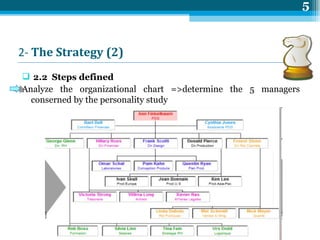
2-  The  Strategy (2)     2.2  Steps defined  Analyze the organizational chart =>determine the 5 managers conserned by the personality study
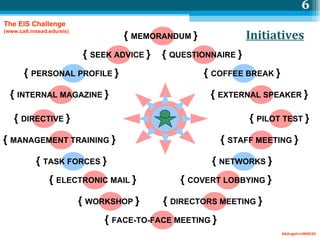
The EIS Challenge (www.calt.insead.edu/eis) AAAngehrn/INSEAD Initiatives {  MANAGEMENT TRAINING  }   {  SEEK ADVICE  }   {  PERSONAL PROFILE  }   {  TASK FORCES  }   {  INTERNAL MAGAZINE  }   {  DIRECTIVE  }   {  WORKSHOP  }   {  NETWORKS  }   {  COVERT LOBBYING  }   {  COFFEE BREAK  }   {  DIRECTORS MEETING  }   {  ELECTRONIC MAIL  }   {  QUESTIONNAIRE  }   {  PILOT TEST  }   {  STAFF MEETING  }   {  FACE-TO-FACE MEETING  }   {  MEMORANDUM  }   {  EXTERNAL SPEAKER  }
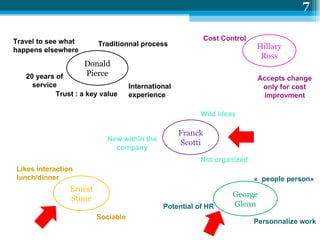
George Glenn Hillary Ross Franck Scotti Donald Pierce Ernest Stone 20 years of service International experience Trust : a key value  Traditionnal process Travel to see what happens elsewhere Likes interaction lunch/dinner Sociable Cost Control Accepts change only for cost improvment Wild ideas  New within the company Not organized Personnalize work Potential of HR «  people person»
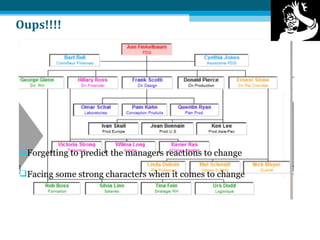
Oups!!!! Negligence of the structure of the company : closed hierarchy  The approval of the CEO was mandatory for many key initiatives  Not understanding the initiatives (something we didn’t do)  Misreading the organization chart (the key actors) Forgetting to predict the managers reactions to change  Facing some strong characters when it comes to change 
2.3 -  The  change (1)  Meeting Ms Finkelbaum earlier than planned Getting the interest of Cynthia in The EIS is primordial Informing all teams about the project
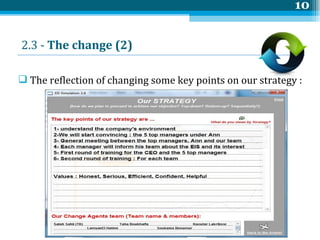
2.3 -  The  change (2)  The reflection of changing some key points on our strategy :
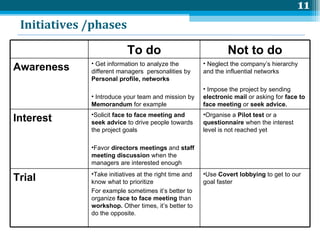
Initiatives /phases  To do Not to do Awareness Get information to analyze the different managers  personalities by  Personal profile, networks Introduce your team and mission by  Memorandum  for example Neglect the company’s hierarchy  and the influential networks Impose the project by sending  electronic mail  or asking for  face to face meeting  or  seek advice. Interest Solicit  face to face meeting and seek advice  to drive people towards the project goals Favor  directors meetings  and  staff meeting discussion  when the managers are interested enough Organise a  Pilot test  or a  questionnaire  when the interest level is not reached yet Trial Take initiatives at the right time and know what to prioritize  For example sometimes it’s better to organize  face to face   meeting  than  workshop.  Other times, it’s better to do the opposite.  Use  Covert lobbying  to get to our goal faster
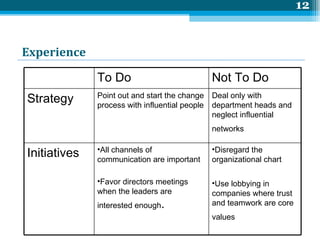
Experience   To Do Not To Do Strategy Point out and start the change process with influential people Deal only with department heads and neglect influential networks   Initiatives All channels of communication are important Favor directors meetings when the leaders are interested enough . Disregard the organizational chart Use lobbying in companies where trust and teamwork are core values
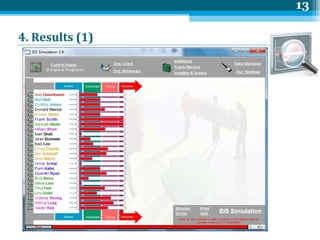
4.  Results (1)
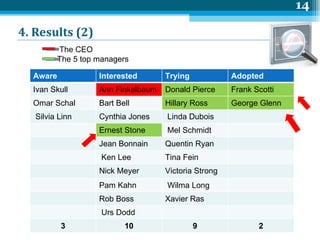
4.  Results (2)   The CEO The 5 top managers Aware Interested Trying Adopted Ivan Skull Ann Finkelbaum Donald Pierce Frank Scotti Omar Schal Bart Bell Hillary Ross George Glenn Silvia Linn Cynthia Jones Linda Dubois Ernest Stone Mel Schmidt Jean Bonnain Quentin Ryan Ken Lee Tina Fein Nick Meyer Victoria Strong Pam Kahn Wilma Long Rob Boss Xavier Ras Urs Dodd 3 10 9 2
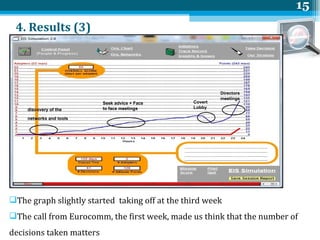
4.  Results (3)   discovery of the networks and tools   Seek advice + Face to face meetings Covert Lobby Directors meetings The graph slightly started  taking off at the third week The call from Eurocomm, the first week, made us think that the number of  decisions taken matters
5. Team  dynamics Collaboration to define the strategy and take decisions Resort to votes when an agreement isn’t reached No leader and followers pre-defined In reaction to unexpected events, the members of the team adapted together the strategy according to the feedbacks
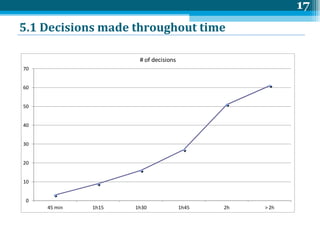
5.1 Decisions made throughout time
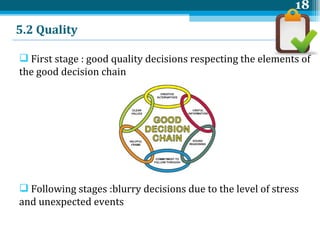
5.2 Quality  First stage : good quality decisions respecting the elements of the good decision chain Following stages :blurry decisions due to the level of stress and unexpected events
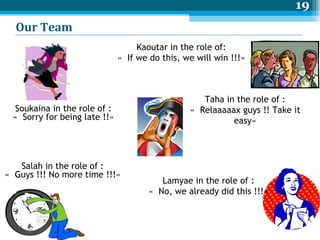
Our Team  Soukaina in the role of : «  Sorry for being late !!» Salah in the role of : «  Guys !!! No more time !!!» Kaoutar in the role of: «  If we do this, we will win !!!» Lamyae in the role of : «  No, we already did this !!!» Taha in the role of : «  Relaaaaax guys !! Take it easy»
Soukaina ‘s role  Contribution :  Vibes-watcher, Analyzer and coordinator Impact : Make our work more productive. Respect and listen to other members' views  Without me :  The team would have lost its focus They wouldn’t have lost time getting me involved
Lamyae ‘s role  Contribution :  Analyzing the feedbacks keeping records of all the initiatives taken and their outcomes Initiating votes when the team disagreed   The impact :  Remembering why and when an action did or not happen  Without me :  No records kept of all the initiatives
Kaoutar ‘s role  Contribution: Giving my opinions  Understanding the feedbacks Impact:  Take decisions when the situation has stagnated Without me:  The overall score would have been better if I didn’t initiate a covert lobbying
Contribution :  Analyzing the situation Dealing with unexpected events Impact : Motivation of the team members Without me :  Increase the level of stress and its impact on our decision making process Taha ‘s role
Salah ‘s role  My Contribution:  Supporting the team while making decisions Keeping track of the time Informing the team members of the time remaining to  take the best initiatives  Impact: As time was passing, I pushed the team to take quick decisions Without Me: The due date wouldn’t have been respected The level of stress wouldn’t have been high
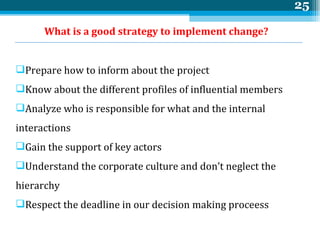
What is a good strategy to implement change? Prepare how to inform about the project Know about the different profiles of influential members Analyze who is responsible for what and the internal interactions Gain the support of key actors Understand the corporate culture and don’t neglect the  hierarchy Respect the deadline in our decision making proceess
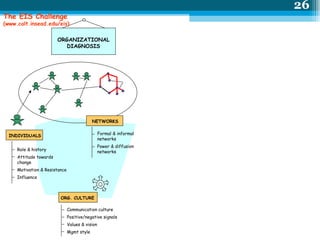
ORGANIZATIONAL DIAGNOSIS INDIVIDUALS NETWORKS ORG. CULTURE Role & history Attitude towards change Motivation & Resistance Influence Formal & informal networks Power & diffusion networks Communication culture Positive/negative signals Values & vision Mgmt style The EIS Challenge (www.calt.insead.edu/eis)
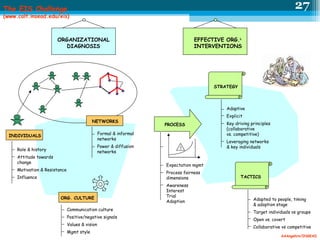
STRATEGY ORGANIZATIONAL DIAGNOSIS EFFECTIVE ORG. L INTERVENTIONS Adaptive Explicit Key driving principles (collaborative vs. competitive) Leveraging networks & key individuals TACTICS Adapted to people, timing & adoption stage Target individuals vs groups Open vs. covert Collaborative vs competitive Expectation mgmt Process fairness dimensions Awareness Interest Trial Adoption ! INDIVIDUALS NETWORKS ORG. CULTURE Role & history Attitude towards change Motivation & Resistance Influence Formal & informal networks Power & diffusion networks Communication culture Positive/negative signals Values & vision Mgmt style PROCESS AAAngehrn/INSEAD The EIS Challenge (www.calt.insead.edu/eis)
Thank you for your attention  Now it’s your time to take the right decision and ask the right questions

EIS what we learned team2

  • 1.
    Presented by Team2 : Boukhalfa Taha Benamar Soukaina El Hatimi Lamyae Lakribssi Kaoutar Sahli Mohamed Salah EIS SIMULATION WHAT WE LEARNED Academic Year 2011/2012 Professor : Pietri José
  • 2.
    Plan 1. The Context 2. The Strategy 3. The Change 4. Results 5. Team dynamic 6. Our Team 7. A good strategy
  • 3.
    1- The Context Our team is sent for 6 months by EuroComm Corporation to introduce an innovation in one of its subsidiaries : Teleswitches LTD. The innovation is the Executive Information System that is supposed to increase the company’s performance. Ann Finkelbaum, the CEO of Teleswitches, has been asked to implement the EIS for 2 years but was against any change. Both sides (Our team and Teleswitches members) don’t have any information about each other.
  • 4.
    2- The Strategy (1) 2.1 Global Objectives : Analyze the environment Convince first the top managers to reach the approval of the CEO Once the managers adopt the EIS, they would be in charge of conducting the change within their teams.
  • 5.
    2- The Strategy (2) 2.2 Steps defined Analyze the organizational chart =>determine the 5 managers conserned by the personality study
  • 6.
    The EIS Challenge(www.calt.insead.edu/eis) AAAngehrn/INSEAD Initiatives { MANAGEMENT TRAINING } { SEEK ADVICE } { PERSONAL PROFILE } { TASK FORCES } { INTERNAL MAGAZINE } { DIRECTIVE } { WORKSHOP } { NETWORKS } { COVERT LOBBYING } { COFFEE BREAK } { DIRECTORS MEETING } { ELECTRONIC MAIL } { QUESTIONNAIRE } { PILOT TEST } { STAFF MEETING } { FACE-TO-FACE MEETING } { MEMORANDUM } { EXTERNAL SPEAKER }
  • 7.
    George Glenn HillaryRoss Franck Scotti Donald Pierce Ernest Stone 20 years of service International experience Trust : a key value Traditionnal process Travel to see what happens elsewhere Likes interaction lunch/dinner Sociable Cost Control Accepts change only for cost improvment Wild ideas New within the company Not organized Personnalize work Potential of HR «  people person»
  • 8.
    Oups!!!! Negligence ofthe structure of the company : closed hierarchy  The approval of the CEO was mandatory for many key initiatives  Not understanding the initiatives (something we didn’t do)  Misreading the organization chart (the key actors) Forgetting to predict the managers reactions to change  Facing some strong characters when it comes to change 
  • 9.
    2.3 - The change (1) Meeting Ms Finkelbaum earlier than planned Getting the interest of Cynthia in The EIS is primordial Informing all teams about the project
  • 10.
    2.3 - The change (2) The reflection of changing some key points on our strategy :
  • 11.
    Initiatives /phases To do Not to do Awareness Get information to analyze the different managers personalities by Personal profile, networks Introduce your team and mission by Memorandum for example Neglect the company’s hierarchy and the influential networks Impose the project by sending electronic mail or asking for face to face meeting or seek advice. Interest Solicit face to face meeting and seek advice to drive people towards the project goals Favor directors meetings and staff meeting discussion when the managers are interested enough Organise a Pilot test or a questionnaire when the interest level is not reached yet Trial Take initiatives at the right time and know what to prioritize For example sometimes it’s better to organize face to face meeting than workshop. Other times, it’s better to do the opposite. Use Covert lobbying to get to our goal faster
  • 12.
    Experience To Do Not To Do Strategy Point out and start the change process with influential people Deal only with department heads and neglect influential networks Initiatives All channels of communication are important Favor directors meetings when the leaders are interested enough . Disregard the organizational chart Use lobbying in companies where trust and teamwork are core values
  • 13.
  • 14.
    4. Results(2) The CEO The 5 top managers Aware Interested Trying Adopted Ivan Skull Ann Finkelbaum Donald Pierce Frank Scotti Omar Schal Bart Bell Hillary Ross George Glenn Silvia Linn Cynthia Jones Linda Dubois Ernest Stone Mel Schmidt Jean Bonnain Quentin Ryan Ken Lee Tina Fein Nick Meyer Victoria Strong Pam Kahn Wilma Long Rob Boss Xavier Ras Urs Dodd 3 10 9 2
  • 15.
    4. Results(3) discovery of the networks and tools Seek advice + Face to face meetings Covert Lobby Directors meetings The graph slightly started taking off at the third week The call from Eurocomm, the first week, made us think that the number of decisions taken matters
  • 16.
    5. Team dynamics Collaboration to define the strategy and take decisions Resort to votes when an agreement isn’t reached No leader and followers pre-defined In reaction to unexpected events, the members of the team adapted together the strategy according to the feedbacks
  • 17.
    5.1 Decisions madethroughout time
  • 18.
    5.2 Quality First stage : good quality decisions respecting the elements of the good decision chain Following stages :blurry decisions due to the level of stress and unexpected events
  • 19.
    Our Team Soukaina in the role of : «  Sorry for being late !!» Salah in the role of : «  Guys !!! No more time !!!» Kaoutar in the role of: «  If we do this, we will win !!!» Lamyae in the role of : «  No, we already did this !!!» Taha in the role of : «  Relaaaaax guys !! Take it easy»
  • 20.
    Soukaina ‘s role Contribution : Vibes-watcher, Analyzer and coordinator Impact : Make our work more productive. Respect and listen to other members' views Without me : The team would have lost its focus They wouldn’t have lost time getting me involved
  • 21.
    Lamyae ‘s role Contribution : Analyzing the feedbacks keeping records of all the initiatives taken and their outcomes Initiating votes when the team disagreed The impact : Remembering why and when an action did or not happen Without me : No records kept of all the initiatives
  • 22.
    Kaoutar ‘s role Contribution: Giving my opinions Understanding the feedbacks Impact: Take decisions when the situation has stagnated Without me: The overall score would have been better if I didn’t initiate a covert lobbying
  • 23.
    Contribution : Analyzing the situation Dealing with unexpected events Impact : Motivation of the team members Without me : Increase the level of stress and its impact on our decision making process Taha ‘s role
  • 24.
    Salah ‘s role My Contribution: Supporting the team while making decisions Keeping track of the time Informing the team members of the time remaining to take the best initiatives Impact: As time was passing, I pushed the team to take quick decisions Without Me: The due date wouldn’t have been respected The level of stress wouldn’t have been high
  • 25.
    What is agood strategy to implement change? Prepare how to inform about the project Know about the different profiles of influential members Analyze who is responsible for what and the internal interactions Gain the support of key actors Understand the corporate culture and don’t neglect the hierarchy Respect the deadline in our decision making proceess
  • 26.
    ORGANIZATIONAL DIAGNOSIS INDIVIDUALSNETWORKS ORG. CULTURE Role & history Attitude towards change Motivation & Resistance Influence Formal & informal networks Power & diffusion networks Communication culture Positive/negative signals Values & vision Mgmt style The EIS Challenge (www.calt.insead.edu/eis)
  • 27.
    STRATEGY ORGANIZATIONAL DIAGNOSISEFFECTIVE ORG. L INTERVENTIONS Adaptive Explicit Key driving principles (collaborative vs. competitive) Leveraging networks & key individuals TACTICS Adapted to people, timing & adoption stage Target individuals vs groups Open vs. covert Collaborative vs competitive Expectation mgmt Process fairness dimensions Awareness Interest Trial Adoption ! INDIVIDUALS NETWORKS ORG. CULTURE Role & history Attitude towards change Motivation & Resistance Influence Formal & informal networks Power & diffusion networks Communication culture Positive/negative signals Values & vision Mgmt style PROCESS AAAngehrn/INSEAD The EIS Challenge (www.calt.insead.edu/eis)
  • 28.
    Thank you foryour attention Now it’s your time to take the right decision and ask the right questions