SOUND -SHREY PARIDA
REFLECTION OF SOUND
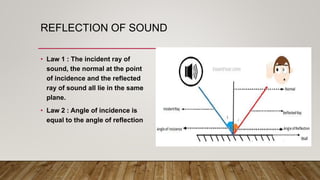
• Law 1 : The incident ray of
sound, the normal at the point
of incidence and the reflected
ray of sound all lie in the same
plane.
• Law 2 : Angle of incidence is
equal to the angle of reflection
ECHO
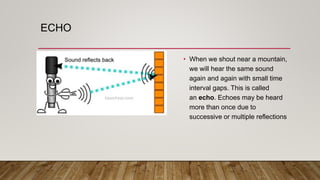
• When we shout near a mountain,
we will hear the same sound
again and again with small time
interval gaps. This is called
an echo. Echoes may be heard
more than once due to
successive or multiple reflections
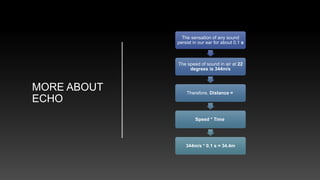
MORE ABOUT
ECHO
The sensation of any sound
persist in our ear for about 0.1 s
The speed of sound in air at 22
degrees is 344m/s
Therefore, Distance =
Speed * Time
344m/s * 0.1 s = 34.4m
REVERBERATION
•The sound will persist for a very long
time due to this multiple reflections. The
repeated reflection that results in this
persistence of sound is
called reverberation.
APPLICATION
• Some musical instruments have a tube followed by a conical opening. This
architecture helps to reflect sound again and again such that most of the sound
waves move in the forward direction. Eg: Horn, Trumpets, Loud speakers etc
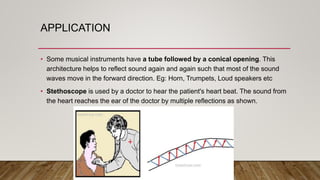
• Stethoscope is used by a doctor to hear the patient's heart beat. The sound from
the heart reaches the ear of the doctor by multiple reflections as shown.
SOUNDBOARD
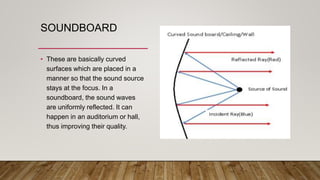
• These are basically curved
surfaces which are placed in a
manner so that the sound source
stays at the focus. In a
soundboard, the sound waves
are uniformly reflected. It can
happen in an auditorium or hall,
thus improving their quality.
AUDIBLE AND INAUDIBLE
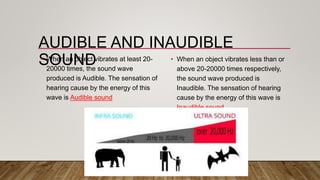
SOUND• When an object vibrates at least 20-
20000 times, the sound wave
produced is Audible. The sensation of
hearing cause by the energy of this
wave is Audible sound
• When an object vibrates less than or
above 20-20000 times respectively,
the sound wave produced is
Inaudible. The sensation of hearing
cause by the energy of this wave is
Inaudible sound
AUDIBLE SOUND
 The human ear can easily detect frequencies between 20 Hz and 20 KHz. Hence sound
waves with frequency ranging from 20 Hz to 20 KHz is known are audible sound.
 As we grow older and are exposed to sound for longer period of time, our ears get
damaged and the upper limit of audible frequencies decreases. For a normal middle-aged
adult person, the highest frequency which they can hear clearly is 12-14 kilohertz.
INAUDIBLE SOUNDS
Human ear cannot detect sound frequencies less than 20 vibrations per second
i.e. 20 Hz.
So any sound below this frequency will be inaudible sound for humans. In the
high-frequency range, the human ear cannot detect frequencies above 20000
vibrations per second (20 KHz)
The low-frequency sound which human ear cannot detect are also known as
infrasonic sound.
Whereas the higher range inaudible frequency are also known as ultrasonic
sound.
INAUDIBLE SOUNDS
• INFRASONIC
-Sound waves having frequencies
below 20hz are Infrasonic which cannot
be heard
-Whales and Elephant produces
infrasonic sounds
• Ultrasonic
-Sound waves which have frequencies
higher that 20Khz which Ultrasonic
waves.
-Bats produce Ultrasonic waves
ULTRASONIC WAVES-MEDICAL APPLICATION
• Ultrasonography are very commonly used to get images of internal body organs
such as liver, kidney, uterus. It helps the doctor to diagnose and treat problems in
the body of the patient.
• Ultrasonography is used to observe the growth of the fetus inside the uterus. It
can also use to monitor the abnormalities.
• It is used to break kidney stones into fine grains which later get flushed out
through urine.
INDUSTRIAL APPLICATION
• Ultrasound is used to clean machine parts located in places which are not easily
accessible - electronic components, internal parts, spiral parts etc.
• It is used to detect defects, flaws, cracks in machine parts, bridges, building etc.
Ultrasound waves are passed at one end and monitored using detectors. If there
are laws or cracks, then the ultrasound waves are reflected back indicating the
presence of a defect.
SONAR (SOUND NAVIGATION AND RANGING)
• SONAR is a device that uses ultrasonic waves to measure distances which are
practically impossible to measure - depth of ocean, distance and direction of
underwater objects.
• SONAR comprises of a ultrasound transmitter and detector fitted in a ship.
• The transmitter produces ultrasound waves which travel, hit the bottom of the
ocean(or any object) and return back and are detected.

Sound

  • 1.
  • 2.
    REFLECTION OF SOUND •Law 1 : The incident ray of sound, the normal at the point of incidence and the reflected ray of sound all lie in the same plane. • Law 2 : Angle of incidence is equal to the angle of reflection
  • 3.
    ECHO • When weshout near a mountain, we will hear the same sound again and again with small time interval gaps. This is called an echo. Echoes may be heard more than once due to successive or multiple reflections
  • 4.
    MORE ABOUT ECHO The sensationof any sound persist in our ear for about 0.1 s The speed of sound in air at 22 degrees is 344m/s Therefore, Distance = Speed * Time 344m/s * 0.1 s = 34.4m
  • 5.
    REVERBERATION •The sound willpersist for a very long time due to this multiple reflections. The repeated reflection that results in this persistence of sound is called reverberation.
  • 6.
    APPLICATION • Some musicalinstruments have a tube followed by a conical opening. This architecture helps to reflect sound again and again such that most of the sound waves move in the forward direction. Eg: Horn, Trumpets, Loud speakers etc • Stethoscope is used by a doctor to hear the patient's heart beat. The sound from the heart reaches the ear of the doctor by multiple reflections as shown.
  • 7.
    SOUNDBOARD • These arebasically curved surfaces which are placed in a manner so that the sound source stays at the focus. In a soundboard, the sound waves are uniformly reflected. It can happen in an auditorium or hall, thus improving their quality.
  • 8.
    AUDIBLE AND INAUDIBLE SOUND•When an object vibrates at least 20- 20000 times, the sound wave produced is Audible. The sensation of hearing cause by the energy of this wave is Audible sound • When an object vibrates less than or above 20-20000 times respectively, the sound wave produced is Inaudible. The sensation of hearing cause by the energy of this wave is Inaudible sound
  • 9.
    AUDIBLE SOUND  Thehuman ear can easily detect frequencies between 20 Hz and 20 KHz. Hence sound waves with frequency ranging from 20 Hz to 20 KHz is known are audible sound.  As we grow older and are exposed to sound for longer period of time, our ears get damaged and the upper limit of audible frequencies decreases. For a normal middle-aged adult person, the highest frequency which they can hear clearly is 12-14 kilohertz.
  • 10.
    INAUDIBLE SOUNDS Human earcannot detect sound frequencies less than 20 vibrations per second i.e. 20 Hz. So any sound below this frequency will be inaudible sound for humans. In the high-frequency range, the human ear cannot detect frequencies above 20000 vibrations per second (20 KHz) The low-frequency sound which human ear cannot detect are also known as infrasonic sound. Whereas the higher range inaudible frequency are also known as ultrasonic sound.
  • 11.
    INAUDIBLE SOUNDS • INFRASONIC -Soundwaves having frequencies below 20hz are Infrasonic which cannot be heard -Whales and Elephant produces infrasonic sounds • Ultrasonic -Sound waves which have frequencies higher that 20Khz which Ultrasonic waves. -Bats produce Ultrasonic waves
  • 12.
    ULTRASONIC WAVES-MEDICAL APPLICATION •Ultrasonography are very commonly used to get images of internal body organs such as liver, kidney, uterus. It helps the doctor to diagnose and treat problems in the body of the patient. • Ultrasonography is used to observe the growth of the fetus inside the uterus. It can also use to monitor the abnormalities. • It is used to break kidney stones into fine grains which later get flushed out through urine.
  • 13.
    INDUSTRIAL APPLICATION • Ultrasoundis used to clean machine parts located in places which are not easily accessible - electronic components, internal parts, spiral parts etc. • It is used to detect defects, flaws, cracks in machine parts, bridges, building etc. Ultrasound waves are passed at one end and monitored using detectors. If there are laws or cracks, then the ultrasound waves are reflected back indicating the presence of a defect.
  • 14.
    SONAR (SOUND NAVIGATIONAND RANGING) • SONAR is a device that uses ultrasonic waves to measure distances which are practically impossible to measure - depth of ocean, distance and direction of underwater objects. • SONAR comprises of a ultrasound transmitter and detector fitted in a ship. • The transmitter produces ultrasound waves which travel, hit the bottom of the ocean(or any object) and return back and are detected.