Observations | Questions | Discussion| Key Concepts
Mara Cabrera
    Dang David
Jovelle Delos Reyes
  Zonasha Musa
Kristabelle Ocampo
   Chinina Perez
     Ana Reyes
   Armida Reyes
  Agatha Sayurin
 Distance affects frequency
 Sound waves travel faster in solid
 Patterns are formed from the sounds made
 Solid is a better resonator than liquid
 The longer the tuning fork is, the lower the tone it
  produces
 Chirping of birds and buzzing of bees differ from
  volume/tone but they have alike patterns
 How is sound formed?
 How do we perceive sound?
 How does sound travels?
 Does the frequency of sound
  decrease over distance?
 Why does sound has a higher
  frequency in solid than in liquid?
 Does the universe resonate sound
  waves?
How is sound formed?

• Sound waves are produced by vibrations of an object


• Vibration – to and fro motion of an object.


•Source of sound is always a vibrating body.
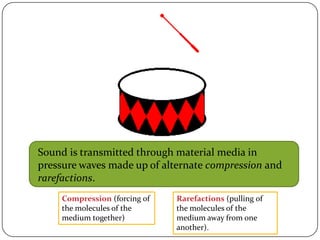
Sound is transmitted through material media in
pressure waves made up of alternate compression and
rarefactions.
     Compression (forcing of   Rarefactions (pulling of
     the molecules of the      the molecules of the
     medium together)          medium away from one
                               another).
How do we perceive sound?

We perceive sounds through our ears.

E A R - sound detector
      -can detect sound waves over a wide range of
      frequencies
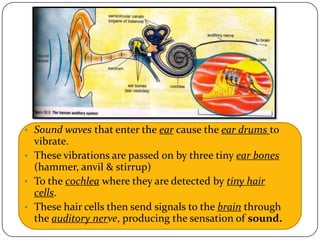
• Sound waves that enter the ear cause the ear drums to
  vibrate.
• These vibrations are passed on by three tiny ear bones
  (hammer, anvil & stirrup)
• To the cochlea where they are detected by tiny hair
  cells.
• These hair cells then send signals to the brain through
  the auditory nerve, producing the sensation of sound.
How does sound travels?
1. Sound is transmitted by particles in a solid, liquid or gas
colliding with each other. It is a wave which is created by
vibrating objects.
2. Sound vibrations, then, travel outwards in all
directions in waves from a sound source. As they travel
outwards the energy they contain becomes dissipated and
therefore the sound becomes weaker the further it is from
the source.
3. Eventually the sound reaches the ear and is made into
signals which are sent to the brain.
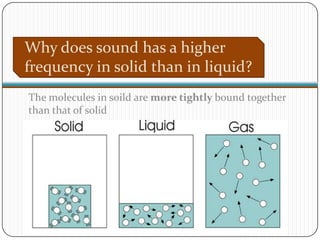
Why does sound has a higher
frequency in solid than in liquid?
The molecules in soild are more tightly bound together
than that of solid
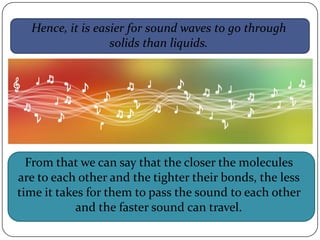
Hence, it is easier for sound waves to go through
                  solids than liquids.


  From that we can say that the closer the molecules
are to each other and the tighter their bonds, the less
time it takes for them to pass the sound to each other
            and the faster sound can travel.
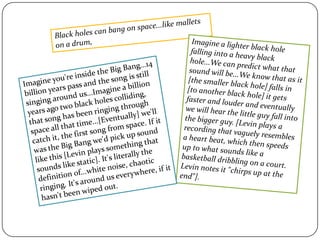
Does the universe resonate sound
waves?

“The universe is not a silent movie. The universe
isn't silent. I'd like to convince you that the
universe has a soundtrack and that soundtrack is
played on itself because space can wobble like a
drum. It can ring out a recording of some of the
most dramatic events as they unfold.”
                                         –Janna Levin
KEY CONCEPTS
  Without vibration, there is no sound.
  We perceive sound through our ears.
 Sound travels through matter as a waveform.
 The speed of sound depends on its
 medium or resonator.
  Our universe creates sound too.
 Sound is significant to our lives.
REFERENCES:
Padua, A. & Crisostomo, R (2010).
        Science and Technology Series
       Practical and Explorational Physics:
Modular         Approach 2nd Edition
        Quezon City: Vibal Publishing House, Inc.
http://www.tellmewhyfacts.com/2007/09/how-
does-sound-travel.html
http://www.huffingtonpost.com/2011/03/01/janna-
levin-at-ted-2011_n_829746.html
http://www.ndted.org/EducationResources/HighSc
hool/Sound/speedinmaterials.htm

Sound

  • 1.
    Observations | Questions| Discussion| Key Concepts
  • 2.
    Mara Cabrera Dang David Jovelle Delos Reyes Zonasha Musa Kristabelle Ocampo Chinina Perez Ana Reyes Armida Reyes Agatha Sayurin
  • 4.
     Distance affectsfrequency  Sound waves travel faster in solid  Patterns are formed from the sounds made  Solid is a better resonator than liquid  The longer the tuning fork is, the lower the tone it produces  Chirping of birds and buzzing of bees differ from volume/tone but they have alike patterns
  • 6.
     How issound formed?  How do we perceive sound?  How does sound travels?  Does the frequency of sound decrease over distance?  Why does sound has a higher frequency in solid than in liquid?  Does the universe resonate sound waves?
  • 8.
    How is soundformed? • Sound waves are produced by vibrations of an object • Vibration – to and fro motion of an object. •Source of sound is always a vibrating body.
  • 9.
    Sound is transmittedthrough material media in pressure waves made up of alternate compression and rarefactions. Compression (forcing of Rarefactions (pulling of the molecules of the the molecules of the medium together) medium away from one another).
  • 10.
    How do weperceive sound? We perceive sounds through our ears. E A R - sound detector -can detect sound waves over a wide range of frequencies
  • 11.
    • Sound wavesthat enter the ear cause the ear drums to vibrate. • These vibrations are passed on by three tiny ear bones (hammer, anvil & stirrup) • To the cochlea where they are detected by tiny hair cells. • These hair cells then send signals to the brain through the auditory nerve, producing the sensation of sound.
  • 12.
    How does soundtravels? 1. Sound is transmitted by particles in a solid, liquid or gas colliding with each other. It is a wave which is created by vibrating objects. 2. Sound vibrations, then, travel outwards in all directions in waves from a sound source. As they travel outwards the energy they contain becomes dissipated and therefore the sound becomes weaker the further it is from the source. 3. Eventually the sound reaches the ear and is made into signals which are sent to the brain.
  • 13.
    Why does soundhas a higher frequency in solid than in liquid? The molecules in soild are more tightly bound together than that of solid
  • 14.
    Hence, it iseasier for sound waves to go through solids than liquids. From that we can say that the closer the molecules are to each other and the tighter their bonds, the less time it takes for them to pass the sound to each other and the faster sound can travel.
  • 15.
    Does the universeresonate sound waves? “The universe is not a silent movie. The universe isn't silent. I'd like to convince you that the universe has a soundtrack and that soundtrack is played on itself because space can wobble like a drum. It can ring out a recording of some of the most dramatic events as they unfold.” –Janna Levin
  • 17.
    KEY CONCEPTS Without vibration, there is no sound.  We perceive sound through our ears. Sound travels through matter as a waveform. The speed of sound depends on its medium or resonator.  Our universe creates sound too. Sound is significant to our lives.
  • 18.
    REFERENCES: Padua, A. &Crisostomo, R (2010). Science and Technology Series Practical and Explorational Physics: Modular Approach 2nd Edition Quezon City: Vibal Publishing House, Inc. http://www.tellmewhyfacts.com/2007/09/how- does-sound-travel.html http://www.huffingtonpost.com/2011/03/01/janna- levin-at-ted-2011_n_829746.html http://www.ndted.org/EducationResources/HighSc hool/Sound/speedinmaterials.htm