RepúblicaBolivariana de VenezuelaForeign Languages DepartmentNURR-ULATrujillo – Estado TrujilloUsing Music In the ESL ClassroomStudents: YeuskiCangaProf. José Rafael Pernía
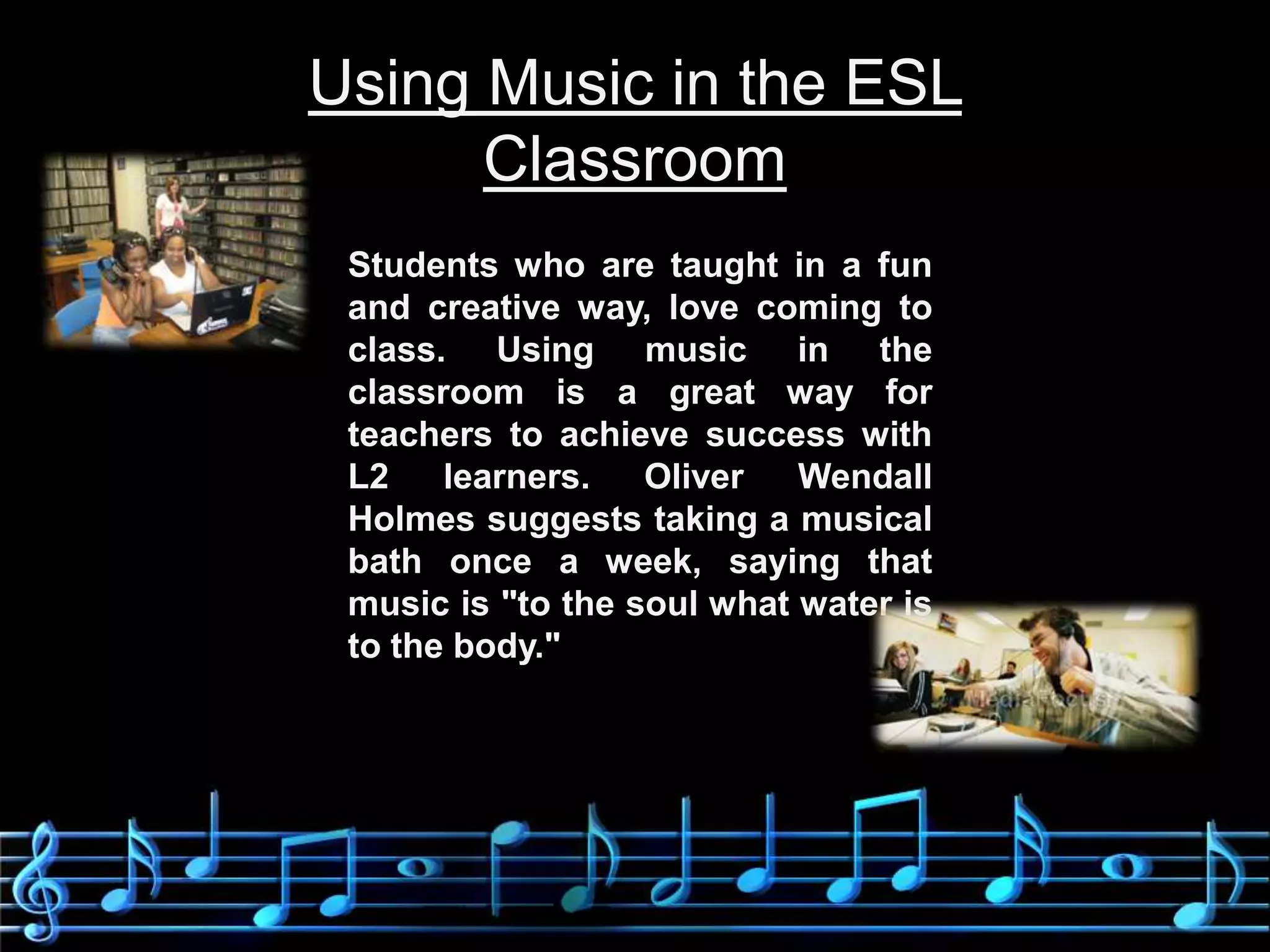
Using Music in the ESL Classroom Students who are taught in a fun and creative way, love coming to class. Using music in the classroom is a great way for teachers to achieve success with L2 learners. Oliver Wendall Holmes suggests taking a musical bath once a week, saying that music is "to the soul what water is to the body."
Benefits of Using MusicStudies have shown that music: Improves concentration
 Improves memory
Brings a sense of community to a group
 Motivates learning
 Relaxes people who are overwhelmed or stressed
 Makes learning fun
 Helps people absorb material"Music stabilizes mental, physical and emotional rhythms to attain a state of deep concentration and focus in which large amounts of content information can be processed and learned."(Chris Brewer, Music and Learning)
Techniques for Using Music with L2 LearnersMusic can be used to: Introduce a new theme or topic
 Break the ice in a class where students don't know each other or are having difficulty communicating
 Change the mood

Using music in the esl classroom

  • 1.
    RepúblicaBolivariana de VenezuelaForeignLanguages DepartmentNURR-ULATrujillo – Estado TrujilloUsing Music In the ESL ClassroomStudents: YeuskiCangaProf. José Rafael Pernía
  • 2.
    Using Music inthe ESL Classroom Students who are taught in a fun and creative way, love coming to class. Using music in the classroom is a great way for teachers to achieve success with L2 learners. Oliver Wendall Holmes suggests taking a musical bath once a week, saying that music is "to the soul what water is to the body."
  • 3.
    Benefits of UsingMusicStudies have shown that music: Improves concentration
  • 4.
  • 5.
    Brings a senseof community to a group
  • 6.
  • 7.
    Relaxes peoplewho are overwhelmed or stressed
  • 8.
  • 9.
    Helps peopleabsorb material"Music stabilizes mental, physical and emotional rhythms to attain a state of deep concentration and focus in which large amounts of content information can be processed and learned."(Chris Brewer, Music and Learning)
  • 10.
    Techniques for UsingMusic with L2 LearnersMusic can be used to: Introduce a new theme or topic
  • 11.
    Break theice in a class where students don't know each other or are having difficulty communicating
  • 12.
  • 13.
    Teach andbuild vocabulary and idioms
  • 14.
  • 15.
    Teach pronunciationand intonation
  • 16.
    Teach songsand rhymes about difficult grammar and spelling rules that need to be memorized
  • 17.
    Teach readingcomprehension
  • 18.
    Inspire aclass discussion
  • 19.
    Teach listeningfor details and gist"Music is the universal language of mankind.“(Henry Wadsworth Longfellow)
  • 20.
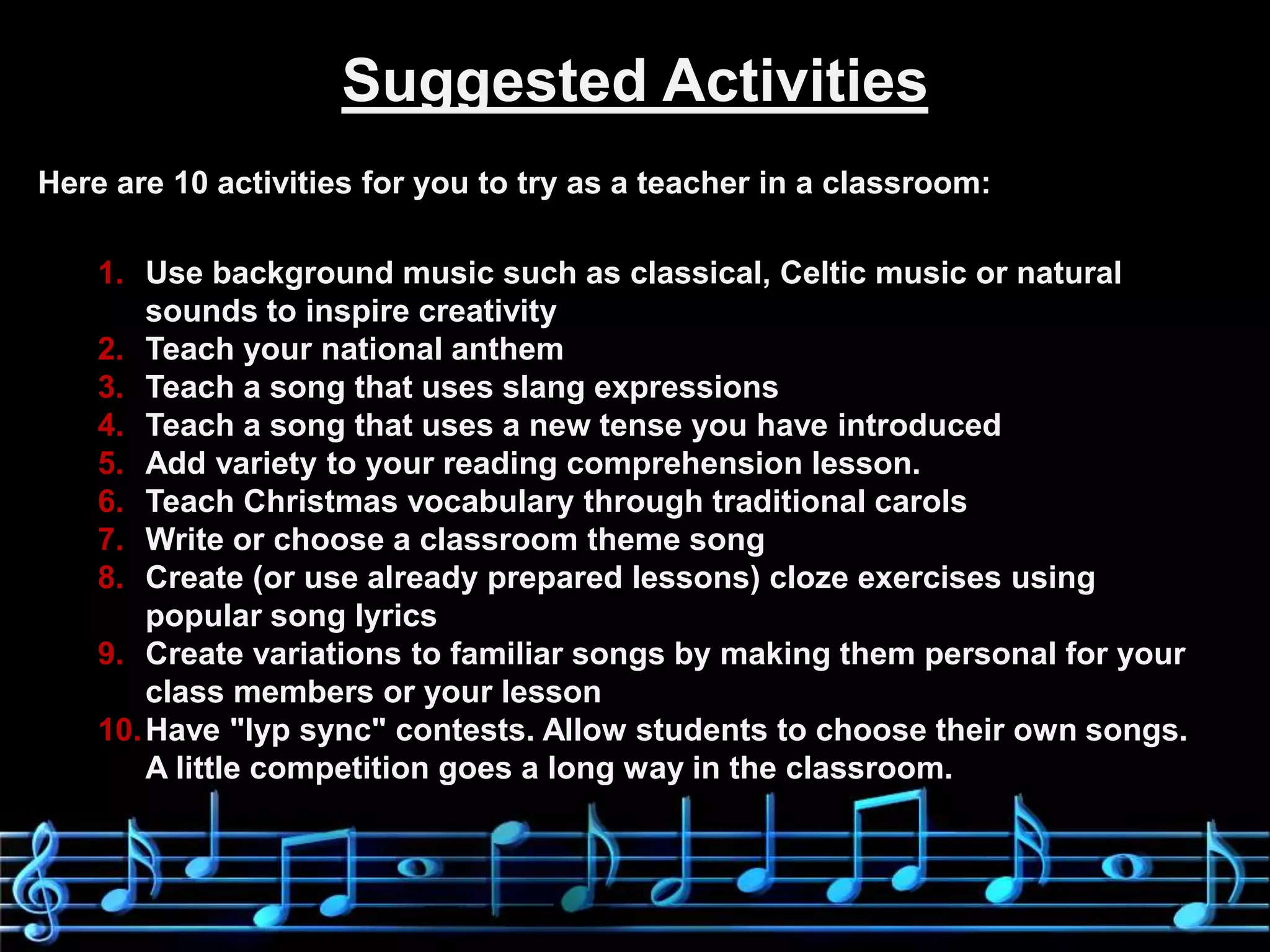
    Suggested ActivitiesHere are10 activities for you to try as a teacher in a classroom:Use background music such as classical, Celtic music or natural sounds to inspire creativity Teach your national anthem Teach a song that uses slang expressionsTeach a song that uses a new tense you have introduced Add variety to your reading comprehension lesson. Teach Christmas vocabulary through traditional carols Write or choose a classroom theme song Create (or use already prepared lessons) cloze exercises using popular song lyrics Create variations to familiar songs by making them personal for your class members or your lesson Have "lyp sync" contests. Allow students to choose their own songs. A little competition goes a long way in the classroom.
  • 21.
    "When the musicchanges so, so does the dance."(African proverb)
  • 22.
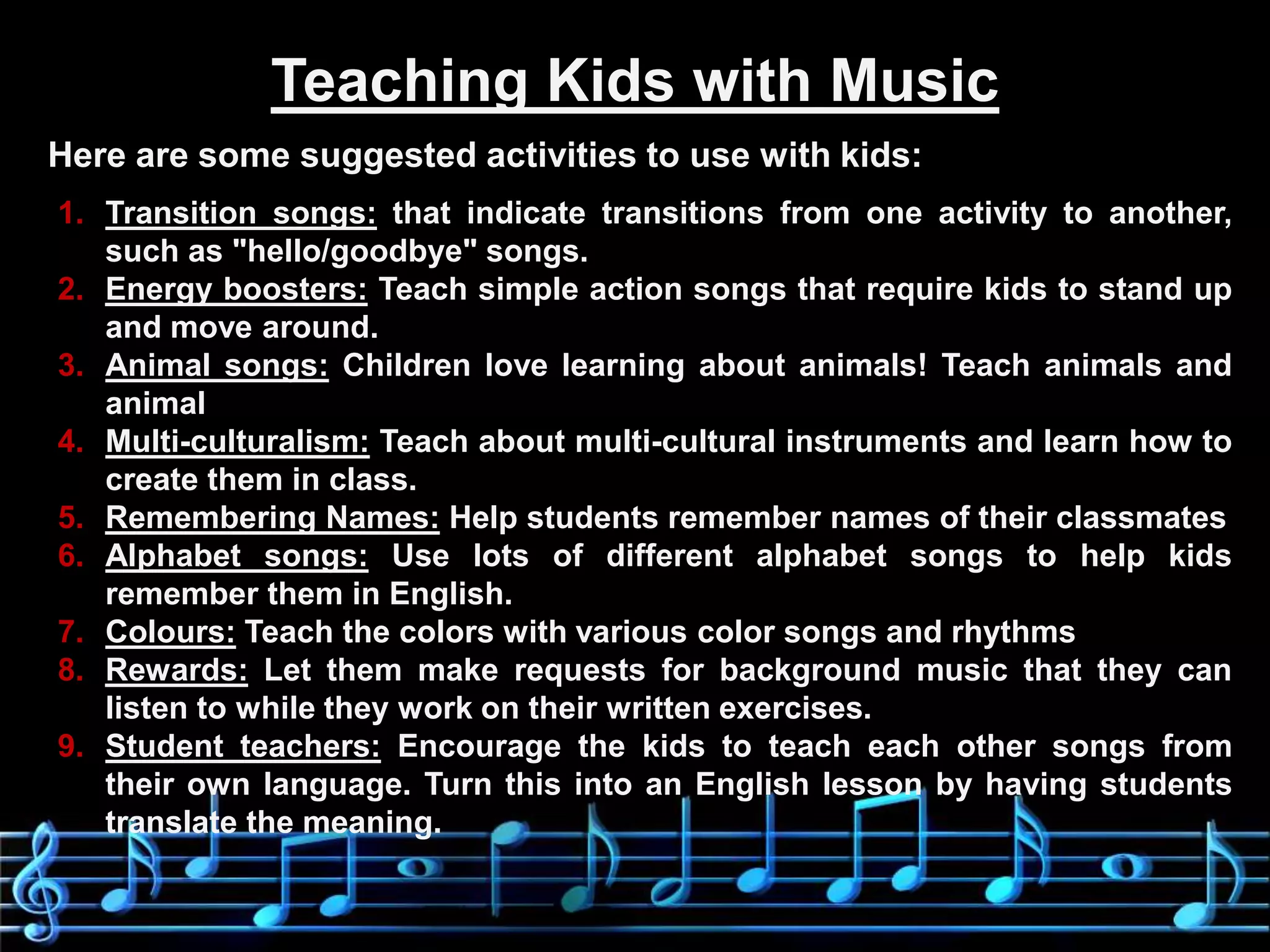
    Teaching Kids withMusicHere are some suggested activities to use with kids:Transition songs: that indicate transitions from one activity to another, such as "hello/goodbye" songs. Energy boosters: Teach simple action songs that require kids to stand up and move around. Animal songs: Children love learning about animals! Teach animals and animalMulti-culturalism: Teach about multi-cultural instruments and learn how to create them in class. Remembering Names: Help students remember names of their classmatesAlphabet songs: Use lots of different alphabet songs to help kids remember them in English. Colours: Teach the colors with various color songs and rhythmsRewards: Let them make requests for background music that they can listen to while they work on their written exercises. Student teachers: Encourage the kids to teach each other songs from their own language. Turn this into an English lesson by having students translate the meaning.
  • 23.
    “Musical nourishment whichis rich in vitamins is essential for children."(Zolton Kodaly)
  • 24.
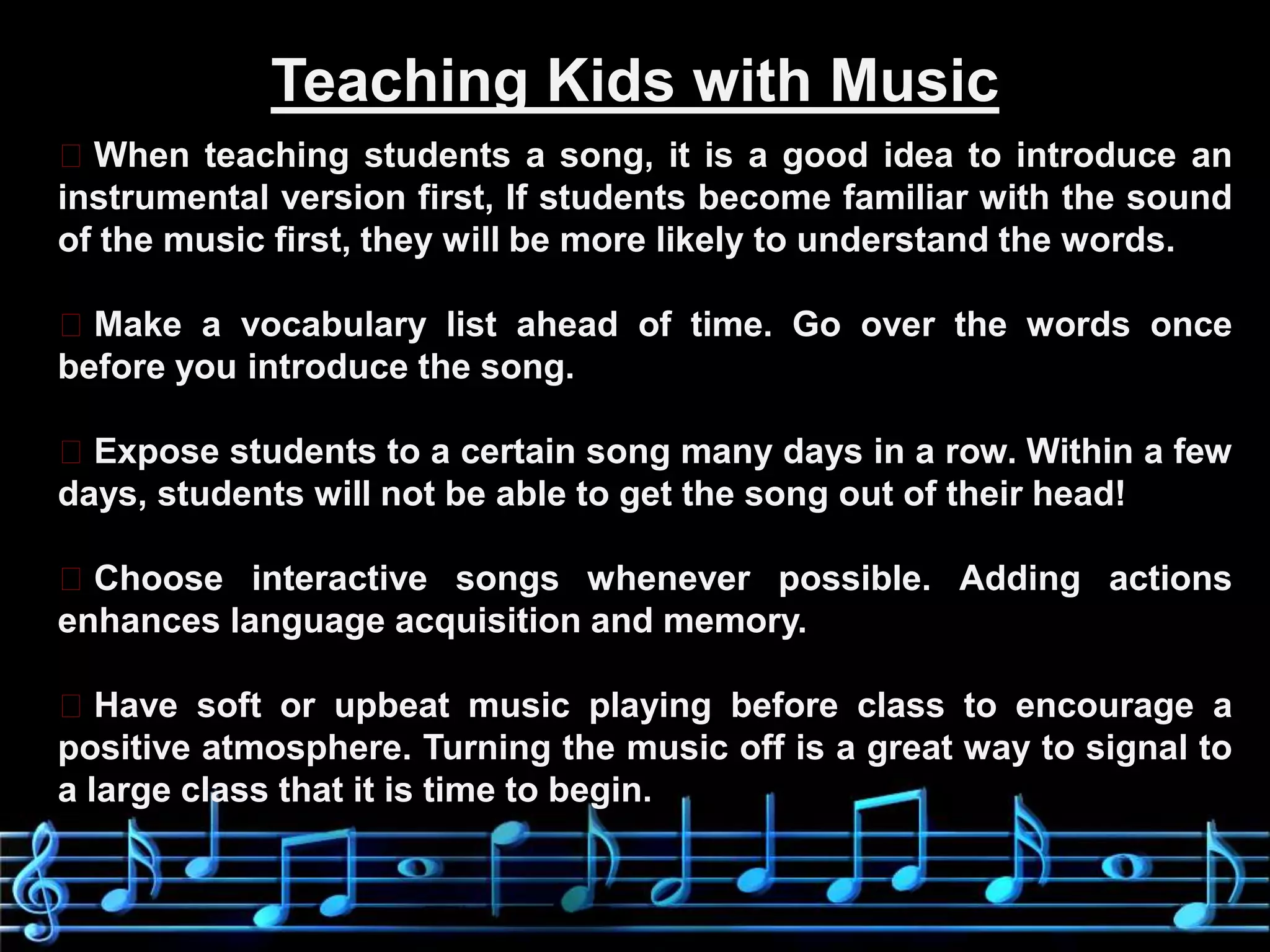
    Teaching Kids withMusic When teaching students a song, it is a good idea to introduce an instrumental version first, If students become familiar with the sound of the music first, they will be more likely to understand the words.
  • 25.
    Make avocabulary list ahead of time. Go over the words once before you introduce the song.
  • 26.
    Expose studentsto a certain song many days in a row. Within a few days, students will not be able to get the song out of their head!
  • 27.
    Choose interactivesongs whenever possible. Adding actions enhances language acquisition and memory.
  • 28.
    Have softor upbeat music playing before class to encourage a positive atmosphere. Turning the music off is a great way to signal to a large class that it is time to begin.Thank You…!!!