More Related Content


Similar to Some other Importent Question (Mix)


Some other Importent Question (Mix)
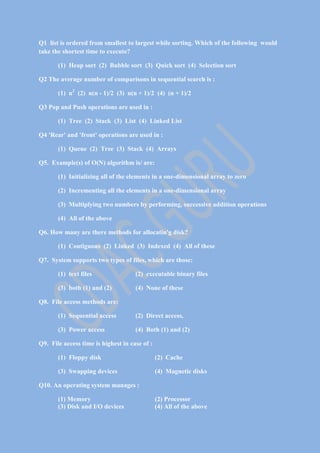
- 1. Q1 list isordered from smallest to largest while sorting. Which of the following would take the shortest time to execute? (1) Heap sort (2) Bubble sort (3) Quick sort (4) Selection sort Q2 The average number of comparisons in sequential search is : (1) n2 (2) n(n - 1)/2 (3) n(n + 1)/2 (4) (n + 1)/2 Q3 Pop and Push operations are used in : (1) Tree (2) Stack (3) List (4) Linked List Q4 'Rear' and 'front' operations are used in : (1) Queue (2) Tree (3) Stack (4) Arrays Q5. Example(s) of O(N) algorithm is/ are: (1) Initializing all of the elements in a one-dimensional array to zero (2) Incrementing all the elements in a one-dimensional array (3) Multiplying two numbers by performing, successive addition operations (4) All of the above Q6. How many are there methods for allocatin'g disk? (1) Contiguous (2) Linked (3) Indexed (4) All of these Q7. System supports two types of files, which are those: (1) text files (2) executable binary files (3) both (1) and (2) (4) None of these Q8. File access methods are: (1) Sequential access (2) Direct access, (3) Power access (4) Both (1) and (2) Q9. File access time is highest in case of : (1) Floppy disk (2) Cache (3) Swapping devices (4) Magnetic disks Q10. An operating system manages : (1) Memory (3) Disk and I/O devices (2) Processor (4) All of the above