OLD Question Set Of OOPS for CCAT
(previously known as CET)
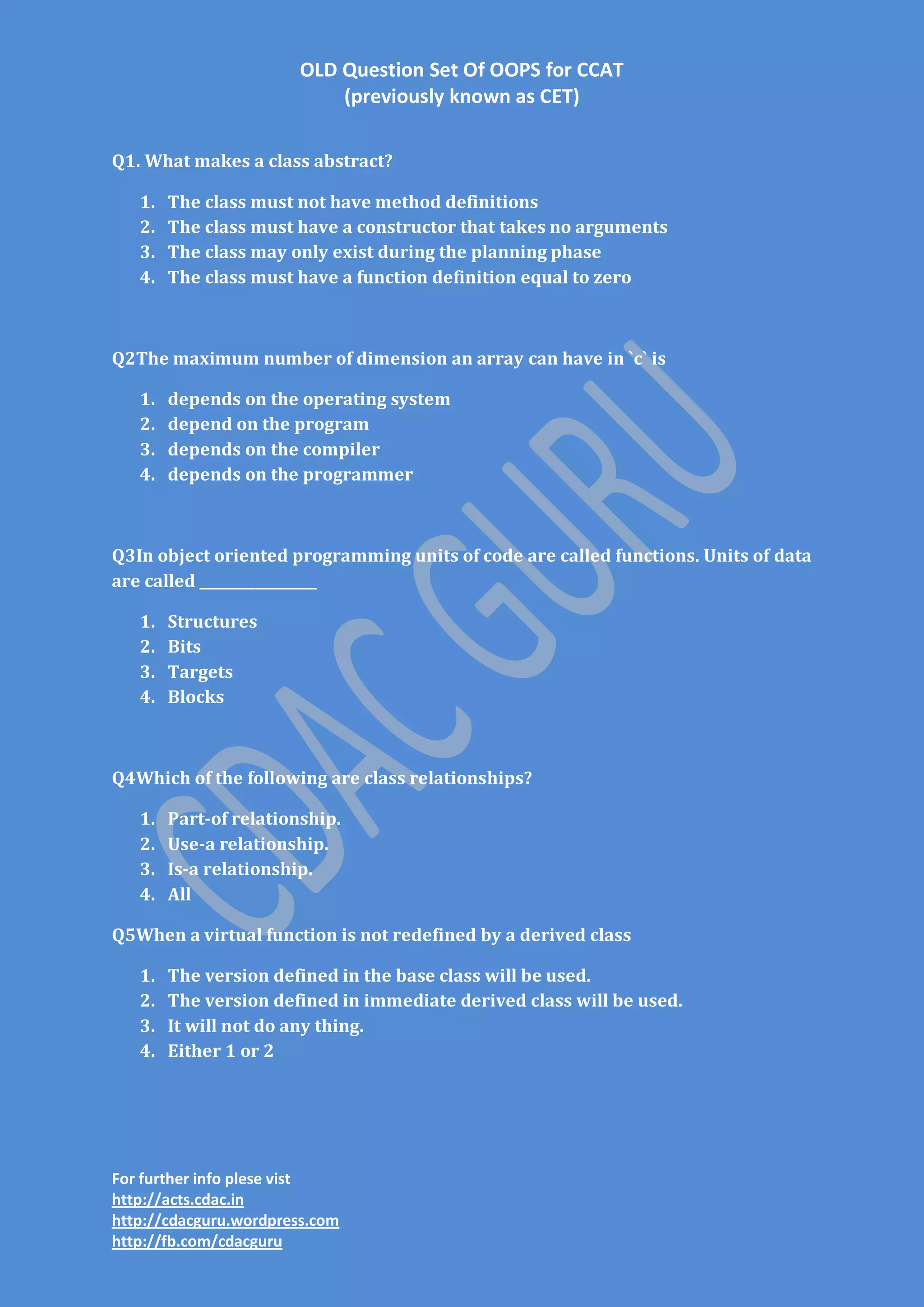
Q1. What makes a class abstract?
1.
2.
3.
4.

The class must not have method definitions
The class must have a constructor that takes no arguments
The class may only exist during the planning phase
The class must have a function definition equal to zero

Q2The maximum number of dimension an array can have in `c` is
1.
2.
3.
4.

depends on the operating system
depend on the program
depends on the compiler
depends on the programmer

Q3In object oriented programming units of code are called functions. Units of data
are called _________________
1.
2.
3.
4.

Structures
Bits
Targets
Blocks

Q4Which of the following are class relationships?
1.
2.
3.
4.

Part-of relationship.
Use-a relationship.
Is-a relationship.
All

Q5When a virtual function is not redefined by a derived class
1.
2.
3.
4.

The version defined in the base class will be used.
The version defined in immediate derived class will be used.
It will not do any thing.
Either 1 or 2

For further info plese vist
http://acts.cdac.in
http://cdacguru.wordpress.com
http://fb.com/cdacguru
OLD Question Set Of OOPS for CCAT
(previously known as CET)

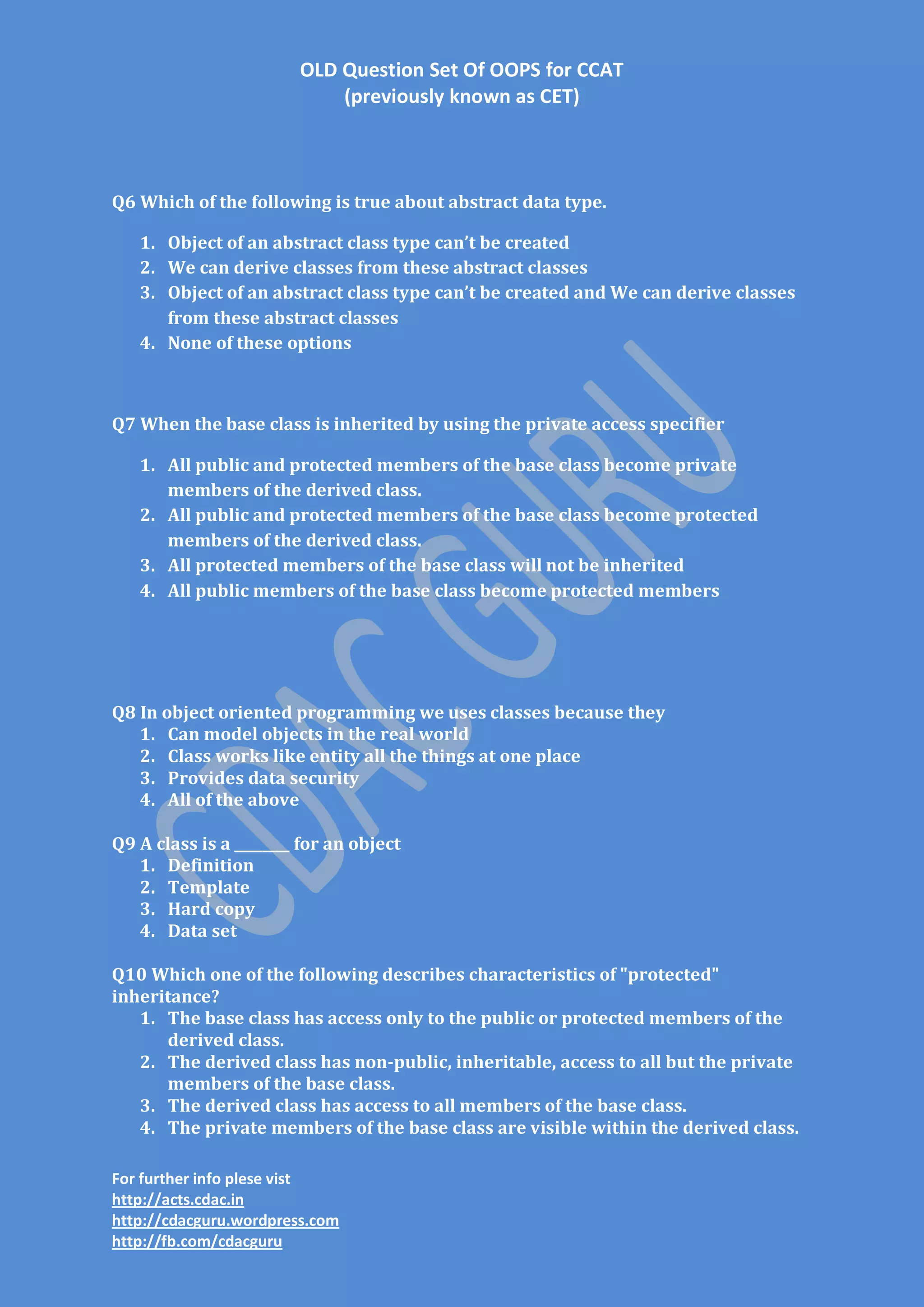
Q6 Which of the following is true about abstract data type.
1. Object of an abstract class type can’t be created
2. We can derive classes from these abstract classes
3. Object of an abstract class type can’t be created and We can derive classes
from these abstract classes
4. None of these options

Q7 When the base class is inherited by using the private access specifier
1. All public and protected members of the base class become private
members of the derived class.
2. All public and protected members of the base class become protected
members of the derived class.
3. All protected members of the base class will not be inherited
4. All public members of the base class become protected members

Q8 In object oriented programming we uses classes because they
1. Can model objects in the real world
2. Class works like entity all the things at one place
3. Provides data security
4. All of the above
Q9 A class is a ________ for an object
1. Definition
2. Template
3. Hard copy
4. Data set
Q10 Which one of the following describes characteristics of "protected"
inheritance?
1. The base class has access only to the public or protected members of the
derived class.
2. The derived class has non-public, inheritable, access to all but the private
members of the base class.
3. The derived class has access to all members of the base class.
4. The private members of the base class are visible within the derived class.
For further info plese vist
http://acts.cdac.in
http://cdacguru.wordpress.com
http://fb.com/cdacguru
OLD Question Set Of OOPS for CCAT
(previously known as CET)
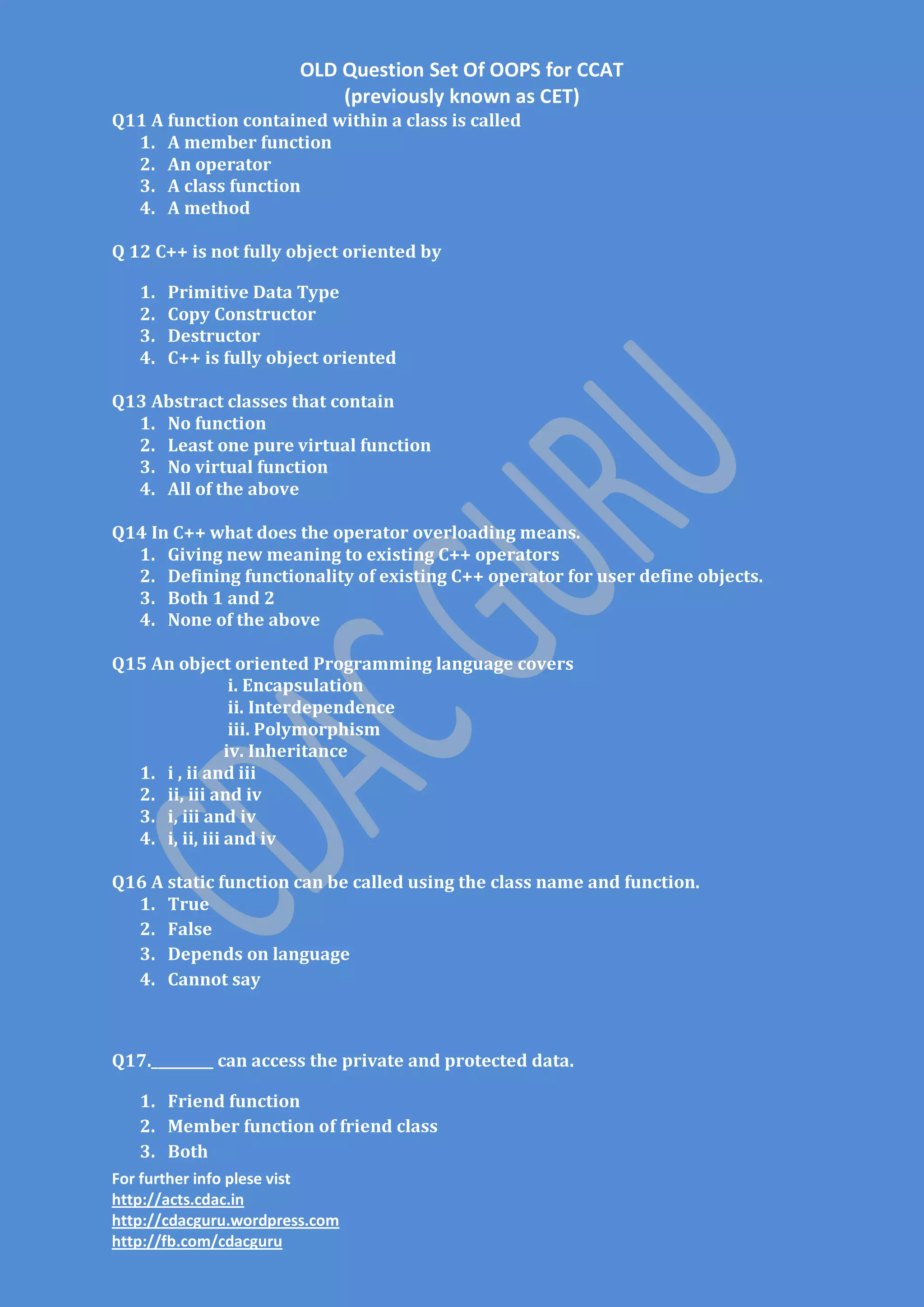
Q11 A function contained within a class is called
1. A member function
2. An operator
3. A class function
4. A method
Q 12 C++ is not fully object oriented by
1.
2.
3.
4.

Primitive Data Type
Copy Constructor
Destructor
C++ is fully object oriented

Q13 Abstract classes that contain
1. No function
2. Least one pure virtual function
3. No virtual function
4. All of the above
Q14 In C++ what does the operator overloading means.
1. Giving new meaning to existing C++ operators
2. Defining functionality of existing C++ operator for user define objects.
3. Both 1 and 2
4. None of the above
Q15 An object oriented Programming language covers
i. Encapsulation
ii. Interdependence
iii. Polymorphism
iv. Inheritance
1. i , ii and iii
2. ii, iii and iv
3. i, iii and iv
4. i, ii, iii and iv
Q16 A static function can be called using the class name and function.
1. True
2. False
3. Depends on language
4. Cannot say

Q17._________ can access the private and protected data.
1. Friend function
2. Member function of friend class
3. Both
For further info plese vist
http://acts.cdac.in
http://cdacguru.wordpress.com
http://fb.com/cdacguru
OLD Question Set Of OOPS for CCAT
(previously known as CET)
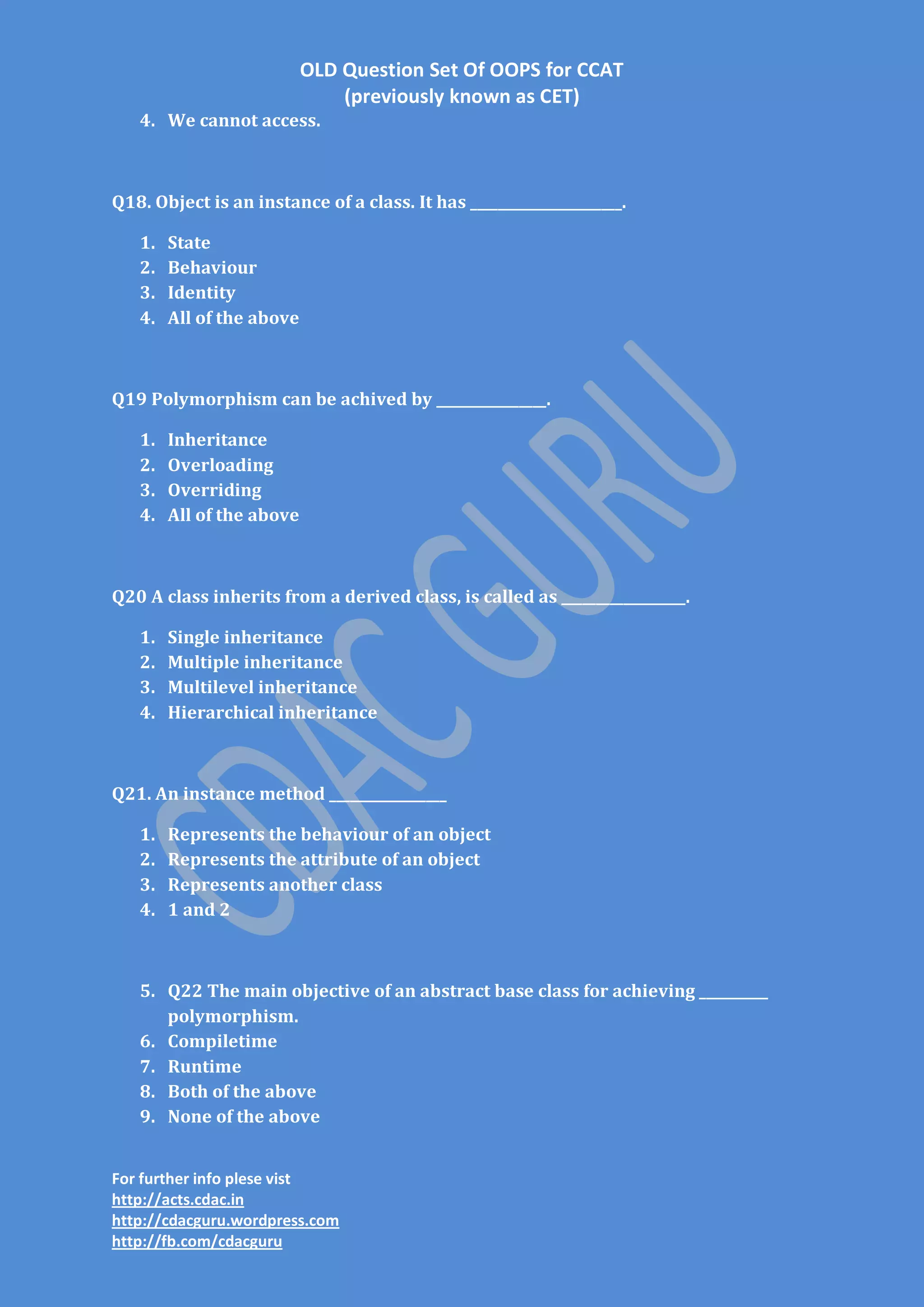
4. We cannot access.

Q18. Object is an instance of a class. It has ______________________.
1.
2.
3.
4.

State
Behaviour
Identity
All of the above

Q19 Polymorphism can be achived by ________________.
1.
2.
3.
4.

Inheritance
Overloading
Overriding
All of the above

Q20 A class inherits from a derived class, is called as __________________.
1.
2.
3.
4.

Single inheritance
Multiple inheritance
Multilevel inheritance
Hierarchical inheritance

Q21. An instance method _________________
1.
2.
3.
4.

Represents the behaviour of an object
Represents the attribute of an object
Represents another class
1 and 2

5. Q22 The main objective of an abstract base class for achieving __________
polymorphism.
6. Compiletime
7. Runtime
8. Both of the above
9. None of the above
For further info plese vist
http://acts.cdac.in
http://cdacguru.wordpress.com
http://fb.com/cdacguru
OLD Question Set Of OOPS for CCAT
(previously known as CET)
Q23.Operator overloading is ____________.
1.
2.
3.
4.

Making c++ operators works with objects
Giving new meaning to existing c++ operators
Making new c++ operator
Both 1 & 2

Q24 Parametric polymorphism is ______________.
1.
2.
3.
4.

Static binding
Dynamic binding.
Both 1 and 2
None of the abovee

Q25. In ___________, the constructor is executed in the order of inheritance.
1.
2.
3.
4.

Single inheritance
Multiple inheritance
Multilevel inheritance
Hierarchical inheritance

Q26.We can have virtual ___________ but not virtual __________.
1.
2.
3.
4.

Constructor, Destructor
Destructor, Constructor
Both can have virtual
None can have virtual

Q 27.______________ is a technique for minimizing interdependencies among modules
by defining a strict external interface.
1.
2.
3.
4.

Interface
Inheritance
Abstraction
Encapulation

For further info plese vist
http://acts.cdac.in
http://cdacguru.wordpress.com
http://fb.com/cdacguru

Oops Paper

  • 1.
    OLD Question SetOf OOPS for CCAT (previously known as CET) Q1. What makes a class abstract? 1. 2. 3. 4. The class must not have method definitions The class must have a constructor that takes no arguments The class may only exist during the planning phase The class must have a function definition equal to zero Q2The maximum number of dimension an array can have in `c` is 1. 2. 3. 4. depends on the operating system depend on the program depends on the compiler depends on the programmer Q3In object oriented programming units of code are called functions. Units of data are called _________________ 1. 2. 3. 4. Structures Bits Targets Blocks Q4Which of the following are class relationships? 1. 2. 3. 4. Part-of relationship. Use-a relationship. Is-a relationship. All Q5When a virtual function is not redefined by a derived class 1. 2. 3. 4. The version defined in the base class will be used. The version defined in immediate derived class will be used. It will not do any thing. Either 1 or 2 For further info plese vist http://acts.cdac.in http://cdacguru.wordpress.com http://fb.com/cdacguru
  • 2.
    OLD Question SetOf OOPS for CCAT (previously known as CET) Q6 Which of the following is true about abstract data type. 1. Object of an abstract class type can’t be created 2. We can derive classes from these abstract classes 3. Object of an abstract class type can’t be created and We can derive classes from these abstract classes 4. None of these options Q7 When the base class is inherited by using the private access specifier 1. All public and protected members of the base class become private members of the derived class. 2. All public and protected members of the base class become protected members of the derived class. 3. All protected members of the base class will not be inherited 4. All public members of the base class become protected members Q8 In object oriented programming we uses classes because they 1. Can model objects in the real world 2. Class works like entity all the things at one place 3. Provides data security 4. All of the above Q9 A class is a ________ for an object 1. Definition 2. Template 3. Hard copy 4. Data set Q10 Which one of the following describes characteristics of "protected" inheritance? 1. The base class has access only to the public or protected members of the derived class. 2. The derived class has non-public, inheritable, access to all but the private members of the base class. 3. The derived class has access to all members of the base class. 4. The private members of the base class are visible within the derived class. For further info plese vist http://acts.cdac.in http://cdacguru.wordpress.com http://fb.com/cdacguru
  • 3.
    OLD Question SetOf OOPS for CCAT (previously known as CET) Q11 A function contained within a class is called 1. A member function 2. An operator 3. A class function 4. A method Q 12 C++ is not fully object oriented by 1. 2. 3. 4. Primitive Data Type Copy Constructor Destructor C++ is fully object oriented Q13 Abstract classes that contain 1. No function 2. Least one pure virtual function 3. No virtual function 4. All of the above Q14 In C++ what does the operator overloading means. 1. Giving new meaning to existing C++ operators 2. Defining functionality of existing C++ operator for user define objects. 3. Both 1 and 2 4. None of the above Q15 An object oriented Programming language covers i. Encapsulation ii. Interdependence iii. Polymorphism iv. Inheritance 1. i , ii and iii 2. ii, iii and iv 3. i, iii and iv 4. i, ii, iii and iv Q16 A static function can be called using the class name and function. 1. True 2. False 3. Depends on language 4. Cannot say Q17._________ can access the private and protected data. 1. Friend function 2. Member function of friend class 3. Both For further info plese vist http://acts.cdac.in http://cdacguru.wordpress.com http://fb.com/cdacguru
  • 4.
    OLD Question SetOf OOPS for CCAT (previously known as CET) 4. We cannot access. Q18. Object is an instance of a class. It has ______________________. 1. 2. 3. 4. State Behaviour Identity All of the above Q19 Polymorphism can be achived by ________________. 1. 2. 3. 4. Inheritance Overloading Overriding All of the above Q20 A class inherits from a derived class, is called as __________________. 1. 2. 3. 4. Single inheritance Multiple inheritance Multilevel inheritance Hierarchical inheritance Q21. An instance method _________________ 1. 2. 3. 4. Represents the behaviour of an object Represents the attribute of an object Represents another class 1 and 2 5. Q22 The main objective of an abstract base class for achieving __________ polymorphism. 6. Compiletime 7. Runtime 8. Both of the above 9. None of the above For further info plese vist http://acts.cdac.in http://cdacguru.wordpress.com http://fb.com/cdacguru
  • 5.
    OLD Question SetOf OOPS for CCAT (previously known as CET) Q23.Operator overloading is ____________. 1. 2. 3. 4. Making c++ operators works with objects Giving new meaning to existing c++ operators Making new c++ operator Both 1 & 2 Q24 Parametric polymorphism is ______________. 1. 2. 3. 4. Static binding Dynamic binding. Both 1 and 2 None of the abovee Q25. In ___________, the constructor is executed in the order of inheritance. 1. 2. 3. 4. Single inheritance Multiple inheritance Multilevel inheritance Hierarchical inheritance Q26.We can have virtual ___________ but not virtual __________. 1. 2. 3. 4. Constructor, Destructor Destructor, Constructor Both can have virtual None can have virtual Q 27.______________ is a technique for minimizing interdependencies among modules by defining a strict external interface. 1. 2. 3. 4. Interface Inheritance Abstraction Encapulation For further info plese vist http://acts.cdac.in http://cdacguru.wordpress.com http://fb.com/cdacguru