Enough Mathematical Appetizers!
Let us look at something more interesting:

Algorithms

Fall 2002

CMSC 203 - Discrete

1
Algorithms
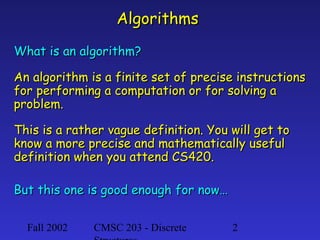
What is an algorithm?
An algorithm is a finite set of precise instructions
for performing a computation or for solving a
problem.
This is a rather vague definition. You will get to
know a more precise and mathematically useful
definition when you attend CS420.
But this one is good enough for now…
Fall 2002

CMSC 203 - Discrete

2
Algorithms
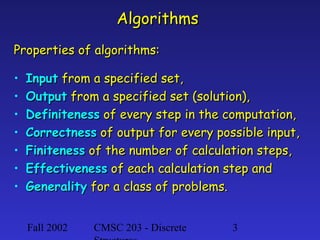
Properties of algorithms:
•
•
•
•
•
•
•

Input from a specified set,
Output from a specified set (solution),
Definiteness of every step in the computation,
Correctness of output for every possible input,
Finiteness of the number of calculation steps,
Effectiveness of each calculation step and
Generality for a class of problems.
Fall 2002

CMSC 203 - Discrete

3
Algorithm Examples
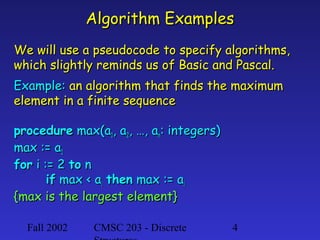
We will use a pseudocode to specify algorithms,
which slightly reminds us of Basic and Pascal.
Example: an algorithm that finds the maximum
element in a finite sequence
procedure max(a1, a2, …, an: integers)
max := a1
for i := 2 to n
if max < ai then max := ai
{max is the largest element}
Fall 2002

CMSC 203 - Discrete

4
Algorithm Examples
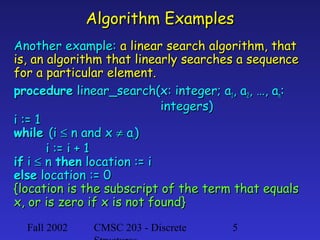
Another example: a linear search algorithm, that
is, an algorithm that linearly searches a sequence
for a particular element.
procedure linear_search(x: integer; a1, a2, …, an:
integers)
i := 1
while (i ≤ n and x ≠ ai)
i := i + 1
if i ≤ n then location := i
else location := 0
{location is the subscript of the term that equals
x, or is zero if x is not found}
Fall 2002

CMSC 203 - Discrete

5
Algorithm Examples
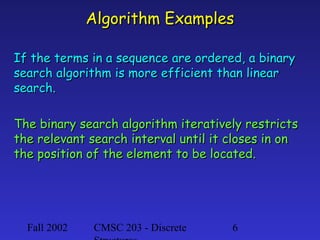
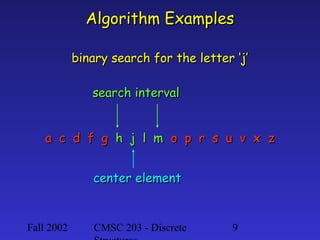
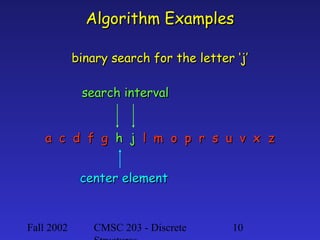
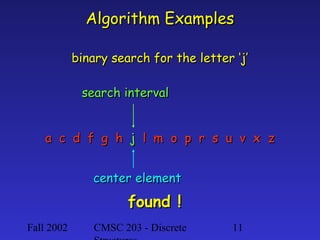
If the terms in a sequence are ordered, a binary
search algorithm is more efficient than linear
search.
The binary search algorithm iteratively restricts
the relevant search interval until it closes in on
the position of the element to be located.

Fall 2002

CMSC 203 - Discrete

6
Algorithm Examples
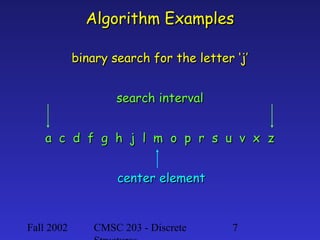
binary search for the letter ‘j’
search interval
a c d f g h j l m o p r s u v x z
center element

Fall 2002

CMSC 203 - Discrete

7
Algorithm Examples
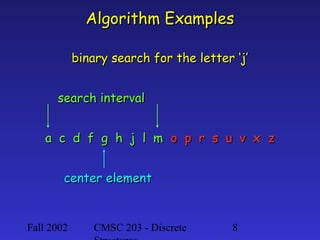
binary search for the letter ‘j’
search interval
a c d f g h j l m o p r s u v x z
center element

Fall 2002

CMSC 203 - Discrete

8
Algorithm Examples
binary search for the letter ‘j’
search interval
a c d f g h j l m o p r s u v x z
center element

Fall 2002

CMSC 203 - Discrete

9
Algorithm Examples
binary search for the letter ‘j’
search interval
a c d f g h j l m o p r s u v x z
center element

Fall 2002

CMSC 203 - Discrete

10
Algorithm Examples
binary search for the letter ‘j’
search interval
a c d f g h j l m o p r s u v x z
center element

found !
Fall 2002

CMSC 203 - Discrete

11
Algorithm Examples

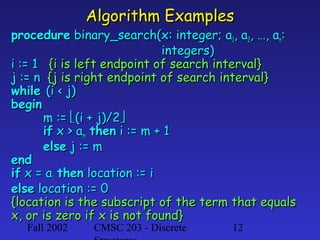
procedure binary_search(x: integer; a1, a2, …, an:
integers)
i := 1 {i is left endpoint of search interval}
j := n {j is right endpoint of search interval}
while (i < j)
begin
m := (i + j)/2
if x > am then i := m + 1
else j := m
end
if x = ai then location := i
else location := 0
{location is the subscript of the term that equals
x, or is zero if x is not found}
Fall 2002

CMSC 203 - Discrete

12
Complexity
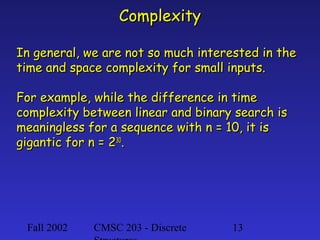
In general, we are not so much interested in the
time and space complexity for small inputs.
For example, while the difference in time
complexity between linear and binary search is
meaningless for a sequence with n = 10, it is
gigantic for n = 230.

Fall 2002

CMSC 203 - Discrete

13
Complexity
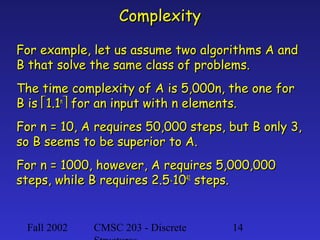
For example, let us assume two algorithms A and
B that solve the same class of problems.
The time complexity of A is 5,000n, the one for
B is 1.1n for an input with n elements.
For n = 10, A requires 50,000 steps, but B only 3,
so B seems to be superior to A.
For n = 1000, however, A requires 5,000,000
steps, while B requires 2.5⋅1041 steps.

Fall 2002

CMSC 203 - Discrete

14
Complexity
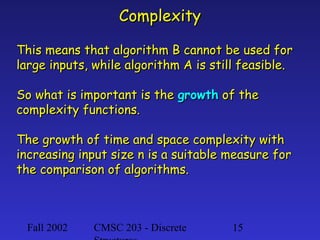
This means that algorithm B cannot be used for
large inputs, while algorithm A is still feasible.
So what is important is the growth of the
complexity functions.
The growth of time and space complexity with
increasing input size n is a suitable measure for
the comparison of algorithms.

Fall 2002

CMSC 203 - Discrete

15
Complexity
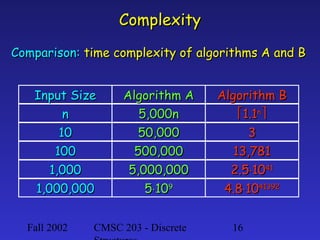
Comparison: time complexity of algorithms A and B
Input Size
n
10
100
1,000
1,000,000
Fall 2002

Algorithm A
5,000n
50,000
500,000
5,000,000
5⋅109

CMSC 203 - Discrete

Algorithm B
1.1n
3
13,781
2.5⋅1041
4.8⋅1041392
16
Complexity
This means that algorithm B cannot be used for
large inputs, while running algorithm A is still
feasible.
So what is important is the growth of the
complexity functions.
The growth of time and space complexity with
increasing input size n is a suitable measure for
the comparison of algorithms.
Fall 2002

CMSC 203 - Discrete

17
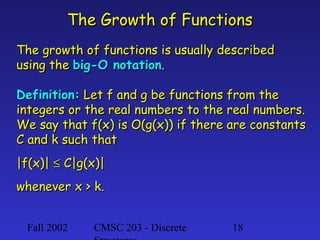
The Growth of Functions
The growth of functions is usually described
using the big-O notation.
Definition: Let f and g be functions from the
integers or the real numbers to the real numbers.
We say that f(x) is O(g(x)) if there are constants
C and k such that
|f(x)| ≤ C|g(x)|
whenever x > k.
Fall 2002

CMSC 203 - Discrete

18
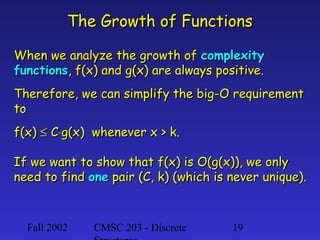
The Growth of Functions
When we analyze the growth of complexity
functions, f(x) and g(x) are always positive.
Therefore, we can simplify the big-O requirement
to
f(x) ≤ C⋅g(x) whenever x > k.
If we want to show that f(x) is O(g(x)), we only
need to find one pair (C, k) (which is never unique).

Fall 2002

CMSC 203 - Discrete

19
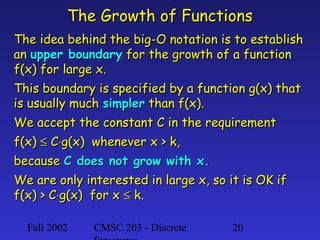
The Growth of Functions
The idea behind the big-O notation is to establish
an upper boundary for the growth of a function
f(x) for large x.
This boundary is specified by a function g(x) that
is usually much simpler than f(x).
We accept the constant C in the requirement
f(x) ≤ C⋅g(x) whenever x > k,
because C does not grow with x.
We are only interested in large x, so it is OK if
f(x) > C⋅g(x) for x ≤ k.
Fall 2002

CMSC 203 - Discrete

20
The Growth of Functions
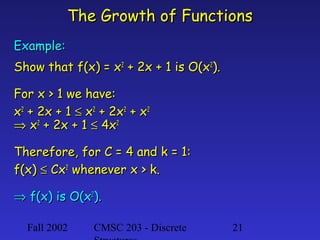
Example:
Show that f(x) = x2 + 2x + 1 is O(x2).
For x > 1 we have:
x2 + 2x + 1 ≤ x2 + 2x2 + x2
⇒ x2 + 2x + 1 ≤ 4x2
Therefore, for C = 4 and k = 1:
f(x) ≤ Cx2 whenever x > k.
⇒ f(x) is O(x2).
Fall 2002

CMSC 203 - Discrete

21
The Growth of Functions
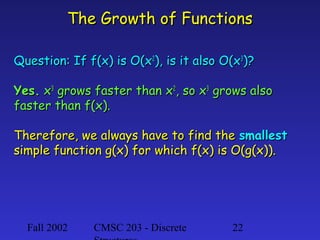
Question: If f(x) is O(x2), is it also O(x3)?
Yes. x3 grows faster than x2, so x3 grows also
faster than f(x).
Therefore, we always have to find the smallest
simple function g(x) for which f(x) is O(g(x)).

Fall 2002

CMSC 203 - Discrete

22
The Growth of Functions
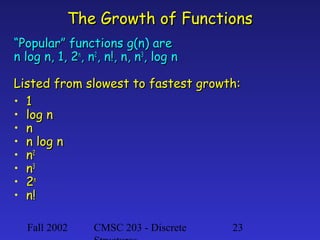
“Popular” functions g(n) are
n log n, 1, 2n, n2, n!, n, n3, log n
Listed from slowest to fastest growth:
• 1
• log n
• n
• n log n
• n2
• n3
• 2n
• n!
Fall 2002

CMSC 203 - Discrete

23
The Growth of Functions
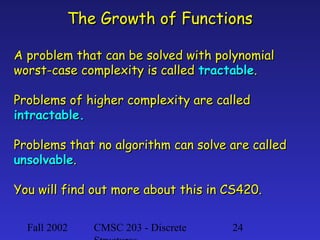
A problem that can be solved with polynomial
worst-case complexity is called tractable.
Problems of higher complexity are called
intractable.
Problems that no algorithm can solve are called
unsolvable.
You will find out more about this in CS420.
Fall 2002

CMSC 203 - Discrete

24
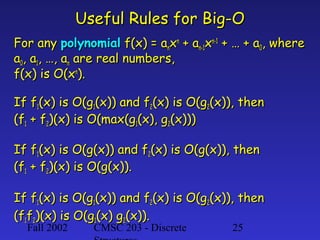
Useful Rules for Big-O
For any polynomial f(x) = anxn + an-1xn-1 + … + a0, where
a0, a1, …, an are real numbers,
f(x) is O(xn).
If f1(x) is O(g1(x)) and f2(x) is O(g2(x)), then
(f1 + f2)(x) is O(max(g1(x), g2(x)))
If f1(x) is O(g(x)) and f2(x) is O(g(x)), then
(f1 + f2)(x) is O(g(x)).
If f1(x) is O(g1(x)) and f2(x) is O(g2(x)), then
(f1f2)(x) is O(g1(x) g2(x)).
Fall 2002

CMSC 203 - Discrete

25
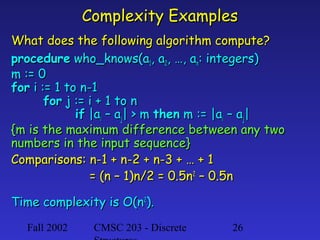
Complexity Examples
What does the following algorithm compute?
procedure who_knows(a1, a2, …, an: integers)
m := 0
for i := 1 to n-1
for j := i + 1 to n
if |ai – aj| > m then m := |ai – aj|
{m is the maximum difference between any two
numbers in the input sequence}
Comparisons: n-1 + n-2 + n-3 + … + 1
= (n – 1)n/2 = 0.5n2 – 0.5n
Time complexity is O(n2).
Fall 2002

CMSC 203 - Discrete

26
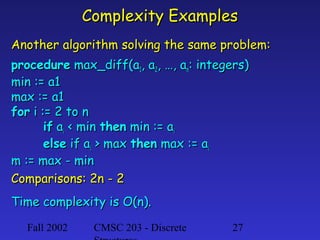
Complexity Examples
Another algorithm solving the same problem:
procedure max_diff(a1, a2, …, an: integers)
min := a1
max := a1
for i := 2 to n
if ai < min then min := ai
else if ai > max then max := ai
m := max - min
Comparisons: 2n - 2
Time complexity is O(n).
Fall 2002

CMSC 203 - Discrete

27

Big oh Representation Used in Time complexities

  • 1.
    Enough Mathematical Appetizers! Letus look at something more interesting: Algorithms Fall 2002 CMSC 203 - Discrete 1
  • 2.
    Algorithms What is analgorithm? An algorithm is a finite set of precise instructions for performing a computation or for solving a problem. This is a rather vague definition. You will get to know a more precise and mathematically useful definition when you attend CS420. But this one is good enough for now… Fall 2002 CMSC 203 - Discrete 2
  • 3.
    Algorithms Properties of algorithms: • • • • • • • Inputfrom a specified set, Output from a specified set (solution), Definiteness of every step in the computation, Correctness of output for every possible input, Finiteness of the number of calculation steps, Effectiveness of each calculation step and Generality for a class of problems. Fall 2002 CMSC 203 - Discrete 3
  • 4.
    Algorithm Examples We willuse a pseudocode to specify algorithms, which slightly reminds us of Basic and Pascal. Example: an algorithm that finds the maximum element in a finite sequence procedure max(a1, a2, …, an: integers) max := a1 for i := 2 to n if max < ai then max := ai {max is the largest element} Fall 2002 CMSC 203 - Discrete 4
  • 5.
    Algorithm Examples Another example:a linear search algorithm, that is, an algorithm that linearly searches a sequence for a particular element. procedure linear_search(x: integer; a1, a2, …, an: integers) i := 1 while (i ≤ n and x ≠ ai) i := i + 1 if i ≤ n then location := i else location := 0 {location is the subscript of the term that equals x, or is zero if x is not found} Fall 2002 CMSC 203 - Discrete 5
  • 6.
    Algorithm Examples If theterms in a sequence are ordered, a binary search algorithm is more efficient than linear search. The binary search algorithm iteratively restricts the relevant search interval until it closes in on the position of the element to be located. Fall 2002 CMSC 203 - Discrete 6
  • 7.
    Algorithm Examples binary searchfor the letter ‘j’ search interval a c d f g h j l m o p r s u v x z center element Fall 2002 CMSC 203 - Discrete 7
  • 8.
    Algorithm Examples binary searchfor the letter ‘j’ search interval a c d f g h j l m o p r s u v x z center element Fall 2002 CMSC 203 - Discrete 8
  • 9.
    Algorithm Examples binary searchfor the letter ‘j’ search interval a c d f g h j l m o p r s u v x z center element Fall 2002 CMSC 203 - Discrete 9
  • 10.
    Algorithm Examples binary searchfor the letter ‘j’ search interval a c d f g h j l m o p r s u v x z center element Fall 2002 CMSC 203 - Discrete 10
  • 11.
    Algorithm Examples binary searchfor the letter ‘j’ search interval a c d f g h j l m o p r s u v x z center element found ! Fall 2002 CMSC 203 - Discrete 11
  • 12.
    Algorithm Examples procedure binary_search(x:integer; a1, a2, …, an: integers) i := 1 {i is left endpoint of search interval} j := n {j is right endpoint of search interval} while (i < j) begin m := (i + j)/2 if x > am then i := m + 1 else j := m end if x = ai then location := i else location := 0 {location is the subscript of the term that equals x, or is zero if x is not found} Fall 2002 CMSC 203 - Discrete 12
  • 13.
    Complexity In general, weare not so much interested in the time and space complexity for small inputs. For example, while the difference in time complexity between linear and binary search is meaningless for a sequence with n = 10, it is gigantic for n = 230. Fall 2002 CMSC 203 - Discrete 13
  • 14.
    Complexity For example, letus assume two algorithms A and B that solve the same class of problems. The time complexity of A is 5,000n, the one for B is 1.1n for an input with n elements. For n = 10, A requires 50,000 steps, but B only 3, so B seems to be superior to A. For n = 1000, however, A requires 5,000,000 steps, while B requires 2.5⋅1041 steps. Fall 2002 CMSC 203 - Discrete 14
  • 15.
    Complexity This means thatalgorithm B cannot be used for large inputs, while algorithm A is still feasible. So what is important is the growth of the complexity functions. The growth of time and space complexity with increasing input size n is a suitable measure for the comparison of algorithms. Fall 2002 CMSC 203 - Discrete 15
  • 16.
    Complexity Comparison: time complexityof algorithms A and B Input Size n 10 100 1,000 1,000,000 Fall 2002 Algorithm A 5,000n 50,000 500,000 5,000,000 5⋅109 CMSC 203 - Discrete Algorithm B 1.1n 3 13,781 2.5⋅1041 4.8⋅1041392 16
  • 17.
    Complexity This means thatalgorithm B cannot be used for large inputs, while running algorithm A is still feasible. So what is important is the growth of the complexity functions. The growth of time and space complexity with increasing input size n is a suitable measure for the comparison of algorithms. Fall 2002 CMSC 203 - Discrete 17
  • 18.
    The Growth ofFunctions The growth of functions is usually described using the big-O notation. Definition: Let f and g be functions from the integers or the real numbers to the real numbers. We say that f(x) is O(g(x)) if there are constants C and k such that |f(x)| ≤ C|g(x)| whenever x > k. Fall 2002 CMSC 203 - Discrete 18
  • 19.
    The Growth ofFunctions When we analyze the growth of complexity functions, f(x) and g(x) are always positive. Therefore, we can simplify the big-O requirement to f(x) ≤ C⋅g(x) whenever x > k. If we want to show that f(x) is O(g(x)), we only need to find one pair (C, k) (which is never unique). Fall 2002 CMSC 203 - Discrete 19
  • 20.
    The Growth ofFunctions The idea behind the big-O notation is to establish an upper boundary for the growth of a function f(x) for large x. This boundary is specified by a function g(x) that is usually much simpler than f(x). We accept the constant C in the requirement f(x) ≤ C⋅g(x) whenever x > k, because C does not grow with x. We are only interested in large x, so it is OK if f(x) > C⋅g(x) for x ≤ k. Fall 2002 CMSC 203 - Discrete 20
  • 21.
    The Growth ofFunctions Example: Show that f(x) = x2 + 2x + 1 is O(x2). For x > 1 we have: x2 + 2x + 1 ≤ x2 + 2x2 + x2 ⇒ x2 + 2x + 1 ≤ 4x2 Therefore, for C = 4 and k = 1: f(x) ≤ Cx2 whenever x > k. ⇒ f(x) is O(x2). Fall 2002 CMSC 203 - Discrete 21
  • 22.
    The Growth ofFunctions Question: If f(x) is O(x2), is it also O(x3)? Yes. x3 grows faster than x2, so x3 grows also faster than f(x). Therefore, we always have to find the smallest simple function g(x) for which f(x) is O(g(x)). Fall 2002 CMSC 203 - Discrete 22
  • 23.
    The Growth ofFunctions “Popular” functions g(n) are n log n, 1, 2n, n2, n!, n, n3, log n Listed from slowest to fastest growth: • 1 • log n • n • n log n • n2 • n3 • 2n • n! Fall 2002 CMSC 203 - Discrete 23
  • 24.
    The Growth ofFunctions A problem that can be solved with polynomial worst-case complexity is called tractable. Problems of higher complexity are called intractable. Problems that no algorithm can solve are called unsolvable. You will find out more about this in CS420. Fall 2002 CMSC 203 - Discrete 24
  • 25.
    Useful Rules forBig-O For any polynomial f(x) = anxn + an-1xn-1 + … + a0, where a0, a1, …, an are real numbers, f(x) is O(xn). If f1(x) is O(g1(x)) and f2(x) is O(g2(x)), then (f1 + f2)(x) is O(max(g1(x), g2(x))) If f1(x) is O(g(x)) and f2(x) is O(g(x)), then (f1 + f2)(x) is O(g(x)). If f1(x) is O(g1(x)) and f2(x) is O(g2(x)), then (f1f2)(x) is O(g1(x) g2(x)). Fall 2002 CMSC 203 - Discrete 25
  • 26.
    Complexity Examples What doesthe following algorithm compute? procedure who_knows(a1, a2, …, an: integers) m := 0 for i := 1 to n-1 for j := i + 1 to n if |ai – aj| > m then m := |ai – aj| {m is the maximum difference between any two numbers in the input sequence} Comparisons: n-1 + n-2 + n-3 + … + 1 = (n – 1)n/2 = 0.5n2 – 0.5n Time complexity is O(n2). Fall 2002 CMSC 203 - Discrete 26
  • 27.
    Complexity Examples Another algorithmsolving the same problem: procedure max_diff(a1, a2, …, an: integers) min := a1 max := a1 for i := 2 to n if ai < min then min := ai else if ai > max then max := ai m := max - min Comparisons: 2n - 2 Time complexity is O(n). Fall 2002 CMSC 203 - Discrete 27