Some Dimensionless Numbers in Heat Transfer
         Reynolds Number
         Nusselt Number
         Stanton Number
         Peclet Number
         Prantdl Number

Reynolds Number
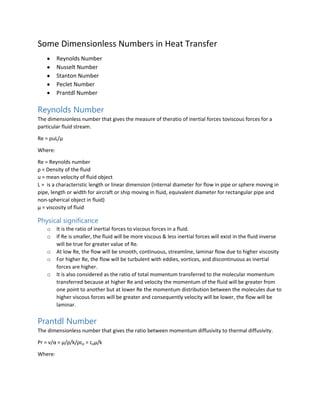
The dimensionless number that gives the measure of theratio of inertial forces toviscous forces for a
particular fluid stream.

Re = ρuL/µ

Where:

Re = Reynolds number
ρ = Density of the fluid
u = mean velocity of fluid object
L = is a characteristic length or linear dimension (internal diameter for flow in pipe or sphere moving in
pipe, length or width for aircraft or ship moving in fluid, equivalent diameter for rectangular pipe and
non-spherical object in fluid)
µ = viscosity of fluid

Physical significance
    o    It is the ratio of inertial forces to viscous forces in a fluid.
    o    If Re is smaller, the fluid will be more viscous & less inertial forces will exist in the fluid inverse
         will be true for greater value of Re.
    o    At low Re, the flow will be smooth, continuous, streamline, laminar flow due to higher viscosity
    o    For higher Re, the flow will be turbulent with eddies, vortices, and discontinuous as inertial
         forces are higher.
    o    It is also considered as the ratio of total momentum transferred to the molecular momentum
         transferred because at higher Re and velocity the momentum of the fluid will be greater from
         one point to another but at lower Re the momentum distribution between the molecules due to
         higher viscous forces will be greater and consequently velocity will be lower, the flow will be
         laminar.


Prantdl Number
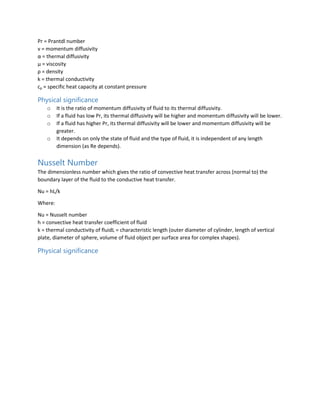
The dimensionless number that gives the ratio between momentum diffusivity to thermal diffusivity.

Pr = ν/α = μ/ρ/k/ρcp = cpµ/k

Where:
Pr = Prantdl number
ν = momentum diffusivity
α = thermal diffusivity
µ = viscosity
ρ = density
k = thermal conductivity
cp = specific heat capacity at constant pressure

Physical significance
    o    It is the ratio of momentum diffusivity of fluid to its thermal diffusivity.
    o    If a fluid has low Pr, its thermal diffusivity will be higher and momentum diffusivity will be lower.
    o    If a fluid has higher Pr, its thermal diffusivity will be lower and momentum diffusivity will be
         greater.
    o    It depends on only the state of fluid and the type of fluid, it is independent of any length
         dimension (as Re depends).


Nusselt Number
The dimensionless number which gives the ratio of convective heat transfer across (normal to) the
boundary layer of the fluid to the conductive heat transfer.

Nu = hL/k

Where:

Nu = Nusselt number
h = convective heat transfer coefficient of fluid
k = thermal conductivity of fluidL = characteristic length (outer diameter of cylinder, length of vertical
plate, diameter of sphere, volume of fluid object per surface area for complex shapes).

Physical significance
Some dimensionless numbers in heat transfer

Some dimensionless numbers in heat transfer

  • 1.
    Some Dimensionless Numbersin Heat Transfer Reynolds Number Nusselt Number Stanton Number Peclet Number Prantdl Number Reynolds Number The dimensionless number that gives the measure of theratio of inertial forces toviscous forces for a particular fluid stream. Re = ρuL/µ Where: Re = Reynolds number ρ = Density of the fluid u = mean velocity of fluid object L = is a characteristic length or linear dimension (internal diameter for flow in pipe or sphere moving in pipe, length or width for aircraft or ship moving in fluid, equivalent diameter for rectangular pipe and non-spherical object in fluid) µ = viscosity of fluid Physical significance o It is the ratio of inertial forces to viscous forces in a fluid. o If Re is smaller, the fluid will be more viscous & less inertial forces will exist in the fluid inverse will be true for greater value of Re. o At low Re, the flow will be smooth, continuous, streamline, laminar flow due to higher viscosity o For higher Re, the flow will be turbulent with eddies, vortices, and discontinuous as inertial forces are higher. o It is also considered as the ratio of total momentum transferred to the molecular momentum transferred because at higher Re and velocity the momentum of the fluid will be greater from one point to another but at lower Re the momentum distribution between the molecules due to higher viscous forces will be greater and consequently velocity will be lower, the flow will be laminar. Prantdl Number The dimensionless number that gives the ratio between momentum diffusivity to thermal diffusivity. Pr = ν/α = μ/ρ/k/ρcp = cpµ/k Where:
  • 2.
    Pr = Prantdlnumber ν = momentum diffusivity α = thermal diffusivity µ = viscosity ρ = density k = thermal conductivity cp = specific heat capacity at constant pressure Physical significance o It is the ratio of momentum diffusivity of fluid to its thermal diffusivity. o If a fluid has low Pr, its thermal diffusivity will be higher and momentum diffusivity will be lower. o If a fluid has higher Pr, its thermal diffusivity will be lower and momentum diffusivity will be greater. o It depends on only the state of fluid and the type of fluid, it is independent of any length dimension (as Re depends). Nusselt Number The dimensionless number which gives the ratio of convective heat transfer across (normal to) the boundary layer of the fluid to the conductive heat transfer. Nu = hL/k Where: Nu = Nusselt number h = convective heat transfer coefficient of fluid k = thermal conductivity of fluidL = characteristic length (outer diameter of cylinder, length of vertical plate, diameter of sphere, volume of fluid object per surface area for complex shapes). Physical significance